

Co-Investing Alongside UAE Developers: A Structuring Guide for Family Offices
Explains how family offices can co-invest with developers on aligned terms.
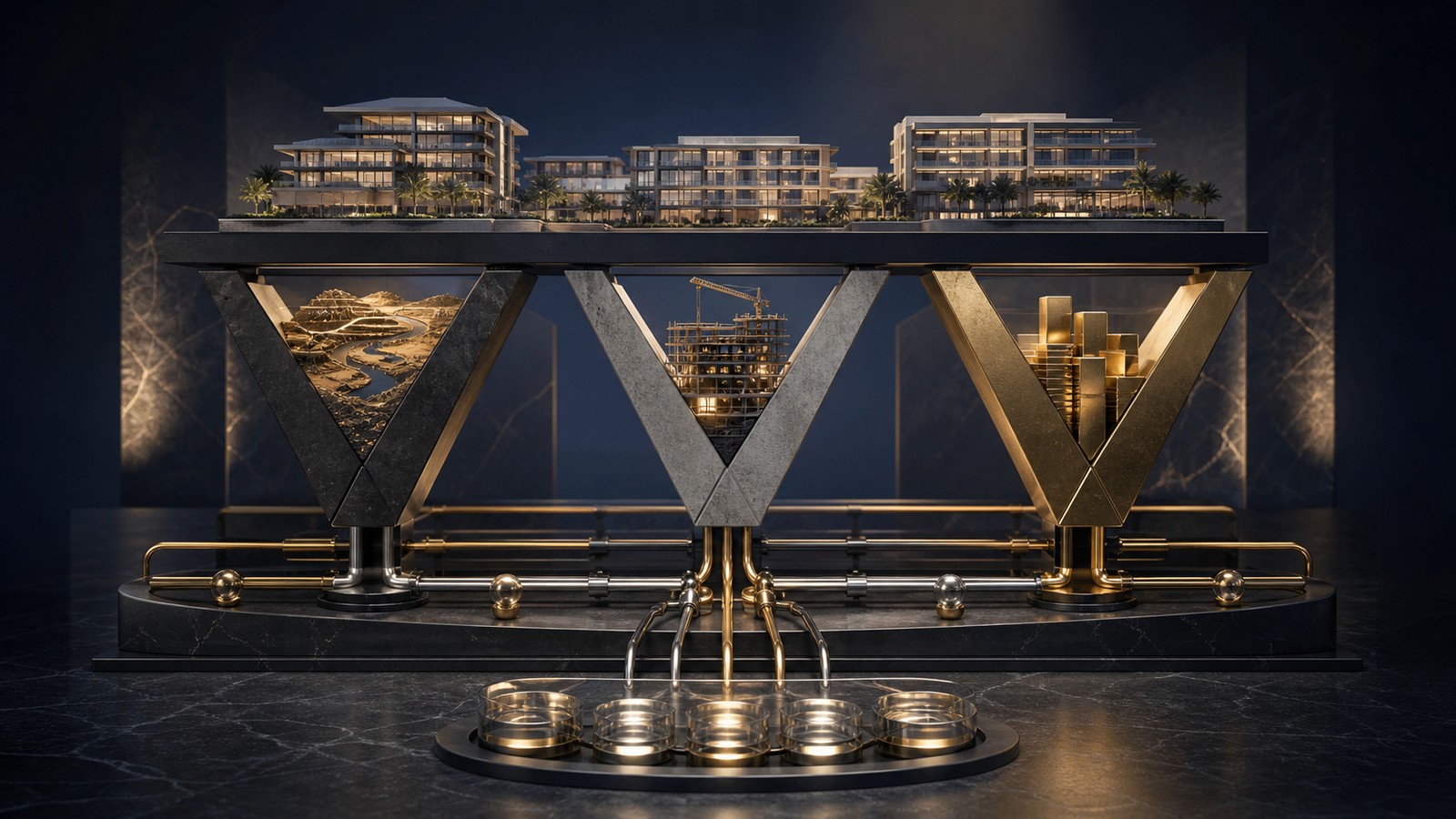
Family offices in the Gulf and beyond increasingly want exposure to United Arab Emirates real estate, but they are rightly wary of two extremes. Funding a developer through a blind-pool fund cedes control and adds a layer of fees, while building a development capability in-house demands expertise and a deal flow that most single-family offices do not possess.
Family offices in the Gulf and beyond increasingly want exposure to United Arab Emirates real estate, but they are rightly wary of two extremes. Funding a developer through a blind-pool fund cedes control and adds a layer of fees, while building a development capability in-house demands expertise and a deal flow that most single-family offices do not possess. Direct co-investment alongside an established developer sits between these poles, and it has become one of the most requested structures in the region. This paper sets out a practitioner's framework for doing it well. It treats the co-investment not as a single negotiation but as a structure whose components, the holding vehicle, the distribution waterfall, the governance rights and the exit mechanics, must be assembled so that the developer and the family office want the same outcomes. The paper presents an illustrative co-investment structure, a four-tier distribution waterfall, an alignment checklist and a set of sensitivity figures that show how net returns respond to the promote, the hurdle and the governance terms. It then offers a staged execution roadmap from sourcing to monitoring. The argument throughout is that alignment is engineered, not assumed: the terms that protect a minority co-investor are the same terms that make a good developer comfortable, because both depend on a structure in which reward follows performance. Nothing in this paper is investment advice, and all figures are illustrative. JEL Classification: G11, G23, G32, R33, L85 Keywords: co-investment, family offices, real estate development, United Arab Emirates, GCC, distribution waterfall, alignment of interests, joint ventures, private real estate
This MP Insight presents the web edition of Matchpoint Partners' research. The supporting paper contains the full framework, structures, worked examples and source material.
Read the full research paper Explore our Real Estate Finance practice
Introduction
A family office that has decided it wants more United Arab Emirates real estate in its portfolio faces a question that is less about which asset to back than about how to hold it. The choice of vehicle, the choice of partner and the choice of terms will do more to determine the eventual return than the choice of building. This is the part of the decision that families most often underweight. They spend their diligence on the location, the developer's track record and the projected yield, and then accept a structure drafted by the developer's counsel without asking whether it aligns the two sides or merely transfers risk to the party with the smaller cheque.
Direct co-investment alongside a developer has become the structure of choice for families that want this exposure. It avoids the fee drag and the loss of control that come with committing to a blind-pool fund, and it avoids the expertise gap and the concentration that come with developing alone. It lets a family put capital next to a sponsor who sources, builds and manages, while keeping a defined set of rights and a defined share of the upside. In the United Arab Emirates, where the development market is deep, where the largest developers are well capitalised and where the legal venues at the Dubai International Financial Centre and the Abu Dhabi Global Market support sophisticated joint-venture structures, the conditions for good co-investment are unusually favourable. The structure is only as good as its terms, however, and the terms are where families most often give away value.
This paper supplies a structuring framework for the family office that wants to co-invest well. It is written for the principal, the family-office chief investment officer and the adviser who must turn a relationship with a developer into a defensible structure. It treats co-investment as an exercise in engineering alignment: the work is to build a vehicle, a waterfall and a set of rights in which the developer earns most when the co-investor earns most, and in which neither party can prosper at the expense of the other. The paper sets out each component, shows how the components interact and distils the analysis into a checklist and an execution roadmap.
Three caveats frame the analysis. First, this is a structuring and orientation document, not investment, legal or tax advice, and nothing in it is a recommendation to enter any transaction or to use any particular structure. Second, every figure and table is illustrative. The waterfalls, the return sensitivities and the scores are stylised to make the mechanics legible; they are not forecasts, benchmarks or sourced market data, and they should not be read as such. Third, any co-investment in the United Arab Emirates requires qualified local legal, tax and regulatory advice, because the structuring choices that matter most, the vehicle, the security and the enforcement path, turn on facts and on advice specific to the deal.
The Structuring Framework
This section presents the framework in the order of the propositions. It first sets out the structure and the vehicle, then the distribution waterfall, then the alignment and governance terms, and finally the exit. Throughout, the figures are illustrative and exist to show how the mechanics behave, not to forecast any outcome.
The Structure and the Vehicle
The first decision is the vehicle. In almost every developer co-investment, the asset is held in a special-purpose vehicle, a company or a limited partnership, into which the family office and the developer contribute equity and which carries any project-level debt. Holding the asset in a dedicated vehicle ring-fences it from the other activities of both parties, gives the co-investor a clean claim on a defined asset rather than an exposure to the developer's balance sheet, and provides the framework within which governance and distributions are defined. The vehicle is established in a jurisdiction chosen for legal certainty and for the enforceability of the parties' rights, which in the United Arab Emirates often means a common-law venue such as the Dubai International Financial Centre or the Abu Dhabi Global Market, or an onshore structure where the asset and the regulatory position require it. The choice is a matter for local advice and turns on the asset, the financing and the tax position of the parties.
The contributions to the vehicle define the starting alignment. The family office contributes capital and takes a minority equity stake. The developer contributes capital as well, its co-investment, and its development expertise, its team and its pipeline, and in exchange earns a management role and a promote on the upside. The single most important feature of the structure, before any waterfall is drawn, is that the developer has its own capital in the deal. A developer that contributes nothing and earns only fees and a promote is not aligned with the co-investor; a developer that stands to lose its own money if the project fails is. Figure 1 sets out the typical shape: two capital providers, a governing agreement and a vehicle that holds the asset.
A feature that distinguishes the United Arab Emirates from many development markets, and that shapes the structure, is the strength and capitalisation of the largest developers. Where a co-investor partners with a well-capitalised sponsor, the sponsor's own balance sheet and reputation provide a layer of comfort that a thinly capitalised operator cannot. This does not remove the need for alignment terms, but it changes their emphasis: with a strong sponsor the co-investor's concern is less the sponsor's solvency than the fairness of the split and the protection of its minority position.
4.1a Choosing the Vehicle and the Venue
The vehicle and the venue are structural decisions that shape every right the co-investor will later rely on, and they deserve attention at the outset rather than acceptance of the developer's default. The two common-law centres, the Dubai International Financial Centre and the Abu Dhabi Global Market, both offer company and partnership forms that support co-investment, governed by law a foreign investor will recognise and supported by independent courts. An onshore vehicle may be necessary where the asset, the financing or the regulatory position requires it, and the trade-off between the certainty of a common-law venue and the practical requirements of holding the specific asset is exactly the kind of question on which qualified local advice is indispensable.
The choice between a company and a limited partnership turns on tax, on governance and on the parties' preferences. A company offers a familiar governance architecture of shares, a board and a shareholders' agreement; a limited partnership offers flexibility in how returns are allocated and is the form many investors associate with private capital. Neither is universally right. What matters is that the form chosen supports the waterfall, the reserved matters and the exit mechanics the parties intend, and that the co-investor's rights are enforceable in the chosen venue. A structure that looks elegant on paper but whose key protections are unenforceable in the relevant court is worse than a simpler structure whose protections hold.
The Distribution Waterfall
The waterfall is the heart of the economic bargain. It is the schedule that determines who receives cash, in what order, and on what conditions, as the project generates returns. A well-constructed waterfall aligns the two parties by ensuring that the sponsor's promote is earned only after the co-investor has received its capital and a minimum return; a poorly constructed one rewards the sponsor regardless of performance and quietly transfers value from the capital partner to the operator.
Figure 2 sets out a standard four-tier waterfall. The first tier returns invested capital to both parties, pro rata, so that no one earns a profit share until everyone has their money back. The second tier pays the co-investor a preferred return, a hurdle, here illustrated at eight per cent, before the sponsor participates in profits. The third tier is a catch-up, in which the sponsor receives a larger share until it has reached the agreed split of profits above the hurdle. The fourth tier splits the remaining profits in the agreed promote ratio, here illustrated at eighty to twenty in the co-investor's favour. The exact numbers are matters for negotiation; the principle is invariant. Cash fills each tier before the next begins, and the sponsor's outsized reward, the promote, sits at the top, reachable only when the co-investor has done well.
Implementation: A Co-Investment Execution Roadmap
The framework leads to a plan. This section sets out a staged roadmap for a family office executing a developer co-investment, from sourcing the opportunity to monitoring the asset after close. The sequence matters: diligence should precede structuring, structuring should precede legals, and governance should be designed for the life of the investment, not bolted on at close. Figure 8 sets out the stages.
Illustrative sequencing of five phases. The timeline is stylised; real transactions vary widely. Not a schedule.
Sourcing and Thesis
The first phase is to source the opportunity and to form a clear thesis. Most family-office co-investments arise from an existing relationship with a developer or from a trusted intermediary, rather than from a cold process. The discipline at this stage is to be clear about why the asset fits the office's strategy, what the office brings beyond capital, and what return, net of all fees and adjusted for the illiquidity and concentration, would make the investment worthwhile. An office that cannot articulate its thesis crisply at the outset will struggle to negotiate terms that protect it later.
Sponsor and Asset Due Diligence
The second phase is diligence, and it has two objects: the sponsor and the asset. Sponsor diligence asks whether this is a developer the office wants to be locked into for years. It examines the track record, including failed and troubled projects, not only successes; the financial strength and the capital the sponsor will put at risk; the team that will actually run the project; and the sponsor's reputation among lenders, partners and counterparties. Asset diligence asks whether this specific project will perform: the location, the demand and supply for the product, the planning and permitting position, the construction plan and contractor, the financing, and the sensitivity of the return to cost overruns and delays, which are the two risks that most often impair development returns. A co-investor relies on the sponsor for execution, but it cannot delegate the judgement of whether to invest at all.
Term Sheet and Structuring
The third phase turns the thesis and the diligence into terms. This is where the framework of Section 4 is applied: the vehicle is chosen, the waterfall is negotiated, the alignment and governance terms are set, and the exit mechanics are agreed. The work is best done at the term-sheet stage, where the parties negotiate the economics and the key rights in a short document before incurring the cost of full legals. A co-investor that leaves the hurdle, the fees, the reserved matters and the exit to be discovered in the long-form agreement has lost the leverage to shape them. The term sheet should capture every term in the alignment checklist; the lawyers then render it into enforceable language.
Legals and Close
The fourth phase is the legal documentation and completion. The shareholders' or limited-partnership agreement, the subscription documents and any side letters are drafted to reflect the agreed term sheet, and the co-investor takes qualified local legal and tax advice on the vehicle, the security and the enforceability of its rights in the chosen jurisdiction. This is the point at which the abstract alignment of the term sheet becomes concrete and enforceable, and it is worth the cost of good counsel, because the value of a right is the value of being able to enforce it.
Monitoring and Governance
The fifth phase begins at close and lasts the life of the investment. Governance is not a document filed and forgotten; it is the regular work of receiving and reading the reporting, exercising the reserved-matter and consent rights when major decisions arise, attending to valuations, and staying close enough to the sponsor to know how the project is progressing. A co-investor that negotiates strong rights and then fails to exercise them is no better protected than one that never had them. The monitoring phase is also where the relationship that produced the first co-investment is tested and, if it goes well, where the next one is sourced.
Common Pitfalls and How the Roadmap Avoids Them
Conclusion
A family office that wants United Arab Emirates real estate, that has found a developer it trusts and that has the capacity to diligence and to monitor, has in direct co-investment a structure that can serve it well. The structure is not, however, self-executing. Its value depends on terms, and the terms are where families most often give away what the relationship and the asset would otherwise earn them. This paper has argued that the way to co-invest well is to treat the co-investment as an assembled structure, vehicle, waterfall, governance and exit, and to engineer alignment into each component rather than to assume it.
The central claim is worth restating, because it is the test a family office can carry into every negotiation. The terms that protect a minority co-investor, a real hurdle ahead of the promote, a meaningful sponsor co-investment, independent valuation and transparent reporting, disciplined fees, reserved matters it can enforce and a clear exit, are the same terms that a confident, competent developer should welcome, because every one of them rests on the principle that reward follows performance. A developer that resists them is revealing something; a developer that embraces them is demonstrating the confidence that makes it worth backing. Alignment, in the end, is not a matter of trust but of structure, and structure is something a family office can build.
The framework and the figures in this paper are illustrative, and nothing in it is investment, legal or tax advice. Their purpose is to make the structure of a developer co-investment legible, so that a family office can ask the right questions, see how the answers move the economics, and assemble a structure in which it and the developer want the same thing. The asset will do what the market and the developer make it do; the structure is what the family office can control, and it is worth the effort of getting right.
[1] Brueggeman, W. B. and Fisher, J. D. (2018). Real Estate Finance and Investments. 16th ed. New York: McGraw-Hill Education.
[2] Fang, L., Ivashina, V. and Lerner, J. (2015). The Disintermediation of Financial Markets: Direct Investing in Private Equity. Journal of Financial Economics, 116(1), 160-178.
[3] Geltner, D., Miller, N. G., Clayton, J. and Eichholtz, P. (2014). Commercial Real Estate Analysis and Investments. 3rd ed. Mason: OnCourse Learning.
[4] Gompers, P. and Lerner, J. (1999). The Venture Capital Cycle. Cambridge, MA: MIT Press.
[5] Jensen, M. C. and Meckling, W. H. (1976). Theory of the Firm: Managerial Behaviour, Agency Costs and Ownership Structure. Journal of Financial Economics, 3(4), 305-360.
Related MP Insights
Shows how co-investment lifts net returns on Gulf allocations.…
Cross-Border · Real EstateHow UK developers can access GCC family-office and sovereign liquidity for cross-border capital.…
Private Credit · Family OfficeFinancing family-office private-equity portfolios with NAV-based facilities at around 30% LTV.…
Co-Investing Alongside UAE Developers: frequently asked questions
Family offices in the Gulf and beyond increasingly want exposure to United Arab Emirates real estate, but they are rightly wary of two extremes. Funding a developer through a blind-pool fund cedes control and adds a layer of fees, while building a development capability in-house demands expertise and a deal flow that most single-family offices do not possess.
The web edition covers The Structure and the Vehicle; 4.1a Choosing the Vehicle and the Venue; The Distribution Waterfall; Sourcing and Thesis; Sponsor and Asset Due Diligence.
The full supporting PDF is available from this MP Insights page. It contains the complete methodology, analysis, references and appendices.
The Topic Tracker maps this paper to Matchpoint Partners' Real Estate Finance practice.
This publication is general information for professional audiences. It is not investment, legal or tax advice, and it is not an offer or solicitation. Readers should verify current legal, regulatory and tax requirements with qualified advisers.
Apply this insight to a live decision
Discuss the financing, capital allocation or transaction implications with a Matchpoint partner.
