
SAFE Financing
Raise pre-seed and seed capital on SAFEs — fast, founder-friendly agreements for future equity.

A SAFE (Simple Agreement for Future Equity) — sometimes called a SAFE note — is a widely-used early-stage instrument in which an investor provides capital now in exchange for the right to shares in a future priced round, typically with a valuation cap and/or discount but no interest, maturity date or debt. Matchpoint helps founders structure SAFE rounds (valuation cap, discount, MFN, pre- vs post-money), model the cap-table impact, and connects them to angels, syndicates and seed investors across the GCC, India and the UK.
As part of our Equity practice, Matchpoint Partners has originated and led $2+ billion of transactions across four continents, and every equity mandate is led by a partner, from first call to close.
A SAFE (Simple Agreement for Future Equity) was introduced by Y Combinator in 2013 and has become a default instrument for pre-seed and seed fundraising. The founder receives capital immediately; in return the investor gets a contractual right to shares when the company next raises a priced equity round, is acquired, or winds down. Because a SAFE is not debt, it carries no interest and no maturity date — which makes it far quicker and cheaper to negotiate and close than a priced round or a convertible note.
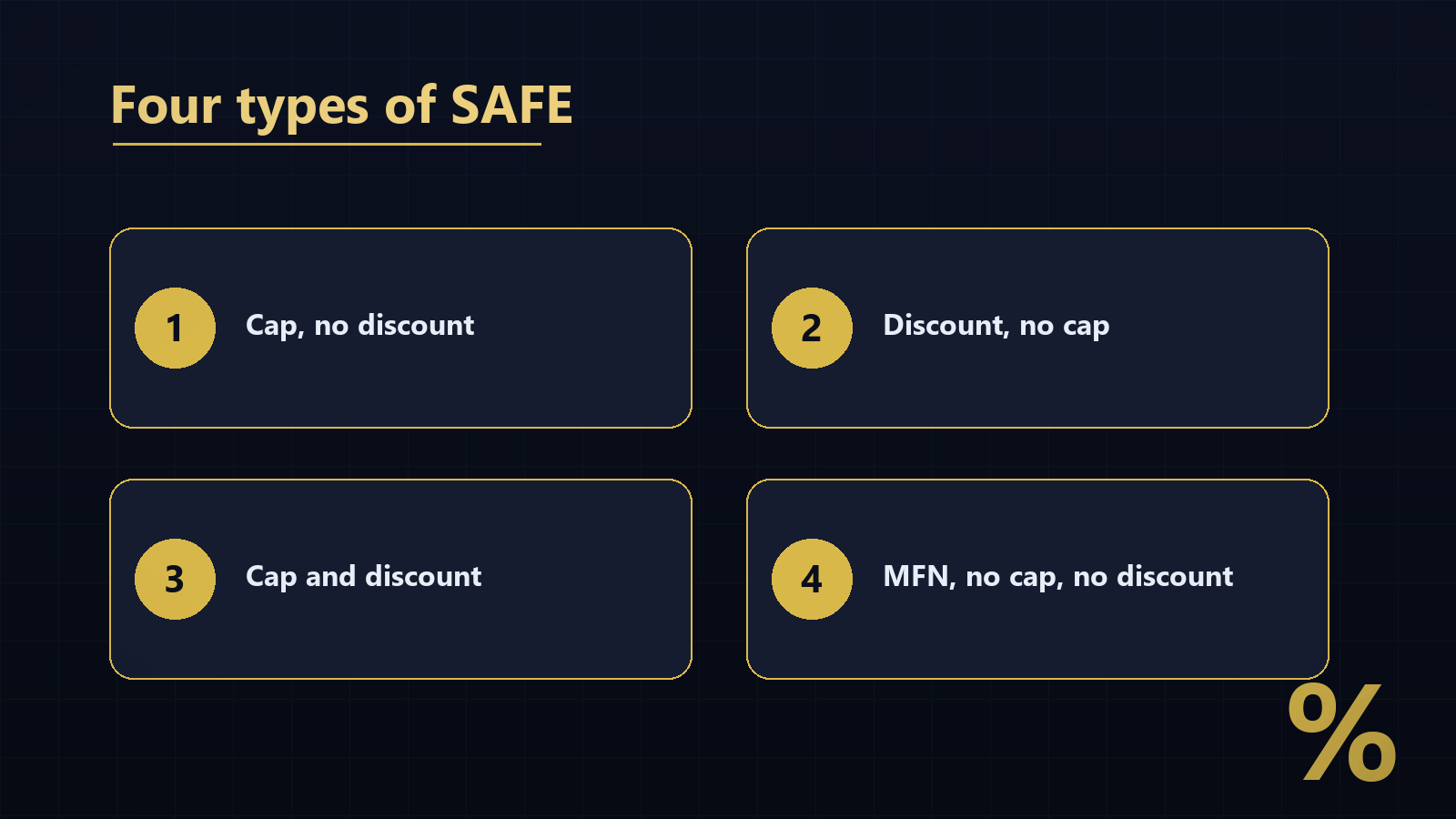
SAFEs come in four common forms, defined by whether they carry a valuation cap, a discount, both, or only a most-favoured-nation (MFN) clause: (1) cap, no discount; (2) discount, no cap; (3) cap and discount; and (4) MFN, with neither a cap nor a discount. The right form depends on stage, leverage and how much certainty each side wants on conversion price.
The economics of a SAFE turn on two terms: the valuation cap and the discount. A valuation cap sets the maximum valuation at which the investor’s money converts to equity, rewarding early backers if the company’s value rises; a discount (commonly 10–25%) lets the SAFE convert below the next round’s price. The post-money SAFE — now the market standard — fixes each investor’s ownership percentage after all SAFEs convert, making dilution transparent for founder and investor alike. Matchpoint helps founders choose the right combination and models the resulting cap table before a single document is signed.
Matchpoint Partners structures SAFE rounds for founders across the GCC, India and the UK and introduces them to the angels, syndicates and seed funds most likely to back the company — adapting the instrument to local legal requirements where a US-style SAFE is not directly enforceable. Every mandate is led by a partner, from shaping the raise to closing commitments. SAFE financing sits alongside our Early-Stage & Seed Capital and Venture Capital services for founders building their first institutional cap table.
Our role on safe financing mandates
- SAFE round structuring — valuation cap, discount, MFN
- Pre-money vs post-money SAFE guidance
- Cap-table and dilution modelling
- Introductions to angels, syndicates and seed investors
Research relevant to this area
Original analysis and decision frameworks from the Matchpoint team.
SAFE Financing — frequently asked questions
A SAFE is an early-stage fundraising instrument where an investor gives a startup capital now in return for the right to shares in a future priced round. Unlike a convertible note, a SAFE is not debt — it has no interest rate and no maturity date — which makes it faster and cheaper to close.
Both convert into equity later, but a convertible note is debt that accrues interest and has a maturity date, while a SAFE is not. SAFEs are simpler, quicker and more founder-friendly; convertible notes give investors creditor protection and a repayment deadline.
A valuation cap sets the maximum company valuation at which the SAFE converts to equity, protecting early investors if the next round is priced higher. A discount (commonly 10–25%) lets the SAFE convert below the next round’s price. A SAFE can have a cap, a discount, both or neither.
A post-money SAFE — the current market standard — fixes each investor’s ownership percentage after all SAFEs convert, making dilution transparent; a pre-money SAFE calculates ownership before other SAFEs and the new round. Post-money SAFEs are easier to model but more dilutive to founders.
SAFEs suit pre-seed and seed rounds where speed and low legal cost matter and a priced round is premature. They let founders raise on a rolling basis from angels and seed investors without fixing a valuation up front.
Yes — SAFEs and SAFE-style instruments are increasingly used for early-stage rounds across the GCC, UK and India, though they need local legal adaptation where a US-style SAFE is not directly enforceable. Matchpoint structures the round and introduces founders to regional angels, syndicates and seed funds.
Matchpoint prepares your equity story and investor materials, maps your raise against a curated base of PE funds, family offices, SWFs, VCs and strategic investors, and runs the process to close. Typical equity tickets range from USD 5m to USD 300m.
Assess the adviser against the transaction size, sector and geography; the quality of its investor-screening method; senior involvement; preparation capability; conflicts; process reporting; fee transparency; and its ability to support diligence and term-sheet comparison. Ask to see the proposed deliverables and qualification fields before any outreach begins.
The target list should record each investor's sector, stage, geography, cheque size, preferred instrument, governance requirements, relevant portfolio or transaction evidence, conflicts, relationship route and the reason the investor fits the mandate. It should be prioritised and updated as feedback is received.
Venture capital funds early-stage, high-growth companies (seed to Series C) for minority equity, while private equity backs more established businesses via growth equity, buy-outs or minority stakes. We raise both, matching the investor to your stage and sector.
Yes. We support founders from MVP traction through growth rounds — building the pitch, model and go-to-market narrative, then introducing the company to seed and growth-stage investors across MENA and India.
Engagements ordinarily combine a retainer with a success fee. Terms are agreed in writing before work begins and calibrated to the mandate’s size, scope and complexity.
Most mandates reach a first term sheet within 30 days, depending on diligence readiness and structure; closing follows once terms are agreed.
A short, confidential scoping call and NDA; we structure the requirement and prepare materials, then run a competitive process across our 5,000+ investor and lender relationships, and negotiate to close — with a partner leading at every step.
Matchpoint Partners is based in the UAE and runs cross-border mandates across the UAE, KSA, India and the UK, with active deal activity in wider Europe, Singapore and the United States.
Matchpoint undertakes corporate finance, financing, M&A and fund-placement mandates from USD 5m upwards, subject to mandate fit, diligence, applicable regulation, capacity and a written engagement. The partner team has originated and led $2+ billion of transactions.
Use the enquiry form, email contact@matchpoint-partners.com, or call/WhatsApp +971 55 345 6487. Every mandate is led by a partner from the very first conversation.
Yes. Confidential information is handled under the engagement terms and any applicable non-disclosure agreement.
More in Equity
Interested in safe financing?
Tell us your requirement and a partner will respond personally.
Investment roles, structures and decision criteria
Explore the participants and transaction options relevant to this practice. Each entry sets out a discussion scope, decision checks, a paid engagement starting point and the specialist responsibilities to confirm.
Equity and Hybrid Capital
SAFEsCME-196 · Equity and Hybrid Capital · Funding Instrument
- Ecosystem role
- Funding Instrument
- Related asset class
- Private equity
- Instrument context
- Equity or hybrid
Mandate context: equity raises, founder financing and growth investment. The structure and rights are established by the specific transaction documents.
Decision focus: Ownership economics across alternative structures.
- Cash-flow rights, conversion and dilution
- Governance, preferences and contingent payments
- Valuation, exit and specialist documentation
Scope to discuss: Capital-structure design, financing options analysis and execution support.
Paid engagement entry point: financing-options and term-sheet assessment; followed by lender or investor process execution.
Illustrative GCC scenario: An illustrative UAE investment can compare ordinary, preferred or convertible terms using the same ownership, cash-flow and exit scenarios; actual rights depend on the documents. This is a hypothetical decision example.
What should be agreed before a mandate involving SAFEs?
Define the investment or transaction objective, the authorised decision-maker, the evidence available, the requested deliverables and the next approval. Use the decision checks above to identify gaps; agree the workplan, delivery responsibilities and fee terms in writing.
Delivery and specialist boundary: Confirm decision authority, evidence access, conflicts, scope and applicable jurisdiction-specific permissions before execution. Legal, tax, fund-marketing, securities and Shariah questions require the relevant appointed specialist. Capital availability, investment returns and execution dates remain subject to assessment.
Discuss a paid scopeFurther reading on diligence, market frameworks and applicable requirements. These resources do not verify an individual mandate or Matchpoint permission.
