

The GCC AI Data-Centre Boom: A Capital-Deployment Guide for Infrastructure Investors
A capital-deployment guide for international infrastructure investors assessing the GCC AI data-centre buildout.
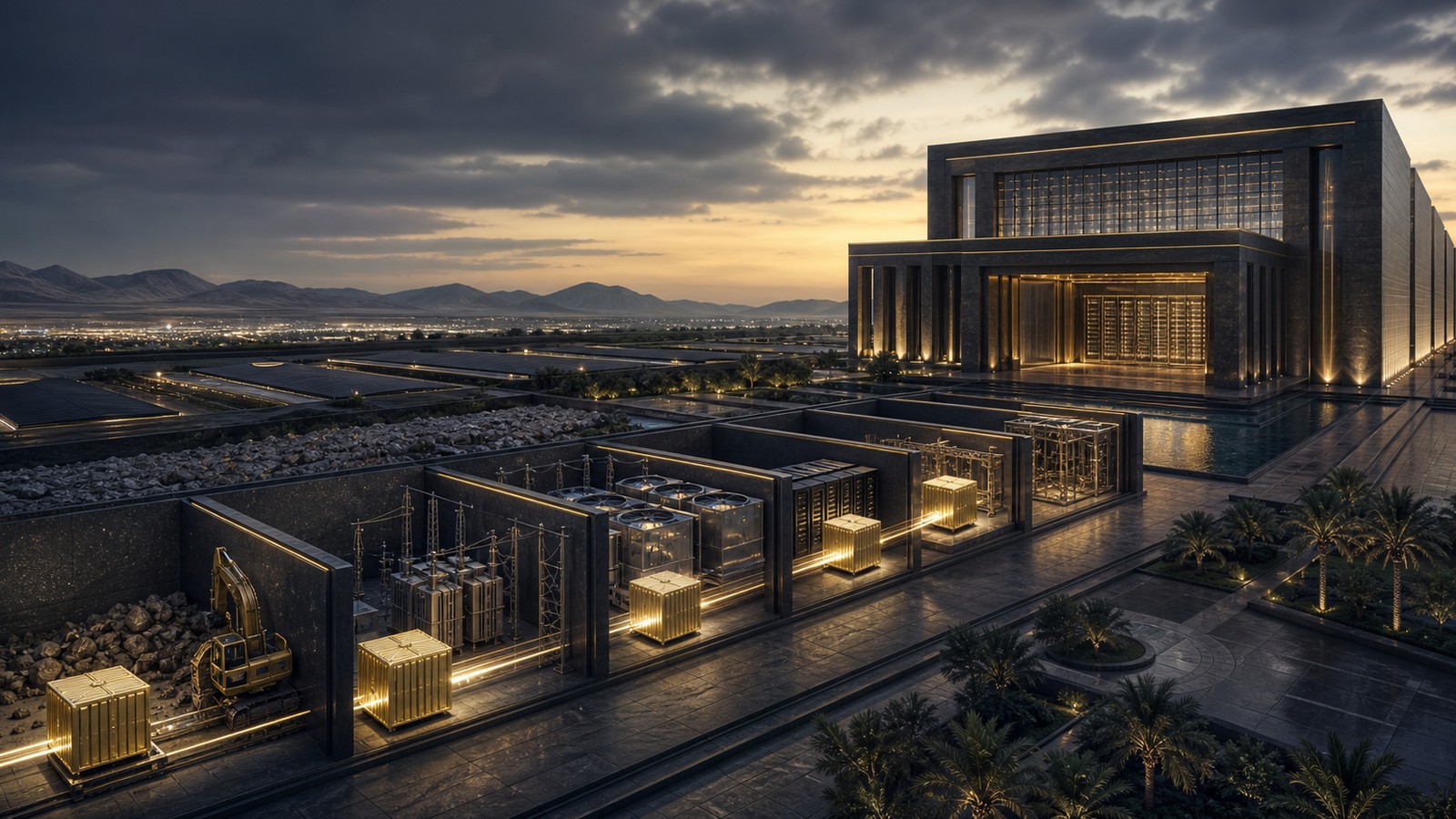
Artificial intelligence has turned data centres from a niche real-asset class into one of the largest infrastructure opportunities of the decade, and the Gulf, with cheap power, sovereign ambition and a strategic location, is building at scale. This paper is a capital-deployment guide for an international infrastructure investor weighing the GCC data-centre boom: where the demand comes from, how capital is deployed across the asset lifecycle, what return each entry point offers for what risk, and how to choose a strategy.
Artificial intelligence has turned data centres from a niche real-asset class into one of the largest infrastructure opportunities of the decade, and the Gulf, with cheap power, sovereign ambition and a strategic location, is building at scale. This paper is a capital-deployment guide for an international infrastructure investor weighing the GCC data-centre boom: where the demand comes from, how capital is deployed across the asset lifecycle, what return each entry point offers for what risk, and how to choose a strategy. Drawing on the literature on digital-infrastructure investment, on real-asset returns and development risk, and on offtake and contracted cash flows, it advances five propositions concerning Gulf data-centre capital deployment. Using a stylised, clearly-labelled framework, it characterises the demand drivers, maps the capital deployed across the land, construction, equipment and stabilisation phases, quantifies the return available at each entry point, and shows why offtake quality drives value. The analysis finds that Gulf data-centre demand is large, structural and AI-led rather than cyclical; that the risk and return vary sharply across entry points, from low-risk stabilised assets to high-return greenfield development; that the quality of the offtake, the tenant and the lease, is the single greatest determinant of value; and that an investor should match its entry point and strategy to its risk appetite, capability and capital scale. The paper provides a deployment framework, an entry-point comparison and a glossary, and discusses the limitations and avenues for further research. JEL Classification: G11, G31, G32, L94, O18 Keywords: data centres, digital infrastructure, artificial intelligence, real assets, infrastructure investment, GCC, offtake, capital deployment
This MP Insight presents the web edition of Matchpoint Partners' research. The supporting paper contains the full framework, structures, worked examples and source material.
Read the full research paper Explore our AI Data Centres practice
Introduction
Artificial intelligence has changed the economics of computing, and in doing so it has changed the economics of the buildings that house it. Training and serving large AI models requires enormous, dense, power-hungry computing capacity, and that capacity lives in data centres, which have moved in a few years from a specialised corner of the real-asset universe to one of the largest infrastructure opportunities of the decade. The demand for data-centre capacity is now growing faster than the industry can build it, and the constraint has shifted from whether the demand exists to whether the power, land, capital and capability can be assembled to meet it. The Gulf, with abundant and inexpensive energy, sovereign strategies that prize digital infrastructure, and a location between Europe, Africa and Asia, has become one of the regions building most aggressively, which makes it a natural destination for international infrastructure capital seeking exposure to the AI buildout.
This paper is a capital-deployment guide for an international infrastructure investor weighing the GCC data-centre opportunity. It is written for the investment committee, the head of infrastructure and the deal team of a fund or institution considering how, where and at what risk to deploy capital into Gulf data centres. Its purpose is to map the opportunity in a way that supports a deliberate choice of strategy: to set out where the demand comes from and how durable it is, how capital is deployed across the lifecycle of a data-centre asset, what return each entry point offers for what risk, and how an investor should match its strategy to its appetite, capability and scale. The central message is that the Gulf data-centre boom is a large, structural, AI-led opportunity, but that the risk and return vary so sharply across the lifecycle that the investor’s first decision, where to enter, matters more than the decision to participate at all.
The Gulf context is favourable in ways that bear directly on data-centre economics. Power is the largest operating input of a data centre, and the Gulf’s abundant, inexpensive energy, increasingly complemented by solar, is a structural advantage over power-constrained markets elsewhere. Sovereign and government-linked demand, for cloud, data sovereignty and national AI ambitions, provides an anchor of demand that many markets lack. And the region’s capital, both sovereign and private, is willing to co-invest, which eases the funding of large projects. These advantages do not remove the risks, which the paper addresses, but they make the Gulf a market where the AI data-centre opportunity is unusually well-supported on the supply side.
Results And Discussion
This section presents the framework in the order of the propositions: the demand trajectory and drivers (Proposition 1); the capital deployment and returns across the lifecycle (Propositions 2 and 4); the offtake quality (Proposition 3); and the comparison of strategies (Proposition 5).
The Demand Trajectory
The opportunity begins with demand. Figure 1 shows the trajectory of Gulf data-centre capacity.
Figure 1. GCC Data-Centre Capacity: Live and Committed Pipeline
Indicative; both live capacity and the committed pipeline are growing rapidly, with the pipeline outpacing live capacity.
The figure supports Proposition 1. Both the live data-centre capacity in the Gulf and the committed pipeline of projects under development are growing rapidly, and the pipeline is growing faster than live capacity, which signals that the industry expects demand to continue rising and is building ahead of it. The crucial point is that this growth is driven by structural forces rather than by the economic cycle: the demand for AI computing, cloud capacity and sovereign data infrastructure does not ebb and flow with the business cycle but rises with the secular adoption of these technologies. For an infrastructure investor, this means the opportunity is a structural growth theme rather than a cyclical play, which supports a deliberate, multi-year capital-deployment strategy rather than an opportunistic entry. The scale and durability of the demand are the first part of the case for committing capital to the Gulf buildout.
The Gulf’s position in this demand picture has a distinctive feature worth drawing out: a substantial part of the demand is sovereign or sovereign-linked, which changes its character. National AI strategies, government cloud programmes and data-sovereignty mandates generate demand that is both large and unusually durable, because it is driven by state priorities rather than commercial cycles, and it often comes with strong, long offtakes from government-linked entities. For an investor, sovereign-anchored demand is attractive because it provides creditworthy, long-term tenants and a degree of political alignment that supports the project through development, but it also requires the investor to understand the sovereign’s priorities and to structure for the particular characteristics of government-linked counterparties. The presence of this sovereign demand is one of the features that distinguishes the Gulf data-centre opportunity from purely commercial markets, and it is part of why the region’s demand is treated as especially durable.
A complementary demand consideration is the locational concentration of the buildout, because data-centre demand is not uniform across the Gulf but clusters where power, connectivity and tenant demand coincide. The major hubs attract the bulk of the pipeline, benefiting from established connectivity and tenant presence, while secondary locations may offer cheaper land and power but thinner demand and connectivity. For the investor, this means the demand diligence must be locational as well as sectoral: a project in an established hub with deep connectivity and tenant demand is better-supported than one in a location chosen for cheap inputs alone, however attractive its cost base. The interplay of land cost, power availability, connectivity and tenant demand across locations is part of the supply-and-demand map the investor must read, and it reinforces that the opportunity, while large in aggregate, must be assessed project by project and place by place rather than as a single regional bet. The companion paper on power and land examines these locational constraints in greater depth.
Underlying the whole demand picture is a structural shift in computing that the investor should understand, because it explains why this boom differs from earlier data-centre cycles. Previous waves of data-centre demand were driven chiefly by the migration of existing computing from on-premise to cloud, a large but ultimately bounded transition. The AI wave is different in kind: it creates entirely new computing demand, the training and serving of models that did not previously exist, at densities far above traditional workloads, and this demand grows with the capability and adoption of AI rather than being capped by the stock of computing to be migrated. This is why the analysis treats the demand as structural rather than cyclical and why the industry is building so far ahead: the AI wave represents not a one-time migration but an open-ended expansion of what computing is used for. The investor should hold this distinction in mind, because it is the basis for treating the opportunity as a durable, multi-year theme rather than a cyclical surge, while remaining alert, as the scenarios counsel, to the possibility that the trajectory moderates.
4.1a Why the Pipeline Outpacing Live Capacity Matters
Implementation Considerations
Translating the framework into practice involves choosing the entry point and strategy, securing power and offtake, partnering for local capability, and governing the deployment over time.
A foundational sequencing point is that the strategy choice should precede deal sourcing, not follow it. An investor that begins by looking at available deals and then rationalises a strategy around them tends to drift toward whatever is on offer, which may not match its capability or appetite; one that first fixes its strategy, the entry point, the risk profile, the role of partnership, and then sources deals that fit, retains control of its risk-return profile. This is especially important in a booming market where many deals are offered and the temptation to participate broadly is strong. The discipline is to let the strategy filter the deal flow rather than letting the deal flow set the strategy, so that the investor builds the portfolio it intended rather than an accidental collection of whatever the market presented. The strategy-first sequence is the practical expression of the deliberate matching the framework counsels.
Choosing the Entry Point and Strategy
The first and most consequential decision is where to enter and with what strategy, which should follow from the investor’s risk appetite, capability and capital scale rather than from the headline return. An investor seeking stable income should target stabilised assets or construction lending; one seeking and able to manage development returns should target build-to-core or greenfield; one wanting debt exposure should lend. The decision should be made explicitly and at the outset, because it sets the risk-return profile of everything that follows, and an investor that drifts into a higher-risk entry point without the capability to manage it will find the development risk it underestimated.
A practical refinement on power is to understand the difference between contracted power capacity and merely-anticipated power, because the distinction is as consequential for power as offtake quality is for demand. A project with a firm, contracted power supply agreement, ideally with a clear path to the additional capacity it will need as it scales, has secured the binding input; one relying on anticipated grid capacity that has not been firmly allocated bears a real risk that the power arrives late, costs more, or falls short, delaying or impairing the whole project. The investor should therefore treat power with the same contractual rigour it applies to offtake, seeking firm commitments rather than expectations, and should understand the project’s power roadmap as it scales, since AI workloads are driving power densities ever higher. In the Gulf the structural abundance of power eases but does not remove this project-level diligence, and an investor that secures contracted power alongside a contracted offtake has locked down the two variables the sensitivity analysis identifies as decisive.
Securing Power and Offtake
Because power and offtake dominate the return, the investor should treat both as gating items. It should confirm, before committing, that firm, affordable power can be secured on the timeline the project needs, taking nothing for granted even in the power-rich Gulf. And it should prioritise securing a strong, long offtake, an investment-grade tenant on a long lease, since that is what converts the asset into contracted, financeable income. An investor that secures power and offtake has de-risked the two largest drivers of return; one that proceeds without them is exposed to the two factors most likely to disappoint.
Concluding Comments
The Gulf AI data-centre boom is one of the largest infrastructure opportunities of the decade, supported by structural, AI-led demand and by the region’s power, sovereign ambition and co-investing capital. This paper has set out a capital-deployment guide: where the demand comes from, how capital is deployed across the lifecycle, what return each entry point offers for what risk, and how to choose a strategy.
The evidence and analysis support five conclusions. First, Gulf data-centre demand is large, structural and AI-led, not cyclical. Second, risk and return vary sharply across the lifecycle, so the entry point sets the profile. Third, the quality of the offtake is the single greatest determinant of value. Fourth, the Gulf’s power, sovereign demand and co-investing capital are structural supply-side advantages. Fifth, an investor should match its entry point and strategy to its appetite, capability and scale.
It is also worth being candid about what could go wrong with the opportunity as a whole, beyond the project-level scenarios. The data-centre boom is, in part, a bet on the continued, rapid growth of AI computing demand, and while the breadth of demand drivers cushions this, a broad, sustained disappointment in AI adoption, or a step-change in computing efficiency that sharply reduced the capacity required per unit of AI output, would moderate the whole opportunity. An investor should hold this possibility in mind, size its overall exposure to the theme accordingly, and rely, as throughout, on contracted offtakes to protect individual assets against a demand disappointment. The honest position is that the opportunity is large and well-supported but not certain, and that the prudent investor participates with conviction tempered by diversification and protected by contracts, rather than betting the portfolio on an uninterrupted continuation of the current trajectory. This measured conviction, large enough to matter, protected enough to endure a disappointment, is the disposition the analysis recommends toward the theme as a whole.
Related MP Insights
Lays out the full capital stack for Gulf digital infrastructure.…
Digital Infrastructure · DebtThe diligence and underwriting model for a Gulf data centre.…
Digital Infrastructure · AlternativesThe constraints behind the buildout that investors must price.…
The GCC AI Data-Centre Boom: frequently asked questions
Artificial intelligence has turned data centres from a niche real-asset class into one of the largest infrastructure opportunities of the decade, and the Gulf, with cheap power, sovereign ambition and a strategic location, is building at scale. This paper is a capital-deployment guide for an international infrastructure investor weighing the GCC data-centre boom: where the demand comes from, how capital is deployed across the asset lifecycle, what return each entry point offers for what risk, and how to choose a strategy.
The web edition covers The Demand Trajectory; Choosing the Entry Point and Strategy; Securing Power and Offtake.
The full supporting PDF is available from this MP Insights page. It contains the complete methodology, analysis, references and appendices.
The Topic Tracker maps this paper to Matchpoint Partners' AI Data Centres practice.
This publication is general information for professional audiences. It is not investment, legal or tax advice, and it is not an offer or solicitation. Readers should verify current legal, regulatory and tax requirements with qualified advisers.
Apply this insight to a live decision
Discuss the financing, capital allocation or transaction implications with a Matchpoint partner.
