Introduction
A valuation gap is rarely one number. A GCC family-business owner may price years of reinvestment, reputation, relationships, future contracts and a strategic buyer's opportunity. A buyer may price normalised cash flow, execution risk, required return, financing capacity and the rights acquired. Both positions can be internally coherent while addressing different economic objects. A transaction becomes possible when the parties expose those differences and allocate them among cash at close, closing adjustments, contingent value, retained ownership and contractual protection.
Current scoped evidence still establishes the practical importance of valuation disagreement. The American Bar Association's 2025 Private Target M&A Deal Points Study reviewed 139 publicly available definitive agreements for acquisitions of private targets by public buyers, signed during 2024 and the first quarter of 2025, with transaction values from USD 25 million to USD 900 million and a majority below USD 200 million. Earnouts appeared in 18 per cent of that sample, down from 26 per cent in the preceding study [11,12]. Axial's survey of 107 lower-middle-market participants reported valuation expectations as the leading cited cause of 2025 deal failure for 28.3 per cent of respondents [17]. SRS Acquiom reports from proprietary private-target datasets that post-closing indemnity claims and earnout disputes remain frequent, and that outside life sciences just over half of earnout deals in its dataset produced some payout while most potential earnout dollars were unpaid [14-16]. Each result belongs to its stated population. None is a universal GCC rate.
The governing question is: how can a seller and buyer reconcile evidence, valuation methods, transaction definitions and future uncertainty into a structure that both can approve and administer? The answer developed here is a signed valuation bridge. It contains the perimeter, valuation date, evidence register, normalised earnings, comparable record, DCF assumptions, enterprise-to-equity bridge, structure alternatives, earnout mechanics, operating covenants, information rights, dispute process and named decision owners.
IFRS 13 supplies a relevant fair-value frame when another IFRS Standard requires or permits fair value. It defines an exit price in an orderly transaction between market participants at the measurement date [1]. International Valuation Standards effective from 31 January 2025 emphasise data and inputs, valuation models, documentation and reporting [4]. The 2025 IPEV Guidelines apply fair-value principles in private capital [5]. These sources guide disciplined analysis. A negotiated acquisition price can reflect buyer-specific synergies, control, financing, tax, liquidity, warranties and structure that differ from a standalone fair-value conclusion.
This paper contributes:
- a decision perimeter for owners and institutional buyers;
- a distinction among price, value, consideration and retained risk;
- a normalised-earnings and evidence register;
- comparable and DCF protocols with sensitivity analysis;
- an enterprise-value to equity-value and cash-at-close bridge;
- an earnout design and post-closing control architecture;
- alternatives including fixed deferral, seller notes, rollover and staged sales;
- an Illustrative example that reconciles seller and buyer cases; and
- a ninety-day readiness and negotiation programme.
The analysis reviews 52 official, primary, standards-body, court, academic and scoped market sources available through 2 August 2026. The source register covers valuation and governance standards [1-7], UAE family and company materials [8-10,35,36,52], deal studies and market evidence [11-20], official court and statute materials [21-26], UAE tax sources [27-34], audit and reporting sources [37-44,49,50], and academic valuation and earnout research [45-48,51]. UAE law, tax and transaction applicability depends on the entity, free zone or mainland status, transaction, governing law and facts. The paper is research and requires transaction-specific legal, tax, accounting and valuation advice. Illustrative examples are method demonstrations. No approved observed Matchpoint or client evidence was supplied for revenue, cash cost reduction, loss reduction or alpha. Those attributed values remain USD 0.
| Seller and buyer valuations can diverge | Supported by scoped deal surveys [11,12,17] | Diagnose the object, evidence and assumption differences |
| The gap is approximately 48 per cent | Could not be verified as a valuation-gap magnitude | Excluded from calculations and conclusions |
| Earnouts can bridge future uncertainty | Supported as a transaction mechanism [11-16,21-25] | Price and govern the contingent claim |
| Earnouts avoid disputes | Unsupported | Design for measurement, review and dispute resolution |
| Structure can create agreement | Transaction-specific | Compare cash, deferred, contingent and participating value |
| Research proposition | Verified evidence position | |
|---|---|---|
| Seller and buyer valuations can diverge | Supported by scoped deal surveys [11,12,17] | Diagnose the object, evidence and assumption differences |
| The gap is approximately 48 per cent | Could not be verified as a valuation-gap magnitude | Excluded from calculations and conclusions |
| Earnouts can bridge future uncertainty | Supported as a transaction mechanism [11-16,21-25] | Price and govern the contingent claim |
| Earnouts avoid disputes | Unsupported | Design for measurement, review and dispute resolution |
| Structure can create agreement | Transaction-specific | Compare cash, deferred, contingent and participating value |
Audience and Decision Perimeter
owner objective
An owner should therefore write an objective hierarchy before receiving bids. A headline price can be economically inferior when a large amount is contingent, delayed, subordinated, exposed to buyer-controlled operations or payable in illiquid securities. A lower headline can provide more certain cash, a cleaner release and lower post-closing dependence. The hierarchy should state the minimum cash at close, acceptable deferral, required protections, willingness to retain equity, operational role and risk limits.
buyer objective
The institutional decision includes mandate, concentration, currency, liquidity, duration, leverage, tax, sanctions, governance and exit. A value indication does not establish an approvable transaction. The investment committee needs a bridge from verified historical evidence to forecast, value, consideration, covenants and returns.
Shared transaction object
The parties should negotiate one economic object. The perimeter identifies the legal entities, branches, assets, liabilities, licences, contracts, employees, intellectual property, cash, debt and excluded items. The valuation date identifies the information set. The basis identifies whether the analysis estimates market value, fair value, investment value or a negotiated buyer case. The consideration schedule identifies cash, securities, deferral, earnout, escrow, rollover and releases.
| Decision field | owner question | buyer question | Joint record |
|---|---|---|---|
| Perimeter | What exactly am I selling? | What rights and liabilities are acquired? | Signed legal and economic perimeter |
| Earnings | Which costs or income are non-recurring? | Which adjustments are reproducible? | Normalised earnings register |
| Future | Which growth is already built? | Which growth needs new capital or capability? | Forecast assumption register |
| Value | What evidence supports the seller case? | What return does the buyer case require? | Method-specific ranges |
| Structure | What value is certain and liquid? | Which risks remain with the seller? | Consideration and risk map |
| Governance | Who controls operations after closing? | Who can protect the investment? | Reserved-matters schedule |
| Dispute | How can the seller verify results? | How are objections bounded? | Information and resolution process |
Authority
Management establishes business facts and representations. Finance reconciles accounts. Valuation specialists apply the relevant basis and method. Legal counsel drafts and interprets transaction documents. Tax advisers assess transaction and post-closing consequences. Accountants determine reporting under the applicable standards. Buyer and seller approval bodies accept or reject the transaction. The valuation bridge records these roles and does not transfer professional authority to a model or adviser outside its mandate.
The Gap: Price, Value, Structure And Risk
Four different numbers
Value is an estimate under a defined basis, date and assumptions. Price is the amount agreed in a transaction. Consideration is the package transferred or potentially transferred. Proceeds are what the seller receives after adjustments, repayment, tax, costs and timing. Mixing these numbers creates apparent agreement that can fail at signing or closing.
A buyer may offer AED 100 million enterprise value, subject to AED 20 million net debt, an AED 8 million working-capital shortfall, AED 5 million escrow and AED 20 million earnout. The seller may describe the offer as AED 120 million. Cash at close before tax and costs can be AED 67 million. Each number has a different meaning. The bridge must show all of them.
Sources of disagreement
The gap can arise from perimeter, metric, period, accounting policy, normalisation, forecast, comparable set, control premium, discount rate, terminal value, net debt, working capital, tax exposure, contingent liabilities, financing, synergies and strategic optionality. It can also reflect negotiating posture. A disciplined process tests observable differences first and records unsupported positions as negotiation positions.
| Gap source | Seller position that may arise | Buyer challenge | Resolution evidence |
|---|---|---|---|
| Earnings period | Latest run-rate represents the business | Run-rate is seasonal or untested | Monthly ledger, orders, cash and capacity |
| Add-backs | Owner costs are removable | Cost is needed under new ownership | Contract, replacement cost and operating plan |
| Growth | Pipeline will convert | Pipeline is unsigned or capacity-constrained | Contract status, probability and delivery plan |
| Comparable | High-growth peer multiple applies | Peer has scale, margin or liquidity advantage | Selection and adjustment record |
| Synergy | Buyer should pay for strategic benefit | Buyer created and funds the synergy | Standalone and buyer-specific cases |
| Net debt | Item is ordinary working capital | Item is financing or debt-like | Contract, ageing, history and definition |
| Earnout | Future value is preserved | Metric is exposed to execution risk | Formula, controls, rights and remedies |
Evidence before midpoint
An arithmetic midpoint is not reconciliation. If the seller case includes unsupported earnings and the buyer case includes an excessive risk discount, averaging preserves both defects. The parties should first align the perimeter, historical period, measurement definitions and evidence. They can then identify genuine risk and allocate it through value or structure.
Current market evidence
The ABA study's decline in earnout prevalence from 26 per cent to 18 per cent in its specific agreement sample was interpreted by the ABA as consistent with a narrowing valuation gap in that sample [11]. Axial's 107-respondent survey recorded valuation expectations as a leading failure cause [17]. BizBuySell's 2025 survey found a large difference between buyer expectations and owner plans for seller financing in the U.S. small-business market [18]. These sources point to negotiation and structure challenges within their populations. They do not supply a GCC valuation-gap percentage.
Evidence Register And Normalised Earnings
Evidence hierarchy
The bridge begins with a source register. Signed contracts, bank records, tax filings, statutory records, audited or reviewed financial statements and system exports generally carry more evidential weight than an undated presentation. Reliability remains fact-specific. A bank statement can prove a cash receipt and cannot by itself prove revenue recognition. A customer contract can establish terms and cannot prove performance or collectability.
Each material input should carry a stable identifier, source, entity, period, currency, units, owner, acquisition date, transformation, reviewer and status. Contradictions remain open records. A management explanation is labelled until corroborated.
Reconciliation spine
The financial spine connects the trial balance to statutory accounts, management reporting, tax filings, bank records and the earnings schedule. Revenue should reconcile by legal entity, business line, customer, currency and period where relevant. Gross margin should connect to the cost classification actually used. Payroll should connect employee populations and payment evidence. Related-party balances should connect to agreements, ownership and settlement history.
| Record | Minimum fields | Acceptance test |
|---|---|---|
| Revenue bridge | Ledger, invoice, contract, cash, entity, period | Population and differences reconcile |
| EBITDA bridge | Reported result, adjustment, tax effect, evidence | Each adjustment has basis and recurrence view |
| Working capital | Account, ageing, seasonality, policy | Target reflects ordinary operation |
| Net debt | Instrument, balance, interest, control | Classification matches agreed definition |
| Forecast | Driver, source, owner, downside, dependency | Assumption can be traced and challenged |
| Comparable | Transaction, date, value, metric, relevance | Terms and denominator are consistent |
Normalised EBITDA
Normalisation asks what earnings the acquired business can generate under ordinary ownership and the agreed perimeter. It is not a collection of seller-favourable add-backs. The register should distinguish classification corrections, discontinued activity, exceptional items, owner-specific compensation, related-party pricing, run-rate changes, carve-out costs, stand-alone costs and buyer synergies.
An adjustment needs amount, period, accounting treatment, cash effect, recurrence assessment, evidence, replacement cost, forecast treatment and buyer response. A one-time expense that recurs annually under different descriptions is economically recurring. An owner salary above market may support an add-back only after the replacement role and cost are included. Buyer-specific procurement savings belong in the buyer case rather than standalone EBITDA.
Quality and conversion
EBITDA does not measure cash available to capital providers. The buyer should bridge normalised EBITDA to taxes, capital expenditure, working-capital investment, lease or financing cash flows and other recurring requirements. Customer concentration, contract duration, renewal, pricing, churn, capacity, key-person dependence and supplier terms shape the durability of the result.
PCAOB audit-evidence and documentation standards provide useful comparative logic concerning relevance, reliability, contradictory evidence and a record of work performed [37-39]. Their legal scope is audit practice. uses their evidence discipline without presenting the valuation bridge as an audit.
Valuation Basis And Purpose
Instruction
The signed instruction states the subject interest, valuation date, purpose, basis, currency, intended users, market, premise, assumptions, restrictions and authority. A 100 per cent controlling interest in an operating company differs from a minority holding. A strategic acquisition differs from financial reporting. A negotiated value can include buyer-specific benefits that a market-participant fair value excludes.
IFRS 13 defines fair value and provides a measurement framework when another IFRS Standard requires or permits it [1]. It is an exit-price framework using market-participant assumptions. IVS defines bases including market value and investment value and requires appropriate data, models, documentation and reporting [4]. IPEV provides private-capital fair-value guidance [5]. The transaction team selects the applicable basis with advisers and records any difference between a valuation conclusion and the negotiated price.
Enterprise and equity
Enterprise value usually represents the operating business before an agreed set of financing and financing-like items. Equity value adjusts enterprise value for cash, debt, debt-like items and other agreed balances. Cash at close then reflects working-capital adjustments, escrow, holdback, transaction expenses, leakage and the timing of deferred consideration. Definitions control the bridge.
Standalone and buyer cases
The standalone case reflects the business under supportable ordinary assumptions. The buyer case adds synergies, integration costs, financing, tax and strategic options specific to the acquirer. The seller can negotiate participation in buyer-specific value. The buyer can require evidence that the seller is transferring capabilities necessary to realise it. Recording both cases prevents synergy from being hidden in a multiple.
Date and known information
The valuation date governs the information set. Later information can confirm conditions existing at the date or reveal a subsequent event. The record should state its treatment. Forecasts need a cut-off, version and approval. Bid changes should identify the changed evidence or commercial position.
Market Approach And Comparables
Comparable universe
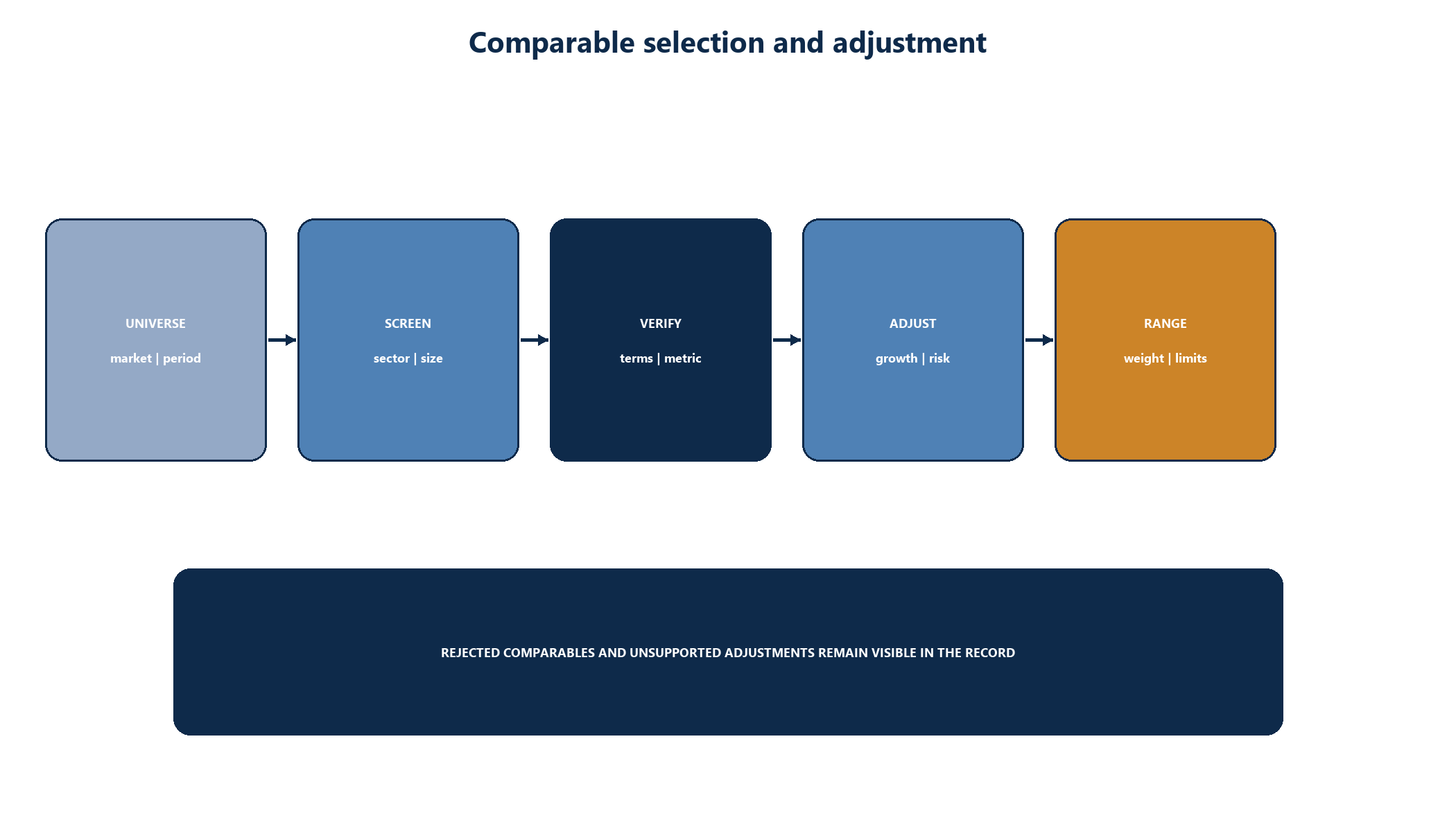
The market approach uses prices or valuation multiples from relevant transactions or traded companies. Relevance depends on business model, geography, customer, scale, growth, margin, cyclicality, capital intensity, concentration, control, liquidity, transaction date and terms. A large public company with diversified revenue and active liquidity can be a weak comparator for a private GCC SME.
The register records all screened candidates, inclusion or exclusion, source documents, transaction date, enterprise and equity value, contingent consideration, metric period, accounting basis and adjustments. Unannounced terms and database estimates are labelled. A reported headline price without assumed debt, rollover, earnout or acquired cash may not support an enterprise-value multiple.
Denominator integrity
The numerator and denominator must use consistent perimeters and periods. Last-twelve-month EBITDA can differ from reported annual EBITDA. Revenue may be gross or net. Lease treatment can affect both enterprise value and earnings. Minority interests, associates, pension deficits and contingent consideration can affect the numerator. The team should reproduce each multiple from the available source evidence.
Size and quality
GF Data's current proprietary middle-market evidence reports a size-related valuation difference between larger platform companies and smaller companies in its sample [20]. That result supports explicit size analysis within its market and dataset. It does not supply a mechanical discount for every GCC company. The adjustment record should explain how scale affects customer diversification, management depth, financing access, systems, liquidity and buyer universe.
Range and weight
A multiple range should reflect the quality and dispersion of evidence. The team can report an unadjusted observed range, a selected adjusted range and the subject metric. Weighting should be explained. Precision should not exceed evidence quality. A five-comparable set with large undisclosed terms supports less precision than a larger set with verified values and consistent denominators.
Transaction process feedback
Qualified indications, management meetings, diligence and financing can reveal how market participants price the asset. Bid evidence can calibrate the valuation when the process is credible and sufficiently competitive. A single opportunistic bid is not automatically market value. The adviser should record outreach, response, conditions, financing, timing and strategic rationale without disclosing confidential information outside authorised channels.
Income Approach And Dcf
Forecast architecture
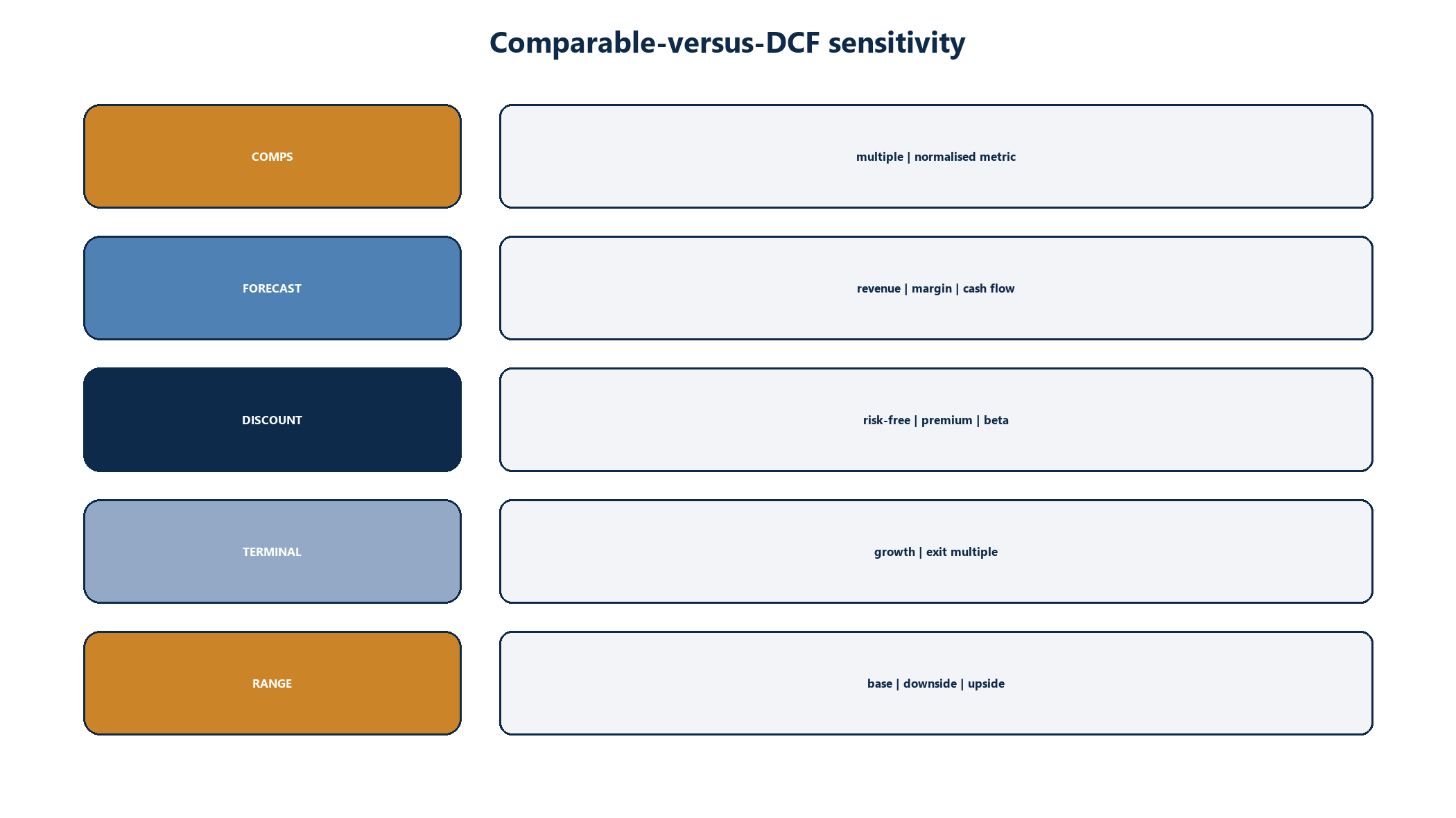
The income approach converts expected future cash flows into a present value [1,4]. The forecast should be driver-based and reconcile to history. Revenue can be decomposed into volume, price, retention, pipeline conversion, capacity and currency. Margin can be decomposed into product mix, procurement, labour, utilisation and overhead. Capital expenditure, working capital and tax convert accounting earnings into cash flow.
Each driver needs an owner, source, base, downside, upside, dependency and review date. Forecasts should identify contracts already signed, renewals, pipeline, market growth and management initiatives. Buyer-funded expansion belongs in the buyer case unless the required funding transfers with the business.
Discount rate
The discount rate should match the cash-flow definition, currency and risk. A nominal AED cash flow requires a consistent nominal rate. Country, size, concentration, leverage and execution risks should be treated coherently. Double counting arises when downside cash flows and an additional discount-rate premium cover the same risk. The assumption register explains each component and the treatment of risk.
Terminal value
Terminal value can dominate a DCF. The perpetuity-growth method requires a sustainable long-term growth rate and steady-state margins, investment and return on capital. An exit-multiple method imports market-approach assumptions. Both should be sensitised. A terminal result that exceeds the credible economic scale or conflicts with the selected market evidence requires challenge.
Sensitivity
The DCF reports a range across operating states, discount rates and terminal assumptions. Sensitivities should vary dependent drivers together where appropriate. Lower revenue growth may reduce utilisation and margin while increasing working-capital pressure. A table that changes one cell at a time can understate correlated downside.
Reconciliation to market evidence
The DCF and comparables answer related questions with different evidence. A DCF above the comparable range can reflect superior forecast growth, margins, duration or lower risk. It can also reflect optimism. The reconciliation identifies the assumptions required to justify the difference and assigns them to cash at close, contingent value or buyer-specific synergy.
| Gap source | Seller position that may arise | Buyer challenge | Resolution evidence |
|---|---|---|---|
| Earnings period | Latest run-rate represents the business | Run-rate is seasonal or untested | Monthly ledger, orders, cash and capacity |
| Add-backs | Owner costs are removable | Cost is needed under new ownership | Contract, replacement cost and operating plan |
| Growth | Pipeline will convert | Pipeline is unsigned or capacity-constrained | Contract status, probability and delivery plan |
| Comparable | High-growth peer multiple applies | Peer has scale, margin or liquidity advantage | Selection and adjustment record |
| Synergy | Buyer should pay for strategic benefit | Buyer created and funds the synergy | Standalone and buyer-specific cases |
| Net debt | Item is ordinary working capital | Item is financing or debt-like | Contract, ageing, history and definition |
| Earnout | Future value is preserved | Metric is exposed to execution risk | Formula, controls, rights and remedies |
Reconciling Methods Into A Range
Method-specific indications
The bridge retains each method rather than averaging automatically. It records the value indication, evidence quality, sensitivity, known limitations and weight. A method with weak inputs receives less weight. A method addressing the wrong perimeter receives none.
| Method | Evidence strength | Main vulnerability | Reconciliation question |
|---|---|---|---|
| Precedent transactions | Actual negotiated prices | Terms, timing and comparability | Which economics are observable? |
| Trading comparables | Current market prices | Scale, liquidity and minority basis | Which adjustments are supportable? |
| DCF | Subject-specific cash flows | Forecast and terminal assumptions | Which drivers are evidenced? |
| Asset approach | Identifiable assets and liabilities | Omits unrecorded franchise value | Is the business asset-led? |
| Bid evidence | Current buyer positions | Process quality and conditions | Is the bid executable? |
Valuation bridge waterfall
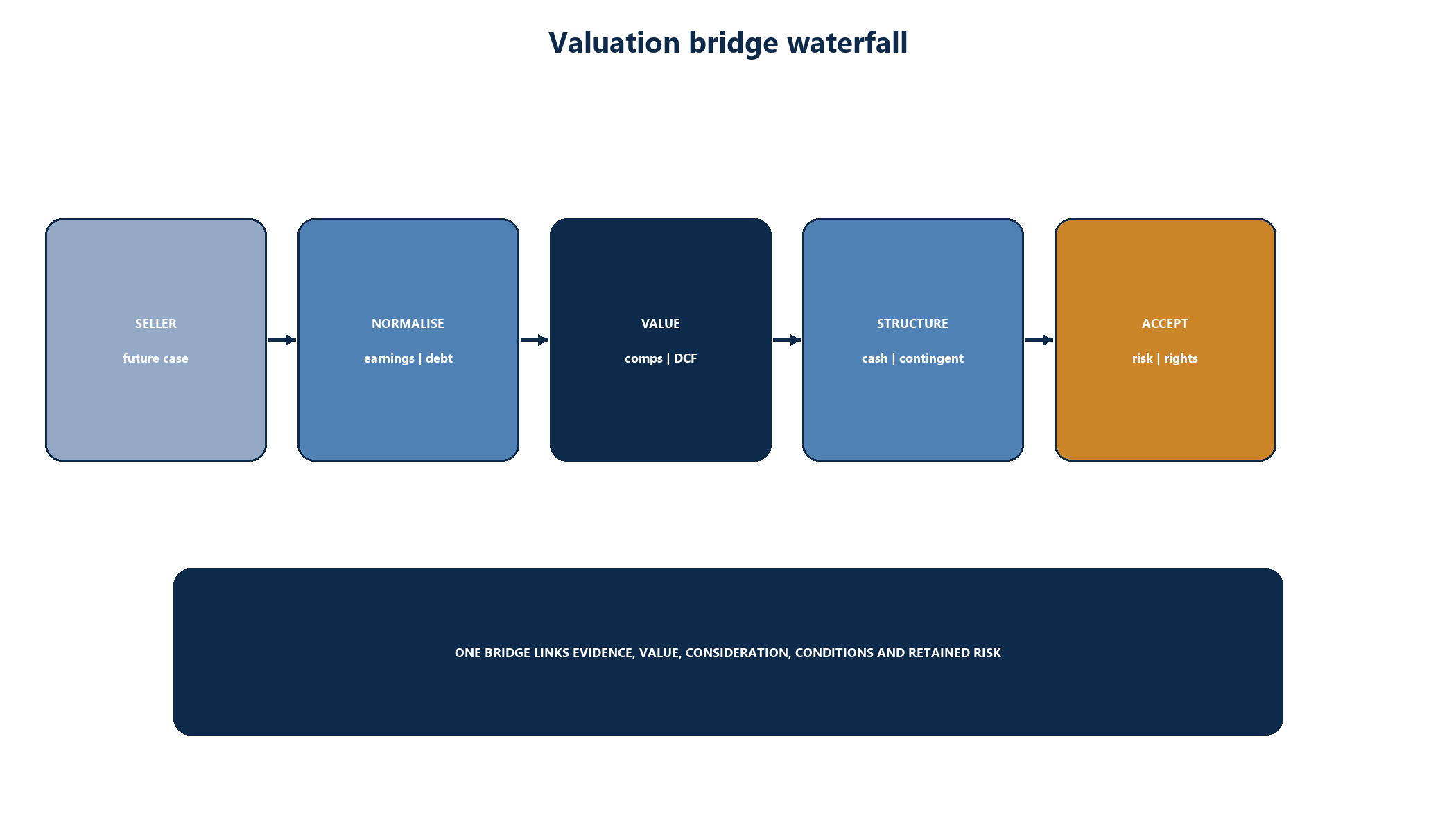
The waterfall begins with the seller case. It then shows agreed normalisation, evidence-based forecast revisions, method reconciliation, net-debt and working-capital definitions, identified liabilities, buyer synergies, consideration form, time value and retained risk. Each movement has an owner and status: agreed, buyer position, seller position, adviser range or unresolved.
Agreement zones
The parties may agree historical earnings and disagree future growth. Cash at close can price the agreed base; an earnout can price a bounded portion of future performance. They may agree enterprise value and disagree a debt-like item. A specific escrow or closing adjustment can isolate that item. They may agree value and disagree financing certainty. A reverse termination fee, financing condition or timing mechanism may address it under legal advice.
Acceptance record
An accepted bridge states who approved each economic term and which matters remain for drafting. It also records sensitivity to closing date, working capital, cash, debt, tax and performance. The record prevents a headline handshake from obscuring unresolved economics.
Synergy And Seller Future Potential
Separate capability from opportunity
Seller future potential can include signed backlog, renewal, pricing, capacity, new products, geography and cross-selling. The evidence should distinguish capability already present from a buyer-created opportunity. A seller-developed product with customers and a repeatable delivery model differs from a buyer's plan to distribute it through a global channel.
Synergy allocation
Synergy value can be divided among seller participation, buyer return and integration risk. The negotiation considers uniqueness, competitive tension, alternative buyers, cost to realise, time, execution risk and which party controls the outcome. A seller can request cash for proven standalone value and contingent or rollover participation for buyer-dependent upside.
Management forecasts
Management's plan should identify investments, people, systems, licences and capital needed. A forecast that omits growth costs overstates standalone value. A buyer case that assigns all synergy to itself may understate the seller's bargaining position when the asset is scarce. The bridge makes the allocation explicit.
Family-business considerations
Federal Decree-Law No. 37 of 2022 establishes a UAE framework for family companies, including governance and transfer matters [8]. The Ministry's registry and charter materials add current official context [10,35]. A transaction involving a family company can require alignment across legal ownership, beneficial interests, governance bodies, heirs, restrictions and family objectives. Transaction counsel should determine applicability and approvals.
Enterprise Value To Equity Value
Definition schedule
The equity bridge is a negotiated accounting and legal schedule. It defines cash, debt, debt-like items, working capital, leakage, transaction expenses, tax, provisions, leases, shareholder balances and contingent liabilities. An item should not move merely because one party labels it debt-like. The analysis tests economic function, history, settlement, duplication and whether the selected multiple already reflects the item.
Net debt
Debt commonly includes borrowings and accrued interest. Potential debt-like items can include overdue tax, unpaid capital expenditure, customer advances, bonuses, litigation provisions, related-party balances, factoring, guarantees, lease obligations or deferred revenue depending on the agreement and valuation treatment. Each item requires a definition and anti-double-counting test.
Working capital
A completion-accounts mechanism often compares actual working capital with an agreed target. The target should reflect ordinary operation, seasonality, growth, accounting consistency and the selected perimeter. Accounts, policies and calculation methods need specificity. The parties should test historic monthly balances and identify unusual collection or payment actions before closing.
Locked box
A locked-box mechanism fixes equity value by reference to historical accounts and protects the buyer through leakage provisions. Its suitability depends on account quality, timing, access and risk. The parties should identify permitted leakage, interest or value accrual, warranties and remedies. Transaction counsel and accountants should design the mechanism.
Cash-at-close schedule
The schedule shows enterprise value, equity adjustments, escrow, holdback, repayment, expenses, fixed deferral, earnout, rollover and securities. Each future payment is discounted or presented separately. The seller should evaluate credit and liquidity. The buyer should evaluate funding, security and covenant effects.
Risk Allocation As Price
Economic equivalence
A warranty, indemnity, escrow, holdback, purchase-price adjustment, condition, earnout and rollover can move economic value. The bridge values the exposure where practicable and identifies who controls it. A lower price with clean risk transfer can be preferable to a higher price with broad recourse.
Known and unknown risks
Known quantified items can be adjusted directly or covered by a specific indemnity. Uncertain future performance can support contingent value. Unknown historical breaches may be addressed through warranties, disclosure and insurance where available. The choice depends on legal advice, enforceability, cost, materiality and bargaining position.
Time and credit
Deferred consideration is a credit exposure. The seller should assess obligor, ranking, guarantees, security, covenants, set-off rights, acceleration and transfer. A nominal AED 20 million payable in three years is economically different from AED 20 million at closing. The discount rate should reflect time and credit risk without implying a legal conclusion.
Control
Risk should be allocated with attention to control. A seller should resist an earnout metric that the buyer can change materially without constraints or transparency. A buyer should retain operational flexibility needed to manage the acquired business. The agreement can define ordinary-course conduct, integration rights, prohibited actions, budgets, resource commitments, information rights and remedies with legal advice.
Earnout Design
Economic purpose
An earnout makes part of consideration contingent on future events. IFRS 3 defines contingent consideration and addresses recognition and disclosure in business combinations [2,3]. Transaction documents determine legal rights. Accounting classification and subsequent measurement require advice based on the terms and applicable standards.
ABA evidence records earnouts in 18 per cent of its scoped 2025 agreement sample [11]. The mechanism can bridge different views about future performance. It also creates a claim whose value depends on metric, probability, timing, credit and control.
Metric selection
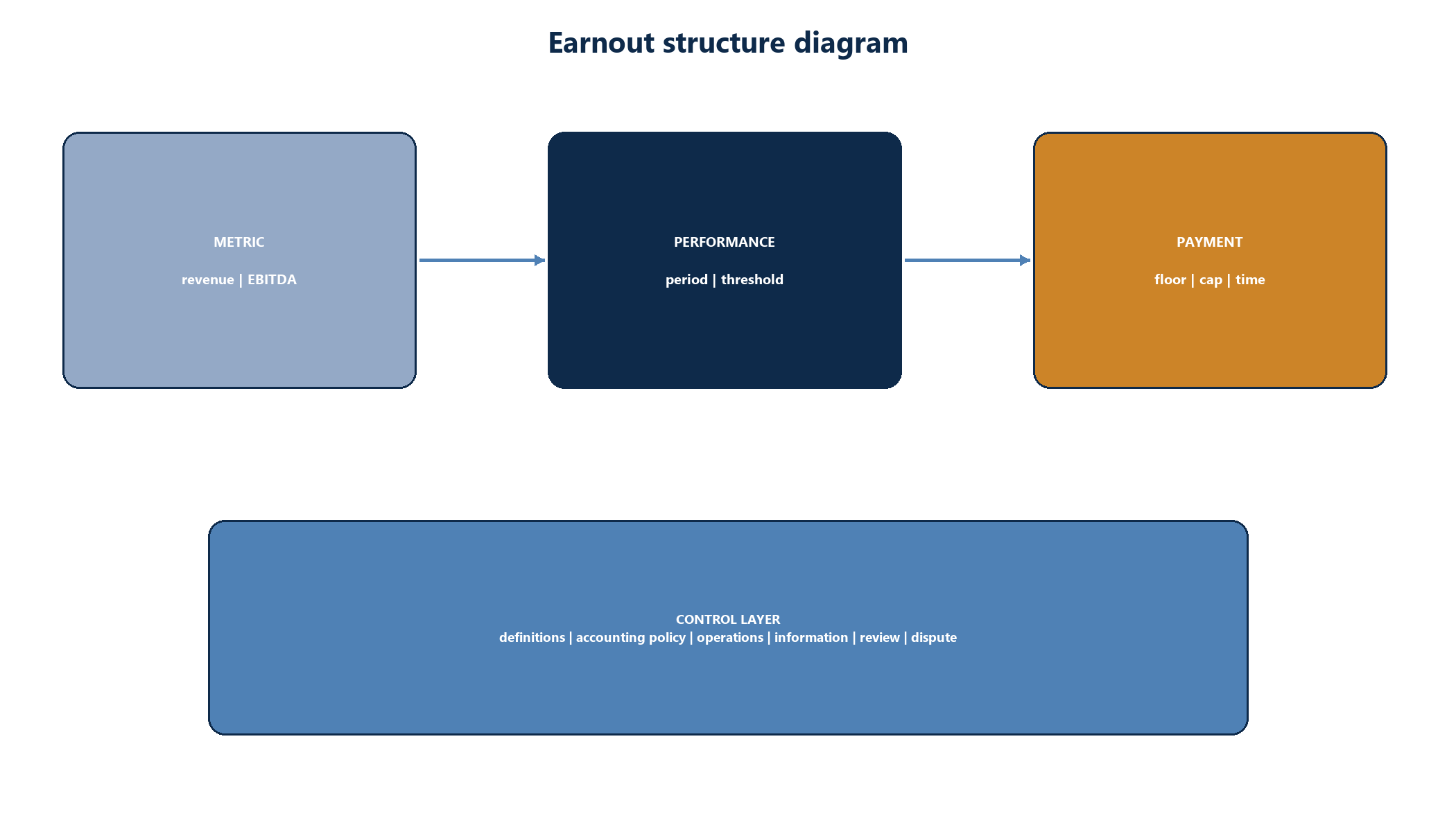
Revenue can be observable and vulnerable to discounting, channel stuffing, bundling and acquisition accounting. Gross profit adds cost-allocation questions. EBITDA can align with profitability and is exposed to accounting policy, allocations, investment and integration. Net income adds financing, tax and non-operating decisions. Operational milestones can be clearer when objectively defined and independently verifiable.
The metric should connect to the disputed value driver and remain measurable after closing. A seller who retains operating responsibility may accept a metric it can influence. A buyer may require a metric that reflects value after cost. Multiple metrics increase complexity and can reduce manipulation when designed coherently.
Formula
The term sheet states performance period, threshold, target, cap, slope, floor, currency, time, payment date and examples. It defines accounting policies, consistency, acquisitions, disposals, new products, intercompany charges, allocation, capital expenditure, head-office cost, financing, tax, force majeure and changes in law. Worked examples should cover boundary values and adverse cases.
Information and verification
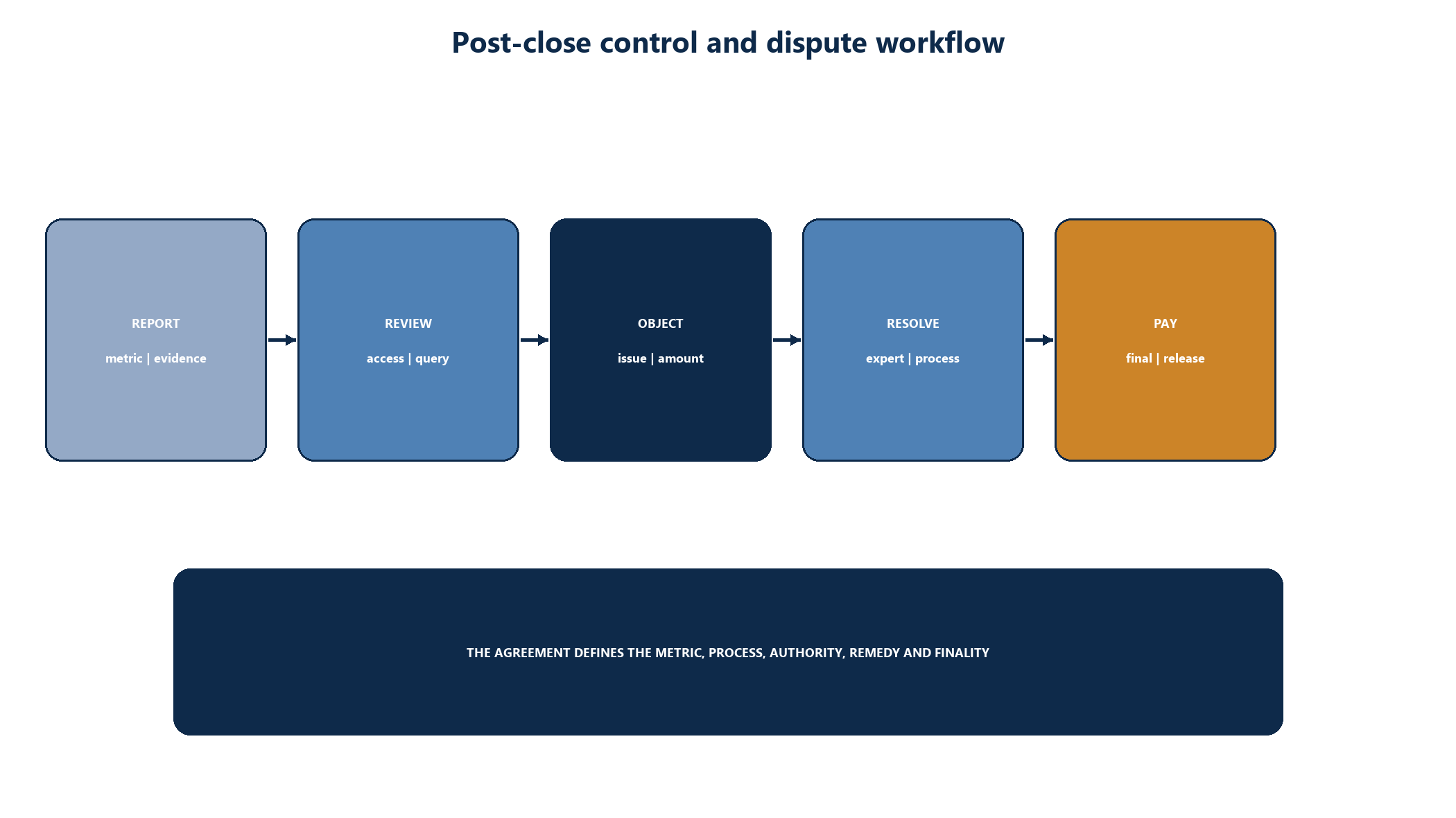
The seller needs timely statements, underlying records, calculation detail, access, query rights and an objection period. The buyer needs confidentiality, privilege, operational control and finality. The agreement should identify the preparer, reviewer, expert, scope of review, burden, time limits, costs and effect of missing information.
Operating covenants
The covenant package can require ordinary-course operation, good faith, specified resources, separate books, non-diversion of revenue, consistent accounting and restrictions on actions designed primarily to avoid payment. Drafting should match governing law and the actual bargain. Broad language can create uncertainty. Narrow language can leave uncontrolled value drivers.
Payment security
Security can include escrow, guarantee, letter of credit, retention, covenant or accelerated payment. Each changes cost and credit. Set-off rights require careful drafting because unrelated claims can delay an otherwise earned amount.
Accounting, Tax And Legal Perimeter
Accounting
IFRS 3 addresses acquisition-date measurement and disclosure of contingent consideration in a business combination [2]. IFRS 13 provides the fair-value framework [1]. The classification of future payments can depend on whether they form purchase consideration or remuneration linked to continued employment, among other facts. The IFRS Interpretations Committee considered payments contingent on continued employment during handover periods in 2024 [44]. The parties should model accounting consequences before agreeing the structure.
Tax
UAE corporate-tax treatment depends on facts, parties and structure. The Ministry of Finance and Federal Tax Authority publish official materials on corporate tax, business-restructuring relief and deregistration [27-33]. Ministerial decisions describe conditions and possible clawback for restructuring relief [29]. The FTA guide is explanatory and states its status. Transaction advisers should confirm eligibility, elections, filing, valuation, consideration and subsequent-transfer consequences.
Company and family-company law
The Ministry's companies-legislation page records current federal company-law materials and amendments [9,36]. Family-company law and governance materials can affect transfer and approvals [8,10,35]. Free-zone rules, constitutional documents, shareholder agreements, financing and sector regulation can add requirements. Counsel should determine the transaction path.
Governing law and disputes
Earnout rights are contractual. Court decisions from Delaware provide detailed foreign examples of disputes concerning metrics, operating conduct, reimbursement, information and alternative dispute resolution [21-25]. They are not UAE law and do not predict an outcome in a UAE or free-zone court or arbitration. uses them to illustrate issues that precise drafting and evidence should address.
Post-Close Operating Covenants
Operating plan
The earnout schedule should attach or identify the operating plan used in valuation. It states budget, resources, products, territories, channels, capital expenditure, management roles and integration. Deviations require a process. The plan should allow necessary management decisions while preserving the economic premise of the contingent payment.
Books and allocations
Separate books can improve traceability when the business is integrated. The agreement defines allocations for shared staff, systems, marketing, premises, financing and group services. Acquisitions or disposals during the period require treatment. Revenue recognition and cost classification should be consistent with the agreed policy unless law or applicable accounting standards require change.
Information rights
Monthly or quarterly reporting can surface issues before the final calculation. Rights should be proportionate and respect confidentiality, privilege, privacy and competition law. The seller's representative should receive data sufficient to reproduce the calculation. An independent accountant can receive broader information subject to the agreed process.
Change control
Every material change to the metric, policy, system, perimeter or operating plan should have a record: proposer, reason, date, quantified impact, approval and treatment. Silence should not rewrite the bargain. Counsel should define whether and how consent can be withheld and what remedy applies.
Dispute Evidence And Case Lessons
Frequency evidence
SRS Acquiom's 2026 risk discussion, drawing on its deal-terms data, reports that about three in ten private-target acquisitions face a post-closing indemnity claim and that at least as many earnout deals encounter a dispute [15]. Its claims and earnout analysis reports that outside life sciences just over half of earnout deals in its dataset achieve some payout, while most available earnout dollars remain unpaid [14]. These are proprietary SRS datasets and definitions. They provide current scoped evidence and do not establish GCC-wide rates.
ABA's 2025 study supplies earnout prevalence for its agreement sample and does not measure universal dispute incidence [11,12]. Market and court data therefore serve different purposes. Agreement studies show drafted terms. Claims administrators show matters handled in their populations. Courts show litigated issues. None alone measures all signed GCC deals.
Contract language controls
Delaware opinions repeatedly examine the words the parties selected. The Auris and Johnson & Johnson dispute concerned a transaction with substantial contingent value and illustrates how earnouts bridge a price gap while making contractual obligations central [21]. A Delaware Supreme Court decision concerning a capped earnout considered the agreed calculation sequence and alternative dispute process [22]. Another post-trial opinion involved objective milestones and disagreement over reimbursement treatment after the parties could not agree an upfront price [23].
Operations and metric control
A Delaware Superior Court opinion considered allegations that post-closing operational choices reduced EBITDA and affected the earnout, alongside the scope of an independent-auditor process [24]. The SRS representative dispute concerning Sphera includes allegations relating to cross-selling and budget decisions [25]. These examples show why the agreement should define operating discretion, resources, allocation and remedies.
Expert determination
An accounting expert can decide defined calculation questions. A court or arbitral tribunal may address contract interpretation, conduct or legal remedies depending on the clause and governing law. The drafting should distinguish accounting disputes from legal disputes, define the expert's authority and specify finality, procedure, evidence and costs. The parties need legal advice for the selected forum.
Dispute-prevention record
The operating team should maintain monthly metric calculations, source extracts, allocation schedules, policy changes, management decisions, seller queries and responses. Early review can identify a disagreement while corrective action remains possible. The record also supports a bounded final objection process.
Structure Alternatives
Fixed deferred consideration
A fixed payment moves timing and credit risk without making value contingent on performance. It can address buyer funding or seller tax and liquidity objectives subject to advice. Security, ranking, interest, covenants, acceleration and set-off determine economic value.
Seller note
A seller note finances part of the price. It can support transaction certainty and creates borrower credit exposure. Terms should be compared with market financing, collateral, subordination and intercreditor restrictions. The seller should evaluate recovery under downside, not only scheduled interest.
Rollover equity
Rollover lets the seller retain participation in future value. It also retains illiquidity, governance, dilution and exit risk. The seller should understand security class, rights, waterfall, leverage, reserved matters, information, transfer, drag, tag, future funding and exit. The buyer should evaluate alignment and governance complexity.
Staged acquisition and options
A buyer can acquire control or a majority first and purchase the remainder later under an agreed formula or option. The structure raises future valuation, control, minority protection, financing and enforcement questions. A put or call can create a substantial future liability. Legal, tax and accounting advice should precede agreement.
Escrow and holdback
Escrow can secure defined historic risks. It is usually a poor substitute for a performance mechanism when the disputed value concerns future growth. The parties should map each risk to the instrument designed to address it.
Comparison matrix
| Structure | Seller receives | Buyer protection | Main retained risk |
|---|---|---|---|
| Cash at close | Certain liquid value | Limited unless other protections apply | Buyer bears future performance |
| Fixed deferral | Contractual future payment | Funding relief | Seller bears credit and time |
| Earnout | Conditional future payment | Pays for realised outcome | Metric, control, credit and dispute |
| Seller note | Principal and interest | Purchase financing | Credit, ranking and recovery |
| Rollover | Future equity participation | Alignment and lower cash need | Liquidity, governance and dilution |
| Staged sale | Cash plus future sale right | Learning and risk staging | Future valuation and control |
Negotiation, Governance And Approval
Parallel workstreams
Valuation, diligence, tax, legal drafting, financing and regulatory work should use one assumptions register. A change in forecast can affect value, covenants, financing and earnout. A change in perimeter can affect accounts, tax and approvals. The transaction office records dependencies and unresolved items.
Bid comparison
The seller should compare bids through expected and downside proceeds, not headline price alone. The schedule includes cash at close, probability-weighted contingent value for internal decision use, time, credit, escrow, indemnity, rollover liquidity, tax, costs, conditions and execution risk. Probability-weighting is an analytical input and does not convert contingent consideration into certain proceeds.
Decision gates
| Gate | Minimum evidence | Approval owner |
|---|---|---|
| Perimeter | Entity and asset schedule | Seller board and counsel |
| Earnings | Reconciled normalisation register | Finance and valuation leads |
| Value | Comparable, DCF and sensitivity record | Respective approval bodies |
| Structure | Cash, deferred, contingent and retained risk | Buyer and seller boards |
| Drafting | Definitions, examples, covenants and disputes | Transaction counsel |
| Funding | Sources, security, conditions and timing | Buyer finance authority |
| Closing | Updated bridge and completion schedule | Authorised signatories |
Family governance
A family owner may require an internal decision before external negotiation. The process should record who represents the family, who owns the shares, which approvals apply, how proceeds are allocated and how retained ownership is governed. Official UAE family-company materials provide a legal and governance context [8,10,35]. The specific solution depends on documents and facts.
Communications
The bridge supports consistent communication across owner, board, management, advisers and buyer. It remains confidential. External statements, employee communications and data-room disclosure require authorised review. Negotiation positions should not be presented as independent valuation conclusions.
hypothetical illustrative examples
Facts
Illustrative example A UAE-based family-owned services company reports AED 18.0 million EBITDA. The seller applies an 8.0x multiple and describes enterprise value as AED 144.0 million. The buyer supports AED 14.5 million normalised EBITDA and a 6.5x multiple, producing AED 94.25 million. The apparent gap is AED 49.75 million. These figures are invented for method demonstration and are not a market benchmark, Matchpoint result or client case.
The parties reconcile AED 1.2 million of genuinely removable owner costs, reject AED 1.0 million of recurring annual exceptional costs and include AED 0.8 million replacement management cost. They agree base normalised EBITDA of AED 15.7 million. They also identify a signed but early-stage customer programme that could add AED 3.0 million EBITDA after delivery investment.
Method sensitivity
Illustrative example Verified comparables support a 6.5x to 7.5x range after size and concentration review. Applied to AED 15.7 million, the indicative enterprise-value range is AED 102.05 million to AED 117.75 million. A DCF using invented operating assumptions produces AED 105 million in downside, AED 114 million in base and AED 128 million in upside. The upper DCF depends on conversion of the new customer programme and margin expansion.
| Method or case | Low | Base | High | Evidence state |
|---|---|---|---|---|
| Comparable method | AED 102.05m | AED 109.90m | AED 117.75m | Invented range for illustration |
| DCF | AED 105.00m | AED 114.00m | AED 128.00m | Invented assumptions for illustration |
| Reconciled cash value | AED 108.00m | AED 112.00m | AED 116.00m | Negotiation example only |
| Potential earnout | AED 0 | AED 8.00m | AED 15.00m | Conditional example only |
Structure
Illustrative example The parties use AED 112 million enterprise value as the cash-price reference, subject to net debt and working capital. They create an earnout of up to AED 15 million linked to cumulative gross profit from the identified programme over two years. The seller retains access to contract-level revenue and direct-cost evidence. The buyer retains operational control subject to defined non-diversion, allocation and reporting obligations. An independent expert determines specified calculation disputes.
The example does not claim that this structure is optimal. It shows how cash can price the evidenced base and contingent value can price a bounded future driver. Legal, tax, accounting, credit and operational advice could produce a different result.
Equity bridge
Illustrative example The company has AED 12 million agreed net debt, an AED 3 million working-capital shortfall, AED 4 million escrow and AED 2 million transaction expenses. Cash at close before tax is AED 91 million: AED 112 million enterprise value less AED 12 million net debt, AED 3 million working capital, AED 4 million escrow and AED 2 million expenses. The AED 15 million earnout remains separate and uncertain.
This bridge prevents the seller from describing AED 127 million as immediate proceeds. It also prevents the buyer from describing the earnout as costless. The buyer should value the contingent liability under the applicable reporting framework, and the seller should value time, credit and probability for its own decision.
Sensitivity and failure case
Illustrative example If the buyer changes the product bundle, reallocates shared salespeople and moves direct costs among business units, gross profit can change without a change in customer economics. The term sheet therefore needs product and customer identifiers, revenue treatment, direct and allocated cost rules, policy consistency, change control, information rights and worked calculations. If these cannot be agreed, rollover or fixed deferred consideration may be more administrable.
Ninety-Day Implementation
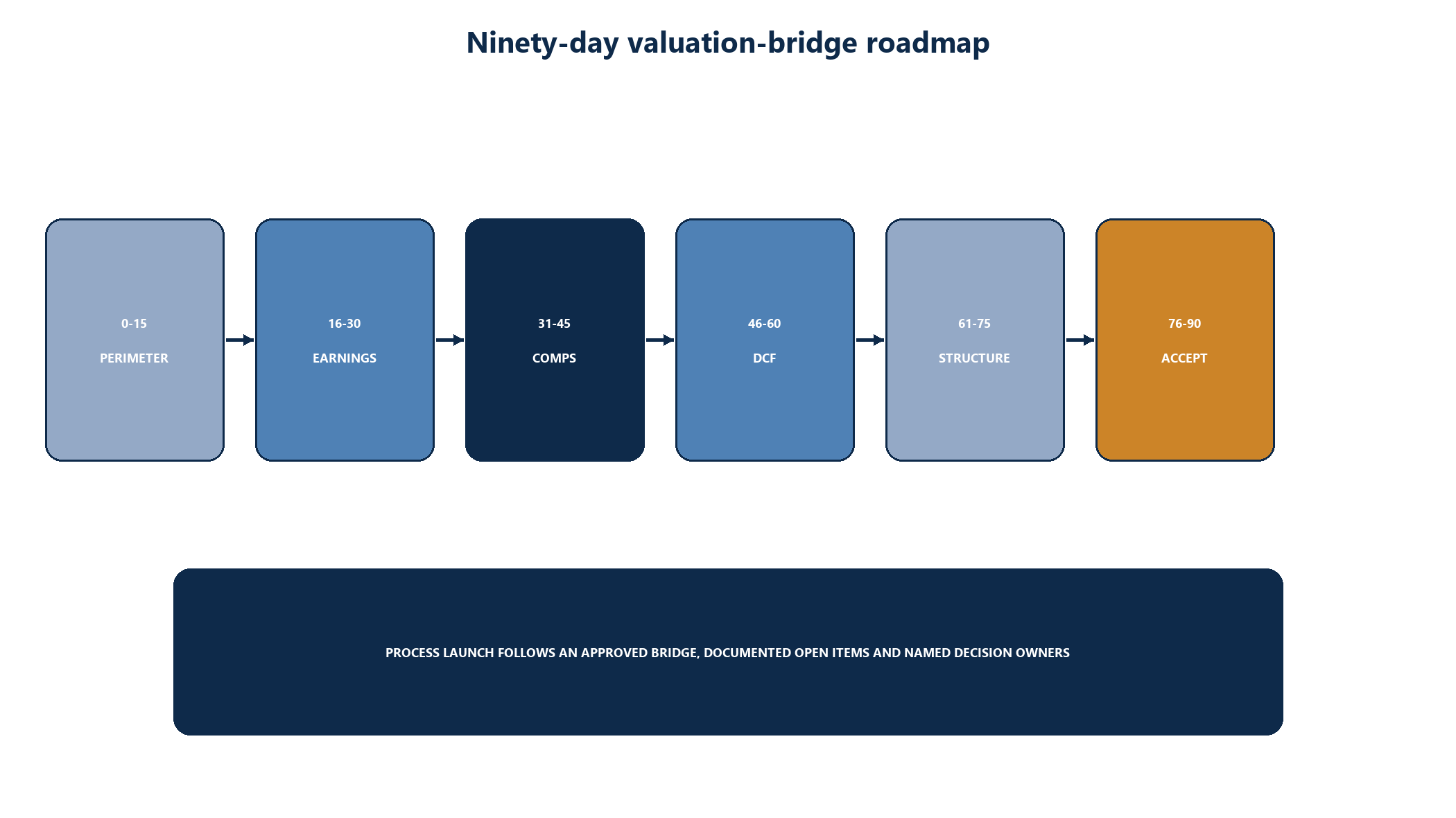
Days 0 to 15: perimeter and authority
Days 16 to 30: earnings and cash
Reconcile reported accounts, management results, bank, tax and working-capital populations. Build the normalised EBITDA register. Separate seller adjustments, buyer adjustments, agreed items and unresolved items. Bridge EBITDA to cash flow.
Days 31 to 45: market evidence
Create the comparable universe and verify transaction terms and denominators. Record rejected candidates. Select and document the range. Test size, concentration, growth, margin, geography, liquidity and control.
Days 46 to 60: DCF and sensitivities
Approve forecast drivers, downside states, discount-rate components and terminal treatment. Reconcile DCF with market evidence. Identify value dependent on unsigned pipeline, buyer capital or synergy.
Days 61 to 75: structure
Model cash at close, fixed deferral, seller note, earnout, rollover and staged alternatives. Draft metric, formula, examples, operating covenants, information rights, security and dispute process. Obtain accounting, tax and legal advice.
Days 76 to 90: acceptance and process launch
Approve the valuation bridge, bid-comparison model, negotiation limits and disclosure plan. Close or assign every open issue. Launch the process only with a reproducible evidence pack and named authorities. The ninety-day sequence is a Matchpoint implementation framework. No observed benchmark establishes elapsed time or economic benefit.
Economics and measurement
The programme should record internal hours, adviser cost, bid changes, diligence issues, time to resolution, working-capital and net-debt changes, contingent value, disputes and proceeds. Attribution requires a counterfactual and approval. claims no Matchpoint or client revenue, cost saving, loss prevention or alpha. Attributed amounts remain USD 0.
Limitations And Conclusion
The practical conclusion is that meeting in the middle requires a shared evidence and transaction architecture. The parties define one perimeter, reconcile earnings, retain method-specific ranges, expose synergy, agree enterprise-to-equity definitions and compare structure by certainty, time, credit, control, tax, accounting and enforceability. An earnout can allocate a bounded future uncertainty. It also creates a contractual claim that needs precise metric definitions, operating covenants, information rights, examples and dispute mechanics.
For owners, the central output is a defensible bridge from business evidence to proceeds and retained obligations. For buyers, it is an underwriting bridge from historical evidence to value, consideration, governance and return. Agreement occurs when the accepted structure reflects both the supported base and the allocated uncertainty.
References
[1] IFRS Foundation. IFRS 13 Fair Value Measurement. Issued Standards. https://www.ifrs.org/issued-standards/list-of-standards/ifrs-13-fair-value-measurement/
[2] IFRS Foundation. IFRS 3 Business Combinations. Issued standard. https://www.ifrs.org/content/dam/ifrs/publications/pdf-standards/english/2022/issued/part-a/ifrs-3-business-combinations.pdf?bypass=on
[3] IFRS Foundation. Accounting for Contingent Consideration in a Business Combination. Annual Improvements project. https://www.ifrs.org/projects/completed-projects/2013/accounting-for-contingent-consideration-in-a-business-combination/
[4] International Valuation Standards Council. New edition of the International Valuation Standards published. 31 January 2024; effective 31 January 2025. https://ivsc.org/new-edition-of-the-international-valuation-standards-ivs-published/
[5] International Private Equity and Venture Capital Valuation Board. International Private Equity and Venture Capital Valuation Guidelines. 2025. https://www.privateequityvaluation.com/Valuation-Guidelines
[6] U.S. Securities and Exchange Commission. Good Faith Determinations of Fair Value: Small Entity Compliance Guide. https://www.sec.gov/resources-small-businesses/small-business-compliance-guides/good-faith-determinations-fair-value-small-entity-compliance-guide
[7] OECD. G20/OECD Principles of Corporate Governance 2023. https://doi.org/10.1787/ed750b30-en
[8] UAE Ministry of Economy and Tourism. Federal Decree-Law No. 37 of 2022 Concerning Family Companies. https://www.moet.gov.ae/documents/20121/0/family%2Bcompany%2Benglish%2Bversion%2Bexamined%2Band%2Bcorrecetd.pdf/5639a956-fe15-6de2-a04e-c8f8ecb6c2bf
[9] UAE Ministry of Economy and Tourism. Companies legislations. Accessed 2 August 2026. https://www.moet.gov.ae/en/companies-legislations
[10] UAE Ministry of Economy and Tourism. Unified family businesses registry and governance decisions. https://www.moet.gov.ae/en/-/ministry-of-economy-launches-unified-family-businesses-registry-and-reviews-four-new-decisions-to-strengthen-the-sector-s-governance
[11] American Bar Association. 2025 Private Target M&A Deal Points Study. December 2025. https://www.americanbar.org/groups/business_law/resources/business-law-today/2025-december/aba-2025-private-target-mergers-acquisitions-deal-points-study/
[12] American Bar Association. M&A Deal Points Studies. Current studies page. https://www.americanbar.org/groups/business_law/about/committees/mergers-and-acquisitions/deal-points/
[13] American Bar Association. The Ins and Outs of Earn-Outs: A Delaware Perspective. March 2022. https://www.americanbar.org/groups/business_law/resources/business-law-today/2022-march/the-ins-and-outs-of-earn-outs-a-delaware-perspective/
[14] SRS Acquiom. M&A Claims, Undisclosed Liabilities and Earnouts. 2025. https://www.srsacquiom.com/our-insights/ma-claims-undisclosed-liabilities-earnouts/
[15] SRS Acquiom. M&A Risks: The Real Threats to Shareholder Representatives. 2026. https://www.srsacquiom.com/our-insights/ma-risks/
[16] SRS Acquiom. M&A Earnouts: An Overview. https://www.srsacquiom.com/our-insights/ma-earnouts-overview/
[17] Axial. 2026 Lower Middle Market M&A Outlook. Survey of 107 Axial members. https://www.axial.net/forum/2026-lower-middle-market-ma-outlook-valuations-deal-activity-market-trends/
[18] BizBuySell. Insight Report: Business for Sale Market. Accessed 2 August 2026. https://www.bizbuysell.com/insight-report/
[19] National Center for the Middle Market, Ohio State University. Owner Transitions in the Middle Market. https://www.middlemarketcenter.org/research-reports/owner-transitions-in-the-middle-market
[20] GF Data. The Size Premium and the ESOP Competitive Advantage. https://gfdata.com/size-premium-esop-competitive-advantage/
[21] Delaware Court of Chancery. Auris earnout opinion. Official opinion. https://courts.delaware.gov/Opinions/Download.aspx?id=369060
[22] Supreme Court of Delaware. Earnout calculation and alternative dispute-resolution opinion. Official opinion. https://courts.delaware.gov/opinions/download.aspx?id=391560
[23] Delaware Court of Chancery. Post-trial earnout milestone opinion. Official opinion. https://courts.delaware.gov/Opinions/Download.aspx?id=374340
[24] Delaware Superior Court. Earnout EBITDA and independent-auditor opinion. Official opinion. https://courts.delaware.gov/opinions/download.aspx?id=397810
[25] Delaware Court of Chancery. SRS v. Sphera Solutions earnout opinion. March 2026. https://courts.delaware.gov/Opinions/Download.aspx?id=393840
[26] Delaware General Assembly. Delaware Code, Title 8, Corporations. https://delcode.delaware.gov/title8/
[27] UAE Federal Tax Authority. Business Restructuring Relief. https://tax.gov.ae/en/content/business.restructuring.relief.aspx
[28] UAE Federal Tax Authority. Business Restructuring Relief Guide. 17 April 2024. https://tax.gov.ae/Datafolder/Files/Guides/CT/Business%20Restructuring%20Relief%20-%2017%2004%202024.pdf
[29] UAE Ministry of Finance. Corporate tax decisions on intra-group transfers, taxable income and restructuring relief. https://mof.gov.ae/en/news/ministry-of-finance-issues-new-corporate-tax-decisions-on-intra-group-transfers-determination-of-taxable-income-and-restructuring-relief/
[30] UAE Ministry of Finance. Corporate Tax. https://mof.gov.ae/en/public-finance/tax/corporate-tax/
[31] UAE Federal Tax Authority. Corporate Tax Deregistration. Current service page. https://www.tax.gov.ae/en/services/corporate.tax.deregistration.aspx
[32] UAE Ministry of Finance. Explanatory Guide for Corporate Tax Purposes. https://mof.gov.ae/en/news/ministry-of-finance-issues-explanatory-guide-for-corporate-tax-purposes/
[33] UAE Federal Tax Authority. Corporate Tax Guides and References. https://tax.gov.ae/en/taxes/corporate.tax/corporate.tax.guides.references.aspx
[34] UAE Legislation. Federal Decree-Law No. 47 of 2022 on the Taxation of Corporations and Businesses. https://uaelegislation.gov.ae/en/legislations/1582
[35] UAE Ministry of Economy and Tourism. Family Business Charter. 2024. https://www.moet.gov.ae/documents/20121/0/%D9%85%D9%8A%D8%AB%D8%%D9%82%2B%D8%%D9%84%D8%%D8%%D9%83%D8%%2B%D8%%D9%84%D8%%D8%%D9%8A%D9%94%D9%84%D9%8A%D8%%2B2024.pdf/510d46cd-8c28-3299-583e-6d27d164062f
[36] UAE Legislation. Federal Decree-Law No. 32 of 2021 on Commercial Companies. https://uaelegislation.gov.ae/en/legislations/1542
[37] Public Company Accounting Oversight Board. AS 1105: Audit Evidence. https://pcaobus.org/oversight/standards/auditing-standards/details/AS1105
[38] Public Company Accounting Oversight Board. AS 1215: Audit Documentation. https://pcaobus.org/oversight/standards/auditing-standards/details/AS1215
[39] IAASB. International Standard on Related Services 4400 (Revised), Agreed-Upon Procedures Engagements. https://www.iaasb.org/publications/international-standard-related-services-isrs-4400-revised-agreed-upon-procedures-engagements
[40] IFRS Foundation. IFRS 3 Supporting Material. https://www.ifrs.org/supporting-implementation/supporting-materials-by-ifrs-standards/ifrs-3/
[41] IFRS Foundation. IAS 36 Impairment of Assets. https://www.ifrs.org/issued-standards/list-of-standards/ias-36-impairment-of-assets/
[42] IFRS Foundation. IAS 12 Income Taxes. https://www.ifrs.org/issued-standards/list-of-standards/ias-12-income-taxes/
[43] IFRS Foundation. IFRS 10 Consolidated Financial Statements. https://www.ifrs.org/issued-standards/list-of-standards/ifrs-10-consolidated-financial-statements/
[44] IFRS Interpretations Committee. Payments Contingent on Continued Employment during Handover Periods. April 2024. https://www.ifrs.org/news-and-events/updates/ifric/2024/ifric-update-april-2024/
[45] Kaplan, S. N., and Ruback, R. S. The Valuation of Cash Flow Forecasts: An Empirical Analysis. Journal of Finance, 50(4), 1059-1093, 1995. https://doi.org/10.1111/j.1540-6261.1995.tb04050.x
[46] Cain, M. D., Denis, D. J., and Denis, D. K. Earnouts: A Study of Financial Contracting in Acquisition Agreements. Journal of Accounting and Economics, 51(1-2), 151-170, 2011. https://doi.org/10.1016/j.jacceco.2010.05.001
[47] Kohers, N., and Ang, J. Earnouts in Mergers: Agreeing to Disagree and Agreeing to Stay. Journal of Business, 73(3), 445-476, 2000. https://doi.org/10.1086/209647
[48] Barbopoulos, L., and Sudarsanam, S. Determinants of Earnout as Acquisition Payment Currency and Bidder's Value Gains. Journal of Banking and Finance, 36(3), 678-694, 2012. https://doi.org/10.1016/j.jbankfin.2011.10.007
[49] Financial Accounting Standards Board. Post-Implementation Review Report on FASB Statement No. 141(R), Business Combinations. https://storage.fasb.org/PIR_Report_FAS141R.pdf
[50] U.S. Securities and Exchange Commission. Good Faith Determinations of Fair Value, Investment Company Act Release No. 34128. 2020. https://www.sec.gov/files/rules/final/2020/ic-34128.pdf
[51] OECD. The responsibilities of the board: G20/OECD Principles of Corporate Governance 2023. https://www.oecd.org/en/publications/g20-oecd-principles-of-corporate-governance-2023_ed750b30-en/full-report/component-8.html
[52] UAE Ministry of Economy and Tourism. Family Businesses. Official policy and legislation portal. https://www.moet.gov.ae/en/family-businesses
Appendix A. Normalised Ebitda Record
| Field | Required content |
|---|---|
| Adjustment ID | Stable reference linked to calculation and source |
| Entity and period | Legal entity, account, month and currency |
| Reported amount | Amount in reconciled source reporting |
| Proposed adjustment | Positive or negative change and rationale |
| Category | Classification, exceptional, owner-specific, run-rate, synergy or other |
| Cash effect | Cash, non-cash or timing |
| Recurrence | Recurring, non-recurring, uncertain or forecast-only |
| Replacement cost | Required continuing cost and source |
| Evidence | Contract, invoice, ledger, bank, payroll, tax or management explanation |
| Forecast treatment | Included, excluded or separately modelled |
| Seller position | Accepted, rejected or open |
| Buyer position | Accepted, rejected or open |
| Reviewer | Name, role, date and decision |
| Structure | Seller receives | Buyer protection | Main retained risk |
|---|---|---|---|
| Cash at close | Certain liquid value | Limited unless other protections apply | Buyer bears future performance |
| Fixed deferral | Contractual future payment | Funding relief | Seller bears credit and time |
| Earnout | Conditional future payment | Pays for realised outcome | Metric, control, credit and dispute |
| Seller note | Principal and interest | Purchase financing | Credit, ranking and recovery |
| Rollover | Future equity participation | Alignment and lower cash need | Liquidity, governance and dilution |
| Staged sale | Cash plus future sale right | Learning and risk staging | Future valuation and control |
Appendix B. Comparable Adjustment Record
- Identify transaction or company, source, date and market.
- Reproduce enterprise value and equity value from disclosed terms.
- Identify cash, debt, contingent value, rollover and acquired interests.
- Reproduce the selected financial metric and period.
- Confirm accounting and lease basis.
- Compare business model, geography, scale, growth, margin and concentration.
- Record control, liquidity and transaction-process differences.
- State adjustment rationale, range and evidence.
- Retain excluded candidates and reasons.
- Record reviewer and approval date.
Appendix C. Dcf Assumption Register
| Assumption | Base | Downside | Upside | Source | Owner | Dependency | Review state |
|---|---|---|---|---|---|---|---|
| Revenue volume | Required | Required | Required | Contract or operating data | Commercial lead | Capacity | Open or accepted |
| Price | Required | Required | Required | Contract or market data | Commercial lead | Mix and renewal | Open or accepted |
| Gross margin | Required | Required | Required | Ledger and plan | Finance lead | Volume and procurement | Open or accepted |
| Working capital | Required | Required | Required | Monthly history | Finance lead | Growth and terms | Open or accepted |
| Capital expenditure | Required | Required | Required | Asset and capacity plan | Operations lead | Growth | Open or accepted |
| Tax | Required | Required | Required | Adviser analysis | Tax lead | Structure | Open or accepted |
| Discount rate | Required | Required | Required | Market inputs and policy | Valuation lead | Currency and cash flow | Open or accepted |
| Terminal assumption | Required | Required | Required | Economics and market | Valuation lead | Steady state | Open or accepted |
Appendix D. Earnout Term-Sheet Checklist
- State the economic uncertainty the earnout addresses.
- Define metric, period, currency, threshold, target, cap, floor and slope.
- Attach worked examples at boundary and adverse cases.
- Define accounting policies, consistency and required changes.
- Define acquisitions, disposals, integration and intercompany allocations.
- Define ordinary-course conduct, resources and prohibited actions.
- Define reporting, source access, queries and objection periods.
- Define security, payment date, interest, set-off and acceleration.
- Separate accounting-expert questions from legal disputes.
- Identify forum, governing law, finality, costs and enforcement.
- Obtain transaction-specific legal, tax, accounting and valuation advice.
- Approve the schedule through buyer and seller authorities.
| Method or case | Low | Base | High | Evidence state |
|---|---|---|---|---|
| Comparable method | AED 102.05m | AED 109.90m | AED 117.75m | Invented range for illustration |
| DCF | AED 105.00m | AED 114.00m | AED 128.00m | Invented assumptions for illustration |
| Reconciled cash value | AED 108.00m | AED 112.00m | AED 116.00m | Negotiation example only |
| Potential earnout | AED 0 | AED 8.00m | AED 15.00m | Conditional example only |
Appendix E. Valuation-Bridge Acceptance Record
| Gate | Required attachment | Owner | Status |
|---|---|---|---|
| Perimeter | Entity, asset, liability and exclusion schedule | Legal leads | Open or accepted |
| Evidence | Source and contradiction register | Finance and diligence | Open or accepted |
| Earnings | Normalised EBITDA and cash-conversion bridge | Finance and valuation | Open or accepted |
| Comparables | Universe, terms, adjustments and range | Valuation lead | Open or accepted |
| DCF | Drivers, sensitivities and terminal analysis | Valuation lead | Open or accepted |
| Equity bridge | Net debt, working capital and cash schedule | Finance and counsel | Open or accepted |
| Structure | Cash, deferred, contingent and retained risk | Approval bodies | Open or accepted |
| Earnout | Formula, covenants, rights, security and dispute | Counsel and finance | Open or accepted |
| Tax and accounting | Written adviser analysis | Tax and accounting leads | Open or accepted |
| Process | Bid comparison, limits and communication plan | Transaction lead | Open or accepted |
Appendix F. Claims Register
| Claim | Evidence | Scope | conclusion |
|---|---|---|---|
| Earnouts appeared in 18% of the ABA 2025 sample | ABA study [11] | 139 public agreements; private targets acquired by public buyers | Report only within sample |
| Valuation expectations led 28.3% of cited failures | Axial survey [17] | 107 lower-middle-market respondents | Report as respondent survey result |
| Post-closing claims and earnout disputes are frequent | SRS proprietary data [14-16] | SRS-administered private-target deals | Report with source limitation |
| creates financial benefit | No approved observed evidence | Matchpoint or client attribution | Revenue, saving, loss reduction and alpha remain USD 0 |
Source Register
The full paper records the scope, evidence setting and limitations applied to these sources.
- [1] IFRS Foundation. **IFRS 13 Fair Value Measurement.** Issued Standards. Open source
- [2] IFRS Foundation. **IFRS 3 Business Combinations.** Issued standard. Open source
- [3] IFRS Foundation. **Accounting for Contingent Consideration in a Business Combination.** Annual Improvements project. Open source
- [4] International Valuation Standards Council. **New edition of the International Valuation Standards published.** 31 January 2024; effective 31 January 2025. Open source
- [5] International Private Equity and Venture Capital Valuation Board. **International Private Equity and Venture Capital Valuation Guidelines.** 2025. Open source
- [6] U.S. Securities and Exchange Commission. **Good Faith Determinations of Fair Value: Small Entity Compliance Guide.** Open source
- [7] OECD. **G20/OECD Principles of Corporate Governance 2023.** Open source
- [8] UAE Ministry of Economy and Tourism. **Federal Decree-Law No. 37 of 2022 Concerning Family Companies.** Open source
- [9] UAE Ministry of Economy and Tourism. **Companies legislations.** Accessed 2 August 2026. Open source
- [10] UAE Ministry of Economy and Tourism. **Unified family businesses registry and governance decisions.** Open source
- [11] American Bar Association. **2025 Private Target M&A Deal Points Study.** December 2025. Open source
- [12] American Bar Association. **M&A Deal Points Studies.** Current studies page. Open source
- [13] American Bar Association. **The Ins and Outs of Earn-Outs: A Delaware Perspective.** March 2022. Open source
- [14] SRS Acquiom. **M&A Claims, Undisclosed Liabilities and Earnouts.** 2025. Open source
- [15] SRS Acquiom. **M&A Risks: The Real Threats to Shareholder Representatives.** 2026. Open source
- [16] SRS Acquiom. **M&A Earnouts: An Overview.** Open source
- [17] Axial. **2026 Lower Middle Market M&A Outlook.** Survey of 107 Axial members. Open source
- [18] BizBuySell. **Insight Report: Business for Sale Market.** Accessed 2 August 2026. Open source
- [19] National Center for the Middle Market, Ohio State University. **Owner Transitions in the Middle Market.** Open source
- [20] GF Data. **The Size Premium and the ESOP Competitive Advantage.** Open source
- [21] Delaware Court of Chancery. **Auris earnout opinion.** Official opinion. Open source
- [22] Supreme Court of Delaware. **Earnout calculation and alternative dispute-resolution opinion.** Official opinion. Open source
- [23] Delaware Court of Chancery. **Post-trial earnout milestone opinion.** Official opinion. Open source
- [24] Delaware Superior Court. **Earnout EBITDA and independent-auditor opinion.** Official opinion. Open source
- [25] Delaware Court of Chancery. **SRS v. Sphera Solutions earnout opinion.** March 2026. Open source
- [26] Delaware General Assembly. **Delaware Code, Title 8, Corporations.** Open source
- [27] UAE Federal Tax Authority. **Business Restructuring Relief.** Open source
- [28] UAE Federal Tax Authority. **Business Restructuring Relief Guide.** 17 April 2024. Open source
- [29] UAE Ministry of Finance. **Corporate tax decisions on intra-group transfers, taxable income and restructuring relief.** Open source
- [30] UAE Ministry of Finance. **Corporate Tax.** Open source
- [31] UAE Federal Tax Authority. **Corporate Tax Deregistration.** Current service page. Open source
- [32] UAE Ministry of Finance. **Explanatory Guide for Corporate Tax Purposes.** Open source
- [33] UAE Federal Tax Authority. **Corporate Tax Guides and References.** Open source
- [34] UAE Legislation. **Federal Decree-Law No. 47 of 2022 on the Taxation of Corporations and Businesses.** Open source
- [35] UAE Ministry of Economy and Tourism. **Family Business Charter.** 2024. Open source
- [36] UAE Legislation. **Federal Decree-Law No. 32 of 2021 on Commercial Companies.** Open source
- [37] Public Company Accounting Oversight Board. **AS 1105: Audit Evidence.** Open source
- [38] Public Company Accounting Oversight Board. **AS 1215: Audit Documentation.** Open source
- [39] IAASB. **International Standard on Related Services 4400 (Revised), Agreed-Upon Procedures Engagements.** Open source
- [40] IFRS Foundation. **IFRS 3 Supporting Material.** Open source
- [41] IFRS Foundation. **IAS 36 Impairment of Assets.** Open source
- [42] IFRS Foundation. **IAS 12 Income Taxes.** Open source
- [43] IFRS Foundation. **IFRS 10 Consolidated Financial Statements.** Open source
- [44] IFRS Interpretations Committee. **Payments Contingent on Continued Employment during Handover Periods.** April 2024. Open source
- [45] Kaplan, S. N., and Ruback, R. S. **The Valuation of Cash Flow Forecasts: An Empirical Analysis.** Journal of Finance, 50(4), 1059-1093, 1995. Open source
- [46] Cain, M. D., Denis, D. J., and Denis, D. K. **Earnouts: A Study of Financial Contracting in Acquisition Agreements.** Journal of Accounting and Economics, 51(1-2), 151-170, 2011. Open source
- [47] Kohers, N., and Ang, J. **Earnouts in Mergers: Agreeing to Disagree and Agreeing to Stay.** Journal of Business, 73(3), 445-476, 2000. Open source
- [48] Barbopoulos, L., and Sudarsanam, S. **Determinants of Earnout as Acquisition Payment Currency and Bidder's Value Gains.** Journal of Banking and Finance, 36(3), 678-694, 2012. Open source
- [49] Financial Accounting Standards Board. **Post-Implementation Review Report on FASB Statement No. 141(R), Business Combinations.** Open source
- [50] U.S. Securities and Exchange Commission. **Good Faith Determinations of Fair Value, Investment Company Act Release No. 34128.** 2020. Open source
- [51] OECD. **The responsibilities of the board: G20/OECD Principles of Corporate Governance 2023.** Open source
- [52] UAE Ministry of Economy and Tourism. **Family Businesses.** Official policy and legislation portal. Open source