

A practical decision process
A five-step process for comparing direct, SPV and forward pre-IPO exposure structures.
- Define the exposure objective: Record the target company, ticket size, concentration limit, expected holding period, diversification need and tolerance for delivery risk.
- Identify what the investor will own: Establish whether the investor receives shares, an interest in a vehicle or a contractual claim to future delivery or value.
- Reconcile the all-in economics: Compare entry price, spread, legal and transfer costs, setup charges, management fees, carry, taxes and costs over the full expected holding period.
- Test access, control and downside: Review issuer consent, transfer restrictions, information and governance rights, manager powers, counterparty credit, liquidity and failure-to-deliver scenarios.
- Complete specialist review and document the choice: Obtain the legal, tax and investment reviews required for the specific structure and record why its access, cost and risk fit the mandate.
Introduction
An investor who wishes to own a share of a private company before it lists must answer two separate questions. The first is which company to back, a question of judgement about value, growth and the prospect of a listing, and one that the financial press and the investor's own analysis address at length. The second question, far less discussed but no less consequential, is how to take the exposure: through which legal and commercial structure the investor will acquire its interest in the company's shares. The same economic exposure to the same company can be obtained in several ways, and the way chosen determines what the investor actually owns, what it pays to own it, what risks sit between it and the shares, and how much of any eventual gain it keeps. This second question is the subject of this paper.
There are three principal structures through which pre-IPO secondary exposure is taken. The first is the direct secondary: the investor buys shares, or a direct interest in shares, from an existing holder, a founder, an employee or an early investor, and is recorded, subject to the company's consent and its transfer restrictions, as a holder on the capital table. The second is the pooled vehicle: a special-purpose vehicle or feeder fund acquires the shares and the investor buys an interest in the vehicle, so that the vehicle, not the investor, is the registered holder and the investor's claim runs through it. The third is the forward purchase agreement: the investor contracts with a counterparty to receive shares, or the value of shares, at or after a listing, paying today for a delivery that is contingent on events that have not yet occurred. Each of these structures is in wide use, each suits a different investor and a different situation, and each carries a characteristic set of costs and risks.
This paper compares the three structures and sets out a framework for choosing between them. It is written for the family office, the institution and the private investor weighing how to take a pre-IPO position, and for the adviser structuring that position on their behalf. Its purpose is to make the choice of structure explicit and disciplined: to show what each structure conveys, what each costs, what risks each carries, and the conditions under which each is the right choice. The central message is that the choice of structure is not a formality but a decision that materially changes the investor's risk and net return, and that the appropriate structure is the one whose access, cost and risk profile match the investor's ticket size, its appetite for diversification, and above all its tolerance for the delivery and counterparty risk that distinguishes a contingent claim from an owned one.
| Dimension | Direct secondary | SPV / feeder fund | Forward purchase |
|---|---|---|---|
| What the investor owns | The shares, or a direct interest in them | An interest in a vehicle that holds the shares | A contractual right to future delivery |
| Registered holder | The investor | The vehicle | Neither (until delivery) |
| Nature of the claim | Owned, direct | Owned, through the vehicle | Contingent, contractual |
| Typical minimum ticket | Large | Smaller (pooled) | Variable, often small |
| Diversification | None (single name) | Single name (SPV) or many (feeder) | None (single name) |
| Company consent at entry | Required | Required (by the vehicle) | Not required at entry |
| Principal risk | Access; concentration | Fees; reliance on manager | Contingency; counterparty; transfer |
| All-in cost | Lowest | Highest | High (embedded in price) |
The Mechanics Of The Three Structures
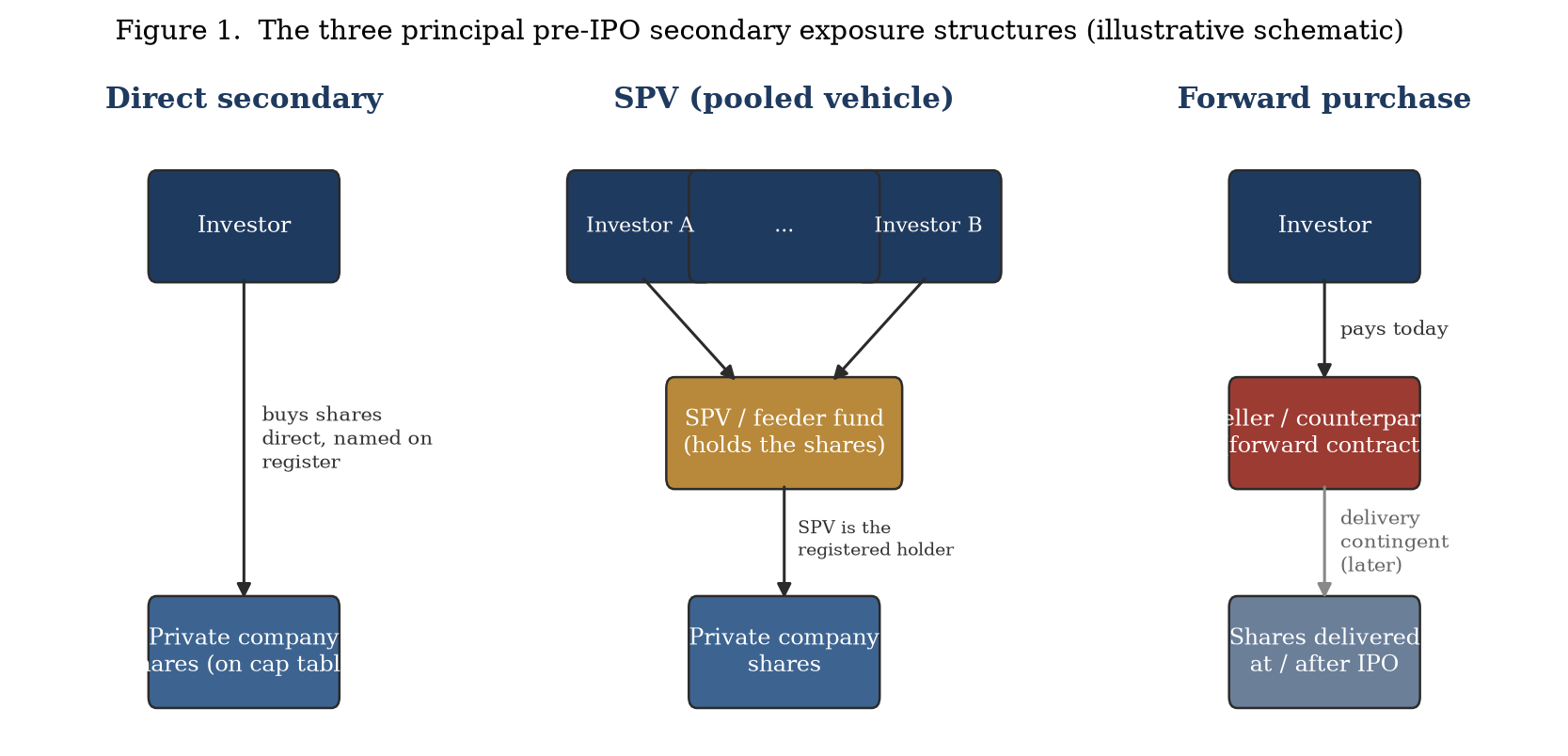
This section describes how each of the three structures works, what the investor acquires under each, and where each places the investor in relation to the shares. Figure 1 sets out the three schematically. The distinctions drawn here, what is owned, who is the registered holder, and whether the claim is owned or contingent, underlie the cost and risk comparisons that follow.
Figure 1. The three principal pre-IPO secondary exposure structures (illustrative schematic).
Before describing each structure in turn, it is useful to set them side by side on the dimensions that distinguish them. Table I summarises what the investor owns under each, who is the registered holder, whether the claim is owned or contingent, the typical minimum ticket, the degree of diversification, and the principal risk. The rows of the table are developed in the sections that follow; the table serves as a map of the comparison and as a reference to which the later analysis can be related.
Table I. Structure comparison matrix (illustrative). Rows are developed in Sections III to VI.
In a direct secondary, the investor buys shares, or a direct and recorded interest in shares, from an existing holder of the company. The transaction is between the buyer and the selling shareholder, but it cannot be completed without the company: the company's transfer restrictions must be satisfied, any right of first refusal must be waived or exhausted, and the company's consent, where required, must be obtained. Once completed, the investor is recorded on the company's register, or holds a direct beneficial interest recognised by the company, and stands in the same position as any other holder of that class of share. The investor's claim is to the shares themselves, unmediated by any vehicle or counterparty.
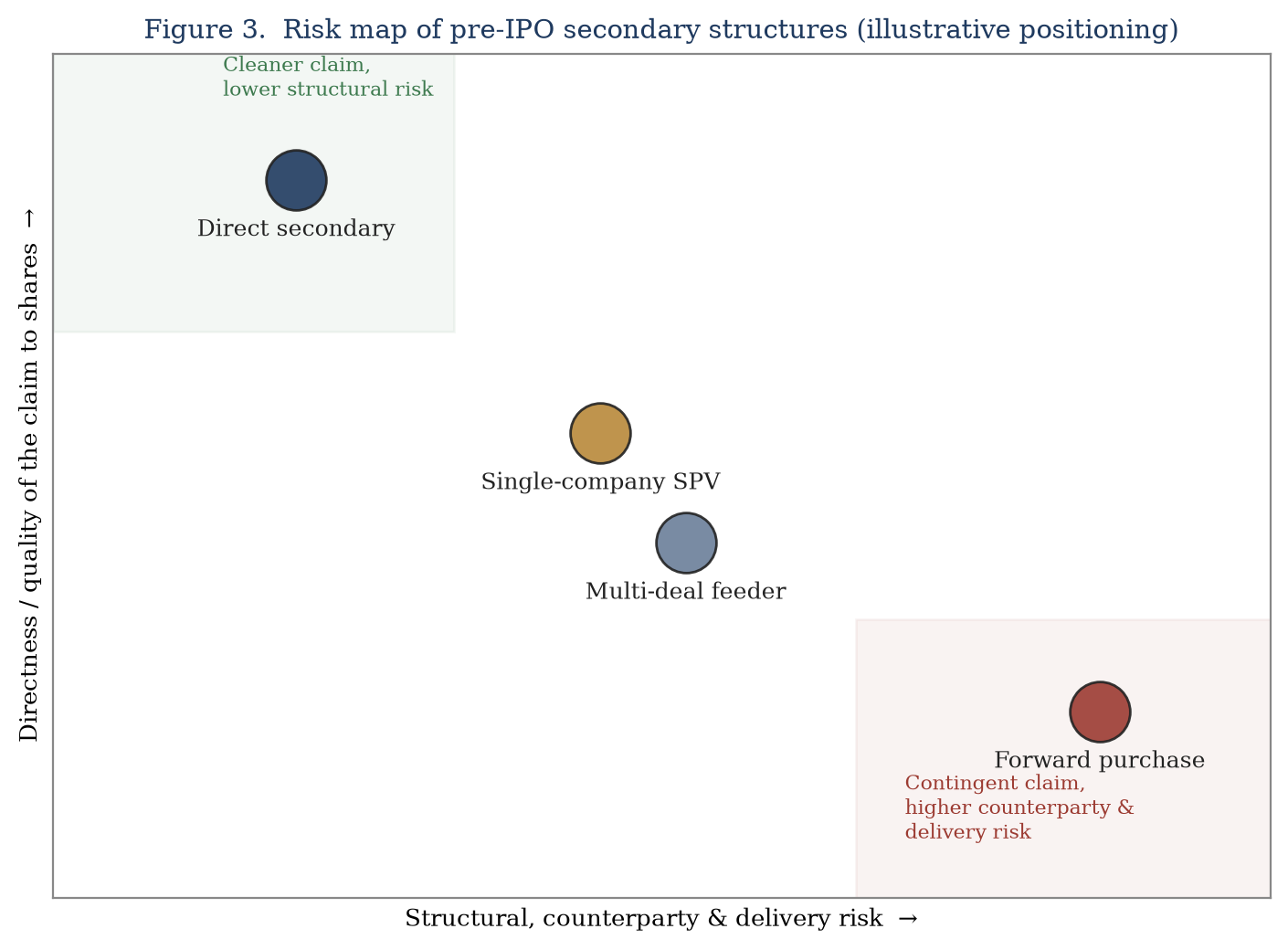
The direct secondary is the structure that conveys the cleanest claim, because the investor owns the shares directly and bears no structural layer between itself and the company. It is also the hardest to access. Direct stakes of a size worth transacting are scarce, the company's consent is not assured, and the process of clearing transfer restrictions is slow and uncertain. Sellers of direct stakes in the most sought-after companies transact in large size, so the direct route is in practice open mainly to investors who can write a large cheque and absorb a concentrated, single-name position. This is the substance of Proposition 1.
Within the direct route there are gradations. The cleanest form is a transfer recorded on the company's register with the company's express consent, leaving the investor a holder indistinguishable from any other. A less clean form is a direct beneficial interest recognised by the company but held through a nominee or custodial arrangement, which preserves the directness of the claim while easing the administrative burden of the transfer. The investor should establish which form it is acquiring, because the protections that attach to a recognised holder, information rights, pre-emption and the standing to enforce, may not attach to a less formal interest. The direct route is also the one in which the timing is least certain: clearing a right of first refusal alone can take weeks, during which the price may move and the opportunity may close, and an investor pursuing the direct route should plan for that delay rather than assume an immediate completion.
B. The special-purpose vehicle and the feeder fund
In a pooled structure, a special-purpose vehicle, or a feeder fund where several holdings are involved, acquires the shares and the investor buys an interest in the vehicle rather than in the shares directly. The vehicle, not the investor, is the registered holder; the investor's claim runs through the vehicle, governed by the vehicle's constitution and by the terms on which the manager operates it. A single-company SPV holds one company's shares and offers concentrated exposure to it; a multi-deal feeder fund holds several and offers a diversified pre-IPO portfolio. In both cases the manager assembles the holding, admits the investors, and administers the vehicle through to a liquidity event.
The pooled vehicle widens access in two ways. It aggregates smaller tickets into a holding large enough to transact, so that an investor who could not write the cheque for a direct stake can participate; and it gives access to a manager's deal flow and relationships, which may reach holdings the investor could not source alone. Where the vehicle holds several companies, it also diversifies the single-name risk that the direct route concentrates. These benefits come at a cost. The vehicle layers fees on the investor's return: an upfront set-up and placement charge, an annual management fee over the life of the hold, and, in many cases, a share of the profit, or carry. The investor also relies on the manager, for the quality of the holding acquired, for the administration of the vehicle, and for the eventual realisation, and bears the agency risk that the manager's interests may not align perfectly with its own. This is the substance of Proposition 2, and Section IV quantifies the cost.
| Cost component | Direct secondary | SPV / feeder fund | Forward purchase |
|---|---|---|---|
| Price spread / discount friction | Low to moderate | Moderate | High (premium for access) |
| Upfront set-up & placement | Low | High | Low to moderate |
| Annual management fee | None | Typically c. 1.5-2% p.a. | None |
| Carry / performance share | None | Typically c. 15-20% | None |
| Legal, transfer & ROFR | High | Moderate (borne by vehicle) | Moderate to high |
| All-in cost (life-of-deal proxy) | Lowest | Highest | High |
| Who bears the cost | Investor directly | Pooled across LPs | Embedded in forward price |
The All-In Cost Of Each Structure
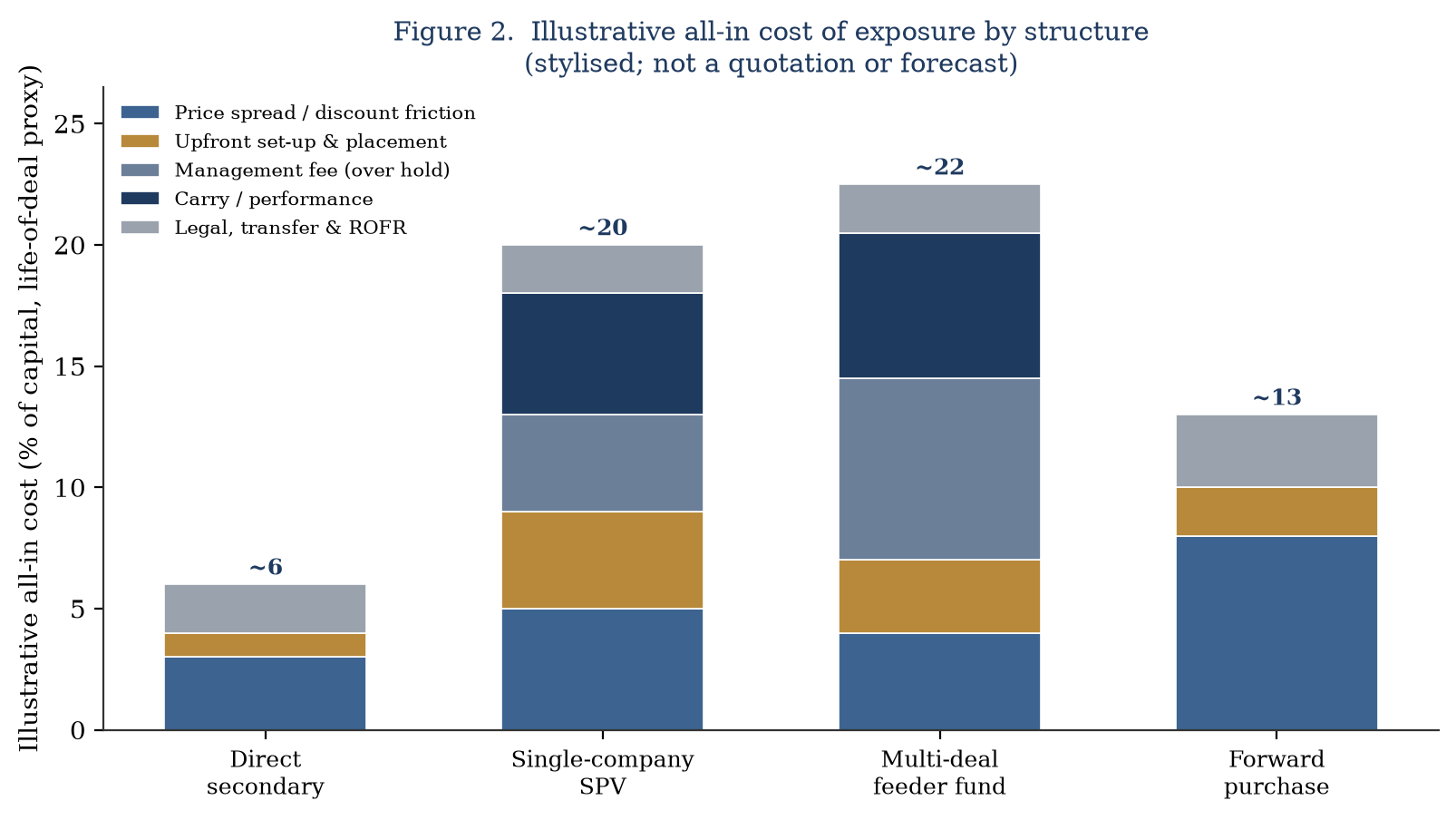
The structures differ not only in what they convey and the risk they carry but in what they cost. The cost of taking pre-IPO exposure is not a single figure but a stack of charges and frictions, and the stack differs markedly between the structures. This section sets out the components of cost and compares them. Figure 2 illustrates the comparison; Table II records the components. All figures are stylised and indicative, chosen to illustrate the relative magnitude and composition of cost across the structures, not to quote any transaction.
Figure 2. Illustrative all-in cost of exposure by structure (stylised; not a quotation or forecast).
Five components make up the all-in cost. The first is the price spread or discount friction: the gap between the price the investor pays and the fair value of the underlying shares, which widens as the chain between the investor and the company lengthens and as the seller's bargaining position strengthens. The second is the upfront set-up and placement charge: the legal, structuring and placement cost incurred to establish the position, borne most heavily by the pooled vehicle, which must be formed and marketed. The third is the annual management fee, charged by the manager of a pooled vehicle over the life of the hold and absent from the direct route and the forward. The fourth is the carry, or share of the profit, which the manager of a pooled vehicle takes on realisation. The fifth is the legal, transfer and rights-of-first-refusal cost: the expense of clearing the company's transfer restrictions, borne most heavily by the direct route and the forward.
Table II. Illustrative composition of the all-in cost of each structure. Figures are stylised and indicative, not quotations.
Three points emerge from the comparison. First, the direct secondary, though it bears the heaviest legal and transfer cost, carries no management fee and no carry, and so has the lowest all-in cost over the life of the deal for an investor able to bear its frictions. Second, the pooled vehicle has the highest all-in cost, because it layers an upfront charge, an annual fee and a carry on top of the underlying friction; the investor pays for the access and diversification the vehicle provides. Third, the forward embeds its cost in the price: the premium the investor pays over fair value for a contingent claim is the price of access through a structure that asks neither for the company's consent nor for a large direct stake, and it can be the highest single friction of all where demand for the name is intense. The fee structures of pooled vehicles in this market, an annual management fee of the order of one and a half to two per cent and a performance share of the order of fifteen to twenty per cent, together with upfront charges, are the principal reason the pooled route is the costliest over a multi-year hold. This is the substance of Proposition 4, developed further in Section VI.
Two refinements sharpen the comparison. First, cost should be judged over the whole life of the position, not at entry. A structure with a low entry cost but a recurring annual fee can prove dearer than one with a high entry cost and no ongoing charge, once the position is held for several years, and the pre-IPO horizon, however much an early listing is hoped for, can extend well beyond the investor's expectation. The life-of-deal proxy used in the figures is intended to capture this, summing the one-off and recurring charges over a representative hold rather than reporting only the cost at entry. Second, the components of cost are not independent of the structure's benefits: the fee a feeder charges buys the diversification and sourcing it provides, and the premium embedded in a forward buys access that may be available no other way. A bare comparison of cost, without reference to what each cost buys, would mislead; the cost comparison must be read alongside the access and risk comparisons that surround it.
Conclusion
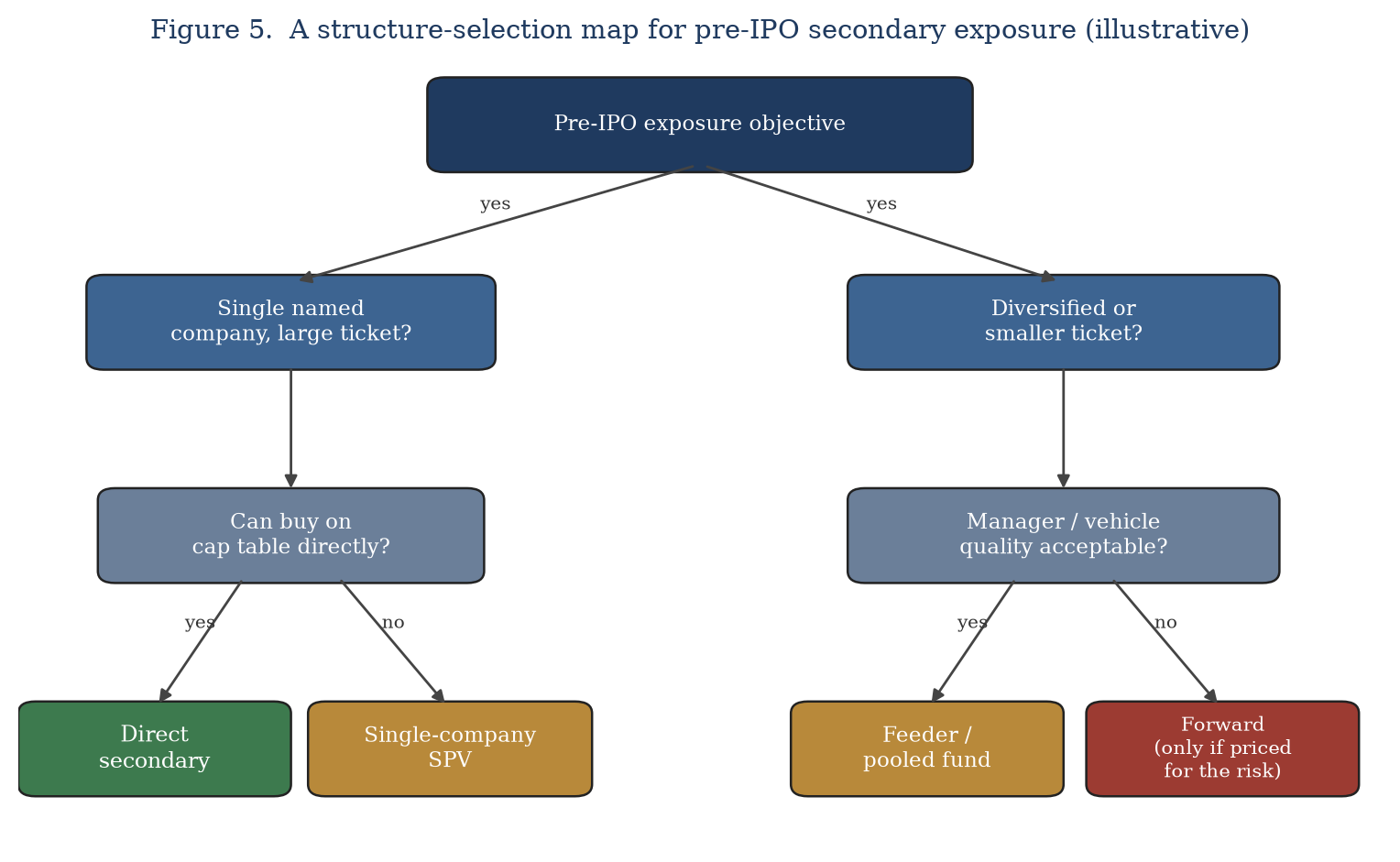
An investor seeking exposure to a private company before its listing must choose not only which company to back but how to back it, and the choice of structure materially changes its risk and its net return. This paper has compared the three principal structures through which pre-IPO secondary exposure is taken and offered a framework for choosing between them. The direct secondary conveys the cleanest claim and the lowest cost but is the hardest to access and demands the largest ticket. The pooled vehicle, whether a single-company SPV or a multi-deal feeder fund, widens and diversifies access at the cost of layered fees and reliance on a manager. The forward purchase agreement is the most accessible but conveys only a contingent claim and carries the greatest structural, counterparty and delivery risk, and is appropriate only where its price compensates for that risk.
The central message is that there is no structure that is best in all cases: the right structure is the one whose access, cost and risk match the investor's ticket, its appetite for diversification and its tolerance for delivery risk. For the Gulf family offices and institutions taking exposure to a concentrated set of late-stage technology and artificial-intelligence companies ahead of an anticipated listing wave in 2026, the framework points towards the direct route or a single-company SPV for a high-conviction single name, a multi-deal feeder for diversified exposure to the theme, and the forward only where no other route reaches the name and the price plainly compensates for the risk. The discipline the paper urges, of asking what is owned, what it costs and what risks sit between the investor and the shares, is the discipline that turns a scramble for access into a considered investment decision, and it is most valuable precisely when the urgency to enter before a listing is at its height.
| Structure | Best suited to | Avoid when |
|---|---|---|
| Direct secondary | Large ticket; single high-conviction name; investor able to clear transfer restrictions and hold a concentrated position | Ticket too small to transact; diversification required; company consent unobtainable |
| Single-company SPV | Concentrated exposure to one name with a smaller ticket; access to a manager's sourcing; investor comfortable with one layer of fees | Manager or vehicle terms are poor; fees erode the thesis; direct route is available on better terms |
| Multi-deal feeder fund | Diversified pre-IPO exposure; smaller tickets; investor valuing the spread of single-name risk over fee drag | Investor wants a single named exposure; fee and carry stack is unacceptable; hold period too long |
| Forward purchase | No other route to a sought-after name; price clearly compensates for contingency and counterparty risk; investor can bear delivery risk | Company has disavowed forwards; price equals clean ownership; investor requires a sound, recognised claim |
| Parameter | Illustrative value | Basis |
|---|---|---|
| Direct all-in cost (life-of-deal proxy) | c. 6% of capital | Spread + legal/transfer, no fees |
| Single-company SPV all-in cost | c. 20% of capital | Spread + upfront + fee + carry |
| Multi-deal feeder all-in cost | c. 22.5% of capital | As SPV, longer hold, more admin |
| Forward all-in cost | c. 16% of capital | Access premium embedded in price |
| SPV / feeder management fee | c. 1.5-2.0% p.a. | Market-representative range |
| SPV / feeder carry | c. 15-20% of profit | Market-representative range |
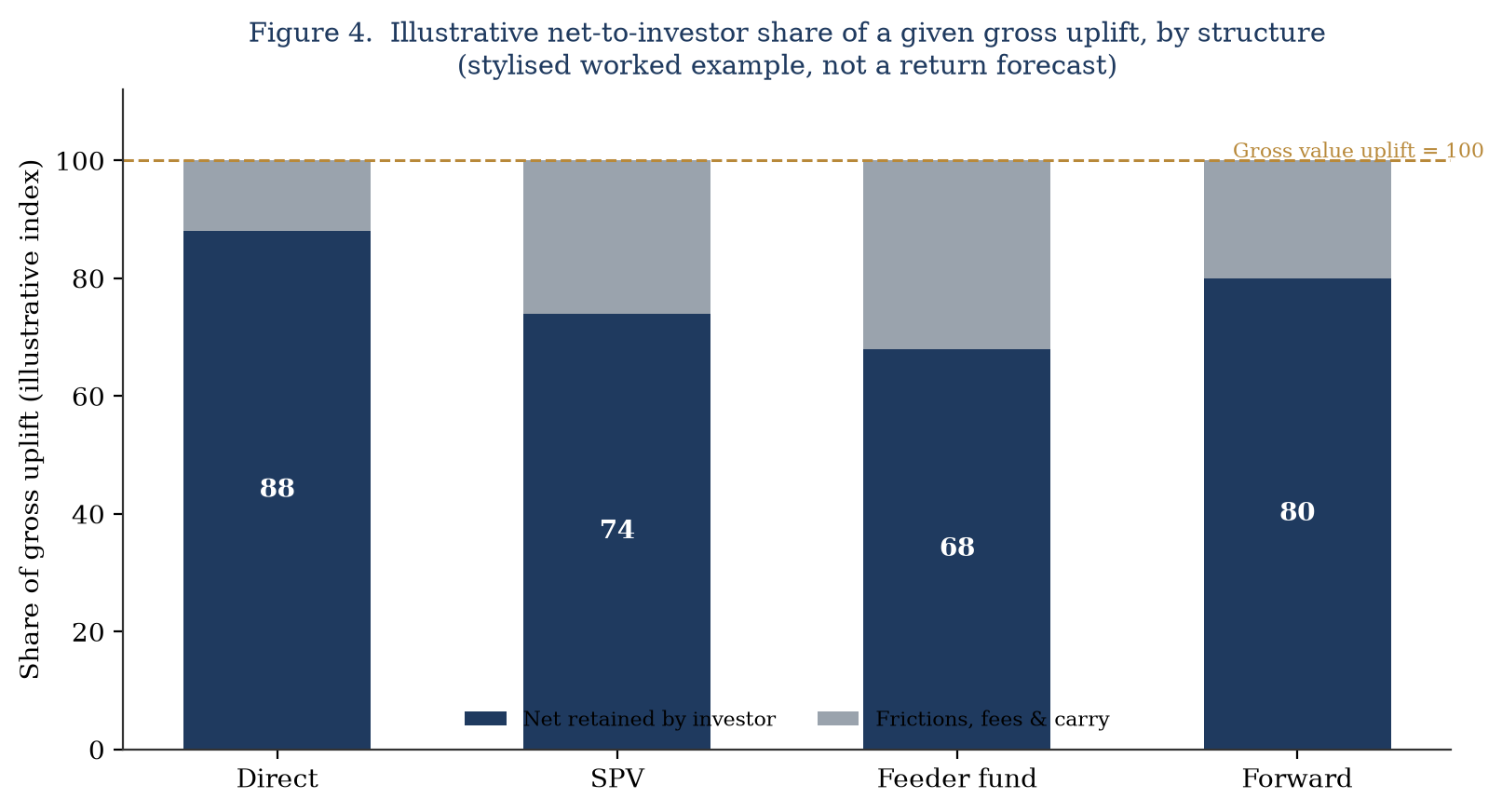
| Gross value uplift (index) | 100 | Common base for net-outcome comparison |
| Net retained: direct / SPV / feeder / forward | 88 / 74 / 68 / 80 | Illustrative, per Figure 4 |
