Introduction
A family office building a portfolio of alternative investments faces a question that is easy to postpone and costly to ignore: how should private credit, real estate and venture capital fit together? Each of these sleeves is attractive in its own right, each has its advocates, and each tends to be acquired separately, often through relationships and opportunities that arrive one at a time. The result, for many families, is an alternatives portfolio that grew by accumulation rather than design, a collection of individual commitments whose combination no one ever planned and whose risk, liquidity and return characteristics no one ever assessed as a whole.
This matters because the three sleeves are genuinely different instruments that play different roles, and their value to a family depends as much on how they are combined as on how each is chosen. Private credit provides contractual income and capital preservation. Real estate provides inflation protection and a blend of income and appreciation. Venture capital provides asymmetric growth, with most of its return concentrated in a few outsized winners. Combined deliberately, they can deliver a return profile that none achieves alone, with diversification that improves the risk-adjusted outcome. Combined carelessly, they can leave a family simultaneously over-concentrated, illiquid and exposed to risks it never intended to take.
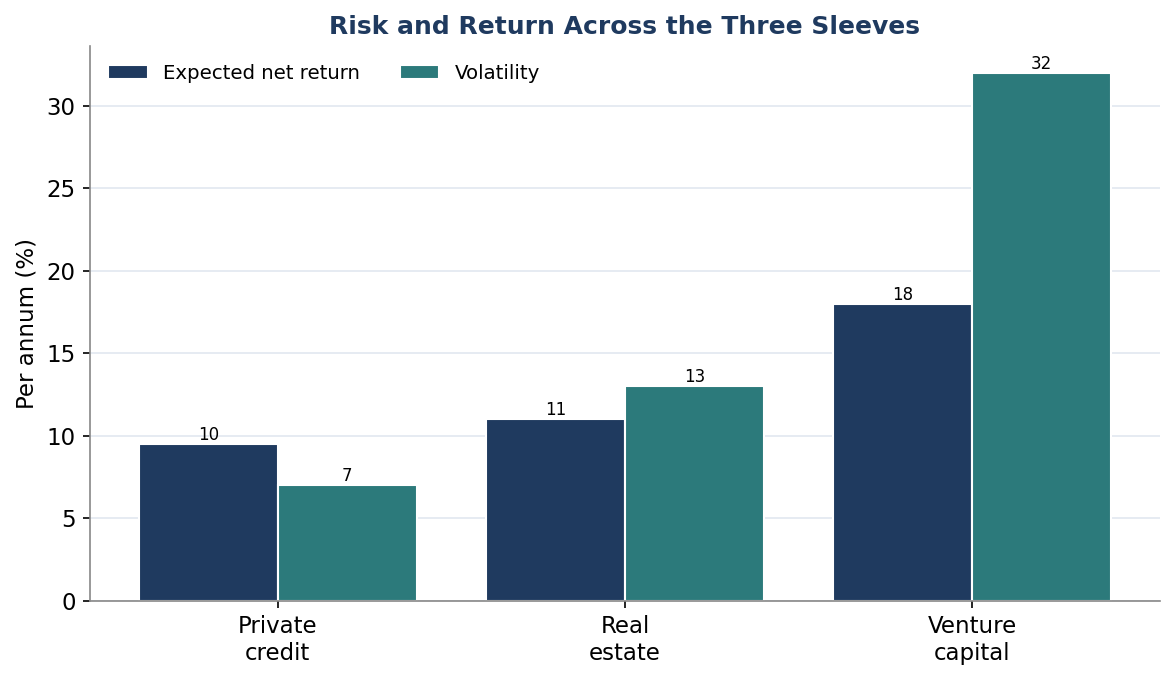
This paper sets out a framework for constructing the combination deliberately. It characterises each sleeve by the dimensions that matter for portfolio construction, namely risk, return, cash flow shape and role, examines how they interact through their mutual correlation and their cash flow timing, and presents allocation profiles matched to different family objectives. It then turns to the practical disciplines that determine whether a sensible paper allocation can survive contact with reality, and illustrates the whole with worked family cases. The framework is built for the family office, with particular attention to the Gulf and UK families whose wealth and objectives shape the choices.
The Shape of Cash Flows
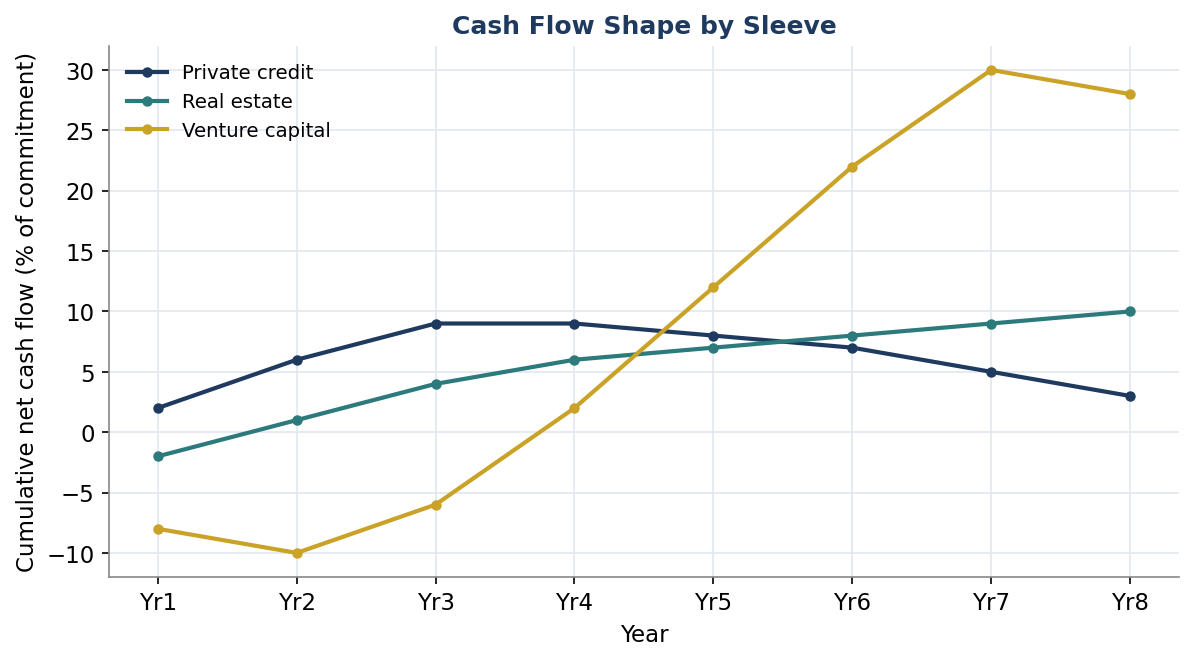
Beyond risk and return, the three sleeves differ in the timing of their cash flows, and this difference is central to constructing an implementable portfolio. A return figure says what a sleeve earns; the cash flow shape says when, and the when determines whether the family can actually live with the allocation.
Figure 2. Cash Flow Shape by Sleeve
Cumulative net cash flow as a share of commitment over a typical fund life.
The contrast is stark. Private credit begins distributing income early and returns capital steadily, producing a front-loaded, relatively predictable cash flow that supports a family’s spending. Real estate builds more slowly, with income through the hold and the bulk of the return on eventual sale or refinancing. Venture capital displays the deepest and longest J-curve, drawing capital for years and returning nothing until its winners mature, after which distributions can be large but are concentrated and uncertain in timing. A family that combines the three without regard to this timing can find itself cash-constrained in the early years, when venture and real estate are drawing capital and only credit is distributing.
Understanding the cash flow shapes allows the family to construct a combination that funds itself. The early income from private credit can fund the capital calls of venture and real estate, smoothing the family’s net cash position and reducing the liquidity reserve it must hold idle. This self-funding property is one of the most valuable and least appreciated benefits of combining the sleeves deliberately, and it is invisible to a family that considers each sleeve in isolation.
The Diversification Dividend
The strongest argument for combining the three sleeves is that they are lowly correlated with one another and with public markets, so that the combination carries less risk than the weighted average of its parts. This diversification dividend is the closest thing to a free lunch in investing, and capturing it is a primary goal of deliberate construction.
Figure 3. Correlation Across Sleeves and Public Markets
Indicative correlations; lower correlation between sleeves improves the diversification of the combination.
The correlation matrix shows why the combination works. Private credit, real estate and venture respond to different drivers: credit to interest rates and the credit cycle, real estate to rents and replacement cost, venture to technology and growth. Because these drivers do not move together, the sleeves rarely all suffer at once, and the combination smooths the return path. Venture in particular has low correlation with credit and real estate, so that even though it is the most volatile sleeve on its own, its contribution to the volatility of the combination is far smaller than its standalone risk suggests. This is the mathematical heart of why a measured venture allocation improves rather than destabilises a portfolio.
The diversification dividend is also why the three sleeves are better together than any one scaled up. A family could pursue a target return by concentrating in a single sleeve, but it would bear that sleeve’s full risk. By combining sleeves with low mutual correlation to reach the same return, it bears less risk for the same reward, or earns more reward for the same risk. The combination dominates the concentration, and the magnitude of the advantage grows the more genuinely uncorrelated the sleeves are, which places a premium on selecting sleeves and managers whose returns are driven by genuinely different forces.
The Risk-Return Trade-Off of Blends
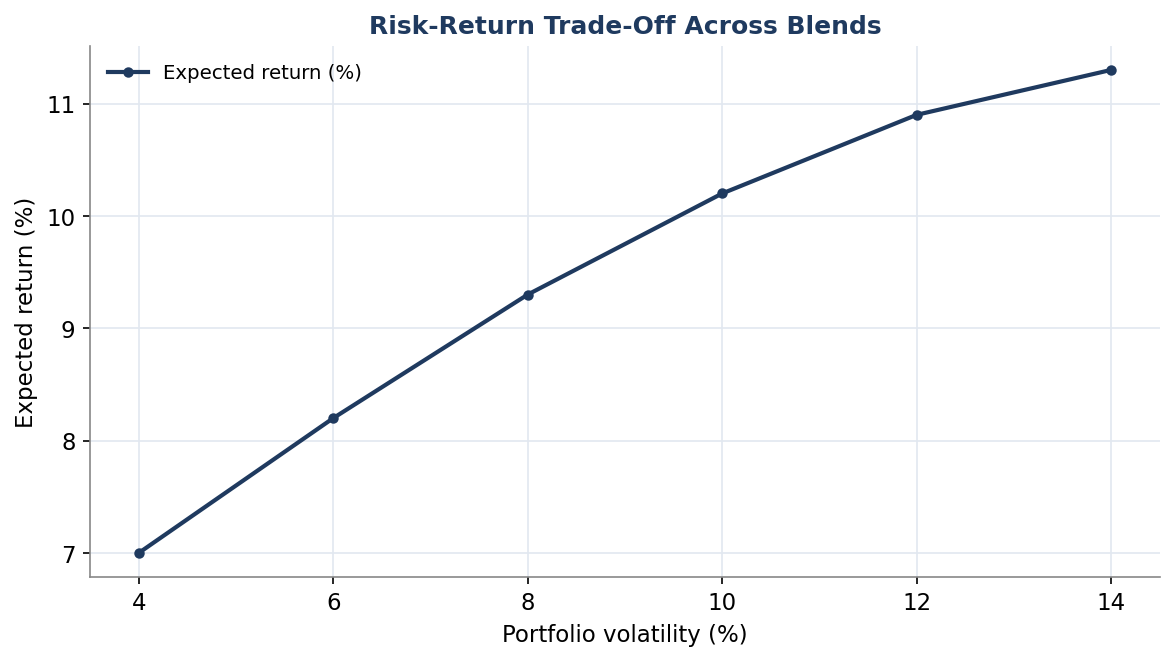
Moving along the spectrum from income to growth is, in effect, moving along a risk-return frontier, and visualising that frontier helps a family see the cost and benefit of each step. As the venture weight rises, the expected return rises but so does the volatility, and the family must judge how much additional risk it is willing to bear for each increment of return.
Figure 5. The Risk-Return Trade-Off Across Blends
Expected return rises with volatility as the allocation shifts from income toward growth.
The frontier is concave, which carries an important lesson: the early steps from a pure-income allocation toward a balanced one add return cheaply, because a modest venture and real estate allocation diversifies and lifts return without much additional risk. The later steps toward a growth-heavy allocation add return more expensively, because each further increment of venture adds disproportionate volatility. This shape argues against the extremes for most families: a pure-income allocation forgoes cheap return available from modest diversification, while a growth-heavy allocation pays dearly in volatility for its last increments of return. The balanced region captures most of the available return for a moderate level of risk, which is why it suits the majority of families.
The frontier also makes clear that the family’s position on it should be a deliberate choice tied to its capacity to bear risk, not a default. A family with substantial wealth beyond its alternatives portfolio, a long horizon and no income need can sit further along the frontier, because it can absorb the volatility; a family relying on its portfolio for spending should sit toward the income end, where the path is smoother. The frontier does not tell the family where to sit, but it shows the trade-off honestly, which is what disciplined construction requires.
Three Worked Family Cases
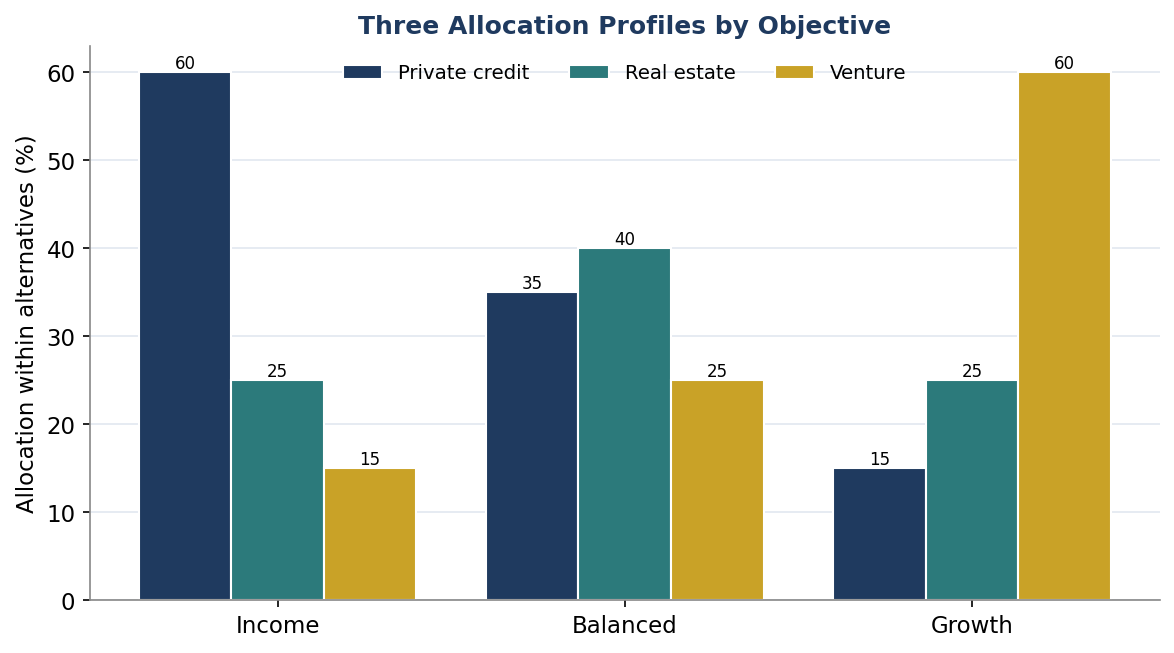
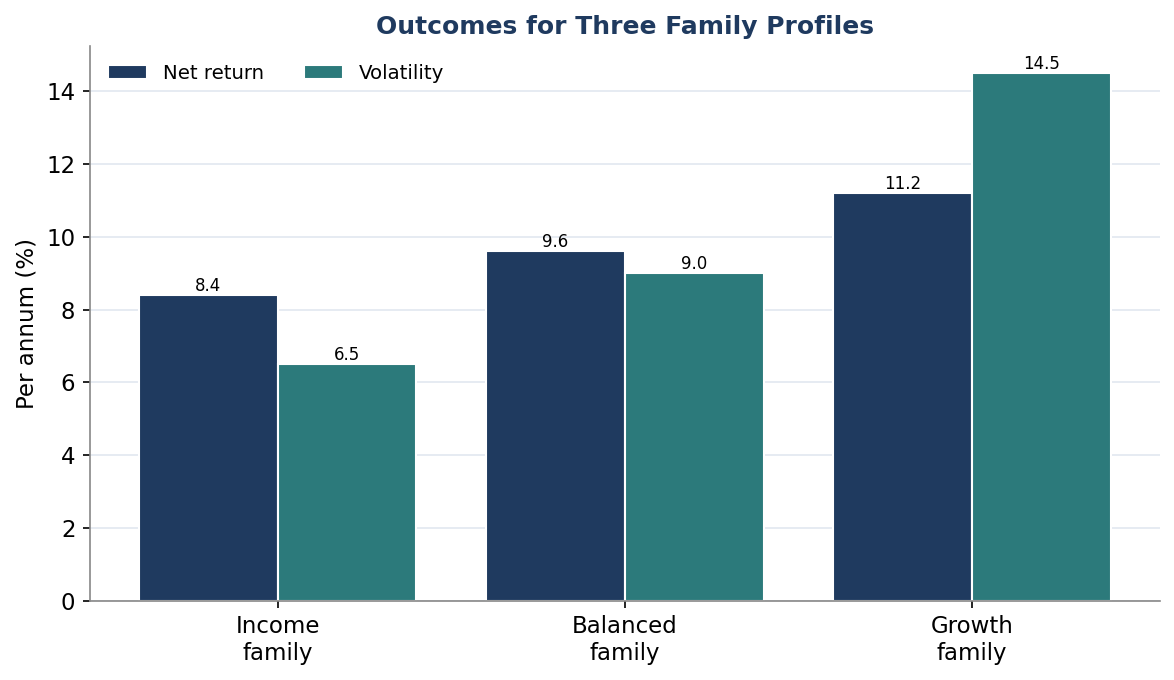
To show the framework in practice, consider three families adopting the three profiles, each starting from its own circumstances. The cases trace the net return and volatility each profile delivers, illustrating how deliberate construction matches the allocation to the family’s objectives.
Figure 7. Outcomes for Three Family Profiles
Modelled net return and volatility for families adopting the income, balanced and growth profiles.
Table 1. Case Summary
Modelled figures. Higher return comes with higher volatility, and the right profile depends on the family’s circumstances.
The income family relies on its portfolio for spending and prioritises a smooth, predictable cash flow. Its credit-heavy allocation delivers a solid return with the lowest volatility of the three and the earliest, steadiest distributions, exactly matching its need for income and stability even at the cost of a lower expected return.
The balanced family has no acute income need and wants a diversified allocation that performs across conditions. Its even blend captures the diversification dividend most fully, delivering a higher return than the income profile at a moderate level of volatility, and it sits in the attractive middle of the risk-return frontier.
The growth family has a long horizon, substantial wealth beyond its alternatives portfolio and no need for current income. Its venture tilt delivers the highest expected return, accepting the highest volatility and the deepest J-curve, which it can absorb because it will not need to draw on the portfolio during the years when venture is calling capital and returning nothing.
Common Errors
Accumulating rather than constructing. building the alternatives portfolio deal by deal, so that its aggregate risk, liquidity and concentration are never chosen.
Double-counting strengths. ignoring existing operating wealth, so that a property-rich family concentrates further rather than diversifying.
Underfunding liquidity. underestimating the liquidity reserve needed to fund capital calls during the ramp, forcing sales at bad times.
Neglecting vintage spread. committing all capital in one or two vintages, concentrating the outcome on a single entry environment.
Over-relying on diversification. assuming correlations stay low in a crisis, sizing risk as though diversification were perfect.
Mismatched growth tilt. over-weighting venture for its return without the horizon or liquidity to absorb its J-curve.
An Implementation Roadmap
Define the family’s objectives, income needs, horizon and risk tolerance, and count existing operating and investment wealth as part of the picture.
Choose a target allocation profile across the three sleeves deliberately, adapting the income, balanced or growth template to the family’s circumstances.
Model the combined cash flows forward and size a liquidity reserve sufficient to fund net capital calls through the ramp under conservative assumptions.
Commit steadily across vintages toward the target over a defined ramp period, pairing steady pacing with consistent manager selection standards.
Use early private credit income to help fund the capital calls of the slower-maturing sleeves, building a self-funding ladder.
Stress-test the allocation for correlated drawdowns and avoid leverage that would turn a temporary stress into a permanent loss.
Review the whole portfolio, not just individual deals, at least annually, rebalancing toward the target profile as the programme matures.
Secondaries and Liquidity Solutions
The secondary market, in which investors buy and sell existing private fund interests, has matured into an important tool for the family allocator, and it serves several distinct purposes in a constructed portfolio. As a buyer, a family can use secondaries to build exposure more quickly than primary commitments allow, acquiring seasoned interests that are already past the early part of the J-curve and so beginning to distribute, which shortens the ramp to a self-funding programme. Secondary purchases also offer some visibility into the underlying assets, reducing the blind-pool risk of a primary commitment.
As a seller, a family can use the secondary market to manage liquidity and to rebalance, exiting positions it no longer wishes to hold without waiting for the fund to wind down. This flexibility comes at a price, since secondary sales often occur at a discount to stated value, particularly in stressed markets when buyers are scarce, but the ability to convert an illiquid interest into cash can be worth the discount when the family genuinely needs liquidity or wishes to correct a large over-allocation. The existence of this exit route allows a family to hold a larger illiquid core with greater confidence than it could if every commitment were truly locked until wind-down.
The broader lesson is that secondaries and related liquidity solutions soften, without eliminating, the illiquidity that defines these sleeves. A family that understands and occasionally uses the secondary market can construct a more responsive portfolio than one that treats every commitment as permanently illiquid, building exposure faster, rebalancing when necessary and accessing liquidity in need. Used opportunistically rather than as a crutch, secondaries are a valuable complement to a primary commitment programme and a further reason that deliberate construction outperforms passive accumulation.
Conclusion
Private credit, real estate and venture capital are the three principal sleeves of a family’s alternatives portfolio, and their value depends as much on how they are combined as on how each is chosen. This paper has argued for deliberate construction over accumulation, characterised each sleeve by its risk, return, cash flow shape and role, shown how their low mutual correlation creates a diversification dividend, and presented allocation profiles matched to family objectives. It has emphasised the practical disciplines, liquidity management, vintage diversification and the avoidance of over-concentration, that determine whether a sensible allocation can actually be implemented, and it has been honest about the limits of diversification in a crisis.
The central message is that construction beats accumulation. A family that begins with its objectives, derives a target allocation, builds a self-funding cash flow ladder, diversifies across vintages and respects the limits of diversification will hold a portfolio whose characteristics match its intentions and whose resilience exceeds that of any single sleeve. For the Gulf and UK family allocator, that deliberate construction, counting existing wealth and filling the gaps, is the difference between an alternatives portfolio that happened and one that was built. The reward for building rather than accumulating is a portfolio that does, reliably and across cycles, what the family needs it to do.
| Family | Profile | Net return | Volatility | Why it fits |
|---|---|---|---|---|
| Income family | Credit-heavy | 8.4% | 6.5% | Needs current income, values stability |
| Balanced family | Even blend | 9.6% | 9.0% | No income need, wants all-weather mix |
| Growth family | Venture-tilted | 11.2% | 14.5% | Long horizon, tolerance for volatility |
Limitations
This paper uses modelled figures and illustrative profiles to convey relationships and disciplines rather than to forecast returns or recommend a specific allocation. The risk, return and correlation assumptions are indicative and will differ by market, manager and period, and correlations in particular can change materially in stress. Nothing here constitutes investment advice. Families should obtain advice tailored to their circumstances, conduct their own diligence and stress-test their allocation before committing capital, treating the framework as a structured way to think rather than a prescription to follow.