

1. Start with the financing problem
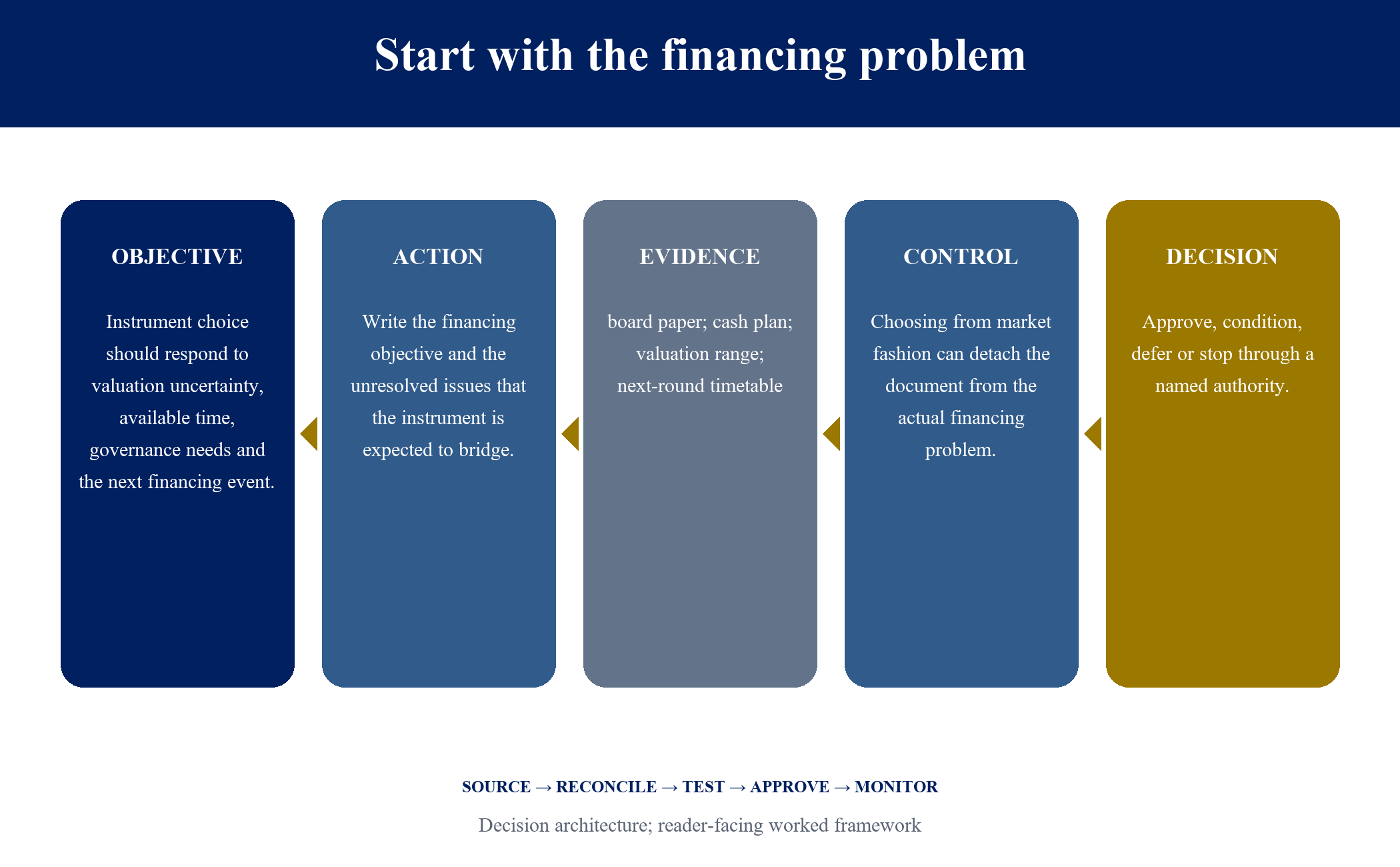
Instrument choice should respond to valuation uncertainty, available time, governance needs and the next financing event. This matters in safe versus convertible versus priced round in the gcc context because the economics, legal rights, operating evidence and timing can move on different clocks. A useful analysis therefore begins with the decision being made, the party authorised to make it and the date on which the evidence is expected to be current. The work should distinguish source facts, management representations, analytical assumptions and professional judgement so that a reviewer can see where each conclusion originates.
The recommended workstream is to write the financing objective and the unresolved issues that the instrument is expected to bridge. The team should translate that instruction into named owners, dated gates and a common set of definitions. A base case should describe the expected path; a downside case should test weaker operating performance or slower execution; and a delay case should test what happens when a required approval, document, counterparty or financing event arrives later than planned. Any decision threshold used in the model should be recorded as a management choice unless it comes directly from a cited rule or contract.
The decision framework has four layers. First, define the commercial objective and non-negotiable constraints. Second, assemble the minimum source record and reconcile it to the numbers used in the analysis. Third, compare executable alternatives under consistent assumptions, including cost, control, liquidity, timing and downside. Fourth, approve the route, its conditions and the fallback. This sequence keeps a transaction from moving ahead on an attractive headline while unresolved implementation questions remain outside the decision paper.
1.2 Evidence and controls
The minimum evidence for this module is board paper; cash plan; valuation range; next-round timetable Each item should have an owner, effective date, source location and review status. Where information is produced through a model or transformation, the file should preserve the original input, calculation logic and output version. The reviewer should be able to reproduce the material conclusion without relying on a presentation slide, an uncited summary or the memory of the person who prepared it.
Control quality can be tested through three questions. Does the source support the stated fact? Does the calculation use the approved definition? Does the proposed action remain within the authority and risk limits already granted? An exception to any of these tests should enter a dated register with a named resolver and a stop, proceed or conditional-proceed decision. Completion means that the evidence and decision have been accepted by the accountable owner; document production alone is an intermediate output.
The principal failure mode is that choosing from market fashion can detach the document from the actual financing problem. The response is to make the vulnerable assumption visible, test a plausible adverse state and identify the earliest observable warning indicator. The analysis should also state what remains outside its scope and which legal, tax, regulatory, accounting, valuation, technical or investment conclusions require qualified advice. This creates a practical boundary between a research framework and a conclusion for a particular company, investor, lender, family or transaction.
| Control question | Required record | Decision response |
|---|---|---|
| What is being decided? | Write the financing objective and the unresolved issues that the instrument is expected to bridge. | Approve objective and authority. |
| What proves the case? | board paper; cash plan; valuation range; next-round timetable | Reconcile and sign off. |
| What can fail? | Choosing from market fashion can detach the document from the actual financing problem. | Test downside and escalation. |
2. Define the legal issuance path
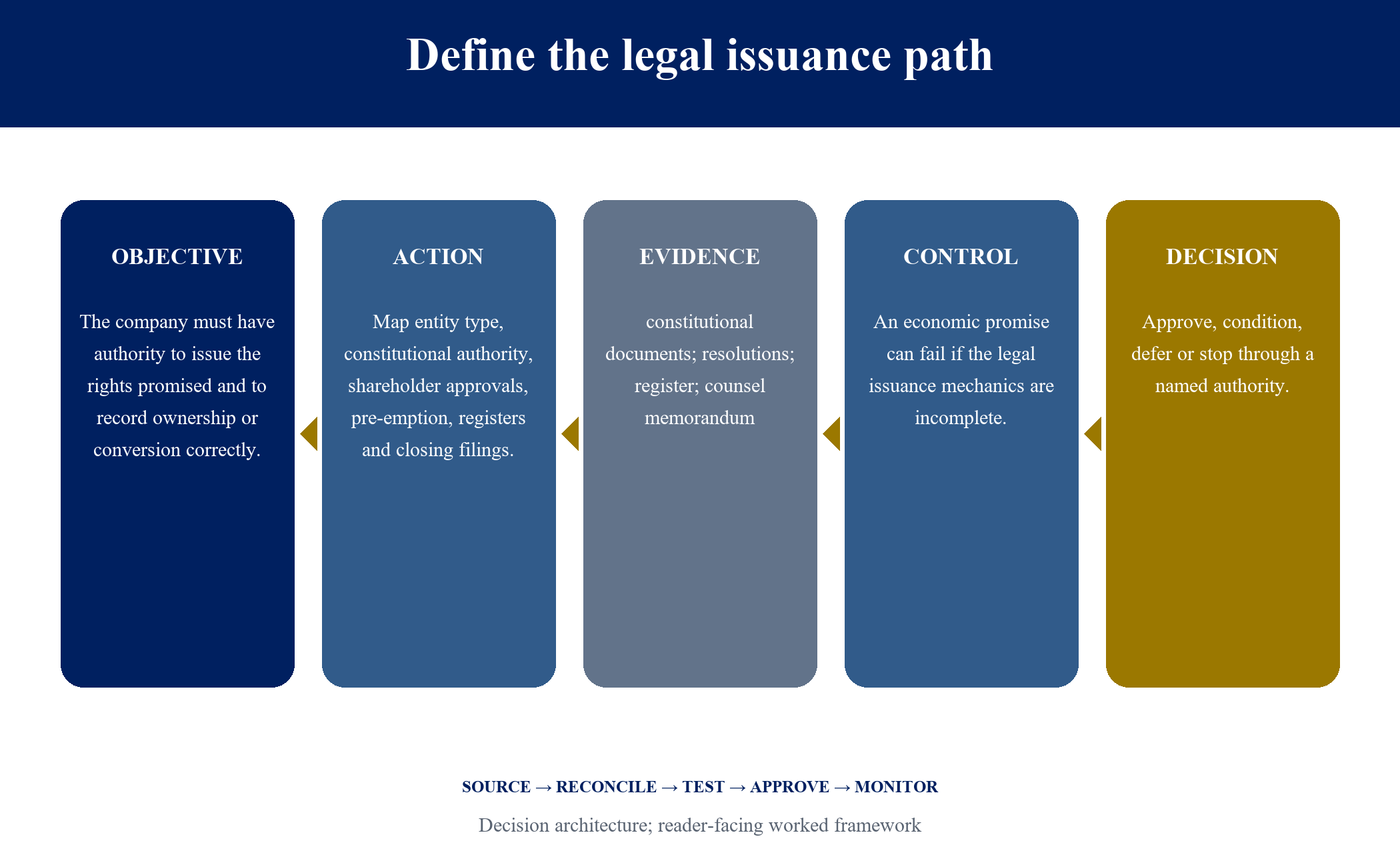
The company must have authority to issue the rights promised and to record ownership or conversion correctly. This matters in safe versus convertible versus priced round in the gcc context because the economics, legal rights, operating evidence and timing can move on different clocks. A useful analysis therefore begins with the decision being made, the party authorised to make it and the date on which the evidence is expected to be current. The work should distinguish source facts, management representations, analytical assumptions and professional judgement so that a reviewer can see where each conclusion originates.
The recommended workstream is to map entity type, constitutional authority, shareholder approvals, pre-emption, registers and closing filings. The team should translate that instruction into named owners, dated gates and a common set of definitions. A base case should describe the expected path; a downside case should test weaker operating performance or slower execution; and a delay case should test what happens when a required approval, document, counterparty or financing event arrives later than planned. Any decision threshold used in the model should be recorded as a management choice unless it comes directly from a cited rule or contract.
The decision framework has four layers. First, define the commercial objective and non-negotiable constraints. Second, assemble the minimum source record and reconcile it to the numbers used in the analysis. Third, compare executable alternatives under consistent assumptions, including cost, control, liquidity, timing and downside. Fourth, approve the route, its conditions and the fallback. This sequence keeps a transaction from moving ahead on an attractive headline while unresolved implementation questions remain outside the decision paper.
2.2 Evidence and controls
The minimum evidence for this module is constitutional documents; resolutions; register; counsel memorandum Each item should have an owner, effective date, source location and review status. Where information is produced through a model or transformation, the file should preserve the original input, calculation logic and output version. The reviewer should be able to reproduce the material conclusion without relying on a presentation slide, an uncited summary or the memory of the person who prepared it.
Control quality can be tested through three questions. Does the source support the stated fact? Does the calculation use the approved definition? Does the proposed action remain within the authority and risk limits already granted? An exception to any of these tests should enter a dated register with a named resolver and a stop, proceed or conditional-proceed decision. Completion means that the evidence and decision have been accepted by the accountable owner; document production alone is an intermediate output.
The principal failure mode is that an economic promise can fail if the legal issuance mechanics are incomplete. The response is to make the vulnerable assumption visible, test a plausible adverse state and identify the earliest observable warning indicator. The analysis should also state what remains outside its scope and which legal, tax, regulatory, accounting, valuation, technical or investment conclusions require qualified advice. This creates a practical boundary between a research framework and a conclusion for a particular company, investor, lender, family or transaction.
| Control question | Required record | Decision response |
|---|---|---|
| What is being decided? | Map entity type, constitutional authority, shareholder approvals, pre-emption, registers and closing filings. | Approve objective and authority. |
| What proves the case? | constitutional documents; resolutions; register; counsel memorandum | Reconcile and sign off. |
| What can fail? | An economic promise can fail if the legal issuance mechanics are incomplete. | Test downside and escalation. |
3. SAFE economics
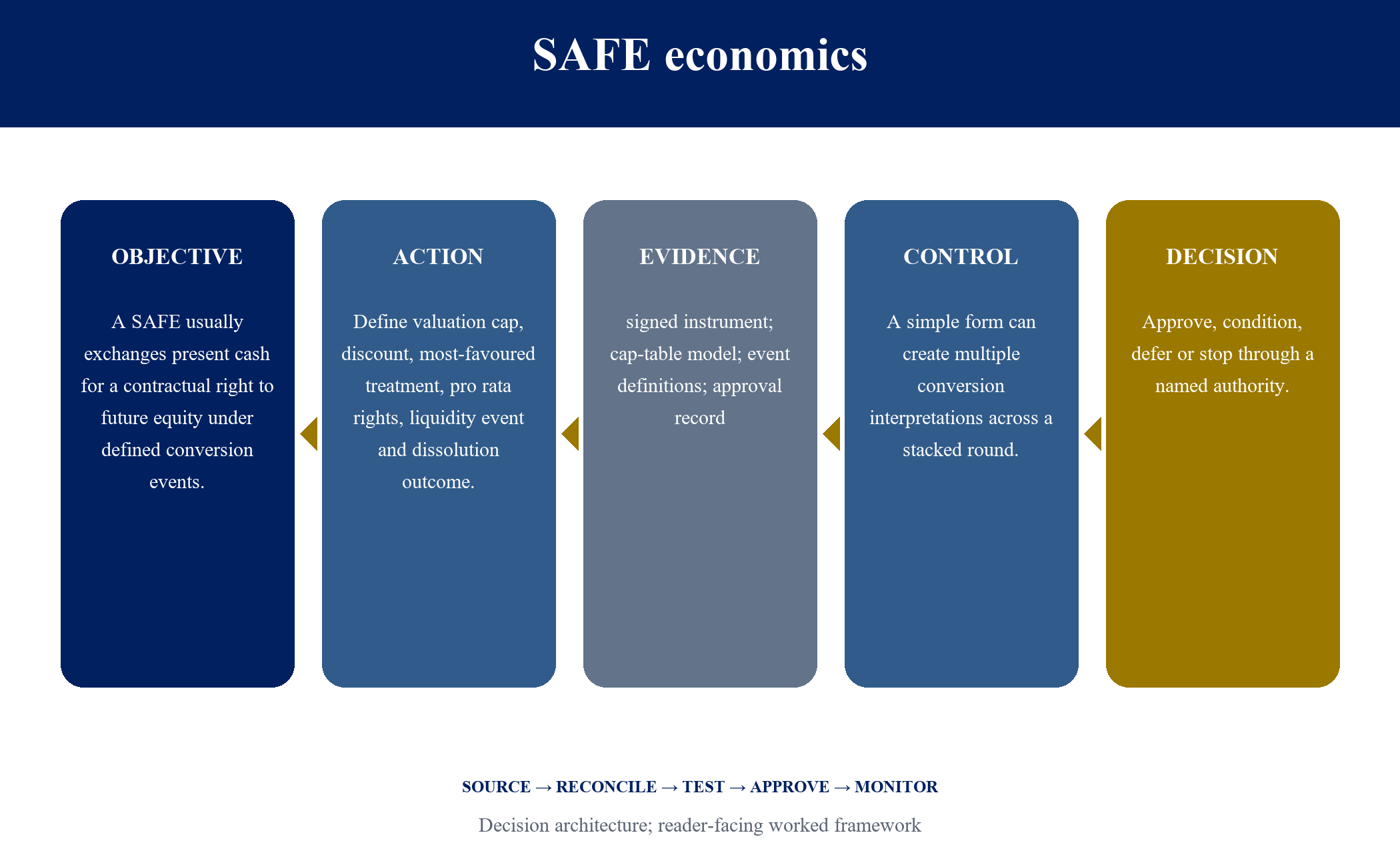
A SAFE usually exchanges present cash for a contractual right to future equity under defined conversion events. This matters in safe versus convertible versus priced round in the gcc context because the economics, legal rights, operating evidence and timing can move on different clocks. A useful analysis therefore begins with the decision being made, the party authorised to make it and the date on which the evidence is expected to be current. The work should distinguish source facts, management representations, analytical assumptions and professional judgement so that a reviewer can see where each conclusion originates.
The recommended workstream is to define valuation cap, discount, most-favoured treatment, pro rata rights, liquidity event and dissolution outcome. The team should translate that instruction into named owners, dated gates and a common set of definitions. A base case should describe the expected path; a downside case should test weaker operating performance or slower execution; and a delay case should test what happens when a required approval, document, counterparty or financing event arrives later than planned. Any decision threshold used in the model should be recorded as a management choice unless it comes directly from a cited rule or contract.
The decision framework has four layers. First, define the commercial objective and non-negotiable constraints. Second, assemble the minimum source record and reconcile it to the numbers used in the analysis. Third, compare executable alternatives under consistent assumptions, including cost, control, liquidity, timing and downside. Fourth, approve the route, its conditions and the fallback. This sequence keeps a transaction from moving ahead on an attractive headline while unresolved implementation questions remain outside the decision paper.
3.2 Evidence and controls
The minimum evidence for this module is signed instrument; cap-table model; event definitions; approval record Each item should have an owner, effective date, source location and review status. Where information is produced through a model or transformation, the file should preserve the original input, calculation logic and output version. The reviewer should be able to reproduce the material conclusion without relying on a presentation slide, an uncited summary or the memory of the person who prepared it.
Control quality can be tested through three questions. Does the source support the stated fact? Does the calculation use the approved definition? Does the proposed action remain within the authority and risk limits already granted? An exception to any of these tests should enter a dated register with a named resolver and a stop, proceed or conditional-proceed decision. Completion means that the evidence and decision have been accepted by the accountable owner; document production alone is an intermediate output.
The principal failure mode is that a simple form can create multiple conversion interpretations across a stacked round. The response is to make the vulnerable assumption visible, test a plausible adverse state and identify the earliest observable warning indicator. The analysis should also state what remains outside its scope and which legal, tax, regulatory, accounting, valuation, technical or investment conclusions require qualified advice. This creates a practical boundary between a research framework and a conclusion for a particular company, investor, lender, family or transaction.
| Control question | Required record | Decision response |
|---|---|---|
| What is being decided? | Define valuation cap, discount, most-favoured treatment, pro rata rights, liquidity event and dissolution outcome. | Approve objective and authority. |
| What proves the case? | signed instrument; cap-table model; event definitions; approval record | Reconcile and sign off. |
| What can fail? | A simple form can create multiple conversion interpretations across a stacked round. | Test downside and escalation. |
4. Convertible economics
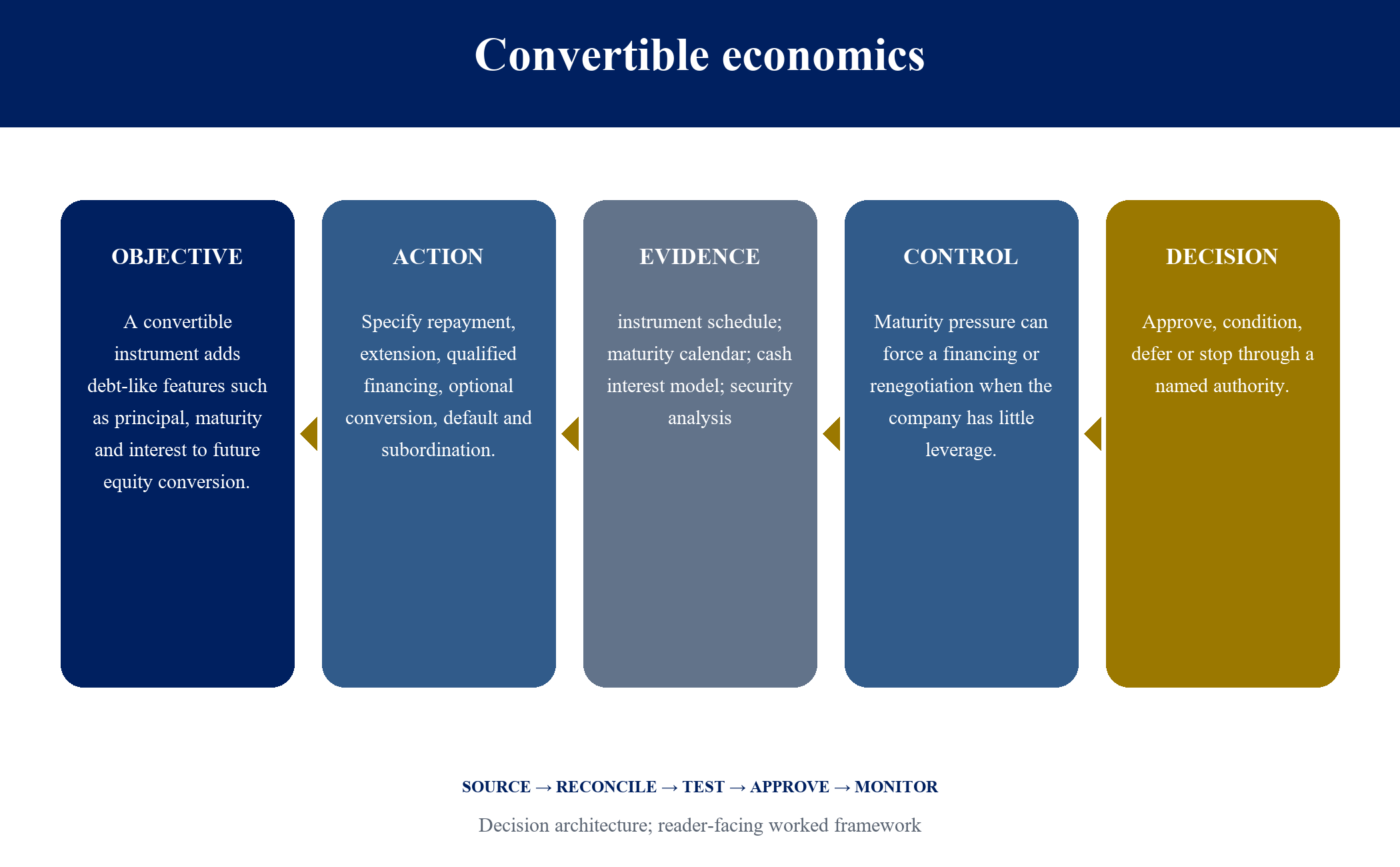
A convertible instrument adds debt-like features such as principal, maturity and interest to future equity conversion. This matters in safe versus convertible versus priced round in the gcc context because the economics, legal rights, operating evidence and timing can move on different clocks. A useful analysis therefore begins with the decision being made, the party authorised to make it and the date on which the evidence is expected to be current. The work should distinguish source facts, management representations, analytical assumptions and professional judgement so that a reviewer can see where each conclusion originates.
The recommended workstream is to specify repayment, extension, qualified financing, optional conversion, default and subordination. The team should translate that instruction into named owners, dated gates and a common set of definitions. A base case should describe the expected path; a downside case should test weaker operating performance or slower execution; and a delay case should test what happens when a required approval, document, counterparty or financing event arrives later than planned. Any decision threshold used in the model should be recorded as a management choice unless it comes directly from a cited rule or contract.
The decision framework has four layers. First, define the commercial objective and non-negotiable constraints. Second, assemble the minimum source record and reconcile it to the numbers used in the analysis. Third, compare executable alternatives under consistent assumptions, including cost, control, liquidity, timing and downside. Fourth, approve the route, its conditions and the fallback. This sequence keeps a transaction from moving ahead on an attractive headline while unresolved implementation questions remain outside the decision paper.
4.2 Evidence and controls
The minimum evidence for this module is instrument schedule; maturity calendar; cash interest model; security analysis Each item should have an owner, effective date, source location and review status. Where information is produced through a model or transformation, the file should preserve the original input, calculation logic and output version. The reviewer should be able to reproduce the material conclusion without relying on a presentation slide, an uncited summary or the memory of the person who prepared it.
Control quality can be tested through three questions. Does the source support the stated fact? Does the calculation use the approved definition? Does the proposed action remain within the authority and risk limits already granted? An exception to any of these tests should enter a dated register with a named resolver and a stop, proceed or conditional-proceed decision. Completion means that the evidence and decision have been accepted by the accountable owner; document production alone is an intermediate output.
The principal failure mode is that maturity pressure can force a financing or renegotiation when the company has little leverage. The response is to make the vulnerable assumption visible, test a plausible adverse state and identify the earliest observable warning indicator. The analysis should also state what remains outside its scope and which legal, tax, regulatory, accounting, valuation, technical or investment conclusions require qualified advice. This creates a practical boundary between a research framework and a conclusion for a particular company, investor, lender, family or transaction.
| Control question | Required record | Decision response |
|---|---|---|
| What is being decided? | Specify repayment, extension, qualified financing, optional conversion, default and subordination. | Approve objective and authority. |
| What proves the case? | instrument schedule; maturity calendar; cash interest model; security analysis | Reconcile and sign off. |
| What can fail? | Maturity pressure can force a financing or renegotiation when the company has little leverage. | Test downside and escalation. |
5. Priced equity economics
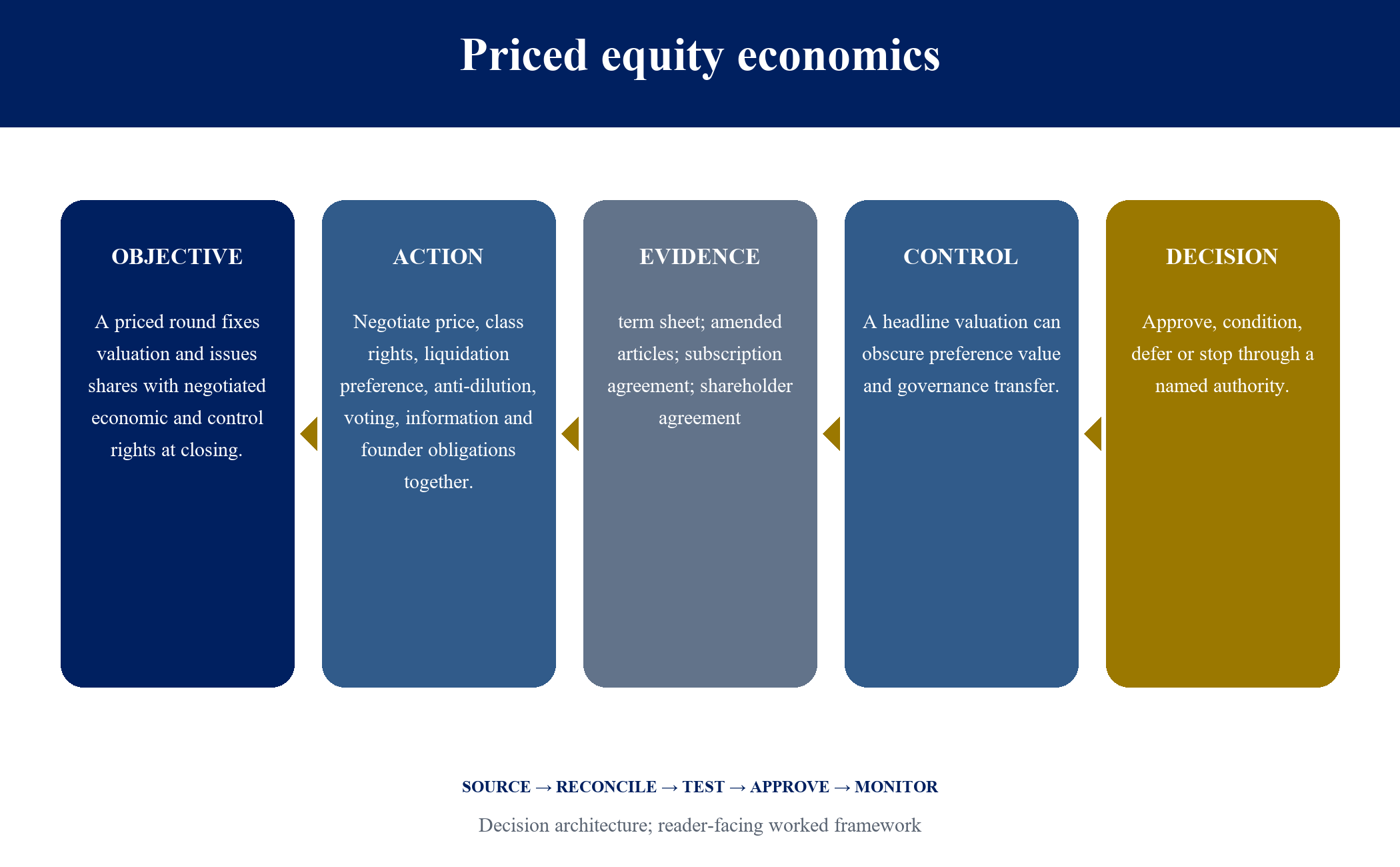
A priced round fixes valuation and issues shares with negotiated economic and control rights at closing. This matters in safe versus convertible versus priced round in the gcc context because the economics, legal rights, operating evidence and timing can move on different clocks. A useful analysis therefore begins with the decision being made, the party authorised to make it and the date on which the evidence is expected to be current. The work should distinguish source facts, management representations, analytical assumptions and professional judgement so that a reviewer can see where each conclusion originates.
The recommended workstream is to negotiate price, class rights, liquidation preference, anti-dilution, voting, information and founder obligations together. The team should translate that instruction into named owners, dated gates and a common set of definitions. A base case should describe the expected path; a downside case should test weaker operating performance or slower execution; and a delay case should test what happens when a required approval, document, counterparty or financing event arrives later than planned. Any decision threshold used in the model should be recorded as a management choice unless it comes directly from a cited rule or contract.
The decision framework has four layers. First, define the commercial objective and non-negotiable constraints. Second, assemble the minimum source record and reconcile it to the numbers used in the analysis. Third, compare executable alternatives under consistent assumptions, including cost, control, liquidity, timing and downside. Fourth, approve the route, its conditions and the fallback. This sequence keeps a transaction from moving ahead on an attractive headline while unresolved implementation questions remain outside the decision paper.
5.2 Evidence and controls
The minimum evidence for this module is term sheet; amended articles; subscription agreement; shareholder agreement Each item should have an owner, effective date, source location and review status. Where information is produced through a model or transformation, the file should preserve the original input, calculation logic and output version. The reviewer should be able to reproduce the material conclusion without relying on a presentation slide, an uncited summary or the memory of the person who prepared it.
Control quality can be tested through three questions. Does the source support the stated fact? Does the calculation use the approved definition? Does the proposed action remain within the authority and risk limits already granted? An exception to any of these tests should enter a dated register with a named resolver and a stop, proceed or conditional-proceed decision. Completion means that the evidence and decision have been accepted by the accountable owner; document production alone is an intermediate output.
The principal failure mode is that a headline valuation can obscure preference value and governance transfer. The response is to make the vulnerable assumption visible, test a plausible adverse state and identify the earliest observable warning indicator. The analysis should also state what remains outside its scope and which legal, tax, regulatory, accounting, valuation, technical or investment conclusions require qualified advice. This creates a practical boundary between a research framework and a conclusion for a particular company, investor, lender, family or transaction.
| Control question | Required record | Decision response |
|---|---|---|
| What is being decided? | Negotiate price, class rights, liquidation preference, anti-dilution, voting, information and founder obligations together. | Approve objective and authority. |
| What proves the case? | term sheet; amended articles; subscription agreement; shareholder agreement | Reconcile and sign off. |
| What can fail? | A headline valuation can obscure preference value and governance transfer. | Test downside and escalation. |
6. Fully diluted ownership
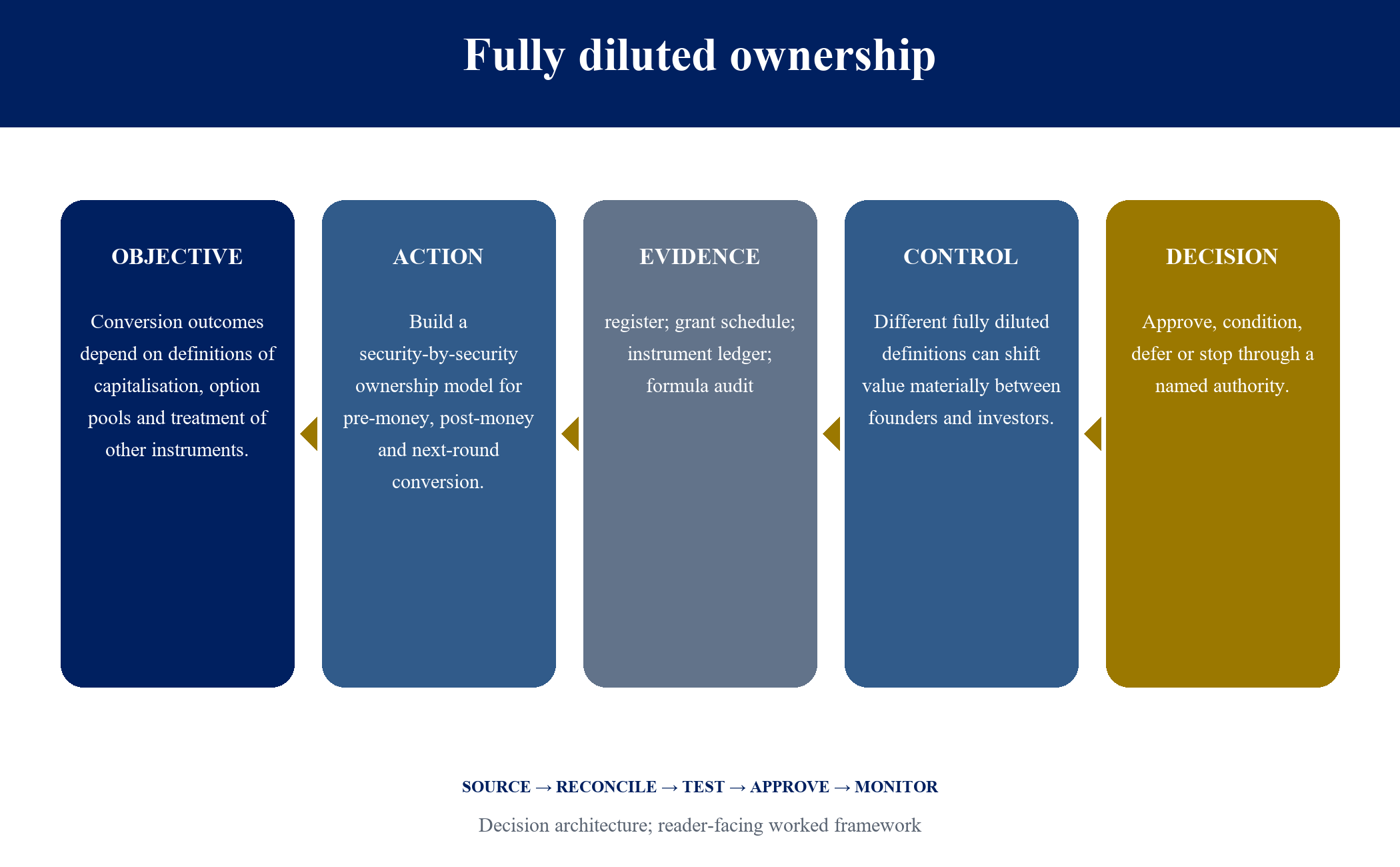
Conversion outcomes depend on definitions of capitalisation, option pools and treatment of other instruments. This matters in safe versus convertible versus priced round in the gcc context because the economics, legal rights, operating evidence and timing can move on different clocks. A useful analysis therefore begins with the decision being made, the party authorised to make it and the date on which the evidence is expected to be current. The work should distinguish source facts, management representations, analytical assumptions and professional judgement so that a reviewer can see where each conclusion originates.
The recommended workstream is to build a security-by-security ownership model for pre-money, post-money and next-round conversion. The team should translate that instruction into named owners, dated gates and a common set of definitions. A base case should describe the expected path; a downside case should test weaker operating performance or slower execution; and a delay case should test what happens when a required approval, document, counterparty or financing event arrives later than planned. Any decision threshold used in the model should be recorded as a management choice unless it comes directly from a cited rule or contract.
The decision framework has four layers. First, define the commercial objective and non-negotiable constraints. Second, assemble the minimum source record and reconcile it to the numbers used in the analysis. Third, compare executable alternatives under consistent assumptions, including cost, control, liquidity, timing and downside. Fourth, approve the route, its conditions and the fallback. This sequence keeps a transaction from moving ahead on an attractive headline while unresolved implementation questions remain outside the decision paper.
6.2 Evidence and controls
The minimum evidence for this module is register; grant schedule; instrument ledger; formula audit Each item should have an owner, effective date, source location and review status. Where information is produced through a model or transformation, the file should preserve the original input, calculation logic and output version. The reviewer should be able to reproduce the material conclusion without relying on a presentation slide, an uncited summary or the memory of the person who prepared it.
Control quality can be tested through three questions. Does the source support the stated fact? Does the calculation use the approved definition? Does the proposed action remain within the authority and risk limits already granted? An exception to any of these tests should enter a dated register with a named resolver and a stop, proceed or conditional-proceed decision. Completion means that the evidence and decision have been accepted by the accountable owner; document production alone is an intermediate output.
The principal failure mode is that different fully diluted definitions can shift value materially between founders and investors. The response is to make the vulnerable assumption visible, test a plausible adverse state and identify the earliest observable warning indicator. The analysis should also state what remains outside its scope and which legal, tax, regulatory, accounting, valuation, technical or investment conclusions require qualified advice. This creates a practical boundary between a research framework and a conclusion for a particular company, investor, lender, family or transaction.
| Control question | Required record | Decision response |
|---|---|---|
| What is being decided? | Build a security-by-security ownership model for pre-money, post-money and next-round conversion. | Approve objective and authority. |
| What proves the case? | register; grant schedule; instrument ledger; formula audit | Reconcile and sign off. |
| What can fail? | Different fully diluted definitions can shift value materially between founders and investors. | Test downside and escalation. |
7. Valuation cap and discount
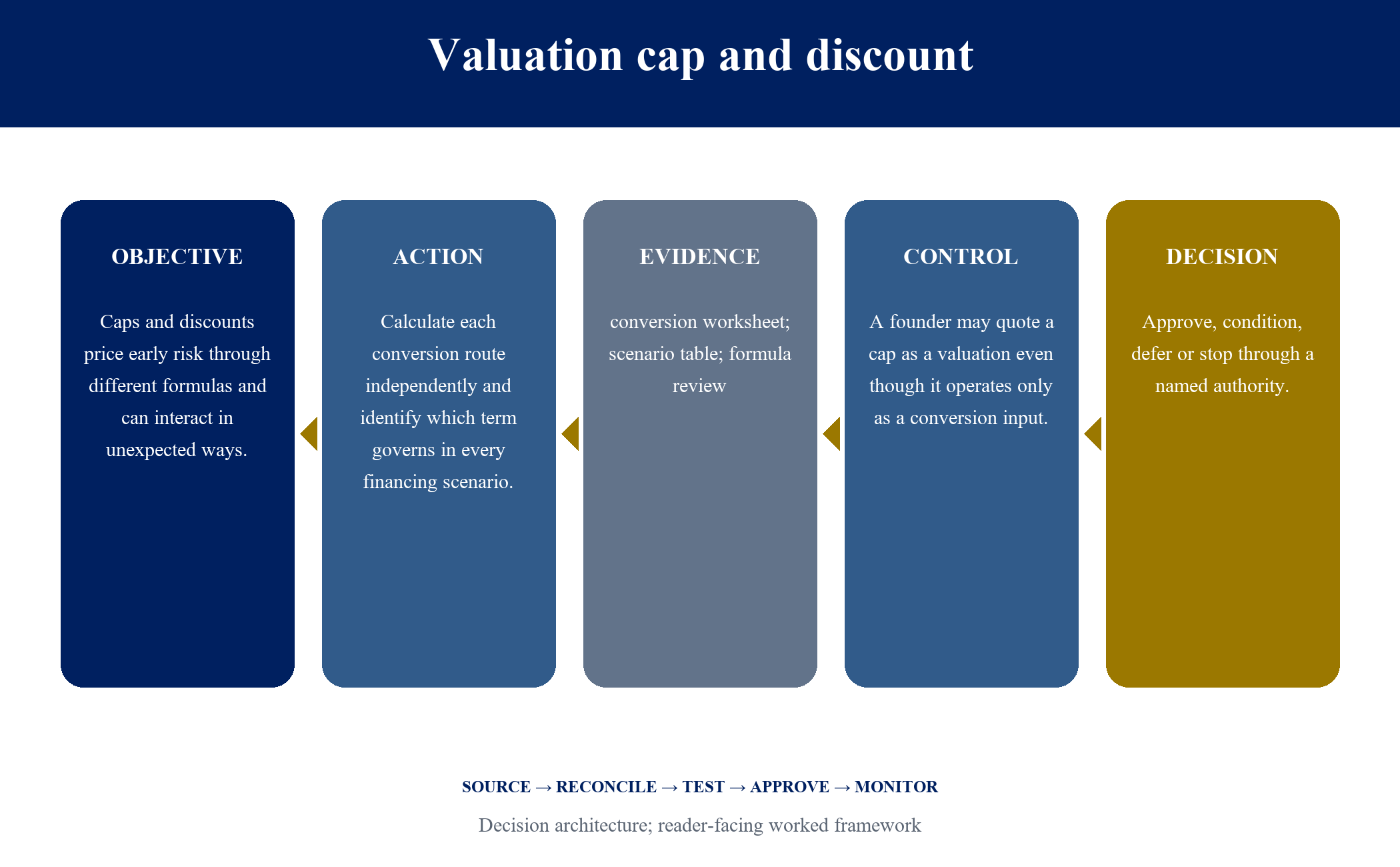
Caps and discounts price early risk through different formulas and can interact in unexpected ways. This matters in safe versus convertible versus priced round in the gcc context because the economics, legal rights, operating evidence and timing can move on different clocks. A useful analysis therefore begins with the decision being made, the party authorised to make it and the date on which the evidence is expected to be current. The work should distinguish source facts, management representations, analytical assumptions and professional judgement so that a reviewer can see where each conclusion originates.
The recommended workstream is to calculate each conversion route independently and identify which term governs in every financing scenario. The team should translate that instruction into named owners, dated gates and a common set of definitions. A base case should describe the expected path; a downside case should test weaker operating performance or slower execution; and a delay case should test what happens when a required approval, document, counterparty or financing event arrives later than planned. Any decision threshold used in the model should be recorded as a management choice unless it comes directly from a cited rule or contract.
The decision framework has four layers. First, define the commercial objective and non-negotiable constraints. Second, assemble the minimum source record and reconcile it to the numbers used in the analysis. Third, compare executable alternatives under consistent assumptions, including cost, control, liquidity, timing and downside. Fourth, approve the route, its conditions and the fallback. This sequence keeps a transaction from moving ahead on an attractive headline while unresolved implementation questions remain outside the decision paper.
7.2 Evidence and controls
The minimum evidence for this module is conversion worksheet; scenario table; formula review Each item should have an owner, effective date, source location and review status. Where information is produced through a model or transformation, the file should preserve the original input, calculation logic and output version. The reviewer should be able to reproduce the material conclusion without relying on a presentation slide, an uncited summary or the memory of the person who prepared it.
Control quality can be tested through three questions. Does the source support the stated fact? Does the calculation use the approved definition? Does the proposed action remain within the authority and risk limits already granted? An exception to any of these tests should enter a dated register with a named resolver and a stop, proceed or conditional-proceed decision. Completion means that the evidence and decision have been accepted by the accountable owner; document production alone is an intermediate output.
The principal failure mode is that a founder may quote a cap as a valuation even though it operates only as a conversion input. The response is to make the vulnerable assumption visible, test a plausible adverse state and identify the earliest observable warning indicator. The analysis should also state what remains outside its scope and which legal, tax, regulatory, accounting, valuation, technical or investment conclusions require qualified advice. This creates a practical boundary between a research framework and a conclusion for a particular company, investor, lender, family or transaction.
| Control question | Required record | Decision response |
|---|---|---|
| What is being decided? | Calculate each conversion route independently and identify which term governs in every financing scenario. | Approve objective and authority. |
| What proves the case? | conversion worksheet; scenario table; formula review | Reconcile and sign off. |
| What can fail? | A founder may quote a cap as a valuation even though it operates only as a conversion input. | Test downside and escalation. |
8. Option-pool mechanics
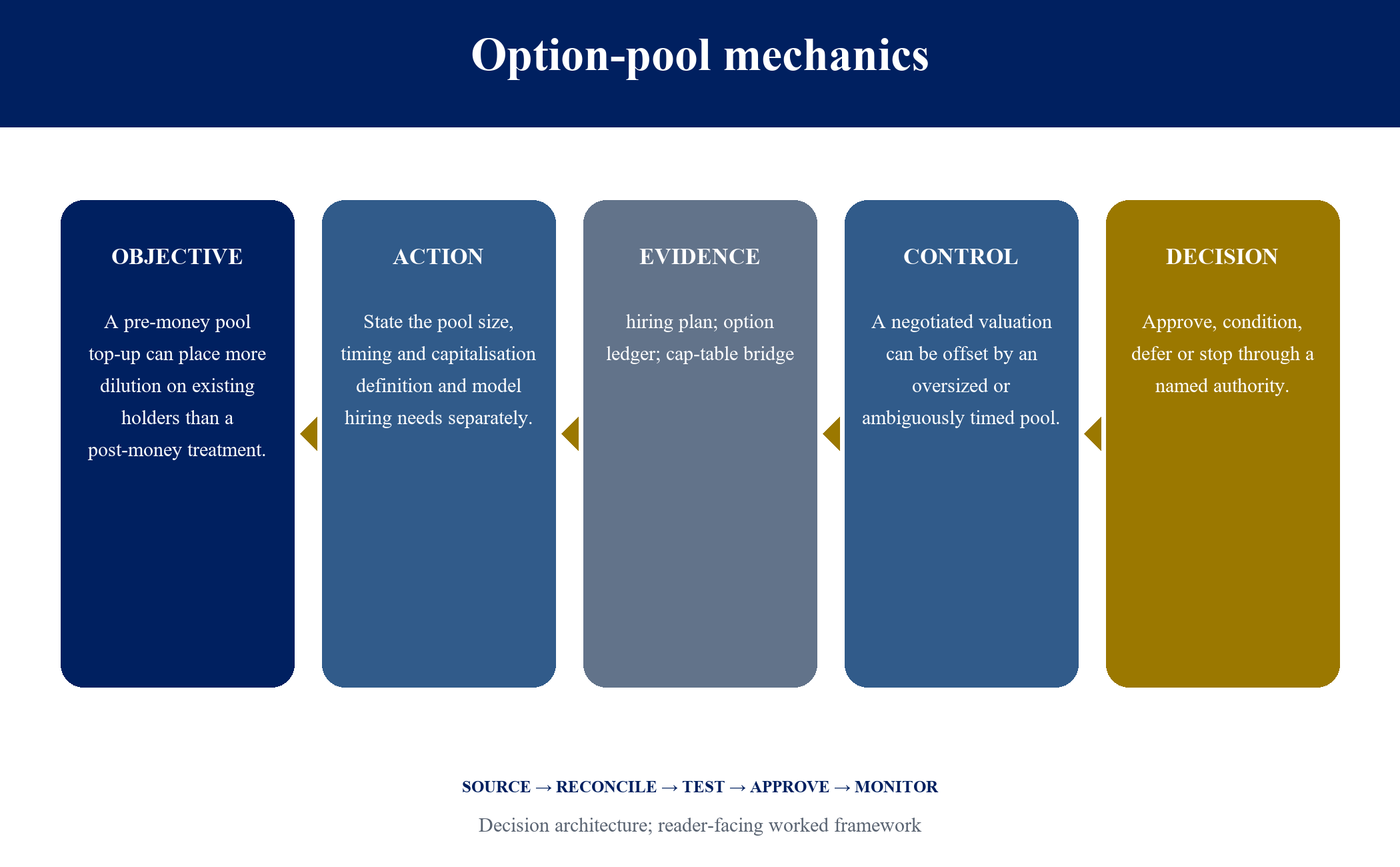
A pre-money pool top-up can place more dilution on existing holders than a post-money treatment. This matters in safe versus convertible versus priced round in the gcc context because the economics, legal rights, operating evidence and timing can move on different clocks. A useful analysis therefore begins with the decision being made, the party authorised to make it and the date on which the evidence is expected to be current. The work should distinguish source facts, management representations, analytical assumptions and professional judgement so that a reviewer can see where each conclusion originates.
The recommended workstream is to state the pool size, timing and capitalisation definition and model hiring needs separately. The team should translate that instruction into named owners, dated gates and a common set of definitions. A base case should describe the expected path; a downside case should test weaker operating performance or slower execution; and a delay case should test what happens when a required approval, document, counterparty or financing event arrives later than planned. Any decision threshold used in the model should be recorded as a management choice unless it comes directly from a cited rule or contract.
The decision framework has four layers. First, define the commercial objective and non-negotiable constraints. Second, assemble the minimum source record and reconcile it to the numbers used in the analysis. Third, compare executable alternatives under consistent assumptions, including cost, control, liquidity, timing and downside. Fourth, approve the route, its conditions and the fallback. This sequence keeps a transaction from moving ahead on an attractive headline while unresolved implementation questions remain outside the decision paper.
8.2 Evidence and controls
The minimum evidence for this module is hiring plan; option ledger; cap-table bridge Each item should have an owner, effective date, source location and review status. Where information is produced through a model or transformation, the file should preserve the original input, calculation logic and output version. The reviewer should be able to reproduce the material conclusion without relying on a presentation slide, an uncited summary or the memory of the person who prepared it.
Control quality can be tested through three questions. Does the source support the stated fact? Does the calculation use the approved definition? Does the proposed action remain within the authority and risk limits already granted? An exception to any of these tests should enter a dated register with a named resolver and a stop, proceed or conditional-proceed decision. Completion means that the evidence and decision have been accepted by the accountable owner; document production alone is an intermediate output.
The principal failure mode is that a negotiated valuation can be offset by an oversized or ambiguously timed pool. The response is to make the vulnerable assumption visible, test a plausible adverse state and identify the earliest observable warning indicator. The analysis should also state what remains outside its scope and which legal, tax, regulatory, accounting, valuation, technical or investment conclusions require qualified advice. This creates a practical boundary between a research framework and a conclusion for a particular company, investor, lender, family or transaction.
| Control question | Required record | Decision response |
|---|---|---|
| What is being decided? | State the pool size, timing and capitalisation definition and model hiring needs separately. | Approve objective and authority. |
| What proves the case? | hiring plan; option ledger; cap-table bridge | Reconcile and sign off. |
| What can fail? | A negotiated valuation can be offset by an oversized or ambiguously timed pool. | Test downside and escalation. |
9. Investor rights and governance
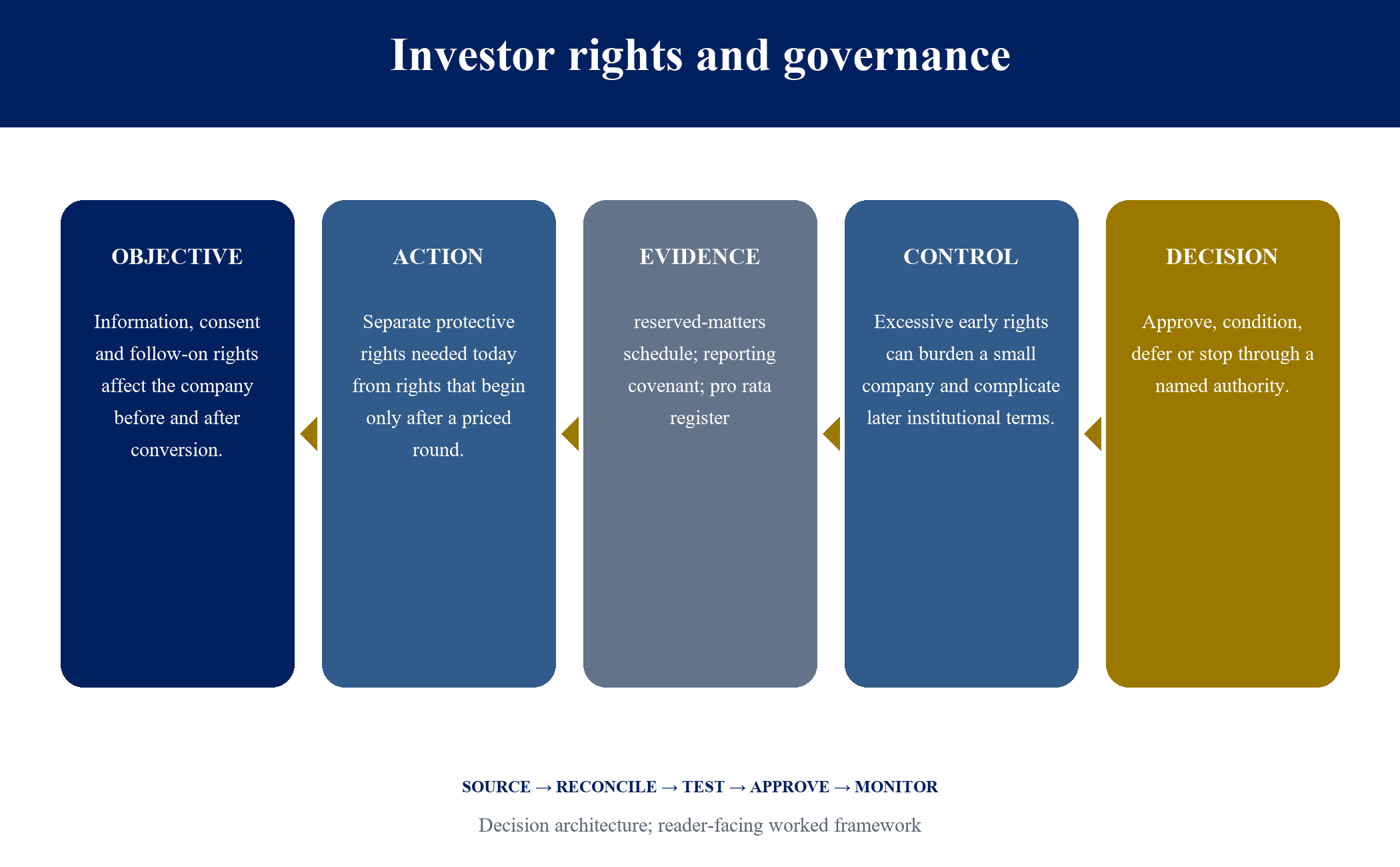
Information, consent and follow-on rights affect the company before and after conversion. This matters in safe versus convertible versus priced round in the gcc context because the economics, legal rights, operating evidence and timing can move on different clocks. A useful analysis therefore begins with the decision being made, the party authorised to make it and the date on which the evidence is expected to be current. The work should distinguish source facts, management representations, analytical assumptions and professional judgement so that a reviewer can see where each conclusion originates.
The recommended workstream is to separate protective rights needed today from rights that begin only after a priced round. The team should translate that instruction into named owners, dated gates and a common set of definitions. A base case should describe the expected path; a downside case should test weaker operating performance or slower execution; and a delay case should test what happens when a required approval, document, counterparty or financing event arrives later than planned. Any decision threshold used in the model should be recorded as a management choice unless it comes directly from a cited rule or contract.
The decision framework has four layers. First, define the commercial objective and non-negotiable constraints. Second, assemble the minimum source record and reconcile it to the numbers used in the analysis. Third, compare executable alternatives under consistent assumptions, including cost, control, liquidity, timing and downside. Fourth, approve the route, its conditions and the fallback. This sequence keeps a transaction from moving ahead on an attractive headline while unresolved implementation questions remain outside the decision paper.
9.2 Evidence and controls
The minimum evidence for this module is reserved-matters schedule; reporting covenant; pro rata register Each item should have an owner, effective date, source location and review status. Where information is produced through a model or transformation, the file should preserve the original input, calculation logic and output version. The reviewer should be able to reproduce the material conclusion without relying on a presentation slide, an uncited summary or the memory of the person who prepared it.
Control quality can be tested through three questions. Does the source support the stated fact? Does the calculation use the approved definition? Does the proposed action remain within the authority and risk limits already granted? An exception to any of these tests should enter a dated register with a named resolver and a stop, proceed or conditional-proceed decision. Completion means that the evidence and decision have been accepted by the accountable owner; document production alone is an intermediate output.
The principal failure mode is that excessive early rights can burden a small company and complicate later institutional terms. The response is to make the vulnerable assumption visible, test a plausible adverse state and identify the earliest observable warning indicator. The analysis should also state what remains outside its scope and which legal, tax, regulatory, accounting, valuation, technical or investment conclusions require qualified advice. This creates a practical boundary between a research framework and a conclusion for a particular company, investor, lender, family or transaction.
| Control question | Required record | Decision response |
|---|---|---|
| What is being decided? | Separate protective rights needed today from rights that begin only after a priced round. | Approve objective and authority. |
| What proves the case? | reserved-matters schedule; reporting covenant; pro rata register | Reconcile and sign off. |
| What can fail? | Excessive early rights can burden a small company and complicate later institutional terms. | Test downside and escalation. |
10. Downside and liquidity events
Sale, insolvency, shutdown and a delayed financing need express treatment. This matters in safe versus convertible versus priced round in the gcc context because the economics, legal rights, operating evidence and timing can move on different clocks. A useful analysis therefore begins with the decision being made, the party authorised to make it and the date on which the evidence is expected to be current. The work should distinguish source facts, management representations, analytical assumptions and professional judgement so that a reviewer can see where each conclusion originates.
The recommended workstream is to model cash and ownership outcomes under an early sale, no qualified round, maturity and liquidation. The team should translate that instruction into named owners, dated gates and a common set of definitions. A base case should describe the expected path; a downside case should test weaker operating performance or slower execution; and a delay case should test what happens when a required approval, document, counterparty or financing event arrives later than planned. Any decision threshold used in the model should be recorded as a management choice unless it comes directly from a cited rule or contract.
The decision framework has four layers. First, define the commercial objective and non-negotiable constraints. Second, assemble the minimum source record and reconcile it to the numbers used in the analysis. Third, compare executable alternatives under consistent assumptions, including cost, control, liquidity, timing and downside. Fourth, approve the route, its conditions and the fallback. This sequence keeps a transaction from moving ahead on an attractive headline while unresolved implementation questions remain outside the decision paper.
10.2 Evidence and controls
The minimum evidence for this module is waterfall model; event definitions; priority schedule Each item should have an owner, effective date, source location and review status. Where information is produced through a model or transformation, the file should preserve the original input, calculation logic and output version. The reviewer should be able to reproduce the material conclusion without relying on a presentation slide, an uncited summary or the memory of the person who prepared it.
Control quality can be tested through three questions. Does the source support the stated fact? Does the calculation use the approved definition? Does the proposed action remain within the authority and risk limits already granted? An exception to any of these tests should enter a dated register with a named resolver and a stop, proceed or conditional-proceed decision. Completion means that the evidence and decision have been accepted by the accountable owner; document production alone is an intermediate output.
The principal failure mode is that parties often discover incompatible expectations only when the company is under pressure. The response is to make the vulnerable assumption visible, test a plausible adverse state and identify the earliest observable warning indicator. The analysis should also state what remains outside its scope and which legal, tax, regulatory, accounting, valuation, technical or investment conclusions require qualified advice. This creates a practical boundary between a research framework and a conclusion for a particular company, investor, lender, family or transaction.
| Control question | Required record | Decision response |
|---|---|---|
| What is being decided? | Model cash and ownership outcomes under an early sale, no qualified round, maturity and liquidation. | Approve objective and authority. |
| What proves the case? | waterfall model; event definitions; priority schedule | Reconcile and sign off. |
| What can fail? | Parties often discover incompatible expectations only when the company is under pressure. | Test downside and escalation. |
11. Execution timetable and cost
A faster document may still require corporate approvals, banking, diligence and investor coordination. This matters in safe versus convertible versus priced round in the gcc context because the economics, legal rights, operating evidence and timing can move on different clocks. A useful analysis therefore begins with the decision being made, the party authorised to make it and the date on which the evidence is expected to be current. The work should distinguish source facts, management representations, analytical assumptions and professional judgement so that a reviewer can see where each conclusion originates.
The recommended workstream is to compare end-to-end work, external cost, founder time, conditions and closing certainty. The team should translate that instruction into named owners, dated gates and a common set of definitions. A base case should describe the expected path; a downside case should test weaker operating performance or slower execution; and a delay case should test what happens when a required approval, document, counterparty or financing event arrives later than planned. Any decision threshold used in the model should be recorded as a management choice unless it comes directly from a cited rule or contract.
The decision framework has four layers. First, define the commercial objective and non-negotiable constraints. Second, assemble the minimum source record and reconcile it to the numbers used in the analysis. Third, compare executable alternatives under consistent assumptions, including cost, control, liquidity, timing and downside. Fourth, approve the route, its conditions and the fallback. This sequence keeps a transaction from moving ahead on an attractive headline while unresolved implementation questions remain outside the decision paper.
11.2 Evidence and controls
The minimum evidence for this module is closing plan; responsibility matrix; counsel scope; fee budget Each item should have an owner, effective date, source location and review status. Where information is produced through a model or transformation, the file should preserve the original input, calculation logic and output version. The reviewer should be able to reproduce the material conclusion without relying on a presentation slide, an uncited summary or the memory of the person who prepared it.
Control quality can be tested through three questions. Does the source support the stated fact? Does the calculation use the approved definition? Does the proposed action remain within the authority and risk limits already granted? An exception to any of these tests should enter a dated register with a named resolver and a stop, proceed or conditional-proceed decision. Completion means that the evidence and decision have been accepted by the accountable owner; document production alone is an intermediate output.
The principal failure mode is that document count is an incomplete measure of execution speed. The response is to make the vulnerable assumption visible, test a plausible adverse state and identify the earliest observable warning indicator. The analysis should also state what remains outside its scope and which legal, tax, regulatory, accounting, valuation, technical or investment conclusions require qualified advice. This creates a practical boundary between a research framework and a conclusion for a particular company, investor, lender, family or transaction.
| Control question | Required record | Decision response |
|---|---|---|
| What is being decided? | Compare end-to-end work, external cost, founder time, conditions and closing certainty. | Approve objective and authority. |
| What proves the case? | closing plan; responsibility matrix; counsel scope; fee budget | Reconcile and sign off. |
| What can fail? | Document count is an incomplete measure of execution speed. | Test downside and escalation. |
12. Decision matrix and closing controls
A disciplined selection compares instruments against the same objectives and evidence. This matters in safe versus convertible versus priced round in the gcc context because the economics, legal rights, operating evidence and timing can move on different clocks. A useful analysis therefore begins with the decision being made, the party authorised to make it and the date on which the evidence is expected to be current. The work should distinguish source facts, management representations, analytical assumptions and professional judgement so that a reviewer can see where each conclusion originates.
The recommended workstream is to score price uncertainty, runway, governance, accounting, next-round fit and downside before approval. The team should translate that instruction into named owners, dated gates and a common set of definitions. A base case should describe the expected path; a downside case should test weaker operating performance or slower execution; and a delay case should test what happens when a required approval, document, counterparty or financing event arrives later than planned. Any decision threshold used in the model should be recorded as a management choice unless it comes directly from a cited rule or contract.
The decision framework has four layers. First, define the commercial objective and non-negotiable constraints. Second, assemble the minimum source record and reconcile it to the numbers used in the analysis. Third, compare executable alternatives under consistent assumptions, including cost, control, liquidity, timing and downside. Fourth, approve the route, its conditions and the fallback. This sequence keeps a transaction from moving ahead on an attractive headline while unresolved implementation questions remain outside the decision paper.
12.2 Evidence and controls
The minimum evidence for this module is signed decision paper; final model; closing set; post-close register Each item should have an owner, effective date, source location and review status. Where information is produced through a model or transformation, the file should preserve the original input, calculation logic and output version. The reviewer should be able to reproduce the material conclusion without relying on a presentation slide, an uncited summary or the memory of the person who prepared it.
Control quality can be tested through three questions. Does the source support the stated fact? Does the calculation use the approved definition? Does the proposed action remain within the authority and risk limits already granted? An exception to any of these tests should enter a dated register with a named resolver and a stop, proceed or conditional-proceed decision. Completion means that the evidence and decision have been accepted by the accountable owner; document production alone is an intermediate output.
The principal failure mode is that a late instrument change can invalidate approvals and ownership calculations. The response is to make the vulnerable assumption visible, test a plausible adverse state and identify the earliest observable warning indicator. The analysis should also state what remains outside its scope and which legal, tax, regulatory, accounting, valuation, technical or investment conclusions require qualified advice. This creates a practical boundary between a research framework and a conclusion for a particular company, investor, lender, family or transaction.
| Control question | Required record | Decision response |
|---|---|---|
| What is being decided? | Score price uncertainty, runway, governance, accounting, next-round fit and downside before approval. | Approve objective and authority. |
| What proves the case? | signed decision paper; final model; closing set; post-close register | Reconcile and sign off. |
| What can fail? | A late instrument change can invalidate approvals and ownership calculations. | Test downside and escalation. |
Primary and authoritative sources
- UAE Federal Decree-Law No. 32 of 2021 on Commercial Companies. https://uaelegislation.gov.ae/en/legislations/1542/
- ADGM Companies Regulations 2020. https://en.adgm.thomsonreuters.com/rulebook/companies-regulations-2020
- ADGM FSRA, Venture Capital Fund Manager Guidance. https://www.adgm.com/documents/legal-framework/guidance-and-policy/fsra/guidance-regulatory-framework-for-fund-managers-of-venture-capital-funds-20231218.pdf
- Hub71 Access Programme. https://www.hub71.com/program/access-programme
- IFRS Foundation, IAS 32 Financial Instruments: Presentation. https://www.ifrs.org/issued-standards/list-of-standards/ias-32-financial-instruments-presentation/
- IFRS Foundation, IFRS 9 Financial Instruments. https://www.ifrs.org/issued-standards/list-of-standards/ifrs-9-financial-instruments/
