

Introduction
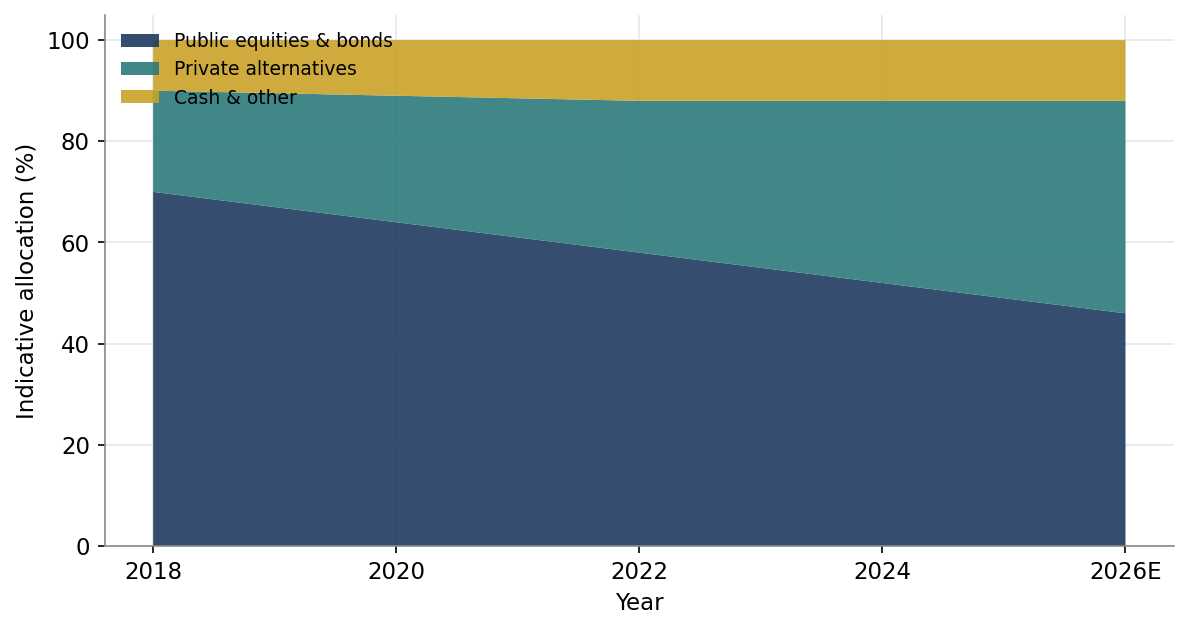
The asset allocation of GCC family offices is undergoing a structural shift. Where the region private wealth was once concentrated in public equities, bonds, cash and direct real estate, it is increasingly being allocated to private alternatives, private equity, private credit, real estate funds, infrastructure and venture capital, in a shift that mirrors a global trend among sophisticated investors but that has distinctive regional features. This shift is reshaping how the region substantial private wealth is deployed, and it is creating both opportunity and challenge for the family offices undertaking it.
This paper examines the GCC family office allocation shift, asking what is driving it, what the growing private allocation comprises, and how a family office can undertake the shift successfully. The shift is significant because it changes not only where the region wealth is invested but the capabilities the family offices need, the risks they bear, and the returns they can expect. Understanding the shift, and how to undertake it well, is increasingly important for the region family offices and for the managers, advisers and institutions that serve them.
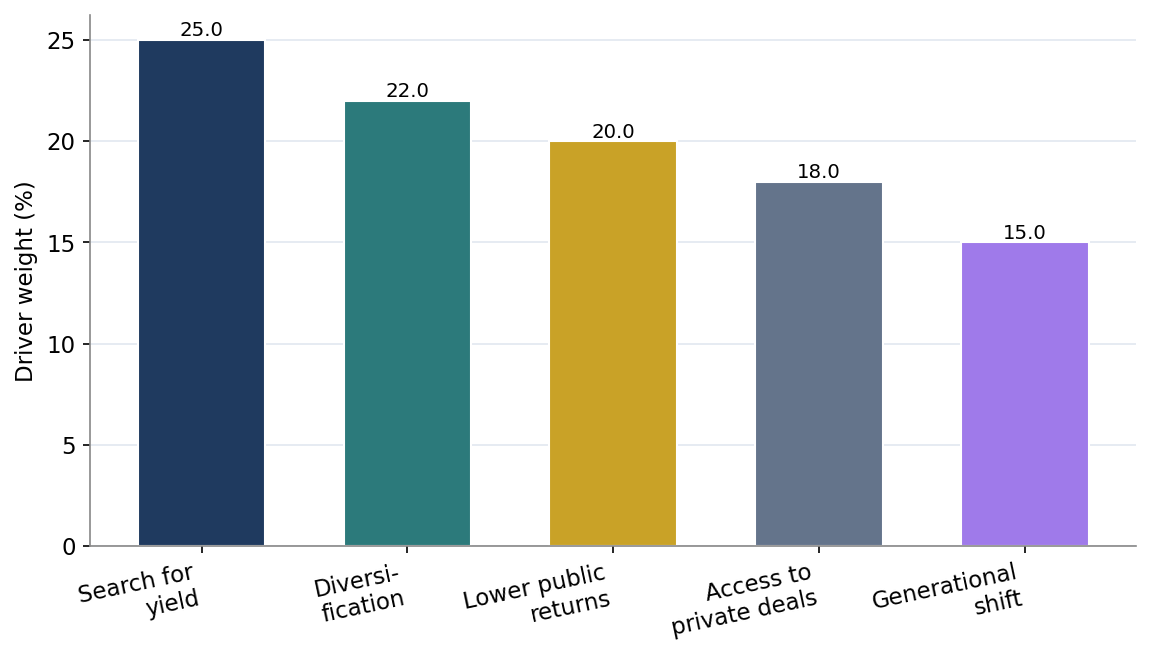
The central argument is that the shift is driven by the search for yield and diversification and by the lower expected returns of public markets, that it offers genuine benefits but requires capabilities, in manager selection, liquidity management and portfolio construction, that family offices must build, and that the family offices that build these capabilities will capture the benefits while those that shift without them will be disappointed. The shift is not simply a matter of moving capital but of building the capabilities to deploy it well in private markets, and the paper develops the framework for doing so.
The figures used throughout are indicative, calibrated to observable GCC conditions in early 2026 but not drawn from any specific family office. The paper proceeds from the scale and trajectory of the shift (Section 2), through its drivers (Section 3), the composition of the private allocation (Section 4), the capabilities the shift requires (Section 5), the framework for undertaking it (Section 6), liquidity and pacing (Section 7), the risks (Section 8), distinctive regional features (Section 9), three indicative cases (Section 10), sensitivity analysis (Section 11), an international comparison (Section 12), common errors (Section 13), an implementation roadmap (Section 14), a strategic perspective (Section 15), a conclusion (Section 16) and limitations (Section 17).
The Composition of the Private Allocation
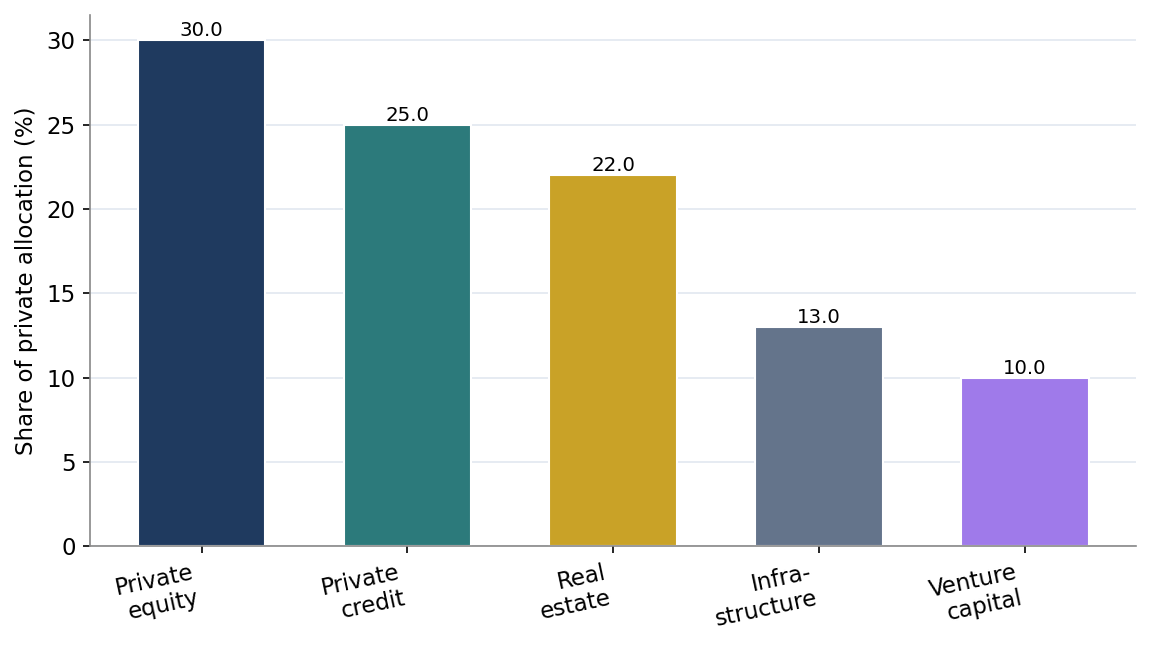
The growing private allocation comprises several asset classes, illustrated in Figure 3, each with its own role. Private equity is typically the largest component, sought for its higher returns, and it spans buyout, growth and other strategies. Private credit, examined in companion papers, is a growing component, sought for its yield and its lower volatility. Real estate, both direct and through funds, is a substantial component, reflecting the region affinity for real assets. Infrastructure and venture capital are smaller but growing components, sought for their diversification and their growth respectively.
Figure 3. Composition of the Private Allocation
The composition reflects the family office objectives and the asset classes characteristics. Private equity provides the higher returns that drive much of the shift; private credit provides yield with lower volatility; real estate provides real-asset exposure and income; infrastructure provides stable, long-duration income and diversification; and venture capital provides growth and exposure to innovation. A family office constructs its private allocation across these asset classes according to its objectives, its risk appetite, and its capabilities, building a diversified private markets portfolio, as a companion paper on portfolio construction develops.
The composition also evolves as the family office private markets programme matures. An early-stage programme may concentrate in the more accessible asset classes, such as real estate and private credit, while a mature programme spans the full range, including the less accessible private equity and venture capital, and builds the vintage diversification that a mature programme requires. The composition of the private allocation therefore reflects not only the family office objectives but the maturity of its programme, and it develops over time as the programme matures, which the framework and the indicative cases explore.
The Framework for Undertaking the Shift
The framework for undertaking the shift is to build the capabilities, then allocate progressively and measuredly, constructing a diversified private markets portfolio across asset classes, managers and vintages. A family office should first build, or access, the capabilities, manager selection, liquidity management and portfolio construction, that the shift requires, before allocating substantially to private markets, because allocating without the capabilities risks poor outcomes. Having built the capabilities, the family office allocates progressively, building the private allocation over time rather than all at once.
The framework emphasises measured, progressive allocation rather than a rushed shift. Building a private markets portfolio takes time, both to deploy the capital as opportunities arise and to build the vintage diversification that spreads the allocation across years, and a family office should allocate measuredly, committing to funds and deals over time, rather than rushing to deploy a large allocation quickly. A rushed allocation risks deploying into a single vintage, concentrating the timing risk, and selecting managers hastily; a measured allocation builds the diversification and allows careful selection. The measured, progressive approach is central to the framework.
The framework also matches the pace and composition of the shift to the family office stage and capabilities. An early-stage family office, building its capabilities, should allocate modestly and in the more accessible asset classes; a maturing family office, with developing capabilities, can allocate more and across more asset classes; a mature family office, with full capabilities, can run a substantial, diversified private markets programme. The framework therefore guides the family office to allocate at a pace and in a composition matched to its stage and capabilities, building toward a mature programme over time, as the indicative cases show.
The Risks of the Shift
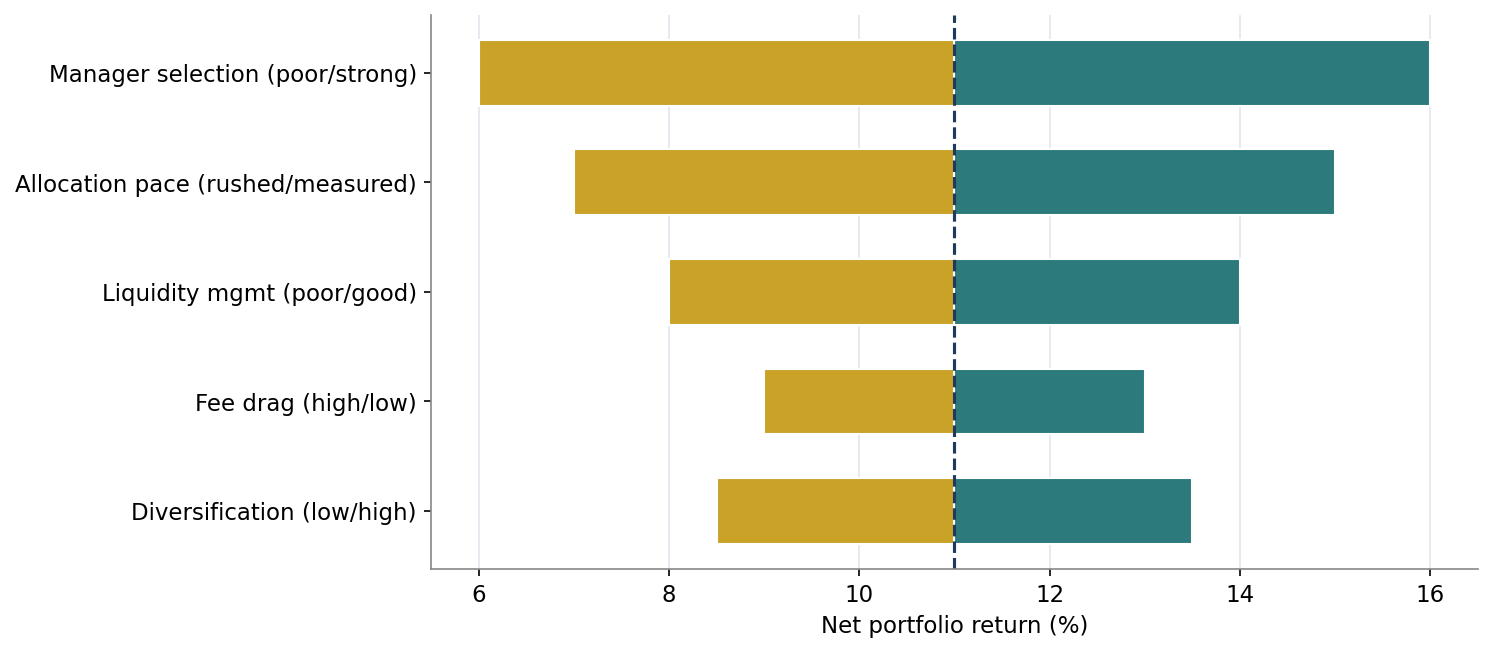
The shift carries risks that a family office must manage. The foremost is the manager selection risk: because private markets returns depend heavily on the manager, selecting poor managers can produce poor returns, even negative ones, and a family office that lacks the manager selection capability risks this outcome. The wide dispersion between the best and worst private markets managers means manager selection is the principal determinant of the outcome, and the risk of selecting poorly is the principal risk of the shift.
The second risk is the liquidity risk: the illiquidity of private markets means a family office that mismanages its liquidity, over-committing or holding too little liquidity, can face strain, unable to meet capital calls or forced to sell at a discount. The third is the concentration risk, where a family office that allocates without diversification, concentrating in a few managers, vintages or strategies, bears excessive idiosyncratic risk. The fourth is the fee drag, where the higher fees of private markets, if not managed, erode the returns, as a companion paper on net-to-LP returns develops.
These risks, the manager selection, the liquidity, the concentration and the fee drag, are the principal risks of the shift, and they are precisely the risks that the capabilities, manager selection, liquidity management and portfolio construction, are designed to manage. A family office that builds the capabilities manages the risks, selecting good managers, managing the liquidity, diversifying the portfolio, and controlling the fees; one that shifts without the capabilities bears the risks unmanaged. The risks of the shift are therefore manageable through the capabilities, which is why building the capabilities is so central, and a family office that builds them undertakes the shift safely while one that does not bears the risks.
Distinctive Regional Features
The GCC allocation shift has distinctive regional features that shape it. The region wealth, much of it recent and built on enterprise and energy, is substantial and growing, providing the capital for the shift, and the region family offices, many relatively young, are professionalising and building the capabilities the shift requires. The region affinity for real assets, particularly real estate, shapes the composition of the private allocation, with real estate a substantial component. And the region compliant requirements shape the shift, with a portion of the allocation requiring Shariah-compliant structures.
The region developing private markets ecosystem, the managers, advisers and infrastructure, is both a constraint on and a beneficiary of the shift. The ecosystem is less developed than in the mature markets, which can constrain the family offices access to managers and capabilities, but it is developing rapidly, fostered by the demand the shift creates, and a family office can increasingly access regional and international managers and advisers. The development of the ecosystem is enabling the shift, and the shift is fostering the ecosystem, in the reinforcing dynamic noted earlier.
The generational shift in the region family offices is a particularly distinctive feature. As a younger, more globally-educated generation takes the helm, it brings a more sophisticated, private-markets-oriented approach, and it drives the allocation shift as part of a broader professionalisation of the family offices. This generational dimension means the shift is bound up with the broader evolution of the region family offices from the wealth-preservation vehicles of the founding generation to the sophisticated investment institutions of the next, and it is likely to accelerate as the generational transition proceeds. The generational shift is therefore both a driver of and a context for the allocation shift in the region.
Indicative Cases
Three indicative cases show family offices at different stages of the shift. The figures are synthetic and constructed for analytical clarity, not drawn from any specific family office.
Case A: early-stage family office
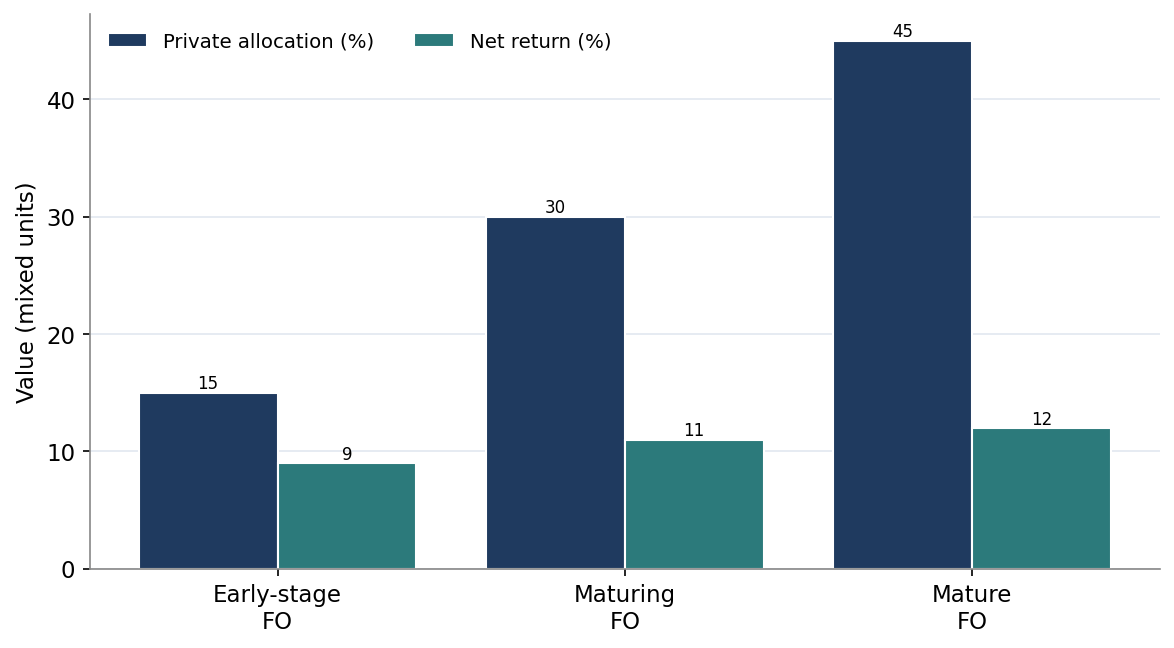
Case A is a family office early in the shift, beginning to allocate to private markets while building its capabilities. It allocates modestly, around fifteen percent, in the more accessible asset classes, real estate and private credit, while building its manager selection and liquidity management capabilities and learning the private markets. The case illustrates the early stage, allocating modestly and accessibly while building the capabilities, laying the foundation for a larger allocation as the capabilities and the programme mature.
Case B: maturing family office
Case B is a family office maturing in the shift, with developing capabilities and a growing private allocation around thirty percent across more asset classes, including private equity. It has built its manager selection and liquidity management capabilities, is constructing a diversified portfolio across asset classes and vintages, and is running a more substantial private markets programme. The case illustrates the maturing stage, with a larger, more diversified allocation supported by developing capabilities, progressing toward a mature programme.
Case C: mature family office
Case C is a family office mature in the shift, with full capabilities and a substantial private allocation around forty-five percent across the full range of asset classes, with built vintage diversification. It has full manager selection, liquidity management and portfolio construction capabilities, runs a substantial, diversified private markets programme, and uses tools such as NAV facilities to manage the liquidity. The case illustrates the mature stage, with a substantial, well-diversified, well-managed private markets programme supported by full capabilities.
Figure 4. Private Allocation and Net Return by Family Office Stage
Synthetic figures for analytical comparison. Not a forecast.
Figure 4 compares the three cases on the private allocation and the net return. The allocation and the net return both rise with the maturity of the family office and its capabilities, as the mature family office, with full capabilities, allocates more and earns more than the early-stage family office still building its capabilities. The comparison illustrates that the benefits of the shift rise with the capabilities, and that a family office captures more of the benefits as it builds its capabilities and matures its programme, which is why building the capabilities and maturing the programme progressively is the path to capturing the benefits of the shift.
International Comparison
The shift toward private markets has been led internationally by the large endowments and institutions, the so-called endowment model pioneered by leading university endowments, which allocated substantially to private markets and earned strong returns through superior manager selection and access. The model has been widely emulated by institutions and, increasingly, by family offices globally, and the GCC family office shift is part of this global movement. The international experience offers a guide to where the regional shift is heading and the capabilities it requires.
The international experience offers important lessons. It shows that the benefits of the shift depend heavily on the capabilities, particularly manager selection and access to top managers, and that the institutions that built these capabilities earned strong returns while those that did not earned less. It also shows that access to the best managers, who are often capacity-constrained, is a key advantage, and that building the relationships and the reputation to access them takes time. The regional family offices can learn from this experience, building the capabilities and the relationships that the successful international investors built, and recognising that the benefits depend on doing so. The international experience confirms that the shift, done well, is rewarding, but that doing it well requires the capabilities.
Implementation Roadmap
Build, or access through advisers, the capabilities the shift requires: manager selection, liquidity management and portfolio construction.
Allocate progressively and measuredly, building the private allocation over time across vintages rather than all at once.
Construct a diversified private markets portfolio across asset classes, managers, vintages and strategies.
Manage the liquidity and pace the commitments, using tools such as NAV facilities where helpful, to run the programme efficiently.
Match the pace and composition of the shift to the family office stage and capabilities, building toward a mature programme over time.
Control the fee drag, negotiating fees and using co-investment where possible, to preserve the net return.
Build the relationships and reputation to access top managers, recognising that access is a key advantage that takes time to build.
Conclusion
GCC family offices are undergoing a structural shift from public markets to private alternatives, driven by the search for yield and diversification and by the lower expected returns of public markets. This paper has argued that the shift offers genuine benefits but requires capabilities, in manager selection, liquidity management and portfolio construction, that family offices must build, and that the family offices that build these capabilities will capture the benefits while those that shift without them will be disappointed. The shift is not simply a reallocation of capital but a transformation of the family office into a private markets institution.
The family offices that undertake the shift well, building the capabilities, allocating measuredly, managing the liquidity, and diversifying, will capture the benefits of private markets and build wealth across generations, while those that shift without the capabilities will bear the risks and be disappointed. For the region, the shift and the transformation of its family offices it requires are part of the maturation of its private wealth and its capital markets. The frameworks in this paper, and the companion papers on manager selection, liquidity, fees and portfolio construction, are intended to help the region family offices undertake the shift successfully and build the private markets institutions the shift requires.
Limitations and Directions for Further Research
This paper is framework-oriented and relies on indicative data, and its conclusions are directional rather than precise. The allocation figures and returns are calibrated to observable conditions but are not empirical estimates, and they vary across family offices. The shift is ongoing, and its trajectory and outcomes are still developing.
Several extensions would strengthen the analysis. An empirical study of GCC family office allocations and their evolution would replace the indicative figures with data. An analysis of the realised returns of family office private markets programmes would test the benefit assumptions. And a study of the capabilities that distinguish successful from unsuccessful family office private markets programmes would sharpen the central argument about capabilities. Each is a natural subject for a later paper in this series.
| Scenario | Manager selection | Capabilities | Net return |
|---|---|---|---|
| Strong | Top managers | Full | ~13% |
| Base | Solid | Developing | ~11% |
| Weak | Average | Limited | ~8% |
| Poor | Poor managers | Absent | ~5% |
