Introduction
The question of how to fund a real estate development in the United Arab Emirates is rarely framed as a strategic decision. In practice, the sequence is familiar. A sponsor identifies a plot or a portfolio, models a gross development value, approaches the relationship bank that financed the previous scheme, accepts whatever loan-to-cost the credit committee will approve, and then scrambles to fill the remaining gap with personal equity, partner equity or pre-sales. The capital structure that results is an accident of relationships and timing rather than the product of deliberate analysis. For schemes of modest size this may cost the sponsor relatively little. For schemes in the AED 50 million to AED 1 billion range, where the financing decision compounds across a multi-year development cycle, the cost of a poorly chosen structure can erode a material share of the equity return.
This paper takes the opposite starting point. It treats the capital structure as a lever of value creation that sits alongside site selection, design efficiency and sales execution, and it argues that the right structure is knowable in advance if the sponsor is willing to analyse the trade-offs. The central trade-off is between cost and control. Senior debt is cheap but restrictive and limited in quantum; common equity is expensive but flexible and unlimited; and a family of instruments in between, principally mezzanine debt and preferred equity, allows a sponsor to tune the blend. The art of structuring is choosing the point on that spectrum that minimises the blended cost of capital for a given level of risk while preserving the control and flexibility the sponsor actually needs.
The analysis is deliberately practical. It is written for the founder, chief financial officer, managing director or head of capital markets who must make this decision under time pressure, and who is more interested in a defensible framework than in financial theory for its own sake. At the same time, the paper draws on the established academic literature on capital structure, because that literature offers genuine insight into why the trade-offs take the shape they do. The figures used throughout are indicative, constructed to be internally consistent and calibrated to conditions observable in the GCC market in early 2026, but they are not drawn from any single live transaction. Their purpose is to make the mechanics visible, not to predict the terms of any particular deal.
Anatomy of the Real Estate Capital Stack
The capital stack is the ordered set of claims against a development project, ranked by the priority in which they are repaid and, correspondingly, by the risk they bear and the return they require. At the base sits senior secured debt, which is repaid first and is secured against the asset; at the top sits common equity, which is repaid last and absorbs the first losses. Between these poles sit mezzanine debt and preferred equity. Figure 4 presents the stack schematically, with indicative loan-to-cost shares and costs of capital.
Figure 4. Indicative Real Estate Capital Stack with Indicative Costs
Senior secured debt
Senior secured debt is the cheapest layer of the stack because it carries the least risk. It is repaid before all other claims and is secured by a first-ranking mortgage over the land and the development, often supported by an assignment of sales receivables, project accounts and insurances. In the UAE in 2026, senior facilities for development typically extend to between 45 and 60 percent of total cost, with the precise ceiling depending on the asset class, the sponsor track record and whether the facility is provided by a bank or a private credit fund. The indicative all-in cost ranges from roughly 7.5 percent for strong bank paper to around 9.5 percent for private credit senior. The trade-off the sponsor accepts in exchange for this low cost is a battery of covenants, security and control rights that constrain operational and financial flexibility. Senior lenders will typically require a first charge, a debt-service or interest-cover covenant, a loan-to-value ceiling tested periodically, restrictions on further indebtedness, and approval rights over material changes to the development plan.
Mezzanine debt
A Decision Framework by Deal Size and Stage
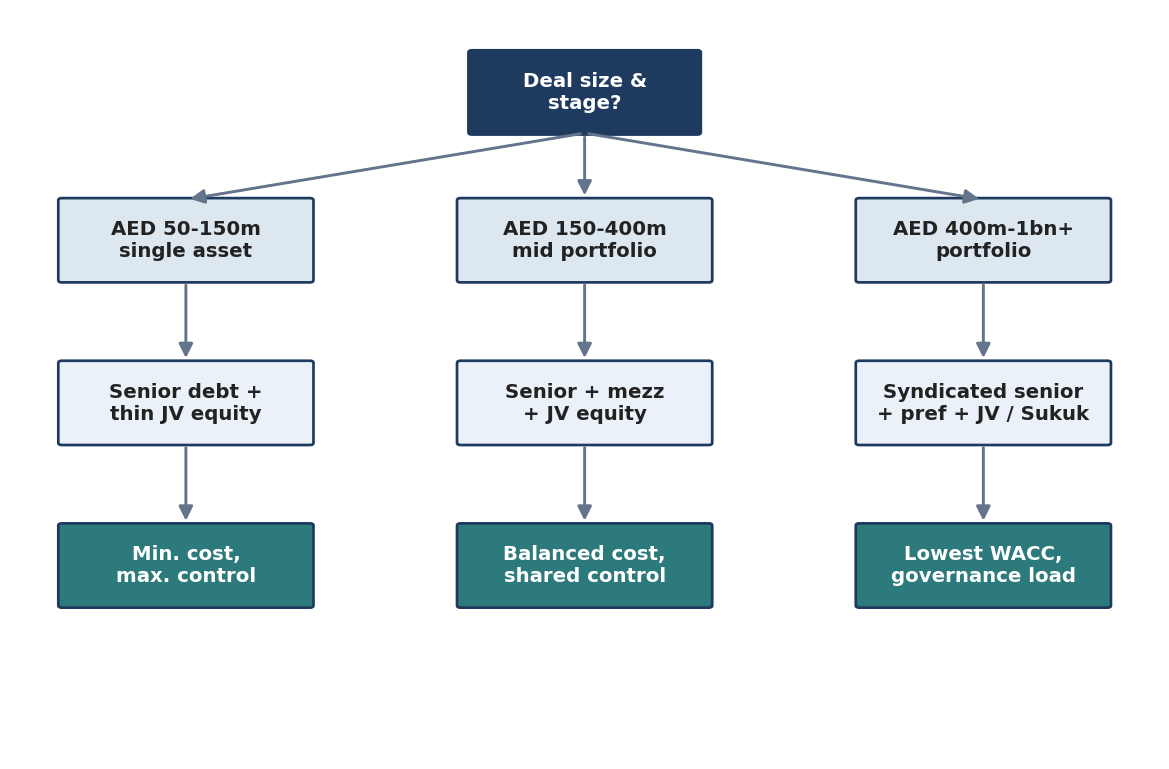
The premise of this section is that the optimal structure is not universal but conditional, and that deal size is the single most useful variable for segmenting the decision. Larger deals support more tranches because the absolute economics justify the legal, advisory and governance cost of a complex structure, and because larger raises naturally engage a broader and more institutional set of capital providers. Smaller deals reward simplicity. Figure 5 presents the framework as a decision tree.
Figure 5. Capital Structure Decision Tree by Deal Size
Indicative framework. Stage, asset quality and sponsor objectives modify the indicated default structure.
AED 50 million to AED 150 million: the single-asset scheme
At the smaller end of the range, the typical transaction is a single ground-up asset or a land acquisition with a defined development plan. Here the dominant consideration is the preservation of sponsor control and the avoidance of structuring complexity that the deal economics cannot absorb. The recommended default is a debt-led structure: a senior facility funding 50 to 60 percent of cost, with the balance provided by sponsor equity and, where available, a thin slice of JV equity from a single trusted partner. A mezzanine tranche is rarely justified at this size because the fixed costs of arranging and documenting subordinated debt are disproportionate to the quantum raised, and because a single capital partner can often be persuaded to take a larger common equity position more simply. The objective at this size is minimum cost and maximum control.
AED 150 million to AED 400 million: the mid-sized scheme or small portfolio
In the middle band, the transaction is often a larger single asset or a small portfolio of two to four projects. The equity cheque required to fund the gap above senior debt becomes large enough that funding it entirely with common equity is both expensive and dilutive. This is the band in which a mezzanine layer earns its place. A structure combining senior debt at 50 to 55 percent of cost, a mezzanine tranche of 12 to 18 percent, and common or JV equity for the remainder allows the sponsor to reach total leverage of 70 percent or more while limiting the dilution of common ownership. The objective shifts to balanced cost with shared but bounded control, and the sponsor must now manage an intercreditor relationship between senior and mezzanine lenders.
AED 400 million to AED 1 billion and above: the portfolio raise
| Attribute | Senior debt | Mezzanine | Preferred equity | JV / common equity |
|---|---|---|---|---|
| Repayment priority | First | Second | Third | Last |
| Typical share of cost | 45-60% | 10-20% | 5-15% | 15-30% |
| Indicative cost | 7.5-9.5% | 13-18% | 16-20% | 20-30%+ |
| Security | 1st mortgage | 2nd / share pledge | Equity ranking | Residual |
| Control impact | Covenants | Light covenants | Reserved matters | Shared governance |
| Maturity / default risk | Fixed | Fixed | Usually none | None |
| Dilution of sponsor | None | None | Minimal | Significant |
Risk, Control and Security Trade-offs
Cost is only one dimension of the structuring decision. The second, and frequently the decisive, dimension is control. Every tranche above pure sponsor equity comes with rights that constrain the sponsor, and the cumulative weight of those rights can determine whether a structure is workable in practice, regardless of its theoretical cost advantage.
Senior lenders impose financial covenants, security, cash sweep mechanisms and approval rights over major decisions, but they do not seek to participate in the upside or to direct the business. Mezzanine lenders impose a lighter covenant package but rank ahead of equity and may hold step-in or conversion rights that crystallise on default. Preferred equity holders typically negotiate reserved matters, a set of decisions that cannot be taken without their consent, and may hold rights that strengthen materially if the preferred return is not met on schedule. Common equity partners in a joint venture expect the most extensive governance: board representation, veto rights over budget, business plan and disposal decisions, and often pre-emption and exit provisions.
The sponsor must therefore weigh not only the headline cost of each tranche but the cumulative governance load of the structure as a whole. A structure that is marginally cheaper on a WACC basis but that hands a capital partner effective control over development decisions may be worse, in practical terms, than a slightly more expensive structure that leaves the sponsor free to execute. This is why the framework in Section 5 weights control so heavily at the smaller end of the size range, where a single misaligned partner can paralyse a scheme, and relaxes that weighting at the larger end, where institutional capital providers are more accustomed to standardised, bounded governance arrangements.
Security interacts with control. The more security a sponsor grants, the less flexibility it retains to refinance, to bring in additional capital, or to restructure if the scheme underperforms. A first mortgage to a senior lender is unavoidable, but layering a second charge, a share pledge and an equity ranking on top of it can leave the sponsor with little room to manoeuvre in a downside. Prudent structuring preserves some unencumbered flexibility for the scenarios in which it is most needed.
The Capital Provider Perspective
A structure that the sponsor finds attractive will only close if each capital provider also finds its tranche attractive on a risk-adjusted basis. Understanding what each provider underwrites is therefore part of designing a fundable structure, not a separate exercise.
What the senior lender underwrites
The senior lender underwrites the recovery of principal in a downside, not the upside of the scheme. Its analysis centres on the loan-to-value and loan-to-cost ratios, the quality and enforceability of its security, the credibility of the sales and cost assumptions, and the sponsor track record. A senior lender will accept a lower return precisely because it expects to be repaid in almost all scenarios, and it prices and structures to protect that expectation. The implication for the sponsor is that the senior tranche is won by demonstrating downside protection, conservative cost contingency, realistic sales assumptions and clean security, rather than by selling the upside.
What the mezzanine and preferred provider underwrites
The provider of mezzanine or preferred capital underwrites a middle risk: it expects to be repaid in the base case and most moderate downsides, but it absorbs loss before the senior lender in a severe downside. It is compensated for this with a higher fixed return and, often, with an equity-like kicker or an exit fee. This provider scrutinises the equity cushion beneath it, the headroom between projected value and the combined senior and mezzanine claim, and the sponsor incentive to complete. A thin equity cushion makes the mezzanine or preferred tranche harder and more expensive to place.
What the equity partner underwrites
The common equity partner underwrites the full risk and the full upside of the scheme. It is the residual claimant and therefore cares most about the absolute return, the sponsor alignment, and the governance rights that protect its capital. An equity partner will often accept a lower contractual protection in exchange for a larger share of the upside and a seat at the table. For the sponsor, attracting equity is as much about demonstrating alignment, skin in the game and a credible execution capability as it is about the projected return, because the equity partner is betting on the sponsor as much as on the asset.
| Sources | AED m | Share | Uses | AED m |
|---|---|---|---|---|
| Senior debt | 46.4 | 58% | Land | 22.0 |
| Sponsor equity | 24.0 | 30% | Construction | 44.0 |
| JV common equity | 9.6 | 12% | Soft costs and finance | 11.0 |
| Total sources | 80.0 | 100% | Contingency | 3.0 |
Indicative Case Studies
To make the framework concrete, this section works through three indicative schemes, one in each size band. The figures are synthetic and constructed for analytical clarity; they are not drawn from any specific transaction. Each case applies the default structure from Section 5 and reports the resulting developer equity IRR.
Case A: AED 80 million single residential asset
Case A is a single residential building with total cost of AED 80 million and a projected gross development value that supports a healthy margin. Applying the smaller-band default, the sponsor funds 58 percent with senior debt, contributes 30 percent as its own equity, and brings a single family-office partner for the remaining 12 percent as common equity. There is no mezzanine layer. The structure is simple, the sponsor retains clear control with only light governance rights ceded to the partner, and the high senior leverage relative to the modest equity base produces a strong equity IRR. The trade-off is that the sponsor carries concentrated risk: with a thin equity cushion, a downside in sales price or pace falls heavily on the equity.
Table 3. Case A Sources and Uses, AED 80m Single Asset
Uses total AED 80.0m. Figures rounded.
Case B: AED 480 million mixed-use scheme
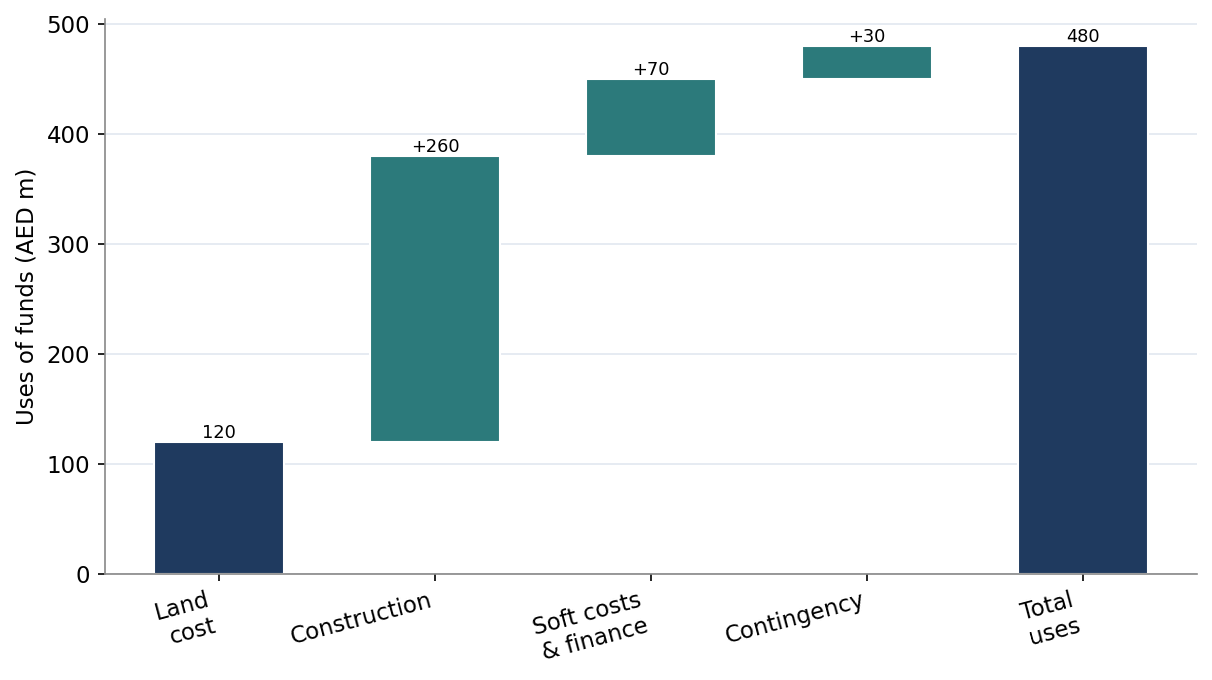
Case B is a mixed-use scheme with total cost of AED 480 million. The sponsor adopts the balanced structure: senior debt at 52 percent, a mezzanine tranche at 15 percent, and the remaining 33 percent as common and JV equity. The mezzanine layer allows the sponsor to limit the common equity cheque, containing dilution while reaching total leverage of 67 percent. The cost is an intercreditor negotiation and a mezzanine coupon that consumes part of the project cash flow during construction. The equity IRR is lower than Case A because leverage is more conservative relative to the equity base, but the risk is better distributed and the structure is more resilient to a moderate downside. Figure 8 shows the uses of funds for this scheme.
Figure 8. Indicative Uses of Funds, AED 480m Mixed-Use Scheme
Table 4. Case B Sources and Uses, AED 480m Mixed-Use
Uses total AED 480.0m. Figures rounded.
Case C: AED 750 million portfolio raise
International Comparison: UAE and United Kingdom Structuring
Because many UAE sponsors also operate in, or raise capital from, the United Kingdom, it is useful to compare the two markets. The United Kingdom has a deeper and more mature development debt market, in which a layered structure of senior debt, stretched senior and mezzanine is standard, and in which specialist development lenders compete actively for business. The all-in cost of UK development debt has, through the recent rate cycle, frequently exceeded comparable UAE pricing, reflecting the higher sterling rate environment, while the structuring conventions are broadly similar.
The UAE market offers two structural advantages that the framework should reflect. The first is the dirham peg to the United States dollar, which removes currency risk for dollar-denominated capital and widens the pool of international capital that can be deployed without a hedging cost. The second is the absence of a tax on development income in the principal jurisdictions, which alters the trade-off theory of Section 3 by removing the tax shield that makes debt advantageous in many other markets. In the UAE, the case for debt rests on its lower required return and its non-dilutive character rather than on a tax benefit, a subtle but important distinction when calibrating the optimal leverage.
Enforcement and security regimes also differ. The United Kingdom has a long-established body of law and practice governing the enforcement of security and the ranking of claims, which gives lenders a high degree of predictability. The UAE regimes have matured rapidly and, in the principal financial centres, offer lenders robust frameworks, but the conventions are younger and a lender new to the market will price some uncertainty into its terms. A sponsor raising from international lenders should anticipate this and be prepared to evidence the enforceability of the proposed security.
The broader lesson is that the framework in this paper is portable across markets but its calibration is not. The hierarchy of instruments, the cost-versus-control trade-off and the deal-size segmentation hold in both markets, but the specific cost figures, leverage ceilings and tax treatments must be recalibrated to local conditions. A sponsor operating across both markets should maintain two calibrations of the same framework rather than assuming the UAE figures travel unchanged to the United Kingdom or the reverse.
Refinancing and Exit
The capital structure chosen at the outset is not permanent; it evolves across the development cycle, and a well-designed structure anticipates its own refinancing. During construction, the stack is weighted toward development risk and therefore toward more expensive capital. On completion and stabilisation, the asset becomes lower risk, and the structure can and should be refinanced into cheaper, longer-dated capital, releasing the more expensive construction-phase tranches and returning capital to equity. A sponsor who designs the initial structure without a refinancing path can find the expensive construction-phase coupons persisting long after the risk that justified them has fallen away.
For schemes intended for sale rather than for hold, the exit is the sale itself, and the structure should be designed so that the waterfall of repayment on sale is clean and predictable. Senior debt is repaid first, then mezzanine, then preferred equity to its accrued return, and finally common equity takes the residual. The order is straightforward in principle but can become contentious if the documentation is ambiguous about accrued returns, exit fees and the treatment of any shortfall. Clarity in the initial documentation about the exit waterfall is one of the least glamorous and most valuable features of a well-structured deal.
For schemes intended for hold and income, the refinancing into stabilised, income-producing debt is the moment at which the equity return is crystallised, even though no sale occurs, because the refinancing can return a large part of the original equity while the asset is retained. This dynamic, sometimes described as a capital event, is a central feature of the buy-and-hold development model and should be modelled explicitly when the initial structure is designed.
| Sources | AED m | Share | Uses | AED m |
|---|---|---|---|---|
| Senior debt | 249.6 | 52% | Land | 120.0 |
| Mezzanine | 72.0 | 15% | Construction | 260.0 |
| Common and JV equity | 158.4 | 33% | Soft costs and finance | 70.0 |
| Total sources | 480.0 | 100% | Contingency | 30.0 |
Implementation Roadmap
Translating the framework into a live financing process involves a disciplined sequence. The following roadmap sets out the practical steps a sponsor should follow once a scheme has been identified and a development appraisal prepared.
Establish the base appraisal and the funding requirement, expressed as total cost and a sources-and-uses statement, before approaching any capital provider. The structure cannot be designed without a reliable view of the quantum and timing of the cash required.
Determine the deal size band and read the default structure from the framework in Section 5, treating it as a starting point to be modified for stage, asset quality and sponsor objectives rather than as a fixed prescription.
Test the default structure against the escrow release schedule and the project cash-flow profile, to confirm that debt service and any fixed mezzanine obligations can be met from the cash actually available during construction.
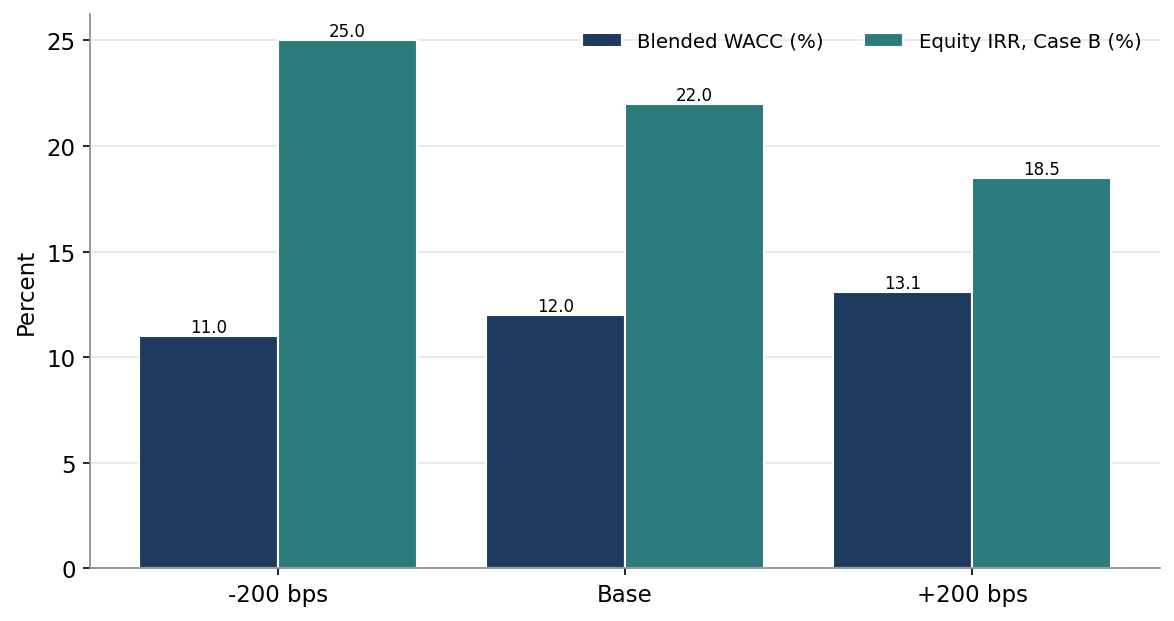
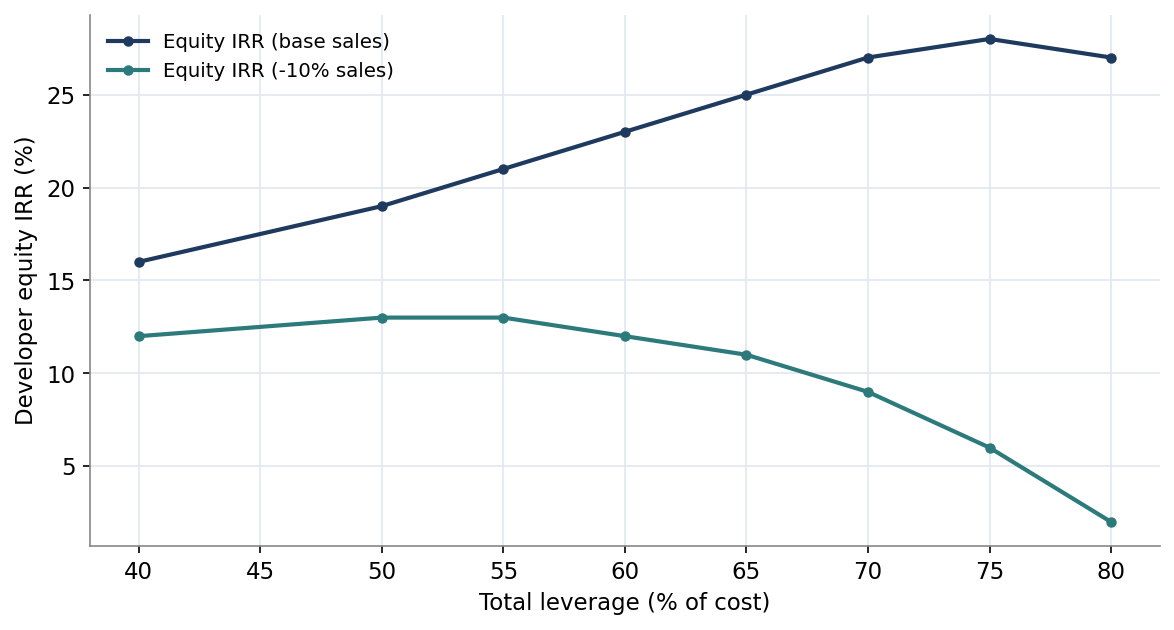
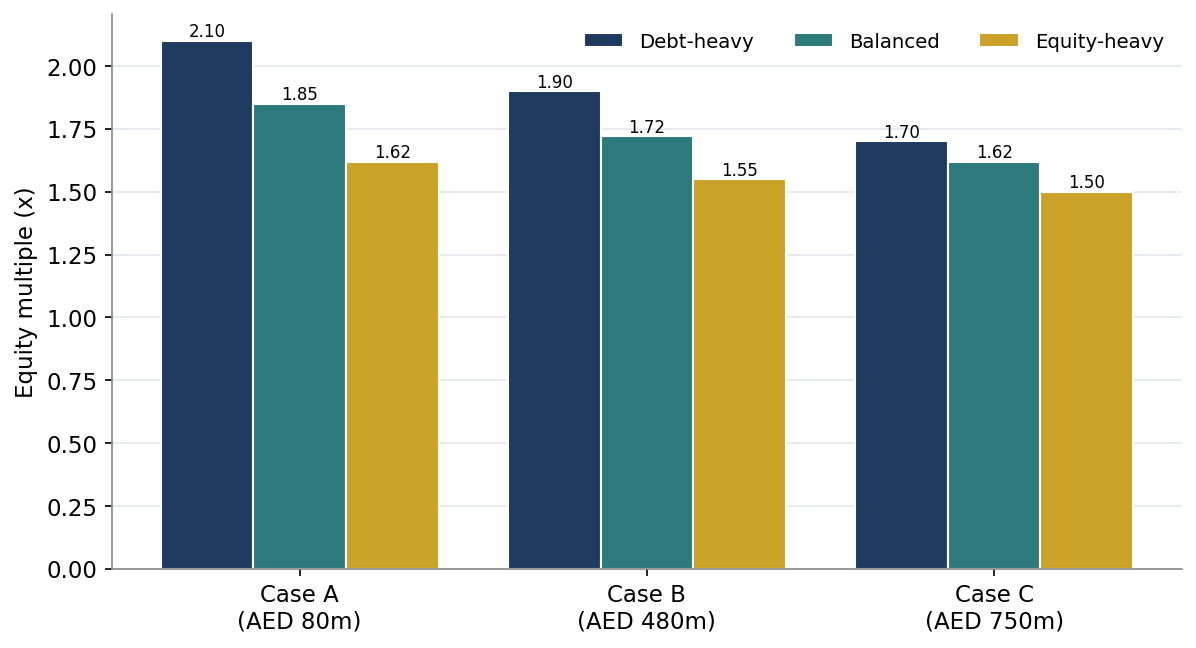
Run the WACC and equity IRR analysis across debt-heavy, balanced and equity-heavy variants, and select the variant that matches the sponsor risk appetite rather than simply the variant with the highest headline IRR.
Approach senior providers, both banks and private credit funds, in parallel to create competitive tension on the senior tranche, which is the largest and therefore the most valuable to price keenly.
Where the structure includes subordinated tranches, begin the intercreditor negotiation early, since it is frequently the critical-path item that delays closing.
Prioritise negotiating effort according to the sensitivity analysis: secure firm control over the operational drivers, sales price and construction cost, before exhausting energy on marginal improvements to financing margins.
Design the refinancing and exit path at the outset, so that expensive construction-phase capital can be released once the asset is stabilised and the equity return crystallised.
A sponsor who follows this sequence will arrive at a structure that is not merely fundable but deliberately optimised, with a clear understanding of why each tranche is present and what it costs in both money and control.
Conclusion
The capital structure of a UAE real estate development is too important to be left to habit. This paper has argued that the choice between senior debt, mezzanine, preferred equity and joint-venture common equity is a value-creation decision in its own right, and that the optimal structure varies systematically with deal size, stage and sponsor objectives. Smaller single-asset schemes reward a simple, debt-led structure that preserves control. Mid-sized schemes justify a mezzanine layer that bridges the senior-to-equity gap and contains dilution. Only the largest portfolio raises warrant the full, multi-tranche structure, including preferred equity and Shariah-compliant Sukuk, whose lower blended cost is paid for with a heavier governance burden.
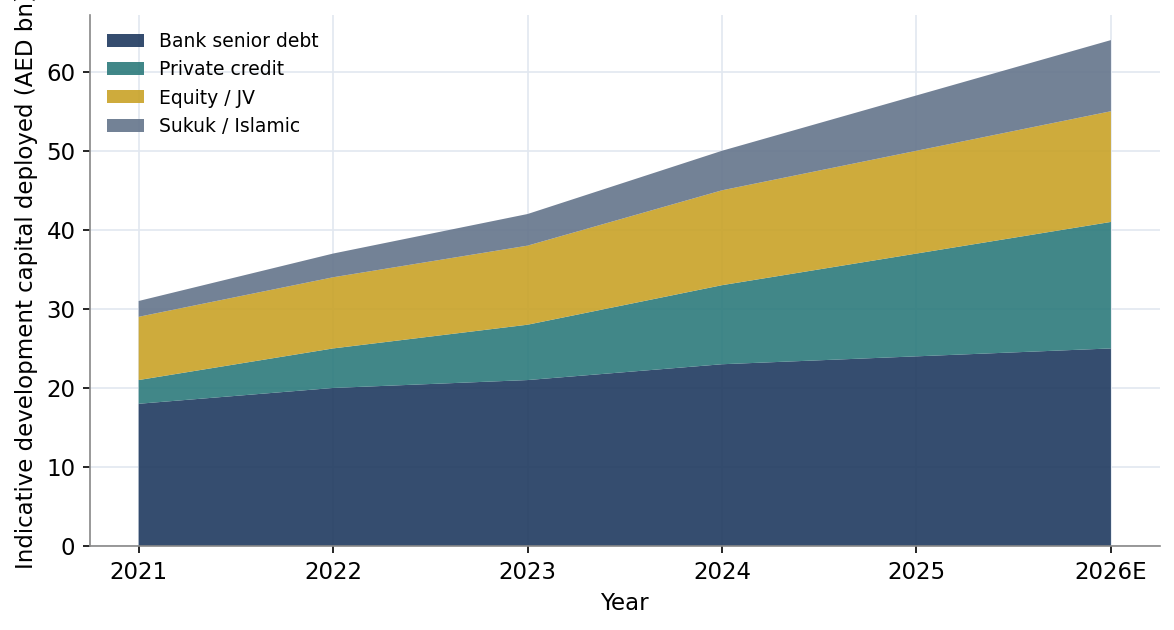
The analysis has also shown that the search for the lowest cost of capital is not the same as the search for maximum leverage, and that the variables which most influence the equity return are operational, sales price and construction cost, rather than financial. The sponsor who internalises these two lessons, designing the structure to fit the deal and directing effort to the drivers that matter, will consistently extract more value from the same underlying asset than the sponsor who defaults to the relationship bank and fills the gap with whatever equity is to hand. In a market where capital has become both more plentiful and more varied, that discipline is a genuine and durable source of advantage. The frameworks, tables and figures in this paper are offered as a starting point for that discipline, to be adapted to the specifics of each scheme and each sponsor rather than applied mechanically.
| Scenario | Sales price | Construction cost | Equity IRR |
|---|---|---|---|
| Upside | +10% | -5% | 31.0% |
| Base | Base | Base | 22.0% |
| Mild stress | -5% | +5% | 16.5% |
| Severe stress | -10% | +10% | 9.5% |
Limitations and Directions for Further Research
This paper is deliberately framework-oriented and relies on indicative data, and its conclusions should be read with that in mind. The figures are internally consistent and calibrated to observable conditions, but they are not empirical estimates drawn from a transaction dataset, and the optimal structures the framework recommends are directional rather than precise. The analysis also uses a simplified return model rather than a full month-by-month development cash-flow waterfall, which would be required to price the structures precisely for a live transaction. Tax treatment, which is light in the principal UAE jurisdictions, is not modelled in detail and would need to be incorporated for cross-border structures.
Several directions for further research follow naturally. An empirical calibration of the cost and leverage figures against a dataset of completed UAE financings would sharpen the framework considerably. A dedicated study of Sukuk pricing relative to conventional debt across market conditions would clarify when the compliant route is genuinely cost-competitive. And an analysis of how these structures have behaved through a genuine downturn, rather than under hypothetical stress, would test the resilience claims that the framework makes for contingent-capital-heavy structures. Each of these would convert the framework from a reasoned argument into an evidence-based tool, and each is a natural subject for a subsequent paper in this series.