

Financing the AI Buildout: A Sponsor's Guide to Debt and Equity for Data Centres
A capital playbook for data-centre sponsors raising debt and equity.
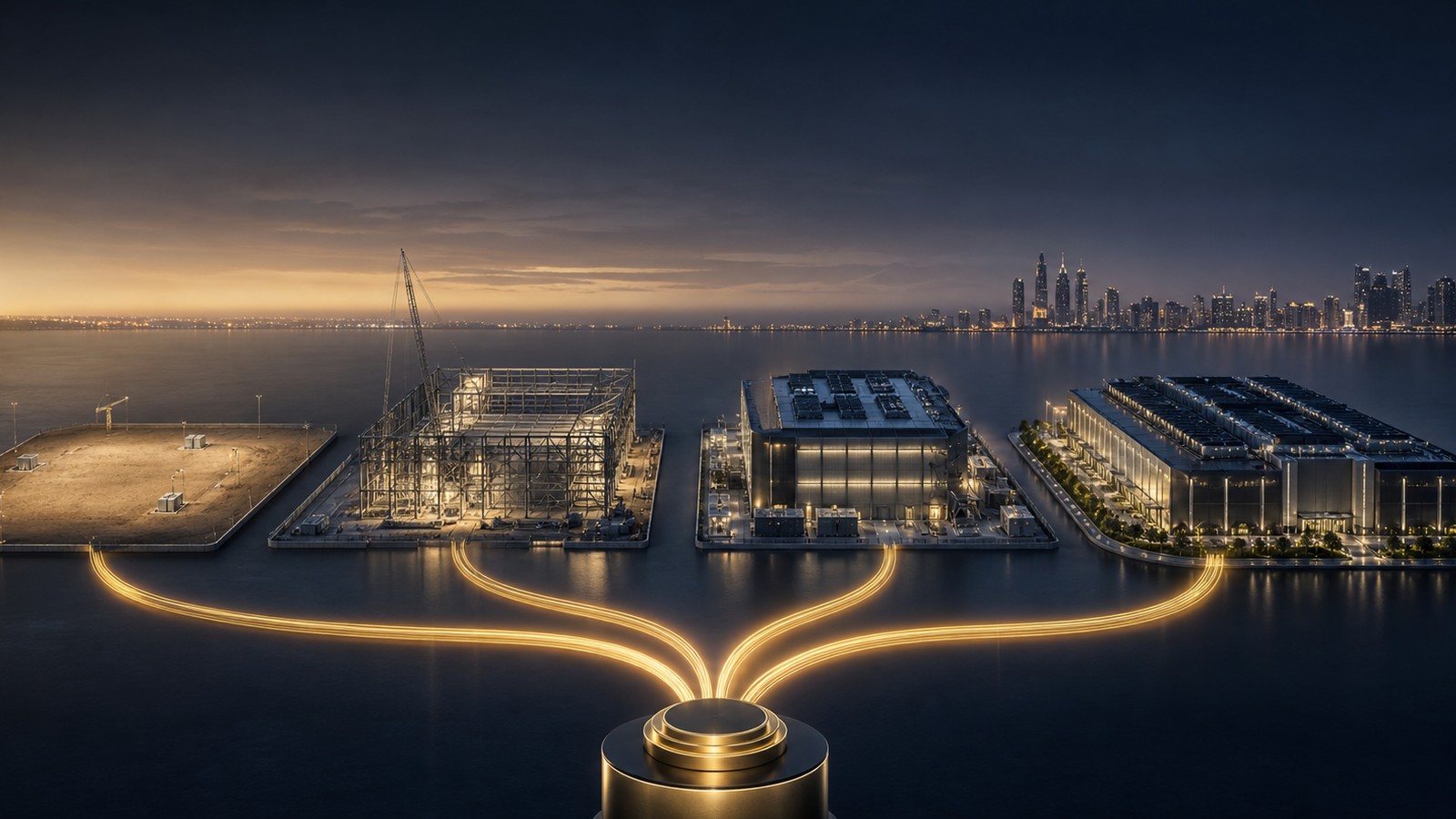
Background. The AI-driven expansion of computing demand has made data centres one of the largest destinations for private capital, and the Gulf has emerged as a distinctive venue for that buildout by virtue of energy availability, land allocation and sovereign-anchored demand.
Background. The AI-driven expansion of computing demand has made data centres one of the largest destinations for private capital, and the Gulf has emerged as a distinctive venue for that buildout by virtue of energy availability, land allocation and sovereign-anchored demand. Sponsors, however, frequently raise capital as if a data centre were a single asset with a single cost of capital. Objective. This paper asks how the capital structure of a data-centre project should map onto its sequence of risk states, what determines bankability at each state, and how Gulf-specific conditions alter that mapping. Approach. The paper develops a stage-and-instrument framework grounded in project finance theory, capital structure theory, the infrastructure asset-class literature and real options analysis. It applies the framework to a representative USD 500 million campus, with every base-case number recorded in a single calibration register drawn from market convention and the author's transaction experience. Findings. Each risk state, from land and power rights through development, construction, lease-up and stabilised operation, has a natural instrument and investor class. Sponsors who raise the wrong instrument for their current state either surrender equity at its most expensive point or carry refinancing risk they cannot price. Offtake quality and tenor, not physical asset quality, dominate debt sizing. Staged raising preserves the option value of information revealed between states. Implications. The paper provides sponsors with a sequencing playbook and term-sheet architecture, and provides infrastructure investors with a framework for locating their capital correctly along the project lifecycle. Highlights A data centre is a sequence of risk states, each with a natural capital instrument Offtake quality and tenor, not the building, drive bankability and debt sizing Staged raising preserves option value; one early raise prices all risk at its peak A USD 500m campus: 55 per cent LTC debt, blended capital cost near 12.5 per cent Gulf sovereign demand moves the binding risk from lease-up to execution and structure JEL Classification: G32, G23, G24, L86, O18 Keywords: data centres, project finance, capital structure, digital infrastructure, private credit, Gulf Cooperation Council, real options, infrastructure investment This paper is an educational and structural analysis prepared for research purposes. It is not investment advice, an offer, or a solicitation. It contains no client information.
This MP Insight presents the web edition of Matchpoint Partners' research. The supporting paper contains the full framework, structures, worked examples and source material.
Read the full research paper Explore our Data Centres practice
Introduction
A sponsor who controls a plot of land, a grid connection application and a letter of interest from a prospective tenant faces a deceptively simple question: how much money to raise, in what form, and from whom. The question is deceptive because the asset the sponsor is building will pass through several economically distinct states before it becomes the stabilised, income-producing property that institutional capital recognises. At the outset it is a bundle of rights and options. During construction it is a contractor's liability wrapped in a financing structure. During lease-up it is an operating business with untested revenue. Only at stabilisation does it resemble the long-duration, contracted-cash-flow asset that appears in an infrastructure fund's pitch book. Each of these states carries a different risk profile, and each risk profile has a natural buyer.
The central claim of this paper is that a data centre is not one asset but a sequence of risk states, and that the sponsor's financing problem is a sequencing problem. The capital instrument that is cheap and appropriate in one state is expensive or unavailable in another. A sponsor who raises common equity to fund construction pays a development-stage cost of capital for construction-stage risk, surrendering ownership at precisely the point where the project's option value is greatest. A sponsor who raises term-style debt against uncontracted revenue imports refinancing risk that neither the sponsor nor the lender can price, because the collateral behind the loan does not yet exist in economic terms. Both errors are common, both are avoidable, and both follow from treating the project as a single asset with a single cost of capital.
The Gulf gives this argument particular force. The region's combination of available energy, allocable land, sovereign digital-infrastructure strategies and anchor demand from state-linked entities has made it one of the more active venues for data-centre development outside the established North American and European markets. Yet the regional capital market for digital infrastructure is younger than the pipeline it must fund. Sponsors in the Gulf therefore face a wider menu of potential capital providers, from international infrastructure funds and private credit managers to regional banks, sovereign-adjacent investors and family offices, with less settled convention about which instrument belongs at which stage. Where convention is unsettled, structure errors are cheap to make and expensive to unwind.
The paper addresses three research questions. RQ1: How should the capital structure of a data-centre project map onto its sequence of risk states, and what is the natural instrument and investor class for each state? RQ2: What determines bankability at each state, and how do lenders and equity investors size and price their commitments as the project moves between states? RQ3: How do Gulf-specific conditions, including sovereign-anchored demand, energy availability, land allocation and local partnership models, alter the mapping and the sequencing of a raise?
Institutional And Market Context
This section characterises the environment in structural terms, establishing the features that the framework must accommodate.
The AI Demand Shock
Three features of the AI-driven demand shock matter for financing structure. First, scale and speed: the training and inference workloads associated with large AI models require facilities that are larger, more power-dense and more capital-intensive per megawatt than the enterprise and cloud facilities of the previous cycle, and hyperscale tenants are contracting capacity earlier in the development cycle than historical practice. Second, tenant stratification: demand now arrives from at least three distinct tenant classes, the global hyperscalers with investment-grade balance sheets, colocation aggregators with diversified but shorter-tenor rent rolls, and AI-compute specialists whose creditworthiness is often venture-backed and unseasoned. These classes support very different debt structures, a point Section 5 develops. Third, technological uncertainty: cooling architectures, rack densities and chip generations are evolving quickly enough that a facility designed today faces genuine specification risk over a long lease term. This uncertainty does not prevent financing, but it pushes lenders toward structures where the tenant, not the vehicle, bears obsolescence risk, and it strengthens the case for shell-and-power strategies in which the most technology-exposed fit-out is funded by the tenant.
The Gulf's Position
The Gulf's attractiveness as a data-centre venue rests on four structural features. Energy availability: the region combines existing generation capacity, expanding renewable programmes and, in several jurisdictions, the ability to allocate power at sovereign discretion, which shortens the single longest lead item in most markets, the grid connection. Land allocation: industrial land is frequently allocated through government or free-zone channels rather than through competitive private markets, which reduces acquisition cost and time but embeds the state in the project's foundational rights. Sovereign strategy: national AI and digital-economy strategies across the Gulf treat compute capacity as strategic infrastructure, producing anchor demand from government entities, sovereign-linked telecommunications operators and national AI initiatives, and producing sovereign-adjacent equity that seeks exposure to the sector. Local partnership models: foreign sponsors commonly build with a local partner, whether a mandated joint-venture arrangement, a free-zone structure, or a commercial partnership adopted for market access, and the partnership choice interacts with every layer of the capital stack because it determines whose consent is required at each stage.
Two consequences follow. First, in the Gulf the scarce inputs are sequenced differently: power and land, the long poles elsewhere, can arrive early, while deep, tested project-debt markets and specialised operating talent are the scarcer inputs. Second, the involvement of sovereign-linked counterparties on both sides of the market, as tenant and as investor, makes counterparty governance and documentation the load-bearing elements of bankability, which is where the Esty and Megginson (2003) insight about enforcement environments becomes practical rather than academic.
The Capital Supply Side
The investor landscape facing a Gulf sponsor divides into recognisable classes. International infrastructure funds, increasingly with dedicated digital-infrastructure strategies, supply co-investment equity from development through stabilisation, with return targets that fall as the state advances. Private credit managers supply construction and mezzanine debt where bank appetite is constrained, at wider pricing but with greater structural flexibility. Regional and international banks supply construction and term facilities, with regional banks often anchored by relationship considerations and international banks by portfolio diversification into the region. Sovereign-adjacent investors and family offices supply flexible capital across the stack, sometimes motivated by strategic as well as financial returns. Finally, the global take-out market, including the securitisation-style refinancing structures described qualitatively in Section 5.6, stands at the end of the sequence, converting stabilised, contracted cash flows into the cheapest available capital. The sponsor's task is not to find capital, which the current cycle supplies in abundance, but to admit each class at the stage where its pricing is competitive and its control demands are tolerable.
The Capital Stack By Stage
This section runs the framework across the five states, identifying at each state the natural instruments, the investor classes that supply them, the sizing and pricing logic, and the Gulf-specific variations. Figure 1 summarises the lifecycle.
Figure 1. Risk states, residual risk and the natural instrument across the data-centre lifecycle
State S0: Land and Power Rights
In S0 the project is a bundle of rights: site control, a power allocation or grid connection pathway, and preliminary zoning or free-zone approvals. Nothing about the project is contracted, and the collateral, such as it is, consists of rights whose value is almost entirely contingent on the sponsor's ability to execute the next four states. The natural instrument is sponsor common equity, occasionally supplemented by a land seller's deferred consideration or, in the Gulf, by government land made available on long lease or against milestone commitments rather than up-front payment. On the base case, S0 absorbs the USD 40 million of land and power rights plus the early portion of development spend.
The financing error characteristic of S0 is external capital of any structured kind. Debt is unavailable on sensible terms because there is no cash flow and no completed collateral; equity from institutional co-investors is available but prices at or above development-stage returns while demanding governance that the sponsor will regret. The correct posture in S0 is to spend as little as possible to secure the rights that create the option, in the sense of Dixit and Pindyck (1994), and to fund that spend from the sponsor's own balance sheet or from partners whose claims are simple.
The Gulf variation is material. Where land arrives through sovereign allocation and power through a sovereign utility's commitment, part of S0's risk is extinguished by the state rather than purchased by the sponsor. This is a genuine subsidy to the capital structure, but it embeds obligations, development timelines, local participation, employment or localisation conditions, that function economically as covenants senior to the entire stack. A sponsor should read an allocation letter the way a lender reads an intercreditor agreement: it is the most senior document in the project.
State S1: Development
Development converts rights into a financeable package: full design, permits, a fixed-price or guaranteed-maximum-price construction arrangement with a credible contractor, long-lead equipment procurement, and, decisively, anchor offtake. The natural instruments are sponsor equity and, for the first time, external joint-venture or co-investment equity from parties who underwrite development risk, typically digital-infrastructure funds with development mandates, regional investors with strategic interest, and, in the Gulf, sovereign-adjacent vehicles. Development-entry co-investment prices around a 20 per cent target IRR on the base case, against the sponsor's own 25 per cent target, the difference reflecting the sponsor's promote and the co-investor's structural protections.
Sizing in S1 is driven backwards from the construction close. The development budget on the base case, USD 35 million of development and soft costs on top of the S0 spend, must carry the project to a state in which the construction facility, the preferred tranche and the balance of equity can close simultaneously. The single most valuable output of S1 is the anchor lease, because it converts every later conversation. A pre-let to a hyperscale tenant of investment-grade credit, on a fifteen-year term with strong assignment and escalation provisions, does more for the cost of the entire stack than any other document the sponsor will ever sign. Proposition 2 begins here: the lease is the collateral.
The characteristic S1 failure is premature scale. Sponsors who raise the full project capitalisation at development entry, whether from enthusiasm or from an anchor investor's insistence, price the construction and stabilisation phases at development risk. On the base case, funding the full USD 500 million at a blended development-stage cost of around 23 per cent, rather than staging as Section 6 describes, transfers value from sponsor to early investors on the order of the entire promote. Proposition 3 is not a nicety; it is most of the sponsor's economics.
State S2: Construction
The construction close is the structural centre of the project. On the base case the stack at close comprises USD 50 million of sponsor equity, USD 125 million of co-investment equity, USD 50 million of preferred or mezzanine capital, and a USD 275 million construction facility at 55 per cent loan to cost, an all-in cost near 8 per cent, and a tenor of three to four years with extension options. Equity funds first, the preferred funds alongside or immediately after, and the facility funds last, the standard sequencing that keeps the lender's exposure junior in time to everyone else's money.
What makes the facility available at all is the wrap: a fixed-price construction arrangement with liquidated damages and a completion guarantee or contingent equity commitment from the sponsor group; an anchor lease that commences on completion; power arrangements executed rather than promised; and an interest reserve inside the facility, part of the USD 45 million of financing costs and interest during construction in the uses. Lenders size to loan-to-cost inside 50 to 60 per cent and stress the schedule; they lend to the completion package, not to the building. Bank lenders dominate where the anchor tenant is hyperscale and the wrap is strong; private credit takes the transactions where the rent roll is colocation or AI-compute weighted, at 100 to 200 basis points wider and looser completion tests.
The Raise Playbook
Section 5 established what belongs where. This section converts the mapping into a playbook: the sequence of raises, the term-sheet architecture appropriate to each, the negotiation priorities that deserve the sponsor's scarce attention, and the failure modes that recur across transactions.
Sequencing the Raise
The base-case sequence has four raises, each sized to reach the next resolution event plus a buffer. Raise one, at or shortly after S0, is sponsor capital plus at most one aligned partner, sized to secure land, power and the development budget's first tranche: on the base case, roughly USD 50 to 60 million of exposure before any external institutional money. Raise two, at development entry, brings the co-investment equity, on the base case USD 125 million committed, drawn against milestones, alongside the sponsor's remaining commitment. The commitment is negotiated at development entry, but drawn capital, and therefore the co-investor's money at risk, scales with progress, which is how the staging benefit of Proposition 3 is captured contractually rather than by running four separate processes. Raise three is the construction close: the USD 275 million facility and the USD 50 million preferred layer close against the completed development package. Raise four is the stabilisation refinancing and, where the pool qualifies, the securitisation-style take-out, at which point the original equity chooses between recapitalisation, secondary sale and continued hold.
Figure 3 quantifies why the sequence matters, comparing the base-case staged strategy with the two dominant errors. The equity-heavy path, raising the full capitalisation as equity at development entry and refinancing only at stabilisation, carries a blended cost above 20 per cent through construction: on USD 500 million over a two-to-three-year construction period, an excess capital charge in the tens of millions, all of it paid by the sponsor's promote. The debt-early path, forcing maximum leverage at construction close against a partly merchant rent roll, looks cheapest through construction and then reprices violently at stabilisation when the refinancing market applies merchant sizing to the uncontracted revenue: coverage-based proceeds fall short of the maturing facility, and the gap is filled by rescue capital at development-stage pricing. The staged path is not the cheapest at every point; it is the cheapest path that is actually available at every point.
Figure 3. Blended cost of capital across the lifecycle under three raise strategies
Source: author's analysis. Base-case calibrations of Table 1.
Term-Sheet Architecture by Stage
Development-entry co-investment. The instrument is common or lightly structured equity in the project vehicle, with the sponsor's promote layered above a preferred return. The load-bearing terms are five. First, the waterfall: a preferred return to all capital in the range of 8 to 10 per cent, then a catch-up, then promote tiers that on market convention run from 15 to 20 per cent above the preferred return to 25 to 30 per cent above higher hurdles. Second, milestone-based drawdowns with defined cure and dilution mechanics for a missed milestone, which is where Proposition 3 lives contractually. Third, governance: a short reserved-matters list, budget approval above tolerances, debt incurrence, affiliate transactions, change of the anchor lease, and sponsor day-to-day control of everything else; Proposition 5 is won or lost in this clause. Fourth, exclusivity and pipeline: whether the co-investor has rights over the sponsor's next site, which is frequently worth more than the promote. Fifth, transfer and exit: tag and drag provisions, a defined marketing window at stabilisation and a fair-value mechanism that does not hand either side a free option.
The preferred or mezzanine layer. The instrument is sized to the gap between senior proceeds and efficient equity, on the base case USD 50 million, with a 12 to 14 per cent return split between current pay and accrual. The terms that matter are the redemption trigger, which should be the stabilisation refinancing and not a hard calendar date inside the construction period; the accrual mechanics in a delay scenario; whether the holder takes board observation or consent rights, which should be narrower than the equity's; and the intercreditor position, in particular standstill terms that private credit holders will negotiate hard and banks will insist upon.
Conclusion
This paper set out to answer a sponsor's question: how to finance a data centre in the Gulf without giving away the project's economics or importing risks the structure cannot survive. The answer developed across Sections 4 to 7 is that the question is a sequencing problem. A data centre is not one asset but five, a bundle of rights, a development, a construction credit, a leasing business and a stabilised bond-like cash flow, and each of these assets has a natural buyer and a natural instrument. The sponsor's task is to sell each risk state to the capital that prices it best, and to refuse the two tempting shortcuts: the single early raise that prices everything at the riskiest state's cost, and the early leverage that mortgages states that do not yet exist.
The propositions of Section 2 organise the argument. Instruments are state-contingent, and mismatches fail in predictable directions. The offtake is the collateral: debt follows the lease, not the building, and the same campus is core infrastructure or growth risk according to its rent roll. Staged raising preserves the option value that the development process itself creates, and on the representative USD 500 million campus the difference between the staged path and its alternatives is measured in blended-cost terms from development-entry pricing near 23 per cent down to a post-take-out floor near 7 per cent. The Gulf inverts the usual sequence, resolving demand and power early and pricing a premium at the back of the lifecycle, so regional structures should be built from the outset to the standards of the international take-out markets they will eventually meet. And control rights should migrate with risk, so that governance never binds decisions that are no longer open, nor frees decisions that still are.
For sponsors, the playbook of Section 6 is the operational core: four raises, each sized to the next resolution event, with negotiation effort concentrated on the offtake, the completion package and the conversion mechanics rather than on margin. For investors, the framework is a discipline for locating capital honestly along the lifecycle. For both, the sensitivity analysis of Section 7 carries the final lesson: the structures that survive the stranded shell are distinguishable from those that do not at the moment of signing, not at the moment of stress. Capital structure, in this asset class as in the theory it draws on, is not an afterthought to the engineering; it is the second engineering discipline the buildout requires.
Declarations
Funding. The author received no external funding for this research.
Related MP Insights
The diligence and underwriting model for a Gulf data centre.…
Digital Infrastructure · AlternativesA capital-deployment guide for international infrastructure investors assessing the GCC AI data-centre buildou…
Digital Infrastructure · AlternativesThe constraints behind the buildout that investors must price.…
Financing the AI Buildout: frequently asked questions
Background. The AI-driven expansion of computing demand has made data centres one of the largest destinations for private capital, and the Gulf has emerged as a distinctive venue for that buildout by virtue of energy availability, land allocation and sovereign-anchored demand.
The web edition covers The AI Demand Shock; The Gulf's Position; The Capital Supply Side; State S0: Land and Power Rights; State S1: Development.
The full supporting PDF is available from this MP Insights page. It contains the complete methodology, analysis, references and appendices.
The Topic Tracker maps this paper to Matchpoint Partners' Data Centres practice.
This publication is general information for professional audiences. It is not investment, legal or tax advice, and it is not an offer or solicitation. Readers should verify current legal, regulatory and tax requirements with qualified advisers.
Apply this insight to a live decision
Discuss the financing, capital allocation or transaction implications with a Matchpoint partner.
