

Introduction
Software sits between the satellite, the ground network, operators, customers and regulators. Mission-control systems plan contacts, validate and transmit commands, receive and process telemetry, monitor spacecraft health, calculate orbits, manage payload schedules and preserve the operational record. A defect, unavailable dependency or inaccessible signing key can interrupt revenue and weaken command authority even when the underlying spacecraft remains technically healthy.
An acquisition therefore involves more than a conventional software-product review. The buyer must understand the mission system as operated. That system includes source repositories, build pipelines, configuration data, deployment environments, cryptographic material, ground interfaces, runbooks, supplier services, engineering judgement and contractual rights. Several of these elements may sit outside the target's legal entity or depend on named individuals.
This paper sets out a transaction framework for that problem. It is designed for strategic acquirers, infrastructure investors, private-capital firms, satellite operators, lenders and boards assessing a software-led space transaction. It focuses on evidence that changes control, continuity, price, conditions and integration design.
1 Define the acquired capability
The buyer should begin with a capability statement. The statement identifies which missions, spacecraft, payloads, ground sites, customer services and operational decisions the software supports. It records service windows, availability expectations, safety consequences, regulatory obligations and revenue dependencies. Product names alone provide an unreliable perimeter because one branded platform can depend on separate flight-dynamics, planning, identity, database, monitoring and ground-station services.
The capability statement should distinguish flight software from ground software. Satellite-control acquisitions usually focus on the ground segment, while operational value can depend on embedded flight interfaces and spacecraft-specific command databases. The buyer needs evidence that the target may use, modify and transfer every interface needed for continued operations.
The perimeter should also identify excluded services. Shared corporate identity, cloud subscriptions, communications links, key-management services, data centres or parent-company staff may be essential on day one. Each exclusion becomes a transition requirement, continuing dependency or value adjustment.
2 Separate ownership, access and control
Legal ownership is one element of control. The buyer also needs physical or logical access, sufficient rights to modify and deploy, knowledge to operate, and authority over credentials and release decisions. These elements can diverge. A target may own custom source code while relying on a non-transferable library. It may possess a repository while the production build depends on a consultant's private toolchain. It may hold broad licences while a government customer controls deployment approval.
The diligence model should record ownership, possession, access, modification rights, distribution rights, operational authority and termination rights separately. Each item needs documentary evidence. Relevant evidence includes assignments, employment terms, contractor agreements, licence schedules, repository permissions, deployment records, customer contracts and supplier confirmations.
Control also has a time dimension. Access that exists during diligence may expire at closing. The buyer should identify the exact actions required to preserve repository access, cloud tenancy, signing authority, administrator credentials, monitoring history and supplier support through the transaction boundary.
3 Build the software and dependency inventory
The inventory should identify applications, services, repositories, branches, build systems, deployment packages, databases, interfaces, commercial products, open-source components, cryptographic libraries and operational scripts. It should connect each component to the mission function it supports and the environment in which it runs.
An SBOM can accelerate component discovery. It does not replace the operating inventory. A useful acquisition inventory links component name and version to source, licence, maintainer, vulnerability status, build artefact, deployed configuration, data dependency and replacement path. Components embedded in containers, firmware or vendor appliances require attention because they can be absent from a conventional application list.
The buyer should reconcile three views: what engineering says exists, what repositories contain and what production telemetry shows running. Differences are diligence findings. An unrecorded service may be critical. A listed repository may be obsolete. A production binary may not trace to an approved source commit.
4 Test source-code completeness
Repository access should cover the full product and its history. The buyer should inspect source, configuration, infrastructure definitions, database schemas, test assets, build scripts, deployment automation, documentation and issue history. A snapshot of selected files cannot demonstrate completeness.
Completeness testing starts from deployed artefacts. The team identifies representative production binaries or containers and traces them back to source revisions, dependency versions, build parameters and approval records. It then builds the software in a controlled environment and compares the result with the deployed artefact or its documented provenance. Differences require explanation.
Generated code deserves separate treatment. NASA guidance recognises that long-term maintenance can require access to models, simulations, data definitions, generators, build data, test scripts and expected results. Possession of generated source can be insufficient when the generator, model or qualified configuration is missing.
5 Reproduce the build
A reproducible build is a high-value diligence test. The objective is to show that an authorised team can create a deployable release from controlled inputs without undocumented intervention. The test should use a clean environment and the target's documented procedure. Buyer observers should record prerequisites, external downloads, credentials, manual steps, tool versions, warnings and deviations.
The result need not be bit-for-bit identical when the existing process does not support deterministic compilation. It should be traceable and functionally equivalent under agreed tests. The buyer should understand why any difference arises and whether the process preserves integrity.
Build failure can reveal missing licences, expired certificates, unavailable package repositories, undocumented patches or reliance on a named engineer. These findings connect directly to transition cost and continuity risk. The purchase agreement can require a successful clean build before closing or place consideration in escrow until the condition is met.
6 Trace release and deployment authority
Source access does not establish the ability to operate production. The buyer should trace authority from code approval through build, signing, release, deployment and rollback. The trace identifies who can approve changes, who holds signing credentials, where packages are stored, how environments are promoted and how emergency releases are controlled.
Satellite-control changes can have mission-safety consequences. Release evidence should include verification results, operational readiness review, configuration approval, customer or authority consent where applicable, and a tested recovery route. The buyer should distinguish routine application releases from changes to command validation, flight dynamics, telemetry interpretation or cryptographic trust.
Credential transfer requires a designed process. Private keys and privileged credentials should not be copied casually during closing. The parties should agree rotation, revocation, re-enrolment, dual control, audit preservation and rollback. The closing plan should state when operational authority changes and how ambiguous responsibility is avoided.
7 Examine mission configuration data
Mission-control software relies on configuration that can be as valuable as source code. Command dictionaries, telemetry definitions, limits, calibration data, spacecraft models, contact plans, orbital parameters, automation rules and customer routing determine how generic software interacts with a real fleet.
The buyer should identify the authoritative source for each configuration class, its approval process, version history and recovery method. It should test whether a new environment can be populated from controlled records. Spreadsheet-based or locally stored configuration creates risk when it lacks review, lineage and backup.
Configuration rights also matter. A customer, spacecraft manufacturer or systems integrator may own or restrict part of the data. The acquisition agreement should address transfer, continuing use, confidentiality, export restrictions and deletion obligations. Missing configuration can make otherwise complete software unusable for a specific mission.
8 Assess software assurance evidence
Software assurance evidence shows whether the product was developed and maintained through controlled practices. NIST's SSDF organises secure development around preparing the organisation, protecting software, producing well-secured software and responding to vulnerabilities. NASA software-assurance guidance adds objective evidence for safety and mission contexts.
The buyer should review requirements traceability, architecture decisions, code review, static analysis, dependency scanning, test coverage, release approval, defect history and vulnerability response. Evidence should correspond to the versions in production. A policy document without executed records provides limited assurance.
The diligence team should sample critical paths such as command generation, authentication, privilege management, orbit determination and recovery. It should examine whether tests cover adverse and boundary conditions. Open findings should be classified by mission consequence, exploitability, recoverability and remediation dependency.
9 Map the software supply chain
The supply chain includes commercial vendors, open-source projects, cloud providers, build services, package repositories, hardware suppliers, consultants and specialist operators. The buyer should map which parties can change, interrupt, access or constrain the product.
For each critical supplier, diligence should cover contractual support, financial resilience, security practices, access privileges, incident notification, change control, end-of-life policy, data location and substitution lead time. A supplier that supports several mission-critical components creates concentration even when annual spend is small.
NIST SP 800-161 treats supply-chain risk as an organisational governance problem rather than a procurement checklist. The transaction team should connect supplier evidence to system criticality and planned ownership. Material suppliers may require consent, novation or direct agreement before closing.
10 Analyse open-source exposure
Open-source components can improve capability and reduce development time. They also create licence, maintenance and security obligations. The buyer should reconcile declared components with code scanning and build manifests. It should identify licence terms, modifications, notices, distribution practices and known vulnerabilities.
Copyleft exposure requires legal analysis based on actual use and distribution. A licence label alone does not establish the obligation. The team should document how components are linked, deployed, modified and provided to customers. Remediation can involve notice correction, source offers, component replacement or customer communication.
Maintenance status affects value. A critical library with no active maintainer or supported release can require internal ownership. The buyer should assess fork strategy, test coverage, patch capability and community dependence. A software bill of materials should remain current after closing rather than becoming a static diligence artefact.
11 Review intellectual-property provenance
Every material code contribution should have a defensible provenance path. Employee inventions should fall within appropriate employment terms. Contractor work should be assigned with sufficient scope. Acquired or contributed code should carry the necessary rights. University, government or customer-funded development can include restrictions that require detailed review.
The team should sample commit history against contributor records and contracts. Unrecognised authors, personal accounts or unexplained bulk imports deserve investigation. The review should include documentation, models, test data, user interfaces and algorithms, because valuable intellectual property extends beyond source files.
Patent and trade-secret analysis should focus on the actual product and commercial plan. The buyer should understand defensive registrations, freedom-to-operate work, confidentiality controls and any disclosure that could weaken trade-secret protection. Transaction documents can allocate specific provenance risks through warranties, indemnities, escrows or contingent consideration.
12 Test privileged access and segregation
Mission-control environments concentrate powerful privileges. Administrators may control commands, identity, databases, cloud resources, signing keys and monitoring. The buyer should obtain a privilege inventory that covers human, service and emergency accounts across development, test, production and recovery environments.
The review should test joiner, mover and leaver controls; multifactor authentication; approval; session logging; credential rotation; break-glass access; and segregation between development and production. Shared or dormant accounts reduce accountability. Service accounts require ownership and lifecycle controls.
Closing creates heightened access risk. Departing personnel may retain credentials or knowledge of recovery paths. The transition plan should rotate sensitive credentials, revoke old access, preserve evidence and maintain dual operational coverage. These actions should be rehearsed where loss of access could affect a live mission.
13 Review vulnerability management
The buyer should understand how vulnerabilities are discovered, triaged, remediated and communicated. Sources include static analysis, dependency scanning, penetration testing, customer reports, supplier advisories and operational monitoring. The programme should define severity, mission consequence, remediation timing, exception approval and retesting.
Backlog analysis can reveal hidden maintenance requirements. The buyer should examine age, recurrence, affected versions and closure quality. A low count can reflect weak detection. A high count can reflect active discovery. The useful measure is the organisation's ability to identify relevant exposure and reduce it within risk-based timeframes.
Flight and ground systems may have limited patch windows. The target should show how it applies compensating controls and plans safe releases. Known vulnerabilities in inaccessible or end-of-life components can justify a specific price deduction or funded remediation reserve.
14 Assess interfaces and interoperability
Satellite-control software depends on interfaces with spacecraft, ground stations, networks, identity systems, customer platforms, weather data, orbit data and regulatory services. The buyer should inventory protocol, version, owner, performance requirement, security control, test environment and change process for each interface.
Interface documentation should be tested against observed traffic and current configurations. Proprietary or undocumented interfaces create lock-in. A standard protocol can still contain customer-specific extensions that complicate replacement.
The team should test failure modes. It should observe delayed data, duplicate messages, clock errors, corrupted input, network interruption and partial service loss. Recovery behaviour affects operational value. Integration plans should preserve interface observability and avoid changing several critical dependencies at once.
15 Evaluate data rights and records
Operational data supports monitoring, anomaly analysis, model improvement, customer reporting and regulatory evidence. The buyer should distinguish ownership, custody, permitted use, retention and export rights for telemetry, commands, derived products, logs, customer information and training data.
The transaction perimeter should include historical data needed to operate and improve the system. A buyer may receive software without sufficient operational history to tune alerts or investigate anomalies. Data migration should preserve timestamps, provenance, access controls and evidential integrity.
Privacy and localisation obligations can apply to personnel and customer data. Export controls and national-security restrictions can affect technical data and access by foreign persons. The legal analysis should map obligations to actual datasets and operating locations.
16 Examine operational resilience and recovery
Resilience testing should show how the service continues through infrastructure, software, supplier and human failures. The buyer should review redundancy, backups, recovery environments, communications alternatives, manual procedures, recovery objectives and exercise results.
A backup is useful only when it can be restored within the mission's tolerance. The diligence team should observe a representative restore and validate configuration, credentials, dependencies and data integrity. Recovery should include the ability to rebuild systems when the primary environment or supplier is unavailable.
The acquisition itself should be treated as a resilience event. Corporate systems, domains, cloud accounts and support contracts may change. A detailed cutover plan, rollback criteria, command authority and joint incident process reduce transition risk.
17 Assess people and knowledge concentration
Software continuity depends on people who understand architecture, missions, anomalies, customers and operational judgement. The buyer should map roles to critical processes and identify single points of knowledge. Organisational charts provide limited evidence; the map should reflect who actually resolves incidents and approves releases.
Retention decisions should consider both technical importance and independence. Concentrated knowledge can be reduced through pairing, documentation, rehearsal and succession. Retention payments without knowledge-transfer milestones can preserve dependence rather than reduce it.
The transaction model should include recruitment, retention, contractor conversion and training costs. Key-person risk can affect valuation when capability cannot be transferred within the transition period. Management should report progress against named knowledge-transfer evidence.
18 Review customer and regulatory acceptance
Customer contracts can define software performance, security, audit, approval and change obligations. The buyer should identify contracts that require consent, notice, recertification or named personnel. It should separate revenue that transfers automatically from revenue dependent on customer acceptance.
Government and critical-infrastructure customers may impose technical-data, security-clearance, hosting or supply-chain restrictions. The buyer should assess whether its ownership, financing, personnel and operating model remain eligible. Regulatory licences and spectrum rights may sit outside the software entity while remaining essential to service delivery.
The commercial model should probability-weight uncertain renewals and consents. Consideration can be contingent on verified transfer or retained revenue. The buyer should avoid paying full value for contracts whose operating prerequisites do not transfer.
19 Connect diligence to valuation
Software diligence changes value through cash flow, timing, risk and option life. Remediation increases cost. Missing rights can reduce addressable revenue. operational fragility can increase outage probability. Weak build control can delay product development. Strong evidence can support lower integration reserves and greater confidence in renewal.
The valuation bridge should avoid duplicating adjustments. A recurring support cost belongs in forecast cash flow. A one-time rebuild belongs in transaction or integration uses. A binary rights defect may require exclusion, escrow or a condition rather than a discount rate premium.
The buyer should show base, downside and severe cases. Each case should identify operational assumptions, evidence and management actions. Terminal value should reflect ongoing maintenance, component obsolescence, supplier concentration and the ability to refresh the product.
20 Translate findings into transaction mechanics
Material findings should have an owner and a transaction response. Possible responses include price reduction, holdback, escrow, earn-out, indemnity, closing condition, covenant, transition service, licence novation, key-person arrangement or excluded asset.
Conditions should be objectively testable. A requirement to provide complete source is weak without defined repositories, branches, artefacts and acceptance tests. A build condition can specify environment, inputs, successful test suite and deployment package. An access condition can specify identities, privileges, keys and verified login.
The disclosure process should preserve versioned evidence. The buyer should record which artefacts support each representation and who accepted exceptions. Technical schedules need review by engineering and counsel so that legal language corresponds to operational reality.
21 Design the closing control room
Closing should be managed as an operational change. The control room coordinates legal completion, credential transfer, supplier novation, cloud tenancy, code repositories, signing authority, customer notices, monitoring and incident coverage.
The plan should use explicit go, hold and rollback criteria. Each step identifies evidence, timing, accountable person and fallback. Critical access should be tested before irreversible actions occur. The parties should maintain joint coverage during the highest-risk window.
The buyer should preserve logs and configuration snapshots. These records establish the state at transfer and support later investigation. The first post-close release should follow the agreed assurance process rather than becoming an improvised integration test.
22 Establish the first 100 days
The first 100 days should stabilise control, close priority evidence gaps and reduce concentration. Early actions include access recertification, credential rotation, clean builds, dependency confirmation, critical backlog remediation, recovery testing, staff retention and supplier governance.
Architecture changes should follow evidence. An immediate platform migration can combine ownership transition with technical change and create avoidable risk. The integration team should sequence changes around mission windows, customer commitments and recovery capacity.
The board should receive a concise dashboard covering build reproducibility, critical vulnerabilities, key access, supplier novations, customer consents, recovery tests, knowledge transfer and spend. Reported completion should require objective evidence.
23 Govern continuing software value
Post-close governance should connect software health to commercial and financial outcomes. Engineering measures include deployment reliability, defect escape, vulnerability age, build integrity, recovery performance and dependency status. Commercial measures include service availability, renewal, delivery latency and support cost.
The product roadmap should distinguish mandatory maintenance, customer commitments, security remediation and growth investment. Deferred maintenance can inflate short-term earnings while weakening future cash generation. Investment committees should understand that distinction.
The buyer should maintain an evidence register for critical rights, configurations and suppliers. Changes in ownership, licence, support or architecture can alter the acquisition thesis. Annual assurance and periodic transaction-readiness reviews preserve optionality for refinancing or exit.
24 Hypothetical transaction case
The hypothetical target supports 18 satellites across communications, earth observation and hosted-payload missions. Its platform includes mission planning, command validation, telemetry processing, flight dynamics, automation and customer delivery. Revenue is generated through annual software and operations contracts.
Diligence confirms strong customer retention and capable engineering. It also identifies five transaction exposures. Production builds require an undocumented commercial tool. Two libraries are licensed to the seller's parent and cannot transfer automatically. One administrator controls key production and signing processes. Critical vulnerability remediation has been deferred around mission windows. A customer-specific adapter contains contributions with incomplete assignment evidence.
The buyer prices these findings through a USD 25 million aggregate deduction from the USD 84 million headline value. A further USD 6 million earn-out is available when defined evidence gates are met. The structure preserves seller participation in remediation while protecting buyer cash at closing.
25 Decision principles
First, define the acquired mission capability and its operational perimeter. Second, trace every critical deployed artefact to controlled source, build and approval evidence. Third, separate ownership, access, rights and operational authority. Fourth, map supplier and people concentration to continuity. Fifth, test recovery and transaction cutover. Sixth, translate each unresolved dependency into cash, condition or contractual protection.
These principles create a common language for engineering, finance, operations and legal teams. They also improve transaction speed because evidence requests and acceptance tests become specific.
The buyer's objective is demonstrable control of mission outcomes. That control supports continuity, customer confidence, integration and defensible valuation.
26 Review architecture and technical debt
Architecture diligence should explain how the system separates mission planning, flight dynamics, command validation, telemetry, automation, identity, data stores and external interfaces. The buyer should identify trust boundaries, failure domains, shared services and components whose change could affect several missions. Architecture diagrams should be reconciled with deployed topology, network flows and repository ownership.
Technical debt should be expressed through consequences. An old programming language can remain manageable when expertise, tests and toolchains are available. A modern service can be fragile when it lacks ownership, observability or recovery. The diligence team should estimate the cost, sequencing and operational risk of each material debt item.
Debt classification should distinguish maintainability, security, performance, scalability, obsolescence and compliance. The commercial model should reflect the categories that constrain growth or customer retention. Remediation plans should identify dependencies and mission windows rather than present an undifferentiated backlog.
27 Evaluate observability and incident evidence
Mission-control value depends on the ability to detect and explain abnormal behaviour. The buyer should review logs, metrics, traces, alerts, dashboards, retention, clock synchronisation and incident records. It should identify where data is generated, who can access it and whether records survive a system or supplier failure.
Alert quality deserves sampling. High volumes of unactionable alerts can conceal material events. Sparse alerts can reflect limited coverage. The team should compare selected incidents with recorded telemetry, response actions, root-cause analysis and corrective work. Repeated incidents without durable remediation indicate control weakness.
Transaction planning should preserve monitoring continuity. Account migration, cloud separation or tool replacement can create blind periods. The closing plan should define which alerts remain active, who receives them and how the joint team handles an event during transition. Evidence of stable monitoring can support a shorter transition-services period.
28 Test scalability and fleet expansion
Historical performance does not establish that the platform can support the buyer's planned fleet. The team should identify scale drivers such as satellites, contacts, telemetry volume, command load, customer interfaces, concurrent operators and ground sites. It should review observed peak utilisation and capacity margins.
Load tests should use representative message patterns and failure conditions. Space operations can create short periods of intense activity around launch, commissioning, anomalies and contact windows. Average utilisation can hide queueing, database contention or operator overload during these periods.
The growth case should include infrastructure, licence, support and staffing costs. A platform that scales technically may face commercial limits from per-satellite vendor pricing or scarce specialists. The valuation model should align growth revenue with the capital and operating cost required to deliver it.
29 Assess artificial-intelligence features carefully
Targets may use machine learning for anomaly detection, scheduling, image processing, predictive maintenance or operator assistance. Diligence should identify the exact decision supported, model owner, training data rights, validation, monitoring, human oversight and failure response. Marketing descriptions provide limited evidence of operational value.
The buyer should compare claimed performance with a defined baseline and representative mission data. It should examine false positives, false negatives, drift, retraining, version control and edge cases. A model that improves average detection can still be unsuitable for command decisions when its failure modes are opaque.
Generative tools used in engineering or operations need governance over sensitive data, code provenance and output review. The product roadmap should separate demonstrated customer value from experimental capability. Valuation should recognise AI-related revenue only when rights, performance, deployment and cash conversion are evidenced.
30 Review export control and sovereign-access constraints
Satellite software, technical data and services can be subject to export controls, sanctions, security classifications and sovereign-access requirements. The buyer should map controlled items, licences, nationalities, locations, cloud regions and customer restrictions. Specialist counsel should interpret the applicable legal regime.
Operational access can be constrained even when ownership transfers. Certain customers may require cleared personnel, domestic hosting or segregated support. The buyer's ownership and financing structure can trigger review or consent. These factors affect integration design and the ability to centralise operations.
The transaction model should include compliance staffing, segregated environments, licence timing and possible revenue restrictions. Closing conditions should address approvals that are necessary for continuity. Management should avoid broad assurances and identify the precise scope covered by each authorisation.
31 Create an investment-committee evidence pack
The investment committee needs a concise connection between technical findings and economic decisions. The pack should begin with the acquired capability, revenue dependency and critical control points. It should present the source and build evidence, rights position, supplier map, operational resilience, customer consents and people concentration.
Each material finding should show evidence status, cash consequence, proposed mechanic, accountable owner and residual risk. The committee should be able to distinguish a verified gap from a management estimate and a future remediation promise. Scenario analysis should show the effect of delays and combined failures.
Approval should state conditions, delegated authorities and post-close reporting. The evidence pack then becomes the baseline for integration governance. This continuity reduces the risk that diligence findings disappear after closing and supports later accountability for value creation.
32 Plan separation from the seller
A carve-out requires a separation model covering applications, infrastructure, identities, networks, contracts, data and people. The buyer should identify services that remain with the seller, services that transfer and services that must be rebuilt. Each line should have an interim operating method, target state, cost, dependency and exit criterion.
Transition-service agreements should describe measurable services and operational responsibilities. They should identify service levels, security obligations, incident coordination, access, change control, data return, audit rights, pricing and termination. A broad commitment to provide reasonable assistance can leave critical mission needs unresolved.
The separation schedule should follow mission constraints. Identity or network changes can affect monitoring and command paths. Data migration can affect history and audit evidence. Supplier novation can change support rights. The parties should stage high-risk changes and preserve rollback until acceptance criteria are met.
Exit readiness should be tested before a transition service ends. The buyer should demonstrate independent access, build, deployment, monitoring, support and recovery. It should also confirm that seller accounts and data can be removed without disrupting service. Any extension should have a defined reason, price and remediation owner.
Separation cost belongs in the transaction model. It includes duplicate infrastructure, temporary licences, migration engineering, security testing, customer validation and operating overlap. The estimate should distinguish committed quotations from management assumptions. A funded and governed separation plan protects continuity and prevents the transaction from carrying an indefinite dependency on the seller.
The board should receive a weekly separation dashboard until all mission-critical services operate independently. The dashboard should identify overdue dependencies, tested exits, unresolved customer obligations, forecast cost and the next irreversible action. Closure should require evidence from engineering, operations, security, finance and the relevant service owner.
Appendix A Diligence evidence register
The evidence register should identify the question, requested artefact, source owner, version, review result, exception, financial consequence and transaction response. It should remain linked to the virtual data room so that conclusions can be reproduced.
High-priority evidence includes the production inventory, repository map, clean-build result, deployment trace, privilege inventory, licence schedule, SBOM, vulnerability backlog, recovery test, customer consent map and key-person plan. Each item should identify the exact systems and configurations covered.
Sampling should be risk based. The team should choose representative high-consequence missions, critical interfaces, recent releases, emergency changes and older components. Samples should test both control design and actual execution.
Appendix B Valuation method
The illustrative method begins with enterprise value derived from the buyer's commercial model. It then adjusts forecast cash flow for recurring maintenance and supplier costs. One-time remediation, separation and transition costs are included in uses. Revenue subject to customer consent is probability weighted. Rights defects and operational conditions are addressed through deductions, escrows or contingent consideration.
Scenario analysis should combine related risks. A supplier delay may also delay remediation and customer acceptance. A key-person departure may weaken both continuity and knowledge transfer. Correlated downside deserves explicit treatment.
No hypothetical number in this paper represents an identified transaction. The case demonstrates how evidence can be connected to valuation and transaction structure.
Appendix C Closing acceptance tests
Acceptance tests should cover repository access, clean build, test execution, package signing, non-production deployment, configuration restore, monitoring, privileged access, supplier support and recovery. The parties should agree test data, environment, pass criteria and evidence before signing.
Tests should avoid live operational disruption. Production changes require mission approval and separate controls. A non-production test can still validate the chain from controlled source to deployable artefact.
Failed tests should have predefined consequences. These can include cure, escrow, delayed closing, reduced consideration or exclusion of an asset. The response should match the operational and financial significance of the failure.
Appendix D Decision figures and tables
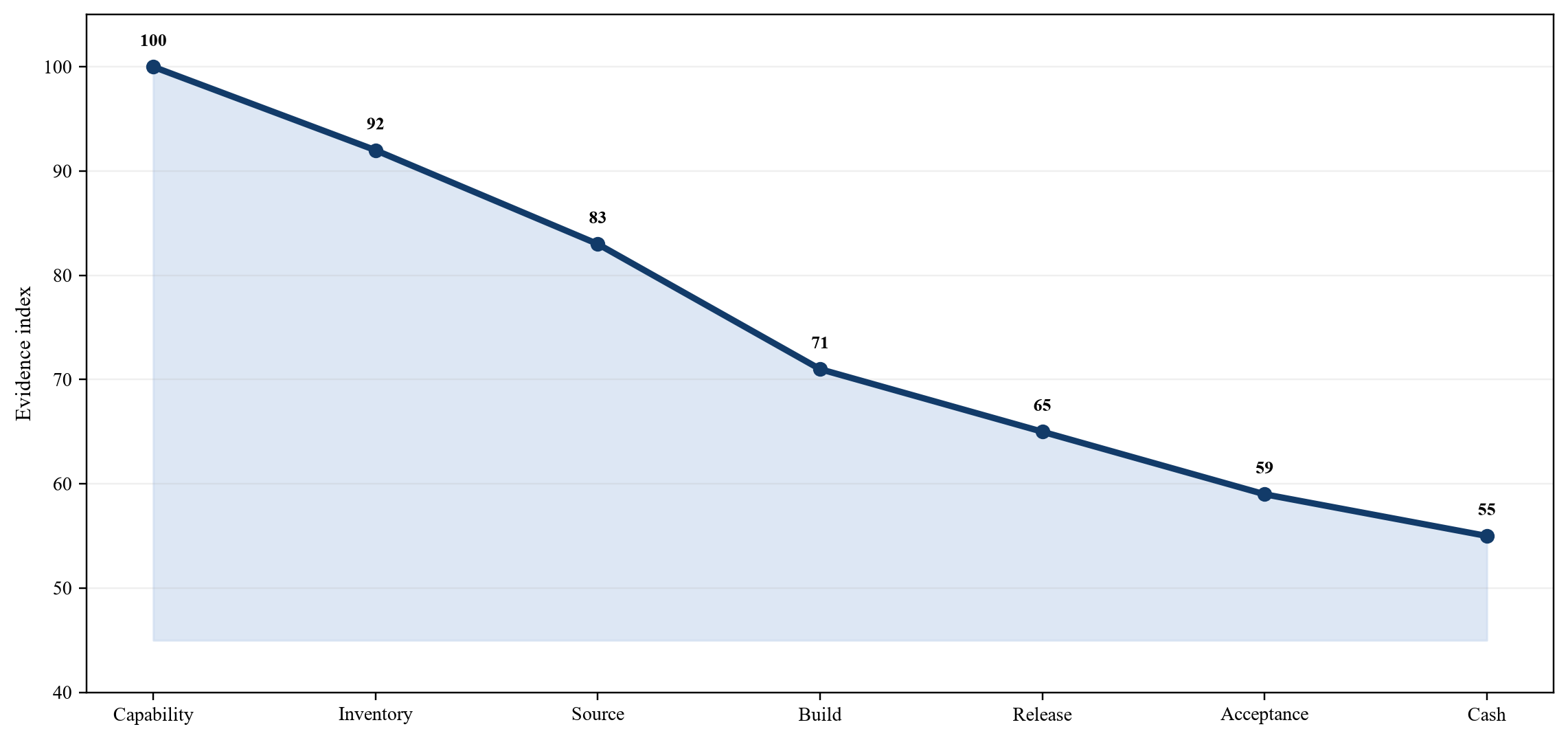
Illustrative evidence progression; values are hypothetical and do not represent an identified company.
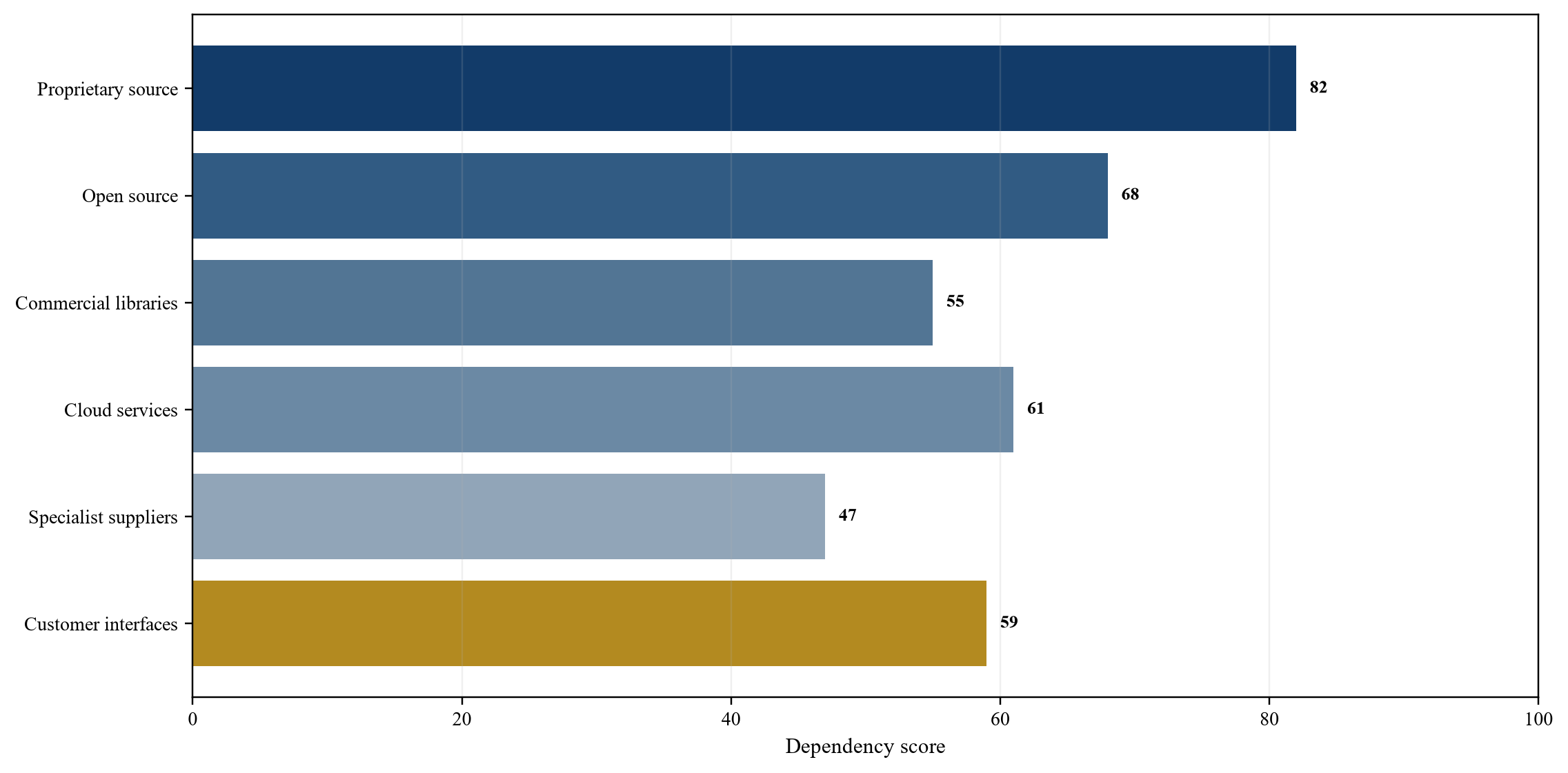
Higher scores indicate greater dependence in the hypothetical case.
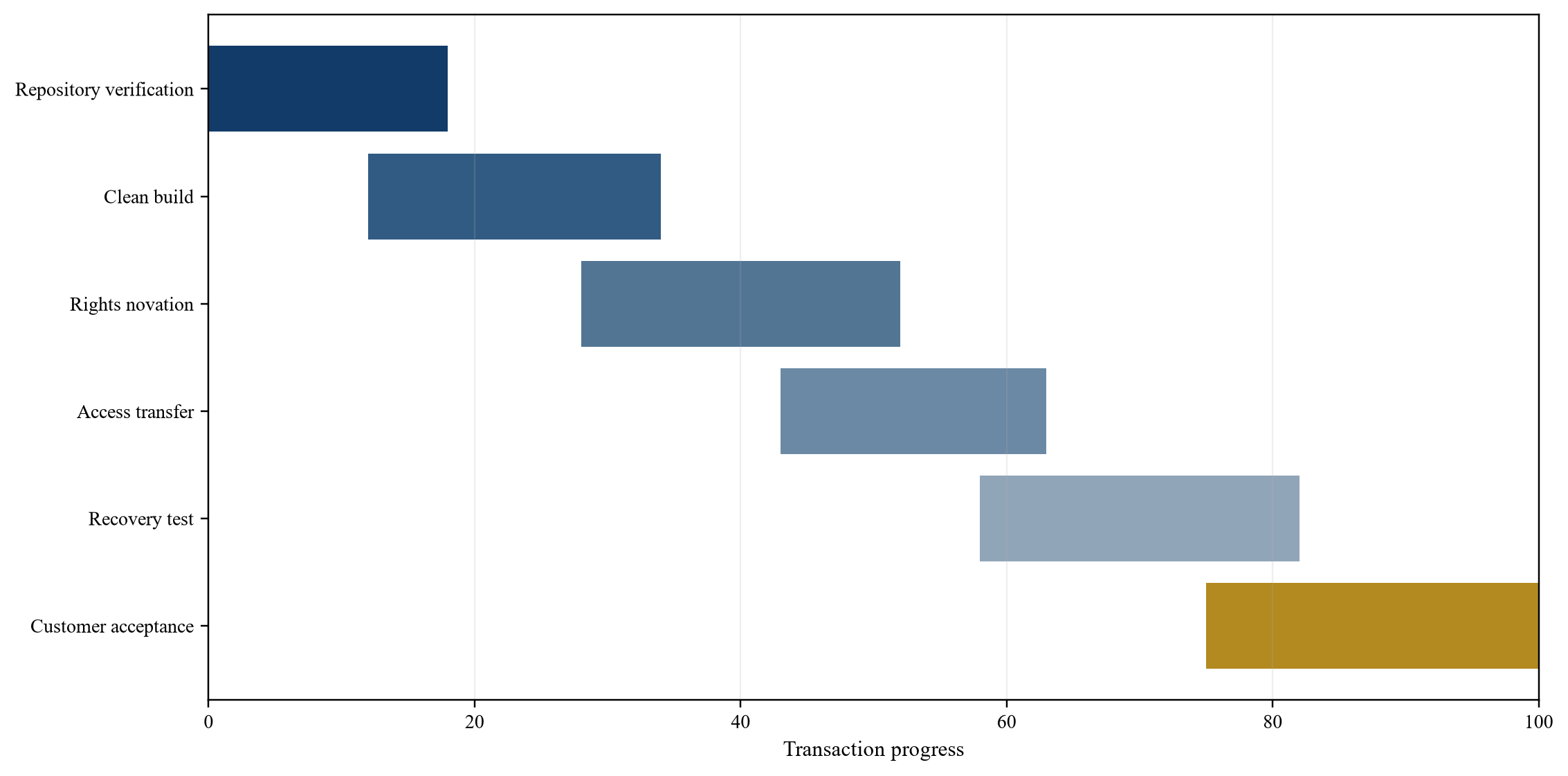
Proposed sequence; actual timing depends on transaction facts and mission constraints.
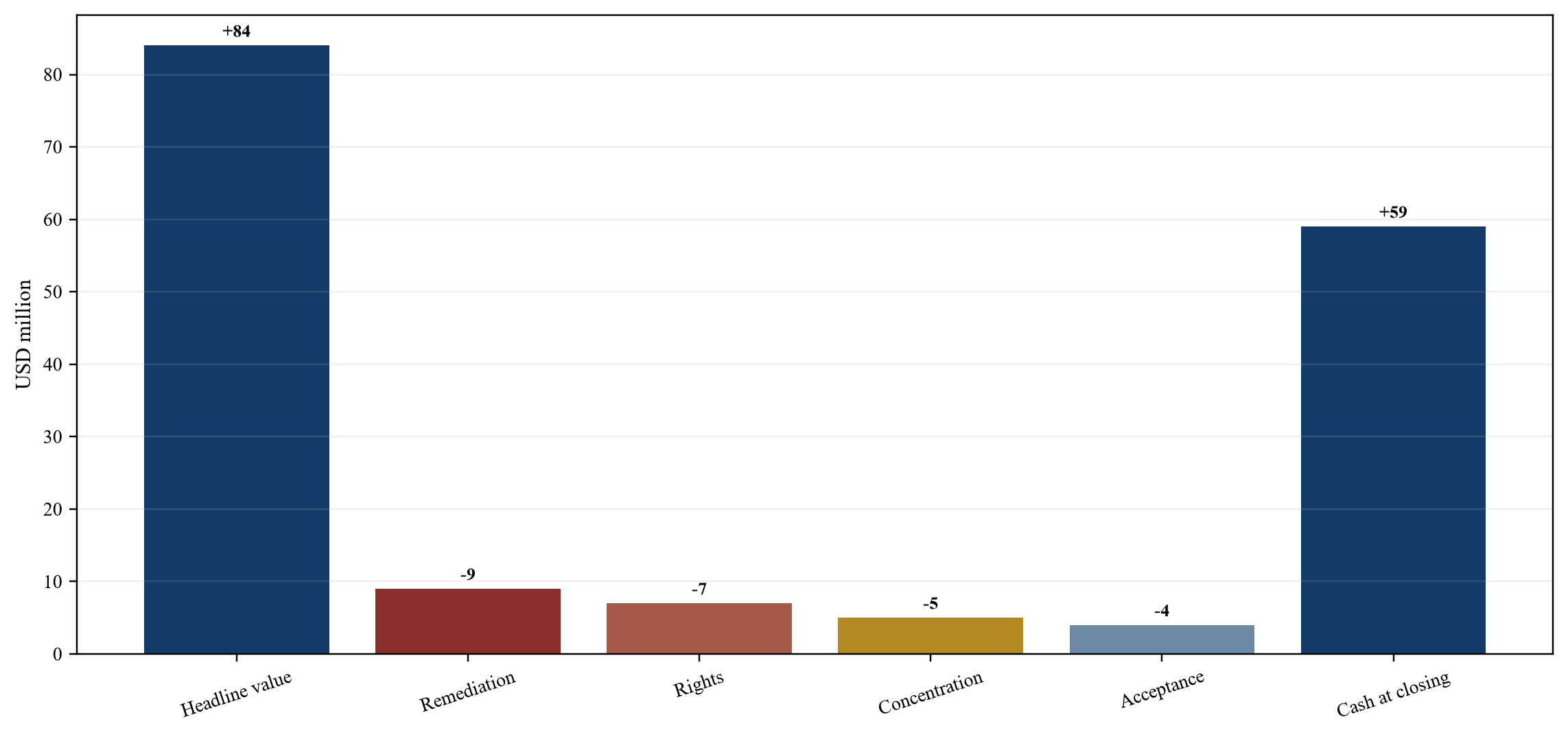
Wholly hypothetical values; USD million.
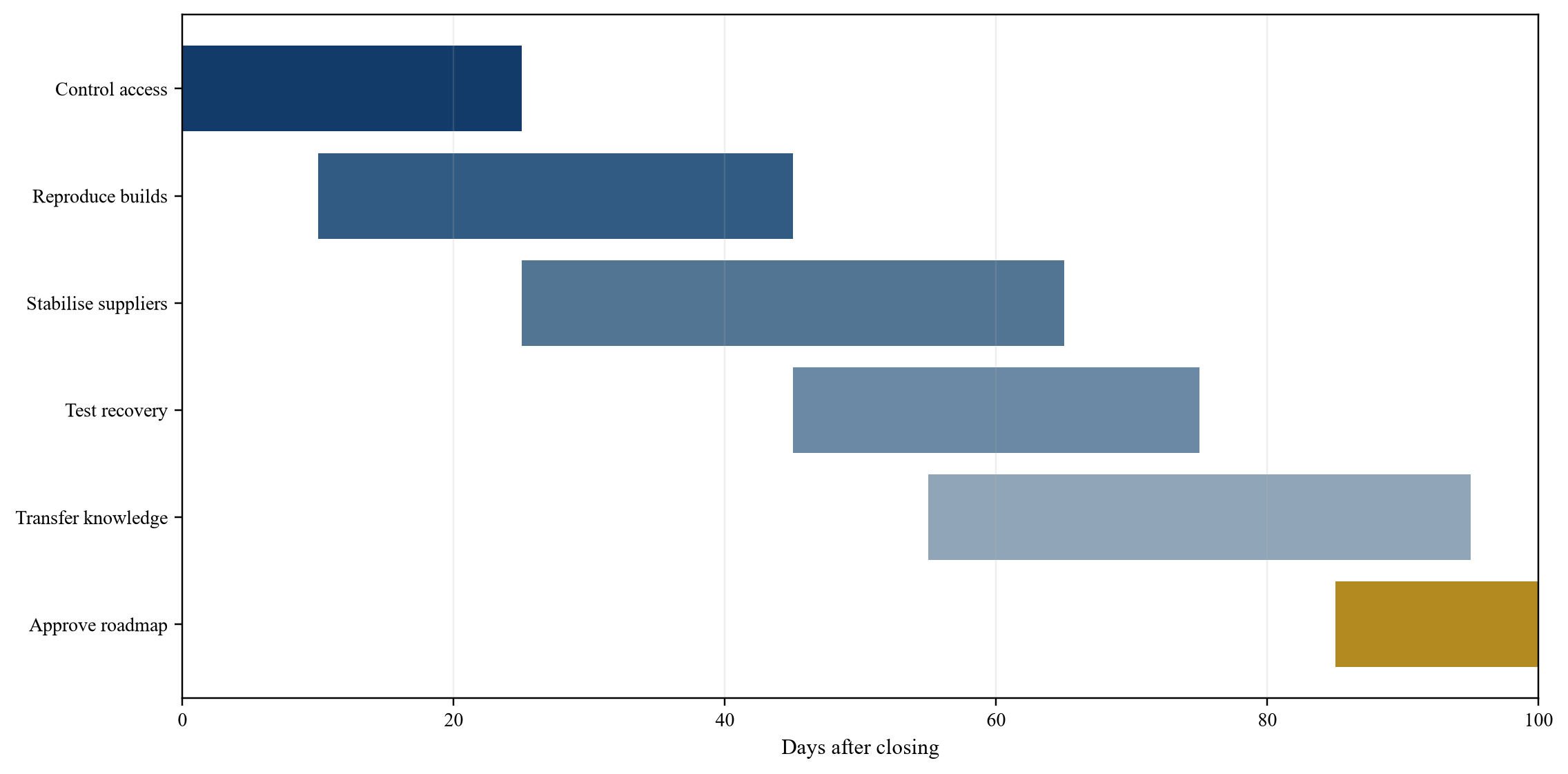
Proposed sequence subject to mission windows and customer obligations.
| Evidence | Transaction question | Acceptance indicator | Response to gap |
|---|---|---|---|
| Repository inventory | Is all material source controlled? | Production components trace to named repositories | Completion condition or scoped exclusion |
| Build definition | Can a clean environment produce a release? | Successful controlled build with documented inputs | Holdback and remediation plan |
| Provenance | Can deployed artefacts be traced? | Version, dependencies, approval and signature linked | Risk reserve and control remediation |
| Generated artefacts | Are models and generators available? | Rebuild possible from controlled sources | Licence or asset transfer condition |
Proposed transaction evidence requirements.
| Dependency | Evidence | Principal exposure | Transaction treatment |
|---|---|---|---|
| Employee code | Employment and invention terms | Ownership gap | Assignment and warranty |
| Contractor work | Statement of work and assignment | Restricted modification or transfer | Specific assignment or indemnity |
| Commercial software | Licence and support terms | Non-transfer, termination or price reset | Novation, replacement or deduction |
| Open-source software | SBOM, licence and distribution record | Compliance and maintenance | Cure plan and continuing governance |
| Customer interface | Contract and contribution history | Use restricted to existing customer | Consent or contingent value |
Proposed legal and operational dependency classification.
| Item | USD million | Evidence basis | Treatment |
|---|---|---|---|
| Headline enterprise value | 84 | Commercial model | Starting value |
| Remediation and transition | -9 | Build, vulnerability and separation plan | Closing deduction |
| Rights and dependencies | -7 | Licence and provenance gaps | Deduction or escrow |
| Concentration and fragility | -5 | Access and key-person review | Integration reserve |
| Customer acceptance | -4 | Consent and interface evidence | Contingent consideration |
| Cash value at closing | 59 | Aggregate framework | Illustrative result |
Wholly hypothetical; USD million.
| Control | Evidence before transfer | Closing action | Post-close verification |
|---|---|---|---|
| Repositories | Access list and protected branches | Transfer administrators | Reconcile access and logs |
| Signing | Key inventory and approval chain | Rotate or re-enrol keys | Test signed non-production release |
| Production access | Privilege inventory | Revoke seller-only accounts | Recertify human and service access |
| Suppliers | Contract and consent schedule | Execute novations | Confirm support and incident contacts |
| Recovery | Latest exercise and backup inventory | Preserve snapshots | Run controlled restore |
Proposed controls; actual sequencing depends on mission constraints.
| Measure | Day 30 evidence | Day 60 evidence | Day 100 evidence |
|---|---|---|---|
| Build control | Clean environment established | Critical products reproduced | Routine release evidence complete |
| Access | Administrators recertified | Service accounts assigned | Exceptions closed or accepted |
| Vulnerabilities | Critical backlog validated | Priority cures tested | Sustainable service levels operating |
| Suppliers | Critical dependencies confirmed | Novations and substitutes progressed | Governance and exit plans approved |
| Knowledge | Key roles retained | Runbooks and pairing underway | Independent operational coverage tested |
Proposed evidence milestones.
| Finding | Cash effect | Contract mechanic | Evidence for release |
|---|---|---|---|
| Non-transferable dependency | USD 7 million | Escrow or price deduction | Executed novation or qualified replacement |
| Build fragility | USD 4 million | Closing condition | Successful clean build and test |
| Key-person dependence | USD 3 million | Retention-linked holdback | Knowledge-transfer milestones |
| Customer-specific rights | USD 4 million | Earn-out | Consent and retained cash collection |
Wholly hypothetical cash effects; USD million.
| Decision area | Green evidence | Amber condition | Red condition |
|---|---|---|---|
| Source control | Complete traceable repositories | Minor controlled gaps | Missing critical source or history |
| Build | Repeatable controlled release | Manual steps with funded cure | Build cannot be reproduced |
| Rights | Transferable documented rights | Consent pending with protection | Material right unavailable |
| Operations | Independent staffed coverage | Concentration with tested transition | Named-person dependency without fallback |
| Recovery | Recent successful restore | Partial scope or aged exercise | Recovery untested or unavailable |
Proposed decision thresholds.
Sources
- National Institute of Standards and Technology, SP 800-218 Secure Software Development Framework Version 1.1, 2022. Read the primary source
- National Institute of Standards and Technology, SP 800-161 Revision 1 Cybersecurity Supply Chain Risk Management Practices for Systems and Organizations, 2022. Read the primary source
- National Institute of Standards and Technology, Software Security in Supply Chains Guidance, updated 2024. Read the primary source
- National Institute of Standards and Technology, Cybersecurity Framework 2.0, 2024. Read the primary source
- National Institute of Standards and Technology, NISTIR 8401 Satellite Ground Segment Applying the Cybersecurity Framework to Satellite Command and Control, 2022. Read the primary source
- National Institute of Standards and Technology, SP 800-53 Revision 5 Security and Privacy Controls for Information Systems and Organizations. Read the primary source
- National Aeronautics and Space Administration, NASA Software Engineering and Assurance Handbook NASA-HDBK-2203. Read the primary source
- National Aeronautics and Space Administration, SWE-042 Source Code Electronic Access. Read the primary source
- National Aeronautics and Space Administration, SWE-158 Evaluate Software for Security Vulnerabilities. Read the primary source
- National Aeronautics and Space Administration, SWE-206 Auto-Generation Software Inputs. Read the primary source
- National Aeronautics and Space Administration, NPR 7150.2 NASA Software Engineering Requirements. Read the primary source
- National Aeronautics and Space Administration, NASA-STD-8739.8 Software Assurance and Software Safety Standard. Read the primary source
- National Aeronautics and Space Administration, NASA-STD-1006A Space System Protection Standard. Read the primary source
- National Aeronautics and Space Administration, Space Security Best Practices Guide. Read the primary source
- Cybersecurity and Infrastructure Security Agency, Securing the Software Supply Chain Recommended Practices for Developers, 2023. Read the primary source
- Cybersecurity and Infrastructure Security Agency, Software Bill of Materials. Read the primary source
- Cybersecurity and Infrastructure Security Agency, Secure by Design. Read the primary source
- Cybersecurity and Infrastructure Security Agency, Federal Government Cybersecurity Incident and Vulnerability Response Playbooks. Read the primary source
- European Space Agency, Software Products for Mission Operations. Read the primary source
- European Space Agency, SPACE-SHIELD Malicious Supply Chain Capabilities and Software Vulnerabilities. Read the primary source
- European Union Agency for Cybersecurity, ENISA Space Threat Landscape 2025. Read the primary source
- Consultative Committee for Space Data Systems, Mission Operations and Information Management Services. Read the primary source
- Consultative Committee for Space Data Systems, Security Working Group Publications. Read the primary source
- United States Office of Space Commerce, Space Policy Directive 5 Cybersecurity Principles for Space Systems. Read the primary source
- United Kingdom National Cyber Security Centre, Cyber Security Toolkit for Boards. Read the primary source
- Open Worldwide Application Security Project, Software Component Verification Standard. Read the primary source
- Open Worldwide Application Security Project, Software Assurance Maturity Model. Read the primary source
- The Linux Foundation, SPDX Software Package Data Exchange. Read the primary source
- International Organization for Standardization, ISO IEC 27001 Information Security Management Systems. Read the primary source
- European Cooperation for Space Standardization, ECSS Software Engineering Standards. Read the primary source
