

1 Identify the terms that govern the submission decision
A team preparing an innovation-funding application must decide which work to begin, which requirements to verify and when to commit the completed submission. Those decisions depend on the identity of the call and the version of its terms. A public announcement can describe a programme before its detailed conditions are available. A later notice can add a submission cycle, clarify an applicant category or change a deadline. The operational question is how to organise preparation while preserving the ability to respond to the terms that actually apply.
We examine selected official programme documents, revision notices and application guidance from Europe, the United Kingdom, the United States and the Gulf. The records support several concrete distinctions. An official notice can reproduce an earlier deadline and its replacement. An annual work programme can publish the following year's calendar. A programme page can move to a different cohort. A displayed update stamp can change while the sampled core requirements remain stable. Each record needs its own classification before it informs an applicant's calendar. [1, 2, 3, 4, 5, 6, 7, 8, 9]
The documentary study establishes what the selected sources state and where their meanings remain unresolved. It supplies no representative estimate of the frequency of grant-term changes. Applicant awareness, abandoned applications, work already performed and realised commercial outcomes are unavailable in this record set. A population estimate would require a defined universe of calls, repeated observations and consistent treatment of missing histories. An outcome study would additionally require applicant-level evidence and a defensible comparison design. These limitations determine the claims made throughout the paper.
Our decision framework records the applicable call, separates the dates attached to different stages and links changed requirements to the preparation tasks they affect. The numerical component is a separately defined planning exercise. Its task durations, checking arrangements and event paths are authored assumptions. The calculated outputs describe the consequences of those assumptions for preparation work and submission timing. Empirical award probabilities, programme-wide effects and cash receipts require different evidence.
This distinction matters for corporate-finance planning. A grant application may sit alongside an equity round, a bank facility, an internal capital allocation or a commercial pilot. The funding team needs to know which commitments can proceed using stable project information and which depend on the selected call's current requirements. Eligibility, selection, contracting and payment should each have a documented evidential basis. A calendar that merges these stages conceals decisions that management still has to make.
2 Separate the clocks in the application process
The first clock is the date attached to a communication. It may be a news publication, a formal decision, a document edition or a page update. The second clock is the applicability date stated for a particular rule. The third is the applicant's opportunity to act, including portal opening and submission cutoffs. A fourth clock covers the organisation's own preparation and approval. The subsequent assessment, award, project-start and payment stages introduce further dates. Recording each event separately creates a usable sequence without assigning certainty that the sources do not provide.
The distinction can be applied at the level of one preparation task. A finance manager may finish a project-cost schedule before a funding notice clarifies which categories are eligible. The project-cost information can remain useful. Its allocation to the call's eligible categories may require further work. A partner can confirm an intention to collaborate while the nominated lead institution is still being checked against the call conditions. These are defined planning situations, with separate evidence and responsibilities. They do not establish how frequently either situation occurs among actual applicants.
Date precision deserves the same care as event identity. A source giving a month defines a coarser interval than a source naming a day and local cutoff time. A planned award window leaves the actual award date unresolved. A publication date alone supplies no complete account of when an applicant saw the notice or when its terms became applicable. Where two dated observations bracket a page difference, the observation interval can be recorded. Assigning an exact intermediate change day would require additional evidence.
We recommend that an application record retain the original date wording alongside its interpretation. Exact deadlines should retain the issuing body's stated clock convention. Month bands should remain bands. An unknown date should remain an explicit question for the programme office. The record should identify which source supports each interpretation and when that source was examined. This makes later review possible when a document at the same URL has changed or a related notice supplies a clarification.
Management can then distinguish a work plan from a funding forecast. The work plan concerns tasks the team can undertake and checks it can schedule. A forecast of an award or cash receipt requires evidence about later decisions and contractual or payment conditions. The present analysis develops the preparation decision and preserves those later uncertainties. It gives the finance team a way to identify the assumptions that would have to be resolved before a prospective programme can be included in a committed funding plan.
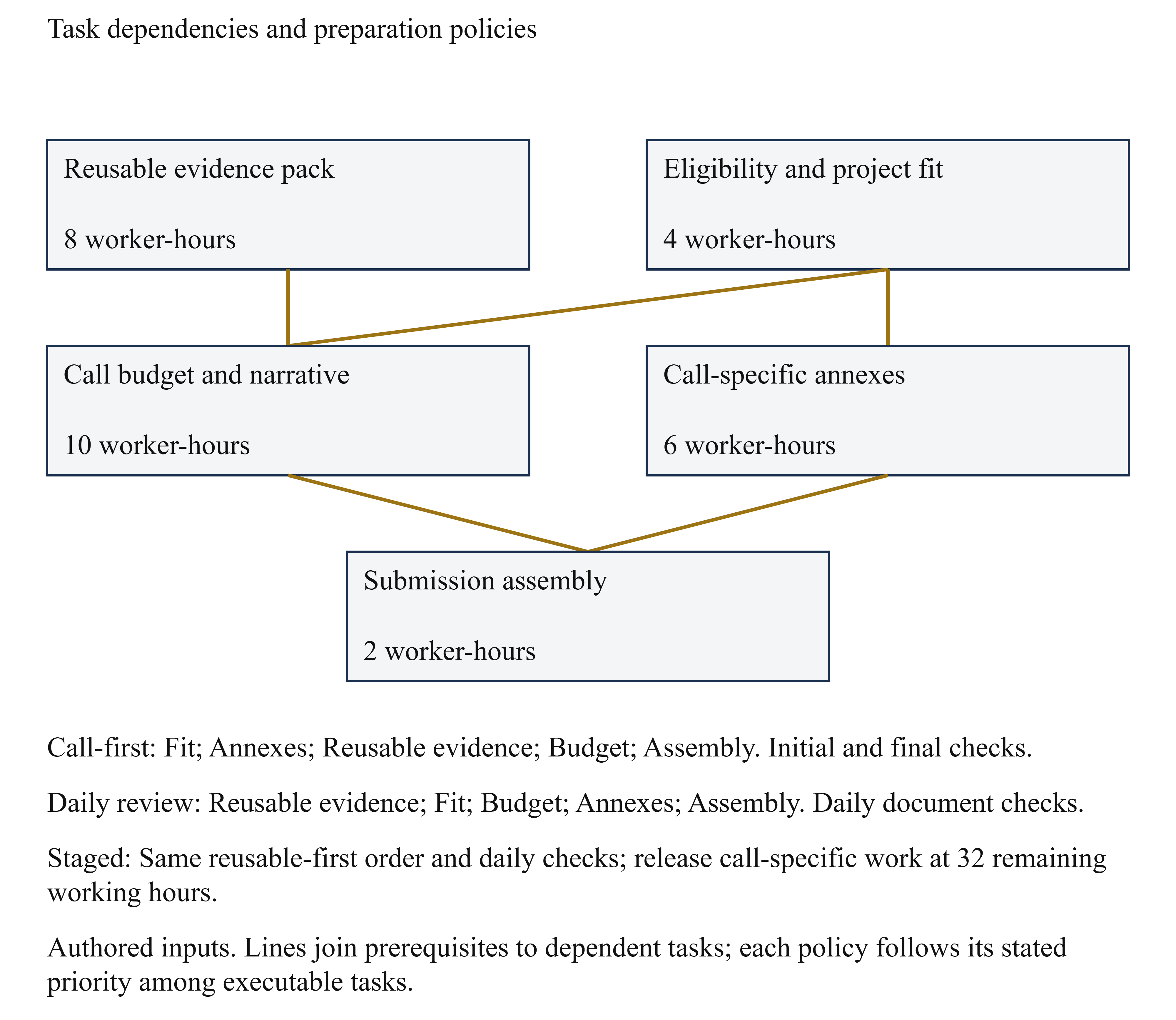
Scroll horizontally to read the figure at full size. You can also open the full-size figure.
Authored task hours and policy rules, defined in the methods below. Checking uses the same single worker as preparation. No programme-specific duration is estimated.
3 Read the scope of a documented deadline extension
An EIC notice published on 3 August 2023 provides a directly documented historical extension. The full-proposal deadline moved from 4 October to 19 October 2023. The two specified calendar dates are fifteen days apart. The notice also describes a short-proposal moratorium beginning on 2 June and reopening on 3 July. Its specified exception allowed certain successful short-proposal applicants reaching their twelve-month limit between the June and October cutoffs to use the October submission. The stage, affected group and programme year are all part of the finding. [2]
A preparation team reviewing that notice would need separate entries for the full-proposal cutoff and the short-proposal arrangements. It would also need to determine whether the stated exception covered its own earlier result. The extended calendar alone would leave that applicability question open. A reusable application checklist should therefore record the requirement affected by a notice, the applicant category it addresses and any conditions attached to the additional time. The headline can help locate the communication; the operative details determine the relevant action.
Several analytical boundaries follow. Fifteen additional calendar days describe this pair of deadlines. The record contains no direct measure of extra preparation performed, proposal quality, successful submissions or awards caused by the extension. A team might use additional time to correct a budget, obtain partner approvals or accommodate other work. The documentary record does not identify its choice. Any calculation of those consequences needs explicit case inputs or observed applicant records.
The applicant guide supplies a second form of history. Version 6.0, internally dated 19 November 2025, lists fourteen editions including the initial edition. The history includes annual programme updates, clarifications, platform changes and deadline-related entries. The current resource metadata gives 20 November 2025. These labels can be retained as different source fields. Counting the history rows as fourteen adverse policy changes would discard the contents and relationships of those editions. [1]
The same historical notice can appear in a news item, a guide history and a later discussion of the programme. An event register should link those representations. Its denominator needs to state whether it counts documents, editions, calls or identified changes. Repeated communications can provide corroboration and useful context. They should retain their shared event identity in any later frequency study. This treatment also makes a practical application file easier to maintain because the team can see which documents refer to the same decision.
4 Track programme amendments and financial quantities separately
The original 2026 EIC Work Programme carries decision C(2025)7410 dated 5 November 2025; its landing-page publication is dated 6 November. It lists six full-proposal batches for 2026 and anticipates possible amendments. A March 2026 programme amendment, identified as C(2026)2051 of 26 March, adds the Scaleup Europe Fund contribution. The original and March introductory programme envelopes are EUR 1.424 billion and EUR 2.024 billion respectively. Those amounts are programme-level financing figures. [10, 11, 12, 15]
The March provisions distinguish a EUR 600 million contribution from 2026, a EUR 400 million contribution conditional on the 2027 work programme, and a target fund capitalisation of approximately EUR 5 billion. Each quantity needs its own label. A conditional future contribution remains conditional. A capitalisation target requires evidence of capital raised before it can be described as achieved. Neither quantity establishes the amount, instrument or payment timing applicable to an applicant preparing a proposal. [12]
The subsequent documentary sequence adds further dates. An EIC news announcement is dated 17 June 2026. The detailed provisions specify 9 July for the relevant Accelerator dual-use application language, with 2 September as its first stated evaluation batch; STEP uses 9 September for its corresponding first batch. A further formal decision, C(2026)5609, is dated 4 August. The current download and landing labels retain June-related identifiers while the linked text includes later material. The records do not establish the exact day on which each mutable web body was replaced. [13, 14, 15, 11]
The preparation decision needs the provision applicable to the particular instrument and stage. A team should record the cited paragraph, its source edition and the stated applicability date before changing its eligibility assessment. The date of an announcement may prompt that review. The resulting application decision still requires the relevant detailed conditions. Preserving the publication, document and applicability fields allows an independent reviewer to follow that sequence and identify any unresolved step.
Current representations also contain an amount conflict. The programme landing summary describes an Accelerator investment range beginning at EUR 0.5 million, while the detailed annex and retained guide state a EUR 1 million minimum, with a EUR 10 million maximum. This comparison establishes a disagreement among the cited representations. It supplies no verified transition from one minimum to another. An applicant relying on that minimum would need to resolve the applicable call conditions with the responsible authority. [14, 11, 1]
For a finance team, the practical output is a list of decisions requiring documentary confirmation. These may concern the instrument, company category, relevant investment range, permitted activity or submission stage. A policy announcement can also require an investment or legal team to review its own assumptions. The study contains no measured estimate of that review's cost. Its scheduling cases must specify which tasks are affected and the work needed to revisit them before any numerical consequence can be calculated.
5 Keep the successor year and prior application status visible
The 2027 EIC programme and associated announcement were published on 5 November 2026. The work programme and current Accelerator page list four full-proposal batches: 20 January, 17 March, 1 September and 4 November 2027, at 17:00 Brussels time. This is a successor-year calendar. The record should retain its year and call identity alongside the earlier six-date 2026 calendar. A team preparing across the year boundary needs to determine which route its submission will use. [4, 5, 3]
That review can extend to the applicant's earlier procedural status. The 2027 work programme refers to recent short-proposal GO results and includes a footnote addressing certain earlier results with an existing full-proposal submission. The current canonical FAQ uses broader wording for some earlier GO years. The two representations leave an applicability question that should remain visible in an applicant record. The sources reviewed here do not establish a universal entitlement for every applicant with an earlier result. [4, 5, 3, 16]
The appropriate preparation response is to identify the applicant's actual result, its year, the relevant submission history and the source condition being applied. Those facts need to be assembled before a decision can be made about reusing earlier preparation. A versioned file can preserve the paragraphs consulted and the programme office's answer to any unresolved question. This provides a record of the decision basis without assuming that an undated FAQ changed on the date a researcher happened to read it.
The published 2027 work programme establishes the stated future batch calendar. An applicant still needs to identify its submission route and confirm the operative portal instructions for the chosen stage. The work programme's dated calendar and an applicant's current ability to submit are separate questions. The application record should retain the calendar source, the procedural conditions being checked and any answer received from the responsible programme office. Current portal acceptance is outside the documentary findings reported here. [4, 5, 3]
Annual transitions also affect the interpretation of management deadlines. An internal plan to finish a proposal in December may be useful preparation for a later batch, subject to the relevant eligibility and process requirements. It supplies no evidence that submission is currently open or that a particular earlier result will be accepted. The application file should state the planned route, the source of its calendar and the unresolved conditions. Management can then decide how much preparatory work is justified while those conditions remain open.
6 Use preparation research within its observed scope
Research on grant preparation provides context for the resource decision. Herbert and colleagues studied Australian NHMRC applications submitted in March 2012. Their analysis included 285 respondents supplying identifiers for 632 proposals and reported aggregate researcher-effort averages of 38 working days for new proposals, 28 for resubmissions and 34 overall. The study relied on retrospective reports and concerned a particular funding system and period. These quantities should retain their person-effort meaning when discussed alongside an application calendar. [17]
An organisation with several contributors can accumulate many days of researcher effort within a shorter elapsed period. Availability, task dependencies, institutional approvals and the timing of external information determine the relationship. A grant-preparation model therefore needs separate units for work and elapsed duration. Importing an average from another programme would require evidence that its tasks, participants and measurement basis fit the intended application. The present planning cases define their own work inputs and make that assumption visible.
Gross and Bergstrom analyse the opportunity costs of scientific funding competitions through a theoretical contest model. Their work gives a conceptual basis for considering preparation resources alongside the funding sought. Its numerical parameters are not estimates of how EIC or Gulf programme terms change. The study also addresses allocation mechanisms and incentives, which differ from the within-application scheduling decision developed here. We use it for that limited conceptual connection. [18]
Howell's study of ranked US Department of Energy SBIR applicants provides a separate example of an empirical research design for grant effects. Its award analysis depends on the setting, assignment mechanism and applicant data examined in that study. The present source register contains no equivalent assignment or outcome data. We therefore keep the documentary analysis and the defined preparation cases separate from claims about subsequent venture finance or company performance. [19]
The contribution is a transparent connection between document interpretation and a preparation calendar. A reader can trace a dated statement to its source, determine the call and stage to which it relates, identify the task affected and inspect the assumptions used for a calculated consequence. The model retains the intervening preparation, verification and observation sequence. Mathematical novelty and a first empirical finding are outside the claims made here.
7 Define the application decision before comparing documents
An application decision has several identities: the programme, the particular call or cohort, the applicant, and the stage at which a requirement applies. A useful documentary register should connect these identities before comparing wording. A change concerning a later cohort may leave an earlier application untouched. A requirement for selected participants may concern a different decision from a requirement for initial submission. For a finance team, this distinction determines which document should inform expenditure approval, which should inform the application itself, and which should remain an unresolved condition before accepting support. [20, 8, 21]
The appropriate starting question is therefore specific: which proposition about this application is supported by this version? A programme name alone provides insufficient detail for that assessment. The register should retain the page or notice title, its issuing body, the relevant application round, the affected field and the evidence supporting applicability. Where an organisation operates several programmes through a common website, a shared introductory paragraph should be connected to the programme-specific instructions. A discrepancy should remain visible until the relationship between those instructions has been established. [20, 8, 21]
This discipline gives the announcement-to-application interval an operational meaning. The interval contains a sequence of decisions about whether to investigate, prepare, verify and submit. Each decision consumes some combination of management attention, professional time and available calendar space. The documentary evidence examined here provides examples of information that can alter those decisions. It contains no observed cohort of applicants whose preparation behaviour and subsequent commercial outcomes can be followed. Accordingly, the analysis concerns the organisation of a decision under stated information conditions; it supplies no estimate of how frequently applicants encounter a material change. [20, 8, 21, 9, 22]
A clear classification also supports expenditure control. An expanded explanation of an equity instrument calls for a different review from a new cohort start date. A changed website update stamp calls for a comparison of the underlying clauses. An unresolved conflict calls for clarification before relying on the disputed condition. Treating these observations as separate categories allows an application team to allocate review work to the issue that could affect its decision. The resulting record should identify the responsible reviewer and the unresolved dependency, while preserving the words and dates on which the assessment rests. [20, 8, 9, 22]
8 Preserve the sequence of evidence and the precision of dates
The retained evidence has different levels of provenance. Historical Hub71 and Tamkeen files preserve earlier official-page content, and their embedded canonical links identify the original pages. Archive capture labels come from the retained filenames and the accompanying retrieval procedure. Their capture metadata was not independently retrieved again for this review. Contemporary research notes provide an additional account of what was read, with a lower evidential status where the earlier raw page is unavailable. Current official-page observations and the reused earlier observations retain their actual access dates. These distinctions should travel with every comparison. [20, 8, 21, 9, 22]
A version register should distinguish when a source was observed from when its contents became applicable. A capture establishes an observed version within the limits of its provenance. A displayed update date records what the publisher states about the page. An effective date concerns the operation of a particular term. An application cutoff concerns the submission opportunity. Each date answers a separate question. Where the publisher supplies no effective date, the register should leave that field unknown. Substituting a file timestamp or an access date would introduce information that the documentary record does not contain. [20, 8, 9, 22]
Precision should remain attached to the original date throughout the analysis. A deadline stated by month cannot support an exact closing day, hour or time zone. It can support a conditional calendar assessment in which the unresolved boundary is disclosed. An applicant requiring a definite submission decision should seek the missing precision before relying on the remaining interval. A comparison between two versions can locate a difference between observations without revealing the day on which the publisher made it. That observation interval should remain separate from any period available to an applicant after receiving notice. [20, 8, 21]
When exact endpoints are available, interval arithmetic should name both events and specify whether endpoint days are included. A review deadline and a programme start can support a stated interval between those milestones. Their difference cannot be described as an applicant's available preparation period without evidence of when the applicant received actionable notice and which submission cutoff applied. This distinction should remain in table headings as well as prose. [20, 8, 21]
| Field | Evidence to retain | Decision limitation |
|---|---|---|
| Application identity | Programme, call, cohort and affected stage | A later cohort does not establish a revised earlier cutoff. |
| Observed version | Document identity, original URL and actual access date | Access establishes the version read, within recorded provenance limits. |
| Publisher dates | Publication, update and effective dates separately | An update stamp alone does not establish term effectiveness. |
| Schedule milestone | Cutoff, review, start, award or payment | Different milestones cannot be substituted. |
| Date precision | Original date string, precision and stated time zone | Unknown closing details remain unresolved. |
| Comparison identity | Earlier and later field values and linked notices | Shared page content does not establish independent change events. |
The register should also preserve adverse and unchanged evidence. Identical retained text can be recognised as a repeated observation of the same content. A page whose principal conditions remain stable provides a useful check on an interpretation based only on its update stamp. A contradictory passage should remain available to the reviewer alongside the passage supporting the intended application. Selectively retaining favourable clauses would make the decision record incomplete. None of these documentary categories supplies a denominator for estimating population change frequency; such an estimate would require a defined population, observation schedule and treatment of missing versions. [20, 8, 9, 22]
9 Interpret cohort replacement and expanded disclosure at Hub71
The retained Access page from October 2025 contains equity-incentive and founder-relocation language without a cohort deadline. The September 2026 version supplies a Cohort21 calendar and more explicit SAFE, long-term relocation, team-building and conditional top-up timing language. The current page, observed on 10 November 2026, retains those details. These observations establish differences in published disclosure. They leave the exact effective dates and any underlying legal instrument change unverified. Variation between top-up descriptions within the current page also limits reliance on a precise payment date. [20]
The Life Sciences comparison concerns different cohorts. The retained August 2026 text identifies Cohort20, a 21 August 2026 deadline and a February 2027 start. The current page identifies Cohort21, a February 2027 deadline and a September 2027 start. The AI comparison moves from a retained Cohort17 calendar to the current Cohort21 calendar. Current deadlines have month precision. The Life Sciences page describes consideration for a subsequent cohort after a cohort cutoff. These observations establish cohort-calendar replacement; a same-cohort deadline extension remains unverified. [8, 21]
| Source identity | Earlier evidence | Later observation | Bounded conclusion |
|---|---|---|---|
| Hub71 Access | Retained October 2025 page; September 2026 version | 10 November 2026 confirmation | Calendar and term-disclosure differences; effective date unknown. |
| Hub71 Life Sciences | August 2026 archive; Cohort20 | 10 November 2026; Cohort21 | Different cohort calendar; same-cohort extension unverified. |
| Hub71 AI | January 2025 archive; Cohort17 | 10 November 2026; Cohort21 | Different cohort calendar and current routing context. |
| Tamkeen Riyada | July 2025 archive; February 2025 update stamp | 10 November 2026; May 2026 update stamp | Changed stamp; sampled core conditions stable. |
| Tamkeen Digital Enablement and AI | October 2026 note; September update stamp | 10 November 2026; November update stamp | Earlier raw body unavailable; historical clause change unverified. |
For an applicant, continuity of a programme name therefore leaves an important question open: can the available cohort serve the intended project? A later start may require the project timetable to be reconsidered even when a subsequent application remains possible. The decision should retain the original required start date as an explicit applicant constraint. Moving that constraint merely to obtain a favourable feasibility result would change the question being assessed. Any calendar comparison should state whether the applicant accepts the later cohort and which preparation work remains usable under that choice. [8, 21]
Expanded disclosure requires a clause-level review with similarly bounded conclusions. A finance team can identify the newly explicit instrument and request the applicable documentation before authorising reliance on its terms. It can assess a longer-term founder commitment against the proposed operating arrangements. It should keep eligibility for a conditional top-up separate from any base-case funding assumption. These are recommended review actions derived from the information differences. The retained pages contain no measured evidence of applicant relocation costs, realised dilution, payments or losses attributable to the wording differences. [20]
10 Separate page maintenance from application and cash milestones
Tamkeen Riyada illustrates a changed update stamp alongside stable sampled conditions. Its retained page and the current observation preserve the registration-or-prototype alternatives, founder commitments, programme duration and accelerator-cost coverage. Neither body supplies a dated cohort window. The stamp comparison therefore supports a statement about displayed page maintenance. It leaves the existence of a revised submission deadline unverified. A finance team should review the relevant body clauses and any applicable call notice before deciding whether the stamp affects its application. [9]
The Digital Enablement and AI page currently displays an 8 November 2026 update date. The earlier September stamp survives in the October research note; the earlier raw body is unavailable in the scoped retained evidence. Current reimbursement wording was already read on 9 November. The page connects reimbursement to successful implementation and three months of utilisation, subject to programme conditions. That reading supports a cash-timing distinction. It leaves the date on which the clause first appeared, its exact effective date and any change in an application deadline unverified. [22]
These distinctions matter when an application is incorporated into a financing assessment. The team should identify the expenditure that must occur before a reimbursement claim can become supportable, the evidence required at that stage and the source for each condition. A date attached to a programme webpage supplies no verified receipt date. An assessment can therefore maintain separate entries for a submission opportunity, a condition-dependent claim and cash whose timing remains unresolved. Any assumed interval between those entries should be declared as a case assumption, with the consequences of a longer interval examined separately. [9, 22]
Document maintenance can still prompt a useful revalidation task even when no revised substantive condition has been established. The reviewer can compare the clauses relevant to the application, record unchanged provisions and list the questions that remain open. The task should have a defined scope so that repeated page checks do not become an unbounded demand on the preparation team. A missing dated intake window should remain a request for clarification. The current presence of an application link provides no evidence here of portal acceptance, remaining capacity, approval or subsequent payment. [9, 22]
11 Sequence verification around decisions that depend on it
A preparation calendar can be organised around dependencies between tasks and decisions. Initial investigation identifies the relevant programme and candidate application. Document review establishes which source version supports each required condition. Preparation produces the materials needed for the selected submission route. Revalidation checks the conditions on which the next consequential decision depends. This proposed sequence is an analytical structure for evaluating defined cases. It supplies no empirical description of how the observed programmes' applicants actually organise their work. Task durations, staffing requirements and review costs require separate, explicit assumptions before the structure can produce numerical comparisons. [20, 8, 21, 9, 22]
A fair comparison should give alternative schedules the same published event path, initial facts and observation rules. A staged schedule cannot receive advance knowledge of an unpublished revision. Information learned at a particular hour can differ because verification starts and finishes at different times under each policy. Those observation decisions form part of the policy bundle. The comparison also retains the same applicant constraints, required outputs and treatment of unresolved conditions. This defines a conditional comparison of complete schedules; the separate effect of task sequencing alone remains unidentified. [20, 8, 21, 9, 22]
Work effort and elapsed time require separate accounting. A review task may use limited professional effort while awaiting clarification that delays a dependent decision. Parallel preparation can shorten elapsed time while consuming additional capacity. Rework may affect only the task whose underlying condition changed, or several dependent tasks if the application identity changes. These alternatives should be specified before comparing schedules. The analysis should identify the completion path, the available capacity and the rule assigning rework. Costs expressed per hour, per working day or per application require compatible units and an explicit treatment of waiting time. [20, 8, 21, 9, 22]
Useful adverse cases follow directly from the evidence limits. Verification can consume the remaining submission slack. Repeated checks can add effort while discovering no decision-relevant difference. A later cohort can remain incompatible with the applicant's required project start. A source conflict can leave applicability unresolved despite completed preparation. Such cases make the proposed calendar open to failure on its own stated terms. Any favourable result should therefore be reported with the precise assumptions that produced it, alongside the conditions under which further verification or a different submission choice would cease to be worthwhile. [20, 8, 21, 9, 22]
12 Carry an auditable evidence position into the submission decision
The practical output of documentary review should be a decision record that another reviewer can reconstruct. It should identify the selected application, the controlling source as assessed, the versions compared, the conditions requiring confirmation and the person accountable for the next action. The record should state which assertions were directly observed and which depend on applicant information or authored calendar assumptions. Where a source is unavailable, the limitation should remain explicit. This approach preserves a usable evidence position as work proceeds, while leaving institutional acceptance and subsequent funding decisions outside the applicant team's verified knowledge. [20, 8, 21, 9, 22]
Immediately before committing further material resources, the reviewer should ask whether the evidence still supports the same application identity and timetable. A changed cohort may require a fresh decision about timing. A clarified instrument may require a different financial review. An unchanged clause can close a narrowly defined revalidation task. An unresolved closing date can require clarification before submission is treated as feasible. These recommended responses are conditional on the field affected. They do not imply that repeated checking always creates value, or that an organisation can remove uncertainty through document review alone. [20, 8, 21, 9, 22]
The retained examples also establish the limits of a retrospective documentary register. Missing intervening versions leave the number and timing of changes unknown. Repeated website wording can reflect shared content across programme pages. A displayed update stamp can change while sampled core clauses remain stable. An earlier research note can support a qualified account of what was read without supplying the missing raw version. These features require explicit treatment in any future empirical study. A defined observation protocol would need to specify coverage, capture intervals, missingness, event classification and the linkage between notices and individual applications. [20, 8, 21, 9, 22]
Until such linked evidence exists, the defensible contribution is a disciplined account of how documents enter an application decision and how a defined preparation calendar responds to them. A reader can use the taxonomy to distinguish questions requiring clarification from questions that the retained versions can answer. A finance committee can require assumptions about costs, timing and conditional support to be visible before authorising reliance on them. The observed records support that documentary discussion. Population change rates, award probabilities and subsequent commercial effects remain separate research questions for which this evidence supplies no estimate. [20, 8, 21, 9, 22]
13 Recognise what an additional submission cycle changes
An NIH small-business research notice issued on 1 April 2025 added a submission cycle to an existing solicitation. Its old and revised tables show expiration moving from 6 April to 6 September 2025, with an additional application date of 5 September. Applications were due at 5pm in the applicant organisation's local time. The added cycle listed scientific review in November 2025, council review in January 2026 and an earliest start in April 2026. The historical notice is now marked expired. [6]
This example motivates a proposed classification rule for preparation calendars: identify the event being changed before moving a task. An added receipt cycle creates another application opportunity under the amended solicitation. A planning record should keep the earlier cycles alongside the additional one, then state which cycle the applicant intends to use. Otherwise, a spreadsheet containing a single deadline can silently erase the relationship between an application and its review sequence. The useful decision is whether the later cycle suits the project being proposed. That decision requires a fresh applicability check and an explicit choice of target cycle, followed by preparation tasks assigned to that choice. [6]
Expiration should occupy its own field. Treating it as the delivery target would place this applicant's schedule against the wrong event. The proposed calendar therefore records the submission cutoff, its time zone and the solicitation's expiration independently, even when their dates are close. The person preparing the research plan should be able to see which date governs delivery, while the institutional signatory can verify that the chosen opportunity remains applicable. A changed expiration field should trigger a review of the affected submission cycles. It should not, by itself, move every task already associated with an earlier cycle or authorise unfinished work to proceed to submission. [6]
The added cycle also presents a project-timing decision. A team can compare its required research start with the published assessment sequence, while preserving the qualifier attached to an earliest start. This comparison belongs in the project plan before the team commits further preparation resources. A proposed rule is to maintain separate dates for the applicant's latest acceptable start and the programme's stated milestone. If the relationship remains unresolved, the schedule should carry that uncertainty into the approval decision. It supplies no basis for booking grant receipts, committing expenditure against an expected award, or assigning a financing benefit to the additional cycle. [6]
14 Use an extension without inventing its missing history
The UKRI Gambling Harms Research and Innovation Partnerships page explicitly records an extension to 18 November 2025 at 4pm UK time. Its update log dates a deadline update to 15 August and changes to eligibility and phase timelines to 27 August. The previous cutoff is absent. Current guidance prevents one individual leading both the partnership and coordination-centre applications; co-leads, partners and collaborating organisations may appear on both. The opportunity is closed. These entries establish a documented revision, while leaving the extension's length and the earlier eligibility wording unknown. [7]
A proposed decision record can remain useful with that incomplete history. It should distinguish the verified current requirement from the missing prior value. The team can plan against a verified applicable cutoff without presenting a calculated extension length. For retrospective analysis, the old value remains unknown until a suitable earlier official document is obtained. This separation matters when evaluating preparation decisions: a later observed deadline does not reveal when an applicant first learned about it, how much work had already been completed, or whether the same project was eligible throughout. Each of those questions requires its own evidence and should remain outside the present documentary conclusion. [7]
The linked-call restriction gives the proposed calendar a second dimension: responsibility for the application. A team considering related opportunities should record the intended role of each participant and test that role against the applicable rule before allocating proposal work. This is a document-based review of a specified participation plan. It provides no permission to assume that another funder allows parallel applications or the same person to lead several bids. If the team changes its lead, the review should consider the documents, commitments and approvals that depend on that appointment. The revision should become a defined task with an owner and a recorded reason for changing the name field. [7]
For governance, an extension can be treated as a point at which the team reauthorises its remaining preparation plan. The proposed review asks which work is still required, which approvals remain valid and whether the revised target still serves the project's purpose. It should retain both the original internal plan and the newly approved plan, with the reason for any resource change. Additional calendar time does not supply evidence of additional staff availability or permission to broaden the project. A disciplined decision can therefore retain the same scope, reduce the remaining work, or stop preparation, depending on the team's documented constraints and the current terms. [7]
| Transition | Decision to record | Evidence boundary |
|---|---|---|
| Additional submission cycle | Select the intended cycle and its associated milestones | Earlier receipt dates remain separately identifiable |
| Deadline extension | Reapprove the remaining preparation schedule | Unknown prior cutoff remains unknown |
| Eligibility clarification | Check the applicant's circumstances against the linked notices | Retain the correction and its applicability |
| Institutional vetting stage | Assign delivery and approval responsibilities separately | A planned award period supplies no payment date |
15 Read an eligibility correction as a linked decision record
The NIH Pathway to Independence eligibility notice displays a release date of 30 January 2026. Its purpose initially limited an extension to one cohort, while its detailed list included two. A correction dated 4 March removes that restrictive sentence, retains both cohort entries and states immediate effect. The correction labels the earlier announcement 26 January, creating an unresolved date-label conflict. The two documents support a linked correction record. They do not establish a universal new application deadline. This biomedical career-development example concerns the interpretation of eligibility; its applicant rules do not transfer to a GCC startup. [25, 23]
The proposed application review begins by identifying the exact assertion requiring a decision. An applicant deciding whether an eligibility window applies needs the controlling description of the eligible group, together with the opportunity to which it refers. Recording only the notice title would leave that reasoning incomplete. A useful entry should identify the relevant passage, the linked correction and the applicant circumstance being assessed. The team can then distinguish an unresolved question about applicability from work that can safely continue under the existing project plan. This supports a bounded approval decision without requiring an assumption about how many other applicants encountered the same wording. [25, 23]
Immediate effect and discovery time should also remain separate in the proposed record. The issue date can identify when an official correction says it applies, while a dated observation records when the team obtained it. If an earlier internal decision relied on the original passage, the review should preserve that decision and explain the basis for reconsidering it. This creates a traceable sequence of information and approvals. It does not establish that the team had access to the correction at the moment it took effect. Any analysis of avoidable delay would additionally need evidence about access, responsibilities and the preparation state at the relevant time. [23]
The conflicting labels for the earlier notice illustrate why a record should permit unresolved fields. A proposed chronology can retain each displayed date with its source and role, without selecting an unsupported first-publication day. The substantive applicability decision may still be supported by the correction's explicit text. A historical interval requiring the uncertain date should remain unavailable. This approach gives each conclusion an identifiable evidential requirement: interpretation can use the linked wording, while exact chronology needs a verified time reference. It also avoids converting a discrepancy in a reference label into an invented account of when policy changed or when an applicant should have responded. [25, 23]
16 Separate applicant delivery from institutional vetting and planned awards
The verified second-cycle Qatar neuro and mental-health RFA carries a January 2026 cover date. It specifies opening at noon Doha time on 14 January, applicant submission at noon on 11 March and research-office vetting at noon on 1 April. Its planned award announcement is August/September. Vetting starts after proposal submission, and a valid application requires the submitting institution's vetting. The lead investigator needs the specified terminal degree and affiliation to an approved submitting institution in Qatar. These are the PDF's recorded terms; a dated subsequent amendment and actual award announcement have not been verified here. [24]
For the proposed scheduling framework, this creates two deliverables with different owners. The applicant prepares a complete proposal for the institutional process; the research office performs its required review and approval. The internal handover should specify what completeness means, which supporting materials accompany the proposal and who can resolve questions. A team should establish its institution's actual internal requirements before assigning a target date. The published interval between external milestones does not establish how much of that interval the institution will make available to a particular applicant. The preparation calendar therefore needs an institution-specific handover commitment, documented separately from the public deadline. [24]
The proposed dependency record should show how an unresolved eligibility or document question reaches the person authorised to answer it. An applicant's self-check can be recorded as one completed activity, with institutional vetting remaining outstanding. If the research office requests a revision, the plan should identify the affected document and the approval that must be repeated. This gives a defined place to record rework if it occurs. It supplies no estimate of how long that work will take. Any duration used in a later scheduling case should be identified as a planning assumption and assessed against the institution's actual requirements before operational use. [24]
The award period belongs on a separate planning track. A month band can inform discussion of when a decision is expected, but a project requiring committed funds needs evidence appropriate to that requirement. The proposed record should therefore retain the published precision and leave contract execution and payment fields unresolved until supported. This distinction is useful when a research team must decide whether it can hold staff or supplier capacity while an application is assessed. Those commitments require their own funding authority. The application calendar should display any dependence on an award decision explicitly, without treating the published announcement period as an available cash balance. [24]
17 Plan submission as a sequence with a defined completion condition
NIH guidance requires changed/corrected applications to meet the submission deadline even if the two-business-day viewing window extends beyond it. It distinguishes that procedure from a resubmission addressing an earlier review. The authorised organisational representative submits the correction, which is tracked through validation. NIH's separate policy overview provides next-business-day handling for specified weekends, federal holidays and Washington-area federal-office closures, with limited late-submission and system-issue provisions. These are NIH procedures. No holiday calendar or system outage has been evaluated in this study, and neither page supplies a universal preparation buffer for other funders. [26, 27]
A proposed submission plan should define completion in terms that its responsible people can verify. Preparing the final attachment, obtaining permission to submit, transmitting the application and confirming its status are different activities. Each should have an owner and a record of completion appropriate to the chosen system. The plan can then reserve time for a stated sequence of checks without assuming an unlimited opportunity to correct the application later. If a transmission produces an unresolved error, the team should record the actual status and follow the applicable instructions. A document saved locally or an attempted upload should not be entered as confirmed successful receipt. [26, 27]
The proposed calendar also needs a controlled rule for exceptions. A team can record the published basis for an applicable adjustment, its date and the approval needed to use it. A presumed public holiday or an unsupported expectation of leniency should leave the original planning target in place. Where the applicable date remains uncertain, a responsible person should resolve that question before the team relies on additional time. This is a planning control for a specified application. It does not imply that all grant portals use the same time zone, recognise the same holidays or apply the same rules when their systems are unavailable. [27]
A practical proposed sequence is to approve the opportunity and role first, prepare the required materials, obtain institutional authority, submit through the specified channel and verify the resulting status. The amount of time assigned to each activity should remain visible as an applicant-specific planning choice. If preparation overruns, the decision record should identify which remaining checks are affected and whether a valid route still exists. The team can then authorise a revised plan or stop, using the actual terms and its remaining capacity. This makes the completion condition auditable while leaving the effectiveness of any particular scheduling policy to separate evaluation. [26, 27]
| Checkpoint | Responsible role to name | Evidence retained |
|---|---|---|
| Confirm applicable terms | Application lead and institutional reviewer | Call version, linked notices and unresolved questions |
| Approve complete materials | Document owners and authorised reviewer | Approved versions and remaining dependencies |
| Authorise transmission | Person empowered by the applicable institution | Specific submission approval |
| Transmit and verify status | Authorised submitter | System identifiers, time and observed validation status |
| Resolve an exception | Named institutional decision owner | Applicable published rule and documented disposition |
18 Connect documentary evidence to a bounded preparation decision
The comparators support a proposed preparation record organised around decisions, source versions and responsibilities. For each intended application, the record should state the chosen opportunity, the relevant cycle, the applicant circumstances being assessed and the milestones that govern the next action. A linked notice can then be evaluated against that particular plan. The review asks what field changed, which activities depend on it and who can approve the response. This structure keeps a broad announcement from becoming an undifferentiated deadline entry. It also allows a team to document that a notice was reviewed and found inapplicable, with the reason preserved for subsequent checks. [6, 7, 23]
Any later scheduling analysis should begin with a clearly specified preparation state. The activities already completed, the work still required and the available institutional approvals determine which responses can be represented. A newly available cycle may be usable in one defined case and unsuitable in another because the required project start differs. An eligibility clarification may require a fresh review while leaving the scientific plan unchanged. These are proposed case distinctions to be tested with explicit assumptions. The documents alone provide no measured distribution of preparation progress, staff capacity or response cost. Those quantities should remain outside factual conclusions unless supported by additional observations. [6, 23]
A useful proposed stopping condition is an unresolved requirement that is necessary for the next authorised action. The record should identify the question, the person responsible for resolving it and the work that can continue independently. This allows an application team to separate a pending answer from a completed approval. It also gives a later reviewer a concrete basis for understanding why preparation paused or resumed. The approach makes no prediction about the answer or the timing of a reply. A decision to proceed remains conditional on the applicable terms, the institution's authority and the resources the team has actually committed. [7, 24]
Finally, the evidence supports a set of distinct documentary observations. The additional-cycle notice, the current page's update log and the linked correction have different evidential structures. Their coexistence cannot supply a denominator for how often grant terms change, an estimate of missed applications or an effect on funding outcomes. Their practical value here is to define questions that a reproducible preparation calendar must answer. A future evaluation would need a stated population, prospective observation rules and applicant-level timing evidence. Until those exist, the proposed controls should be presented as transparent decision procedures whose costs and usefulness require separate assessment. [6, 7, 23, 24]
19 A preparation calendar with explicit labour constraints
The analytical unit is one application attempt for an identified submission cycle, prepared by a single worker. Each case specifies an initial information position and a sequence of possible notices. The comparison concerns the completion and currency of a defined preparation package, the timing of an attempted submission, and the labour charged to those activities. The package covers selected tasks declared in the model. Its completion does not certify satisfaction of every programme condition or establish entitlement to funding.
All task durations, event times, costs and policy settings are authored assumptions. They are separate from the dates and requirements documented in the programme narratives. The calendar begins at an assumed Monday at 09:00 and advances in whole elapsed hours. The worker supplies eight working hours on each weekday within a seven-day week. Weekends supply no preparation capacity. Holidays, daylight-saving changes, travel, staff absence and additional workers are excluded. An hour of recorded effort therefore need not correspond to an hour of uninterrupted elapsed preparation.
| Task | Assumed worker-hours | Prerequisites |
|---|---|---|
| Reusable evidence pack | 8 | None |
| Call-specific eligibility and project fit | 4 | None |
| Call-specific budget and narrative | 10 | Fit and reusable evidence |
| Call-specific annexes | 6 | Fit |
| Submission assembly | 2 | Budget and annexes |
The task structure separates reusable evidence from call-specific material and gives each task explicit prerequisites. Budget preparation requires both the evidence pack and the fit assessment; annexes require the fit assessment; assembly requires the budget and annexes. A policy selects its first executable task in a stated priority order. Tasks can be interrupted at hourly boundaries and resumed without an additional switching charge. These assumptions permit transparent scheduling comparisons, while excluding collaboration, parallel drafting and the costs of handing work between specialists.
In the capacity expression, t denotes the current elapsed hour and D with subscript k the exact cutoff currently known to the applicant. The working indicator W equals one for each of the eight hourly work slots beginning at the assumed weekday opening, and zero otherwise. H counts available slots whose end is no later than the known cutoff. The sum is empty and equals zero when the cutoff is at or before t. An unknown cutoff leaves this calculation undefined. It does not supply an assumed last day of a month or a substitute zero-hour window.
The common planning horizon is 360 elapsed hours. Each attempt can finish earlier through submission or abandonment after its observed original-cycle cutoff has passed. The standard post-verification buffer is two calendar-hours. This is passive elapsed time, with no labour charged solely for waiting. Submission is represented as an instantaneous action at an available worker boundary, including the end of a working slot. File transfer duration, portal congestion and institutional authorisation delays would require additional explicit assumptions in an operational application.
20 Information acquired through paid verification
Each policy pays for an initial document check before preparation begins and a distinct final check after the package is complete. A standard check requires one worker-hour. Checking competes with drafting for the same worker and can span non-working periods. The case with more costly review uses three worker-hours per check. Checking effort is therefore an active resource requirement in the calendar. Its effects on timing and cost must remain visible in any interpretation of the policy comparison.
A check captures the notices published at or before its start, and the applicant learns that captured information when the check finishes. A notice issued during the check remains unavailable until a later check. This convention defines a finite observation process; it does not grant continuous awareness of a changing page. When an observed notice supplies a future exact effective time, the applicant can activate that already-known rule at that time. Future unpublished contents never enter the task-selection decision.
The model preserves separate publication, effective and observation times. An unresolved effective date remains unresolved after discovery. A missing exact cutoff or unresolved applicability blocks further call-specific work and submission, while reusable work may continue. The resulting indeterminate position carries no favourable eligibility conclusion. Retaining a null value also preserves the distinction between insufficient information and an exact deadline already passed. Month precision is an information limitation, without an automatic conversion to a point date.
A qualifying final check must start after all required preparation and revalidation are complete. The package must remain complete when its captured notices are applied. An observed original-cycle change invalidates earlier final verification when the change is applied; a known future-effective change does so when its stated effective time arrives. Periodic checks during the buffer consume labour; elapsed buffer time continues unless a material change invalidates that verification. No uncharged last-second source inspection is added at submission. Consequently, a notice issued after the final snapshot can leave an attempted package inconsistent with the authored event path.
At a common hourly boundary, labour from the preceding slot finishes first. A completed check then supplies its snapshot, and observed notices effective by that boundary are applied. An already-observed future rule also activates when its stated time arrives. A qualified submission follows once the buffer has elapsed and a worker boundary is available. Submission takes precedence over starting another periodic check. The policy then checks whether its observed window has passed before allocating another hour to preparation or verification.
A notice published exactly when a check starts is included in that snapshot. The cutoff itself is inclusive. A submitted package is assessed against the authored requirements effective exactly at its submission time, including requirements the applicant has not observed. This terminal assessment is separate from scheduling and supplies no advance information to a policy. These tie conventions make boundary outcomes reproducible and expose the remaining interval between a completed check and a submission attempt.
21 Prospective policy bundles and declared event paths
Three prospective policies use the same task requirements and event path within each case. Their choices depend on information acquired through the same observation convention. The call-first policy prioritises fit and annexes before reusable evidence, then budget and assembly. It undertakes initial and final checks without periodic review. The daily policy prioritises reusable evidence, fit, budget, annexes and assembly, with a check at the first available opportunity on each working day that has not already contained a check start.
| Policy | Preparation priority | Additional rule |
|---|---|---|
| Call-first | Fit; annexes; reusable evidence; budget; assembly | Initial and final checks only |
| Reusable-first with daily review | Reusable evidence; fit; budget; annexes; assembly | Daily checks between preparation periods |
| Staged reusable-first with daily review | Same priority as reusable-first | Release call-specific work at the authored remaining-capacity threshold |
The staged policy uses the daily policy's checks and priority order. It can begin reusable work after the initial check, while call-specific work waits until known remaining working capacity is at most 32 hours. Once released, that work is not locked again following an extension. This threshold is an authored heuristic. It is neither an estimated optimum nor a recommendation for a particular call. Dependencies can still prevent a released task from starting, and a null cutoff cannot activate the release calculation.
| Case | Cutoff and notice assumptions in elapsed hours | Preparation implication specified |
|---|---|---|
| Unchanged window | Exact cutoff 128; no notices | Checking and buffer use the unchanged calendar |
| Affected-task revision | Cutoff 200; budget notice published and effective at 25 | Reset budget; impose one assembly-revalidation hour if assembly has begun |
| Short-notice shortening | Initial cutoff 128; notice at 73 changes it to 76 | A check already in progress cannot see a later notice |
| Extension and successor | Original cutoff 80 extends to 200 at hour 49; successor announced at 96 with cutoff 344 | Successor start 504 exceeds the assumed latest acceptable start 336 |
| Unknown dates | Month-only cutoff; applicability notice at 24 has no exact effective time | Retain indeterminate timing and applicability |
| Costly review | Cutoff 80; each check takes three hours; budget task takes four hours | Allow checking to consume scarce capacity without imposing a favourable ranking |
The paths isolate different decision difficulties without assigning them population weights. A revision concerns specified tasks; a shortened window can become known after preparation is advanced; an extension explicitly changes the original cycle. A successor cycle has its own deadline and project-start conditions. Recording that successor never extends the original cutoff. The applicant's stated latest acceptable project start remains part of its compatibility assessment. The policies retain the original-cycle attempt, with no automatic rollover or credit for securing a later opportunity.
Within a case, the published record, task requirements, work calendar and initial facts are held fixed across policies. Their observed information at a particular hour can differ because checks start and finish at different times. Those information differences form part of the policy bundle. A notice alters a scheduling decision through the specified observation and activation rules; the separate terminal assessment can still identify an effective requirement that the applicant has not observed.
These policies are bundles of task priority, review frequency and release timing. Equal event paths support conditional comparisons of those complete bundles. A difference between bundles cannot identify the separate causal contribution of daily review, evidence reuse or staging. The six paths are deliberately selected planning cases, with no random sample, event hazard, award probability or representative frequency. The adverse review-cost case is included to examine resource pressure; the method imposes no required direction on the resulting policy ordering.
22 Affected work, effort accounting and interpretation boundaries
A discovered revision acts only on the explicitly affected tasks. Reset removes the task's performed live base progress and records those hours as discarded. Every historical hour remains charged. Revalidation retains the work and adds a stated review obligation when the task has already begun. An unstarted task adopts the revised requirement without fictional loss. Affected dependent work must be declared explicitly. In the selected revision case, budget work is reset and existing assembly requires reconciliation; the other preparation tasks retain their progress.
The effort identity defines total performed effort E as base preparation, performed task revalidation and general document verification. The subscripts b, r and v identify those disjoint labour categories. In the conservation identity, P with index i denotes live base progress retained for task i; the sum covers all declared preparation tasks. E with subscript d denotes cumulative discarded base hours. Retained progress is an accounting position whose currency is assessed separately. Discarded and replacement hours are subsets of base effort; adding them again to the effort total would double-count labour.
In the replacement-debt identity, B with index i is outstanding replacement debt for task i. E with subscript x denotes cumulative replacement base effort; adding index i to the discarded or replacement effort term restricts it to task i. Discarding performed base work increases debt; subsequent base work repays it. Debt remaining at termination represents work still unperformed. A newly imposed revalidation obligation is also distinct from review labour actually completed. In the cost identity, C denotes total planning cost. The cost coefficients c with subscripts p and v are 60 planning cost units per preparation or task-revalidation hour and 90 per document-verification hour, respectively. These units represent no currency, applicant valuation, funding amount or realised cash.
Submission slack is the exact original-cycle cutoff under the authored event path at the attempted submission time, less that attempt time. In this expression, t with subscript s denotes the attempt time; D with subscript a and superscript star denotes that reconstructed cutoff. The latter can differ from the applicant-known cutoff used in the capacity calculation. Slack remains undefined when either endpoint is unavailable. The terminal assessment distinguishes an on-time current task record, a late attempt, a stale task record, no submission and an indeterminate position. Current-task status refers solely to the declared preparation requirements. Legal eligibility, competitive assessment, award decisions and payment are outside its meaning. A non-submission within the model's termination rule is not an observed rejection by a funding authority.
| Input family | Values examined | Interpretation |
|---|---|---|
| Verification effort multiplier | 1; 2; 3 | Multiply each case's check duration |
| Post-verification buffer | 0; 2; 8 calendar-hours | Vary passive elapsed waiting |
| Staging release threshold | 16; 32; 48 working hours | Vary the staged policy's heuristic trigger |
Sensitivity calculations vary one family from the baseline while retaining the same authored path. Changing check duration affects both labour and the time at which information is learned. The release-threshold sensitivity concerns the staged policy; repeated results for other policies supply no additional independent observations. Saved traces retain preparation, checks, discovered notices and task revisions. Accounting and boundary controls examine conservation, worker capacity, information timing, unknown dates and cycle identity. Their purpose is reproducibility and internal consistency; empirical calibration and general policy superiority require separate evidence.
23 Read the baseline as a comparison of complete policy bundles
The saved baseline contains six authored cases evaluated under three preparation bundles. The call-first bundle begins with fit and annex work and uses initial and final verification. The daily bundle prioritises reusable material and adds periodic checks. The staged bundle uses the daily task order and checks, with call-specific work released at a remaining-work threshold. Their differences therefore include task order, checking frequency and release timing. A comparison between bundles describes their combined operation in these cases. It does not isolate the causal contribution of any individual component.
All reported times are elapsed calendar hours on the authored work calendar. Labour is measured separately in worker-hours. Costs use invented planning cost units, abbreviated PCU, with preparation and revalidation charged at 60 PCU per hour and document verification at 90. These rates express a transparent accounting convention; they carry no currency, grant valuation or cash-flow interpretation. The baseline table reports the complete set of saved results. An on-time current task record means that the declared timing and task conditions are satisfied; programme admission and funding outcomes are outside this classification.
A null submission hour means that no submission is recorded. A null slack field cannot be read as zero remaining time. The outcome column distinguishes an unresolved decision from a definite failure to submit within the model's stopping rules. Zero slack appears explicitly where a complete, verified package is submitted exactly at its cutoff. Retaining these distinctions makes the table useful for a decision owner who needs to know whether to obtain missing information, finish remaining work, or reconsider the target window.
| Authored case | Policy bundle | Submission hour | Slack: calendar hours | Base / revalidation / check: worker-hours | Cost: PCU | Task-record outcome |
|---|---|---|---|---|---|---|
| Unchanged window | Call-first | 96 | 32 | 30 / 0 / 2 | 1980 | On-time current task record |
| Unchanged window | Reusable-first daily | 102 | 26 | 30 / 0 / 6 | 2340 | On-time current task record |
| Unchanged window | Reusable-first staged | 102 | 26 | 30 / 0 / 6 | 2340 | On-time current task record |
| Budget revision | Call-first | 174 | 26 | 40 / 1 / 3 | 2730 | On-time current task record |
| Budget revision | Reusable-first daily | 104 | 96 | 32 / 0 / 6 | 2460 | On-time current task record |
| Budget revision | Reusable-first staged | 197 | 3 | 30 / 0 / 8 | 2520 | On-time current task record |
| Earlier cutoff | Call-first | No attempt | Undefined | 30 / 0 / 2 | 1980 | No submission |
| Earlier cutoff | Reusable-first daily | No attempt | Undefined | 28 / 0 / 5 | 2130 | No submission |
| Earlier cutoff | Reusable-first staged | No attempt | Undefined | 28 / 0 / 5 | 2130 | No submission |
| Extension and successor | Call-first | 96 | 104 | 30 / 0 / 2 | 1980 | On-time current task record |
| Extension and successor | Reusable-first daily | 102 | 98 | 30 / 0 / 6 | 2340 | On-time current task record |
| Extension and successor | Reusable-first staged | 102 | 98 | 30 / 0 / 6 | 2340 | On-time current task record |
| Unknown dates and terms | Call-first | No attempt | Undefined | 8 / 0 / 1 | 570 | Indeterminate |
| Unknown dates and terms | Reusable-first daily | No attempt | Undefined | 8 / 0 / 11 | 1470 | Indeterminate |
| Unknown dates and terms | Reusable-first staged | No attempt | Undefined | 8 / 0 / 11 | 1470 | Indeterminate |
| Costly checks | Call-first | 80 | 0 | 24 / 0 / 6 | 1980 | On-time current task record |
| Costly checks | Reusable-first daily | No attempt | Undefined | 20 / 0 / 12 | 2280 | No submission |
| Costly checks | Reusable-first staged | No attempt | Undefined | 20 / 0 / 12 | 2280 | No submission |
No attempt denotes an underlying null submission hour; Undefined denotes an underlying null slack value. A displayed 0 remains a calculated zero. PCU are authored cost units, with no currency interpretation.
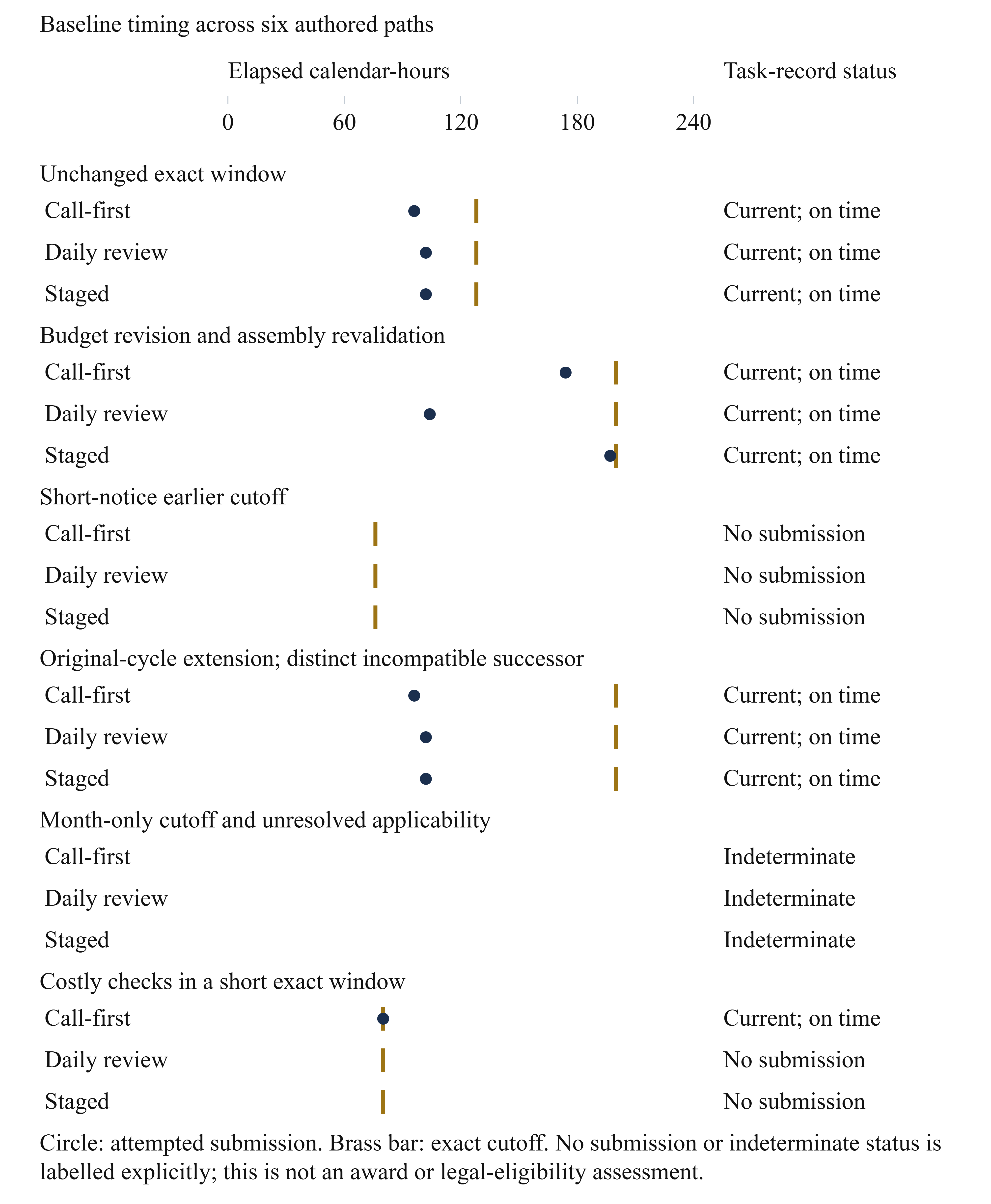
Scroll horizontally to read the figure at full size. You can also open the full-size figure.
Elapsed calendar hours from the assumed start. An absent attempt has no zero-valued submission time. Current-task outcomes cover only declared preparation requirements.
24 Unchanged terms and costly checks produce different capacity decisions
In the unchanged-window case, all three bundles complete the same 30 base worker-hours and produce an on-time current task record. Call-first preparation uses two check hours, costs 1,980 PCU and submits at hour 96. Daily and staged preparation each use six check hours, cost 2,340 PCU and submit at hour 102. The additional four check hours account for the 360 PCU cost difference under the declared rates. The timing difference belongs to the complete bundle comparison, which also changes preparation order. No separate monitoring effect is estimated.
The short-window costly-check case gives verification a larger claim on capacity. Call-first preparation completes 24 base hours and six check hours, costing 1,980 PCU. The package is ready at 75, final verification completes at 78, and the two-hour buffer permits submission at 80. The actual cutoff is also 80, leaving zero calendar-hour slack. A decision owner considering this schedule should recognise the absence of remaining margin within the case. An additional requirement would need its own feasibility assessment before the existing result could be relied upon.
Daily and staged preparation in that costly-check case each perform 20 base hours and 12 check hours, costing 2,280 PCU. Neither completes the package or records a submission. Their last labour interval begins at 79 and ends at 80. Hour 80 is the end-of-workday boundary, so no labour begins there; termination at 81 adds no charged hour. The retained task record contains four of the six required annex hours, with assembly unstarted. These unfinished dependencies explain the incomplete package within the saved schedule.
The practical review question is whether the remaining preparation and mandatory verification can both fit within available capacity. A committee should examine the unfinished tasks and their dependencies alongside the calendar cutoff. A schedule with more verification can exhaust capacity before its required outputs are complete. The saved results support that conditional observation in the costly-check case. They supply no general instruction to reduce checking, since the unchanged and revised-document cases place different demands on the same bundles. An operating decision needs the applicable conditions and the team's own resource commitments.
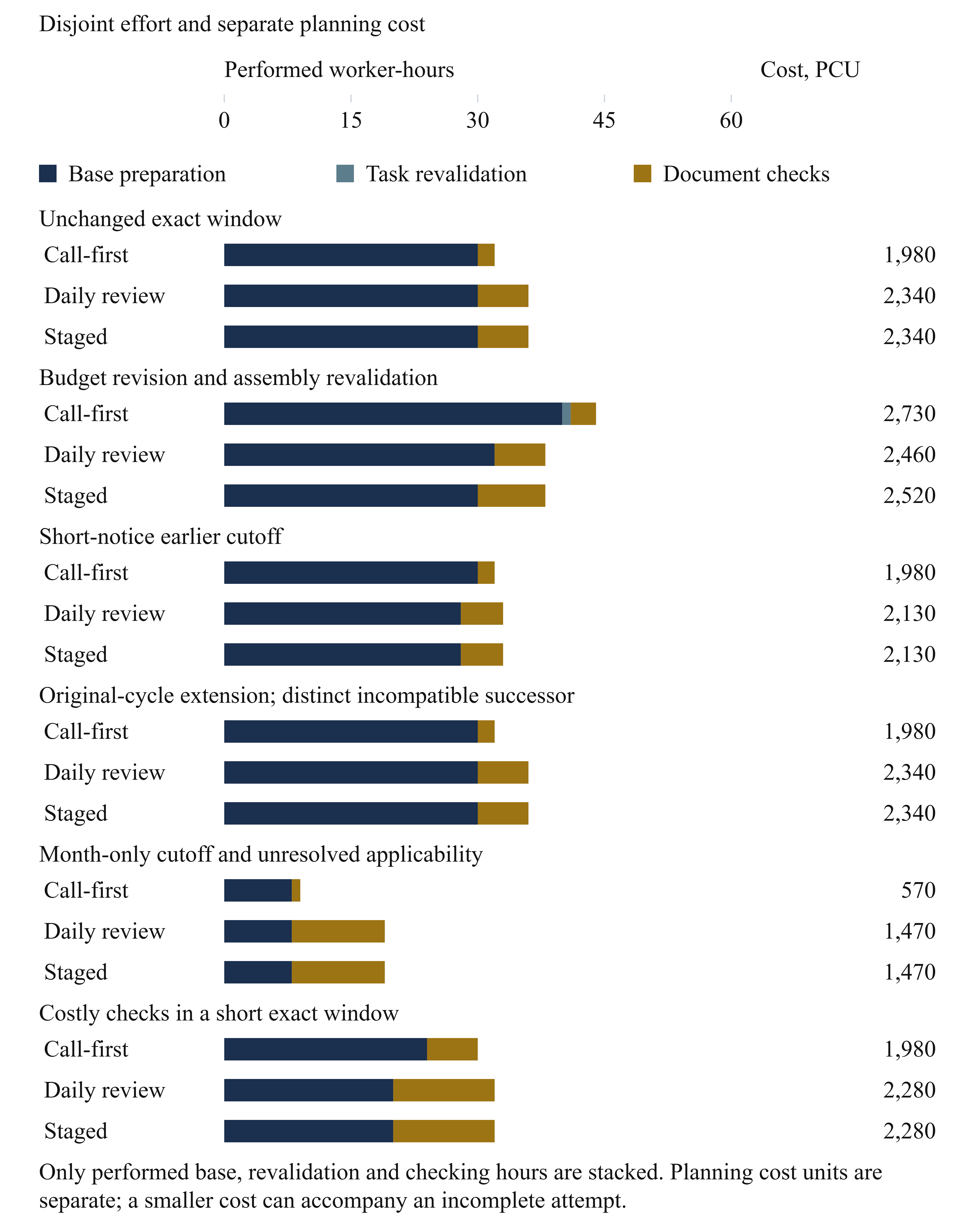
Scroll horizontally to read the figure at full size. You can also open the full-size figure.
Performed labour categories are disjoint. Discarded and replacement hours remain subsets of base labour. Planning cost units have no currency or observed expenditure meaning.
25 The revision case makes performed work and replacement effort visible
In the affected-revision case, the call-first bundle first learns the budget revision when its final check completes at hour 80. Ten already performed budget hours are discarded, and assembly receives one hour of required revalidation. The completed record consequently contains 40 base hours, one revalidation hour and three check hours. Its 2,730 PCU cost follows directly from those performed components. Final verification completes at 172 and submission occurs at 174 against cutoff 200. The discarded and replacement hours remain subsets of base effort and are not additional cost components.
The daily bundle learns the same revision at 49. Only two budget hours have been performed at that point, so two hours are discarded and subsequently replaced. Assembly has not begun and acquires no extra revalidation labour. The resulting record contains 32 base hours and six check hours, costs 2,460 PCU and submits at 104. A check that began at 24 did not include the notice published at 25, even though it completed at 25. The later check's start snapshot supplies the notice eventually learned at 49.
The baseline staged bundle also learns the revision at 49, before beginning budget work. It discards no base effort. Call-specific work releases at 73 under its 32-working-hour threshold. The package requires 30 base hours and eight check hours, costing 2,520 PCU; final verification completes at 195 and submission occurs at 197. The remaining slack is three calendar hours. This schedule incurs no discarded budget effort. Its later release leaves a narrow completion margin in the particular event path.
These ledgers make the response decision more specific than a single rework total. A reviewer can identify which task was invalidated, how much work was actually discarded, which replacement hours were performed and whether an additional review obligation was completed. The cost calculation includes every performed hour once. The figures provide no reason to treat an unperformed obligation as spent labour or to add discarded work to an already inclusive base total. The appropriate management question is whether the remaining current-task record can still be completed within the selected window.
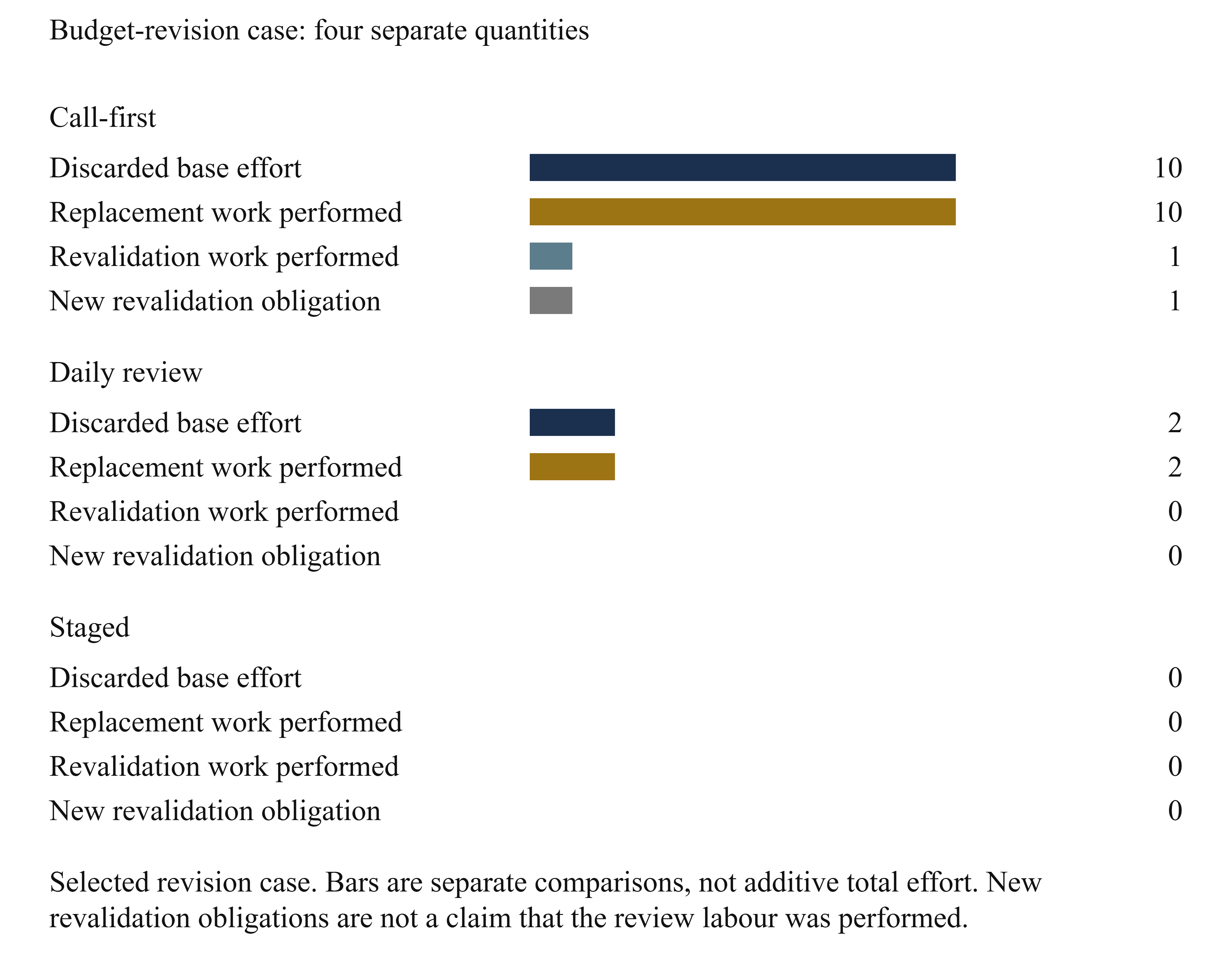
Scroll horizontally to read the figure at full size. You can also open the full-size figure.
Discarded and replacement base hours are shown separately and are not added again to performed effort. Imposed revalidation describes an obligation; performed review is recorded separately.
26 Deadline changes and unknown dates require separate dispositions
None of the bundles submits in the short-notice earlier-cutoff case. The authored notice changes the cutoff to 76. Call-first preparation stops at 80 after its final check has learned the notice, with 30 base hours and two check hours charged. Daily and staged preparation stop at 97, each with 28 base hours and five check hours. Their respective costs are 1,980 and 2,130 PCU. The saved stopping events follow notice discovery through the specified checks. It supplies no evidence that a real institution would accept an application after its deadline.
The extension-and-successor case gives a different disposition. An explicit amendment moves the original cutoff from 80 to 200. Call-first preparation submits at 96 for 1,980 PCU; daily and staged preparation submit at 102 for 2,340 PCU each. The successor opportunity remains a separate cycle. Its authored project start of 504 exceeds the applicant's latest acceptable start of 336, so its recorded compatibility condition is false. The original submissions are assessed against the amended original cutoff. No later-cycle deadline is substituted to improve that result.
The unknown-date case remains indeterminate under every bundle. Call-first preparation performs eight reusable hours and one check hour, costing 570 PCU. Daily and staged preparation each perform the same eight reusable hours and eleven check hours, costing 1,470 PCU. No call-specific task work, final verification or submission is recorded. The exact cutoff and applicable terms remain unresolved in the terminal audit, and submission slack remains null. The extra checking in these paths leaves the missing information unresolved; it does not create a verified date for a feasibility calculation.
The associated management actions should remain distinct. A verified amended original window can support a revised preparation decision. An incompatible successor requires a separate decision about the project's timing constraint. An unresolved date requires suitable clarification before a definitive submission schedule can be approved. These actions depend on the evidence state, the selected opportunity and the applicant's requirements. Collapsing all unsuccessful or unresolved records into a common outcome would conceal the difference between a missed defined window and a question whose necessary date is still unavailable.
27 Sensitivity shows thresholds, incomplete checks and calendar discontinuities
The selected sensitivity rows vary one declared input family at a time. In the revision case, a staged release threshold of 16 working hours delays release until 169 and yields no submission, with 22 base hours, seven check hours and 1,950 PCU charged. Threshold 32 reproduces submission at 197, cost 2,520 PCU and slack three. Threshold 48 releases work at 25 and submits at 104, costing 2,460 PCU with slack 96. The earlier release performs two budget hours that are later discarded and replaced. The lowest reported cost accompanies an incomplete attempt.
Calendar availability also changes the relationship between a buffer and the recorded submission time. For unchanged-window call-first preparation, a zero-hour buffer allows submission at 80. Buffers of two and eight calendar hours both produce submission at 96. All three variants cost 1,980 PCU. Final verification completes at 80, and the next available worker boundary after either positive buffer is 96. Passive waiting adds no labour cost under the method. The resulting step in submission time follows the declared work calendar; it is not a continuous conversion of buffer hours into additional preparation effort.
| Case and bundle | Input varied | Value | Submission hour | Slack: calendar hours | Cost: PCU | Outcome |
|---|---|---|---|---|---|---|
| Unchanged window; Call-first | Calendar buffer: hours | 0 | 80 | 48 | 1980 | On-time current task record |
| Unchanged window; Call-first | Calendar buffer: hours | 2 | 96 | 32 | 1980 | On-time current task record |
| Unchanged window; Call-first | Calendar buffer: hours | 8 | 96 | 32 | 1980 | On-time current task record |
| Budget revision; Reusable-first staged | Release lead: working hours | 16 | No attempt | Undefined | 1950 | No submission |
| Budget revision; Reusable-first staged | Release lead: working hours | 32 | 197 | 3 | 2520 | On-time current task record |
| Budget revision; Reusable-first staged | Release lead: working hours | 48 | 104 | 96 | 2460 | On-time current task record |
| Costly checks; Call-first | Check-effort multiplier | 1 | 80 | 0 | 1980 | On-time current task record |
| Costly checks; Call-first | Check-effort multiplier | 2 | No attempt | Undefined | 2160 | No submission |
| Costly checks; Call-first | Check-effort multiplier | 3 | No attempt | Undefined | 2190 | No submission |
| Costly checks; Reusable-first daily | Check-effort multiplier | 1 | No attempt | Undefined | 2280 | No submission |
| Costly checks; Reusable-first daily | Check-effort multiplier | 2 | No attempt | Undefined | 2640 | No submission |
| Costly checks; Reusable-first daily | Check-effort multiplier | 3 | No attempt | Undefined | 2880 | No submission |
No attempt denotes an underlying null submission hour; Undefined denotes an underlying null slack value. A displayed 0 remains a calculated zero. PCU are authored cost units, with no currency interpretation.
Doubling check effort in the costly-check call-first case leaves a complete task record at 78 but no completed final verification. The run performs 24 base hours and eight check hours, costs 2,160 PCU and records no submission. Eight is the performed check total, including the unfinished final check; charging two fully completed checks would misstate that path. Tripling check effort under the daily bundle consumes 32 check hours and leaves zero base hours before stopping, at a cost of 2,880 PCU. These variants expose the capacity implications of the declared priority rule.
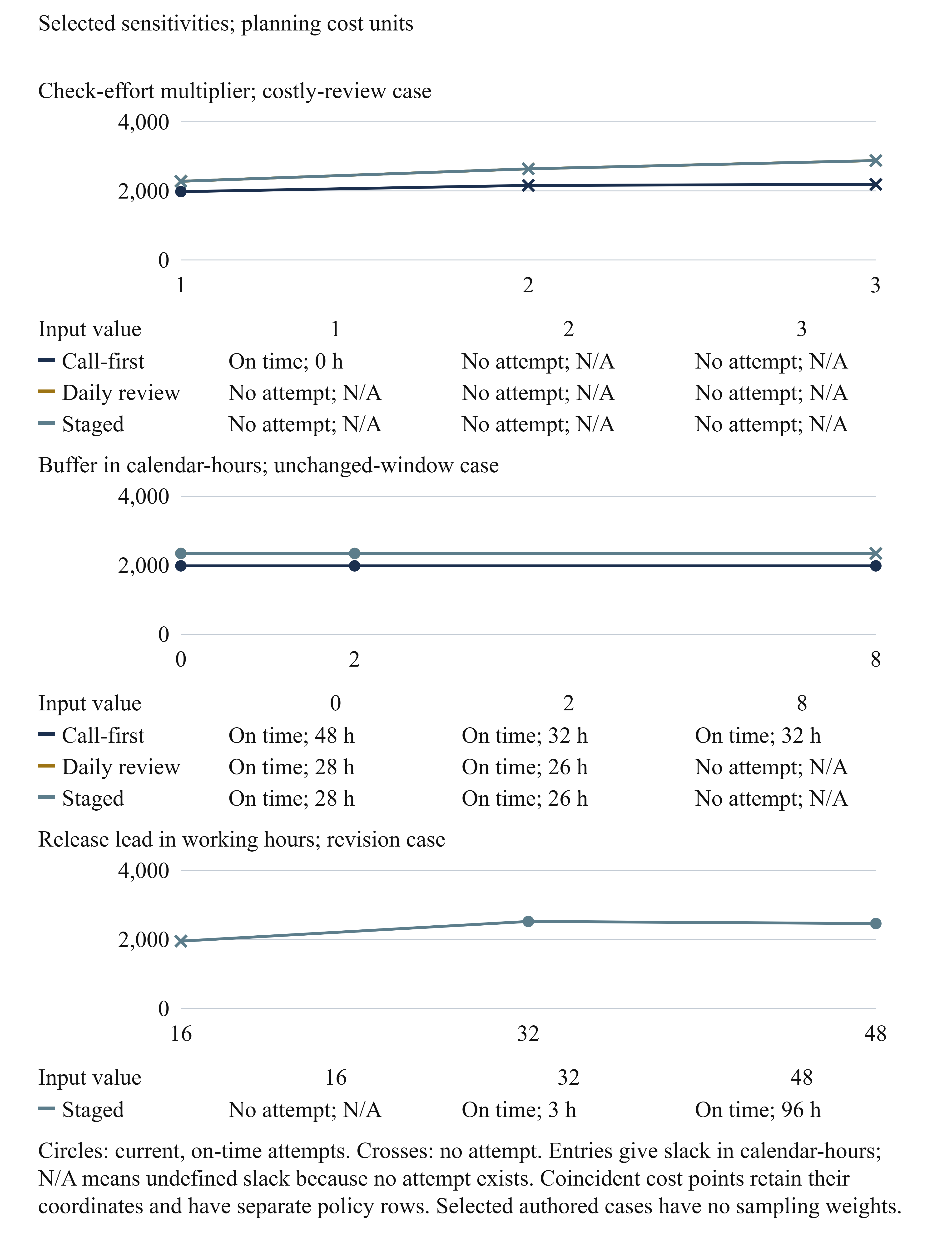
Scroll horizontally to read the figure at full size. You can also open the full-size figure.
Selected comparisons from 162 deterministic sensitivity results. Repeated paths carry no sampling weights or probability interpretation. Missing attempts and undefined slack remain explicit.
28 Use the saved trade-offs to authorise a defined next action
The sensitivity rows support a review of constraints before selecting a bundle. A lower cost can accompany unfinished work, as the late-release revision variant demonstrates. A completed package can still lack the final verification required by the method, as the doubled-check call-first variant demonstrates. A completed and verified package can reach the cutoff with no remaining margin. These are different approval states. A finance or programme team should specify the required completion conditions and acceptable timing margin before comparing the corresponding costs, keeping unresolved fields visible throughout the decision.
An actionable preparation record should therefore present current task completion, the next required verification, available work capacity, target-cycle compatibility and remaining calendar slack together. Where a revision has been learned, the record should distinguish replacement work from additional revalidation. Where the date is unknown, the decision owner should identify the information needed to proceed and the work that can continue independently. Where the original window is defined, any proposed change of cycle should state how it affects the required project start. Each action should have an owner and a documented basis.
The saved results do not identify an optimal policy or estimate an award effect. They show how the declared bundles operate under the stated task durations, notice times, costs and calendar rules. The selected sensitivities examine individual inputs around those cases; they do not establish robustness to every combination of uncertainties. A practical adoption decision would require the organisation's actual task estimates, institutional approvals and applicable submission procedures. The value of the present accounting is that the relevant trade-offs and unresolved conditions are exposed for that review, without assigning them an unsupported funding benefit.
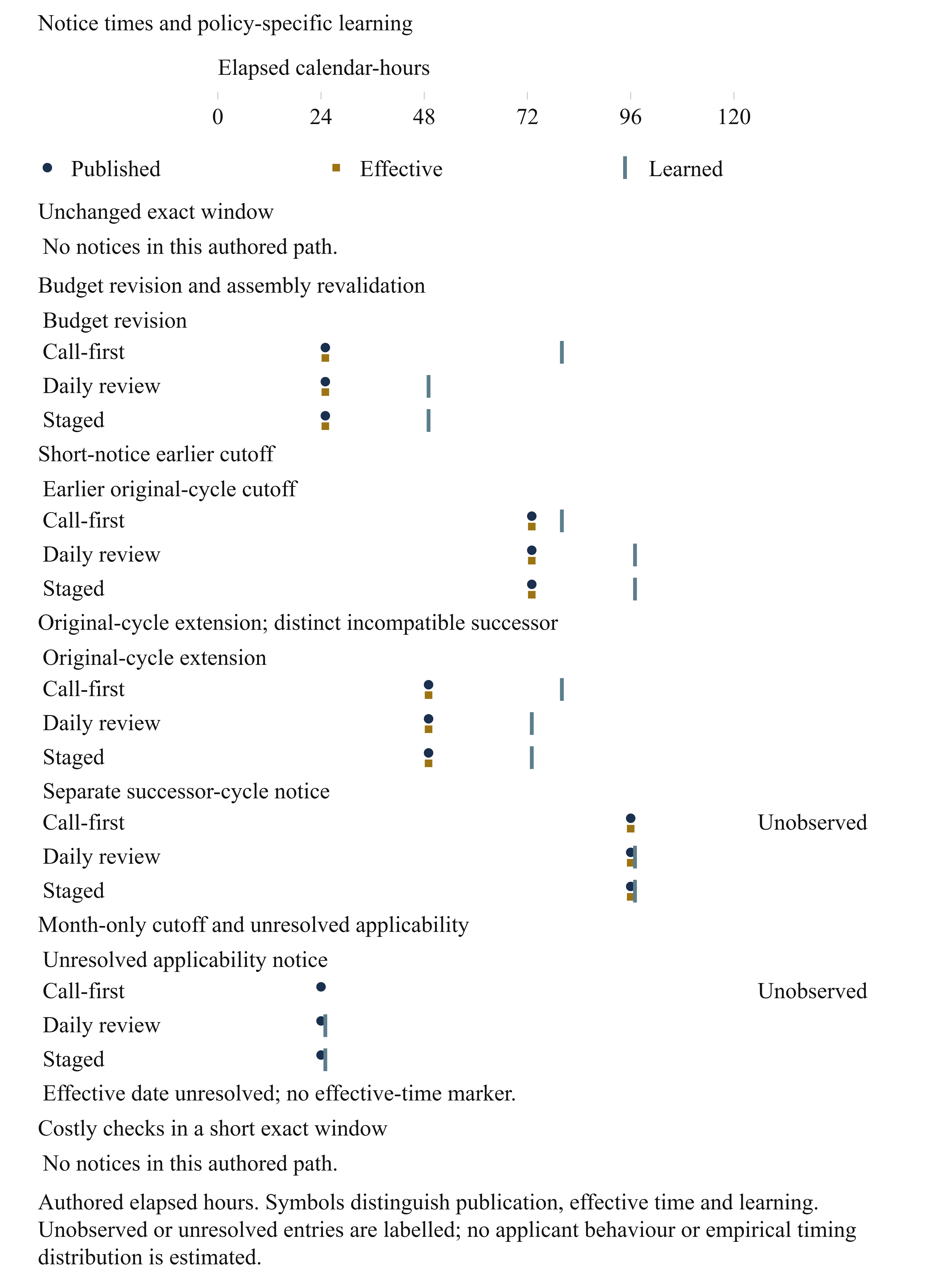
Scroll horizontally to read the figure at full size. You can also open the full-size figure.
Calendar hours in constructed paths. Check information is captured at its start and learned at completion; no unpublished future notice enters a decision.
29 Evaluate the framework with a prospective linked record
A future empirical study should begin with a defined set of funding opportunities and a documented enrolment rule. The researcher would record each programme, instrument, submitting role, call and cohort at the beginning of observation. A specified capture schedule would preserve the official material used by the participating team, including periods in which no relevant clause changes. This establishes the observation frame needed to count changes. Calls that disappear, move URL or lose accessible histories would remain in the register with their missing periods identified. Their removal could otherwise select the sample towards programmes with convenient documentation.
Document capture and applicant observation require different permissions and identifiers. The public record can preserve source text, timestamps, applicable provisions and linked notices. A confidential applicant record would additionally preserve when the team learned of each notice, its interpretation, the work then completed and the action authorised. A shared event identifier would connect the two records without publishing personal or commercially sensitive information. The study protocol should state the retention, access and consent arrangements before collecting applicant evidence. Participation and withdrawal would need to be recorded so that missing applicant histories remain visible in the analysis.
The primary change measure should specify its unit and observation episode before observations are coded. One possible measure is the proportion of enrolled application episodes containing a verified applicable material change. Each episode would identify the applicant, project, call and window, with a prespecified preparation-start decision and an endpoint at recorded submission, application abandonment or withdrawal. Episodes still open at the cutoff would receive a prespecified censoring rule. Its numerator would require an applicable change to a specified field linked to that same call. Its denominator would include all enrolled episodes meeting the observation rule, with missing or censored histories reported separately. Multiple notices describing one decision would share an event identity. Added cycles, successor cohorts, corrections and changed update stamps should remain separate categories, with uncertain classifications disclosed. Programme-level call-window frequency requires its own separately defined denominator.
Preparation cost would require observed labour records with compatible units. The record should identify who performed each task, its duration, its applicable document version and the reason for any repetition. Waiting for an answer would contribute elapsed time; professional effort would be recorded only when someone performed work. Team members working concurrently would create multiple person-hours during the same clock interval. Reuse of an existing document would require a stated allocation rule. The model's disjoint accounting offers a candidate structure for those observations, with discarded work and replacement work traced inside total base effort. Its assumed rates and durations supply no estimates for that later study.
Commercial outcomes would need their own follow-up design. Submitted, withdrawn and abandoned applications should remain distinguishable. Assessment results, awards, legal instruments, contracted commitments and actual payments would require separate dated evidence. Any dilution measure would need the relevant instrument and ownership basis. Subsequent sales, employment or external financing would need an observation horizon and consistent definitions. A comparison of teams choosing different preparation policies would also need to address their existing resources, project readiness and application difficulty. Observed differences alone would leave policy selection and other explanations unresolved. A causal design requires an independently justified assignment mechanism and suitable data.
The most direct initial validation concerns the preparation process itself. Researchers could compare recorded task completions, checks and notice discoveries with the event sequence predicted using the participating team's own inputs. Disagreement would identify a missing dependency, an inaccurate duration or a different interpretation of applicability. A model revision should preserve the original prediction and explain the change before its performance is reassessed. This allows the framework to acquire measured operational content while retaining a clear boundary between documentary facts, observed applicant behaviour and numerical assumptions. Independent coding of a subset of changes would further expose interpretive disagreements that a single register cannot reveal.
30 Authorise preparation against the evidence and available capacity
An application team can use the framework at a specific spending decision. It should identify the intended call, the project requirement and the next commitment requiring approval. The preparation record then links the relevant conditions to the tasks that depend on them. A cost schedule may require a clause-level budget review; a change of submitting institution may require fresh authority and supporting documents. The owner of each task should state what can be reused and what must be reconsidered. This gives a notice an explicit operational consequence before management changes the resource plan.
Verification should occupy a visible place in that plan. A review has a scope, a responsible person, a completion condition and a demand on available time. Its outcome may confirm an unchanged clause, identify affected work or leave a question unresolved. Management should consider which upcoming commitment makes that information valuable and whether the remaining preparation capacity can accommodate the check. The costly-review case demonstrates how a defensible information task can compete with completion. The affected-task revision case demonstrates why the scope of work already committed also matters. Both mechanisms belong in the approval discussion.
A staging decision needs a working-capacity calculation and a clear release condition. The model's lead thresholds are deliberately visible assumptions. They can be replaced in an operational plan only with a documented estimate of the actual work, staffing and approvals involved. If an extension becomes known, the team should re-evaluate remaining tasks and the project's required timing. A subsequent cohort requires a separate choice about its suitability. Management should preserve the original decision basis when it authorises a revised plan, allowing the consequences of changed information to be reviewed later.
The paper's practical contribution is a source-linked preparation decision with explicit labour and information timing. The official records establish specific documentary distinctions. The numerical cases show how their declared mechanisms can produce reduced rework, lost slack, unfinished preparation or an indeterminate position. A responsible approval records the applicable evidence, the assumptions still carrying the decision and the limit on resources committed. Future applicant-level research can test the usefulness of that procedure. Funding outcomes and cash availability continue to require their own evidence before they enter a committed financing plan.
References
- European Innovation Council. EIC Accelerator Guide for Applicants, version 6.0, 19 November 2025. Accessed 10 November 2026. https://eic.ec.europa.eu/document/download/9d96fbf3-4d85-4ad0-9483-c77ce348111d_en?filename=EIC+Accelerator+guide+for+applicants_WP26.pdf
- European Innovation Council. EIC Accelerator applicants given additional two weeks to submit for October cut-off, 3 August 2023. Accessed 10 November 2026. https://eic.ec.europa.eu/news/eic-accelerator-applicants-given-additional-two-weeks-submit-october-cut-2023-08-03_en
- European Innovation Council. EIC Accelerator. Accessed 10 November 2026. https://eic.ec.europa.eu/eic-funding-opportunities/eic-accelerator_en
- European Commission. European Innovation Council Work Programme 2027; decision label C(2026)7629. Published resource 5 November 2026. Accessed 10 November 2026. https://eic.ec.europa.eu/document/download/ed9ab103-1ffb-4d5f-a6ad-168ac3b36900_en?filename=EIC-2027-Work-Programme.pdf
- European Innovation Council. Announcement of funding for 2027, 5 November 2026. Accessed 10 November 2026. https://eic.ec.europa.eu/news/european-innovation-council-launches-eur18-billion-funding-2027-2026-11-05_en
- National Institutes of Health. Notice to Extend the Expiration Date of PA-24-245, PHS 2024-2 Omnibus Solicitation for Small Business Innovation Research Grant Applications; NOT-OD-25-075, 1 April 2025. Accessed 10 November 2026. https://grants.nih.gov/grants/guide/notice-files/NOT-OD-25-075.html
- UK Research and Innovation. Gambling harms research and innovation partnerships. Published 23 June 2025; last updated 14 October 2025. Accessed 10 November 2026. https://www.ukri.org/opportunity/gambling-harms-research-and-innovation-partnerships/
- Hub71. Hub71+ Life Sciences. Accessed 10 November 2026. https://www.hub71.com/program/hub71-plus-life-sciences
- Labour Fund (Tamkeen). Riyada Business Accelerator Programme. Accessed 10 November 2026. https://tamkeen.bh/en/programs/riyada-business-accelerator-program/
- European Commission. European Innovation Council Work Programme 2026, original version; decision C(2025)7410 of 5 November 2025. Accessed 10 November 2026. https://eic.ec.europa.eu/document/download/7c6d14b5-9dcf-40cc-ae85-97f31cfb691c_en?filename=EIC-Work-Programme-2026-5-november-2025.pdf
- European Innovation Council. EIC 2026 Work Programme. Published 6 November 2025; current resource label 17 June 2026. Accessed 10 November 2026. https://eic.ec.europa.eu/eic-funding-opportunities/eic-2026-work-programme_en
- European Commission. European Innovation Council Work Programme 2026, March amendment; decision C(2026)2051 of 26 March 2026. Accessed 10 November 2026. https://eic.ec.europa.eu/document/download/023b0721-db3e-4f4b-b043-75fec1fcbb2b_en?filename=EIC-Work-Programme-march-2026.pdf
- European Innovation Council. Announcement on defence and dual-use technologies, 17 June 2026. Accessed 10 November 2026. https://eic.ec.europa.eu/news/european-innovation-council-opens-defence-and-dual-use-technologies-2026-06-17_en
- European Commission. European Innovation Council Work Programme 2026, current download bearing decision label C(2026)4080. Accessed 10 November 2026. https://eic.ec.europa.eu/document/download/52598755-1351-4b54-b46b-e2682d0a3aec_en?filename=EIC-Work-Programme-2026.pdf
- European Commission. Decision C(2026)5609, 4 August 2026. EUR-Lex. Accessed 10 November 2026. https://eur-lex.europa.eu/legal-content/EN/TXT/?uri=intcom:C(2026)5609
- European Innovation Council. FAQs: EIC Accelerator. Accessed 10 November 2026. https://eic.ec.europa.eu/eic-frequently-asked-questions/faqs-eic-accelerator_en
- Herbert DL, Barnett AG, Clarke P, Graves N. On the time spent preparing grant proposals: an observational study of Australian researchers. BMJ Open. 2013;3:e002800. doi:10.1136/bmjopen-2013-002800. Accessed 10 November 2026. https://doi.org/10.1136/bmjopen-2013-002800
- Gross K, Bergstrom CT. Contest models highlight inherent inefficiencies of scientific funding competitions. PLoS Biology. 2019;17(1):e3000065. doi:10.1371/journal.pbio.3000065. Accessed 10 November 2026. https://doi.org/10.1371/journal.pbio.3000065
- Howell ST. Financing Innovation: Evidence from R&D Grants. American Economic Review. 2017;107(4):1136-1164. doi:10.1257/aer.20150808. Accessed 10 November 2026. https://doi.org/10.1257/aer.20150808
- Hub71. Access Programme. Accessed 10 November 2026. https://www.hub71.com/program/access-programme
- Hub71. Hub71+ AI. Accessed 10 November 2026. https://www.hub71.com/program/hub71-plus-ai
- Labour Fund (Tamkeen). Digital Enablement & AI. Accessed 10 November 2026. https://tamkeen.bh/en/programs/digital-enablement/
- National Institutes of Health, Office of the Director. Notice of Correction to Notice of Temporary Extension of Eligibility for the NIH Pathway to Independence Award (K99/R00); NOT-OD-26-042, 4 March 2026. Accessed 10 November 2026. https://grants.nih.gov/grants/guide/notice-files/NOT-OD-26-042.html
- Qatar Research, Development and Innovation Council and Ministry of Public Health. Unlocking the Mind: Advancing Neuro and Mental Health Research, Request for Application, second cycle, January 2026. Accessed 10 November 2026. https://innolight.qrdi.org.qa/files/30da53ff-48f4-4b04-972e-1361f7f47822.pdf
- National Institutes of Health, Office of the Director. Notice of Temporary Extension of Eligibility for the NIH Pathway to Independence Award (K99/R00); NOT-OD-26-021, displayed release date 30 January 2026. Accessed 10 November 2026. https://grants.nih.gov/grants/guide/notice-files/NOT-OD-26-021.html
- National Institutes of Health. Submit a Changed/Corrected Application. Last updated 24 September 2024. Accessed 10 November 2026. https://grants.nih.gov/grants-process/submit/submit-track-view/changed-corrected-application
- National Institutes of Health. Submission Policies. Last updated 11 August 2026. Accessed 10 November 2026. https://grants.nih.gov/grants-process/submit/submission-policies
About the Author
Chennakeshav (CK) is a corporate finance and investment banking executive with 25+ years of global experience in deal origination, structuring and execution across M&A, growth capital and corporate strategy. He has led value-creation mandates for founders, corporates and funds — bridging the boardroom view to hands-on execution and close.
His career spans Morgan Stanley, HSBC, Lloyds Banking Group, EWEC, ADQ portfolio companies and Emirates Growth Fund, across TMT, real estate, fintech, deeptech, cleantech, infrastructure and energy. He has partnered with C-suite leaders, private equity and venture funds, sovereign wealth funds and family offices to finance complex fund raises and scale-up ventures, and has led M&A due diligence, post-merger integration and business-transformation initiatives to create value.
At Matchpoint Partners he is Managing Partner, leading the firm's corporate finance, M&A and capital-raising practice. He holds an MBA from London Business School, an engineering degree from VTU and a Master of Laws (LLM, in progress) from UCL London.
An active start-up mentor, CK mentors at Techstars, DIFC FinTech Hive, Startup Grind, Founder Institute and IN5, serves as Entrepreneur Mentor in Residence (EMiR) at London Business School, and judges the Entrepreneurship World Cup.
https://www.linkedin.com/in/ckadya/
https://www.matchpoint-partners.com/team/ck-adya.html
Disclaimer
This paper is part of a continuing series on the structure of private and alternative markets. The views expressed are the author's own. The paper is for information only, describes market structure in general terms, and does not constitute investment, legal, tax or regulatory advice or a recommendation in respect of any security, vehicle or counterparty.
