
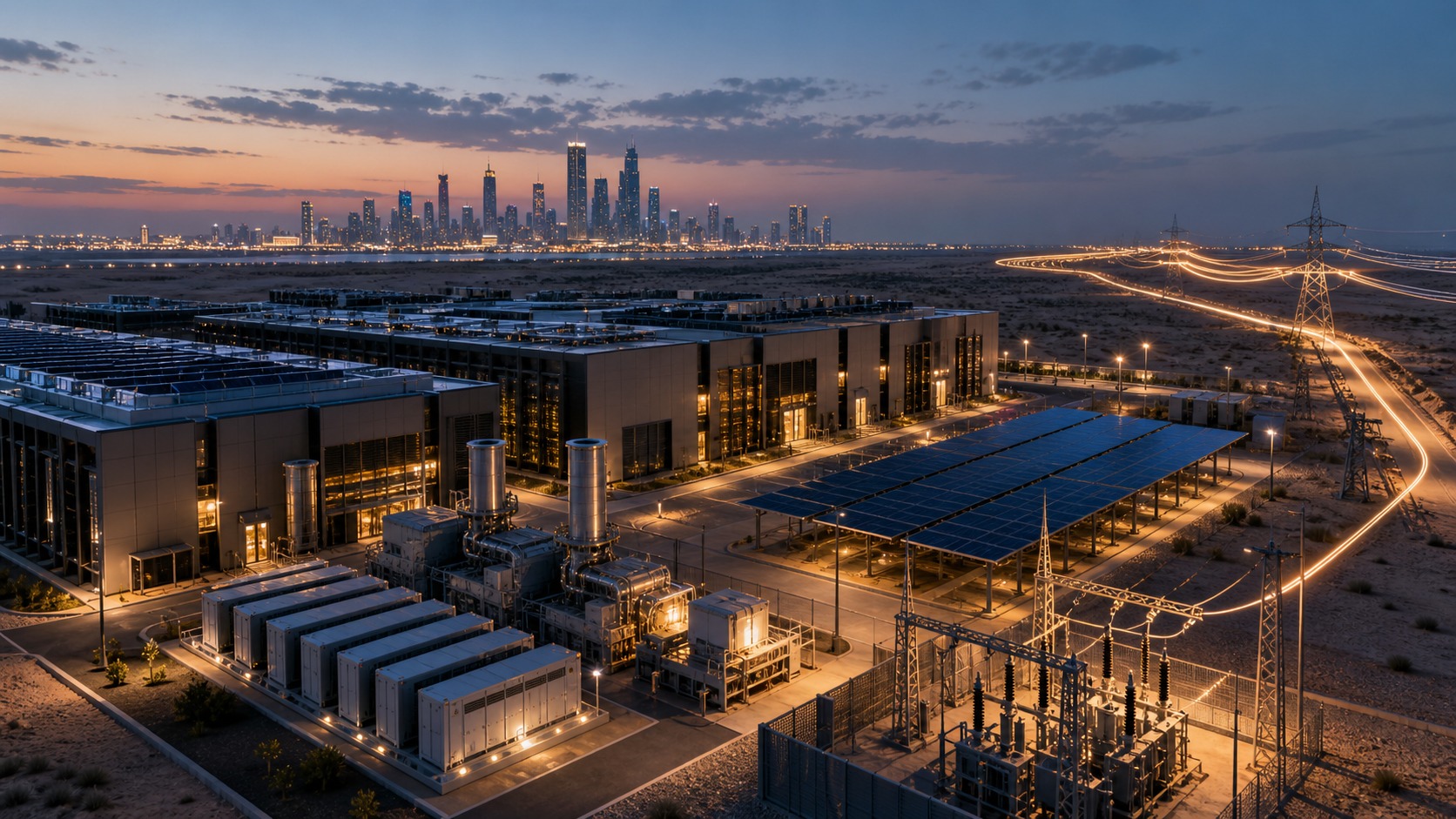
1. Begin with the service date, not the generator
A data-centre customer buys an available service. The service may be a powered shell, commissioned rack capacity, cloud environment, accelerator cluster or managed computing product. Each version requires a specified electrical, thermal, network, security and operating boundary. A behind-the-meter power proposal has value only when it helps deliver that boundary at an acceptable risk-adjusted cost.
The board should therefore begin with the contracted or target service date. It should identify the customer product, initial megawatts, ramp, resilience class, cooling load, maintenance treatment and acceptance tests. The development team then works backwards through energisation, integrated systems testing, commissioning, plant construction, equipment delivery, permits, licence, connection studies, land and fuel.
This sequence prevents an early equipment order from becoming the de facto strategy. A generator can arrive while the site lacks permission to operate it. A solar array can be eligible in one programme and outside the published scope of another. A battery can provide ride-through and peak management while remaining unable to supply the required duration. A technically complete plant can remain commercially unusable because the customer contract assumes a different availability, carbon or price profile.
Behind-the-meter power should have a written role. It may bridge a delayed grid connection, serve as permanent prime power, cover a limited initial phase, provide resilience behind a firm grid supply, reduce peaks, support renewable integration or combine several functions. Each role creates different sizing, duty cycle, fuel, emissions, maintenance, tariff and financing requirements.
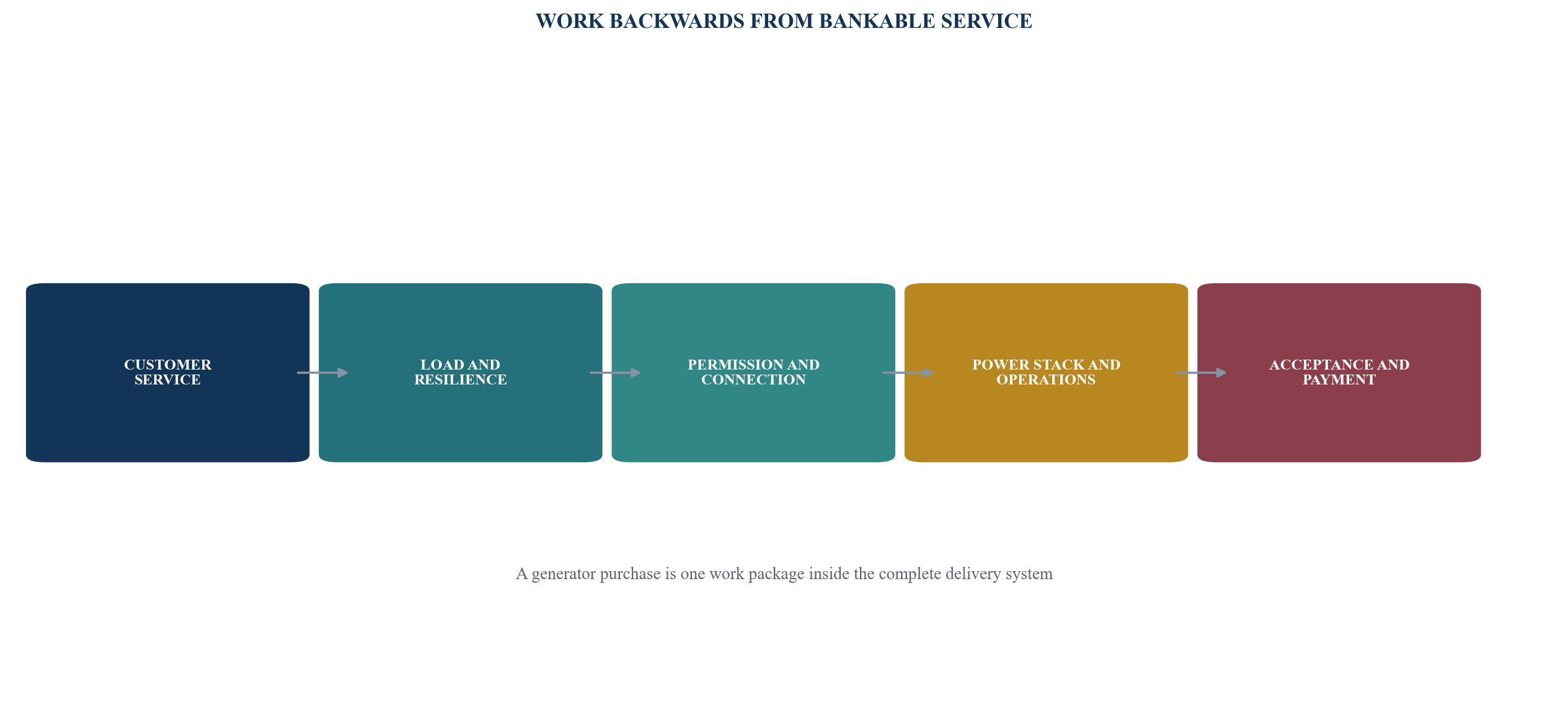
The power stack must support an accepted data-centre service and an evidenced route to payment.
2. Establish the legal activity before design freeze
The first gating question is whether the intended activity can be licensed, permitted, connected and operated at the proposed location. The answer depends on the jurisdiction, technology, capacity, ownership, energy flows, grid relationship and customer structure. Public guidance can identify a pathway. A project needs written authority-specific confirmation before relying on that pathway.
The Abu Dhabi Department of Energy publishes an instant-licence route for small-scale regulated self-supply activities. Its current public page describes electricity generation using all types and techniques, including renewable generation, with production capacity no greater than 5 MW in one facility and no greater than 30 MW across the declared net production capacity. The Department also publishes a self-supply licence service for capacity above 5 MW. That service lists technical, financial and legal evaluation, a public-notice period, code-compliance reporting, a connection agreement, single-line diagram, contractor and operator information, audited accounts and performance criteria among the required elements.
The Department's separate licensing guide and current service pages should be read together with applicable laws, codes, licence conditions and operator requirements. A published threshold does not establish that a specific data-centre configuration qualifies. Multiple units, phased development, storage, export, private wires, a separate power company and supply to more than one facility may change the analysis.
Dubai Electricity and Water Authority publishes connection conditions and technical resources for distributed renewable generators and the D33 Solar PV Initiative. The material reviewed for this paper is solar-specific. It does not establish a general route for gas-fired prime power, a broad private-wire model or a data-centre self-supply project. A sponsor should obtain direct written confirmation of the applicable electricity-generation, connection, building, environmental and operating pathway.
Saudi Electricity Regulatory Authority's published framework reviewed here addresses renewable energy generation for self-consumption. The Authority states that it covers grid-connected and off-grid facilities, caps the relevant systems at 30 MW, requires a study permit before preparatory work, and subjects electricity activities to licensing. The English version of the framework states that the Arabic text prevails in the event of conflict. A gas-fired or mixed-fuel project needs a separately confirmed regulatory basis.
Table 1. Published self-supply pathways and project questions
| Jurisdiction | Public material reviewed | Stated public scope | Project confirmation required |
|---|---|---|---|
| Abu Dhabi | DoE instant licence and self-supply generation service | self-supply generation; instant route up to stated capacity limits and standard route above 5 MW | licence class, owner, facility boundary, storage, connection, export, phased capacity and codes |
| Dubai | DEWA distributed renewable and D33 connection resources | specified solar and distributed renewable connection programmes | eligibility, generation permission, network treatment, operating limits and non-solar pathway |
| Saudi Arabia | SERA renewable self-consumption framework | renewable systems for self-consumption; grid-connected or off-grid within stated limit | study permit, licence, technology, site, capacity, connection, settlement and Arabic governing text |
| Other Gulf markets | competent ministry, regulator, utility and environmental authority | jurisdiction-specific | full activity, ownership, supply, connection, fuel, environment and customer structure |
This table is a source map, not a legal opinion or confirmation of project eligibility.
3. Define the load that must actually be served
Nameplate IT load is not the plant design load. The power model should reconcile IT equipment, cooling, pumps, fans, network, storage, lighting, security, auxiliary systems, conversion losses, battery charging, plant auxiliaries, reserve, maintenance and growth. It should distinguish initial, accepted, ramped and ultimate capacity.
The load profile matters as much as the peak. A relatively flat base load creates different economics from an intermittent test environment. AI training, inference, enterprise hosting and mixed colocation can have different load factors and ramp behaviour. Cooling demand can change with ambient conditions and equipment generation. Startup, transfer and restoration can create short-duration requirements beyond normal operation.
The operator should produce an hourly or finer load model for representative days and critical events. The model identifies firm and flexible loads, ride-through requirements, restart sequence, step changes and protected customer services. It also defines which loads can be curtailed, delayed or shifted under an approved customer contract.
Power quality requires a boundary. Voltage, frequency, harmonics, fault level, grounding, transient response and protection coordination affect data-centre equipment and the generation plant. An apparently adequate megawatt total can still fail at the electrical interface.
The International Energy Agency reported global data-centre electricity consumption of about 415 terawatt-hours in 2024 and a 2030 base case of about 945 terawatt-hours in its 2025 Energy and AI report. Its April 2026 update identifies grids, approvals, turbines, transformers, chips and IT equipment among constraints affecting expansion. These system findings support early power planning. They do not establish demand, connection timing or bankability for a particular Gulf site.
Table 2. Data-centre power specification
| Requirement | Definition | Evidence before commitment | Continuing record |
|---|---|---|---|
| IT capacity | accepted customer load by phase | customer specification and design | allocation and telemetry |
| facility overhead | cooling, electrical and building load | design model and equipment data | plant meters |
| peak and ramp | maximum demand and change rate | load study and operating scenarios | event log |
| resilience | redundancy, reserve and ride-through | reliability analysis and single-line diagram | tests and maintenance history |
| power quality | voltage, frequency, harmonics and fault boundary | study and equipment specification | power-quality monitor |
| flexible load | permitted curtailment or deferral | executed customer terms | dispatch and compensation log |
| expansion | future load, date and dependencies | approved master plan | gate review by tranche |
Every value needs an engineering basis, owner and current evidence source.
4. Compare complete power stacks
The decision should compare complete systems rather than individual technologies. A system can combine grid supply, solar generation, battery energy storage, gas engines or turbines, diesel emergency generation, thermal storage, demand management and temporary rental plant. Each component needs a defined duty.
Solar can reduce daytime energy purchases and fuel use. Its output varies and it requires land, roof or canopy area, connection equipment, controls and an operating framework. It does not by itself supply a constant data-centre load. Battery storage can provide fast response, ride-through, smoothing, peak management, black-start support in an engineered system and limited energy shifting. Duration and recharge determine the service it can provide.
Gas engines or turbines can provide dispatchable power when fuel is firm and the plant is available. They introduce emissions, noise, heat, fuel-delivery, maintenance, overhaul and technology-specific operating risks. Diesel sets can support emergency duty and certain temporary arrangements. Prime-power use changes fuel logistics, maintenance, emissions and economics materially.
Grid supply can offer scale and lower site complexity when adequate capacity is contracted, connected, commissioned and available. A planned connection date remains a third-party dependency until the relevant operator has made the required commitment and conditions have been met. A temporary behind-the-meter plant should therefore be capable of carrying schedule delay without creating an unbounded fuel or customer liability.
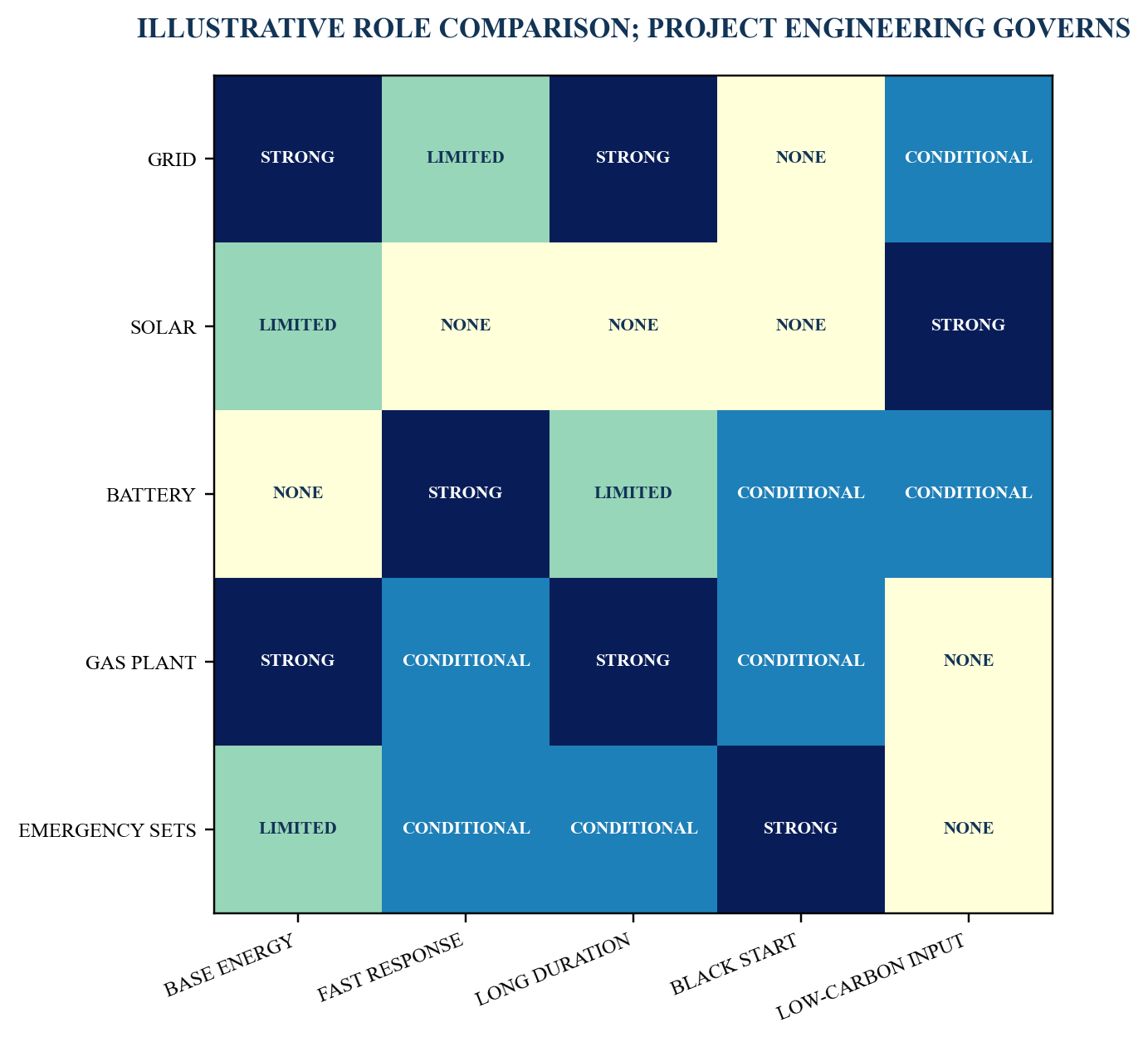
A bankable stack gives each component a specific service, duration and evidence requirement.
5. Make fuel a contracted infrastructure service
A dispatchable plant depends on fuel quality, pressure, quantity, delivery, storage and continuity. The fuel plan should identify source, transport, connection, compression or treatment, metering, balancing, backup, curtailment, quality variation, planned maintenance and emergency response.
Pipeline gas can require a connection agreement, construction works, pressure-reduction equipment and a delivery schedule. Trucked compressed or liquefied gas adds transport, unloading, on-site storage, traffic, safety and replenishment constraints. Liquid backup fuel adds tanks, bunding, quality management, deliveries and environmental controls. Each route has a maximum sustainable duty and credible interruption scenario.
The commercial agreement should define firm and interruptible quantities, nominations, take-or-pay exposure, imbalance, specification, metering, price index, taxes, transport, curtailment, force majeure and restoration. The power model should translate these terms into energy cost and availability. A low headline fuel price has limited value when capacity is interruptible during the customer peak.
Fuel counterparty credit and infrastructure completion belong in the financing file. Lenders and customers need evidence that the fuel route can support the contracted service through construction, ramp and downside operation. A sponsor should avoid using an informal supply indication as an underwritten availability assumption.
6. Engineer the electrical island and its grid interface
Behind-the-meter power changes the site's electrical architecture. The design should cover generation voltage, transformers, switchgear, bus arrangement, protection, synchronisation, islanding, earthing, fault contribution, battery controls, uninterruptible power supplies, emergency generation, load shedding, black start and restoration.
Grid-connected operation requires the relevant network studies and an executed connection arrangement. Export prohibition, reverse-power protection, dispatch limits, power factor, metering, communication, protection settings, testing and operator control can all affect design. Off-grid operation removes the grid as an operating reference and places greater responsibility on plant controls, reserve and restoration.
The single-line diagram should show normal, maintenance and fault states. The reliability analysis should test common-mode failures, shared controls, fuel dependencies, cooling dependencies, maintenance overlaps and human intervention. A nominal N+1 label can conceal a common bus, control, fuel or environmental dependency.
Commissioning should proceed from component tests through energisation, load-bank tests, transfer events, failure injection, islanding where permitted, black start, thermal response and integrated systems tests. Customer acceptance should use the same boundary that appears in the service contract.
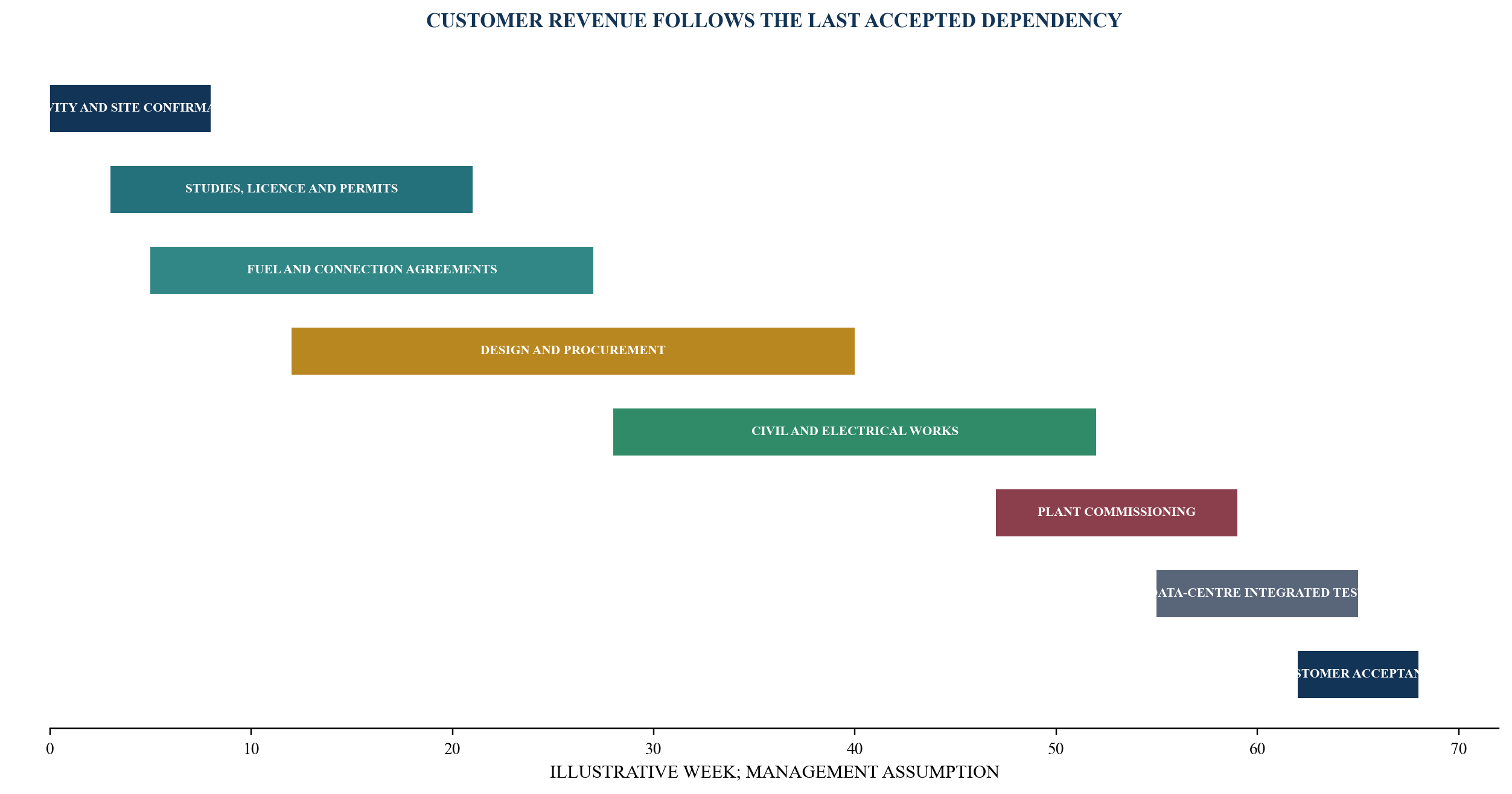
Permissions, fuel, electrical works and customer acceptance run as one controlled programme.
7. Treat environmental performance as an operating condition
Combustion plant can create air emissions, greenhouse-gas emissions, noise, vibration, heat, water use, wastewater, hazardous materials and community safety risks. Solar and battery systems have different land, electrical, fire, materials and end-of-life considerations. The environmental and social workstream should begin during site selection.
The International Finance Corporation's Environmental, Health and Safety Guidelines for Thermal Power address combustion processes, including reciprocating engines and combustion turbines, for facilities above the guideline's stated thermal-input scope. The Guidelines cover air emissions, energy efficiency, water, waste, noise, occupational health and community considerations. They are a technical reference rather than a substitute for applicable Gulf law, permit conditions or lender-specific requirements.
The project should establish its applicable environmental assessment, permit and monitoring obligations with the competent authorities. Air-dispersion modelling, stack design, fuel specification, noise modelling, water balance, hazardous-material management, fire strategy, emergency response and cumulative impact may be required depending on the site and plant.
Customer carbon requirements should be written into the product design. Renewable-energy claims, certificates, emissions allocation and reporting boundaries require current legal and assurance review. A temporary high-emission bridge can conflict with a customer's procurement policy even when it is technically permitted.
Environmental operating limits can reduce available output under certain conditions. The capacity model should reflect ambient derating, emissions restrictions, noise windows, water constraints and maintenance. A permit-compliant plant can deliver less firm capacity than its nameplate rating.
8. Allocate construction and technology risk
The delivery model may use a single engineering, procurement and construction contractor, multiple equipment packages, an energy-service provider or a power special-purpose company. The structure should follow the interfaces that can be managed and financed.
A single-point contract can simplify responsibility while retaining exclusions for fuel, grid, permits, site conditions and customer changes. A multi-package model can improve specialist control and procurement choice. It places integration risk on the sponsor unless an engineer or integrator has clear authority and liability.
Equipment warranties should cover output, efficiency, availability, emissions, degradation and relevant duty. The test conditions need to match the Gulf site and expected load. Ambient temperature, humidity, dust, fuel quality and cycling can change performance. Liquidated damages require a measurable failure, appropriate cap and creditworthy obligor.
Long-lead equipment should be connected to a controlled release plan. Early procurement may protect schedule and creates cancellation, storage, design-change, warranty-start and financing risks. The board should release deposits only when the design basis, site rights, permission path, customer logic and funding source are sufficiently developed.
Table 3. Construction and operating risk allocation
| Risk | Natural control point | Required evidence | Commercial mechanism |
|---|---|---|---|
| design integration | owner and engineer | approved design basis and interface register | professional duty and change control |
| equipment performance | supplier and EPC contractor | guaranteed curves and witnessed tests | warranty and performance damages |
| site and civil works | owner and contractor | surveys and geotechnical record | disclosed baseline and relief regime |
| fuel infrastructure | fuel provider and owner | connection plan and supply agreement | long-stop, capacity and interruption terms |
| permission | owner with authority | permits, licence and conditions | conditions precedent and schedule relief |
| operations | operator | staffing, procedures and maintenance plan | availability regime and reporting |
| customer acceptance | provider and customer | agreed test protocol | objective gate, cure and deemed rules |
Executed contracts and applicable law determine the final allocation.
9. Build an operating system, not an availability promise
Prime or bridging power requires a qualified operator, spare parts, consumables, maintenance windows, remote monitoring, incident management and an overhaul plan. The operating model should define roles across the data-centre operator, plant operator, equipment supplier, fuel provider, network operator and customer team.
Availability is calculated over a defined boundary and period. Plant availability, bus availability and customer service availability are different measures. Planned maintenance, fuel interruption, grid events, customer load, curtailment and force majeure require explicit treatment. The numerator, denominator, source systems and exclusions should be reproducible.
Maintenance strategy affects capacity. A multi-unit plant can preserve output during planned work when reserve and fuel systems are also available. Major overhauls can require extended outages. The life-cycle model should schedule maintenance by running hours, starts and condition while respecting customer commitments.
Critical spares require a failure-mode analysis. A stored component has value only when it is preserved, compatible and installable within the required time. Service agreements should state response, technician access, tooling, software rights, remote-support controls and escalation.
Operating evidence should flow into customer reporting and lender monitoring. Meter data, alarms, event logs, maintenance, fuel delivery, emissions, tests, incidents and corrective actions form a single evidence chain. A monthly availability percentage without the underlying record is weak diligence evidence.
10. Convert power into an auditable tariff
The power arrangement needs an economic boundary even when the plant and data centre share ownership. A separate power company may charge for reserved capacity, delivered energy, availability, renewable attributes or an agreed service package. An internal project still needs transfer-pricing, accounting and cost-allocation policies.
A two-part tariff can separate a capacity charge from a metered energy charge. The capacity charge supports fixed capital recovery, fixed operations, insurance, major maintenance and financing. The energy charge follows fuel, variable maintenance and other throughput costs. Start, imbalance, backup, emissions, indexation and change can require separate treatment.
The meter hierarchy should reconcile generation, imports, exports if permitted, battery charge and discharge, auxiliaries, cooling, data-centre load and losses. Meter class, location, calibration, time basis, data retention and correction govern the invoice. The customer contract should use the same measurement architecture as the power agreement.
Indexation should follow the cost being indexed. Fuel can reference an agreed source and adjustment formula. Fixed operations can follow an appropriate inflation measure. Foreign-currency equipment exposure can require a separate mechanism. A broad pass-through without audit rights can reduce customer acceptability and financing clarity.
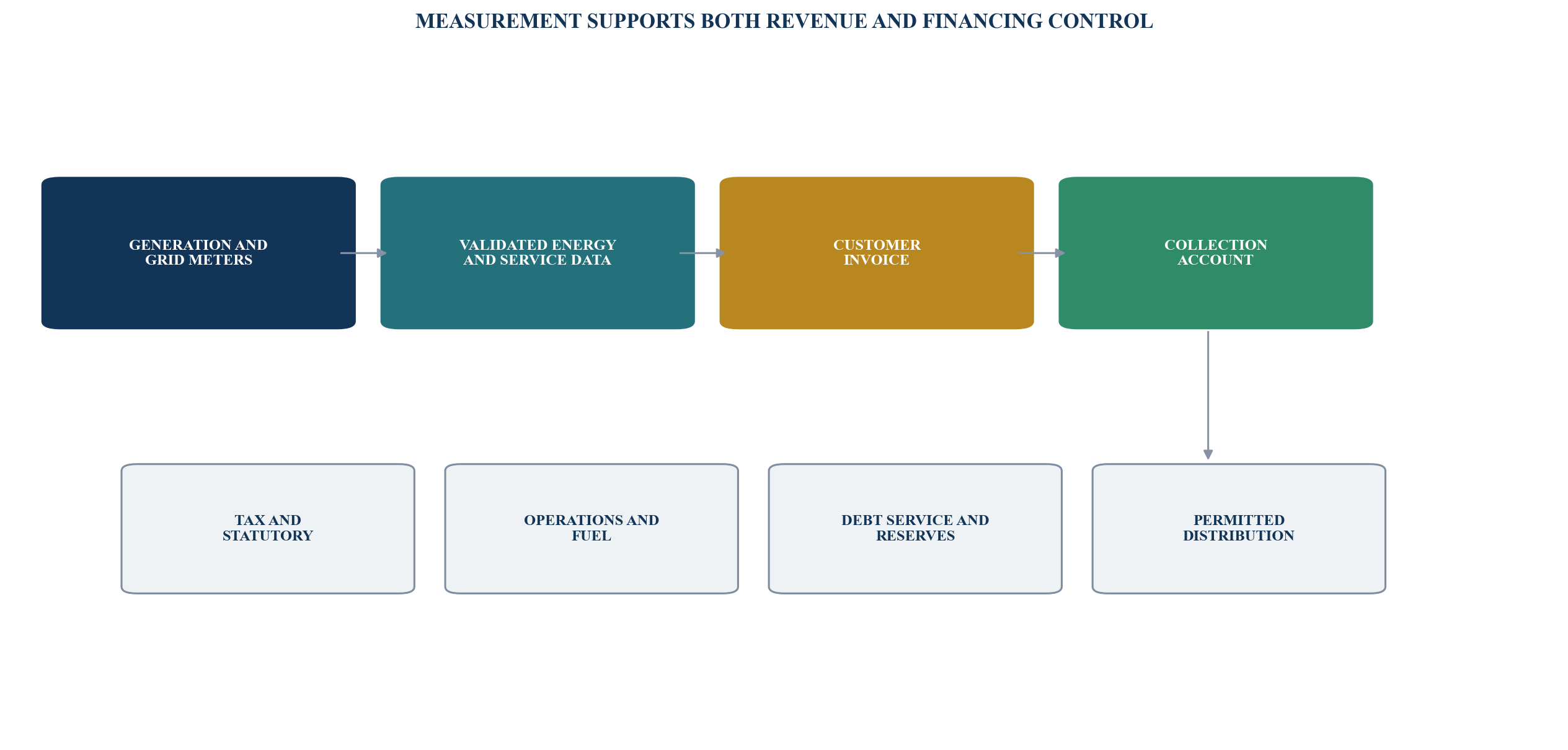
Bankability requires the physical energy record, customer service record and cash allocation to reconcile.
11. Align the customer contract with the power duty
The data-centre contract should disclose the service being sold and the dependencies that affect it. The customer needs a clear capacity definition, target and long-stop dates, acceptance, ramp, availability, maintenance, curtailment, metering, price, sustainability attributes, remedies, termination and transition plan.
The provider should avoid promising a grid-quality service while the underlying plant agreement permits frequent interruption. It should also avoid passing every plant risk to the customer. A financeable contract usually allocates controllable provider performance to the provider, customer-caused delay to the customer and defined third-party events through a bounded relief regime.
Customer credit matters. A long-term capacity commitment can support financing when the customer obligation is enforceable, sufficiently unconditional, appropriately secured and matched to the financed asset. Parent guarantees, deposits, letters of credit, reserve accounts and milestone payments may support the risk. Their value depends on issuer quality and executable terms.
The contract should address a delayed utility connection. The customer may continue on the temporary stack, accept a revised price, reduce load or exercise a termination right after a long-stop. The provider needs time and economic protection to extend fuel and operating arrangements. This scenario should be modelled before contract signature.
Carbon and renewable claims require consistency across the power, meter and customer documents. The contract should state which attributes transfer, how they are evidenced, who can claim them and what happens when the intended source is unavailable.
12. Match capital to the development gate
The capital structure should reflect when risk converts into evidence. Sponsor development capital can fund site studies, engineering, regulatory work and customer development. Equipment deposits may require sponsor equity, vendor support or bridge capital. Construction debt generally needs a mature permission path, fixed or bounded cost, credible contractor, fuel and connection evidence, customer support and a complete financial model.
The power asset can sit within the data-centre company, a dedicated project company or a third-party energy-service structure. Integration can simplify control. Separation can support specialist capital and risk allocation. The choice affects permits, land, security, tax, accounting, customer contracting, step-in and transition.
Financing sources may include sponsor equity, shareholder loans, vendor finance, bank construction facilities, equipment leases, infrastructure capital and project debt. Each source has a different view of residual value, technology, completion, customer credit and fuel exposure. A short bridge plant with limited reuse may support less long-duration debt than a permanent, transferable asset.
Debt sizing should use downside cash flow after operating cost, fuel, maintenance, tax, working capital and required reserves. A contracted capacity charge may support fixed obligations. It should not be treated as cash until acceptance, invoicing, collection and counterparty performance are understood.
Table 4. Capital release and evidence gates
| Gate | Capital need | Minimum evidence | Stop condition |
|---|---|---|---|
| feasibility | studies, site control and applications | customer case, load, site, authority map and budget | no credible activity pathway |
| design release | engineering and deposits | design basis, fuel route, connection concept and permit plan | unresolved fatal interface |
| financial close | construction and equipment | licences, contracts, model, equity, insurance and security package | incomplete condition precedent |
| commissioning | completion funding and working capital | test plan, operator, fuel, customer acceptance and reserves | unsafe or non-compliant plant |
| operations | debt service and maintenance reserve | accepted service, invoices, collections and reporting | unresolved material default |
| transition | grid works, relocation or retirement | approved transition design and contract changes | stranded or incompatible asset |
Funding terms remain subject to lender diligence, approval and executed documents.
13. Model the complete unit economics
The model should begin with customer service and end with distributable cash. Revenue follows accepted capacity, availability, energy, indexation, credits, ramp and customer collection. Costs include fuel, electricity, operations, maintenance, overhaul, emissions obligations, water, insurance, land, network, people, security, working capital and corporate support.
Capital cost includes generation, storage, solar, electrical works, fuel connection, grid interface, civil works, cooling interaction, controls, permits, development, financing fees, contingency and interest during construction. Decommissioning, relocation or repurposing should be included when the plant is temporary.
The model should keep data-centre and power economics separable. This shows whether the power stack creates value, transfers cost or hides a subsidy. It also allows the sponsor to compare owner-build, lease and service-provider structures on a consistent basis.
The worked case below assumes a 24 MW initial customer service, 30 MW gross plant, 92 per cent plant availability before redundancy and system effects, a 24-month bridge to grid, a management-estimated capital programme of USD 42 million, a capacity charge of USD 145 per kW-month and an energy charge based on a management-estimated delivered fuel cost. These inputs are illustrative management assumptions. They are not market benchmarks or project forecasts.
Table 5. Illustrative worked-case assumptions
| Input | Base assumption | Downside test | Evidence required in a live case |
|---|---|---|---|
| accepted customer load | 24 MW | 16 MW | executed customer schedule and test |
| gross dispatchable plant | 30 MW | 30 MW | guaranteed output at site conditions |
| bridge period | 24 months | 36 months | utility programme and contingency plan |
| plant availability | 92% | 86% | configuration, maintenance and fuel analysis |
| capital programme | USD 42m | USD 50m | priced scope, contingency and financing |
| capacity charge | USD 145/kW-month | USD 120/kW-month | executed customer agreement |
| energy charge | formula | higher fuel and lower efficiency | fuel contract, heat rate and meter formula |
| debt share | 55% | 40% | lender term sheet and model |
All figures are management assumptions for method demonstration only.
14. Stress the bridge period and operating stack
The most important downside may be a bridge that lasts longer than planned. A twelve-month grid delay can add fuel, maintenance, overhaul, emissions, working capital and customer-pricing exposure. It can also move the plant beyond an initial permit, lease, warranty or fuel term.
The downside model should test lower accepted load, slower ramp, lower availability, higher fuel price, lower efficiency, ambient derating, plant delay, grid delay, customer credit deterioration, higher capital cost and refinancing difficulty. Combined cases are more informative than isolated sensitivities because schedule, cost and customer performance can move together.
Liquidity should be measured through the lowest cash balance, reserve draw, equity cure and covenant headroom. A project can show positive lifetime value and fail during commissioning or a fuel-price shock. Working capital matters when fuel is paid before the customer invoice is collected.
Break-even analysis can show the accepted load, capacity charge, availability or bridge duration required to cover fixed obligations. The board should decide which variable it can control and which requires contractual protection.
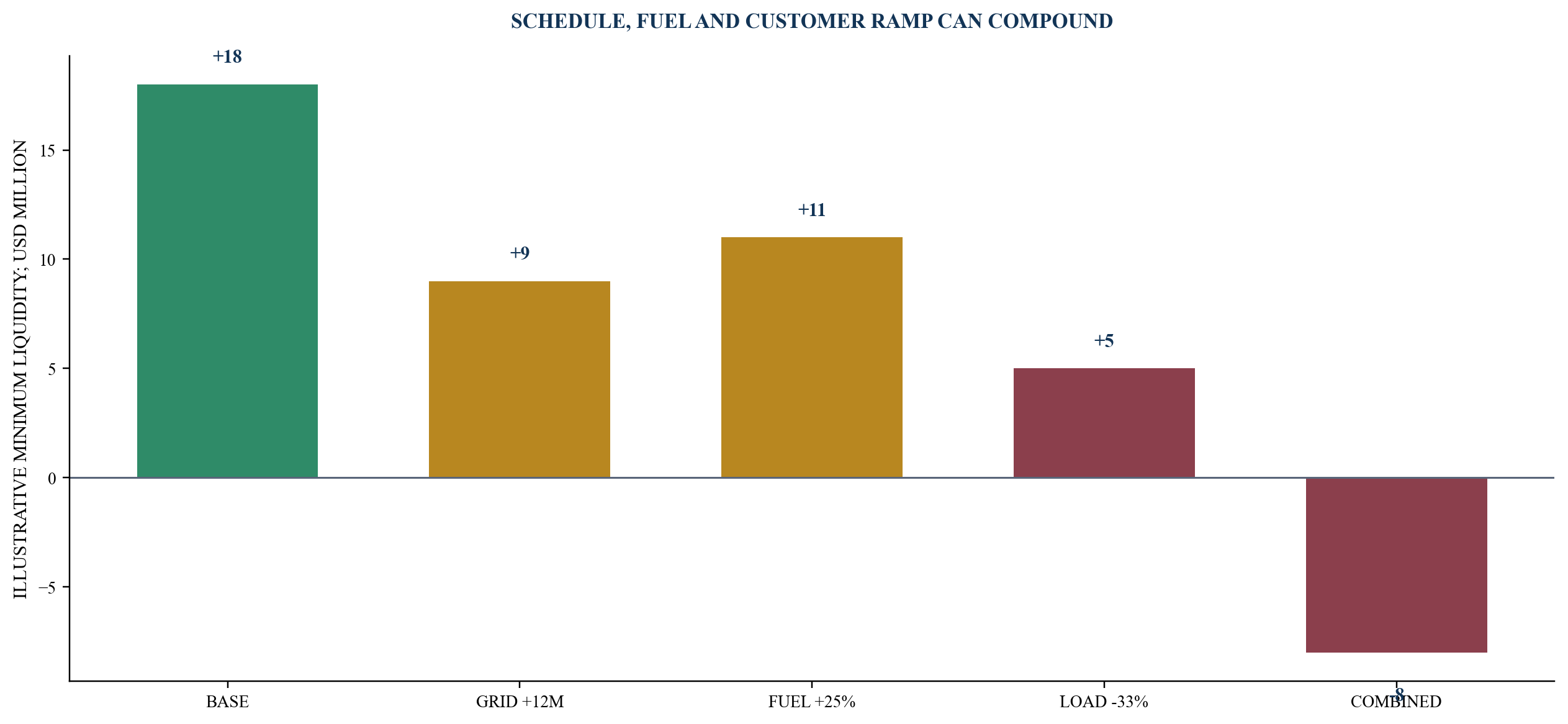
Values are management assumptions and show directional sensitivity rather than a forecast.
15. Plan the transition before the bridge begins
A temporary plant needs a destination. It may remain as resilience capacity, convert to peak support, relocate to another development, sell to a third party, enter a capacity or flexibility arrangement where permitted, or retire. The design and financing should preserve credible options without relying on an unconfirmed future market.
Grid transition requires electrical studies, protection changes, control modifications, new metering, tests, revised permits and contract amendments. Parallel operation can differ from island operation. Export may be prohibited or separately regulated. The plant cannot assume a grid-services revenue stream without an eligible programme and executed agreement.
The customer contract should state how price, carbon reporting, availability and maintenance change after grid connection. Fuel and operating contracts need termination or reduced-duty provisions. Financing documents should permit the transition and define security over relocated or sold equipment.
Residual value should be supported by equipment condition, remaining life, warranties, marketability, relocation cost and alternative use. Book value and purchase price are not evidence of recoverable value. The downside case can assign zero residual value and test whether the original service remains viable.
16. Make the financing data room decision-ready
The data room should allow an investor or lender to trace each material assumption to current evidence. The corporate folder covers ownership, governance, authority and financial statements. The land folder covers title or lease, access, easements and site conditions. Regulatory folders cover the activity map, applications, licences, permits, codes, correspondence and conditions.
Technical folders include the design basis, load model, single-line diagrams, studies, equipment specifications, warranties, interfaces, reliability analysis, construction programme, commissioning and operations. Commercial folders include the customer contract, fuel agreement, grid and connection documents, EPC and operating contracts, insurance and material supplier terms.
The financial folder contains the integrated model, assumptions register, sources and uses, funding plan, tax and accounting analysis, sensitivities and reconciliations. Every model input should identify source, date, owner, confidence and update requirement.
The issue log should identify gaps without hiding them in narrative. A missing connection agreement, incomplete fuel term, customer option or unpriced interface can be shown with owner, action, date and funding consequence. This creates an investable work plan.
Table 6. Financing evidence and red flags
| Diligence area | Decision evidence | Red flag | Required action |
|---|---|---|---|
| activity and permission | written pathway, applications, licence and conditions | reliance on a programme outside published scope | obtain authority confirmation |
| load and customer | accepted capacity schedule and credit support | demand forecast without binding obligation | contract the initial tranche |
| fuel and grid | executed capacity, quality and connection terms | informal availability indication | secure terms and contingency |
| engineering | integrated design and reliability analysis | nameplate comparison only | complete interface studies |
| construction | priced scope, schedule and performance regime | excluded integration risk | allocate and fund interface |
| operations | operator, maintenance and spares plan | availability unsupported by duty analysis | test operating model |
| economics | auditable meter, tariff and downside model | residual value or grid date used as certainty | evidence or remove assumption |
The relevance and materiality of each item depend on the live structure.
17. Govern the programme through integrated gates
The sponsor should create one steering committee across data centre, power, customer, finance, legal, regulatory, environmental and operations. Separate teams can optimise their own package while leaving a critical interface unresolved.
Each gate should state the decision, required evidence, open items, capital at risk and approval authority. The board can authorise feasibility, early engineering, long-lead deposits, full construction, commissioning and operations separately. A gate is useful when it can stop expenditure.
The integrated schedule should show third-party dependencies and float. Regulatory approval, grid studies, fuel connection, environmental permission, equipment delivery, data-centre commissioning and customer testing need a single critical path. Management should report movement in the service date and liquidity consequence, not only percentage completion.
Change control should cover customer load, technology, site, plant, fuel, connection, schedule and law. Each change receives a technical, regulatory, commercial, funding and contract assessment. An approved design change without customer or lender treatment remains incomplete.
18. Use a 180-day bankability office
The first thirty days establish the service boundary, load model, site constraints, jurisdictional activity map, utility status, fuel options, initial stack and decision register. Management should request written authority and network engagement during this period.
Days 31 to 60 develop the design basis, single-line concept, environmental screen, power-stack comparison, fuel strategy, customer term sheet, preliminary capital cost and critical path. The sponsor selects a preferred case and a credible fallback.
Days 61 to 90 advance applications, studies, land and fuel terms, customer capacity and acceptance schedules, EPC strategy, operating model, insurance review and integrated financial model. The investment case should show base, grid-delay, fuel, load and combined downsides.
Days 91 to 120 convert the preferred case into priced packages, draft contracts, technical schedules, permit submissions, lender materials and a controlled data room. Independent engineering and legal review test the interfaces.
Days 121 to 150 resolve material diligence, complete the financing plan, agree customer and supply documents, finalise commissioning and transition plans, and obtain internal investment approval. Capital release remains conditional on the named evidence.
Days 151 to 180 close documents, satisfy conditions, authorise only the approved work packages and establish monthly operating and financing reporting. The bankability office continues through acceptance because completion risk does not end at financial close.
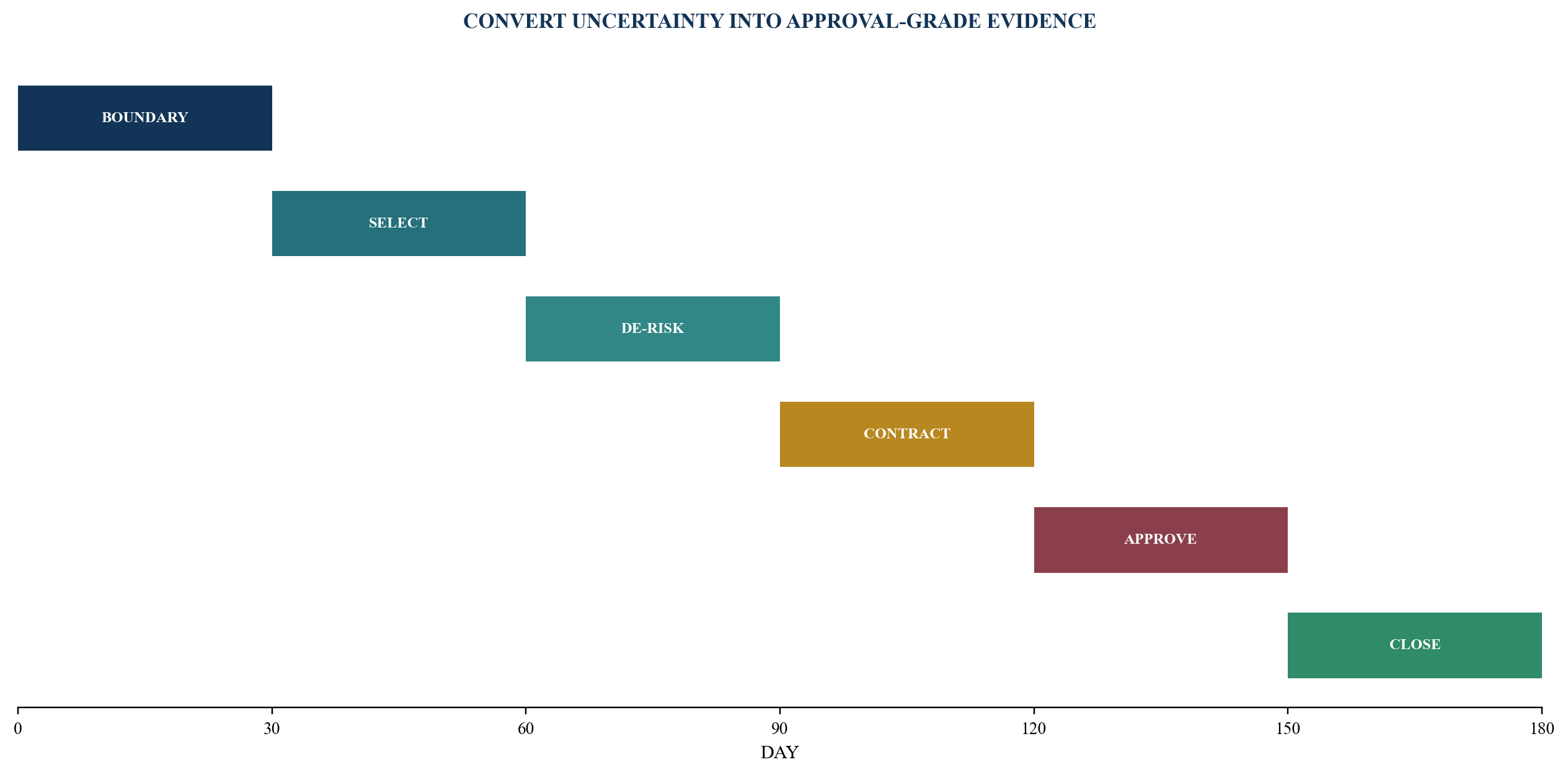
Each workstream ends in decision evidence rather than document volume.
19. Define advisory mandates around board decisions
A sponsor may require a power-strategy mandate to define the service date, load, jurisdictional pathway, stack, fallback and board gates. A development office can integrate utility, fuel, technical, environmental, customer and financing workstreams. A transaction mandate can structure the power company, capital stack, risk allocation, customer support and lender process.
The deliverable should remain decision-specific. A site and power options paper supports location and stack selection. A bankability diagnostic identifies conditions before procurement or financing. A 180-day office owns the issue register, model, data room, counterparties and approvals. A financing mandate prepares the investment case, conducts lender engagement and supports execution subject to applicable permissions and professional advice.
Fees and scope should follow the work, senior time, specialist requirements, transaction complexity and accountable outcomes. No advisory revenue should be recorded until an executed mandate exists, an invoice has been issued under its terms and collection is evidenced. Pipeline interest, meetings and proposals remain commercial indicators.
20. Make the board decision explicit
The board should approve a behind-the-meter strategy only when the customer service boundary, legal activity, site, load, power stack, fuel, connection, environment, engineering, construction, operations, meter, tariff, customer contract, financing and transition form one coherent case.
The approval should name the permitted capacity, technology, phase, budget, capital source, counterparties, conditions, downside headroom and stop rules. It should also state which assumptions remain dependent on authority, network, customer, fuel provider, contractor or lender action.
A credible project can still carry open items. Bankability comes from identifying each open item, allocating it, funding it and preventing premature capital release. The result is a power programme that supports an accepted data-centre service and a collection pathway rather than an isolated generating asset.
References
- International Energy Agency. Energy and AI. April 2025. https://www.iea.org/reports/energy-and-ai
- International Energy Agency. Electricity 2026: Analysis and forecast to 2030. April 2026. https://www.iea.org/reports/electricity-2026
- Abu Dhabi Department of Energy. Instant Licence. Accessed August 2026. https://www.doe.gov.ae/E-Services/Instant-Licence
- Abu Dhabi Department of Energy. Issue New Electricity Generation Self-Supply Licence. Accessed August 2026. https://www.doe.gov.ae/en/Services/Issue-New-Electricity-Generation-Self-Supply-Licence
- Abu Dhabi Department of Energy. Electricity Generation Licensing Guide for Self-Supply Purposes. Effective 1 January 2023. https://www.doe.gov.ae/-/media/Project/DOE/Department-Of-Energy/Media-Center-Publications/Guidance-document/Electricity-Generation-Licensing-Guide-for-self-supply-purposes.pdf
- Abu Dhabi Department of Energy. DoE Energy Services. Accessed August 2026. https://www.doe.gov.ae/en/E-Services/DoE-Energy-Services
- Dubai Electricity and Water Authority. D33 Solar PV Initiative. Accessed August 2026. https://www.dewa.gov.ae/en/consumer/solar-community/d33-solar-pv-initiative
- Dubai Electricity and Water Authority. Standards for Distributed Renewable Resources Generators Connected to the Distribution Network, Version 3.0. December 2023. https://www.dewa.gov.ae/en/consumer/solar-community/publications-resources
- Dubai Electricity and Water Authority. Connection Guidelines for Distributed Renewable Resources Generators Connected to the Distribution Network, Version 2.1. October 2020. https://www.dewa.gov.ae/en/consumer/solar-community/publications-resources
- Saudi Electricity Regulatory Authority. Regulatory Framework for Renewable Energy Generation for Self-Consumption, Version 2. June 2023. https://sera.gov.sa/-/media/707a90db48fb470d8a2073d18002939f.ashx
- Saudi Electricity Regulatory Authority. Amendments to the Regulatory Framework for Self-Consumption of Renewable Energy. 21 July 2023. https://sera.gov.sa/en/media%20center/news/newsitem43
- International Finance Corporation. Environmental, Health, and Safety Guidelines: Power. Accessed August 2026. https://www.ifc.org/en/insights-reports/general-environmental-health-and-safety-guidelines/ehs-guidelines-power
- International Finance Corporation. Environmental, Health, and Safety Guidelines for Thermal Power Plants. 19 December 2008. https://www.ifc.org/content/dam/ifc/doc/2000/2007-thermal-power-ehs-guidelines-en.pdf
- Abu Dhabi Department of Energy. Self-Supply Generation Licence ED/L08/003. 21 May 2020. https://www.doe.gov.ae/-/media/Project/DOE/Department-Of-Energy/Media-Center-Publications/ED-L08-003-Self-Supply----Generation-Licence-final-A-ABU-Dhabi.pdf
About the Author
Chennakeshav Adya, Independent Researcher
This paper provides a decision framework for boards, sponsors, data-centre developers, infrastructure investors and financing teams evaluating behind-the-meter power. It is general research and does not provide engineering, legal, regulatory, tax, accounting, environmental, insurance, investment or financing advice.
