Introduction
The Gulf buy-side combines two demanding tasks. The first is to find a business that fits a defined investment thesis, can be acquired at an acceptable risk-adjusted price and has a credible ownership path. The second is to establish that the business described by the seller is the same legal, licensed, tax-compliant and operational enterprise that the buyer would own after completion. A target can appear commercially attractive while its licences, beneficial-ownership records, workforce permissions, end-of-service accruals, tax filings, government dues, premises approvals or change-of-control consents remain incomplete or inconsistent.
This paper develops an evidence-led framework for sourcing and diligencing Gulf targets. It covers six GCC states at a principles level, with deeper operational treatment of the UAE and Saudi Arabia. Rules differ between states, free zones, financial centres, licensed activities, legal forms, employee populations and transaction structures. Current legal, tax, competition, employment, immigration, licensing and regulatory advice is required for every live transaction.
The framework has seven control principles:
- define the investible perimeter before counting targets;
- preserve provenance for each name, claim and document;
- verify legal entity, ownership, authority, activity and site as a connected graph;
- reconcile financial, tax, workforce and government records at entity and period level;
- convert each exception into an exposure, owner, remedy and decision date;
- keep warranties, indemnities, conditions, price and operating remediation connected to verified facts; and
- give the investment committee a traceable record of what is verified, unresolved, assumed and excluded.
The analysis reviews 52 official, primary, academic and scoped professional sources available through 2 August 2026 [1-52]. UAE sources include the commercial-companies, commercial-register, beneficial-ownership, labour, tax, bankruptcy, competition, anti-money-laundering and data-protection frameworks [1-24]. Saudi sources cover commercial registration, companies, investment, competition and employment [25-30]. Bahrain, Oman, Qatar and Kuwait sources extend the registry, ownership and workforce comparison [31-40]. FATF, OECD, academic and financial-centre materials inform ownership verification, responsible-business due diligence, target selection, transaction diligence and contractual protection [41-52].
No approved observed Matchpoint or client evidence was supplied for revenue, cash cost reduction, loss reduction or alpha. Those attributed values remain USD 0. Illustrative examples and Illustrative example figures are method demonstrations. They do not represent completed mandates, client outcomes, forecasts or universal benchmarks.
| Capital chases too few investible Gulf targets | No authoritative universal ratio identified | Build a mandate-specific denominator and record each exclusion |
| Generic diligence lists can miss local issues | Supported as a process risk; the exact gap is transaction-specific | Use authority, licence, workforce and government-dues workstreams |
| Trade licences can affect operating continuity | Supported by official registry and licensing regimes [1-5,25-40] | Verify entity, activity, site, validity, conditions and change path |
| Visa liabilities exist as one universal category | Unsupported as a universal legal category | Test employer-linked work and residence records, fees and continuity separately |
| Warranties resolve incomplete verification | Unsupported | Link evidence gaps to price, conditions, specific indemnities and legal drafting |
| Research proposition | Evidence position | |
|---|---|---|
| Capital chases too few investible Gulf targets | No authoritative universal ratio identified | Build a mandate-specific denominator and record each exclusion |
| Generic diligence lists can miss local issues | Supported as a process risk; the exact gap is transaction-specific | Use authority, licence, workforce and government-dues workstreams |
| Trade licences can affect operating continuity | Supported by official registry and licensing regimes [1-5,25-40] | Verify entity, activity, site, validity, conditions and change path |
| Visa liabilities exist as one universal category | Unsupported as a universal legal category | Test employer-linked work and residence records, fees and continuity separately |
| Warranties resolve incomplete verification | Unsupported | Link evidence gaps to price, conditions, specific indemnities and legal drafting |
Buyer And Target Perimeter
decision requirement
An allocator or institutional buyer needs a decision process that can survive internal review, external audit, regulatory inquiry and future portfolio governance. The target thesis should identify geography, sector, legal forms, revenue and earnings ranges, ownership situations, transaction size, control requirement, leverage limits, excluded activities and minimum evidence. A name becomes an investible candidate only after it passes the stated perimeter. The process should therefore distinguish a sourced name, a potentially relevant company, an engaged seller, a diligence candidate and an approved transaction.
Institutional governance also requires a record of conflicts, source compensation, confidentiality, personal data, sanctions and anti-money-laundering analysis. The source of a lead may be an adviser, operating partner, founder, lender, trade network, database, regulator register or portfolio relationship. Each source has different incentives and information quality. A referral should be recorded with the date, referring party, permission basis, known conflicts and any compensation arrangement.
owner and target requirement
A owner may evaluate a sale, partial liquidity, succession, partnership or growth-capital transaction. The target's investibility depends on more than historic performance. Buyers need lawful and transferable ownership, current licences, reliable reporting, documented related-party arrangements, a workforce continuity plan, supportable tax and government records, transferable contracts and credible management depth.
The owner should have one legal and economic perimeter. It should identify entities, branches, assets, liabilities, employees, sites, licences, customers, suppliers, debt, guarantees, intellectual property and excluded items. An attractive trading brand can sit across several entities. Revenue can be booked in one entity while staff, licence, premises or IP sit elsewhere. That structure requires a reconciliation before valuation.
Transaction structure boundary
A share acquisition, asset acquisition, merger, business transfer and minority investment create different continuity and liability questions. A share purchase usually leaves the target entity in place while ownership changes. An asset purchase selects assets and assumed liabilities but can require transfers, assignments, new licences and workforce actions. Legal counsel should determine the structure and applicable continuity rules before the diligence team assumes that an asset schedule or share register answers the same question.
| Perimeter field | Required record | Buy-side question | Typical consequence of a gap |
|---|---|---|---|
| Entity | current official extract and constitutional documents | Which legal person is being acquired? | wrong perimeter or invalid authority |
| Ownership | legal and beneficial ownership chain | Who can sell and who controls? | consent, AML or title risk |
| Activity | licence and permitted-activity schedule | Can the entity lawfully conduct reported operations? | remediation, condition or exclusion |
| Site | lease, title and site approvals | Can operations continue at the location? | landlord, municipality or sector action |
| Workforce | employee-to-entity and permission record | Who employs and sponsors each worker? | continuity, entitlement or fee exposure |
| Financial | entity-period trial-balance reconciliation | Which earnings and cash belong to the perimeter? | valuation adjustment |
Sourcing The Investible Universe
Thesis-led origination
Origination begins with a written thesis, not a list of company names. The thesis states the customer problem, industry boundaries, business model, geographic relevance, ownership situation, size, return logic, value-creation capabilities and disqualifiers. Each field should have an operational test. A preference for recurring revenue, for example, requires a definition that addresses contract term, cancellation rights, usage variability, collection history and customer concentration.
Academic and practitioner literature distinguishes strategic and financial buyers and examines how target characteristics, familiarity and screening shape acquisition choices [44-46]. These studies come from defined samples and institutional settings. They inform questions rather than Gulf benchmarks. A buyer should record its own screening experience and later compare accepted and rejected opportunities against portfolio outcomes.
Source channels and provenance
A complete source map can include proprietary relationships, sector executives, family-business networks, lenders, accountants, lawyers, trade associations, regulators' public registers, conference participants, databases and advisers. The buyer should allocate each channel an owner, coverage hypothesis, contact standard, confidentiality rule, conflict test and outcome measure.
Every sourced target receives a stable identifier. The identifier follows the company through de-duplication, outreach, screening, diligence, rejection and monitoring. Aliases, former names, trade names and legal names should be preserved. The source record should also capture country, legal form, registry number where lawfully available, website, owner indication, source date and confidence status.
Investibility screen
The first screen should be short enough to use consistently and strict enough to prevent weak names from consuming diligence capacity. A suggested screen covers thesis fit, legal existence, operating evidence, ownership approachability, size, earnings quality indicators, management, customer concentration, regulatory intensity, transaction feasibility and exclusion criteria.
| Screen | Evidence before engagement | Status values |
|---|---|---|
| legal existence | official or official-linked registry evidence | verified, stale, unavailable, conflict |
| activity fit | company materials plus licence evidence when available | in scope, adjacent, out of scope |
| scale | source and period attached to each metric | verified, management-estimated, unverified |
| ownership | named legal owner or documented open question | verified, partial, unverified |
| approachability | lawful contact route and conflict check | ready, restricted, hold |
| disqualifiers | sanctions, prohibited activity, mandate exclusions | clear, review, exclude |
Market denominator
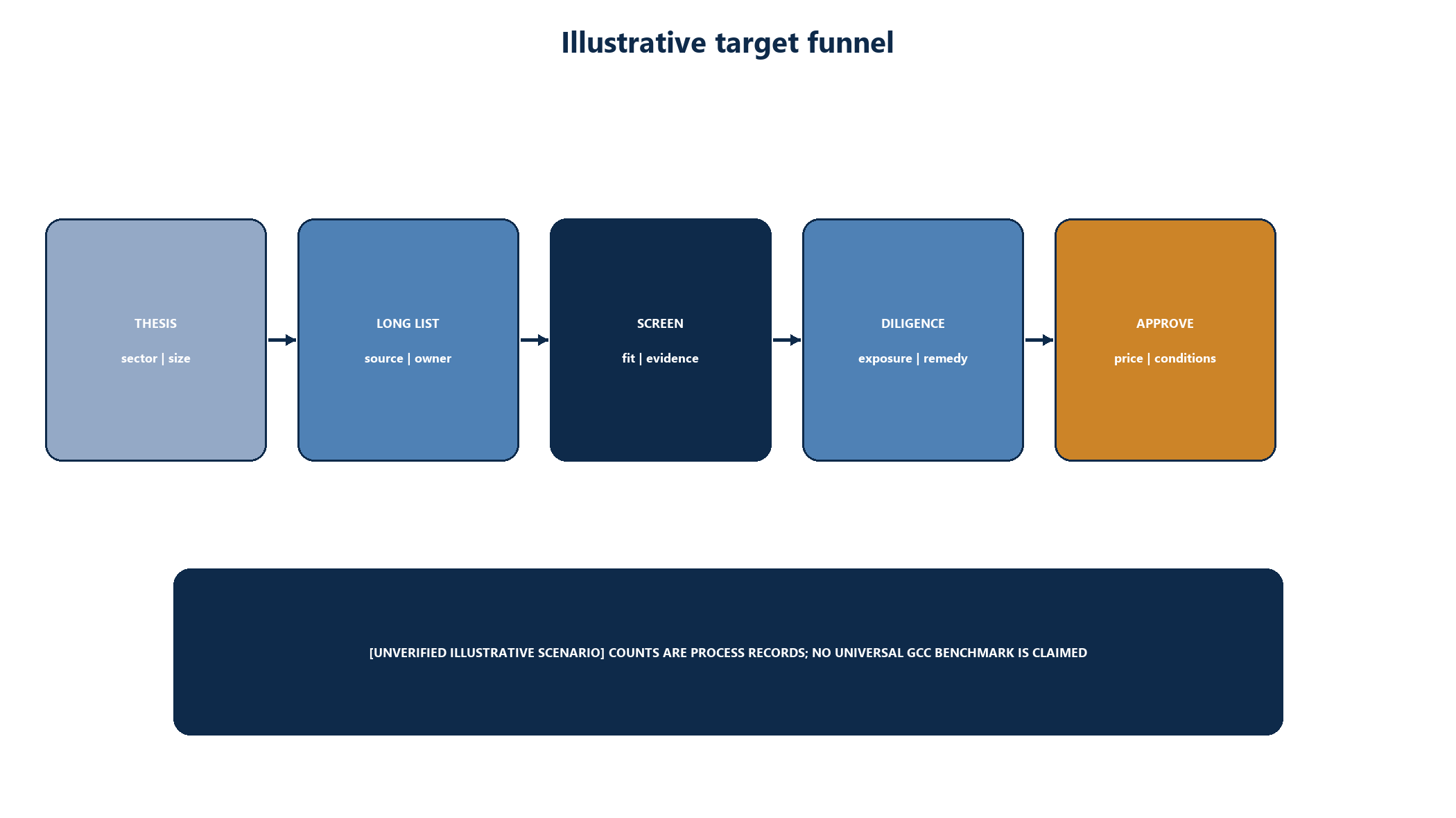
Claims about a shortage of investible targets require a denominator. The buyer should record the total names considered, duplicates, entities outside geography, companies outside sector, size failures, ownership failures, unavailable sellers, legal or regulatory exclusions, insufficient evidence and active candidates. This process produces a mandate-specific funnel. It does not establish a market-wide scarcity ratio.
The funnel should be analysed by source channel and exclusion reason. A low conversion rate can indicate a narrow market. It can also indicate an over-broad source universe, poor definitions, stale data or weak outreach. The decision record should preserve those explanations.
Target Funnel And Decision Gates
Gate design
Each gate should answer one decision question. Gate zero tests whether a sourced name belongs in the investible universe. Gate one tests whether the ownership situation and scale warrant contact. Gate two tests whether preliminary evidence and seller intent warrant management time. Gate three tests whether an indicative value range and material risks support diligence. Gate four tests whether verified findings and contractual protection support final approval.
The gate record should contain the decision, date, decision-maker, evidence set, exceptions, required next actions and expiry. A target can be returned to monitoring when timing changes. Its previous evidence should retain dates and source status.
Funnel metrics
Useful measures include unique sourced names, verified legal entities, contacted owners, substantive responses, initial meetings, information packs received, indicative proposals, letters of intent, full diligence launches, signed transactions and completed transactions. Time-to-gate and cost-to-gate add operational value.
Conversion rates require clear denominators. A response rate can use delivered outreach or attempted outreach. A diligence conversion can use engaged targets or proposals. The metric dictionary should state the rule. No public source reviewed for established one authoritative GCC target-funnel benchmark [41-47].
Rejection discipline
A rejection should state a principal reason and any secondary reasons. The principal reason supports later portfolio and origination analysis. Examples include thesis mismatch, scale, valuation, ownership timing, legal perimeter, licence continuity, financial quality, workforce exposure, customer dependency, regulatory path, management capacity and integrity concerns.
Sensitive allegations require careful source handling and legal review. The register should distinguish a verified official record, credible reported information, management representation and unverified lead. Access should be restricted to those with a legitimate decision purpose.
Funnel data quality
Duplicate companies can appear under brands, branches, local-language names, historical names or different registry extracts. De-duplication should use legal name, registry number, website domain, address, owners and phone numbers where lawfully processed. Automated matching can support review. A human approver should decide uncertain merges.
Deal-Readiness Scorecard
Purpose
The scorecard turns a broad diligence list into a prioritised decision tool. It should score evidence completeness, current compliance, transferability and consequence. A high commercial score cannot offset missing legal title. A current licence can still have change-of-control conditions. The scorecard therefore retains hard gates as well as weighted dimensions.
Four dimensions
Authority covers entity existence, legal ownership, beneficial ownership, constitutional authority, seller title and required approvals. Operating readiness covers licences, permitted activities, premises, sector permits, key contracts, assets and management. Financial readiness covers quality of earnings, cash, debt, tax, government dues, working capital and related parties. Transfer readiness covers consents, employee continuity, financing, regulatory approval, conditions, warranties and day-one actions.
| Dimension | Suggested evidence test | Hard-gate example |
|---|---|---|
| authority | official extract, registers and resolutions reconcile | seller cannot establish title |
| operating | every material activity maps to current licence and site | core activity appears outside permitted scope |
| financial | ledgers reconcile to filings, bank and operating evidence | unsupported material earnings |
| transfer | required approvals and consents have owners and timing | unachievable regulatory or counterparty condition |
Evidence status
Each item should use standard statuses: verified; verified with exception; management-provided; third-party-provided; pending authority confirmation; unverified; not applicable. The evidence field should record the document or system, issuer, period, retrieval date, reviewer and limitation.
The scorecard should avoid false precision. A percentage can be useful for workflow completeness. It should not be presented as the probability that a deal will close or create value without a validated model. Red flags and decision rights should remain visible beside any score.
Consequence logic
Each exception should connect to one or more consequences: valuation; cash or debt adjustment; working-capital target; condition precedent; covenant; specific indemnity; warranty disclosure; retention; escrow; insurance consideration; pre-closing remediation; post-closing action; or rejection. Legal counsel determines the enforceability and drafting of transaction protection [47-49].
Entity, Ownership And Authority
Legal existence and register evidence
The UAE Commercial Register law provides for a register covering traders and commercial activities and applies to free-zone entities within its stated scope [2]. Its executive regulations provide procedural detail [3]. The Companies Law governs company forms and corporate matters [1]. Current official extracts should be obtained for every entity and branch in the proposed perimeter.
Saudi Arabia's new Commercial Register Law introduced one nationwide commercial registration and annual electronic confirmation, with statutory consequences for delayed confirmation described by the Ministry of Commerce [25]. Saudi Companies Law and the updated Investment Law govern entity and investment matters within their scope [26,27]. Bahrain, Qatar and Kuwait also maintain official commercial-register frameworks and services [31,37-39]. Oman Ministry of Labour services demonstrate direct linkage between work-permit processing and commercial-register data [34].
Ownership graph
The ownership graph should trace issued interests from the target to natural-person beneficial owners or other verified control points. It should reconcile constitutional documents, shareholder registers, transfers, pledges, nominee arrangements, trust or foundation records, beneficial-ownership filings and seller disclosures.
UAE Cabinet Resolution No. 109 of 2023 establishes beneficial-owner procedures, and Cabinet Resolution No. 132 of 2023 addresses administrative penalties [4,5]. FATF guidance supports a multi-pronged approach using more than one source of beneficial-ownership information [41]. ADGM requires applicable entities to keep accurate beneficial-ownership records and report changes, with a 2026 circular emphasising active verification rather than passive reliance on stale third-party information [50].
Authority to transact
The diligence team should identify who can approve the transaction, sign documents, waive rights and deliver title. Constitutional reserved matters, board and shareholder approvals, powers of attorney, pre-emption, tag, drag, pledge, financing and family-governance arrangements can affect authority. The team should also inspect signatory authority for material contracts and bank accounts.
Red-flag tests
| Test | Evidence | Possible consequence |
|---|---|---|
| issued interests reconcile | register, certificates and constitutional records | title remediation or exclusion |
| legal and beneficial owners reconcile | filings, source documents and KYC | AML review, condition or rejection |
| transfers are recorded | transfer instruments and registry | ownership uncertainty |
| pledges and security are identified | registers, finance documents and searches | release condition and debt treatment |
| seller authority is current | resolutions and powers | invalid signing risk |
Trade Licences, Activities And Premises
Licence matrix
A commercial registration identifies the legal trader. It does not necessarily establish every operating permission. The buyer should create a licence matrix linking each entity and site to activity, issuing authority, licence number, permitted location, issue and expiry dates, conditions, managers, renewals, fees, inspections, sanctions and transaction actions.
The reported business model should be mapped to the wording of permitted activities. Revenue lines, invoices, websites, proposals, customer contracts and staff roles can reveal activities that require review. The diligence conclusion should be made by qualified local counsel or the relevant authority when scope is uncertain.
Free zones and financial centres
Free-zone and financial-centre entities can have separate company, licensing, employment, data-protection and regulatory rules. ADGM's 2026 commercial-legislation changes and beneficial-ownership materials illustrate an evolving framework [50]. DFSA guidance states that financial services conducted in or from the DIFC require authorisation and provides public-register and regulatory-due-diligence links [52]. A licence from one authority should not be assumed to cover an activity, location or client base governed by another.
Premises and municipality evidence
The licence matrix should connect each activity to the lease, title, landlord approval, municipality record, fit-out, civil-defence, environmental, health, food, education, transport or other sector permissions as applicable. The buyer should examine expiry dates and changes required by a share sale, asset transfer, new manager or ownership change.
Government fees
Licence, establishment, permit, renewal, inspection, municipality and sector fees can sit outside the general ledger or be paid by related parties. The buyer should obtain authority receipts and portal evidence where lawfully accessible. An absence of ledger accrual does not establish an absence of dues.
| Screen | Evidence before engagement | Status values |
|---|---|---|
| legal existence | official or official-linked registry evidence | verified, stale, unavailable, conflict |
| activity fit | company materials plus licence evidence when available | in scope, adjacent, out of scope |
| scale | source and period attached to each metric | verified, management-estimated, unverified |
| ownership | named legal owner or documented open question | verified, partial, unverified |
| approachability | lawful contact route and conflict check | ready, restricted, hold |
| disqualifiers | sanctions, prohibited activity, mandate exclusions | clear, review, exclude |
Financial Quality And Cash
Entity-period evidence spine
Quality-of-earnings work begins with the legal perimeter. Trial balances should reconcile by entity and period to financial statements, tax filings, bank statements, sales systems, payroll, inventory and key contracts. Consolidation entries, intercompany balances, owner transactions and branches require separate treatment.
Management accounts can support analysis when their status is clearly labelled. The buyer should preserve whether a number is audited, reviewed, filed, management-prepared, third-party-provided or unverified. Period definitions and currency translations should remain explicit.
Revenue
Revenue testing should link samples or populations to contracts, orders, delivery, invoices, acceptance, credit notes, collections and tax records. Concentration analysis requires consistent customer identifiers. Related-party revenue, pass-through amounts, agency relationships and gross-versus-net presentation require accounting and legal analysis.
Earnings and normalisation
Normalisation should identify non-recurring items, owner compensation, related-party arrangements, one-off gains, capitalised costs, unusual provisions, government support and costs required under institutional ownership. Each adjustment needs a source, period, rationale and approval. An adjustment should not be counted twice in earnings, working capital, debt-like items or capital expenditure.
Cash, debt and working capital
Bank accounts should reconcile to the ledger and confirmed control structure. Debt analysis should include loans, overdrafts, guarantees, letters of credit, shareholder balances, leases, factoring, supplier finance and other obligations. Working-capital analysis should reflect seasonality, payment practices, ageing quality, tax balances and government receivables or payables.
| Area | Verification | Decision output |
|---|---|---|
| revenue | contract-to-cash and tax reconciliation | recurring and collectible revenue base |
| margin | product, customer and site bridge | supportable earnings and concentration |
| cash | bank-to-ledger reconciliation | available and restricted cash |
| debt | facility, security and balance schedule | debt-like and release requirements |
| working capital | monthly history and ageing | normal target and adjustment mechanics |
Tax And Government Dues
Registration and filing map
The tax workstream should identify every entity's corporate-tax, VAT, withholding, customs, excise, payroll, municipal and other registrations that apply. It should reconcile registration dates, periods, returns, assessments, payments, refunds, audits, correspondence, elections and deregistrations.
The UAE Tax Procedures Law governs tax administration [11]. The Federal Tax Authority publishes a Corporate Tax General Guide and Transfer Pricing Guide [12,13]. The buyer should use current authority guidance and transaction-specific tax advice. Corporate-tax, VAT and transfer-pricing analysis depends on entity, period, transactions, related parties, elections and applicable law.
Sale and deregistration evidence
FTA service materials recognise transaction-related events in VAT and corporate-tax deregistration workflows. The VAT deregistration service requests sale documentation in relevant cases and sets a final-return timing rule from effective deregistration [14]. The corporate-tax deregistration service addresses sale or merger scenarios [15]. These services show that a transaction can intersect with authority records. They do not establish the correct treatment of a live transaction without tax advice.
Penalties and open positions
UAE Cabinet Decision No. 75 of 2023 addresses administrative penalties relating to corporate tax [16]. The buyer should reconcile authority statements and portal records to the ledger. Open tax positions should identify principal, penalty, interest where applicable, period, legal basis, adviser view, management representation and proposed protection.
Government-dues waterfall
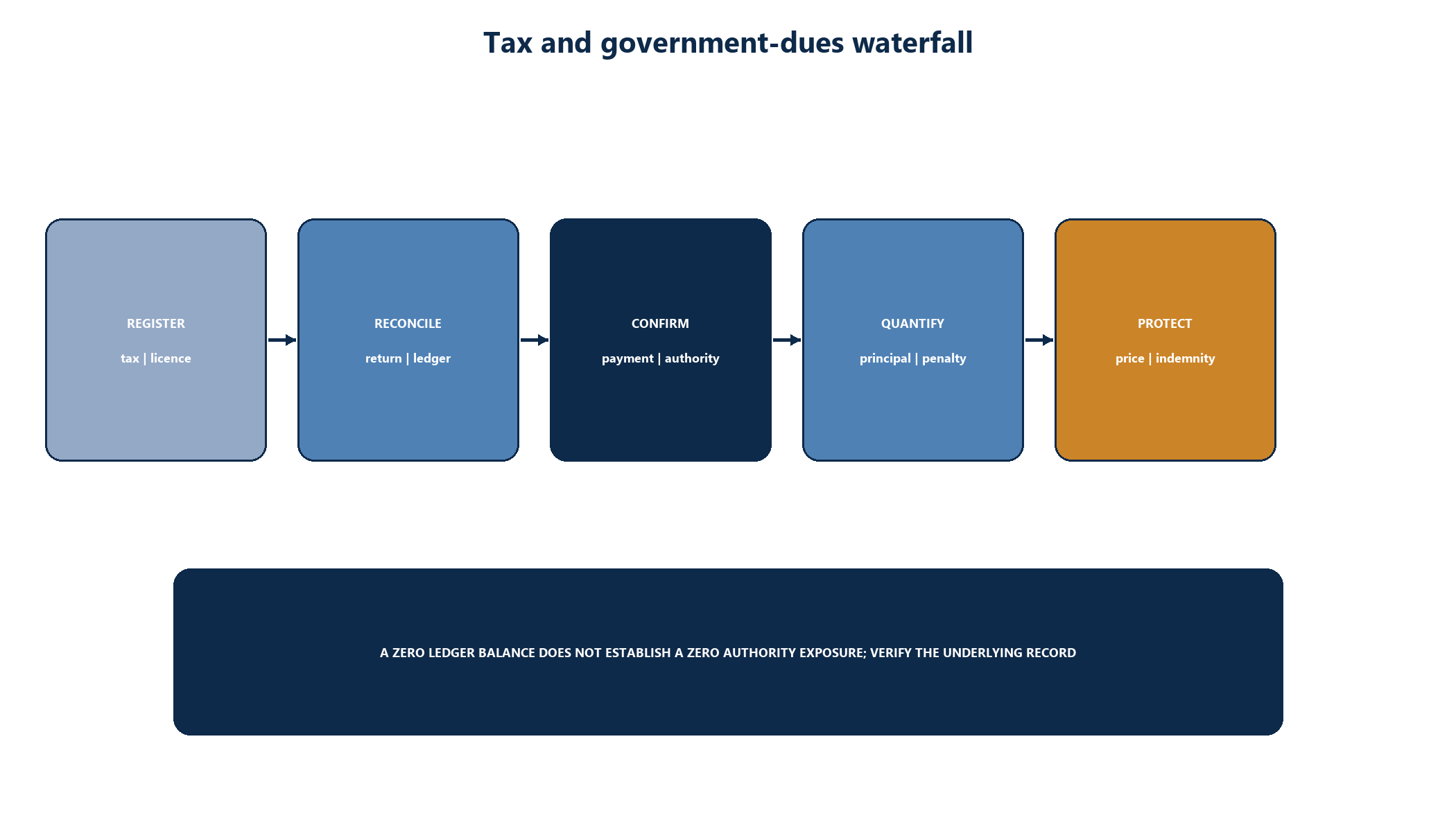
Government dues can include licence, permit, immigration, municipality, customs, sector, labour, tax and court amounts. The diligence process should:
- identify all applicable registrations and authorities;
- reconcile returns, renewals and permits to the ledger;
- obtain payment receipts, portal extracts or authority confirmation where available;
- quantify open principal and penalties;
- identify responsibility and timing; and
- connect the result to price, condition, indemnity or remediation.
Workforce, Permits And End-Of-Service
Employee-to-entity map
The workforce register should map every person to employer entity, work location, role, contract type, start date, wage components, leave, benefits, immigration or work-permit position, pension or social-insurance status and termination or transfer plan. The register must be processed under applicable data-protection rules [24]. Access should be limited and proportionate.
UAE employment entitlements
UAE Federal Decree-Law No. 33 of 2021 and its executive regulations govern private-sector employment within their scope [6,7]. MOHRE guidance states a gratuity formula of 21 days of basic wage for each of the first five years and 30 days for each subsequent year, subject to stated conditions and a cap [8]. The buyer should calculate employee-by-employee exposure using current law, contract, basic wage, service, payments and any applicable alternative scheme.
MOHRE's transfer-work-permit service requires a target establishment with a valid licence and no suspending violations and sets procedural requirements including a signed official job offer and timing after cancellation [9]. The voluntary alternative end-of-service-benefits scheme operates under its own rules [10]. These sources show why workforce continuity links to entity and licence status.
Saudi and other GCC positions
Saudi HRSD materials state an end-of-service formula and address labour rights in ownership-transfer contexts [29,30]. Qatar's official labour-law text states that employment does not end solely because an establishment is merged or ownership or management is transferred and provides for successor responsibility in the stated circumstances [36]. Bahrain labour legislation defines the wage basis for specified employee rights, while Bahrain trade legislation contains business-transfer liability provisions within its scope [32,33]. Kuwait maintains an official private-sector labour-law text covering terminal service indemnity [40].
These rules differ. The buyer should avoid applying one state's formula or continuity rule to another state. Free-zone and financial-centre regimes require separate analysis. ADGM's Employment Regulations 2024 took effect on 1 April 2025 and include work-permit and visa requirements within that regime [51].
Employer-linked permissions
The phrase visa liability should be decomposed into employer sponsorship, work permit, residence status, establishment record, fines, deposits, medical or insurance requirements, cancellation, transfer, dependants and day-one continuity. The correct categories depend on the jurisdiction and worker. Qualified employment and immigration advisers should confirm the action plan.
Reconciliation
Payroll, contracts, bank payments, wage-protection records, leave, gratuity accruals, permits, pension or social-insurance records and the general ledger should reconcile. Differences should be quantified employee by employee.
![Figure 5. Licence and ownership verification graphSource: Matchpoint framework; commercial-register and beneficial-ownership authorities [1-5,19-35,38-40].](../assets/images/insights/body/P122/P122-figure-02.png)
Commercial Contracts And Customers
Contract population
The buyer should establish the complete population before selecting material contracts. Sources can include contract repositories, customer and supplier ledgers, purchase orders, invoices, legal registers, email systems and management interviews. The population should record parties, entity, term, renewal, termination, exclusivity, assignment, change of control, pricing, rebates, service levels, liabilities, governing law and disputes.
Customer quality
Revenue concentration should be tested by legal customer, economic group, channel and beneficial relationship where information is lawfully available. A reseller can conceal end-customer concentration. Related parties and owner relationships should be separated. Contracted revenue should be distinguished from historical purchasing patterns and non-binding forecasts.
Supplier and dependency risk
Supplier diligence should cover single-source items, related parties, volume commitments, import rights, distributor or agency relationships, price resets, credit terms, sanctions, continuity and alternate supply. Key-person or owner relationships should be documented as such.
Consents and closing plan
Change-of-control and assignment provisions should be mapped to the proposed structure. Required consents need an owner, request strategy, confidentiality treatment, legal consequence and condition date. The buyer should not assume that a share acquisition avoids every contractual consent or that an asset purchase transfers a relationship automatically.
Competition, Aml And Regulatory Approval
UAE economic concentration
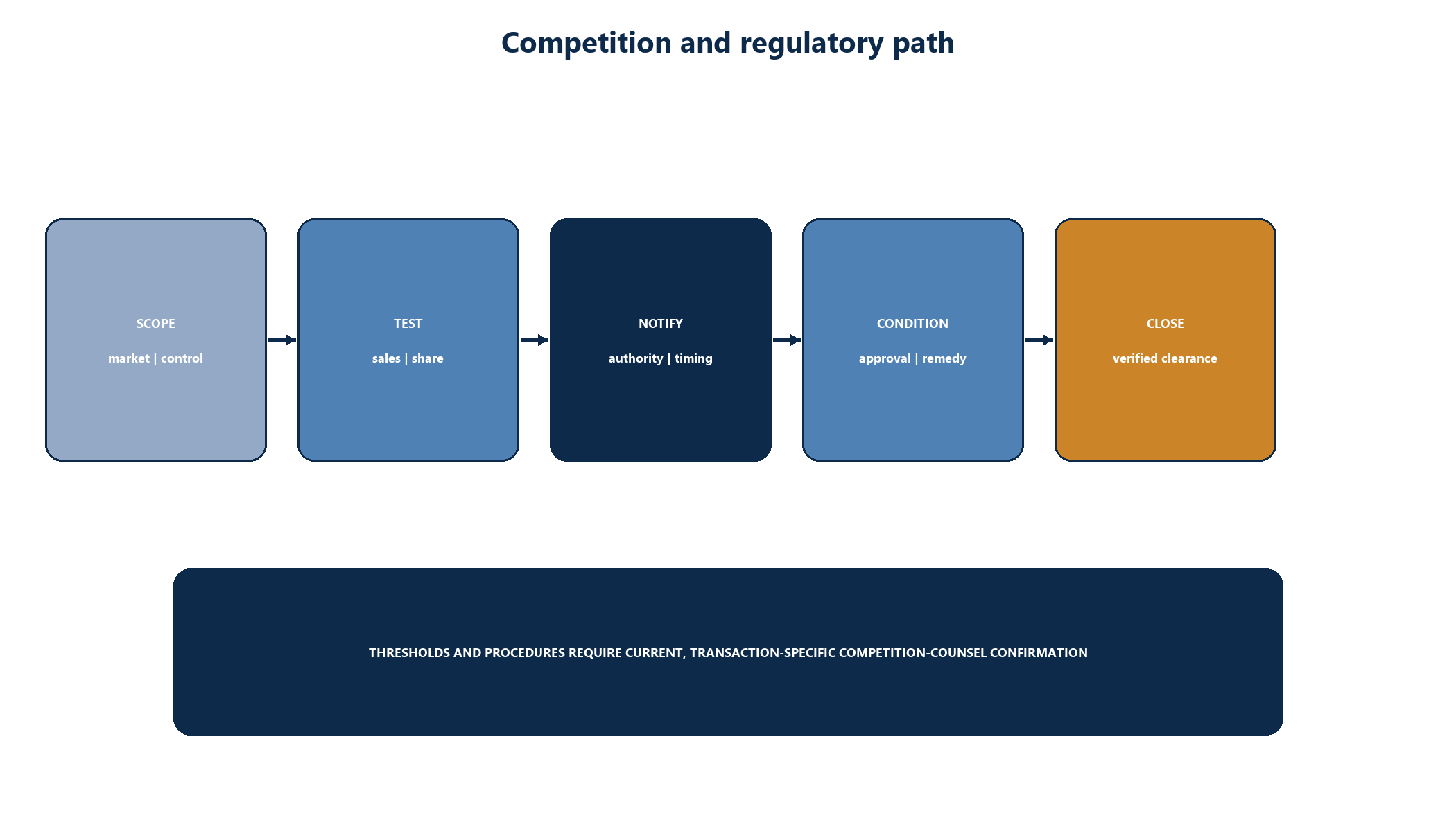
UAE Federal Decree-Law No. 36 of 2023 governs competition within its scope [19]. Cabinet Decision No. 3 of 2025 established notification thresholds based on UAE annual sales in the relevant market exceeding AED 300 million or a combined market share exceeding 40%, subject to the law and applicable definitions [20]. Cabinet Decision No. 59 of 2026 provides current executive regulations and became effective on 30 July 2026 [21]. Competition counsel should confirm current applicability, market definition, control, filing, timing, standstill and remedies for the live transaction.
Saudi economic concentration
Saudi General Authority for Competition guidelines define economic concentration broadly and explain the review framework [28]. The diligence team should identify transaction structure, control, parties, relevant activities, thresholds, timing, information requirements and conditions with Saudi competition counsel.
AML and beneficial ownership
UAE Federal Decree-Law No. 10 of 2025 and Cabinet Resolution No. 134 of 2025 form current anti-money-laundering legislation within their scope [22,23]. FATF Recommendation 24 guidance calls for adequate, accurate and up-to-date beneficial-ownership information and a multi-pronged verification approach [41]. The transaction process should verify sellers, owners, controllers, funding sources and relevant counterparties according to applicable law and institutional policy.
Sector regulators
Financial services, insurance, healthcare, education, transport, telecoms, energy, defence, food, real estate and other regulated sectors can have ownership, manager, fit-and-proper, capital, licence-transfer or approval requirements. DFSA guidance illustrates the need to confirm authorisation through public registers for firms conducting financial services in or from the DIFC [52]. Each sector workstream should name the authority, licence, applicable transaction trigger, submission, approval and closing dependency.
Ip, Data, Cyber And Technology
IP ownership
The diligence team should identify trade marks, domains, software, databases, designs, patents, copyright, trade secrets and know-how. Ownership should be traced from creator or contractor to the target. Registration, assignment, licence, encumbrance, territory, renewal and dispute records should reconcile.
Trade-mark warranties require careful definition of the assets and scope [49]. A broad warranty should not substitute for registry searches, chain-of-title evidence, contractor assignments and use analysis. Product names and domains should match legal ownership and transaction perimeter.
Personal data
UAE Federal Decree-Law No. 45 of 2021 establishes a federal personal-data framework within its scope [24]. Financial centres can have separate regimes. The buyer should map personal-data categories, purposes, systems, locations, transfers, processors, retention, security and incidents. Diligence access should use minimisation, redaction, aggregation and controlled permissions.
Cyber and systems
The buyer should identify critical systems, owners, licences, hosting, access, backups, incidents, vulnerabilities, outsourced providers, source code and change control. A founder-managed account or personal email can create transition risk. The diligence conclusion should distinguish observed controls, management statements and untested assumptions.
Technology separation
Where the target relies on a wider family group or related company, the buyer should map shared applications, data, domains, devices, staff and contracts. The separation plan should state ownership, licences, migration, consent, cost, security, transitional services and exit.
| Area | Verification | Decision output |
|---|---|---|
| revenue | contract-to-cash and tax reconciliation | recurring and collectible revenue base |
| margin | product, customer and site bridge | supportable earnings and concentration |
| cash | bank-to-ledger reconciliation | available and restricted cash |
| debt | facility, security and balance schedule | debt-like and release requirements |
| working capital | monthly history and ageing | normal target and adjustment mechanics |
Assets, Sites, Hse And Sector Permits
Asset existence and title
Material assets should be tied to purchase records, fixed-asset registers, physical inspection, serial numbers, maintenance, insurance, security interests and operating use. Assets recorded in one entity and used by another require documented rights. Leased assets should be distinguished from owned assets.
Inventory
Inventory diligence should cover location, ownership, count controls, ageing, obsolescence, consignment, returns, slow-moving items, customs and cut-off. Sector-specific shelf life, certification or controlled-goods requirements should be included.
Health, safety and environment
The buyer should identify permits, inspections, incidents, claims, remediation, waste, hazardous materials, worker safety, product safety and insurance. The applicable authority and standard depend on sector and location. A clean inspection history should be supported by current records and site evidence.
Site continuity
The site plan should connect legal occupier, landlord or owner, permitted use, licence, utilities, access, staff, equipment, insurance and required transaction consent. A commercially important location may require a landlord waiver, new lease or authority amendment before closing.
Management And Related Parties
Management depth
The buyer should map decisions, customer relationships, technical knowledge, licences, bank authority and key systems to named roles. Founder dependence should be measured through evidence such as approval matrices, customer ownership, product decisions and system access. Succession, retention and incentive plans should reflect the verified dependency.
Related-party population
Related parties can supply premises, staff, financing, procurement, intellectual property, customers, suppliers or personal guarantees. The population should reconcile accounting disclosures, ledgers, ownership records, contracts, bank payments and management representations. Terms should be assessed for continuity and normalisation.
Integrity and conflicts
Background and integrity review should follow applicable law, policy, consent and privacy requirements. The process should record official findings, credible sources, management response and unresolved issues separately. Unverified allegations should remain labelled and access-restricted.
Post-close governance
The buyer should define board rights, delegated authority, bank controls, reporting, compliance ownership, reserved matters, related-party approvals and whistleblowing. Any governance improvement assumed in the investment case requires a named owner, cost, date and dependency.
Warranty-Gap Heatmap And Transaction Protection
Evidence before drafting
Transaction documents allocate risk through representations, warranties, indemnities, covenants, conditions, price mechanics, retentions, escrow and other agreed protections. Their meaning and enforceability depend on governing law and drafting [47-49]. The diligence team should give counsel a structured exception register rather than a generic request for protection.
Heatmap fields
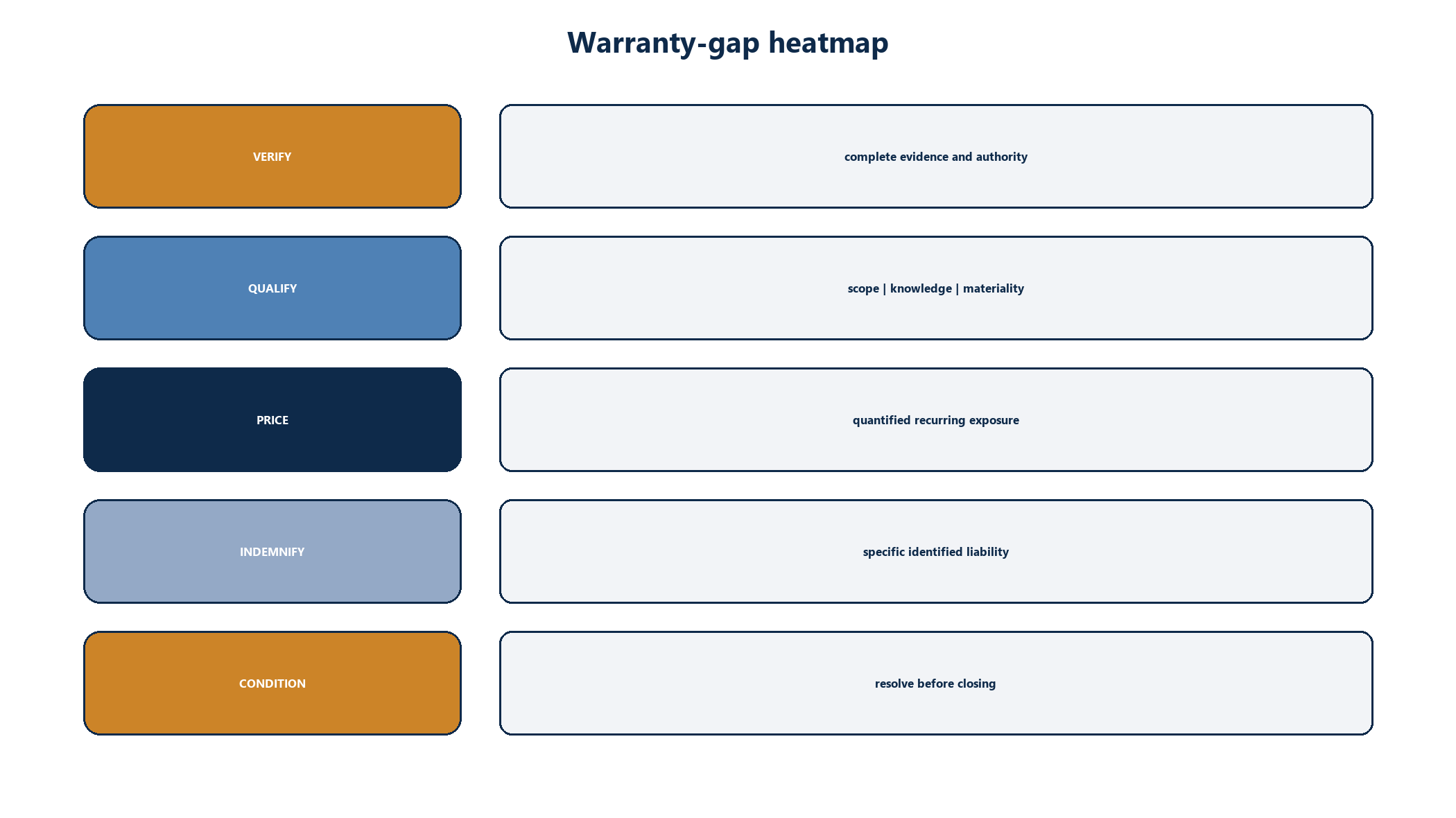
Each issue should record the factual statement, evidence, status, legal analysis, financial exposure, recurrence, responsible entity, seller response, proposed remediation, transaction mechanism, owner and deadline. The heatmap can classify verified, qualified, unresolved, contradicted and unavailable evidence.
| Evidence state | Commercial response | Legal drafting question |
|---|---|---|
| verified compliant | retain proof and monitor expiry | appropriate warranty scope |
| verified exception, quantified | price, debt-like or specific remediation | indemnity, covenant or condition |
| verified exception, unquantified | scenario range and decision threshold | cap, retention, escrow or exclusion |
| management representation only | obtain third-party or authority evidence | disclosure and knowledge limitations |
| contradictory or unavailable | hard gate or reject | condition, exclusion or walk-away right |
Warranties and verification
A warranty can create a contractual remedy if drafted and breached under the governing law. It does not make the underlying licence current, pay a government due, regularise a worker or transfer a contract. Identified operational gaps should have operational actions. Identified monetary exposures should be quantified where possible.
Insurance
Warranty and indemnity insurance may be considered with specialist advice. Coverage, exclusions, diligence expectations, retention, premium and claims process require transaction-specific analysis. The investment committee should see the residual risk after proposed insurance, seller recourse and remediation.
Investment-Committee Evidence Pack
Evidence hierarchy
The committee pack should distinguish official authority records, executed contracts, audited records, third-party reports, management information, buyer analysis and unverified assertions. Every material investment-case number needs a source, period and owner.
Decision bridge
The paper should bridge headline enterprise value to equity value, funding, fees, taxes, working capital, debt-like items, contingent liabilities and required capital expenditure. It should then bridge the base operating case to downside cases. Scenario assumptions should be explicit and labelled.
Exception register
The top issues should state current evidence, possible consequence, probability status where supportable, quantified exposure or range, mitigation, document protection, post-close action and owner. The committee should know which questions remain open and which party accepted the residual risk.
Conditions and expiry
Approval should have conditions, validity period and reapproval triggers. A licence expiry, delayed closing, material trading change, new liability, financing change or adverse authority communication can require refresh. The evidence pack should retain the version approved.
Illustrative example Target Review
Scenario boundary
Illustrative example An institutional buyer screens a regional business-services company with operations reported in the UAE and Saudi Arabia. Management reports annual revenue of USD 24 million and adjusted EBITDA of USD 4 million. These figures are invented for method demonstration. They are not Matchpoint or client results.
Sourcing and preliminary screen
The target enters through a sector executive. The buyer verifies two legal entities and one branch from available records. The trade name used in marketing differs from one legal name. Ownership documents show a family holding structure. The source register labels the ultimate ownership chain pending current official and KYC confirmation.
The preliminary scorecard gives commercial fit a positive status. Authority and transfer readiness remain conditional. No investment probability is assigned.
Diligence findings
The licence matrix shows that one reported activity requires scope confirmation from counsel and the issuing authority. The employee register includes personnel whose payroll entity differs from the reported operating site. End-of-service calculations use total compensation in one spreadsheet and basic wage in another. Authority receipts for two establishment-related fees are missing. A top customer contract has a change-of-control clause.
The team records each point separately:
| Issue | Evidence state | Illustrative response |
|---|---|---|
| licence scope | pending authority or counsel confirmation | closing condition or perimeter exclusion |
| employee mapping | records conflict | employee-level reconciliation and continuity plan |
| gratuity basis | management files conflict | recompute under applicable law and contracts |
| government fees | receipts unavailable | portal confirmation, payment or specific protection |
| customer consent | executed clause verified | consent strategy and closing condition |
Economics
No financial exposure is asserted for these invented facts. The method requires a case team to quantify principal, penalty, recurrence and cash timing using verified records. Attributed Matchpoint or client revenue, cash cost reduction, loss reduction and alpha remain USD 0.
Decision
The committee could issue a conditional approval only after its stated hard gates are satisfied. The decision record would identify residual risks, accepted assumptions, transaction protection and post-close owners. This scenario does not predict approval or completion.
120-Day Buy-Side Roadmap
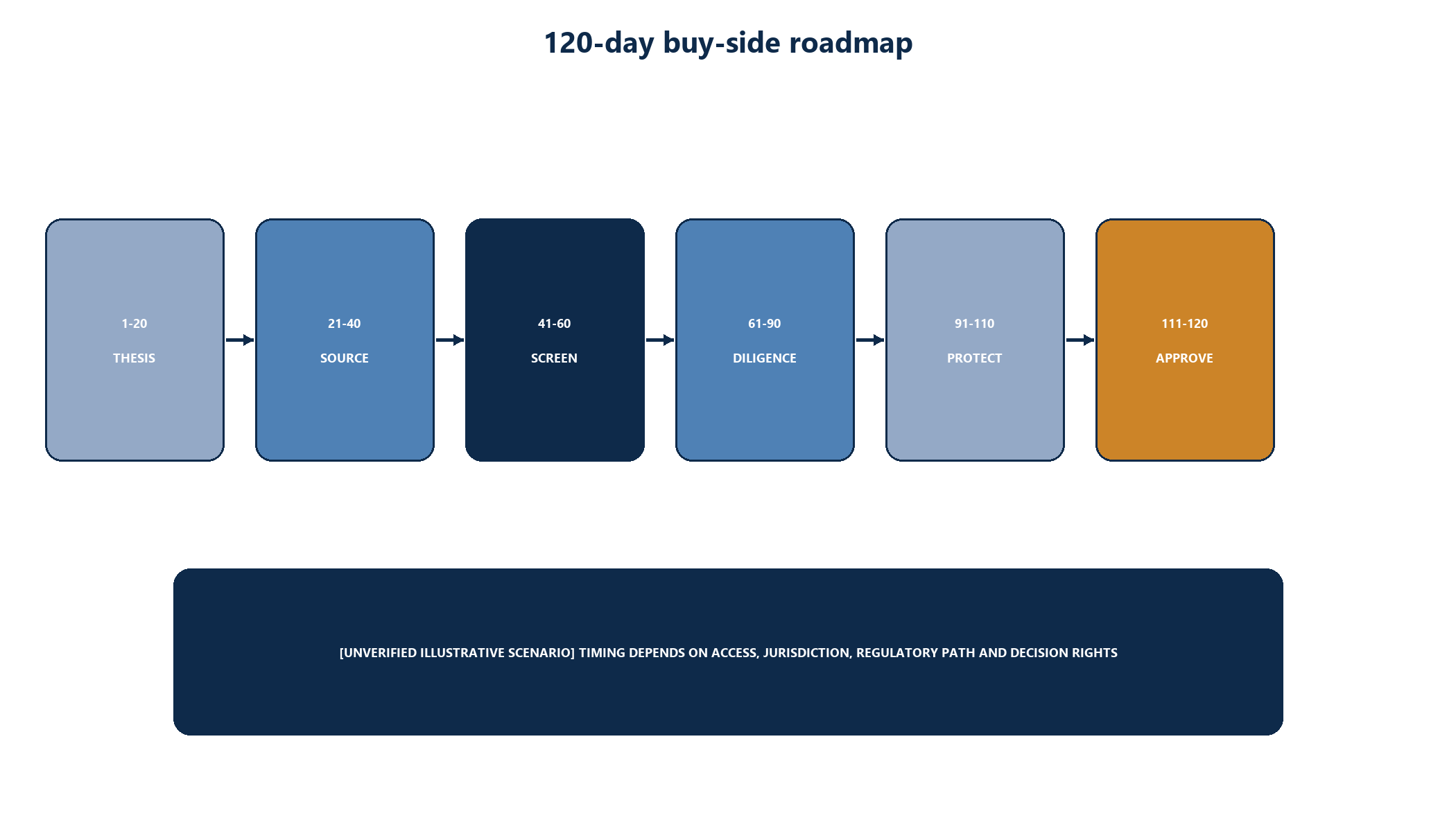
Days 1 to 20: thesis and governance
Define the target perimeter, exclusions, decision rights, source channels, conflicts, information standard and funnel dictionary. Establish legal, tax, financial, workforce, commercial, technology and regulatory workstream owners.
Days 21 to 40: source and verify names
Build the long list, de-duplicate identities, attach provenance and perform legal-existence and mandate-fit screening. Record reasons for exclusion. Select targets for lawful outreach.
Days 41 to 60: engage and screen
Confirm seller interest, ownership situation, size, perimeter and preliminary evidence. Use a consistent information request. Hold the first gate review before providing value indications.
Days 61 to 90: diligence
Launch authority, licence, financial, tax, workforce, commercial, regulatory, IP, technology, site and management workstreams. Maintain one issue register. Escalate contradictory evidence and preserve direct source links.
Days 91 to 110: protect and document
Quantify exposures, finalise the warranty-gap heatmap, determine price mechanics and conditions, obtain consents and approvals, and draft transaction documents with counsel. Build the day-one continuity plan.
Days 111 to 120: approve
Issue the final evidence pack, investment-case bridge, exceptions, conditions, funding plan, regulatory status and post-close ownership. Record decision, expiry and reapproval triggers.
Limitations And Conclusion
This paper is a cross-jurisdiction process framework. It is not a legal opinion, tax opinion, audit, valuation, investment recommendation, sanctions review or regulator confirmation. Official sources can be amended, replaced or interpreted through further instruments. English translations can differ from authoritative Arabic texts. The live transaction requires current local advice and direct authority verification.
The paper does not establish a universal shortage of investible Gulf targets. It does not establish universal funnel conversion rates, diligence costs, timelines, liability values or post-close outcomes. The illustrative scenario has no evidential connection to a Matchpoint or client transaction.
The central conclusion is operational. A Gulf buy-side team needs a single evidence spine from investment thesis through source, verified target perimeter, exception, exposure, protection and decision. Commercial registration, trade licence, beneficial ownership, workforce permissions, end-of-service entitlements, tax, government dues and consents should be tested as connected records. A local issue becomes manageable when its issuer, entity, period, consequence, owner and remedy are explicit.
Attributed Matchpoint or client revenue, cash cost reduction, loss reduction and alpha remain USD 0 until approved observed evidence exists.
Appendix A. Gcc Diligence Checklist
| Workstream | Minimum field | Evidence standard | Output |
|---|---|---|---|
| entity | legal name, number, form, status | current official extract | perimeter |
| ownership | legal and beneficial chain | registers, filings and KYC | title and AML conclusion |
| authority | approvals and signatories | constitutional records and resolutions | signing path |
| licences | entity, activity, site, expiry | issuing-authority record | continuity plan |
| financial | entity-period trial balance | statements, ledger and bank | quality-of-earnings bridge |
| tax | registrations, returns, payments | authority and filing evidence | exposure register |
| workforce | employee, entity, rights, permission | contracts, payroll and authority records | liability and day-one plan |
| commercial | material contracts and consents | executed documents | revenue and consent conclusion |
| regulatory | threshold, submission, approval | counsel and authority evidence | closing condition |
| IP and data | title, licence, processing, incidents | registers, assignments and systems | ownership and remediation |
Appendix B. Deal-Readiness Scorecard
| Field | Entry rule |
|---|---|
| item ID | stable identifier |
| question | one testable statement |
| entity and jurisdiction | exact legal perimeter |
| evidence | document, system or authority |
| issuer and date | provenance and currency |
| status | verified, exception, provided, pending, unverified, not applicable |
| consequence | valuation, condition, continuity, compliance or governance |
| severity | decision-specific definition |
| owner | named workstream owner |
| action and due date | executable next step |
| transaction response | price, condition, indemnity, covenant, retention or reject |
Appendix C. Target Funnel Fields
| Category | Fields |
|---|---|
| identity | target ID, legal names, trade names, registry numbers, countries |
| source | channel, referring party, date, conflict, compensation |
| thesis | sector, model, size, geography, ownership, exclusions |
| evidence | source, period, verification status, reviewer |
| engagement | contact route, permission, dates, responses |
| gate | decision, owner, date, evidence version, expiry |
| rejection | principal reason, secondary reasons, monitoring date |
| outcome | diligence, signed, completed or closed |
Appendix D. Warranty-Gap Register
| Field | Required content |
|---|---|
| issue | precise factual exception |
| evidence | source and conflict status |
| applicable entity | legal owner or obligor |
| legal analysis | counsel-owned conclusion |
| financial exposure | principal, penalty, recurrence and cash timing |
| operational remedy | action, authority and owner |
| document mechanism | warranty, indemnity, covenant, condition or exclusion |
| residual risk | accepted, transferred, mitigated or rejected |
| decision | approver and date |
Appendix E. Request List
- current entity, branch and commercial-register extracts;
- constitutional documents, ownership registers, transfer history and pledges;
- beneficial-ownership records and KYC support;
- all licences, activity permits, site approvals, inspections and government receipts;
- monthly trial balances, statements, bank records and accounting policies;
- tax registrations, returns, assessments, payments, audits and correspondence;
- employee register, contracts, wage components, leave, gratuity, permits and pensions;
- customer, supplier, property, financing and related-party contracts;
- change-of-control, assignment and consent schedule;
- IP, domains, software, data, cyber incidents and technology contracts;
- litigation, claims, investigations, sanctions and insurance records; and
- management organisation, authority, retention and day-one plans.
| Issue | Evidence state | Illustrative response |
|---|---|---|
| licence scope | pending authority or counsel confirmation | closing condition or perimeter exclusion |
| employee mapping | records conflict | employee-level reconciliation and continuity plan |
| gratuity basis | management files conflict | recompute under applicable law and contracts |
| government fees | receipts unavailable | portal confirmation, payment or specific protection |
| customer consent | executed clause verified | consent strategy and closing condition |
Appendix F. Investment-Committee Decision Memorandum
F.1 Decision requested
State the exact approval, transaction perimeter, price range, funding, conditions and expiry.
F.2 Evidence position
List official and third-party evidence, management-provided information, unverified items and material limitations.
F.3 Investment case
State the verified commercial rationale, operating case, financial bridge, required capital and value-creation owners.
F.4 Top exceptions
For each exception state evidence, exposure, remedy, transaction protection, residual risk and owner.
F.5 Closing and day one
List regulatory approvals, consents, licence actions, workforce actions, funds flow, security releases, systems access and communications.
F.6 Approval record
Record decision-makers, conflicts, conditions, dissent, expiry and reapproval triggers.
References
[1] United Arab Emirates Government. Federal Decree-Law No. 32 of 2021 on Commercial Companies. UAE Legislation. https://uaelegislation.gov.ae/en/legislations/1542
[2] United Arab Emirates Government. Federal Decree-Law No. 37 of 2021 concerning the Commercial Register. UAE Legislation. https://uaelegislation.gov.ae/en/legislations/1532
[3] United Arab Emirates Government. Cabinet Resolution No. 107 of 2022 concerning the Executive Regulations of the Commercial Register Law. UAE Legislation. https://uaelegislation.gov.ae/en/legislations/1622
[4] United Arab Emirates Government. Cabinet Resolution No. 109 of 2023 concerning Procedures of the Real Beneficiary. UAE Legislation. https://uaelegislation.gov.ae/en/legislations/2176
[5] United Arab Emirates Government. Cabinet Resolution No. 132 of 2023 concerning Administrative Penalties for Real-Beneficiary Procedures. UAE Legislation. https://uaelegislation.gov.ae/en/legislations/2314
[6] United Arab Emirates Government. Federal Decree-Law No. 33 of 2021 concerning the Regulation of Employment Relationships. UAE Legislation. https://uaelegislation.gov.ae/en/legislations/1541
[7] United Arab Emirates Government. Cabinet Resolution No. 1 of 2022 concerning the Executive Regulations of the Employment Relationships Law. UAE Legislation. https://uaelegislation.gov.ae/en/legislations/1547
[8] Ministry of Human Resources and Emiratisation. Dear Worker: Know Your Rights; end-of-service benefits guidance. https://mohre.gov.ae/en/guidance-and-awareness-portal-new/employee-companies/dear-worker-know-your-rights
[9] Ministry of Human Resources and Emiratisation. Transfer Work Permit service. https://www.mohre.gov.ae/en/services/transfer-work-permit-2022
[10] Ministry of Human Resources and Emiratisation. Voluntary Alternative End-of-Service Benefits Scheme announcement. 1 November 2023. https://mohre.gov.ae/en/media-center/news/1/11/2023/voluntary-alternative-end-of-service-benefits-scheme-goes-into-effect-by-cabinet-resolution-aiming-t
[11] United Arab Emirates Government. Federal Decree-Law No. 28 of 2022 on Tax Procedures. UAE Legislation. https://uaelegislation.gov.ae/en/legislations/1625
[12] Federal Tax Authority. Corporate Tax General Guide. https://tax.gov.ae/en/content/corporate.tax.general.guide.aspx
[13] Federal Tax Authority. Transfer Pricing Guide. 23 October 2023. https://tax.gov.ae/Datafolder/Files/Pdf/2023/Transfer%20Pricing%20Guide%20-%20EN%20-%2023%2010%202023.pdf
[14] Federal Tax Authority. VAT Deregistration service. https://www.tax.gov.ae/en/services/vat.deregistration.aspx
[15] Federal Tax Authority. Corporate Tax Deregistration service. https://www.tax.gov.ae/en/services/corporate.tax.deregistration.aspx
[16] United Arab Emirates Government. Cabinet Decision No. 75 of 2023 on Administrative Penalties for Corporate Tax. UAE Legislation. https://uaelegislation.gov.ae/en/legislations/2161
[17] United Arab Emirates Government. Federal Decree-Law No. 51 of 2023 promulgating the Financial Reorganisation and Bankruptcy Law. UAE Legislation. https://uaelegislation.gov.ae/en/legislations/2190
[18] United Arab Emirates Government. Cabinet Resolution No. 94 of 2024 concerning the Executive Regulations of the Financial Reorganisation and Bankruptcy Law. UAE Legislation. https://uaelegislation.gov.ae/en/legislations/2582
[19] United Arab Emirates Government. Federal Decree-Law No. 36 of 2023 on Competition Regulation. UAE Legislation. https://uaelegislation.gov.ae/en/legislations/2117
[20] United Arab Emirates Government. Cabinet Decision No. 3 of 2025 on Economic Concentration Thresholds. UAE Legislation. https://uaelegislation.gov.ae/en/legislations/2788
[21] United Arab Emirates Government. Cabinet Resolution No. 59 of 2026 concerning the Executive Regulations of the Competition Regulation Law. UAE Legislation. https://uaelegislation.gov.ae/en/legislations/4451
[22] United Arab Emirates Government. Federal Decree-Law No. 10 of 2025 on Combating Money Laundering and Terrorism Financing. UAE Legislation. https://uaelegislation.gov.ae/en/legislations/3314
[23] United Arab Emirates Government. Cabinet Resolution No. 134 of 2025 concerning the Executive Regulations of the Anti-Money-Laundering Law. UAE Legislation. https://uaelegislation.gov.ae/en/legislations/3857
[24] United Arab Emirates Government. Federal Decree-Law No. 45 of 2021 concerning the Protection of Personal Data. UAE Legislation. https://uaelegislation.gov.ae/en/legislations/1972
[25] Saudi Ministry of Commerce. New Commercial Register Law and Trade Names Law announcement. 17 September 2024. https://mc.gov.sa/en/mediacenter/News/Pages/17-09-24-01.aspx
[26] Saudi Ministry of Commerce. Companies Law. Official English text. https://mc.gov.sa/regapis?attId=0d5e00e7-1ea3-4890-a16a-af8700f9eb32&display=true&dt=03072026091255&isInline=false&lng=en&op=Download&siteURL=https%3A%2F%2Fregulations.mc.gov.sa%2F
[27] Ministry of Investment of Saudi Arabia. Updated Investment Law. https://misa.gov.sa/activities/laws-regulations-copy/
[28] General Authority for Competition, Saudi Arabia. Economic Concentration Review Guidelines. https://gacbep.gac.gov.sa/cms/b9376edc-79a1-4573-a36d-4f3effaba838.pdf
[29] Saudi Ministry of Human Resources and Social Development. Labour Relations; Article 84 and related guidance. https://www.hrsd.gov.sa/en/%D8%%D9%84%D8%%D9%82%D8%%D8%AA-%D8%%D9%84%D8%%D9%85%D9%84
[30] Saudi Ministry of Human Resources and Social Development. Implementing Regulations of the Labour Law and Annexes. https://www.hrsd.gov.sa/sites/default/files/2023-02/The%20Implementing%20Regulations%20of%20Labor%20Law%20and%20its%20Annexes.pdf
[31] Kingdom of Bahrain Ministry of Industry and Commerce. Legislative Decree No. 27 of 2015 concerning the Commercial Register. https://moic.gov.bh/sites/default/files/2021-10/Legislative%20Decree%20no.%20%2827%29%20of%202015%20Concerning%20the%20Commercial%20Register.pdf
[32] Kingdom of Bahrain Legislation and Legal Opinion Commission. Law No. 36 of 2012 promulgating the Labour Law for the Private Sector. https://legalaffairs.gov.bh/Legislation/HTM/K3612
[33] Kingdom of Bahrain Legislation and Legal Opinion Commission. Legislative Decree No. 7 of 1987 promulgating the Law of Commerce. https://www.lloc.gov.bh/Legislation/HTM/L0787
[34] Sultanate of Oman Ministry of Labour. Issue Commercial Work Permits for Establishments. https://www.mol.gov.om/manpoweralleservices/details/284
[35] Sultanate of Oman Ministry of Labour. Regulatory Decisions and Work-Permit Regulations. https://mol.gov.om/RegulationArticles
[36] State of Qatar Supreme Judiciary Council. Labour Law No. 14 of 2004, updated official legal database text. https://encyclop.sjc.gov.qa/lawlib/files/ViewDOC.aspx?id=432
[37] State of Qatar Ministry of Commerce and Industry. Commercial Registration Procedures. https://www.moci.gov.qa/%D8%AE%D8%AF%D9%85%D8%%D8%AA%D9%86%D8%/%D8%%D9%84%D9%85%D8%%D8%AA%D8%AB%D9%85%D8%/%D8%%D9%84%D8%%D8%%D8%%D9%84%D8%-%D8%%D9%84%D8%%D8%%D8%%D8%%D8%/%D8%%D8%AC%D8%%D8%%D8%%D8%%D8%AA-%D8%%D9%84%D8%%D8%AC%D9%84%D8%%D8%AA-%D8%%D9%84%D8%AA%D8%AC%D8%%D8%%D9%8A%D8%/
[38] State of Kuwait Ministry of Commerce and Industry. Electronic Services for Managing the Commercial Registry. https://www.moci.gov.kw/ar/e-service/electronic-services-managing-commercial-registry/
[39] Kuwait Business Center. Companies and commercial-licensing laws portal. https://kbc.moci.gov.kw/
[40] Kuwait Public Authority for Manpower. Private Sector Labour Law, official English text. https://www.manpower.gov.kw/PdfProxy.ashx?path=docs%2FLaborLaw%2FLabor_Law_Eng.pdf
[41] Financial Action Task Force. Guidance on Beneficial Ownership of Legal Persons. 10 March 2023. https://www.fatf-gafi.org/content/fatf-gafi/en/publications/Fatfrecommendations/Guidance-Beneficial-Ownership-Legal-Persons.html
[42] OECD. Due Diligence Guidance for Responsible Business Conduct. https://www.oecd.org/en/topics/sub-issues/due-diligence-guidance-for-responsible-business-conduct.html
[43] OECD. Promoting Responsible Business Conduct through Trade and Investment in the Middle East, North Africa and Türkiye. 2026. https://www.oecd.org/en/publications/promoting-responsible-business-conduct-through-trade-and-investment-in-the-middle-east-north-africa-and-türkiye_520109c0-en.html
[44] Vild, J. and Zeisberger, C. Strategic Buyers vs. Private Equity Buyers in an Investment Process. INSEAD Working Paper No. 2014/39/DSC/EFE. 2014. https://ssrn.com/abstract=2439589
[45] Dittmar, A. K., Li, D. and Nain, A. It Pays to Follow the Leader: Acquiring Targets Picked by Private Equity. Journal of Financial and Quantitative Analysis, 47(5). 2012. https://ssrn.com/abstract=1317829
[46] Katselas, D. and Chapple, L. L. The Preferences of Private Equity Investors in Selecting Target Acquisitions: An International Investigation. Australian Journal of Management, 37(3). 2012. https://ssrn.com/abstract=2190815
[47] Galpin, T. Investigate to Prevent Post-close Surprises. In Winning at the Acquisition Game. Oxford University Press. 2020. https://doi.org/10.1093/oso/9780198858560.003.0004
[48] McMeel, G. Conditions, Warranties, and Indemnities. In McMeel on The Construction of Contracts. Oxford University Press. 2017. https://doi.org/10.1093/law/9780198755166.003.0020
[49] Smith, G. Trade mark warranties in M&A transactions. Journal of Intellectual Property Law & Practice, 3(8), 501-506. 2008. https://doi.org/10.1093/jiplp/jpn100
[50] Abu Dhabi Global Market Registration Authority. Beneficial Ownership and Control; including 2026 compliance materials. https://www.adgm.com/operating-in-adgm/obligations-of-adgm-registered-entities/beneficial-ownership-and-control
[51] Abu Dhabi Global Market Registration Authority. Employment Regulations 2024 announcement and enacted-regulation link. 9 January 2025. https://www.adgm.com/media/announcements/adgm-publishes-new-employment-regulations
[52] Dubai Financial Services Authority. Regulatory Due Diligence Links and Authorisation Overview. https://www.dfsa.ae/what-we-do/international-relations/how-we-regulate
Source Register
The full paper records the scope, evidence setting and limitations applied to these sources.
- [1] United Arab Emirates Government. Federal Decree-Law No. 32 of 2021 on Commercial Companies. UAE Legislation. Open source
- [2] United Arab Emirates Government. Federal Decree-Law No. 37 of 2021 concerning the Commercial Register. UAE Legislation. Open source
- [3] United Arab Emirates Government. Cabinet Resolution No. 107 of 2022 concerning the Executive Regulations of the Commercial Register Law. UAE Legislation. Open source
- [4] United Arab Emirates Government. Cabinet Resolution No. 109 of 2023 concerning Procedures of the Real Beneficiary. UAE Legislation. Open source
- [5] United Arab Emirates Government. Cabinet Resolution No. 132 of 2023 concerning Administrative Penalties for Real-Beneficiary Procedures. UAE Legislation. Open source
- [6] United Arab Emirates Government. Federal Decree-Law No. 33 of 2021 concerning the Regulation of Employment Relationships. UAE Legislation. Open source
- [7] United Arab Emirates Government. Cabinet Resolution No. 1 of 2022 concerning the Executive Regulations of the Employment Relationships Law. UAE Legislation. Open source
- [8] Ministry of Human Resources and Emiratisation. Dear Worker: Know Your Rights; end-of-service benefits guidance. Open source
- [9] Ministry of Human Resources and Emiratisation. Transfer Work Permit service. Open source
- [10] Ministry of Human Resources and Emiratisation. Voluntary Alternative End-of-Service Benefits Scheme announcement. 1 November 2023. Open source
- [11] United Arab Emirates Government. Federal Decree-Law No. 28 of 2022 on Tax Procedures. UAE Legislation. Open source
- [12] Federal Tax Authority. Corporate Tax General Guide. Open source
- [13] Federal Tax Authority. Transfer Pricing Guide. 23 October 2023. Open source
- [14] Federal Tax Authority. VAT Deregistration service. Open source
- [15] Federal Tax Authority. Corporate Tax Deregistration service. Open source
- [16] United Arab Emirates Government. Cabinet Decision No. 75 of 2023 on Administrative Penalties for Corporate Tax. UAE Legislation. Open source
- [17] United Arab Emirates Government. Federal Decree-Law No. 51 of 2023 promulgating the Financial Reorganisation and Bankruptcy Law. UAE Legislation. Open source
- [18] United Arab Emirates Government. Cabinet Resolution No. 94 of 2024 concerning the Executive Regulations of the Financial Reorganisation and Bankruptcy Law. UAE Legislation. Open source
- [19] United Arab Emirates Government. Federal Decree-Law No. 36 of 2023 on Competition Regulation. UAE Legislation. Open source
- [20] United Arab Emirates Government. Cabinet Decision No. 3 of 2025 on Economic Concentration Thresholds. UAE Legislation. Open source
- [21] United Arab Emirates Government. Cabinet Resolution No. 59 of 2026 concerning the Executive Regulations of the Competition Regulation Law. UAE Legislation. Open source
- [22] United Arab Emirates Government. Federal Decree-Law No. 10 of 2025 on Combating Money Laundering and Terrorism Financing. UAE Legislation. Open source
- [23] United Arab Emirates Government. Cabinet Resolution No. 134 of 2025 concerning the Executive Regulations of the Anti-Money-Laundering Law. UAE Legislation. Open source
- [24] United Arab Emirates Government. Federal Decree-Law No. 45 of 2021 concerning the Protection of Personal Data. UAE Legislation. Open source
- [25] Saudi Ministry of Commerce. New Commercial Register Law and Trade Names Law announcement. 17 September 2024. Open source
- [26] Saudi Ministry of Commerce. Companies Law. Official English text. Open source
- [27] Ministry of Investment of Saudi Arabia. Updated Investment Law. Open source
- [28] General Authority for Competition, Saudi Arabia. Economic Concentration Review Guidelines. Open source
- [29] Saudi Ministry of Human Resources and Social Development. Labour Relations; Article 84 and related guidance. Open source
- [30] Saudi Ministry of Human Resources and Social Development. Implementing Regulations of the Labour Law and Annexes. Open source
- [31] Kingdom of Bahrain Ministry of Industry and Commerce. Legislative Decree No. 27 of 2015 concerning the Commercial Register. Open source
- [32] Kingdom of Bahrain Legislation and Legal Opinion Commission. Law No. 36 of 2012 promulgating the Labour Law for the Private Sector. Open source
- [33] Kingdom of Bahrain Legislation and Legal Opinion Commission. Legislative Decree No. 7 of 1987 promulgating the Law of Commerce. Open source
- [34] Sultanate of Oman Ministry of Labour. Issue Commercial Work Permits for Establishments. Open source
- [35] Sultanate of Oman Ministry of Labour. Regulatory Decisions and Work-Permit Regulations. Open source
- [36] State of Qatar Supreme Judiciary Council. Labour Law No. 14 of 2004, updated official legal database text. Open source
- [37] State of Qatar Ministry of Commerce and Industry. Commercial Registration Procedures. Open source
- [38] State of Kuwait Ministry of Commerce and Industry. Electronic Services for Managing the Commercial Registry. Open source
- [39] Kuwait Business Center. Companies and commercial-licensing laws portal. Open source
- [40] Kuwait Public Authority for Manpower. Private Sector Labour Law, official English text. Open source
- [41] Financial Action Task Force. Guidance on Beneficial Ownership of Legal Persons. 10 March 2023. Open source
- [42] OECD. Due Diligence Guidance for Responsible Business Conduct. Open source
- [43] OECD. Promoting Responsible Business Conduct through Trade and Investment in the Middle East, North Africa and Türkiye. 2026. Open source
- [44] Vild, J. and Zeisberger, C. Strategic Buyers vs. Private Equity Buyers in an Investment Process. INSEAD Working Paper No. 2014/39/DSC/EFE. 2014. Open source
- [45] Dittmar, A. K., Li, D. and Nain, A. It Pays to Follow the Leader: Acquiring Targets Picked by Private Equity. Journal of Financial and Quantitative Analysis, 47(5). 2012. Open source
- [46] Katselas, D. and Chapple, L. L. The Preferences of Private Equity Investors in Selecting Target Acquisitions: An International Investigation. Australian Journal of Management, 37(3). 2012. Open source
- [47] Galpin, T. Investigate to Prevent Post-close Surprises. In Winning at the Acquisition Game. Oxford University Press. 2020. Open source
- [48] McMeel, G. Conditions, Warranties, and Indemnities. In McMeel on The Construction of Contracts. Oxford University Press. 2017. Open source
- [49] Smith, G. Trade mark warranties in M&A transactions. Journal of Intellectual Property Law & Practice, 3(8), 501-506. 2008. Open source
- [50] Abu Dhabi Global Market Registration Authority. Beneficial Ownership and Control; including 2026 compliance materials. Open source
- [51] Abu Dhabi Global Market Registration Authority. Employment Regulations 2024 announcement and enacted-regulation link. 9 January 2025. Open source
- [52] Dubai Financial Services Authority. Regulatory Due Diligence Links and Authorisation Overview. Open source