

1. Define the platform thesis before assembling a target list
A carrier-neutral edge roll-up is an operating and network thesis expressed through acquisitions. The board should state the intended customer problem, geographic logic, product set, connectivity model and cash-flow pathway before asking advisers to identify targets. Without that discipline, a buyer can accumulate small facilities with different contracts, service levels, equipment, licences and economics while calling the collection a platform.
The thesis should identify which demand nodes require distributed capacity. Candidate nodes include dense business districts, industrial zones, ports, airports, government clusters, media hubs, gaming audiences, financial centres, energy sites and secondary cities with constrained network paths. The investment case should explain why local compute, interconnection or data handling is valuable at each node and why customers would pay the platform rather than use a large central campus, a telecom operator site or public cloud alone.
The source of recurring cash should also be explicit. It can include cabinets, cages, private suites, cross-connects, internet exchange access, cloud on-ramps, remote hands, managed network services and power. Each line has a different margin, churn profile and capital requirement. The base case should rely on signed, accepted, billed and collected services. Pipeline and future product launches belong in an upside case.
The board should approve five acquisition gates: evidenced demand, credible neutrality and interconnection, power and technical readiness, legal and regulatory control, and cash conversion. A target that fails one gate may still have strategic value, although its price, structure and integration plan should reflect the deficiency. The acquisition mandate should specify the minimum evidence, permitted exceptions and walk-away conditions.
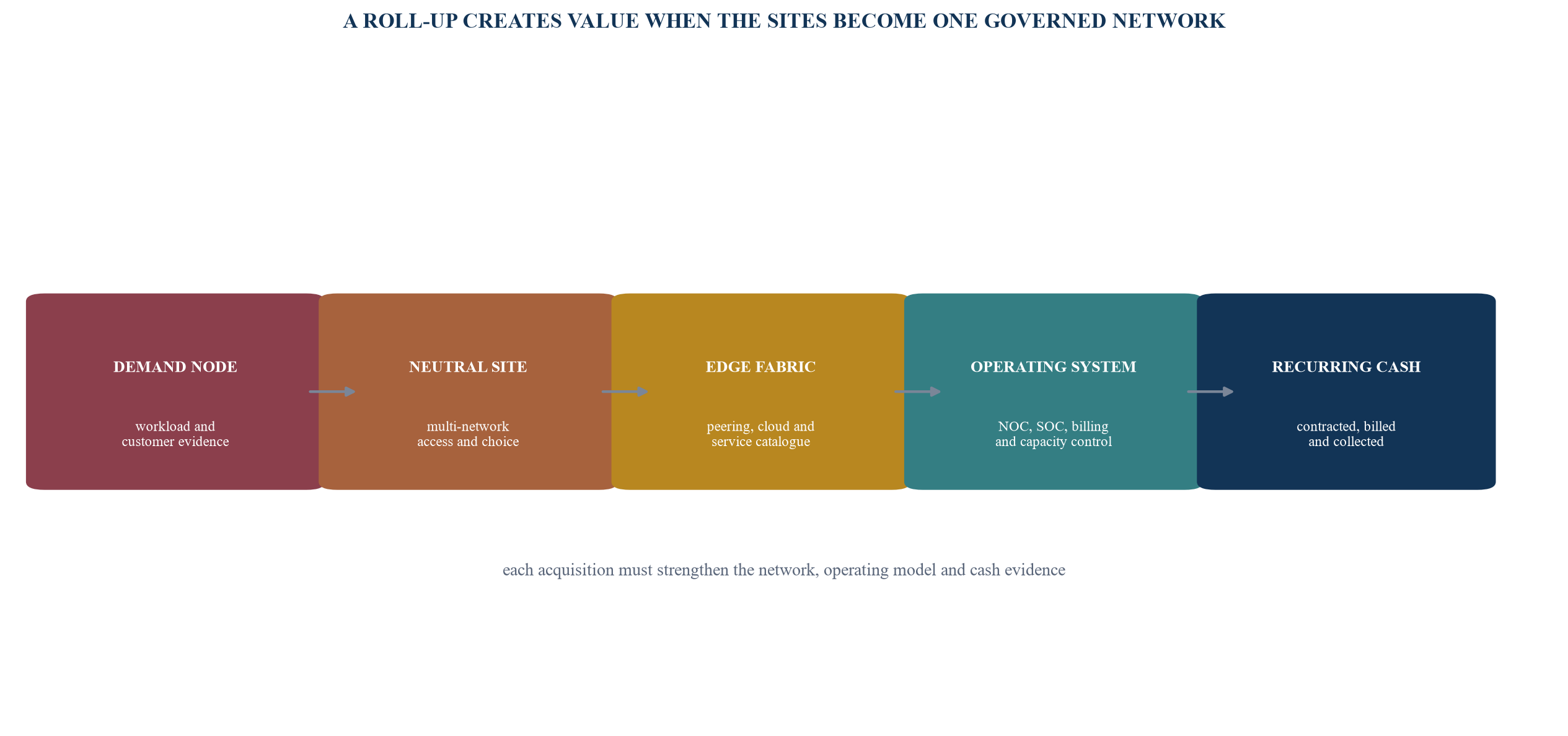
Value progresses through evidence gates; geographic coverage alone does not create a platform.
2. Define edge and carrier neutrality precisely
"Edge" describes placement relative to users, devices, networks or workloads. It is not a universal distance, building size or rack count. An edge site serving a port may be close to industrial control systems. A metropolitan edge site may sit near enterprise customers and network aggregation. A regional site may connect a secondary city to cloud and content platforms. The diligence team should define the relevant latency, availability, data-residency, bandwidth and operational requirements for each workload.
ETSI's multi-access edge computing framework describes a distributed environment with platforms, applications, management and federation. Its use-case and requirements material addresses security, access control, regulation and service lifecycle. These standards help a buyer distinguish a simple equipment room from an operable edge service environment. Conformance and technical fitness require site-specific verification.
Carrier neutrality should mean that customers can access multiple independent networks on transparent and non-discriminatory terms, subject to capacity, law and security. It should cover physical entry routes, meet-me-room governance, cross-connect ordering, pricing, access procedures, interconnection policy and disclosure of related-party carriers. A facility owned by a network operator can still offer meaningful choice, yet ownership, pricing and operational controls require careful review.
Neutrality is an operating commitment. The buyer should test whether two listed carriers use the same upstream route, whether diverse entrances converge outside the building, whether a related party receives preferred treatment and whether customers can connect without purchasing an unrelated service. The acquisition agreement can protect critical representations, while the integration plan should establish a common neutrality charter and an auditable cross-connect process.
Table 1. Definitions and evidence boundary
| Term | Practical definition | Required evidence | Common misclassification |
|---|---|---|---|
| demand node | location where a defined workload benefits from nearby compute or interconnection | customer interviews, traffic, latency, regulation and signed demand | population or building density alone |
| edge site | facility positioned to meet the workload's latency, resilience, sovereignty or access need | topology, measurements, service design and customer acceptance | any small data centre |
| carrier neutral | transparent access to multiple independent networks without compulsory carrier tie-in | carrier contracts, route maps, pricing, orders and governance | multiple reseller logos sharing one path |
| internet exchange | facility or service enabling traffic exchange among autonomous systems under stated policy | licence or permit, participant list, route-server policy and traffic evidence | ordinary upstream internet transit |
| cloud on-ramp | controlled connectivity to a cloud service through an authorised partner or exchange | partner status, service specification, route and order history | a generic internet connection |
| platform | sites operated through common products, controls, systems, metrics and capital allocation | operating model, systems, governance and customer experience | a consolidated financial statement |
Classification depends on verified technical, contractual and operating facts.
3. Map GCC demand nodes using workload evidence
Regional digital adoption creates an addressable context rather than a site-level demand guarantee. GSMA's 2025 enterprise research surveyed more than 5,300 enterprises globally, including over 850 across eight Middle East and North Africa countries. It reported strong expected digital-transformation spending in the GCC and differentiated adoption patterns across the United Arab Emirates, Saudi Arabia and Qatar. The findings support targeted customer discovery; they do not establish contracted demand for a particular facility.
Saudi Arabia's Communications, Space and Technology Commission reported 99.6 per cent internet penetration for 2025, 45.2 per cent adoption of artificial-intelligence tools, average monthly mobile data use of 53 gigabytes per person, 200 autonomous-system numbers and 67 per cent IPv6 activation. These indicators describe a digitally intensive market. A platform buyer still needs local traffic, customer, route, power and competitor evidence.
The demand map should use a standard record for each node. It should identify users and devices, target latency, peak and average traffic, data-location requirement, compute or storage need, resilience requirement, current route, switching cost, procurement owner, budget and expected contract form. The record should distinguish a customer statement of interest from a funded procurement process and a signed order.
Workloads should be grouped by their economic drivers. Content delivery and gaming need audience proximity and network density. Regulated enterprises may value locality, control and auditability. Industrial and private-5G applications can need deterministic performance and on-site integration. Hybrid-cloud customers need consistent connectivity and security. Public services may require procurement, localisation and continuity conditions. The target screen should score a site against the workloads it can serve after verified investment, not against a generic "edge" narrative.
4. Build a country-by-country regulatory and access register
Each GCC jurisdiction has its own telecom, internet exchange, data, cyber, competition, property, utility, foreign-investment, licensing and change-of-control rules. A six-country footprint cannot be underwritten through one regional legal conclusion. The diligence office should maintain an applicability register by entity, site, service, customer and transaction step.
Saudi rules define access to locally hosted internet content and address neutral internet exchange points, content providers and data centres. The Communications, Space and Technology Commission also operates a permit process for internet exchange services. Its approved access and interconnection materials indicate that technical and commercial terms may extend to physical facilities, data centres, subsea assets and internet exchanges. The exact obligations depend on the operator and service.
Qatar's Communications Regulatory Authority stated in July 2025 that the Qatar Internet Exchange Point had 19 active participants as of May 2025 and operated an open route server. Bahrain's Telecommunications Regulatory Authority lists internet-exchange licensees. Oman has published internet-exchange consultation and access/interconnection material. These sources establish regulatory context and disclosed market infrastructure; they do not replace current counsel or confirm a target's compliance.
The transaction timeline should include licence transfer, change-of-control notification, competition filing, customer consent, landlord consent, utility approval and cyber or data review. The United Arab Emirates introduced revenue and market-share thresholds for economic-concentration assessment under Cabinet Decision No. 3 of 2025. Saudi Arabia also applies economic-concentration review. Counsel should determine filing requirements using the transaction facts and rules in force at signing and closing.
Table 2. GCC regulatory workstream
| Jurisdiction | Core workstreams | Transaction evidence | Closing control |
|---|---|---|---|
| United Arab Emirates | telecom activity, data and cyber, competition, property, utilities and foreign investment | licences, economic-concentration analysis, title or lease, power rights and customer consents | filings, approvals, consent schedule and compliance certificate |
| Saudi Arabia | communications and internet services, IXP permit, access rules, data and cyber, competition and utilities | CST approvals, route-server and peering policy, GAC analysis, land and utility package | permit continuity, merger clearance where applicable and operational transition plan |
| Qatar | communications approvals, QIXP participation, data, property and utilities | CRA status, interconnection agreements, customer and landlord consents | regulatory confirmation and access continuity |
| Bahrain | telecom and internet-exchange licensing, data, property and utility rights | TRA licence status, carrier agreements, site tenure and power evidence | licence and consent conditions satisfied |
| Oman | telecom, access/interconnection, data, property and utility rights | TRA applicability, interconnection terms, tenure and power agreement | approval matrix and transition responsibility |
| Kuwait | communications, data, competition, property, utilities and foreign investment | current local-law memorandum, licences, route, tenure and customer contracts | transaction-specific approvals and operational readiness |
The register is a diligence agenda; qualified local advisers determine current applicability.
5. Construct the target universe and evidence scorecard
The target universe should include operating edge facilities, telecom-adjacent sites, enterprise colocation assets, internet-exchange locations, regional network hubs, carve-outs and sites that can become neutral after separation. It should also include greenfield infill opportunities where acquisition coverage leaves a commercially important gap. Every candidate needs a stable identifier and a traceable source record.
Screening begins with ownership, location, tenure, commissioned and available power, customer mix, carrier list, route diversity, utilisation, revenue, cash margin, maintenance status, permits and systems. The team should record source date, owner, document and confidence. Missing evidence reduces the score. A management claim should not receive the same weight as a signed contract, meter record, bank receipt or regulator confirmation.
Strategic fit and asset quality should remain separate. A site can occupy an attractive node and require extensive remediation. Another site can be technically sound while adding little network density. The acquisition committee should see both scores, the cost and time to close gaps, and the residual risks after remediation.
The scorecard should also test platform contribution. A target can add a new customer cohort, carrier, cloud route, operating capability, licence, node or management team. It can also introduce concentration, incompatible equipment, weak billing, a single point of failure or an expensive lease. A disciplined target screen prevents high-level geographic logic from masking site-level liabilities.
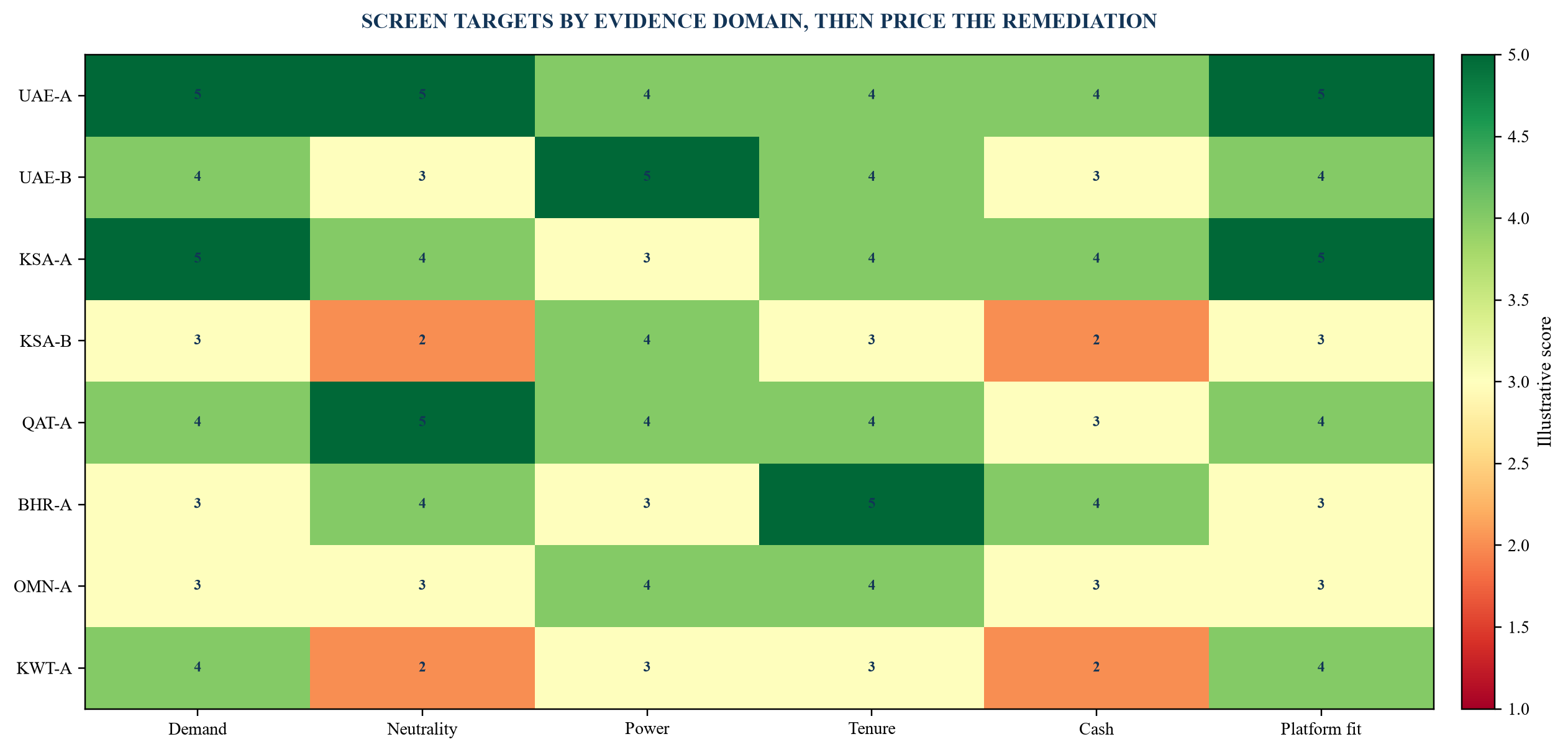
Scores are management assumptions for method demonstration and require source-backed diligence.
6. Underwrite network density and local traffic exchange
Network density is a cumulative advantage when each new participant increases the practical connectivity available to customers. The acquisition team should count active networks, physical cross-connects, internet-exchange participants, route-server use, cloud connections, content caches and customer traffic relationships. Logo lists should be reconciled to contracts, ports, bills and live configuration.
Internet Society materials explain that local internet exchange can keep traffic local, reduce routing distance and lower cost and complexity. Its 2026 work also warns that selective, remote or centralised peering can weaken local infrastructure and introduce dependency. A platform should therefore build local participation and route diversity rather than route every market through one hub.
Operator disclosures offer directional context. DE-CIX stated in February 2026 that UAE-IX had more than 110 connected networks, peak traffic above one terabit per second and 6.6 terabits per second of connected capacity. Its 2025 annual report described more than 230 network connections across its Middle East operations. These are operator-reported measures. They do not establish traffic quality, customer retention, revenue, capacity at a target site or the economics of an acquisition.
The diligence model should calculate network contribution at both site and platform level. It should show new autonomous systems added, overlapping carriers, unique routes, concentration by provider, cross-connects per customer, port utilisation, traffic locality and cost per delivered unit. The integration case should identify which connections can be sold, which require consent and which depend on third parties.
7. Trace power, cooling and technical readiness
Edge sites can be small in aggregate and difficult to upgrade. Power availability, connection date, tariff, redundancy, generator rights, cooling design, rack density, structural load, access and maintenance windows can constrain the workloads that a site can support. The buyer should trace each capacity claim from utility right through commissioned equipment to billable and occupied load.
The International Energy Agency reported that global data-centre electricity demand increased sharply in 2025 and that grid and supply-chain bottlenecks were tightening. Its 2026 analysis examines the speed at which grids and equipment supply can respond. Those global findings reinforce the need for power diligence; they do not forecast a specific GCC site's availability or tariff.
The technical critical path should cover utility reservation, design approval, long-lead equipment, civil work, commissioning, customer acceptance and revenue activation. Each dependency needs an owner, evidence date, cost range and contingency. The capital plan should separate already commissioned capacity, funded upgrade, unfunded potential and speculative expansion.
Cooling and density require a workload view. A conventional enterprise cabinet, a gaming cache, a private-cloud cluster and high-density artificial-intelligence inference can create different heat and power profiles. The target's current equipment may serve its existing customers while being unsuitable for the buyer's proposed product. The underwriting should value current cash and separately price a verified upgrade pathway.
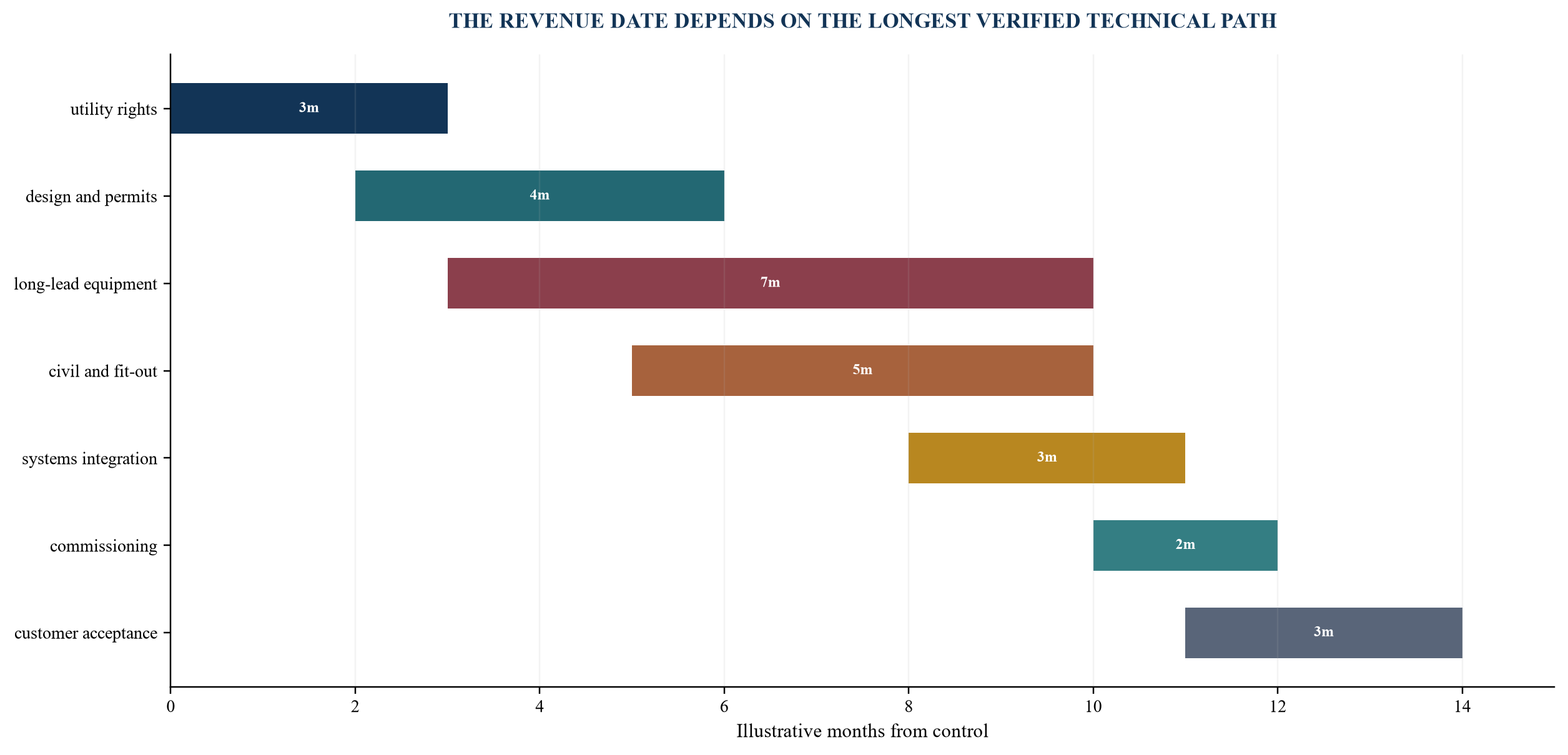
Durations are illustrative management assumptions; actual lead times require utility, vendor and engineering evidence.
8. Build a contract-to-cash model for every site
Platform value begins with recurring cash that can be traced from contract to invoice and bank receipt. The model should classify cabinet and space charges, power, cross-connects, internet exchange ports, cloud connectivity, remote hands, managed services, installation and credits. Gross revenue can overstate quality when pass-through power or low-margin resale forms a large share.
Customer term should be measured after break, termination, relocation, service-credit and change-of-control rights. A contract with a familiar brand may sit with a thin subsidiary. A public-sector customer may require procurement compliance and annual funding. A network customer can be valuable to the ecosystem while contributing modest direct revenue. The model should show contractual obligor, guarantee, service, site, margin, expiry and switching cost.
Collections require operational evidence. The buyer should reconcile billed, collected, overdue, disputed, credited and written-off amounts by customer and service. It should examine deposits, advance billing, utility-payment timing and foreign-exchange exposure. The integration plan should establish common customer, contract, capacity, meter, invoice and receipt identifiers.
The base case should exclude unsigned renewals, uncommissioned capacity, unapproved price increases and sales opportunities. It can include an evidenced run rate where acceptance, billing and collections are complete. Any normalisation should have a documented rule and source. This method allows the investment committee to distinguish observed site cash from management initiatives.
Table 3. Site evidence scorecard
| Domain | Core test | Strong evidence | Remediation response |
|---|---|---|---|
| customer demand | service solves a measured local need and has a budget owner | signed order, acceptance, invoice and renewal history | customer discovery, pilot or price adjustment |
| network | independent routes and active interconnection increase choice | carrier agreements, cross-connect inventory, route maps and live ports | new entrance, carrier onboarding or route redesign |
| power and cooling | commissioned systems support the contracted load and resilience | utility agreement, single-line diagram, test results and meter data | upgrade programme, reserve and delayed consideration |
| tenure and permits | site can operate through the investment horizon | title or lease, permits, access, easements and consent analysis | condition precedent, extension or alternative structure |
| cash | recurring margin converts to timely collections | contract-to-bank reconciliation and customer ageing | billing cleanup, working-capital reserve and earn-out |
| controls | operations, cyber, billing and reporting are repeatable | procedures, logs, incident record, access control and audit trail | integration office and pre-close control plan |
The acquisition committee should see source quality and remediation alongside the score.
9. Separate base earnings from cost and revenue synergies
The acquisition model should present three layers: observed site economics, executable cost actions and customer-backed revenue actions. Observed economics use reconciled historical revenue, collections, operating cost, maintenance and capital requirements. Cost actions require a named contract, supplier, role, system or process. Revenue actions require a product, customer, capacity, price, sales owner and delivery date.
Cost synergies can arise from network transit, maintenance, insurance, software, monitoring, procurement, duplicate systems and central functions. Some savings demand new capital or create transition risk. Removing local staff before telemetry, access and escalation processes are stable can damage service. The model should show gross savings, implementation cost, timing, dis-synergy and recurring net benefit.
Revenue synergies can arise from cross-selling sites, cloud and exchange connections, regional contracts, service consistency and new workload capacity. They should remain outside acquisition debt sizing unless supported by binding orders and deliverable capacity. A sales pipeline is useful for resource planning and is not equivalent to contracted cash.
The investment committee should approve a synergy evidence ledger. Each line needs baseline, source, owner, action, dependency, cost, delivery date and realised cash. Finance should validate results after customer credits, churn and capital expenditure. Management incentives should reward collected margin and service quality rather than bookings or run-rate claims alone.
Table 4. Base earnings and synergy register
| Value layer | Inclusion rule | Evidence | Governance |
|---|---|---|---|
| observed recurring margin | signed, accepted, billed and collected service less attributable cost | contract, invoice, bank receipt, meter and ledger | finance-validated base case |
| cost synergy | executable action with identified baseline, cost, owner and date | supplier quote, organisation design, system plan and contract | integration committee approval and monthly tracking |
| revenue synergy | customer-backed order with capacity and delivery path | signed order, technical design, price and acceptance plan | excluded from base until acceptance and collection |
| avoided capital | documented removal or deferral of a funded requirement | approved capex plan, engineering study and replacement design | technical and finance validation |
| working-capital release | repeatable billing, collections or payment improvement | ageing, invoice cycle, contract terms and bank history | cash metric with reversal monitoring |
| valuation effect | cash flow supported by risk, growth and capital assumptions | approved model, sensitivity and independent advice | investment-committee decision, not a synergy |
Values in a live model require reconciled records and accountable owners.
10. Price the full acquisition-to-platform capital requirement
Purchase price is only the first cash call. The platform needs transaction fees, taxes, refinancing, equipment remediation, power upgrades, network entrances, cross-connect capacity, cyber controls, monitoring, billing, branding, customer transition, spare parts and contingency. Deferred maintenance and tenant-specific commitments can surface after closing.
The capex register should classify safety or compliance work, service continuity, lifecycle replacement, customer delivery, efficiency, integration and growth. Mandatory work belongs in the acquisition funding need. Growth capital should have a separate approval based on customer evidence and capacity. Combining every project into a headline "platform capex" number conceals timing and return.
The model should also include working capital. Utility and supplier payments can precede customer collections. Integration can delay invoicing or generate credits. A common procurement policy can require deposits. Customer migration and contract novation can interrupt billing. A liquidity reserve should reflect the actual cash cycle and transition risk.
Capital should be released through gates. For example, a site upgrade can require verified utility right, approved design, fixed-scope vendor offer, customer order, permit and commissioning plan before full notice to proceed. This approach preserves the option value of a node while preventing the platform from funding speculative capacity as if it were committed revenue.
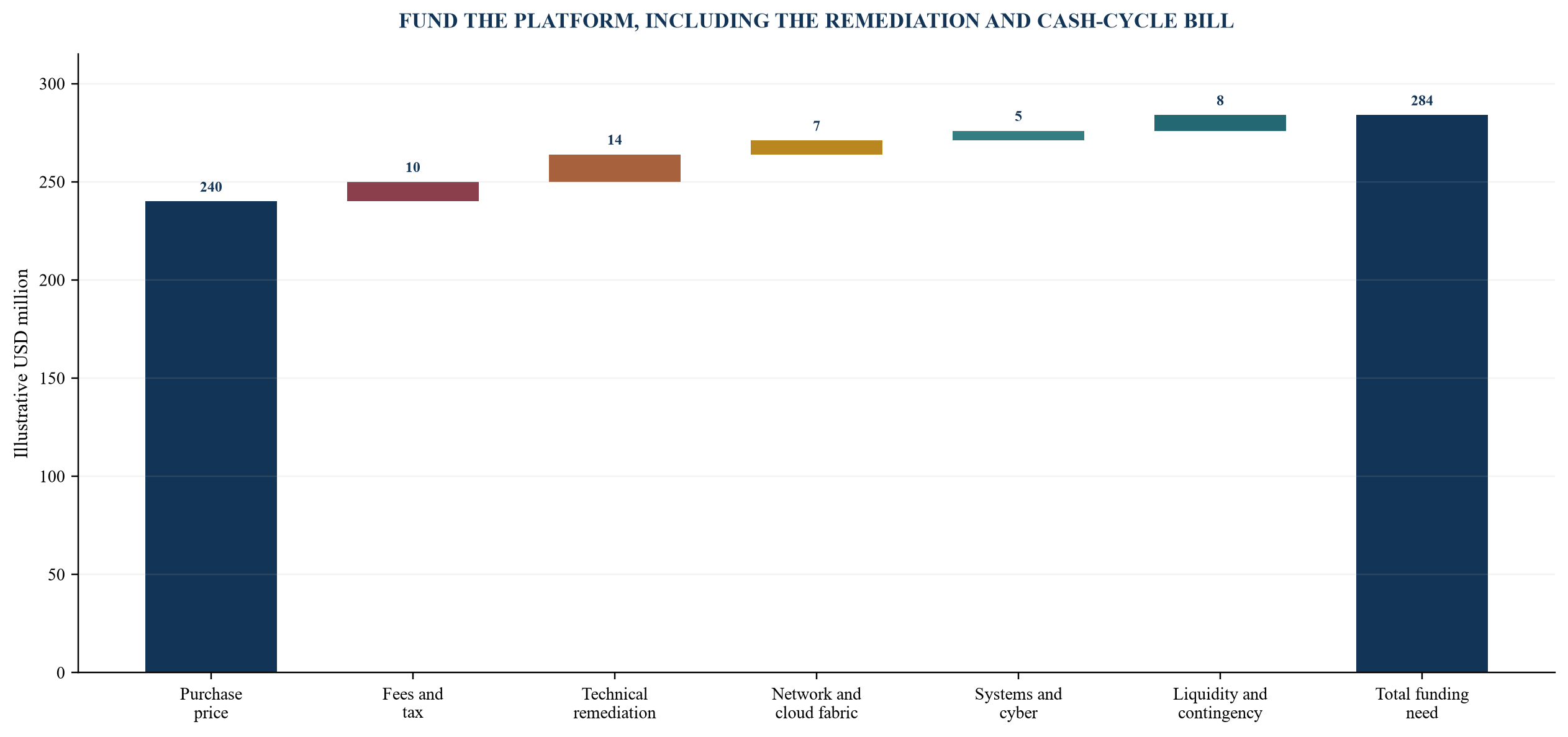
All amounts are management assumptions for method demonstration only.
11. Match products and offtake to site capability
A common product catalogue makes a distributed footprint saleable and operable. It should define space, power, connectivity, cloud access, security, remote support, reporting, service levels, order forms, acceptance, billing and change control. Local variations can remain where law, utility terms or customer needs require them, provided the exceptions are visible.
The product team should map each workload to minimum site conditions. Content cache may need strong peering and moderate density. Financial-services workloads may prioritise access control, audit, resilience and cloud connectivity. Industrial applications may need local integration and deterministic network performance. Artificial-intelligence inference may need higher density, specialised cooling and accelerated hardware support. Public-sector workloads can add sovereignty and procurement requirements.
Offtake should be measured through contract quality, margin and delivery readiness. A memorandum of understanding, forecast or capacity reservation without enforceable payment does not equal a firm order. The board should see signed capacity, accepted capacity, billable capacity, occupied load and collected revenue separately.
The platform can use anchor customers to support a node, while preserving space and network access for ecosystem density. Excessive dependence on one anchor can turn a neutral edge site into a single-user facility. The commercial plan should balance predictable cash with the cross-connect and customer diversity that support platform value.
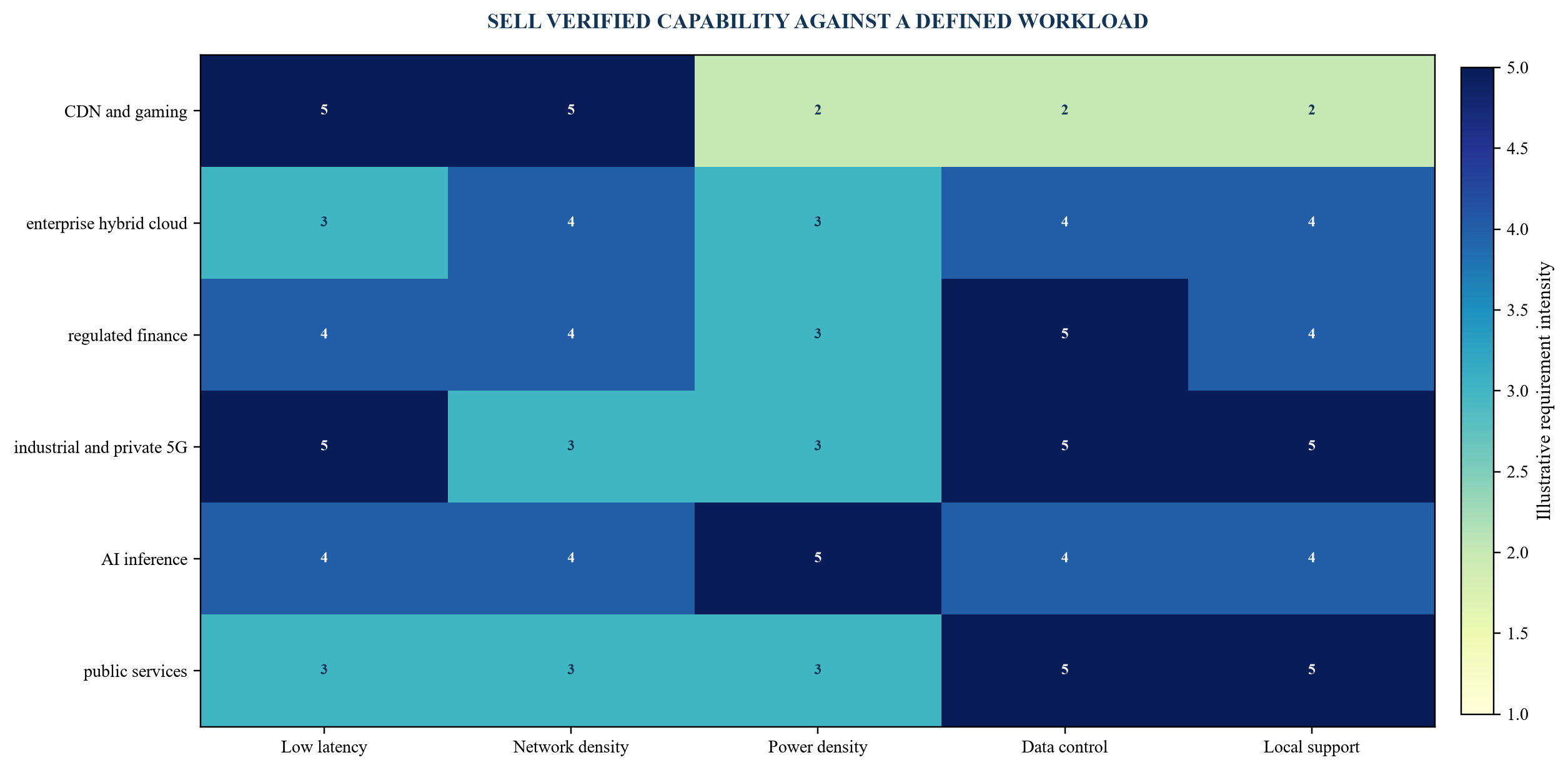
Ratings are illustrative; site and customer requirements require technical validation.
12. Choose the acquisition and control route
Full acquisition gives the buyer broad control and exposes it to the full remediation, funding and integration burden. A minority investment or joint venture can preserve local expertise and regulatory relationships while requiring reserved matters, information rights, funding rules and exit mechanisms. A carve-out can provide an attractive footprint and demand extensive separation from the seller's network, brand, systems, people and contracts.
A long-term lease or managed-service arrangement can secure a node with less upfront capital. Its value depends on access, control, service rights, renewal, change of control, termination, customer contracting and capex allocation. A greenfield infill site can complete a network where acquisition targets are unavailable, provided power, permits, customers and time are supportable.
Earn-outs and deferred consideration can bridge uncertainty around customer renewal, revenue, licences, power delivery and remediation. The metric should be observable, controllable and resistant to accounting manipulation. Payment linked to collected margin or commissioned, accepted capacity can be stronger than a broad revenue target. The documents should address integration decisions that affect achievement.
The route should match the evidence gap. A site with strong cash and clean control can support acquisition. A strategic node with uncertain demand may fit an option, lease or staged joint venture. A network facility owned within a telecom group may require a carve-out with transitional services. The board should compare control, capital at risk, speed, regulatory complexity, integration and exit for each candidate.
Table 5. Transaction route comparison
| Route | Control profile | Capital profile | Principal execution questions |
|---|---|---|---|
| full acquisition | direct ownership and integration control | highest upfront and remediation funding | price, liabilities, licences, consents, systems and people |
| majority or joint venture | shared control under negotiated governance | staged equity and partner funding | reserved matters, deadlock, related parties, future funding and exit |
| minority investment | influence through rights and information | lower initial capital with limited control | protection, reporting, path to control and alignment |
| carve-out | control after separation from seller | purchase plus transitional and stand-alone costs | contracts, licences, network, systems, employees and transitional services |
| lease or managed service | contractual operating rights | lower purchase cost with ongoing commitments | tenure, access, capex, customer contracting, termination and step-in |
| greenfield infill | designed to platform standard | phased development capital | power, permits, site, customers, schedule and construction risk |
Legal, regulatory, tax and accounting consequences require transaction-specific advice.
13. Design the platform operating model before closing
The operating model should specify which activities sit at site, country and group level. Site teams protect physical service and customer access. Country functions manage regulators, utilities, employment, tax and local vendors. The group can own product, network architecture, security policy, monitoring, billing standards, procurement, capital allocation and performance reporting.
A common network operations centre should monitor connectivity, capacity, alarms, incidents and maintenance. A security operations function should monitor cyber events, access and vulnerabilities. Centralisation should follow tested telemetry, escalation and remote-control capability. The buyer should preserve local response capacity where distance, language, regulation or site design requires it.
NIST Cybersecurity Framework 2.0 provides a governance-oriented taxonomy for managing cybersecurity risk. A roll-up can use current and target profiles to assess each site and create an integration backlog. The programme should cover identity, privileged access, network segmentation, logging, vulnerability management, supplier risk, incident response, recovery, data handling and board reporting.
The service model needs accountable owners. A customer should know where to order, escalate and review performance. An engineer should know the approved design and change process. Finance should reconcile contract, capacity, invoice, meter and cash. The board should receive service, cyber, customer, power, capital and cash measures from governed systems rather than manually assembled narratives.
14. Integrate systems and data without interrupting service
The platform data model should connect legal entity, site, room, rack, circuit, carrier, power allocation, customer, contract, service, ticket, invoice, receipt, asset, work order and incident. Duplicate or inconsistent identifiers prevent reliable capacity, billing and margin analysis. Data migration should begin with a dictionary and reconciliation rather than a bulk system upload.
Operational systems can include data-centre infrastructure management, building management, network monitoring, access control, ticketing, customer portal, billing, enterprise resource planning, customer relationship management and security tools. The target architecture should define the system of record, interfaces, retention, access and recovery for each domain. Temporary coexistence may be safer than rapid replacement where service continuity is at risk.
The buyer should create a day-one control pack. It should include contact trees, network and power diagrams, customer commitments, privileged accounts, vendor access, incident procedures, spare parts, insurance, cash accounts and regulatory responsibilities. Critical credentials and knowledge should transfer through controlled processes before seller access is removed.
Integration success should be measured through reconciled records, closed access gaps, tested recovery, accurate billing, incident response and customer experience. A software migration completed on schedule can still fail economically if invoices are delayed, cross-connect orders slow or capacity becomes unclear. The programme should use service and cash acceptance criteria for each system transition.
15. Protect neutrality during integration
Consolidation can unintentionally weaken neutrality. A group procurement team may prefer one carrier. A shared backbone may route customers through an affiliated network. Cross-connect pricing can favour large customers. A central sales team can bundle connectivity in a way that reduces choice. The platform should therefore convert neutrality into explicit governance.
The neutrality charter should state access principles, carrier onboarding, technical requirements, pricing logic, information separation, capacity allocation, complaint handling and related-party treatment. It should be reflected in product, order, site-access and staff procedures. Exceptions should have a defined rationale, approval and expiry.
Physical diversity needs continuing validation. Construction, landlord changes, carrier rerouting or new shared ducts can turn previously independent paths into common infrastructure. The platform should maintain route maps, entrance audits and failover tests. Marketing claims should match the verified topology.
Commercial teams should understand that network choice can create long-term value even when a particular cross-connect has modest revenue. Carrier and exchange participants attract customers and counterparties. The platform can measure ecosystem density through active networks, unique paths, ports, cross-connects, traffic locality and customer retention. These measures should sit alongside direct product margin.
16. Model an illustrative eight-site roll-up
The worked case uses eight hypothetical sites across the GCC. Every value is a management assumption for method demonstration. It is not a forecast, market quotation, valuation opinion, financing term or description of an existing target. The assumptions include USD 48 million of revenue, USD 12 million of site EBITDA, 18 megawatts of commissioned capacity, 11 megawatts of occupied or billable load, USD 240 million purchase enterprise value and USD 44 million of fees, remediation, systems, network, liquidity and contingency.
The base acquisition case excludes revenue synergy. It includes USD 3 million of recurring cost synergy after 24 months, subject to named initiatives and service protection. The platform would have a total illustrative funding need of USD 284 million. A 55 per cent debt and 45 per cent equity split would imply approximately USD 156 million of debt and USD 128 million of equity, before transaction-specific fees, lender requirements or adjustment. These percentages are assumptions rather than available market terms.
The downside combines 10 per cent customer churn on affected revenue, a one-site integration delay, 25 per cent higher technical remediation and a one-year synergy delay. Management would then reassess liquidity, covenant headroom, capex gates and consideration structure. The paper does not assign a probability to the downside.
The case shows why entry price cannot absorb unverified platform value. The buyer pays for observed cash and separately funds remediation. Synergy becomes value when the action is delivered and cash is collected. Network effects need measurable customer, carrier, traffic and retention evidence. This separation supports investment discipline and post-close accountability.
Table 6. Illustrative eight-site roll-up case and stress
| Metric | Base assumption | Downside assumption | Decision implication |
|---|---|---|---|
| sites | 8 | 8, with one delayed integration | stage integration and preserve local controls |
| commissioned capacity | 18 MW | 18 MW, with upgrade timing delayed | value current capability separately from planned density |
| occupied or billable load | 11 MW | 10 MW equivalent after churn | protect liquidity and revisit growth capex |
| annual revenue | USD 48m | USD 43.2m before replacement sales | exclude pipeline from debt and price case |
| site EBITDA before synergy | USD 12m | USD 9.5m after churn and cost pressure | test price, covenants and consideration structure |
| recurring cost synergy | USD 3m after 24 months | USD 3m after 36 months | fund implementation and track realised cash |
| purchase enterprise value | USD 240m | unchanged contractual price | use conditions, escrow, earn-out or reprice where evidence allows |
| total funding need | USD 284m | USD 287.5m after higher remediation | size liquidity and equity for execution risk |
All values are management assumptions for method demonstration only.
17. Stress technology obsolescence and customer migration
Technology risk is not a single curve. Power density, cooling, network ports, processors, storage, orchestration, security, software support and customer architecture can age at different rates. A building can remain physically sound while its product-market fit weakens. A lower-density site can retain value for enterprise, content or network workloads while being unsuitable for high-density artificial-intelligence deployment.
The asset register should record condition, support dates, capacity, compatibility, energy efficiency, replacement lead time and service dependency. The commercial register should record which customers rely on each technology. This link allows the platform to prioritise investment by revenue at risk and strategic value rather than by equipment age alone.
The model should test three responses: maintain for the current workload, retrofit for a validated customer need, or harvest cash while planning migration or exit. Retrofit requires a customer, technical design, outage plan, power and cooling path, price, contract and funding. A generic assumption that every site will support the newest workload can overstate terminal value and consume capital.
IAS 36 requires assets and cash-generating units to be carried at no more than recoverable amount, and it requires annual testing for acquired goodwill. IFRS 3 addresses recognition and measurement in business combinations. IFRS 16 addresses lease accounting. The transaction team should determine the accounting treatment and impairment indicators using current standards and facts.
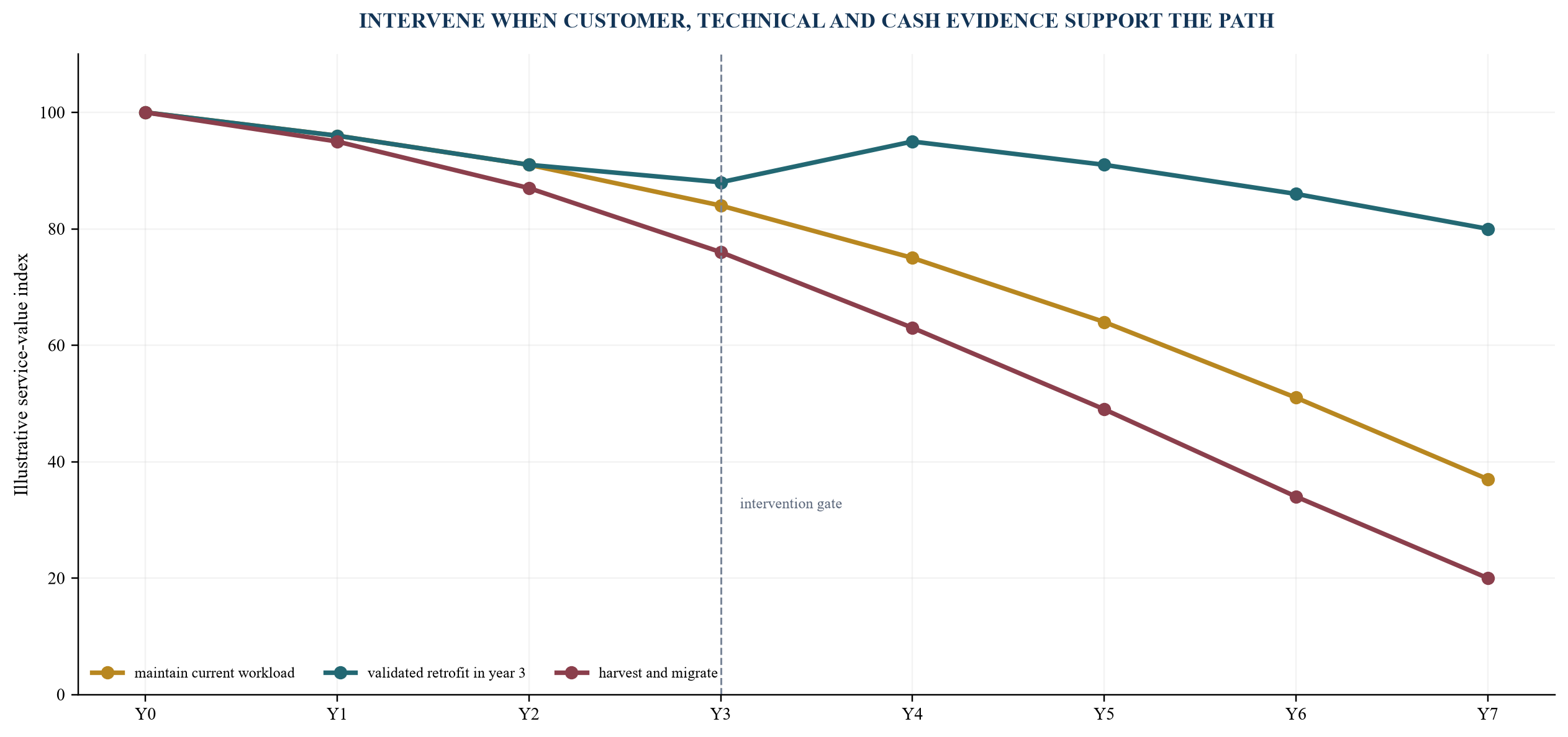
Curves are conceptual management assumptions; engineering and customer evidence determine actual intervention.
18. Run a 100-day integration office
The integration office should begin before signing and operate through defined acceptance gates. The pre-close phase establishes licences, consents, day-one controls, customer communication, cash accounts, access, critical vendors, transitional services, cyber containment and integration sequencing. Closing should occur only when the agreed conditions and operational controls are evidenced.
Days 1 to 30 should protect service and cash. The team reconciles customers, contracts, capacity, billing, bank accounts, privileged access, incidents, maintenance and regulatory duties. It freezes non-essential system changes, confirms escalation and tests reporting. Customers receive a clear service and commercial contact without unnecessary contract disturbance.
Days 31 to 60 should standardise the operating baseline. The platform approves product definitions, network and power records, capacity rules, security priorities, vendor actions, capex gates and synergy owners. It begins carrier onboarding and cross-selling only where service delivery is ready. Finance validates the first integrated contract-to-cash report.
Days 61 to 100 should launch governed value creation. The platform activates approved procurement, network, product, systems and commercial initiatives. Each initiative has baseline, cost, dependency, customer effect, cash milestone and acceptance owner. The board receives a combined service, customer, network, power, cyber, capital and cash dashboard. Unresolved critical items remain visible with owner and decision date.
19. Govern a 24-month buildout and value-creation agenda
The platform should sequence expansion by evidence. Node selection precedes site design. Customer and traffic evidence precede final capacity. Power and permits precede equipment orders. Signed service and acceptance precede base-case revenue. This order protects capital while allowing the group to reserve strategic options.
The 24-month agenda can use four waves. The first protects and standardises acquired cash. The second integrates network, monitoring, security, billing and procurement. The third launches customer-backed product and capacity initiatives. The fourth evaluates infill sites, refinancing, partnership or further acquisitions using the platform's observed data.
Board metrics should include signed and accepted recurring margin, collections, churn, contracted and available capacity, active networks, cross-connects, route diversity, power incidents, service credits, cyber exceptions, maintenance completion, capex against gate, realised synergy and cash conversion. Traffic, ports and sales pipeline provide context; mandate and capital decisions should use validated economics.
Acquisition performance should be reviewed against the original investment case. The review should bridge entry EBITDA, lost customers, price, volume, cost, capex, synergy, working capital and financing. It should show which assumptions were observed, management-estimated or unverified at approval and what occurred after closing. That evidence improves the next acquisition screen and limits narrative drift.
20. Convert the thesis into an accountable advisory mandate
A fixed-scope diagnostic can test whether a sponsor, operator, fund, family office or infrastructure investor has a viable carrier-neutral edge thesis. Deliverables can include the demand-node map, country applicability register, target universe, site scorecard, network-density review, power critical path, contract-to-cash model, capex bridge, transaction-route paper and board decision pack. The engagement should define client evidence, adviser roles, timing, exclusions and acceptance.
A retained transaction office can then support target screening, approach strategy, commercial and financial diligence, valuation, structure, financing materials, data-room coordination, negotiation analysis and integration planning. Legal, competition, regulatory, tax, accounting, engineering, environmental, cyber, insurance and independent valuation work remains with appointed qualified advisers. Matchpoint can coordinate those workstreams within the agreed mandate.
The commercial pathway should be measured through qualified decision-makers, accepted diagnostic scope, signed engagement, invoice, payment, target access, approved investment case, signed transaction and collected fees. Views, downloads and meetings are useful leading indicators and do not establish revenue. Commercial demand, mandate conversion, fee level and timing remain unverified until a client signs an engagement, invoices are issued and cash is collected.
Advisory revenue remains zero until those events occur. A buyer should authorise work when it needs a defensible acquisition thesis, evidence-backed target screen and integration model. The immediate decision is whether to commission a paid platform diagnostic with named data owners and a board date. The output should support a clear proceed, reshape, stage or stop decision.
References
- GSMA, Accelerating Digital Industries in the GCC and Wider MENA Region, 25 November 2025, https://www.gsma.com/newsroom/press-release/mena-emerges-as-global-leader-in-enterprise-digital-transformation-new-gsma-report-finds/
- GSMA, The Mobile Economy MENA 2025, https://www.gsma.com/solutions-and-impact/connectivity-for-good/mobile-economy/mena/
- Communications, Space and Technology Commission, Saudi Internet Report 2025, https://www.cst.gov.sa/en/knowledge-center/reports/saudi-internet-report-25-dashboard
- Communications, Space and Technology Commission, Regulations of Accessing Locally Hosted Internet Content, https://www.cst.gov.sa/-/media/cst-website-app/data/media/files/RALHIC-E
- Communications, Space and Technology Commission, Permit to Provide Internet Exchange Services, https://www.cst.gov.sa/en/business/services/Permit-to-provide-Internet-exchange-services-IXP
- Communications, Space and Technology Commission, Approved Access and Interconnection Reference Offer, February 2025, https://www.cst.gov.sa/regulations-and-licenses/regulations/Document-1608
- Communications Regulatory Authority of Qatar, KaopuCloud and Mibura Join Qatar Internet Exchange Point to Boost Local Connectivity, 6 July 2025, https://www.cra.gov.qa/en/press-releases/kaopucloud-and-mibura-join-qatar-internet-exchange-point-to-boost-local-connectivity
- Telecommunications Regulatory Authority, Kingdom of Bahrain, Licensees, https://www.tra.org.bh/en/category/licensees
- Telecommunications Regulatory Authority of Oman, Establishing an Internet Exchange Point in Oman, https://tra.gov.om/ViewPublicConsultations.jsp?code=21
- Telecommunications Regulatory Authority of Oman, Access and Interconnection Regulation, https://tra.gov.om/ViewNews.jsp?code=42
- ETSI, GS MEC 003 V4.1.1, Multi-access Edge Computing Framework and Reference Architecture, May 2025, https://www.etsi.org/deliver/etsi_gs/MEC/001_099/003/04.01.01_60/gs_MEC003v040101p.pdf
- ETSI, GS MEC 002 V4.1.1, Multi-access Edge Computing Use Cases and Requirements, June 2025, https://www.etsi.org/deliver/etsi_gs/MEC/001_099/002/04.01.01_60/gs_MEC002v040101p.pdf
- Internet Society, Community-Driven Internet Exchange Points, 2025, https://www.internetsociety.org/resources/doc/2025/community-driven-ixps/
- Internet Society, The Peering Disconnect, 2026, https://www.internetsociety.org/resources/doc/2026/the-peering-disconnect/
- DE-CIX, UAE-IX Powered by DE-CIX Ready for the 800 Gigabit Ethernet Era, 26 February 2026, https://www.de-cix.net/en/about-de-cix/media/press-releases/uae-ix-powered-by-de-cix-now-ready-for-the-800-gigabit-ethernet-era
- DE-CIX, Annual Report 2025, https://www.de-cix.net/_Resources/Persistent/6/6/5/8/6658352b75eed5e0e7173df5a12ff814fe1f3115/DE-CIX%20-%20Annual-Report-2025%20-%20final_Online.pdf
- Equinix, Inc., Form 10-K for the year ended 31 December 2025, https://www.sec.gov/Archives/edgar/data/1101239/000110123926000032/eqix-20251231.htm
- International Energy Agency, Key Questions on Energy and AI, 16 April 2026, https://www.iea.org/reports/key-questions-on-energy-and-ai
- National Institute of Standards and Technology, The NIST Cybersecurity Framework 2.0, 26 February 2024, https://www.nist.gov/publications/nist-cybersecurity-framework-csf-20
- Ministry of Economy and Tourism, United Arab Emirates, Regulation of Competition Legislation, https://www.moec.gov.ae/en/regulation-of-competition-legislations
- United Arab Emirates, Cabinet Decision No. 3 of 2025 on Ratios Related to the Implementation of Federal Decree-Law No. 36 of 2023 Regulating Competition, https://www.moec.gov.ae/documents/20121/0/Cabinet%2BDecision%2BNo.%2B%283%29%2Bof%2B2025%2BOn%2Bthe%2BRatios%2BRelated%2Bto%2Bthe%2BImplementation%2Bof%2BFederal%2BDecree-Law%2BNo.%2B%2836%29%2Bof%2B2023%2BRegulating%2BC.pdf/c8e816c6-4670-a5cd-906f-b5f0837011e9?t=1738899193286
- General Authority for Competition, Saudi Arabia, Economic Concentration Review Guidelines, https://gacbep.gac.gov.sa/cms/b9376edc-79a1-4573-a36d-4f3effaba838.pdf
- IFRS Foundation, IFRS 3 Business Combinations, https://www.ifrs.org/issued-standards/list-of-standards/ifrs-3-business-combinations/
- IFRS Foundation, IAS 36 Impairment of Assets, https://www.ifrs.org/issued-standards/list-of-standards/ias-36-impairment-of-assets/
- IFRS Foundation, IFRS 16 Leases, https://www.ifrs.org/projects/completed-projects/2016/ifrs-16-leases/
About the Author
Chennakeshav Adya, Independent Researcher
This research is provided for general information. It is not investment, legal, regulatory, competition, accounting, tax, engineering, environmental, cyber, insurance, valuation or financing advice. Sponsors, operators, investors and lenders should obtain current advice from qualified professionals and conduct transaction-specific diligence.
