Capital follows the evidence
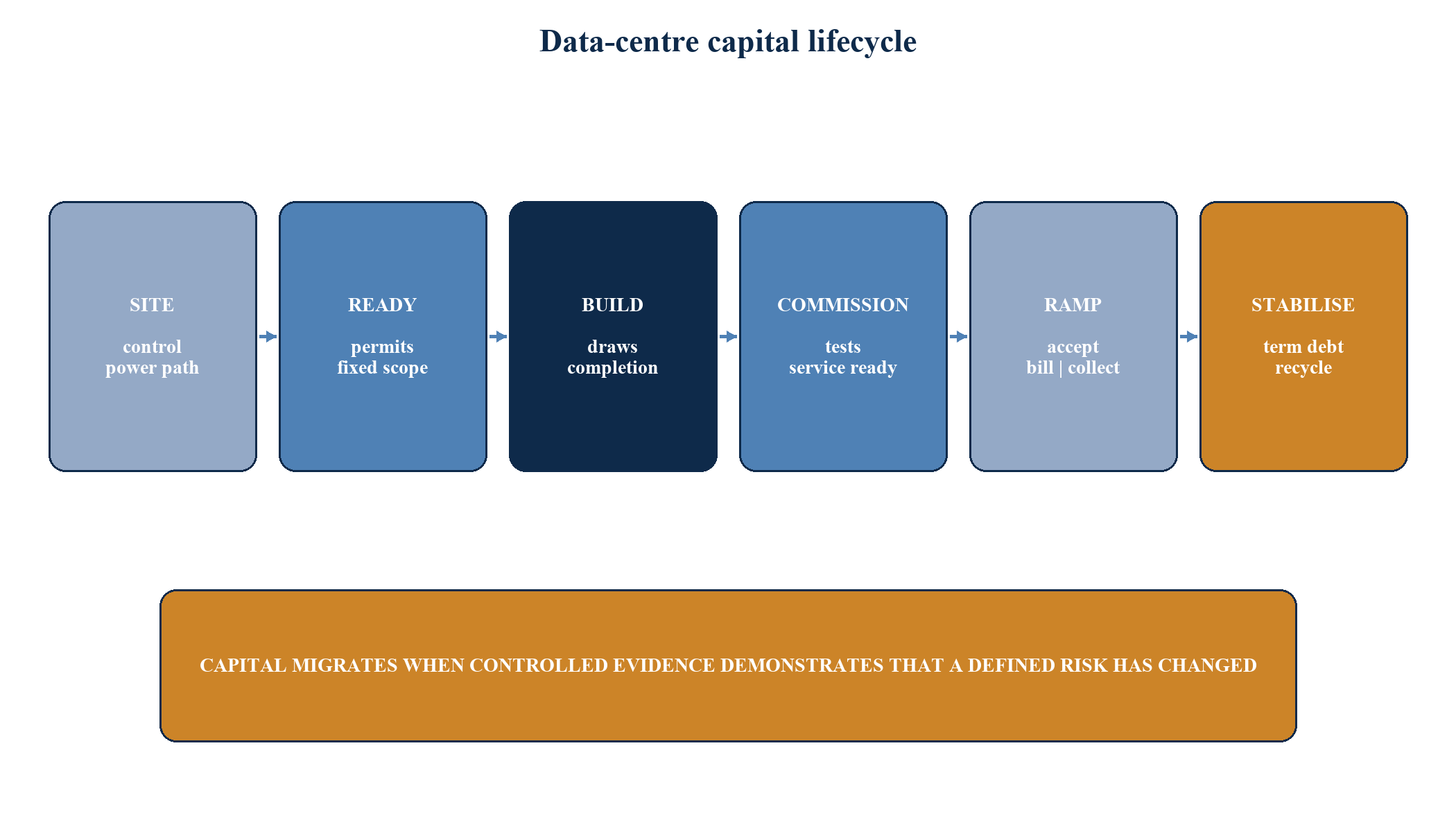
A data-centre campus moves through a sequence of distinct assets. A site option provides decision control. A ready-to-build project adds durable land rights, permits, a defined power path, an approved design, customer evidence and a funded delivery plan. Construction converts those rights and designs into physical capacity. Commissioning converts installed systems into tested service capacity. Lease-up and operating ramp convert capacity into accepted, billed and collected revenue. Stabilisation adds a sustained operating and cash-flow record.
Use one lifecycle gate for each capital decision
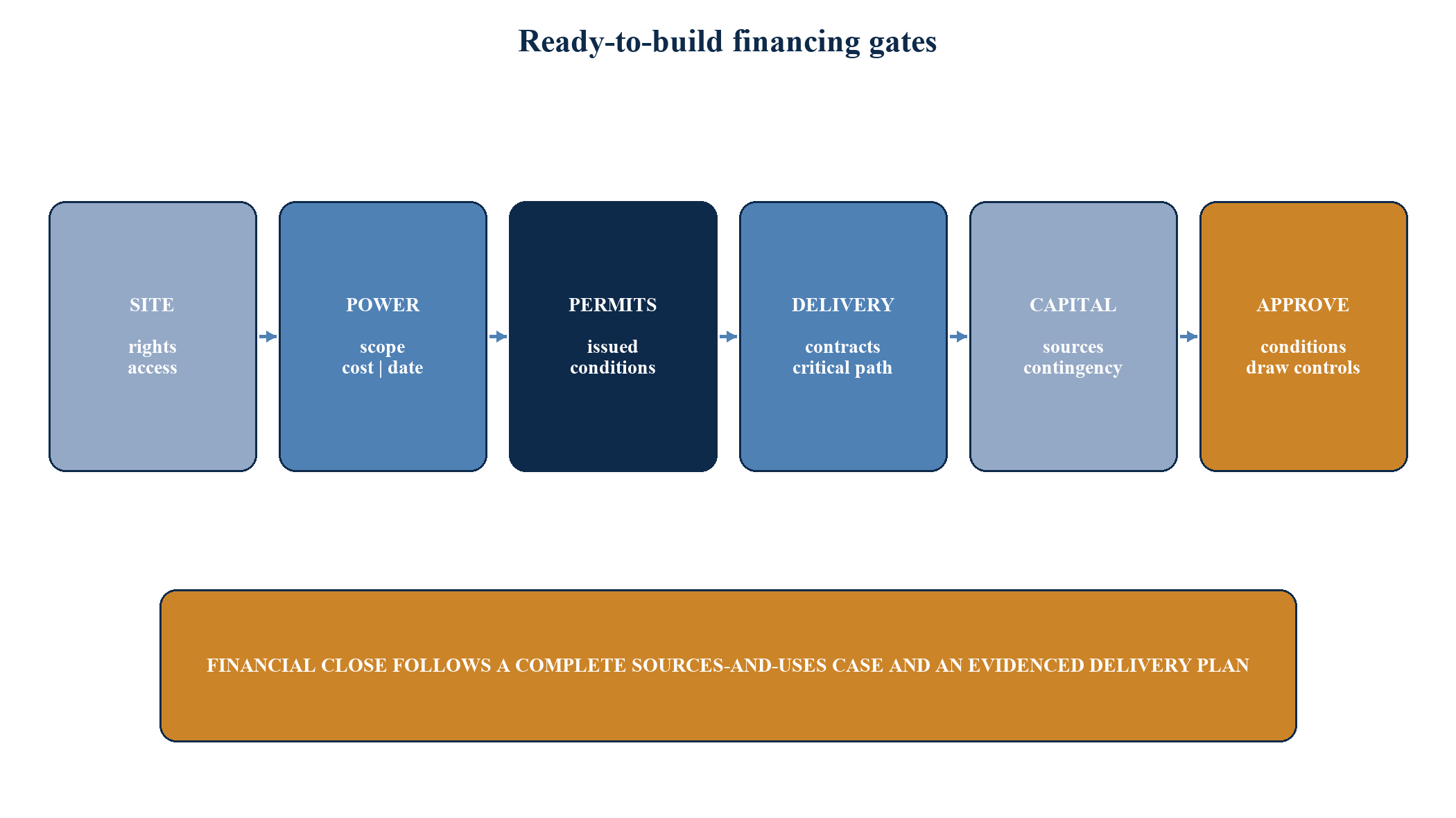
Each stage should have a stated question, evidence schedule, decision owner and capital consequence. Site and development equity fund information and optionality. Construction debt becomes appropriate after the project has a complete sources-and-uses case, controlled contracts and objective draw conditions. Mini-perm capital can bridge customer acceptance and operating ramp. Permanent debt relies on seasoned collections, operating performance and resilient contracts.
Keep risk states separate
Requested power is different from contracted and tested power. Reserved capacity is different from customer-accepted capacity. Technical completion is different from commercial stabilisation. Precise definitions stop a favourable label from carrying more financing value than the supporting evidence.
| Lifecycle question | Evidence required | Capital consequence |
|---|---|---|
| Can the site support the intended asset? | land, power, planning, fibre, water and environmental records | option capital or development equity |
| Is the project ready to build? | approved design, priced scope, permits, customer evidence and funding plan | construction financial close |
| Is physical progress creating financeable value? | certified work, procurement status, contingency and updated completion forecast | controlled construction draws |
| Can the facility produce contracted service? | energisation, integrated systems testing, customer acceptance and operating readiness | completion or mini-perm conversion |
| Has recurring cash flow stabilised? | occupancy, revenue, collections, operating performance and covenant headroom | permanent refinancing |
| Can capital be recycled? | seasoned portfolio evidence, valuation, governance and exit rights | portfolio debt, joint venture, bond or sale |
From site option to financial close
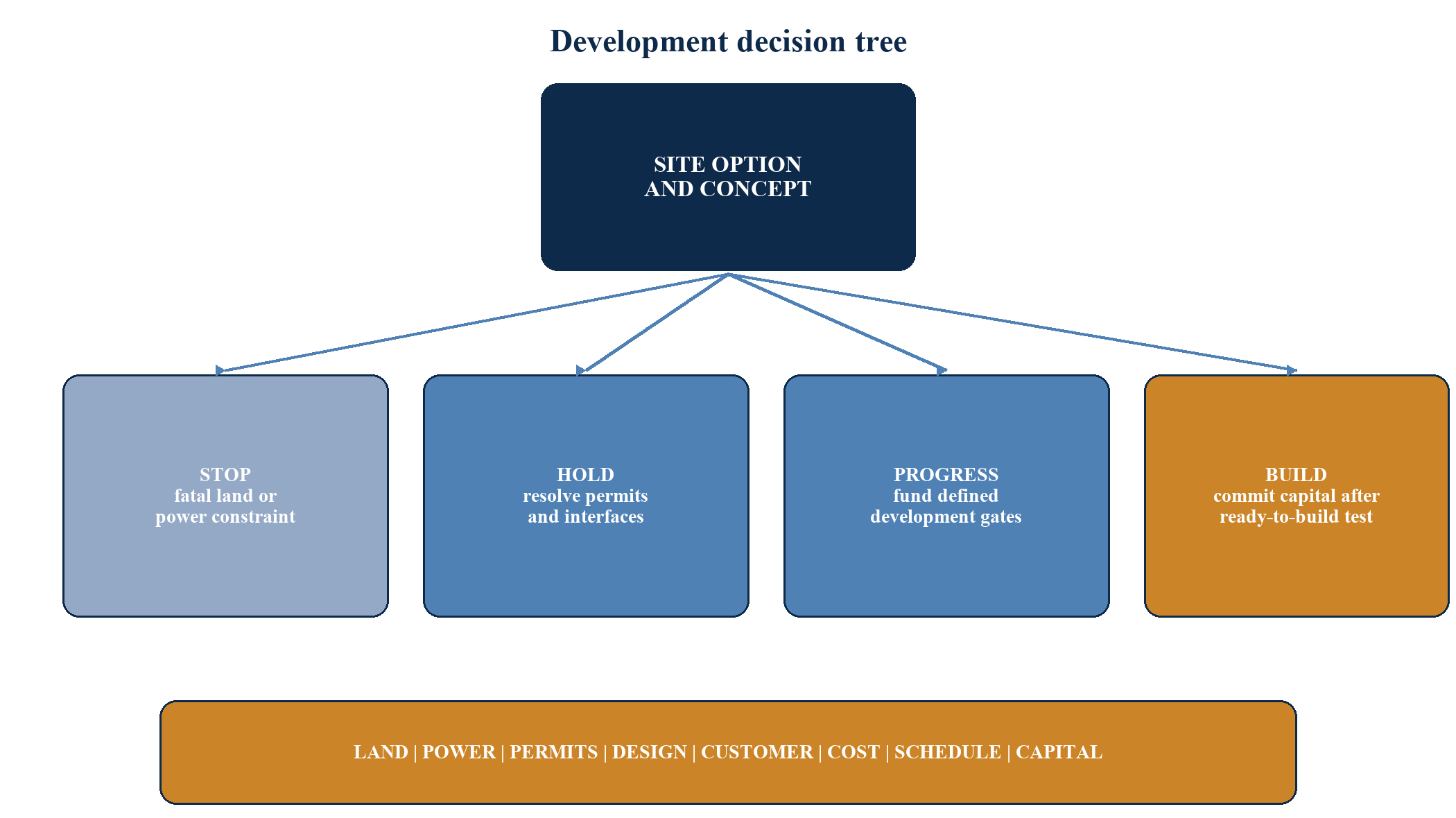
Early development capital should purchase information and limited rights. The site-control package should address title or lease rights, access, restrictions, environmental conditions, planning, fibre routes, water and cooling assumptions, and the route to permanent power. The option budget should identify the decision enabled by each workstream and the latest date at which management can stop, redesign, phase or proceed.
Define ready-to-build for the transaction
Ready-to-build is a financing state. The credit committee should approve a schedule covering land, material permits, power, design maturity, procurement, construction price, customer support, environmental and social requirements, insurance, budget, contingency, funding and governance. Open items remain classified by consequence; a permit that prevents physical work belongs at a different gate from a reporting item that can close after funding.
Fix the completion perimeter
The financing documents should state the facility, phase and systems being delivered, including permanent power, redundancy, cooling, fibre, security, operating capability, customer works and acceptance tests. Shared substations, common cooling, roads and network rooms require durable rights, cost allocation and operating obligations for the financed phase.
| Financial-close test | Minimum evidence | Failure response |
|---|---|---|
| land and permits | enforceable rights and permit schedule | close condition or reduced scope |
| permanent power | documented route, scope, cost and programme | draw gate, reserve or site decision |
| design maturity | approved design basis and interface register | additional design contingency |
| construction price | executed packages and procurement schedule | price contingency and sponsor support |
| customer evidence | executed pre-lease, reservation or controlled sales case | lower leverage or later conversion |
| funding sufficiency | monthly sources and uses through completion | equity first-loss and overrun support |
| environmental and social | completed review and action plan | conditions and monitoring |
Construction, commissioning and the capacity bridge
Construction draw control begins with eligible cost, certified progress and sufficient remaining sources. Every utilisation should update incurred and forecast expenditure, remaining contracts, contingency, claims, change orders, financing costs and equity contributions. The independent review should test whether committed and drawable sources cover forecast remaining cost and required reserves.
Protect commissioning liquidity
Commissioning can require test energy, specialist labour, consumables, temporary systems, repeated tests and defect correction before full billing begins. A dedicated reserve should remain available through integrated systems testing, permanent energisation, operating handover and the agreed customer-acceptance process.
Track capacity through to cash
The operating bridge should distinguish reserved, contracted, ready-for-installation, accepted, billed and collected capacity. It should record commencement conditions, pricing, energy pass-through, credits, customer credit and termination rights. The distinction identifies the operational and documentation tasks that convert demand into debt-service capacity.
Early operations also establish actual electricity, cooling, staffing, maintenance, insurance, security and connectivity costs. These results should be reconciled with design assumptions and customer recoveries. Availability incidents, service credits and operating exceptions should be recorded with their cash-flow and refinancing effects.
Stabilisation and refinancing
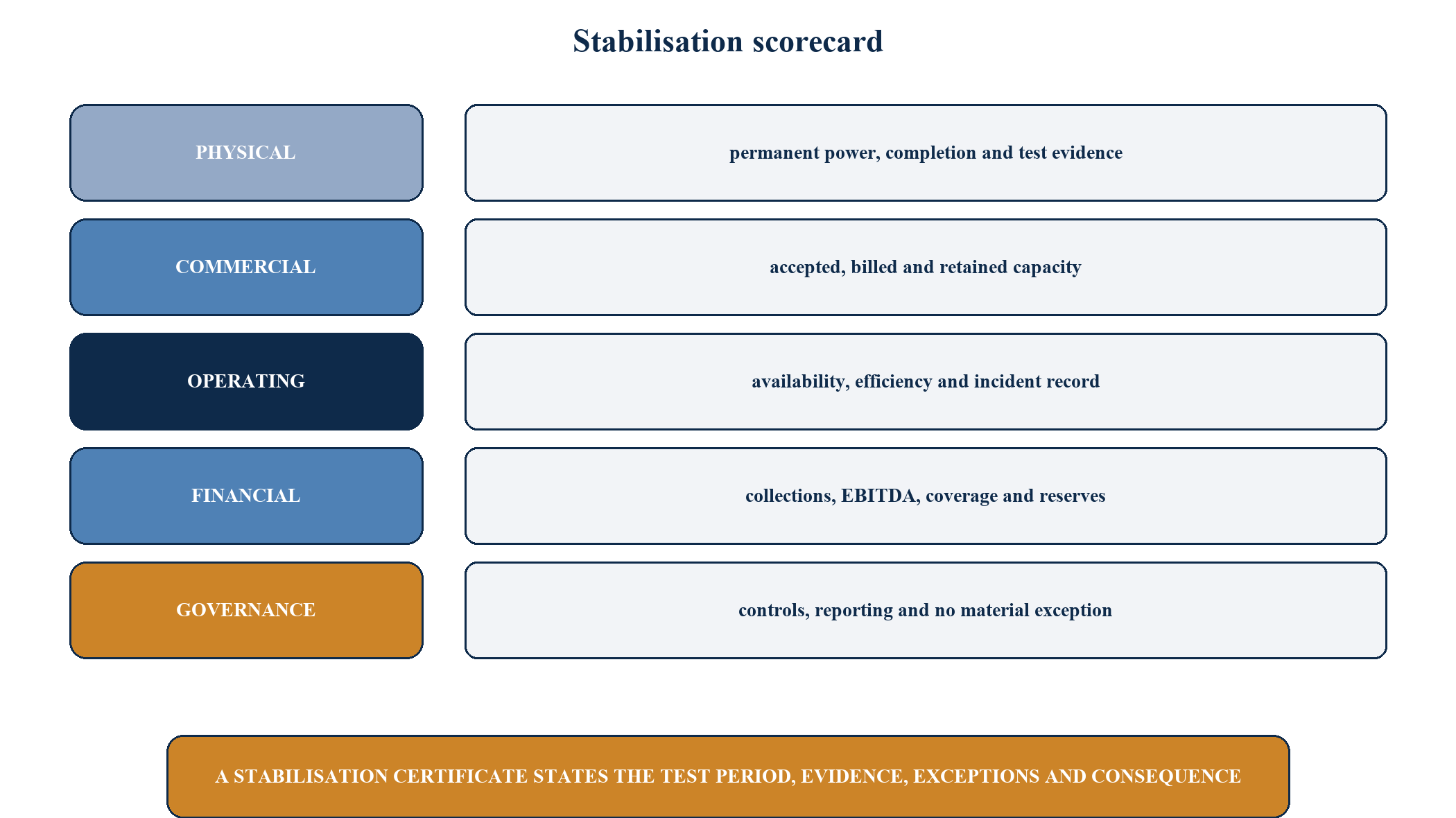
Stabilisation combines physical, commercial, operating, financial and governance tests over a defined period. The evidence can include permanent power, completion tests, accepted and billed capacity, recurring collections, operating costs, availability, efficiency, reserves, reporting controls and the absence of material unresolved defects or claims. A stabilisation certificate should state the measurement dates, evidence, exceptions and financing consequence.
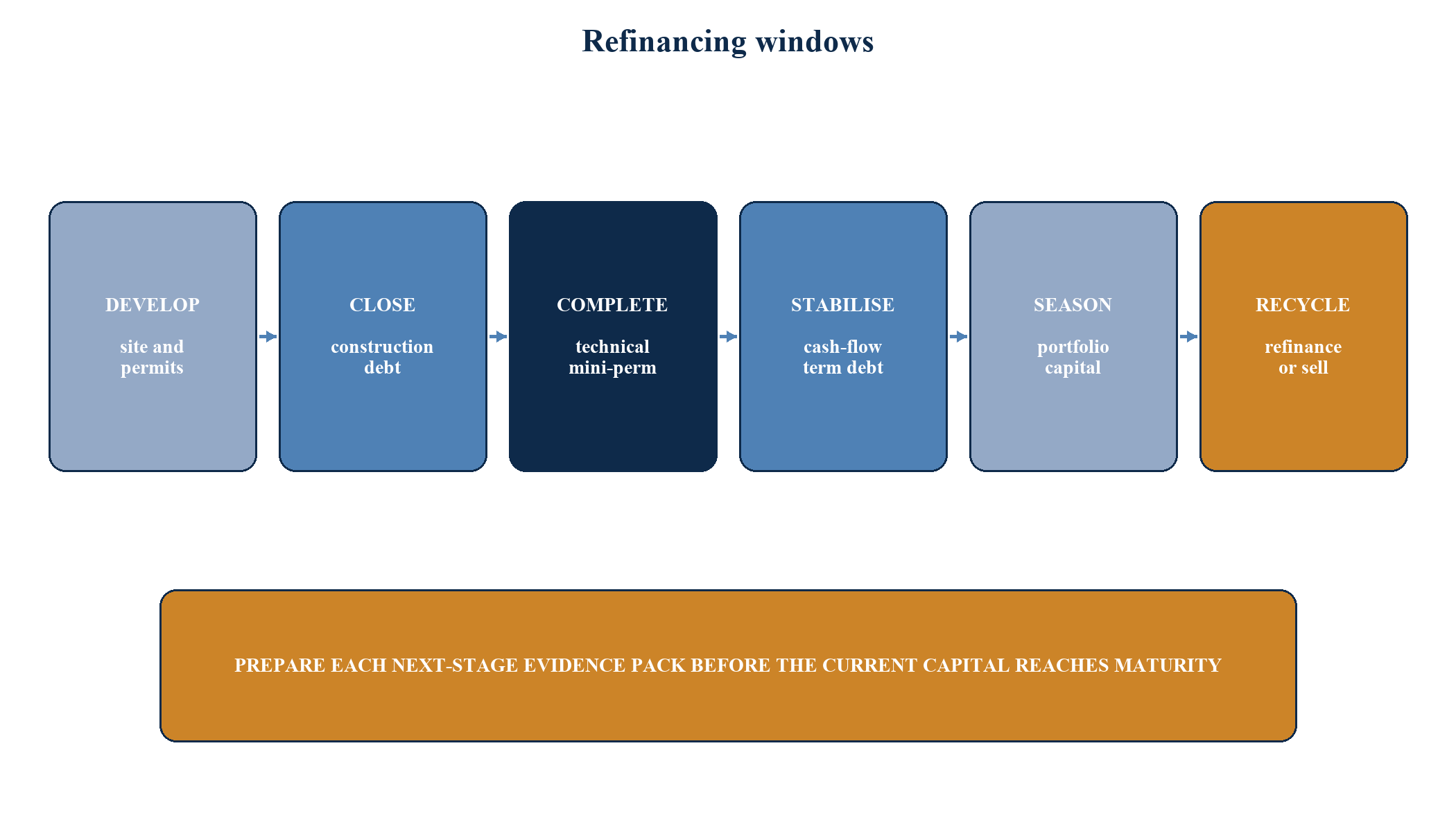
Prepare refinancing before maturity
The principal financing windows are construction close, technical completion, commercial stabilisation and portfolio seasoning. Each window needs a lender pack, valuation basis, debt-sizing method, consent and security-release plan, and a fallback if closing is delayed. Construction documents should preserve assignability, operating data, completion records and customer evidence for the next capital provider.
Apply independent sizing constraints
Permanent debt should be tested against cash-flow coverage, asset value and absolute exposure. Gross proceeds first settle existing debt, accrued interest, hedge and transaction costs, reserve requirements and remaining capital expenditure. Distributable proceeds are the residual allowed by the financing documents after future phases and operating resilience have been protected.
Once assets season, sponsors can retain them, refinance them, sell an interest, contribute them to a fund or joint venture, or aggregate them into a portfolio facility. Consistent contracts, reporting, security, sustainability data and operating definitions make future aggregation more efficient.
| Instrument | Principal risk financed | Core repayment source | Critical evidence |
|---|---|---|---|
| site or development facility | entitlement and site readiness | construction close or site sale | site rights, permits, power path |
| construction facility | delivery, cost and completion | permanent refinance or asset sale | budget, contracts, engineer reports |
| equipment facility | procurement and asset life | project cash flow | title, security and equipment schedule |
| mini-perm | lease-up and operating ramp | permanent refinance | acceptance, billing and ramp evidence |
| permanent term debt | recurring operating performance | contracted cash flow | stabilisation certificate and accounts |
| portfolio facility | diversified operating assets | portfolio cash flow | asset eligibility and release mechanics |
A controlled implementation programme
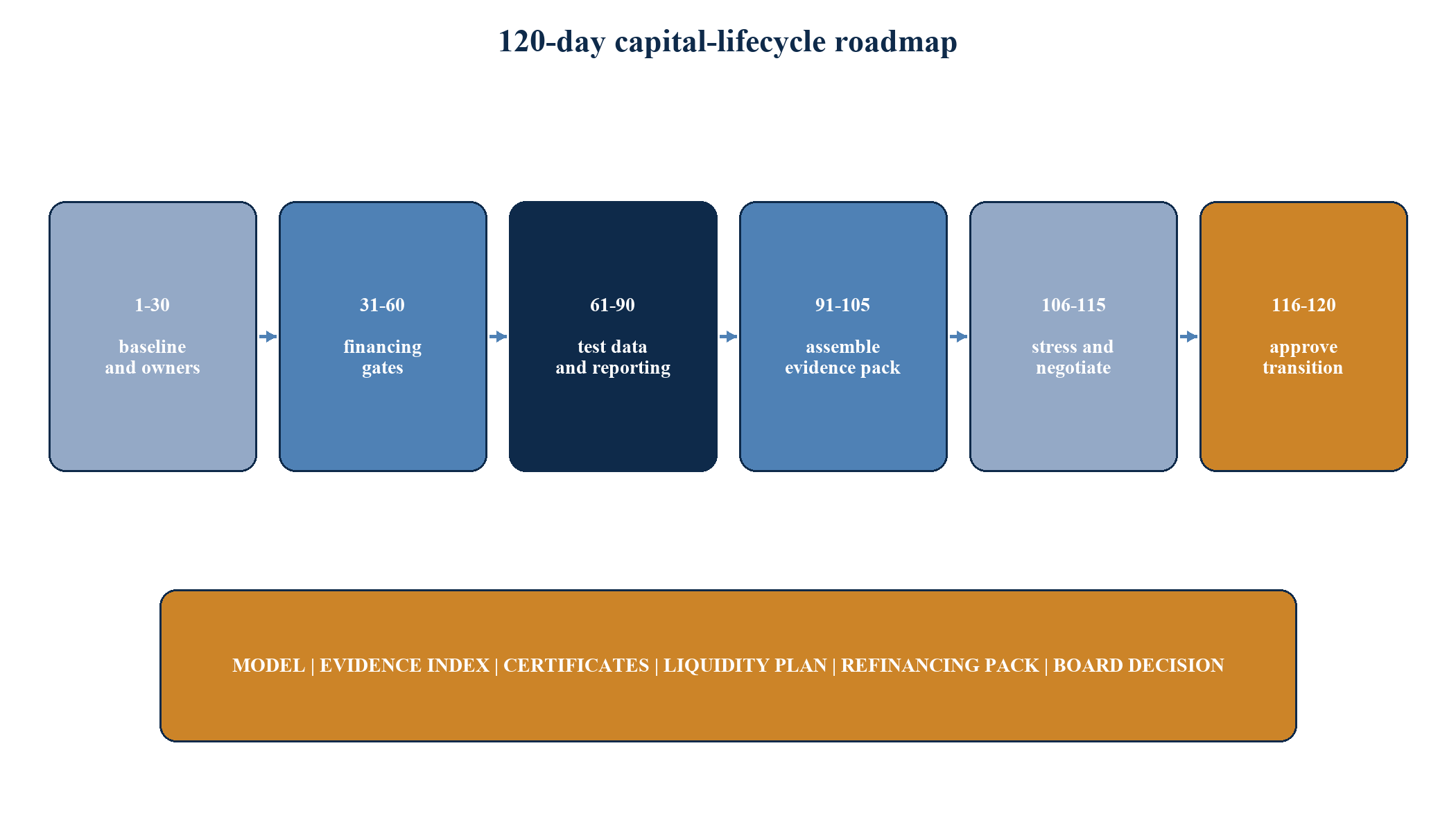
The first 30 days establish one milestone schedule, sources-and-uses statement, risk register, contract register, evidence index and metric dictionary. Days 31 to 60 convert the lifecycle into financing gates, draw controls, equity sequencing, account waterfalls and downside responses. Days 61 to 90 test the operating and reporting data flows through simulated draw, completion and stabilisation certificates. Days 91 to 120 assemble and stress the evidence pack for the next capital transition.
Model connected downside cases
Useful scenarios combine grid delay, construction overrun, equipment delay, slower customer acceptance, lower realised price, unrecovered operating cost and higher refinancing rates. The model should identify the maximum cumulative funding requirement, covenant position, maturity headroom and pre-agreed management response.
Keep assumptions identifiable
Executed contracts, verified technical evidence, controlled management information and modelling assumptions belong in separate evidence classes. Every material item should have an owner, date, source and review status. Scenario results should remain distinguishable from observed performance.
The discipline creates a direct connection between engineering delivery, customer conversion, cash flow and capital. Sponsors and lenders can then approve each transition with a clear understanding of the evidence achieved, support released, residual risks retained and fallback available.
| Document | Lifecycle purpose | Key negotiation point |
|---|---|---|
| facility agreement | funding and repayment | draw, completion, maturity and covenants |
| common-terms agreement | consistent definitions | capacity, cash flow and events |
| security documents | asset and cash-flow control | perfection, priority and releases |
| intercreditor agreement | creditor coordination | enforcement, standstill and turnover |
| direct agreements | continuity of material contracts | notice, cure and step-in |
| account agreement | cash waterfall | permitted withdrawals and reserves |
| equity support agreement | completion and shortfall support | amount, conditions and expiry |