Power readiness is a financing condition
Electricity is part of the revenue-enabling asset. A substantially completed building cannot deliver contracted IT capacity when the permanent connection, substation, protection scheme or commissioning sequence remains incomplete. The completion test should therefore connect the physical power system to the commercial definition of ready-for-service capacity.
Use a dated evidence ladder
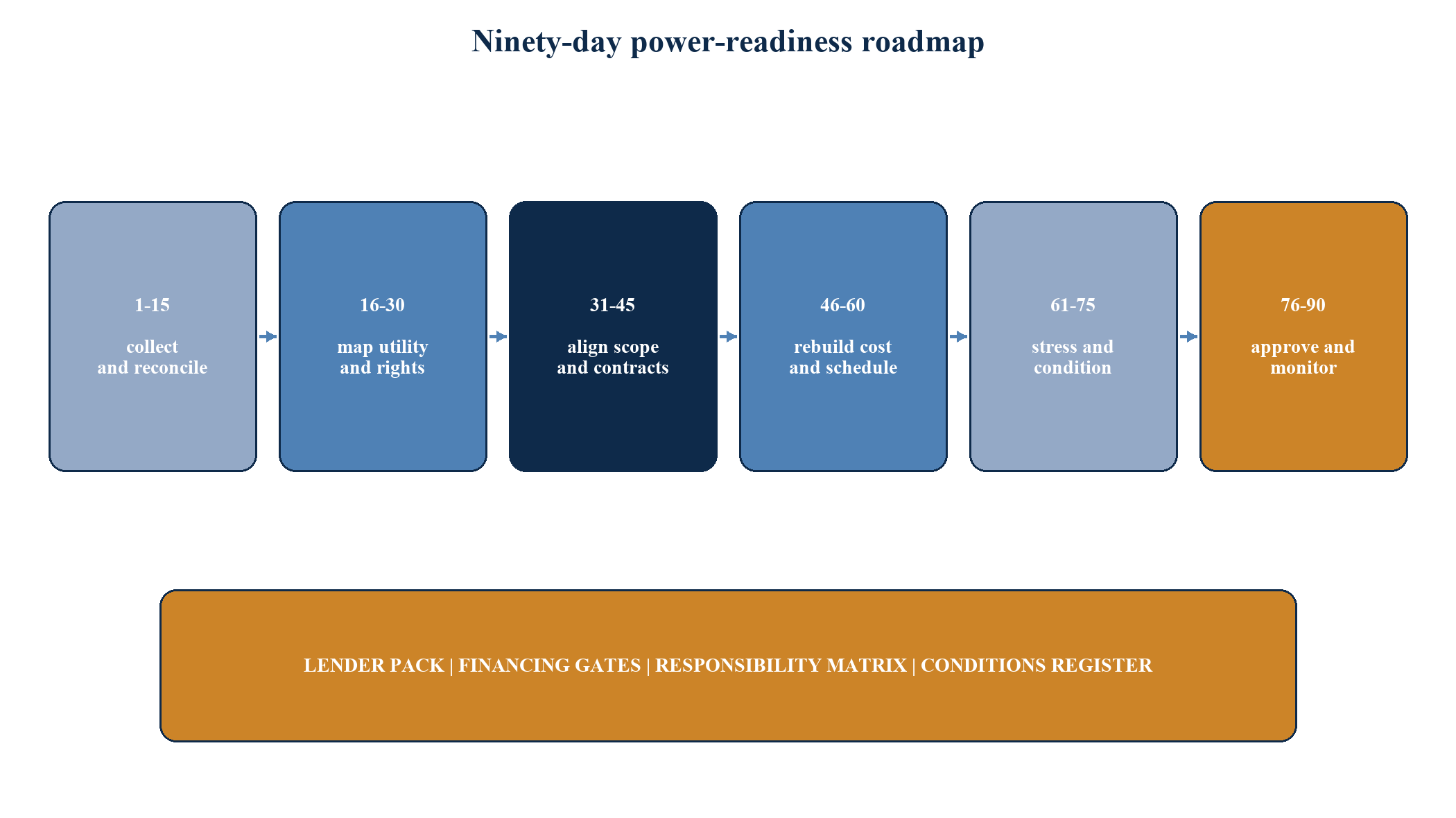
The readiness ladder distinguishes screened, submitted, studied, allocated, contracted and energised capacity. Each level is supported by a document, date, conditions and expiry. Development expenditure, major equipment orders, senior draws, customer commitments and completion can then be tied to the level actually achieved.
Reconcile the megawatt numbers
The utility application, electrical single-line design, tenant plan and financial model should use one reconciled demand schedule. IT load, facility maximum demand, power-usage efficiency, common loads, redundancy and phase timing must be stated separately.
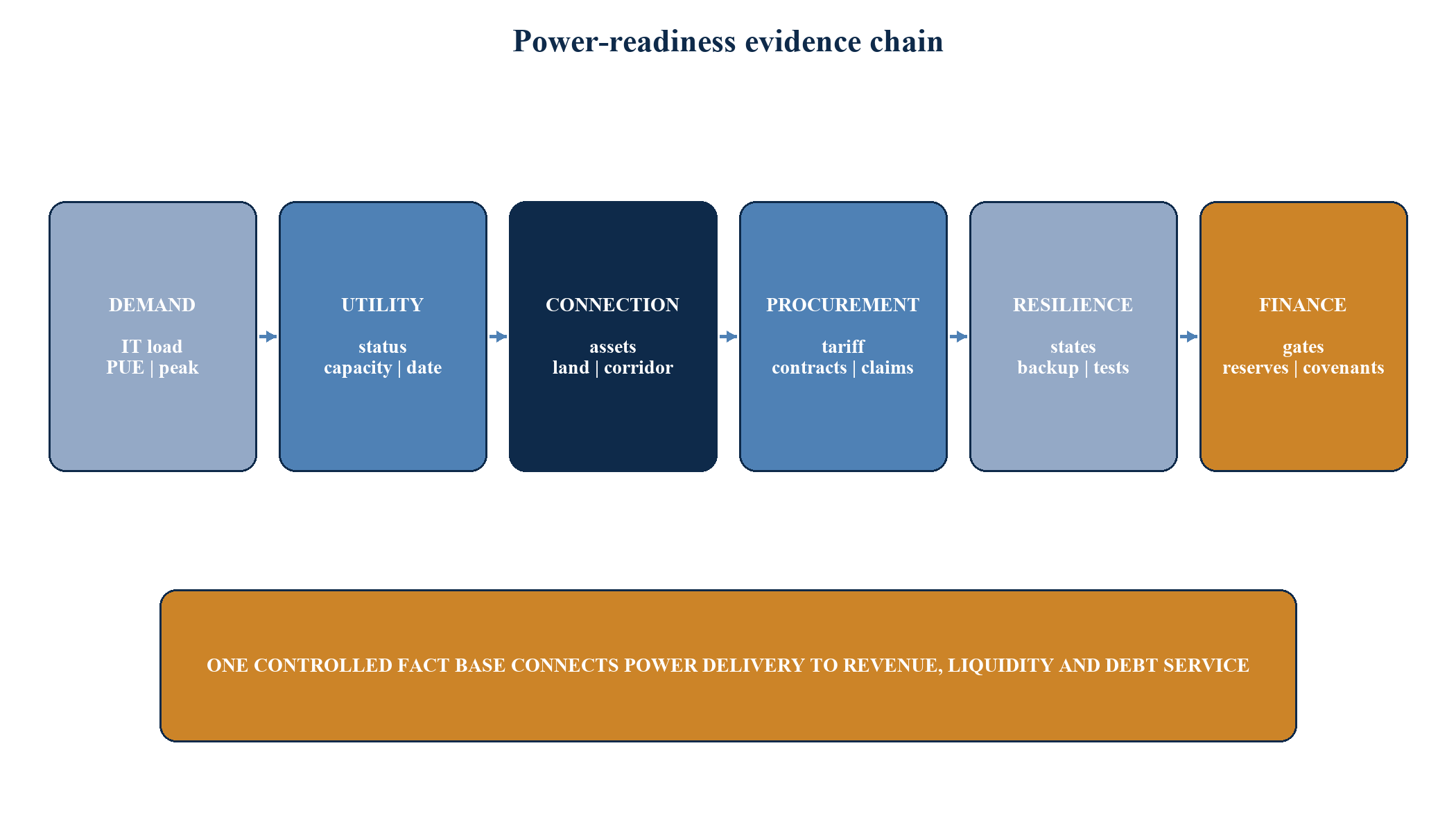
The credit committee can then identify which revenue assumptions depend on a utility decision, which costs remain provisional and which milestones belong in the financing documents. This converts power from a narrative risk into a controlled set of evidence gates. It also prevents a preliminary utility discussion from being treated as contracted capacity and allows uncertainty to be funded in stages.
| Financing question | Required evidence | Decision consequence |
|---|---|---|
| Is capacity available? | utility response, system study, connection point and phased allocation | site and phase go/no-go |
| Can it arrive on time? | critical path, network-asset scope, procurement lead times and approvals | drawstop, contingency and long-stop date |
| Is the supply reliable? | network topology, redundancy design, outage study and operating procedures | availability case and insurance review |
| Is the price controllable? | tariff basis, contract indexation, demand charges and procurement options | base case, downside case and covenant headroom |
| Is the environmental case credible? | energy mix, emissions method, efficiency plan and lender due diligence | eligibility, disclosure and risk conditions |
| Who carries delay and cost overrun? | interface matrix, contracts, guarantees, liquidated damages and reserves | risk allocation and financing structure |
From site plan to grid connection
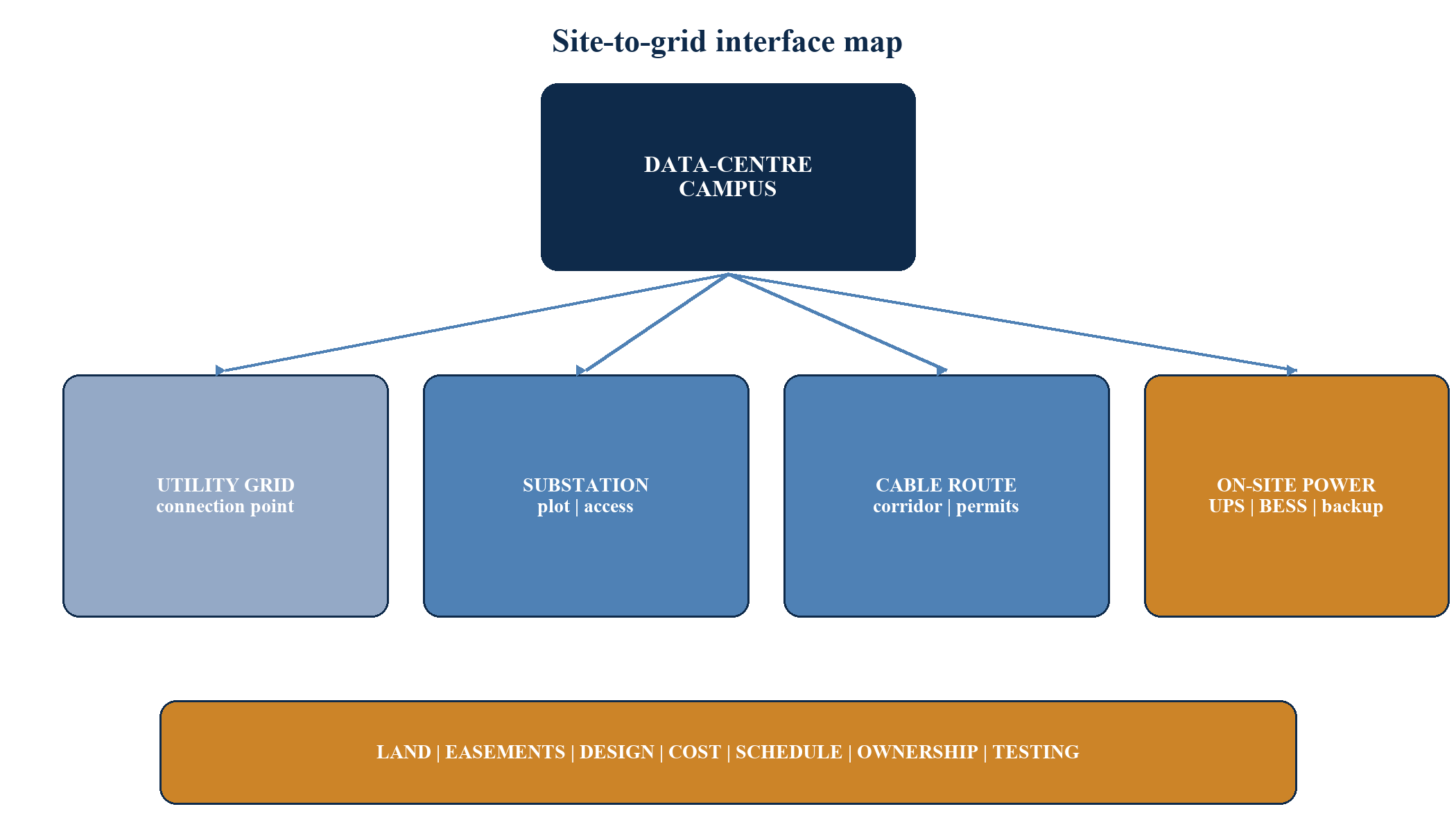
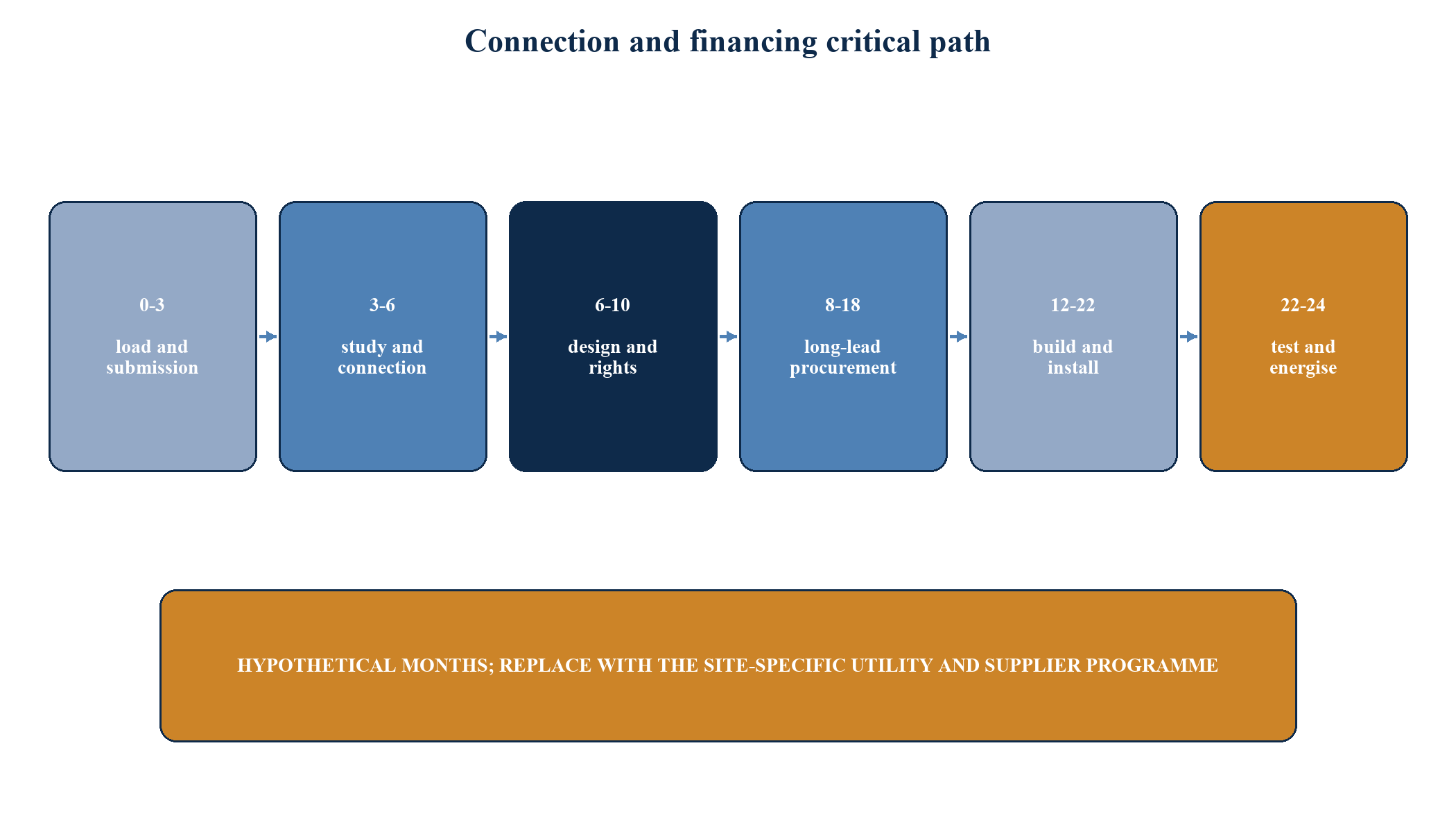
Power availability is spatial. The lender pack should place the connection point, substation plots, cable corridors, access, easements, fibre routes and future buildings on one controlled drawing. Land rights, network reinforcement and long-lead equipment sit on the same critical path as the building.
Classify schedule confidence
Every energisation date should be identified as contracted, stated in a formal utility programme, supplier-committed, engineer-forecast, sponsor-targeted or a modelling assumption. This prevents an internal target from being represented as a binding utility date.
Monitor physical milestones
Independent monitoring should cover submissions, design comments, corridor rights, equipment orders, factory testing, civil works, cable installation, protection, commissioning and permanent energisation. Each variance should be connected to the forecast liquidity effect.
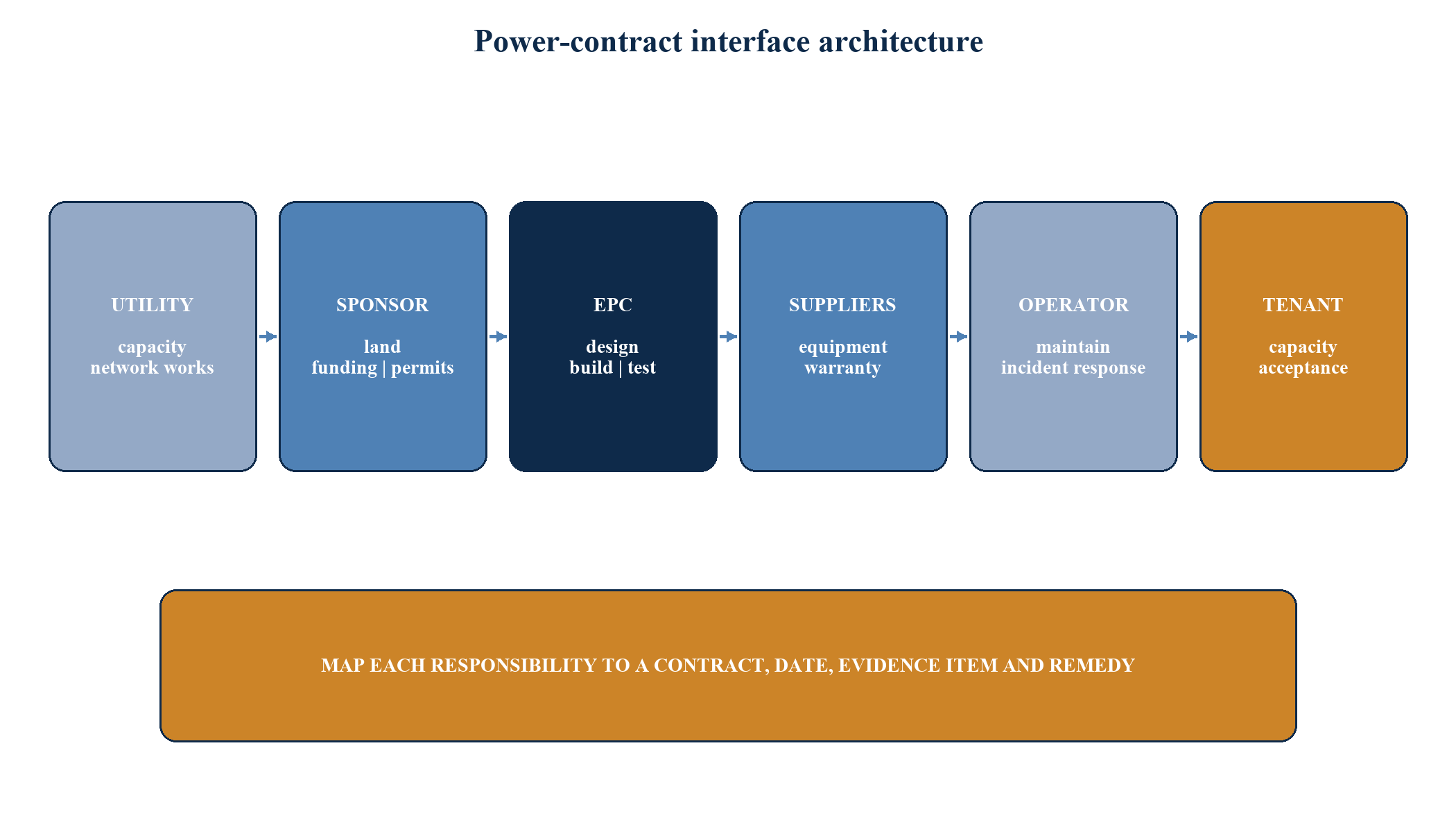
The utility, sponsor, EPC contractor, equipment suppliers and operator should work from one interface matrix. The matrix allocates design, approval, land, procurement, testing, cost and delay to a named party and contract. A responsibility described only in a presentation provides little protection when the programme slips; the lender needs the underlying obligation, evidence and remedy.
| Milestone | Evidence owner | Financing linkage |
|---|---|---|
| complete utility submission | sponsor and electrical consultant | early development expenditure |
| connection concept accepted | utility and engineer | site and phase approval |
| capacity and works documented | utility, counsel and engineer | financial close condition |
| long-lead orders placed | sponsor and suppliers | draw condition and contingency use |
| substation and corridor ready | sponsor, contractor and utility | construction progress test |
| testing complete | utility, engineer and operator | completion test |
| permanent energisation | utility | revenue and term-loan conversion gate |
Procurement, resilience and environmental claims
The physical foundation is the authorised site supply. Renewable certificates, captive generation, storage, backup generation and demand response can supplement it where current rules and contracts permit. Physical electricity, contractual renewable attributes, environmental reporting and outage cover require separate evidence boundaries.
Translate topology into operating states
The resilience case should show facility behaviour during loss of a utility feed, transformer, bus, UPS module, battery string, generator or cooling component. The operating-state matrix records load served, duration, automatic and manual actions, fuel requirements, customer impact and recovery.
Control sustainability reporting
Facility and IT meters, utility invoices, certificate retirement, emissions factors and calculation methods should feed a governed reporting chain. Any green or sustainability-linked financing structure needs defined eligibility, baseline, metrics, verification and adjustment rules.
Backup generation also carries fuel, emissions, noise, fire-safety, maintenance and logistics dependencies. Battery storage needs a defined service, duty cycle, degradation model and replacement plan. The environmental and social review should follow the material power and water assets supporting the data centre, including associated facilities outside the main site where lender standards require them.
| Financing stage | Power evidence | Typical control |
|---|---|---|
| development | submission and feasibility | sponsor-funded cap and reporting |
| long-lead procurement | accepted design and supply contract | deposit cap, security and assignment |
| construction | connection documents and works programme | certified draw and contingency test |
| commissioning | permanent supply and test plan | completion reserve and expert sign-off |
| operation | metering, service and maintenance | reporting, covenants and reserve accounts |
Financing gates and downside analysis
Early development capital carries connection and design risk. Senior construction debt can be released after executed connection arrangements, corridor rights, accepted equipment contracts, a complete network programme, an independent cost-to-complete certificate and funded contingency.
Stress combined power risks
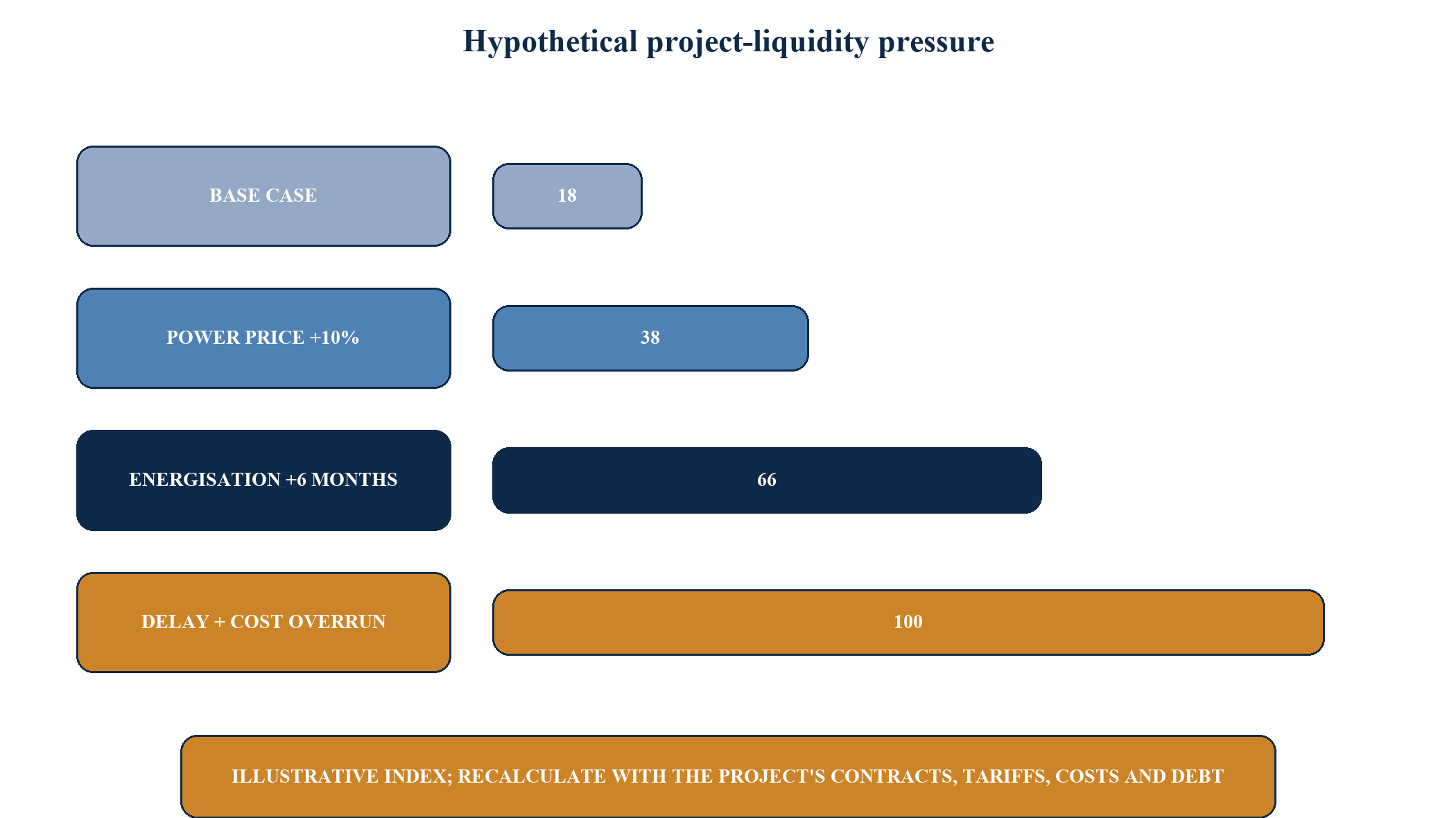
The core model should test energisation delay, phased capacity below plan, connection cost overrun, tariff increase, efficiency deterioration, slower occupancy, backup fuel use and battery replacement. Delay can increase capitalised interest while deferring contracted revenue, so combined stresses belong in the financing case.
Maintain the evidence chain after energisation
Operating reporting should cover electricity consumption, maximum demand, efficiency, availability, outages, generator tests, fuel, battery health, renewable instruments, emissions calculations, maintenance, capacity headroom and covenant status. Each metric needs a definition, source, owner, frequency and exception threshold.
Useful draw conditions correspond to the physical sequence: connection documents before senior construction funding, accepted equipment orders before deposits, corridor access before cable works, integrated tests before completion and permanent energisation before term conversion. The financing waterfall should also specify how delay is handled through sponsor funding, contingency, revised milestones, drawstops and long-stop remedies.
| Failure mode | Early warning | Control response |
|---|---|---|
| weak capacity status | no formal utility document | readiness ladder and legal review |
| unreconciled demand | inconsistent megawatt figures | single approved load schedule |
| hidden critical path | utility milestones absent | integrated programme and engineer monitoring |
| missing interfaces | obligations described only in presentations | contract responsibility matrix |
| fragile resilience | topology label without state tests | integrated systems commissioning |
| weak claim governance | certificates and physical supply combined | separate accounting boundaries |