

1. The financing problem is a race between cash generation and economic ageing
Compute equipment begins ageing economically before it is installed. Purchase commitments may be made months before delivery. Site readiness, power, cooling, network, firmware, software and customer acceptance can delay productive use after delivery. A new architecture can be announced while an earlier generation is still being deployed. Revenue can therefore start later than the financing clock, while competitive value can change faster than physical condition.
The underwriting question is not whether a processor or server remains capable of operating. It is whether the financed system can generate enough controlled cash, within its contracted and economically competitive period, to repay debt with an acceptable margin of safety. The answer requires a chain of evidence from purchase order to serial number, accepted capacity, utilisation, invoice, collection and debt service.
The United States market provides current public evidence. CoreWeave's filings describe delayed-draw facilities used to acquire GPU servers and related infrastructure, borrowing capacity linked to depreciated equipment purchase price and customer-credit quality, and amortisation that begins after specified deployment or commitment milestones [1-5]. NVIDIA's fiscal 2026 Form 10-K describes a one-year cadence for advanced data-centre architectures and notes that product transitions can affect inventory, warranties, supply, customer purchase timing and deployment [6]. These facts support a disciplined method; they do not provide a universal useful life or residual value.
Five clocks should be recorded separately:
1. Physical operating life: the period during which equipment can function safely with maintenance. 2. Accounting useful life: the period used for financial-statement depreciation and impairment analysis. 3. Tax recovery period: the statutory period and method used for US tax depreciation. 4. Contracted use: the period and capacity for which customer payment is enforceable. 5. Economic competitiveness: the period during which performance, energy use, software support and total cost remain commercially relevant.
The shortest clock does not mechanically determine debt tenor. It identifies the first point at which support may weaken. A lender should then test whether cash amortisation, customer renewal, lower-tier workloads, redeployment, sale or sponsor support provides a credible bridge.
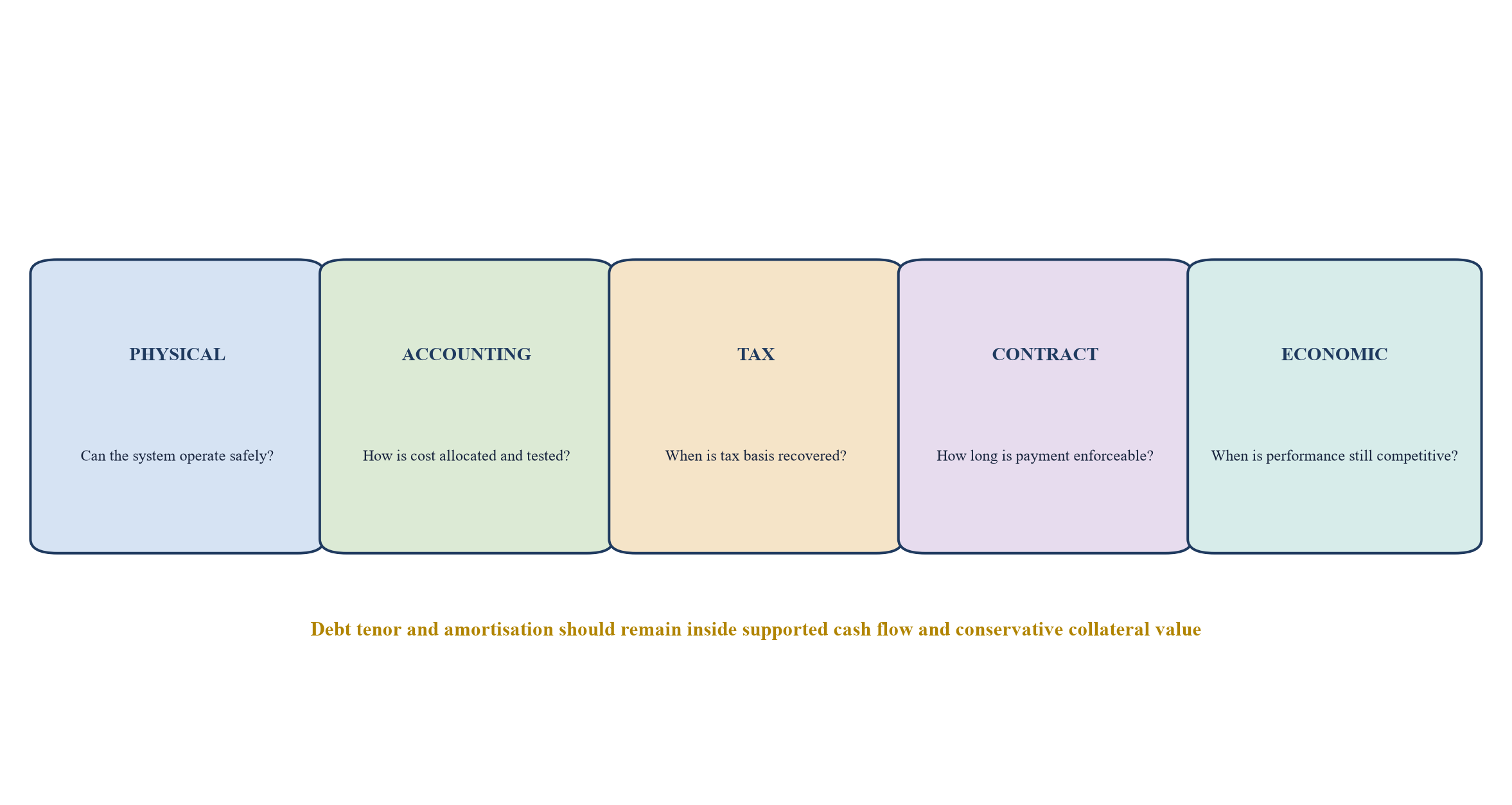
Physical, accounting, tax, contract and economic periods answer different questions and should be recorded separately.
2. Build a serial-level asset and rights register
The equipment register is the foundation of collateral control. It should identify each processor, server, rack, network component, storage device and material accessory by manufacturer, model, configuration, serial number, purchase order, invoice, cost, delivery date, acceptance date, installed location and legal owner. It should also record warranty, maintenance, firmware, software licence, export-control classification where applicable, insurance, lien status and current operating state.
System-level financing requires component-level discipline. A rack may include processors, memory, networking, power distribution, cooling interfaces and management software supplied by different parties. The value of the combined system can exceed the sum of saleable components when the configuration is supported and in demand. It can fall sharply when proprietary integration, missing software rights or removal damage prevents independent reuse. The register should therefore store both system relationships and separable component records.
Title and possession need separate evidence. A borrower may have paid a deposit without receiving title. Equipment may be delivered to a data-centre operator, integrator, colocation provider or customer site. It may be held by a special-purpose borrower while operated by an affiliate. A lender's security analysis should identify the legal owner, bailee or custodian, location, access rights, competing claims, landlord or operator waivers, and steps required to perfect and enforce security under applicable law.
Software rights are part of the economic asset. Firmware, drivers, orchestration, virtualisation, security tooling and vendor support can determine whether hardware can be redeployed. The register should identify whether licences are transferable, tied to a customer or operator, prepaid, subscription-based or dependent on continued support. A collateral appraisal that assumes functioning software without verifying these rights can overstate recovery.
Data and sanitisation are also disposition conditions. NIST Special Publication 800-88 Revision 2 describes an enterprise media-sanitisation programme for reuse and disposal [11]. Storage devices, logs, model data and customer information should have approved sanitisation, certification and chain-of-custody procedures. A recovery route that cannot satisfy confidentiality obligations may not be usable on the required timetable.
Table 1. Minimum equipment and rights register
| Field | Required evidence | Financing purpose | Review trigger |
|---|---|---|---|
| Identity and configuration | Manufacturer, model, serial, rack and component map | Prevents duplicate or ineligible collateral | Installation, swap or repair |
| Cost and delivery | Purchase order, invoice, payment and acceptance | Establishes funded basis and draw eligibility | Change order or rejection |
| Ownership and location | Title, borrower, operator, custodian and site | Supports security and access analysis | Transfer or relocation |
| Operating state | Commissioning, uptime, capacity and workload | Connects asset to revenue generation | Material outage or underuse |
| Software and support | Licence, firmware, warranty and maintenance | Tests continued usability and transfer | Version or support change |
| Insurance and liens | Policy, loss payee, lien search and waiver | Protects priority and casualty proceeds | Renewal or new financing |
| Export and transfer | Classification, destination and screening | Tests lawful redeployment or sale | Rule or buyer change |
| Data sanitisation | Policy, method, certificate and custody log | Enables compliant reuse or disposal | Removal or disposition |
Every financed item should connect legal ownership, physical control, operating state and disposition rights.
3. Convert customer contracts into an equipment-linked cash-flow map
Customer contracts support equipment finance when they create enforceable cash that is connected to the financed system. The underwriter should identify the customer, guarantor, credit quality, contracted capacity, service start, acceptance criteria, ramp, minimum payment, price, escalation, service-level regime, termination rights, renewal, credit support, currency, tax, data-location terms and payment route.
A take-or-pay label is insufficient. The contract may permit termination for delay, performance failure, regulatory change, prolonged force majeure, service-level breach or change of control. Credits and penalties may reduce billed revenue. Capacity may be portable across the operator's fleet, weakening the link to one borrowing base. The customer may have set-off rights or prepaid amounts that are refundable. Each provision should be translated into a dated cash-flow rule.
The equipment map should connect contracted capacity to specific clusters or an approved substitution pool. Substitution can preserve service when hardware fails or is refreshed. It can also permit collateral leakage if financed equipment is removed while revenue remains attributed to it. The financing documents should define eligible substitutions, equivalent or better specifications, title, lien, value, location and reporting.
Customer concentration should be measured across legal entities and economic groups. CoreWeave's filings describe facilities whose borrowing capacity and deployment are linked to customer contracts [1-5]. This demonstrates a contractual financing model and highlights the need to underwrite the customer alongside the equipment. A strong customer can support cash certainty, while concentration can make default, termination, renegotiation or delayed acceptance a portfolio-level event.
The lender should maintain three cases. The contracted case uses enforceable minimum payments after explicit deductions. The operating case reflects observed usage, availability, pricing and collections. The redeployment case estimates the time, cost and cash achievable if the initial contract ends. The borrowing base should use the case required by the documents and report the others as separate risk views.
4. Use a utilisation waterfall rather than a single headline percentage
Utilisation is often reported as a single percentage, yet several denominators exist. Installed capacity may include equipment waiting for power, networking, software or customer acceptance. Available capacity may exclude maintenance and failures. Reserved capacity may be contractually committed without being used. Billable capacity may differ from technical usage. Collected cash can differ from billed revenue.
The proposed waterfall begins with delivered equipment and removes each constraint in sequence:
1. Installed capacity: equipment physically installed and connected. 2. Accepted capacity: equipment that passed commissioning and customer or internal acceptance. 3. Available capacity: accepted capacity after outages, maintenance and technical restrictions. 4. Contracted capacity: capacity covered by enforceable customer commitments. 5. Used capacity: capacity actually consumed by workloads. 6. Billed capacity: capacity meeting invoice rules after credits and disputes. 7. Collected capacity equivalent: billed cash collected within the measurement period.
Each stage should have a system-of-record source, owner, measurement interval and reconciliation. Telemetry can show technical usage; it cannot by itself prove contractual billing or collection. General-ledger revenue can show recognised income; it cannot identify the serial-level equipment producing it without allocation controls. The lender should be able to trace from telemetry through contract and invoice to controlled cash.
For revolving or borrowing-base structures, eligible utilisation may be the lower of contracted, available and collected measures after concentration and dispute adjustments. For amortising equipment debt, utilisation is a leading indicator of cash coverage and redeployment need. A fall in used capacity while minimum payment remains intact has a different risk meaning from a fall caused by technical unavailability or contract termination.
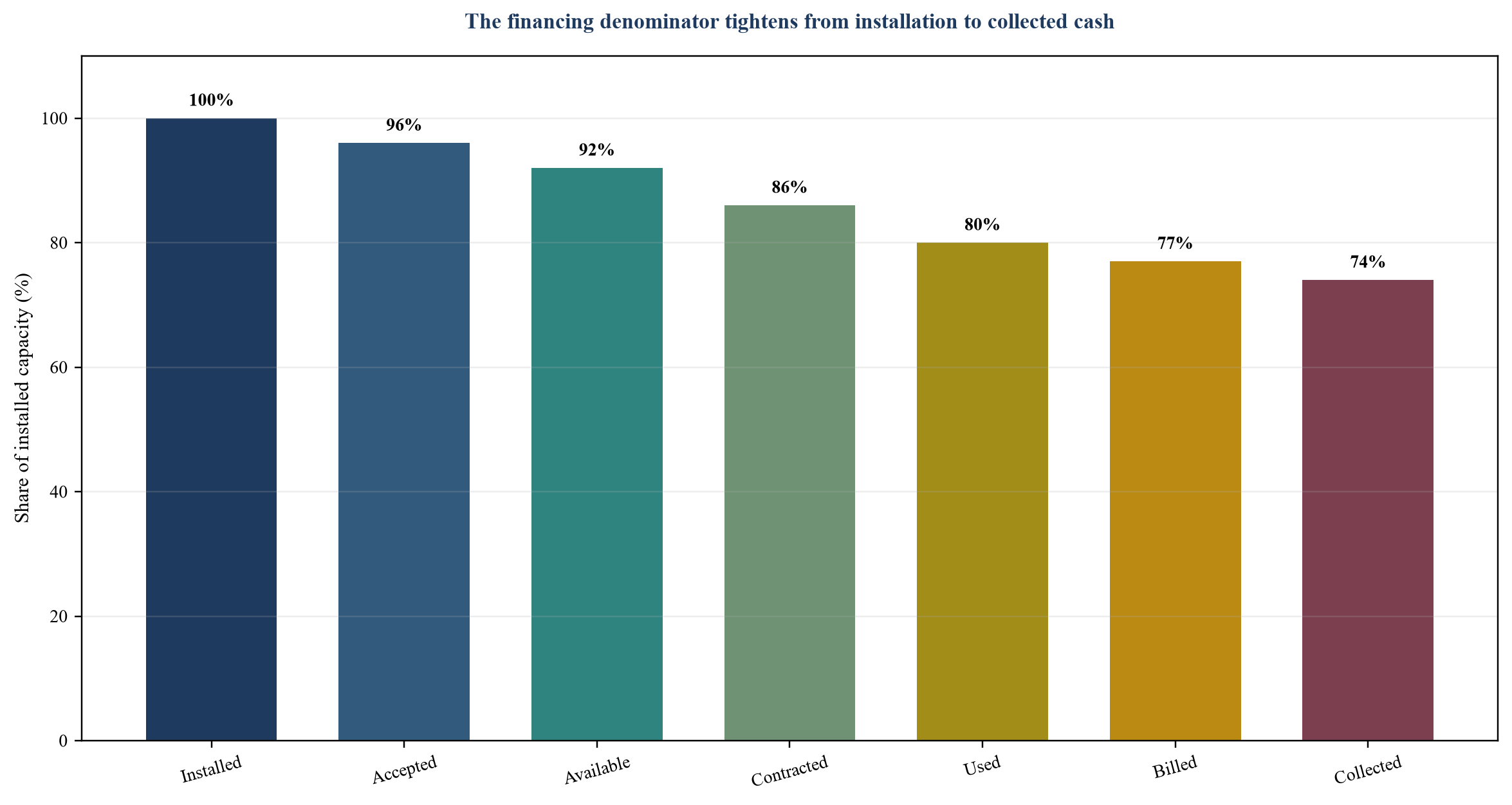
Percentages are hypothetical modelling assumptions; production underwriting requires telemetry, contracts, invoices and cash records.
Table 2. Utilisation evidence and financing treatment
| Stage | Evidence | Principal deduction | Financing use |
|---|---|---|---|
| Installed | Serial register and installation certificate | Awaiting commissioning or connection | Asset existence |
| Accepted | Test and acceptance records | Failed or conditional acceptance | Draw eligibility |
| Available | Monitoring and incident data | Outage, maintenance and restrictions | Service capacity |
| Contracted | Executed customer schedules | Termination, portability and concentration | Cash-flow support |
| Used | Workload telemetry | Idle, reserved or non-billable use | Operating demand |
| Billed | Invoice and credit records | Service credits, disputes and set-off | Revenue quality |
| Collected | Bank and receivables records | Late payment and deduction | Debt-service cash |
Each stage answers a different control question; no stage should be silently substituted for another.
5. Separate accounting, tax and lending value
Accounting depreciation allocates the cost of a long-lived asset and reflects management's useful-life and residual-value estimates under applicable accounting policy. Tax depreciation follows statutory classification and elections. IRS Publication 946 identifies computers and peripheral equipment as five-year property under the general MACRS examples and describes applicable conventions and deductions [9]. These rules affect tax cash flow; they do not establish market value or a lender's recovery.
Lending value is a controlled estimate of cash recoverable from the collateral under specified conditions and timing. It should incorporate equipment identity, configuration, age, condition, software support, warranty, location, demand, removal, transport, testing, remarketing, data sanitisation, legal enforcement and sale costs. The value may differ from net book value, tax basis and replacement cost.
CoreWeave's public credit documentation has included definitions using straight-line depreciation assumptions for GPU servers and facilities constrained by depreciated purchase price [4,5]. These are transaction-specific contractual mechanics. Another financing should derive its curve from current equipment, contracts, market evidence and documentation. A contractual depreciation formula can provide certainty for availability; it does not replace an appraisal or downside recovery analysis.
Three values should therefore be reported together: contractual borrowing-base value, current orderly-market value and stressed net recovery. The first follows the finance documents. The second uses current market evidence under an assumed sale process. The third deducts delay, removal, configuration loss, software limitations, enforcement costs and market stress. Differences between the three are decision information.
6. Construct a collateral-value curve from observable drivers
The collateral-value curve estimates value through time under a defined operating and disposition state. It should begin with the complete installed-system cost and separately identify non-recoverable items such as integration labour, site-specific installation, taxes, freight or software that cannot transfer. The eligible basis should then be reduced by age, condition, performance, energy efficiency, support, concentration and sale costs.
Technology cadence is a principal driver. NVIDIA's fiscal 2026 annual report describes a one-year cadence for advanced data-centre architectures, including Rubin, and identifies customer purchase timing and supply-management risks during transitions [6]. A product announcement does not make installed equipment worthless. It changes the comparison set. Older systems may remain productive for inference, fine-tuning, simulation, rendering or lower-price workloads when software support, power cost and customer demand remain suitable.
Energy efficiency affects economic value because power is a scarce input and operating cost. ENERGY STAR describes enterprise-server replacement cycles commonly in the three-to-five-year range and highlights power management and efficiency attributes [12,13]. AI accelerators and dense systems require equipment-specific analysis beyond generic server guidance. The relevant metric is useful workload output per unit of constrained power and total operating cost, not the age of the processor alone.
Configuration affects redeployment. A complete supported rack with high-speed networking may be more marketable than isolated components. A proprietary liquid-cooling interface, unusual power density, site-specific busway or non-transferable support can narrow buyers. The appraiser should test whole-system sale, component sale, continued operation, relocation and lower-tier redeployment.
The curve should be scenario-based. A base case can assume continued operation and planned refresh. A redeployment case can assume contract loss and a controlled move. A stressed case can assume simultaneous demand weakness, technology transition and a compressed sale period. The curve should be refreshed when a new architecture ships, observed utilisation changes materially, support terms change, a customer contract moves or secondary-market evidence weakens.
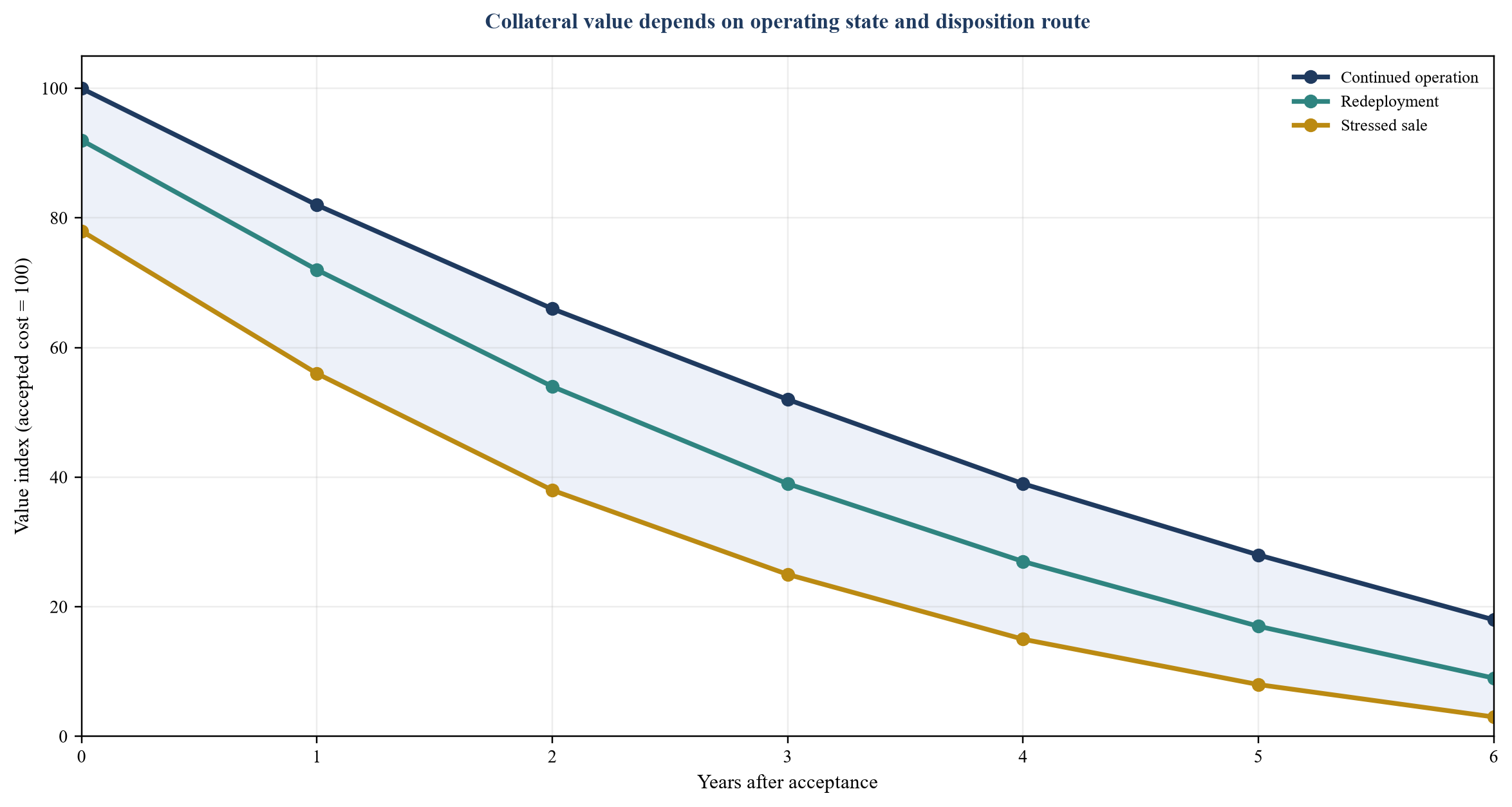
Index values are hypothetical; actual curves require current appraisals, market evidence, configuration, contract and disposition costs.
7. Design the refresh schedule before the first draw
Refresh is a capital-allocation decision, a customer-service decision and a collateral decision. A borrower can refresh too early, sacrificing remaining cash generation and creating new capital needs. It can refresh too late, weakening performance, energy efficiency, customer retention and resale value. The financing case should define triggers, decision rights, funding sources and treatment of released equipment before debt is drawn.
The refresh schedule begins with architecture and component roadmaps, yet vendor roadmaps remain vendor-supplied information. The borrower should combine them with observed workload economics, customer requirements, software support, maintenance, failure rates, energy use, secondary demand and capital availability. A new generation should trigger analysis rather than an automatic replacement.
Four paths should be compared:
1. Continue: retain equipment in its current workload while cash coverage and service remain acceptable. 2. Re-tier: move equipment to a less demanding workload or lower-price service. 3. Redeploy: move equipment to another site, customer or operator after testing rights and cost. 4. Dispose: sell components or systems through an approved process after sanitisation and lien release.
The decision should be made at cluster or configuration level. Mixed-generation fleets can create operational flexibility and spare capacity. They can also increase software, parts, scheduling and support complexity. The refresh model should include disruption, migration, testing, customer approval, removal, transport, installation and lost-revenue costs.
Financing documents should state how new equipment enters the collateral pool and how released equipment exits. Replacement collateral should satisfy title, lien, value, location, insurance and eligibility conditions. Sale proceeds should follow an agreed waterfall: debt prepayment, replacement reserve, approved reinvestment or another documented use. Uncontrolled disposal can remove collateral before replacement cash flow is proven.
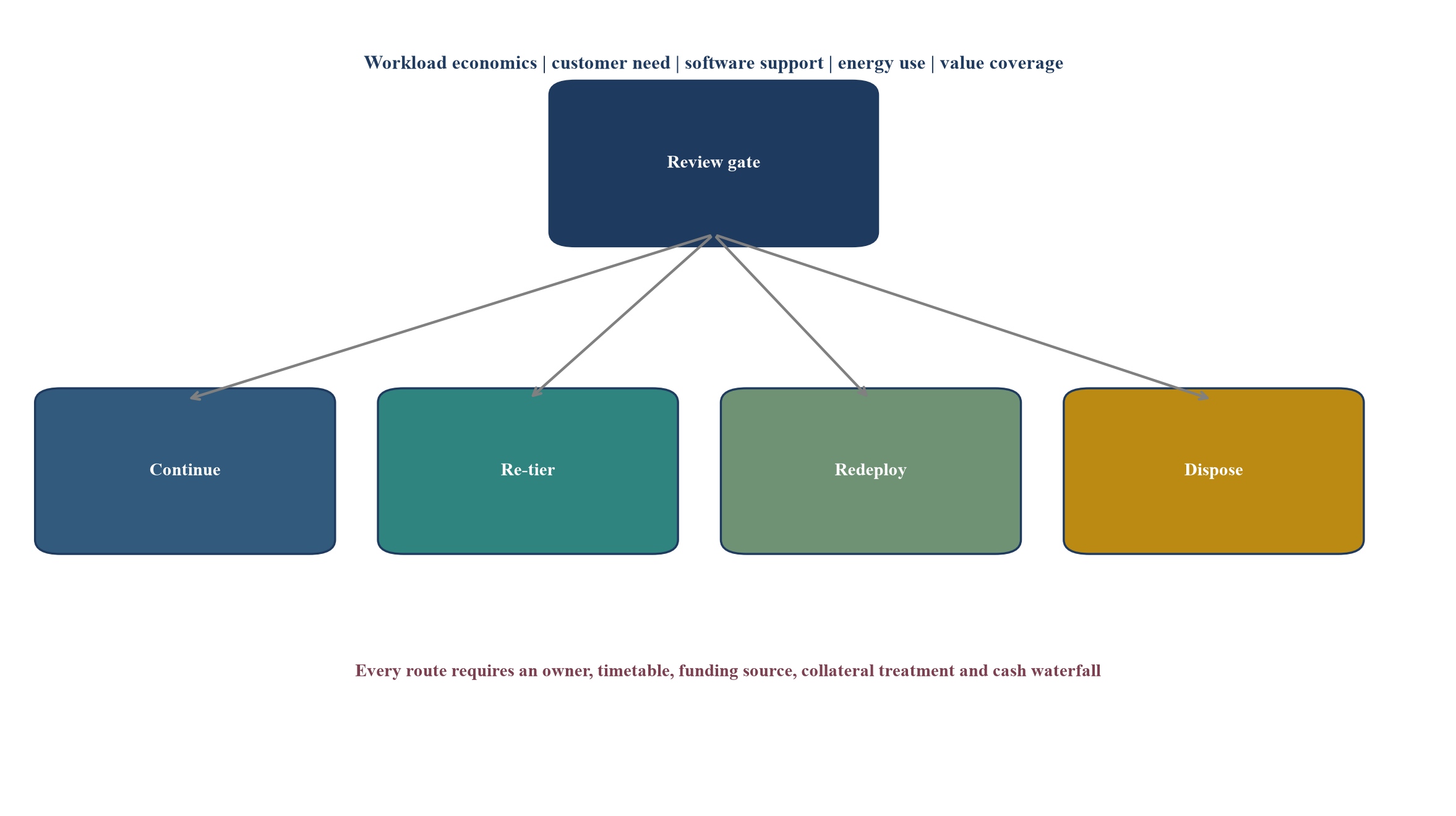
The route is selected from current workload economics, customer requirements, support, energy use and net disposition value.
8. Build a controlled borrowing base
The borrowing base converts eligible equipment and cash-flow support into current debt capacity under the agreed rules. It is a legal and control mechanism rather than a statement of enterprise value. Eligibility should be tested asset by asset and contract by contract before advance rates or concentration limits are applied.
Equipment should normally be excluded until it is delivered, titled to the approved borrower, free of unpermitted liens, located at an approved site, insured, accepted, operating or ready to operate, recorded by serial number and covered by required software and support. Deposits, undelivered systems, rejected equipment, unsupported configurations, restricted locations, missing serials and assets subject to competing claims require separate treatment.
The eligible collateral value can be the lower of contractual depreciated cost, current orderly value and another defined basis. The applicable advance rate can then vary by architecture, age, condition, customer linkage, support, location and concentration. Haircuts should be additive only where their definitions avoid double counting. A low current value and a separate obsolescence haircut may capture the same risk twice.
Contract support should be included only after termination, set-off, concentration and payment deductions. A borrowing base that includes both full equipment value and the full present value of customer cash can count the same economics twice. The equipment and contract may support one integrated facility; documentation should specify the single availability formula and priority of proceeds.
Availability should be recalculated at an agreed frequency and after trigger events. The certificate should reconcile opening eligible value, purchases, acceptances, depreciation, appraisals, substitutions, disposals, collections, concentration, reserves, debt and excess availability. Independent testing should sample serials, invoices, locations, contracts, telemetry and bank receipts.
Table 3. Equipment borrowing-base eligibility and control schedule
| Test | Eligible condition | Principal exclusion | Control evidence |
|---|---|---|---|
| Ownership | Approved borrower has clear title | Deposit, consignment or disputed title | Invoice, payment and title record |
| Location | Approved site with access rights | Unknown, restricted or inaccessible site | Serial-location reconciliation |
| Acceptance | Commissioned and accepted | Rejected, damaged or incomplete system | Acceptance certificate |
| Security | Perfected permitted lien position | Competing lien or missing waiver | Counsel and lien evidence |
| Operating state | Available or approved standby | Failed, unsupported or cannibalised item | Telemetry and maintenance record |
| Contract linkage | Eligible customer commitment | Terminable, disputed or over-concentrated cash | Contract and billing schedule |
| Valuation | Current approved basis and haircut | Stale or unsupported appraisal | Appraisal and market data |
| Transferability | Lawful sale or redeployment route | Licence, export or data restriction | Rights and compliance review |
The schedule separates eligibility, valuation and advance mechanics so reviewers can identify the source of every deduction.
9. Make debt amortisation outrun the conservative value curve
The amortisation profile should be tested against both cash flow and collateral value. A structure can pass one test and fail the other. Fast amortisation can protect value coverage but create liquidity pressure during installation or customer ramp. Slow amortisation can match contracted cash while leaving a residual debt balance above stressed collateral value after a technology transition.
The model should calculate scheduled principal, interest, fees, reserve movements and cash sweep under each scenario. It should compare outstanding debt with contractual borrowing-base value, orderly value and stressed net recovery. The difference is value headroom. A minimum headroom test can trigger prepayment, additional collateral, restricted distributions or a refresh decision before the gap becomes severe.
Delayed-draw structures can align funding with purchase, delivery and deployment. CoreWeave's filings describe facilities with draw windows, customer-linked use, amortisation commencement and hedging obligations [2-5]. These are useful public examples of matching funding to deployment. Another borrower should derive its dates from purchase orders, site readiness, customer acceptance and conservative cash collection.
Balloon risk should be explicit. A balloon may be supportable when the equipment remains productive, customer contracts extend beyond maturity, refinance markets are credible and value headroom remains strong. It becomes speculative when repayment depends on a future appraisal, an uncommitted renewal or an assumed market for an ageing architecture. The base case should not classify uncommitted refinancing as a source.
Cash sweeps can accelerate repayment when utilisation or price exceeds the underwriting case. They can also reduce funds available for refresh, maintenance and working capital. The waterfall should preserve required operating, tax, interest, maintenance and replacement reserves before discretionary prepayment or distribution.
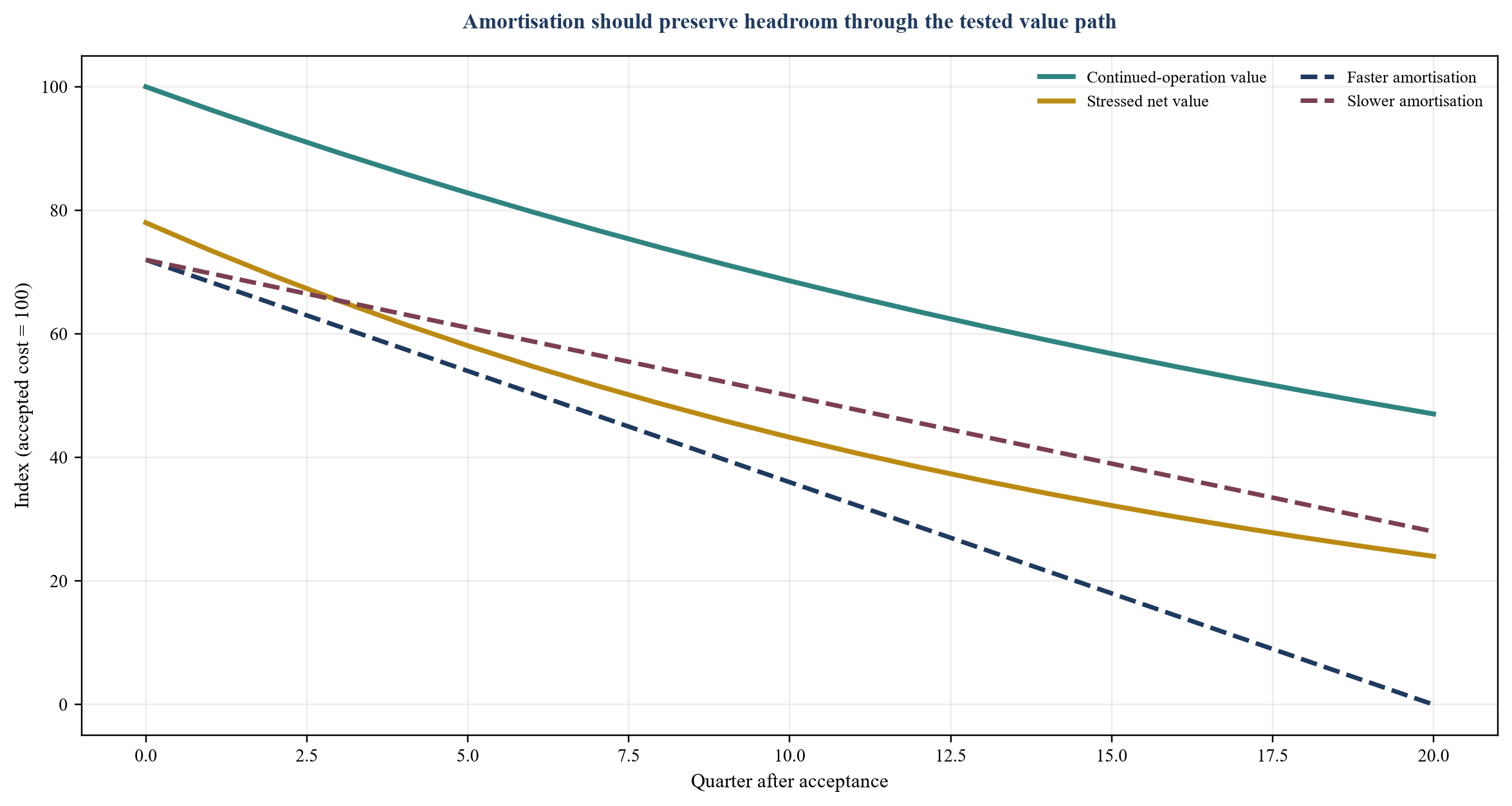
Values are hypothetical; production documents should use current cash-flow and appraisal evidence.
10. Stress technology, utilisation, customer and disposition together
Single-variable sensitivities are useful for attribution. Credit decisions also need combined scenarios because adverse events can interact. A new architecture can reduce demand for an older system while a customer renewal is pending. Lower utilisation can weaken cash coverage and make equipment available for sale at the same time that other operators are selling similar systems. A site constraint can delay redeployment while interest and storage costs continue.
The collateral stress grid should include at least four dimensions:
1. Technology: timing of new architecture, software support, performance-per-watt and compatibility. 2. Commercial: contracted price, utilisation, customer concentration, termination and collections. 3. Operational: availability, failure, maintenance, site access, removal and migration. 4. Market: buyer depth, sale period, financing availability, export restrictions and transaction cost.
The grid should report debt-service coverage, liquidity runway, debt balance, borrowing-base value, stressed recovery, headroom, cure need and decision deadline. It should identify the first failing covenant and the operational action required. A scenario that produces a breach without a decision path is incomplete.
NVIDIA reported a USD 4.5 billion charge associated with H20 excess inventory and purchase obligations following US export licensing requirements in fiscal 2026 [6]. The event concerns NVIDIA's inventory and market access, not financed equipment owned by another borrower. It demonstrates that policy changes can affect demand and marketability quickly. Export classification, destination and buyer screening should therefore be included in any collateral disposition plan.
Stress probabilities should not be invented when there is no defensible basis. Committees can use named scenarios, break-even tests and reverse stress. A reverse stress asks which combination of utilisation, price, delay and value haircut removes headroom or exhausts liquidity. This supports covenant calibration and early action.
Table 4. Illustrative collateral stress grid
| Case | Collected utilisation | Value index at year three | Customer outcome | Financing response |
|---|---|---|---|---|
| Operating plan | 78% | 52 | Contract performs | Scheduled amortisation and normal refresh |
| Delayed ramp | 60% | 48 | Acceptance six months late | Draw stop, liquidity support and revised ramp |
| Technology transition | 68% | 34 | Price reset at renewal | Accelerated amortisation and re-tier plan |
| Customer loss | 35% | 30 | Major contract terminates | Cash sweep, redeployment and sponsor cure |
| Market-wide stress | 30% | 18 | Weak demand and buyer depth | Enforcement readiness and controlled disposition |
Percentages and outcomes are hypothetical modelling assumptions intended to demonstrate combined testing.
11. Allocate risk through covenants and reporting
Covenants should follow the equipment lifecycle. Before delivery, controls focus on purchase orders, deposits, vendor performance, funding and site readiness. At delivery, they focus on title, acceptance, serials, insurance and security. During operation, they focus on utilisation, availability, customer performance, cash coverage and maintenance. Before refresh or disposition, they focus on value, substitution, sale process, proceeds and data sanitisation.
Financial covenants can include minimum debt-service coverage, liquidity, value coverage, borrowing-base excess and customer-concentration limits. Operational covenants can include availability, maintenance, supported software, approved locations and asset-verification thresholds. Information covenants should deliver the asset register, telemetry reconciliation, invoices, collections, customer changes, appraisals, insurance, liens, incidents and refresh plan.
Trigger levels should create time to act. A warning threshold can require enhanced reporting and management review. A control threshold can stop draws or distributions. A cure threshold can require prepayment, additional collateral or equity. A default threshold can activate enforcement rights. Using one threshold for every stage can cause either premature disruption or delayed intervention.
The financing documents should also regulate additional debt, intercompany transfers, customer amendments, material equipment changes, relocation, liens, disposals, software-right changes and affiliate transactions. The purpose is to preserve the evidence and cash path on which the credit decision was based.
Table 5. Lifecycle covenant and monitoring schedule
| Lifecycle stage | Principal evidence | Early-warning indicator | Potential response |
|---|---|---|---|
| Order and deposit | Purchase order, deposit and vendor schedule | Delivery or funding slippage | Stop additional commitments |
| Delivery and acceptance | Serial, title, inspection and test | Rejection or incomplete configuration | Withhold draw and require cure |
| Ramp | Customer acceptance, available capacity and billing | Lower accepted or billable capacity | Liquidity plan and revised amortisation |
| Operation | Telemetry, collections, coverage and maintenance | Utilisation, outage or payment deterioration | Enhanced reporting and cash sweep |
| Refresh | Roadmap, workload economics and appraisal | Value-headroom compression | Re-tier, replace or prepay |
| Disposition | Buyer, rights, sanitisation and proceeds | Sale delay or cost increase | Controlled sale and reserve use |
Thresholds and frequencies require transaction-specific calibration; the table identifies the required control domains.
12. Treat redeployment and resale as operating capabilities
Redeployment is credible when it has a documented route, technical capability, customer demand, rights, time and cost. A statement that equipment is fungible does not establish these conditions. Dense AI systems can require specific power, cooling, networking, firmware, software and skills. Moving them can interrupt revenue, damage components, void support or require new acceptance.
The borrower should maintain an approved redeployment playbook. It should identify alternative sites, power and cooling compatibility, network requirements, logistics providers, testing, spares, software licences, customer pipeline, pricing, approvals and working capital. The plan should calculate the period from contract loss to collected cash under each route.
Resale requires market preparation. The operator should know which components can be sold independently, who can test and certify them, which warranties transfer, how data will be sanitised, which buyers are permitted and what fees and taxes apply. Broker quotations can inform current markets; completed transactions, binding bids and observed clearing prices carry stronger evidence. The appraiser should state the valuation date, equipment state, sale premise and assumed period.
OCC's Asset-Based Lending handbook emphasises collateral administration, field examination, appraisal, controls and liquidation analysis in asset-based structures [10]. GPU and server finance requires equipment-specific implementation, yet the supervisory principles remain relevant: availability depends on reliable records, current valuation, enforceable controls and a realistic liquidation path.
13. Govern appraisals, models and data
An equipment appraisal is an expert input with a stated premise and date. It should identify the appraiser, scope, equipment inspected, data relied upon, market approach, comparable evidence, adjustments, sale premise, assumed marketing period, costs and limitations. A desktop update can support monitoring when the asset and market are stable. A material technology, contract, location or market change may require a new physical or serial-level review.
The financing model should maintain lineage from source records to every result. Purchase cost should trace to invoice and payment. Contracted capacity should trace to executed schedules. Utilisation should trace to approved telemetry. Collections should trace to bank records. Value should trace to an appraisal or documented contractual formula. Debt should trace to the agent statement. Manual adjustments require owner, reason, date and approval.
Model governance should separate preparation, review and approval. The business team can prepare operating assumptions. Finance can reconcile revenue and cash. Technical teams can validate configuration, performance and refresh. Credit can challenge cash, value and downside. Legal advisers can confirm documents and security. The committee approves the case and exceptions. No analytical model creates a lender commitment or substitutes for executed documents.
Version control matters because rapid transitions can change assumptions between commitment and draw. The model should preserve the approved commitment case, each draw case, current monitoring case and downside case. A change log should identify whether a difference came from equipment, contract, market, policy, accounting or model methodology.
Data quality should be reported through completeness, timeliness, reconciliation and exception metrics. Missing serials, unreconciled telemetry, stale appraisals, disputed invoices and unverified customer allocations are financing issues. Precision should not exceed the evidence. When a parameter is a management estimate, the model should state the basis, owner, approval and sensitivity.
14. Structure the financing process in four gates
A disciplined process can be organised into four gates.
Gate one is commercial eligibility. The operator identifies the workload, customer, capacity, price, term, acceptance, termination, concentration and expected cash. The investment or credit team determines whether the contract provides an acceptable basis for further work.
Gate two is asset eligibility. The team verifies purchase orders, configuration, delivery, title, serials, location, acceptance, software, support, insurance, liens and compliance. The lender defines which costs and assets can enter the borrowing base and when.
Gate three is cash and value sizing. The model builds the utilisation waterfall, operating cash flow, borrowing base, value curves, amortisation, reserves and stresses. The structure is sized to the lower supported result after all required deductions and headroom.
Gate four is documentation and monitoring readiness. Credit, security, account control, intercreditor, reporting, appraisal, substitution, disposition, data and compliance terms are completed. The borrower demonstrates that it can produce the first borrowing-base certificate and monitoring pack before the first draw.
The gates reduce false momentum. A large customer announcement cannot replace asset readiness. Delivered equipment cannot replace a valid customer and power path. A favourable appraisal cannot replace controlled cash. A signed facility cannot replace operational reporting. Each gate answers a different condition for financeability.
The process should maintain a conditions register with evidence, owner, due date, dependency, reviewer and status. Waivers and exceptions should state duration, rationale, compensating control and approval. A temporary exception should not become a permanent assumption through repeated rollover.
15. Use a ninety-day execution plan
The first thirty days establish the information spine. The borrower consolidates the equipment and rights register, customer-contract map, site and power dependencies, financing schedule, insurance, lien evidence, software rights, utilisation definitions and data sources. It reconciles serials to invoices, locations and general-ledger assets. The financing team agrees the underwriting perimeter and missing-evidence list.
Days thirty-one to sixty build the decision models. The team creates the utilisation waterfall, operating cash flow, collateral curves, borrowing base, amortisation profiles, stress grid and refresh schedule. Technical, commercial, finance, legal, tax, accounting and credit reviewers challenge the assumptions relevant to their remit. Appraisal scope and field examination are completed where required.
Days sixty-one to ninety close the control system. The borrower finalises account flows, security, reporting, covenant definitions, substitution rules, disposition process, data sanitisation, appraisal refresh and exception governance. It rehearses a borrowing-base certificate and a contract-loss scenario. The committee approves the final structure, residual risks and monitoring ownership.
After closing, a monthly equipment-finance pack should present:
1. Equipment additions, removals, substitutions and exceptions. 2. Installed, accepted, available, contracted, used, billed and collected capacity. 3. Customer concentration, disputes, credits, termination and renewal changes. 4. Debt, interest, amortisation, cash sweep, reserves and value headroom. 5. Technology, software, support, energy-efficiency and refresh developments. 6. Appraisal, secondary-market, redeployment and disposition evidence. 7. Covenant results, warnings, cures, waivers and accountable actions.
Quarterly review should include a refreshed value and reverse stress. Annual review should reassess useful lives, tax treatment, accounting policies, appraiser scope, legal security, insurance, customer strategy and the refresh plan. Material events trigger an interim review.
16. Limitations and research agenda
This paper develops an underwriting framework. It does not estimate a representative market value curve for GPUs or servers, a market advance rate, default probability, loss-given-default or appropriate debt price. Public filings describe individual companies and transactions under their own facts. Their terms cannot be applied to another borrower without current diligence.
Secondary-market data can be fragmented. Quoted prices may omit configuration, condition, software, location, warranty, quantity, buyer credit, transport, testing and sale period. Completed transactions may not be public. Rapid architecture changes can make historical samples stale. Appraisals should therefore explain evidence quality and avoid false precision.
Utilisation data can also be difficult to compare. Operators may use different definitions for installed, available, reserved, used and billable capacity. Workload intensity, duration and pricing can differ. A standard utilisation percentage does not capture performance per watt, network bottlenecks, memory, availability, customer mix or contribution margin.
Future research should assemble anonymised, serial-level observations across architecture, configuration, age, workload, power use, software support, location, contract, utilisation, sale route and realised recovery. It should compare accounting useful life, contractual depreciation, appraisal value and realised proceeds. It should also test whether contract structure, configuration completeness, energy efficiency and redeployment time explain recoveries after controlling for age.
Additional work is needed on cross-border transfer and export rules, insurance claims, data-sanitisation cost, liquid-cooling compatibility, component separation, software licence transfer and the relationship between equipment refresh and customer renewal. Evidence should be collected through governed lender, operator, appraiser, broker and customer records.
17. Conclusion
Data-centre equipment finance sits between contracted infrastructure cash flow and rapid technology change. A processor or server can remain physically functional while its competitive position, customer use, software support, energy economics and resale market change. Original purchase price records what was paid; it does not by itself determine lendable value.
The proposed method starts with control. Every financed asset is identified, titled, located, accepted, insured, secured and connected to the required software and support. Customer contracts are translated into equipment-linked cash rules. Utilisation moves through a waterfall from installation to collected cash. Value is estimated under continued operation, redeployment and stressed disposition. Debt amortisation is then tested against both supported cash flow and conservative collateral value.
The financing structure becomes stronger when refresh and downside routes are designed before the first draw. Continue, re-tier, redeploy and dispose are operating choices with cost, time, rights and customer consequences. The borrowing base, covenants, appraisals and reporting should preserve those choices and create early action while value headroom remains.
The practical credit question is direct: after applying current contract deductions, eligible-asset controls, technology and market haircuts, disposition costs and liquidity reserves, can collected cash and conservative collateral value repay the debt within the period supported by the equipment? A financing case that answers this question with traceable evidence can be assessed by banks, private-credit funds, equipment financiers, infrastructure investors and customers on a clearer basis.
References
- CoreWeave, Inc., Form S-1/A, 21 March 2025. https://www.sec.gov/Archives/edgar/data/1769628/000119312525052207/d899798ds1a.htm
- CoreWeave, Inc., Form 10-Q for the quarter ended 30 September 2025. https://www.sec.gov/Archives/edgar/data/1769628/000176962825000062/crwv-20250930.htm
- CoreWeave, Inc., Form 8-K, Delayed Draw Term Loan Facility 3.0, 28 July 2025. https://www.sec.gov/Archives/edgar/data/1769628/000176962825000033/crwv-20250728.htm
- CoreWeave, Inc., Form 10-K for the year ended 31 December 2025. https://www.sec.gov/Archives/edgar/data/1769628/000176962826000104/crwv-20251231.htm
- CoreWeave, Inc., Form 10-Q for the quarter ended 30 June 2026. https://www.sec.gov/Archives/edgar/data/1769628/000176962826000366/crwv-20260630.htm
- NVIDIA Corporation, Form 10-K for the fiscal year ended 25 January 2026. https://www.sec.gov/Archives/edgar/data/1045810/000104581026000021/nvda-20260125.htm
- NVIDIA Corporation, Form 10-Q for the quarter ended 26 July 2026. https://www.sec.gov/Archives/edgar/data/1045810/000104581026000075/nvda-20260726.htm
- CoreWeave, Inc., Credit Agreement exhibit defining GPU depreciated amount, filed 2025. https://www.sec.gov/Archives/edgar/data/1769628/000119312525044231/d899798dex109.htm
- Internal Revenue Service, Publication 946 (2025), How To Depreciate Property. https://www.irs.gov/publications/p946
- Office of the Comptroller of the Currency, Asset-Based Lending, Comptroller's Handbook, January 2017. https://www.occ.treas.gov/publications-and-resources/publications/comptrollers-handbook/files/asset-based-lending/pub-ch-asset-based-lending.pdf
- National Institute of Standards and Technology, SP 800-88 Revision 2, Guidelines for Media Sanitization, September 2025. https://nvlpubs.nist.gov/nistpubs/SpecialPublications/NIST.SP.800-88r2.pdf
- US Environmental Protection Agency, ENERGY STAR Enterprise Servers. https://www.energystar.gov/products/enterprise_servers
- US Environmental Protection Agency, ENERGY STAR Data Center Equipment. https://www.energystar.gov/products/data_center_equipment
- Bank for International Settlements, Financing the AI infrastructure boom: on- and off-balance-sheet borrowing, 2026. https://www.bis.org/publications/financing-ai-infrastructure-boom-on-and-off-balance-sheet-borrowing
- International Energy Agency, Energy and AI, 2025. https://www.iea.org/reports/energy-and-ai
- US Department of Energy, DOE Releases New Report Evaluating Increase in Electricity Demand from Data Centers, 20 December 2024. https://www.energy.gov/articles/doe-releases-new-report-evaluating-increase-electricity-demand-data-centers
- National Institute of Standards and Technology, Cybersecurity Framework 2.0, 2024. https://www.nist.gov/cyberframework
- US Securities and Exchange Commission, CoreWeave Form 8-K, Delayed Draw Term Loan Facility 4.0, 30 March 2026. https://www.sec.gov/Archives/edgar/data/1769628/000176962826000129/crwv-20260330.htm
- CoreWeave, Inc., DDTL 5.0 financing announcement filed with the SEC, 18 May 2026. https://www.sec.gov/Archives/edgar/data/1769628/000176962826000236/ex9912.htm
- Federal Reserve, OCC and FDIC, Interagency Guidance on Third-Party Relationships: Risk Management, June 2023. https://www.federalreserve.gov/supervisionreg/srletters/SR2304.htm
