

1 Define the financing decision before counting programmes
A financing plan needs an application route that fits the project, a timetable the team can meet and a clear account of the support being sought. A programme name supplies only part of that information. The relevant decision is whether to devote scarce preparation capacity to a particular call or cohort, given the applicant's documented position and the evidence available on the review date. We organise the analysis around that decision. The register distinguishes the entity submitting an application, the people responsible for the project, the proposed activity, the funding instrument and the dates attached to each stage.
Hub71's published Access Programme illustrates the importance of instrument classification. Its page describes cash support of AED 250,000 in exchange for equity through a SAFE, together with AED 250,000 of in-kind incentives. Further cash support is conditional on performance and additional equity. A founder evaluating this route needs to examine ownership terms and the practical usefulness of the services. Treating the whole package as unrestricted grant cash would obscure both questions. Our register therefore retains the cash component, in-kind component and equity-linked character as separate source fields. [1]
The identity of the applicant also changes the available route. KFAS's Applied Research Grants page lists researchers and scientists from research and higher education, public bodies and not-for-profit or civil-society organisations. International academic and research institutes require a Kuwaiti institutional route with substantial local collaboration. An innovation-led commercial company may participate in a wider research relationship, subject to the applicable terms. Its status as a startup alone does not establish the lead-applicant role described on that page. The analysis records the proposed submitting institution and the relevant individual roles before evaluating the documented conditions. [17]
We propose a sequence of decisions that can be recorded and reviewed. First classify the support and identify the submitting party. Then examine the source-stated conditions and the application calendar. Estimate the preparation work using an explicit internal assumption and retain questions that require clarification. Selection, contracting and cash receipt remain later events with their own evidence. The numerical component evaluates constructed applicant records against these recorded checks. It produces conditional planning outputs and does not estimate the probability of an award. That boundary applies throughout the paper, including the worked cases and the interpretation of their results.
2 Set the observation date and the unit of comparison
The reference date for the register is 9 November 2026. The selected routes provide examples from the United Arab Emirates, Saudi Arabia, Qatar, Bahrain, Oman and Kuwait. Selection is purposive and follows the financing and eligibility distinctions relevant to the research question. It does not establish the size of the GCC funding market or enumerate every available programme. Each entry identifies a particular route and, where the source provides one, its call or cohort version. An organisation can operate several instruments with different applicants, timetables and contractual conditions. Those differences remain visible in the underlying records.
RDIA's current funding directory links to the Saudi Innovation Grants Program and researcher grants. It supports recording those programme families. Complete current eligibility conditions and cutoffs for the linked routes remain unverified in this study's accepted source record. RDIA's separate Researchers and Innovators Guide describes research grants, commercialisation support and institutional responsibilities. The record identifies that guide's historical document context. Its programme descriptions support the classification of research support, while current call conditions require separately dated evidence. [4,5]
A call version also matters when a programme page remains online after its stated deadline. The KFAS Research Infrastructure Grants page reviewed for this study displays a 2026 first-call period from 1 February to 1 May. That recorded call has an elapsed deadline relative to the study date. No later call was verified in the reviewed material. The record preserves that distinction so a reader can investigate a subsequent opportunity without treating the earlier period as current. Application dates are recorded separately from publication or page-update dates, programme duration, evaluation dates and planned award announcements. [19]
Every record should support a later reviewer who did not perform the original search. The proposed minimum record contains the publisher, source URL, access date, relevant source passage, call identity, date precision and the fields supported by that passage. A current call document can establish a particular window; an institutional overview can establish the kind of support offered. A missing clause remains unresolved. Conflicting official descriptions are retained side by side with their scopes. The register gives each unresolved point a concrete clarification question and a review trigger, allowing subsequent evidence to change the decision without rewriting its history.
| Field | What to retain | Decision supported |
|---|---|---|
| Route and version | Programme, call/cohort and publisher | Identify the specific offer under review |
| Source scope | URL, reviewed passage and date | Separate current terms from contextual material |
| Applicant role | Submitting entity, individual and institution | Assign requirements to the correct party |
| Instrument | Legal form, native currency, cost and use restrictions | Identify financing and participation obligations |
| Calendar | Raw wording, precision, clock/timezone if stated | Plan and review preparation against the actual cutoff |
| Open question | Reason, responsible reviewer and clarification trigger | Authorise the next evidence-gathering step |
Proposed operational record; this table does not add provider terms.
3 Separate funding instruments and restrictions on use
The UAE Ministry of Finance describes two distinct MBRIF programmes. The Guarantee Scheme enables access to financing through a government-backed guarantee without taking equity. The Innovation Accelerator provides non-financial support through mentors and industry experts. These descriptions lead to different financing questions. A company considering guaranteed borrowing needs to understand the lending and repayment obligations. A company considering an accelerator needs to assess the services, management commitment and suitability of the programme. The source does not provide a common cash value that can be added across the two routes. [3]
Bahrain's Digital Enablement and AI Program provides another distinction. The reviewed Tamkeen page describes support for eligible software and service costs, with reimbursement following implementation and a period of use. It specifies cost-sharing support up to 50 percent, subject to the programme's caps and terms. This creates a need to examine the applicant's ability to pay eligible costs before reimbursement. The page also distinguishes eligible software and services from excluded items such as hardware and basic productivity tools. Our record preserves the requested expenditure category and reimbursement timing rather than treating a broad technology-sector description as sufficient evidence of an admissible application. [10]
The Oman financing route for incubated companies and business accelerators is described as repayable finance, with a committee-determined ceiling up to OMR 70,000 and additional conditions. The reviewed source states a 2 percent figure, but the fee basis and annualisation were not established in the material examined. We therefore do not convert it into an annual percentage rate or a borrowing-cost forecast. The same record retains discretionary contribution, grace and repayment provisions as published conditions. These terms require examination alongside the applicant's financing capacity and the project timetable. [14]
Headline ceilings require equally careful treatment. A stated maximum describes a boundary in a published offer, subject to its conditions. It does not establish the amount a particular applicant would receive. In-kind incentives, reimbursements, equity-linked cash, loan principal and guarantees are retained in separate columns, together with their original currencies. We make no exchange-rate conversion or aggregate value ranking across those categories. For a live capital plan, the proposed decision record should distinguish documented resources already available to the business from assistance dependent on application, selection, contract or later performance. The worked analysis applies that separation without assuming an award or commercial outcome.
| Selected route | Published instrument and terms | Relevant scope |
|---|---|---|
| Hub71 Access Programme, Cohort 21 | Onboarded startups: AED 250,000 cash for equity through a SAFE plus AED 250,000 in-kind; further AED 250,000 conditional on performance and additional equity. Valuation, disbursement and award probability unverified. | No portal acceptance or award observed; No country-only exclusion is encoded; The three nominal support descriptions are not summed into a grant value. |
| MBRIF Innovation Accelerator | Six months of services/coaching; no equity stake, membership fee or success fee stated. No cash award inferred. | Foreign applicant wording is unresolved; priority sectors do not exclude all other innovations; No current intake or remaining capacity verified. |
| MBRIF Guarantee Scheme | Government-backed guarantee enabling finance without taking equity. Financed principal is not a cash grant or forgiveness; price, coverage and disbursement unverified. | The Accelerator and Guarantee Scheme are separate instruments and route rows. |
| Saudi Innovation Grants Program | Directory names a grants programme. Current ceilings, award terms, disbursement and individual eligibility were not verified. | No country-only, sector or maturity rejection inferred; The guide's 2024 creation metadata does not date a 2026 call. |
| Aqua-Intelligence Smart Water Quality Innovation Challenge, 2026 archived call | Support up to USD 100,000 plus data/pilot access and mentoring; detailed cash schedule, eventual contract and actual awards unverified. | Zero live and eleven closed entries refer only to the captured QOI listing; Foreign eligibility is unresolved; no nationality rejection is encoded; Passing listed checks does not establish full challenge terms or current availability. |
Dated official-source descriptions and recorded limitations; native amounts retain their separate currencies and roles. No aggregate funding value or current individual entitlement is calculated. References [1–19].
| Selected route | Published instrument and terms | Relevant scope |
|---|---|---|
| Riyada Business Accelerator Program | Tamkeen covers 100% of the six-month programme cost. Cash award, equity and investment terms are unknown; potential funding access is not committed funding. | No dated current intake verified; Apply Now and page-update dates do not settle it. |
| Digital Enablement & AI Program | Up to 50% of eligible software/service costs; unspecified caps/terms. Reimbursement follows implementation and three months of use; 24-month contract. Legal repayability/equity terms unverified. | All sectors stated, subject to recorded activity/entity/cost conditions; No BHD cap or current dated opening verified. |
| SME Fund | Sharia-compliant financing repaid over up to five years; approved profit subsidies and guarantees. Ceiling, subsidy rate, security and guarantee coverage unknown. | A software developer using fintech technology is not automatically a financial/brokerage activity; No cash-grant status or dated intake inferred. |
| Upgrade | Undated Omantel description: winner seed funding up to OMR 12,000 and three-year incubation/business development. Current 2026 amount, equity and repayability unverified. | Page-update date and Start now do not verify current intake; Additional foreign-participant restrictions remain unresolved. |
| Financing Incubated Companies and Business Accelerators, Fourth Financing Program | Up to OMR 70,000 by committee decision; possible applicant contribution up to 10%. Repayment up to ten years after grace; grace up to two years. Published 2% fee basis/annualisation unknown. | No current dated intake or unconditional financed amount; Programme-unknown conduct terms are not filled using constructed applicant facts. |
| Omantel Accelerator, Cohort 9 | Six-month mentoring, perks and workspace; investment conditional. Amount, valuation, equity and repayability unknown. | No universal foreign acceptance or nationality ban inferred; Timeline is publisher-announced and the application portal was not tested; Earlier-stage or non-priority applicants do not fail solely for those advisory differences. |
| KFAS Applied Research Grants, 2026 second call | Cap, award amount, co-funding ratio and detailed legal/IP terms unknown; co-funding schemes disclosed with institutional letter of intent. | General commercial-startup eligibility is not established; Package-ready is an authored input, not a completed portal submission. |
| KFAS Young Researcher Grants, 2026 second call | Cash cap, co-funding ratio and detailed grant/IP terms unknown. | A young PhD holder does not satisfy the stated no-PhD applicant rule even if the mentor is qualified; Founder status alone does not establish eligibility. |
| KFAS Research Infrastructure Grants, displayed 2026 first call | Institutional co-funding and maintenance commitments required. Amount, maximum and required co-funding percentage unknown. | Ordinary founder nationality or age does not replace institutional eligibility; Email submission route differs from GMS grants; no submission is represented by this checker. |
Dated official-source descriptions and recorded limitations; native amounts retain their separate currencies and roles. No aggregate funding value or current individual entitlement is calculated. References [1–19].
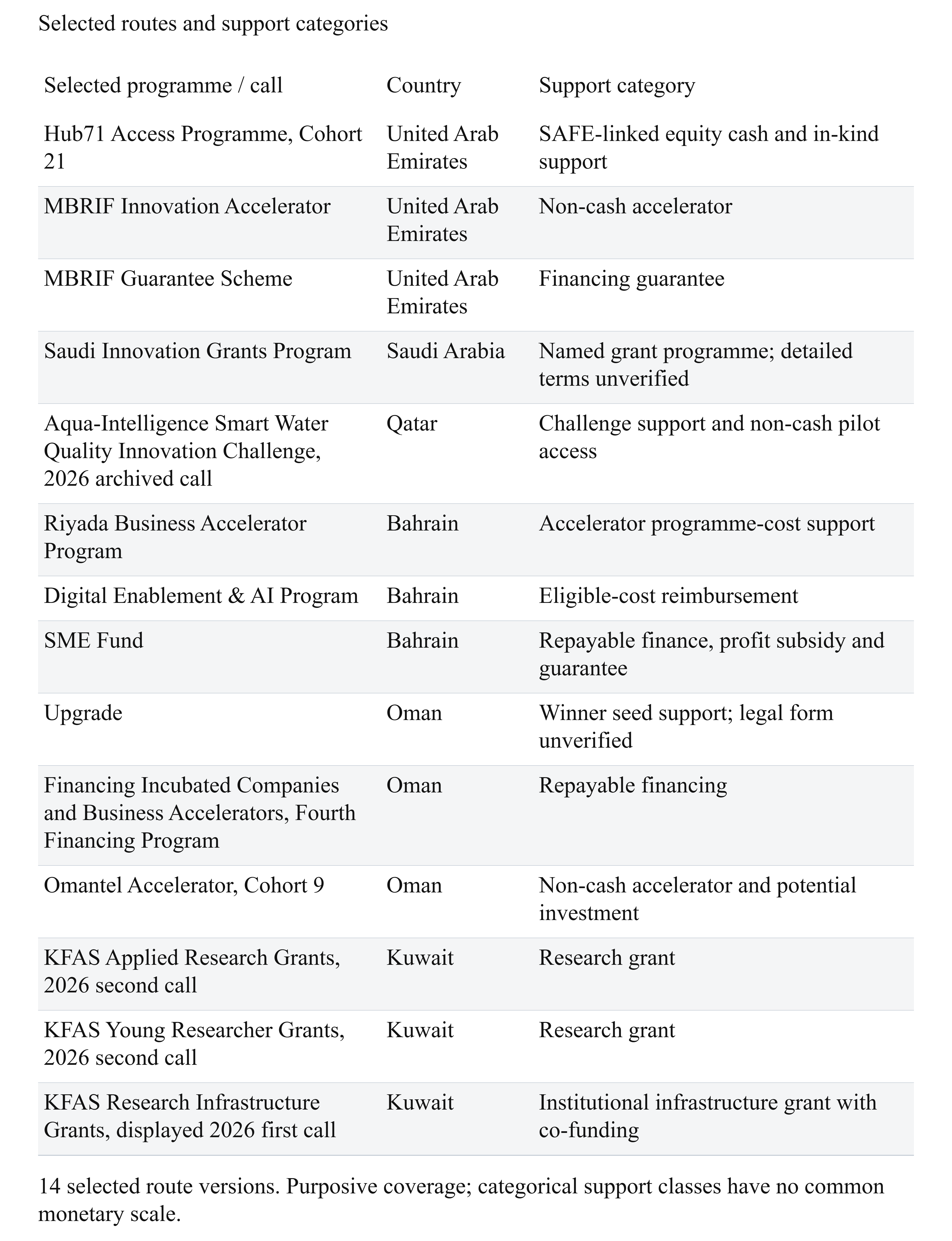
Scroll horizontally to read the figure at full size. You can also open the full-size figure.
Purposive selected records from official sources. Different instruments and evidence depths are retained; country counts do not rank national funding systems.
4 Read cohort cutoffs separately from programme dates
Hub71's Access Programme page states that it is accepting applications for Cohort 21, gives a February 2027 deadline and identifies September 2027 as the programme start. It also explains that applications submitted after a cohort deadline can be considered for the next cohort. These statements describe a cohort-selection timetable and a continuing application route. The month-only cutoff cannot be represented as a specific day or hour. The programme start also provides no verified date for receipt of cash by an individual participant. Our calendar therefore stores the cutoff's precision, the announced start and the later-cohort provision as separate fields. [1]
The Omantel Accelerator page publishes the opening value 27/09/2026 and closing value 09/01/2027 for Cohort 9, followed by programme start and end dates. The raw values are preserved. The constructed calendar uses day/month/year as an explicit interpretation convention, consistent with the unambiguous opening value. A closing hour and timezone were not established in the reviewed page. The page describes access to potential investment alongside mentoring, services and workspace. Its application timetable therefore supplies no commitment that investment will occur, or a date when a business can include it in available cash. [15]
Qatar Open Innovation's Aqua-Intelligence challenge provides a useful archived-call example. The challenge page describes a scouting period from 1 February to 30 April 2026, later selection stages and planned awarding in July to August. It continues to display participation links. The separately reviewed challenge listing places the route among registrations that are closed and displays zero live programmes within that listing. We retain the particular challenge and its published timetable. The listing observation does not establish that every QRDI funding programme is closed, and the planned awarding dates do not verify that any award was made. [6,7]
KFAS's Applied Research Grants page gives a different degree of precision. Its 2026 second call specifies submission from 15 September to 15 December 2026, by midnight Kuwait time. The page states that missing major requirements at the closing date can cause an application to be declined as incomplete. Preparation planning therefore needs to include institutional approval and the required submission material, rather than reserving time only for the technical proposal. Any internal completion buffer in our worked cases is an authored planning assumption. It does not change the provider's published cutoff or establish that a submission would be accepted. [17]
| Selected route/version | Published cutoff | Recorded precision and scope |
|---|---|---|
| Hub71 Access Programme, Cohort 21 | February 2027 | month; publisher accepting current cohort |
| Aqua-Intelligence Smart Water Quality Innovation Challenge, 2026 archived call | April 30th 2026 | day; archived call closed |
| Omantel Accelerator, Cohort 9 | 09/01/2027 | day; published interval |
| KFAS Applied Research Grants, 2026 second call | 2026-12-15 | day; published interval |
| KFAS Young Researcher Grants, 2026 second call | 2026-12-15 | day; published interval |
| KFAS Research Infrastructure Grants, displayed 2026 first call | 2026-05-01 | day; displayed first call closed |
Recorded cutoff dates and precision; exact-day values may be normalized to ISO form. Omantel's raw DD/MM values retain the declared computation convention. Archived versions remain closed in the reference-date comparison; current portal acceptance is untested. References [1,7,15,17,18,19].
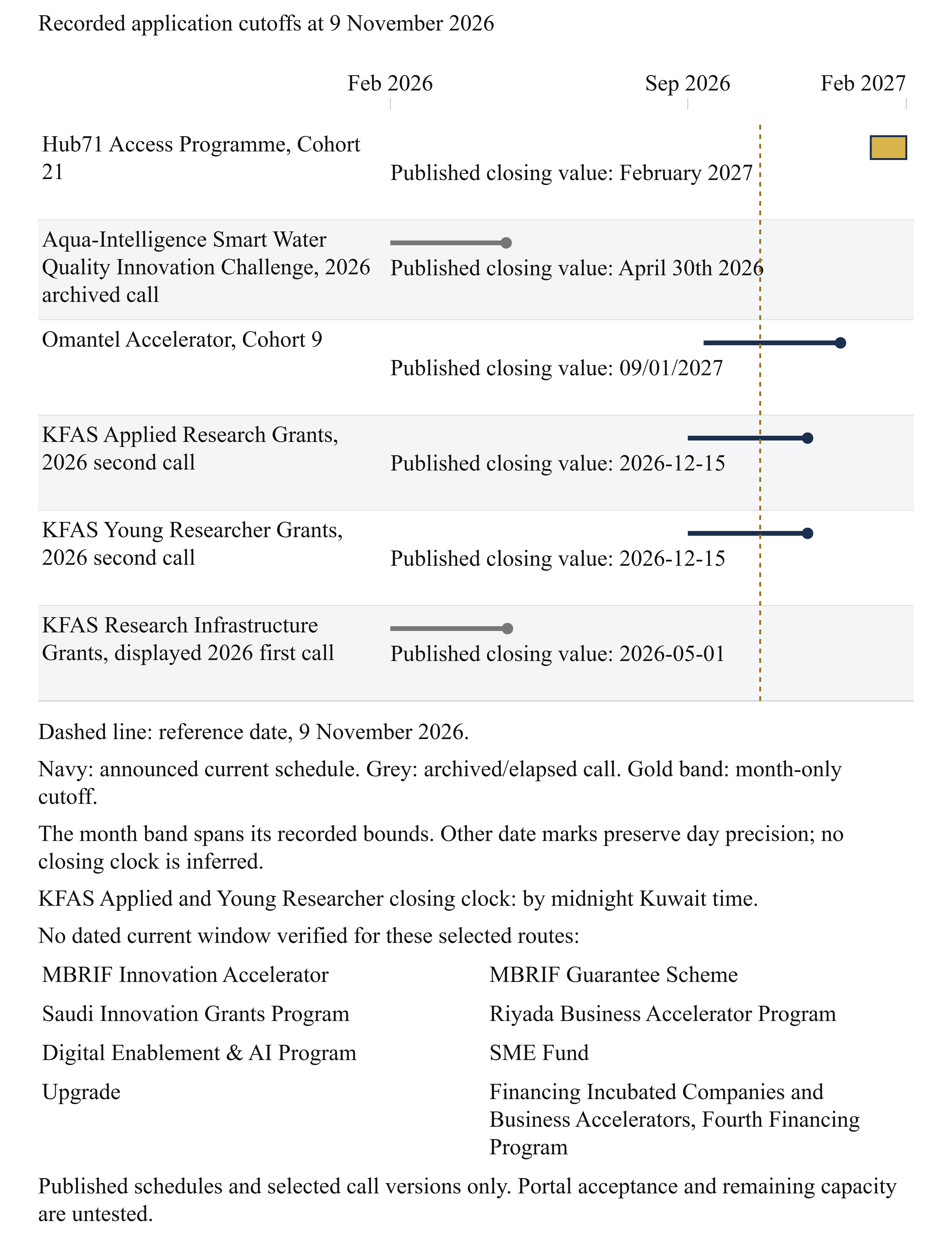
Scroll horizontally to read the figure at full size. You can also open the full-size figure.
Official dated records at 9 November 2026. Earlier call versions and month precision remain visible. Missing windows are not invented; start, review and award stages are separate events.
5 Identify the applicant entity and responsible individuals
An application can involve a commercial beneficiary, a submitting institution, an individual investigator, a mentor and a collaborating organisation. Their conditions require separate records. KFAS's Applied Research Grants page specifies eligible research sectors, a Kuwaiti institutional route for international academic and research institutes, substantial local collaboration and an institutional letter of intent. Those requirements belong to different actors and documents. A description such as international startup compresses information that the published route asks applicants to distinguish. We record each relevant role and its supporting document before evaluating whether the listed checks have been met. [17]
The Young Researcher Grants route adds individual conditions. The reviewed KFAS material specifies an age threshold, degree conditions and a mentor with the relevant qualification, alongside a local research or academic implementation entity. A company's incorporation record would leave those personal and institutional questions unanswered. A researcher could also fit the stated age condition while failing a separate qualification condition. Our constructed records therefore state the individual facts independently. Any result describes the checks represented in the model, with the remaining programme and contractual conditions retained for provider review. [18]
Tamkeen's Riyada Business Accelerator uses a different combination of routes. Its reviewed page distinguishes a Bahrain-based young startup with an active commercial registration or licence from a team without registration that has a prototype and at least one Bahraini founder. It also describes commitment and technology-related conditions. The alternatives should be represented as complete paths. Combining the registration condition from one path with a founder condition from the other could produce a requirement that the page does not state. The proposed checker preserves the alternative paths and reports which facts support a particular assessment. [9]
A live applicant review should also distinguish present facts from proposed changes. A business may intend to establish an entity, appoint a partner or secure institutional approval. The proposed action needs a responsible person, evidence and a timetable. Until it is completed, the decision record should show the condition's present state and the planned work separately. For research partnerships, the record should describe the contributions, governance, intellectual-property arrangements and approvals to be discussed with the institution. The paper does not treat an intention or an informal conversation as evidence that a provider's institutional requirements have already been satisfied.
| Role or fact | Evidence to inspect | Scope limitation |
|---|---|---|
| Submitting institution | Legal type, country and authority to submit | An individual's nationality does not establish the institution |
| Research applicant | Age, qualifications and current research role | Mentor qualification does not replace applicant requirements |
| Mentor or collaborator | Qualification, responsibilities and approvals | A proposed relationship remains incomplete until documented |
| Company registration | Jurisdiction, possession and active licence status | Worldwide registration and Bahrain CR are distinct facts |
| Project and expenditure | Maturity, challenge purpose and requested cost | An industry label does not establish admissible expenditure |
Proposed dossier structure grounded in the role distinctions discussed in references [9,10,17,18,19].
6 Distinguish mandatory conditions from sector priorities
Sector descriptions carry different meanings across programme pages. A provider may define the activity it will fund, identify preferred themes or invite proposals outside its priorities. MBRIF's Accelerator FAQ lists seven priority sectors and also states that other innovations can receive consideration. Both statements belong in the evidence record. The proposed screening policy preserves the priority list and the invitation to other sectors. It does not generate a hard rejection solely from a mismatch with a priority label. Any additional restriction found in the applicable call or contract would require a new, specifically supported condition. [2]
KFAS's Applied Research Grants page similarly invites general science, technology and innovation topics while giving priority to specified domains. The register records those priorities and the broader invitation. The research character of the proposal, institutional route and required documents remain separate questions. A company preparing a proposal about an unfamiliar technology therefore needs to establish its research purpose and submitting arrangement, as well as the relation to the published themes. A priority score would be a separate evaluation assumption. We derive no award likelihood or scoring weight from the provider's list. [17]
A challenge with a specific technical objective can support a narrower activity check. The Qatar Open Innovation water-quality call seeks an AI-supported solution for continuous water-quality monitoring and describes startups and SMEs at TRL 5 or above. A proposed activity should be assessed against that stated challenge and maturity description. Its alignment with a broad water or AI industry label supplies incomplete evidence about the proposed solution. The source also records the application timetable for that particular call. Technical alignment and calendar availability are retained independently so that a promising technical fit cannot silently replace a missing or elapsed submission window. [7]
Activity exclusions also require the provider's actual wording. Tamkeen's SME Fund describes excluded business activities, including finance and brokerage. A software supplier serving financial institutions needs to identify its own activity and the applicable classification; a broad fintech label leaves the question unresolved. The Digital Enablement and AI Program separately restricts the categories of costs it supports. The proposed review therefore distinguishes the applicant's activity, the project's purpose and the expenditure requested. Each condition is linked to its source, and ambiguity is assigned a clarification question before the team incurs substantial preparation costs. [10,11]
| Reviewed wording | Recorded treatment | Unresolved question |
|---|---|---|
| MBRIF priorities with other innovations considered | Priority remains advisory | Applicable full call and applicant conditions |
| KFAS priority domains with other STI topics considered | Priority is separate from research/institution conditions | Project-specific scope and institutional route |
| QOI water challenge and TRL 5+ | Listed technical activity and maturity checks | Complete challenge terms and relevant call version |
| SME Fund excluded finance/brokerage activity | Inspect the applicant's actual activity | Provider classification of the particular business |
Source-linked treatment at the review date; no evaluation score or award probability is inferred. References [2,7,11,17].
7 Record evidence conflicts and unavailable information
The Omantel Accelerator provides a concrete eligibility conflict for the register. The programme page describes a startup founded in Oman and operating in Oman and the MENA region. The official Innovation Labs FAQ separately permits non-Omani startups with an executable Omani angle and describes participation expectations. These statements have different apparent scopes. We preserve both descriptions and leave the current cohort's treatment of a foreign-founded applicant unresolved. A later response from the provider should identify the relevant cohort and condition before it changes the record. [15,16]
The Saudi entries demonstrate a different evidence limitation. The current RDIA directory supports programme-family identification, while complete current conditions for the linked routes remain unverified in the accepted register. Those fields are retained as unresolved. The separate Researchers and Innovators Guide supports institutional and programme context, with its historical document status stated. Each field is linked to the source that supports it. A later call document or scoped clarification can therefore update the relevant condition without altering the meaning or date of the earlier record. [4,5]
An unresolved field can reflect several different problems. The required information may be absent from the reviewed page, available in an attachment that has not been examined, dependent on the applicant, or contradicted by another official source. These situations lead to different next actions. A missing attachment calls for document retrieval. An applicant-specific fact calls for evidence from the applicant. A conflict between official statements calls for a scoped clarification. The proposed register records the reason for uncertainty alongside the field value, allowing a reviewer to identify the work needed to improve the decision.
We recommend preserving changes as dated versions. Each update should retain the prior value, the new supporting source, the reason for the change and the affected applications. If a provider clarifies a condition, the reviewer can identify which cases require reassessment. If a published window changes, the preparation plan can be recalculated using the new dates. This is a proposed control for maintaining the register. It supplies no assurance that a source has captured every contractual term or that a provider will make a particular selection decision. Those boundaries remain visible in the worked analysis and the reporting template.
8 Compare selected programmes across the six GCC economies
The country comparison is organised around selected routes and their documented features. The UAE entries distinguish Hub71's equity-linked cash and in-kind support from MBRIF's accelerator and financing guarantee. Qatar's selected water-quality challenge supplies an archived application calendar and a specific technical objective. Saudi Arabia's current funding directory and historical guide establish programme context, while the current terms inaccessible in the linked portal remain unresolved. These entries show different evidence situations within the selected register. They do not support a ranking of national funding systems or a claim about the number of opportunities available to every business. [1,2,3,4,5,6,7]
Bahrain's entries distinguish accelerator-cost support, a software-and-service reimbursement route and repayable SME finance with associated support. Their conditions address different applicant and expenditure questions. Riyada includes alternative startup or founder-and-prototype routes. Digital Enablement requires relevant registration and presence conditions and identifies excluded cost categories. The SME Fund's repayable structure requires attention to financing obligations and the applicant's activity. The comparison therefore retains the instrument and scope before examining the application's timing. A common country label does not make the routes interchangeable in a capital plan. [9,10,11]
Oman's selected entries span graduation-project commercialisation, repayable financing connected to incubated businesses and an accelerator with published cohort dates. The Upgrade material describes a graduation-project and team-based route; current benefit terms and intake details require further confirmation where the reviewed sources leave them unspecified. The financing programme describes a committee-dependent amount and repayment provisions. Omantel describes potential investment and other support, together with the separate eligibility conflict discussed above. The comparison preserves these distinctions and the different depth of evidence available for each entry. [12,13,14,15,16]
Kuwait's KFAS entries emphasise research and institutional roles. Applied and Young Researcher material provides a published second-call period for 2026. The Research Infrastructure Grants material reviewed for this study displays an earlier first-call period and institution-specific requirements. The register keeps those call identities separate. It also leaves unpublished caps, co-funding details and contractual conditions unresolved where the reviewed pages do not establish them. The resulting comparison is a dated working record for preparing further questions and applicant-specific reviews. It provides no estimate of grant-market size, remaining funding capacity or the likelihood of an award. [17,18,19]
9 Explain what earlier grant research establishes
Howell's American Economic Review article studies ranked applicants to the US Department of Energy's SBIR programme using a quasi-experimental design. The published abstract reports effects of early-stage awards on subsequent financing and innovation-related outcomes, with differences associated with financing constraints. The study concerns what happens after awards in a particular institutional setting. Our application framework addresses the preceding preparation decision. It keeps eligibility, the application calendar and the financing instrument separate, and uses no reported effect to assign a GCC applicant an award probability or expected financial return. [8]
Hall and Lerner's 2009 author chapter draft reviews financing frictions in research and development. Its discussion of R&D investment includes financing costs, the continuity of research activity and the particular position of innovative firms. These considerations make the timing of a funding need relevant to the preparation decision. A programme that could support a later development stage requires a different financing plan from cash already available for ongoing work. The dated programme record provides the relevant operational evidence for that comparison; the financing review supplies background rather than contemporary eligibility or calendar terms. [20]
Lerner's 1999 Journal of Business article examines the longer-run experience of US SBIR-supported firms. Its published abstract reports heterogeneous outcomes, including differences associated with the surrounding venture-capital environment. The finding motivates attention to firm and financing context when discussing the potential role of public support. We retain that context without transferring an outcome estimate to the selected GCC routes. Their applicant roles, instruments and application windows require their own current evidence. A result about supported firms cannot determine whether a particular company can submit a complete application to a contemporary call. [21]
This analysis concentrates on a dated comparison method for the preparation decision. The source register describes selected public offers and their evidence limits. The deterministic component checks constructed applicant facts and preparation assumptions against recorded conditions and dates. A prospective empirical study would require authorised applicant-level records, suitable comparison groups and clearly defined outcomes. We evaluate the proposed checker through transparent inputs, boundary cases and reproducibility controls. Its results describe the stated cases and recorded rules. They provide a basis for reviewing a preparation plan without representing the real-world effects of receiving a grant.
10 Define the three valued recorded eligibility rule
The checker uses three states for the conditions represented in the register. T denotes passing a listed check under the stated facts. F denotes failure of a listed condition. U denotes an unresolved check, including missing applicant evidence, unavailable programme information or an unresolved interpretation. These definitions describe the recorded analysis. A provider can require additional evidence or apply terms outside the reviewed record. The state labels should therefore travel with the condition, its source and the relevant applicant role whenever a result is reported.
In Equations 1a and 1b, i identifies a constructed applicant and j a selected route version. E is the recorded eligibility state, and P is the recorded package state. The individual e terms describe the listed eligibility checks; the p terms describe package or document checks. K and L give the numbers of those checks for the route. The AND operator returns F if any input is F, T if every input is T, and U otherwise. A route with no recorded eligibility rule is assigned U. An empty package list adds no recorded package condition and contributes T as an identity.
Alternative routes need their own grouping. A programme may describe a registered-company path and a separate founder-and-prototype path, with several conditions within each. The AND rule applies inside each path. The OR rule across the paths returns T when at least one complete path is T, F when every path is F, and U otherwise. A requirement from one path should not be added to another path unless the source states that relationship. The Riyada example motivates keeping those groupings visible and preserving uncertainty about the scope of a registration condition. [9]
In Equation 2a, each b is the complete state of an alternative path, M is the number of paths, and B is their combined result. In Equation 2b, each s is the state obtained under a recorded source interpretation, H is the number of interpretations, and C is their consistency result. CONS returns the common state when all interpretations agree and U when they differ. It therefore preserves an unresolved source conflict. Priorities and advisory observations are retained separately and do not enter the hard-condition conjunction. The source record determines which kind of condition is being evaluated.
| Input one | Input two | AND | OR |
|---|---|---|---|
| T | T | T | T |
| T | F | F | T |
| T | U | U | T |
| F | T | F | T |
| F | F | F | F |
| F | U | F | U |
| U | T | U | T |
| U | F | F | U |
| U | U | U | U |
Declared logical definitions for recorded checks. U is unresolved; a source interpretation conflict retains U when its branch states differ.
11 Model date precision and preparation time
The time calculation begins with a declared preparation-start date and an assumed duration for each constructed applicant. It uses calendar days and a stated sensitivity multiplier. These are inputs to the worked analysis. They are not estimates of how long actual applicants require. The calculation does not change a missing institutional approval, licence or qualification into a completed condition merely because time has passed. It keeps the readiness-date calculation separate from the applicant's documented eligibility and package state.
In Equation 3a, r is the calculated readiness date, a the declared preparation-start date, d the assumed baseline duration in calendar days, and lambda the stated multiplier. The ceiling rounds a fractional duration up to a whole day. In Equation 3b, D denotes the earliest and latest dates consistent with the recorded cutoff precision, and the two s terms are calendar-day differences between those endpoints and readiness. A month-only cutoff produces a band covering the calendar month. An unavailable cutoff retains an unresolved state and no calculated slack.
The recorded readiness state R is T when the calculated date is strictly earlier than the earliest admissible cutoff date, F when it is later than the latest, and U within the band or on the cutoff day. This is a date-only planning convention. The source's stated closing time and timezone remain separate fields, and the calculation supplies no test of portal acceptance. The published-intake state I is also separate. It retains a verified archived-call closure or the source's announced schedule at the reference date, with uncertainty preserved at unresolved date boundaries.
In Equation 4a, A is the combined recorded action state, E and P are the states defined above, I is the published-intake state for the selected route, and R is calendar readiness. In Equation 4b, J is the number of selected route versions, the indicator is one when its stated condition holds and zero otherwise, and N counts the resulting route states for an applicant. The T count records passed checks; the T-plus-U count includes unresolved routes. These are conditional counts over the selected record set. They do not establish provider acceptance, a jointly executable application portfolio or a quantity of funding.
12 Construct applicant records and common comparison rules
The worked analysis uses 6 explicitly constructed applicant records. They represent a UAE AI startup, a foreign water-technology SME, a Kuwait institutional researcher, a Kuwait PhD-holder researcher, an Oman national founder and a Bahrain software-adoption SME. The complete input record states the facts used for each case. These descriptions support a controlled examination of the recorded rules. They supply no population proportions or observations about actual businesses. Missing facts are retained as unresolved rather than being converted into a negative answer.
The profiles distinguish the submitting entity from individual and institutional roles. Nationality, entity domicile, registration, operating presence, research role, mentor status and project maturity are recorded separately where they are used. A fact concerning an individual cannot supply a missing fact about an institution. Registration in one jurisdiction cannot silently establish the scope of a registration condition in another. The case record also distinguishes a priority-sector description from an explicit activity or expenditure restriction. These choices allow an individual failed or unresolved check to be traced to the fact and source on which it depends.
The baseline and preparation-time sensitivities use the same programme records, reference date and applicant facts. Only the declared preparation multiplier changes. The comparison therefore isolates the mechanical effect of that assumption within the checker. It does not represent a measured effect of faster proposal preparation or a change in the probability of winning. Where the provider has not supplied a dated current window, the sensitivity preserves an unresolved timing state. A shorter assumed preparation duration cannot create a source-confirmed intake.
The resulting matrix has 84 route-and-applicant cells over the selected records. Each cell retains its eligibility, package, published-intake and calendar-readiness components, together with failed and unresolved checks. The full record permits a reviewer to distinguish a timing obstacle from a role or documentation question. State counts summarise that matrix for the constructed applicants. The analysis makes no choice of a financially optimal programme and assigns no utility or award probability to a support package. A live resource-allocation decision would also require current restrictions on concurrent applications and an explicit preparation budget.
| Constructed applicant | Declared context | Preparation days |
|---|---|---|
| UAE AI startup | An authored UAE seed-stage AI startup with proprietary technology and a full-time founder willing to build an Abu Dhabi team. It has no Bahrain registration or presence. No Kuwait research-institution role is assigned. | 21 |
| Foreign water-technology SME | An authored Canadian small water-technology company, with a TRL 7 AI water-quality prototype and an executable Omani angle. It was founded outside Oman and intends UAE establishment. A deliberately long 100-day work package illustrates partial-date readiness; the duration has no empirical calibration. | 100 |
| Kuwait institutional researcher | An authored 45-year-old Kuwaiti PhD researcher with administrative responsibility at a Kuwait public research laboratory. The institutional applied project, facilities, co-funding, maintenance and package commitments are declared case assumptions, not observed approvals. | 28 |
| Kuwait PhD-holder researcher aged 29 | An authored 29-year-old Kuwaiti PhD holder at a Kuwait public university with an independently qualified mentor. Age, applicant PhD status and mentor PhD status are separate inputs. The example illustrates their distinct source roles without inventing a provider exception. | 14 |
| Oman national founder | An authored Omani founder aged 27 with a registered 4IR graduation project, 67% Omani executive team and a newly existing incubated SME. It has a prototype and proprietary technology before MVP. Listed training/card/licence/staff facts are assumptions; truncated and unspecified programme conditions remain unresolved. | 35 |
| Bahrain software-adoption SME | An authored Bahraini small software SME with an active non-virtual CR and physical presence. Its activity is software development, including fintech software, with no financial/brokerage activity. The request is software/services adoption rather than hardware, training or basic productivity tools; overlap and conduct facts are explicitly declared. | 14 |
All inputs are authored assumptions, not actual applicant observations, verified approvals or estimates of typical preparation time. Every case starts preparation on 9 November 2026.
13 Report application options with uncertainty bounds
The baseline calculation evaluates 84 combinations of a constructed applicant and a selected route version. The table reports every applicant's combined T, F and U states over the same 14-route denominator. The proposed reporting convention shows the passed count alongside the passed-plus-unresolved count. That second count identifies records requiring further investigation; it includes programmes whose current intake or detailed criteria could not be established. It provides no upper bound on awards or on actually available applications. A different source set would produce a different denominator and could change both counts.
| Constructed applicant | T | F | U | T+U |
|---|---|---|---|---|
| UAE AI startup | 0 | 9 | 5 | 5 |
| Foreign water-technology SME | 0 | 10 | 4 | 4 |
| Kuwait institutional researcher | 1 | 7 | 6 | 7 |
| Kuwait PhD-holder researcher aged 29 | 1 | 7 | 6 | 7 |
| Oman national founder | 1 | 7 | 6 | 7 |
| Bahrain software-adoption SME | 0 | 8 | 6 | 6 |
Constructed inputs and dated selected records. T means all represented checks pass; F means at least one represented component fails; U means unresolved without a recorded failure. T+U counts unresolved-inclusive records, not available funding. Every row has the same fourteen-route denominator.
For the UAE AI startup, the baseline has 0 passed records, 9 failed records and 5 unresolved records. Hub71's published intake and calculated calendar readiness pass, while its complete mandatory eligibility remains unresolved in the accepted record. MBRIF's two routes and the Saudi programme similarly lack sufficient current detail to establish an actionable application. Omantel's domicile interpretation is unresolved for this constructed business. The five unresolved entries therefore require different questions. An intake question, an entity-scope question and a missing mandatory-condition record should appear separately in the preparation plan.
The foreign water-technology SME has 0 passed, 10 failed and 4 unresolved records. Its declared TRL 7 AI water-quality proposal passes the listed technical and applicant checks for the selected Qatar challenge. The named call's elapsed window still makes the combined result F. This is a concrete reason to preserve technical alignment and call identity as separate fields. The result does not rule out a subsequent challenge or a different Qatar instrument. It indicates that the selected archived version cannot be treated as an available November application merely because its technical description fits the project. [7]
Both Kuwait researcher cases pass the represented Applied Research checks at baseline. Their assumed institutional and package facts matter directly to that result. Neither passes the Young Researcher route: both have their own PhD, and the older researcher also exceeds the stated age threshold. The younger applicant's qualified mentor cannot reverse the applicant's separate no-PhD condition. The institutional researcher passes the represented infrastructure conditions, but the displayed first-call deadline has elapsed. The profiles therefore have one passed record each, with different failures and unresolved questions behind the same aggregate count. [17,18,19]
The Oman founder has 1 passed, 7 failed and 6 unresolved records. Its Omantel result passes the represented conditions and calendar. Upgrade remains unresolved because of the team-share interpretation and incomplete source wording; the incubated-company finance route retains an unresolved conduct condition and undated intake. The Bahrain software-adoption SME has 0 passed, 8 failed and 6 unresolved records. Its listed Digital Enablement and SME Fund conditions pass under the authored facts, while current application timing remains unresolved. These results identify the particular clarification or timing work required before treating a route as executable. [10,11,12,14,15]
The complete matrix should accompany the count summary. The Bahrain SME and an institutional researcher can share the same unresolved count while facing entirely different requirements. A count alone cannot indicate whether clarification will be easy, whether a partnership is practical or whether preparation is worthwhile. We propose recording the next evidence request against each unresolved component and using the full failed-condition list when deciding whether to defer a route. The study supplies no population weights for the six cases and no financial ranking of their resulting records.
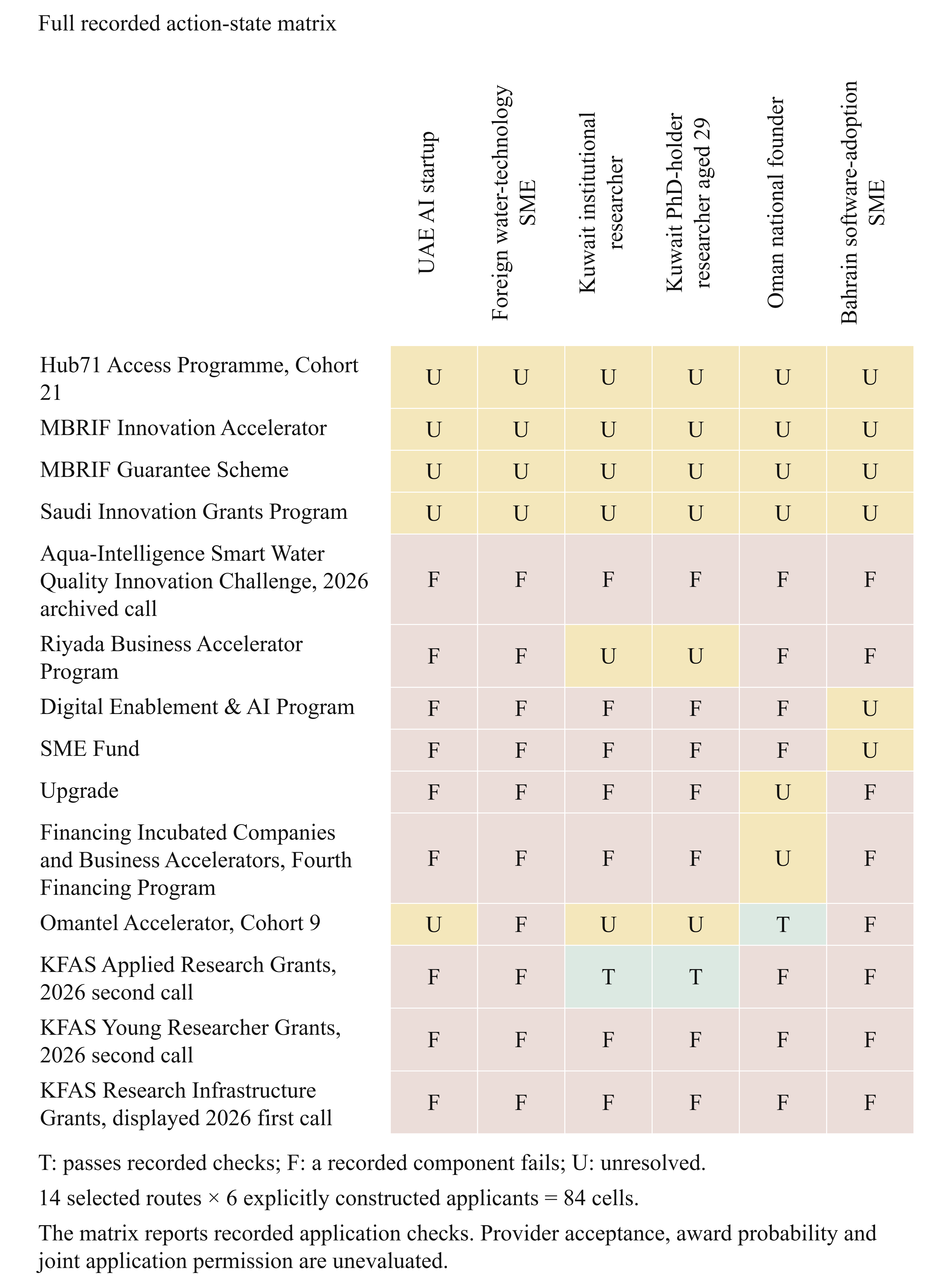
Scroll horizontally to read the figure at full size. You can also open the full-size figure.
Complete eighty-four-cell matrix. T, F and U concern the represented conditions and dated versions; they do not certify provider acceptance or award likelihood.
14 Test deadline precision and readiness assumptions
The preparation sensitivity changes only the declared duration multiplier, using half, baseline and double duration. It retains the same source records, reference date and applicant facts. The resulting 252 records separate a mechanical scheduling difference from a change in eligibility evidence. Calendar days include weekends and public holidays; the model has no working-day, approval-queue or staff-capacity estimate. A real applicant should replace the duration assumption with a documented task plan before relying on an internal completion date. The sensitivity is a conditional calculation whose limits are visible in the same table as its result.
| Multiplier | Days | Ready | Slack days | R | A |
|---|---|---|---|---|---|
| 0.5 | 50 | 2026-12-29 | 34 to 61 | T | U |
| 1 | 100 | 2027-02-17 | -16 to 11 | U | U |
| 2 | 200 | 2027-05-28 | -116 to -89 | F | F |
All cases start preparation on 9 November 2026. Durations are authored calendar-day assumptions, multiplied by 0.5, 1 or 2 and rounded upward. Slack is cutoff minus readiness; a pair records earliest/latest admissible cutoffs. State labels retain separate eligibility and timing components.
| Multiplier | Days | Ready | Slack days | R | A |
|---|---|---|---|---|---|
| 0.5 | 50 | 2026-12-29 | 11 | T | U |
| 1 | 100 | 2027-02-17 | -39 | F | F |
| 2 | 200 | 2027-05-28 | -139 | F | F |
All cases start preparation on 9 November 2026. Durations are authored calendar-day assumptions, multiplied by 0.5, 1 or 2 and rounded upward. Slack is cutoff minus readiness; a pair records earliest/latest admissible cutoffs. State labels retain separate eligibility and timing components.
| Multiplier | Days | Ready | Slack days | R | A |
|---|---|---|---|---|---|
| 0.5 | 14 | 2026-11-23 | 22 | T | T |
| 1 | 28 | 2026-12-07 | 8 | T | T |
| 2 | 56 | 2027-01-04 | -20 | F | F |
All cases start preparation on 9 November 2026. Durations are authored calendar-day assumptions, multiplied by 0.5, 1 or 2 and rounded upward. Slack is cutoff minus readiness; a pair records earliest/latest admissible cutoffs. State labels retain separate eligibility and timing components.
| Multiplier | Days | Ready | Slack days | R | A |
|---|---|---|---|---|---|
| 0.5 | 18 | 2026-11-27 | 43 | T | T |
| 1 | 35 | 2026-12-14 | 26 | T | T |
| 2 | 70 | 2027-01-18 | -9 | F | F |
All cases start preparation on 9 November 2026. Durations are authored calendar-day assumptions, multiplied by 0.5, 1 or 2 and rounded upward. Slack is cutoff minus readiness; a pair records earliest/latest admissible cutoffs. State labels retain separate eligibility and timing components.
For the foreign water-technology SME, the baseline 100-day assumption gives 17 February 2027 as readiness. Hub71's month-only February deadline produces a cutoff band from 1 to 28 February. The two calendar differences are minus sixteen and plus eleven days. The date-only readiness state is U because the source does not establish whether the actual cutoff lies before or after readiness. Assigning the last day of the month would convert that uncertainty into a favourable result without source support. Assigning its first day would impose the opposite unsupported precision. The published month itself is the defensible input. [1]
Halving that assumption gives fifty calendar days and readiness on 29 December 2026. The Hub71 cutoff differences become thirty-four to sixty-one days, so calendar readiness changes to T. Complete eligibility remains U, leaving the combined action state unresolved. With two hundred days, readiness is 28 May 2027, after every date in the February band, and calendar readiness is F. The source's later-cohort consideration policy remains a separate undated possibility. The calculation supplies no future cohort cutoff, admission result or cash date from that policy. [1]
The Kuwait institutional researcher illustrates an exact-day boundary. Twenty-eight assumed preparation days give readiness on 7 December 2026, eight calendar days before the recorded Applied Research cutoff. At fifty-six days, readiness shifts to 4 January 2027, twenty days after it, and the combined action state changes from T to F. The package and institutional facts remain identical in that comparison. The result isolates the assumed timing dependency. It does not establish that the applicant could complete the work in either duration or that the provider would approve a fully prepared proposal. [17]
For the Oman founder, the baseline thirty-five days give 14 December 2026, twenty-six days before the interpreted 9 January 2027 Omantel cutoff. Doubling duration gives 18 January, nine days after it, changing the combined state from T to F. The half-duration calculation rounds 17.5 days to eighteen and gives 27 November 2026. The foreign water SME reaches 29 December under its half-duration assumption and passes Omantel's calendar check, while the source-scope eligibility conflict remains U. These two examples show why acceleration of preparation and resolution of a domicile condition require separate decisions. [15,16]
A same-day readiness date remains U under the declared date-only convention. KFAS's stated midnight Kuwait cutoff is preserved for a final operational check; the checker does not simulate uploads or establish what the portal accepts. An unavailable cutoff produces U and missing slack, regardless of how short the assumed preparation duration becomes. Reviewers should examine the preparation work and source precision before interpreting a changed state. This keeps the numerical comparison tied to its actual inputs and avoids presenting a faster assumed schedule as evidence of greater award prospects.
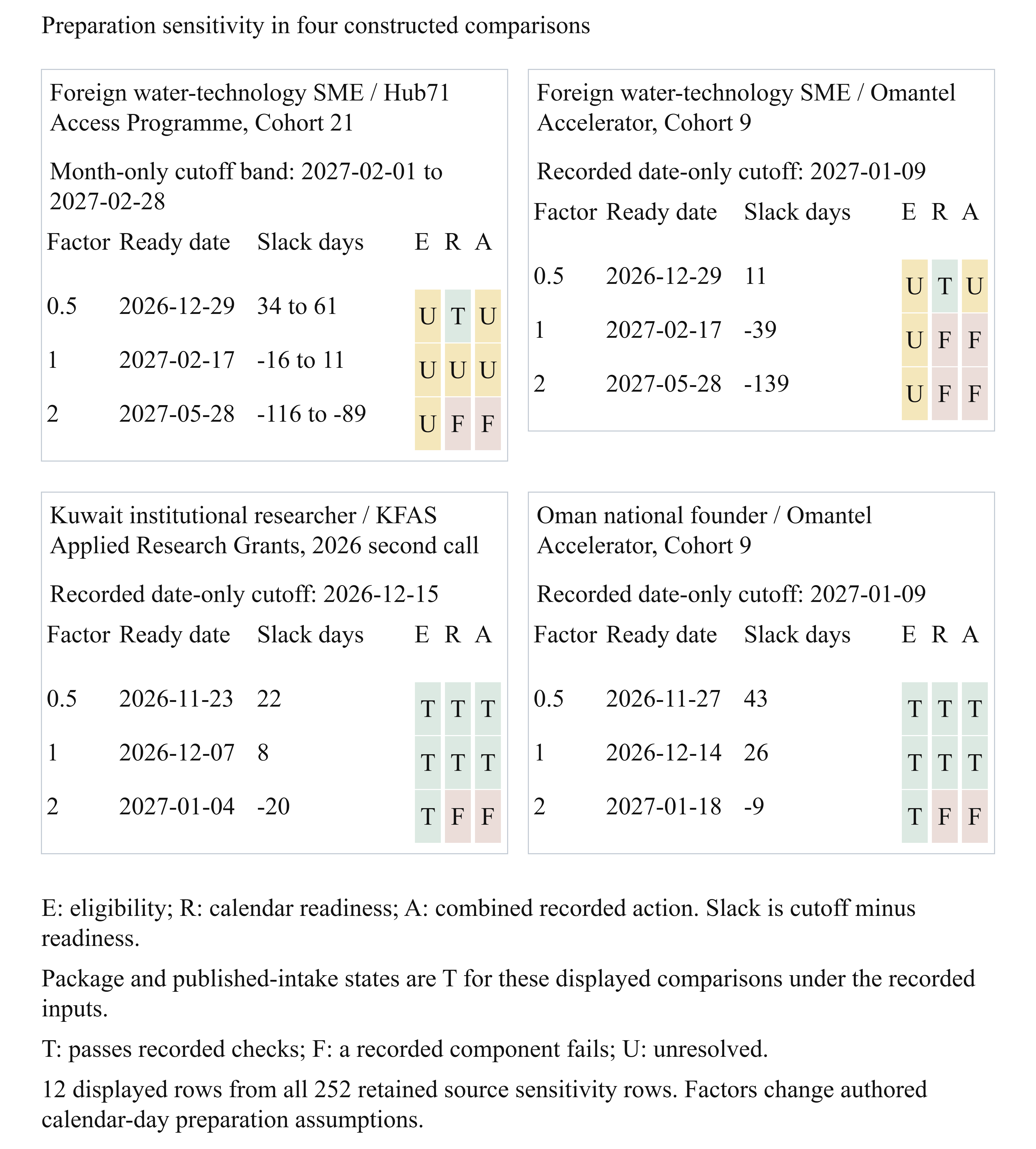
Scroll horizontally to read the figure at full size. You can also open the full-size figure.
Readiness dates and cutoff differences are calculated from declared durations; the February 2027 cutoff remains a month-long band. Eligibility, package, published intake and calendar readiness stay distinct.
15 Test institutional and domicile interpretations
The role checks preserve a distinction between the person applying, the institution submitting, the place of establishment and the proposed implementation arrangement. In the younger Kuwait researcher case, age twenty-nine satisfies the represented age threshold, and the mentor's qualification is declared as present. The applicant's own PhD makes the Young Researcher eligibility state F. The same applicant passes the represented Applied Research conditions because that record has a different set of roles and requirements. The result follows from keeping those routes separate; it supplies no exception to either provider's conditions. [17,18]
For the institutional researcher, the infrastructure route requires a Kuwait-based public research centre or laboratory, an appropriately responsible representative, institutional co-funding and maintenance commitments, alongside the listed package evidence. Those facts are explicitly supplied for the constructed public laboratory. A nationality field or an individual's age could not establish the institutional requirements. The recorded eligibility and package states are T, while the selected first-call timing is F. Replacing the institution with a private company would require a new case record and a new assessment of each relevant condition. The present output does not make that substitution. [19]
| Question | Preserved interpretation | Required next evidence |
|---|---|---|
| Riyada registration scope | Worldwide registration and Bahrain licence possession are distinct facts; disagreement remains unresolved | Provider clarification of the no-CR/licence alternative for the particular founder and entity |
| Upgrade team-share wording | Exact 51 percent and minimum 51 percent readings are retained as hypotheses | Complete governing programme wording and applicant-specific interpretation |
| Omantel domicile | Founded-in-Oman description and executable-Omani-angle FAQ retained together | Cohort-specific confirmation of the foreign-founded applicant's route |
| KFAS young researcher | Applicant qualification and mentor qualification remain separate | Applicant degree evidence, mentor qualification and local implementation approval |
Source-linked questions, not confirmed provider exceptions. The two possible readings of an ambiguous statement are analytical hypotheses. References [9,12,15,16,18].
The Riyada record also preserves two distinct facts: worldwide business registration and possession of a Bahrain commercial registration or relevant licence. Active status has its own field. The source's founder-and-prototype alternative does not establish the treatment of every foreign-registered entity. Where a worldwide-absence reading and a Bahrain-absence reading disagree, the checker returns U for that scope question. Agreement between readings still describes only the represented condition. No worldwide registration prohibition or Bahrain-only permission is asserted. The six cases do not contain the particular foreign-registered, locally unregistered Bahraini-founder combination, so they provide no substantive test of its provider treatment. [9]
Upgrade's executive-team description states a 51 percent Omani share in the reviewed English material. The accepted record does not resolve whether the phrase means exactly that share or at least that share. The constructed Oman case uses 67 percent. An exact-share interpretation fails and a minimum-share interpretation passes, producing U for their consistency. A separate incomplete source condition also remains unresolved. Changing the interpretation alone would therefore leave another missing requirement. We recommend requesting the complete current condition and its intended application together, with the relevant project and team structure stated. [12]
Omantel's programme description and Innovation Labs FAQ produce different readings for a foreign-founded startup with an executable Omani angle. Under the constructed foreign SME facts, the founded-in-Oman requirement fails while the FAQ alternative passes. Eligibility remains U. Under the constructed Oman founder facts, both readings agree and the represented domicile condition passes. The comparison identifies a source-scope dependency without choosing one statement as universally controlling. For the UAE startup, the incomplete current formal eligibility record at Hub71 is likewise kept unresolved even when the stage and relocation context appear suitable. [1,15,16]
A clarification has value when it identifies the governing call, applicant, condition and required evidence. A general statement that a programme welcomes innovation would leave the specific institutional or domicile issue unanswered. We propose a clarification log that records the question, the official response, its scope and the field it changes. Recalculation can then retain all other facts and dates, showing the precise dependency of the result. The present analysis assigns no monetary value to clarification and makes no empirical claim about how frequently the unresolved interpretations are accepted in practice.
16 Allocate a common preparation budget
We propose a preparation budget defined before management chooses which applications to develop. The budget should state the cash available for external work, the staff time that can be released and the period over which those resources are available. Each limit needs an accountable owner. Availability should reflect existing delivery obligations, review capacity and planned absences. This creates a common basis for considering candidate routes. The deterministic checker supplies recorded conditions and calendar comparisons; the allocation described here is a proposed management process, with its own estimates and authorisation record.
Separate reusable evidence from work that belongs to a particular application. Incorporation records, an approved technical description and a controlled financial history can form a shared dossier, subject to their relevance and permitted use. The budget should charge their initial preparation once and identify any route-specific adaptation. Institutional approval remains specific to its required purpose: KFAS Applied Research material requires an institution's letter of intent and disclosure of co-funding arrangements. A general company presentation leaves that approval task outstanding. Record who can obtain it, the expected review sequence and the evidence required for completion. [17]
Estimate each work package in its own unit before translating it into an internal commitment. Staff hours, external fees and elapsed calendar time answer different questions. A technical reviewer may be available for limited working time even when the nominal preparation period appears sufficient. Proposed ranges should identify their basis, dependencies and accountable estimator. Where an estimate is unavailable, retain the work package as uncosted and explain how that uncertainty affects the authority to proceed. The model supplies no preparation-cost estimate or optimal allocation.
Use staged commitments for questions that could change the preparation decision. An initial task can establish the applicant's role, resolve an official-source conflict or obtain an applicable document before a full narrative is commissioned. The decision record should identify the maximum authorised work at that stage and the evidence needed for the next commitment. Programme participation also creates demands beyond submission. Riyada describes a six-month programme and founder commitment. Those obligations belong in a separate participation-capacity review, alongside the preparation ledger, so management can consider the proposed application within the team's wider responsibilities. [9]
When several routes compete for the same resources, management should publish its decision rule in the internal record. Relevant considerations could include the evidence supporting the applicant's role, the importance of unresolved questions, readiness dependencies and the proposed project's financing need. These are proposed judgement criteria, with no weights or award probabilities assigned here. Separately examine any restrictions on simultaneous applications, duplicated expenditure or overlapping support. The checker has no concurrent-application permission model. Its route counts therefore require a further capacity and terms review before they become a jointly authorised programme of work.
Maintain the budget as a commitment ledger throughout preparation. Record authorised work, completed work, actual expenditure, remaining obligations and the next decision date. If a route is deferred, retain the effort already spent and identify any evidence that remains reusable. The original budget and reason for revision should remain visible. The proposed table provides the minimum work-package structure. Its entries are management inputs to be completed for a real decision; they are independent of the constructed timing assumptions and represent no calculated savings, selection advantage or funding return.
| Work package | Budget treatment | Release condition | Accountable review |
|---|---|---|---|
| Reusable applicant dossier | Charge initial work once; record adaptation separately | Evidence is current, relevant and approved for reuse | Dossier owner verifies scope and version |
| Route-specific eligibility clarification | Bound the clarification task before full drafting | Relevant condition or source conflict is resolved or explicitly retained | Programme reviewer records the answer and its scope |
| Institutional approval and proposal adaptation | Record institution and applicant work separately | Required roles, approval path and documents identified | Institutional contact and proposal owner approve the plan |
| Submission preparation and checking | Record staff capacity, external fees and elapsed dependencies | Current call/version and required package confirmed | Submission owner signs off the remaining work |
| Participation and overlapping support | Maintain a separate commitment/terms review | Attendance, expenditure overlap and concurrency restrictions reviewed | Management authorises the combined commitments |
Proposed operational template. Budget amounts, staff estimates, permissions and completion states require applicant-specific evidence; no portfolio optimisation is calculated.
17 Separate application feasibility from usable cash
Maintain separate records for preparation feasibility, provider selection, contractual entitlement and usable cash. The checker's combined state concerns the documented application conditions and the declared calendar assumptions. It supplies no award decision, financial benefit calculation or disbursement forecast. For management purposes, each later financing event needs its own evidence and responsible reviewer. The preparation decision should therefore identify the resources supporting the project during that interval and the event that would justify changing its cash plan.
Reimbursement requires particular attention to the order of expenditure and recovery. Tamkeen's Digital Enablement and AI material describes support following implementation and three months of utilisation, subject to eligible costs and programme terms. We propose recording the supplier payment obligation, the applicant's funding source, the reimbursement conditions and the evidence needed to claim recovery separately. In a constructed planning example, an enterprise proposes to implement software while its support request remains undecided. The financing schedule should preserve the supplier obligation and the contingent recovery as distinct entries. The example assigns no amount, approval probability or reimbursement date. [10]
Repayable finance and guarantees require another set of records. MBRIF's Ministry description distinguishes financing guarantees from its non-financial accelerator, while Tamkeen's SME Fund and Oman's incubated-company route describe repayable support. A proposed treasury review should identify the borrower, lender, principal, repayment obligations, security and any subsidy or guarantee conditions once operative documents are available. A guarantee can support a financing arrangement while the borrower retains obligations under that arrangement. Published programme ceilings and discretionary grace provisions supply questions for this review. The paper derives no debt-service schedule or borrowing-cost estimate from incomplete terms. [3,11,14]
Equity-linked cash and in-kind services also require separate treatment. Hub71's Access page describes cash exchanged for equity through a SAFE alongside an in-kind package, with additional support subject to performance and further equity. A preparation review should identify which terms require founder or investor approval and which services match the project's planned work. Any proposed substitution of services for budgeted expenditure needs an explicit description of the work displaced and the conditions of access. Nominal package value remains separate from available bank balances. The analysis makes no valuation of dilution or assumed conversion of unused services into cash. [1]
A useful financing schedule connects evidence to the project's expenditure milestones. It should distinguish resources already available, amounts supported by operative commitments and assistance dependent on later events. For each contingent item, identify the required decision, remaining conditions and the source of any stated timing. A planned programme start or published evaluation stage supplies no individual payment instruction. Hall and Lerner's review provides background on financing frictions and continuity in research investment. It supports considering the funding need in its development context; the actual milestone and liquidity assumptions must come from the business's own documented plan. [20]
The proposed cash-use register can accompany the application decision without being merged into the eligibility score. Its purpose is to expose the transition required before a type of assistance supports a particular cash obligation. The owner should record the governing document and the scope of any approval, including institutional use or eligible expenditure restrictions. KFAS's institutional submission requirements illustrate why the proposed beneficiary and submitting organisation require explicit roles. The table gives a review structure for those transitions. [17]
| Support category | Evidence to retain | Separate planning entry | Question before use |
|---|---|---|---|
| Cost reimbursement | Approved eligible expenditure, claim conditions and implementation/use evidence | Supplier obligation and contingent recovery | What resources cover expenditure before recovery? |
| Repayable finance and guarantee | Operative financing, repayment and guarantee/subsidy documents | Financing proceeds and borrower obligations | Which conditions govern drawdown and repayment? |
| Equity-linked cash | Executed investment terms and relevant approvals | Conditional investment receipt and ownership implications | Which approvals and completion conditions remain? |
| Services or other in-kind support | Available service scope, access period and permitted use | Specified work supported; no assumed cash receipt | Does the service address an actual planned requirement? |
| Institutional research grant | Operative award, institution roles and expenditure/reporting conditions | Restricted research support and remaining conditions | Who may receive, control and spend the funds? |
Proposed review categories, not a financial model. Amounts, receipt dates, legal rights and expenditure permissions remain document-dependent.
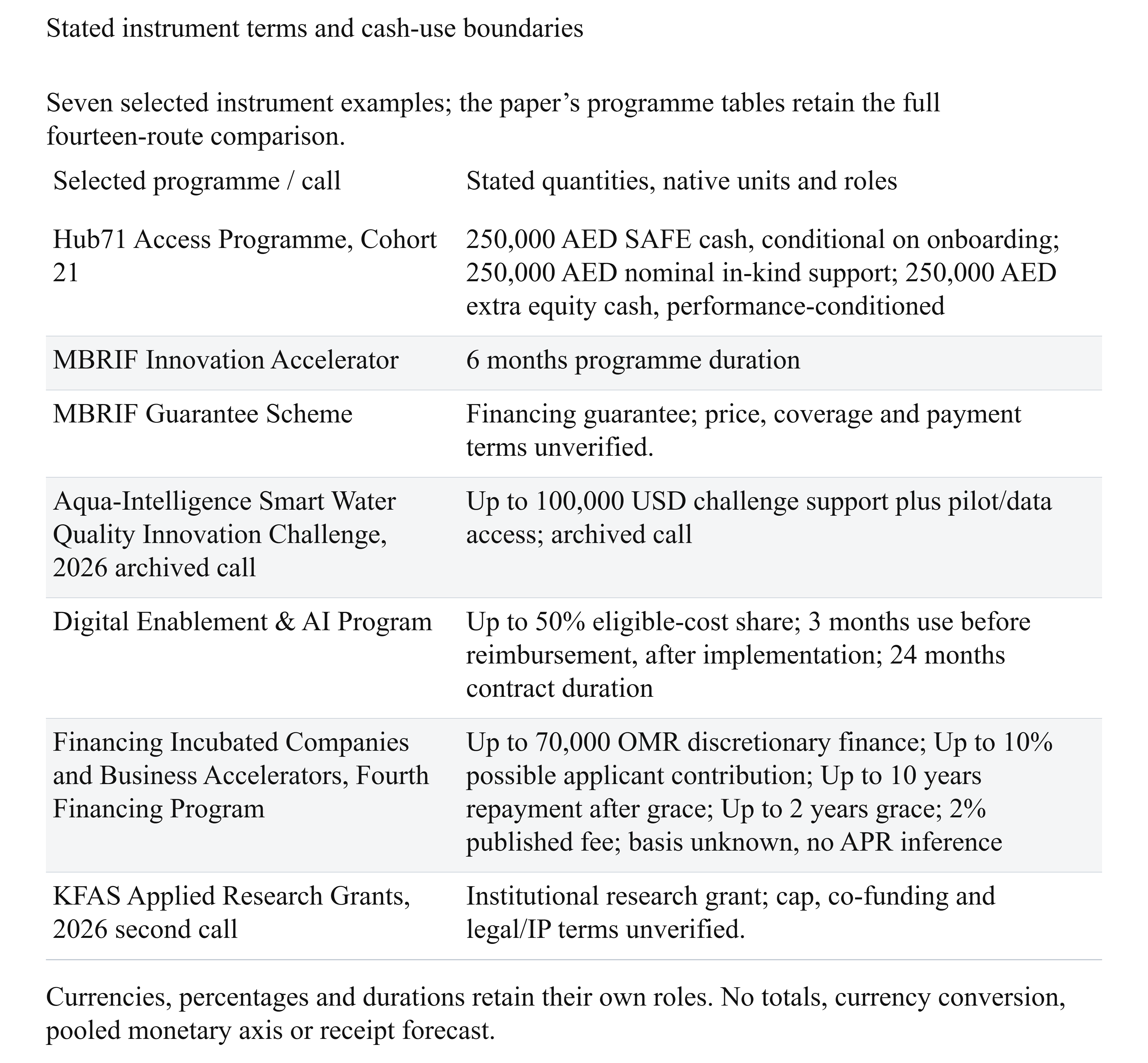
Scroll horizontally to read the figure at full size. You can also open the full-size figure.
Native published quantities retain their currency, role, conditionality and document scope. No common monetary axis, currency conversion, grant-equivalent total or cash receipt is implied.
18 Preserve consistent controls and reproducibility
A reproducible comparison begins with a defined analytical version. Retain the selected route records, source-reference map, constructed applicant facts, preparation assumptions and calculation code together with their hashes. Preserve the reference date, raw published date strings and declared interpretation conventions. The record should identify which fields are source-supported and which are authored inputs. A revised document or applicant fact should create a successor version with a stated reason. This lets another reviewer reconstruct the particular comparison that informed a preparation decision and identify the inputs affected by subsequent evidence.
Trace each combined state through its eligibility, package, published-intake and calendar-readiness components. Failed and unresolved checks need their own explanations and source or applicant references. An independent reviewer should be able to distinguish a missing document, an alternative applicant path, a conflicting source interpretation and a timing boundary. Advisory priorities require a separate field. MBRIF's invitation to innovations outside its named priority sectors illustrates the importance of that distinction. A control review should check the recorded rule's scope before examining whether the implementation reproduces it; computational consistency alone supplies no authority for an unsupported exclusion. [2]
We propose control families covering conjunction, complete alternative paths, unresolved information and conflicting interpretations. Date controls should examine readiness before, within and after a permitted cutoff band, including the declared treatment of a cutoff day. A missing window should remain unresolved under a shorter preparation assumption. Instrument controls should retain cash, services, guarantees and repayable support as separate categories and preserve currencies. Each control requires a stated input, expected result and explanation. Actual control outcomes belong in the execution record, separate from this proposed control design.
Sensitivity comparisons need the same constructed cases, route versions and reporting denominator. Record the input deliberately changed and retain the others unchanged. For preparation-time sensitivity, this means identifying the multiplier and its effect on the calculated readiness date while preserving the source timetable and applicant facts. For a source interpretation comparison, identify the disputed condition and the alternative readings. Keep failed and unresolved cells in the comparison. Counts should reconcile with the complete retained matrix and its component states. Any difference between the detailed output and a summary should receive an explicit disposition before the summary is accepted.
The saved calculation records 59 executed checks, all passing in that run. The individual outcomes are retained with the exact implementation and input records. An independent review examined the saved outputs, source roles, state partitions and calendar arithmetic without rerunning the model. These evidence layers address different questions: source review concerns the represented conditions; implementation review concerns the declared logic; saved execution evidence identifies the checks performed. The count has no interpretation as a grant-success rate, a statistical confidence level or coverage of every provider term. The six constructed cases do not exercise every possible applicant condition or source-interpretation branch.
Independent review should also examine how analytical outputs enter the written decision. Tables, figures and prose need consistent definitions, denominators and qualifications, including the distinction between passed checks and an authorised application plan. A reviewer should trace a reported comparison to the underlying records and examine whether an unresolved condition has disappeared during summarisation. Retain the review findings, exact corrective changes and accepted successor versions. This closes the proposed reproducibility chain from source and constructed case to calculation and interpretation.
| Review layer | Required retained record | Acceptance question | Disposition of an exception |
|---|---|---|---|
| Source and applicant inputs | Version, hash, source passage or authorised fact, uncertainty reason | Does each operative condition have the correct role and scope? | Retain unresolved status or correct the source-linked rule |
| Logical and calendar controls | Input, expected state, actual state and explanation | Do alternative paths, unknowns and date boundaries follow the declared convention? | Preserve failure and identify affected cases |
| Sensitivity comparison | Common inputs/denominator and declared changed assumption | Can each difference be traced to the specified input change? | Reconcile case-level and summary outputs |
| Execution evidence | Actual control outcomes, implementation/input pins and execution record | Does the reported count belong to these retained records? | Keep failed or incomplete checks visible |
| Written interpretation | Source-to-result trace and independent findings/repair record | Do tables and prose preserve component meanings and limitations? | Accept only the reviewed successor interpretation |
Proposed operational acceptance register. Populate execution-layer records from frozen actual receipts; this table is not itself a test receipt.
19 Plan a prospective validation study
A prospective study should define its observation as a project, a particular application route and a dated preparation decision. The record should identify the source version available to the decision maker, the applicant facts that had been verified and the work authorised at that point. This permits later reviewers to reconstruct the information available when a decision was made. A retrospective record assembled only from successful applications would omit abandoned, rejected and unresolved routes. The proposed study should therefore enrol projects before the preparation decision and retain the reasons for every route considered.
One initial validation exercise could assess the consistency and completeness of documented-condition reviews. Independent reviewers could assess the same authorised dossiers using a fixed source record, with disagreements adjudicated against the relevant programme document or a scoped provider clarification. The study would record missing evidence, unsupported assumptions, mistaken treatment of priorities, date-precision errors and the time spent resolving them. This exercise would evaluate a review process. It would require a distinct design to assess whether the process changes selection outcomes, funding receipt or business performance.
A later comparison of preparation methods should specify the allocation rule, common time budget, permitted clarification work and treatment of incomplete cases in advance. Relevant outcomes could include completion of required documents before the planned internal cutoff, verified reasons for withdrawing an unsuitable application and avoidable rework. Actual award decisions would need their own definitions and follow-up periods. Differences between calls, institutions and applicant characteristics would need consideration. We propose no statistical power calculation or target sample size from the constructed records in this paper; those choices require prospective design inputs and a defensible outcome model.
Applicant-level research also requires authorised access, an appropriate basis for processing personal and organisational information, and controls on retention and disclosure. A research agreement should identify the permitted uses of the records and the process for correcting errors. Published summaries should avoid identifying applicants or revealing confidential proposals. Verification status can often be retained separately from the underlying sensitive document. The study protocol should undergo the relevant organisational, ethical and legal review before collection. These are design requirements for a future study; no applicant-level dataset or completed field experiment is represented here.
20 Specify evidence requests for real applicants
An applicant review should start with the particular route and the party proposing to submit. The required evidence can then be organised by legal entity, responsible individuals, project activity, expenditure and timetable. A company record might establish a licence or commercial registration and its operating location. A research route may instead require an institutional approval, an investigator's qualification or a mentor arrangement. The request should identify the exact condition the evidence is intended to address. This limits unnecessary collection and allows a reviewer to distinguish missing documents from a substantive failure of a recorded condition.
The selected KFAS pages illustrate the need for role-specific evidence. Applied Research material describes institutional approval and local collaboration for international academic and research institutes. Young Researcher material adds individual and mentor conditions. The review record should identify the proposed submitting institution, principal person and collaborators, with approval and qualification checks attributed to the appropriate role. It should also retain any issue awaiting institutional or provider interpretation. A generic company profile cannot establish all of those facts. The dossier should enable a competent reviewer to connect each relevant document to a particular published condition. [17,18]
For cost-sharing and repayable routes, the dossier should distinguish the proposed expenditure, the applicant's contribution and the resources available before any reimbursement or financing decision. Requested support should be classified consistently with the provider's published instrument. If a ceiling, percentage or grace period is discretionary, the proposed financing plan should preserve that discretion. The applicant should identify any documents or agreements that determine the operative terms. A calculation based on an assumed financing amount belongs in a separately labelled worked plan, with its assumptions visible and its dependency on approval retained.
The final review record should state which checks have documentary support, which have failed and which remain unresolved. Each unresolved item needs a specific question, a responsible reviewer and a point at which the preparation decision will be reconsidered. New evidence should be added with its date and relevance. Where a formal provider clarification is required, the record should preserve the scope of the reply, including the call or cohort and applicant circumstances addressed. The business can then decide whether to continue preparation, change its proposed route or defer the application using an auditable record of the available evidence.
21 Use automation for verified records and exception routing
A proposed digital workflow can organise the register around source-linked fields rather than a single free-text opportunity description. Programme identity, call version, instrument, currency, applicant role and application dates should have separate fields. Each factual field should retain a link to its supporting source passage and the date of review. Extracted values should remain pending until the required review is complete. The process should preserve the original wording for dates and conditions where interpretation matters. This design provides a record that an analyst can inspect and revise without treating an unreviewed extraction as an authoritative programme decision.
The workflow can apply deterministic checks to required fields, date formats, reversed intervals and inconsistent units. It should flag a month-only cutoff if a downstream calculation demands a precise day, and retain an unresolved result where the evidence does not supply it. A priority label should remain distinct from a mandatory exclusion. An unresolved official-source conflict should be routed for review with both passages attached. These are proposed system requirements. The paper makes no claim about the accuracy of a particular language model, extraction product or automated eligibility service.
Human review is especially important when source statements have different scopes. A general FAQ, a current cohort page and an operative grant manual can address different stages or applicants. The review should establish which statement governs the proposed application, or retain the conflict while a clarification is sought. Automated change notifications should therefore identify the affected fields and source passages. A changed page date or an edited headline alone is insufficient evidence that the application's eligibility or deadline has changed. The reviewer should record the actual term that affects the decision.
For an investor or corporate group, a versioned register can support reviews across several portfolio businesses while keeping their applicant facts separate. Access controls should restrict confidential proposals and personal documents to the people who need them. A central report can display the route, evidence state, next required action and preparation commitment without exposing those documents. Translated working material should preserve official names, amounts and date precision, with the governing source retained for interpretation. The proposed operating model assigns responsibility for the decision and the evidence; it provides no assurance of provider acceptance or selection.
22 Integrate the funding map with capital raising decisions
A funding application should be considered alongside the business's development plan and existing resources. The decision record should identify the milestone to be financed, the expected expenditure profile and the funding instrument proposed for it. Assistance that depends on later selection or reimbursement should retain that dependency in the capital plan. Equity-linked support requires attention to the ownership and governance terms. Repayable finance requires a repayment analysis once the operative terms are available. Services and in-kind support should be evaluated by their relevance to the planned work and the cash expenditure they could actually replace.
The board or investment committee should receive a concise explanation of the proposed route, the evidence supporting the application and the resources needed for preparation. The report should identify the applicable call or cohort, the documented applicant requirements, the cutoff's precision and the questions awaiting clarification. A separate financing schedule should show which receipts are already available or contractually documented and which remain contingent. This keeps the application decision connected to the wider capital requirement. It also permits management to revise the financing plan when a call changes or an application does not progress.
For an acquisition or investment in an existing business, the review should examine the actual assistance agreements already in place. Where an agreement contains change-of-control, expenditure, reporting, ownership or repayment provisions, the transaction team should assess their implications with the relevant advisers. The proposed register can identify the documents requiring that review and the dates of upcoming obligations. The general programme descriptions examined here do not establish the terms of an individual award. No transaction adjustment, valuation increment or continuing entitlement is calculated from those descriptions.
The practical output is a preparation decision linked to a capital plan. A business can authorise document work for a route that passes its recorded checks, seek clarification on an unresolved condition or defer a route with a documented timing obstacle. Management should record the resources committed and the point for reconsideration. If several applications are considered, their combined preparation demand and any source-stated restrictions require review. These choices should be made using the same declared resource and timing assumptions as the comparison presented to the decision maker, with the unresolved funding outcomes kept visible.
23 State coverage and measurement limits
The selected register is a dated, purposive set of programme and call records. It does not estimate the number of GCC funding opportunities or describe every condition within the selected programmes. Public sources can refer readers to additional documents, and individual eligibility may depend on provider interpretation or applicant-specific facts. The register preserves unavailable information and official-source conflicts. A result that passes the listed checks therefore describes the recorded evidence and conditions. The provider remains responsible for its application process, interpretation and selection decisions.
The applicant records used in the numerical component are constructed cases with declared attributes and preparation assumptions. They are not a sample of actual applicants and supply no population weights. The resulting counts and timing comparisons describe those cases under the recorded rules. They do not estimate application success, the distribution of readiness in the market or the impact of receiving support. A different applicant profile, newly verified condition or changed call version can produce a different result. The underlying record and calculation should make those dependencies inspectable.
The treatment of dates also has a defined scope. Published application periods, cohort cutoffs, planned programme starts and proposed awarding stages represent different events. A completed calendar comparison cannot verify that an online portal is functioning, that capacity remains or that a provider will accept an individual submission. Month-only dates and unspecified closing times retain their limitations. The internal preparation assumptions used for the worked analysis are disclosed separately from the provider's timetable. This permits a reader to distinguish source evidence from the calculation convention.
The financial comparison is deliberately limited to the instrument and terms supported by the reviewed sources. It makes no aggregate cash valuation across currencies, in-kind packages, guarantees, repayable finance and equity-linked support. It also supplies no award-probability model or empirical estimate of commercial benefits. Earlier grant studies provide background in their own institutional settings. Their findings are not treated as calibration for the GCC cases. A live financing or transaction decision requires the relevant applicant evidence and operative terms, together with appropriate professional review.
24 Maintain a dated review process
A maintained register should identify its owner, source-review date and the next event that requires reassessment. Relevant events include a new call document, a changed cohort cutoff, a provider clarification, a change in the applicant's role or readiness, and a material revision to the proposed project. The reviewer should record the affected fields and the decision that needs reconsideration. This approach supports a dated record of the application plan without implying that every route is continuously available. The update process should retain earlier call versions so that previous decisions remain interpretable.
Before a business commits substantial preparation resources, we recommend rechecking the source record and the unresolved conditions relevant to that commitment. Before submission, the responsible reviewer should confirm the applicable documents and timetable against the current provider material. The frequency of intervening checks should reflect the decision's sensitivity to change and the resources at risk. A programme with a clear forthcoming cutoff presents a different review task from an undated route whose eligibility terms remain incomplete. These are proposed operating choices, rather than a measured claim about the performance of a particular monitoring schedule.
A revised decision should retain the original evidence and the reason for the change. If a clarified requirement affects a constructed case, the checker can be rerun from a new source version with the remaining assumptions unchanged. If preparation time changes, the revised assumption should be identified separately from the published cutoff. The comparison can then show which input changed and which outcomes depend on it. Reproducibility in this setting means that another reviewer can reconstruct the stated comparison; it does not establish the accuracy of facts that have not been verified.
The next decision for a business is to identify the particular application it could prepare and the information required to justify that commitment. The dated register provides a way to organise that review. Its value depends on the relevance of the selected route, the quality of the applicant evidence, a realistic preparation plan and continued attention to the provider's current terms. The worked results remain conditional on their declared inputs. The paper's proposed method makes those conditions explicit so that management can decide what to investigate, prepare or defer within its wider financing plan.
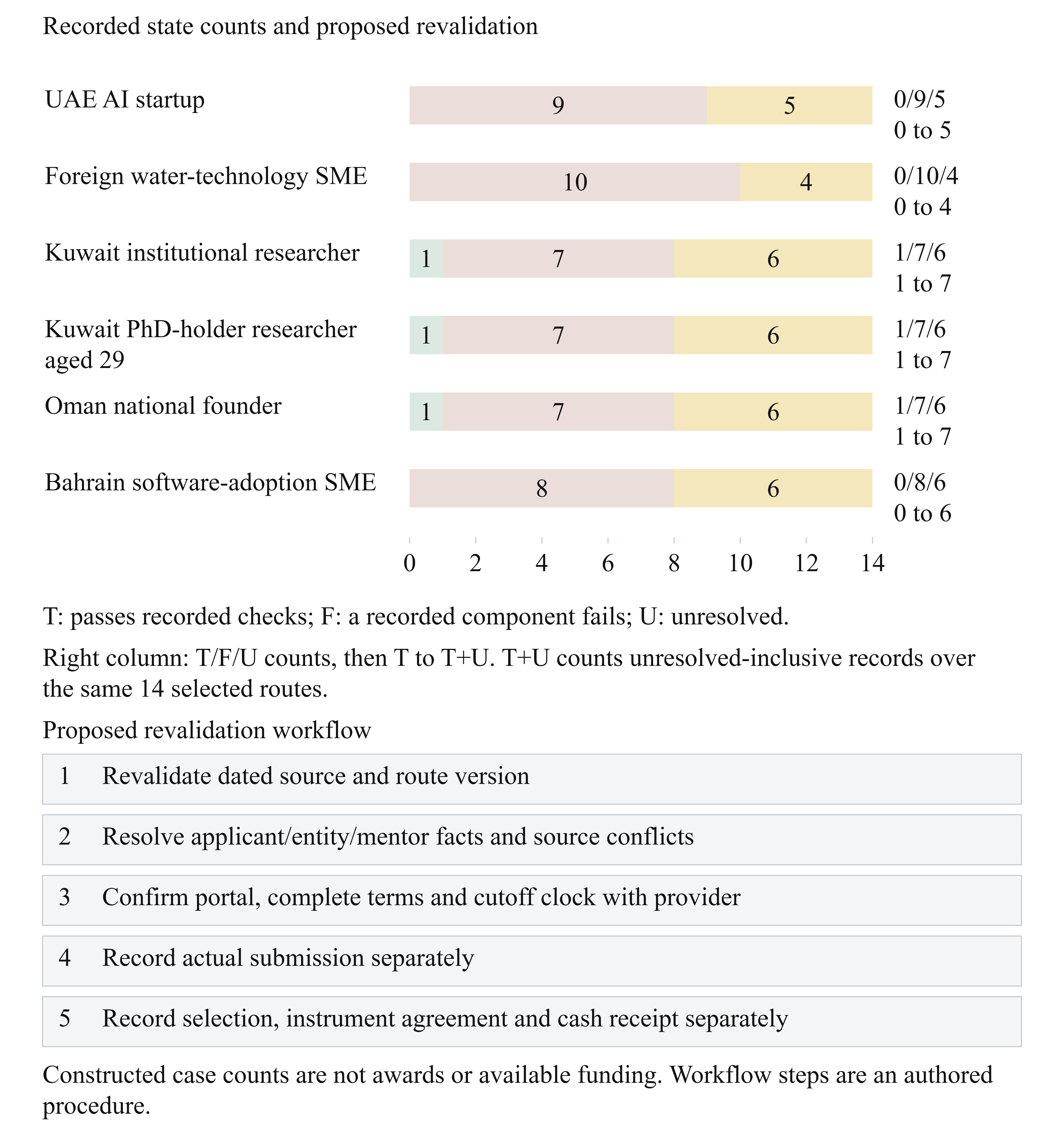
Scroll horizontally to read the figure at full size. You can also open the full-size figure.
Counts use the same fourteen selected records for each case. The workflow is a proposed procedure; unresolved-inclusive counts do not establish available applications or awards.
References
- Hub71. Access Programme. Accessed 9 November 2026. https://www.hub71.com/program/access-programme
- Mohammed bin Rashid Innovation Fund. Frequently Asked Questions. Accessed 9 November 2026. https://mbrif.ae/faq-2/
- UAE Ministry of Finance. Mohammed bin Rashid Innovation Fund. Accessed 9 November 2026. https://mof.gov.ae/en/about-us/our-partners/mohammed-bin-rashid-innovation-fund/
- Research Development and Innovation Authority. Funding. Accessed 9 November 2026. https://rdia.gov.sa/en/programs/funding/
- Research Development and Innovation Authority. Researchers and Innovators Guide. Accessed 9 November 2026. https://rdia.gov.sa/media/i3sfclzn/researchers-innovators-guidebookv6-eng.pdf
- Qatar Research Development and Innovation Council. Qatar Open Innovation List of challenges. Accessed 9 November 2026. https://qoi.qrdi.org.qa/web/en/challenges
- QRDI and KAHRAMAA. Aqua-Intelligence The Smart Water Quality Innovation Challenge. Accessed 9 November 2026. https://qoi.qrdi.org.qa/en/challenges/aqua-intelligence-the-smart-water-quality-innovation-challenge
- Howell, S. T. (2017). Financing Innovation: Evidence from R&D Grants. American Economic Review, 107(4), 1136-1164. DOI 10.1257/aer.20150808. https://www.aeaweb.org/articles?id=10.1257/aer.20150808
- Labour Fund (Tamkeen). Riyada Business Accelerator Program. Accessed 9 November 2026. https://tamkeen.bh/en/programs/riyada-business-accelerator-program/
- Labour Fund (Tamkeen). Digital Enablement & AI Program. Accessed 9 November 2026. https://tamkeen.bh/en/programs/digital-enablement/
- Labour Fund (Tamkeen). SME Fund. Accessed 9 November 2026. https://tamkeen.bh/en/programs/sme-fund/
- Gov.om; entry attributed to Ministry of Higher Education, Research and Innovation. Apply for Upgrade Program. Accessed 9 November 2026. https://gov.om/en/w/apply-for-upgrade-program
- Oman Telecommunications Company (Omantel). Key Initiatives details: Upgrade. Accessed 9 November 2026. https://portal.omantel.om/en/csr/key-initiatives/upgrade
- Oman Small and Medium Enterprises Development Authority. Fourth Financing Program: Financing Incubated Companies and Business Accelerators. Accessed 9 November 2026. https://www.sme.gov.om/en/funding-programs-related-to-the-authority-desc/?ID=3
- Oman Telecommunications Company (Omantel). The Accelerator: The Omantel Accelerator. Accessed 9 November 2026. https://www.omantel.om/en/innovation-labs/accelerator
- Oman Telecommunications Company (Omantel). FAQ: Innovation Hub. Accessed 9 November 2026. https://www.omantel.om/en/innovation-labs/faq
- Kuwait Foundation for the Advancement of Sciences (KFAS). Applied Research Grants. Accessed 9 November 2026. https://www.kfas.org.kw/research/grants/Applied-Research-Grants
- Kuwait Foundation for the Advancement of Sciences (KFAS). Young Researcher Grants. Accessed 9 November 2026. https://www.kfas.org.kw/research/grants/Young-Researcher-Grants
- Kuwait Foundation for the Advancement of Sciences (KFAS). RIG: Research Infrastructure Grants. Accessed 9 November 2026. https://www.kfas.org.kw/research/grants/RIG
- Hall, B. H., and Lerner, J. (2009). The Financing of R&D and Innovation. Author chapter draft, August 2009, UC Berkeley. https://eml.berkeley.edu/~bhhall/papers/HallLerner09_rndfin_chapter_draft.pdf
- Lerner, J. (1999). The Government as Venture Capitalist: The Long-Run Impact of the SBIR Program. The Journal of Business, 72(3), 285-318. DOI 10.1086/209616. https://www.jstor.org/stable/10.1086/209616?seq=1
About the Author
Chennakeshav (CK) is a corporate finance and investment banking executive with 25+ years of global experience in deal origination, structuring and execution across M&A, growth capital and corporate strategy. He has led value-creation mandates for founders, corporates and funds — bridging the boardroom view to hands-on execution and close.
His career spans Morgan Stanley, HSBC, Lloyds Banking Group, EWEC, ADQ portfolio companies and Emirates Growth Fund, across TMT, real estate, fintech, deeptech, cleantech, infrastructure and energy. He has partnered with C-suite leaders, private equity and venture funds, sovereign wealth funds and family offices to finance complex fund raises and scale-up ventures, and has led M&A due diligence, post-merger integration and business-transformation initiatives to create value.
At Matchpoint Partners he is Managing Partner, leading the firm's corporate finance, M&A and capital-raising practice. He holds an MBA from London Business School, an engineering degree from VTU and a Master of Laws (LLM, in progress) from UCL London.
An active start-up mentor, CK mentors at Techstars, DIFC FinTech Hive, Startup Grind, Founder Institute and IN5, serves as Entrepreneur Mentor in Residence (EMiR) at London Business School, and judges the Entrepreneurship World Cup.
https://www.linkedin.com/in/ckadya/
https://www.matchpoint-partners.com/team/ck-adya.html
Disclaimer
This paper is part of a continuing series on the structure of private and alternative markets. The views expressed are the author's own. The paper is for information only, describes market structure in general terms, and does not constitute investment, legal, tax or regulatory advice or a recommendation in respect of any security, vehicle or counterparty.
