

1. Treat backlog as a claim that requires evidence
Engineering companies often lead with the size of the order book. The number is commercially useful only when the buyer understands what it represents. It may combine signed contracts, letters of award, framework quantities, expected variations, customer forecasts and management opportunities. These categories have different enforceability, timing, margin and cash requirements. A buyer should therefore treat headline backlog as a claim to be reconstructed rather than as revenue already secured.
The reconstruction begins with a complete contract population. The target should provide the executed agreement, accepted purchase order, amendments, drawings, bills of quantity, change orders, correspondence, programme, invoices, certificates, bank guarantees and claims record for every material project. The legal entity named in the contract should reconcile to the reporting entity and transaction perimeter. The remaining value should reconcile to recognised revenue, billed amounts and contract assets under the applicable accounting policy.
Ind AS 115 distinguishes contract assets from unconditional receivables and requires an entity to assess contract assets for impairment under Ind AS 109.[1][2] That distinction matters in a buyout. Unbilled work may reflect valid performance awaiting a contractual milestone; it may also reflect disputed measurement, missing certification or a weak claim. The buyer should test the contractual right, evidence of performance, certification path and expected collection for each balance.
The backlog register should preserve status. A signed fixed-price EPC contract has a different risk profile from a rate contract with no minimum volume. A letter of award may be binding, conditional or superseded by later terms. A framework agreement may provide access to work without committing customer spend. Optional quantities, escalation claims and variations should remain separate until the customer has accepted the obligation.
Backlog quality also depends on execution. Remaining revenue without the required people, procurement slots, permits, drawings, sites, equipment or working capital is not equivalent to deliverable cash flow. The underwriting question is whether the acquired organisation can convert the documented scope into acceptable work, certified billing and collected cash within the modelled time and cost.
2. Fix the transaction perimeter before measuring performance
Many Indian engineering groups operate through multiple companies, partnerships, proprietorships, joint ventures and promoter-owned assets. Employees may work across entities. Equipment, offices, intellectual property, licences, bank guarantees and customer contracts may sit outside the legal company being acquired. Financial statements can consolidate or disclose some relationships while operational practice remains more intertwined.
The buyer should build three perimeters. The legal perimeter identifies shares, entities, branches, assets and liabilities included in the transaction. The operating perimeter identifies the people, systems, facilities, licences, equipment, supplier arrangements and customer relationships required to deliver the business. The financial perimeter identifies the revenue, cost, cash, debt, guarantees, tax positions and working capital included in historical and forecast performance. Differences among the three create separation costs and transaction dependencies.
Ind AS 24 requires disclosure of related-party relationships, transactions, outstanding balances and commitments that may affect financial position or performance.[3] The Companies Act, 2013 and, for listed entities, SEBI's Listing Obligations and Disclosure Requirements create approval and disclosure requirements for related-party transactions.[4][5] These sources establish a governance baseline; transaction diligence still needs a wider economic map of benefits, control and dependency.
The map should include promoter-owned premises, equipment leases, subcontractors, travel companies, recruitment businesses, finance providers, distributors and consulting arrangements. Each relationship should identify owner, contract, pricing method, duration, termination, replacement cost, approvals, balances and post-completion plan. A service that appears immaterial by annual expense can still be critical if it controls a licence, tender qualification, bank facility or customer access.
The transaction perimeter should also capture obligations that do not sit neatly in ordinary debt. Performance guarantees, advance-payment guarantees, letters of credit, indemnities, corporate guarantees, bid bonds and disputed claims can constrain cash after completion. The buyer needs the beneficiary, issuing bank, secured cash, margin, expiry, extension history, counter-indemnity and project connection for each instrument.
Completion should occur only when the buyer knows which capabilities transfer, which require consent, which must be replaced and which create a continuing promoter dependency. That perimeter becomes the denominator for every later earnings, cash and valuation conclusion.
3. Build a contract-level backlog bridge
A backlog bridge connects the headline order book to the revenue and cash that a buyer can underwrite. It starts with the target's reported figure and removes unsupported, conditional, duplicated, completed or cancelled amounts. The remaining contracted value is then adjusted for timing, capacity, cost-to-complete, customer credit, dispute and working-capital constraints.
The bridge should be built by contract, not by broad management category. Required fields include customer, project, legal entity, award date, contract date, currency, original value, approved variation, recognised revenue, certified billing, cash collected, remaining contractual value, optional scope, programme, completion estimate and current status. The contract owner and finance reviewer should approve each material record.
Revenue timing should follow evidence. A delayed site can move the programme and increase standby cost. A missing drawing or permit can block procurement and installation. A customer may have a contractual right to omit scope. A supplier may have repriced a critical component. These matters should change the backlog state and forecast rather than sit only in a narrative risk list.
The Reserve Bank of India's Order Books, Inventories and Capacity Utilisation Survey collects information on new orders, backlog, work in progress and capacity utilisation in Indian manufacturing.[6] Aggregate survey evidence provides market context; it does not validate a target's order book. The buyer still needs contract-level reconciliation and physical operating evidence.
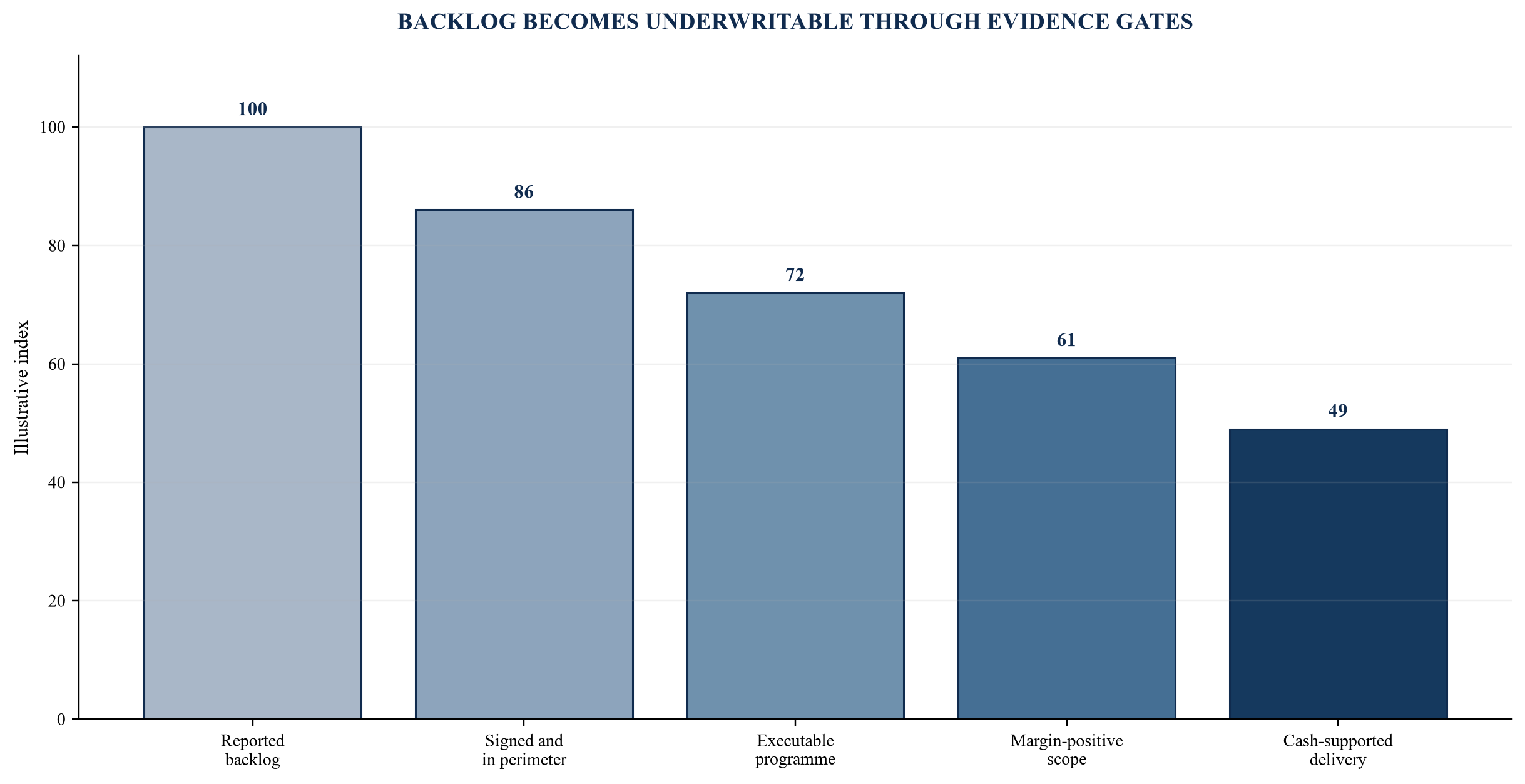
Hypothetical values illustrate the sequential evidence gates applied to reported backlog.
The final output is not a single certainty-adjusted number. It is a portfolio of contracts with different evidence, timing and downside. The investment model should preserve those differences so that later diligence findings can change the correct project, cash period and valuation response.
4. Classify every order by contractual quality
Contract classification prevents unlike forms of backlog from being valued together. The buyer should define categories before reviewing management's forecast. A useful hierarchy separates executed contracts, accepted purchase orders, letters of award, framework agreements, options, change requests, claims and pipeline. Each category needs an entry test and permitted valuation treatment.
An executed contract requires confirmation of signatures, authority, effective date, scope, price, programme, security, payment, change control, termination and governing law. An accepted purchase order may be sufficient for standard supply but inadequate for complex project work if specifications and commercial terms remain unresolved. A letter of award can create obligations before a formal agreement; counsel should determine its legal effect from the actual wording and conduct of the parties.
Frameworks and rate contracts often allow the customer to order quantities over time. The buyer should include only committed call-offs in contracted backlog unless the agreement contains an enforceable minimum. Management expectations can remain in the commercial forecast with a separate probability and evidence basis. Customer options and cancellable scope should remain visible.
Variations deserve their own ledger. An instructed change may be payable even when price is not final; an informal request may lack authority; a contractor claim may be disputed. The ledger should state instruction, contractual notice, valuation method, customer response, cost incurred, revenue recognised, cash received and legal assessment. Historical conversion of claims into certified value provides context but cannot replace current evidence.
Price mechanisms also change risk. Fixed price transfers productivity, quantity and input-cost exposure to the contractor subject to contract relief. Unit-rate work transfers some volume risk to the customer while leaving measurement and mix uncertainty. Cost-reimbursable work can protect margin if eligibility, approval and fee terms are clear. Price-adjustment clauses can reduce commodity exposure but introduce index, lag and threshold effects.
The Indian Department of Expenditure's 2025 procurement manual describes performance security, retention and completion mechanisms used in public works.[7] NHAI EPC agreements provide project-specific examples of retention deductions and release conditions.[8] These instruments should be read contract by contract. A buyer should not assume that market convention overrides signed terms.
Table 1. Contract classification and underwriting treatment
| Contract state | Minimum evidence | Principal risk | Illustrative underwriting treatment |
|---|---|---|---|
| Executed firm order | signed agreement, authority, scope and price | termination, delay, cost-to-complete | include by contract and scenario |
| Accepted purchase order | acceptance, specifications and governing terms | incomplete commercial terms | include eligible committed scope |
| Letter of award | wording, conditions and party conduct | condition or superseding agreement | include only after legal assessment |
| Framework or rate contract | call-off and minimum-volume provisions | no committed quantity | include committed call-offs; model options separately |
| Variation | authorised instruction and valuation evidence | entitlement and pricing dispute | include approved value; separate claims |
| Claim or pipeline | notice, basis and counterparty response | enforceability and collection | exclude from contracted base case |
Treatment depends on the actual contract, accounting policy and legal advice.
5. Reconstruct revenue and margin by project cohort
Reported revenue is an accounting outcome; buyout underwriting needs the operating bridge beneath it. The buyer should reconcile revenue from the general ledger to contracts, performance obligations, progress measures, invoices, certificates and cash. The same project should carry consistent identifiers across project management, procurement, finance and bank-guarantee records.
Ind AS 115 requires revenue recognition to reflect transfer of promised goods or services and includes requirements for variable consideration, contract modifications, significant financing components and contract balances.[1] The diligence team should test how the target determines progress, estimates total cost and updates forecasts. A small change in estimated cost-to-complete can create a material margin movement on a long-duration contract.
Project cohorts help identify repeatable economics. Cohorts can be formed by customer type, contract form, sector, geography, project size, award year or delivery model. For each cohort, the buyer should compare bid margin, latest forecast margin, realised margin, cash conversion, delay, variation, claim and warranty outcome. Persistent deterioration in a cohort may indicate pricing weakness, execution constraints or selective recognition of favourable projects.
The quality-of-earnings review should separate ordinary delivery from catch-up adjustments, claim recognition, provision release, foreign-exchange effects, one-off procurement gains, related-party pricing and capitalised cost. The buyer should trace journal entries posted near period end and compare operational evidence with the accounting conclusion.
Cost completeness matters as much as revenue. Project forecasts should include committed purchase orders, unplaced procurement, labour, mobilisation, testing, warranties, liquidated damages, escalation, subcontractor claims, site overhead, corporate support and financing cost where relevant to the transaction model. Missing cost should be assigned to the project whose revenue depends on it.
The output is a project-level earnings bridge. It identifies reported margin, normalisation, forecast correction, cash timing and residual uncertainty. This permits a buyer to decide whether the appropriate response is a valuation adjustment, completion condition, price mechanism, escrow, indemnity or operating action.
6. Age retention money by release condition
Retention money is common in works contracts because the customer withholds part of each interim payment until completion, acceptance or the end of the defect-liability period. The Department of Expenditure's 2025 manual notes that works contracts often withhold a percentage of running bills and describes staged release or replacement with an acceptable guarantee.[7] Actual contractual terms determine the target's rights.
The buyer should separate retention from ordinary trade receivables. Each balance should identify project, customer, invoice, certificate, amount, currency, deduction rate, cap, completion status, taking-over certificate, defect-liability period, expected release date, dispute, set-off right, guarantee alternative and subsequent receipt. The accounting classification should reconcile to Ind AS 115 and Ind AS 109.[1][2]
Age alone can mislead. A two-year-old retention may be current under a long defect-liability period; a six-month-old balance may be impaired if the project has unresolved defects or no completion certificate. Aging should therefore use both time and condition. The schedule should show which contractual event has occurred and which evidence remains missing.
The buyer should also test net exposure. A customer may hold retention while the target withholds amounts from subcontractors. The timing and legal rights may differ. Releasing subcontractor retention before customer receipt can create a funding gap. The working-capital model should preserve each side and model set-off only where contracts and practice support it.
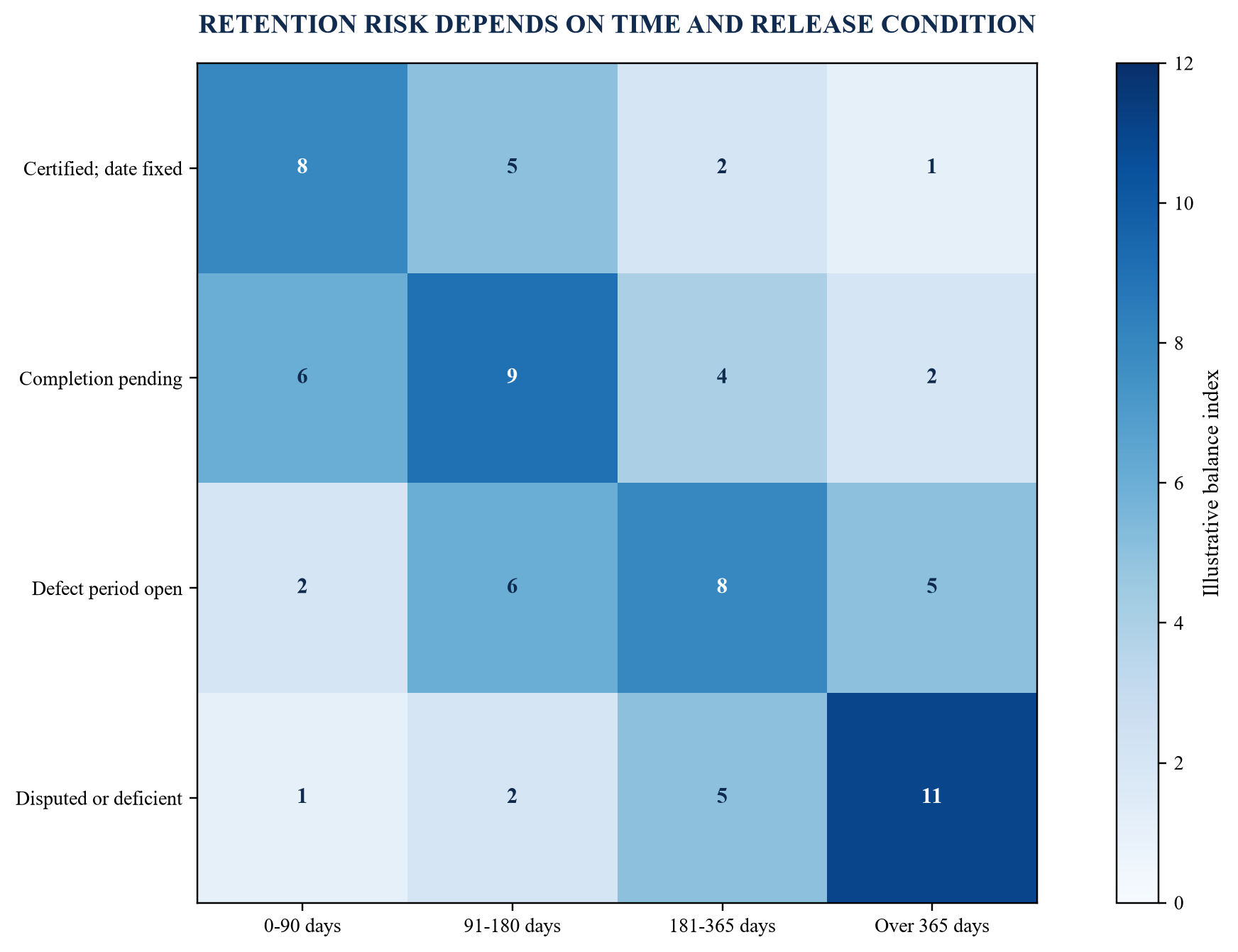
Hypothetical balances show why calendar age and release evidence must be assessed together.
Recovery testing should compare forecast release with subsequent cash and customer confirmations. Material balances may require direct confirmation or legal review. If recovery depends on promoter intervention, the retention schedule should link to the dependency map and transition plan.
7. Model working capital needed to deliver the backlog
An engineering buyout can acquire profitable projects and still face a cash shortfall. Mobilisation, design, procurement, inventory, site work and subcontractors may be funded before milestone certification and customer payment. Performance-security margin and restricted cash can consume liquidity. Retention extends the cash tail beyond physical completion.
The buyer should build a contract-level cash curve. The curve starts with opening receivables, contract assets, retention, advances and payables. It then adds forecast procurement, labour, overhead, taxes, bank charges, guarantees, billing, certification, collection and subcontractor payments. Each item should use contractual timing and evidence rather than a single corporate days-sales-outstanding assumption.
Customer advances can improve cash flow but create performance obligations and refund exposure. Advance-payment guarantees may tie up bank limits or cash margin. A project that appears cash positive at award can become cash negative if milestones slip or procurement must be accelerated. The model should show gross cash, restricted cash and available liquidity separately.
India's MSMED Act includes delayed-payment provisions for eligible micro and small suppliers; the Ministry of MSME describes the facilitation mechanism and interest consequences.[9] A buyer should identify registered suppliers, overdue balances, disputes and any unrecorded interest exposure. Supplier stretching that supported historical cash flow may be legally, commercially or operationally unsustainable.
Working capital should be normalised for the acquired backlog and ownership model. A promoter may have delayed supplier payments, provided informal funding or negotiated exceptional customer advances. The buyer should replace these effects with a supportable operating cycle. Forecast growth should carry the incremental cash needed for tender security, procurement, work in progress, tax and retention.
The acquisition financing model should test a 13-week liquidity view and a full project cash profile. The result influences debt capacity, minimum cash, revolving facilities, guarantee limits, equity reserve and completion mechanics. Cash that is restricted against guarantees or unavailable within a joint venture should not fund consideration or ordinary operations.
8. Map customers, contracts and decision access
Customer concentration should be measured through more than reported revenue. Engineering businesses can depend on a small number of public authorities, utilities, industrial groups, EPC partners or original-equipment manufacturers. The same customer can appear through several entities and projects. Revenue, backlog, receivables, retention, guarantees, claims and future tender access should be aggregated by economic group.
The customer map should distinguish contractual buyer, end user, consultant, engineer, approving authority, payer and relationship sponsor. A project can perform technically while cash depends on certification by another party. A customer may have broad set-off rights across contracts or group entities. These rights can connect an otherwise healthy project to a disputed one.
Contract quality includes change-of-control, assignment, subcontracting, confidentiality, data, audit, performance, termination and suspension provisions. The buyer should identify required consents and the practical relationship plan for each material customer. A consent condition may protect closing; early engagement can also create disclosure and competitive risk. The transaction plan should define authority and sequence.
Customer references should test delivery, quality, safety, responsiveness, claims behaviour and reliance on named individuals. The discussion should be grounded in specific completed and current projects. Management-provided references should be supplemented with contract evidence, complaint records, tender outcomes and independent channels permitted by the process.
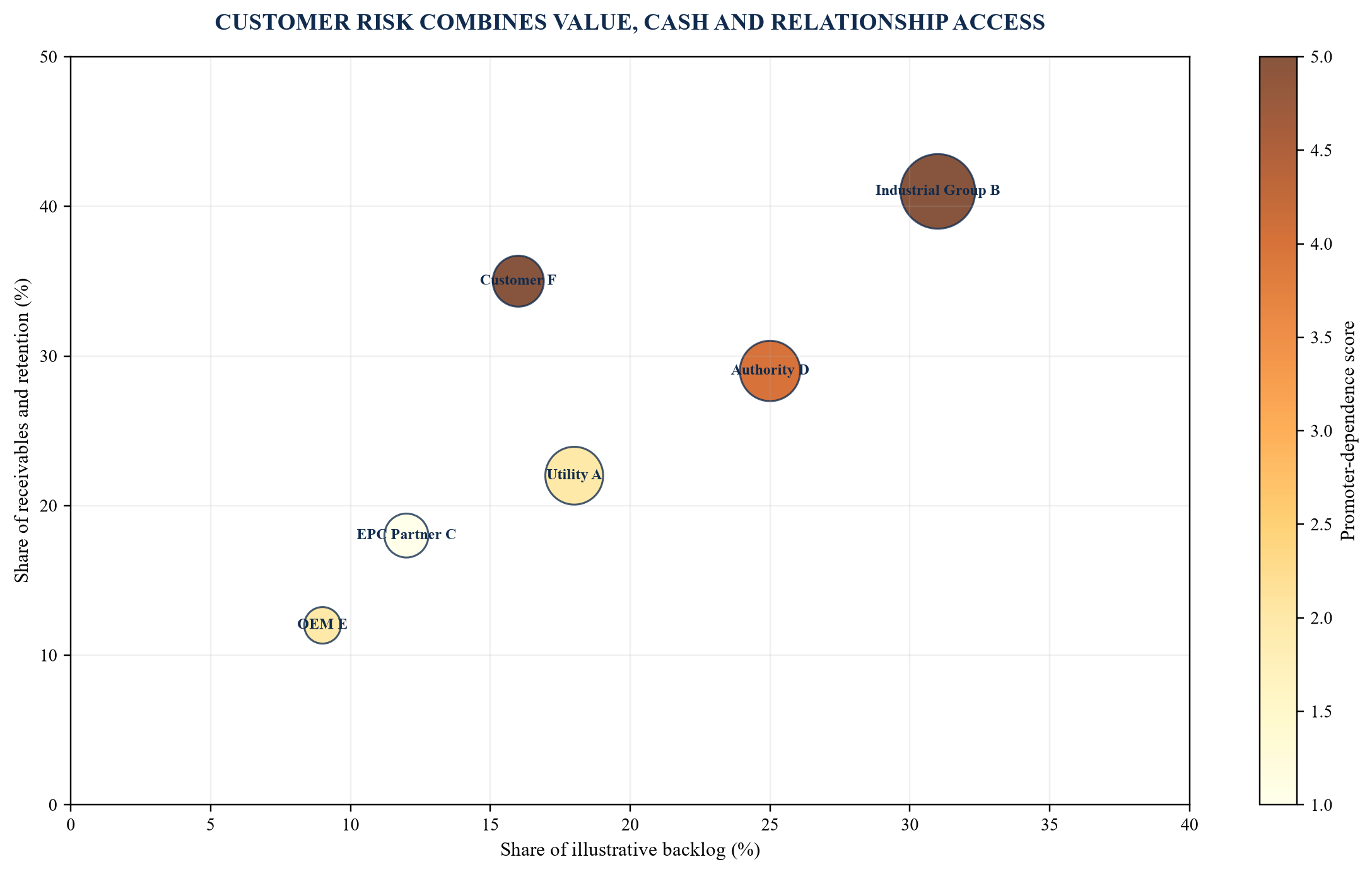
Hypothetical bubbles combine revenue concentration with cash exposure and promoter-led access.
The resulting exposure map should feed valuation and protection. Concentrated, promoter-led and slow-paying customers may justify lower underwritten value, targeted retention, customer-consent conditions or a transition covenant. Strong contractual continuity and team-owned coverage provide evidence for transferability.
9. Convert accounting profit into recurring quality of earnings
Quality of earnings asks whether reported profit represents recurring economics available to the buyer. In project businesses, the answer depends on revenue recognition, cost estimates, claims, provisions, working capital and the composition of projects completed during the measurement period. A single adjusted EBITDA number can hide important cohort differences.
The review should begin with audited and management accounts, trial balances, ledgers, project reports and tax filings. Revenue and gross margin should reconcile by contract and period. The team should inspect project forecast changes, manual journals, unbilled revenue, negative work in progress, provision releases, reversals and revenue recorded without corresponding certification or collection.
Normalisations require both non-recurring status and a credible post-completion treatment. Promoter remuneration may be above or below market; replacement cost and continuing role determine the adjustment. Related-party rent may require a market lease. Informal management services may need to be added. A one-off claim gain should be excluded from recurring earnings even if properly recognised.
Loss-making contracts need full-life treatment. A current-period margin can appear acceptable while future cost or liquidated damages remain. Ind AS 37 addresses provisions and onerous contracts; the buyer should test the latest cost-to-complete and unavoidable obligations.[10] Warranty, defect and performance exposure should reconcile to project evidence and historical outcomes.
Foreign currency and commodity exposure can create operating volatility. The review should distinguish realised project economics, hedge effects, translation and speculative positions. Procurement savings achieved through delayed purchase may reverse if the remaining backlog requires current market pricing.
Table 2. Quality-of-earnings adjustment register
| Adjustment domain | Evidence required | Earnings treatment | Cash and deal implication |
|---|---|---|---|
| Project forecast change | approved cost-to-complete history | correct period and remaining margin | value and completion adjustment |
| Claims and variations | notices, approvals and collection | separate approved and disputed value | escrow, indemnity or exclusion |
| Promoter remuneration | role, contract and replacement benchmark | apply sustainable management cost | transition and retention plan |
| Related-party services | contracts, pricing and replacement quotes | normalise to arm's-length perimeter | TSA or standalone cost |
| Provision release | underlying obligation and closure evidence | retain only supported release | residual liability protection |
| Foreign exchange | contract currency, hedge and settlement | separate operating and financial effect | liquidity and covenant scenario |
Every adjustment needs source evidence, ownership treatment and a cash consequence.
The final bridge should connect reported EBITDA to recurring project margin, standalone overhead and cash conversion. The buyer should retain a range where evidence is incomplete. A defensible range is more useful than precise adjustments built on weak project data.
10. Stress cost-to-complete and project margin
Cost-to-complete is the central estimate in an engineering project. It combines remaining quantity, productivity, procurement, subcontractors, site conditions, programme, escalation, warranty and risk. The buyer should compare the latest estimate with the bid, prior forecasts and actual cost. Repeated late deterioration can indicate weak controls or optimistic recognition.
The review should test quantity completeness and rates. Bills of quantity can change through design. Unplaced purchase orders should be repriced to current quotes and lead times. Subcontractor commitments should include claims and scope gaps. Labour forecasts should reflect remaining access, productivity, shifts, accommodation and mobilisation. Site overhead should extend with the realistic programme.
Delay exposure should separate customer-caused, contractor-caused and concurrent events. Entitlement to extension or compensation depends on notice and contract. The economic model should include standby, acceleration, extended overhead, liquidated damages and bonding cost before assuming claim recovery.
The buyer should compare projects through a consistent margin-at-completion framework. High-risk projects may require independent technical review, site visits and quantity validation. A portfolio reserve can supplement project adjustments but should not replace identified corrections.
Scenario analysis should apply common shocks and project-specific events. Commodity inflation, customer delay, supplier failure, productivity loss, currency movement and guarantee calls can correlate across projects. The downside should flow into EBITDA, cash, facility headroom and equity value.
11. Measure promoter dependence as transferable capability risk
Promoter dependence is often described as key-person risk. The transaction question is broader: which cash flows, decisions and stakeholder relationships can continue under the buyer's ownership? Dependence may exist in bidding, pricing, customer access, bank facilities, supplier credit, technical approvals, recruitment, dispute resolution and government relationships.
The buyer should map activities rather than personalities alone. For each material process, record current owner, delegated authority, documentation, alternate owner, system record, stakeholder recognition and evidence of independent execution. A deputy named on an organisation chart is insufficient if customers and banks continue to call only the promoter.
Customer dependence can be tested through meeting participation, account ownership, CRM records, bid sign-off and completed renewals led by the team. Technical dependence can be tested through design authority, estimates, project reviews and documented standards. Financial dependence can be tested through banking mandates, guarantees, cash approvals and lender communication.
Promoter share encumbrances, personal guarantees and cross-group support may affect control and refinancing. SEBI's takeover framework includes disclosure requirements for promoter encumbrances in listed targets.[11][12] Private-company diligence should still identify every pledge, guarantee, non-disposal undertaking, power of attorney and informal commitment connected to the promoter or acquired shares.
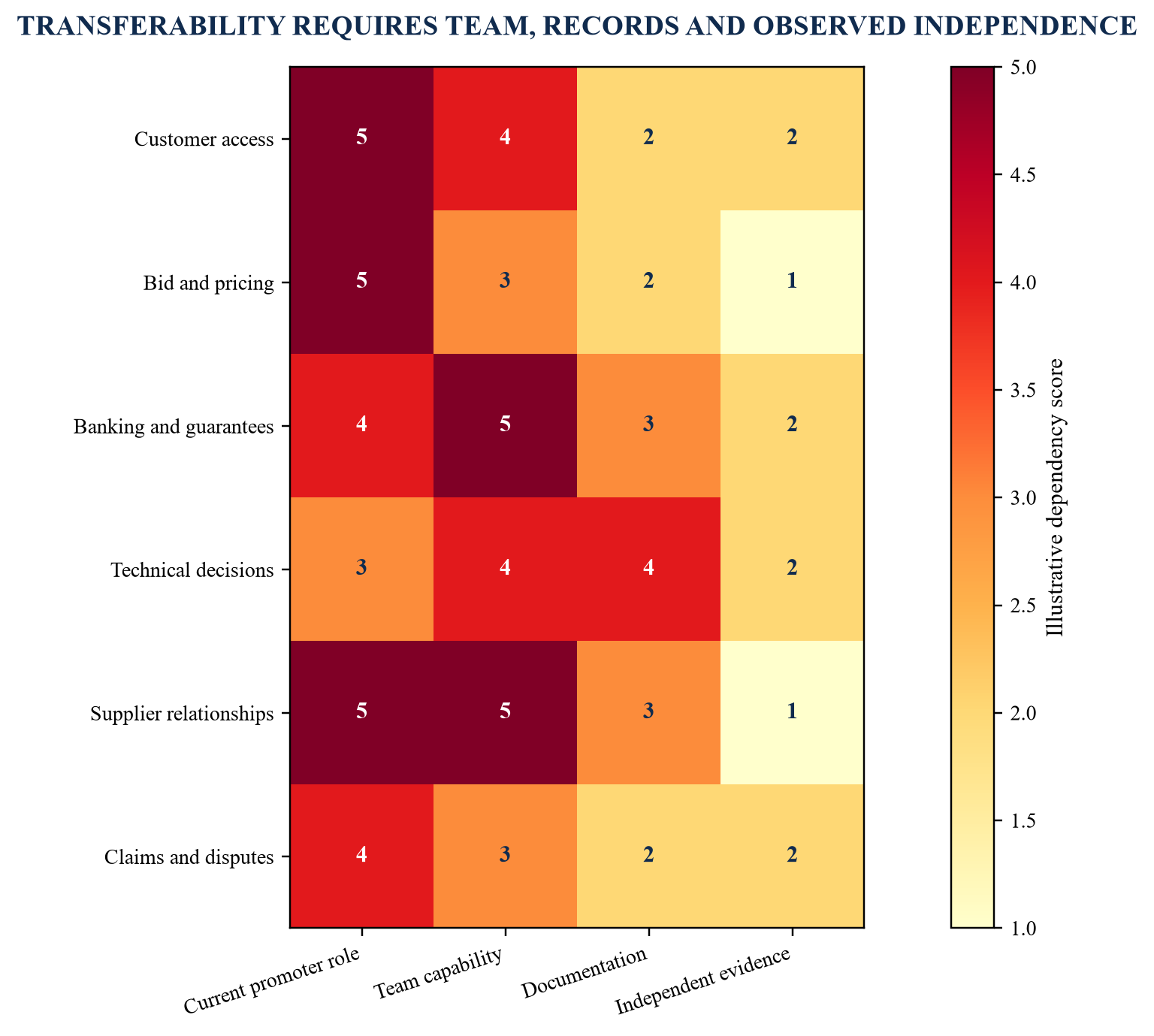
Hypothetical scores identify functions requiring transfer evidence before completion.
The transition plan should create evidence before completion where possible. Team-led customer meetings, delegated approvals, renewed facilities, documented pricing and completed projects can demonstrate transfer. Continued promoter involvement may support value if role, authority, duration, incentives, restrictions and exit conditions are explicit.
12. Test related parties and promoter-group economics
Related-party diligence should capture transactions, balances and economic dependencies across the promoter group. Ind AS 24 provides the accounting disclosure framework.[3] The Companies Act and SEBI rules impose governance requirements that depend on entity and listing status.[4][5] A buyout review should reconcile those disclosures to the actual operating network.
The team should obtain a promoter-group structure, beneficial ownership, directorships, common addresses, bank accounts, guarantees, contracts and ledgers. Vendor and customer masters can be screened against these records. Material matches should be confirmed with management and supporting documents. The purpose is to understand price, cash, control and continuity, not merely to create a list.
Transactions should be assessed for arm's-length economics and post-completion availability. Promoter-owned premises may carry below-market rent but weak tenure. A group procurement entity may provide scale while retaining supplier rebates. A related subcontractor may hold key labour permits or equipment. A customer relationship may depend on another promoter entity that is outside the acquisition.
Outstanding balances require recoverability and settlement analysis. A receivable from a promoter entity may not convert to cash. A payable may represent informal funding. Netting should follow enforceable rights, not management convention. Completion accounts should classify settlements, leakage, debt-like items and working capital consistently.
Related-party guarantees and collateral can block separation. Bank facilities may be supported by group property or personal guarantees. The buyer should agree release, replacement and timing with lenders. An assumption that guarantees will disappear at closing can create a funding failure.
The post-completion model should include standalone cost and transition services where required. Every continuing relationship needs scope, service level, price, data control, liability, duration, exit plan and governance. The buyer should avoid permanent dependency disguised as a short-term transition arrangement.
13. Prove management depth and operating transfer
An engineering acquisition transfers a system of decisions. Project managers, estimators, designers, procurement teams, commercial managers, finance staff, safety leaders and site supervisors need authority, information and incentives to perform under new ownership. The diligence process should assess whether that system exists beyond the promoter.
Organisation charts should reconcile to payroll, contracts, locations and project assignments. The buyer should identify critical roles by impact on revenue, safety, certification, quality, cash, licences and customer continuity. Replacement difficulty, notice, non-compete enforceability, succession and retention expectations should be assessed with employment counsel.
Decision rights should be observed in practice. Who approves bids, discounts, procurement, variations, claims, hiring, guarantees and cash? Where are thresholds documented? Do project reviews record challenge and action? Does finance have authority to stop unsupported recognition or payment? A management team that reports information without decision authority may not transfer the business.
Systems and records provide institutional memory. Bid models, estimates, drawings, vendor qualifications, project forecasts, correspondence, certificates and claims should be stored in controlled repositories. Personal email, messaging and local drives create continuity and evidence risk. Access rights and data ownership should be tested before completion.
Management incentives should align with the underwritten plan. Retention awards can protect continuity; performance measures should include cash, margin, safety, customer outcomes and control quality. Incentives based only on revenue or order intake can encourage low-quality backlog.
The buyer should use a management-capability matrix for the first 100 days. Each material process receives an accountable owner, required evidence, decision calendar and escalation route. Promoter transition becomes one workstream within a broader institutionalisation plan.
14. Convert diligence findings into transaction protection
Diligence creates value when findings change a decision. Each material issue should enter an integrated register with source, amount, probability, timing, owner, proposed response and closure standard. The response can change valuation, completion mechanics, contract terms, financing or the operating plan.
Price adjustment is appropriate when a finding changes sustainable earnings, required investment or recoverable cash. Completion accounts can address delivered cash, debt and working capital when definitions are precise. A locked-box structure requires reliable historical balances and leakage controls. The chosen mechanism should reflect the target's reporting quality and the volatility of project balances.
Escrow or holdback can support identified contingent exposure, subject to enforceability and negotiated limits. Indemnities can allocate specific tax, claim, litigation or contract risk. Warranties support disclosure and recourse but do not replace diligence. Conditions precedent can require customer consent, lender release, permit, key contract, guarantee replacement or settlement before closing.
Earn-outs can bridge uncertainty about backlog conversion or customer continuity. Measures should be objective, reconcilable and resistant to manipulation. Revenue alone can reward low-margin work; gross profit, cash collection or project completion may be more aligned. Buyer control, required investment and accounting policy should be addressed in the drafting.
Table 3. Diligence finding to deal-response matrix
| Finding | Economic effect | Potential response | Required closure evidence |
|---|---|---|---|
| Unsupported backlog | lower revenue and capacity value | valuation adjustment or exclusion | executed contract and programme |
| Overstated project margin | lower recurring earnings | price reduction and forecast reset | independent cost-to-complete |
| Aged retention | impaired cash conversion | working-capital adjustment or escrow | certification and receipt evidence |
| Customer consent risk | continuity uncertainty | condition precedent or covenant | executed consent or legal confirmation |
| Promoter-dependent relationship | transferability discount | transition, earn-out or retention | team-led customer evidence |
| Group guarantee or collateral | refinancing requirement | lender condition and replacement facility | release and new security documents |
The selected response should match the evidence, amount, timing and controllability of the risk.
The issue register should continue after signing. Interim covenants can protect projects, cash, guarantees, people and customer relationships. Material deviations should trigger notification and an agreed response. At completion, every open issue should have a contractual allocation and operating owner.
15. Build a purchase-price waterfall from enterprise value to available cash
The purchase-price waterfall should reconcile enterprise value to equity consideration through the actual project and balance-sheet economics. It begins with an agreed valuation basis and then applies cash, debt, debt-like items, working capital, leakage and contingent mechanisms using defined accounting policies and contract schedules.
Cash should be tested for ownership, availability and restriction. Margin deposits, escrow, joint-venture balances, unclaimed funds and customer advances may not be freely distributable. Debt should include funded borrowing and accrued interest. Debt-like treatment may apply to unpaid capex, overdue statutory amounts, guarantee claims, deferred consideration, related-party funding or other obligations depending on the agreement.
Working capital definitions should distinguish ordinary operating balances from debt-like and excluded items. Contract assets, retention, customer advances, provisions, claims, MSME payables and related-party balances require explicit treatment. The peg should reflect the acquired backlog and seasonal or project mix rather than a mechanical historical average.
The waterfall should prevent double counting. A project loss should not reduce both recurring EBITDA and debt-like items unless separate effects exist. A doubtful retention balance should not be adjusted twice through earnings and working capital without reconciliation. Every item needs source, sign, tax treatment and agreement reference.
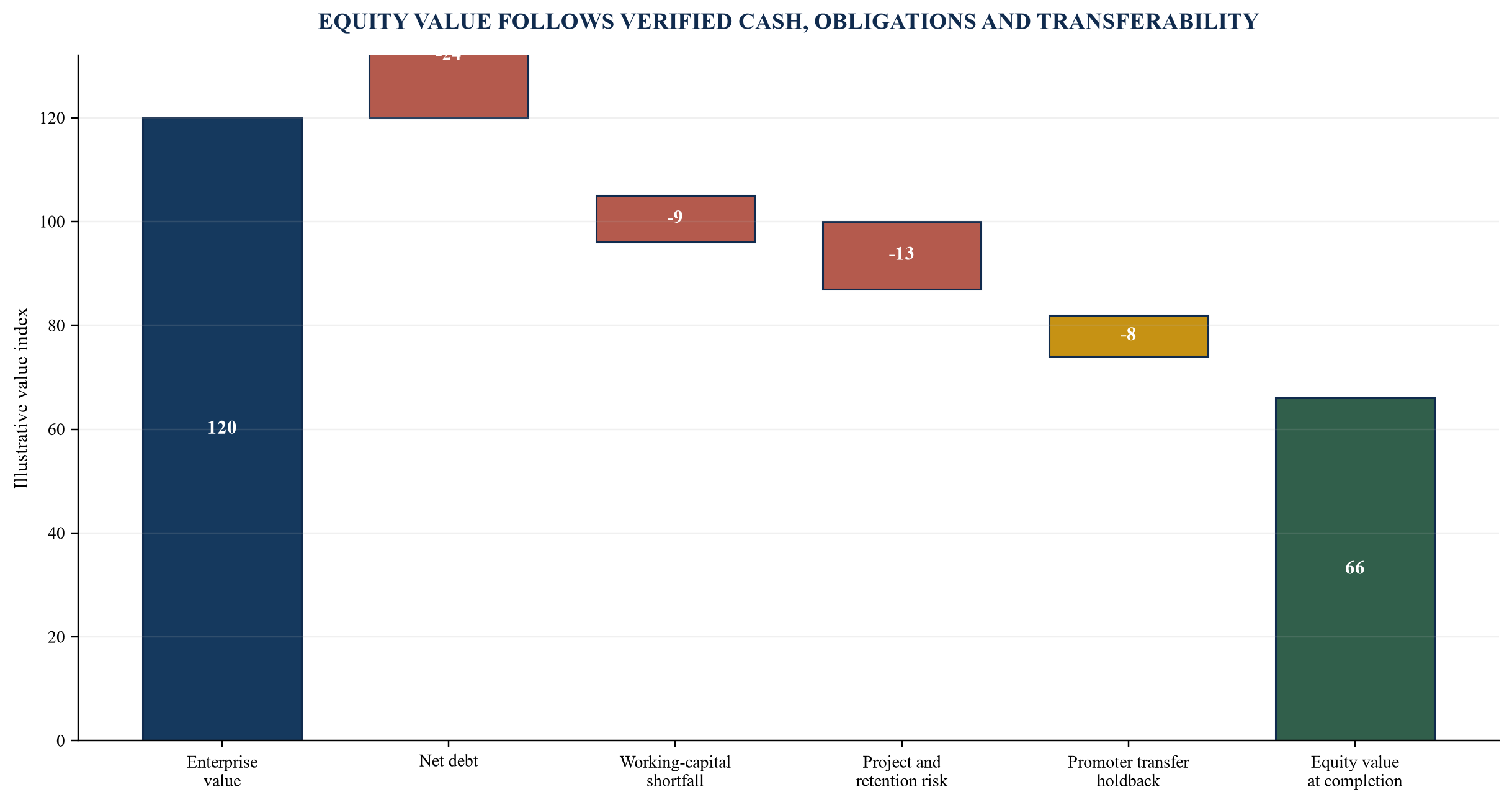
Hypothetical values illustrate how project, cash and dependency findings can change equity value.
The buyer should model payment sources and uses alongside the waterfall. Acquisition debt, refinancing, fees, taxes, minimum cash and post-close liquidity determine the cash required at completion. The board should approve both the value and the funding plan under base and downside cases.
16. Size acquisition financing to project cash volatility
Debt capacity for an engineering buyout depends on cash availability, not headline EBITDA alone. Project milestones, retention, customer delay, guarantees and procurement can create volatile borrowing needs. A lender should understand the same contract-level evidence used by the buyer.
The financing model should separate acquisition term debt, working-capital facilities, non-fund-based guarantee lines and equipment finance. Each facility has different usage, security, maturity, covenant and cash effect. A target may have adequate funded liquidity but insufficient guarantee limits to bid or execute work.
Base-case debt service should use recurring cash after tax, capex, working capital and guarantee margin. Downside cases should delay billing and collection, reduce project margin, impair retention, call guarantees and restrict customer advances. Revolving facilities should be sized for peak need and tested for availability under covenant stress.
Security should reconcile to contract restrictions and operating needs. Receivables may be subject to assignment limits or prior bank charges. Equipment may be leased or owned by a related party. Project accounts can have controlled cash flows. Lenders need enforceable collateral and a practical path that does not destroy the enterprise value they finance.
Table 4. Financing structure matched to engineering cash requirements
| Funding need | Suitable instrument | Principal sizing evidence | Key control |
|---|---|---|---|
| Acquisition consideration | term loan and buyer equity | recurring free cash flow and downside value | leverage and amortisation covenant |
| Project working capital | revolving facility | contract cash curves and peak need | borrowing base and clean-down |
| Performance obligations | guarantee and letter-of-credit lines | contract security schedule | expiry, margin and claim monitoring |
| Equipment | asset finance or lease | ownership, utilisation and residual value | asset register and insurance |
| Contingent project risk | equity reserve or committed liquidity | stress loss and timing | minimum liquidity gate |
| Transition and institutionalisation | buyer equity or delayed consideration | approved 100-day budget | milestone-controlled release |
Facility availability and terms require lender approval and transaction-specific advice.
Financing conditions should be integrated with the transaction timetable. Lender diligence, valuation, security, guarantee migration, regulatory checks and customer consents can affect completion. Funds-certain requirements for public transactions and takeover rules may impose additional constraints where applicable.[11]
17. Map legal, competition and approval conditions early
An Indian engineering buyout may require corporate, competition, securities, sector, foreign-investment, lender, customer and contractual approvals. The exact route depends on buyer, target, ownership, sector, listing status, transaction value and control. The timetable should distinguish analysis, preparation, filing, review and completion.
The Competition Commission of India's 2024 combination framework includes asset, turnover and deal-value tests, along with substantial-business-operations criteria and exemptions.[13][14] Parties should obtain current competition advice before signing assumptions harden. Control rights, minority protections and staged acquisitions require analysis based on the actual documents.
For listed targets, SEBI's takeover regulations and listing requirements can affect open offers, disclosures, pricing, board processes and timing.[5][11] Promoter encumbrances, insider information and public statements need controlled handling. Private targets still require Companies Act approvals, registers, beneficial ownership and valid corporate authority.
Engineering operations can depend on sector registrations, factory approvals, environmental consents, safety permissions, electrical licences, contractor registrations and customer qualifications. The buyer should identify whether each approval transfers on change of control, requires notification or depends on named personnel. Tender eligibility can be affected by ownership, financial capacity and past performance.
Contract consent should be mapped by customer and instrument. Change-of-control clauses, assignment restrictions, bank guarantees, joint ventures and insurance can create interdependent conditions. The closing checklist should include evidence owner, submission date, expected response, long-stop consequence and interim covenant.
Insolvency searches and creditor exposure also matter. The Insolvency and Bankruptcy Board of India maintains the legal framework for corporate insolvency and claims under the Insolvency and Bankruptcy Code.[15] The buyer should test proceedings, defaults, statutory dues, operational-creditor disputes and security interests with current legal evidence.
18. Convert ownership risk into a first-100-day plan
The first 100 days should protect project continuity while transferring authority and improving evidence. Day One priorities include banking, cash, guarantees, customer communication, bid authority, safety, payroll, systems access, insurance, licences and escalation. Structural changes should follow verified readiness.
The backlog register becomes an operating control. Project managers update programme, cost-to-complete, billing, cash, retention, claims and risk through a consistent monthly process. Finance reconciles the register to the ledger. Management reviews exceptions and approves forecast changes. The board sees a portfolio view and material project decisions.
Promoter transition should move stakeholder access and decisions to accountable teams. Customer and lender meetings, delegated signatures, tender approvals, supplier negotiation and claims governance can be sequenced against evidence. A promoter can retain a defined advisory role without remaining the hidden operating system.
Working-capital control should use a 13-week cash forecast linked to project milestones. Billing, certification, collection, supplier payments, guarantee margin and restricted cash receive named owners. Deviations trigger an action and revised liquidity case.
Table 5. First-100-day ownership control plan
| Period | Control objective | Required evidence | Ownership decision |
|---|---|---|---|
| Day One | preserve authority, cash, safety and customer continuity | approved signatories, access tests and communication plan | release controlled operating authority |
| Days 1-30 | establish one backlog and cash record | contract reconciliation and 13-week forecast | approve corrected project baselines |
| Days 31-60 | transfer promoter-dependent processes | team-led customer, lender and bid evidence | reduce or redefine transition role |
| Days 61-80 | close margin and retention exceptions | independent project reviews and recovery actions | fund, remediate or exit exposure |
| Days 81-100 | validate ownership case and financing headroom | value bridge, covenant forecast and capability matrix | approve scale, integration or constraint |
Timing is illustrative; live priorities depend on transaction evidence and consent requirements.
The 100-day review should compare the acquisition case with verified results. Changes in backlog quality, project margin, cash conversion, customer retention, management capability and financing headroom should update value-creation priorities and risk appetite.
19. Use scenarios without disguising uncertainty
Project underwriting contains estimates. Remaining margin depends on quantities, productivity, procurement, programme and claims. Retention depends on certification and defects. Customer continuity depends on contract and relationship behaviour. Promoter transfer depends on observed capability. A model should make these uncertainties visible rather than compress them into a single confident forecast.
The buyer should maintain a management case, independently adjusted base case and defined downside. Project-specific events should be modelled where they are material. Portfolio stresses should capture correlated customer delay, commodity inflation, currency movement, supplier failure, guarantee calls and financing restriction.
Probability weights can support comparison if their basis is documented. They should not replace decision thresholds. A deal may be unacceptable because one project creates a liquidity failure even when expected value remains positive. The investment committee should see covenant headroom, minimum cash, equity reserve and stop conditions.
Scenario outputs should preserve the route from evidence to value. If a customer consent is obtained, the correct contract and case should change. If a retention balance is collected, cash and working capital should update without changing unrelated margin. This traceability supports negotiation and post-close review.
Independent challenge should focus on the largest sensitivities and weakest evidence. Technical, legal, accounting, tax and financing advisers should test the assumptions within their competence. Management representations should be recorded and corroborated where possible.
The limitations of the analysis should be explicit. No model can remove customer behaviour, site conditions, litigation, regulation or execution uncertainty. The framework improves decision discipline by connecting assumptions to sources, owners, responses and observable outcomes.
20. Underwrite an operating system, not an order-book multiple
An engineering buyout succeeds when the acquired organisation can deliver contractual scope, protect margin, convert work into cash and maintain stakeholder confidence under new ownership. Headline backlog is one input. Its value depends on enforceability, execution capacity, cost-to-complete, customer credit, retention, working capital and transferability.
The five records in this paper create one transaction architecture. The backlog bridge tests contracted and executable value. The retention-aging schedule separates calendar age from release conditions. The customer map connects earnings, cash and relationship access. The promoter-dependency heat map tests whether capability transfers. The purchase-price waterfall converts those findings into equity value and funding.
Quality of earnings sits at the centre. Reported profit is reconciled to project cohorts, recurring margin, standalone cost and cash. Diligence findings move into price, completion mechanics, protection, financing and ownership actions. The buyer can then judge both the value of the business and the resources required to own it safely.
The strongest evidence is observable performance. Signed contracts, accepted milestones, reconciled cost forecasts, collected retention, team-led customer relationships, renewed facilities and controlled decisions demonstrate transferability. Management forecasts remain useful when they are connected to these records and tested against downside.
A disciplined buyer should begin early, work contract by contract and preserve a single issue and value ledger through signing and completion. The result is an acquisition case that can be challenged, financed, negotiated and managed after closing.
References
- Ministry of Corporate Affairs, Government of India, “Indian Accounting Standard 115: Revenue from Contracts with Customers.” https://www.mca.gov.in/Ministry/pdf/IndAS115_2020_10112020.pdf
- Ministry of Corporate Affairs, Government of India, “Indian Accounting Standard 109: Financial Instruments.” https://www.mca.gov.in/Ministry/pdf/INDAS109.pdf
- Ministry of Corporate Affairs, Government of India, “Indian Accounting Standard 24: Related Party Disclosures.” https://www.mca.gov.in/Ministry/pdf/INDAS24.pdf
- Ministry of Corporate Affairs, Government of India, “The Companies Act, 2013.” https://www.mca.gov.in/content/dam/mca/pdf/CompaniesAct2013.pdf
- Securities and Exchange Board of India, “SEBI Listing Obligations and Disclosure Requirements Regulations, 2015, last amended 22 January 2026.” https://www.sebi.gov.in/web/?file=https%3A%2F%2Fwww.sebi.gov.in%2Fsebi_data%2Fattachdocs%2Fjun-2026%2F1780915347745.pdf
- Reserve Bank of India, “Quarterly Order Books, Inventories and Capacity Utilisation Survey.” https://www.rbi.org.in/scripts/PublicationsView.aspx?Id=18086
- Department of Expenditure, Ministry of Finance, Government of India, “Manual for Procurement of Works, Second Edition, 2025.” https://doe.gov.in/files/manuals_documents/Works_Manual_SE_2025.pdf
- National Highways Authority of India, “Engineering, Procurement and Construction Agreement.” https://nhai.gov.in/nhai/sites/default/files/2020/EPC-Agreement-03.pdf
- Ministry of Micro, Small and Medium Enterprises, Government of India, “Delayed Payments to Micro and Small Enterprises.” https://ramp.msme.gov.in/ramp/pdf-documents/scheme-guidelines/msefc.pdf
- Ministry of Corporate Affairs, Government of India, “Indian Accounting Standard 37: Provisions, Contingent Liabilities and Contingent Assets.” https://www.mca.gov.in/Ministry/pdf/INDAS37.pdf
- Securities and Exchange Board of India, “Substantial Acquisition of Shares and Takeovers Regulations, 2011, last amended 5 December 2025.” https://www.sebi.gov.in/sebiweb/home/HomeAction.do?doListing=yes&sid=1&ssid=3
- Securities and Exchange Board of India, “Disclosure of Reasons for Encumbrance by Promoters of Listed Companies.” https://www.sebi.gov.in/legal/circulars/aug-2019/disclosure-of-reasons-for-encumbrance-by-promoter-of-listed-companies_43837.html
- Competition Commission of India, “The Competition Commission of India Combinations Regulations, 2024.” https://cci.gov.in/combination/legal-framwork/regulations/details/12/0
- Competition Commission of India, “Filing of Combination Notices.” https://www.cci.gov.in/public/combination/combination/filing-of-combination-notice/introduction
- Insolvency and Bankruptcy Board of India, “Insolvency and Bankruptcy Code, 2016 and Amendments.” https://ibbi.gov.in/legal-framework/act
- Securities and Exchange Board of India, “Industry Standards on Minimum Information for Approval of Related Party Transactions,” 26 June 2025. https://www.sebi.gov.in/web/?file=https%3A%2F%2Fwww.sebi.gov.in%2Fsebi_data%2Fattachdocs%2Fjun-2025%2F1750948720659.pdf
- Central Public Works Department, Government of India, “CPWD Works Manual 2022.” https://cpwd.gov.in/Publication/CPWD_Works_Manual_2022_13122022.pdf
- Reserve Bank of India, “Industrial Outlook Survey and Survey Methodology.” https://www.rbi.org.in/scripts/PublicationsView.aspx?Id=18086
- IFRS Foundation, “IFRS 13 Fair Value Measurement.” https://www.ifrs.org/issued-standards/list-of-standards/ifrs-13-fair-value-measurement/
- IFRS Foundation, “IFRS 3 Business Combinations.” https://www.ifrs.org/issued-standards/list-of-standards/ifrs-3-business-combinations/
