

1. Put merger control on the transaction critical path
Merger control should enter the deal plan when the transaction perimeter first becomes credible. Waiting for a signed agreement can compress the filing, financing and completion timetable into the same period. The UAE framework requires relevant undertakings to submit an application at least ninety days before completing a qualifying economic concentration [1]. The Minister or authorised representative has ninety days from receipt of a complete application, extendable by forty-five days, to decide [1]. During that review period, the relevant undertakings must not take steps to complete the transaction [1].
The 2026 executive regulation adds a formal examination stage. The Ministry, concerned authority or sectoral regulatory authority, as applicable, conducts a formal examination of the application and supporting documents within ten working days, extendable for a similar period [3]. An incomplete filing can trigger a request for additional documents within a period specified by the authority, up to ten working days from notification [3]. These stages mean that the commercial timetable should distinguish preparation, submission, formal completeness and substantive review. Treating all four as one filing date conceals timing risk.
The deal team should create a merger-control workstream with one accountable executive, transaction counsel, competition counsel, finance, commercial, data and sector-regulatory owners. The workstream should connect directly to the signing timetable, financing plan, conditions precedent, disclosure schedule, interim operating covenants, integration planning and stakeholder communications. Each dependency needs an owner, due date, evidence requirement and escalation route.
The board should receive a plain-language statement of what is known, what remains fact-dependent and what requires legal advice. A commercial team can assemble revenue data, market descriptions, prior transactions, customer concentration and strategic documents. Counsel determines legal scope, control, notification and procedure. This division allows early progress without presenting management analysis as a legal conclusion.
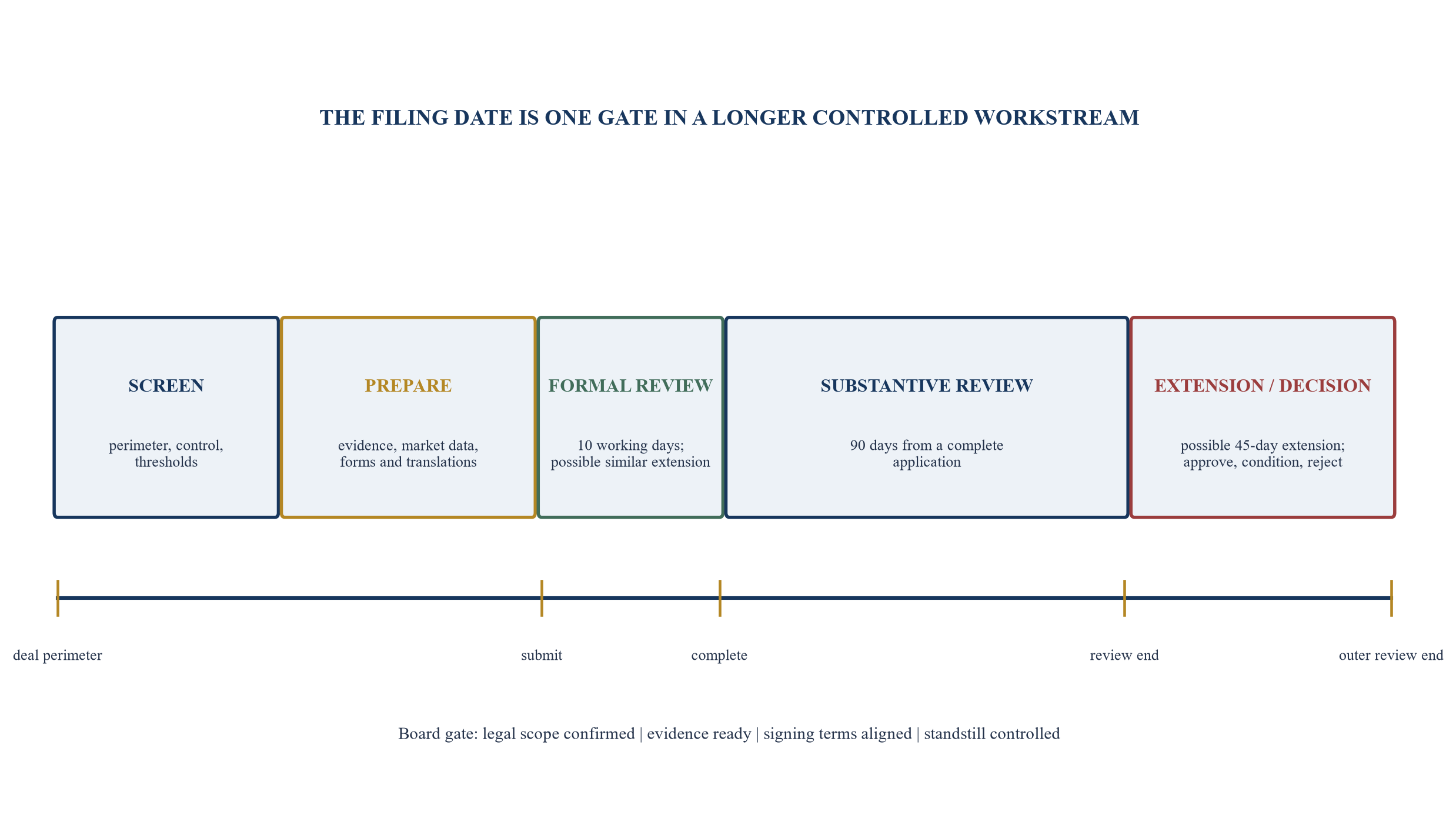
Durations outside the stated statutory periods are hypothetical management assumptions. Transaction counsel should confirm the operative timetable for the specific filing.
2. Read the current regime as one integrated rule set
The operating framework begins with Federal Decree-Law No. 36 of 2023. It defines an economic concentration as an act that results in the total or partial transfer of ownership or usufruct of property, rights, shares, stocks or obligations of an undertaking to another undertaking, enabling direct or indirect control over one or more undertakings [1, 7]. The definition reaches mergers and acquisitions and can also be relevant to joint ventures and arrangements that confer control. Transaction-specific counsel should assess the facts and the applicable Arabic text.
Cabinet Resolution No. 3 of 2025 supplies the notification thresholds. An economic concentration meets the threshold where the undertakings' total annual sales value in the relevant market within the State exceeded AED 300 million during the last fiscal year, or where their total share exceeded forty percent of total transactions in the relevant market within the State during the last fiscal year [2]. The tests are alternatives. Applying either test requires a supported view of the relevant product and geographic market and the undertakings included in the calculation.
Cabinet Resolution No. 59 of 2026 supplies the current executive procedures and became effective on 30 July 2026 [3]. It addresses the filing package, responsible applicants, formal examination, verification, interested-party submissions and related procedure. Its effective date makes 2026 a transition year for transaction processes, precedent documents and internal playbooks.
The Ministry of Economy and Tourism publishes the economic-concentration process and decisions on its website [4]. That page shows approvals, conditional approvals and non-objection outcomes, illustrating that transaction teams should plan for more than a single binary clearance label. The legal meaning and availability of each route depend on the facts and current authority practice.
The workstream should maintain a current-law register with the instrument, article relied upon, official URL, language, effective date, transaction implication and counsel confirmation. A rule copied from a previous transaction can become a source of execution error after the legal framework changes.
Table 1. Current UAE merger-control decision register
| Decision question | Primary official source | Management evidence | Legal owner | Timing implication |
|---|---|---|---|---|
| is there an economic concentration? | Federal Decree-Law No. 36 of 2023 | structure chart, rights, agreements and control facts | competition counsel | begin before structure is fixed |
| is either threshold met? | Cabinet Resolution No. 3 of 2025 | UAE sales, market definition and market-share evidence | competition counsel with finance and commercial teams | screen at perimeter changes |
| who files and what is required? | Cabinet Resolution No. 59 of 2026 | applicant authority, forms, documents and translations | transaction and competition counsel | build before signing |
| which authority participates? | Decree-Law exclusions and sector rules | licence map and regulator contacts | sector counsel | parallel consent path may be required |
| when may completion occur? | Articles 12 to 15 of the Decree-Law | conditions precedent and standstill plan | transaction counsel | align long-stop and financing dates |
| what outcome is feasible? | law, regulation and official case information | competition assessment and remedy options | competition counsel and board | preserve decision time |
This register summarises official sources for management workflow design. Counsel should confirm the law, Arabic text and transaction-specific application.
3. Define the transaction perimeter before calculating thresholds
The transaction perimeter determines which entities, rights, revenues and activities enter the analysis. It should describe the buyer group, target group, sellers, co-investors, acquisition vehicle, financing entities, existing joint ventures and any related step transactions. It should also identify options, vetoes, reserved matters, board appointment rights, management agreements and other arrangements that may influence control.
The perimeter can change during negotiations. A seller may retain a minority interest; a consortium may add an investor; the target may carve out a business; a buyer may acquire assets rather than shares; or completion may occur in stages. The merger-control register should therefore be version-controlled. Each change should state whether counsel re-screened control, thresholds, jurisdiction, filing responsibility and timing.
The relevant market is central to both the turnover and market-share tests because the 2025 resolution refers to sales and transactions in the relevant market within the UAE [2]. Finance data alone cannot establish the correct perimeter. Commercial evidence may include product characteristics, customer use, substitution, pricing, supply routes, competitors, tender data and geographic reach. Legal advisers apply the statutory definition and current practice to that evidence.
Sponsors should consider the broader portfolio in the first perimeter review. Roll-up strategies, common control, adjacent holdings, shared commercial relationships and prior acquisitions may affect data collection and competitive analysis. The board needs a portfolio map that is factual, current and linked to source documents. An acquisition vehicle with no revenue does not by itself resolve the analysis.
The perimeter memo should remain short enough to be used. A one-page chart and a structured appendix can show current ownership, proposed ownership, control rights, business activities, jurisdictions and material changes. The full legal analysis can sit behind that decision tool. This keeps the commercial and legal teams working from the same transaction.
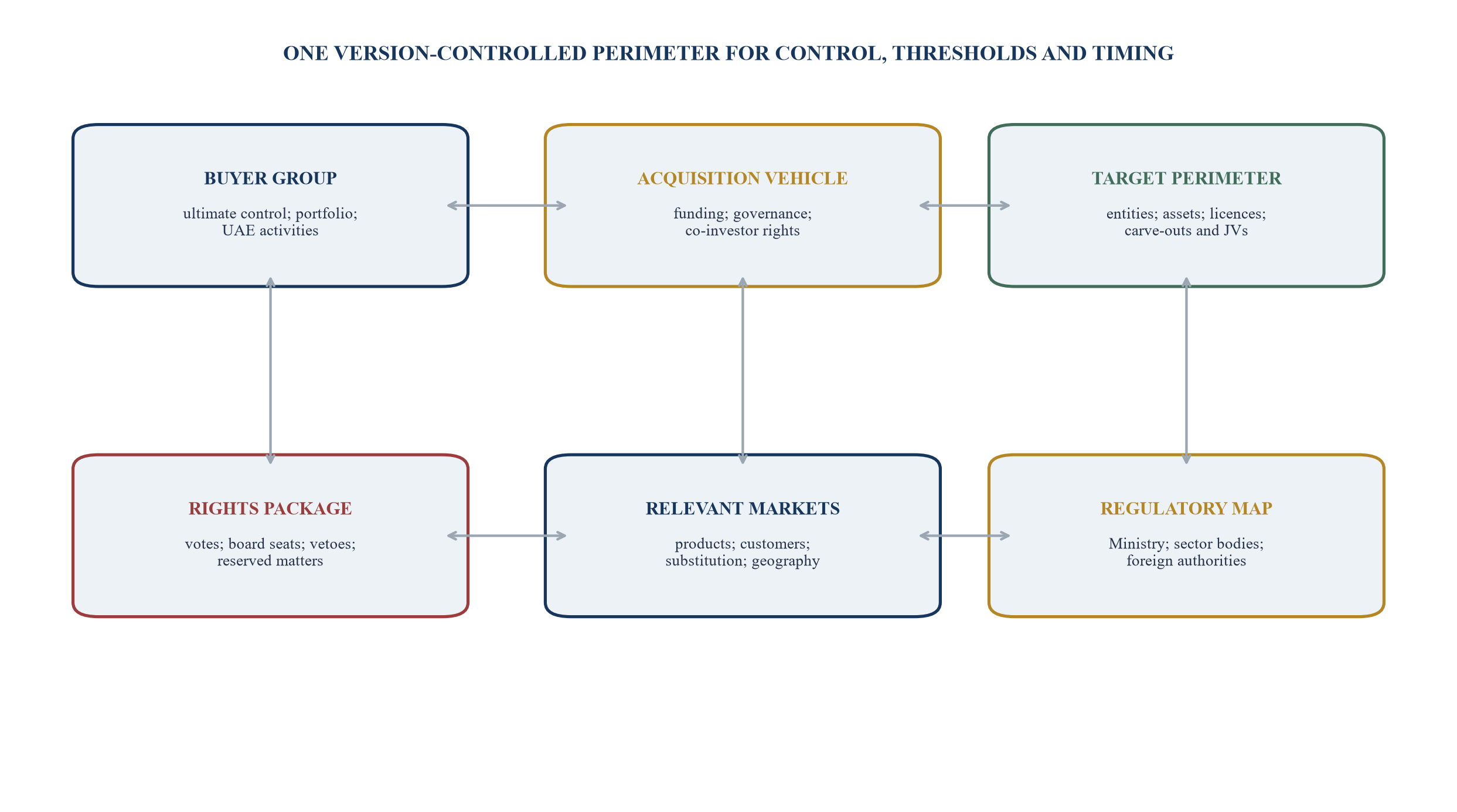
The diagram is an illustrative information architecture. It does not determine legal control or notification.
4. Build a two-test threshold screen with source evidence
The threshold screen should show both statutory tests separately. The first asks whether total annual sales in the relevant market within the UAE exceeded AED 300 million in the last fiscal year. The second asks whether the undertakings' total share exceeded forty percent of total transactions in the relevant market within the UAE in the last fiscal year [2]. A clear result on one test does not remove the need to document how the other was assessed.
The finance workstream should reconcile sales to audited or management accounts and then bridge to the legal market perimeter. The bridge should identify excluded geography, products, intra-group items, discontinued operations, acquisitions, disposals, currency conversion and the fiscal periods used. Counsel should approve the calculation methodology. Where legal or factual uncertainty remains, the register should state the issue rather than selecting a convenient number.
Market-share evidence often requires more than internal sales. The team may use official statistics, customer data, tender records, industry sources and competitor information, subject to counsel's assessment of reliability and legality. The metric described as total transactions in the relevant market may require careful interpretation. A share estimate should show numerator, denominator, period, source, range and sensitivity to market definition.
The screen should be refreshed when the deal structure, business perimeter, fiscal data or market definition changes. It should also be refreshed if a portfolio acquisition, disposal or joint venture changes the buyer group's UAE position before completion. A signed screening memo can support governance; it does not replace a filing decision by qualified counsel.
For transactions well below a threshold on management data, the board may approve proportionate diligence. For transactions near a threshold, the team should create a range, obtain independent market evidence and preserve time for regulator engagement. The escalation boundary is a management assumption approved for the transaction, not a legal safe harbour.
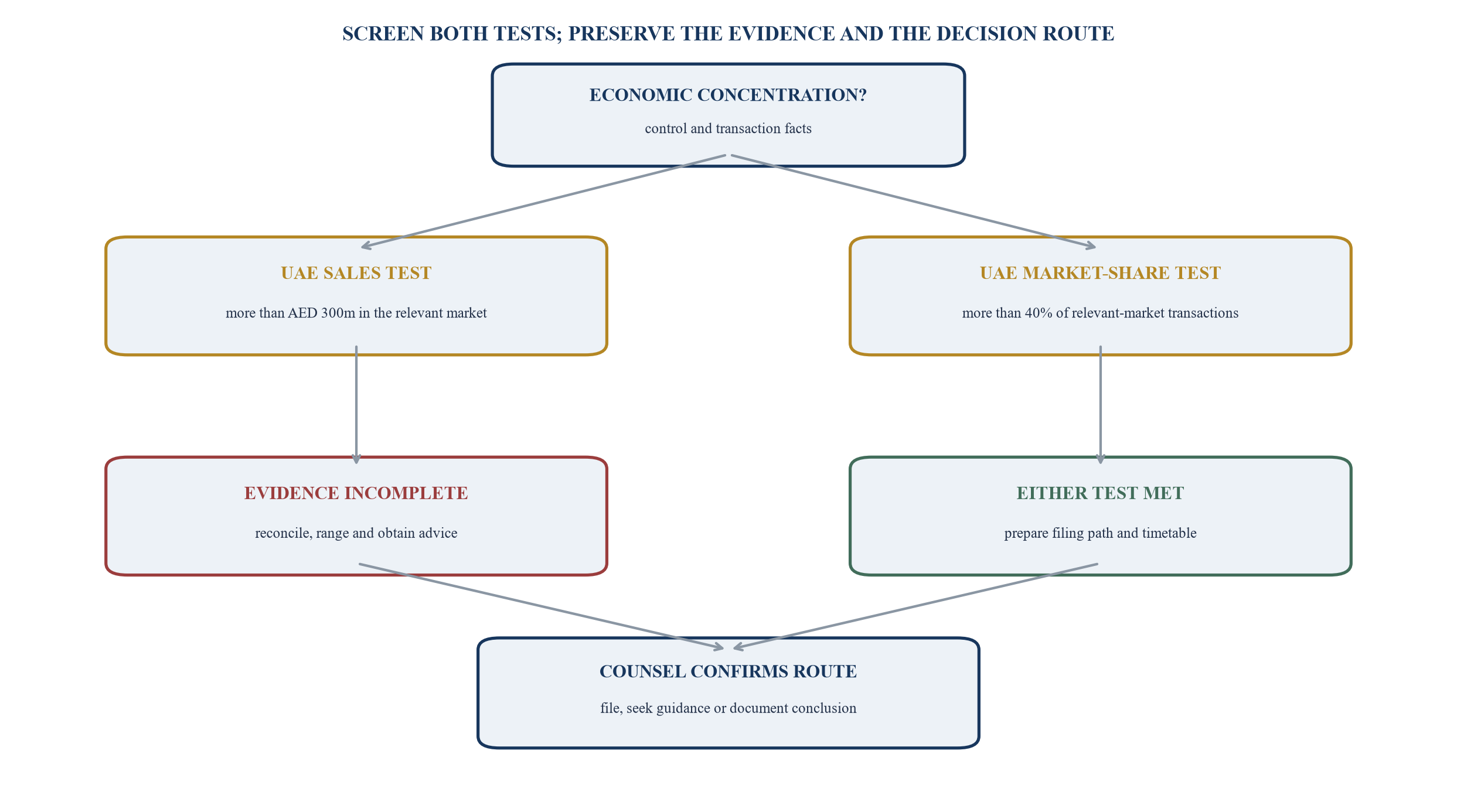
The tree is an illustrative management workflow. It does not provide a legal filing conclusion or safe harbour.
5. Resolve exclusions and sector-regulator interfaces early
Federal Decree-Law No. 36 of 2023 excludes certain agreements, practices or conduct relating to goods or services where another law assigns a sectoral regulatory agency the competition rules, unless that agency asks the Ministry in writing to act and the Ministry agrees [1]. It also provides exclusions for federal-government-owned undertakings specified by Cabinet resolution and emirate-government-owned undertakings carrying out activities in that emirate as specified by the local government [1]. Counsel should determine whether an exclusion applies; ownership assumptions and sector labels are insufficient.
Financial-sector transactions can require Central Bank approval independently of general merger control. The CBUAE Major Acquisitions Regulation requires prior written approval for a bank's major acquisition and asks for transaction, funding, financial, prudential, market, governance, risk, technology, human-resources, due-diligence and valuation information [8, 9]. The CBUAE Rulebook also contains control-transfer and licence-specific approval requirements for other regulated entities [10, 11].
Public-company acquisitions and mergers can engage Securities and Commodities Authority procedures. The SCA publishes a service for public joint-stock company acquisition approval and regulations requiring approval before licensed entities undertake a merger [12, 13]. Telecommunications and other sectors have their own statutory and regulatory frameworks [14]. Free-zone and financial-centre requirements may also affect company, market or licensed-entity actions [15, 16].
The deal team should create one regulator matrix that records the authority, legal basis, approval or notification, applicant, documents, sequencing, confidentiality, public disclosure, fees, review period and contact protocol. Counsel should identify whether processes run in parallel, depend on one another or require consistent remedies.
The board should see the aggregate critical path rather than separate legal lists. A transaction can receive one approval and remain unable to complete because another consent, licence transfer or shareholder procedure is outstanding. The conditions precedent schedule should mirror the live regulator matrix.
Table 2. Multi-authority coordination matrix
| Workstream | Trigger evidence | Potential authority | Core dependency | Deal control |
|---|---|---|---|---|
| general economic concentration | control, UAE sales and market share | Ministry of Economy and Tourism | complete filing and review | standstill and clearance condition |
| banking or financial institution | licence, acquirer status and control change | Central Bank of the UAE | prudential, ownership and governance review | prior approval and data alignment |
| public joint-stock company | listing, acquisition route and ownership change | Securities and Commodities Authority and market | offer, disclosure and shareholder process | timetable and announcement control |
| telecommunications | regulated activity and licence | TDRA | sector competition and licence requirements | sector counsel confirmation |
| ADGM or DIFC entity | incorporation, listing or regulated status | relevant registrar or financial regulator | company, market and licence rules | parallel filings or consents |
| foreign jurisdictions | local nexus, turnover, assets or share | relevant competition authorities | coordinated facts and remedies | global closing sequence |
Authorities and requirements depend on the parties, sector, listing status, licences and structure. Counsel should confirm every row.
6. Turn filing preparation into an evidence programme
Article 10 of the 2026 executive regulation requires the parties to submit the Ministry's application form with specified documents [3]. The official text includes constitutional documents, business licences, the economic-concentration agreement, financial information, transaction and market information, potential geographic scope and a list of related acquisitions, mergers or joint ventures completed during the preceding three years [3]. The exact filing package should be confirmed against the current form and transaction-specific instructions.
The application may be submitted in Arabic or English as an electronically signed copy by a legal representative acting under a duly authenticated special power of attorney [3]. Documents in another language require translation into Arabic or English [3]. Confidential information should be marked confidential and supported by non-confidential summaries that permit adequate understanding [3]. These requirements create lead times for powers, authentication, translation, document collection and confidentiality review.
The deal team should maintain a filing data room distinct from the broader diligence room. Every required item should have a source, owner, review status, translation status, confidentiality status, legal sign-off and version. Data extracted into a filing form should link back to the source and reconciliation. A spreadsheet without provenance creates rework when the authority asks how a figure was derived.
Internal documents require controlled collection. Board papers, investment committee materials, strategy presentations, budgets, customer studies and transaction rationales may be relevant to the authority's assessment. Counsel should direct preservation, privilege, responsiveness and production. The workstream should never rewrite historical documents to fit a filing narrative.
The filing-readiness gate should require an agreed perimeter, threshold analysis, market narrative, data reconciliations, signed authority, translations, confidentiality schedule, draft form, source index and list of unresolved legal questions. A board decision to sign can then reflect the actual preparation state.
7. Establish the formal-completeness control room
The 2026 regulation gives the reviewing authority ten working days for formal examination, with a possible similar extension [3]. That stage should be treated as an active control period. The parties need a response team with access to counsel, source data, translators, executives and signatories. The team should record every communication, request, answer, version and delivery receipt.
An additional-document request may carry a response period of up to ten working days from notification [3]. The exact period is set by the authority. A deal team that disperses after submission can lose valuable time locating data or approving an answer. The response rota should identify primary and alternate owners for each evidence category.
Completeness is a legal and procedural status, not a subjective view that the filing looks finished. The workstream should record when the authority confirms completion of formal examination and when counsel considers the substantive review clock to have started. Long-stop calculations and financing extensions should use counsel-confirmed dates.
The control room should maintain a request log with the question, authority, date, due date, issue classification, source owner, counsel owner, response status, affected transaction documents and escalation. A request that changes the market definition, control view or revenue calculation may require board-level consideration. Routine documentary completion may remain within the workstream.
The team should also maintain one fact base across regulators. A revenue total, ownership chart or transaction rationale submitted to one authority should reconcile with submissions elsewhere or explain legitimate differences. Cross-filing inconsistency can create delay and credibility risk.
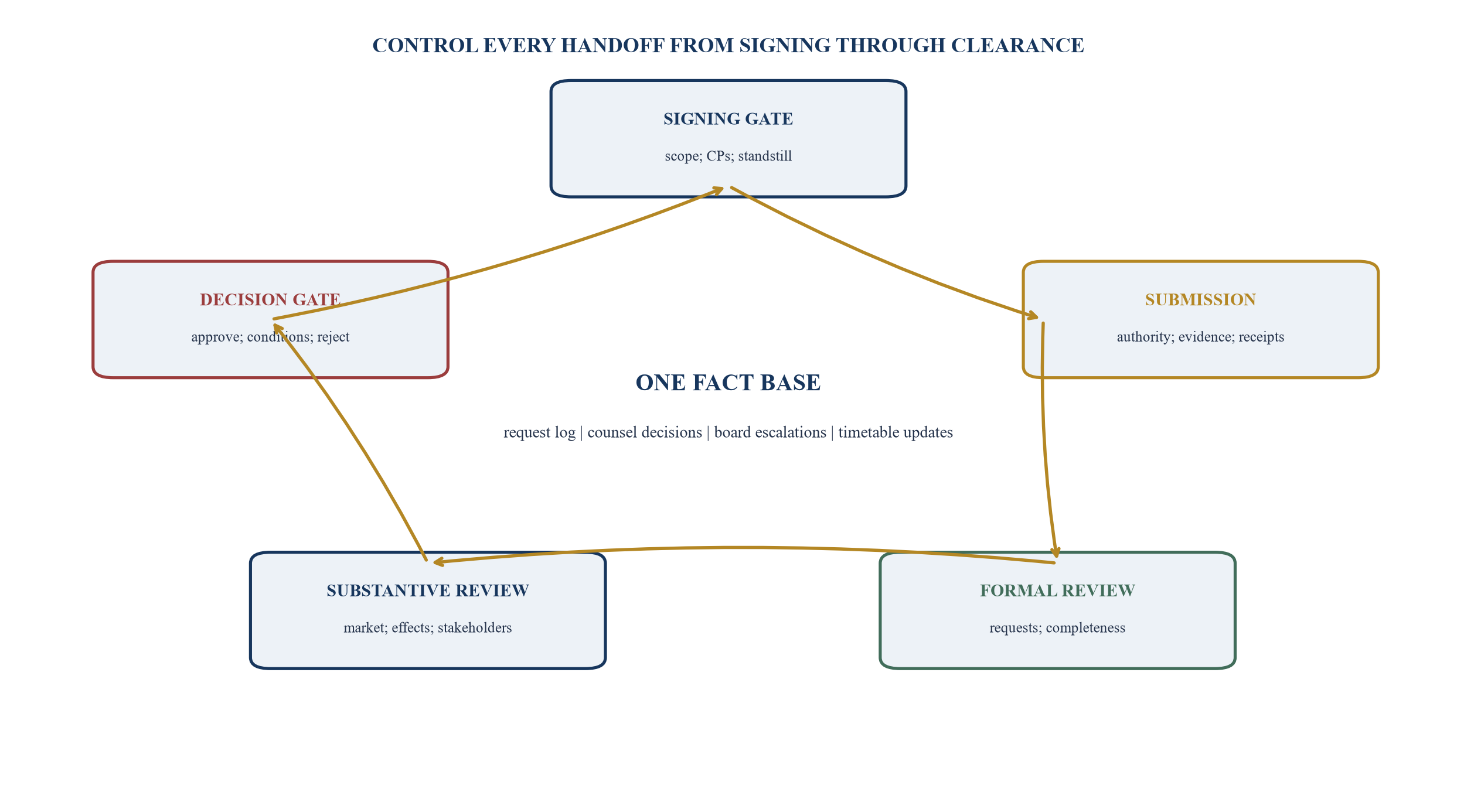
The operating cadence is a hypothetical management design. The authority and counsel determine actual procedures and response dates.
8. Design the signing package around regulatory reality
The sale agreement should translate the regulatory workstream into enforceable obligations. Transaction counsel should address conditions precedent, filing responsibility, cooperation, information rights, conduct of the review, authority communications, remedies, appeal decisions, confidentiality, public announcements, long-stop mechanics, termination and cost allocation. The allocation should reflect the negotiated risk and applicable law.
The filing obligation should identify who prepares and submits, who controls strategy, which decisions require consultation or consent and how disputes are escalated. A buyer may hold the filing responsibility while the seller controls essential target data. The agreement should create a practical response path for both.
Remedy provisions require precision. Expressions such as reasonable efforts or all necessary actions allocate different levels of risk only when interpreted with the governing law and full drafting. The agreement can address structural remedies, behavioural commitments, asset perimeter, revenue limits, cost caps, time limits and effects on the buyer's other businesses. The board should understand the commercial boundary before signing.
Interim covenants should support standstill compliance and preserve the target. They should permit ordinary-course operation while controlling material actions that could alter the business assessed by the authority. Competition counsel should review information-sharing and consent rights so that the buyer does not exercise premature control.
The long-stop date should be built from preparation, formal examination, substantive review, possible extension, information-request response, other regulator approvals, financing availability and completion mechanics. A buffer is a management decision, not a statutory period. The board paper should show the source of every component.
9. Control standstill and pre-completion conduct
Federal Decree-Law No. 36 of 2023 states that relevant undertakings shall not perform acts or procedures to complete the economic concentration during the review period [1]. Violation of Article 12 can attract a fine of two to ten percent of annual UAE sales or service revenue relating to the violation; if the amount cannot be computed, the law provides an AED 500,000 to AED 5 million range [1]. Violation of the completion prohibition in Article 13(2) can attract an AED 50,000 to AED 500,000 fine [1]. Counsel should confirm the applicable provisions and exposure.
The standstill plan should cover governance, commercial decisions, information, branding, employees, customers, suppliers, systems, premises, licences and financing. The buyer can protect the value of the signed transaction through negotiated covenants; those rights should not become de facto control. Counsel should classify reserved-consent matters and define the approval process.
Clean teams can help manage competitively sensitive information. The protocol should define members, permitted data, aggregation, purpose, storage, reporting and destruction or transition. It should also comply with applicable privacy, employment, confidentiality and sector rules. UAE data-protection law and financial-free-zone rules can create additional obligations [17, 18, 19].
Integration planning should use a red, amber and green classification. Green work can prepare neutral plans without implementation or sensitive exchange. Amber work requires clean-team or counsel approval. Red work remains prohibited until required clearances and completion. The classification should be transaction-specific and updated as facts change.
Training is part of the control. Executives may inadvertently promise combined pricing, direct target employees, share customer plans or present the companies as one enterprise. A short role-based briefing, approved contact list and rapid legal escalation channel can reduce that risk.
Table 3. Pre-completion conduct and information-control matrix
| Activity | Illustrative status | Control | Evidence | Escalation owner |
|---|---|---|---|---|
| confirm ordinary-course budget compliance | controlled buyer consent | defined covenant and response time | decision log | transaction counsel |
| share customer-level pricing | restricted | clean-team or aggregated route where legally permitted | access log and output review | competition counsel |
| negotiate combined supplier terms | prohibited before clearance and completion unless counsel approves | separate teams and communications | training acknowledgement | business lead and counsel |
| plan systems migration | preparatory only | no access or configuration change | integration plan version | technology clean-team lead |
| communicate transaction status | controlled | approved scripts and disclosure route | communication archive | communications and legal |
| appoint or direct target personnel | restricted | preserve target governance | board and HR records | transaction counsel |
Classifications are illustrative management assumptions. Competition and transaction counsel should approve the transaction-specific protocol.
10. Prepare for substantive verification and stakeholder input
The Ministry may verify the economic concentration through meetings, records and, where required, field investigations under the 2026 executive regulation [3]. The regulation describes recorded meeting minutes and the ability of the Ministry, concerned authority or sectoral regulatory authority to examine records, documents and electronic files [3]. The parties should maintain a verification protocol led by counsel.
Federal Decree-Law No. 36 of 2023 permits the Ministry to publish basic information and seek stakeholder views [1]. The 2026 regulation provides a period of up to fifteen working days for invited views and for interested parties to submit relevant data or documents after publication [3]. Competitors, customers or suppliers may therefore influence the record.
The deal team should anticipate the most credible theories of harm and evidence relevant to them. Topics may include market definition, unilateral effects, coordinated effects, entry, expansion, buyer power, foreclosure, access to data or infrastructure, innovation, customer switching and efficiencies. Counsel selects the applicable analysis. Management supplies verifiable facts and documents.
A rebuttal file should distinguish evidence from advocacy. Customer contracts, tender results, switching history, lost bids, capacity, entry plans, price data, product road maps and third-party studies can support or challenge a proposition. Each item should have provenance and a clear explanation of its limitations.
The board should approve the boundaries for voluntary commitments or remedies. Federal Decree-Law No. 36 of 2023 allows relevant undertakings to offer measures intended to eliminate harmful effects when filing or within thirty days of receipt of a complete application [1]. The timing means that remedy feasibility should be assessed before the review becomes urgent.
11. Test remedy feasibility before it becomes a deadline
Remedies can affect transaction value, financing, operating design and strategic rationale. A structural remedy may require divestment of a business, asset or right. A behavioural commitment may govern access, supply, pricing, data, interoperability or conduct. The authority determines what is acceptable under the law. The deal team should assess feasibility without assuming an outcome.
The remedy workstream should identify the perimeter, legal owner, licences, people, contracts, technology, data, intellectual property, facilities, financing and transitional services required for a viable package. A remedy described at product level may be impossible to execute if systems and contracts are shared. Early separation analysis preserves decision time.
The valuation model should show the impact of each remedy scenario on purchase price, synergies, standalone cost, capital requirements, financing covenants and post-close strategy. These are hypothetical scenarios until the authority and parties agree actual terms. The board should see which scenarios preserve the investment thesis and which require renegotiation or termination.
Remedy governance should establish who may offer, amend or withdraw a proposal and when board approval is required. Counsel should control submissions. Business leaders provide operational evidence. Finance validates economic effects. The seller should understand any obligation to support a divestment or transition.
The agreement should align the remedy covenant with feasibility. A buyer cannot responsibly promise an unlimited action without understanding the commercial and regulatory perimeter. The negotiated standard, cap or excluded asset should be explicit and legally reviewed.
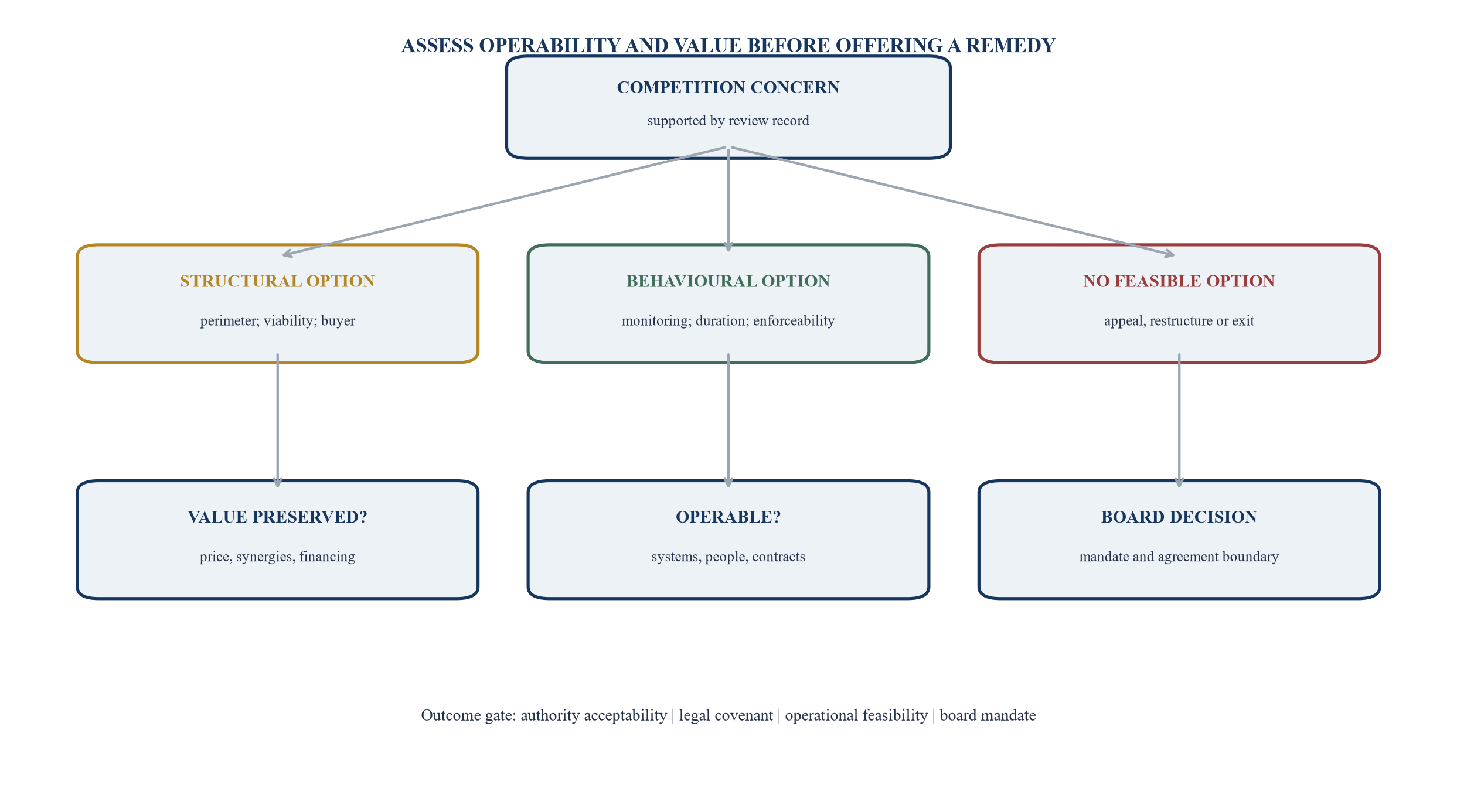
The tree shows hypothetical management gates. The authority and transaction documents determine available outcomes.
12. Align financing with clearance and long-stop mechanics
Acquisition financing has its own availability period, conditions, information requirements, market-flex terms and termination rights. The regulatory timetable should be reflected in commitment letters, facility agreements, hedging, equity funding and funds-flow planning. A financing date that expires before a possible forty-five-day review extension creates avoidable transaction risk.
The finance workstream should build a date bridge from signing to submission, formal examination, completeness, substantive review, possible extension, other approvals, satisfaction of conditions and completion. Each component should show statutory source or management assumption. Counsel and lenders should validate the final structure.
Interest, commitment fees, ticking fees, foreign-exchange exposure and hedging costs may accumulate during review. The valuation model should include base, delayed and remedy scenarios. A delay can also affect target performance, working capital, dividend policy and locked-box economics. The board should understand the combined cost rather than viewing regulatory review as a legal-only issue.
Lenders may require updates on filings, information requests, remedies and material changes. The disclosure protocol should preserve privilege, confidentiality and consistency. A remedy that changes the asset perimeter or expected cash flows may require lender consent or a financing re-underwrite.
The funds-flow plan should include the legal condition that completion cannot occur before required clearance. Operational teams should not schedule irreversible transfers, licences, control changes or system actions solely because funding is ready. The completion checklist should require written confirmation from transaction and competition counsel.
13. Use one multi-jurisdiction fact base
Cross-border transactions can require filings in several jurisdictions. The UAE analysis should sit within a global filing map covering control, turnover, assets, market share, local nexus, filing type, review period, standstill, information requirements, fees, public disclosure, remedies and appeal. Local counsel confirms each jurisdiction.
The European Commission, UK Competition and Markets Authority, United States agencies, Saudi General Authority for Competition, COMESA Competition Commission and Competition and Consumer Commission of Singapore publish merger guidance and procedures [20, 21, 22, 23, 24, 25]. These sources can inform process design and terminology; they do not determine UAE law.
One transaction description, ownership chart, revenue book, market taxonomy and remedy inventory should support all filings. Jurisdiction-specific answers can differ for legitimate legal reasons. Each difference should be explained and approved. Unexplained inconsistency can trigger questions and slow coordination.
The global team should track whether one authority's information request or remedy proposal affects another filing. Customer evidence, market definitions and internal documents may travel across workstreams. Counsel should manage privilege, confidentiality and disclosure.
Completion sequencing also matters. Some jurisdictions allow local closing; others impose global standstill. A hold-separate arrangement, carve-out or deferred transfer may be considered only with counsel and authority acceptance. The board should see operational cost, legal feasibility and residual control risk before relying on such a structure.
Table 4. Multi-jurisdiction filing coordination matrix
| Field | Global core | Local variation | Control owner | Board relevance |
|---|---|---|---|---|
| transaction and control | one signed structure and rights map | jurisdiction-specific control test | transaction counsel | perimeter changes |
| revenue and assets | reconciled group data book | local nexus and currency rules | finance with local counsel | filing exposure |
| markets and shares | common product taxonomy and source index | local market definition and share test | commercial economics team | substantive risk |
| timetable | master critical path | formal and substantive local periods | programme lead | long-stop and financing |
| documents | central preservation and review | filing-specific production | legal operations | privilege and consistency |
| remedies | global option inventory | authority-specific acceptability | board and competition counsel | value and operability |
The example fields support coordination. Local counsel should confirm every jurisdictional entry and legal conclusion.
14. Govern joint ventures and minority rights as control questions
The 2026 executive regulation states that all parties concerned submit the application in a merger or joint venture, or an authorised undertaking may submit under a duly authenticated special power of attorney [3]. That procedural rule makes joint-venture governance and applicant authority practical filing issues.
A minority investment can carry rights that require a control assessment. Board appointments, vetoes over budgets or strategy, information rights, management arrangements, options, funding obligations and shareholder agreements should be mapped. Counsel decides whether the rights confer direct or indirect control under the applicable law.
The deal team should separate protective rights from strategic influence in its factual record. It should also examine combinations of rights and commercial dependence. The analysis should use signed or near-final documents; a term sheet may omit decisive details.
Joint ventures require an operating perimeter. The parties should define assets, people, intellectual property, customers, territory, duration, exclusivity, supply arrangements and exit rights. A venture that changes scope during negotiation should be re-screened. The related agreements may also require separate competition analysis.
Applicant governance should be established early. The parties need authority to appoint counsel, sign forms, provide information, mark confidentiality, answer requests, offer commitments and receive decisions. The power-of-attorney and authentication process can create lead time. The agreement should allocate filing costs and cooperation duties.
15. Build a sponsor portfolio heat map
Private-equity sponsors often execute multiple acquisitions through different funds, vehicles and portfolio companies. A portfolio heat map helps identify UAE activities, adjacent markets, common customers, shared suppliers, common data, control links and pending transactions. It supports data collection and competition analysis without substituting for legal advice.
Each portfolio company should have an owner for current revenue, market descriptions, licences, prior acquisitions, joint ventures and sector-regulator contacts. Data should be refreshed at a defined cadence. Transaction teams should not discover the portfolio perimeter only after signing.
The heat map can rank information readiness and potential overlap. Red may indicate missing or stale evidence, unresolved control or a credible overlap requiring counsel attention. Amber may indicate adjacency, range-based market shares or pending portfolio changes. Green may indicate current evidence and no identified issue in the management screen. These colours are management states, not legal conclusions.
Roll-up programmes require special timing control. Each acquisition can alter the group's revenue, market position and regulatory record. The sponsor should re-screen the next deal against the updated portfolio and maintain a three-year transaction history consistent with the 2026 filing requirements [3].
The investment committee should receive the heat-map conclusion before exclusivity or binding offer when feasible. An unresolved overlap can affect price, conditions, diligence, financing and bidder credibility. Early identification creates options.
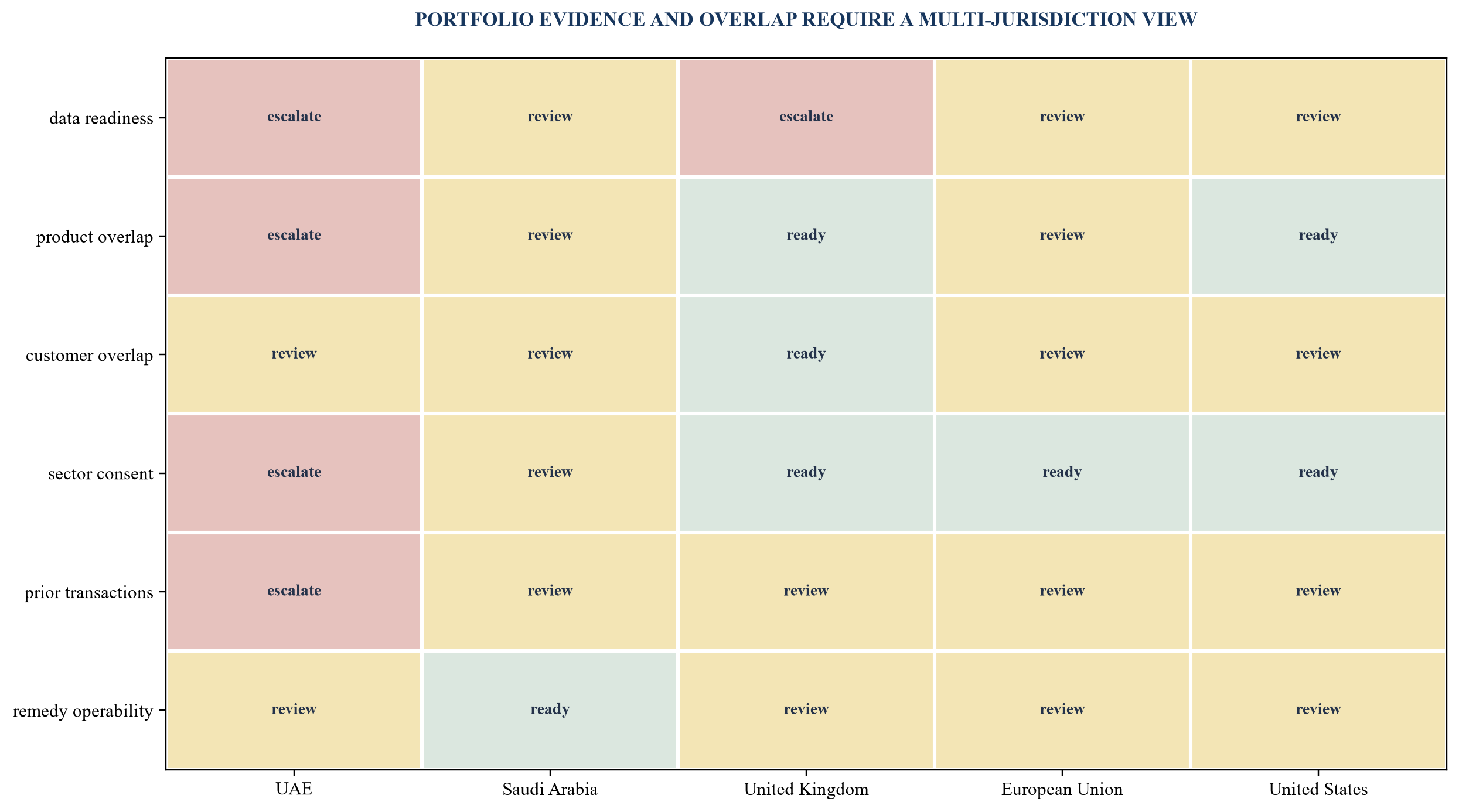
Scores are hypothetical management states. They do not express legal filing risk, probability or outcome.
16. Convert the review into a weekly operating cadence
The workstream should operate through a fixed cadence from signing until clearance and completion. A weekly meeting can review the critical path, filing status, information requests, regulator interactions, standstill, other approvals, financing, remedies, communications, integration controls and decisions due. The meeting should produce an updated register rather than a narrative email.
Daily coordination may be required during filing preparation, formal examination or urgent requests. The cadence should expand and contract with risk. Senior executives should join only when a decision or evidence issue requires them. A permanent large meeting can slow the work and diffuse accountability.
Each issue should carry a status, owner, due date, evidence, dependency and escalation. The programme lead should distinguish legal advice, factual work, commercial decision and administrative completion. This prevents a missing document from being reported in the same way as an unresolved filing obligation.
The board cadence should be event-driven and monthly at minimum during a material review. Events include a perimeter change, threshold conclusion, filing, completeness, information request, stakeholder process, remedy discussion, review extension, financing impact, adverse authority signal or decision. Board materials should state the ask and consequences.
The operating record should be auditable. Decisions, legal instructions, submission versions, receipts, approvals and training should be retained under the transaction's document-management and privilege protocol. A clear record supports execution and post-deal learning.
Table 5. Illustrative twelve-week operating cadence
| Period | Primary objective | Required output | Decision gate | Principal owners |
|---|---|---|---|---|
| weeks 1 to 2 | perimeter, control and authority map | signed structure chart and issue register | legal scope and workplan | transaction and competition counsel |
| weeks 2 to 4 | threshold and market evidence | reconciled revenue book and share ranges | filing route | finance, commercial and counsel |
| weeks 3 to 6 | application and source data room | draft form, documents, translations and confidentiality schedule | filing readiness | legal operations and counsel |
| weeks 5 to 7 | signing alignment | conditions, covenants, long-stop and financing bridge | board signing approval | board, legal and finance |
| weeks 6 to 9 | submission and formal review | receipts, request log and completeness status | substantive-clock confirmation | counsel and programme lead |
| weeks 9 to 12 | substantive review readiness | evidence file, stakeholder and remedy scenarios | response and remedy mandate | counsel, business and board |
Weeks and outputs are hypothetical management assumptions. The actual sequence depends on deal stage, evidence and authority instructions.
17. Make the board dashboard decision-oriented
The board dashboard should answer five questions: What approval is required? What is the current legal and procedural state? What can move the timetable? What value is at risk under the live scenarios? What decision is required now? A long list of completed tasks does not answer these questions.
The dashboard can show counsel-confirmed filing status, days to key contractual dates, formal-completeness status, open information requests, other regulators, standstill exceptions, remedy scenarios, financing availability, target-performance variance and top decisions. Each red item should have an owner and an escalation date.
Legal conclusions should be attributed to counsel and dated. Management assumptions should be identified as such. Authority communications should be reported accurately without predicting outcome. This separation supports board challenge and reduces false certainty.
The dashboard should connect regulatory developments to value. A broader market definition may reduce concern; a narrower one may increase information needs. A potential remedy may reduce revenue or synergies. An extension may add financing cost. The model should use ranges and disclose assumptions.
Board minutes should record the information reviewed, advice received, decisions and delegated authority. They should avoid copying privileged advice unnecessarily. Company secretarial and legal teams should determine the appropriate record.
18. Protect exit readiness and bidder credibility
Sellers can prepare merger-control evidence before a buyer is selected. A vendor data room can include business descriptions, UAE revenue bridges, customer and competitor information, licences, prior acquisitions, joint ventures, organisation charts and source indices. Counsel should direct the scope and confidentiality.
Bidder instructions can require a preliminary filing analysis, identified jurisdictions, remedy position, financing coverage and review timetable. The seller can compare execution certainty alongside price. A bidder with a credible plan may provide more value than one whose assumptions depend on an untested filing conclusion.
The seller should identify which information can be shared with all bidders, clean teams or only after exclusivity. Customer-level pricing, strategy and competitor-sensitive information need careful control. Data-protection and contractual restrictions also apply.
The sale agreement should reflect the selected bidder's actual regulatory profile. A generic covenant copied from another deal may allocate too little or too much remedy risk. The seller should understand the buyer portfolio, overlapping businesses and other pending transactions.
During review, the seller remains responsible for operating the target within the agreement and law. The target team needs resources to answer requests while serving customers and delivering the business plan. The transition-service and separation analysis should remain ready if a remedy or carve-out becomes relevant.
19. Use close-readiness gates before funds flow
Clearance is one condition in a broader completion system. The close-readiness checklist should include the official decision, any conditions or obligations, other regulator approvals, financing, shareholder and corporate actions, third-party consents, licences, funds flow, disclosure and integration controls. Counsel confirms satisfaction or waiver of each legal condition.
Conditional approval requires an obligation register. Each condition should have an owner, deadline, evidence, monitoring, reporting and escalation. The completion decision should confirm which obligations apply before closing and which continue afterwards.
The standstill protocol should remain active until counsel confirms the legal completion point. Operational enthusiasm after an authority decision can still precede satisfaction of other conditions. Access, control, branding, employee instructions and system integration should move only through the approved close plan.
The board or delegated committee should receive a concise closing certificate from the relevant advisers and executives. It should state approvals received, conditions outstanding, financing availability, authority for funds flow and any accepted exceptions. The certificate is an internal governance tool; it does not replace legal opinions or contractual documents.
The programme should archive the final filing record, decisions, commitments, communications and timetable. This supports compliance, future transactions and portfolio governance.
20. Hand remedies and commitments into post-close operations
Post-close integration must incorporate every authority condition, undertaking and transaction covenant. The obligation register should be embedded in operating policies, contracts, systems, training, reporting and internal audit. A commitment that remains only in the legal file can fail in execution.
The integration-management office should map each obligation to the business process that performs it. Access, supply, pricing, data, interoperability, governance, divestment or reporting obligations may require different owners and controls. Technology teams may need to restrict data flows or preserve interfaces. Commercial teams may need approval gates.
Evidence should be designed at the same time as the control. If an obligation requires periodic reporting, the data source, calculation, review and sign-off should be specified. Independent monitoring or trustee arrangements require governance and budget.
The board should receive a post-close compliance dashboard until obligations expire or transfer into business-as-usual oversight. Material breaches or interpretation questions should go immediately to counsel. Any planned change to the business should be screened against the commitments before implementation.
The transaction review should also compare actual timing, cost and information requests with the original plan. Lessons should update the sponsor or corporate playbook without turning a prior outcome into a legal precedent.
Table 6. Board merger-control dashboard
| Dashboard line | Evidence | Green condition | Escalation trigger | Board decision |
|---|---|---|---|---|
| filing status | counsel-confirmed register and authority receipt | current procedure and date confirmed | uncertainty over scope, completeness or clock | mandate or timetable change |
| critical path | integrated transaction plan | dates fit within contractual and financing capacity | projected date approaches approved buffer | extend, renegotiate or pause |
| information requests | request log and source index | complete response on approved schedule | material gap, inconsistency or missed date | resource or disclosure decision |
| standstill | training, access and consent logs | no unresolved exception | possible premature control or sensitive exchange | remedial action and legal review |
| remedies | feasibility and value scenarios | options within approved boundary | authority direction exceeds mandate | offer, restructure, appeal or exit |
| post-close obligations | obligation register and control owners | controls designed and evidenced | owner, system or reporting gap | integration priority and assurance |
Thresholds, ratings and tolerance levels are hypothetical management assumptions requiring board and counsel approval.
21. Build a permanent merger-control capability
Repeat acquirers should institutionalise the workstream. The capability can include a current-law register, portfolio activity map, transaction-perimeter template, threshold data book, prior-transaction history, regulator matrix, filing data-room index, clean-team protocol, board dashboard, remedy inventory and post-close obligation register.
The capability should be owned across legal, finance, strategy, M&A, compliance and business teams. Legal retains responsibility for legal conclusions. Finance owns reconciled data. Strategy and commercial teams maintain market evidence. The M&A office controls the timetable. Compliance and integration teams operate continuing obligations.
Training should be role-specific. Investment professionals need early screening and portfolio-data discipline. Executives need standstill and communications guidance. Finance needs legal-market bridges and source provenance. Integration teams need pre-close boundaries and post-close obligations.
The organisation should rehearse the first ten days after an information request or formal-review query. The exercise can test source retrieval, counsel review, translation, executive approval, confidentiality and submission. Any timing result is a management test, not a representation of authority deadlines beyond the official rules.
Annual assurance can verify that templates reflect current UAE legislation and official forms, portfolio data is current, prior transactions are logged, training is complete and open commitments are monitored. The 2026 executive regulation demonstrates why a static precedent library is insufficient.
The commercial objective is transaction certainty. A well-run merger-control workstream gives boards better options before signing, supports credible bids, protects financing, reduces avoidable rework and carries regulatory commitments into operations. It cannot promise clearance or timing. It can create a disciplined evidence and decision system around the authority's process.
Sources and further reading
- UAE Legislation, Federal Decree-Law No. 36 of 2023 Regarding Regulating Competition Official source
- UAE Legislation, Cabinet Resolution No. 3 of 2025 Regarding Competition Ratios and Notification Thresholds Official source
- UAE Legislation, Cabinet Resolution No. 59 of 2026 Executive Regulations of the Competition Decree-Law Official source
- UAE Ministry of Economy and Tourism, Economic Concentration Official source
- UAE Ministry of Economy and Tourism, Regulation of Competition Legislation Official source
- UAE Ministry of Economy, Cabinet Resolution No. 3 of 2025 Roundtable and Enforcement Update Official source
- UAE Ministry of Economy and Tourism, Regulation of Competition Official source
- Central Bank of the UAE, Major Acquisitions Regulation Official source
- Central Bank of the UAE, Approval of Major Acquisitions Official source
- Central Bank of the UAE, Operational Requirements for Acquisitions, Mergers and Joint Ventures Official source
- Central Bank of the UAE, Transfer of Company Control Official source
- Securities and Commodities Authority, Application for Public Joint Stock Company Acquisition Official source
- Securities and Commodities Authority, Regulations Register Official source
- Telecommunications and Digital Government Regulatory Authority, Regulations and Rulings Official source
- Abu Dhabi Global Market, Legal Regulations and Rules Official source
- Dubai Financial Services Authority, Rulebook Official source
- UAE Government, Data Protection Laws Official source
- Abu Dhabi Global Market, Office of Data Protection Guidance Official source
- Dubai International Financial Centre, Data Export and Sharing Official source
- European Commission, EU Merger Control Legislation Official source
- UK Competition and Markets Authority, Mergers Jurisdiction and Procedure Guidance Official source
- United States Department of Justice and Federal Trade Commission, 2023 Merger Guidelines Official source
- Saudi General Authority for Competition, Economic Concentration Review Guidelines Official source
- COMESA Competition Commission, How to File a Merger Official source
- Competition and Consumer Commission of Singapore, Merger Procedures Official source
- Organisation for Economic Co-operation and Development, Recommendation on Merger Review Official source
- International Competition Network, Recommended Practices for Merger Notification and Review Procedures Official source
- European Commission, Best Practices on the Conduct of EC Merger Control Proceedings Official source
- European Commission, Commission Notice on Remedies Acceptable under the Merger Regulation Official source
- Group of Twenty and Organisation for Economic Co-operation and Development, Principles of Corporate Governance 2023 Official source
