

1. Define the decision before collecting documents
Product due diligence should answer a decision question: should this firm make this product available, through this service, to this target market, subject to which conditions and monitoring? A document request without a decision model can become a data room with no conclusion. A score without traceable evidence can create confidence without control.
The distributor should separate five decisions. Legal-route analysis determines whether the product and service can be offered under the relevant law, licence and client classification. Product approval determines whether the manager, fund, assets, economics and operations meet the firm's standard. Target-market approval defines the clients for whom the product may and may not be considered. Client assessment tests the actual client's circumstances under the applicable service. Transaction approval confirms that current documents, capacity, funding and controls support execution.
These decisions interact, but they are not interchangeable. A notification, registration or professional-client classification does not establish product quality. Strong manager performance does not establish liquidity. A suitable portfolio role does not cure an undisclosed conflict. A signed subscription does not prove that the client can fund future calls.
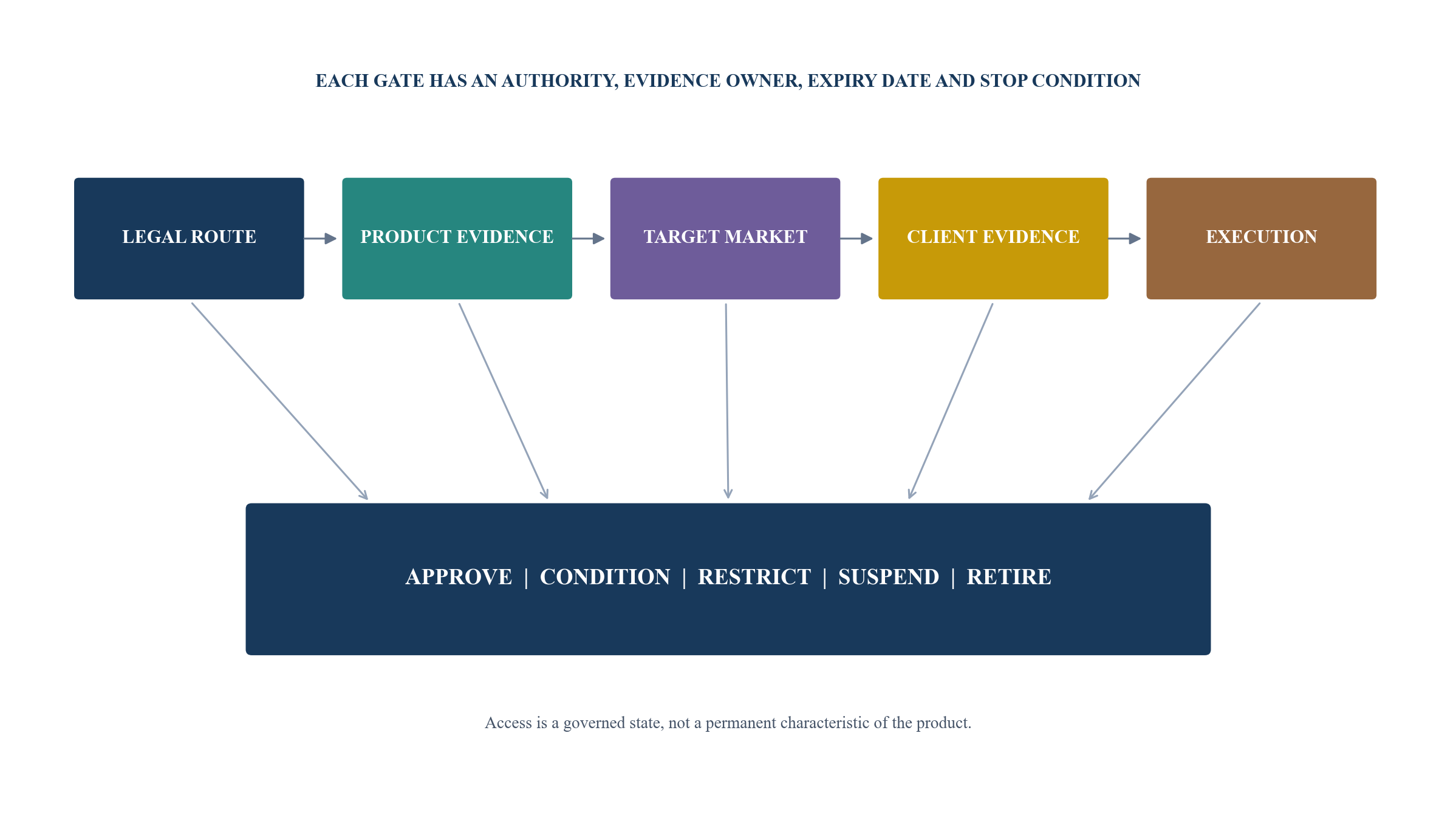
Author framework. Legal route, product evidence, target market, client evidence and execution require distinct owners and records.
Table 1. Product-due-diligence evidence register
| Evidence domain | Primary records | Reconciliation | Approval question |
|---|---|---|---|
| legal route | law, licence, offering restrictions, classification | counsel analysis to actual service and channel | can this product be offered through this route? |
| manager | regulatory record, ownership, people, governance, financials | claims to filings, audited records and references | can the manager execute and remain accountable? |
| fund | constitution, offering document, agreements, policies | terms across all controlling documents | what rights and obligations actually bind investors? |
| assets and strategy | pipeline, holdings, underwriting, portfolio data | mandate to portfolio and realised evidence | does activity match the stated strategy? |
| valuation | policy, models, inputs, committee minutes, audit | reported NAV to asset evidence and governance | is value determined consistently and independently? |
| liquidity | terms, cash forecasts, borrowing, gates, side letters | product promises to asset and funding liquidity | can the structure meet obligations under stress? |
| economics | fees, expenses, offsets, waterfall, platform charges | documents to model, invoices and investor statements | what does the investor pay and retain? |
| operations | administrator, custodian, bank, cyber, BCP, reporting | contracts to service evidence and incidents | can the product operate through disruption? |
Evidence status should distinguish received, attributable, reconciled, challenged, approved and expired.
2. Build an evidence hierarchy
Evidence quality depends on authority, specificity, recency and reconciliation. Signed constitutional documents normally carry more decision weight than a presentation. Audited financial statements normally carry more weight than management accounts. Administrator records normally support cash and ownership more directly than a manually maintained spreadsheet. These are working priorities rather than universal legal rankings; the governing law and actual document hierarchy control.
The register should record the source, owner, date, version, scope, exceptions and expiry of every material item. It should show whether the item was merely received or was read, tested and reconciled. A document can be genuine and still fail to answer the question. An audit can cover the financial statements and exclude the operating assertion under review. A legal opinion can depend on facts that have since changed.
Conflicting evidence should remain visible. If the marketing deck states quarterly liquidity and the fund documents permit the manager to gate, suspend or defer redemptions, the committee needs both facts. If a performance record excludes predecessor funds, realised losses or foreign-exchange effects, the record should show the boundary. If a manager's operational process depends on an affiliate, the relationship and contract should be tested.
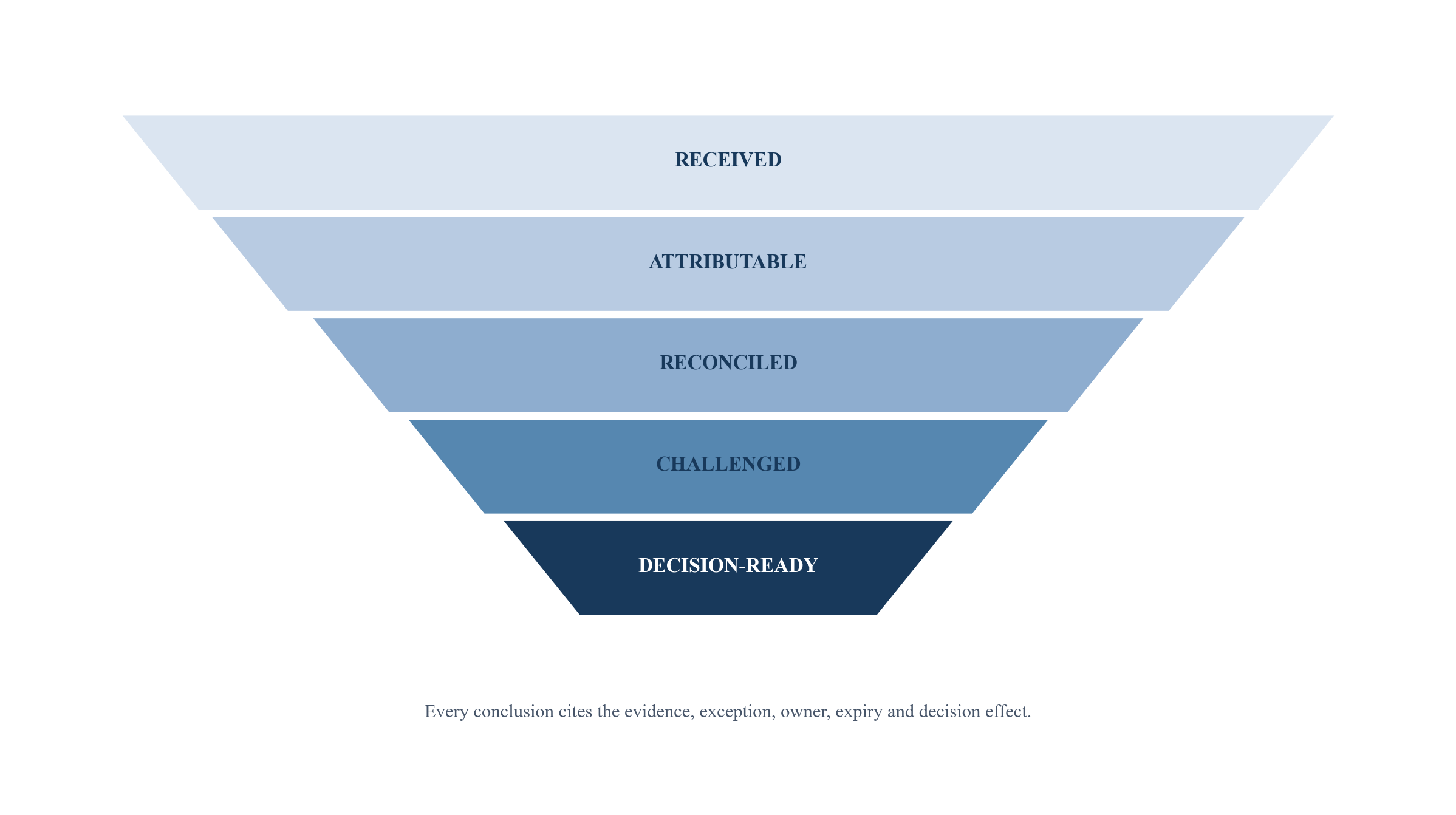
Author framework. Volume narrows as evidence is attributed, reconciled, challenged and converted into an approval condition.
3. Separate manager, fund, asset and distribution diligence
The manager is an organisation. The fund is a legal and economic structure. The assets generate risk and return. The distribution route connects the product to the client. A single overall score can hide a critical weakness in one layer.
Manager diligence examines ownership, governance, key people, succession, financial resources, regulation, compliance, conflicts, investment process, risk management, operations, technology and record of execution. Fund diligence examines legal form, jurisdiction, term, extensions, commitments, drawdowns, investment period, borrowing, recycling, distributions, defaults, transfer, key-person events, removal, termination, advisory committee, reporting, side letters and dispute provisions.
Asset diligence asks what the strategy actually owns or expects to own. It examines sourcing, underwriting, concentration, leverage, cash conversion, valuation inputs, downside recovery, ESG or sustainability claims where relevant, and exit mechanisms. Distribution diligence tests the manufacturer-distributor information flow, target market, negative target market, training, financial promotions, client journey, remuneration, data, complaints and monitoring.
The four layers should meet at defined interfaces. Manager authority must agree with the fund documents. The fund's liquidity must agree with asset liquidity. Distribution claims must agree with the actual product. Client reporting must be deliverable by the manager, administrator and platform.
Table 2. International product-governance design evidence
| Market | Official evidence | Design discipline | Boundary |
|---|---|---|---|
| DIFC | DFSA COB client classification, suitability, conflicts and records | connect service and recommendation to current client and product evidence | apply the current Rulebook and actual licence |
| United Kingdom | FCA product-governance and alternatives-review findings | target market, distributor diligence, MI, training and investor assessment | cited findings do not replace applicable rules |
| European Union | ESMA MiFID II product-governance guidelines | manufacturer and distributor target-market responsibilities across the lifecycle | scope depends on product, firm and service |
| Singapore | MAS CISNet restricted-scheme notification | verify offer route, notification status, changes and annual declarations | notification is a regulatory route, not product endorsement |
| Hong Kong | SFC suitability materials and listed-alternative-fund circular | product diligence, valuation disclosure, client knowledge and loss capacity | requirements vary by authorisation, client and transaction |
| Australia | ASIC design and distribution obligations for schemes | target-market determination, reasonable distribution steps and review | scope depends on the product and statutory regime |
| United States | SEC examination observations and risk alerts | test disclosed process against fees, valuation, conflicts and actual practice | specific 2023 private-fund rules were vacated in 2024 |
| International | IOSCO valuation and liquidity materials | documented methods, governance, consistency, review and disclosure | recommendations require local implementation |
The regimes are legally distinct. The table supports control design and does not state legal equivalence.
4. Read governing documents as an economic system
The product's economics can be distributed across a limited partnership agreement, private-placement memorandum, subscription agreement, investment-management agreement, administration agreement, side-letter policy and fee schedule. Due diligence should create a term concordance rather than rely on one summary.
The concordance should identify which document controls when terms conflict. It should map commitment, drawdown, default, excuse, exclusion, borrowing, recycling, distribution, clawback, transfer, withdrawal, redemption, suspension, valuation, reporting, amendment and termination provisions. It should identify who can exercise each discretion and which notice, consent or advisory-committee process applies.
Side letters require a governed review. The distributor may need evidence about preferential liquidity, information, fee, co-investment, excuse or governance rights and the most-favoured-nation mechanism. The purpose is to understand whether the distributed product behaves consistently for the target market and whether any difference creates a conflict, capacity issue or reporting requirement.
5. Test the manager's organisation and decision rights
Track record begins with attribution. The diligence team should establish which people made which decisions, at which firm, through which mandate and with which resources. Team stability, ownership, economics and succession affect whether past execution can support a conclusion about the current organisation.
The investment process should be traced from sourcing to exit or repayment. Sample transactions should show screening, underwriting, approval, documentation, monitoring, valuation and outcome. Exceptions should reveal whether the process can be overridden, by whom, with which record and how frequently.
Governance should address investment committee authority, risk challenge, valuation independence, conflicts, allocation among vehicles, personal dealing, use of affiliates, service-provider oversight and incident escalation. Financial resources should be considered because weak operating capital can affect talent retention, systems, controls and the ability to support a long-duration fund.
Table 3. Manager-and-fund diligence matrix
| Domain | Core question | Evidence test | Escalation trigger |
|---|---|---|---|
| ownership and people | who controls decisions and economics? | ownership records, biographies, references, succession plan | disputed attribution or unstable team |
| investment process | how does capital move from thesis to outcome? | sample files, minutes, models, monitoring and exits | undocumented override or style drift |
| fund governance | which rights constrain manager discretion? | constitution, committees, key-person and removal terms | weak remedy or unclear authority |
| performance | what is realised, unrealised and attributable? | cash flows, administrator records, audit and bridge | unsupported exclusions or inconsistent method |
| risk and compliance | how are limits, breaches and incidents handled? | policies, registers, testing and remediation | repeat breach or overdue remediation |
| service providers | who holds, values, administers and reports? | agreements, controls reports, reconciliations | concentration, qualified report or service gap |
| conflicts | where can incentives diverge? | allocation, affiliates, fees, side letters, personal interests | conflict without effective control |
| continuity | can the fund operate through disruption? | key-person cover, cyber, BCP, data and succession tests | single point of failure or untested recovery |
The required depth should reflect strategy, structure, client route and materiality.
6. Rebuild performance from cash flows and definitions
Private-market performance is sensitive to cash-flow dates, valuation, currency, subscription facilities, recycling, fee treatment and the selected start and end points. The distributor should obtain the underlying data and definitions needed for the conclusion it intends to publish or use.
Gross and net returns answer different questions. Internal rate of return and multiple of invested capital capture different dimensions. Realised and unrealised value have different evidence quality. A public-market equivalent depends on the selected benchmark, currency and timing. Cohort and vintage analysis can reveal whether a headline record is concentrated in one fund, one asset or one market period.
The reconstruction should reconcile called capital, distributions, NAV and fees to administrator or audited records where available. It should show subscription-line effects and bridge predecessor, co-investment, warehoused or exited assets. Any simulated, modelled or hypothetical record should remain clearly distinct from actual performance.
7. Challenge valuation as a governance process
Valuation is a repeated decision with economic consequences. It can affect NAV, performance, fees, subscriptions, redemptions, collateral, transfers and portfolio risk. The diligence standard should examine policy, methodology, inputs, frequency, independence, overrides, back-testing and disclosure.
IOSCO's published valuation principles emphasise comprehensive documented policies and asset-specific methodologies. Its later consultation on updated collective-investment-scheme valuation recommendations should be treated as a consultation until finalised. Hong Kong's SFC circular for listed alternative funds highlights valuation policies, models, assumptions, parameters and uncertainties in illiquid assets. These materials are useful design evidence under their stated scope.
The challenge process should select material and judgement-intensive positions. It should reproduce the method, inspect source data, test calibration and compare the prior valuation with subsequent financing, sale, impairment or operating evidence. Overrides require rationale, authority and impact. The committee should understand who benefits from the judgement.
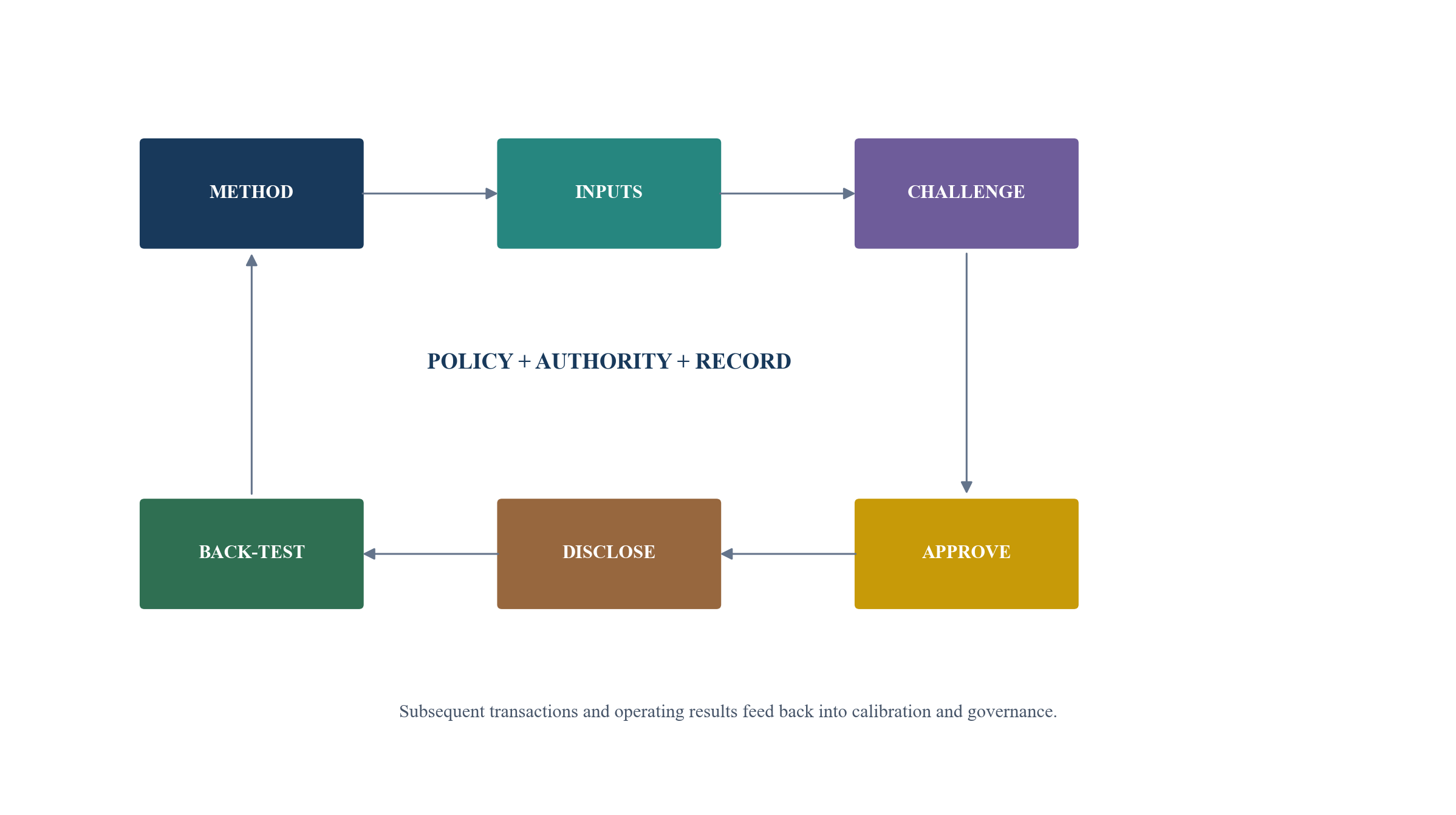
Author framework. Valuation control connects method, evidence, challenge, approval, disclosure and subsequent back-testing.
Table 4. Valuation and liquidity challenge log
| Challenge | Evidence | Sensitivity | Decision effect |
|---|---|---|---|
| revenue or EBITDA normalisation | audited accounts, management accounts, contracts | base, downside and break-even case | valuation range and covenant headroom |
| comparable-company selection | business model, geography, scale, growth and margin | include and exclude marginal peers | multiple range and concentration of judgement |
| last financing round | terms, preferences, time elapsed, operating change | calibrate for rights and subsequent evidence | instrument-level value and disclosure |
| credit recovery | collateral, seniority, cash, enforcement and timing | probability and recovery-duration cases | impairment, return and liquidity |
| asset-sale horizon | buyer universe, process evidence and market capacity | delayed sale and discount cases | fund life, cash flow and exit value |
| redemption or transfer | governing terms, queue, gate, consent and market evidence | delay, discount and suspension cases | target market and portfolio capacity |
The committee should record the evidence, sensitivity, owner and decision effect for each material issue.
8. Map liquidity from asset to client
Private-market liquidity has several layers. Asset liquidity concerns the time and cost required to realise investments. Fund liquidity concerns drawdowns, distributions, borrowing, recycling, gates and term. Secondary liquidity concerns transfer restrictions, consent, information, buyer depth, price and settlement. Client liquidity concerns future spending, commitments, taxes, collateral and portfolio stress.
The product label can obscure these differences. A semi-liquid vehicle may offer periodic redemptions while retaining broad gates or suspensions. A closed-ended fund can generate early distributions or require extensions. A private-credit fund can hold loans that amortise, refinance, default or extend. The committee should model contractual rights and realistic cash behaviour separately.
The client assessment should aggregate commitments across managers, strategies, currencies and vehicles. It should model capital calls during a distribution drought, delayed exits, lower NAV, currency movement and reduced liquid-portfolio value. The output is a capacity range and funding plan, not a promise of liquidity.
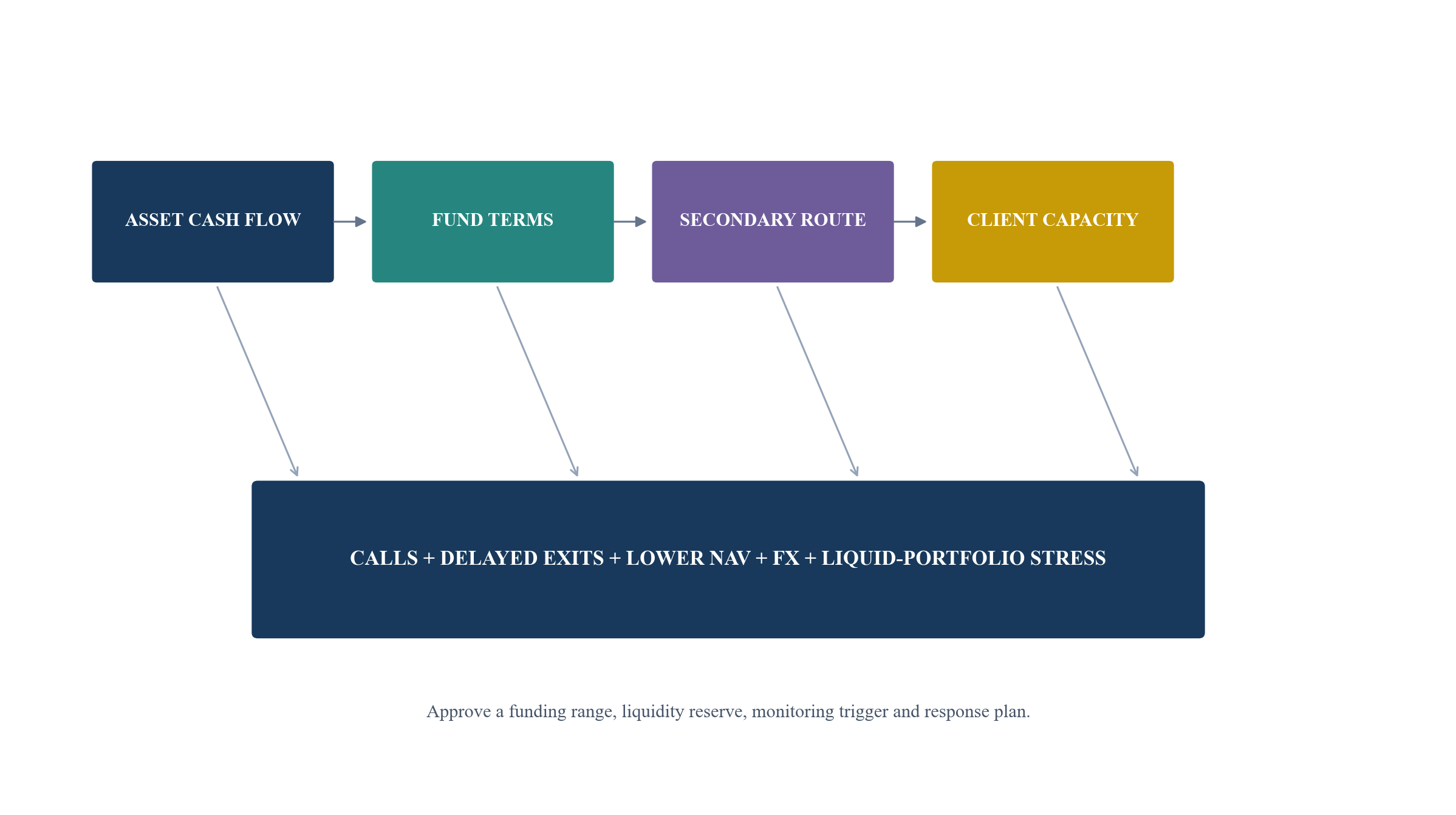
Author framework. Contractual terms, asset cash flows, secondary options and client resources interact under stress.
9. Reconcile complete economics
The investor's economic result begins with gross asset performance and passes through every fee, expense, financing cost, tax leakage, currency effect and distribution charge. Private-market costs can arise at fund, feeder, platform, advisory and portfolio-company levels. Some costs are fixed, some vary with commitment, invested capital, NAV, transactions or performance.
The diligence model should reproduce the governing formula. It should distinguish management fee basis, step-down, organisational expenses, fund expenses, broken-deal expenses, administration, audit, legal, custody, financing, placement, monitoring, transaction, director, feeder, platform, advisory and performance charges. It should identify offsets, rebates, waivers, caps, affiliated providers and allocations among funds or investors.
The SEC's 2020 private-fund risk alert recorded examination observations involving valuation, fees, offsets and disclosed processes. The SEC's June 2026 economic-conflicts risk alert addresses policies, disclosure and calculation of advisory fees and expenses. These are examination materials within the United States context. The 2023 SEC private-fund adviser rules were vacated by a federal court in 2024 and should not be presented as current requirements.
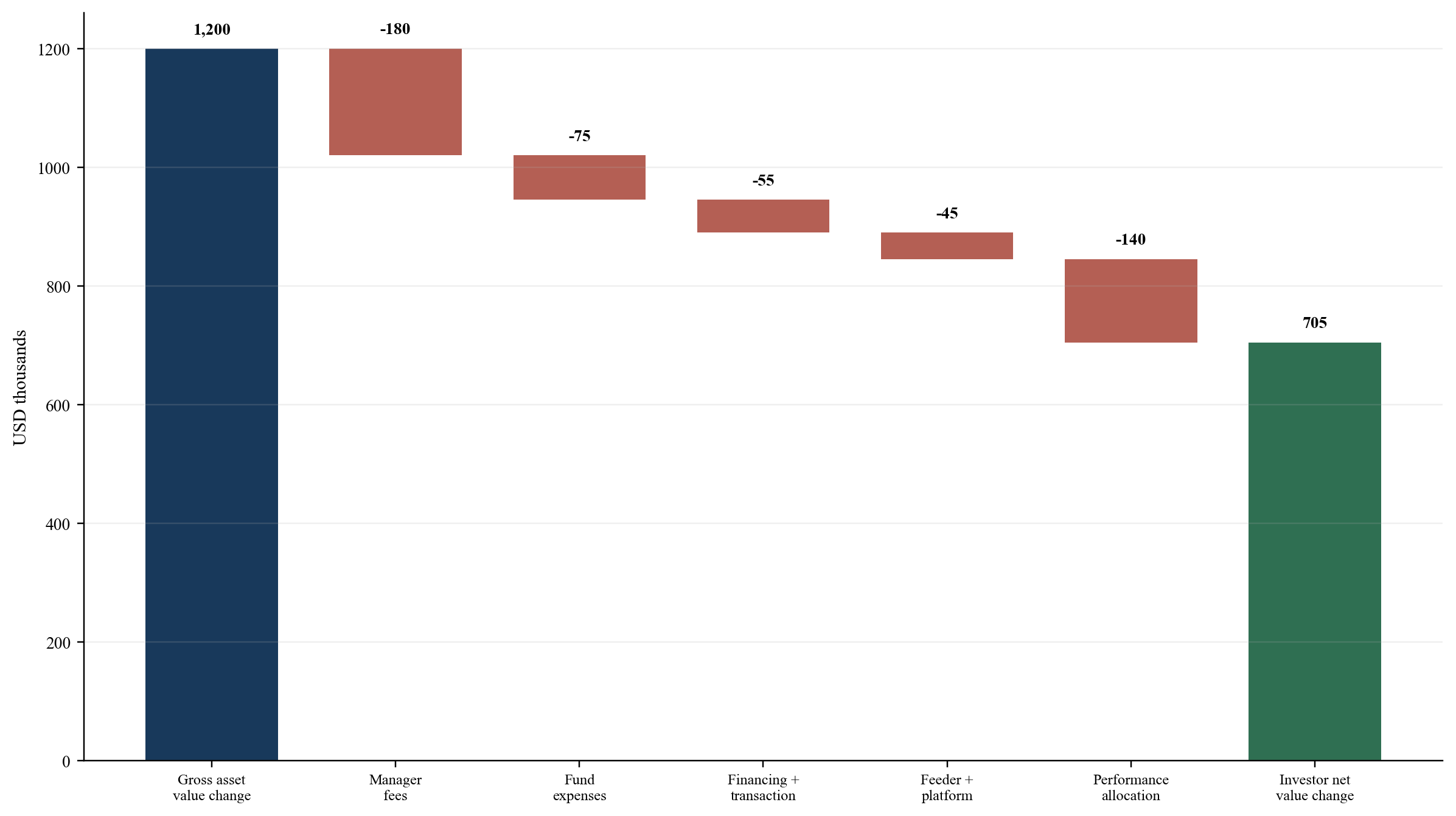
Every value is a hypothetical management assumption in USD thousands and demonstrates reconciliation only.
Table 5. Hypothetical private-market product economics
| Measure | Base case | Downside case | Diligence question |
|---|---|---|---|
| commitment | USD 10,000,000 | USD 10,000,000 | what obligations remain unfunded? |
| gross asset value change | USD 1,200,000 | USD 200,000 | which assets and assumptions create the result? |
| management fees | USD 180,000 | USD 180,000 | what basis, step-down and offsets apply? |
| fund and transaction expenses | USD 130,000 | USD 170,000 | which costs vary under stress? |
| feeder and platform charges | USD 45,000 | USD 45,000 | which distribution layers receive compensation? |
| performance allocation | USD 140,000 | USD 0 | which hurdle, catch-up and clawback apply? |
| investor net value change | USD 705,000 | USD (195,000) | does the client understand the complete path? |
| peak additional capital call | USD 1,400,000 | USD 2,300,000 | can the client fund the obligation when liquid assets fall? |
All values are hypothetical management assumptions and are not a product forecast or recommendation.
10. Identify conflicts before disclosure
Disclosure is one part of conflict management. The firm should first identify where its interests, the manager's interests, an affiliate's interests or another client's interests can diverge from the investor's interests. It should then prevent, control, consent to or disclose the conflict as required by the applicable framework.
Common private-market conflicts involve product selection, placement or platform remuneration, proprietary products, affiliates, allocation among funds, co-investment, warehousing, continuation vehicles, cross-trades, valuation, financing, service providers, expenses, side letters, personal investments and capacity. The register should identify the economic beneficiary, decision authority, affected clients, control, residual risk and monitoring evidence.
The compensation map should include cash and non-cash benefits across the chain. A manager payment to a distributor, platform, adviser or affiliate can affect product selection and ongoing retention. Complete economics and conflict analysis therefore need the same underlying data.
11. Test service providers and asset control
Private-market products depend on administrators, custodians or depositaries where applicable, banks, auditors, valuation providers, legal advisers, technology vendors and data providers. The diligence team should establish the contractual scope, responsibility, information flow, control evidence, incident record and termination plan for material providers.
Cash and ownership deserve transaction-level testing. The team should trace a sample capital call from notice to bank account, investor ledger, investment and reporting. It should trace a distribution or redemption in reverse. It should confirm authorised signatories, dual control, reconciliations and exception management.
The operating model should address cyber security, data protection, access, change, backup, business continuity, disaster recovery and record retention. A policy should be supported by test results and remediation. Concentration in one person, system, bank or provider should lead to an explicit continuity decision.
12. Convert diligence into target-market rules
The target market translates product evidence into client boundaries. It should define the product's objectives, expected holding period, risk and loss profile, liquidity, commitment behaviour, knowledge, experience, portfolio role and servicing needs. It should also define a negative target market and conditions requiring additional review.
The FCA's product-governance review discusses positive and negative target markets, distributor due diligence, management information and staff competence. ESMA's MiFID II product-governance guidelines address manufacturer and distributor responsibilities. Australia's design and distribution obligations require a target-market determination for in-scope registered schemes and reasonable steps to distribute consistently with it. These approaches sit within different legal systems and should be applied only within their proper scope.
The distributor's internal target market should be at least as precise as the evidence requires. A broad label such as professional investor or accredited investor may establish a legal route while leaving knowledge, capacity, liquidity and portfolio concentration unresolved.
13. Assess the actual client and service
Client assessment depends on the service. Advice, discretionary management, execution, placement and introduction can create different obligations. The firm should identify the actual role before designing the client journey.
Current DFSA COB materials address client classification, suitability, conflicts and record keeping. The suitability framework considers needs and objectives, financial situation and, where relevant, risk tolerance, knowledge, experience and understanding. The actual Rulebook, client agreement and service control. Hong Kong's SFC describes suitability as a cornerstone of investor protection and links it to product due diligence. Its 2025 listed-alternative-fund circular includes client-knowledge and loss-capacity expectations for the products within that circular's scope.
The assessment should use current evidence. It should quantify liquidity resources, commitments and concentration. It should record the client's understanding of capital calls, valuation, transfer, fees, conflicts and downside. Any limitation in the assessment should follow the applicable rules and agreement rather than a general disclaimer.
14. Govern manufacturer-distributor information
The distributor needs sufficient information to understand and monitor the product. The manufacturer needs sufficient distribution information to understand whether the product reaches its target market and produces the expected outcomes. Contracts and data standards should support both directions.
The data set can include client category, channel, geography, commitment, concentration, assessment result, exceptions, complaints, cancellations, defaults, transfers, redemptions, gates and incidents. Personal data should be limited and governed. Aggregation can support product oversight where client-level sharing is restricted.
Missing information should become a documented challenge. The FCA's product-governance review observed difficulty obtaining end-client data and emphasised documented challenge and distributor oversight. A commercial relationship does not answer the governance question.
15. Use conditional approval and evidence expiry
Approval should state scope and conditions. A product can be approved for one client category, channel or portfolio service and restricted elsewhere. Conditions can include commitment caps, concentration limits, additional training, minimum liquid reserves, enhanced disclosure, legal confirmation or completion of a service-provider remediation.
Every material evidence item needs an expiry or event trigger. Annual financial statements, quarterly valuation evidence, regulatory status, team changes, key-person events, fund amendments, litigation, cyber incidents, valuation adjustments and liquidity changes can all affect approval. The system should route each event to an owner and decision.
Overdue evidence should not silently remain green. The product can move to restricted, suspended or review status depending on materiality. Existing clients may require a different response from new distribution, and the committee should document both.
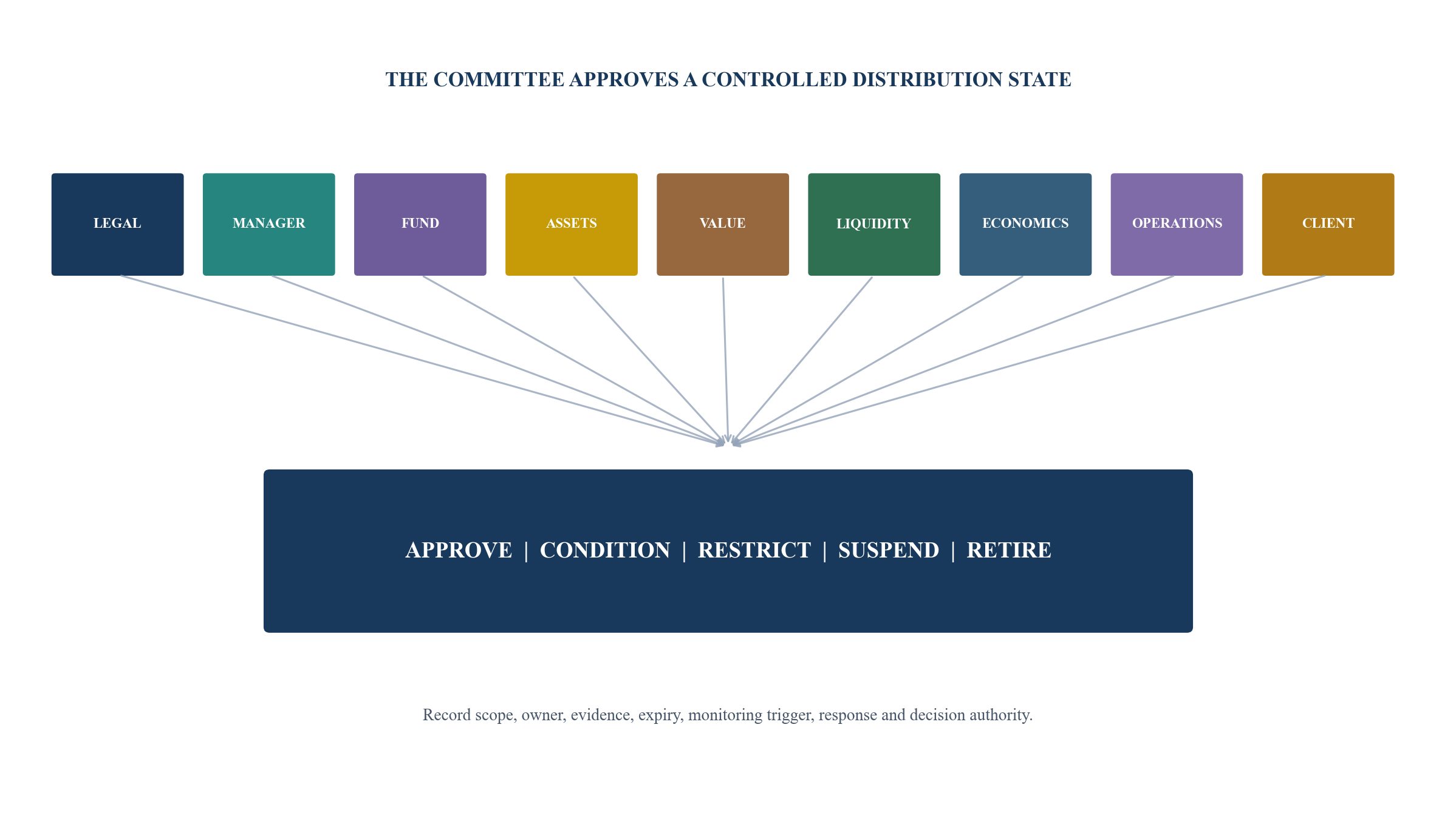
Author framework. Complete evidence supports a bounded decision with conditions, monitoring and stop authority.
Table 6. Product approval and monitoring register
| Workstream | Approval evidence | Monitoring trigger | Committee response |
|---|---|---|---|
| regulatory route | current legal and compliance confirmation | rule, licence, product or channel change | hold new access and reassess route |
| manager and people | approved organisation and succession review | key departure, ownership or control change | restrict, escalate key-person rights or suspend |
| fund terms | reconciled controlling documents | amendment, extension, side-letter or borrowing change | update conditions and client communication |
| valuation | policy, sample challenge and governance evidence | material write, override or model change | independent challenge and approval review |
| liquidity | asset, fund, secondary and client stress | gate, suspension, delayed exit or call increase | stop new access and reassess capacity |
| fees and conflicts | complete economics and conflict register | new charge, affiliate, incentive or allocation | prevent, control, consent or disclose as required |
| operations | provider, cash, cyber and continuity evidence | control failure, outage, breach or qualified report | incident response, remediation and restriction |
| distribution outcomes | target-market and client evidence | exception, complaint, default or concentration | investigate, remediate and revise target market |
Owners, thresholds and dates are illustrative fields to be completed under the firm's approved framework.
16. Monitor outcomes across the lifecycle
Product monitoring should test whether the original case remains true. It should cover manager, fund, portfolio, valuation, liquidity, economics, operations and distribution outcomes. A stable NAV does not establish that controls are stable.
Management information should separate new commitments, existing exposure and clients approaching capacity. It should show exceptions, overdue evidence, valuation changes, delayed reporting, calls, distributions, redemptions, transfers, gates, complaints and incidents. It should identify concentrations by manager, strategy, vintage, currency, geography and service provider.
The committee should compare actual outcomes with the approved target market and product thesis. If the distribution population changes, the target market may need revision. If the strategy drifts, the manager may need to explain, cure or obtain approval. If fees or liquidity behave differently from the model, the firm should update client materials and controls as required.
17. Design incident escalation and product retirement
Incidents can involve fraud, regulatory action, litigation, key people, valuation, liquidity, cyber security, cash, reporting, service providers, documents or client outcomes. The framework should define materiality, notification, investigation, authority and records before an incident occurs.
New distribution can be paused while the firm investigates. Existing clients may need information, advice, consent, liquidity planning or legal action depending on facts and obligations. The response should remain within the firm's authority and role.
Retirement is part of product governance. A product can remain economically viable and cease to fit the firm's strategy, operating capacity or target market. The retirement plan should cover new access, existing servicing, data, reporting, complaints, conflicts and client communication through the end of the relationship.
18. Build a diligence data model
A scalable process needs structured data and linked documents. Core objects include manager, fund, vehicle, share class, feeder, strategy, asset, service provider, document, term, risk, conflict, fee, target market, client segment, approval, condition, exception, incident and review.
Each conclusion should link to evidence. Version control should preserve what the committee knew at the decision date. Permissions should protect confidential manager and client information. Automation can route evidence, compare fields, identify expiry and produce monitoring packs; accountable specialists remain responsible for interpretation and approval.
The model should allow differences among jurisdictions and channels. One global taxonomy can describe the evidence domain while local rules, documents and approvals remain separate. This supports international comparison without collapsing legal distinctions.
19. Implement the standard in 180 days
During the first thirty days, define product universe, services, jurisdictions, target-market taxonomy, decision authority and critical evidence. Select a small group of products representing different strategies, liquidity profiles and operating routes.
During days 31 to 60, build the evidence register, document hierarchy, manager-and-fund template, valuation challenge, liquidity stress, economics model and conflicts register. Map current files and identify gaps.
During days 61 to 90, complete pilot reviews. Run committee decisions with real evidence, conditions and expiry. Test client segmentation, training, exception and escalation workflows. Record where the standard creates duplication or fails to answer a decision question.
During days 91 to 120, integrate service-provider, cash-control, cyber and continuity evidence. Establish manufacturer-distributor information requirements and outcome monitoring. Remediate the highest-risk gaps before expanding the universe.
During days 121 to 180, migrate the remaining shelf in risk order. Train relationship managers, investment teams, operations and control functions. Report approved, conditional, restricted, suspended and retired products separately. The board should receive evidence quality, overdue items, exceptions, incidents, concentrations and remediation.
20. Use the board gate to protect capacity
The board or delegated committee should approve the standard, decision authority, risk appetite and reporting. It should understand which products and channels create the largest evidence, liquidity, valuation, conflicts and operating burden.
The final decision should state what the firm knows, what remains unresolved and what condition protects the boundary. It should identify the evidence supporting access and the evidence that would cause access to change. Commercial urgency should appear as a factor in the decision record, not as a substitute for evidence.
A high-quality diligence process can support growth. It makes the product proposition precise, identifies the client it can serve, reduces avoidable operating surprises and creates an auditable path from manager claim to client outcome. The value comes from disciplined decisions rather than document volume.
Conclusion
Private-market access is an operating commitment. The distributor assumes responsibilities for understanding the product, defining its target market, governing the client journey and monitoring outcomes within the applicable legal and contractual framework.
An evidence-first standard separates legal route, product approval, target market, client assessment and transaction execution. It examines manager, fund, assets, valuation, liquidity, economics, conflicts, service providers and distribution as connected systems. It converts diligence into explicit approval conditions, expiry dates, monitoring triggers and stop authority.
International official materials demonstrate recurring design disciplines while preserving legal differences. Target market, client knowledge and capacity, valuation, liquidity, complete costs, conflicts, distributor oversight and lifecycle monitoring repeatedly appear as essential evidence domains.
The governing question is practical: can the firm explain, with current attributable evidence, why this product should be available through this service to this target market, which conditions apply and which event would change the decision? Access should follow when that record is complete.
References
- Dubai Financial Services Authority, Conduct of Business Module, version 51/07-26, https://dfsaen.thomsonreuters.com/rulebook/conduct-business-module-cob-ver5107-26
- Dubai Financial Services Authority, COB 3.4.2 Suitability, https://dfsaen.thomsonreuters.com/entiresection/12440
- UK Financial Conduct Authority, MiFID II product governance review, https://www.fca.org.uk/publications/multi-firm-reviews/mifid-ii-product-governance-review
- UK Financial Conduct Authority, Smaller asset managers and alternatives business model review: our findings, https://www.fca.org.uk/publications/good-and-poor-practice/smaller-asset-managers-and-alternatives-business-model-review-our-findings
- European Securities and Markets Authority, Guidelines on MiFID II product governance requirements, https://www.esma.europa.eu/document/guidelines-mifid-ii-product-governance-requirements
- Monetary Authority of Singapore, CISNet user guide, https://eservices.mas.gov.sg/cisnet/html/WebHelp/About_This_Guide.htm
- Securities and Futures Commission of Hong Kong, Suitability requirement, https://www.sfc.hk/en/Rules-and-standards/Suitability-requirement
- Securities and Futures Commission of Hong Kong, Circular on listed closed-ended alternative asset funds, https://apps.sfc.hk/edistributionWeb/api/circular/list-content/circular/doc?lang=EN&refNo=25EC9
- Australian Securities and Investments Commission, Design and distribution obligations for schemes, https://www.asic.gov.au/regulatory-resources/managed-funds/design-and-distribution-obligations-for-schemes/
- United States Securities and Exchange Commission, Observations from Examinations of Investment Advisers Managing Private Funds, https://www.sec.gov/files/Private%20Fund%20Risk%20Alert.pdf
- United States Securities and Exchange Commission, Examinations Observations of Investment Adviser Obligations Related to Economic Conflicts of Interest, https://www.sec.gov/compliance/risk-alerts/exams-observations-ia-obligations-related-economic-conflicts-interest-060926
- United States Securities and Exchange Commission, Technical amendments reflecting vacatur of private fund adviser rules, https://www.sec.gov/rules-regulations/2024/11/s7-03-22
- International Organization of Securities Commissions, Principles for the Valuation of Collective Investment Schemes, https://www.iosco.org/library/pubdocs/pdf/IOSCOPD413.pdf
- International Organization of Securities Commissions, Consultation Report on Valuing Collective Investment Schemes, https://www.iosco.org/library/pubdocs/pdf/IOSCOPD811.pdf
About the Author
Chennakeshav Adya is an independent researcher and Managing Partner of Matchpoint Partners. His work examines strategy, capital formation, valuation, transactions and operating execution across private and public markets.
