

1. Treat consultation as a controlled change portfolio
CP173 is a consultation document. It describes Part I proposals and Part II discussion topics. The DFSA states that firms should not act on the proposals until the legislative and Rulebook changes are finalised and that it will issue a notice when the changes have been made.[1] This status should appear at the top of every internal workstream.
A wealth firm can still prepare. It can analyse its licences, funds, product agreements, target markets, systems, procedures and client journeys against the consultation. It can identify dependencies, prepare feedback, model operating choices and stage implementation. The resulting work should remain reversible until final instruments and transition arrangements are known.
The change register should have four columns of authority. Current requirement cites current law or Rulebook. Proposed change cites CP173 and its draft appendices. Possible future policy identifies Part II discussion only. Management decision records the firm's chosen commercial or operating response. Combining these categories can cause premature implementation and inaccurate communication.
Each proposed change should be assigned to legal, compliance, product, investment, operations, technology, finance and distribution owners. The register should show the affected funds, clients, processes, contracts and data. It should also record whether the firm plans to respond to the consultation before 7 September 2026.
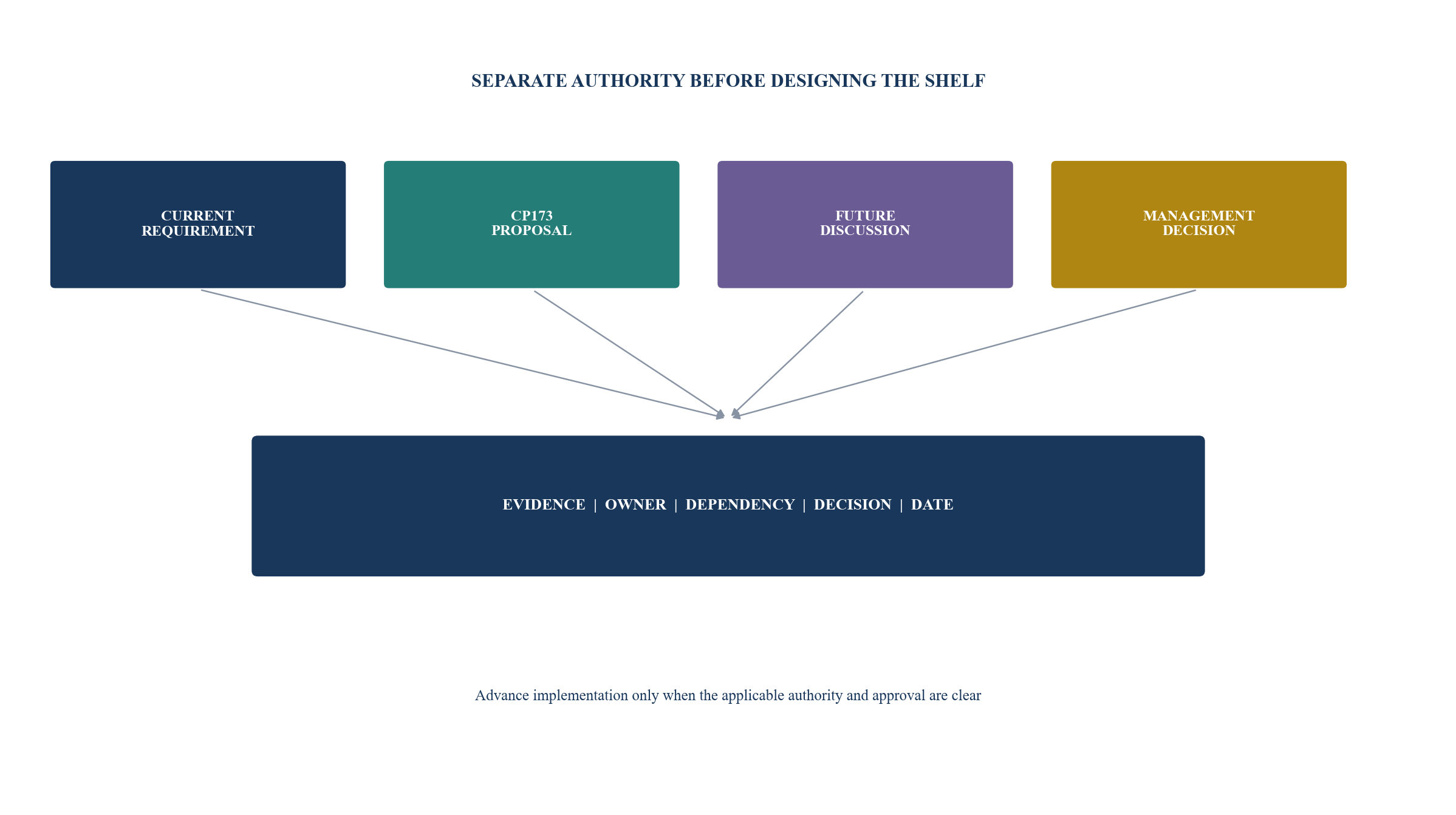
Author framework. Current law, consultation proposals, future discussion and management decisions require separate evidence and approval.
Table 1. CP173 change-control register
| Workstream | CP173 status | Shelf implication to analyse | Implementation gate |
|---|---|---|---|
| Private-fund classifications | proposal to move from rigid specialist classes for relevant Exempt Funds and QIFs towards activities, risks, safeguards and disclosure | revise product taxonomy and diligence fields | final instruments and affected-product mapping |
| Horizontal risk management | proposed wider risk-profile, borrowing and prime-broker requirements | standardise risk data across the shelf | final scope, controls and evidence owners |
| Credit and venture strategies | proposed changes to credit-fund thresholds and safeguards; proposed extension of venture-capital relief to funds of venture funds | reassess manager route and product eligibility | final rules, licence and product-specific advice |
| Managing Assets | proposed clarification for integral dealing-as-agent and arranging activity | review permissions and delegated models | final GEN wording and licence analysis |
| Master-feeder structures | proposed removal of specified eligibility constraints and broader master-fund definition | review public feeder architecture and underlying liquidity | final CIR rules and fund-structure diligence |
| External Fund Managers | proposal to remove the regime | identify affected managers, products and transition dependencies | final rule, grandfathering and transition decision |
| Employee investment | proposed direct and vehicle routes with experience and disclosure conditions | update conflicts and eligible-investor data | final rules, conflicts design and documentation |
| Tokenisation and long-term funds | discussion topics for possible later policy | build research options, not implementation commitments | separate future consultation or final policy |
The proposal summary is not a substitute for the consultation paper, draft instruments or final rules.
2. Read the proposal through the client proposition
Regulatory change becomes commercial only when it affects a defined client and product journey. A private bank may distribute third-party funds, advise clients, manage discretionary portfolios, operate nominee structures, arrange transactions or introduce clients. Each activity creates different permissions, duties and operating responsibilities.
The alternatives proposition should state which client problem it addresses. Common objectives include return diversification, income, inflation sensitivity, growth, capital preservation through different risk drivers, intergenerational planning and access to specialised managers. Each objective must be translated into horizon, drawdown tolerance, liquidity, currency, concentration, commitment pacing and cash-flow needs.
The firm should then map which funds can lawfully and operationally serve each segment. A product that accepts a client under its subscription documents may still fall outside the distributor's approved target market. A client who meets a wealth threshold may lack the knowledge, capacity or liquidity horizon for the product.
Revenue should enter after the target market and product case. Placement fees, trailer fees, management rebates, advisory fees, performance allocations or financing income can distort selection. The product committee should receive commercial economics alongside conflicts and client-outcome evidence.
3. Segment clients by capacity and use case
Broad labels such as high net worth or professional client are insufficient for shelf design. The segmentation should combine legal classification with financial capacity, investment knowledge, liquidity needs, time horizon, existing alternatives exposure, commitment experience, tax residence, currency, custody, reporting and advice relationship.
A founder after a liquidity event can have substantial wealth and little experience with drawdowns and capital calls. A multi-generational family office can have an investment committee and long horizon while needing predictable distributions. An entrepreneurial client can accept illiquidity while remaining highly concentrated in one operating sector. A discretionary client requires a portfolio mandate that supports the allocation and servicing model.
The firm should define exclusion criteria. These can include insufficient emergency liquidity, foreseeable cash requirements, excessive concentration, inability to meet calls, weak understanding of loss and lock-up, unsuitable leverage, unresolved sanctions or tax issues, and product terms that conflict with the client's mandate.
Client segmentation is a control and a service design. It informs education, advice, minimum evidence, allocation range, product type, pacing and monitoring. It should be reviewed when wealth, residence, mandate, knowledge or financial circumstances change.
Table 2. Alternatives client-segmentation matrix
| Segment | Primary use case | Required evidence | Common shelf boundary |
|---|---|---|---|
| Newly liquid entrepreneur | diversify concentrated operating wealth | liquidity plan, loss capacity, knowledge and pacing | avoid rapid vintage or strategy concentration |
| Established UHNW investor | add specialised risk and return drivers | portfolio map, prior experience and cash-flow horizon | match commitments, currency and reporting burden |
| Family investment company | institutionalise governance and manager access | mandate, committee authority, policy and consolidated exposure | require look-through concentration and conflicts reporting |
| Multi-family office client | access curated managers with delegated administration | client classification, service agreement and responsibility map | define distributor, adviser, administrator and custodian roles |
| Discretionary portfolio | allocate within an approved mandate | mandate authority, target range and liquidity budget | ensure product and dealing terms fit portfolio governance |
| Experienced employee investor | align with a managed fund where permitted | experience, role, conflict and disclosure evidence | apply final rules and avoid information advantage |
Categories are illustrative. Legal classification and suitability must follow current requirements and the actual client.
4. Build a shelf architecture instead of a product list
An alternatives shelf should be organised by client outcome, economic exposure, vehicle, liquidity, risk and service model. Asset labels alone can conceal important differences. Two private-credit funds can differ in origination, seniority, leverage, duration, currency, jurisdiction, valuation, concentration, cash distributions and redemption.
The first layer is portfolio role: diversifier, income, growth, inflation-sensitive real asset, opportunistic return, capital solution or hedge. The second is underlying strategy and risk. The third is access vehicle, including closed-ended commitment, evergreen, open-ended, feeder, fund of funds, co-investment, listed closed-ended fund or managed account. The fourth is servicing: subscription, call management, valuation, tax reporting, custody, transfer and exit.
The shelf should have an approved core, specialist satellite, watchlist, restricted and retired status. Core status requires durable investment and operating evidence. A specialist product can serve a narrow experienced segment. A watchlist product can remain unavailable while diligence is completed. Retired status should include a plan for existing clients.
Shelf breadth has a cost. Every product requires due diligence, agreements, data, training, operations, monitoring and incident response. The committee should measure active assets and clients per product, not only the number of manager relationships.
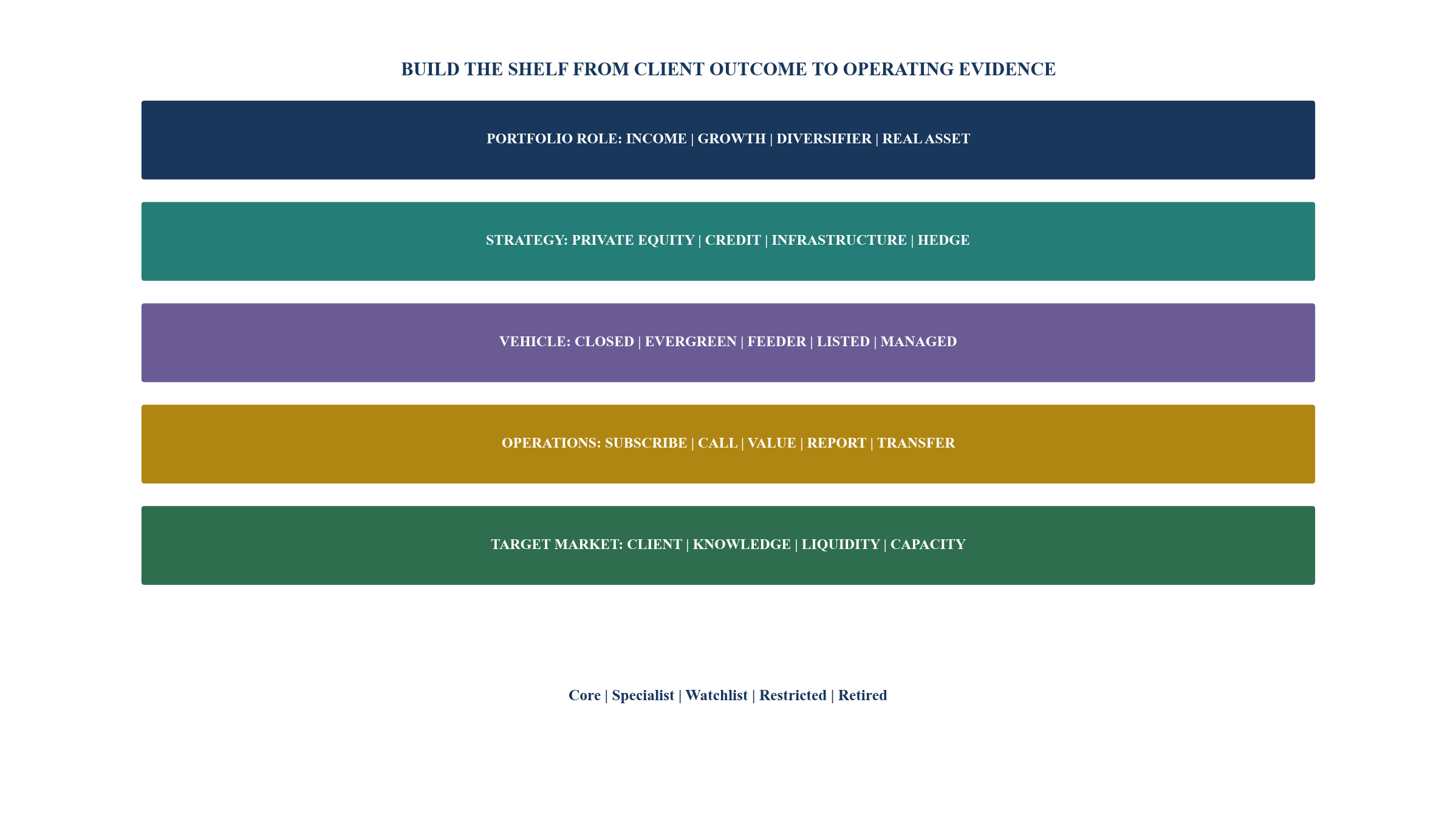
Author framework. Products progress from portfolio role through strategy, vehicle, operating route and approved client segment.
5. Translate the proposed risk-based approach into data
CP173 proposes moving away from certain fixed specialist classifications for Exempt Funds and QIFs. It describes a focus on activities, associated risks and safeguards, supported by disclosure.[2] It also proposes horizontal risk-management provisions across fund managers and disclosures concerning expected maximum borrowing and its basis.
A distributor should respond with a structured risk ontology. The product record can capture strategy, instrument, borrower or asset type, geography, sector, concentration, leverage, borrowing basis, liquidity, prime-broker rights, collateral, counterparty, valuation, conflicts and operational dependencies. A flexible regulatory classification increases the importance of precise product data.
The taxonomy should allow hybrid strategies. A fund combining asset-backed credit, preferred equity and opportunistic real estate should not be forced into one marketing label. The committee should inspect each economic risk and how exposures interact.
Disclosures should reconcile to the manager's operating evidence. A stated borrowing limit should match fund documents, facility agreements, risk systems and investor reports. A liquidity policy should match asset disposal time, redemption terms, gates, notice and cash resources.
6. Distinguish current product routes from proposed changes
The current DIFC framework includes Public Funds, Exempt Funds and Qualified Investor Funds, with current rules and eligibility requirements.[3] CP173 proposes changes to specified parts of that regime. The platform should retain current product eligibility until final changes take effect.
The product file should identify domestic or external fund status, manager and delegate, vehicle, offering route, target investor, minimum subscription, governing documents, administrator, custodian or trustee, auditor, valuation function and distribution agreement. It should cite current authority for each conclusion.
CP173 proposes removing the external fund-manager regime, citing limited supervisory reach and increased interest in full DFSA authorisation.[4] A platform distributing a product connected to an external fund manager should identify whether the proposal affects the manager, fund or distributor and await final transition treatment.
The consultation also proposes extending specified venture-capital relief to managers of funds dedicated to investing in venture-capital funds. The product committee should distinguish direct venture funds, funds of venture funds, co-investments and broader growth vehicles because their fees, diversification, liquidity and look-through evidence differ.
7. Use international comparisons as design evidence
International regimes can show how regulators address access, liquidity, valuation, disclosure and distribution. They do not determine DIFC law. Every product still requires analysis under the applicable regime and licence.
The European Long-Term Investment Fund framework provides an EU route for long-term assets. Regulation (EU) 2023/606 includes retail suitability, written alerts for long and illiquid commitments, complaint procedures and specific disclosure and record-keeping provisions.[5]
The United Kingdom recognises authorised fund categories including the Long-Term Asset Fund. FCA materials describe LTAFs as authorised funds intended for long-term illiquid assets and subject to distribution, valuation and governance requirements.[6] In 2026 the FCA also began consulting on reforms to the UK AIFM regime, reinforcing that rule status and timing matter.[7]
Singapore uses separate public and restricted-scheme routes. MAS CISNet states that notification of a restricted scheme relates to offers to accredited and other specified investors and that inclusion does not indicate licensing or endorsement of the manager.[8] Hong Kong's SFC issued requirements for authorised listed closed-ended alternative funds, including valuation disclosure, client knowledge and risk-capacity controls.[9]
Table 3. International alternatives-distribution design comparison
| Market | Official route or development | Shelf-design lesson | Required caution |
|---|---|---|---|
| DIFC | CP173 consultation plus current CIL and CIR | separate present rules, proposed changes and future discussion | do not act on proposals before finalisation |
| European Union | ELTIF framework for long-term assets | integrate suitability, warnings, complaints, liquidity and disclosure | EU authorisation does not determine DIFC offer eligibility |
| United Kingdom | LTAF, QIS, NURS and UCITS categories; AIFM reform consultation | map client route, product category, liquidity and valuation | current FCA rules and consultation status must be checked |
| Singapore | authorised or recognised schemes for public offers and notified restricted schemes | distinguish notification, authorisation and investor category | list inclusion is not manager endorsement |
| Hong Kong | authorised listed closed-ended alternative funds | link complex-product knowledge, risk capacity, NAV and disclosure | listed liquidity can diverge from underlying asset liquidity |
The table identifies design evidence, not legal equivalence or passporting.
8. Diligence manager, fund and distribution route
Manager diligence should cover ownership, governance, regulatory status, people, track record, strategy, sourcing, underwriting, portfolio construction, risk, valuation, liquidity, operations, service providers, cyber security, financial crime, conflicts, business continuity and financial resilience.
Fund diligence should cover legal form, governing law, term, investment restrictions, leverage, commitment and drawdown, recycling, distributions, valuation, expenses, management fee, performance allocation, key person, removal, no-fault rights, transfer, default, side letters, reporting, audit, tax and wind-down.
Distribution diligence covers who markets, advises, arranges, receives orders, performs classification and suitability, transmits documents, handles money, holds assets, maintains records and responds to complaints. Responsibility gaps are a material risk.
The distributor should independently verify manager claims where possible. Track-record attribution, realised value, remaining value, bridge financing, subscription lines, NAV facilities and valuation policies can materially affect reported performance.
Table 4. Alternatives product diligence register
| Domain | Core evidence | Principal question | Shelf escalation |
|---|---|---|---|
| Manager and team | licence, ownership, governance, people and attribution | can the organisation execute the stated strategy through a full cycle? | key-person or track-record evidence cannot be reconciled |
| Portfolio and leverage | assets, concentration, facilities, borrowing and collateral | which economic risks drive loss and liquidity? | headline strategy conceals leverage or concentrated exposure |
| Valuation | policy, independence, models, inputs, overrides and audit | can NAV and performance be reproduced and challenged? | stale marks or unexplained divergence from exits and peers |
| Liquidity | asset sale time, term, redemption, gates, notice and cash | can the vehicle meet promised dealing terms under stress? | asset liquidity conflicts with investor liquidity |
| Fees and conflicts | waterfall, expenses, affiliates, allocations and side letters | do incentives and total cost align with the target market? | undisclosed economics or unequal treatment |
| Operations and distribution | administrator, custody, data, suitability and complaints | can the product be subscribed, held, reported and serviced safely? | responsibility or data gap at a critical client step |
Evidence should be current, attributable and reconciled to contracts, reports and service-provider records.
9. Match asset liquidity to product liquidity
Alternatives can contain assets that take months or years to realise. The vehicle can be closed-ended, periodically dealing, evergreen or listed. Each structure allocates liquidity risk differently.
An evergreen product should disclose subscription, redemption, notice, frequency, gate, queue, suspension, side-pocket, cash and borrowing mechanisms. The firm should test how those tools work together under stress. A redemption date is not equivalent to guaranteed cash on that date.
A listed closed-ended fund gives secondary-market transfer while its price can trade above or below NAV. Hong Kong's SFC alternative-fund framework highlights NAV publication and disclosure of closed-ended and illiquid-asset risks.[9] The distributor should explain market-price and underlying-asset liquidity separately.
IOSCO's revised 2025 recommendations and implementation guidance address liquidity-risk management for collective investment schemes.[10] A platform should use manager evidence on asset liquidity, investor concentration, stress testing and tools rather than relying on the product label.
10. Build an independent valuation control
Private assets require estimates. The valuation system should identify policy, responsible body, independent challenge, frequency, methodology, inputs, comparable data, calibration, impairment, override, back-testing and disclosure.
The platform should reconcile NAV changes to operating performance, financing, transactions, public comparables, foreign exchange and methodology. A smooth NAV series can reflect genuine asset stability or stale information. The firm should examine the evidence.
Fee calculations can depend on NAV. Valuation affects management fees, performance allocations, subscriptions, redemptions, collateral and client reporting. Conflicts should be identified where the manager performs valuation and earns a fee from the result.
The relationship manager should receive approved language explaining that reported NAV is an estimate and may differ from a realisation price. Client statements should retain valuation dates and sources.
11. Design suitability as an evidence workflow
The workflow begins with legal eligibility and continues through target market, knowledge, experience, financial capacity, loss tolerance, time horizon, liquidity, objectives, concentration, commitments and product understanding. A threshold alone cannot answer every dimension.
The adviser should explain asset risk, vehicle risk, leverage, cash flows, valuation, fees, conflicts, reporting and exit. Client understanding should be recorded through relevant questions and acknowledgement. A generic form completed once can become stale.
Portfolio context matters. The proposed allocation should be combined with existing private funds, direct businesses, property, private credit and unfunded commitments. A 5 per cent allocation to a fund can produce a much higher look-through exposure to the client's operating sector or geography.
The approval should state allocation, funding source, currency, commitment schedule, expected calls and distributions, monitoring and review triggers. A decline or defer decision should be recorded with the reason.
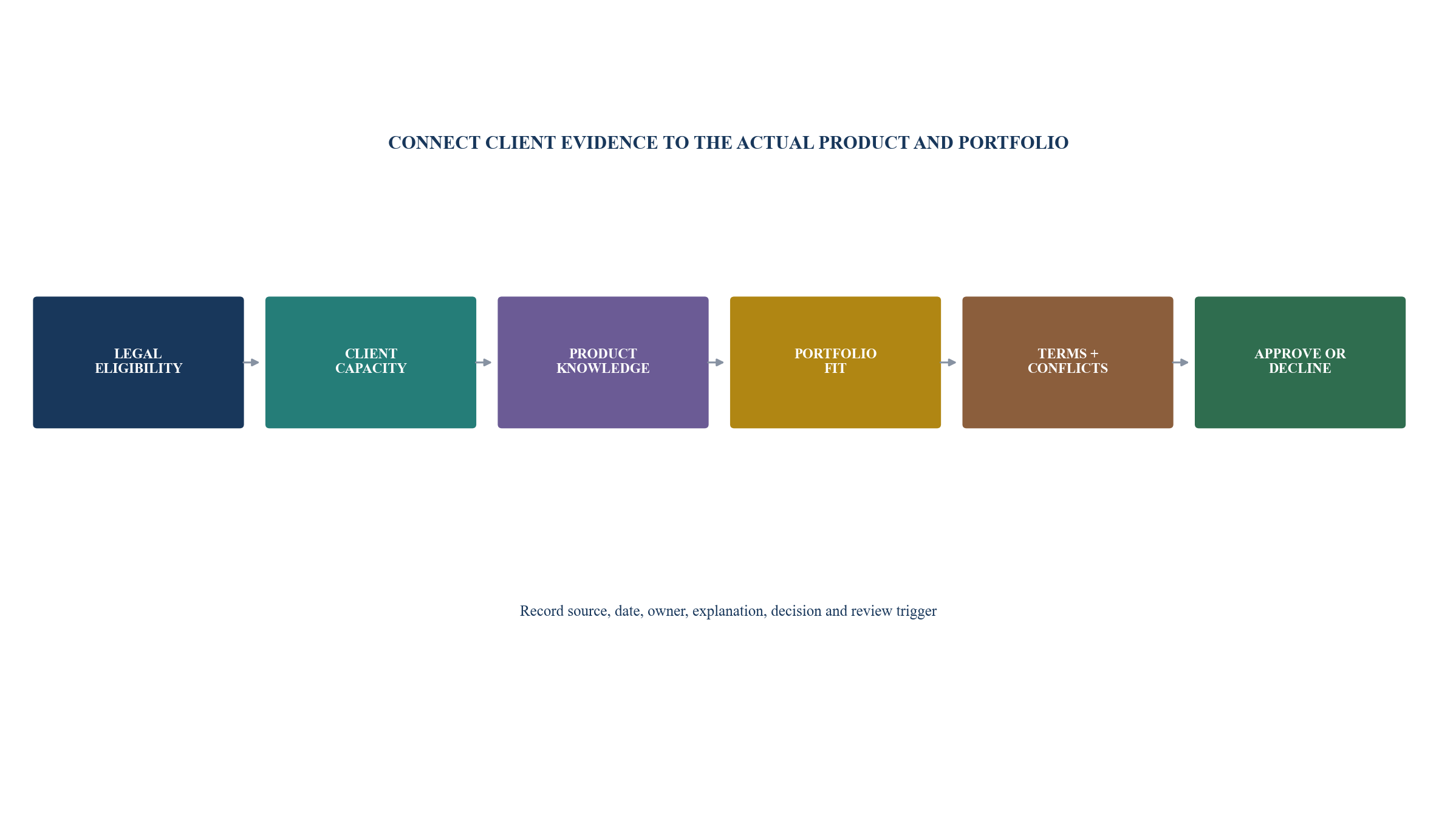
Author framework. Legal access is one gate within a wider client, portfolio and product assessment.
12. Make fees and conflicts visible
Alternative-product cost can include management fee, performance allocation, fund expenses, acquisition or disposition fees, financing cost, administrator, feeder cost, placement fee, platform fee, advice fee, custody, foreign exchange and tax. Some fees are charged on commitments, invested capital or NAV at different times.
The client should see the complete structure and the distributor's remuneration. The product committee should compare costs with the service and expected portfolio role. A lower headline fee can coexist with high transaction, feeder or incentive economics.
Conflicts can arise from manager selection, revenue sharing, affiliated funds, proprietary vehicles, allocations, side letters, co-investments, valuation, financing and employee participation. CP173's employee-investment proposal includes additional disclosure and conflict-management concepts.[11]
The firm should maintain a conflicts register with owner, control, disclosure and outcome monitoring. Disclosure should be clear and should not replace control where the conflict cannot be managed adequately.
13. Model the complete fee waterfall
The fee model should follow the actual documents and a plausible cash-flow path. A commitment-based fee can continue before full investment. A performance allocation can include hurdle, catch-up, crystallisation, loss carry-forward, clawback and deal-by-deal or whole-fund mechanics.
The following example uses a hypothetical AED 10 million investment over one year. It assumes AED 900,000 gross investment gain, AED 150,000 management fee, AED 70,000 fund expenses, AED 35,000 feeder and administration cost, AED 45,000 platform and advice cost and AED 120,000 performance allocation. Net value created is AED 480,000 before tax and investor-specific effects. These values demonstrate the bridge only.
The committee should run lower-return, loss, delayed-exit and FX cases. Fees can change differently from performance. A product can have strategic portfolio value even when one-year return is low; the client still needs transparent cost.
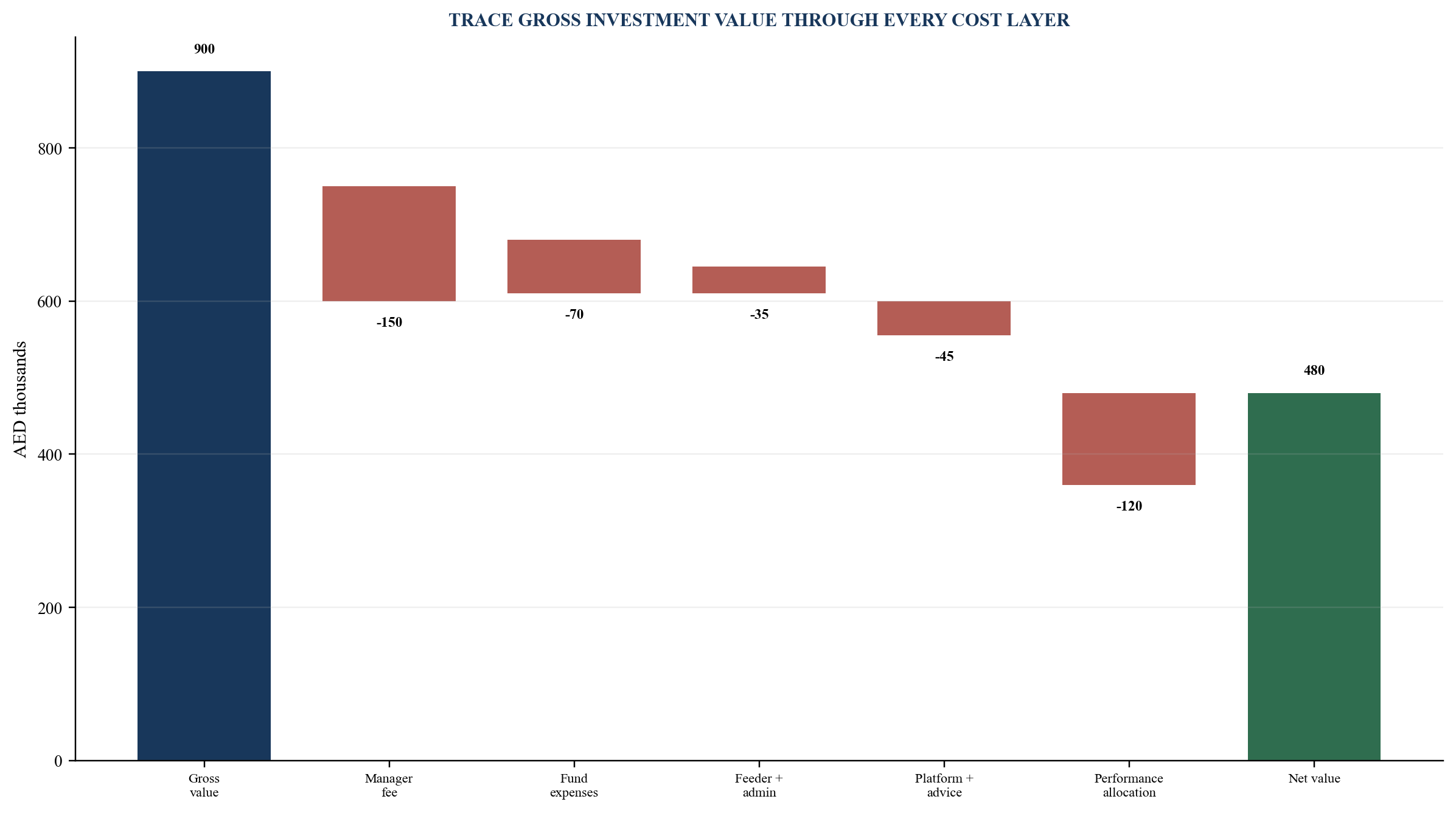
Every value is a hypothetical management assumption in AED thousands and demonstrates the method only.
Table 5. Hypothetical alternatives product economics
| Measure | Base case | Downside case | Governance question |
|---|---|---|---|
| Initial investment | AED 10,000,000 | AED 10,000,000 | does the funded amount and commitment reconcile to documents? |
| Gross one-year investment change | AED 900,000 | AED 100,000 | which operational and market drivers produce the change? |
| Total fees and expenses | AED 420,000 | AED 280,000 | which costs vary with performance, NAV or commitments? |
| Net one-year value change | AED 480,000 | AED (180,000) | does the client understand the return and loss path? |
| Unfunded commitment | AED 2,000,000 | AED 2,000,000 | can liquidity meet calls under portfolio stress? |
| Earliest expected liquidity | year 5 | year 8 | which right, market or manager action supports the date? |
| Look-through strategy concentration | 18% | 27% | how do underlying holdings interact with the client's wealth? |
All values are hypothetical management assumptions and are not a product forecast or recommendation.
14. Govern master-feeder and platform structures
CP173 proposes removing specified public feeder eligibility criteria and broadening the master-fund definition so that non-feeder investors can invest alongside feeder funds.[12] These proposals can increase structural flexibility if finalised.
A distributor should examine both levels. The feeder can add currency, dealing, reporting, governance, fee and tax features. The master holds the economic assets. Liquidity promised by the feeder depends on master liquidity, cash, borrowing and transfer arrangements.
The diligence file should contain both sets of documents, service providers, fees, valuation times, dealing calendars, gates, side pockets, suspensions, notices and termination rights. Information-sharing and audit evidence should support look-through monitoring.
Investor fairness requires attention where direct master investors and feeder investors have different terms. Side letters, capacity, expenses, redemption priority and information access should be understood.
15. Build the manager and platform operating model
The alternatives shelf is an operating system. Product management owns taxonomy, target market, governance and lifecycle. Investments owns thesis and manager diligence. Compliance owns regulatory mapping, financial promotion and suitability control. Operations owns onboarding, orders, calls, cash, custody, valuation and reporting. Technology owns data lineage, access and workflow. Finance owns revenue, expense and profitability reconciliation.
The responsibility map should name who receives manager notices, capital calls, valuation files, amendments, incidents and complaints. The platform should retain evidence that clients received required documents and that orders followed approval.
Data fields should be standard across products. Documents can remain product-specific while common fields support exposure, commitment, liquidity, fee, valuation and incident reporting.
Product retirement requires governance. The firm may stop new sales while continuing service, calls, distributions and reporting for existing investors. Manager termination or product closure should trigger a client communication and asset-servicing plan.
16. Treat tokenisation as an operating model, not a label
CP173 seeks feedback on tokenised fund units, tokenised money-market funds, funds holding tokenised investments and operational uses of crypto or fiat crypto tokens. It notes existing DIFC provisions introduced after a 2021 consultation and asks whether barriers remain.[13]
A token can represent a fund interest while the underlying product still needs manager, fund, custody, valuation, transfer, financial-crime, cyber, data and investor controls. The ledger design should identify the legal register, finality, ownership, wallet, key management, permissioning, recovery and incident process.
The commercial case should quantify settlement time, reconciliation, administration, collateral or distribution benefit. It should also include technology, custody, integration, governance and failure cost. A tokenised wrapper does not change underlying asset liquidity.
The platform should keep tokenisation in the research register until an approved product, current regulatory route and operating evidence exist. Marketing should avoid implying guaranteed liquidity or lower risk.
17. Prepare for possible long-term retail access
CP173 asks for early feedback on a possible long-term investment fund regime. It states that current DIFC long-term funds can be established as Exempt Funds or QIFs and discusses potential safeguards for retail or restricted-retail access, including access criteria, redemptions and investor awareness.[14]
This is a discussion item that may lead to future policy. It is not a current retail product route created by CP173. The firm can study client demand, product structure, liquidity, education, suitability, complaints, dealing and operational capacity.
EU ELTIF and UK LTAF experience can inform design. The EU framework includes suitability and written alerts for long commitments. The FCA LTAF regime addresses long-term illiquid strategies, valuation and authorised-fund governance. The legal details remain jurisdiction-specific.
A retail or restricted-retail proposition would require clear outcome evidence. The firm should test whether a client can withstand lock-up, delayed or limited redemption, valuation uncertainty and loss. Product availability should not precede the client-protection and service model.
18. Enable relationship managers with evidence
Relationship managers need a short, approved representation of a complex product. The pack should include target market, portfolio role, strategy, vehicle, term, liquidity, valuation, leverage, fees, conflicts, cash flows, risk, documentation and escalation contacts.
Training should use cases. An RM should be able to distinguish a commitment from funded NAV, a redemption window from assured exit, reported NAV from realisation value and legal eligibility from suitability. Knowledge should be tested and refreshed.
The dashboard should measure client conversations, completed education, suitability pass and decline, subscriptions, funded value, unfunded commitments, concentration, calls, distributions, liquidity events, complaints and incidents. Sales volume alone gives incomplete governance evidence.
Client outcome monitoring should identify unexpected cash strain, misunderstanding, excess concentration, unresolved service problems and product underperformance against its stated role. The firm should define intervention and product-review triggers.
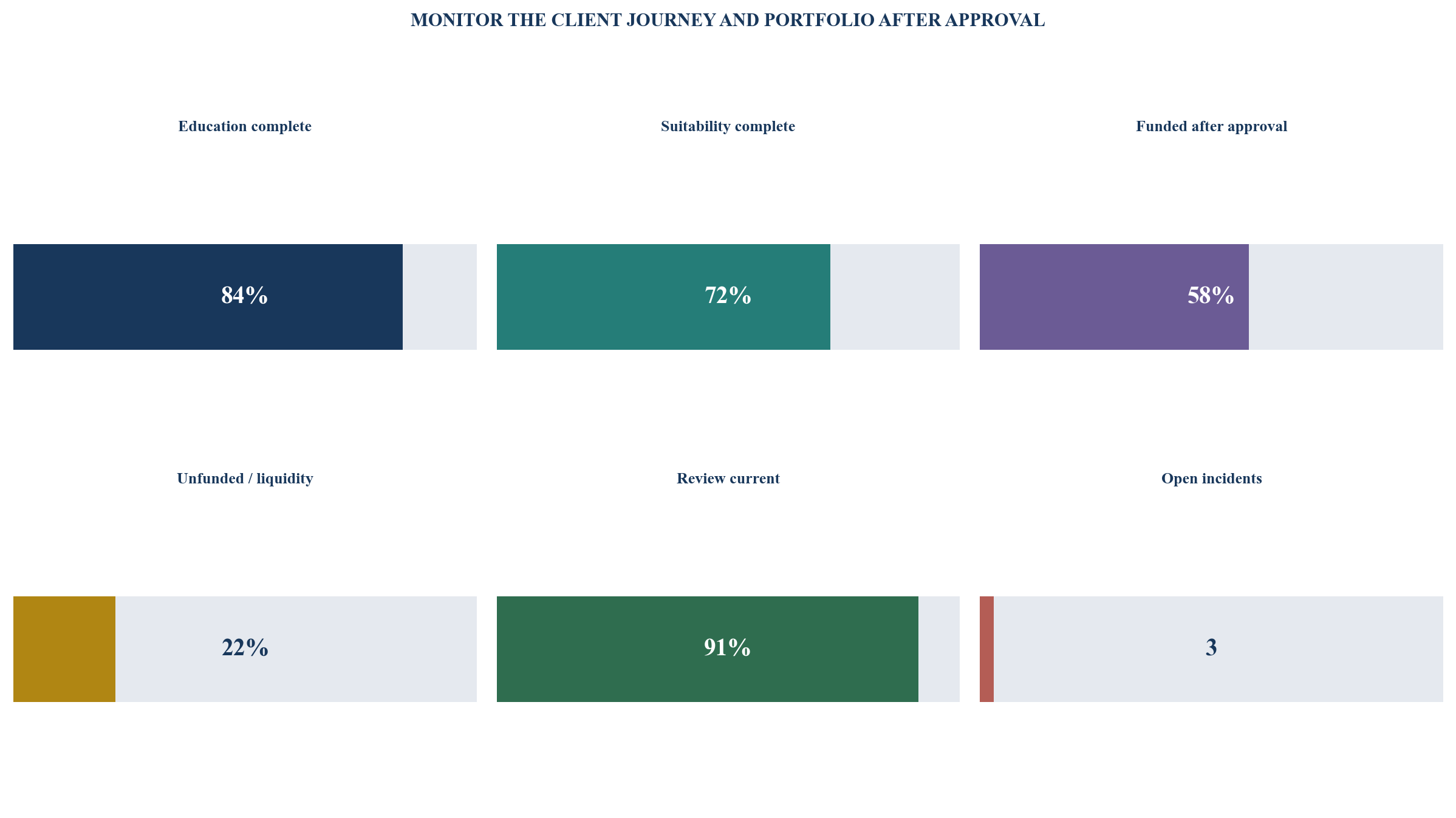
Values are hypothetical management assumptions used solely to demonstrate workflow monitoring.
19. Run a 180-day shelf-rebuild programme
During the first thirty days, the firm should establish the current-law and CP173 registers, inventory products, classify clients, map permissions and document current fees, conflicts, liquidity and data. It should identify consultation points requiring management input.
During days 31 to 60, product and compliance teams should define the target-market methodology, shelf taxonomy, diligence standard and suitability workflow. Investments should test the highest-revenue and highest-risk products against the new standard.
During days 61 to 120, the firm should complete product reviews, reconcile agreements and fees, implement dashboards, train relationship managers and test cases. Any response to CP173 should be approved and submitted by the applicable deadline.
During days 121 to 180, the committee should approve core, specialist, restricted and retired classifications, remediate data and responsibility gaps and run client-file sampling. Final implementation of regulatory proposals should wait for final instruments and an approved transition plan.
Table 6. Alternatives shelf implementation register
| Workstream | Deliverable | Acceptance evidence | Stop or escalation condition |
|---|---|---|---|
| Regulatory change | current, proposed, future and decision registers | cited authority, owner and status review | proposal represented as effective law |
| Client segmentation | legal and economic target-market rules | test cases, exclusions and approval | wealth threshold substitutes for suitability |
| Product shelf | core, specialist, restricted and retired map | complete diligence and committee minutes | material valuation, liquidity or conflict gap |
| Suitability and advice | end-to-end evidence workflow | sampled files and portfolio look-through | missing knowledge, capacity or explanation evidence |
| Fees and conflicts | total-cost model and remuneration disclosure | document reconciliation and conflict control | undisclosed distributor or affiliate economics |
| Operations and RM | data model, servicing map, training and dashboard | reconciled orders, calls, reporting and monitoring | responsibility gap or stale client and product data |
Owners and dates are illustrative fields. The firm should populate them with approved responsibility and current evidence.
20. Use a board gate that can hold the shelf
The board or delegated product committee should approve a product only when six conditions align: legal route, defined target market, credible manager and strategy, matched liquidity and valuation, transparent economics and conflicts, and an operating and monitoring model.
The decision can be core approval, specialist approval, conditional remediation, watchlist, restriction, retirement or rejection. It should state the client segment, allocation or use boundary, required disclosure, review frequency and incident triggers.
Regulatory change remains a separate gate. A product can be commercially attractive and operationally ready while a proposed route is not final. The decision should record the authority in force on the approval date.
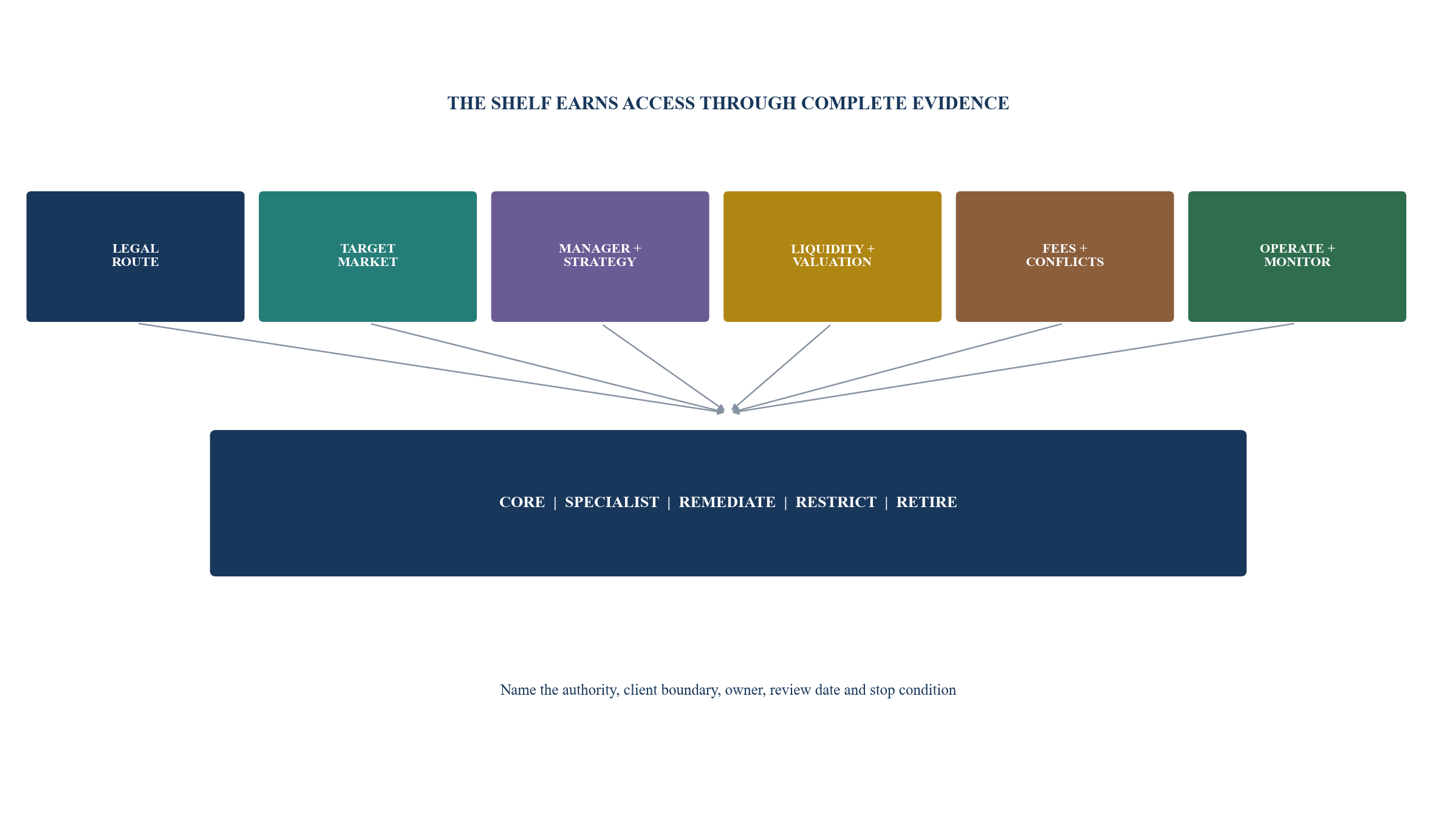
Author framework. Product access follows regulatory, client, investment, liquidity, economic and operating evidence.
Conclusion
CP173 creates a valuable opportunity for DIFC fund managers, wealth firms and service providers to examine how a more risk-based framework could affect products and operations. It remains a consultation. The DFSA has stated that firms should wait for final changes before acting on the proposals.
A well-governed firm can prepare through evidence. It can separate current rules, proposed changes, future policy and commercial choices. It can rebuild the shelf around client capacity, product risk, liquidity, valuation, cost, conflicts, operations and outcomes.
International regimes demonstrate several recurring disciplines: distinguish professional and retail routes, align liquidity with assets, govern valuation, assess knowledge and capacity, disclose complete economics and maintain operational evidence. Their rules are not interchangeable.
The final shelf should be smaller or larger only because the evidence supports that result. Its quality comes from precise target markets, manager and fund diligence, controlled servicing, trained relationship managers and a board gate capable of restricting or retiring a product. Regulatory flexibility can then support responsible innovation through a distribution system designed for durable client outcomes.
References
- Dubai Financial Services Authority, Consultation Paper No. 173, Proposals to Enhance the DFSA's Collective Investment Fund Framework, https://dfsaen.thomsonreuters.com/sites/default/files/net_file_store/CP_173_Enhance_the_DFSAs_collective_investment_fund_framework.pdf
- Dubai Financial Services Authority, The DFSA proposes significant updates to its Collective Investment Fund framework, https://www.dfsa.ae/news/dfsa-proposes-significant-updates-its-collective-investment-fund-framework
- Dubai Financial Services Authority, Collective Investment Rules module, https://dfsaen.thomsonreuters.com/rulebook/collective-investment-rules-cir
- Dubai Financial Services Authority, The DFSA Rulebook, https://dfsaen.thomsonreuters.com/sites/default/files/net_file_store/DFSA1547_11821_VER170.pdf
- European Union, Regulation (EU) 2023/606 on European long-term investment funds, https://eur-lex.europa.eu/eli/reg/2023/606/oj
- UK Financial Conduct Authority, Authorised and recognised funds, https://www.fca.org.uk/firms/authorised-recognised-funds
- UK Financial Conduct Authority, COLL 15 Long-term asset funds, https://handbook.fca.org.uk/handbook/coll15
- UK Financial Conduct Authority, CP26/28: The UK AIFM Regime, https://www.fca.org.uk/publications/consultation-papers/cp26-28-uk-aifm-regime
- Monetary Authority of Singapore, CISNet, https://eservices.mas.gov.sg/cisnet/home/CISNetHome
- Monetary Authority of Singapore, List of Restricted Schemes Notified, https://eservices.mas.gov.sg/cisnetportal/jsp/list.jsp
- Securities and Futures Commission of Hong Kong, Circular on listed closed-ended alternative asset funds, https://apps.sfc.hk/edistributionWeb/api/circular/list-content/circular/doc?lang=EN&refNo=25EC9
- International Organization of Securities Commissions, Revised Recommendations for Liquidity Risk Management for Collective Investment Schemes, https://www.iosco.org/library/pubdocs/pdf/IOSCOPD797.pdf
- International Organization of Securities Commissions, Guidance for Open-ended Funds for Effective Implementation of the Recommendations for Liquidity Risk Management, https://www.iosco.org/library/pubdocs/pdf/IOSCOPD798.pdf
About the Author
Chennakeshav Adya is an independent researcher and Managing Partner of Matchpoint Partners. His work examines strategy, capital formation, valuation, transactions and operating execution across private and public markets.
