
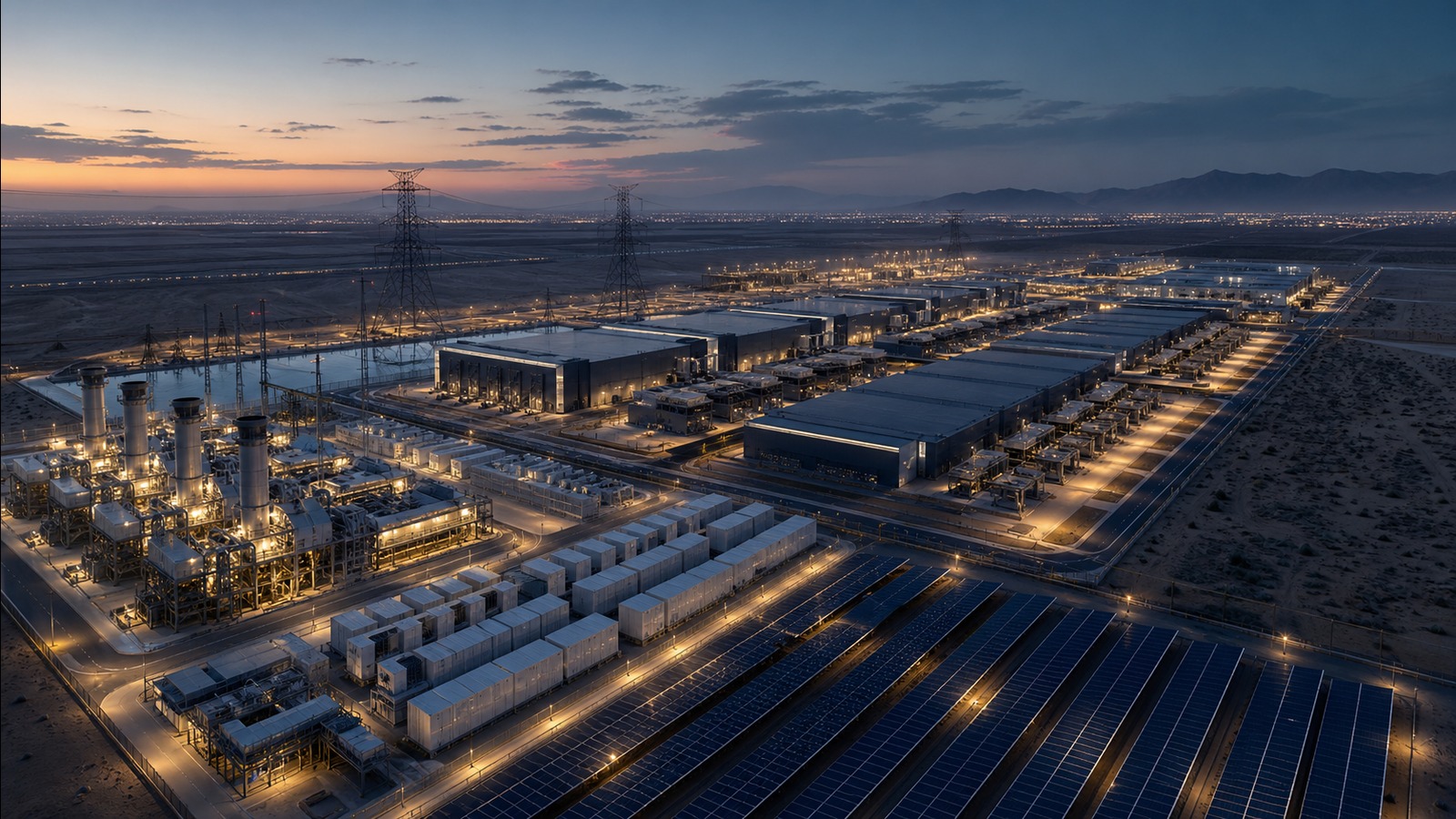
1. Start with the computing service, not the power plant
An AI campus does not purchase electricity as an abstract commodity. It requires a defined computing service supported by power quality, uptime, cooling, communications and physical security. The energy transaction should begin with the electrical conditions under which the campus can deliver its contracted compute. These conditions include dependable megawatts, permitted interruptions, voltage and frequency tolerances, restart behaviour, redundancy, maintenance windows and the ramp from initial halls to full campus.
The International Energy Agency identifies electricity as a central constraint on AI infrastructure and reports that data-centre demand is both geographically concentrated and uncertain.[1] A campus can therefore create a local system problem even where national generation appears sufficient. Behind-the-meter supply changes the timing and allocation of that problem. It does not remove the need for network studies, permits, fuel, environmental controls or an eventual grid strategy.
The transaction perimeter should identify the land, campus operator, compute customers, energy special-purpose vehicle, generation assets, storage, renewable sources, fuel supply, grid interface, cooling load and shared infrastructure. It should state which entity owns each asset, who controls dispatch, who bears losses and auxiliary consumption, and how service failure affects compute revenue.
The energy service specification should distinguish critical load, flexible load and non-critical load. Critical load may require firm supply through an outage or generator maintenance event. Flexible training workloads may shift in time. Cooling and water treatment can have different operating constraints. Treating every megawatt as identical can overbuild the system and obscure valuable flexibility.
The investment case should express the reason for self-supply. Possible reasons include connection delay, reliability, tariff exposure, renewable procurement, resilience or phased capacity. Each reason has a different counterfactual. The financial model should compare the integrated system with the credible grid-connected alternative, including timing, reinforcement, backup and transition costs.
2. Convert the campus ramp into a financeable load envelope
A campus masterplan often states ultimate capacity while financing begins years earlier. The energy system should follow a load envelope containing minimum, expected and high cases for each phase. The envelope should reflect construction completion, server delivery, customer contracting, utilisation, cooling efficiency and operational ramp.
Nameplate IT capacity is not the same as total facility demand. Power-usage effectiveness connects IT load with cooling and other facility consumption. The governing model should define measurement boundaries and avoid combining design PUE, annual PUE and instantaneous peak conditions. Temperature and humidity can materially affect cooling demand in GCC climates.
The load case should distinguish energisation from commercial use. A completed hall may require testing power before it earns contracted revenue. A compute customer may reserve capacity and ramp later. Minimum payments, deposits and commissioning milestones can protect the energy vehicle from an empty-load period.
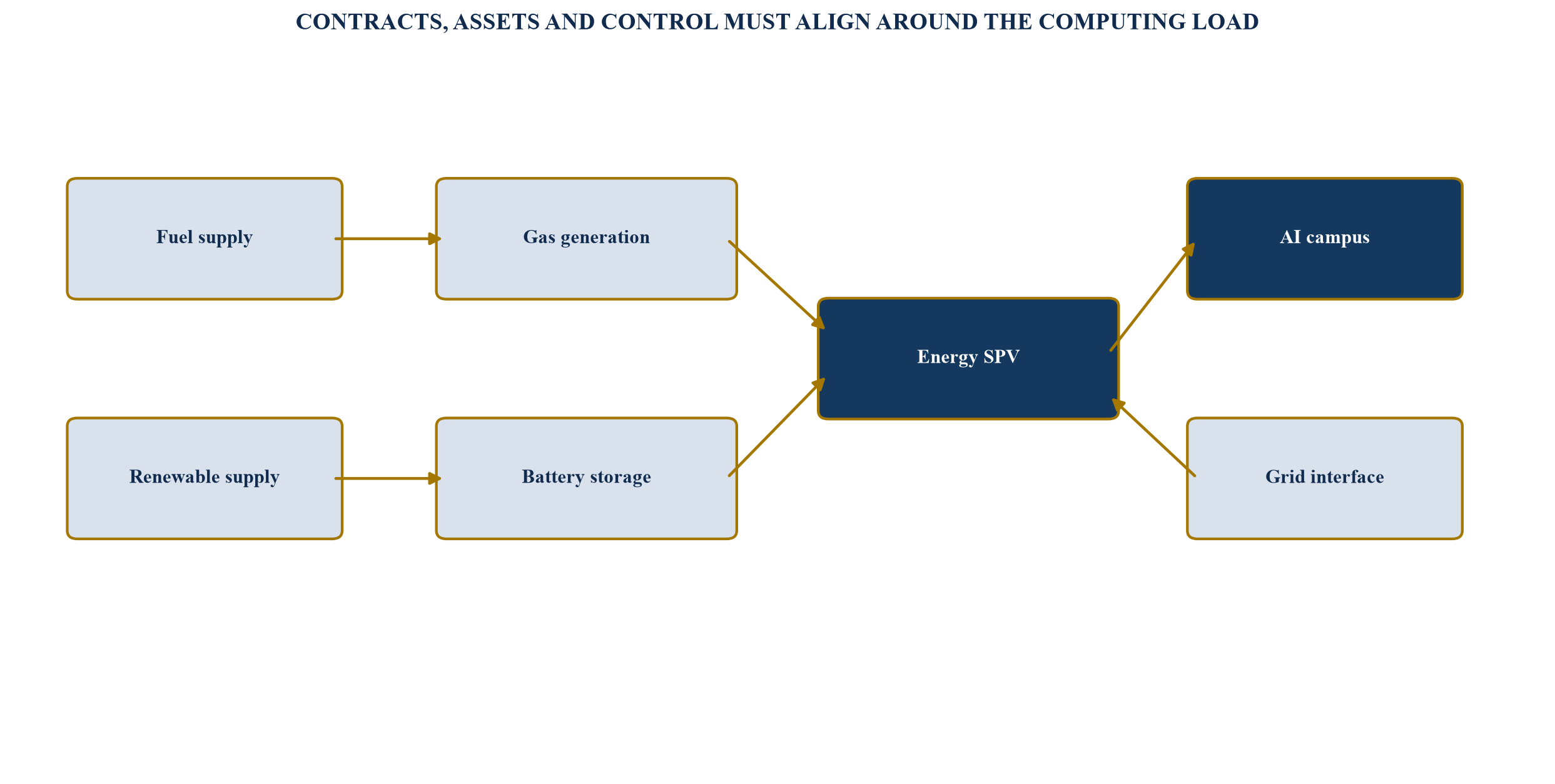
The diagram is illustrative; live structures depend on licensing, ownership and network rules.
The load envelope should be updated through evidence rather than calendar alone. Relevant evidence includes customer contracts, deposits, equipment purchase orders, building completion, fibre readiness and commissioning results. Each update should identify the resulting generation, storage and funding decision.
3. Design the generation mix by function
Gas generation, battery storage and renewable electricity have different roles. Dispatchable gas capacity can support firm energy and long-duration operation, subject to fuel and maintenance. Batteries provide fast response, ride-through, peak support and limited-duration energy. Solar and wind can reduce fuel use and emissions while their production varies by time and weather.
The design should allocate functions before allocating megawatts. Black start, spinning reserve, frequency response, uninterruptible transfer, peak shaving, renewable firming and normal energy supply require different equipment and controls. A battery sized for seconds of ride-through cannot be treated as hours of firm supply. A solar contract matched annually does not guarantee production during the campus peak.
The IEA expects renewables and natural gas to play material roles in meeting additional data-centre electricity demand, with storage and the grid supporting the mix.[2] IRENA's storage framework stresses that storage value depends on the services provided and the regulatory setting.[3] The transaction model should therefore identify each service, its beneficiary, its measurement and its payment.
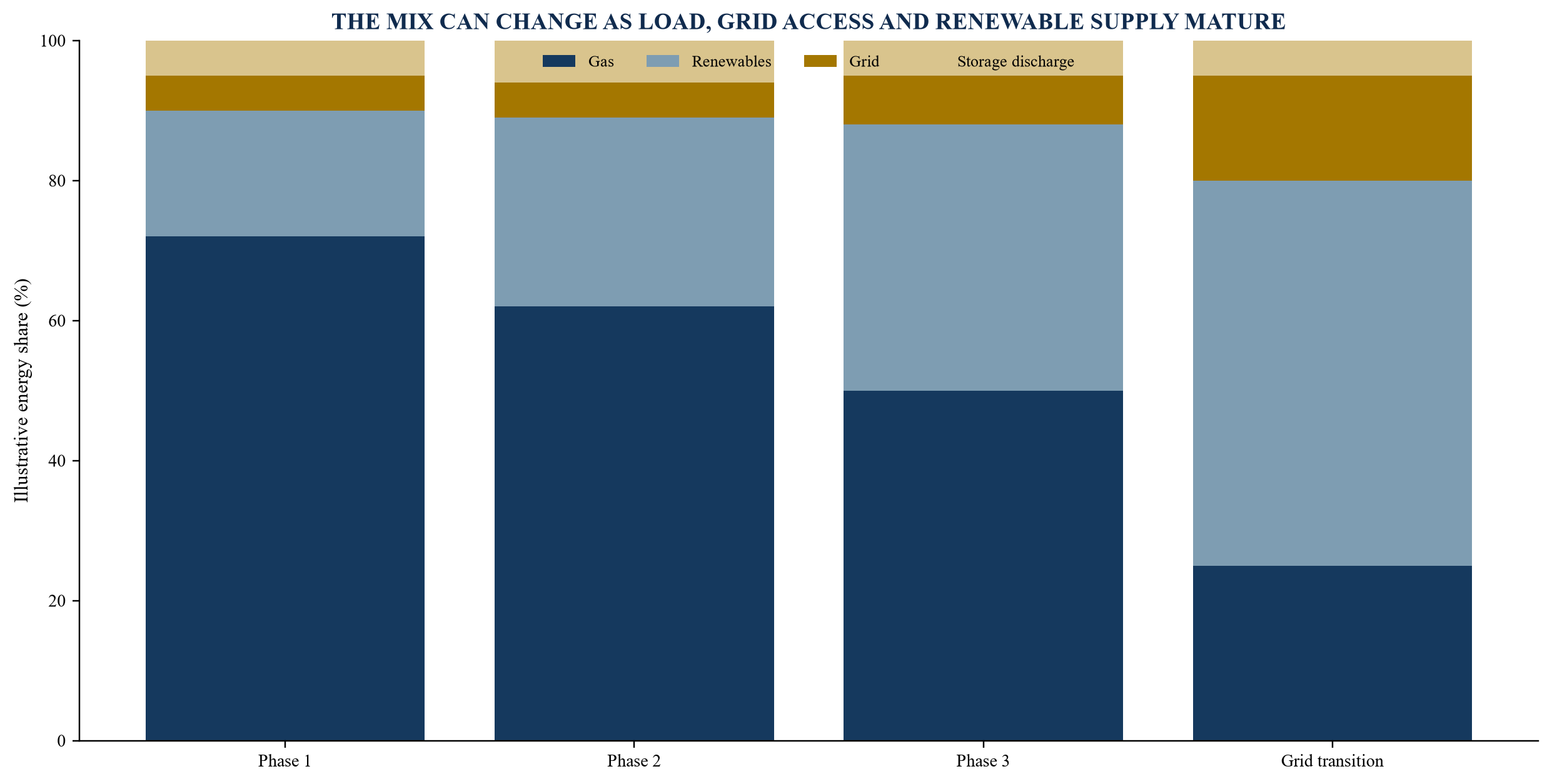
Percentages are hypothetical energy shares and do not represent dependable capacity.
Dependable capacity should be calculated under coincident stress: high ambient temperature, a planned outage, a forced outage, low renewable output and battery state-of-charge limits. The financing case should use the system capacity that survives the agreed contingency, not the sum of equipment nameplates.
4. Define the energy vehicle and contract perimeter
An energy special-purpose vehicle can own generation and storage, contract for renewable supply, purchase fuel and sell capacity and energy to the campus. The structure separates energy assets and cash flows from the campus property and compute business. Separation is useful only when contracts allocate interfaces and the security package reaches the relevant rights.
The service agreement should define capacity availability, delivered energy, power quality, testing, dispatch, metering, planned maintenance, outages, liquidated damages, force majeure, change in law, termination and transition to grid supply. The term should align with debt maturity and asset life while allowing the campus to change its energy mix.
The campus operator should provide the load forecast, site access, shared facilities, cooling interface and timely payment. The energy vehicle should provide compliant assets, fuel arrangements, operating capability, insurance and reporting. Direct agreements can give lenders cure and step-in rights without making them operators.
Ownership of the interconnection, substation, switchgear, pipelines and control system should be explicit. Shared assets can create priority conflicts among campus phases or tenants. Easements, access, spares and maintenance should survive a change in ownership or enforcement.
Table 1. Core contract perimeter for the campus energy vehicle
| Contract | Core obligation | Financeability test | Principal failure exposure |
|---|---|---|---|
| Energy service agreement | dependable capacity and delivered energy | term, payment and remedies support debt | campus default or service failure |
| Fuel supply agreement | quantity, quality, pressure and delivery | entitlement and interruption rules match dispatch | fuel shortage or price shock |
| EPC and equipment contracts | complete tested assets | fixed perimeter, security and interface control | delay, cost or performance shortfall |
| O&M and long-term service | availability and maintenance | capability, spares and lifecycle budget | forced outage or degradation |
| Renewable supply | delivered or financially matched clean energy | profile, location and attribute ownership | intermittency or basis risk |
| Grid and connection agreements | import, export and transition rights | milestones and operating code are achievable | delay, curtailment or reinforcement |
Contract names and enforceability depend on jurisdiction and project structure.
5. Stage construction around modular completion
The campus and energy system should have compatible construction packages and completion tests. Civil works, fuel connection, generation modules, storage blocks, substations, control systems and campus halls can complete at different times. A single final completion date can hide the interfaces that determine first energisation.
Each module should have mechanical completion, energisation, reliability run and commercial-operation tests. Tests should measure net dependable output after auxiliary load, heat conditions and agreed contingency. Storage testing should include power, usable energy, response, efficiency and degradation baseline. Renewable assets should demonstrate metering and attribute transfer.
Construction funding can follow defined gates. Early equity can fund land rights, studies, permits and long-lead reservations. Senior construction debt can fund equipment once contracts, permits and customer commitments satisfy conditions. Delayed-draw debt, vendor finance and equity commitments can cover later modules.
Interface risk should have one accountable integrator or a controlled matrix. A generation contractor cannot deliver power if the fuel pipeline, substation or campus acceptance system is late. Schedule relief and damages should address the interface cause and preserve lender remedies.
The completion budget should include owner costs, duties, connection, initial fuel, spares, testing load, insurance, interest during construction, contingency and reserves. A cost item omitted because it sits outside the EPC contract remains a project cost.
Procurement should recognise that generator, transformer, switchgear and battery delivery schedules can move independently. A reservation fee can preserve a production slot while exposing the project to cancellation cost if the campus slips. The investment committee should compare that option cost with the economic effect of delayed energisation and the likelihood that customer milestones will be met. Assignment, substitution and resale rights can reduce exposure where the equipment is sufficiently standard.
Factory acceptance, shipping, customs, storage and site acceptance should appear in the integrated schedule. Equipment arriving before secure storage and foundations can create damage and warranty risk. Equipment arriving after campus completion can create idle property and customer damages. The schedule should show the contractual consequence of each interface rather than use a single undifferentiated contingency.
Early operating modules also create learning. Their measured heat rate, availability, cooling interaction and load profile can improve the design of later modules. The project should preserve the ability to change later specifications when evidence supports it. Standardisation can reduce spares and training cost, while strict replication can embed a weakness discovered in the first phase.
6. Secure fuel as a capacity input
Gas generation is dependable only when fuel is physically and contractually available. The fuel case should identify supplier, source, pipeline capacity, pressure, quality, nomination, balancing, interruption priority, maintenance and emergency arrangements. A national gas resource does not establish a project entitlement.
The fuel contract should align daily and hourly delivery with dispatch. Take-or-pay supports supply investment but can create cost when campus load ramps slowly. Minimum campus payments or fuel pass-through can allocate that exposure. Alternative fuel capability can support resilience while adding storage, handling, emissions and operating complexity.
Price formulas should identify commodity, transport, capacity, imbalance, taxes and escalation. Currency and index timing should match the energy tariff where pass-through is intended. Caps, collars or hedging can protect affordability while creating collateral and termination requirements.
Lenders should test fuel disruption beyond contractual damages. The practical questions are how long the campus can operate, whether battery and grid import can cover critical load, and how quickly supply can resume. Fuel reserve cannot be assumed where no physical storage exists.
Fuel carbon intensity, methane exposure and reporting can influence customer requirements and financing. The contract should provide data needed for emissions measurement without stating environmental attributes that the supplier cannot substantiate.
7. Treat storage as an operating asset with declining capability
Battery storage supports fast response and energy shifting, but its usable capability changes with temperature, cycling, calendar age and operating strategy. The financial model should use a degradation curve linked to warranted and expected use. It should include augmentation, replacement, disposal and fire-safety costs.
The control system should preserve the state of charge needed for the critical service. Arbitrage revenue cannot consume capacity reserved for ride-through or contingency. A service hierarchy should state which dispatch has priority and how conflicting instructions are resolved.
Availability should measure both power and usable energy. A battery can produce nameplate power briefly while lacking the energy required for the contracted duration. Testing should occur at defined conditions and after material events.
Warranty terms should align with actual dispatch, temperature, depth of discharge and throughput. A warranty exclusion can transfer risk back to the project even when the vendor remains solvent. Insurance should be coordinated with fire separation, detection, suppression and emergency response.
Storage may earn value from avoided generation starts, fuel efficiency, peak reduction, grid services or renewable firming. Each value stream should have measurement, eligibility and control. Revenue stacking is financeable when services are compatible and contracts do not double-count the same capability.[3]
8. Contract renewable supply against time and location
Renewable procurement can include on-site generation, a physical private-wire project, a utility tariff, a sleeved power-purchase agreement or energy-attribute certificates. These instruments have different relationships to physical supply, price and emissions claims. The transaction should describe the instrument accurately.
On-site solar can reduce daytime gas generation while competing for land and requiring coordination with construction and security. Off-site physical supply depends on network access and settlement. A financial PPA can hedge price without delivering physical electricity to the campus. Certificates support attribute claims under specified rules and periods.
Matching should be tested by interval where the commercial objective requires it. Annual renewable volume can coexist with gas generation during evening or low-production hours. Hourly matching requires more granular contracts, data and balancing. The energy model should show both physical dispatch and attribute accounting.
Curtailment, deemed energy, negative pricing, grid loss and change in law should be allocated. Renewable production may exceed campus load during early phases. Export rights or storage can reduce waste; their availability should be verified.
The counterparty and tenor should support the financing case. A long renewable contract can lower price exposure and create termination liability if the campus ramp changes. Volume bands, phase notices and portfolio supply can preserve flexibility.
9. Dispatch the system against an hourly constraint set
Annual energy balances cannot prove reliability or cost. The dispatch model should simulate hourly or finer load, renewable production, generation availability, fuel limits, battery state of charge, grid import and export, cooling conditions and maintenance.
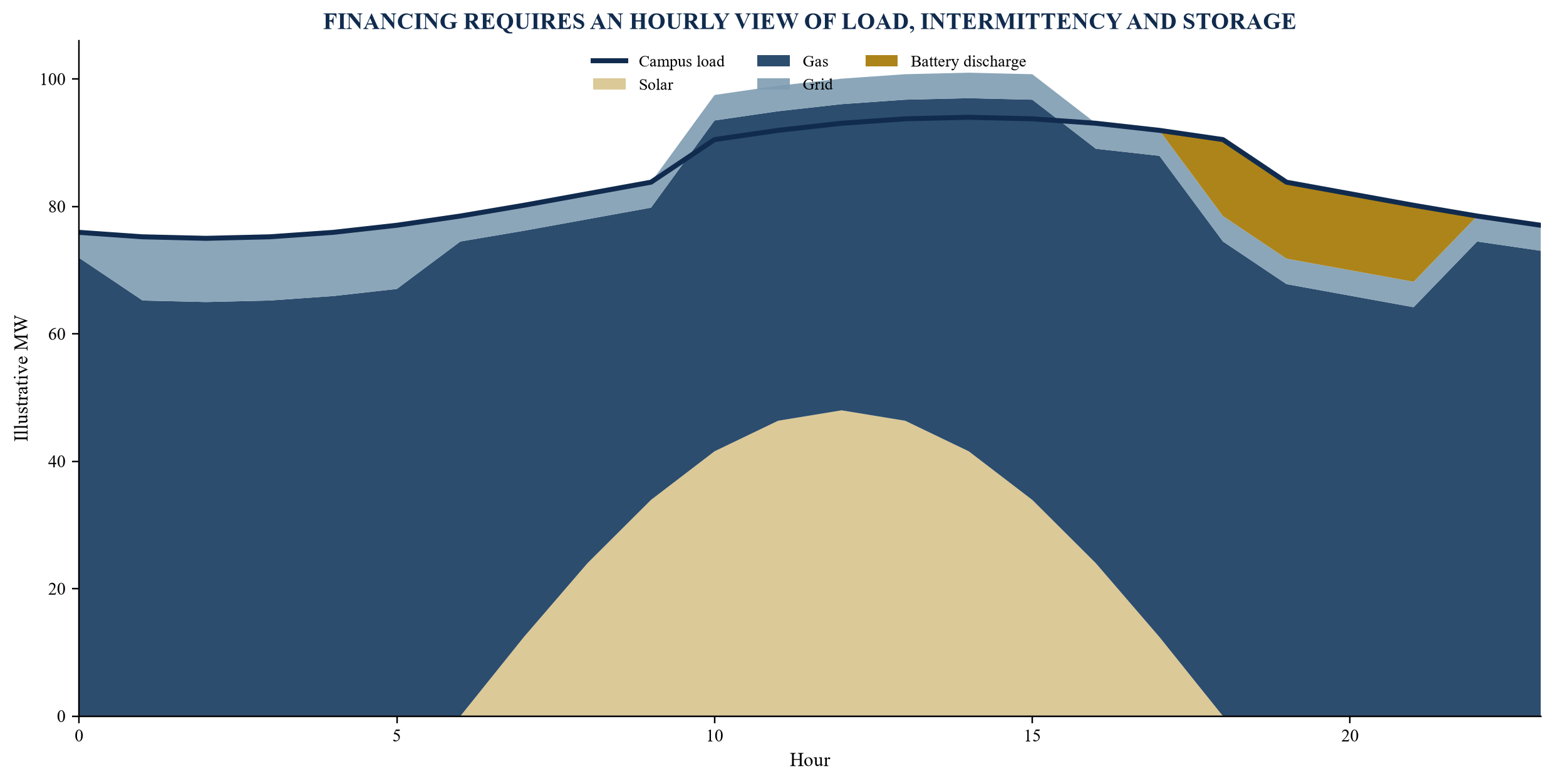
Values are hypothetical and omit reserves; a live model requires site and equipment data.
The dispatch engine should minimise a defined objective such as total cost, emissions or fuel use while satisfying reliability constraints. The objective should not override engineering limits. Reserve, minimum stable generation, ramp rates, battery duration, start time and maintenance remain binding.
Scenarios should include hot weather, low renewable production, fuel interruption, grid outage, battery degradation, generator trip and faster or slower campus ramp. Correlated events deserve attention because heat can raise cooling load while reducing generation and battery capability.
10. Build a transparent capacity-and-energy tariff
The energy vehicle can earn a capacity payment for dependable availability and an energy payment for delivered electricity. This separation aligns fixed capital and operating cost more closely than a single volumetric tariff. The capacity charge can step with commissioned campus phases.
The tariff should identify fuel, variable O&M, start costs, renewable settlement, storage losses, grid charges, taxes and carbon-related items. Pass-through should apply only to costs the operator cannot reasonably control. Efficiency standards and availability incentives should preserve operating discipline.
A minimum payment can support debt during a slow load ramp. It should be calibrated to committed capacity and reduced when the energy vehicle fails to provide service. Parent support, deposits, letters of credit or funded reserves can strengthen payment without replacing the underlying customer credit analysis.
Indexation should match the cost base and avoid overlapping escalation. A tariff indexed to inflation plus separate escalators for every cost can over-recover. The financial model should reconcile index dates, lag, caps and rebasing.
Payment timing matters alongside tariff level. Fuel and operating costs may be payable before the campus settles its energy invoice. Billing should specify meter close, invoice review, dispute, payment and late-interest periods. The working-capital facility and reserve should follow the longest credible cash gap. Disputes should allow payment of the undisputed amount and provide a rapid technical determination route for meter or performance questions.
The tariff should also define treatment of testing energy, auxiliary load, network losses and energy consumed while restoring the system. If those quantities remain undefined, the project can produce accounting differences that become material at scale. Net delivery at the agreed meter is usually the cleanest settlement basis, with separately approved services where another boundary is required.
Termination economics should reconcile with the tariff. A long-lived energy system financed through capacity payments can retain unrecovered capital when the campus terminates early. The contract can address debt, break costs, asset value, mitigation and fault. A termination sum should not create a better economic outcome than continued compliant performance, and its enforceability and credit support require legal analysis.
Table 2. Illustrative tariff and payment architecture
| Component | Cost or service supported | Adjustment basis | Control |
|---|---|---|---|
| Capacity payment | invested capital and fixed O&M | commissioned dependable MW | availability and performance tests |
| Energy payment | variable operation and fuel | verified net MWh | metering and heat-rate standard |
| Fuel adjustment | commodity and transport | contract invoice and index | audit, efficiency and exclusions |
| Renewable settlement | contracted clean-energy volume | delivered profile and attributes | meter and certificate reconciliation |
| Storage service | reserve, response and shifting | available MW and MWh | state-of-charge and degradation test |
| Minimum-load support | committed unused capacity | contracted phase ramp | customer milestones and mitigation |
The table is a transaction checklist, not a proposed tariff.
11. Allocate construction, fuel, load and intermittency risk
Risk should sit with the party able to control it, price it or absorb it, with relief when neither party can reasonably control the event. A matrix should connect cause, owner, mitigation, contract remedy, financial effect and lender response.
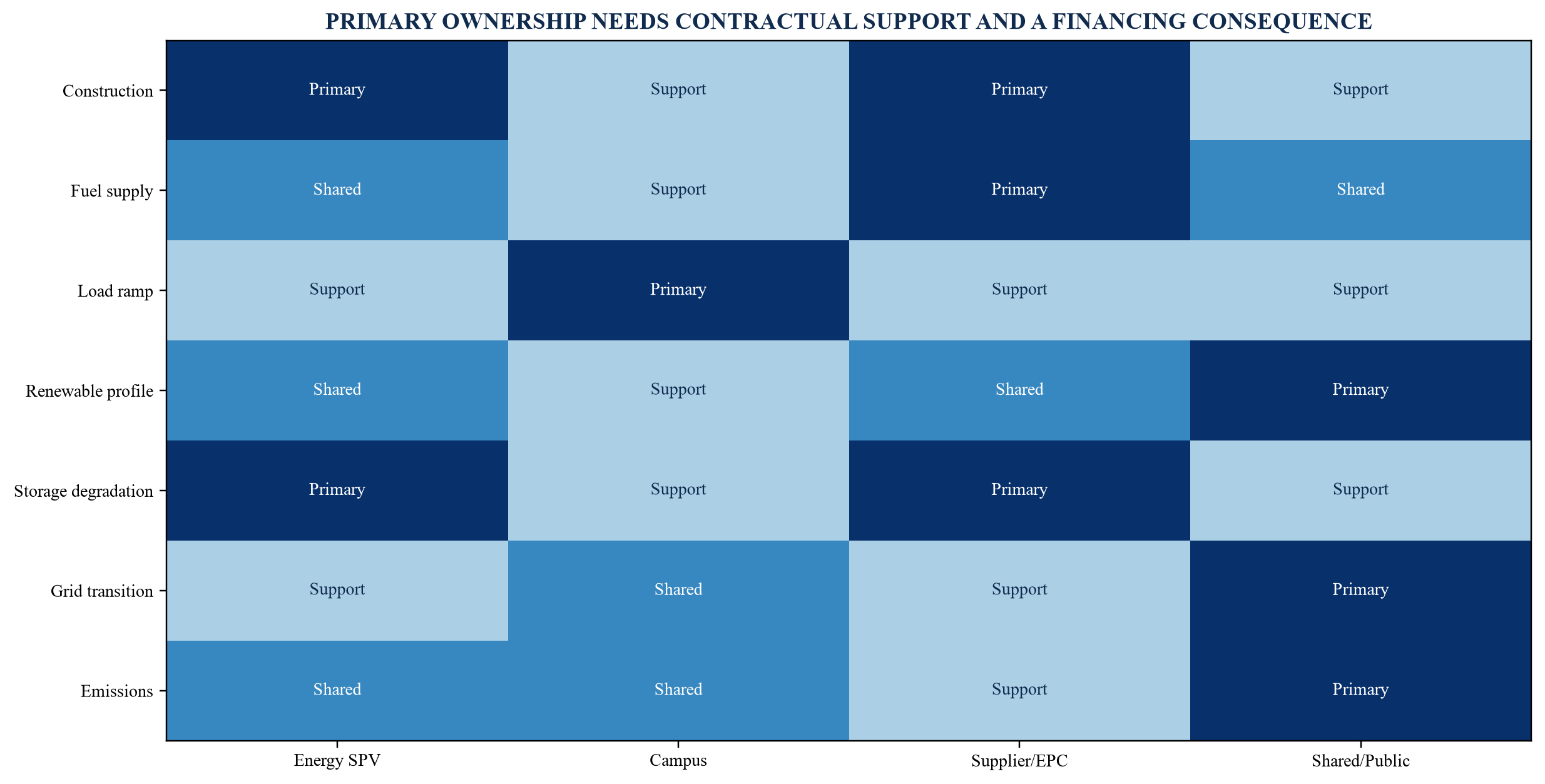
Allocation is illustrative; live contracts require jurisdiction-specific analysis.
Construction risk is controlled through design maturity, fixed scope, security, interface management and completion tests. Fuel risk is controlled through entitlement, transport, pricing, alternative supply and pass-through. Load risk is controlled through phased commitments, minimum payments and customer credit support. Intermittency is controlled through portfolio supply, dispatchable generation, storage and curtailment rules.
Risk transfer has limits. Liquidated damages cannot produce electricity during an outage and may be capped below the economic consequence. Insurance can fund covered loss while excluding performance, delay or cyber causes. The financing case should assess operational recovery as well as monetary remedy.
12. Preserve the grid-transition option
Behind-the-meter supply can be a bridge to grid connection, a permanent hybrid or a resilience layer. The transaction should state the intended path and preserve the rights needed for each alternative.
Grid transition can strand generation, change fuel volume, reduce capacity payments or create export opportunity. The energy service agreement should define notice, compensation, dispatch priority, minimum use, asset transfer and refinancing consequences. A fixed long-term take-or-pay structure may conflict with an uncertain grid date.
The project can stage commitments through modular equipment, shorter fuel blocks, repowering rights and redeployment. These options have costs and technical limits. Their value should be measured against the probability and timing of grid access.
The grid interface should address protection, synchronisation, fault contribution, import and export metering, islanding and reconnection. Operating in parallel with the grid is different from isolated self-supply and may require different licences and studies.
Connection expenditure should identify which assets become utility property and whether refunds or credits apply. Security and access rights should remain clear after transfer. The project should avoid funding a network asset twice through both tariff and direct contribution.
13. Finance emissions exposure as a cash-flow risk
Gas generation creates direct emissions for the operating entity and can affect the campus customer's climate reporting and procurement commitments. The transaction should map emissions by ownership, operational control and contractual claim. IFRS S2 requires climate-related disclosures including greenhouse-gas emissions for reporting entities applying the standard.[4]
The UAE's Federal Decree-Law on reduction of climate-change effects creates a national legal context for emissions measurement and reduction.[5] Project requirements depend on implementing rules, permits, entity scope and effective dates. The transaction should use current legal analysis rather than assume a uniform carbon price.
The model should test fuel carbon intensity, heat rate, run hours and renewable displacement. It should separate physical emissions from certificates, offsets or contractual claims. Avoided emissions should have a transparent baseline.
Carbon cost, emissions limits, efficiency standards and customer commitments can change dispatch and asset value. Change-in-law provisions should distinguish general business risk from project-specific discrimination. Pass-through may protect debt service while weakening the customer's incentive to decarbonise.
An emissions trajectory can link phase expansion with renewable supply, efficiency, storage, grid transition and possible technology replacement. The capital plan should identify which investments are required, optional or contingent on policy and customer demand.
14. Control heat, cooling and water interfaces
Ambient heat affects campus cooling, generator output and battery capability at the same time. The dependable-capacity test should use site-specific design conditions and verify correction curves. Testing on a mild day should not prove summer capacity without an accepted adjustment method.
Cooling can be electrically or thermally integrated with generation. Waste heat recovery, absorption cooling or district cooling may improve system efficiency while adding interface and operating complexity. The economic case should measure net facility power and water use.
Water requirements can constrain thermal generation and cooling. The project should identify source, quality, treatment, discharge, redundancy and drought or interruption exposure. A water entitlement should be evidenced through permits and contracts.
The energy and campus operators need a joint operating protocol for temperature excursions, cooling failure, load shedding and restart. Critical computing equipment can have limited tolerance for abrupt conditions even when electrical supply remains available.
Efficiency metrics should use consistent boundaries. PUE, water-usage effectiveness and generation heat rate measure different parts of the system. Improving one metric can worsen another, so the investment committee should review total service, cost and environmental effect.
15. Govern controls, telemetry and cybersecurity
The integrated energy system relies on plant controls, battery management, meters, campus load management, weather data and grid protection. These systems need a controlled architecture, access model, time synchronisation, logging and fallback.
Dispatch optimisation can use forecasts and automated control while remaining inside approved engineering constraints. The model should never have uncontrolled authority to change protection or safety settings. Manual and local fallbacks should preserve critical service when communications fail.
Contract settlement depends on trustworthy meter data. Primary and check meters, calibration, missing-data rules, dispute procedures and retention should be agreed. Renewable attributes, fuel efficiency and availability calculations should reconcile to the same time base.
Cyber obligations should allocate patching, remote access, incident reporting, vendor support and recovery. A campus cyber event can affect the energy system and an energy control compromise can affect compute. Shared response plans and exercises should cover both directions.
Lenders need reporting and cure rights without direct operational access. Security over software licences, data, warranties and service agreements should be evaluated alongside physical assets.
16. Build the project-finance cash waterfall
The finance structure should match asset life, contract term, customer credit, construction risk and technology replacement. Senior debt can fund proven generation, storage and electrical infrastructure after equity and contractual conditions are satisfied. Shorter-lived or less proven components may require different amortisation, reserves or equity.
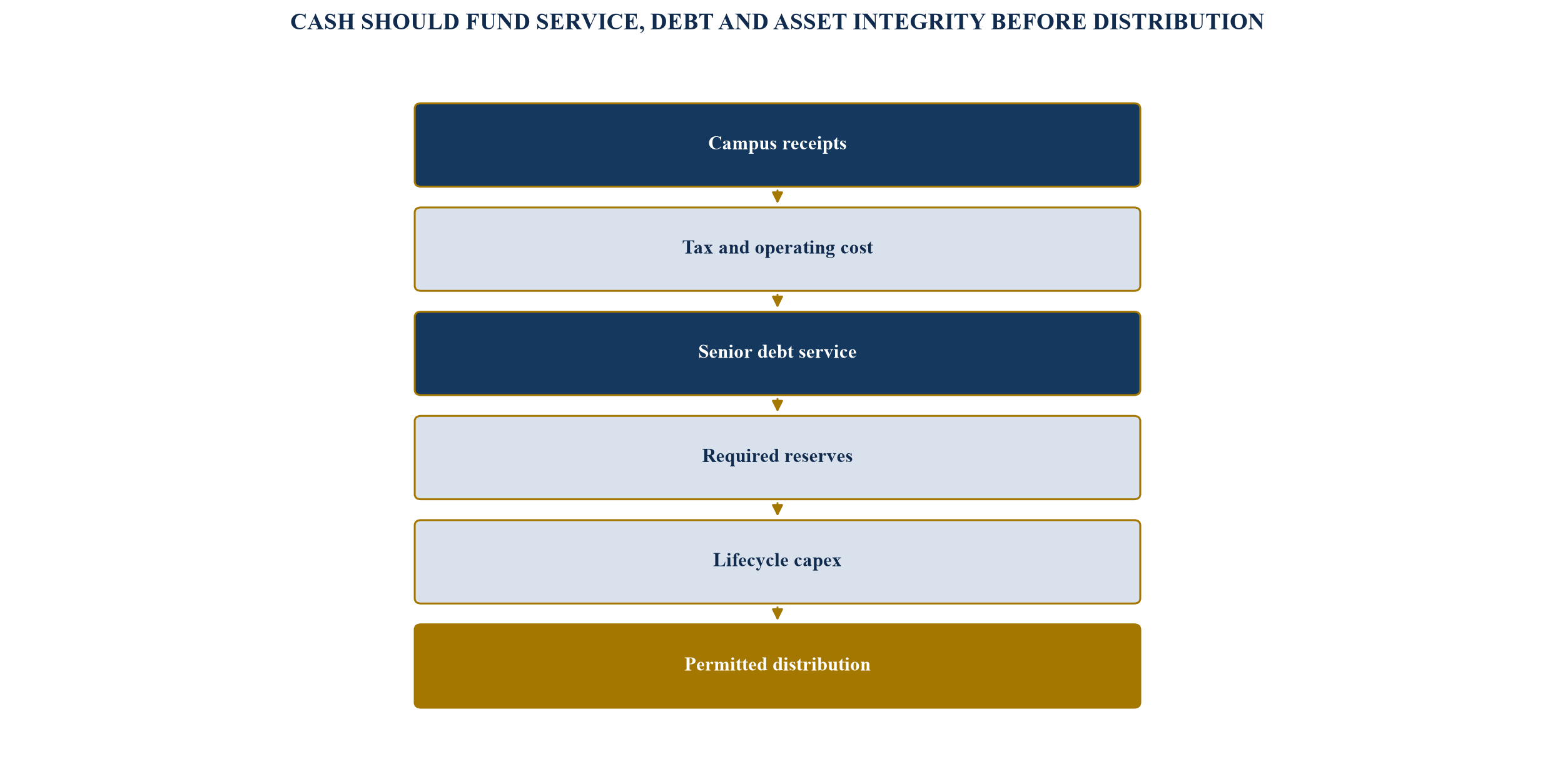
The sequence is hypothetical and subject to finance documents, tax and law.
The waterfall should fund taxes, operating costs, senior debt, reserves, lifecycle expenditure and subordinated obligations before equity distribution. Fuel pass-through receipts should remain available for fuel payment. Insurance and termination proceeds require a controlled application.
Debt sizing should use downside load, availability, fuel cost, degradation and grid-transition cases. Coverage should be tested through the full debt term rather than at the first operating year. Balloon and refinancing assumptions should reflect residual contract and asset risk.
The financial model should maintain separate operating cases for the campus and energy vehicle. A tariff that protects the energy vehicle can still make the campus uneconomic, weakening the customer that supports the debt. The consolidated view should test compute revenue, occupancy, energy intensity and energy cost, while the project-finance view tests contracted receipts and permitted deductions. Reconciliation identifies when risk has been shifted contractually without being removed economically.
Interest-rate, currency and inflation risks should follow the funding and cost base. Hedging can stabilise debt service while creating collateral, break cost and counterparty exposure. A currency mismatch between campus receipts, fuel, equipment service and debt should be measured under both operating and termination scenarios. The hedge tenor should recognise construction uncertainty and possible refinancing.
Tax and accounting treatment can affect cash available for debt service. Asset ownership, leases, service payments, withholding, import duties, depreciation, losses and transfer pricing require transaction-specific advice. The financing case should record assumptions and provide a mechanism for verified changes without promising a tax result.
17. Size reserves and security to the failure path
Reserves should correspond to specific timing gaps and recovery needs. A debt-service reserve covers temporary cash shortfall. A major-maintenance reserve supports planned overhauls. A battery augmentation reserve supports declining usable capacity. A fuel or working-capital reserve bridges invoice timing.
Completion support can include sponsor commitments, letters of credit, performance bonds, warranties and contingency. The package should identify amount, expiry, draw conditions, replenishment and counterparty quality. Several weak supports do not become strong merely because they are numerous.
Security may include shares, accounts, receivables, contracts, equipment, land rights, insurance and project permits where legally available. Lenders need access and enforcement analysis for assets integrated into the campus. Equipment that cannot be removed or operated independently may have limited standalone recovery value.
Direct agreements can preserve key contracts through notice and cure. Step-in should respect licensing, safety and operational competence. A lender cannot cure an unavailable gas source or become a utility without required authority.
Table 3. Reserve and security design
| Instrument | Exposure addressed | Sizing driver | Release condition |
|---|---|---|---|
| Construction contingency | cost and interface overrun | design maturity and package risk | tested modular completion |
| Debt-service reserve | temporary cash shortfall | payment delay and debt schedule | debt repayment or agreed test |
| Major-maintenance reserve | generator overhaul | service plan and operating hours | completed eligible maintenance |
| Battery augmentation reserve | degradation and replacement | warranty curve and dispatch | tested usable capacity restored |
| Working-capital reserve | fuel and settlement timing | invoice cycle and ramp | stable operating liquidity |
| Sponsor support | completion and ramp | uncapped gaps or fixed commitment | final completion and covenant test |
Sizing should follow project evidence and downside timing.
18. Plan refinancing as evidence is created
Construction lenders price incomplete assets, interfaces, untested performance and uncertain load. Refinancing can reduce cost after those risks are replaced by operating evidence and durable contracts. The project should define the evidence package from the start.
Relevant evidence includes modular completion, reliability runs, heat-rate performance, battery capability, customer payment, fuel delivery, renewable settlement, emissions data and reserve funding. A stable operating period should cover meaningful seasonal conditions.
Refinancing proceeds should first discharge existing debt and transaction costs. Cash release to sponsors should follow required coverage, reserves and remaining capital. An optimistic refinancing assumption should not fund completion risk.
The refinancing tenor should not exceed the economic support of the service agreement, customer credit and asset condition. Residual value should consider overhaul, battery replacement, grid transition and decommissioning.
Green or sustainability-linked finance may be available where use of proceeds, metrics and reporting meet applicable requirements. Labels do not change physical emissions or credit risk. The financing documents should define metrics, verification and consequences without double counting renewable attributes.
19. Operate a joint reliability and finance dashboard
The board and lenders need a dashboard connecting service, assets, contracts and cash. Operational reporting should include campus load, dependable capacity, outages, fuel position, renewable delivery, battery state and grid status. Financial reporting should include receipts, costs, coverage, reserves, covenants and forecast funding.
Table 4. Integrated reliability and finance dashboard
| Indicator | Evidence | Warning trigger | Required response |
|---|---|---|---|
| Campus ramp | contracted and metered load | deviation from committed phase | revise dispatch and funding plan |
| Dependable capacity | tested net MW | margin falls below contingency | restore capacity or restrict load |
| Fuel cover | entitlement and nominations | delivery gap or price breach | activate mitigation and liquidity |
| Battery capability | tested MW and MWh | degradation exceeds plan | augment, reserve or change dispatch |
| Renewable matching | interval delivery and attributes | profile or certificate shortfall | procure replacement or revise claim |
| Debt service | cash and forecast coverage | threshold breached | trap cash, cure and reforecast |
Thresholds should be project-specific and linked to action.
Warnings should have owners, deadlines and escalation. A traffic-light colour without a defined action has limited value. The dashboard should retain history and explain overrides.
Forecasts should be reconciled to actual operations. Persistent load shortfall may require phase delay or tariff action. Higher fuel use may reflect renewable shortfall, heat, equipment efficiency or dispatch. Root cause determines the contractual and financial response.
The dashboard should separate observed, contracted and modelled values. Management estimates should be clearly identified. Lender reporting should reconcile to audited or controlled financial records.
20. Use a staged decision sequence
The transaction can begin with a controlled feasibility stage. The sponsors define the campus load envelope, service standard, grid path, fuel options, renewable supply, storage functions, permits and commercial structure. A bankability review tests customer credit, payment, security and downside cash flow.
The development stage secures land rights, connection studies, fuel entitlement, environmental approvals, equipment reservations, customer commitments and an integrated design. Capital remains staged until interfaces and risk allocation are credible.
Table 5. Capital gates for integrated campus energy
| Gate | Required evidence | Capital decision | Stop or redesign trigger |
|---|---|---|---|
| Feasibility | load envelope, service standard and alternatives | fund studies and options | no credible service or site path |
| Development | permits, fuel, grid, customers and design | fund enabling work | unresolved critical interface |
| Procurement | bankable contracts and equipment capacity | reserve long-lead items | terms misalign with campus ramp |
| Construction | finance documents and completion plan | draw senior capital | funding or security gap |
| Operation | passed tests and funded reserves | convert to term debt | dependable capacity shortfall |
| Refinancing | operating history and durable cash flow | resize and extend debt | residual risk remains construction-like |
Decision authority should align with governance, contracts and financing.
Final investment approval should state the accepted risks, retained options and evidence that would change the decision. It should identify the cost of delay, overbuild and service failure. It should also preserve the authority to stop later modules when campus demand or grid timing changes.
The completed structure is a linked control system. Campus contracts support the load, the dispatch model supports the asset mix, asset contracts support dependable capacity, the tariff supports costs and debt, and the waterfall preserves operations before distributions. Behind-the-meter power becomes financeable when these links remain measurable through construction, operation and transition.
Implementation governance should include a sponsor committee, technical authority, commercial workstream, finance workstream and independent review. Each gate should have a named approver and an evidence pack retained with the decision. Changes to the load envelope, grid date, fuel route or major equipment should trigger a controlled assessment of design, contracts, schedule, emissions and debt. Informal agreement among workstreams should not replace the governed change record.
The first 100 days can focus on five outputs. The team creates the campus service specification and load envelope; secures evidence of the grid and fuel paths; compares modular gas, storage and renewable configurations; drafts the contract and risk perimeter; and produces an integrated funding and downside model. These outputs allow sponsors to decide whether to reserve equipment and spend development capital without representing that final finance is already available.
The next stage should convert assumptions into third-party evidence. Customer commitments, supplier offers, connection studies, permits, environmental assessments, fuel terms and lender feedback replace management estimates. The model should retain the earlier assumptions so that the committee can see which risks have reduced and which have merely changed form.
Commercial close is supported by consistency across documents. Capacity in the energy service agreement should match the completion test, fuel commitment, battery capability, dispatch model, tariff and debt case. Dates should reconcile across customer, EPC, fuel, grid and finance documents. Defined terms should not give the same event different remedies. A closing checklist should trace each material model input to an executed right, obligation or approved assumption.
After operations begin, the transaction remains dynamic. New compute customers, efficiency improvements, grid access, renewable supply and technology replacement can change the preferred mix. The governance system should permit beneficial change while protecting reliability, lenders and environmental claims. A disciplined amendment process can preserve value that a rigid original design would strand.
References
- International Energy Agency, Energy and AI, 2025, https://www.iea.org/reports/energy-and-ai
- International Energy Agency, Energy Supply for AI, 2025, https://www.iea.org/reports/energy-and-ai/energy-supply-for-ai
- International Renewable Energy Agency, Electricity Storage Valuation Framework, 2020, https://www.irena.org/publications/2020/Mar/Electricity-Storage-Valuation-Framework-2020
- IFRS Foundation, IFRS S2 Climate-related Disclosures Supporting Materials, https://www.ifrs.org/supporting-implementation/supporting-materials-for-ifrs-sustainability-disclosure-standards/ifrs-s2/
- United Arab Emirates, Federal Decree-Law No. 11 of 2024 on the Reduction of Climate Change Effects, https://www.uaelegislation.gov.ae/en/legislations/2558
- International Energy Agency, Key Questions on Energy and AI, 2026, https://www.iea.org/reports/key-questions-on-energy-and-ai
- International Energy Agency, Electricity 2026, https://www.iea.org/reports/electricity-2026
- International Energy Agency, Electricity Grids and Secure Energy Transitions, 2023, https://www.iea.org/reports/electricity-grids-and-secure-energy-transitions
- International Energy Agency, Building the Future Transmission Grid, 2025, https://www.iea.org/reports/building-the-future-transmission-grid
- International Renewable Energy Agency, Renewable Power Generation Costs in 2024, https://www.irena.org/Publications/2025/Jul/Renewable-Power-Generation-Costs-in-2024
- International Renewable Energy Agency, Innovation Landscape for a Renewable-Powered Future, 2019, https://www.irena.org/publications/2019/Feb/Innovation-landscape-for-a-renewable-powered-future
- Dubai Electricity and Water Authority, Digital DEWA, https://www.dewa.gov.ae/en/about-us/strategic-initiatives/digital-dewa
- Dubai Electricity and Water Authority, Expansion of the Solar-Powered Data Centre, 2024, https://www.dewa.gov.ae/en/about-us/media-publications/latest-news/2024/12/he-saeed-mohammed-al-tayer-reviews
- Dubai Electricity and Water Authority, Clean Energy and Storage Projects, 2026, https://dewa.gov.ae/en/about-us/media-publications/latest-news/2026/1/dewas-projects-strengthen
- Dubai Electricity and Water Authority, Smart Grid Report, https://dewa.gov.ae/~/media/Files/About%20DEWA/Smart%20Grid%20Report%20EN.ashx?la=en
- World Bank Group, PPP Risk Allocation Tool for Energy, Communications and Industrial Parks, https://ppp.worldbank.org/sites/default/files/2022-03/gih-risk-allocation-tool-energy-comm-industrial-parks.pdf
- World Bank Group, Private Participation in Infrastructure Database, https://ppi.worldbank.org/en/ppi
- GCC Interconnection Authority, GCC Power Trade and Interconnection, https://gccia.com.sa/gcc-power-trade-market/
- United Arab Emirates Government, UAE Energy Strategy 2050, https://u.ae/en/about-the-uae/strategies-initiatives-and-awards/strategies-plans-and-visions/environment-and-energy/uae-energy-strategy-2050
- IFRS Foundation, Greenhouse Gas Emissions Disclosure Requirements Applying IFRS S2, 2025, https://www.ifrs.org/content/dam/ifrs/supporting-implementation/ifrs-s2/ghg-ifrs-s2-educational-material.pdf
