

1. Define the product as controlled grid-import reduction
A flexible-demand agreement should begin with the change observed at the grid connection point. The resource may reduce demand, move consumption to another time, transfer work to another facility, discharge a battery, start permitted on-site generation or combine several actions. The electricity system sees a controlled change in import against an agreed reference.
This definition separates the grid product from the internal mechanism. A customer or system operator may contract 5 MW of reduction for two hours with 30 minutes' notice. The data centre decides which approved resources deliver it. The contract still needs to identify restrictions on batteries, generators, workload movement, exports and environmental operation.
The product should state location, capacity, direction, notice, response time, duration, recovery, event frequency, availability window, measurement point and performance threshold. A promise to be “flexible” has little commercial meaning without these parameters.
The customer-service boundary remains primary. Critical computing, security, safety, network and data obligations should be protected. Flexible capacity is the portion that can change without breaching customer contracts, resilience design or law. The board should approve the method used to determine that portion.
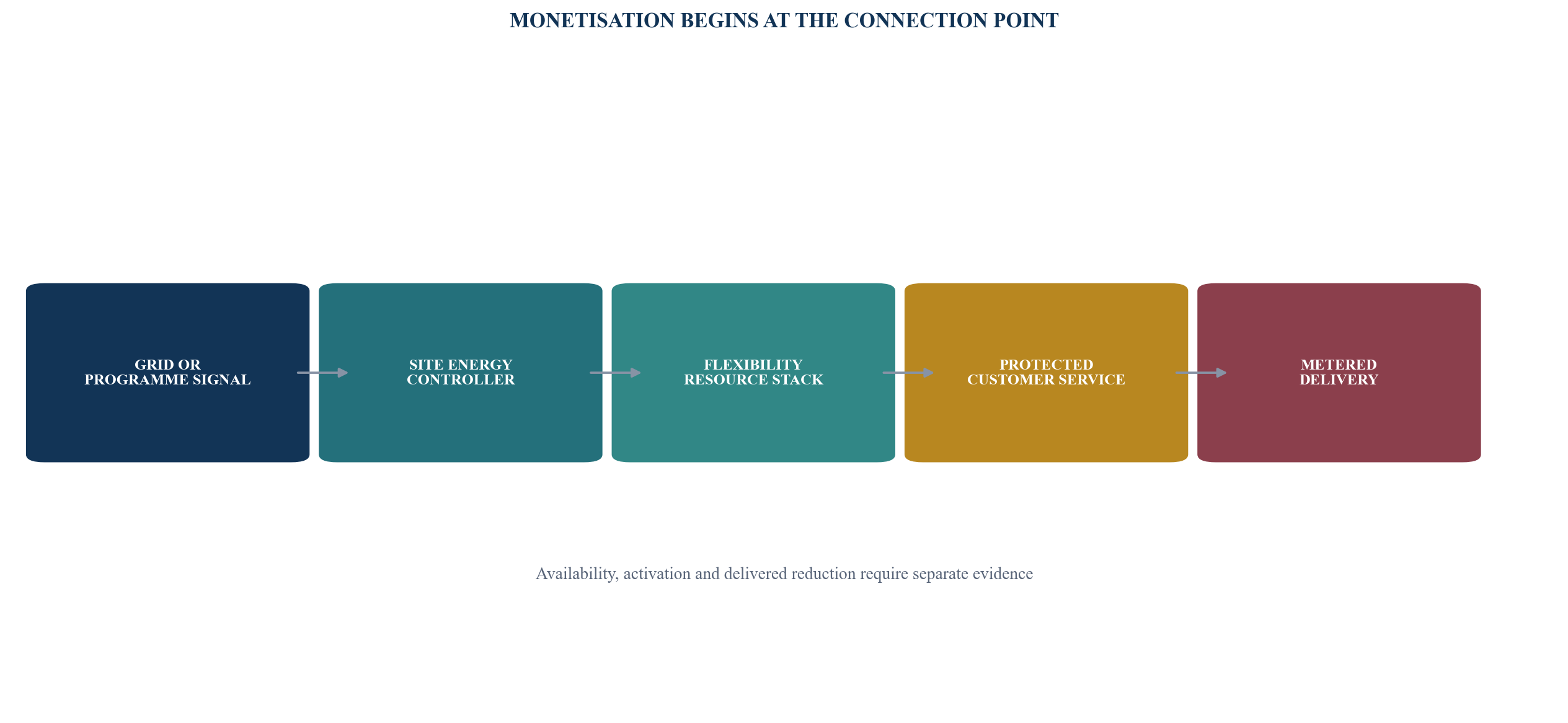
Grid value follows a measurable import change supported by controlled physical and digital actions.
2. Establish programme access before revenue
A technically flexible facility does not automatically have a route to payment. The relevant regulator, utility, system operator, market operator or contracted counterparty must recognise the product and the participant. Licensing, registration, metering, telemetry, aggregation, credit and settlement rules can apply.
Abu Dhabi's Demand Response Policy, effective 1 January 2024, defines demand response as shifting customer electricity consumption in response to economic or reliability signals. It sets a strategic target of 200 MW of contracted capacity by 2030 and an interim target of 80 MW by 2027. It calls for a regulatory framework, code changes, procurement planning and the ability to schedule and dispatch resources with regard to response speed, duration, frequency and predictability.
The Abu Dhabi Department of Energy reported that the 2024 pilot achieved an average 106 MW peak reduction across ten events, a maximum 210 MW reduction and an 80 per cent reliability rate against 137 MW of contracted capacity. Its May 2025 disclosure described a second-phase pilot using an aggregator, targeting more than 250 MW across more than 30 industrial and commercial entities, with energy-management systems, monitoring and reporting. These disclosures demonstrate programme development. They do not confirm data-centre participation, a general participation right or a published price.
The Saudi Arabian Grid Code lists demand-side response, interruptible load, fast frequency response and changes in active power due to system constraints among services that a relevant connection, supply or purchase agreement may require. The Code governs transmission-system access and operation. It does not by itself establish that a data centre can enrol, receive compensation or use a particular technology.
Singapore's Energy Market Authority publishes separate Demand Response and Interruptible Load programmes. Eligible business consumers can participate through a retailer or aggregator, or directly when the published conditions are met. Singapore therefore provides a useful operating comparator. Its rules and economics do not transfer to a Gulf project.
Table 1. Market pathway and evidence boundary
| Market | Public framework reviewed | Evidence supported | Confirmation still required |
|---|---|---|---|
| Abu Dhabi | DoE Demand Response Policy and pilot disclosures | strategic targets, pilot operation, aggregator role and measurement focus | data-centre eligibility, procurement route, contract, price, baseline and settlement rules |
| Saudi Arabia | Saudi Arabian Grid Code | demand-side response and interruptible load can be system services under relevant agreements | participant route, product, dispatch, compensation, metering and customer rights |
| Singapore | EMA Demand Response and Interruptible Load programmes | published business-consumer participation routes and resource treatment | live registration, aggregator, facility qualification and current market rules |
| Ireland | CRU 2025 data-centre connection policy | generation or storage and wholesale participation requirements for new connections | project-specific connection, flexibility obligations and revenue route |
| United States | FERC Order 2222 and regional market rules | DER aggregation and wholesale participation architecture | regional implementation, retail coordination and facility qualification |
Public policy signals and programme access are different forms of evidence.
3. Decompose the data-centre flexibility stack
Flexibility can come from computing, thermal systems, batteries, generation and non-critical facility loads. Each resource has a different speed, duration, rebound, customer impact and evidence burden. The resource register should keep them separate.
Compute shifting moves deferrable work to another time or location. Batch processing, model training stages, data transformation, software builds and internal analytics can have more scheduling freedom than real-time inference, financial transaction processing or customer-facing services. Workload classification must follow executed customer and data obligations.
Cooling flexibility can use thermal inertia, chilled-water storage, temperature bands and staged equipment. Its usable duration depends on the facility, ambient conditions, rack density, thermal limits and recovery. Gulf heat can reduce the available envelope. Safety and equipment warranty remain controlling constraints.
Battery storage can reduce grid import without curtailing IT load. Power, energy duration, state of charge, degradation, reserve duty and recharge determine deliverability. A battery already reserved for ride-through or emergency service cannot be fully sold again without a reconciled priority rule.
On-site generation can substitute grid imports when it is permitted, fuelled, available and contractually allowed. Emissions, noise, maintenance and customer sustainability terms can limit use. Emergency equipment may have operating restrictions that prevent commercial dispatch.
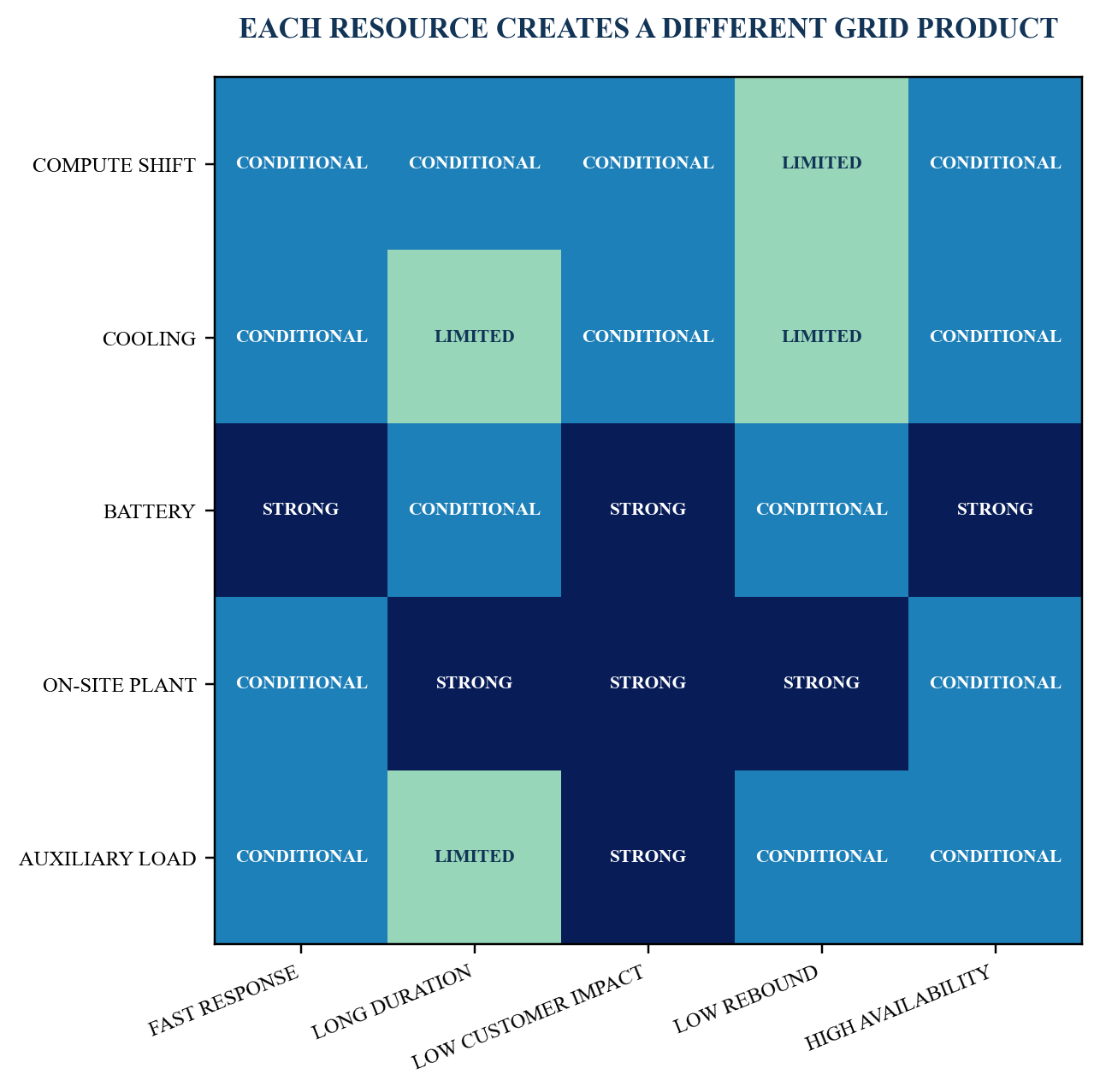
The ratings are illustrative; live engineering, customer and programme rules govern.
4. Protect customer workloads before offering capacity
The workload catalogue should classify services by criticality, latency, completion deadline, location, data residency, cyber-security, customer consent and recovery behaviour. Flexible computing comes from an approved subset, not from an aggregate utilisation estimate.
A workload can be shifted in time when its completion window exceeds the event and recovery period. It can be shifted in location when capacity, network, data, software and customer terms permit. It can be curtailed when the job can stop safely and resume without corruption or unacceptable cost.
Customer contracts should address the flexibility programme. The provider may retain control over internal optimisation when service levels remain unaffected. Material workload relocation, data movement, capacity restriction or use of customer equipment can require consent. Customer price or benefit-sharing terms may be appropriate when the customer provides the flexibility.
The protected-load schedule should identify life safety, security, core network, storage integrity, control systems and contractual compute. Every dispatch plan should preserve these loads through the event and recovery. A financial incentive should never override an approved protection rule.
Table 2. Workload and facility flexibility schedule
| Resource | Flexible action | Protection test | Delivery evidence | Recovery constraint |
|---|---|---|---|---|
| batch compute | pause, slow or reschedule | completion deadline and data integrity | scheduler and power telemetry | catch-up energy and capacity |
| geographic compute | move approved work | residency, network, software and consent | workload and site records | destination capacity |
| cooling | adjust set point or equipment sequence | rack thermal envelope and warranty | temperature, flow and power | rebound and ambient condition |
| battery | discharge behind meter | reserve floor and ride-through duty | revenue meter and state of charge | recharge window and cost |
| on-site plant | start or raise generation | permit, fuel, emissions and customer terms | generator and connection meters | minimum run and maintenance |
| auxiliary systems | defer or reduce non-critical load | safety and operating procedure | submeter and control log | service restoration sequence |
Eligibility follows the live service contract, architecture and operating controls.
5. Translate capability into a dispatch product
The product schedule should state committed megawatts, location, availability windows, minimum and maximum event duration, notice, response ramp, event cap, recovery, rest period and season. It should also define whether the service is firm, best-efforts or portfolio-aggregated.
Different grid needs require different products. Peak reduction may use advance notice and multi-hour duration. Contingency reserve can require rapid and dependable response. Energy-market demand response follows price or dispatch. Local network relief is location-specific. Capacity products require availability during defined risk periods. The same physical resource may qualify for only some products.
The International Energy Agency's Electricity 2026 analysis describes demand response as a growing flexibility tool that can reduce peak-capacity requirements, defer grid investment, lower renewable-integration cost and strengthen resilience. Its June 2026 report on scaling flexibility emphasises the policies, digital systems and market frameworks required for expansion. These system benefits do not determine the value of one facility.
The product should include an availability declaration process. Planned maintenance, customer events, low battery state, fuel restrictions, environmental limits or technology incidents can reduce capacity. Advance declarations protect the operator's scheduling decision and the facility's performance record.
Location should remain part of the product. A reduction at one constrained substation can be more useful than an equal reduction elsewhere. Aggregation across facilities can diversify performance and may cross electrical boundaries that the operator cannot treat as equivalent. Registration and settlement should therefore preserve the relevant connection point, network zone and dispatch authority.
The sponsor should distinguish voluntary economic response from an emergency interruption obligation. Economic response follows a price or commercial instruction and may permit the participant to choose whether to offer. Interruptible service can require standing availability and rapid execution when called. Connection conditions can create mandatory operational obligations with a different payment basis. Combining these categories in one forecast can overstate optional revenue.
6. Build an auditable baseline
Demand reduction is measured against what the facility would otherwise have consumed. The baseline converts a counterfactual into a settlement quantity. Its design has direct financial consequences.
A historical baseline may use comparable days, recent intervals, weather, calendar, operating schedule and adjustment factors. A forecast baseline may use an approved model submitted before the event. A control-group or meter-before-and-after method can suit some resources. Batteries and generation can sometimes be measured more directly while the overall connection-point effect still requires reconciliation.
Data-centre growth, customer ramp, ambient heat, equipment maintenance and workload mix can make a simple historical average inaccurate. Baseline rules should define eligible days, exclusions, lookback, adjustment cap, weather treatment, missing data, new load and audit rights.
Gaming controls protect both parties. A participant should not increase demand before an event to inflate the baseline, move normal consumption outside the baseline window solely to increase payment or receive two payments for the same reduction. The operator should avoid retrospective changes that remove legitimate delivery.
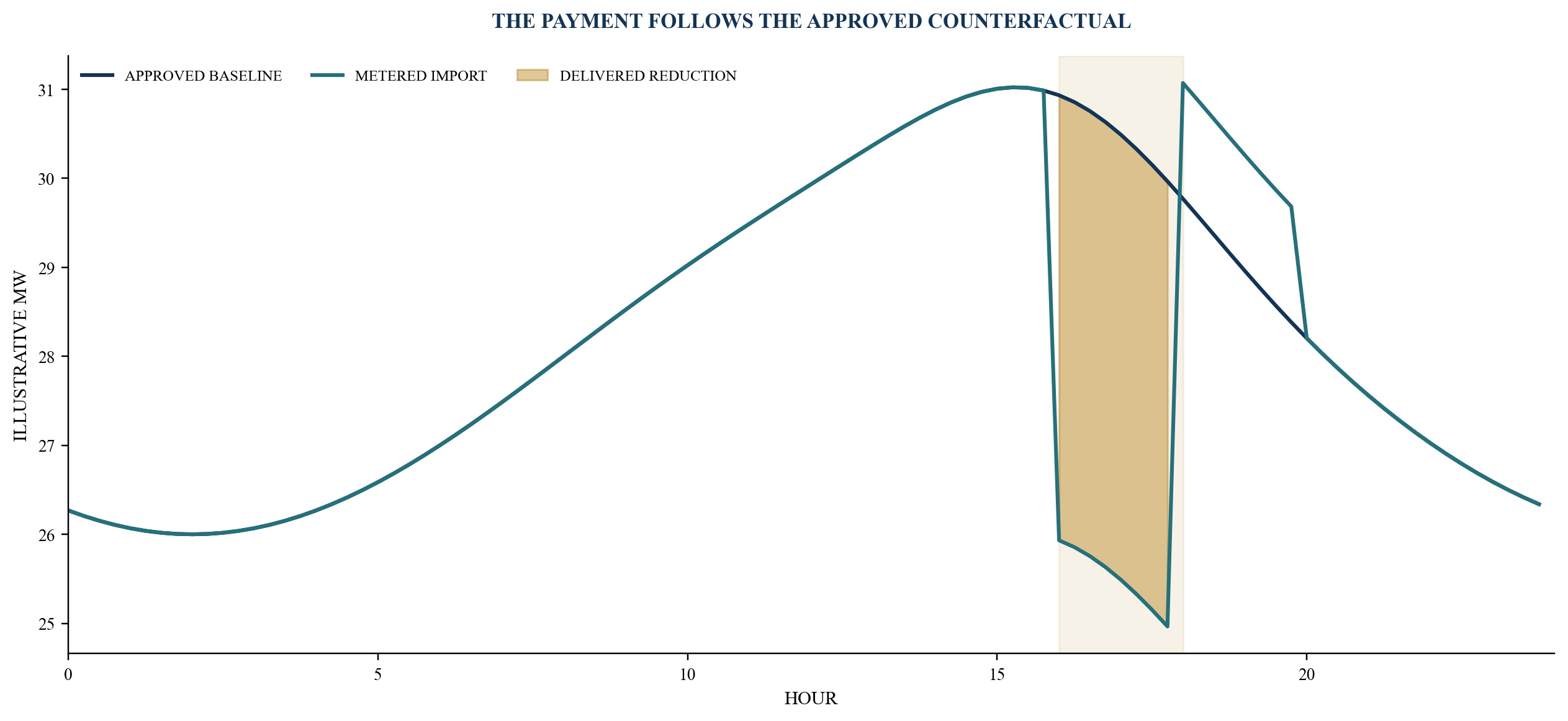
Delivered flexibility requires a reproducible counterfactual and an auditable meter chain.
7. Specify meters, telemetry and time
The settlement meter should be identified by serial number, location, class, interval and owner. The measurement boundary can be the utility connection point, an approved submeter or a combination. Generation, battery, cooling and workload telemetry provide diagnostic evidence and should reconcile to the settlement quantity.
Clock synchronisation matters. Dispatch signals, control actions, grid meters, battery systems and computing platforms should use an agreed time source and interval. A five-minute misalignment can change measured delivery during a short event.
Telemetry requirements should define real-time or near-real-time frequency, accuracy, availability, cyber-security, communication path, outage treatment and retention. The operator needs enough visibility to depend on the resource. The data centre needs a controlled boundary that protects operational and customer information.
Missing data rules should be set before events. Substitute estimates, conservative defaults, event exclusion and dispute processes create different incentives. Calibration and meter replacement require a change record.
Qualification testing should use the same interval, meter, baseline and delivery calculation intended for settlement. A facility can demonstrate a physical reduction and still fail a commercial test because its data arrive late, the baseline window is invalid or the registered meter differs from the operating display. Test reports should record raw inputs, calculations, exceptions and sign-off.
8. Design the dispatch and recovery sequence
The operating sequence begins with availability declaration. A dispatch instruction then identifies product, start, target, location and expected end. The site controller validates the signal, checks protected loads and resource availability, and executes the approved response plan.
The facility should acknowledge receipt and report the expected response. Automated controls can improve speed while retaining human override for safety and customer protection. The control hierarchy should identify the authority to reject or limit an unsafe instruction.
During the event, the site monitors connection-point import, resource status, customer service and environmental conditions. Deviations trigger a predefined escalation. The operator receives the contracted telemetry rather than unrestricted access to facility systems.
Recovery is part of the product. Workload catch-up, battery recharge, thermal restoration and generator shutdown can create a rebound peak. The agreement should cap or schedule rebound and state whether the facility remains unavailable during recovery.
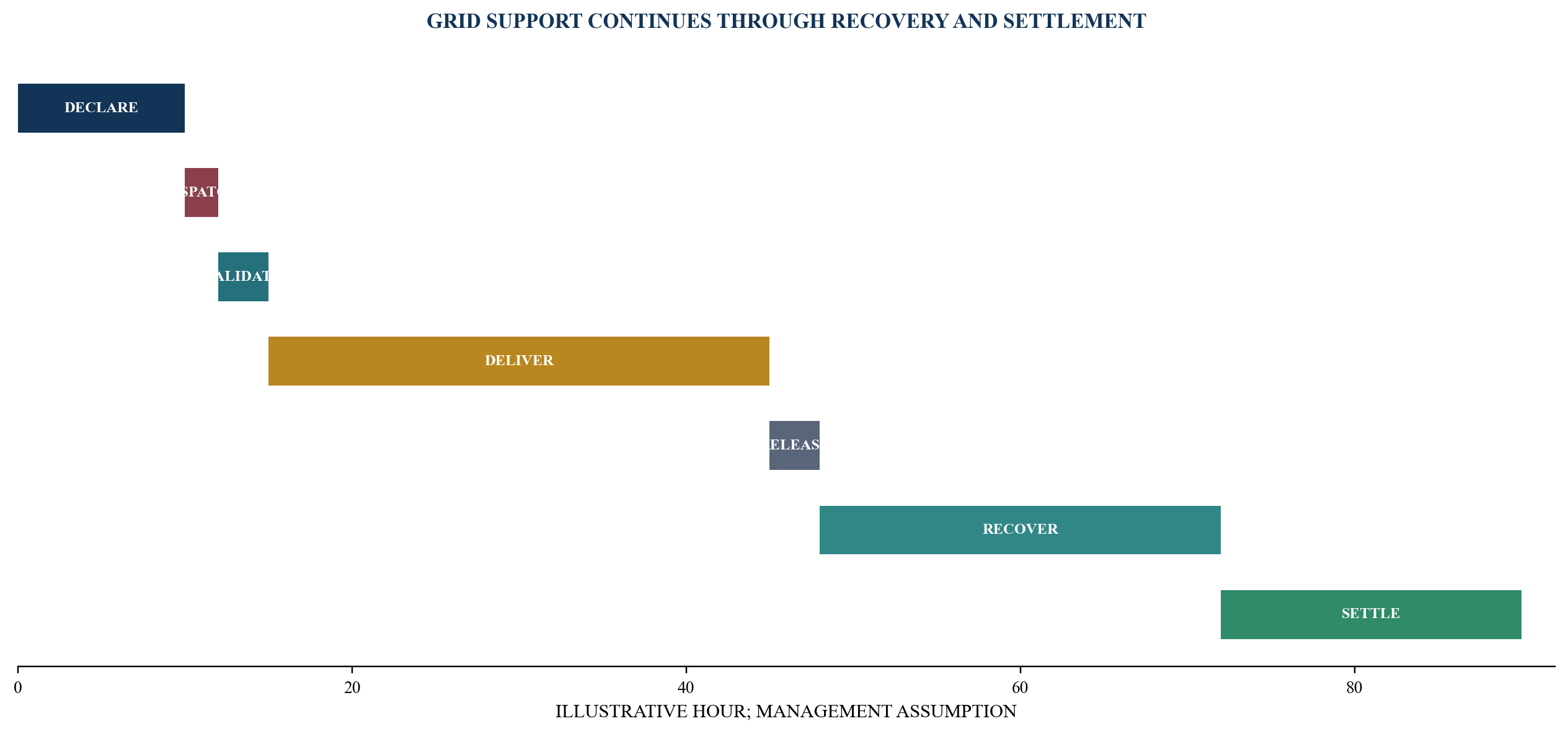
A complete event includes availability, activation, delivery, release, recovery and settlement.
9. Contract performance and non-delivery
Performance can be expressed as delivered reduction divided by instructed reduction over the settlement intervals. The agreement should define tolerance, minimum qualifying delivery, partial payment, over-delivery, ramp, early release and rebound.
Availability performance is separate. A facility can declare capacity and fail when dispatched. It can also declare unavailability honestly and receive no availability payment. The programme may need different consequences for these cases.
Non-delivery can result from customer load, equipment, communications, meter failure, operator signal, grid outage, fuel, environment or force majeure. The contract should allocate each cause and specify evidence. Broad exclusions can make capacity unreliable. Absolute liability can make participation uneconomic.
Singapore's published programme material illustrates the importance of thresholds, activation limits and consequences. The exact current market rules govern Singapore participation. A new contract elsewhere should use its own system need, legal framework and operating evidence.
Table 3. Performance and remedy schedule
| Measure | Definition | Evidence | Illustrative treatment |
|---|---|---|---|
| declared availability | capacity offered in approved window | declaration and system record | availability payment eligibility |
| response speed | time to reach instructed reduction | signal and interval meter | ramp adjustment or failure |
| delivered energy | baseline less metered import | approved baseline and meter | utilisation payment |
| delivery ratio | delivered divided by instructed quantity | settlement calculation | partial payment and threshold |
| rebound | import above approved recovery reference | post-event meter | deduction or scheduled recovery |
| repeated failure | failures within rolling period | event ledger | cure plan, derating or suspension |
Thresholds are illustrative and require programme-specific agreement.
10. Separate availability, activation and value-sharing
A flexible-demand tariff can include an availability payment for standing ready, an activation payment for delivered MW or MWh, and a performance component for quality. Each part compensates a different obligation.
Availability supports fixed control, telemetry, staffing, maintenance and opportunity cost. It should follow eligible capacity and hours. Activation covers incremental degradation, fuel, workload movement, customer compensation and energy effects. A value-sharing payment can connect compensation to system savings when the methodology is transparent.
The participant's net revenue is gross payment less energy, fuel, battery degradation, emissions, workload cost, customer benefit-sharing, aggregator fee, operating labour, technology, tax, insurance and non-performance. Gross programme revenue can overstate economic value materially.
Indexation should follow the relevant exposure. A market product may settle at market prices. A bilateral service can use a fixed capacity rate and indexed activation cost. Price caps, floors, negative prices and pass-throughs need explicit treatment.
11. Prevent double commitment
One battery, generator or flexible workload can appear valuable across resilience, peak management, energy arbitrage, capacity, reserve and customer services. Physical capability should be allocated through a priority waterfall.
The first layer protects life safety, data integrity, cyber-security and customer obligations. The next protects facility continuity and approved reserve. Remaining capability can support contracted grid services. Simultaneous products are possible when programme rules allow them and delivery can be co-optimised without double payment.
FERC Order 2222 requires regional market rules to address coordination, metering, information and restrictions needed to avoid double counting when distributed resources participate in multiple programmes. This principle is broadly useful even where the United States rule does not apply.
The resource ledger should show nameplate capability, derating, reserve, committed products, time conflicts and remaining headroom. Every bid or bilateral commitment should pass this control.
Table 4. Resource priority and double-commitment control
| Priority | Obligation | Capacity reservation | Release authority | Evidence |
|---|---|---|---|---|
| 1 | safety, security and data integrity | mandatory protected quantity | designated safety authority | design and operating procedure |
| 2 | customer service and contracted resilience | service-specific quantity | customer and service governance | capacity and service ledger |
| 3 | facility reserve and recovery | engineered reserve | operating authority | state, fuel and maintenance data |
| 4 | firm grid-service commitment | registered eligible capacity | programme rules | bid, award and availability record |
| 5 | discretionary optimisation | residual capability | commercial controller | real-time resource ledger |
The approved customer, engineering and programme hierarchy governs every event.
12. Govern batteries and on-site generation
A battery can deliver a clean connection-point reduction while preserving IT load. Its state of charge before an event, power limit, energy duration, efficiency, degradation, thermal condition and post-event recharge determine performance.
The agreement should define minimum state of charge, reservation period, test, dispatch, warranty treatment, degradation cost and recharge. Grid support should not consume a reserve needed for uninterruptible power or safe shutdown unless the approved design and customer contract permit it.
On-site generation changes the environmental and regulatory profile. Starting a standby generator for commercial grid support can exceed its permitted duty or customer sustainability policy. Fuel and maintenance constraints can reduce availability. Metering should distinguish reduced imports from export.
Singapore EMA's current material provides an example of BESS participation in demand response and continued work on high-availability distributed resources. Project eligibility remains conditional on its rules and approvals. A Gulf facility needs its own authority and programme confirmation.
13. Secure the control and data architecture
Demand response connects an external signal to critical infrastructure. The cyber-security design should isolate programme communications from customer and control networks, authenticate commands, log access, limit privileges and preserve a safe manual mode.
The aggregator or operator should receive the minimum data needed for qualification, dispatch and settlement. Customer workload content, identity and operational detail usually sit outside that boundary. Data ownership, retention, location, incident notification and permitted use should be contractual.
Control software should be tested through simulation, factory acceptance, site acceptance and periodic drills. Changes to algorithms, firmware, equipment or workload orchestration need approval and rollback. A model-driven dispatch decision should remain explainable enough to protect operating authority.
Business continuity should cover loss of external communications. The facility can default to protected operation, while the contract defines whether the event is excused or treated as non-delivery. Redundant communications can support a firm product.
14. Align the agreement with customer and utility contracts
The grid-service agreement should be read alongside electricity supply, connection, customer, fuel, equipment, land, insurance and financing documents. A right to curtail under one contract can breach another.
The electricity supplier may carry balancing exposure when the facility changes consumption. Supplier notification, nominations and settlement should be coordinated. The connection agreement can limit export, generation, protection or control. Customer contracts can restrict workload movement, maintenance or service availability.
An aggregator agreement should define authority, registration, bids, dispatch, data, payments, fees, audit, liability, credit, termination and transition. Exclusivity should be limited to the relevant product, meter or period where possible. The facility should retain access to its operating and settlement data.
Change in programme rules needs a mechanism. Registration, prices, baselines, telemetry or penalties can change. The contract should define pass-through, renegotiation, suspension and termination when the economic or operating basis moves materially.
15. Finance only the contracted, collectible cash flow
Flexibility can improve project economics and should be treated conservatively in financing. A lender will examine programme duration, counterparty, eligibility, dispatch record, baseline, meter, technology, customer permissions, penalties and termination.
Availability revenue can resemble contracted capacity when the obligation and payment are durable. Activation revenue can be volatile. Market-price revenue carries price and dispatch risk. Pilot payments may not support long-term debt when continuation is uncertain.
The base financing case can exclude flexibility revenue until the contract, registration and operating history meet an agreed threshold. An upside case can show value after operating cost and reserve. Debt sizing should not rely on an aspirational future programme.
The security package should respect the operational nature of the asset. Lender step-in cannot force an unsafe dispatch or override customer protection. Assignment and change of control may require programme or aggregator consent.
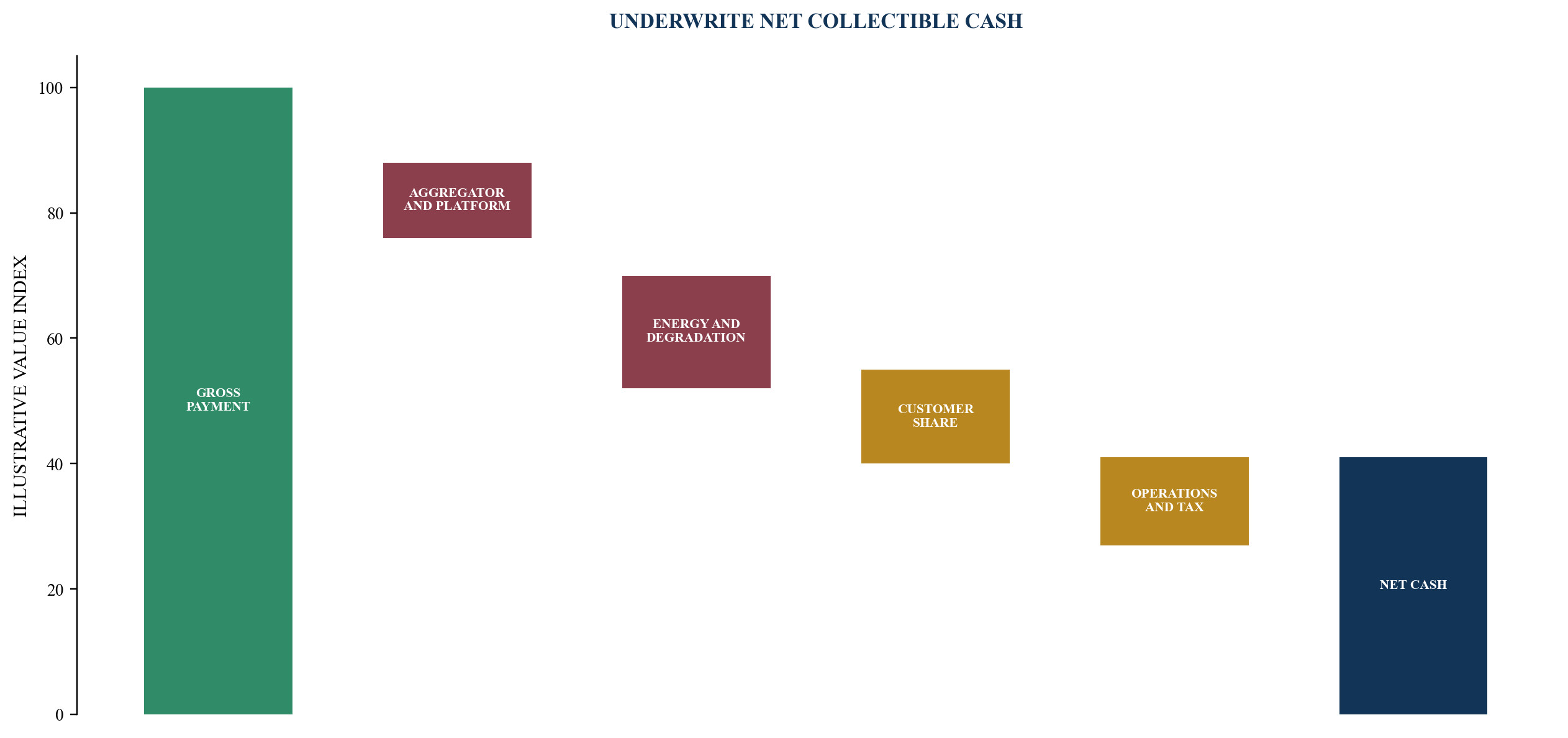
Values are illustrative management assumptions and do not represent a market tariff.
16. Model a complete operating case
The worked case assumes a 30 MW data-centre import, 6 MW of registered flexible capacity, a four-hour availability window, 20 events per year and a two-hour average event. It assumes an availability payment of USD 45,000 per MW-year and an activation payment of USD 160 per delivered MWh. These are management assumptions for method demonstration.
The model separates gross availability, activation and performance payments. It deducts aggregator fees, platform and telemetry cost, battery degradation, energy and fuel, customer sharing, incremental labour, insurance, tax and expected non-performance.
The model should calculate contribution by resource. Compute shifting may have low direct energy cost and high orchestration or customer constraints. Battery response has measurable degradation and recharge. Generation carries fuel, maintenance and emissions costs. Cooling flexibility can create rebound.
Capital includes controls, meters, telemetry, battery or plant modifications, cyber-security, testing and programme registration. The investment case should calculate payback and value under base, lower price, fewer events, lower delivery and programme termination cases.
Table 5. Illustrative flexible-demand assumptions
| Input | Base assumption | Downside | Live evidence required |
|---|---|---|---|
| site import | 30 MW | 24 MW | utility meter and customer ramp |
| registered flexibility | 6 MW | 3 MW | qualification test and award |
| events per year | 20 | 8 | programme history or contract |
| average duration | 2 hours | 3 hours | product schedule |
| delivery ratio | 92% | 70% | tested resource portfolio |
| availability payment | USD 45,000/MW-year | USD 25,000 | executed agreement |
| activation payment | USD 160/MWh | USD 90 | settlement rules |
| enablement capex | USD 3.2m | USD 4.5m | priced scope and contingency |
All values are management assumptions for method demonstration only.
17. Stress revenue, performance and rebound
The strongest downside combines a lower capacity award, fewer activations, reduced delivery and higher operating cost. A technology can perform physically while the programme provides limited revenue. A strong tariff can still produce weak cash when the resource is unavailable.
Baseline error should be tested in both directions. An inflated baseline can create clawback, dispute and reputational risk. A low baseline can underpay genuine delivery. The model can include a conservative settlement haircut until event history supports the method.
Rebound can reduce net grid value and increase energy cost. A workload shifted from an event may run during a later system peak. Battery recharge can create a new peak. Recovery controls and price-aware scheduling should be modelled.
Concentration also matters. Several sites can share the same weather, network, software, cloud orchestration or aggregator dependency. A portfolio that appears diversified by customer can fail together when one control platform or upstream connection is unavailable. The downside case should identify common-mode dependencies and apply correlated derating.
Settlement delay should be included in working capital. Event validation, baseline review and dispute can delay cash beyond the normal electricity-billing cycle. The model should carry receivables, disputed amounts and tax timing rather than assuming immediate collection.
Programme termination and rule change deserve a zero-revenue case. Enablement investment should also create operational value through peak management, resilience, energy optimisation or customer service. Those benefits require separate evidence and should not be counted twice.
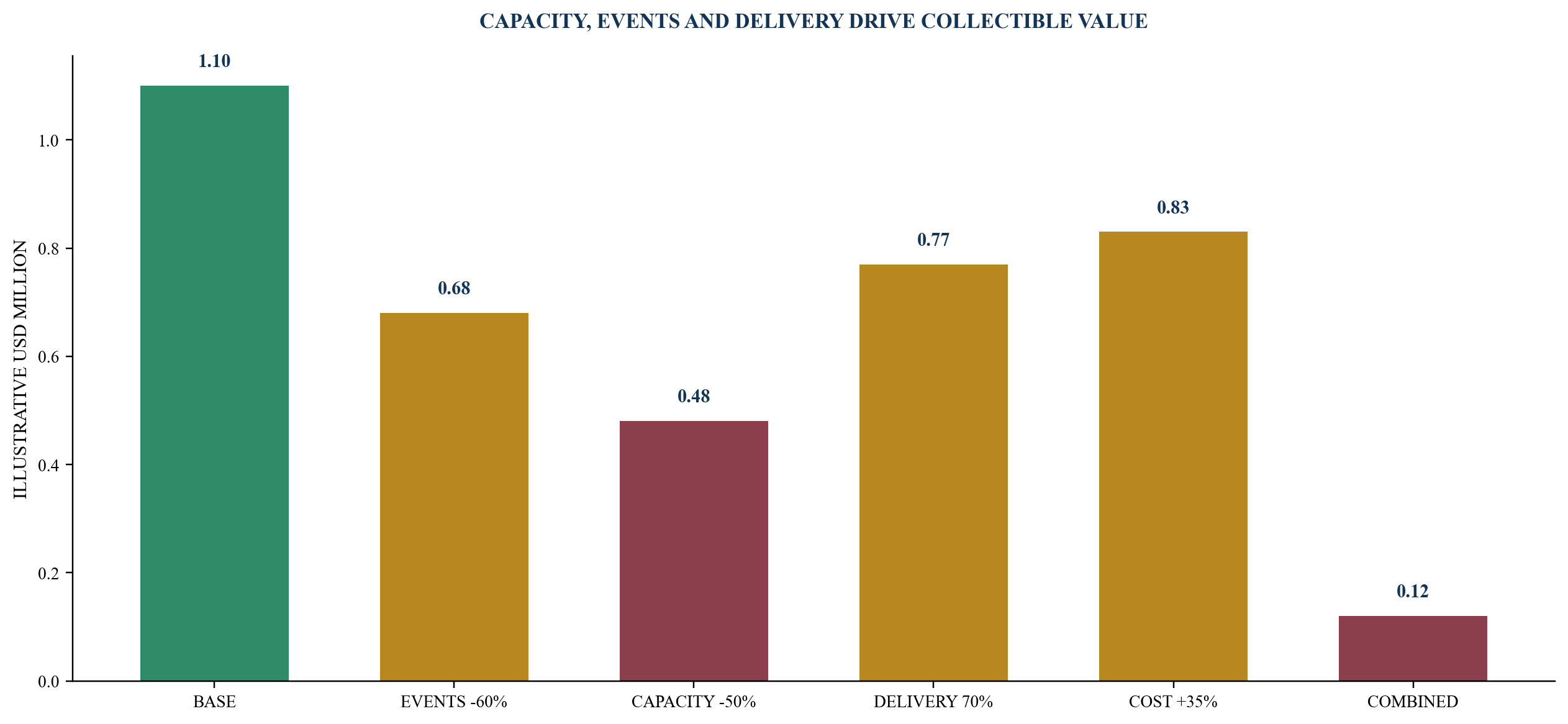
Values are management assumptions and show directional sensitivity rather than a forecast.
18. Build a decision-grade data room
The regulatory folder should contain programme rules, participant status, licences, connection and supply agreements, aggregator authority and relevant correspondence. The technical folder contains the load and resource register, single-line diagram, control architecture, meter schedule, telemetry, cyber-security, tests and maintenance.
The customer folder should show workload classification, protected services, consent, benefit sharing and service-level treatment. Commercial files cover product, prices, availability, event rules, penalties, invoices, settlement and change. The financial folder includes capex, operating cost, model, tax, accounting and sensitivities.
An event evidence pack should be reproducible. It contains the original signal, acknowledgement, resource state, baseline inputs, meter data, operating log, customer-service record, calculation, exception, invoice and collection. Lenders and auditors should be able to trace the payment.
The issue register should identify unconfirmed eligibility, missing rules and dependencies plainly. A policy target, pilot invitation or grid-code reference should not be represented as an executed revenue contract.
Governance should name the evidence owner and refresh frequency. Programme rules can change, meters can be replaced, customer workloads can move and batteries can degrade. A current registration supported by stale technical evidence can create non-delivery exposure. Quarterly or event-driven recertification should be matched to the programme and asset.
Table 6. Flexibility financing evidence and red flags
| Area | Decision evidence | Red flag | Required action |
|---|---|---|---|
| eligibility | written participant and resource approval | policy cited as programme access | obtain registration and contract |
| physical capacity | tested resource register and protection plan | nameplate capacity offered twice | reconcile priority ledger |
| measurement | approved baseline, meter and telemetry | settlement depends on opaque estimate | test and audit methodology |
| customer | service and consent alignment | flexibility can breach service level | amend or reduce product |
| economics | net cash after all delivery cost | gross payment used as revenue | build resource-level model |
| term and credit | enforceable payment and counterparty | short pilot used for long-term debt | exclude or haircut financing case |
| operations | dispatch tests and event evidence | rebound or recovery uncontrolled | implement event procedure |
Final diligence depends on the live programme, facility and financing structure.
19. Run a 150-day flexibility commercialisation office
Days 1 to 30 establish the market pathway, customer boundary, resource register, protected loads, current contracts and initial value hypothesis. The team seeks written utility, operator or aggregator confirmation and avoids recording revenue.
Days 31 to 60 perform interval-data analysis, engineering tests, baseline design, meter and telemetry mapping, customer review, cyber-security assessment and product selection. The sponsor chooses a firm initial capacity with reserve.
Days 61 to 90 negotiate participation, aggregator and customer terms; design control and reporting; price enablement capex; and build the full economic model. A simulation tests dispatch, safety, recovery and settlement.
Days 91 to 120 complete registration, install approved controls and meters, execute agreements, conduct witnessed tests and establish the data room. The investment committee reviews downside liquidity and stop conditions.
Days 121 to 150 run a controlled event or qualification test, reconcile measurement, correct exceptions, confirm insurance and financing treatment, and approve commercial operation. Monthly reporting tracks declared capacity, events, delivery, deductions, invoices and collections.
20. Convert flexibility into an accountable mandate
A data-centre sponsor can use a flexibility-readiness diagnostic to establish market access, resource capacity, customer constraints, capex and economics. A commercialisation office can coordinate the utility, operator, aggregator, engineer, technology provider, customer and financing workstreams.
A transaction mandate can structure the agreement, resource company, capex financing, customer credit and lender evidence. Ongoing retained support can govern event performance, settlement, contract changes and portfolio expansion. Regulated, engineering and professional responsibilities remain with appropriately appointed parties.
The deliverable should be tied to a board decision: enrol, invest, contract, finance, scale or stop. Fees should reflect scope, senior accountability, specialist requirements, transaction complexity and execution period. Advisory revenue remains zero until a mandate is executed, an invoice is issued under its terms and collection is evidenced.
The board should approve only capacity that is eligible, protected, measurable, dispatchable and economically positive under downside. Every additional megawatt should pass the same gate. This creates a grid-support service with evidence from signal through collection.
References
- International Energy Agency. The Value of Demand Flexibility. 23 December 2025. https://www.iea.org/reports/the-value-of-demand-flexibility
- International Energy Agency. Electricity 2026: Flexibility. April 2026. https://www.iea.org/reports/electricity-2026/flexibility
- International Energy Agency. Scaling Up Demand Flexibility. 26 June 2026. https://www.iea.org/reports/scaling-up-demand-flexibility
- International Energy Agency. Energy and AI. April 2025. https://www.iea.org/reports/energy-and-ai
- Abu Dhabi Department of Energy. Demand Response Policy in Abu Dhabi, DoE/PD/G04/001. Effective 1 January 2024. https://www.doe.gov.ae/-/media/Project/DOE/Department-Of-Energy/Media-Center-Publications/Demand-Response-Policy---Final.pdf
- Abu Dhabi Department of Energy. Launches Phase Two of the 2025 Demand Response Project. 16 January 2025. https://www.doe.gov.ae/en/Media-Centre/News/Abu-Dhabi-Department-of-Energy-Launches-Phase-Two-of-the-2025-Demand-Response-Project
- Abu Dhabi Department of Energy. Launches second phase of demand response pilot project in collaboration with Energy Pool. 30 May 2025. https://www.doe.gov.ae/en/Media-Centre/News/DoE-launches-second-phase-of-demand-response-pilot-project-in-collaboration
- Saudi Electricity Regulatory Authority. The Saudi Arabian Grid Code, Updated Version May 2024. https://sera.gov.sa/-/media/760cb4c6f4d7482fbae4325f53e035d1.ashx
- Energy Market Authority of Singapore. Non-Residential Consumers: Demand Response and Interruptible Load. Accessed August 2026. https://www.ema.gov.sg/our-energy-story/energy-demand/non-residential-consumers
- Energy Market Authority of Singapore. New Initiatives to Bolster Power Grid's Reliability through Flexible Electricity Demand. 29 October 2025, updated May 2026. https://www.ema.gov.sg/news-events/news/media-releases/2025/new-initiatives-to-bolster-power-grid-reliability-through-flexible-electricity-demand
- Commission for Regulation of Utilities Ireland. Decision on New Electricity Connection Policy for Data Centres. 12 December 2025. https://www.cru.ie/about-us/news/the-cru-publishes-its-decision-on-new-electricity-connection-policy-for-data-centres/
- United States Federal Energy Regulatory Commission. Order No. 2222 Fact Sheet. 28 September 2020. https://www.ferc.gov/media/ferc-order-no-2222-fact-sheet
- United States Federal Energy Regulatory Commission. Order No. 2222 Explainer. Updated 2025. https://www.ferc.gov/ferc-order-no-2222-explainer-facilitating-participation-electricity-markets-distributed-energy
- Google Cloud. Supporting Power Grids with Demand Response at Google Data Centers. 3 October 2023. https://cloud.google.com/blog/products/infrastructure/using-demand-response-to-reduce-data-center-power-consumption
- PJM Interconnection. Demand Response Training Resources and Current Governing-Document Links. Accessed August 2026. https://www.pjm.com/training/training-resources
About the Author
Chennakeshav Adya, Independent Researcher
This paper provides a decision framework for data-centre boards, sponsors, operators, infrastructure investors and financing teams evaluating flexible demand. It is general research and does not provide engineering, utility, legal, regulatory, cyber-security, tax, accounting, insurance, investment or financing advice.
