

1. Define the acquisition decision
The acquisition decision is whether a buyer should combine a group of GCC contractors, at what value, with what perimeter and under what protections. The buyer must determine how much reported profit depends on unapproved change, how much cash is trapped in disputed accounts, which projects carry delay or performance exposure, and whether the combined business can control claims after closing.
Claims diligence should answer transaction questions rather than produce a document inventory. The buyer needs a supportable range for collectible claims, likely counterclaims, completion cost, cash conversion and dispute cost. It also needs project-level conditions precedent, price adjustments, indemnities, escrows, earn-outs and integration actions.
The framework treats every claim as a chain of contractual entitlement, factual causation, notice, contemporaneous records, programme effect, quantum, accounting and recoverability. Strength in one link does not cure failure in another. A well-priced variation with no instruction or a timely notice with no demonstrated impact can remain commercially weak.
| Transaction decision | Evidence required | Analytical output | Deal response |
|---|---|---|---|
| Value reported claims | Contract, instruction, notice, records, programme and valuation | Recoverability range by claim | Price adjustment, escrow or contingent value |
| Assess delay exposure | Baseline and updates, event chronology, critical path and correspondence | Extension and damages range | Indemnity, reserve or exclusion |
| Test earnings quality | Revenue recognition, cost to complete, certifications and cash | Maintainable EBITDA and working-capital bridge | Valuation and completion accounts |
| Select acquisition perimeter | Project, entity, JV, guarantee and licence mapping | Transferability and stranded-risk map | Carve-out, novation or condition precedent |
| Plan integration | Systems, people, project controls and claims governance | Day-one and first-hundred-day plan | Retention, controls and accountability |
Transaction decisions should connect to project-level contractual and factual evidence.
2. Map the legal and contractual perimeter
The buyer should identify every legal entity, branch, joint venture, consortium, licence, project company and guarantee connected to the targets. Construction risk often sits outside the entity that records revenue. Parent guarantees, performance bonds, advance-payment guarantees, joint liability, subcontract pass-through and related-party plant arrangements can extend exposure.
Each project record should identify governing law, dispute forum, contract form, amendments, employer, engineer, contractor, subcontractors, currency, price basis, scope, start date, completion date, extension history, cap, retention, security and termination rights. Standard forms are frequently amended. The signed particular conditions and subsequent agreements control the analysis.
Current law should be verified for each jurisdiction and contract. The UAE maintains official legislation portals and introduced a new federal Civil Transactions Law effective in 2026; Saudi Arabia's Civil Transactions Law entered into force in 2023 [1-3]. Transaction counsel should determine the actual effect on each contract and claim.
3. Establish the project population
The project population should reconcile tender, contract, enterprise-resource-planning, project-control, bonding, legal and management records. Completed projects remain relevant when final accounts, defects, retention, guarantees or disputes are open. Dormant projects can contain contingent liabilities.
Projects should be segmented by size, status, customer, geography, contract model, margin, cash, claim balance and dispute stage. The buyer should identify projects that account for most revenue, profit, claim assets, negative cash and potential damages. A risk-weighted sample can then supplement portfolio-wide analytics.
The population requires stable project and contract identifiers. Different systems may use tender numbers, job codes, contract numbers and informal names. A controlled crosswalk prevents documents and ledger balances from being assigned to the wrong project.
4. Preserve evidence provenance
Claims analysis depends on authentic, complete and time-ordered evidence. The ingestion process should preserve original files, metadata, message headers, attachments, folder paths and cryptographic hashes. Derived text, translations, classifications and model outputs should remain linked to their source.
The diligence team should document collection scope and gaps. Mailboxes may exclude departed staff. Site systems may be archived separately. Messaging applications, common-data environments and subcontractor portals may contain instructions absent from formal correspondence. A missing record is an uncertainty rather than proof that an event did not occur.
Access should follow legal, privacy, privilege and commercial-sensitivity controls. The review environment should separate source records, model processing, human annotations and approved transaction outputs. Legal teams should control potentially privileged material and disclosure decisions.
5. Create a claims taxonomy
A common taxonomy allows the buyer to compare contractors whose commercial teams use different labels. Categories may include variation, disruption, prolongation, acceleration, suspension, access delay, design change, differing condition, late information, measurement, payment, price escalation, force majeure, termination, defects, back charge and liquidated damages.
Each item should also carry procedural states: potential event, notice, detailed submission, engineer review, determination, negotiation, certification, settlement, adjudication, arbitration, court or closed. Financial states should distinguish submitted amount, management estimate, recognised revenue, certified value, billed value, cash received and remaining exposure.
The taxonomy should preserve the contractual basis. Two documents may both mention delay while relying on different clauses and remedies. Automated classification should suggest labels and evidence; a qualified reviewer should confirm material items.
The data model should also distinguish an event from a claim line. One instruction can create time, direct cost, disruption and financing consequences. Several notices can relate to the same underlying event. Conversely, one global submission can combine many events with different merits. Event-level identifiers allow the team to aggregate without double counting and to test each component separately.
Status labels require definitions. “Approved” may mean technical acceptance, commercial agreement, engineer determination, client budget allocation or certified payment. These states have different implications for accounting and recovery. The taxonomy should capture the approving person, authority, date, document and conditions. Free-text status fields should be mapped to controlled states while retaining the original wording.
Materiality should be measured through several lenses. A low-value notice may preserve entitlement to a large future impact. A high-value submission can have limited earnings effect when it has not been recognised. A small programme event can threaten a sectional milestone and trigger substantial damages. Portfolio triage should therefore combine gross value, accounting carrying amount, cash exposure, completion effect and contractual deadline.
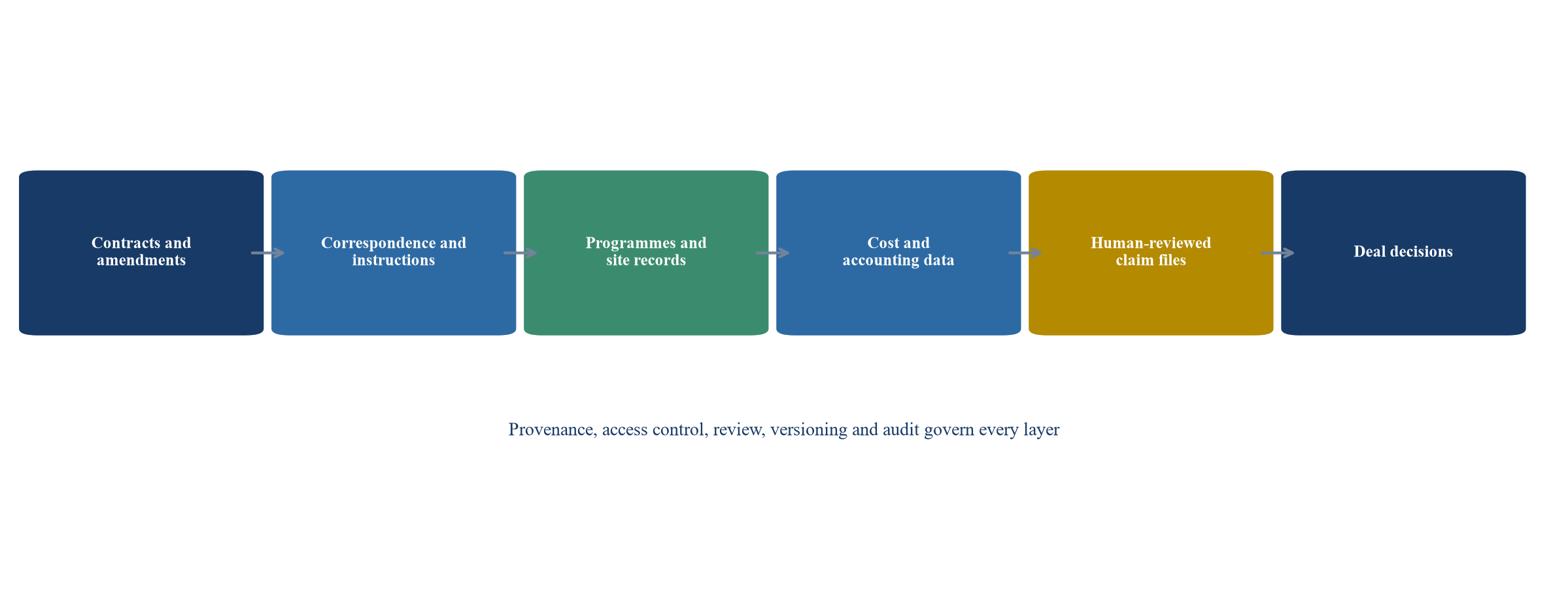
Source records remain linked to extracted events, contractual analysis, programme and quantum before a transaction output is approved.
6. Extract contractual obligations
The contract model should identify notice periods, content requirements, service methods, engineer powers, programme duties, record obligations, variation procedures, payment, time bars, caps, exclusions, dispute steps and governing-law qualifications. Clause extraction should include amendments and hierarchy provisions.
AI can locate candidate clauses and compare drafting across projects. It can also highlight deviations from a standard form. The reviewer should confirm the executed version and interpret interactions among clauses. A clause summary generated from an unsigned draft can misstate entitlement.
The output should be a project-specific obligation matrix. It should show who must act, what must be delivered, when, through which channel, and what consequence may follow. This matrix becomes the rule set against which event records are tested.
7. Reconstruct the event chronology
Construction disputes often turn on sequence. The diligence environment should connect instructions, requests for information, drawings, approvals, access, inspections, resources, progress reports, meeting minutes and notices into an event chronology.
Entity resolution is essential. The same event may be described by a document number, drawing reference, variation number and informal subject line. AI can propose links using dates, participants, locations and text similarity. Human reviewers should confirm high-value connections and ambiguous merges.
Chronologies should preserve contradictory evidence. A monthly report may attribute delay to late design while internal correspondence records labour shortage. The model should surface both records and their dates. It should not choose a legal narrative.
8. Test notice compliance
Notice testing compares the obligation matrix with event chronology. The analysis should identify the triggering event, knowledge date, notice date, recipient, service method, cited clause, requested remedy and subsequent detailed submission.
Timeliness is only one dimension. A notice may be late, sent to the wrong recipient, omit a required effect or fail to reserve a remedy. Later conduct, waiver, prevention principles or governing law may affect the consequence. Legal interpretation remains necessary.
The transaction output should grade procedural strength and show the basis. It should also identify recurring operational failures. A target that repeatedly misses notices may continue losing entitlement after acquisition unless processes change.
9. Analyse instructions and variations
Variation analysis should connect instruction, authority, scope change, design record, quantity, resource effect, programme effect, valuation and certification. Informal instructions require special attention because site teams may proceed before commercial documentation catches up.
The model can compare drawing revisions, bills of quantities, work packages and correspondence to detect potential unrecorded change. It can identify instructions with no commercial response and claim items with no source instruction. These are investigation leads.
Valuation should distinguish agreed rates, analogous rates, new rates, cost-plus mechanisms and disputed methods. A gross submitted amount should not be treated as value without testing contractual valuation and evidence.
| Dimension | Strong evidence | Moderate evidence | Weak evidence |
|---|---|---|---|
| Entitlement | Clear executed clause and instructed event | Plausible clause with interpretive issue | No identified contractual basis |
| Procedure | Timely compliant notice and submission | Minor defect or arguable timing | Material time or service failure |
| Causation | Records connect event to demonstrated effect | Partial linkage with competing causes | Assertion without contemporaneous support |
| Programme | Accepted baseline and supported critical impact | Update or concurrency issue | No reliable programme analysis |
| Quantum | Reconciled records and contractual valuation | Sampled or estimated support | Top-down amount without records |
| Recoverability | Certification, settlement path or strong counterparty | Active negotiation with uncertainty | Denial, weak counterparty or stale dispute |
Scores are analytical aids; legal and technical reviewers determine the transaction conclusion.
10. Build the variation waterfall
The variation waterfall reconciles potential change to reported financial value. It begins with events identified from records, then separates notified, submitted, assessed, approved, certified, billed and collected amounts. It also shows rejected, withdrawn and duplicated items.
This waterfall exposes management practices. A business may recognise revenue at submission while another waits for approval. Some projects may carry the same event in a variation log and a global claim. Duplicate detection should test identifiers, descriptions, dates, values and linked documents.
The buyer should reconcile the waterfall to contract assets, receivables, revenue, margin and cash. Unreconciled differences require explanation before they influence enterprise value.
11. Assess programme reliability
Delay analysis requires a reliable programme record. The team should inventory tender, baseline, recovery and update schedules, including native files, calendars, logic, constraints, progress, data date and narrative. PDF snapshots alone can limit analysis.
Programme quality should be scored through logic density, open ends, excessive constraints, negative float, out-of-sequence progress, actual dates and unexplained changes. The US Government Accountability Office Schedule Assessment Guide and recognised delay protocols provide useful assessment disciplines [4-5]. Project-specific expert judgement remains essential.
An accepted baseline is relevant, but acceptance does not prove analytical quality. The team should identify the programme actually used to manage the work and explain differences from contractual submissions.
Programme updates should be reconciled to reporting periods and source records. Actual starts and finishes, remaining durations, logic changes and progress percentages can shift between versions. The analytics should identify changes made after the data date, retrospective insertion of logic, unexplained deletion of activities and movement of contractual milestones. These flags guide expert review; they do not establish manipulation.
The diligence team should test whether delay analyses use the schedule version that existed when the event occurred. A later recovery programme can embed mitigation, resequencing and revised scope. Applying it retrospectively without explanation can distort causation. Each analytical window should state the accepted or contemporaneous programme, data date, update quality and material limitations.
Resource records provide an additional check. Labour histograms, plant logs, procurement schedules, access permits and daily reports can confirm or contradict planned work. A programme showing an activity ready to proceed may conflict with missing design, materials or permits. The review should record these conflicts and their possible effect on criticality.
12. Test critical-path impact
The analysis should determine whether the claimed event affected work controlling completion at the relevant time. A delay to a non-critical activity may consume float without extending completion. A later event can become critical after sequence changes.
Methods may include time-impact analysis, windows analysis, as-planned versus as-built or other approaches suited to records and dispute context. The diligence process is not a substitute for expert evidence. It should identify whether the target's method is coherent, reproducible and supported.
AI can extract event dates and map records to activities. It should not infer criticality from correspondence frequency. The programme and factual record must support the connection.
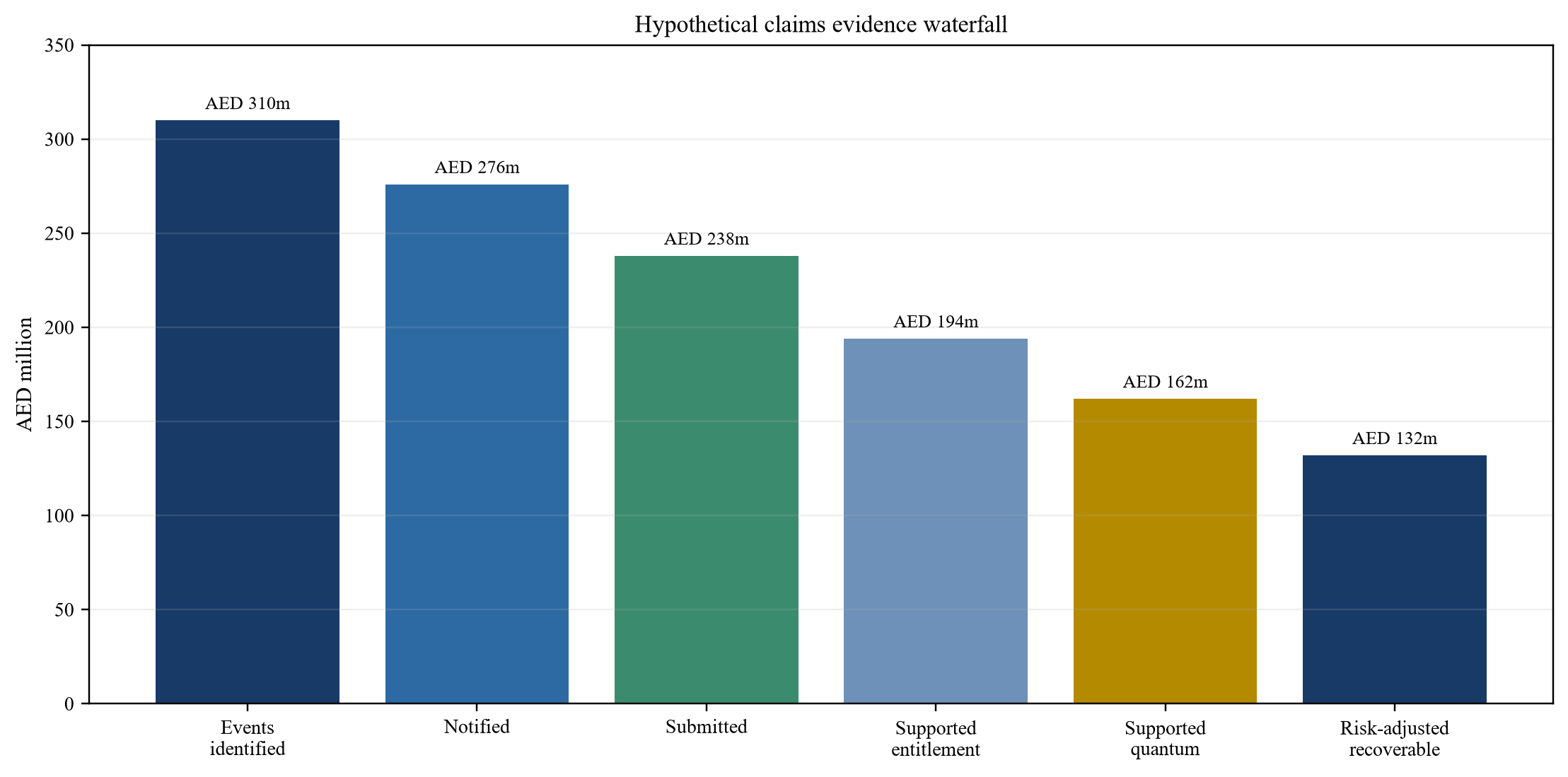
Hypothetical amounts show how gross identified change narrows through procedure, causation, quantum and recoverability tests.
13. Identify concurrency and contractor risk
An employer event can coincide with contractor delay, subcontractor failure, procurement slippage or adverse conditions. The diligence team should identify competing causes rather than assume every event transfers full time and cost.
Records should connect labour, plant, materials, approvals, access and subcontract performance to the programme. Internal reports can reveal causes omitted from formal claims. The analysis should distinguish true concurrency, sequential events and separate delays affecting different paths.
The transaction model should reflect uncertainty. A claim with strong employer causation and material contractor delay may retain some entitlement while carrying a wider range. Legal and delay experts should determine the relevant contractual and legal treatment.
14. Quantify prolongation and disruption
Prolongation analysis tests time-related cost resulting from compensable delay. It should reconcile site overhead, staff, plant, facilities, insurance, bonds and other costs to actual periods and contractual rules. Global daily rates can overstate or understate loss.
Disruption analysis tests loss of productivity. It requires a causal link between event and affected work, plus a reliable comparison or measured method. A broad assertion that variations reduced productivity is insufficient.
AI can help group daily records, resource data and work fronts. The reviewer should control definitions, normalisation and comparisons. Missing records should widen the range rather than be silently imputed.
15. Analyse counterclaims and damages
The buyer should model employer counterclaims, back charges, defect costs, completion costs, liquidated damages, bond calls and third-party exposure. These items can sit outside the target's claims register and appear in employer correspondence, engineer determinations, legal files or cash deductions.
Liquidated-damages analysis should identify contractual rate, cap, relevant completion obligation, extensions, sectional completion and potential relief. Governing law and contract terms determine enforceability and adjustment.
Counterclaims should be reconciled to provisions, contingent liabilities and project forecasts. An unrecorded allegation is not automatically a liability; it remains part of the transaction risk range until assessed.
16. Reconcile claims to IFRS 15
IFRS 15 requires revenue to reflect consideration expected in exchange for goods or services and addresses contract modifications and variable consideration [6]. A variation may change scope before price is agreed. The accounting assessment should consider enforceable rights, approval, estimation and the constraint on variable consideration.
The diligence team should connect every material recognised claim or variation to accounting judgement, source evidence, approval state and subsequent cash. It should test consistency across projects and reporting periods. Post-period certifications and settlements can provide evidence about earlier estimates while requiring careful cut-off analysis.
Accounting compliance does not establish legal recoverability or transaction value. The buyer may apply a more conservative valuation probability than the seller's accounting estimate.
17. Test cost to complete
Claims cannot be assessed independently from remaining cost. A project can carry valuable variations while suffering procurement inflation, rework, productivity loss or subcontractor default. The buyer should reconstruct committed, incurred and forecast costs by package.
Forecast testing should compare historical productivity, purchase orders, subcontract exposure, remaining quantities, mobilisation, commissioning and close-out. Optimism can appear through unapproved savings, delayed accruals or assumed recovery from others.
The claims and cost models should share event assumptions. If a delay claim assumes six additional months, the cost-to-complete forecast should reflect relevant prolongation cost and programme consequences.
18. Identify onerous contracts
IAS 37 requires recognition and measurement of an onerous-contract provision when unavoidable costs exceed expected economic benefits [7]. Diligence should identify projects whose remaining revenue and supportable claims do not cover direct and allocated fulfilment costs.
The test should use the applicable accounting policy and current evidence. It should also identify projects near the threshold because a claim downgrade, programme delay or cost increase can create a provision after acquisition.
Transaction modelling should distinguish accounting provision from economic downside. The buyer may face cash, bonding, management and reputational effects beyond the recognised amount.
19. Test cash conversion
The bridge from revenue to cash should show certification, billing, retention, advance recovery, set-off, tax, collections and settlement. A profitable project can consume cash when certification lags or disputed amounts remain in contract assets.
Ageing should be measured from event, submission, certification and invoice dates. A single receivable age can conceal years of unresolved commercial process. Counterparty, project funding and approval hierarchy affect recoverability.
The buyer should model working capital under base and downside settlements. Roll-up financing should not assume that acquired claims fund integration before they convert to cash.
20. Measure dispute exposure
Construction and engineering represented 23.2% of new ICC arbitration cases in 2024, while construction and engineering plus energy represented 44% [8]. This evidence shows the materiality of dispute risk in relevant sectors; it does not predict that a particular project will arbitrate.
The diligence file should identify dispute notice, forum, seat, governing law, parties, amount, counsel, experts, procedural timetable, security, settlement history and cost. DIAC and SCCA rules provide regional institutional frameworks, including mechanisms for case management and emergency relief [9-10].
The transaction model should include legal and expert cost, management time, delay to cash, adverse outcome and enforcement. Settlement strategy should remain under buyer governance.
21. Validate the AI system
The AI system should be validated for document extraction, classification, chronology, retrieval and contradiction detection. Test sets should include different languages, scans, tables, drawings, email chains and contract forms. Accuracy should be measured on fields that affect decisions.
Hallucination is controlled through source-linked outputs and mandatory review. Every material conclusion should point to the underlying document and location. The system should state when evidence is absent or ambiguous.
NIST's AI Risk Management Framework and ISO/IEC 42001 provide governance concepts for managing AI risk and management systems [11-12]. The diligence workflow should define accountable owners, approved uses, access, monitoring, incidents and change control.
Validation should use a stratified test set. It should cover English and Arabic records, poor scans, handwritten annotations, transmittals, tables, long email chains, programme narratives, payment certificates and amended contracts. The team should measure field-level accuracy for dates, amounts, parties, clauses, project identifiers and document status. Performance on generic text classification does not establish reliability for these transaction-critical fields.
Retrieval quality should be tested with known questions. Reviewers can create a benchmark list of material events and supporting records, then measure whether the system returns the relevant documents and avoids unrelated results. False negatives are particularly important because a missing adverse letter can distort the acquisition case. The workflow should provide a conventional search and sampling route when confidence is low.
Model versions, prompts, extraction rules and human corrections should be logged. A change that improves one document type can reduce performance on another. The team should freeze the production configuration for final diligence and preserve the outputs used for the investment decision. Later improvements can be tested separately.
Language handling requires care. Translation can change contractual meaning, defined terms and degrees of obligation. The system should preserve original text and provide aligned translations for navigation. Material legal conclusions should be reviewed by professionals competent in the governing language and law.
22. Protect confidentiality and privilege
Construction records include personal data, pricing, design, security, disputes and privileged advice. The buyer should collect only what approved diligence questions require and separate legal review from general transaction access.
Role-based permissions should distinguish financial, commercial, delay, legal and integration teams. AI vendors and hosting providers require contractual, security and data-location review. Model training on transaction records should be prohibited unless expressly approved.
Outputs can reveal sensitive information even when source documents are restricted. The release process should review tables, excerpts and claim narratives before they enter buyer models, lender packs or board papers.
23. Convert evidence into claim probabilities
Probability should reflect entitlement, procedure, causation, programme, quantum, counterparty, forum and settlement evidence. It should be expressed as a range and supported by reasons. A single percentage can conceal offsetting strengths and weaknesses.
The model should distinguish expected value from downside exposure. Claims may be positively correlated with counterclaims, delay cost and cash strain. Portfolio aggregation should preserve project dependence.
Overrides require approval and evidence. Management confidence, historical relationships and verbal assurances should be recorded as context rather than treated as verified recovery.
| Risk grade | Evidence profile | Valuation treatment | Transaction protection |
|---|---|---|---|
| A | Strong entitlement, procedure, causation, quantum and recovery path | High probability within tested range | Ordinary completion-account treatment |
| B | Supportable case with defined uncertainty | Probability-weighted value | Targeted escrow or contingent value |
| C | Material gaps, competing cause or disputed valuation | Limited value in base case | Exclusion, indemnity or deferred consideration |
| D | Weak entitlement, failed procedure or unsupported quantum | No positive value | Reserve for cost and dispute exposure |
| Counterclaim | Credible employer or subcontract claim | Downside probability and cash timing | Escrow, indemnity, cap and conduct rights |
Treatment depends on materiality, evidence and deal structure.
24. Rebuild maintainable EBITDA
Maintainable EBITDA should remove unsupported claim revenue, correct cost-to-complete optimism, include recurring claims-management cost and distinguish non-recurring transaction or dispute expenses. It should also reflect synergies only when evidence supports timing and execution.
The bridge should begin with reported EBITDA and trace each adjustment to projects. A portfolio-level percentage is insufficient when one contract drives the risk. Adjustments should reconcile to revenue, gross margin, provisions, contract assets and cash.
The buyer should separately model the value of recoveries excluded from maintainable EBITDA. Claim-specific contingent consideration can share upside without capitalising it fully at closing.
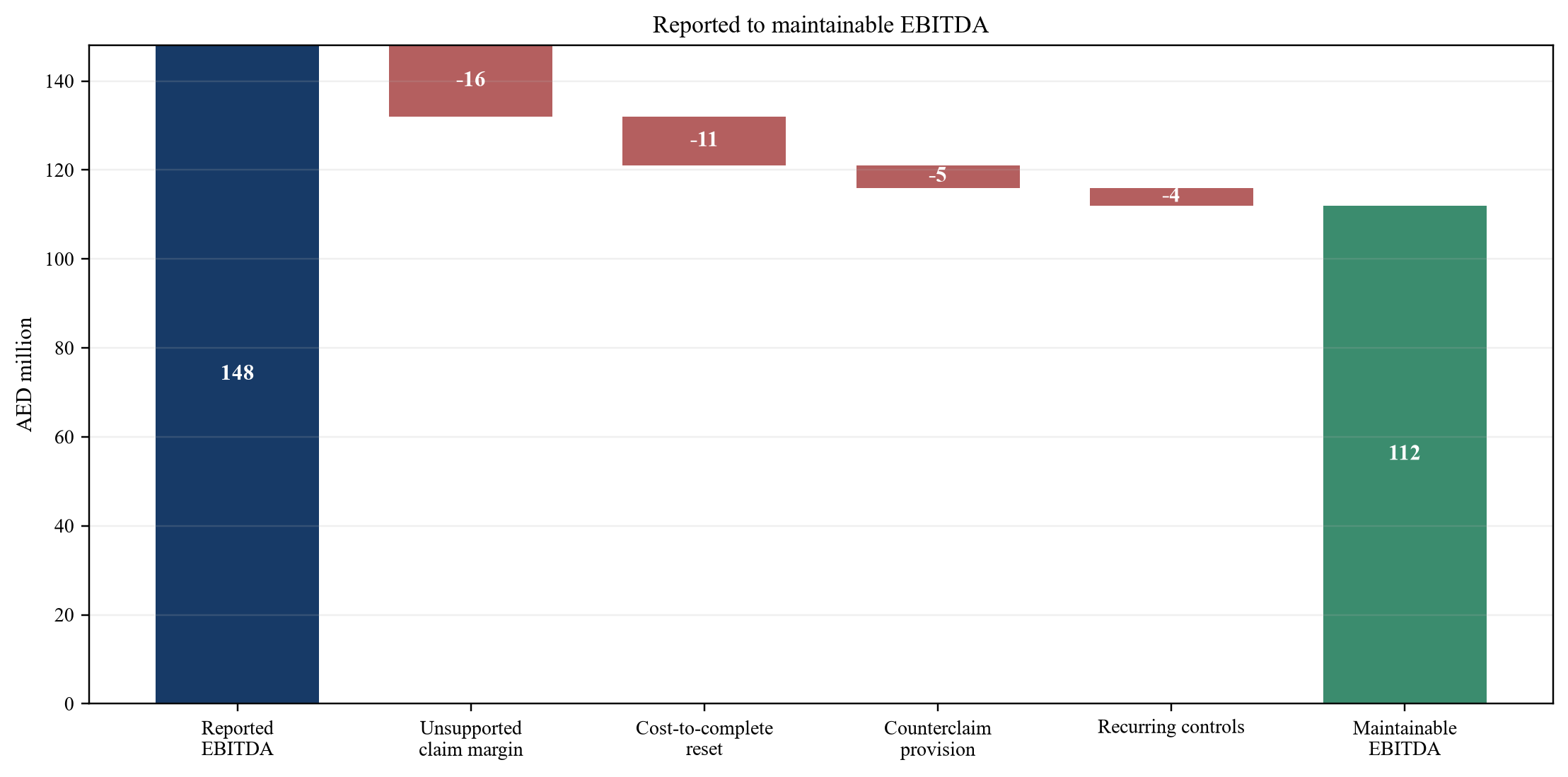
All amounts are management assumptions used solely to demonstrate the framework.
25. Demonstrate the roll-up model
Consider three hypothetical GCC contractors with combined revenue of AED 1.85 billion and reported EBITDA of AED 148 million. They operate 64 active or commercially open projects. Management assumes 2.4 million pages or messages, gross recognised variation and claim assets of AED 230 million, and potential counterclaims and liquidated damages of AED 126 million.
Portfolio-wide classification identifies AED 310 million of potential change events. AED 276 million was notified, AED 238 million submitted, AED 194 million supported by an initial entitlement test and AED 162 million supported by quantum evidence. After procedure, causation, programme, counterparty and recovery adjustments, risk-adjusted claim assets are AED 132 million.
Counterclaim review estimates AED 78 million of probable exposure within a wider AED 52 million to AED 126 million range. Earnings adjustments of AED 36 million produce maintainable EBITDA of AED 112 million. These outputs support a purchase-price structure rather than a precise forecast.
| Item | Target A | Target B | Target C | Combined |
|---|---|---|---|---|
| Revenue | 760 | 610 | 480 | 1,850 |
| Reported EBITDA | 66 | 48 | 34 | 148 |
| Recognised claim assets | 98 | 74 | 58 | 230 |
| Risk-adjusted claim assets | 61 | 43 | 28 | 132 |
| Probable counterclaim exposure | 26 | 31 | 21 | 78 |
| Maintainable EBITDA | 50 | 36 | 26 | 112 |
| Projects reviewed | 22 | 24 | 18 | 64 |
All figures are management assumptions in AED million.
26. Structure the transaction
The hypothetical buyer can value maintainable operations on evidence-led EBITDA and separate uncertain claim recoveries. A claim-specific contingent-value right can pay sellers when defined cash is collected, after taxes, costs, set-offs and counterclaims. The drafting should prevent disputes over attribution and conduct.
An escrow can cover identified counterclaims, liquidated damages and documentary deficiencies. Completion accounts should define contract assets, provisions, cost to complete, retentions and related-party balances. Specific indemnities may address known disputes or guarantees.
Conduct rights should preserve recovery value without allowing sellers to control the combined business indefinitely. The agreement should define settlement authority, information rights, cooperation, cost, privilege and expiry.
27. Integrate claims control
Day one should preserve access, authority, notices, programme submissions, bonding and dispute deadlines. The buyer should retain key commercial managers, planners and project leaders where their knowledge is material, subject to verified roles and appropriate terms.
The first hundred days should create one project register, claims taxonomy, obligation calendar, delegated authority and review cadence. High-risk projects receive deep dives, recovery plans and executive ownership. Accounting, commercial and legal records should reconcile.
Integration should preserve target evidence before migrating systems. Folder restructuring, mailbox closure or programme conversion can break provenance. Controlled migration should retain originals, mappings and audit logs.
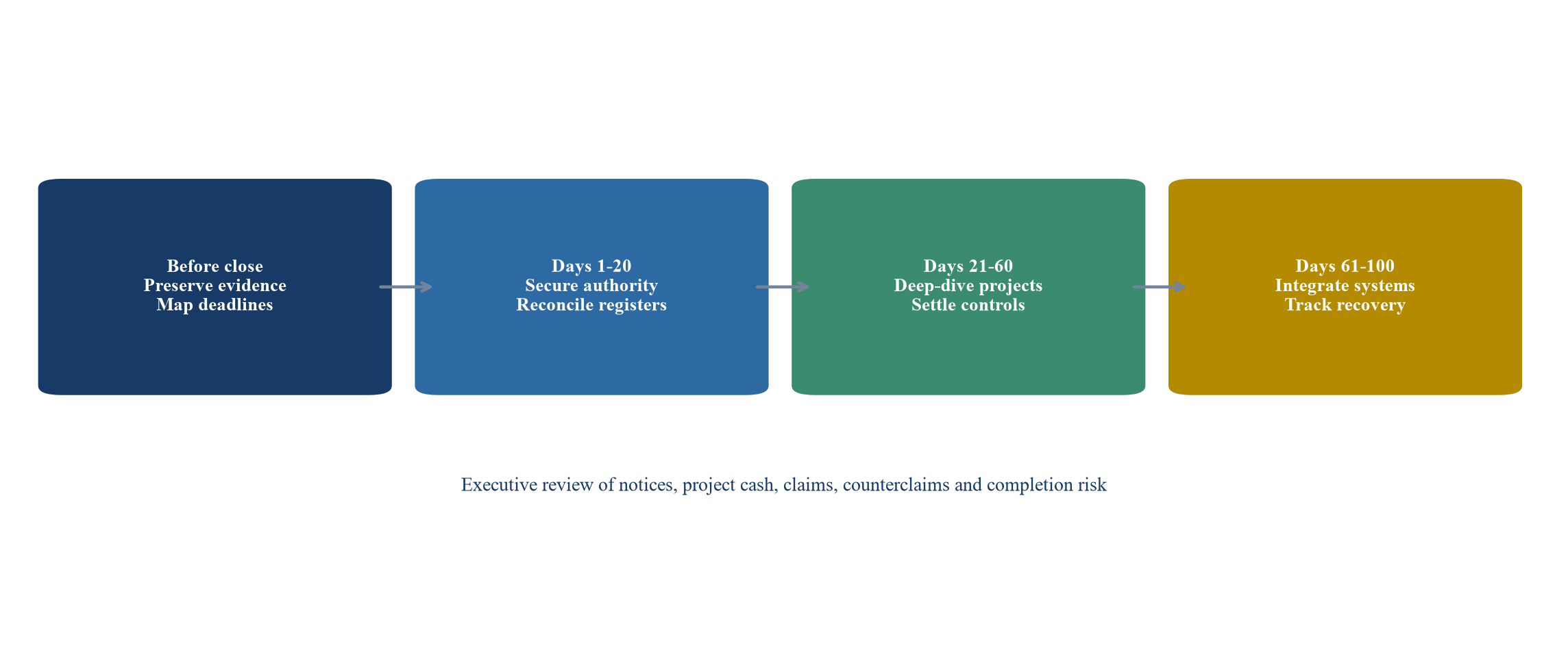
Evidence preservation and deadline control begin before systems and processes are consolidated.
28. Establish the decision and governance record
The final diligence record should state the contract perimeter, data scope, gaps, claim methodology, programme limitations, accounting treatment, legal review, probability ranges, earnings adjustments, transaction protections and integration actions. Every material conclusion should be traceable to source evidence and named reviewers.
Decision rights should remain clear. Data and AI teams manage ingestion, extraction and retrieval. Quantity surveyors and commercial specialists assess entitlement and quantum evidence. Planning and delay specialists assess programme effect. Accountants assess recognition and forecast. Counsel interprets contract, law, privilege and dispute. The deal team converts these inputs into value and terms.
Ongoing governance should compare predicted recoveries, settlements, project outcomes and integration actions with the acquisition case. The buyer should preserve the original diligence snapshot to avoid hindsight. Lessons should update future screening and underwriting.
The investment committee pack should separate verified facts, professional assessments, management assumptions and unresolved gaps. Verified facts include executed documents, certified amounts, cash receipts and preserved source records. Professional assessments include claim strength, programme reliability, accounting treatment and legal interpretation. Management assumptions include settlement timing, synergy, collection probability and future project performance. Unresolved gaps should carry an explicit consequence for value or protection.
The decision record should also explain sampling. Portfolio-wide analytics can cover millions of records while detailed human review focuses on material projects and exceptions. The team should state the projects, claims and document types reviewed deeply, the selection logic and the coverage of revenue, EBITDA, claim assets and downside exposure. This allows the committee to judge whether the evidence supports the breadth of the conclusion.
Quality review should include adversarial testing. A reviewer who did not build the claim file should attempt to disprove the entitlement, programme and quantum chain using employer correspondence, internal records and competing causes. The purpose is to identify unsupported confidence before price and terms become fixed. Material disagreements should remain visible in the range and transaction structure.
The buyer should translate the diligence result into operating accountability. Each high-risk project needs an executive owner, commercial lead, planner, accountant and legal contact. Required actions should have deadlines, evidence and financial effect. The acquisition model should identify cash or value at risk when an action is missed. This connects the investment case to execution.
Post-close reviews should compare actual certification, settlement, cost and completion with the ranges used at signing. Variance should be decomposed into new events, evidence quality, analytical error, management action and market or counterparty change. The purpose is learning and control, not retrospective rewriting of the original case.
The framework can also improve future origination. A buyer that repeatedly encounters weak notices, programme records or cost forecasts can make these capabilities part of target screening. Strong claims governance can become a source of operating value when it accelerates certification, protects entitlement and reduces dispute escalation. Any expected improvement should be modelled with evidence, cost, timing and accountable delivery.
The value of claims analytics lies in disciplined evidence and faster challenge. It can reveal documents, connect events and test consistency across a portfolio. It cannot decide legal entitlement, critical-path causation or fair value without qualified judgement. A construction roll-up should proceed when the buyer can explain the earnings, cash, liability and control case project by project.
29. Design an acquisition-screening protocol
Claims analytics can begin before full diligence. A buyer screening a contractor should request a compact project register that reconciles contract value, certified value, cash, forecast cost, completion date, extension status, claims, counterclaims, retention and security. The initial purpose is to locate concentration, accounting dependence and evidence gaps before committing substantial diligence resources.
The screen should calculate reported EBITDA dependence on unapproved commercial positions. It should compare recognised variation revenue with certification and cash, test the proportion of gross margin contributed by projects behind programme, and identify projects where a claim asset has grown while recovery evidence has weakened. These indicators do not determine value. They direct questions, sampling and specialist review.
Target comparisons require consistent definitions. One contractor may record an employer instruction as a variation when issued; another may wait for agreement; a third may record only the margin expected from the change. The buyer should normalise submitted, assessed, certified, billed and collected amounts before comparing portfolios. It should also reconcile each target's definition of approved, probable, instructed and pending.
A screening protocol can use four gates. The perimeter gate confirms the entities, projects, guarantees and open disputes entering the transaction. The evidence gate tests whether executed contracts, programmes, correspondence and cost records are available and traceable. The economics gate tests earnings, cash and downside concentration. The controllability gate considers whether the buyer can preserve records, retain key people and correct processes after closing.
An adverse result at a gate should have a predetermined response. The buyer may narrow the perimeter, extend diligence, require a price mechanism, condition closing on a project event, seek specific protection or decline the opportunity. A finding that has no defined decision consequence can consume time without improving underwriting.
The screening record should identify the source date of every balance and project status. Construction portfolios change quickly as certificates, instructions, settlements and completion forecasts move. A clear cut-off date allows subsequent developments to be analysed as changes rather than mixed into the original evidence base.
30. Convert findings into value-creation actions
A buyer should distinguish value protection from value creation. Value protection includes removing unsupported earnings, reserving credible exposure, preserving entitlement, controlling notices and avoiding evidence loss. Value creation includes accelerating certification, improving final-account preparation, reducing leakage, deploying scarce commercial specialists and using portfolio evidence to negotiate consistently.
Each action should carry a baseline, owner, required evidence, cost, timing and measurable result. For example, a recovery initiative may target a defined set of instructed variations with complete records and agreed valuation principles. Its measure could be certification and cash collected within an agreed period, net of external cost. A broad commitment to improve claims does not provide an underwritable benefit.
Synergies should be tested against project obligations. Centralising planning or commercial review can improve control, while removing site knowledge can weaken notices and substantiation. Integration design should retain the people who understand event history and contract administration until records and responsibilities transfer safely. Retention decisions should reflect verified contribution and role criticality.
Portfolio analytics can reveal repeated causes such as late design, incomplete scope, weak subcontract flow-down, missing programme updates or delayed commercial response. The acquirer can then prioritise bidding discipline, contract review, project controls, delegation and training. The expected benefit should be linked to a defined mechanism such as fewer missed notices, faster submission, stronger certification or lower external dispute cost.
Cash remains the primary test. A claim can strengthen reported profit without funding payroll, suppliers, bonds or debt service. The integration dashboard should reconcile claim movement to certification, invoicing, set-off and cash. It should also track the cost and working-capital burden of pursuing recovery. This prevents gross settlements from being presented as value without the associated cost and timing.
The combined business should maintain a claims committee with clear thresholds. Material new claims, settlements, waivers, programme changes and reserve movements should receive cross-functional review. The committee record should state the evidence, professional views, authority and financial effect. Senior management should receive a concise portfolio view alongside project-level exceptions.
Value-creation reporting should preserve uncertainty. Forecast recoveries should be ranges with dated assumptions and identifiable dependencies. Realised outcomes should be reported separately from forecast benefits. When a settlement resolves both claim and counterclaim positions, the record should show the net economic result and any effect on programme, retention, guarantees or future work.
The acquisition thesis is strongest when the operating plan can be executed with the people, systems and authority available at closing. Claims analytics provides a common evidence base for that plan. Transaction protections cover risks that cannot be controlled immediately; integration actions address risks that can be changed; contingent value preserves potential upside that remains dependent on future recovery.
Sources
- UAE Legislation Platform, current federal legislation and legislative updates. Read the primary source
- UAE Ministry of Justice, Main Legislations and federal legal framework. Read the primary source
- WIPO Lex, Saudi Arabia Civil Transactions Law, Royal Decree M/191 of 18 June 2023. Read the primary source
- United States Government Accountability Office, Schedule Assessment Guide GAO-16-89G. Read the primary source
- Society of Construction Law, Delay and Disruption Protocol, second edition. Read the primary source
- IFRS Foundation, IFRS 15 Revenue from Contracts with Customers. Read the primary source
- IFRS Foundation, IAS 37 Provisions, Contingent Liabilities and Contingent Assets. Read the primary source
- International Chamber of Commerce, 2024 Dispute Resolution Statistics. Read the primary source
- Dubai International Arbitration Centre, DIAC Arbitration Rules 2022. Read the primary source
- Saudi Center for Commercial Arbitration, SCCA Arbitration Rules 2023. Read the primary source
- National Institute of Standards and Technology, AI Risk Management Framework 1.0. Read the primary source
- International Organization for Standardization, ISO/IEC 42001 Artificial intelligence management systems. Read the primary source
- International Federation of Consulting Engineers, FIDIC Construction Contract, Red Book and claims resources. Read the primary source
- International Federation of Consulting Engineers, FIDIC contracts guides and documents. Read the primary source
- United Nations Commission on International Trade Law, Model Law on Electronic Commerce. Read the primary source
- United Nations Commission on International Trade Law, Model Law on Electronic Transferable Records. Read the primary source
- International Organization for Standardization, ISO 19650 information management using building information modelling. Read the primary source
- buildingSMART International, Industry Foundation Classes standards and resources. Read the primary source
- buildingSMART International, BIM Collaboration Format resources. Read the primary source
- World Bank, Procurement Regulations for Investment Project Financing Borrowers. Read the primary source
- Organisation for Economic Co-operation and Development, OECD AI Principles. Read the primary source
- International Association for Contract and Commercial Management, contract management research and standards. Read the primary source
- Project Management Institute, Practice Standard for Scheduling and project-controls resources. Read the primary source
- Association for the Advancement of Cost Engineering International, Recommended Practices for forensic schedule and cost analysis. Read the primary source
