

1. Define the transaction decision
The transaction decision is whether the buyer can price, structure and execute an industrial carve-out using sufficiently reliable evidence about the assets, their condition, the maintenance burden and the cost of standing the business up independently. The answer affects enterprise value, debt capacity, completion accounts, representations, indemnities, transitional arrangements and the Day One plan. It also determines whether the buyer can operate safely and deliver the base-case earnings assumed in the investment memorandum.
An industrial carve-out differs from a conventional share acquisition because the transfer perimeter must be created from a larger operating system. Assets may be shared, physically intermingled, recorded under a parent legal entity or supported by group maintenance, procurement, information technology and engineering functions. A line can appear in the fixed-asset register while another entity owns the land, utilities or critical tooling. Conversely, equipment essential to production can be absent from the proposed perimeter because it is expensed, leased, supplied by a customer or embedded in a shared service.
Computer vision can improve the speed and coverage of physical evidence collection. Its value arises when imagery is tied to a controlled asset register, location, timestamp, inspection protocol and engineering review. A model output without this chain is an observation of pixels. It becomes transaction evidence only after identity, provenance, materiality and decision rights are established.
| Evidence layer | Typical source | Question answered | Transaction use |
|---|---|---|---|
| Physical existence | Time-stamped image, video, scan and site walk | Is the asset present and identifiable? | Perimeter confirmation and asset-register cleansing |
| Operating condition | Engineering inspection, permitted sensors and work history | Can it perform the required duty safely and reliably? | Maintenance backlog and capital plan |
| Accounting record | Fixed-asset register, ledger and depreciation schedule | How is it recorded and carried? | Net asset bridge and accounting diligence |
| Legal control | Title, lease, licence, easement and contract | Can the buyer use and transfer it? | Conditions precedent and transaction documents |
| Economic role | Capacity, yield, quality, energy and downtime data | What value does it support? | Forecast, valuation and financing |
| Separation dependency | Shared utility, system, people or service map | What must be replaced or transitioned? | Separation capex and TSA design |
Evidence becomes decision-useful when physical, operational, accounting and legal records reconcile.
2. Understand why industrial carve-outs lose value
Value leakage usually begins with an incomplete perimeter. The seller may define the deal by business unit, product family or customer revenue, while the physical plant operates through shared buildings, utilities, laboratories, maintenance workshops, warehouses and digital systems. The buyer then discovers that productive assets cannot operate independently without additional equipment, licences, people or interfaces. The resulting capital requirement can arrive after valuation has been agreed and negotiating leverage has weakened.
Maintenance deferral creates a second source of leakage. Reported EBITDA can benefit when preventive work, overhaul and replacement are delayed. The accounting statements may remain compliant while reliability risk accumulates. A buyer who capitalises the reported earnings without adjusting for normalised maintenance can pay for cash flow that is not sustainable. A large backlog can also concentrate shutdowns in the first ownership period and reduce the ability to meet customer commitments.
Information fragmentation magnifies both problems. Engineering, finance and transaction teams often use different asset definitions. A finance register may record one production line; maintenance systems may hold hundreds of functional locations; operations may refer to local names; legal schedules may list only categories. The framework therefore starts with identity and reconciliation. It does not begin with an image model.
3. Treat asset condition as a valuation variable
Asset condition affects value through several channels. Poor condition can reduce available capacity, increase maintenance expense, require accelerated replacement, raise energy consumption, increase scrap, constrain product quality and heighten safety exposure. These effects influence both cash flow and risk. The same defect can have different economic consequences depending on whether the asset is redundant, bottlenecked, safety-critical or readily replaceable.
Condition should therefore be translated into specific financial mechanisms. Corrosion on a non-critical guard may require routine repair. Corrosion on a pressure-containing component can require shutdown, specialist inspection and replacement. A leaking seal can be a small consumable issue or an indicator of shaft, alignment or process problems. Computer vision should classify observations and route them to engineering review; it should not assign a financial consequence from appearance alone.
The valuation model needs a documented bridge from condition evidence to maintenance, capital expenditure, downtime and forecast output. The bridge should distinguish mandatory remediation, reliability work, productivity investment, growth capital and optional enhancement. Only then can the buyer decide which items affect enterprise value, completion mechanics, seller obligations or the post-close plan.
4. Establish the carve-out perimeter
The perimeter should be expressed through a controlled asset population. Each record needs a unique identifier, legal owner, site, building, area, production line, functional location, asset class, manufacturer, model, serial number where available, commissioning date, accounting reference, maintenance reference and proposed transaction treatment. The treatment should state whether the item transfers, remains, is shared, is leased, requires replacement or is unresolved.
The buyer should separately map enabling assets. These include electrical distribution, water, compressed air, steam, cooling, effluent treatment, fire protection, cranes, laboratories, tooling, calibration equipment, warehouses, spares, networks and control systems. A machine can be physically present but unusable if its utilities, software licences, safety systems or tooling remain with the seller. Shared land access, environmental permits and building services can be equally important.
The register should preserve changes. An asset added after the first site visit, a changed transfer decision or a newly identified dependency should remain visible with an owner and rationale. Version control protects the transaction team from working from different lists and creates a clear basis for schedules to the sale agreement.
5. Build the evidence architecture
The evidence architecture links each asset to its images, inspection records, work orders, failure history, spare-parts position, production role, financial record and transaction decision. A relational structure is preferable to folders named by site or department because the same evidence may support several questions. The architecture should allow a reviewer to move from an image observation to the asset, maintenance record, cost estimate and decision log.
Images require provenance. The record should include who collected them, when, where, with which device, under which inspection protocol and whether the asset was operating. Geolocation may be inappropriate or unreliable inside facilities, so controlled route maps, area markers and asset tags can provide better identity. Original files should be preserved; edited or annotated copies should remain derivatives with their own hashes.
The system should report evidence gaps rather than fill them. If a serial plate is unreadable, the asset match remains unresolved. If the latest maintenance record cannot be linked, the system records a missing relationship. Gap visibility is valuable because it directs site work, management questions and conditions precedent.
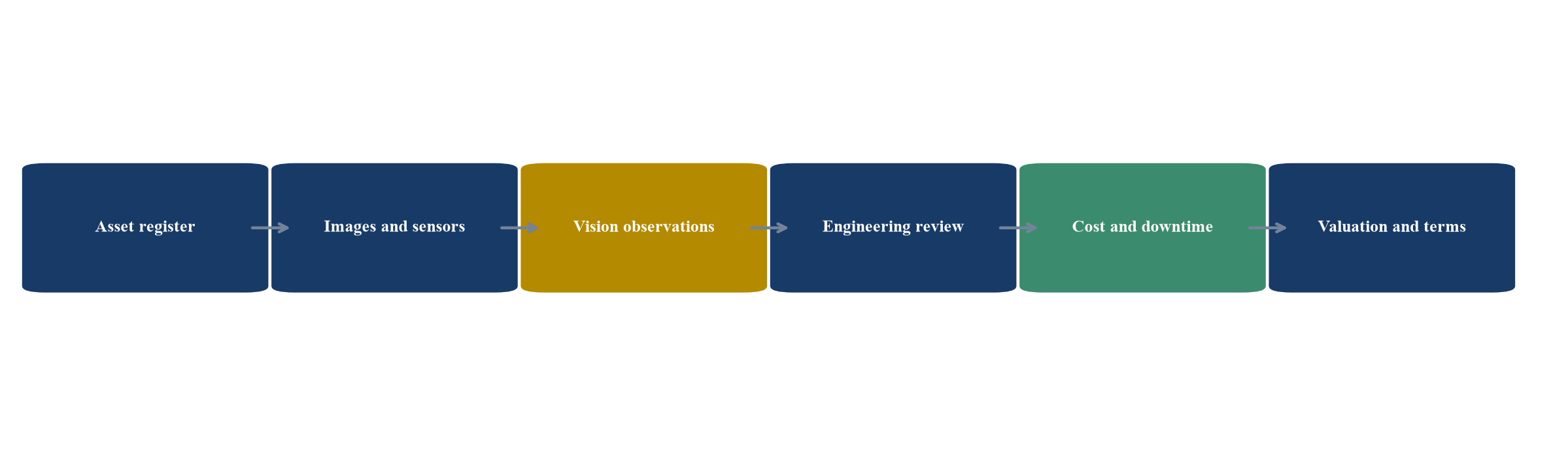
Computer vision supplies observations; accountable specialists convert corroborated evidence into transaction decisions.
6. Design the image acquisition protocol
Model quality cannot compensate for inconsistent acquisition. The protocol should define required viewpoints, distance, lighting, resolution, orientation, scale reference, cleaning state and operating condition for each asset class. Wide images establish context; medium views establish asset identity; close views capture components and defects. Labels, gauges, guards, foundations, electrical panels, pipes and known wear points require specific coverage.
Routes should be repeatable. A route can follow the process flow from receiving to dispatch or a functional-location hierarchy from utility intake to production cells. Repeatability supports change detection between diligence visits and creates a post-close baseline. Images collected during a shutdown should be identified because open guards and disassembled equipment can otherwise be misclassified.
Safety controls govern collection. Personnel should not enter exclusion zones or remove guards for imagery. Thermal, drone, ultraviolet or other specialised sensing requires competent operators, site permission and appropriate calibration. The Occupational Safety, Health and Working Conditions Code places responsibility on employers for safe working conditions and records; BIS machinery-safety materials provide relevant risk-reduction context [1-3]. Transaction urgency does not justify unsafe inspection practice.
7. Select bounded computer-vision tasks
The first useful task is asset identification. Optical character recognition, object detection and image similarity can propose matches between equipment and the register. A reviewer then confirms the match, especially where serial plates are obscured or similar machines sit together. The second task is visible-condition screening: corrosion, coating failure, leaks, damaged insulation, missing guards, contamination, cracks, deformation and housekeeping exceptions.
Other bounded tasks include gauge reading, thermogram segmentation, component counting, safety-zone occupancy and change detection. Each task needs a defined output, confidence measure, escalation rule and prohibited use. A model may flag a pressure gauge outside a documented operating band; it cannot conclude that the process is safe or unsafe without context, calibration and operator review.
The choice of model follows the evidence problem. Detection locates known objects; segmentation outlines defects; anomaly detection identifies departures from normal examples; optical character recognition extracts visible text; visual-language models can support retrieval and summarisation. General models may accelerate setup, while specialised assets often require local data, testing and domain review.
| Task | Model output | Required corroboration | Decision supported |
|---|---|---|---|
| Asset matching | Candidate identity and confidence | Tag, serial, location and register review | Perimeter completeness |
| Defect screening | Location and type of visible anomaly | Engineer inspection and maintenance history | Scope of detailed diligence |
| Gauge reading | Value and image quality | Calibration, operating state and process context | Exception triage |
| Change detection | Difference between dated images | Work order and site confirmation | Remediation tracking |
| Thermal segmentation | Relative hot or cold region | Calibrated thermography and load condition | Specialist diagnostic referral |
| Housekeeping review | Obstruction, storage or leakage flag | Site safety review | Operational-control assessment |
No model output should directly determine price, compliance or safe operating condition.
8. Create a transaction-grade dataset
A transaction dataset must represent the assets and defects relevant to the deal. Public anomaly-detection datasets are useful for benchmarking methods, including MVTec AD and MVTec LOCO AD, but they do not establish performance on a specific Indian plant [4-5]. Local images may differ in lighting, dust, paint, asset age, camera angle and defect prevalence. The deployment population must therefore be tested directly.
Labels should separate observation from diagnosis. An annotator can label visible surface corrosion, staining or insulation damage. The root cause and engineering severity require specialist review. Label guidance should define ambiguous cases, occlusion, image-quality thresholds and multi-defect images. Agreement between reviewers is a useful quality measure because inconsistent labels set a ceiling on model reliability.
Data splits should prevent leakage. Images of the same asset, burst sequence or near-identical viewpoint should not be divided between training and test sets. Site-level or asset-level holdouts provide a stronger test of generalisation. The report should disclose sample composition, class imbalance, thresholds and known blind spots.
9. Measure model performance for the decision
Generic accuracy is insufficient. The relevant cost of error depends on the task. Missing a critical defect can be more consequential than reviewing several false alarms. Asset matching may require very high precision before automatic linkage; screening can accept lower precision if every flag receives rapid human review. Metrics should therefore include precision, recall, false-negative rate, calibration and performance by asset class, site, lighting and defect type.
The validation set should resemble the transaction population. If the model is used across foundry, machining and assembly areas, each environment needs coverage. Performance on clean laboratory images cannot support a claim about dusty production assets. Thresholds should be frozen before final testing, and the independent test result should remain unchanged by repeated tuning.
Models also need abstention. Low-quality images, unknown equipment and out-of-distribution scenes should be routed to manual review. A forced answer converts uncertainty into false confidence. NIST's AI Risk Management Framework organises controls through govern, map, measure and manage; OECD principles emphasise transparency, robustness and accountability [6-8]. These principles fit transaction diligence because outputs influence material commercial decisions.
10. Construct the asset-condition score
The condition score should combine only evidence that can be explained. Components may include visible condition, failure history, overdue preventive work, critical spares, vibration or thermal exceptions, statutory inspection status, maintenance quality and operating duty. Each component needs a definition, source and weighting rationale. A score without decomposition is difficult to challenge and easy to misuse.
Criticality should remain separate from condition. A worn redundant pump and a worn single-point-of-failure pump can have the same physical condition but different transaction consequences. The system can map condition against safety, production, quality, environmental and recovery-time criticality. This matrix directs engineering depth and cost estimation.
Scores should not be averaged across a plant without materiality controls. Hundreds of low-value assets can mask one bottleneck. The report should show asset-level exceptions, system-level dependencies and financial exposure. Management should be able to explain why an item is accepted, reserved, remediated or escalated.
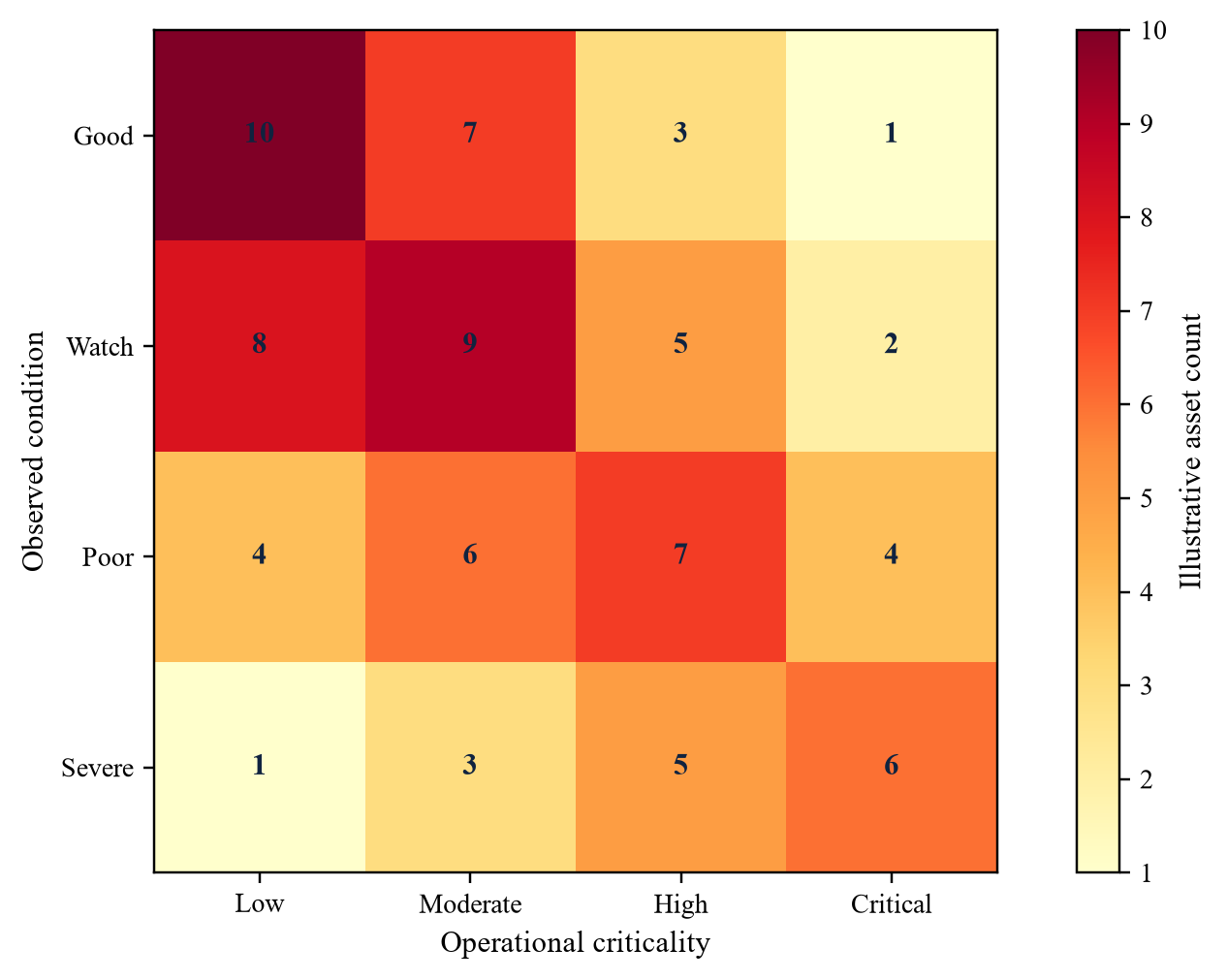
Management-assumed distribution for method demonstration; it is not observed plant evidence.
11. Reconstruct the maintenance backlog
The backlog is the cost and operating consequence of work that should be completed to restore an agreed standard. It is not every open work order. The review should distinguish overdue preventive maintenance, known corrective work, statutory or safety actions, condition-based interventions, obsolescence, shutdown work and improvement projects. Each item needs scope, labour, materials, contractor, shutdown duration, contingency and evidence status.
Computer vision can reveal work that is absent from the maintenance system. It can also confirm that recorded work appears complete. The observed condition must be reconciled to work orders, inspection findings and capital requests. When an image indicates leakage and the system records repeated seal replacements, the reviewer should investigate root cause and recurring cost rather than count one repair.
Backlog estimates should use ranges until scope is mature. A concept estimate based on visible evidence carries more uncertainty than a vendor quote after inspection. The transaction model should preserve estimate class, basis date, currency, tax treatment, contingency and shutdown assumptions. A single point estimate hides the uncertainty that the parties may need to allocate.
12. Separate maintenance from capital expenditure
The accounting treatment of expenditure and its transaction treatment are related but distinct. Ind AS 16 addresses recognition, component accounting, depreciation and subsequent expenditure; Ind AS 36 addresses impairment; Ind AS 105 addresses disposal groups and discontinued operations [9-12]. Engineering work can be essential to sustain operations even when accounting rules classify it as expense. A buyer's cash requirement therefore cannot be derived from the fixed-asset register alone.
The framework classifies expenditure by economic purpose. Catch-up maintenance restores the existing standard. Sustaining capital replaces consumed life or obsolescence. Compliance capital meets legal or permit requirements. Separation capital replicates shared capability. Growth capital expands output or changes product. Productivity capital reduces unit cost. Each category should have a decision rule and avoid double counting.
Normalisation matters for valuation. If historical maintenance was below a sustainable level, the earnings forecast may require higher recurring expense or capital. The buyer should document whether the adjustment affects EBITDA, free cash flow, enterprise value, debt-like items or negotiated price. The same rupee should not appear in several places without an explicit bridge.
13. Quantify separation capital expenditure
Separation capital expenditure arises because the carved business cannot rely indefinitely on the seller's assets and systems. Physical items can include utility connections, laboratories, warehouses, fire systems, access controls, security, tooling and network infrastructure. Digital items include enterprise resource planning, manufacturing execution, maintenance management, historian, quality, cybersecurity and data interfaces.
The estimate should start from a dependency map. Each shared capability receives an interim solution, target-state solution, implementation owner, timing, outage requirement and cost range. Some dependencies can be handled through a transitional service agreement; others require completion before Day One for safety, licensing or operational continuity. The model should distinguish one-time build cost, duplicated run cost and exit cost.
Imagery supports physical dependency discovery. Cable routes, pipe headers, control rooms and shared buildings can reveal interconnections that legal schedules miss. The observation still requires drawings, site confirmation and engineering design. A visible pipe does not establish ownership, capacity or transferability.
14. Reconcile physical evidence to accounting records
The reconciliation begins with the fixed-asset register and general ledger, then maps maintenance and physical records. Items can be matched, missing physically, missing financially, aggregated, duplicated, retired, under construction or unresolved. The objective is not to force a match; it is to show the buyer which values and dependencies remain uncertain.
Accounting useful life is not a condition assessment. A fully depreciated machine can remain productive; a newer asset can be impaired or unreliable. Schedule II to the Companies Act provides useful-life context, while Ind AS 16 requires component-level judgement and review of useful lives and residual values [9,13]. Transaction diligence should preserve these distinctions.
The bridge should also test capital work in progress, spares, leased assets, customer-owned tooling and assets supplied under service contracts. Each category can affect the perimeter, purchase price allocation and operating plan. The final schedule should be capable of supporting legal drafting and post-close opening balances.
15. Examine safety and regulatory exposure
Industrial condition has direct safety implications. The buyer should review statutory inspection, permits, machine guarding, electrical safety, lifting equipment, pressure systems, fire protection, hazardous materials and incident history. Computer vision can support coverage and issue triage; it cannot certify compliance. Competent persons and responsible authorities retain those roles.
The Occupational Safety, Health and Working Conditions Code provides the national legislative context, including employer responsibilities, records and third-party audit provisions [1]. BIS maintains machine-safety standards and certification guidance that should be mapped to the relevant equipment and current applicability [2-3,14]. State rules, environmental consents and sector-specific requirements may add obligations.
Safety findings should flow into the transaction decision. Immediate hazards may require seller remediation or a closing condition. Other items may require price adjustment, escrow, indemnity, capital allocation or a time-bound post-close plan. The treatment should reflect legal advice, technical severity and the buyer's ability to operate during remediation.
16. Protect privacy and operational security
Site imagery can capture employees, visitors, screens, access credentials, drawings, customer information and proprietary processes. The acquisition protocol should minimise personal data, notify relevant stakeholders, define purpose and access, and set retention and deletion rules. India's Digital Personal Data Protection Act provides the statutory context for digital personal data [15]. Transaction counsel should determine the applicable obligations and lawful processing basis.
Operational technology creates additional risk. Cameras, edge devices and transfer media can introduce vulnerabilities into production networks. Collection should favour isolated devices, controlled transfer, malware scanning, encryption and role-based access. CERT-In directions and recognised information-security standards provide relevant governance context [16-17].
The data room should separate highly sensitive plant evidence from general diligence material. Access logs, watermarking where appropriate and download controls support accountability. Model vendors should not receive unrestricted transaction data; contracts should address confidentiality, retention, training use, subcontractors, security and incident response.
17. Govern the AI system
Governance begins with named ownership. The transaction lead owns the decision context; engineering owns technical interpretation; data owners control source records; model owners maintain the system; validation challenges performance; legal and privacy teams oversee permitted use; the investment committee approves commercial consequences. Roles should be explicit before the first image is processed.
The model inventory should record version, intended use, prohibited use, data, thresholds, performance, known limits, reviewer requirements and change history. Material changes require revalidation. A new asset class, site or camera protocol can change performance even when the code is unchanged.
Human review must be substantive. A reviewer should see the source image, model output, confidence, similar cases and relevant records. Approval should capture rationale and changes. The system should retain disagreements; they reveal ambiguity and support later quality improvement.
| Decision | Evidence owner | Technical reviewer | Accountable approver | Required record |
|---|---|---|---|---|
| Asset match | Seller and data team | Plant engineer | Carve-out lead | Identity evidence and confidence |
| Condition exception | Inspection team | Discipline engineer | Technical diligence lead | Image, severity and action |
| Maintenance estimate | Maintenance owner | Cost engineer | Deal finance lead | Scope, basis and range |
| Separation capex | Functional owner | Separation architect | Steering committee | Dependency and target-state design |
| Valuation adjustment | Finance team | Accounting and technical advisers | Investment committee | Valuation bridge and sensitivity |
| Model release | Model owner | Independent validation | AI governance owner | Test report and limitations |
Roles are illustrative and should be adapted to the buyer, seller, advisers and transaction documents.
18. Validate the model independently
Validation should challenge conceptual soundness, data, implementation and outcomes. The reviewer asks whether the task is appropriate for computer vision, whether labels reflect the intended observation, whether leakage exists, whether the test population represents deployment and whether thresholds match the error cost. Reproducing the headline metric is not enough.
Benchmarking can use published methods such as MVTec anomaly-detection datasets, EfficientAD, Segment Anything and self-supervised visual representations [4-5,18-20]. These sources demonstrate technical possibilities; they do not validate a transaction deployment. The local test remains decisive.
Outcome monitoring should continue during diligence. Reviewers can sample accepted and rejected cases, track overrides and compare subsequent engineering findings. If performance degrades or acquisition conditions change, the system should reduce automation and increase manual review. The release should include a clear stop condition.
19. Integrate the workflow into due diligence
The workflow starts with a data request and perimeter hypothesis. The team then builds the register, selects material and representative assets, designs site routes and reviews historical maintenance. Image collection follows the agreed protocol. Models process the evidence, and specialists review exceptions. Cost engineers translate verified scope into cash, timing and downtime.
Findings should enter the main diligence issue log. Each issue needs evidence, financial mechanism, owner, required response and potential transaction treatment. The log should avoid duplicated descriptions across technical, financial and legal workstreams. One defect can influence maintenance cost, capacity, warranty and financing; the integrated issue should show all effects.
The investment committee should receive both the result and the evidence quality. A high-condition risk with strong evidence supports decisive action. A moderate estimate with weak perimeter evidence may justify a reserve, further access or a condition precedent. Uncertainty itself has value implications.
Materiality should be established before the first site visit and revisited as findings develop. A sensible starting point combines replacement cost, production criticality, safety consequence, customer impact and recovery time. The team can then define full-population review for critical assets, risk-based sampling for lower-value populations and mandatory escalation for any observation with safety, permit or business-interruption implications. This approach avoids spending equal effort on every item while preserving coverage of the risks that can change the transaction.
Management interviews should be anchored to evidence. Plant leaders can explain shutdown strategy, chronic losses, bottlenecks, spare-parts constraints and temporary operating controls. Maintenance leaders can explain backlog definitions, preventive-compliance exceptions and vendor dependence. Finance can reconcile capitalisation, repair expense and asset disposals. Separation leaders can identify shared infrastructure and the target state. Each explanation should be recorded as a management statement until corroborated by documents, system records or inspection.
The issue log should distinguish fact, professional assessment, management estimate and unresolved question. A verified image of corrosion is a fact about visible condition at the collection date. Its severity is an engineering assessment. The remediation cost may be a management or adviser estimate. The effect on purchase price is a commercial decision. Keeping these layers separate allows the investment committee to understand what is known, what is judged and what remains open.
Evidence closure also requires negative confirmation. If a selected asset shows no visible exception, the record should still identify the images reviewed, their quality and the limits of the inspection. Absence of a model flag is not proof of good condition. The close-out pack should show inspected populations, excluded areas, failed or low-quality captures, abstentions, unresolved matches and items awaiting specialist testing. This prevents an apparently clean dashboard from concealing incomplete access.
Coordination with legal drafting should begin before the final report. Asset schedules, shared-service schedules, remediation obligations and disclosure materials often require stable identifiers and precise status. If identifiers change late, links between the report and transaction documents can break. The diligence data model should therefore export controlled schedules with version, date, owner and change history. The same schedule can support signing, closing verification and post-close handover.
The final committee material should include a concise decision matrix. For each material issue, it should state the evidence, affected asset or dependency, expected cash and downtime range, forecast effect, proposed protection, residual risk and accountable owner. Supporting images and calculations remain accessible through links. This format keeps the board-level decision focused while preserving traceability for advisers and operating teams.
20. Demonstrate the hypothetical case
The illustrative target is an Indian manufacturing carve-out. Management assumptions set annual revenue at INR 850 crore and EBITDA at INR 120 crore. The seller's initial information identifies INR 28 crore of maintenance backlog and INR 22 crore of separation capital expenditure. These are constructed assumptions used solely to demonstrate the framework.
The evidence programme reconciles the physical register, maintenance system and separation map. It identifies an additional INR 19 crore of priority maintenance and INR 14 crore of separation capital expenditure. The revised totals are INR 47 crore and INR 36 crore respectively. The additional INR 33 crore is used as an illustrative value adjustment before tax, working capital, debt-like items and negotiation.
The case does not assume that every visible defect becomes a price reduction. Engineering review filters observations; cost estimates include scope and timing; the valuation bridge avoids double counting. A real transaction would require site access, verified company data, specialist inspection, legal review, accounting diligence and investment approval.
| Item | Initial case | Evidence-led case | Illustrative change |
|---|---|---|---|
| Revenue | 850 | 850 | 0 |
| EBITDA | 120 | 120 | 0 before normalisation |
| Maintenance backlog | 28 | 47 | 19 increase |
| Separation capital expenditure | 22 | 36 | 14 increase |
| Combined identified requirement | 50 | 83 | 33 increase |
| Illustrative enterprise-value adjustment | 0 | 33 | 33 reduction |
All values are management assumptions in INR crore and demonstrate method only.
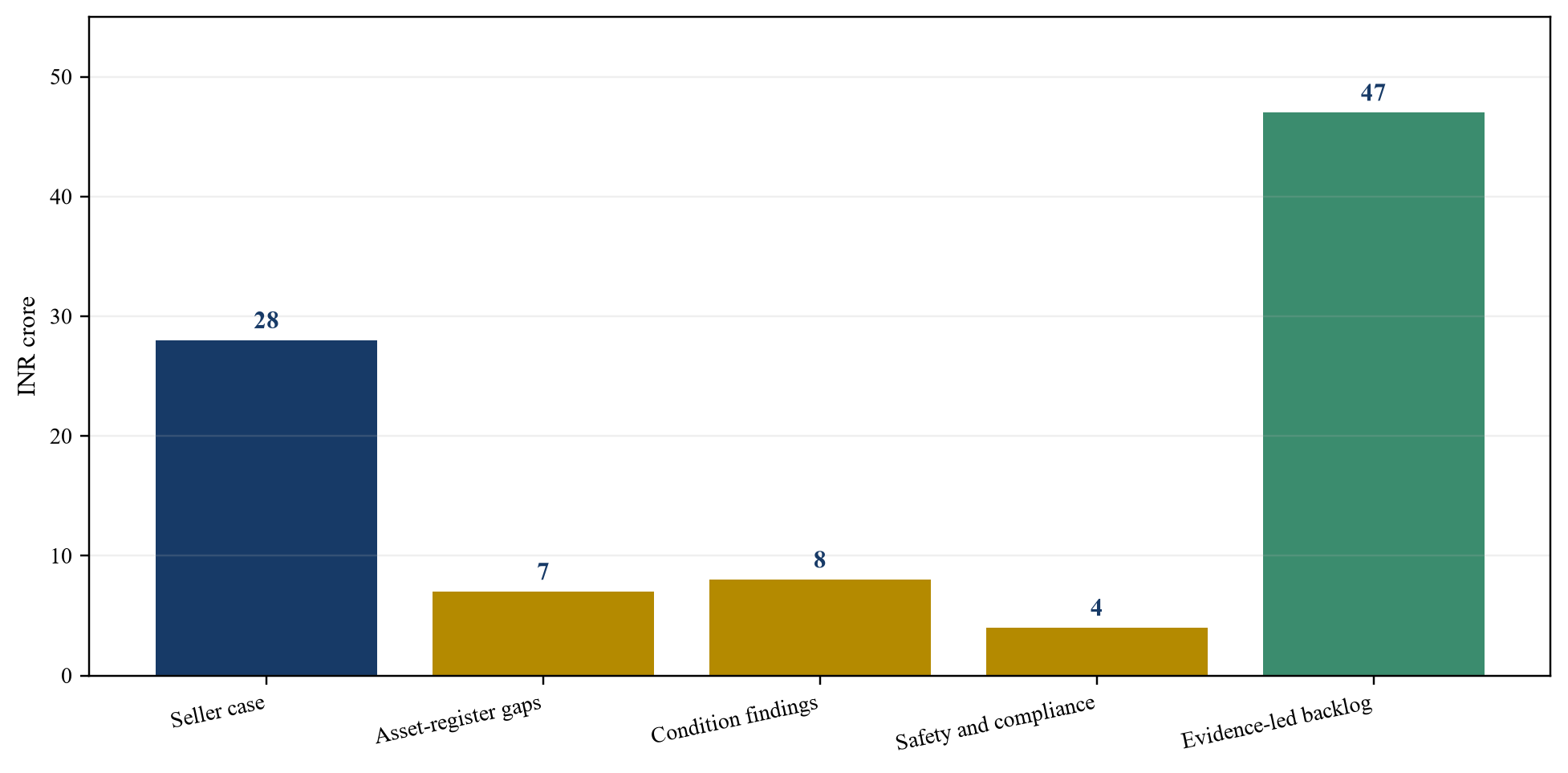
Management assumptions show how register, condition and compliance evidence can expand the initial backlog.
21. Translate evidence into valuation
The valuation bridge should explain how each finding changes cash flow or risk. Priority maintenance may be treated as an immediate cash requirement. Recurring under-maintenance may require EBITDA or free-cash-flow normalisation. Separation capex may reduce enterprise value or remain a buyer-funded investment reflected in the bid. Expected downtime can reduce near-term output. Safety or permit risk can change the probability of closing or operation.
The bridge should preserve gross and net views. If the seller agrees to remediate INR 10 crore of scope before closing, the buyer's residual requirement falls only after completion is verified. If a transitional service defers a system build, the model should still include the target-state cost and TSA fees. Timing can influence present value and debt drawdown.
Sensitivity analysis should vary estimate range, outage duration, remediation timing and recovery. It should also test whether the base EBITDA depends on deferral. A robust committee paper shows the original case, revised evidence-led case and protected structure.
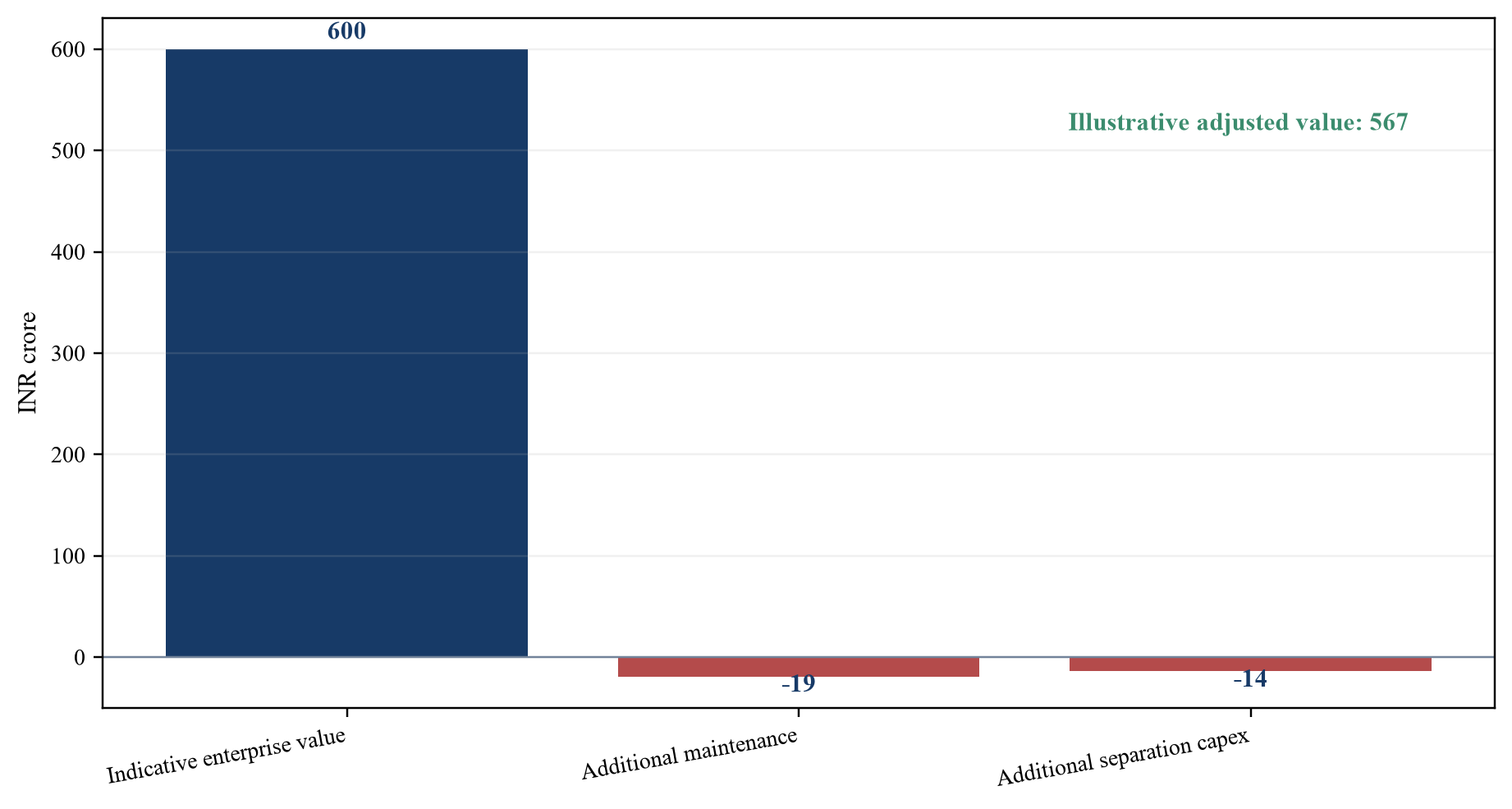
Management assumptions isolate the incremental maintenance and separation-capex effects before other deal adjustments.
22. Convert findings into transaction protections
Different risks require different protections. A known, measurable backlog can support a price adjustment or seller remediation. Uncertain scope may support escrow, retention, a specific indemnity, a closing condition or additional access. Shared assets may require transfer, replacement or a transitional service. Compliance gaps may require warranties, covenants and verified action plans.
Representations should align with the evidence schedule. Broad statements that assets are in good condition can create dispute over meaning. Schedules can identify material assets, inspection status, known defects, overdue work, shared dependencies and capital commitments. Legal counsel should determine drafting and enforceability.
Completion mechanisms should prevent double counting. An item should not reduce enterprise value, increase debt-like items and reappear as a working-capital adjustment without rationale. The transaction bridge should identify the economic mechanism once and show any separate accounting or legal treatment.
23. Design transitional services and separation execution
Transitional services should buy time for a controlled exit from shared capability. The service catalogue needs scope, service level, volume, cost, security, data, liability, change control, exit assistance and termination. Plant-critical services deserve stronger continuity planning than administrative support.
Computer-vision evidence can support exit acceptance. Repeated route images can confirm asset movement, installation, guarding and visible remediation. These checks sit alongside commissioning tests, permits, systems validation and operational readiness. A visual match alone does not prove performance.
The separation plan should integrate procurement lead times and shutdown windows. Long-lead equipment, control-system changes and utility isolation may determine the critical path. The deal timetable should reflect engineering reality rather than assuming every dependency can be resolved between signing and closing.
24. Align the financing plan
Lenders need visibility into maintenance, separation and working-capital cash. A facility sized from unadjusted EBITDA can leave insufficient headroom when catch-up work and stand-up costs arrive. The financing case should include committed acquisition funding, capital facilities, liquidity reserves, covenant definitions and conditions for drawdown.
The lender's technical adviser can use the evidence register to test material assets, capex and completion. Reporting can include remediation progress, downtime, capital spend and critical exceptions. Any covenant add-back for separation costs should be defined, capped and time-bound.
Debt capacity remains a cash-flow decision. Computer vision can strengthen evidence and reduce information asymmetry; it does not create repayment capacity. The financing committee should retain downside cases for delayed separation, higher maintenance and lost output.
25. Build the Day One and first hundred day plan
Day One priorities are safety, legal control, operating continuity, customer delivery, liquidity and decision authority. The buyer should know which assets can operate, which require interim controls and which must remain offline. Critical spares, competent personnel, maintenance contracts and system access should be confirmed before control transfers.
The first hundred days should close high-priority backlog, validate the asset hierarchy, improve preventive maintenance, establish condition baselines and begin separation exits. The image protocol can become a repeatable monitoring route where it adds value. It should integrate with the maintenance system rather than create a parallel issue list.
Benefits should be measured in operating terms: reduced unplanned downtime, improved schedule compliance, lower repeat defects, better spares availability and clearer capital decisions. A technology deployment without these outcomes should be reconsidered.
26. Implement the framework in twelve weeks
Weeks one and two define the perimeter, decision rights, materiality, data rooms and site-access protocol. Weeks three and four reconcile registers and design collection routes. Weeks five and six collect evidence and establish the labelled validation set. Weeks seven and eight run models, engineer review and exception follow-up. Weeks nine and ten complete cost estimates and separation design. Weeks eleven and twelve integrate valuation, financing, transaction protections and the post-close plan.
The programme should prioritise bottlenecks, safety-critical systems, shared infrastructure and high-value assets. Sampling can cover low-risk populations, provided the method and limits are documented. The team should reserve time for repeat access because the first reconciliation usually reveals gaps.
Each weekly governance meeting should decide unresolved ownership, site access, evidence quality, critical findings and model changes. The final output should be a decision package rather than a technology demonstration.
27. Recognise limitations
Images capture visible conditions at a point in time. They may miss internal degradation, intermittent faults, hidden components, process instability and defects obscured by guards or insulation. Lighting, camera angle and cleanliness affect detection. Thermal and other sensors require controlled methods. No visual system replaces non-destructive testing, statutory inspection or competent engineering judgement.
Historical maintenance data can be incomplete or strategically coded. Cost estimates depend on scope, market pricing, access, shutdown windows and contingency. Transaction access may restrict testing. The framework responds by showing evidence status, ranges and residual uncertainty.
Model performance can drift when assets, sites, cameras or processes change. General-purpose models can produce plausible but incorrect descriptions. The system therefore restricts tasks, tests local performance, records abstentions and preserves human approval. These limitations should appear in the investment decision and transaction documents where material.
28. Draw the investment conclusion
Computer vision can improve industrial carve-out diligence when it is embedded in a governed evidence and decision system. It expands physical coverage, accelerates reconciliation and makes condition issues easier to trace. Its commercial value comes from better perimeter decisions, more credible maintenance and separation estimates, clearer transaction protections and a more executable post-close plan.
The buyer should require five conditions before relying on the system: a controlled asset register; repeatable image acquisition; locally validated bounded models; accountable engineering and financial review; and a documented bridge to valuation and transaction terms. Weakness in any condition should reduce reliance and increase direct inspection.
The result is a practical way to convert plant evidence into deal decisions while preserving professional accountability. It can reduce avoidable surprise, but it cannot remove industrial, legal or market risk. The investment committee remains responsible for deciding which risks to accept, price, transfer, remediate or reject.
Sources
- Ministry of Labour and Employment, Occupational Safety, Health and Working Conditions Code 2020 Read the primary source
- Bureau of Indian Standards, Compendium of Indian Standards on Machinery Safety 2025 Read the primary source
- Bureau of Indian Standards, Product Specific Information for Safety Certification of Machinery Read the primary source
- MVTec, MVTec Anomaly Detection Dataset Read the primary source
- MVTec, MVTec LOCO Anomaly Detection Dataset Read the primary source
- National Institute of Standards and Technology, Artificial Intelligence Risk Management Framework 1.0 Read the primary source
- NIST AI Resource Center, AI RMF Core Read the primary source
- OECD, OECD AI Principles updated 2024 Read the primary source
- Institute of Chartered Accountants of India, Educational Material on Ind AS 16 Property Plant and Equipment Read the primary source
- Institute of Chartered Accountants of India, Educational Material on Ind AS 36 Impairment of Assets 2026 Read the primary source
- Institute of Chartered Accountants of India, Educational Material on Ind AS 105 Read the primary source
- IFRS Foundation, IFRS 5 Non-current Assets Held for Sale and Discontinued Operations Read the primary source
- Ministry of Corporate Affairs, Companies Act and Schedule II useful-life requirements Read the primary source
- Bureau of Indian Standards, Indian Standards on Machine Safety Read the primary source
- Ministry of Electronics and Information Technology, Digital Personal Data Protection Act 2023 Read the primary source
- Indian Computer Emergency Response Team, Directions under section 70B of the Information Technology Act Read the primary source
- International Organization for Standardization, ISO IEC 27001 Information Security Management Systems Read the primary source
- Batzner et al., EfficientAD Accurate Visual Anomaly Detection at Millisecond-Level Latencies Read the primary source
- Kirillov et al., Segment Anything Read the primary source
- Oquab et al., DINOv2 Learning Robust Visual Features without Supervision Read the primary source
- International Organization for Standardization, ISO 55001 Asset Management System Requirements 2024 Read the primary source
- ISO Technical Committee 251, ISO 55001 2024 Updated Guidance Read the primary source
- Securities and Exchange Board of India, Scheme of Arrangement by Listed Entities Read the primary source
- Competition Commission of India, Competition Criteria of Combination Rules 2024 Read the primary source
- International Organization for Standardization, ISO 31000 Risk Management Guidelines Read the primary source
- IFRS Foundation, IFRS 5 Supporting Material Read the primary source
