

1. Frame the financing question around collected value
The growth-capital question is not simply how much money an expanding software company can raise. The board must determine which customer evidence supports additional capacity, how that capacity converts into collected recurring gross profit and when the business can fund its own next phase. A financing plan should therefore begin with the operating chain from customer problem to contract, delivery, invoice, collection, renewal and cash contribution.
India provides a large base for exported software activity. The Reserve Bank of India's survey estimated software-services exports excluding overseas commercial presence at USD 190.7 billion for 2023-24. The United States accounted for 54 per cent of destination share, Europe for 31 per cent, and the US dollar for 72 per cent of invoicing currency.[1] These sector statistics establish the importance of cross-border software revenue. They do not establish the quality, durability or value of an individual SaaS company's contracts.
The investor should translate the company story into six linked claims. The target customer has a material problem. The product changes an observable outcome. Contracts preserve an economic relationship through renewal. Delivery economics improve with scale. Currency and regulatory arrangements protect cash conversion. New capital funds a repeatable engine rather than compensating for unidentified leakage.
Each claim needs a dated evidence owner. Management presentations can describe the opportunity, but the model should reconcile to contracts, invoices, bank receipts, product usage, support records, cloud bills, payroll, tax records and the general ledger. A difference between the commercial narrative and the reconciled evidence is an underwriting issue.
The capital thesis should state the amount sought, runway created, operating gates funded, governance rights proposed and the decision enabled at the end of the period. A useful outcome might be an evidenced path to a defined recurring gross-profit scale with an approved cash reserve. A target expressed only as revenue growth can reward contracts that consume cash or remain difficult to collect.
2. Convert the market opportunity into accessible revenue
The Economic Survey 2025-26 reports that India's share of global services trade increased from 2 per cent in 2005 to 4.3 per cent in 2024 and identifies services as a major recipient of foreign direct investment.[2] This supports a strong national context for internationally delivered services. Company underwriting still requires a narrow market definition: a named customer segment, a specific workflow, an addressable buying unit and a route that permits the company to contract, deliver and collect.
A global total addressable market should be decomposed into countries, sectors, customer sizes, use cases and buying channels. Each segment needs evidence of budget, procurement requirements, replacement risk, sales cycle, implementation capacity and collection. A large market can remain inaccessible where the product lacks required integrations, security evidence, local references, language, data arrangements or an accountable buyer.
The company should maintain a market evidence register. Customer interviews, paid pilots, competitive outcomes, procurement findings and lost-deal reasons should be connected to product decisions and the sales forecast. Pipeline stages should have observable entry and exit criteria. Founder relationships and partner introductions can create early revenue, but a growth-capital model needs a path to repeatable acquisition beyond exceptional access.
Geographic concentration should be visible at customer, invoicing currency, legal jurisdiction and delivery level. Ten customers in several countries may still depend on one procurement platform, one cloud region or one regulatory rule. The board should test common-cause exposure rather than count logos alone.
Table 1. Growth-capital evidence register
| Investment claim | Required evidence | Cash-flow question | Governance response |
|---|---|---|---|
| Product-market fit | paid cohorts, usage, renewal and referenceability | does customer value persist after implementation? | approve segment and use-case boundary |
| Revenue quality | signed terms, billing, collection and contract changes | how much reported growth converts into recurring cash? | maintain contract-to-cash reconciliation |
| Scalable acquisition | stage history, conversion, cycle and channel cost | when does acquisition spend recover in cash? | release sales capacity through cohort gates |
| Product efficiency | roadmap, delivery, cloud and support evidence | does incremental revenue raise recurring gross profit? | rank product investment by value and dependency |
| Currency resilience | exposure ledger, pricing, collection and hedge evidence | how do currency movements affect cash and valuation? | approve exposure limits and management actions |
| Financing path | runway, milestones, downside and reserve | what decision becomes possible before cash is exhausted? | set capital gates, reserve and escalation rules |
Each claim should reconcile to source evidence and a responsible owner.
3. Define the recurring-revenue perimeter
Annual recurring revenue is a management measure rather than a complete accounting or cash measure. The company should publish an internal definition that identifies eligible contracts, committed recurring consideration, usage assumptions, discounts, services, implementation, credits, reseller economics, taxes and currency conversion. The definition should remain stable across periods, with changes approved and bridged.
IFRS 15 requires an entity to identify customer contracts and performance obligations, determine the transaction price, allocate that price and recognise revenue as promised goods or services transfer.[3] A board ARR measure can support commercial management, but it should reconcile to the accounting treatment and explain differences. Upfront billing, variable usage, cancellation rights and material services can create different ARR, revenue and cash profiles.
Contracted recurring revenue should be separated from expected renewals and pipeline. Signed multi-year value should be analysed for termination rights, price resets, minimum consumption, service credits, implementation dependencies and customer acceptance. A contract that can be terminated conveniently or depends on unfinished delivery has less financing quality than an unconditional, collectable recurring obligation.
The perimeter should exclude one-off implementation, pass-through cloud, hardware and exceptional professional services unless the investment committee deliberately analyses them separately. These items can be commercially useful, but combining them with subscription revenue can obscure margin, working capital and repeatability.
Discounting should also be visible. A large first-year concession can improve reported logo growth while reducing collected contribution and creating a difficult renewal step. Free months, ramped prices, minimum usage, service credits and bundled professional services should be recorded as economic terms rather than left inside a nominal contract value. Sales compensation should use the approved economic measure so that commercial incentives support the financing case.
The company should retain both gross and net retention. Net retention can show expansion within surviving accounts, while gross retention shows how much of the opening base remains before expansion. A high net figure can coexist with material customer loss when a small number of customers expand rapidly. Investors should therefore review the distribution, customer movements and recurring gross-profit effect.
The company should bridge opening ARR to new business, expansion, contraction, price, usage, churn, currency and closing ARR. A separate contract-to-cash bridge should show billed value, deferred revenue, receivables, credits, write-offs and collections. Together, these records prevent a single recurring-revenue number from carrying several incompatible meanings.
4. Build an ARR quality matrix
Revenue quality has several dimensions. Contract durability tests term, termination and renewal. Product dependency tests workflow importance and usage. Customer quality tests credit, budget ownership and collection. Economic quality tests recurring gross profit after delivery and support. Portfolio quality tests concentration and common dependencies. Evidence quality tests whether the underlying records are complete and reproducible.
The matrix should score each material cohort rather than assign one company-wide label. A regulated enterprise product can have long contracts and slow collections. A self-service product can collect in advance but experience rapid churn. A partner-sold product can scale distribution while surrendering pricing control and customer access. Each pattern creates a different financing profile.
Scores should direct investigation, not substitute for judgement. A low score needs an identified cause, owner and economic effect. Remediation can include contract changes, pricing, product work, implementation discipline, collection, customer-success intervention or a forecast haircut. The board should resist turning the matrix into a cosmetic average that offsets one critical weakness with several minor strengths.
The matrix should be refreshed at least at each financing forecast cycle and after material changes to product, pricing or customer terms. Investors can then distinguish operational improvement from changes in measurement. Historic cohorts should retain their original definitions so that later outcomes can be compared with the assumptions used when capital was committed.
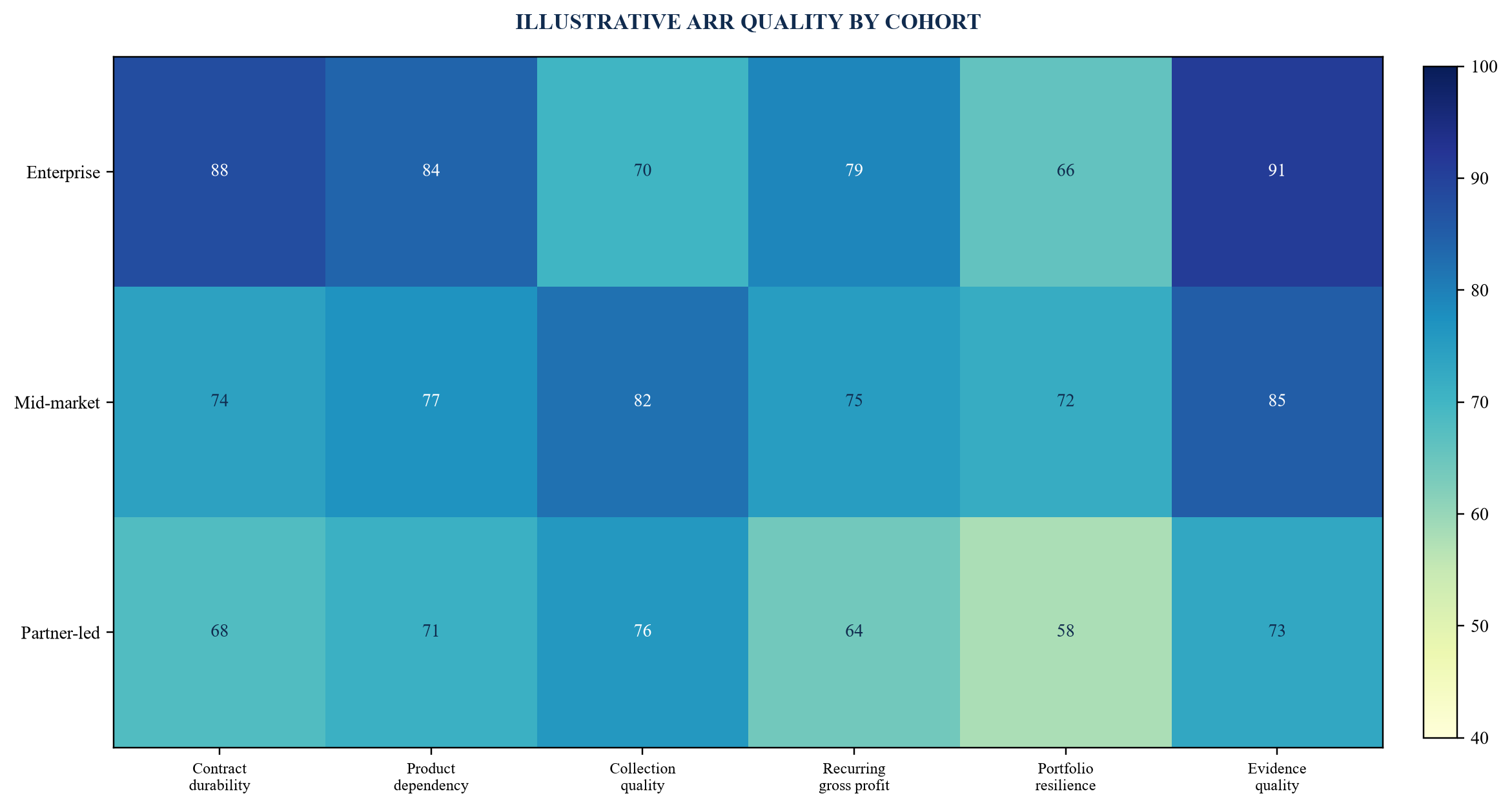
Illustrative scoring architecture; live scores require company evidence.
5. Reconcile revenue, billing and collection
Growth investors ultimately fund cash needs. Reported revenue, invoicing and collection therefore require an integrated monthly bridge. The bridge should begin with contract performance obligations, show billing triggers and credit terms, and end with bank receipts and unresolved receivables. Foreign-currency balances should retain both original and functional-currency values.
IAS 21 addresses foreign-currency transactions and the translation of foreign operations, including identification of functional currency and the exchange rates used.[4] The accounting treatment provides a disciplined base. Management also needs operating views by transaction currency, collection date, contract repricing cycle and forecast cash use.
Receivables ageing should distinguish administrative delay, disputed delivery, customer liquidity, missing documentation, tax withholding and channel settlement. A growing receivables balance can reflect enterprise scale, but it can also indicate weak acceptance, poor contracting or sales compensation that rewards bookings without collection quality.
Deferred revenue can support cash conversion where customers pay in advance. It can also create an obligation to deliver service while the cash has already been consumed. The runway model should therefore show both cash and the cost to fulfil contracted obligations. An investor should understand whether advance collections finance growth or create a future delivery burden.
The board pack should show revenue, billing, collection and recurring gross profit for the same cohorts. Differences should have named causes. This single reconciliation improves valuation, forecasting, sales incentives and financing credibility because it converts accounting and commercial measures into a traceable cash narrative.
6. Underwrite retention through cohort economics
Logo retention describes customer continuity. Revenue retention describes value continuity. Recurring gross-profit retention describes the cash contribution preserved after service costs. A growth-capital model should show all three because expansion revenue can conceal customer loss, price can conceal usage contraction, and revenue can conceal rising cloud or support cost.
Cohorts should be formed by a characteristic that changes economics: acquisition period, segment, product, channel, geography or contract model. Opening value should reconcile to the customer ledger. New, expansion, contraction, churn, price, usage and currency should be shown separately. Reclassifications should be documented so that weak performance is not moved between categories.
Product usage is supporting evidence rather than a substitute for contracted value. A high-frequency workflow can support renewal, but usage without budget ownership or measurable customer outcome may not. The company should connect usage to renewal, expansion, support demand and payment.
Customer acquisition cost should include the people, partner, marketing, trial, security, solution-engineering, implementation and management effort required to reach a live, paying customer. Payback should use collected recurring gross profit. A booked-revenue payback measure can understate the capital required when customers pay late or implementation is intensive.
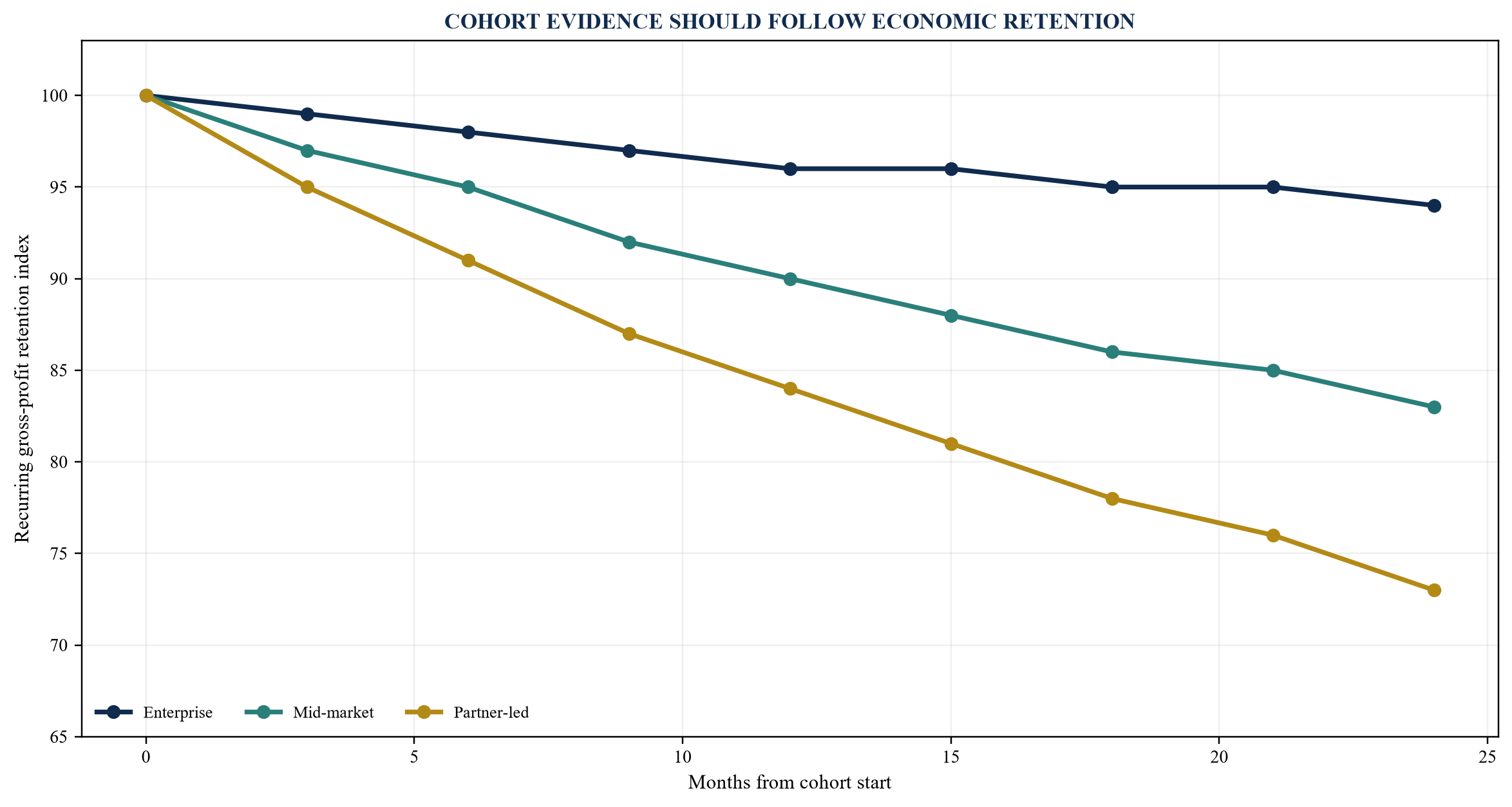
Values are illustrative modelling inputs and are not market benchmarks.
7. Separate the four currency exposures
An India-based SaaS company can benefit when foreign-currency revenue converts into rupees while a substantial cost base remains domestic. The benefit is conditional. The board should separate transaction exposure, translation exposure, pricing exposure and economic exposure.
Transaction exposure arises between contract, invoice and settlement. Translation exposure arises when foreign operations or balances are reported in the functional or presentation currency. Pricing exposure arises when contracts renew more slowly than currency or cost changes. Economic exposure arises when currency movements affect customer budgets, competitor pricing, wage inflation, cloud cost or the location of future operations.
The exposure ledger should record amount, currency, timing, certainty, natural offsets, contractual repricing, derivative position and owner. Forecast pipeline should remain separate from contracted exposure. A hedge sized to optimistic pipeline can create a speculative position if sales do not materialise.
The RBI's foreign-exchange directions permit users to manage eligible exposures subject to applicable conditions and require exposure and hedge records to remain aligned.[5] The company should obtain current advice from its authorised dealer and advisers before executing a hedge. The board's policy should define permitted instruments, counterparties, limits, evidence, reporting and escalation.
Natural hedges can include foreign-currency cloud expense, overseas payroll or local customer-service cost. They should be recognised only where timing and currency genuinely align. A USD cost does not offset a USD receivable if the amount or settlement window is materially different.
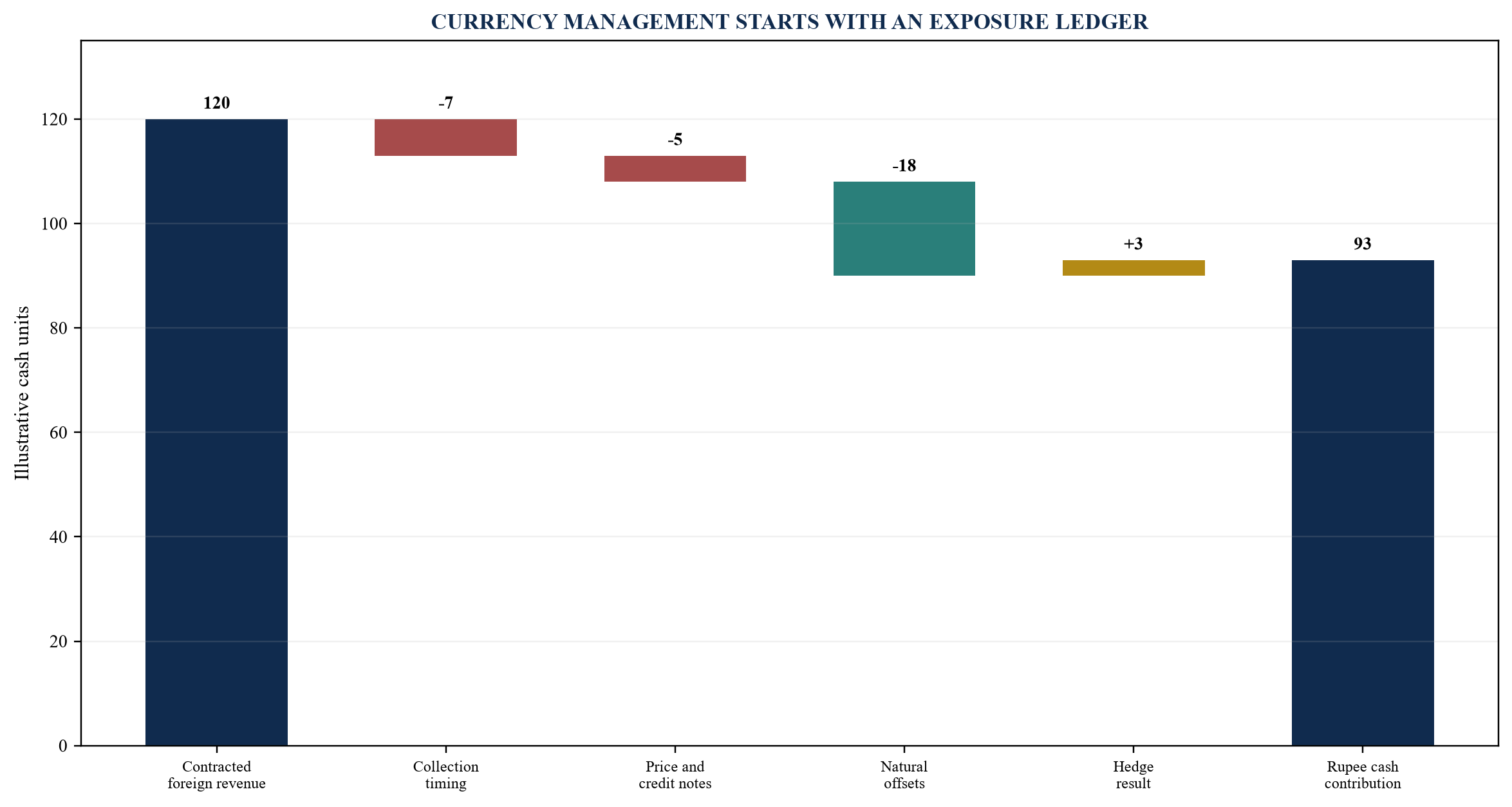
Hypothetical values demonstrate the management bridge.
8. Connect currency to pricing and valuation
Foreign-exchange management should begin in commercial design. Contract currency, billing frequency, payment terms, indexation, renewal timing and price-change rights determine the exposure before a derivative is considered. A company with annual price resets and monthly advance billing has a different risk from one with three-year fixed prices and quarterly arrears.
The pricing committee should review customer willingness to pay, competitive alternatives, service cost and currency. A rupee depreciation can improve translated revenue while increasing imported cloud, software and overseas selling costs. It can also encourage competitors to reduce local-currency prices. The model should therefore avoid treating exchange movement as a permanent margin gain.
Valuation should use a cash-flow view consistent with the forecast currency. Discount rates, terminal assumptions and debt should follow the same currency framework. If a multiple is applied to recurring revenue, the investor should understand whether the metric uses period-end, average or contracted exchange rates and whether currency growth is separated from organic customer growth.
Table 2. Currency exposure and management bridge
| Exposure | Evidence | Model treatment | Possible management action |
|---|---|---|---|
| Contract to invoice | signed terms, milestones and billing currency | probability and timing by contract | align milestones and invoice promptly |
| Invoice to collection | receivables, disputes and bank receipts | ageing and currency-specific collection curve | tighten acceptance and collection ownership |
| Contract repricing | renewal dates and price rights | downside before next reset | indexation, shorter terms or price corridor |
| Natural offset | cloud, payroll and operating commitments | match currency, amount and tenor | preserve genuine operating offset |
| Derivative position | dealer confirmation and underlying exposure | instrument cash flows and accounting | apply approved hedge policy and limits |
| Economic exposure | competitors, customer budgets and cost geography | scenario effect on growth and margin | change pricing, delivery or market allocation |
Policies and instruments require current company-specific advice.
9. Measure product efficiency through recurring gross profit
Software gross margin can appear high while important product costs sit in research, support or implementation. The growth-capital model should identify the cost required to deliver the contracted service at the promised performance, security and reliability. Cloud hosting, model inference, third-party data, observability, support, customer success and recurring implementation effort need consistent classification.
IAS 38 sets recognition principles for intangible assets and distinguishes research expenditure from qualifying development expenditure.[6] Accounting classification should follow the applicable standard and professional advice. Management should also maintain a cash view that shows total product and engineering expenditure, capitalisation, amortisation and the capacity created.
Artificial-intelligence features can change SaaS economics. Inference cost may scale with usage. Third-party model prices and terms can change. Human review may remain necessary for quality or regulated workflows. The product case should state the customer outcome, willingness to pay, cost per unit, error and exception rate, data rights, vendor dependency and fallback.
Cloud commitments require the same discipline. Reserved capacity can reduce unit cost when demand is stable, but it can become an unavoidable cash obligation when growth is delayed or architecture changes. The company should reconcile provider invoices to products, customers, environments and engineering use. Commitments, credits, egress, support and termination terms should appear in the forecast rather than remain solely in a technology budget.
Security and resilience investment should be connected to customer and operating evidence. Certifications, penetration testing, backup, recovery and access control can enable enterprise revenue and protect renewal. Their economic value is visible through contracts won, risks reduced and operating continuity, even where the expenditure does not create a separately priced feature.
Product efficiency should be measured through roadmap throughput and economic effect rather than lines of code or release count. A feature can reduce churn, raise price, reduce support, improve conversion or satisfy a control requirement. Each material initiative should connect to a customer cohort and a measurable result.
The investor should distinguish maintenance, mandatory control, platform resilience and growth options. All can be necessary. Combining them into one undifferentiated research-and-development percentage makes it difficult to understand how new capital creates value.
10. Rebuild unit economics from collected contribution
Unit economics should follow the same customer through acquisition, implementation, billing, collection, service and renewal. The denominator can be a customer, contract, user, location, transaction or workload, depending on the commercial model. The company should choose the unit that best reflects the cost and value driver.
Collected contribution equals cash collected less the cash cost directly required to acquire, implement and serve the cohort within the measurement period. This measure does not replace accounting profit. It gives the financing model a view of when growth begins to return cash.
Gross-margin averages can conceal distribution. Large customers may require bespoke product work, security reviews, local contracting and senior support. Small customers may have low service cost but high churn. Channel partners can reduce acquisition cost while taking margin and limiting customer data. The cohort table should retain these differences.
Table 3. Hypothetical customer-cohort economics
| Measure | Enterprise | Mid-market | Partner-led | Underwriting interpretation |
|---|---|---|---|---|
| Contracted annual value | 100 | 100 | 100 | common index for comparison |
| Cash collected in year one | 92 | 96 | 88 | reflects timing, credits and channel settlement |
| Recurring delivery cost | 24 | 19 | 27 | cloud, support and recurring service |
| Acquisition and implementation cash | 31 | 24 | 18 | fully loaded cohort launch cost |
| Year-one collected contribution | 37 | 53 | 43 | cash returned before central operating cost |
| Month-24 recurring gross-profit retention | 94% | 83% | 73% | durability changes lifetime value materially |
All values are illustrative and should be replaced with reconciled company data.
11. Treat hiring as capacity with lead time
Payroll is often the largest domestic cash commitment. A hiring plan should therefore connect each role to capacity, start date, ramp time, productivity, manager load and customer demand. Hiring against a revenue percentage can produce an attractive spreadsheet while creating capacity before evidence or after the bottleneck has already constrained growth.
Sales capacity should reflect territory, segment, cycle, pipeline coverage and ramp. Engineering capacity should reflect product dependencies and delivery risk. Customer-success capacity should reflect implementation, renewal and support burden. Finance, security, legal and people capacity should reflect the controls required by company scale and customer expectations.
Compensation should include fixed pay, variable pay, statutory costs, recruitment, equipment, facilities, retention and equity dilution. Currency can affect talent cost indirectly through competition from global employers. The model should include realistic notice periods and replacement time for critical roles.
The board should approve role families through gates. A role can be released when the defined demand and management capacity exist. The hiring plan should also identify roles that can be delayed, contracted or transferred in downside. Essential controls and customer commitments require separate protection.
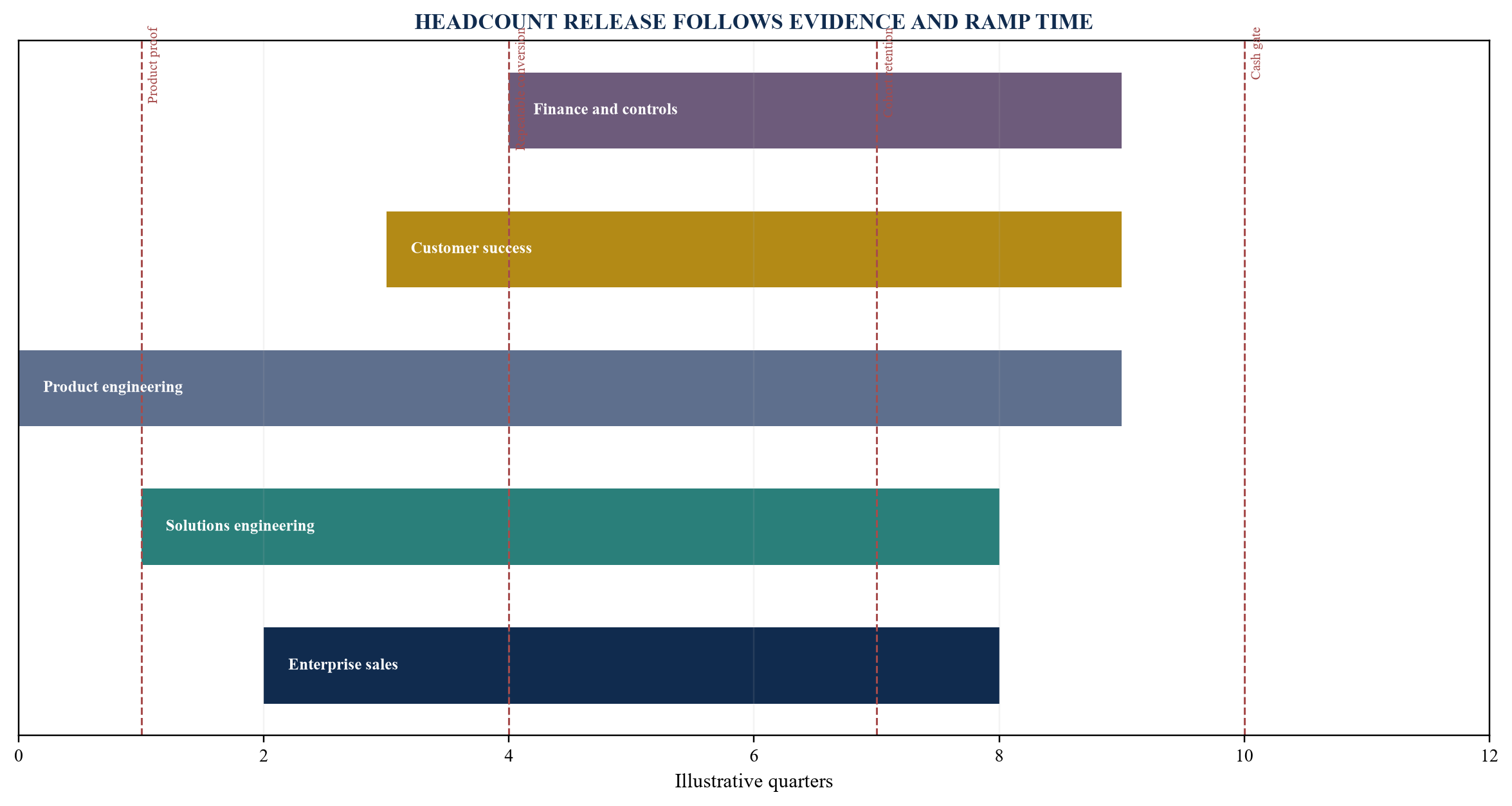
Illustrative role timing; actual hiring requires company-specific evidence.
12. Make working capital part of the growth model
SaaS growth can consume working capital when implementation precedes billing, customers pay in arrears, tax is withheld, partners settle slowly or annual discounts encourage uneconomic terms. The cash forecast should model contract-level billing and collection patterns rather than apply one receivables percentage to revenue.
The RBI's directions on export of goods and services govern relevant foreign-exchange aspects of service exports and should be read with current bank and adviser guidance.[7] The company should reconcile invoices, export documentation, bank receipts, write-offs and outstanding amounts through an accountable process. Regulatory compliance and cash forecasting should use the same underlying records.
Collections should have commercial ownership. Sales can support disputed scope and executive access. Delivery can close acceptance evidence. Finance can control invoicing, follow-up and allocation. Legal can support contract enforcement. A receivables problem rarely belongs to one function alone.
The financing reserve should include a collection downside. A business can meet reported revenue targets and still approach a cash constraint when receivables age or customer concentration rises. The board should define thresholds for aged balances, disputed invoices, credit notes and concentration.
13. Reconcile the legal-entity and tax architecture
Global SaaS revenue can be contracted through an Indian company, foreign subsidiaries, distributors or combinations of these. The structure affects customer procurement, data, intellectual property, tax, foreign exchange, transfer pricing, people and cash repatriation. The operating reality should match the contracts and intercompany arrangements.
India's transfer-pricing framework addresses international transactions, including software and information-technology services, and provides mechanisms such as safe harbours and advance pricing agreements subject to applicable conditions.[8] The company should obtain current advice on functions, assets, risks, pricing and documentation. Historic cost-plus arrangements may not reflect an evolved product company with valuable intellectual property and market risk.
The Reserve Bank's foreign-investment direction sets routes, pricing and reporting principles for investment by persons resident outside India.[9] The Companies Act 2013 contains requirements for private placement and share capital.[10] These regimes affect the financing timetable, instrument design, approvals, valuation evidence and filings.
The data architecture also affects market access. India's Digital Personal Data Protection framework and rules require a current implementation analysis based on the company's processing, customers and timing.[11] Overseas customer requirements may add other privacy, localisation and security obligations.
The diligence map should connect each legal entity to customers, employees, intellectual property, cloud contracts, bank accounts, taxes, licences, data roles and intercompany balances. A financing should avoid placing capital into one entity while critical rights or cash remain elsewhere without enforceable arrangements.
14. Choose the financing instrument after the operating case
Growth capital can be issued as ordinary equity, preference shares, convertible instruments or a combination permitted by the applicable legal and foreign-investment framework. The instrument should reflect valuation certainty, downside allocation, governance, future financing and the company's cash profile.
Equity can absorb operating volatility without scheduled repayment, but its terms can materially affect founder ownership, control, future rounds and exit proceeds. Preference rights, liquidation economics, anti-dilution, conversion, dividends, information, consent and transfer provisions should be modelled across outcomes.
A convertible instrument can defer part of the valuation negotiation. It also creates uncertainty around conversion, dilution, maturity, interest and the next financing. The company should confirm legal form, foreign-investment treatment, pricing and reporting before relying on a familiar label from another jurisdiction.
Investor governance should be sized to material decisions. Information rights can improve discipline when reports use reconciled definitions. Consent rights can protect reserved matters, but an extensive list can slow ordinary operations and future financings. Board composition, observer access, confidentiality, conflicts and decision deadlock should be designed with the expected investor group and company stage.
Secondary liquidity for founders or employees should be separated from primary growth capital. A secondary transaction can support alignment and personal risk diversification. It does not extend company runway. The sources-and-uses schedule should therefore show primary and secondary proceeds, fees, taxes and net cash available to the business.
SEBI's AIF regulations and master circular govern domestic alternative investment funds that can participate in private capital markets.[12][13] A company's investor map should distinguish fund mandate, stage, ownership limits, cheque size, reserves, governance needs, sector expertise and follow-on capacity.
The financing should retain enough unallocated reserve to respond to downside and high-return evidence. Committing every unit of capital to a fixed hiring plan at closing removes management flexibility and can make the next round dependent on perfect execution.
15. Value durable cash flow and strategic options
Valuation should begin with the operating model and use several methods as cross-checks. A revenue multiple is sensitive to ARR definition and quality. A recurring gross-profit multiple reflects delivery economics more directly. Discounted cash flow forces an explicit view of growth, margin, reinvestment, currency and terminal value. Comparable transactions require careful adjustment for time, scale, geography, growth and product.
IFRS 13 defines a fair-value framework for financial reporting.[14] A financing negotiation can involve price, rights and strategic considerations beyond a financial-reporting valuation. The parties should still use consistent inputs and clearly identify the basis of value.
The valuation bridge should separate opening recurring revenue, quality adjustments, currency, gross-profit durability, customer concentration, product investment, working capital, central cost and financing. Investor preference rights and option-pool changes should be included in the fully diluted ownership and exit waterfall.
Strategic options can include new products, markets and channels. They should be valued according to evidence and staged investment rather than included as certain base-case revenue. An option can justify a measured experiment without supporting the same value as a contracted cash flow.
16. Test the company through integrated scenarios
The base case should reflect the operating plan management can support with current evidence. The downside should combine plausible adverse events rather than reduce every line by the same percentage. Customer churn, slower sales, delayed collection, rupee movement, cloud-cost increase and hiring commitments can interact.
The upside should also require evidence. Faster conversion may require more implementation and customer-success capacity. Usage expansion can increase cloud and model cost. International growth can require local contracting or compliance investment. A credible upside retains these dependencies.
Each scenario should show revenue, recurring gross profit, operating cash, minimum liquidity, covenant or governance thresholds and the next financing need. The company should identify actions with lead times: hiring freeze, discretionary product delay, sales reallocation, pricing, collection intervention and capital preservation.
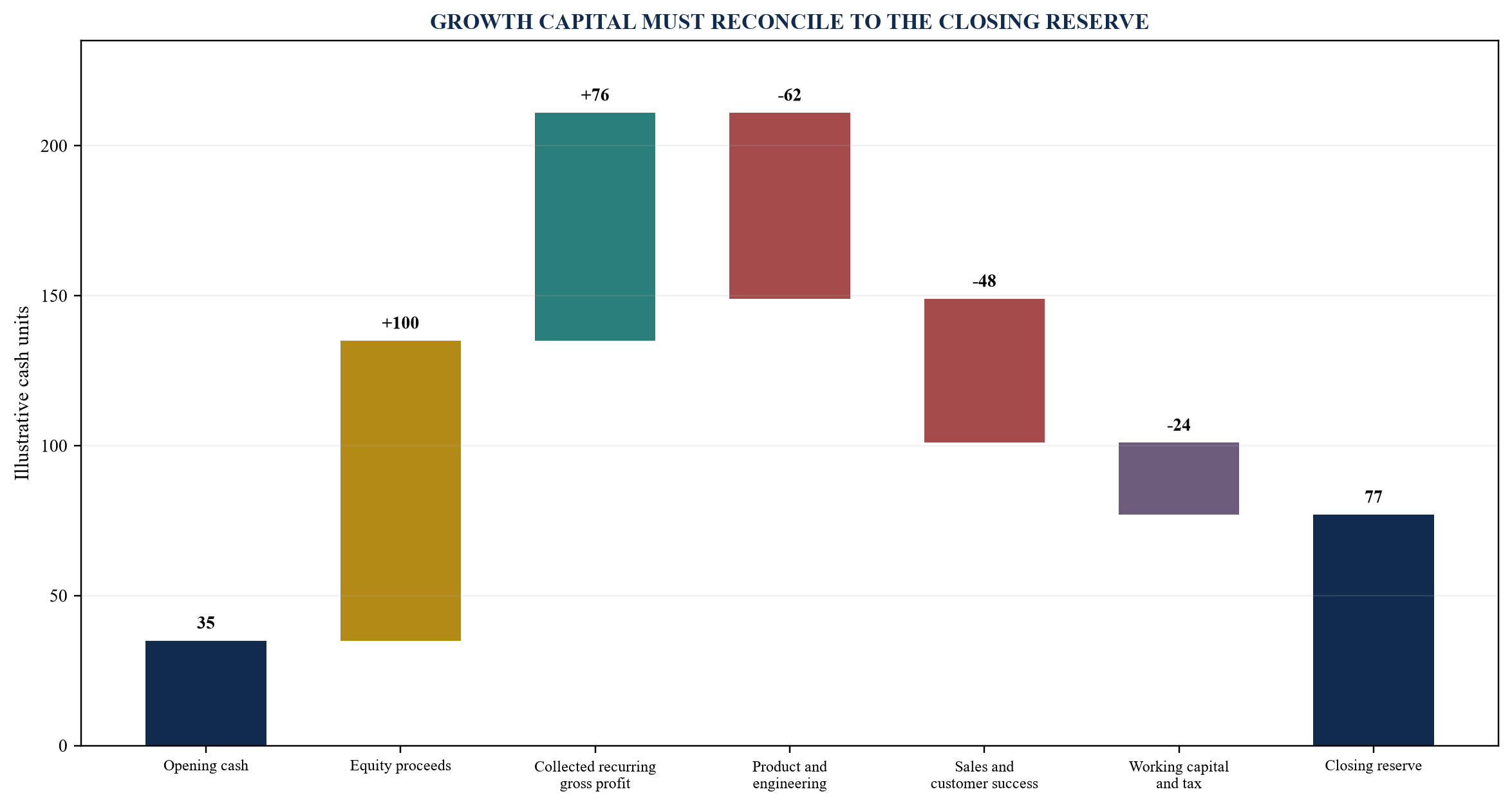
Hypothetical values illustrate how reported growth can differ from cash creation.
17. Release capital through operating gates
The use-of-proceeds schedule should connect spending to a measurable operating gate. Capital can be reserved at closing and released internally when evidence supports the next commitment. This discipline allows a company to move quickly while preserving downside options.
Gates should contain a metric, evidence source, owner, decision authority and consequence. A sales hiring gate can require conversion and pipeline quality. A product gate can require customer validation and cost. A market-entry gate can require paid demand and compliant contracting. A reserve gate can prevent discretionary spending below approved liquidity.
Metrics can be gamed when compensation and capital depend on them. The gate should therefore combine several reconciled measures and retain judgement. A strong ARR number with weak collection or negative recurring gross profit should not release the same capital as balanced evidence.
Table 4. Illustrative capital-release gates
| Capital use | Evidence before release | Monitoring measure | Downside action |
|---|---|---|---|
| Enterprise sales capacity | qualified segment, conversion and cycle evidence | collected recurring gross profit by cohort | freeze new territories and focus on proven segment |
| Product expansion | paid customer need, roadmap dependency and unit cost | adoption, retention, price and delivery cost | stop feature or reduce scope |
| Overseas market cell | compliant route, paid design partners and reference path | market contribution and collection | retain remote coverage or exit market test |
| Customer-success capacity | implementation and renewal workload | time to value, renewal and support burden | redesign onboarding and segment service |
| Resilience and controls | customer and regulatory requirements | incidents, audit findings and remediation | protect essential control budget |
| Strategic reserve | board-approved minimum liquidity | downside runway and committed obligations | escalate and suspend discretionary releases |
Amounts and thresholds require board approval based on live company evidence.
18. Build a financing governance system
The board should receive one monthly financing pack that reconciles the commercial, product, people, currency and cash views. The pack should show definitions, sources, changes and exceptions. A compact set of reliable measures is more useful than a large dashboard without ownership.
Core measures can include contracted recurring revenue, accounting revenue, collection, recurring gross profit, retention, concentration, acquisition payback, cloud unit cost, product delivery, headcount capacity, currency exposure, cash, committed obligations and minimum liquidity. Forecast accuracy should be measured so that repeated optimism becomes visible.
Decision rights should cover pricing, non-standard contracts, credit, hiring, product commitments, foreign exchange, capital expenditure, new entities, related-party transactions and investor consents. Delegations should preserve operating speed while identifying decisions that can change runway or financing rights.
The company should maintain a assumptions register. Each material forecast assumption should have a basis, date, owner and range. Actual outcomes should be compared with the original assumption. This creates institutional learning and improves the next financing process.
Data quality requires control over system boundaries. Customer relationship management, billing, accounting, payment, product and support systems can use different identifiers and dates. The finance team should maintain a governed customer and contract key so that cohort and cash analysis can be reproduced. Manual adjustments should carry a reason, preparer, approver and audit trail.
Governance should also include a financing calendar. The calendar should work backwards from minimum liquidity and include board decisions, investor reporting, diligence readiness, legal lead time and regulatory filings. Starting the next round only after the reserve is nearly exhausted reduces choice and can force management to optimise for speed rather than investor fit and terms.
19. Design diligence around the investment thesis
Diligence should test the claims that create value and the risks that can consume capital. Commercial work should reconcile customers, contracts, cohorts, pipeline, pricing and competition. Product work should test architecture, roadmap, quality, security, cloud, artificial intelligence and technical debt. Financial work should reconcile revenue, billing, collection, margins, costs, tax and cash.
Legal and regulatory work should cover corporate authority, financing instruments, foreign investment, intellectual property, employment, data, customer and supplier contracts, litigation and compliance. Tax work should address domestic and international structure, transfer pricing, withholding, permanent establishment, indirect tax and incentives. Foreign-exchange work should address investment, export receipts, intercompany flows, hedging and reporting.
Every material finding should change valuation, structure, a financing term, a capital gate, remediation, monitoring or the decision to stop. A long diligence report without an investment response does not complete the underwriting process.
Table 5. Finding-to-deal response matrix
| Finding | Economic effect | Financing response | Post-close control |
|---|---|---|---|
| weak contract durability | lower recurring cash and valuation | quality haircut, milestone or tranche | renewal and amendment register |
| aged or disputed receivables | higher working-capital need | reserve, price adjustment or collection condition | weekly cash and dispute ownership |
| customer or channel concentration | downside volatility | valuation scenario and concentration covenant | pipeline and diversification gate |
| uncontrolled currency exposure | margin and cash volatility | exposure policy and approved limit | monthly currency bridge |
| cloud or model cost escalation | lower recurring gross profit | forecast adjustment and product investment | unit-cost and provider monitoring |
| unfunded hiring commitments | compressed runway | revise use of proceeds and reserve | headcount gate and vacancy control |
| incomplete rights or compliance | restricted product or market access | remediation condition, indemnity or stop | accountable closure and audit evidence |
Responses depend on facts, law, materiality and negotiation.
20. Use growth capital to create financing independence
The strongest outcome of a growth-capital round is greater strategic choice. The company should emerge with a more durable customer base, clearer product economics, a controlled currency position, stronger evidence and a credible path to cash generation. A larger cost base without these improvements can make the next financing more urgent and less attractive.
The five records in this paper create one operating system. The ARR quality matrix defines the economic perimeter. The currency bridge protects the conversion of global revenue. Cohort economics identifies durable customer contribution. The hiring plan connects capital to capacity and lead time. The growth-to-cash waterfall preserves liquidity and reveals the next decision.
India's software-export scale, talent base and international customer access support a substantial opportunity. Company value still depends on the specific contracts, customers, product, people, rights, controls and cash flows that an investor can verify. Growth capital should follow that evidence.
The board should approve definitions before targets, reconcile measures before valuation and release spending after operating gates. This sequence converts a fundraising exercise into a disciplined programme for durable free cash flow and long-term enterprise value.
References
- Reserve Bank of India, “Survey on Computer Software and Information Technology Enabled Services Exports: 2023-24,” 18 October 2024. https://systemhealth.rbi.org.in/Scripts/BS_PressReleaseDisplay.aspx?prid=58937
- Government of India, Ministry of Finance, “Economic Survey 2025-26: Services Sector,” 2026. https://www.indiabudget.gov.in/economicsurvey/doc/echapter.pdf
- IFRS Foundation, “IFRS 15 Revenue from Contracts with Customers.” https://www.ifrs.org/issued-standards/list-of-standards/ifrs-15-revenue-from-contracts-with-customers/
- IFRS Foundation, “IAS 21 The Effects of Changes in Foreign Exchange Rates.” https://www.ifrs.org/issued-standards/list-of-standards/ias-21-the-effects-of-changes-in-foreign-exchange-rates/
- Reserve Bank of India, “Master Direction: Risk Management and Inter-Bank Dealings,” updated from time to time. https://systemhealth.rbi.org.in/Scripts/BS_ViewMasDirections.aspx?id=10485
- IFRS Foundation, “IAS 38 Intangible Assets.” https://www.ifrs.org/issued-standards/list-of-standards/ias-38-intangible-assets/
- Reserve Bank of India, “Master Direction: Export of Goods and Services,” updated from time to time. https://systemhealth.rbi.org.in/Scripts/BS_ViewMasDirections.aspx?id=10395
- Income Tax Department, Government of India, “Transfer Pricing.” https://www.incometaxindia.gov.in/en/transfer-pricing
- Reserve Bank of India, “Master Direction: Foreign Investment in India,” updated from time to time. https://systemhealth.rbi.org.in/Scripts/BS_ViewMasDirections.aspx?id=11200
- Ministry of Corporate Affairs, Government of India, “The Companies Act, 2013.” https://www.mca.gov.in/content/dam/mca/pdf/CompaniesAct2013.pdf
- Ministry of Electronics and Information Technology, Government of India, “Digital Personal Data Protection Rules 2025.” https://www.meity.gov.in/documents/act-and-policies/digital-personal-dataprotection-rules-2025gDOxUjMtQWa?pageTitle=Digital-Personal-Data-ProtectionRules-2025
- Securities and Exchange Board of India, “Alternative Investment Funds Regulations, 2012,” last amended 14 July 2026. https://www.sebi.gov.in/sebiweb/home/HomeAction.do?doListingAll=yes&search=Alternative+Investment+Funds
- Securities and Exchange Board of India, “Master Circular for Alternative Investment Funds,” 3 June 2026. https://www.sebi.gov.in/legal/master-circulars/jun-2026/master-circular-for-alternative-investment-funds-aifs-_101817.html
- IFRS Foundation, “IFRS 13 Fair Value Measurement.” https://www.ifrs.org/issued-standards/list-of-standards/ifrs-13-fair-value-measurement/
- IFRS Foundation, “IFRS 9 Financial Instruments.” https://www.ifrs.org/issued-standards/list-of-standards/ifrs-9-financial-instruments/
- IFRS Foundation, “IFRS 7 Financial Instruments: Disclosures.” https://www.ifrs.org/issued-standards/list-of-standards/ifrs-7-financial-instruments-disclosures/
- Department for Promotion of Industry and Internal Trade, Government of India, “Startup India: Looking for Funding.” https://www.startupindia.gov.in/content/sih/en/looking_for_funding.html
- Ministry of Electronics and Information Technology, Government of India, “Annual Report 2025-26.” https://www.meity.gov.in/static/uploads/2026/04/46face7d48c8f6a97030f713ad5fdab4.pdf
- Central Board of Direct Taxes, Government of India, “CBDT signs 219 Advance Pricing Agreements in FY 2025-26.” https://wmstatic-prd.incometaxindia.gov.in/documents/d/guest/cbdt-signs-219-advance-pricing-agreements-in-fy-2025-26
- Reserve Bank of India, “Master Direction: Overseas Investment,” updated from time to time. https://systemhealth.rbi.org.in/Scripts/BS_ViewMasDirections.aspx?id=12710
