
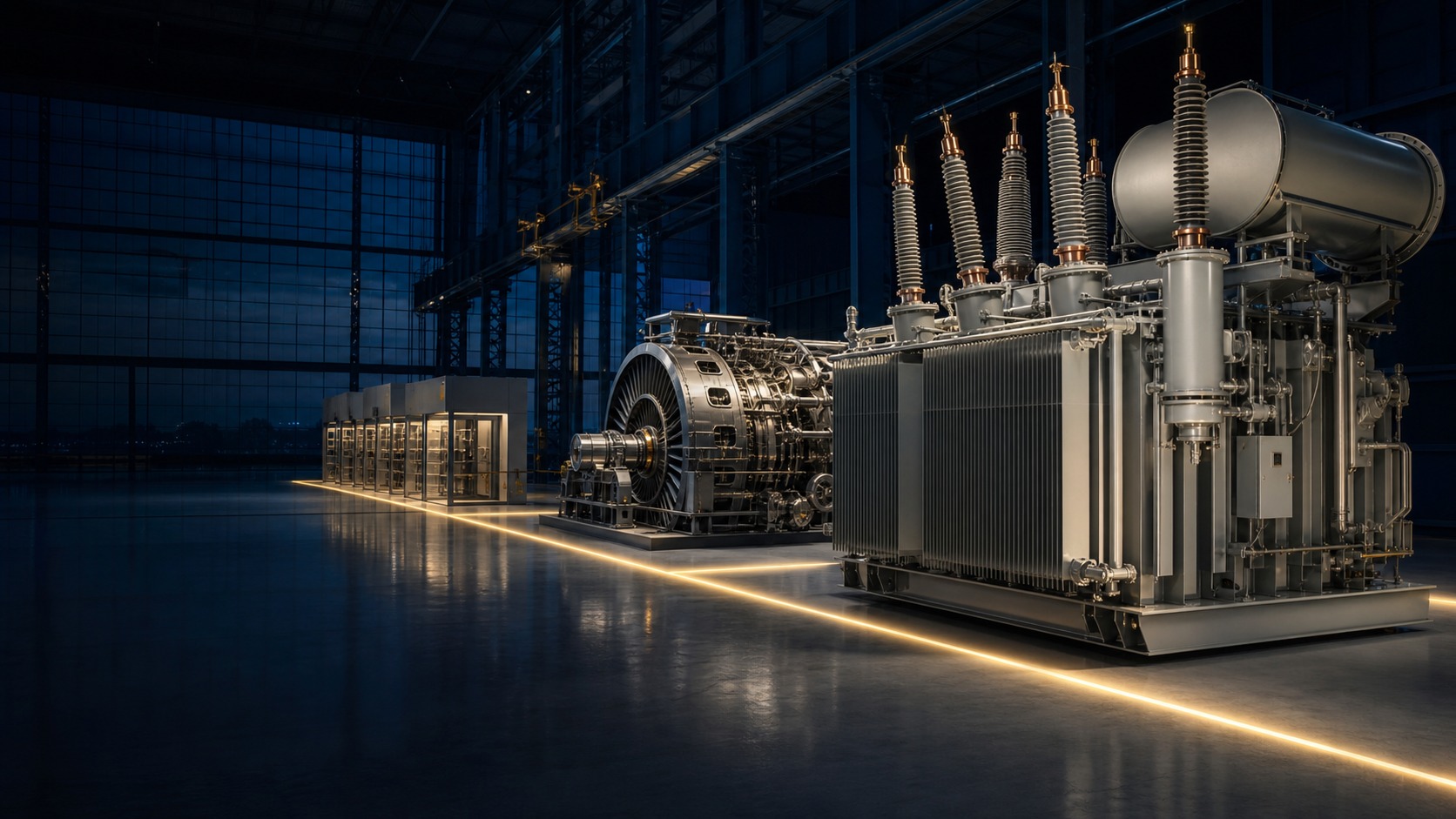
1. Move long-lead equipment onto the financing critical path
Long-lead procurement is a financing decision before it becomes a purchase order. A developer may have land, planning momentum and customer discussions while the power system remains dependent on equipment whose design, manufacture, testing and transport extend beyond the main construction programme. A late order can move energisation, mechanical completion and customer service dates. An early order can expose the sponsor to deposits, cancellation risk and stranded equipment.
The International Energy Agency reports that supply-chain pressures have increased prices and procurement times for key grid components. Its 2025 transmission-grid work describes procurement periods of two to three years for cables and up to four years for large power transformers, with large transformer prices about 75 per cent higher in real terms than in 2019. The US Department of Energy describes large power transformers as customised assets with long production, testing and transport chains, and notes lead times that can reach or exceed 36 months. These published observations establish sector pressure. A project must obtain current supplier evidence for its voltage, rating, configuration, location and delivery window.
The board should place every critical item on one integrated schedule. Grid studies, site permits, technical specifications, OEM qualification, slot reservation, advance payments, factory acceptance, marine and inland transport, installation, commissioning and utility acceptance should link to the revenue start date. The financing critical path begins at the earliest irreversible cash commitment.
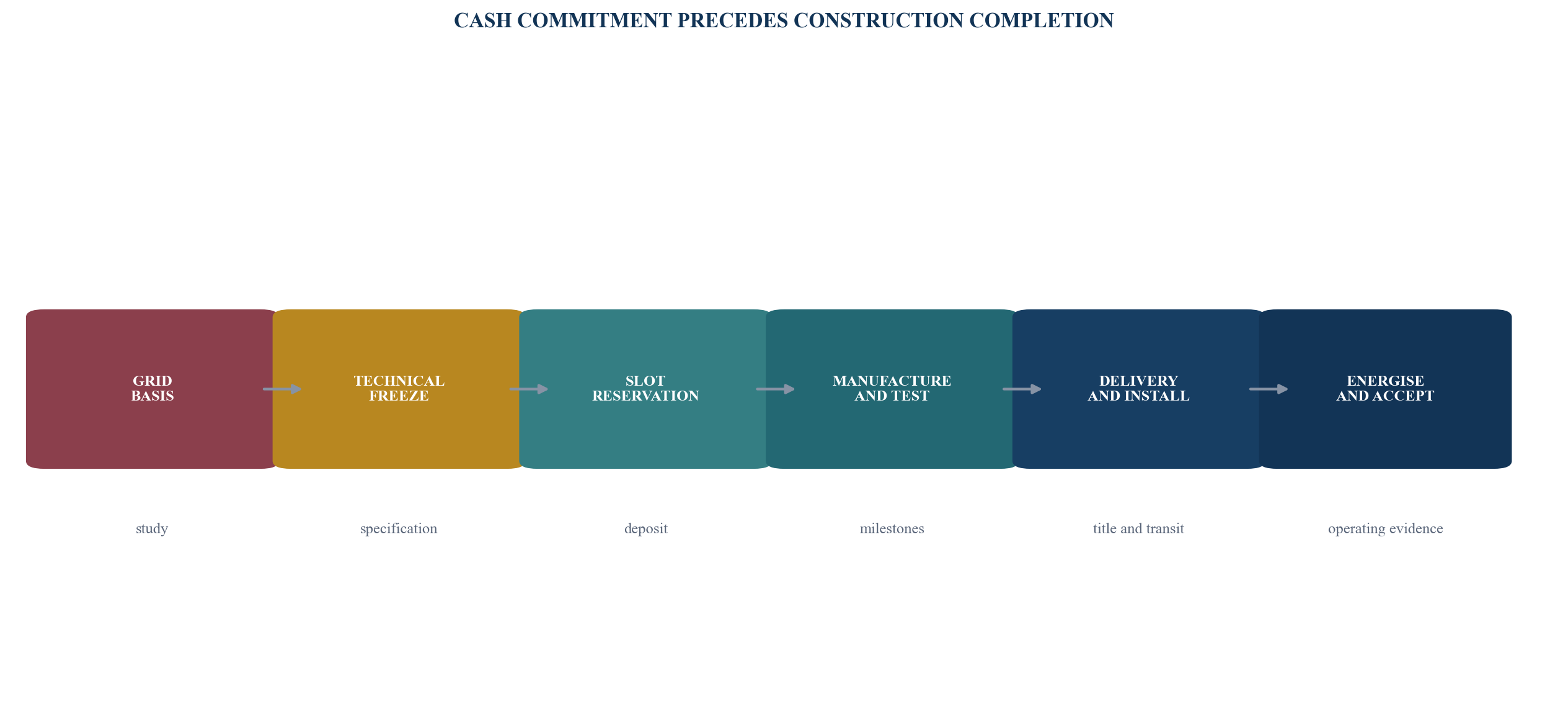
The facility should finance evidence-backed gates; dates remain project-specific.
2. Define the equipment boundary before sizing the facility
A facility should finance a defined equipment perimeter. The register needs the main transformer, generator transformer, gas turbine or reciprocating package, high-voltage and medium-voltage switchgear, protection and control systems, static transfer equipment, bus ducts, spares, commissioning tools, transport frames and required OEM services. It should identify items supplied inside another EPC package to avoid duplicate funding.
Ratings alone do not define compatibility. The register should include voltage levels, short-circuit duties, insulation levels, cooling, harmonics, fault-ride-through, protection philosophy, fuel specification, emissions requirements, control interfaces, cybersecurity, acoustic limits, seismic conditions and utility codes. India's Central Electricity Authority publishes standard specifications and technical parameters for transformers and reactors, together with quality-assurance and type-test guidance for major power equipment. This illustrates the documentation depth expected in a regulated grid environment. Local utility requirements remain controlling for a live project.
The equipment boundary also needs interface ownership. A transformer can arrive before foundations, fire protection, oil containment, protection relays or the grid bay are ready. A turbine can be manufactured while gas supply, emissions permits, cooling systems or black-start arrangements remain unresolved. Switchgear may satisfy a factory test while cable terminations and protection coordination remain incomplete. The facility should finance items only after interfaces, delivery obligations and acceptance responsibility are assigned.
Table 1. Equipment-specific risk register
| Equipment | Principal long-lead driver | Critical interface | Facility evidence |
|---|---|---|---|
| large power transformer | design, core steel, windings, test bay and transport | grid code, foundations, protection and oil systems | approved datasheet, slot evidence, test plan and route survey |
| gas turbine package | manufacturing slot, auxiliaries and control integration | fuel, emissions, cooling, generator and balance of plant | heat balance, emissions basis, reservation terms and interface matrix |
| high-voltage switchgear | engineering, interruption rating, insulation technology and type tests | substation layout, protection, cable or bus connection | single-line diagram, type-test evidence and utility approval route |
| medium-voltage distribution | board architecture, protection selectivity and delivery sequence | data halls, generators, UPS and energisation zones | load schedule, coordination study and phased delivery plan |
| control and protection | hardware, software, communications and testing | utility SCADA, cybersecurity and commissioning | architecture, protocol list, test scripts and change control |
| strategic spares | OEM production and commonality | storage, preservation and maintenance | spare philosophy, ownership, warranty and release conditions |
Each project requires current technical schedules and supplier commitments.
3. Read public supply-chain evidence without substituting it for quotes
Public evidence helps a board identify risk concentrations and procurement models. It cannot replace a current request for proposal. The IEA links delays to manufacturing concentration, specialised materials, testing capacity and expanding grid investment. The US Department of Energy traces large-power-transformer exposure through grain-oriented electrical steel, continuously transposed conductor, insulating materials, custom engineering, factory testing and special transport. The European Commission has also cited significant increases in prices and lead times for transformers and cables.
Manufacturer disclosures reveal order intensity. GE Vernova reported USD 150 billion of backlog at the end of 2025 and more than quadrupling of Electrification equipment backlog over four years. It also disclosed gas-turbine slot reservations and capacity investment. Siemens Energy reported a record EUR 138 billion order backlog for fiscal 2025, with strong Gas Services growth. These figures are company-wide or segment-level disclosures. They do not state the availability, price or delivery date of the equipment required by a particular project.
Programme-level procurement shows how buyers respond. National Grid has used long-term frameworks, including the Great Grid Partnership and an Electricity Transmission Partnership, to create supply-chain visibility and access. Its annual reporting references an advanced procurement mechanism for critical equipment and services. The Australian Energy Market Operator's 2024 Integrated System Plan states that early investment can retain Australia's place in global queues for essential equipment and materials. The board can treat these as strategic precedents while negotiating its own enforceable terms.
4. Create a procurement evidence ladder
The financing model should distinguish a market inquiry, indicative proposal, budget quote, reservation agreement, purchase order, notice to proceed, manufacturing release, factory acceptance and delivered asset. Each stage has a different legal and economic meaning. A project should avoid showing a non-binding supplier email as committed capacity.
At the first gate, the technical team confirms functional requirements and acceptable alternatives. At the second, procurement establishes competitive tension, supplier qualification, pricing basis, escalation rules, validity and production assumptions. At the third, the chosen OEM provides a reservation document that states the fee, slot, conversion deadline, refundability, assignment, cancellation and consequences of project delay. At the fourth, the full supply contract allocates design, performance, testing, delay, transport, warranty and termination risk.
Financing evidence follows the same ladder. A lender can acknowledge an indicative procurement budget while declining to fund it. A credit-approved facility can remain unavailable until sponsor equity, OEM documents, permits, insurance and security are complete. A draw can still require an invoice, engineer's certificate, compliant bank instrument and confirmation that no default exists. The board should report evidence status rather than a single percentage-complete measure.
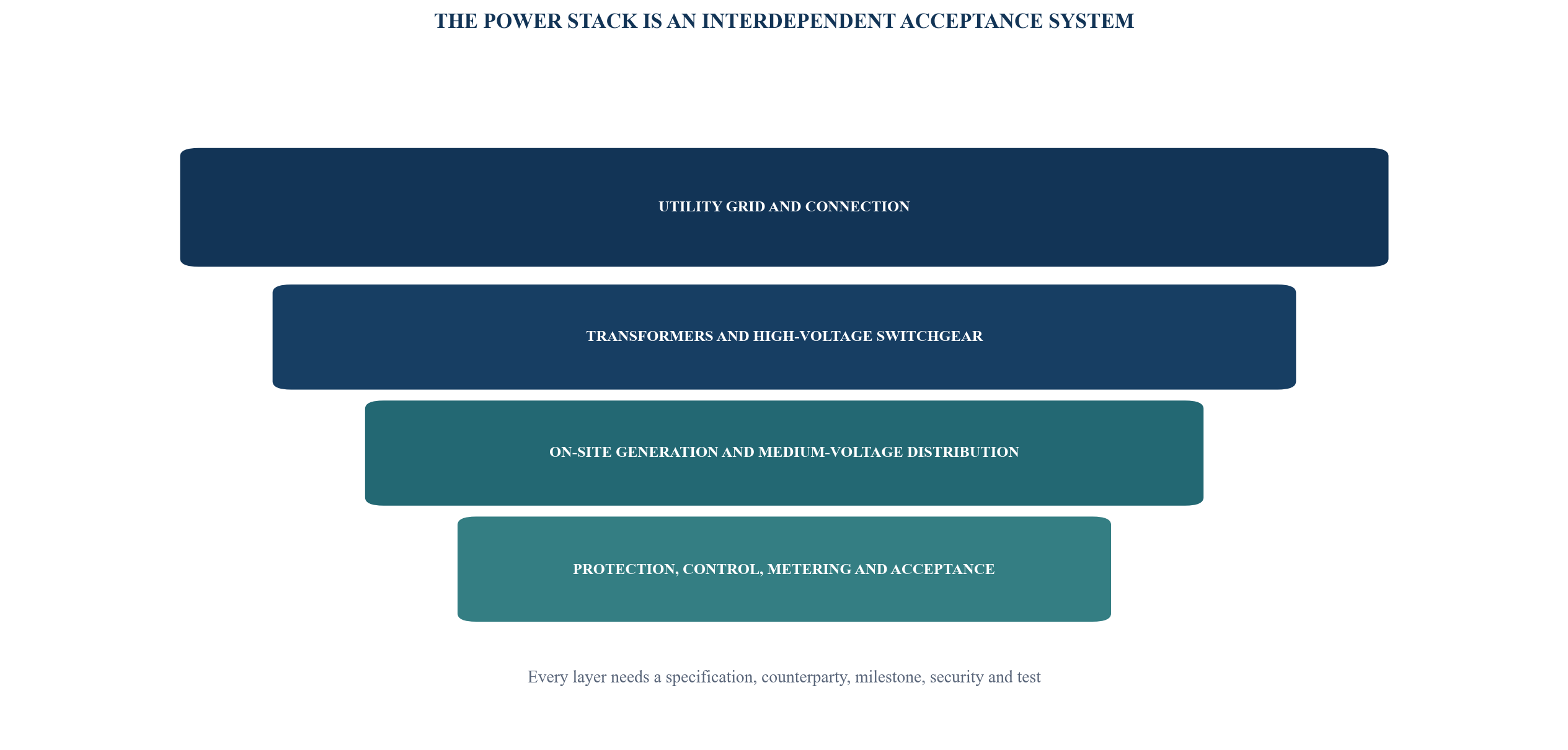
Equipment layers depend on shared grid, control, protection and acceptance evidence.
5. Choose the facility form around the commitment sequence
Several structures can fund long-lead equipment. Sponsor equity can pay reservations and deposits. A shareholder loan can bridge early cash while preserving a later refinancing route. A dedicated procurement facility can lend against specified contracts and assets. A vendor facility can defer a portion of the price. An export-credit-backed buyer credit can fund eligible imported goods and services. The main construction facility can include an early-procurement tranche when its credit process is sufficiently advanced.
The correct form follows the commitment sequence, currencies, supplier jurisdictions, security, project timetable and refinancing certainty. A short bridge with a hard maturity can create risk if construction debt closes late. A project-level procurement facility can reduce sponsor cash usage while demanding stronger controls and security. An export-credit structure can align repayment with the export contract and give the exporter cash-like payment, subject to eligibility, due diligence and documentation.
UK Export Finance states that its Buyer Credit Facility can guarantee a bank loan to an overseas buyer for UK capital goods, services or intangibles. The exporter receives payments as they fall due under the export contract; the buyer receives a repayment period of at least two years. The published criteria include a minimum contract value, eligible UK business, bank acceptability, environmental and social review, foreign-content rules and a buyer contribution. The OECD Arrangement sets disciplines for official export credits with repayment terms of two years or more. Eligibility and pricing require transaction-specific review.
6. Ring-fence sources and uses
The facility should fund only approved uses. Eligible amounts may include reservation fees, engineering, manufacture, factory tests, freight, insurance, import costs, required spares and capitalised financing costs. Development payroll, unrelated land cost, marketing and general overhead require separate approval or sponsor funding. A controlled account can receive lender advances and pay suppliers directly.
The sources schedule should identify sponsor equity, facility debt, grants, export-credit support, OEM credit and recoverable taxes. Equity timing matters. A lender may require the sponsor to fund all initial reservations or a defined proportion of each invoice. The facility can apply a borrowing base to the lower of eligible cost, certified progress and secured asset value. Advance payments deserve conservative treatment until supported by an acceptable refund instrument.
Currency is part of sources and uses. Equipment may be priced in US dollars, euros, sterling, yen or renminbi while project revenue and construction debt use another currency. The board should approve hedge timing, hedge counterparty, collateral treatment, cost overrun responsibility and the treatment of cancelled orders. A long-dated quote without a currency policy leaves the sponsor exposed even if the base price is fixed.
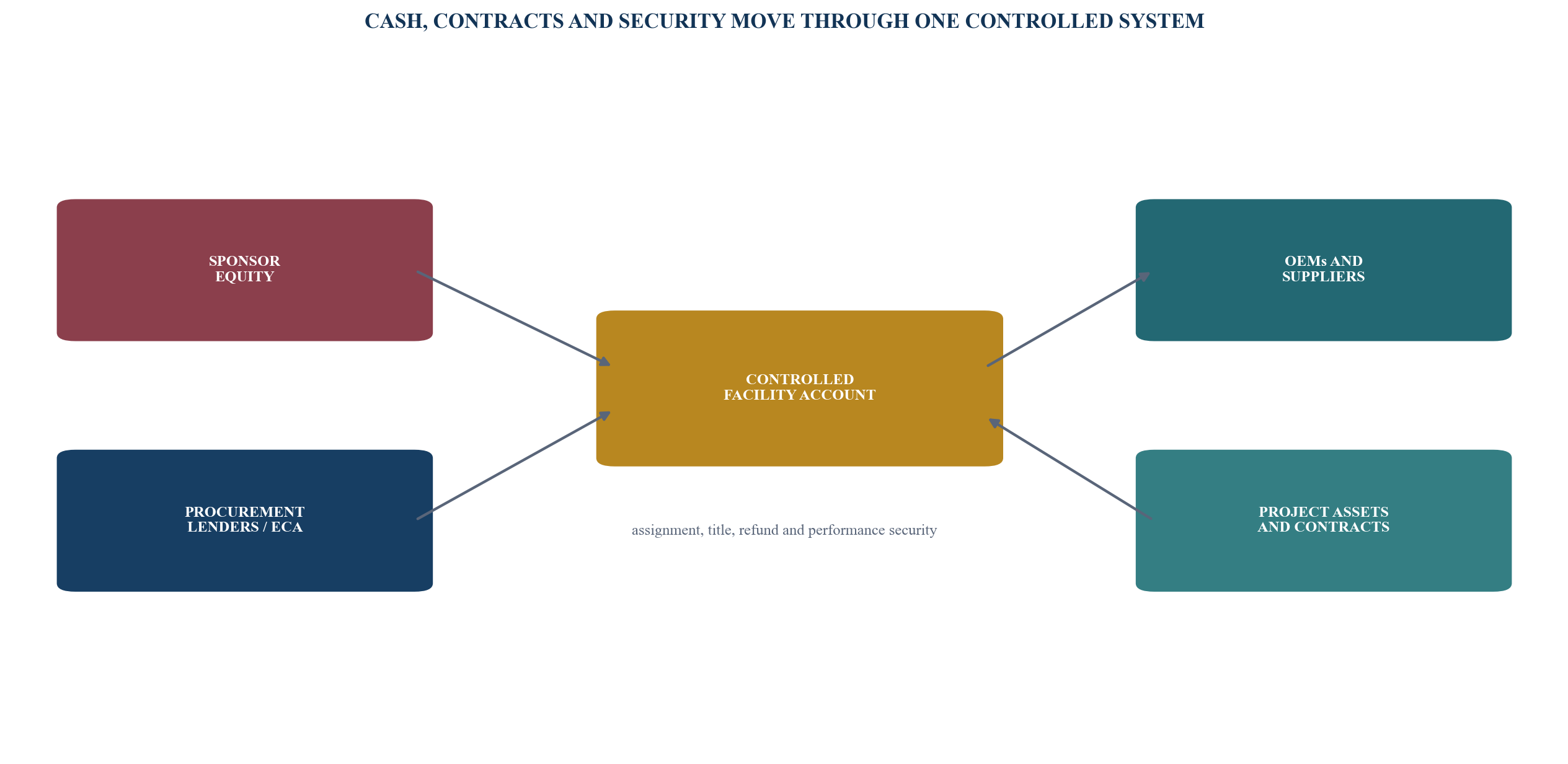
Draws flow to approved suppliers; evidence and security flow back to the facility agent.
7. Build a milestone-based draw mechanism
Supplier payment profiles commonly include an advance, engineering approval, material procurement, manufacturing milestones, factory acceptance, shipment, delivery, installation and final acceptance. The facility should match draws to evidence and risk. A calendar date alone provides weak control because work may have slipped.
Each draw condition should name the invoice, supply-contract clause, deliverable, certifier, security instrument, title position and retention. Engineering deliverables can include approved drawings, bills of material, interface schedules and manufacturing plans. A manufacturing draw can require evidence of dedicated materials or certified progress. Factory acceptance should use an agreed test procedure, calibrated equipment, witness rights, deviation list and closure process. Shipment draws need clean documents, insurance and confirmed title.
World Bank contract-management guidance provides a useful control vocabulary: advance-payment guarantees, performance security, retention security, interim certificates, shipping documents, test results, warranties and records. Its plant-procurement documents use structured technical and commercial evaluation and provide for plant design, supply and installation. These are procurement precedents rather than terms for a private facility. The transaction documents should fit the governing law, supplier market and lender requirements.
Table 2. Draw conditions by procurement milestone
| Milestone | Core evidence | Security treatment | Independent check |
|---|---|---|---|
| slot reservation | signed reservation, slot identifier and conversion deadline | refund or credit terms; sponsor first-loss where required | procurement adviser confirms enforceability and economics |
| advance payment | executed supply contract and compliant invoice | advance-payment instrument for protected amount | legal and facility-agent review |
| engineering release | approved technical schedules and interface register | assignment and step-in rights active | engineer certifies design gate |
| manufacturing progress | certified work, materials and updated programme | title or identified inventory where legally effective | engineer or inspection agent verifies progress |
| factory acceptance | passed tests and closed deviations | performance security continues | independent witness report |
| shipment and delivery | transport documents, insurance, route and site readiness | title, loss-payee and controlled delivery | logistics and engineer confirmation |
| operational acceptance | commissioning tests, utility acceptance and warranty start | retention or performance security adjusts | engineer issues acceptance certificate |
Percentages are negotiated project terms; this table states control logic only.
8. Make the security package follow the asset
The project company should assign the reservation and supply contracts, warranties, refund rights, performance securities, insurance proceeds and material claims where the governing law permits. Lenders also need security over project accounts and the procured assets. The practical value of asset security depends on title, identification, location, customisation, removal cost, alternative use and competing claims.
Title clauses require careful drafting. Title can pass on payment, identification, shipment, delivery or acceptance. Risk of loss may pass at a different point under the agreed Incoterm. A lender should understand whether work in progress is segregated, whether the OEM's financiers hold prior security, and whether insolvency law recognises the buyer's claim. Direct agreements can give lenders notice, cure and step-in rights, subject to OEM consent and practical ability to continue the project.
Refund and performance instruments should match the risk period and amount. The issuing bank, form, expiry, reduction schedule, governing rules and demand conditions matter. A nominal instrument with an early expiry or difficult demand wording can provide little value. The project should track each instrument in a diary and make draw availability conditional on required extensions.
9. Allocate cancellation, delay and price risk
Reservation contracts need an explicit decision tree for project delay. The sponsor should know how long a slot can be held, when the order must convert, whether the slot can move, how deposits are credited, and what happens after a permit, grid or customer delay. A supplier may charge escalation, remobilisation or cancellation amounts. The project may need a substitution right or an ability to transfer the order to an affiliate or buyer.
Delay damages can support discipline when they reflect measurable loss and remain enforceable. Their cap should be evaluated against the debt and revenue consequence of late energisation. The facility model should avoid treating a damages cap as complete compensation. Insurance, contingency, reserve liquidity, alternate equipment and construction float can provide additional protection.
Price risk includes commodity escalation, labour, tariffs, duties, freight, currency and changes in law. A fixed price can contain exclusions and adjustment formulas. The cost model should reproduce the commercial terms and assign every residual risk. The board should approve a contingency amount, release authority and funding source before the first reservation.
10. Connect equipment procurement to offtake
Customer revenue can depend on an energisation date, capacity ramp, redundancy standard, power quality and service acceptance. The equipment contract should align with the offtake schedule without passing every customer remedy directly to the OEM. A project can build a matrix connecting equipment milestones to customer milestones, liquidated damages, termination windows and revenue.
The customer contract may require a utility connection and backup generation. It may specify a phased capacity delivery across several buildings. The equipment order should support this sequence, including partial shipment, staged commissioning and separately accepted systems. If the customer can cancel after delay, the facility should model the lender exposure at each termination date.
Offtake evidence also affects draw availability. A facility can permit early engineering and reservation before a final customer contract, then require a signed offtake before full manufacturing release. This approach limits capital at risk while preserving selected slots. The exact gate follows sponsor strength, alternative demand, equipment transferability and lender appetite.
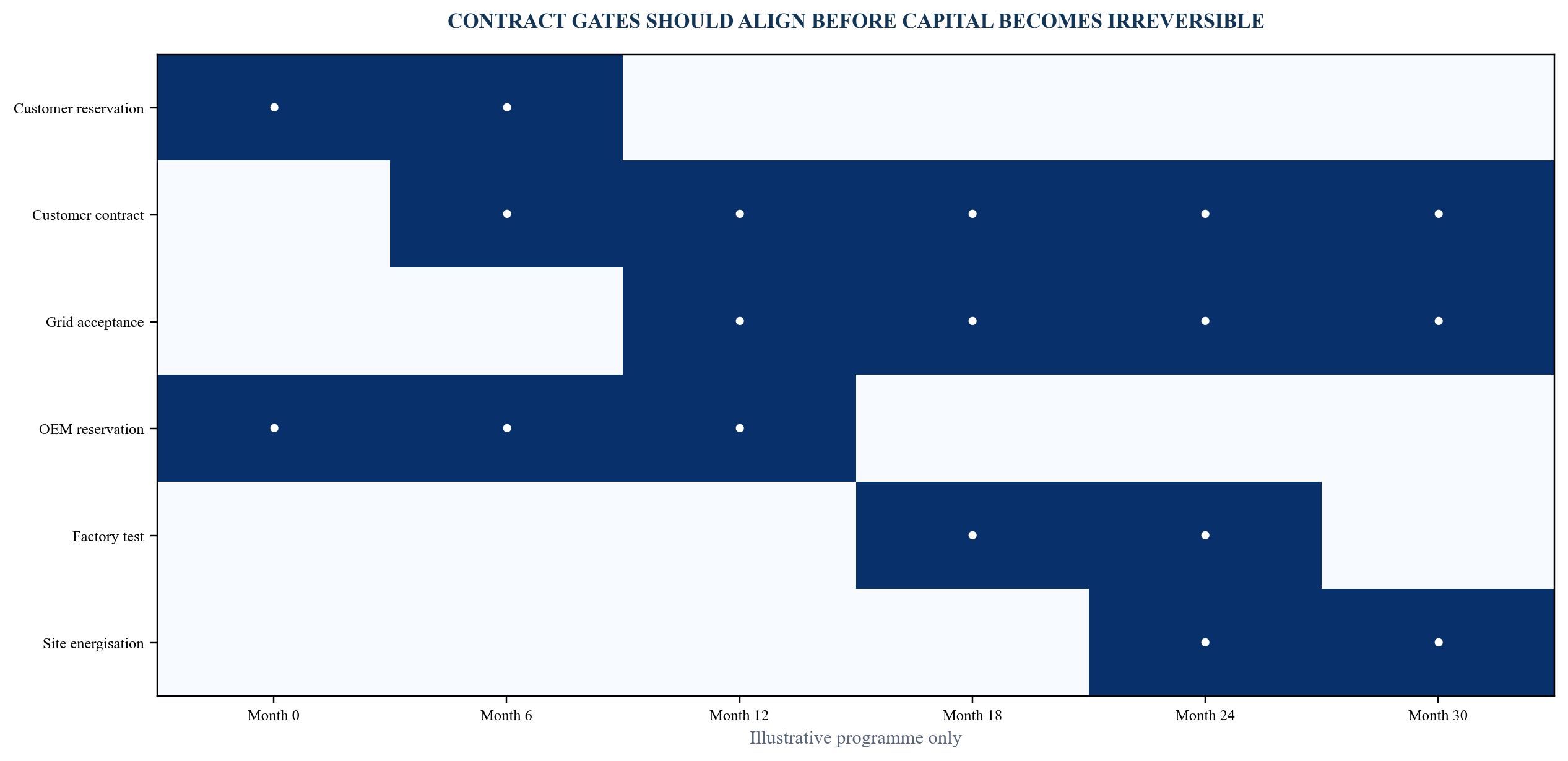
The matrix shows governance relationships; project dates and remedies require executed contracts.
11. Use technical acceptance as a credit control
Factory acceptance is a finance event. Test procedures should cover the performance and safety characteristics relevant to the equipment. Transformer testing can include routine, type and special tests as required by the specification. Turbine testing can cover output, heat rate, emissions, vibration, controls and auxiliaries at the agreed conditions. Switchgear testing can address ratings, interlocks, protection, insulation and control functions.
The contract should define notice periods, witness rights, test equipment, tolerances, correction, retest, deemed acceptance and shipment after deviations. A lender-appointed engineer can confirm that the contractual gate has been met without assuming the OEM's performance responsibility. Open punch-list items need classification, value and closure dates.
Operational acceptance requires the complete system. A transformer factory test does not prove that the grid bay, protection system and site installation operate together. A turbine nameplate does not prove net output at site conditions. The final draw and facility conversion should rely on integrated commissioning, utility approval, customer readiness and required permits.
12. Control logistics, storage and site readiness
Large power equipment creates a transport project inside the development project. The US Department of Energy highlights the difficulty of moving large power transformers, including the last miles to site. A route survey should cover ports, bridges, turning radii, axle loads, clearances, cranes, permits, escorts, weather and temporary works. The delivery schedule should align vessel, customs, haulage and site readiness.
Transit insurance should match title and risk transfer. Policies need adequate limits, deductibles, delay-in-start-up treatment where available, named insureds, lender loss-payee provisions and claims procedures. The project should confirm packaging, preservation, shock monitoring, storage environment and inspection after arrival. Warranty commencement should not be consumed by avoidable storage delay.
Site readiness is a draw condition for late-stage payments. Foundations, access, laydown, cranes, fire systems, oil containment, cable routes, enclosures and commissioning teams should be available. Paying for delivery without a ready site can create demurrage, storage cost and damage exposure. A readiness certificate can connect construction progress to the procurement facility.
Table 3. Security and risk-allocation matrix
| Risk | Primary control | Facility protection | Evidence owner |
|---|---|---|---|
| advance not converted into equipment | refund instrument and clear use of funds | draw capped to protected amount | facility agent and legal counsel |
| OEM non-performance | qualification, performance security and remedies | assignment, notice and step-in process | procurement lead |
| work-in-progress insolvency | title, segregation and identification | legal opinion and direct agreement | legal counsel |
| transport damage | route engineering and cargo cover | lender loss-payee and claims control | logistics and insurance advisers |
| project delay | flexible slot, rescheduling and cancellation rules | sponsor support, contingency and stop gate | board and facility agent |
| interface failure | interface matrix and integrated tests | engineer certification before later draws | owner's engineer |
| technology change | performance envelope and controlled substitution | capped redesign budget and approval right | technical committee |
Legal effectiveness depends on contract, jurisdiction and insolvency analysis.
13. Integrate export credit and bank instruments
Equipment from several countries can create several export-credit routes. Each agency applies national-content, environmental, social, integrity, country and credit requirements. A transaction can combine commercial bank funding, an export-credit guarantee, direct lending, supplier credit or insurance. The financing timetable must include agency screening, due diligence, mandate, credit, documentation and satisfaction of conditions.
UKEF's published Buyer Credit terms provide an example. The maximum loan is generally 85 per cent of the export contract value, with at least 15 per cent paid by the buyer before loan repayment begins. Support can cover corporate, sovereign, public and limited-recourse structures, subject to eligibility. The OECD Arrangement constrains maximum repayment terms, minimum interest rates where official fixed-rate financing applies, local-cost support and minimum premium. Transaction pricing remains case-specific.
Bank instruments can include advance-payment guarantees, performance bonds, standby letters of credit and retention guarantees. An issuing bank takes credit and collateral risk on the supplier. The project facility takes risk on instrument form, bank acceptability and enforceability. The security schedule should identify applicant, beneficiary, amount, expiry, reduction and issuing bank for every instrument.
14. Design the refinancing bridge at inception
A long-lead facility usually expects repayment from the construction financing, sponsor equity, asset sale or operating cash. The takeout should be analysed before the first draw. The construction lenders need access to the equipment contracts, security, technical evidence and payment history. The procurement facility needs a maturity and extension process that accommodates realistic financial-close risk.
The intercreditor plan should address priority, permitted security, cash accounts, enforcement, cure rights, hedging and release on refinancing. If the procurement lenders hold first security, the construction lenders need a documented transfer or discharge. If the sponsor provides a completion or takeout undertaking, its amount, duration and enforcement should be clear.
The financing model should track funded cost, accrued interest, fees, hedge close-out, break cost and tax. A refinancing premium can materially increase the takeout. The board should test a delayed close, a lower loan-to-cost ratio and a partial construction debt takeout. A credible base case should not depend on lender discretion that remains uncommitted.
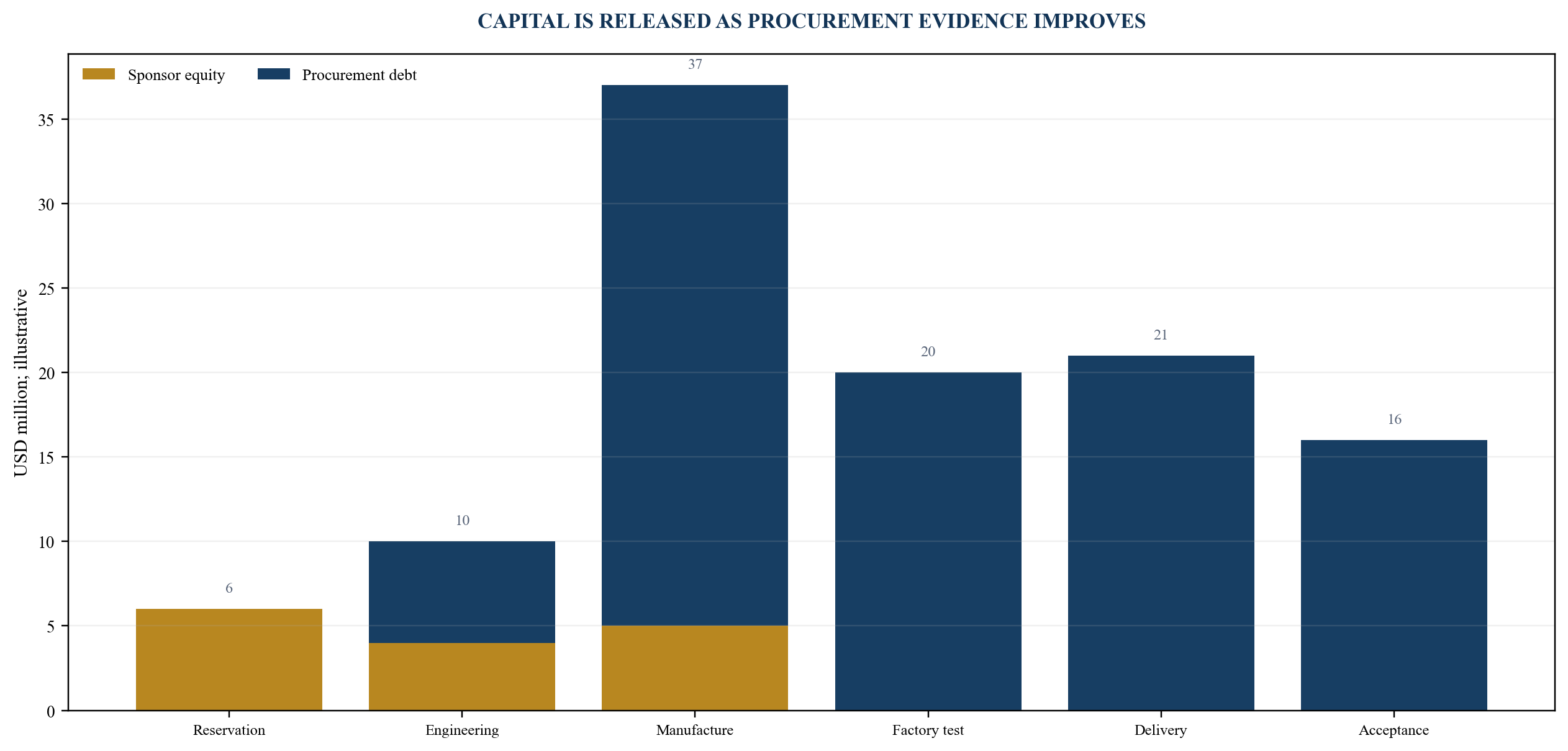
Values are management assumptions for method demonstration and do not represent a project quote.
15. Model an illustrative 96 MW programme
The worked case demonstrates mechanics for a 96 MW power-intensive campus. Every value is a management assumption. The assumed long-lead package costs USD 110 million and contains transformers, high-voltage switchgear, on-site generation, medium-voltage distribution, controls, logistics and spares. The assumed supplier programme runs for 30 months. Sponsor equity funds USD 15 million; procurement debt funds up to USD 95 million.
The assumed facility draws only after defined evidence. It bears an assumed 9.0 per cent annual cash interest rate plus fees and capitalised interest. The assumed construction facility refinances procurement debt at month 30 after grid acceptance, integrated commissioning and an executed customer contract. These terms are neither a quote nor a financing offer.
The model should calculate maximum cash exposure at each gate. It should show equipment value, protected advances, unprotected cost, sponsor support, accrued interest and expected takeout. A delay case moves construction refinancing by six months and adds storage, hedge and financing costs. A cancellation case applies recoveries based on contract rights and equipment transferability rather than book cost.
Table 4. Worked-case management assumptions
| Variable | Management assumption | Use in model |
|---|---|---|
| campus power capacity | 96 MW | scales equipment and offtake sequence |
| long-lead package | USD 110m | total eligible procurement uses |
| sponsor equity | USD 15m | first-loss capital and early deposits |
| procurement debt commitment | USD 95m | maximum principal before interest and fees |
| supplier programme | 30 months | base refinancing and acceptance date |
| cash interest rate | 9.0% per year | illustrative funding cost |
| delayed refinancing case | 6 months | stress for maturity, storage and interest |
| unallocated contingency | USD 8m | sponsor-funded risk buffer outside base package |
All values are management assumptions created for method illustration.
16. Stress debt capacity against delay and obsolescence
Long-lead equipment can retain substantial technical utility while losing commercial fit. A customer may change power density, redundancy, emissions, sustainability or energisation requirements. Grid rules can change. New switchgear technology can reduce environmental impact. A later turbine configuration can offer different efficiency or fuel flexibility. The project should manage change through performance envelopes and controlled substitution.
The facility should stress three forms of loss. Schedule loss increases financing cost and can trigger customer remedies. Cost loss reflects redesign, escalation, storage and rework. Recovery loss reflects the discounted proceeds available if the project stops and equipment is sold, transferred or cancelled. Custom equipment can have limited alternative use even when technically valuable.
Debt capacity should fall as evidence weakens and irreversibility rises. Early reservation exposure can be supported by sponsor equity. Certified manufacture with enforceable title and a strong takeout can support debt. A delayed, highly customised item without customer or grid certainty deserves a lower borrowing value. The facility agent should recalculate exposure after material change.
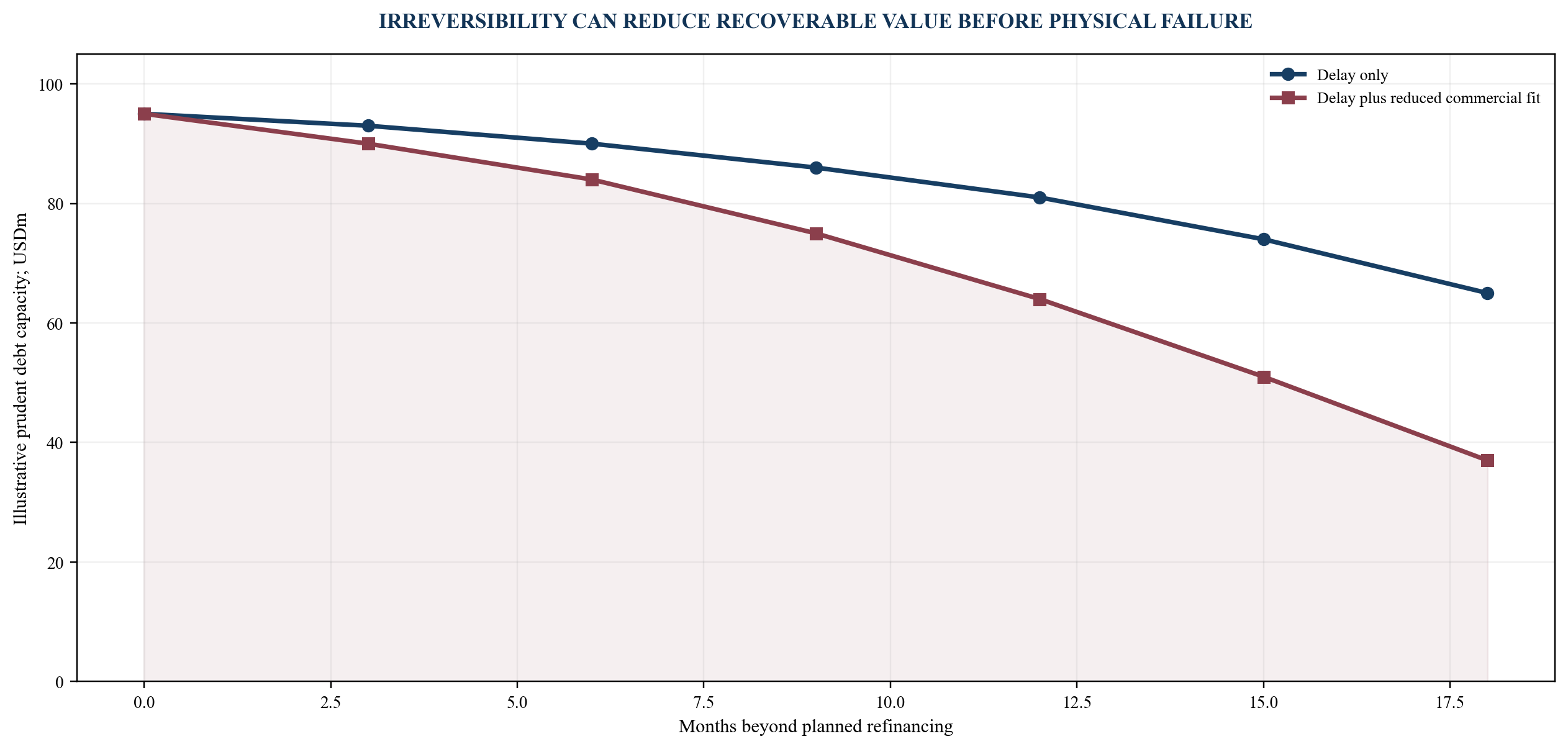
Curves are illustrative management assumptions; they are not market valuations.
17. Build the lender and board data room
The data room should begin with the equipment register, integrated schedule, single-line diagrams, grid studies, technical specifications, interface matrix and procurement plan. It should include bidder qualification, proposals, clarifications, evaluation, reservation terms, supply contracts, payment profiles, programme, guarantees, bonds, insurance, title analysis and legal opinions.
Technical evidence should include approved drawings, manufacturing plans, inspection and test plans, quality records, type-test evidence, factory reports, logistics surveys, site-readiness certificates, commissioning scripts and warranty documents. Commercial evidence should reconcile purchase orders, invoices, payments, currency hedges, contingency and the cost report. Financing evidence should show sources and uses, draw certificates, security perfection, conditions and takeout progress.
The board dashboard should report cash committed, cash paid, debt drawn, unprotected advances, schedule variance, open deviations, expiring instruments, interface readiness, forecast at completion and takeout status. Each item needs an owner and next action. The dashboard should preserve the evidence trail for lenders, auditors and a future buyer.
Table 5. Board and lender data-room index
| Workstream | Required evidence | Decision supported |
|---|---|---|
| power and grid | studies, utility correspondence, connection agreement and code matrix | capacity and energisation certainty |
| equipment design | specifications, drawings, interfaces and approved alternatives | technical fit and substitution |
| procurement | competition record, evaluation, reservation and supply contracts | value, slot and counterparty selection |
| facility | term sheet, credit approval, documents, security and draw log | funding availability and compliance |
| manufacture and test | programme, inspections, certificates, deviations and retests | milestone payment and shipment |
| logistics and site | route, permits, insurance, storage and readiness | delivery and installation |
| offtake and takeout | customer contract, acceptance, construction debt and closing plan | revenue start and repayment |
The index should be maintained through reservation, manufacture, delivery and acceptance.
18. Govern decisions through stop, hold and release gates
The board should approve a gate policy before entering the first reservation. A release decision confirms that the evidence, economics and downside remain within authority. A hold pauses cash while preserving rights where possible. A stop decision avoids further exposure and activates cancellation, transfer or recovery.
Gate authority should reflect materiality. Management can approve routine engineering milestones within budget. A committee can approve deviations, substitute equipment and draw exceptions. The board should approve a major scope change, increased sponsor support, facility extension, customer delay beyond tolerance or cancellation. Conflicts of interest and related-party suppliers require explicit governance.
The same framework supports lenders. Regular reports, independent engineer certificates, covenant compliance and instrument diaries allow timely action. Waivers should state the factual basis, financial effect, cure, conditions and expiry. Repeated temporary waivers can conceal a structural mismatch between project and facility.
19. Run a 180-day procurement-finance office
Days 1 to 30 establish the equipment boundary, critical path, decision rights and evidence gaps. The team confirms grid basis, customer milestones, supplier market, procurement route, financing perimeter and current proposals. It creates one cost model and one controlled document register.
Days 31 to 75 run technical and commercial engagement. The project issues specifications, qualifies OEMs, compares alternatives, tests reservation terms, maps export content and opens lender and export-credit discussions. The owner's engineer reviews interfaces, factory tests, logistics and site sequence. Legal advisers review title, security, direct agreements and bank instruments.
Days 76 to 120 select the preferred procurement and facility structure. The board approves commercial parameters, sponsor exposure, contingency and stop gates. The team negotiates reservation and supply contracts, facility documents, hedging, insurance and takeout requirements. Draft draw packs are tested before signing.
Days 121 to 180 close and mobilise. Security is perfected, accounts are established, equity is funded, instruments are verified and the first draw is certified. The office then moves to weekly schedule, cost, instrument and interface control. This timetable is a governance sequence rather than a promise of transaction completion.
Table 6. 180-day execution agenda
| Period | Core work | Board output | Commercial delivery path |
|---|---|---|---|
| days 1-30 | diagnostic, register, critical path and evidence audit | equipment boundary and risk appetite | scoped readiness diagnostic |
| days 31-75 | OEM engagement, alternatives, ECA and lender screening | shortlist and funding options | procurement-finance structuring mandate |
| days 76-120 | contract, facility, security and takeout negotiation | approved transaction package | transaction office and stakeholder coordination |
| days 121-180 | closing, first draw and controls mobilisation | funded gate and reporting baseline | retained drawdown and acceptance execution |
| post-close | manufacture, tests, logistics, installation and refinancing | monthly hold, release or stop decisions | milestone, lender and collections governance |
Timing remains dependent on technical readiness, counterparties and approvals.
20. Convert the framework into an accountable mandate
A developer, infrastructure sponsor or power-intensive operator can commission a long-lead procurement readiness diagnostic. The work should reconcile grid, equipment, supplier, schedule, offtake, security, funding and takeout evidence. The output should identify which commitments are ready, which need conditions and which should wait.
A transaction mandate can then structure the facility, coordinate lenders and export-credit agencies, negotiate commercial interfaces, build the funding model and prepare approvals. A retained execution office can govern draw packs, instruments, OEM milestones, technical acceptance, cost, reporting and refinancing. Legal, technical, environmental, insurance, tax, accounting, procurement and other regulated responsibilities remain with appropriately qualified advisers.
The board should receive a decision, a controlled evidence base and a route to execution. Advisory fees should reflect scope, senior accountability, transaction complexity and execution duration. Advisory revenue remains zero until a mandate is executed, an invoice is issued under its terms and collection is evidenced.
The essential discipline is straightforward. Reserve scarce equipment only when the project understands the commitment, the downside and the next gate. Finance each milestone against evidence. Preserve the ability to hold or stop. Connect the final draw to an accepted power system and a credible takeout.
References
- International Energy Agency. Building the Future Transmission Grid. 25 February 2025. https://www.iea.org/reports/building-the-future-transmission-grid
- International Energy Agency. Rising component prices and supply chain pressures are hindering the development of transmission grid infrastructure. 25 February 2025. https://www.iea.org/news/rising-component-prices-and-supply-chain-pressures-are-hindering-the-development-of-transmission-grid-infrastructure
- International Energy Agency. Electricity 2026: Grids. 2026. https://www.iea.org/reports/electricity-2026/grids
- US Department of Energy. Large Power Transformer Resilience Report. July 2024. https://www.energy.gov/sites/default/files/2024-10/EXEC-2022-001242%20-%20Large%20Power%20Transformer%20Resilience%20Report%207-10-24.pdf
- US Department of Energy. Transformer Resilience and Advanced Components Program. Accessed August 2026. https://www.energy.gov/oe/transformer-resilience-and-advanced-components-trac-program
- European Commission. European Grids Package. December 2025. https://energy.ec.europa.eu/document/download/869c0537-3fcb-4d0a-bd05-e8b0c3696c12_en?filename=COM_2025_1005_1_EN_ACT_part1_v6.pdf
- GE Vernova. 2025 Annual Report. 2026. https://www.gevernova.com/sites/default/files/gevernova_2025_annual_report.pdf
- GE Vernova. GE Vernova to invest almost USD 600 million in US factories and facilities over next two years. 29 January 2025. https://www.gevernova.com/news/press-releases/ge-vernova-invest-almost-600-million-us-factories-facilities-over-next-two-years
- Siemens Energy. Annual Report 2025. December 2025. https://assets.siemens-energy.com/dam/32b27e9a-af91-4915-8b51-b3af012d0d98/A-Siemens_Energy_Annual_Report_2025-pdf_Original%20file.pdf
- National Grid. The Great Grid Partnership. 9 May 2025. https://www.nationalgrid.com/responsibility/great-grid-partnership
- National Grid. National Grid launches GBP 8bn Electricity Transmission Partnership. 31 July 2025. https://www.nationalgrid.com/media-centre/press-releases/National-Grid-launches-Partnership-to-help-power-Britain-clean-energy-future
- National Grid. Annual Report and Accounts 2024/25. 2025. https://www.nationalgrid.com/document/560191/download
- Australian Energy Market Operator. 2024 Integrated System Plan. June 2024. https://www.aemo.com.au/energy-systems/major-publications/integrated-system-plan-isp/2024-integrated-system-plan-isp
- Central Electricity Authority, India. Power System Engineering and Technology Development Division: transformer and major-equipment specifications. Accessed August 2026. https://cea.nic.in/power-system-engineering-technology-development-division/?lang=en
- World Bank Group. Project Procurement Framework. Updated 2026. https://www.worldbank.org/ext/en/what-we-do/project-procurement/framework
- World Bank Group. Contract Management: Practice, Procurement Guidance. June 2024. https://thedocs.worldbank.org/en/doc/a5487590ccec42b5709816f40ae8b068-0290012024/original/Contract-Management-Practice-Procurement-Guidance-June-2024-FINAL.pdf
- UK Export Finance. Buyer Credit Facility. Updated 27 January 2026. https://www.gov.uk/guidance/buyer-credit-facility
- Organisation for Economic Co-operation and Development. Arrangement and sector understandings. Updated 2026. https://www.oecd.org/en/topics/arrangement-and-sector-understandings.html
- Organisation for Economic Co-operation and Development. Financing terms and conditions. Updated 2026. https://www.oecd.org/en/topics/financing-terms-and-conditions.html
About the Author
Chennakeshav Adya, Independent Researcher
This paper provides a decision framework for developers, power-intensive operators, infrastructure investors and lenders evaluating long-lead procurement finance. It is general research and does not provide legal, technical, grid, environmental, insurance, tax, accounting, procurement, export-credit, investment or financing advice.
