

1. Define sovereign offtake as a payment obligation
Sovereign compute can describe several different arrangements. A government can own a supercomputer, fund private capacity, subsidise eligible users, reserve cloud services, procure a secure platform or anchor a commercial data centre. Each model can advance national policy. Only some create cash flows that a project company can assign, forecast and use for debt service.
The board should begin with the payment obligation. It should identify the contracting entity, its legal authority, the service purchased, the unit of payment, budget route, term, currency, conditions, deductions, termination rights and dispute process. A national strategy, ministerial speech, memorandum of understanding or announced investment is valuable context. It is not a substitute for an executed contract with an authorised payer.
Project finance also requires separation between public demand and public credit support. A ministry can sponsor a programme while an agency, university, state-owned enterprise or procurement vehicle signs the service agreement. The credit, appropriation route and enforcement position can differ materially. The project company should underwrite the actual obligor and support package.
The central objective is a durable service contract that preserves public value. Government should buy measurable capacity and outcomes under transparent procurement and fiscal controls. The provider should accept construction, operating and technology risks it can manage. Lenders should size debt to enforceable base-case cash flows after deductions, operating costs, lifecycle refresh and reserves.
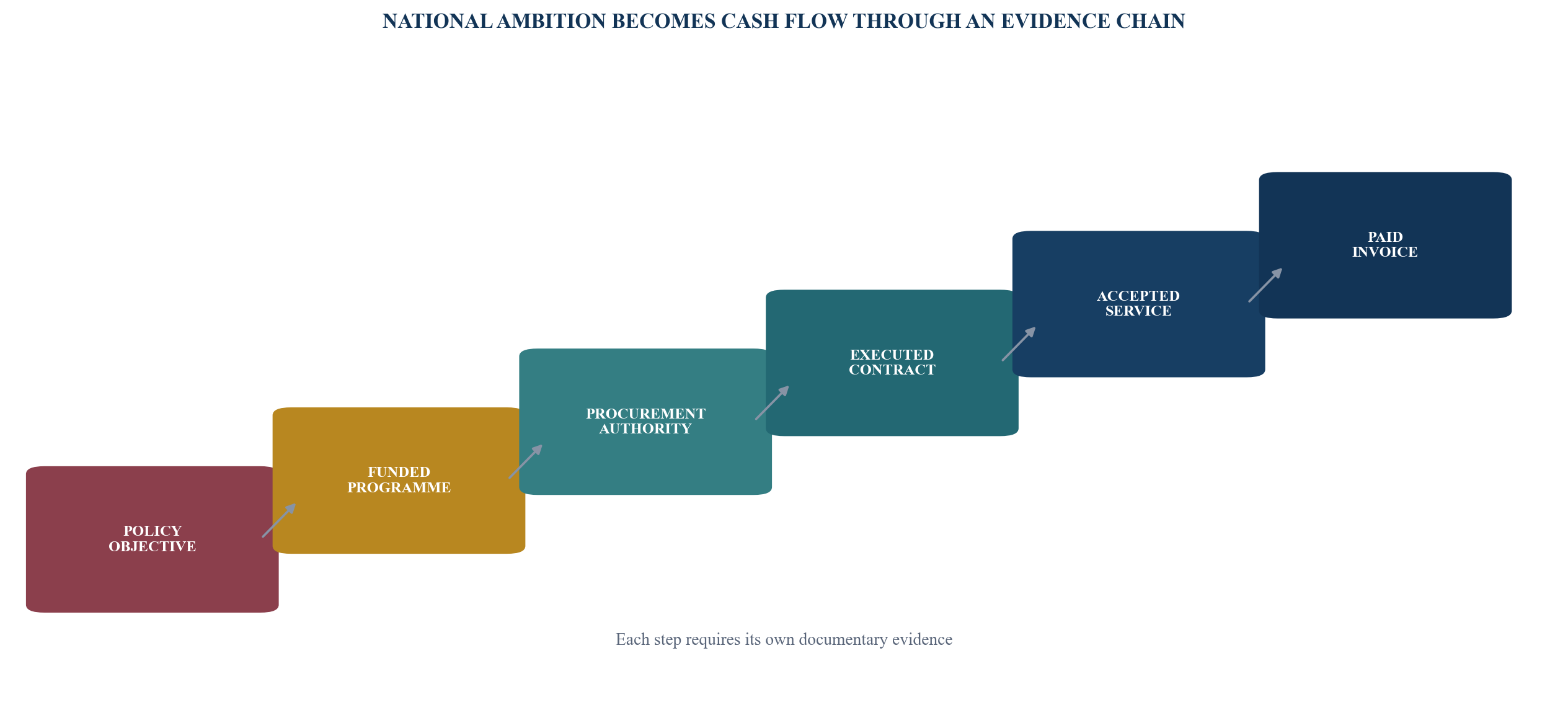
Policy intent becomes financeable only after authority, procurement, contract, acceptance and payment evidence are complete.
2. Separate five public-compute models
Public supercomputing places infrastructure under public ownership or control and allocates access through programme rules. The United Kingdom's AI Research Resource provides access through Isambard-AI and Dawn. Its published routes cover academia, industry and smaller organisations. This model demonstrates public allocation and national research capacity. The allocation rules do not create private-project revenue unless a separate procurement or service contract does so.
An access-subsidy model supports users who purchase services from approved providers. The IndiaAI Compute Portal publishes eligibility, approval, provider and pricing mechanisms. Users apply for compute and can seek subsidies; the programme distinguishes smaller requests and committee-approved larger requests. This can aggregate demand across users, although provider revenue still depends on programme terms, actual orders, subsidy settlement and user payment.
An AI Factory model combines infrastructure, access and expert support. EuroHPC's published access modes include limited playground access, fast-lane allocations and large-scale access for different needs. Eligible SMEs can receive free innovation access, while other industrial applications can use commercial access. A project should therefore separate publicly funded allocation from commercial pay-per-use demand.
A co-investment model uses public capital to mobilise private infrastructure. Canada's Sovereign AI Compute Strategy separates support for commercial data-centre capacity, public supercomputing and an access fund. This is a useful portfolio architecture. A contribution agreement, access fund and customer contract have different risk and cash-flow characteristics.
A sovereign platform or anchor-customer model can integrate data centres, cloud, models and applications. Saudi Arabia's Public Investment Fund describes HUMAIN as operating across the AI value chain. Abu Dhabi's Department of Government Enablement describes a multi-year sovereign-cloud agreement with Microsoft and Core42. These disclosures show strategic platform and service relationships. Public descriptions do not disclose the complete payment, termination, security or financing terms.
Table 1. Public-compute models and finance evidence
| Model | Public objective | Provider revenue route | Finance evidence required |
|---|---|---|---|
| public supercomputer | research and strategic capacity | public capex or operating budget | awarded procurement, appropriations and acceptance |
| access subsidy | affordable access for eligible users | user bill plus public subsidy | provider terms, eligible orders and settlement rules |
| AI Factory | infrastructure, access and technical support | funded allocation and commercial use | allocation budget, tariff and eligible demand |
| co-investment | crowd in domestic infrastructure | grant, contribution or matched capital | executed funding agreement and conditions |
| anchor service contract | secure capacity for government workloads | reservation, usage or availability payment | authorised multi-year service agreement |
| aggregated demand | combine ministry, research and industry needs | master contract and call-off orders | binding minimums, agency access and payment waterfall |
A public programme can combine models; each cash-flow source needs separate diligence.
3. Build a national demand register
A financeable contract starts with workloads rather than a headline quantity of GPUs. The demand register should identify the sponsoring entity, end user, use case, data classification, model type, accelerator requirements, storage, network, availability, location, support and start date. Training, fine-tuning, inference, scientific simulation and secure government workloads can require different infrastructure.
Public demand carries several certainty levels. Existing workloads with budget history provide stronger evidence than policy targets. Approved programmes with named users and implementation budgets can support a ramp. Applications from eligible users reveal interest but do not guarantee consumption. Strategic use-case lists and national aspirations belong in upside cases until contracted.
The register should state whether a workload is movable. Some users can shift across time, regions or hardware. Others require dedicated clusters, protected data, specific software, low latency or a national security boundary. The contract should charge for resources that must remain reserved even when utilisation is low.
Demand aggregation needs governance. A central buyer can reserve capacity and permit authorised agencies to use it. The agreement should identify who can issue an order, how consumption is attributed, whether unused allocations transfer, which entity pays, and whether a user dispute affects the provider's master payment.
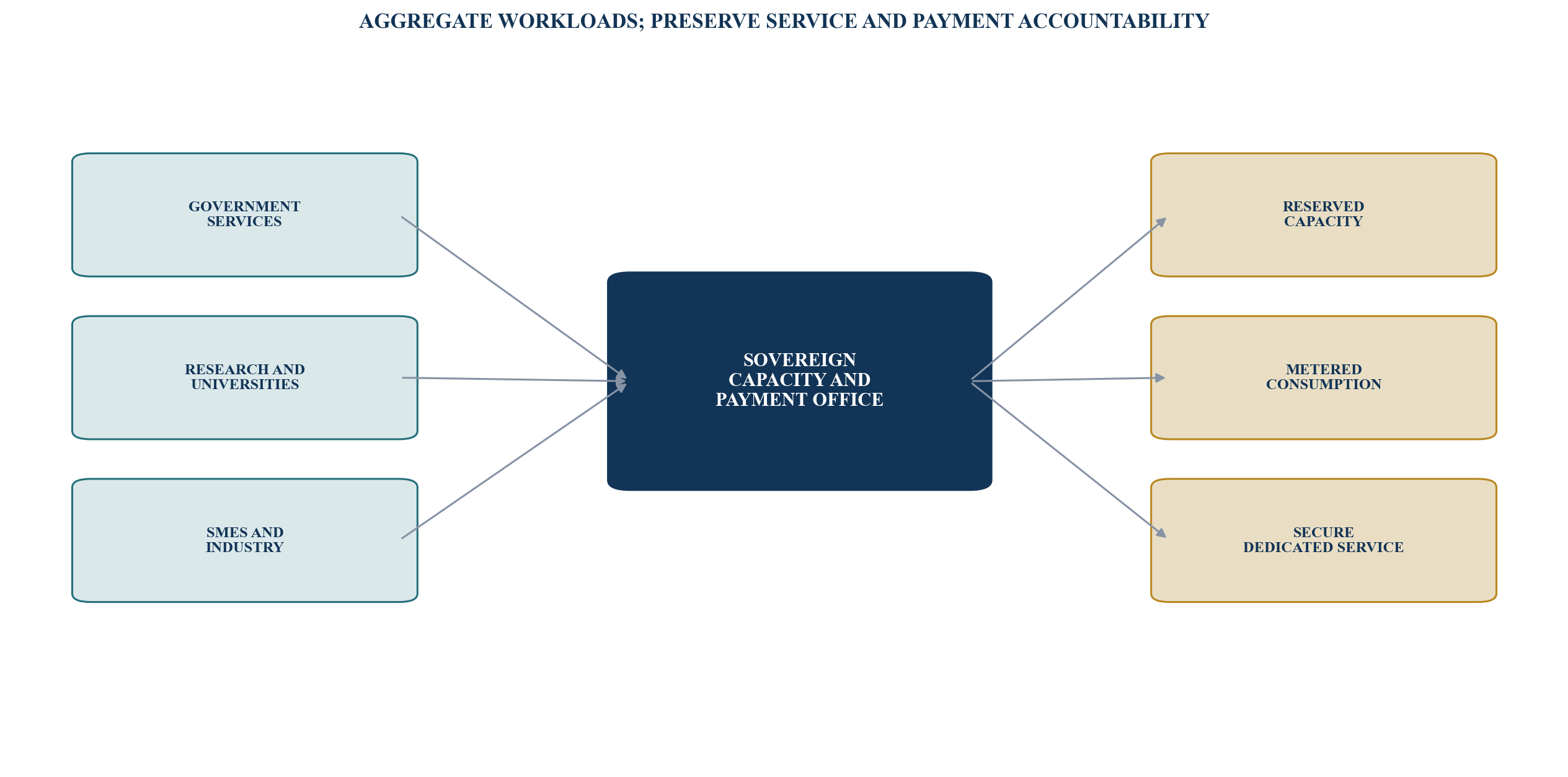
The master offtake should reconcile diverse public workloads with one controlled capacity and payment system.
4. Define the compute service unit
The payment unit should match the service purchased. A GPU-hour can be useful for metered consumption. It can be incomplete for a dedicated cluster because interconnect, storage, network, orchestration, security, software, support, electricity and cooling also determine service. A nominal accelerator count does not establish useful compute output.
The service schedule should state hardware class or performance envelope, cluster topology, memory, storage, network, software environment, data location, security controls, support, planned maintenance and measurement. It should define whether the provider can substitute hardware and how equivalent performance will be tested.
Capacity progresses through states. Ordered equipment is not available service. Installed capacity requires integration. Commissioned capacity has passed defined tests. Accepted capacity has met customer criteria. Available capacity remains ready under the service agreement. Consumed capacity records actual authorised use. The tariff and construction draws should refer to the correct state.
Performance metrics should remain auditable. They can include reserved accelerator equivalents, successful job completion, cluster availability, queue time, storage throughput, network performance, response latency or service credits. The metric boundary, clock, exclusions, data source, retention and dispute process should be stated.
5. Construct a bankable tariff
A tariff can combine reservation, consumption and service charges. The reservation charge pays for accepted capacity held available to the sovereign buyer. It should cover fixed operating cost, lifecycle reserve and an appropriate contribution to debt service. The consumption charge follows measured use and variable electricity, cooling, network or licence costs. Managed services can carry a separate scope and fee.
The contract can include a minimum annual commitment, take-or-pay quantity or availability payment. Each structure has fiscal and procurement implications. World Bank PPP guidance describes government-pays structures in which remuneration can depend on a service being available at a contractually defined quality. The specific legal and public-finance treatment depends on the jurisdiction and contract.
Indexation needs boundaries. Electricity, foreign exchange, imported hardware, software and inflation can move differently. The tariff should identify the index, base date, frequency, cap, floor, sharing mechanism and treatment of taxes or change in law. A pass-through without audit rights can weaken budget control. A fixed price without relief can leave the provider unable to maintain the service.
Deductions should follow measurable failures. A deduction matrix can address unavailable capacity, performance below the accepted envelope, security incidents, delayed restoration and reporting failure. Aggregate deductions should align with the severity and controllability of the failure. Persistent default can trigger cure, replacement, step-in or termination.
Table 2. Compute tariff building blocks
| Charge | Economic purpose | Measurement | Principal diligence |
|---|---|---|---|
| reservation | hold accepted capacity available | reserved unit and availability clock | minimum term, acceptance and deductions |
| consumption | recover variable service cost | metered authorised usage | meter boundary, tariff index and audit |
| managed service | operate software and support layer | service scope and response levels | staffing, licences and subcontractors |
| secure environment | fund dedicated controls and isolation | accepted security service | accreditation, incident and change control |
| lifecycle reserve | fund planned hardware refresh | periodic funded reserve | ownership, release and residual assets |
| termination amount | allocate early-exit value | defined formula by event | debt, break cost, assets and mitigation |
The payment mechanism should reward service readiness, efficient use and accountable performance.
6. Test legal authority and procurement
The contracting entity should have authority to procure the service, commit funds for the term, own or licence required data, and accept dispute and termination provisions. The project should obtain current legal confirmation. Authority can depend on enabling legislation, procurement rules, delegation, budget approval and the status of the entity.
Procurement strategy affects bankability. A competitive process can select a provider, tariff and risk allocation. A direct award can require a valid exception and documented value. A memorandum of understanding can frame cooperation while leaving procurement and contract formation outstanding. The financing case should use executed documents rather than expected awards.
The scope should support output-based competition. Government can define security, capacity, availability, location, sustainability and performance requirements while allowing bidders to propose technology. Prescribing one accelerator or architecture too early can reduce competition and increase obsolescence exposure.
Evaluation should examine complete lifecycle value. Criteria can include deliverability, power and cooling readiness, security, data governance, technology refresh, service performance, local capability, environmental impact, finance certainty and price. Bid assumptions should pass into the final contract and financial model.
7. Underwrite appropriation and sovereign credit
An executed government contract can still face appropriation, budget, payment-administration and set-off risks. The diligence should identify whether the obligation is a direct liability, contingent liability, annual operating expense, capital commitment or another category under the applicable public-finance framework.
World Bank guidance notes that long-term government payment commitments can conflict with annual budget cycles. A project should confirm the approved budget route, medium-term treatment, payment process, invoice approval, dispute escalation and any statutory limitation. It should not assume that sovereign ownership or policy importance removes appropriation risk.
Credit support can include a central-government guarantee, ministry support agreement, escrow, funded reserve, letter of credit, multilateral guarantee or termination-payment protection. Each support instrument requires legal authority and enforceability. A comfort letter or public statement should not be modelled as a guarantee.
Lenders also examine currency and transfer. Imported equipment and debt can be denominated differently from the service tariff. The contract should allocate convertibility, transfer, withholding, tax and indexation. The financing should carry reserves or hedging supported by executable terms.
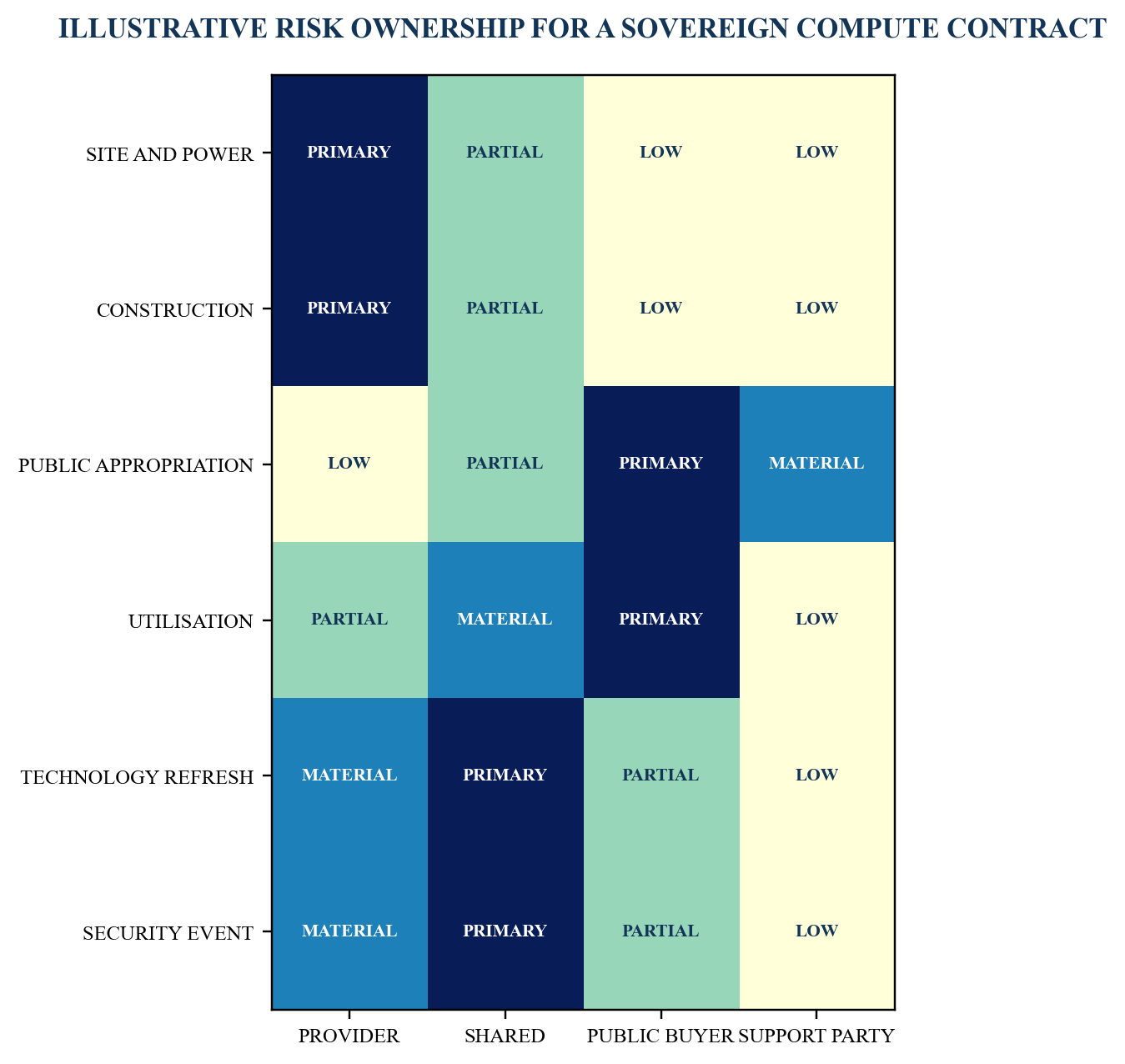
Risk should sit with the party able to control or absorb it at the lowest credible cost.
8. Allocate demand and utilisation risk
Government can reserve capacity for strategic reasons before utilisation develops. The provider incurs fixed costs to hold the service ready. Assigning all utilisation risk to the provider can make the project difficult to finance or increase the tariff. Assigning all demand risk to government can create poor value and idle capacity.
A balanced structure can combine a smaller firm reservation with metered usage and periodic capacity releases. Government receives expansion options supported by notice and deposits. The provider can remarket unused capacity subject to data, security and priority rules. The contract can define how third-party revenue offsets public payments.
The demand register should be refreshed before each capacity release. Signed agency call-offs, approved research allocations, awarded industrial grants and historical utilisation can support the base case. Pipeline applications, policy use cases and future model demand support scenarios. The investment committee should see both contracted demand and plausible upside.
Utilisation metrics need context. High accelerator occupancy can coexist with low useful output if jobs fail, data pipelines bottleneck or users lack skills. The public buyer can track successful workloads, research outcomes, commercial adoption and service access while the payment contract focuses on objective capacity and performance.
9. Govern data, security and eligible users
Sovereign compute can contain personal, commercial, research, critical-infrastructure or national-security data. The service agreement should classify permitted workloads, users, locations, access methods, encryption, logging, retention, model artefacts, incident handling and subcontractors. Separate security domains can require separate infrastructure and accreditation.
User eligibility should be operational. The UK AIRR, EuroHPC AI Factories and IndiaAI publish access routes or eligibility concepts for different communities. A project-backed service needs its own approved-user process, identity checks, sanctions and export-control screening, acceptable-use rules, quota management and revocation.
Data residency does not resolve every sovereignty question. Hardware support, remote administration, control-plane services, software licences, model weights and incident response can cross borders. The architecture and contract should map every dependency.
Security obligations should be testable. Required certifications, penetration tests, vulnerability remediation, privileged access, supply-chain controls, audit rights and incident notices should be scheduled. A serious security event can affect service, payment and lender value. Cure, insurance, reserve and termination provisions need alignment.
Table 3. Security and sovereignty evidence schedule
| Area | Contract requirement | Acceptance evidence | Continuing control |
|---|---|---|---|
| user identity | authorised entities and roles | verified users and approvals | periodic recertification |
| data location | permitted storage and processing zones | architecture and test records | configuration monitoring |
| privileged access | bounded administrator rights | access design and personnel checks | logs and review |
| supply chain | approved hardware, software and support | bill of materials and suppliers | change approval and patching |
| incident response | notification, containment and recovery | exercised response plan | reporting and retesting |
| model and artefacts | ownership, licence and export conditions | rights register | transfer and deletion controls |
Location is one control within a wider operating and contractual boundary.
10. Treat export controls as a capacity condition
Advanced accelerators, software and support can be subject to export, re-export, end-user and end-use controls. The applicable position depends on origin, destination, hardware, parties and use. Public bilateral frameworks can support cooperation while imposing security and diversion-prevention commitments.
The UAE Ministry of Foreign Affairs describes a US-UAE framework involving a planned AI cluster and robust security standards. The White House describes technology-protection commitments and investment cooperation. These statements provide policy context. They do not confirm that a specific project has licences, hardware allocation or unrestricted capacity.
The equipment schedule should identify classification, authorisation, conditions, reporting and transfer restrictions. The contract should state who applies, who bears delay, what substitutions are allowed, how compliance changes affect price, and what happens if permission is denied or withdrawn.
Financing should not rely on equipment that cannot lawfully be delivered, operated, supported or remarketed. Conditions precedent can include required authorisations. Draws can follow delivery and continuing eligibility. The downside case should address delayed equipment, reduced specification and restricted residual value.
11. Allocate technology and refresh risk
AI equipment can lose commercial competitiveness before physical failure. A long sovereign contract therefore needs a refresh architecture. The service can be specified through performance and capacity envelopes with approved substitution. The provider can refresh equipment under an agreed benchmark, acceptance test and lifecycle budget.
Government should avoid paying twice for stranded hardware. The tariff can include a transparent lifecycle reserve, open-book refresh price or periodic market test. Ownership of replaced equipment, data sanitisation, resale rights and proceeds should be defined.
The provider should retain risks it controls: procurement, integration, maintenance, spares and performance within the accepted envelope. The buyer can retain strategic changes in required capability, security or workload. Shared mechanisms can address new mandatory standards or exceptional market discontinuity.
Lenders need visibility over refresh capex. The base model should fund necessary replacements before distributions. A reserve account, vendor financing, sponsor commitment or contracted tariff reset can support the plan. Unfunded refresh is a hidden senior claim on project cash.
12. Connect acceptance to capex releases
The project should use staged acceptance. Site and power readiness precede equipment delivery. Factory tests precede shipment where appropriate. Installation, cluster integration, security accreditation, performance tests, failover and customer workload trials establish service readiness.
Construction draws should follow evidence. Early equity can fund development and deposits. Debt can fund contracted equipment after licences, fixed-price scope and offtake conditions are satisfied. Later draws can require commissioning and acceptance. Retentions or reserves can cover outstanding defects.
The sovereign buyer should control acceptance objectively. Test scripts, data, tolerances, witnesses, retest rights and deemed-acceptance conditions should be agreed before construction. An undefined satisfaction standard creates delay and payment risk.
Capacity modules can reduce exposure. Each module should have customer allocation, infrastructure, equipment, acceptance and payment evidence. Expansion options become committed only after defined notice, budget and deposit conditions.
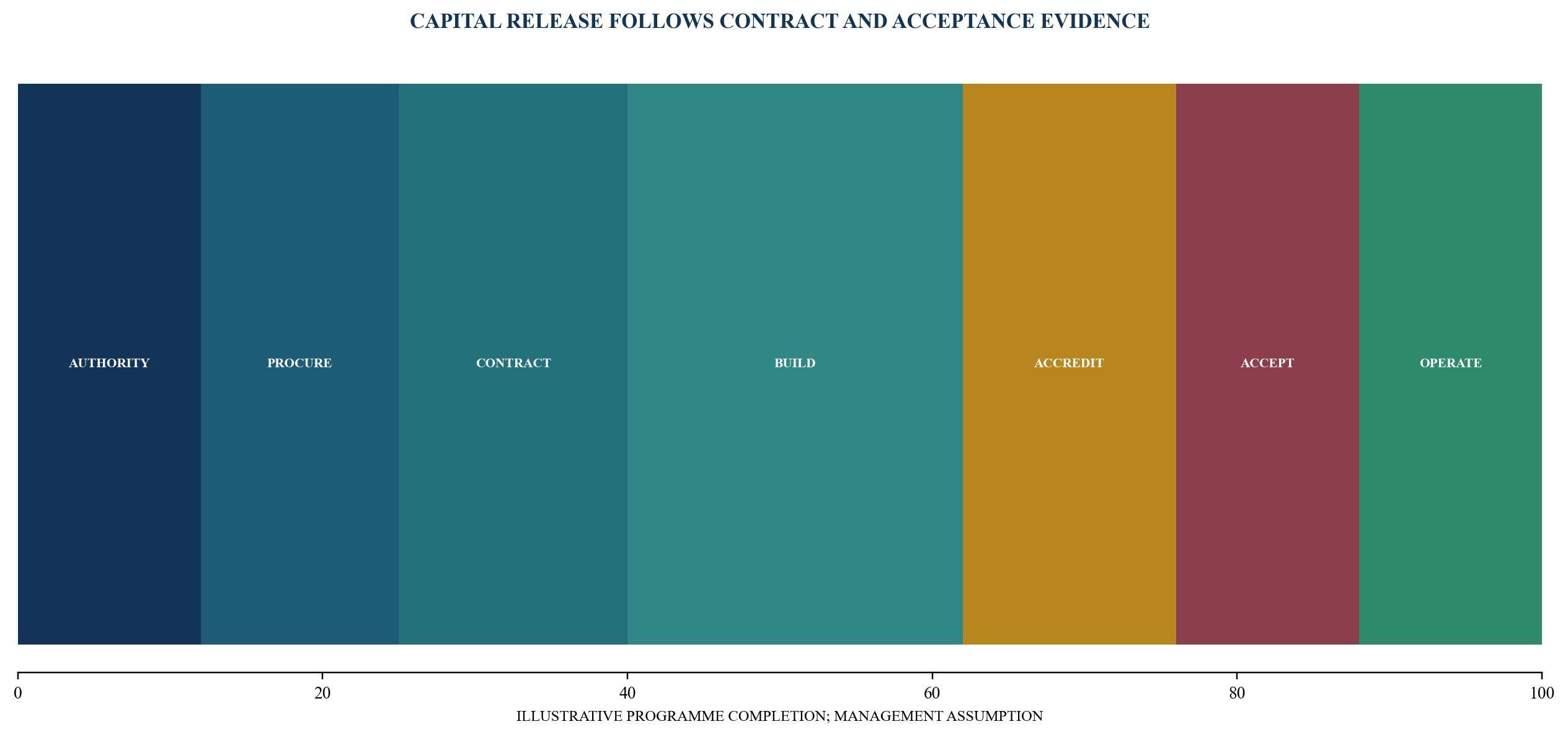
Capital follows authority, contracted demand, technical completion, security approval and customer acceptance.
13. Align contract remedies with financing
The offtake, construction, equipment, operating and financing documents should use compatible definitions. If the customer can deduct for a failure that the operator treats as excused, the project company bears an unallocated gap. If the equipment warranty excludes a condition required by the service agreement, the gap can be permanent.
Step-in rights should preserve service. Lenders can require notice and cure before termination for provider default. Government can require replacement of key subcontractors and continuity for critical workloads. Security incidents may need immediate protective action while financial remedies follow a controlled process.
Termination payments should vary by event. Government default, prolonged force majeure, provider default and voluntary termination can produce different formulas. The formula can consider outstanding senior debt, break costs, lifecycle reserves, asset value, insurance and mitigation. Its enforceability and fiscal treatment need current legal advice.
Change control should preserve the economic bargain. New workloads, higher security, extra capacity, technology substitution or regulatory change can alter cost and schedule. A documented process should require impact evidence, approval, price adjustment and financing consent where relevant.
14. Size debt to collected base-case cash
Debt sizing should begin with accepted capacity and enforceable payment. The model should separate reservation revenue, consumption revenue, public subsidy, third-party sales and managed-service fees. It should apply deductions, payment timing, taxes, operating cost, refresh capex, reserves and working capital.
The base case should use the firm minimum. Uncommitted agency demand and third-party use belong in sensitivities. If the contract allows capacity cancellation, the model should apply notice, compensation and remarketing. If government pays after annual appropriation, liquidity should cover timing risk.
Debt service coverage should be tested after lifecycle capex. A project can show strong cash before refresh and fail when equipment replacement is funded. The model should also test electricity escalation, foreign exchange, delayed acceptance, lower utilisation, security remediation and technology substitution.
Cash control can include an assignment of receivables, collection account, operating waterfall, debt-service reserve, lifecycle reserve, insurance proceeds and distribution lock-up. Sovereign consent and local law determine whether assignments and security are effective.
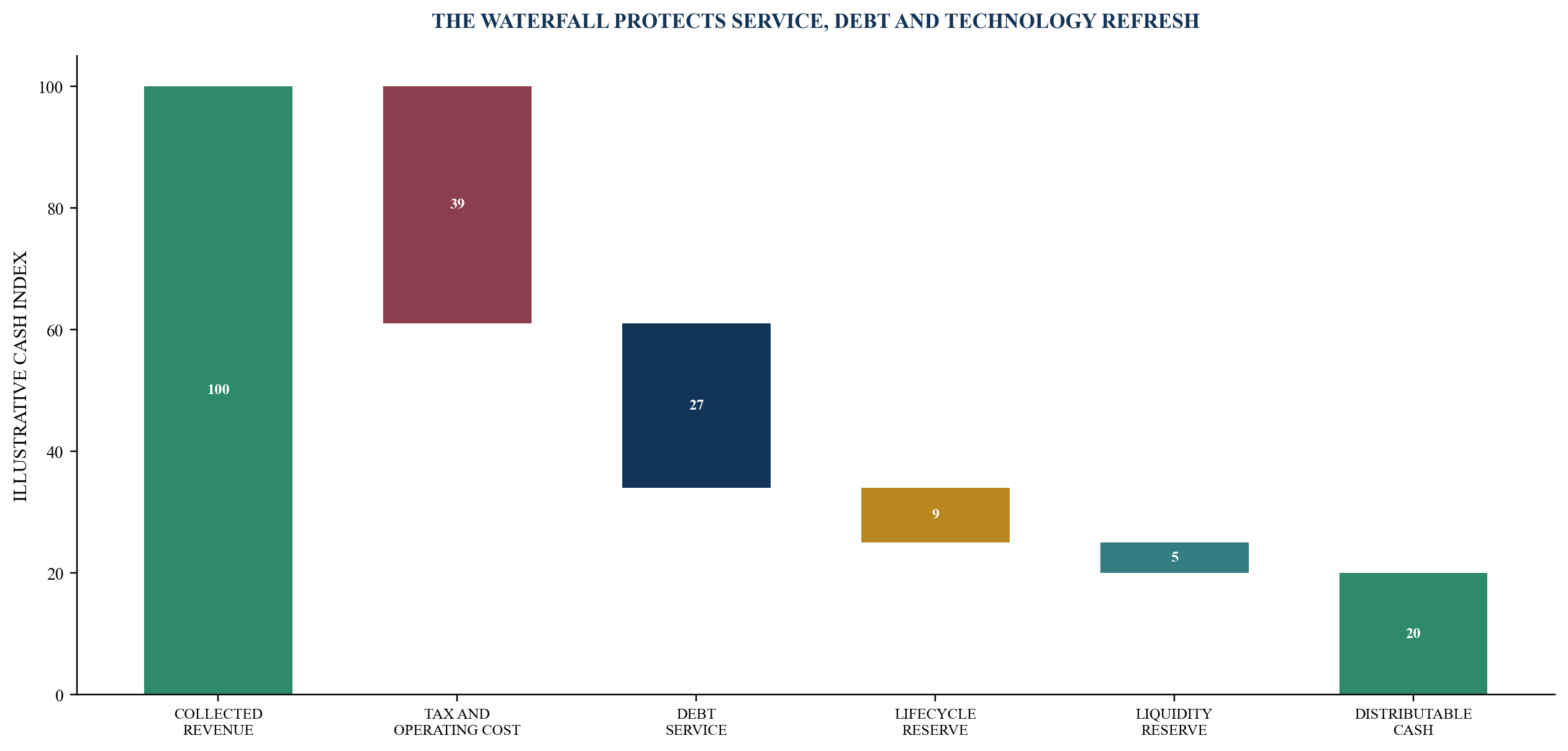
Collected cash funds service continuity, debt and lifecycle obligations before sponsor distributions.
Table 4. Finance evidence and lender response
| Evidence area | Required document | Red flag | Financing response |
|---|---|---|---|
| payer | authority and credit evidence | sponsor differs from obligor | direct agreement or support |
| budget | appropriation and payment route | annual budget assumed automatic | reserve, guarantee or lower debt |
| service | accepted capacity and performance | equipment count used as output | acceptance condition and tests |
| demand | firm reservation or availability payment | applications treated as orders | exclude upside from base case |
| deductions | objective and bounded regime | subjective unlimited set-off | cure, cap and liquidity reserve |
| refresh | funded lifecycle plan | replacement omitted | funded reserve before distributions |
| termination | enforceable event formulas | policy statement treated as support | legal opinion and downside haircut |
Lenders size to contractual and collected cash after service, fiscal and lifecycle risk.
15. Model an illustrative 48 MW programme
The worked case assumes a 48 MW accepted IT-capacity programme developed in three modules. It assumes a public buyer reserves 24 MW at opening, increases to 36 MW after the second acceptance gate and can exercise an option for the final 12 MW. The capacity, timing and contractual structure are management assumptions.
The tariff assumes a fixed reservation payment for accepted capacity, a consumption charge for measured use, and a separate secure-environment charge. The financial model treats the option module as upside until exercised. It carries equipment refresh, security operations, energy, cooling, staff, insurance and reserves.
Capex includes site and power allocation, data-centre fit-out, accelerators, network, storage, software integration, security, commissioning, development and contingency. It excludes any cost or feature absent from the illustrative schedule. A live project needs engineering, bids, tax, customs, licences and financing terms.
The debt case assumes draws follow module acceptance and that the reservation payment covers a defined share of fixed cost and debt service. Consumption revenue supports upside and operating recovery. This is a method illustration. It is not a forecast of sovereign demand or a financing offer.
Table 5. Illustrative sovereign compute assumptions
| Input | Base assumption | Downside | Live evidence required |
|---|---|---|---|
| opening accepted capacity | 24 MW | 16 MW | executed service schedule |
| second module | 12 MW | 8 MW delayed | exercised capacity notice |
| option module | 12 MW | not exercised | approved option and deposit |
| total programme capex | USD 1.44bn | USD 1.66bn | design, procurement and contingency |
| debt share | 55% | 40% | lender terms and conditions |
| base utilisation | 68% | 42% | workload register and orders |
| acceptance period | 24 months | 34 months | programme and test schedule |
| lifecycle refresh reserve | 7% of revenue | 10% | equipment and service-life plan |
Every value is a management assumption for method demonstration.
16. Stress the payment and technology chain
The first downside is delayed authority or procurement. Equipment deposits can become exposed before the contract is effective. Development gates should limit irreversible spend until approval, award and required licences are evidenced.
The second downside is delayed acceptance. Construction can complete while security accreditation, software integration or workload testing remains open. Revenue begins later, interest accrues and equipment ages. The model should carry delay liquidity and allocate responsibility through the contracts.
The third downside is lower reservation or utilisation. A firm availability payment can protect fixed cash, subject to performance. A usage-led structure can create volatile revenue. The project can stage equipment, remarket permitted capacity and maintain sponsor liquidity.
The fourth downside is technology or export restriction. A replacement architecture can cost more, deliver less or arrive later. The contract should permit approved substitution and adjust service requirements when a public change causes the impact. The finance model should haircut residual value.
The combined case matters most. Delayed acceptance, lower demand, higher energy cost and accelerated refresh can erode value simultaneously. Debt should survive the combined scenario with sufficient liquidity or a clear restructuring path.
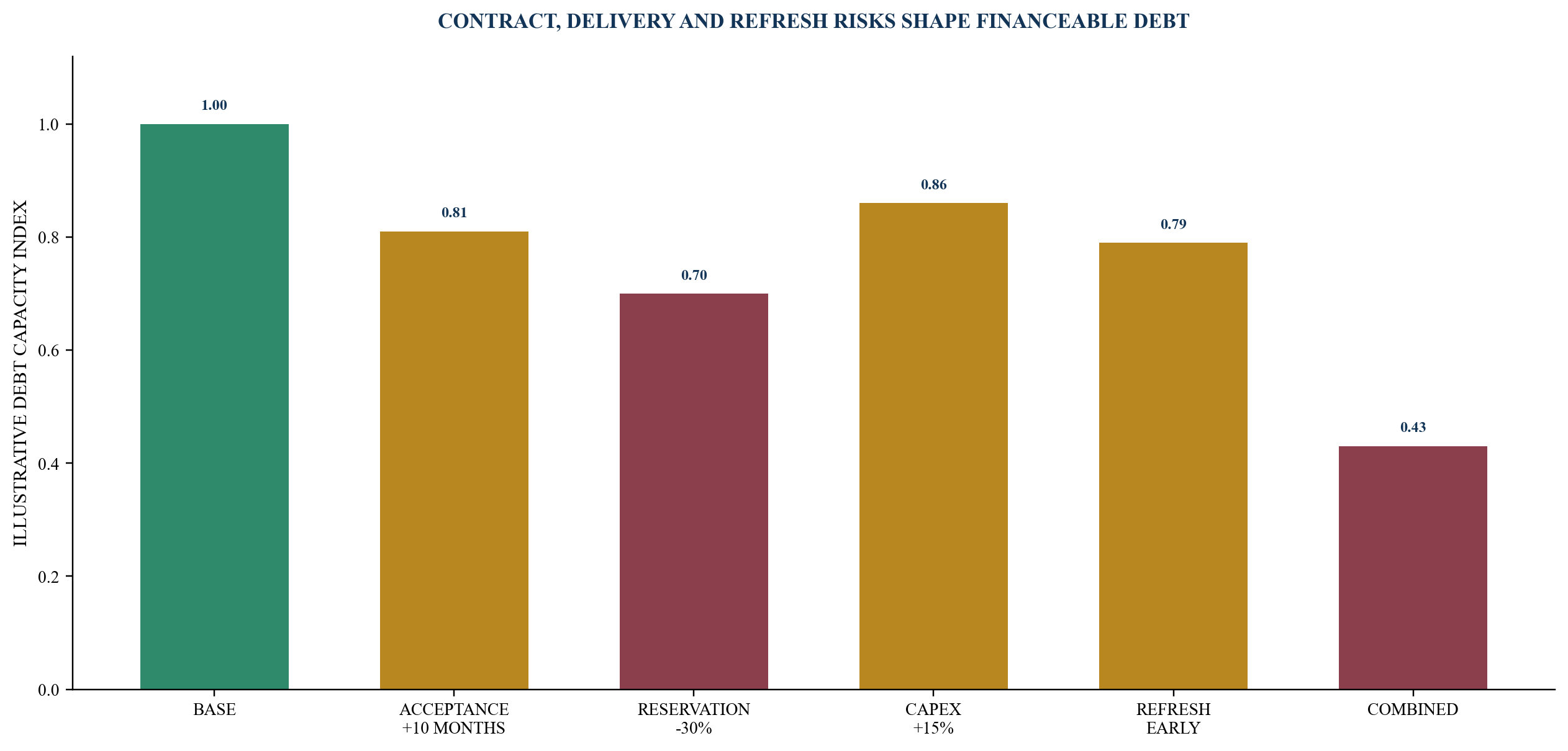
Values are management assumptions and show directional sensitivity rather than a financing conclusion.
17. Build the sovereign offtake data room
The public-authority folder should contain enabling powers, delegation, procurement approvals, budget documents, fiscal classification, tender records, award and any support instrument. The contract folder should hold the service agreement, capacity schedules, tariff, acceptance, deductions, change, termination and direct agreements.
The demand folder should contain the workload register, authorised agencies, historical consumption, allocation rules, call-off orders and pipeline classification. The technical folder should contain site, power, cooling, equipment, network, storage, software, performance and commissioning evidence.
The security folder should contain data classification, architecture, accreditation, access control, supply-chain register, incident response, audits and export authorisations. The finance folder should reconcile capex, operating cost, tariff, collections, reserves, sensitivities and security.
The issue register should identify every unconfirmed authority, budget, user, licence, interface, acceptance condition and payment dependency. Public policy should be cited as context and never relabelled as a contract.
Table 6. Sovereign offtake bankability checklist
| Gate | Evidence | Principal question | Decision |
|---|---|---|---|
| authority | powers, delegation and approvals | can the obligor commit for the term? | proceed, cure or stop |
| procurement | compliant process and award | is the contract validly awarded? | contract condition |
| budget | funded payment route | how are multi-year payments approved? | support and reserves |
| demand | binding reservation and call-offs | which capacity is firm? | base versus upside |
| service | measurable output and tests | when does payment start? | acceptance gate |
| security | accredited operating boundary | which users and workloads qualify? | domain and controls |
| finance | assigned cash and lifecycle funding | can downside cash service debt? | debt and liquidity |
Each board and lender claim should point to a current document, owner and expiry date.
18. Govern public value and transparency
A sovereign offtake can mobilise infrastructure while creating long-term fiscal commitments. Government should compare procurement models, disclose decision criteria where permitted, document value for money and monitor contingent liabilities. The contract should avoid paying for unavailable or obsolete service.
Public value includes more than low unit price. Capacity access, security, resilience, research outcomes, industrial adoption, skills, local capability and environmental performance can matter. Each objective should have a measurable programme indicator. The payment contract should retain a focused set of auditable service obligations.
The provider should report capacity states, availability, use, energy, water, incidents, refresh, deductions, invoices and collections. Independent verification can support material acceptance and performance claims. Confidential security and commercial information should remain protected under the governing framework.
Governance should continue after financial close. A joint contract board can approve changes and resolve issues. Government retains policy and fiscal accountability. The provider retains service delivery. Lenders monitor agreed financial and operating covenants.
19. Run a 180-day sovereign offtake office
Days 1 to 30 establish authority, objectives, users, workloads, data classes, capacity states, procurement route, budget process and decision rights. The team builds the evidence register and separates announced, approved, awarded, contracted, accepted and paid positions.
Days 31 to 60 develop the demand register, capacity modules, service definition, tariff alternatives, security domains, export-control map and preliminary capex. The buyer tests value and fiscal exposure. The provider tests technical and commercial deliverability.
Days 61 to 90 prepare the procurement and contract architecture: output requirements, evaluation criteria, acceptance, metering, deductions, indexation, change, termination and lender interfaces. The financial model sizes the firm reservation and separates upside.
Days 91 to 120 complete market engagement, qualified bids, public-finance analysis, security plan, equipment route, risk allocation and financing terms. The board selects a structure supported by current evidence.
Days 121 to 150 finalise approvals, contract schedules, support instruments, direct agreements, conditions precedent and capex gates. The implementation office aligns construction, equipment, security and customer testing.
Days 151 to 180 close the contract and financing or identify remaining conditions. Monthly reporting begins across accepted capacity, utilisation, performance, capex, budget, invoice, collection, refresh and risk. Expansion remains gated by exercised demand and evidence.
20. Convert the framework into an accountable mandate
A public sponsor or infrastructure developer can commission a sovereign-offtake readiness diagnostic to reconcile authority, demand, procurement, service definition, security, tariff, capex and financing evidence. An offtake and transaction office can coordinate government buyers, users, engineers, operators, technology vendors, security advisers, lenders and investors.
A transaction mandate can design procurement and service schedules, structure capacity reservations, test public-payment support, build the bankability model, manage lender materials and negotiate the commercial interfaces. Retained execution can govern evidence, milestones, acceptance, collections and expansion decisions. Legal, public-finance, procurement, security, export-control, engineering, environmental, tax, accounting and insurance responsibilities remain with appropriately appointed advisers.
The deliverable should lead to a board decision: procure, reserve, build, finance, phase, redesign or stop. Fees should reflect scope, senior accountability, stakeholder complexity and execution period. Advisory revenue remains zero until a mandate is executed, an invoice is issued under its terms and collection is evidenced.
The investment committee should approve debt against accepted service and enforceable public payment after deductions, lifecycle cost and reserves. National ambition supplies the purpose. A controlled evidence chain supplies the cash flow.
References
- UK Department for Science, Innovation and Technology and UK Research and Innovation. AI Research Resource. Updated 17 July 2026. https://www.gov.uk/government/publications/ai-research-resource
- UK Department for Science, Innovation and Technology. AI for Science Strategy. 2025. https://www.gov.uk/government/publications/ai-for-science-strategy/ai-for-science-strategy
- European High Performance Computing Joint Undertaking. AI Factories Access Modes. Accessed August 2026. https://www.eurohpc-ju.europa.eu/ai-factories/ai-factories-access-modes_en
- European High Performance Computing Joint Undertaking. Terms of Reference: AI Factories Access Calls for Industrial Innovation. 2026. https://www.eurohpc-ju.europa.eu/document/download/bd7aa666-bdf3-4436-b5ec-0b34a781e817_en
- IndiaAI Mission. IndiaAI Compute Portal. Accessed August 2026. https://compute.indiaai.gov.in/
- IndiaAI Mission. IndiaAI Compute Price Calculator. Accessed August 2026. https://compute.indiaai.gov.in/indiaaipricecalculator
- Innovation, Science and Economic Development Canada. Canadian Sovereign AI Compute Strategy. Updated 2026. https://ised-isde.canada.ca/site/ised/en/canadian-sovereign-ai-compute-strategy
- Innovation, Science and Economic Development Canada. Canada to Drive Billions in Investments to Build Domestic AI Compute Capacity at Home. 5 December 2024. https://www.canada.ca/en/innovation-science-economic-development/news/2024/12/canada-to-drive-billions-in-investments-to-build-domestic-ai-compute-capacity-at-home.html
- UAE Ministry of Foreign Affairs. UAE/US Framework on Advanced Technology Cooperation. 16 May 2025. https://www.mofa.gov.ae/en/MediaHub/News/2025/5/16/16-5-2025-UAE-US
- The White House. Fact Sheet: President Donald J. Trump Secures $200 Billion in New U.S.-UAE Deals. 15 May 2025. https://www.whitehouse.gov/fact-sheets/2025/05/fact-sheet-president-donald-j-trump-secures-200-billion-in-new-u-s-uae-deals-and-accelerates-previously-committed-1-4-trillion-uae-investment/
- Abu Dhabi Department of Government Enablement. Abu Dhabi Government Accelerates Digital Strategy with Landmark Microsoft, G42 Partnership. 18 March 2025. https://www.dge.gov.ae/en/news/microsoft-g42
- Public Investment Fund. HUMAIN. Accessed August 2026. https://www.pif.gov.sa/en/our-investments/our-portfolio/humain/
- Public Investment Fund. HRH Crown Prince Launches HUMAIN as Global AI Powerhouse. 12 May 2025. https://www.pif.gov.sa/en/news-and-insights/press-releases/2025/hrh-crown-prince-launches-humain-as-global-ai-powerhouse/
- World Bank Group and partner institutions. PPP Reference Guide Version 3. 2017. https://ppp.worldbank.org/sites/default/files/2024-08/PPP%20Reference%20Guide%20Version%203.pdf
- World Bank Group. Structuring the PPP Contract. Accessed August 2026. https://ppp.worldbank.org/structuring-ppp-contract
- World Bank Group. Budgeting for Government Commitments to PPPs. Accessed August 2026. https://ppp.worldbank.org/budgeting-government-commitments-ppps
- World Bank Group. Allocating Risks. Accessed August 2026. https://ppp.worldbank.org/allocating-risks
About the Author
Chennakeshav Adya, Independent Researcher
This paper provides a decision framework for governments, sovereign platforms, data-centre developers, investors and lenders evaluating national AI demand and project-finance offtake. It is general research and does not provide public-finance, procurement, legal, security, export-control, engineering, environmental, tax, accounting, insurance, investment or financing advice.
