

1. Define stranding as a decision condition
A stranded data-centre site is a location whose original use, timing or cash-flow case can no longer support the approved capital plan without a material change. Stranding can occur before energisation, during construction, at commissioning or after operations begin. It can be temporary, partial or permanent. The board needs a test that identifies what failed, which assets remain useful, what evidence supports a new use and how much further capital is justified.
The condition should be separated from ordinary underperformance. A delayed sales ramp can be addressed through commercial execution when the site's technical and power envelope remains suitable. A tenant insolvency can expose a concentration problem while leaving a marketable facility. A high-density customer can withdraw after the operator has installed specialised liquid cooling, creating both a vacancy and a narrow reuse market. A grid delay can strand land and construction even when demand exists. These cases require different remedies.
The first board question is the scope of the affected value. The team should map land and tenure, permits, grid rights, commissioned power, network routes, shell, electrical and mechanical systems, cooling, security, customer contracts, equipment ownership, warranties, staff, operating records and financing obligations. Each layer should have an evidence owner, current status, alternative use and estimated time and cost to recover.
The decision should use cash and control gates. A plausible new customer, a vendor quotation or a future utility date is relevant evidence. Capital should be released only when the commercial commitment, engineering design, regulatory path, funding source and acceptance conditions are sufficiently developed for the next stage. This preserves options while preventing a stranded thesis from becoming an open-ended rescue programme.
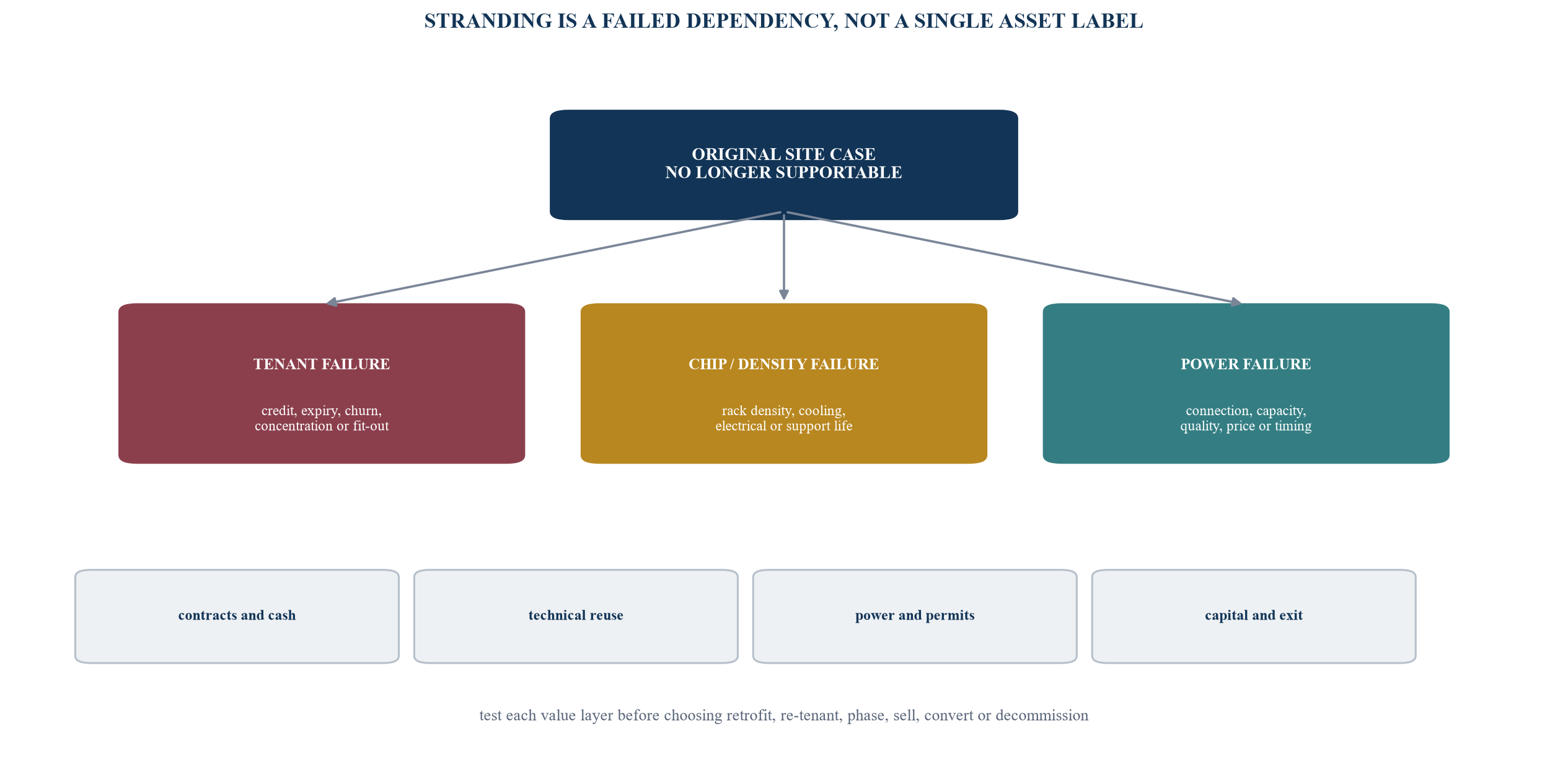
The diagnostic starts with the failed dependency and traces the affected value layers.
2. Establish the evidence boundary
The site record should distinguish four states: verified current facts, signed future commitments, management assumptions and unresolved matters. A utility invoice and commissioning certificate support a different conclusion from a reservation letter. A customer contract with termination rights differs from a non-binding expression of interest. A vendor's generic rack-density statement differs from a site-specific design with hydraulic, electrical and structural calculations.
Evidence should be dated, attributable and traceable. The recovery office should maintain a document index linking each material model input to a contract, drawing, meter record, test, invoice, bank receipt, regulator filing, board approval or adviser report. Management estimates can be used in scenarios, provided the model identifies them and tests the consequence of error. Unknown values should remain visible rather than being replaced with convenient averages.
The diagnostic also needs a consistent unit system. Teams should distinguish utility reservation, contracted supply, energised capacity, installed critical load, tested load, customer-reserved load, occupied load and billed load. They should separate megawatts of IT load from total facility demand and clarify whether power usage effectiveness is measured or modelled. Similar discipline applies to square metres, cabinets, rack density, cooling capacity, network ports and cross-connects.
The board pack should include an evidence-confidence map. High-confidence inputs can support committed capital and financing. Medium-confidence inputs can support design or diligence spend with defined conditions. Low-confidence inputs should remain options or downside sensitivities. This hierarchy allows progress without presenting a future pathway as an accomplished recovery.
Table 1. Failure modes and evidence tests
| Failure mode | Observable trigger | Core evidence | Immediate board question |
|---|---|---|---|
| tenant credit failure | missed payment, restructuring, insolvency or parent support withdrawal | contract, guarantee, ageing, bank receipts, insolvency record and security deposit | can cash and possession be protected while replacement demand is tested? |
| tenant departure | notice, expiry, consolidation or migration | notice, renewal history, fit-out ownership, reinstatement rights and market enquiries | is the space reusable at an acceptable cost and time? |
| chip-density mismatch | target rack load exceeds electrical or thermal envelope | customer specification, one-line diagram, thermal model, test and vendor design | can a customer-backed retrofit meet safety, uptime and return gates? |
| technology support expiry | controls, cooling, UPS, switchgear or software leaves support | asset register, support date, failure history, spares and replacement quotation | should equipment be maintained, replaced or harvested? |
| grid timing failure | connection date moves beyond commercial need | executed agreement, milestone record, network study and utility correspondence | can phasing, relocation or alternative supply preserve the case? |
| grid capacity or quality failure | delivered power, redundancy or quality falls below requirement | meter data, test, protection study, outage log and tariff | which workloads remain feasible and bankable? |
Each conclusion should be linked to current site-specific evidence.
3. Decompose the recoverable-value stack
Recoverable value begins with rights that another user can control. Land value depends on title or lease, term, permitted use, access, easements, environmental condition and alternative demand. A strategic location can lose value if the lease is short, renewal is uncertain or access depends on the failed tenant. The legal and property review should identify transferability and lender control before the valuation assigns a reuse premium.
Power value depends on more than a headline megawatt figure. The stack includes application position, executed connection agreement, security paid, land and route, construction milestones, energised capacity, redundancy, quality, tariff, curtailment rights, ramp profile and ability to transfer or change use. A queue position without enforceable delivery can have limited recoverable value. Energised capacity with weak redundancy or high operating restrictions can serve a narrower workload set.
Network value includes diverse physical entrances, active carriers, dark fibre, internet-exchange access, cloud connectivity, cross-connects and rights to expand. A stranded single-tenant facility may have strong route diversity that supports colocation conversion. A remote powered site can remain difficult to lease where network construction is slow or controlled by one provider. Network diligence should reconcile marketing claims with maps, contracts, live ports and path tests.
The physical plant should be split by adaptability. Shell, floor loading, clear height, security perimeter and fire systems can support multiple generations. Electrical distribution and cooling are more sensitive to density, topology and redundancy. Tenant-owned equipment, customised containment and proprietary controls can complicate recovery. The final layer is operating capability: permits, procedures, staff, maintenance history, incident record, commissioning data and customer acceptance. These records can shorten a re-tenanting process when complete and reduce value when absent.
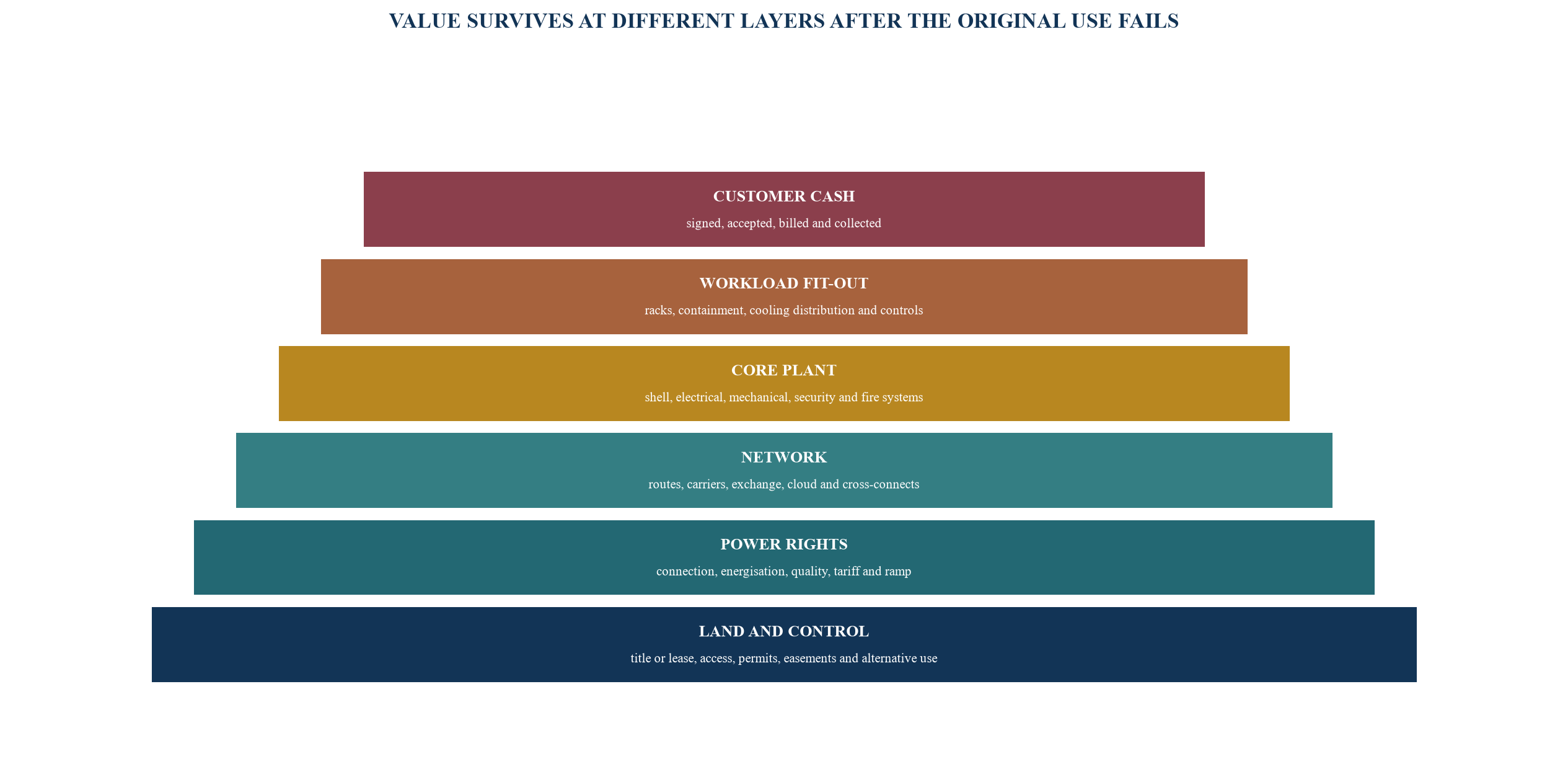
The stack separates durable rights from workload-specific equipment and forecast cash.
4. Diagnose tenant failure without destroying optionality
Tenant failure can be a credit event, a contractual event or a product-market event. The operator should first protect safety, access, critical systems, cash, equipment ownership, insurance and legal rights. It should establish whether the contract can be terminated, assumed, assigned or enforced; whether deposits, guarantees or letters of credit are available; and whether the tenant owns servers, cooling distribution, cabling or other fit-out. Qualified counsel should direct any insolvency, possession or enforcement action.
The commercial team should test replacement demand by product rather than by building. A hyperscale hall, enterprise colocation room, powered shell and high-density suite require different customers, sales cycles, service levels and operator capabilities. The team should define available power, rack density, cooling, network, security, commissioning evidence, earliest ready date, required modification and price before approaching prospects. It should record budget owner, technical acceptance criteria, procurement stage and contract route for every enquiry.
Listed-operator filings show why re-leasing assumptions deserve scrutiny. Digital Realty states that some facilities require significant modification to re-lease and that technological change, including artificial-intelligence compute, cooling and power requirements, can make tenant improvements outdated or obsolete. It also reports customer concentration and single-customer facilities. These disclosures describe issuer risks and do not establish the condition or demand of another site.
The board should compare three tenant pathways. Direct replacement preserves the current design when a compatible user exists. Multi-tenant conversion can diversify cash and requires sales, billing, access, metering, cross-connect and service capabilities. Alternative workload conversion can address a wider market and may require substantial retrofit. Each pathway should show signed demand, capital, outage, operating cost, time to revenue, concentration and downside.
5. Test chip, rack-density and cooling obsolescence
Chip failure in this framework means the site's technical envelope no longer serves the target compute generation or workload. The failure can arise from rack density, voltage, distribution, UPS topology, cooling temperature, flow, water availability, structural load, containment, controls or maintenance support. A single headline such as kilowatts per rack cannot establish fitness. Engineers should model the end-to-end electrical and thermal path, including failure modes and maintainability.
ASHRAE's artificial-intelligence data-centre framework discusses direct-to-chip liquid cooling, rear-door heat exchangers and thermal zones for high-density environments. It identifies energy, water and carbon metrics and points to relevant data-centre standards and thermal guidance. The framework supports a structured design review. A site-specific engineering assessment remains necessary because climate, water, redundancy, equipment, load shape and customer specifications differ.
The diagnostic should classify areas into four zones. A current-fit zone serves the target workload without material modification. An adaptable zone can be upgraded through a defined and tested pathway. A legacy zone can continue serving lower-density enterprise, network, storage or content workloads. A non-economic zone lacks customer demand or requires capital and downtime beyond its recoverable value. This approach avoids treating the entire campus as obsolete because one product no longer fits.
Retrofit proposals should include customer specification, basis of design, hazard review, electrical and thermal model, water and environmental assessment, equipment lead times, construction sequence, commissioning, outage plan, warranty, operating procedures and acceptance test. The commercial contract should allocate changes in chip specification, delivery delay and capacity shortfall. Capital release should be staged against design freeze, equipment order, construction readiness and customer commitment.
Table 2. Technical reuse pathways
| Path | Suitable condition | Required intervention | Principal value risk |
|---|---|---|---|
| maintain current workload | equipment remains supported and customer demand values existing density | lifecycle maintenance, spares and targeted efficiency work | declining demand or rising operating cost |
| retrofit high-density zone | power, structure and heat-rejection path can support a bounded upgrade | liquid-cooling distribution, electrical change, controls, commissioning and training | customer specification moves before delivery |
| split-density operation | part of the site can support newer loads while legacy halls retain demand | hydraulic and electrical zoning, metering and service separation | operational complexity and common-mode failure |
| convert to colocation or network use | location and connectivity support a broader customer set | access, cages, metering, billing, cross-connects and customer operations | slow lease-up and higher service cost |
| powered-shell sale or lease | buyer values land, power and shell more than current plant | separation, disclosure, transfer, reinstatement and warranty allocation | limited buyer pool or transfer restrictions |
| harvest and decommission | reuse capital exceeds supportable value | customer migration, safe shutdown, asset sale and remediation | stranded obligations and environmental cost |
The path depends on engineering, customer and operating evidence.
6. Diagnose power failure from agreement to usable load
Power failure can occur at six stages: site selection, grid application, connection offer, network works, energisation and operational delivery. The critical date is the date when tested, reliable and contractually usable capacity supports the customer's acceptance conditions. A connection letter or substation construction milestone should not be treated as revenue-ready power unless the remaining dependencies are identified and funded.
The International Energy Agency reported that data-centre electricity use rose 17 per cent in 2025 and projects global consumption to approximately double by 2030. It also estimates that around one-fifth of planned data-centre capacity to 2030 could face grid-connection delays. These global estimates explain why connection diligence matters. They do not predict delivery at a named site.
United Kingdom evidence illustrates the difference between queue position and readiness. The National Energy System Operator reported that the historic connections queue exceeded 700 gigawatts and could imply waits of up to ten years. Its 2026 demand-side analysis found that data centres represented more than half of responses, only 32 per cent of data-centre projects reported secured offtakers and 81 per cent were open to phased, ramped or non-firm connections. Those findings support milestone-based prioritisation and flexible connection design.
The recovery team should reconstruct the connection from executed documents and physical evidence. It should confirm rights, securities, milestones, route, land, permits, network reinforcement, long-lead equipment, protection, metering, redundancy, tariff, curtailment, commissioning and transfer. It should then test phased energisation, demand flexibility, co-location with generation or storage, alternative sites and revised customer load. Each option needs legal, technical, regulatory and commercial review.
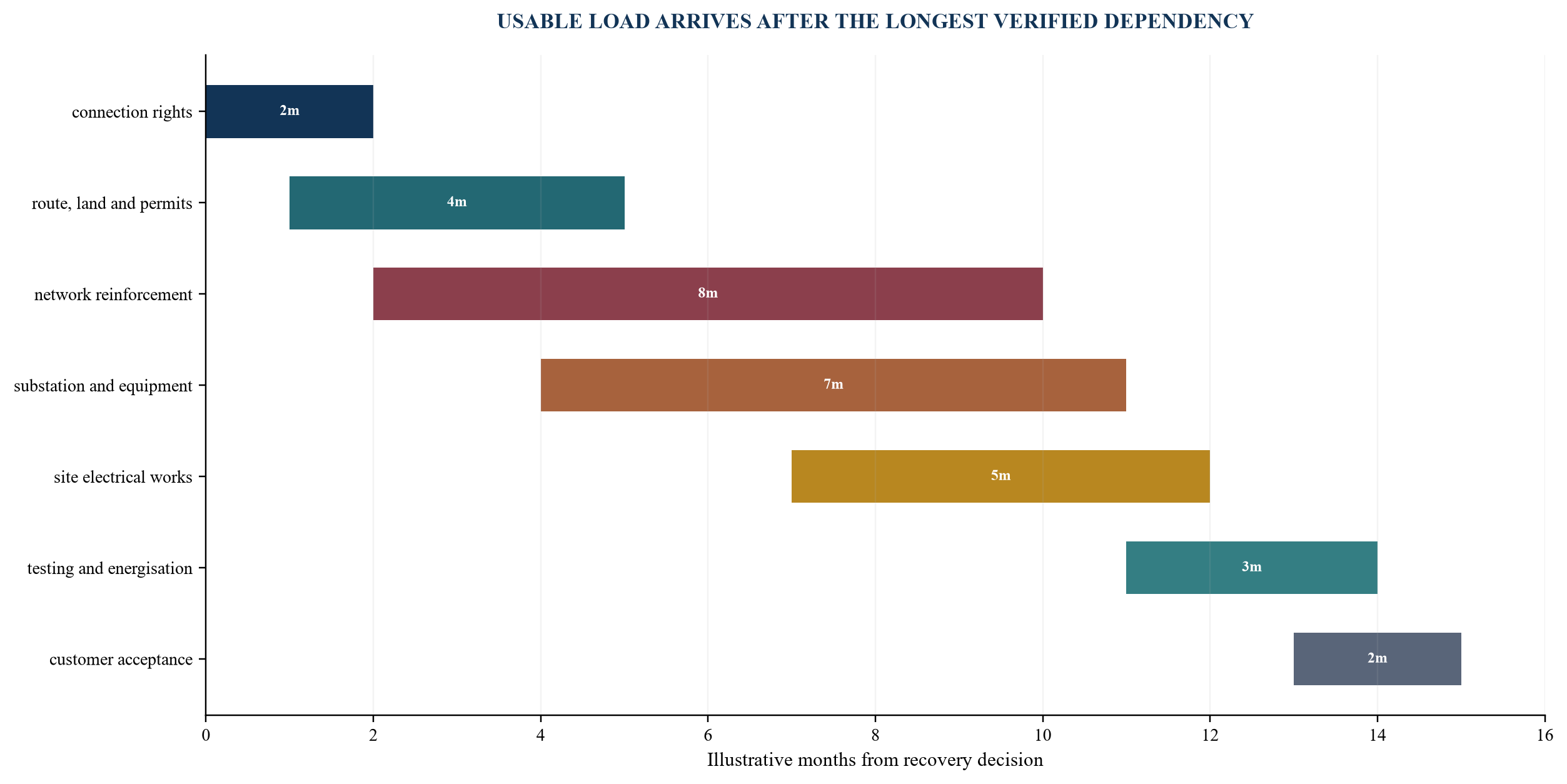
Durations are illustrative management assumptions; actual dates require utility and project evidence.
7. Compare jurisdiction-specific recovery constraints
Recovery options operate within local power, data, sustainability, planning and investment rules. The European Union requires operators of data centres above 500 kilowatts of installed information-technology power demand to report specified performance data under the Energy Efficiency Directive and Delegated Regulation 2024/1364. The European Commission is developing an EU rating scheme and minimum performance standards. A reuse plan should preserve the data and metering required for reporting and anticipate tighter performance expectations.
Singapore's Green Data Centre Roadmap aims to provide at least 300 megawatts of additional capacity in the near term while improving energy efficiency and accessing green energy. It highlights standards for liquid cooling. A stranded-site recovery in Singapore should therefore connect retrofit design to national capacity allocation, efficiency and sustainability requirements rather than assume unrestricted power growth.
The United States Department of Energy's Lawrence Berkeley National Laboratory published a 2024 national data-centre energy-usage report with scenarios through 2028. The national evidence supports utility and policy planning, while local connection, water, tax, zoning and community conditions continue to determine site feasibility. In the United Kingdom, connection reform prioritises projects that are ready and strategically aligned, increasing the importance of milestone evidence.
In the UAE, the Ministry of Energy and Infrastructure inaugurated the Emirates Monitoring Center in July 2026 to connect all four utility authorities and support real-time monitoring of a national system with approximately 48 gigawatts of installed capacity. DEWA's project guidance asks developers to provide realistic connected-load and phasing requirements. Saudi cloud-provider registration and data-centre facility requirements add service and compliance considerations. The board should maintain a jurisdiction register and obtain current local advice for every recovery path.
Table 3. Selected jurisdiction and recovery implications
| Market | Authoritative context | Recovery implication | Evidence to obtain |
|---|---|---|---|
| United Arab Emirates | national grid monitoring and utility-specific project guidance | align load, phasing, connection and resilience with the responsible utility | executed power documents, phasing, single-line diagram, tests and current approvals |
| Saudi Arabia | cloud registration and data-centre facility or sustainability requirements | confirm whether the revised service model changes registration or facility obligations | provider class, certification, hosting model, data controls and change approvals |
| United Kingdom | connections reform prioritises ready and strategically aligned projects | preserve milestone evidence and test phased, ramped or flexible demand | queue status, readiness evidence, offtake, flexibility and delivery programme |
| European Union | mandatory reporting for qualifying data centres and evolving performance rules | retain metering and model retrofit effects on energy, water and sustainability indicators | reporting records, measurement boundary, baseline and retrofit design |
| Singapore | roadmap links capacity growth with efficiency, green energy and liquid cooling | demonstrate efficient design and policy alignment before committing recovery capital | allocation route, efficiency metrics, cooling standard and energy plan |
| United States | national energy scenarios coexist with state, utility and local constraints | underwrite the specific utility, water, planning, tax and community pathway | tariff, interconnection, water, zoning, incentives and stakeholder record |
The table is a diligence agenda; current applicability requires local advice.
8. Build a site scorecard before selecting a remedy
The site scorecard should grade legal control, power, network, technical adaptability, customer demand, operating readiness, capital requirement, timetable and exit liquidity. Scores should be accompanied by evidence quality and a specific gap. A high aggregate score should not override a fatal constraint such as an expired lease, non-transferable power right, unsafe plant or unavailable water pathway.
The commercial score should measure qualified customer demand against the defined product. It should distinguish verbal interest, technical review, funded procurement, signed contract, acceptance and collected cash. The technical score should assess present capability and the validated upgrade path. The power score should distinguish reservation from energised and tested capacity. The capital score should include transaction, remediation, contingency, financing and working-capital needs.
The board can apply minimum gates rather than relying on a weighted average. Legal control, safety, power feasibility, technical feasibility, customer evidence and liquidity can each be mandatory. A site that passes all gates can proceed to staged recovery. A site that fails one gate can remain in an option period, be sold to a better-suited user or enter decommissioning.
The scorecard should be refreshed at defined milestones. New customer requirements, grid dates, equipment quotations, regulation or financing terms can change the preferred path. The decision log should record what changed, which assumption moved and how the capital recommendation responded. This protects governance when a previously attractive recovery later becomes uneconomic.
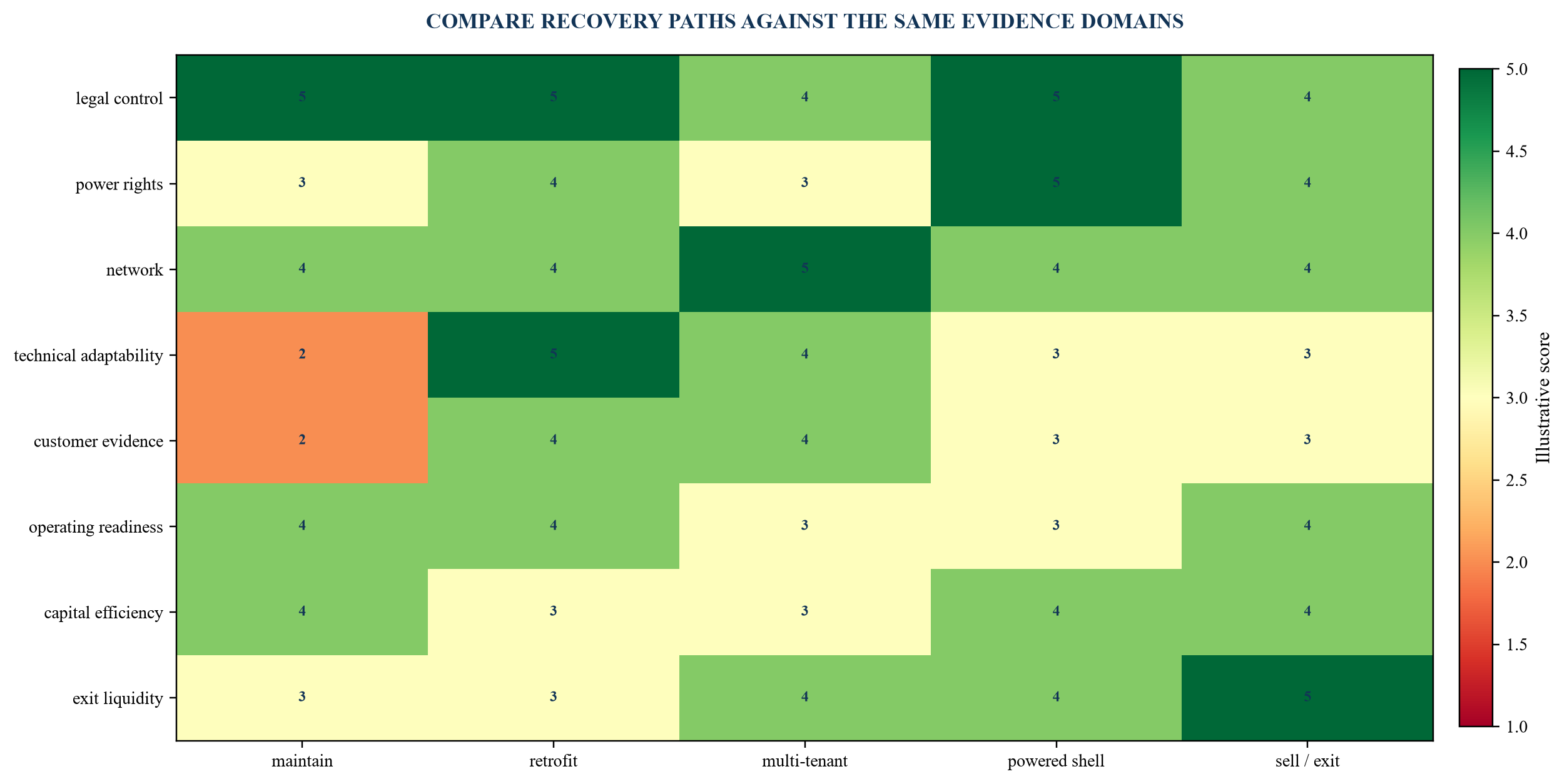
Scores are management assumptions for method demonstration and require current diligence.
9. Sequence the remedy through decision gates
The recovery sequence should begin with containment. The operator protects people, uptime, data, access, cash, insurance, permits and lender rights. It identifies decisions that can wait and actions that could destroy optionality. Removing equipment, terminating a connection agreement or surrendering a lease can affect later value and should follow an approved decision process.
The second gate validates the reuse thesis. The team defines the product, customer, technical envelope, power pathway, capital, schedule and operating model. It compares the current site's advantages with relocation or disposal. A reuse thesis should explain why this site, why this customer, why this design and why the value exceeds the next-best option after risk and delay.
The third gate authorises detailed design and procurement. It requires customer specification, engineering basis, permits, utility position, equipment quotations, delivery dates, outage plan, contract allocation and financing. Long-lead orders should include cancellation, change and warranty protections where commercially available. The fourth gate releases construction capital after design freeze, site readiness and funding.
The final gates are commissioning, customer acceptance and cash. Technical completion does not establish economic recovery. The operator should track accepted capacity, invoicing, collection, service performance and remaining obligations. A recovery should be reported as complete only when the revised use is operating under the approved acceptance criteria and the financial model reconciles to observed results.
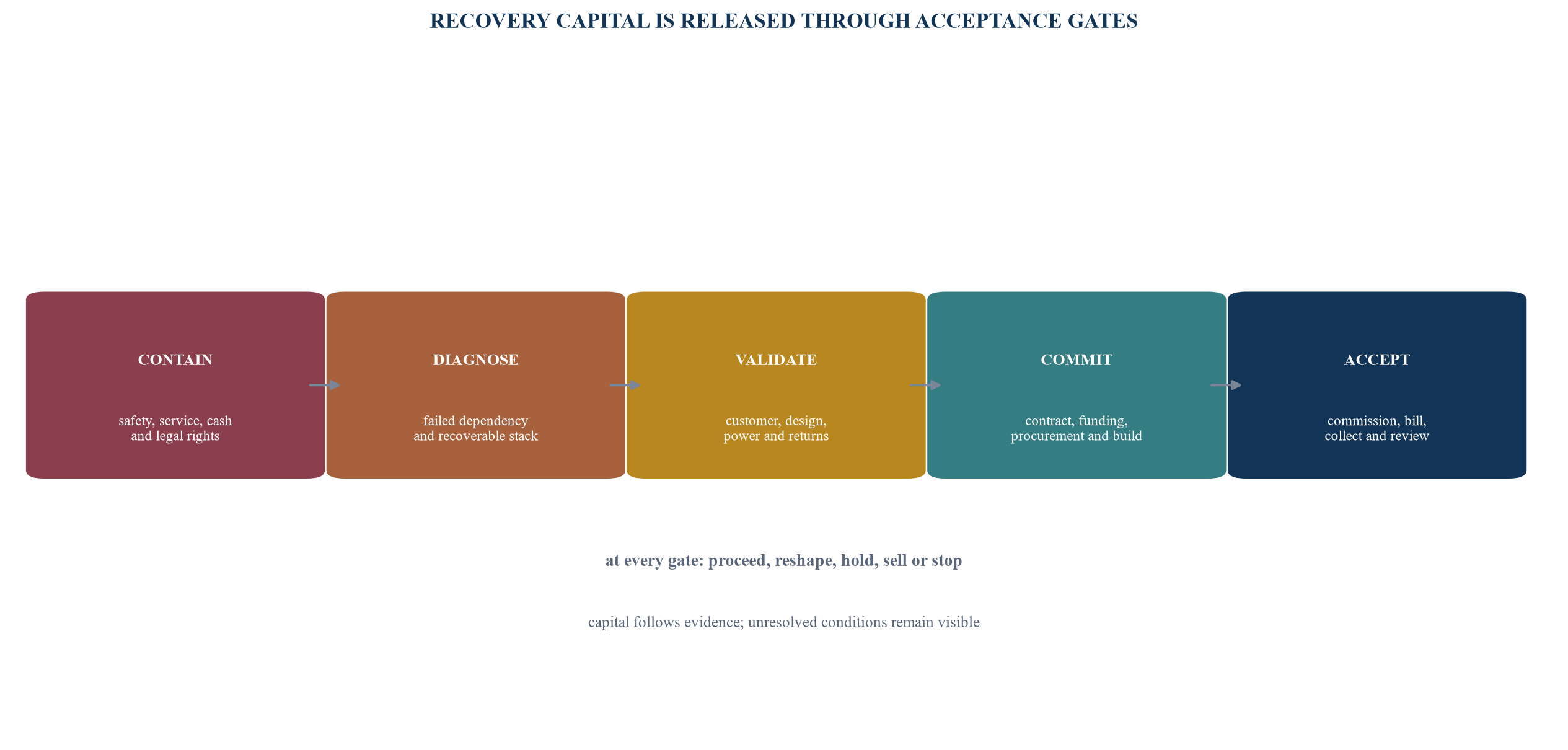
Each gate requires defined evidence, authority and a stop decision.
10. Underwrite the full retrofit capital requirement
Retrofit capital includes more than equipment. The budget should cover design, investigation, utility and permit work, enabling construction, electrical equipment, cooling generation and distribution, controls, fire protection, structural work, network, security, commissioning, customer fit-out, spares, training, outage mitigation, professional fees, taxes, financing cost, contingency and working capital. Existing asset removal and environmental obligations should also be included.
The capex register should classify safety and compliance, continuity, lifecycle replacement, customer delivery, efficiency, capacity, integration and speculative growth. Safety and contractual obligations require funding independent of the growth case. Customer delivery capital should be tied to signed specifications and remedies. Speculative growth should have a separate option budget until demand and technical evidence improve.
Timing affects value through both cost escalation and lost cash. A delayed connection can push equipment into storage, warranty erosion or redesign. A chip specification change can require new cooling distribution. A tenant failure can interrupt utility-cost recovery while fixed operating expenses continue. The liquidity model should therefore use monthly cash rather than an annual steady-state view.
The financing structure should match the evidence stage. Early diagnostic and design work can be funded as risk capital. Construction debt may require permits, fixed-price or controlled contracts, customer commitments, contingency, completion support and tested covenants. Asset sale, joint venture, lease, vendor finance or customer contribution can reduce sponsor exposure where rights and control are clear. Financing availability and terms remain site-specific until committed by counterparties.
Table 4. Retrofit capital waterfall
| Capital line | Illustrative amount | Release evidence | Control |
|---|---|---|---|
| investigation and design | USD 2.0m | site survey, customer specification and approved basis of design | capped diagnostic authority |
| utility, permits and enabling works | USD 4.0m | executed pathway, milestone plan and permits | condition-based release |
| electrical and cooling equipment | USD 18.0m | design freeze, supplier terms, delivery plan and warranties | procurement committee |
| construction and integration | USD 10.0m | site readiness, method, outage plan and contractor security | monthly certified progress |
| commissioning and customer acceptance | USD 3.0m | test scripts, independent witness and acceptance plan | retained payment until acceptance |
| working capital and contingency | USD 8.0m | approved draw case and named risk register | board-controlled reserve |
| total illustrative recovery capital | USD 45.0m | all gates satisfied for each tranche | no automatic release of unused reserve |
Values and percentages are illustrative management assumptions for method demonstration.
11. Model recoverable value and impairment coherently
The valuation should compare the cash consequences of maintain, retrofit, convert, sell and decommission pathways. Each case should include capital, delay, capacity, price, lease-up, churn, operating cost, maintenance, taxes, working capital, terminal value and exit cost. Scenario probabilities can inform a decision when they are approved management estimates; they should not disguise an unresolved fatal condition.
IFRS Foundation material explains that IAS 36 prevents an asset from being carried above the amount recoverable through use or sale. Significant adverse technological, market, economic or legal changes and evidence of obsolescence can indicate impairment. IAS 16 requires useful life to reflect expected utility and considers technical or commercial obsolescence. Qualified accountants and valuers should apply current standards to the entity, cash-generating unit and facts.
The transaction model and accounting test have different purposes and should reconcile. The investment model decides whether new capital creates adequate risk-adjusted value. The accounting process assesses carrying amount and recognition under applicable standards. A commercially attractive reuse can still require an impairment if earlier carrying values cannot be recovered. An impairment can also occur before management abandons a recovery option.
The board should see a bridge from prior carrying value to current recoverable components, new capital and post-recovery value. It should identify which amounts come from observed transactions, external quotations, contracts or management scenarios. Independent valuation may be appropriate where decisions affect financing, related parties, financial reporting or a sale.
12. Work an illustrative single-site case
The worked case assumes a completed 24-megawatt campus designed for one customer. The tenant has terminated before full ramp. Twelve megawatts are energised and tested; a further twelve megawatts depend on network reinforcement. Existing air-cooling distribution supports an average 18 kilowatts per rack. A replacement prospect requests a six-megawatt high-density zone with direct-to-chip liquid cooling and retains the remaining space for conventional enterprise and network workloads.
Every figure in this case is a management assumption for method demonstration. The prior carrying value is USD 180 million. The hypothetical as-is sale value is USD 105 million before transaction cost. A retrofit requires USD 45 million, 15 months and a signed six-megawatt customer commitment. Stabilised annual revenue is assumed at USD 32 million and site EBITDA at USD 16 million after ramp. No market multiple, financing term or probability is asserted.
The base case uses a discounted post-recovery value of USD 205 million after considering capital and delay. The downside assumes a six-month delay, 20 per cent higher retrofit cost, three megawatts of accepted high-density load and slower conventional lease-up; its discounted value is USD 142 million. Decommissioning and equipment recovery are assumed to produce USD 68 million after obligations. The board would compare these values with the certainty, timing, funding and control of an actual sale offer.
The example supports a staged decision. Management could authorise diagnostic and design spend, require a binding customer contract and verified power milestone before long-lead procurement, and preserve a sale process in parallel. If the contract, connection or design gate fails by the agreed date, the sale or controlled exit pathway becomes the base plan. This avoids funding the entire retrofit on the strength of a prospect and a conceptual design.
Table 5. Illustrative single-site recovery case
| Metric | Retrofit base | Retrofit downside | As-is sale | Controlled exit |
|---|---|---|---|---|
| energised capacity at decision | 12 MW | 12 MW | 12 MW | 12 MW |
| new recovery capital | USD 45m | USD 54m | USD 4m transaction cost | USD 12m shutdown and remediation |
| time to principal cash event | 15 months | 21 months | 6 months | 18 months |
| accepted high-density load | 6 MW | 3 MW | buyer risk | none |
| stabilised annual revenue | USD 32m | USD 24m | none to seller | none |
| illustrative discounted value | USD 205m | USD 142m | USD 101m net | USD 68m net |
| decision condition | signed customer, design freeze and power milestone | liquidity supports delay and revised return | binding offer and transferable rights | no superior reuse or sale path |
Every value is a management assumption for method demonstration; the table is not a valuation opinion or forecast.
13. Design the customer and offtake strategy
Recovery demand should be developed through a defined customer map. Potential users include hyperscale and cloud providers, artificial-intelligence platforms, sovereign or regulated workloads, enterprise colocation, financial services, content and gaming, telecom and network providers, research institutions and industrial operators. Each segment values a different combination of density, resilience, network, sovereignty, sustainability, speed and service.
The customer record should capture legal entity, credit, parent support, use case, capacity, density, cooling, voltage, data requirement, network, redundancy, schedule, expansion, contract term, termination, service level, price, deposit, security, fit-out ownership and acceptance. A letter of intent can support design dialogue while remaining weaker than a funded contract. The base case should identify what is signed, conditional, accepted, billed and collected.
Structure can address uncertainty. A reservation agreement can fund design and hold capacity. A phased contract can align capacity with grid delivery. Customer contribution can support specialised fit-out. Take-or-pay, minimum commitment or termination payments can protect capital where enforceable. Step-in, equipment ownership, reinstatement and change-specification provisions should be reviewed by counsel.
The operator should avoid solving one concentration problem with another unsupported anchor. A large anchor can finance a recovery and should be tested for credit, termination, parent support, product specificity and replacement difficulty. The board should model customer loss, delayed acceptance and reduced expansion. Multi-tenant or network products can diversify cash when the site and operating model genuinely support them.
14. Protect cyber, safety and operational continuity
A stranded site can experience heightened operational risk. Staff may leave, vendors may suspend support, the failed tenant may retain credentials, maintenance can be deferred and construction activity can increase physical and cyber exposure. The containment plan should identify privileged accounts, network segmentation, remote access, keys, badges, spares, maintenance, fire systems, fuel, water, monitoring, incident response and insurer requirements.
The recovery programme should preserve a controlled configuration baseline. Engineers need accurate drawings, set points, protection settings, firmware, dependencies and change records. Retrofit work should use approved method statements, isolation plans, permits to work, testing and rollback. Common-mode failures can arise when new and legacy systems share power, cooling, controls or network paths.
Customer and regulatory data should be protected during transition. Equipment removal, storage, reuse and disposal require chain of custody and data-destruction procedures. A new multi-tenant model can change access, logging, monitoring, segregation and customer-audit requirements. The operating design should address these changes before sales commitments are made.
The board should receive leading and outcome measures: overdue maintenance, unsupported assets, privileged-account exceptions, high-severity vulnerabilities, incidents, near misses, alarms, failed tests, service credits and insurance conditions. Recovery speed should never bypass safety or control acceptance. Independent engineering, cyber and commissioning review may be appropriate for material changes.
15. Run a 100-day recovery office
The recovery office should combine commercial, engineering, power, property, legal, finance, operations, cyber, procurement and communications workstreams. It needs one fact base, one decision log and one capital register. Every material issue should have an owner, evidence source, due date, decision consequence and escalation route. Specialist advisers remain accountable for their appointed scopes.
Days 1 to 15 focus on containment and evidence preservation. The team secures access, systems, records, customer and utility communications, insurance and financing notices. It freezes non-essential changes, reconciles obligations and builds the recoverable-value inventory. It also confirms which actions require court, regulator, lender, landlord or customer approval.
Days 16 to 45 develop competing pathways. The team completes technical and grid diagnostics, customer discovery, market testing, sale interest, capex quotations, schedule and monthly liquidity. It identifies the minimum spend needed to keep options alive. The board selects a preferred path and a fallback, with conditions and a decision date.
Days 46 to 100 execute gated commitments. The team advances contracts, design, permits, procurement, financing and transition controls. It keeps a sale or exit path current until the recovery gates are met. The board dashboard shows evidence confidence, critical path, capital committed, remaining exposure, customer status, safety, service and cash.
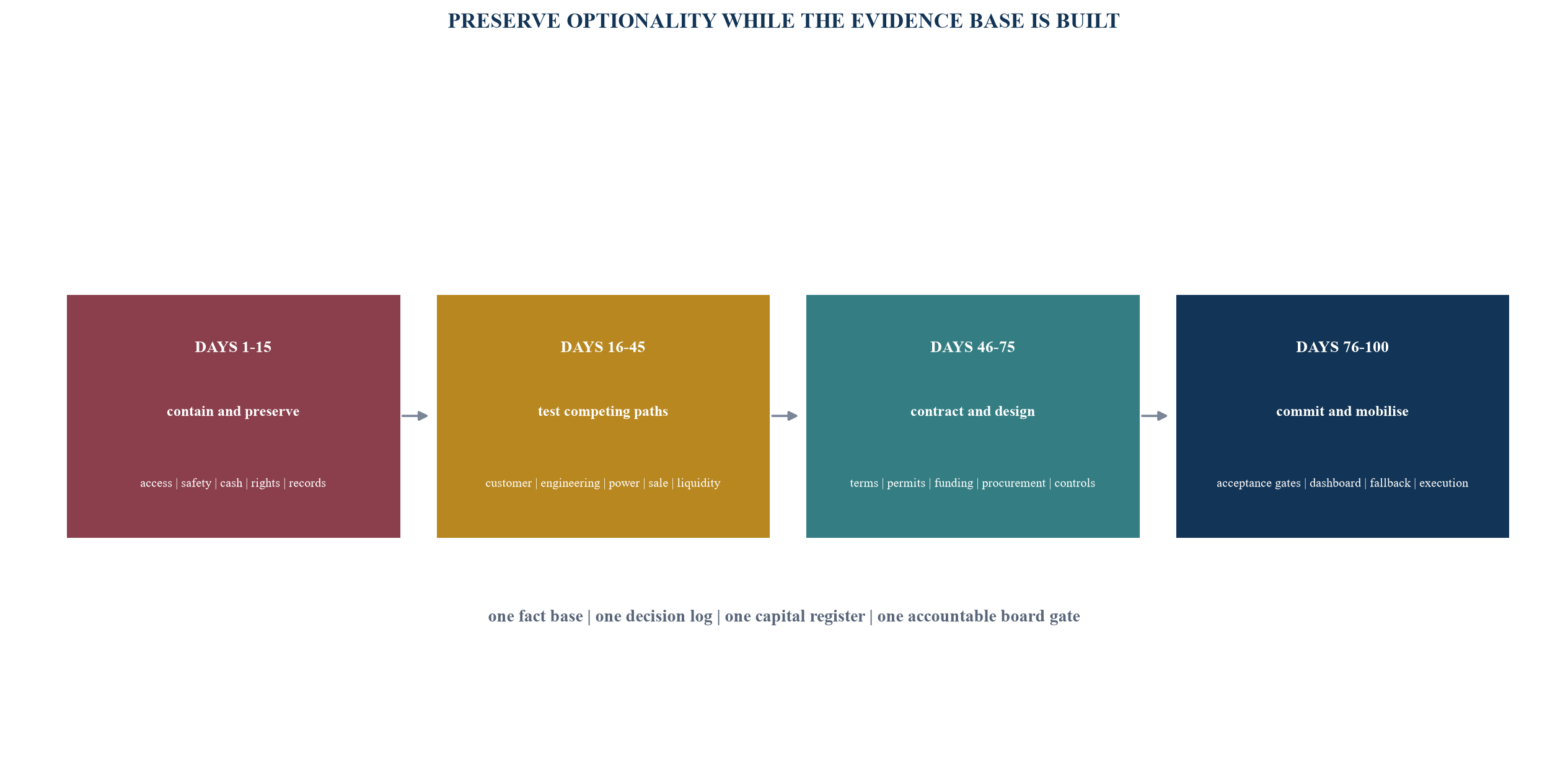
The workstreams converge on a gated board decision and accountable execution.
16. Govern lenders, investors and transaction counterparties
Financing documents can constrain recovery. The operator should identify covenants, material-contract tests, tenant concentration thresholds, insurance, completion support, permitted capex, additional debt, asset disposal, cash sweep, reserves, information undertakings and events of default. Notices should be accurate, timely and coordinated with counsel. A lender waiver can preserve value where the revised plan is credible and funded.
Lenders need a bridge from the original case to the recovery case. The package should show the failed assumption, cash position, legal rights, asset stack, customer evidence, power and technical path, capital need, timeline, downside and exit. It should separate committed support from proposed support. A transparent downside can improve decision quality even when it reduces headline value.
Equity investors should approve who funds each stage, how dilution or priority works, and what happens if a gate fails. A rescue contribution can use preferred equity, shareholder debt, rights issue, joint venture or asset-level capital. The structure should account for control, tax, accounting, security, intercreditor and exit consequences. Terms remain unavailable until agreed by real counterparties.
A sale process can run alongside recovery. Buyers may value the site differently based on their power portfolio, network, customer base, engineering capability and cost of capital. The data room should make transferable rights, obligations and uncertainty clear. Any auction timetable should preserve safety, service and regulatory obligations. The board should compare binding net proceeds with risk-adjusted recovery value rather than headline bids.
17. Establish an auditable board dashboard
The dashboard should show whether the recovery thesis is becoming more certain. Core measures include legal-control status, power milestones, customer stage, design maturity, permits, long-lead dates, committed and spent capital, monthly liquidity, service performance, safety, cyber, sale interest and fallback readiness. Each measure should link to source evidence and a named owner.
Commercial metrics should progress through qualified lead, technical fit, funded procurement, signed contract, customer condition satisfaction, accepted service, invoice and collection. Technical metrics should progress through survey, concept, basis of design, design freeze, equipment order, installation, commissioning and acceptance. Power metrics should progress through rights, works, energisation, test and usable capacity.
The dashboard should highlight assumption movement. If retrofit cost rises, the model should show the return, financing and fallback impact. If a customer reduces capacity, the board should see unallocated specialised fit-out and revised concentration. If the grid date slips, equipment, warranty, contractor and liquidity effects should be visible. A short narrative should explain the decision required and deadline.
Governance should include scheduled investment-committee gates and exception triggers. Safety, legal control, liquidity and material customer or power events can require immediate escalation. The recovery office should not report progress through activity counts alone. Completion means the approved economic and operational acceptance conditions have been met or the board has executed the fallback.
Table 6. Board dashboard and decision rights
| Domain | Weekly evidence | Decision trigger | Decision owner |
|---|---|---|---|
| legal and control | rights, notices, approvals, access and disputes | loss or restriction of a critical right | board with qualified counsel |
| customer | stage, specification, contract conditions and credit | material reduction, delay or termination right | commercial committee and board |
| power | milestone, route, equipment, energisation and quality | connection delay, capacity loss or cost increase | technical committee and board |
| engineering | design maturity, hazards, lead times and tests | design change affecting safety, cost or acceptance | accountable engineer and investment committee |
| capital and liquidity | commitment, spend, forecast, reserve and covenant | gate failure, reserve draw or funding shortfall | finance committee and board |
| exit and fallback | buyer interest, net proceeds, timing and obligations | binding offer exceeds approved recovery case or recovery gate fails | board |
Evidence owners maintain the record; the board retains capital and pathway decisions.
18. Convert the framework into a retained execution mandate
A fixed-scope diagnostic can establish whether a stranded data-centre site has a defensible recovery path. Deliverables can include the failure tree, rights inventory, recoverable-value stack, power and technical critical path, customer evidence map, reuse alternatives, capex waterfall, monthly liquidity, valuation scenarios, jurisdiction register, decision gates and board paper. The engagement should define client evidence, adviser roles, timing, exclusions and acceptance.
A retained recovery office can then coordinate customer outreach, engineering and grid workstreams, transaction and financing materials, data room, investor or lender analysis, procurement gates, sale alternatives and board reporting. Legal, regulatory, accounting, tax, engineering, environmental, cyber, insurance, valuation and financing opinions remain with appointed qualified advisers. Matchpoint can integrate those workstreams within an agreed advisory mandate.
The commercial pathway should be measured through a qualified decision-maker, accepted diagnostic scope, signed engagement, invoice, payment, evidence access, board decision and collected fees. Website visits, downloads and meetings are leading indicators. Advisory revenue remains zero until a client signs an engagement, invoices are issued and cash is collected. Demand, fee level and timing remain unverified until those events occur.
The immediate client decision is whether to commission a paid stranded-site diagnostic with named data owners and a board date. The output should support a proceed, reshape, hold, sell or stop decision. A recovery programme earns its mandate by clarifying capital at risk, protecting optionality and creating an accountable route to cash or exit.
References
- International Energy Agency, Energy and AI, 2025, https://www.iea.org/reports/energy-and-ai/
- International Energy Agency, Energy Demand from AI, 2025, https://www.iea.org/reports/energy-and-ai/energy-demand-from-ai
- International Energy Agency, AI and Energy Security, 2025, https://www.iea.org/reports/energy-and-ai/ai-and-energy-security
- International Energy Agency, Data-centre electricity use surged in 2025 even with tightening bottlenecks, 16 April 2026, https://www.iea.org/news/data-centre-electricity-use-surged-in-2025-even-with-tightening-bottlenecks-driving-a-scramble-for-solutions
- Lawrence Berkeley National Laboratory, 2024 United States Data Center Energy Usage Report, 2024, https://energyanalysis.lbl.gov/publications/2024-lbnl-data-center-energy-usage-report
- European Commission, Energy performance of data centres, https://energy.ec.europa.eu/topics/energy-efficiency/energy-efficiency-targets-directive-and-rules/energy-efficiency-directive/energy-performance-data-centres_en
- European Commission, Preparatory studies for minimum performance standards for EU data centres, https://energy.ec.europa.eu/resources/preparatory-studies/minimum-performance-standards-eu-data-centres_en
- Infocomm Media Development Authority of Singapore, Green Data Centre Roadmap, 30 May 2024, https://www.imda.gov.sg/resources/press-releases-factsheets-and-speeches/factsheets/2024/charting-green-growth-for-data-centres-in-sg
- National Energy System Operator, Connections Reform Results, 2026, https://www.neso.energy/industry-information/connections-reform/connections-reform-results
- National Energy System Operator, Data Centre Demand-Side Evidence, 2026, https://www.neso.energy/document/378226/download
- Digital Realty Trust, Inc., Form 10-K for the year ended 31 December 2025, https://www.sec.gov/Archives/edgar/data/1297996/000110465926015365/dlr-20251231x10k.htm
- Equinix, Inc., Form 10-K for the year ended 31 December 2025, https://www.sec.gov/Archives/edgar/data/1101239/000110123926000032/eqix-20251231.htm
- ASHRAE, AI Data Center Framework: Energy and Thermal Efficiency, https://www.ashrae.org/technical-resources/ai-data-center-framework/energy-and-thermal-efficiency
- Ministry of Energy and Infrastructure, United Arab Emirates, Emirates Monitoring Center, 9 July 2026, https://www.moei.gov.ae/en/media-center/news/9/7/2026/ministry-of-energy-and-infrastructure-inaugurates-emirates-monitoring-center-to-strengthen-national
- Dubai Electricity and Water Authority, Major Projects Power Supply Guidelines, July 2025, https://www.dewa.gov.ae/-/media/Files/Major-Project-Guidelines-July-2025.ashx
- Dubai Electricity and Water Authority, Moro Hub Green Data Centre Second Phase, January 2025, https://www.dewa.gov.ae/en/about-us/media-publications/latest-news/2025/01/maktoum-bin-mohammed-inaugurates-second-phase
- Communications, Space and Technology Commission, Saudi Arabia, Cloud Computing Registration, https://www.cst.gov.sa/en/business/services/Cloud-Computing-Registration
- Communications, Space and Technology Commission, Saudi Arabia, Cloud Computing, https://www.cst.gov.sa/en/knowledge-center/digital-knowledge/cloud-computing
- IFRS Foundation, IAS 36 Impairment of Assets, https://www.ifrs.org/issued-standards/list-of-standards/ias-36-impairment-of-assets/
- IFRS Foundation, IAS 16 Property, Plant and Equipment, https://www.ifrs.org/issued-standards/list-of-standards/ias-16-property-plant-and-equipment/
About the Author
Chennakeshav Adya, Independent Researcher
This research is provided for general information. It is not investment, legal, regulatory, accounting, tax, engineering, environmental, cyber, insurance, valuation or financing advice. Sponsors, operators, investors and lenders should obtain current advice from qualified professionals and conduct site-specific diligence.
