

Introduction
Topological quantum computing seeks to encode and manipulate quantum information in global properties of a physical system that are expected to be less sensitive to local disturbance. In leading solid-state proposals, semiconductor-superconductor structures are engineered to support Majorana zero modes. Information would be represented non-locally and operations would be performed through measurements or exchanges whose outcomes depend on topology. The commercial promise is not simply a better physical qubit. It is a different relationship among device quality, error correction, control complexity, logical reliability and system scale.
The investment problem is difficult because the architecture is simultaneously scientific, industrial and financial. Evidence can be meaningful at one layer while remaining insufficient at the next. A material signature can support a device hypothesis without demonstrating a qubit. A parity measurement can support a control primitive without establishing protected logical information. A small array can demonstrate integration without proving that fabrication yield, measurement fidelity, poisoning time, decoder performance and cryogenic control will support useful computation. A strong technical result can still arrive too late for the existing capital structure.
Boards therefore need a valuation method that remains useful while specialists disagree about interpretation. The method should preserve experimental nuance, identify what has actually been achieved, state what must happen next and connect capital to decisions. A single probability applied to a distant commercial outcome hides the points at which evidence changes. A conventional discounted cash-flow model can create false precision when revenue timing and technical feasibility are deeply conditional. A comparable-company multiple can transfer market sentiment without controlling for architecture, evidence, rights or runway.
This paper treats topological quantum development as a sequence of real options. Each option gives the company or investor the right, with limited obligation, to fund the next experiment or engineering stage. The value of that right depends on the quality of current evidence, the cost and duration of the next stage, the distribution of future outcomes, the ability to stop, the transferability of residual assets and the financing terms required to continue.
1 Define the transaction and the valuation date
The analysis should begin with the decision being made. A primary financing asks how much ownership should be issued for capital that funds the next evidence gate. An acquisition asks what is controlled at closing, which rights transfer and how much consideration should remain conditional. A strategic partnership asks whether access, exclusivity, field rights or supply arrangements justify committed capital. An impairment review asks whether existing assumptions still support carrying value. Each decision uses different rights, horizons and downside treatments.
The valuation date matters because technical evidence changes quickly. The data room should freeze the device version, fabrication lot, software revision, calibration state, analysis code and experiment date supporting each claim. Later announcements should not be blended into an earlier valuation without a documented update. The transaction committee should know whether a result is peer reviewed, preprinted, internally observed, independently replicated or described only in a roadmap.
The unit of account should also be explicit. Enterprise value may include cash-consuming research assets, employees, patents, licences, contracts, equipment and future funding obligations. Equity value then reconciles cash, debt, preferred rights, liquidation preferences, convertibles, options and the new money required before the next financing. A large headline enterprise value can produce modest value for existing ordinary shareholders when several capital-intensive stages remain.
The decision memorandum should state the minimum evidence required for approval, the maximum capital at risk before the next review and the mechanism for revising value. That mechanism can include a tranche, holdback, contingent value right, earn-out, option, convertible security or staged acquisition. The structure should follow the evidence chain rather than an arbitrary calendar.
2 Replace the binary story with an evidence tree
Topological risk appears binary when the investment thesis is stated as a single question: does the platform work? The operational questions are narrower. Does the fabricated material enter the intended superconducting regime? Do device observables support localized end states under defined conditions? Is the relevant gap sufficiently hard and stable? Can quasiparticle poisoning be controlled? Can fermion parity be measured in a single shot with adequate fidelity and speed? Can measurements implement the intended gate set? Does encoded information improve as redundancy grows? Can the architecture be manufactured and operated as an array?
Each question has a different failure mode and residual value. A material programme that fails to establish a protected topological regime may still produce fabrication knowledge, cryogenic measurement capability and patentable device designs. A successful parity sensor that does not support the intended qubit may have value in metrology or adjacent quantum systems. A qubit that cannot scale may retain scientific and licensing value. Residual value should be supported by identifiable rights, buyers and replacement economics rather than assumed as a fixed percentage.
The evidence tree should show dependencies. A later experiment cannot repair missing provenance in an earlier layer. Strong device selection can create an impressive result while hiding a low-yield process. Post-selection, fitting choices and background subtraction can materially affect interpretation. The investor should request complete protocols, raw and processed data, exclusion rules, code, device histories and the distribution of successful and failed runs.
The tree converts scientific debate into valuation inputs. Agreement is not required at the outset. Competing interpretations can be represented as scenarios with different probabilities and tests. A new experiment should be chosen for its information value: it should distinguish among interpretations and change a funding decision. Experiments that produce attractive plots without resolving a value-moving uncertainty should rank lower in the capital plan.
3 Establish the scientific evidence hierarchy
The first layer is materials and device evidence. It includes epitaxy, interface quality, disorder, induced superconductivity, electrostatic control, magnetic-field tolerance, spectroscopy and spatial response. The aim is to establish that devices consistently reach the operating regime assumed by the architecture. Evidence from one selected wire or island should be accompanied by lot-level and device-level distributions.
The second layer is evidence for the candidate topological state and its end modes. Zero-bias peaks, gap closing and reopening, non-local correlations, interferometric signatures and fusion-related measurements can each contribute. None should be interpreted without the specific device geometry, temperature, field, tunnel coupling, analysis choices and plausible non-topological explanations. The diligence report should identify what the experiment rules out and what remains unresolved.
The third layer is control. A valuation inflection requires more than observing a state. The system must initialise, measure and manipulate information with known error rates, cycle times and stability. Interferometric single-shot parity measurement is relevant because parity readout is a required primitive in measurement-based topological architectures. The investor should verify calibration, assignment fidelity, repeatability, poisoning, cross-talk and the consequences of readout errors for a logical protocol.
The fourth layer is computational evidence. It includes a benchmarked qubit, two-qubit operations or their measurement-based equivalent, a protected encoded state, repeated error-detection cycles and logical improvement with scale. The fifth layer is engineering evidence: arrays, routing, cryogenic electronics, automated tuning, fabrication yield and serviceability. The sixth is commercial evidence: accepted workloads, contracted delivery, system economics and repeat demand.
Valuation should identify the highest layer supported by robust evidence. Lower-layer success raises the probability of later stages; it does not establish their value as achieved assets. The model should therefore show achieved value, conditional option value and unsupported narrative value separately.
4 Learn from reproducibility and retraction history
Topological quantum research has experienced prominent disputes about data interpretation and reproducibility. A 2018 Nature paper reporting quantized Majorana conductance was retracted in 2021 after concerns that the original article did not meet the journal's standard of scientific rigour. Contemporary Nature reporting described scrutiny of omitted and processed data. The appropriate transaction response is a stronger evidence system, not a presumption about current teams or results.
The diligence team should obtain raw data, instrument logs, calibration files, device-selection records, analysis code and version history. It should recreate published plots from source records. It should examine negative, failed and excluded runs, because the distribution of failures informs yield and the risk of selection bias. Where confidentiality allows, an independent technical group should repeat a pre-agreed test on a held-out device or a newly fabricated lot.
Governance should protect scientific challenge. Technical experts retained by the buyer should report directly to the transaction committee for value-moving conclusions. Management should document disagreements and the experiments that would resolve them. Incentive structures should avoid rewarding only positive milestones; timely identification of a false path can preserve more value than an ambiguous success.
Reproducibility has direct financial consequences. Weak provenance increases the discount on achieved value, reduces the probability assigned to roadmap options and may require an escrow or contingent payment. Strong provenance can shorten confirmatory work, reduce follow-on capital and support earlier commercial partnerships. Data governance therefore belongs in valuation, transaction documentation and post-close integration planning.
5 Translate public roadmaps into diligence gates
Microsoft Research has described a four-generation roadmap for fault-tolerant computation using topological qubit arrays. The sequence moves from single-qubit benchmarking, to measurement-based two-qubit operations, to an eight-qubit demonstration of logical improvement, and then to array-level operations including lattice surgery. The roadmap is useful as an example of dependent evidence; company statements remain claims until the relevant results are independently assessed.
The first generation should define a qubit, its measurement protocol and benchmark. The investor should know which errors are measured, which are inferred, how device drift is handled and whether performance persists across devices and time. The second generation should demonstrate operations that create and verify multi-qubit correlations under the architecture's measurement model. The third should show that encoding improves an agreed error measure as redundancy or code distance increases. The fourth should integrate fabrication, control, measurement and decoding at an array scale that supports a credible path to useful logical computation.
Each generation should have entry and exit criteria, a budget, a schedule range and a failure response. The valuation model should not assign full value to a later stage merely because it appears on a roadmap. It should estimate the conditional probability of reaching that stage, the capital required after each success and the dilution borne by current owners.
Independent programmes can strengthen the gate. DARPA's Quantum Benchmarking Initiative uses staged technical and utility-scale assessment, with verification and validation central to the programme. Participation can support the seriousness of a development plan and create structured external review. It does not establish commercial value or guarantee technical success. Transaction diligence should understand the programme scope, deliverables, data rights, funding, review status and relationship between public milestones and internal claims.
6 Design independent verification that changes the decision
Independent verification should be specified before results are known. The protocol should identify devices, sample selection, operating conditions, calibration, blinding where feasible, accepted exclusions, raw-data custody, analysis code, statistical thresholds and publication rights. The reviewer should have access sufficient to challenge the claim while respecting export controls, security and trade secrets.
Verification can use several levels. A document review tests whether records support the stated result. A code and data reproduction rebuilds figures and statistics. A witnessed rerun tests the same device and apparatus. A held-out test uses a device not selected for the original claim. A cross-laboratory replication reproduces the result with separate operators or equipment. A fabrication replication tests whether a new lot can produce the required behaviour. Each level reduces a different risk.
The most valuable protocol resolves a specific funding question. If the next USD 80 million tranche depends on repeatable parity readout, the protocol should test the fidelity, speed, poisoning time, uptime and device distribution that justify that expenditure. A broad scientific review may be informative while leaving the capital decision unresolved.
Verification also needs a failure taxonomy. A failure caused by an instrument, a control script, device drift, material disorder or an incorrect physical interpretation has different implications. The company should have time-bounded remediation rights and a clear rule for updating probability and value. Repeated extensions without new information should trigger a stop, switch or sale decision.
7 Value achieved assets separately from roadmap options
Achieved assets include controlled intellectual property, transferable licences, documented fabrication processes, characterised devices, measurement systems, software, equipment, contracts and an organised team. Their value can be assessed through replacement cost, avoided development time, market evidence and income where rights and cash flows exist. The analysis should apply obsolescence and transferability adjustments.
Roadmap options represent the right to invest further after learning from the next stage. Their value depends on upside, uncertainty, time, the cost of exercise and the ability to abandon. A high-variance outcome can create option value when the investor controls the timing and amount of additional capital. The same uncertainty can destroy value when funding commitments are effectively unconditional or when failure is discovered only after a long, expensive programme.
The model should avoid treating all research expenditure as an asset. Historical spend may show the difficulty of rebuilding the capability, but it can also include failed paths and sunk costs. Replacement cost should focus on the current, transferable system and the time required for a credible alternative team to reproduce it. Specialist equipment should be valued by condition, capacity, installation cost, alternative use and bottleneck importance.
The valuation bridge should identify which amount is supported by evidence today, which amount is probability-weighted and which amount depends on future funding. This allows boards to negotiate price and protection separately. A buyer may pay conventional consideration for achieved assets, retain a milestone payment for logical improvement and commit separate growth capital for array engineering.
8 Build the real-options model
The real-options model begins with decision nodes rather than a single terminal value. At each node the investor can continue, wait, expand, switch, partner, sell or abandon. The model records the evidence available, the cost and duration of the next stage, the probability distribution of outcomes, the value in each state and the residual value after failure.
Probabilities should be conditional and auditable. The probability of array-scale logical operation depends on successful device physics, measurement fidelity, qubit control, error correction, yield and system integration. Multiplying a long chain of unsupported point estimates can create false precision. The investment committee should use ranges, correlations and scenario analysis. It should update the model when evidence changes rather than defending the original number.
The exercise price of an option is the capital required to reach the next decision. It includes research payroll, fabrication, mask sets, cryogenic systems, control electronics, test capacity, cloud and compute, facilities, security, regulatory work and contingency. It should also include the cost of maintaining earlier capability and the liquidity buffer needed to avoid a distressed financing before the result is known.
Time reduces value through discounting, competitor progress, employee attrition and financing risk. Delay can also create learning value if external research resolves a question before the company spends. The wait option is therefore legitimate when milestones can be observed externally and the company can preserve rights and talent at modest cost. The model should compare the cost of waiting with the risk of losing leadership or access.
9 Use milestone financing as a valuation instrument
Staged financing converts model assumptions into enforceable decisions. A first tranche can fund raw-data remediation and an independently witnessed parity test. A second can fund multi-qubit measurement operations. A third can support logical improvement. Later capital can fund arrays and application demonstrations. Each tranche should have objective evidence, a review process, a budget and a consequence.
Milestones should measure outputs rather than activity. Hiring a team, filing patents or completing a fabrication run may be necessary but does not establish the technical proposition. Strong milestones specify performance, repeatability, sample size, conditions and independent verification. They also state which deviations are acceptable and who resolves disagreement.
The security can allocate risk. A tranched preferred round can price later capital after evidence. A convertible instrument can defer the valuation while protecting the investor through a cap, discount, maturity and information rights. An acquisition can use contingent consideration linked to independently verified technical outcomes, provided accounting, tax and employment consequences are addressed. A joint venture can limit field or geography while sharing facilities.
Funding terms should preserve the company's ability to conduct valid science. A milestone that encourages selective reporting can damage value. Governance should reward complete evidence, timely disclosure of failures and well-designed experiments. The investor's protection should come from controlled capital exposure and decision rights rather than pressure to manufacture certainty.
10 Model runway as part of technical risk
Scientific probability and financial survival interact. A programme can be technically promising and financially unable to reach the result. The runway model should begin with unrestricted cash and reconcile payroll, fabrication commitments, equipment, facilities, cloud, advisers and working capital. Restricted grants, customer prepayments and committed capital should be separated according to their permitted use and conditions.
The central case should fund the next decisive evidence gate plus a liquidity buffer. Delay cases should include repeated fabrication, instrument downtime, supplier lead times, additional analysis and staff retention. A technical setback may increase cash use before it changes the long-term probability because the team needs a new lot or apparatus to identify the cause.
The model should show when financing must begin, not only when cash reaches zero. A company that needs twelve months to raise capital may have a much shorter effective runway. A weak bargaining position can cause dilution, restrictive terms or loss of key staff. The valuation should therefore discount scenarios that depend on a financing completed after the available decision window.
Boards should define intervention thresholds. Falling below the liquidity floor can freeze discretionary expansion, trigger partnership or licensing work, prepare an asset sale or narrow the technical programme. These actions preserve option value by avoiding a forced transaction. They should be agreed while the company still has time and credibility.
11 Diligence fabrication, yield and control infrastructure
Topological devices depend on materials growth, nanofabrication, interfaces, electrostatic gates, superconducting structures, resonators, sensors, cryogenic wiring, control electronics and analysis software. The company may own only part of that chain. The investor should map each layer to facilities, suppliers, licences, personnel, process records and replacement times.
Yield should be measured at several levels. Fabrication yield asks whether devices meet structural and electrical specifications. Operating-regime yield asks whether they can be tuned into the required state. Evidence yield asks whether the relevant experiment produces interpretable data. Qubit yield asks whether control and readout meet thresholds. Array yield asks whether enough units operate together. A single successful device can coexist with an uneconomic process.
The diligence team should review wafer and chip maps, device histories, tuning time, failure modes and lot-to-lot variation. It should understand how much manual expertise is required. Automated tuning and diagnosis can create material value when they reduce specialist time and enable arrays, but automation should be demonstrated under realistic drift and failure conditions.
Supplier rights can be decisive. Foundry or university agreements may address foreground intellectual property, publication, data, priority, capacity and change of control. Long-lead dilution refrigerators, amplifiers and specialised instruments can delay replication. The transaction model should include consents, duplicate capacity and post-close access.
12 Diligence intellectual property and freedom to operate
Patent counts provide limited information about control. The buyer should map claims to materials, device geometry, measurement, control, architecture, error correction and applications. It should identify inventors, assignments, licences, government support, university rights, encumbrances, geographic coverage, remaining term and prosecution status.
The map should distinguish rights required for the current experiment from rights required for a future array. A company may control a device design while relying on third-party measurement patents or fabrication know-how. A broad architecture claim may be difficult to enforce or design around. Qualified counsel and technical experts should assess claim relevance together.
Trade secrets can be more important than patents in materials growth, processing, tuning and analysis. The investor should examine laboratory notebooks, repositories, access controls, employee agreements and transfer protocols. Knowledge concentrated in one scientist should be treated as retention and documentation risk. A staged transaction can link consideration to successful transfer and reproduction.
Freedom-to-operate analysis should match the planned product, geography and timing. Early research exemptions or academic licences may not cover commercial services. Export controls and security requirements can constrain personnel, collaboration, equipment and data movement. These constraints affect integration, market access and the cost of operating across jurisdictions.
13 Assess talent, governance and scientific culture
The critical team can include condensed-matter physicists, materials scientists, nanofabrication engineers, microwave and radio-frequency engineers, cryogenic specialists, control-software developers, theorists, error-correction researchers and programme leaders. The investor should map capabilities to milestones and identify single points of failure.
Retention should reflect the work that remains. Service-based awards can preserve continuity. Technical milestone awards should use independently verifiable outputs and should not reward selective disclosure. Founder retention may be important, but undocumented process knowledge held by engineers and technicians can be equally critical.
Scientific governance should preserve challenge. Internal review should include alternative explanations and failed experiments. External advisers should disclose conflicts and have access to evidence. The board should receive an integrated report linking experimental results, schedule, cash and probability updates. A technical advisory board can help when its role, data access and accountability are clear.
Post-close integration can damage option value if laboratories, procurement or publication practices are changed before dependencies are understood. The buyer should define protected research autonomy, shared services, security boundaries, decision rights and the conditions for integration. Integration spending should be included in the investment case.
14 Separate publicity, peer review and investment evidence
Public announcements can communicate strategy and attract talent, partners and capital. They are not a substitute for diligence. A company statement should be attributed as a company claim. A peer-reviewed result should be read for scope, conditions, exclusions and limitations. A preprint should be identified as such. A government programme should be evaluated through its actual stage and deliverables.
The 2025 Nature paper on interferometric single-shot parity measurement reported a technical result in hybrid indium arsenide-aluminium devices. The paper's contribution should be assessed on its stated measurements and conditions. Corporate descriptions of a topological core and a path to a million qubits are roadmap claims whose valuation depends on subsequent evidence. Nature news reporting in 2025 and 2026 documented continued scepticism among researchers about whether the available evidence establishes topological qubits.
These categories can coexist. A result can be technically important while its interpretation and scalability remain debated. The investment committee should avoid forcing a yes-or-no scientific verdict before deciding how much capital to expose. It can value achieved measurement and engineering capability, assign a probability to the stronger interpretation and require experiments that resolve the difference.
The data room should contain a claims register. Each external statement should link to supporting evidence, an owner, a confidence classification and the next test. This discipline reduces the risk that promotional language migrates into forecasts, valuation models and transaction documents without scrutiny.
15 Identify commercial pathways without assuming utility
Topological quantum platforms may pursue cloud access, government programmes, strategic partnerships, hardware systems, component licensing, intellectual-property licensing or acquisition by a larger technology company. The business model should identify who pays, for what deliverable, under which acceptance criteria and at what point in the technical roadmap.
Research collaborations, grants and milestone awards can finance development and validate relationships. They should be separated from recurring commercial demand. Cloud availability can provide access and workflow integration; it does not establish sustained usage or customer ownership. Strategic partnerships may transfer knowledge, restrict fields or create change-of-control obligations.
Application claims should be resource estimated. A proposed chemistry, optimisation or materials workload should state logical qubits, logical operations, accuracy, error-correction overhead, runtime and classical alternatives. Commercial value requires an advantage relevant to customer economics, not solely a technical benchmark. The valuation should apply limited near-term income value when the accepted product remains remote.
Early commercial evidence can still matter. Paid technical access, customer-funded algorithm development and joint validation can show budget, engagement and application relevance. The investor should test whether the relationship survives delays and ownership change. Contracted cash should be reconciled with performance obligations, restrictions and delivery cost.
16 Construct the hypothetical valuation
The worked example uses a wholly hypothetical topological quantum programme. It reports USD 240 million of unrestricted cash and USD 84 million of annual cash use. It has characterised hybrid-device fabrication, a parity-readout and control stack, specialist employees, cryogenic laboratories, software and programme relationships. The example does not represent Microsoft or any other company.
The central enterprise value is USD 1.10 billion. The allocation is USD 240 million for materials, process and device intellectual property; USD 160 million for parity-readout and control capability; USD 125 million for software and architecture; USD 155 million for teams and know-how; USD 95 million for laboratories and test infrastructure; USD 75 million for contracts and programme rights; and USD 250 million for probability-weighted roadmap options. These values are management assumptions for illustration.
Four terminal states test the range. A failed topological interpretation with transferable residual assets has a value of USD 180 million and a probability of 25 percent. Repeatable parity measurement and qubit benchmarking has a value of USD 750 million and a probability of 40 percent. Demonstrated logical improvement has a value of USD 2.40 billion and a probability of 27 percent. A scalable topological platform has a value of USD 6.50 billion and a probability of 8 percent. The illustrative probability-weighted value is USD 1.513 billion before financing and dilution.
The difference between central allocated value and scenario-weighted value does not imply a market price. It exposes assumptions. The committee should test probabilities, timing, capital, dilution, residual value and correlation. A risk-adjusted transaction price may be lower because the buyer must fund milestones and integrate the programme. Contingent consideration can preserve upside while controlling upfront exposure.
17 Convert evidence into transaction protections
Technical findings should change terms. Weak raw-data provenance can lead to a verification condition, escrow or reduced upfront price. Uncertain intellectual-property ownership can lead to remediation, indemnity or excluded assets. Concentrated talent can lead to service-based retention and knowledge-transfer milestones. Fabrication dependency can lead to supplier consents and transition arrangements.
A financing can release capital in tranches. An acquisition can separate the purchase of achieved assets from payments for verified qubit, logical and array milestones. A strategic investor can receive information rights, participation rights or an option to expand after evidence. These structures require careful accounting, tax, employment and securities analysis.
Milestone definitions should be resistant to interpretation disputes. They should specify the apparatus, sample, protocol, performance, duration, raw-data package and independent reviewer. The agreement should state how changes in architecture are handled. A company should be able to improve its technical path without losing earned value, while the investor should not pay for a materially different or weaker outcome.
Downside rights should preserve the scientific assets. A licence, field split, equipment sale, team transfer or data package may have value after the original thesis fails. The investor should understand which residual options are legally and operationally available before assigning salvage value.
18 Board decision framework
The board should approve a topological quantum investment only after reconciling five ledgers. The evidence ledger states what has been observed and reproduced. The dependency ledger maps materials, facilities, suppliers, rights and people. The option ledger states the next decisions and exercise costs. The cash ledger funds each decision with a buffer. The value ledger separates achieved assets from conditional upside.
Approval should identify unresolved matters and their controls. A scientific interpretation dispute can be managed through a pre-agreed experiment. A schedule range can be managed through runway and staged capital. A supplier dependency can be managed through contract, duplicate capacity or valuation adjustment. A customer uncertainty can be managed by excluding unsupported revenue and valuing the relationship separately.
The board should define stopping rules. An option should be abandoned or redesigned when the expected information or upside no longer justifies the next expenditure. Stopping a weak path can protect cash, talent and reputation. The decision record should state who can recommend a stop, who decides and how evidence is preserved.
Accountability remains essential. One executive should own the integrated roadmap, named leaders should own each evidence layer and the finance function should reconcile technical progress with capital. The board should receive probability changes with reasons, not only milestone colours. This creates a governance system in which learning, including negative learning, can increase decision quality.
Conclusion
Topological quantum valuation should convert a dramatic binary narrative into a controlled sequence of evidence and investment decisions. Candidate-state evidence, parity measurement, qubit control, multi-qubit operations, logical improvement, array engineering and commercial acceptance are distinct value states. Each requires defined tests, independent review, capital and time.
Real-options analysis is well suited to this structure because it values the right to continue after learning while preserving the ability to wait, switch, partner or stop. Achieved assets can be valued through rights, replacement economics and demonstrated capability. Roadmap value should be conditional on falsifiable milestones, financing and dilution. Historical reproducibility disputes strengthen the case for raw-data access, held-out devices, replicated fabrication and protected technical challenge.
Boards and investors can use this framework to structure financings, acquisitions and partnerships. The discipline is traceability: every material value component should point to observed evidence, a controlled right, a transferable capability or an explicitly stated management assumption. Capital should move when evidence changes. That approach makes uncertainty governable without pretending that the science is settled before it is.
Appendix A Evidence package
The minimum evidence package should contain device designs, fabrication records, material characterisation, wafer and chip maps, device histories, spectroscopy, gap and non-local measurements, parity-readout records, calibration, poisoning and stability data, raw and processed files, analysis code, exclusion logs and failed runs. It should identify apparatus, software versions, operators and dates.
The package should also include experiment protocols, statistical plans, peer-review correspondence where available, independent-review reports and management's claims register. Intellectual-property schedules, university and government agreements, supplier contracts, equipment records and employee invention assignments should link to the relevant technical layer.
Financial records should reconcile cash, restrictions, commitments, payroll, fabrication, equipment, facilities and monthly cash use. Commercial records should distinguish grants, awards, collaborations, pilots, contracted deliverables, accepted work, invoices and cash. The diligence report should state what was reproduced, sampled, unavailable or disputed.
Appendix B Probability governance
Probability estimates should have an owner, date, evidence basis and range. The committee should record the prior probability, new evidence, likelihood under competing hypotheses and resulting update. The model should capture dependency and correlation; fabrication yield, readout fidelity and array integration may fail together rather than independently.
Scenario workshops should include technical, financial, commercial and legal participants. Technical specialists should explain what a result establishes. Finance should quantify capital and dilution. Commercial leaders should test the route to paid use. Counsel should assess rights and restrictions. The output should be a decision range rather than an artificial consensus.
Updates should occur after decisive evidence, material delay, financing, competitor progress or a rights change. The board should retain earlier versions to understand forecast quality and recurring bias. A probability that never moves despite new evidence is a governance warning.
Appendix C Information-value tests
An experiment has high information value when plausible outcomes lead to different actions. A held-out parity test can justify or stop a large control investment. A cross-laboratory replication can change the value assigned to the underlying state. An array-yield study can determine whether more devices or better process control is the binding constraint.
The test should compare expected decision improvement with cost, delay and risk. It should consider whether public research will provide similar information, whether the company can preserve its option while waiting and whether a competitor could gain an irreversible advantage. The chosen portfolio should balance thesis-testing experiments with engineering needed to maintain capability.
Appendix D Decision figures and tables
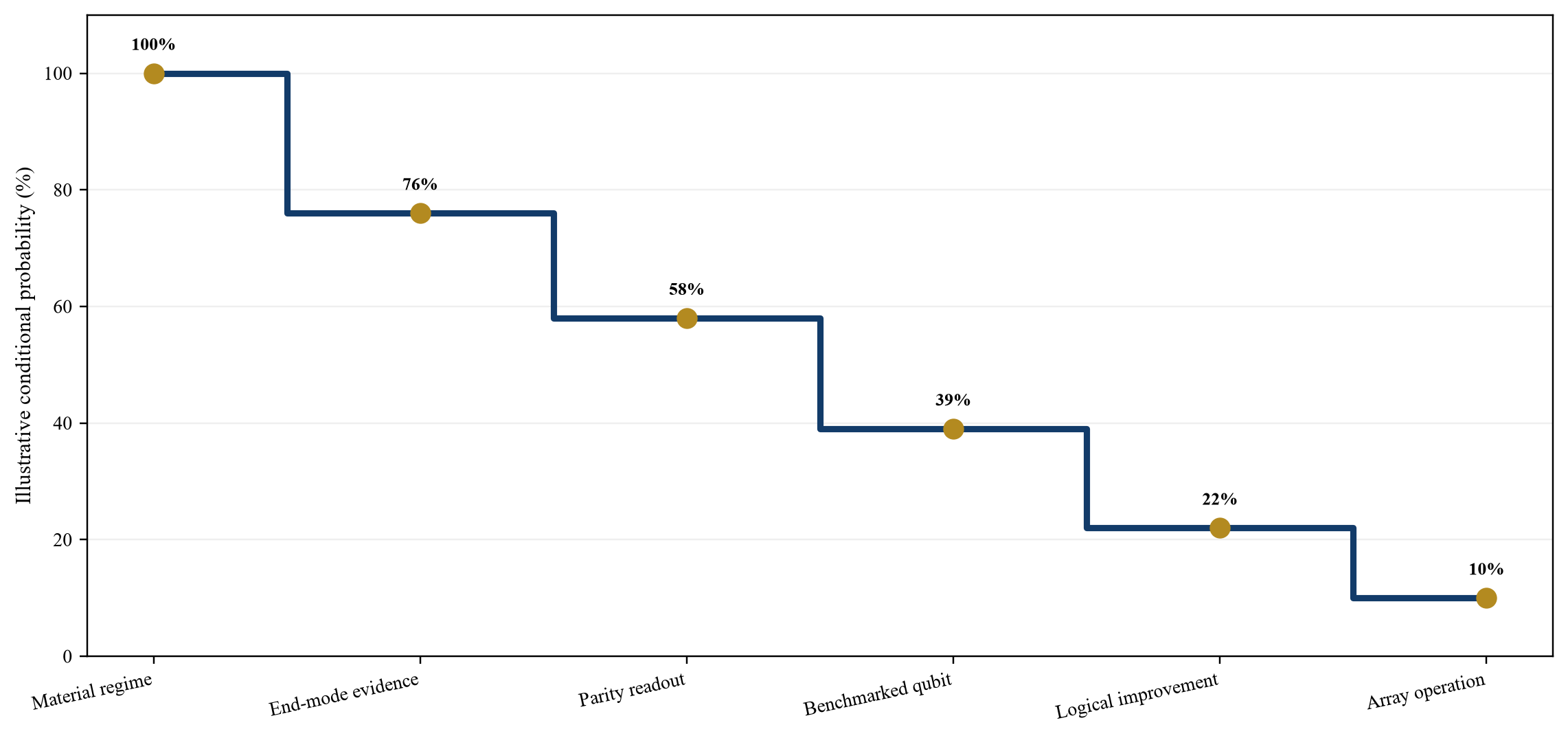
Proposed sequence; each stage requires defined, independently reviewable evidence.
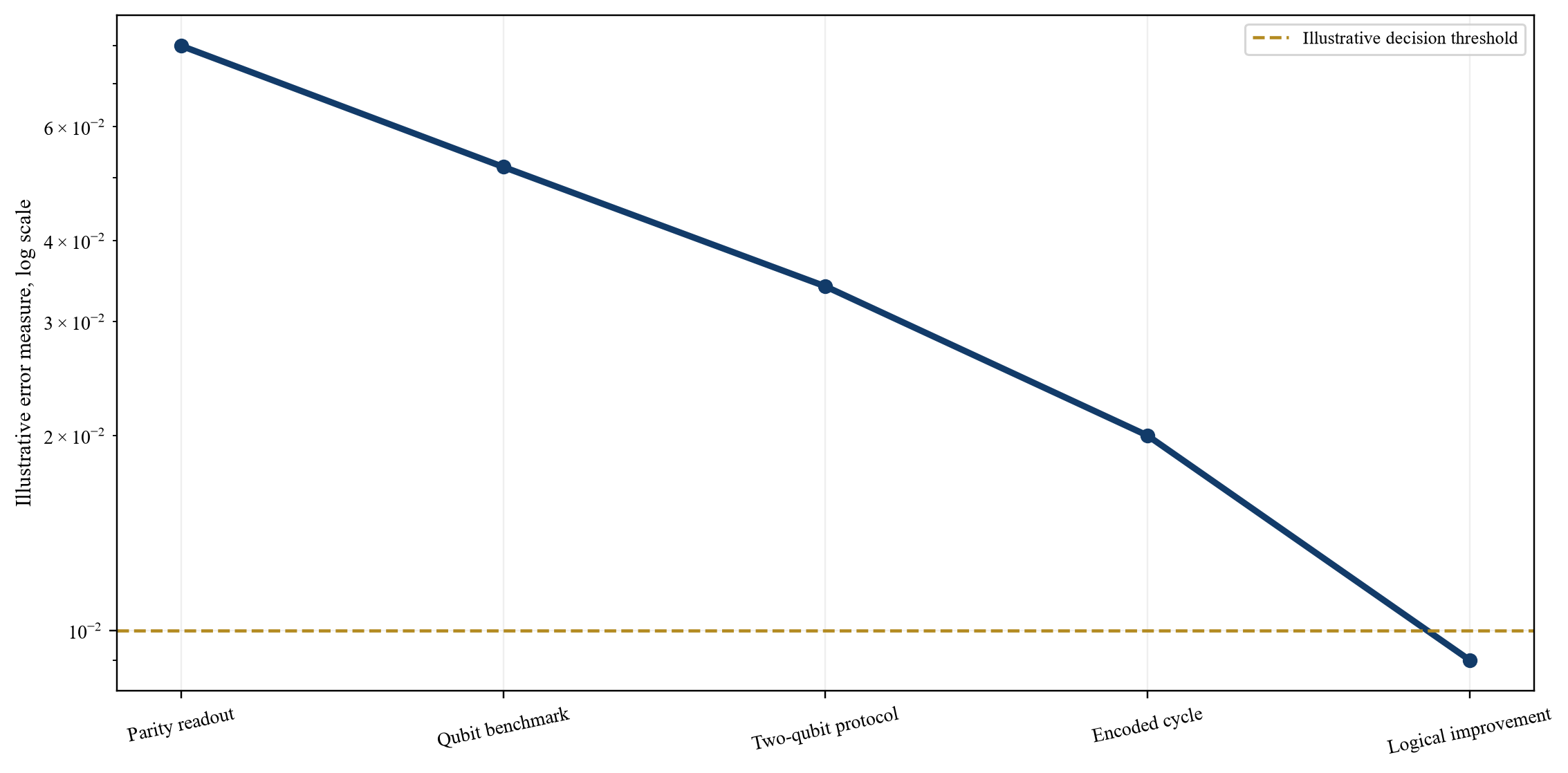
Wholly hypothetical management assumptions; lower is better and values do not represent observed company data.
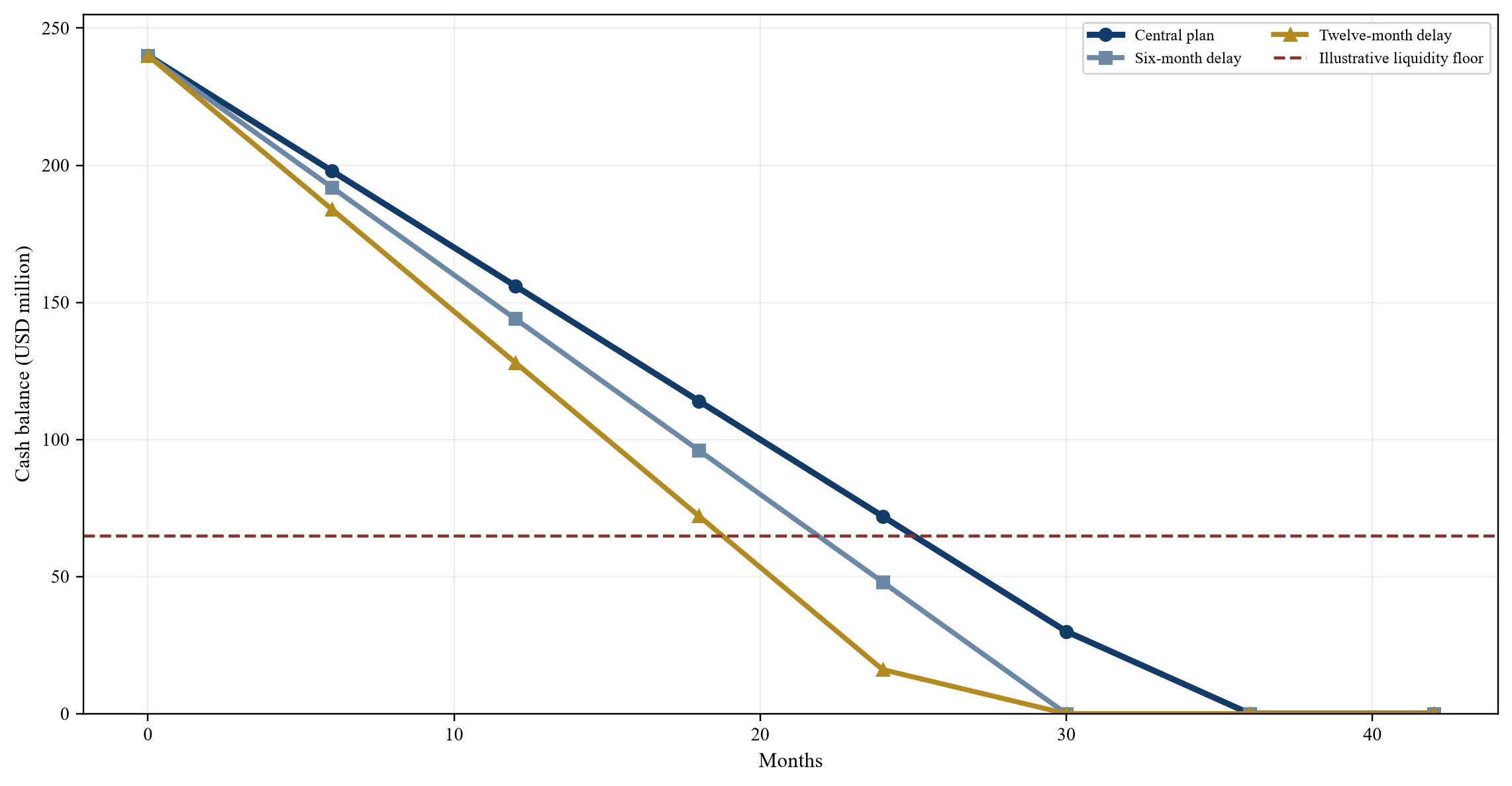
Wholly hypothetical management assumptions; USD million and financing proceeds excluded.
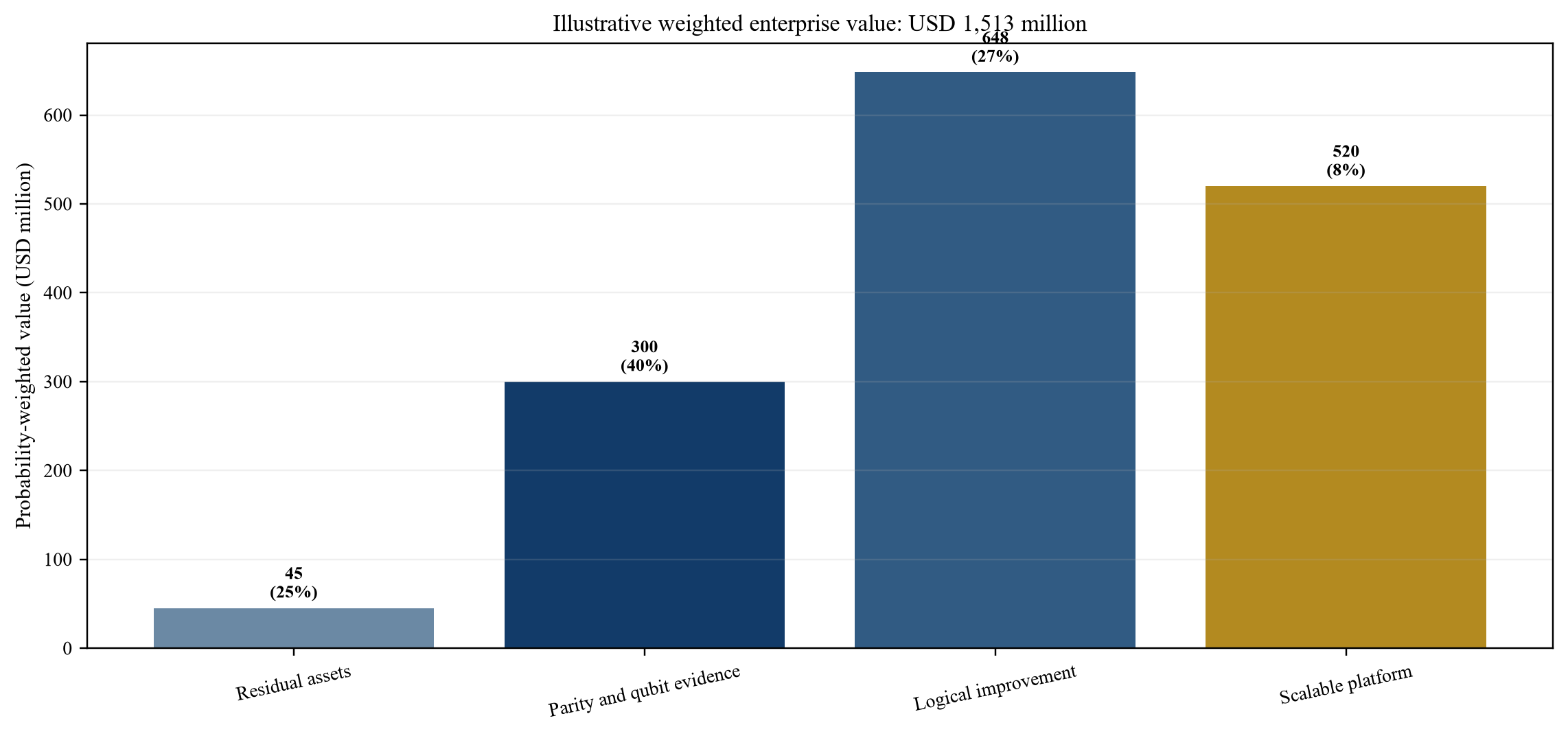
Wholly hypothetical management assumptions; USD million.
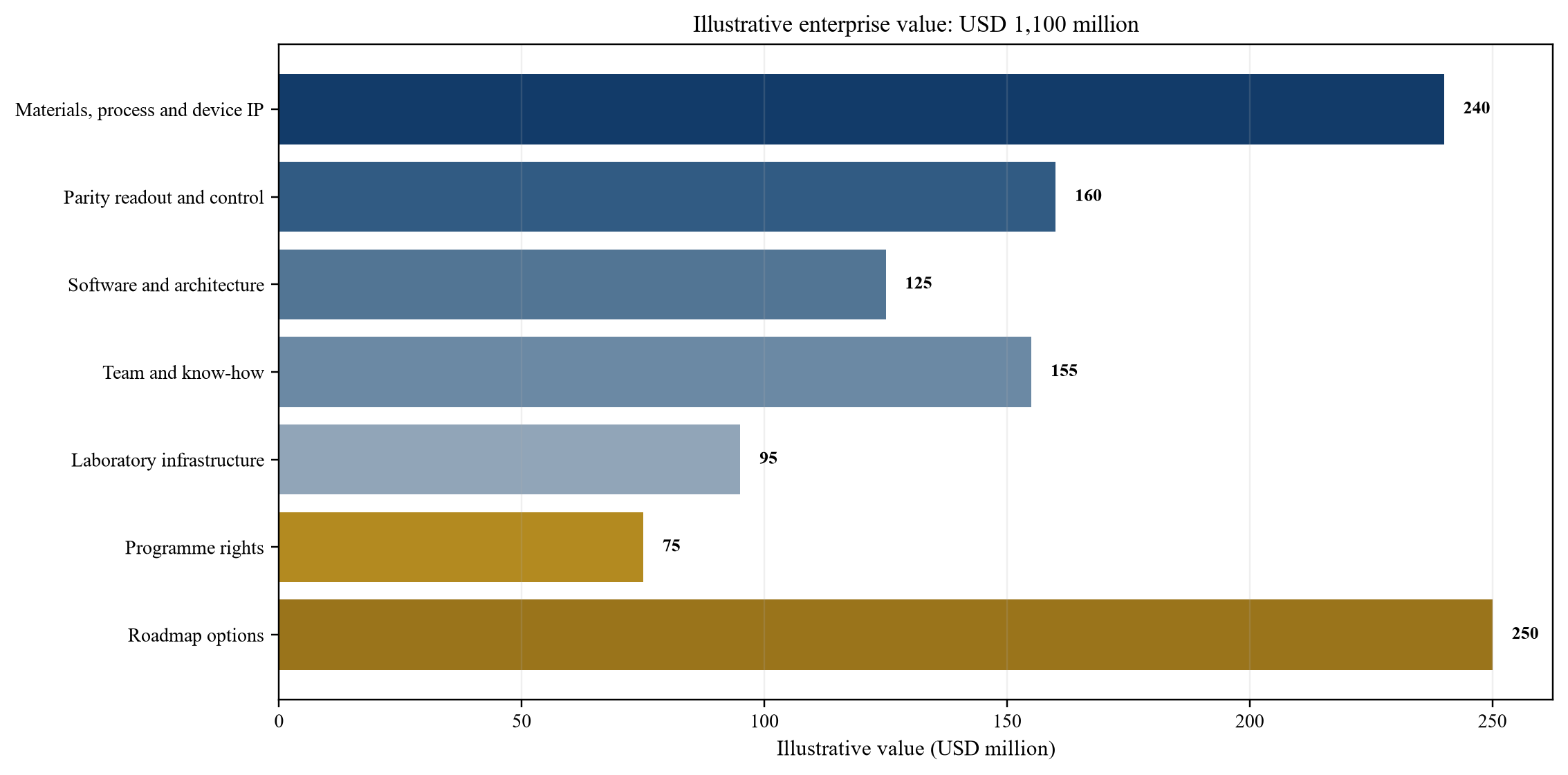
Wholly hypothetical management assumptions; USD million.
| Stage | Minimum evidence | Independent check | Valuation treatment |
|---|---|---|---|
| Material and device | Interface, gap, disorder, tuning and distribution records | Held-out device and lot review | Process and know-how value |
| Candidate topological state | Multiple observables with alternatives assessed | Data, code and replication review | Conditional probability update |
| Parity readout | Single-shot fidelity, speed, poisoning and stability | Witnessed rerun on specified devices | Control-stack value plus option uplift |
| Qubit and multi-qubit control | Benchmark and measurement-based operations | Pre-agreed benchmark suite | Probability-weighted roadmap value |
| Logical improvement | Encoded result improves with scale or code distance | Independent end-to-end verification | Major option exercise point |
| Array and accepted workload | Yield, control, logical operation and customer acceptance | Utility and cost verification | Commercial platform value |
Proposed hierarchy; claims require stated conditions, raw records and appropriate independent review.
| Level | Procedure | Risk reduced | Decision use |
|---|---|---|---|
| Record review | Protocols, device histories, logs and exclusions | Missing provenance | Initial value discount |
| Data reproduction | Rebuild figures and statistics from raw records | Analysis and processing risk | Confirm reported result |
| Witnessed rerun | Repeat experiment with independent observation | Operator and apparatus risk | Release limited tranche |
| Held-out device | Test pre-selected unused devices | Selection bias | Validate repeatability |
| New-lot replication | Fabricate and test a separate lot | Process and yield risk | Fund scaling stage |
| Cross-laboratory replication | Separate operators or apparatus | Organisational dependence | Support major investment or payment |
Proposed sequence; the chosen level should resolve a stated capital decision.
| Layer | Evidence | Dependency risk | Value implication |
|---|---|---|---|
| Materials and epitaxy | Growth, interface, characterisation and supply records | Scarce capability, drift and supplier control | Replacement time and process value |
| Nanofabrication | Designs, recipes, wafer maps and device distributions | Yield, access and undocumented steps | Achieved asset adjustment |
| Cryogenic measurement | Apparatus, calibration, wiring and stability records | Equipment lead time and specialist operators | Reproduction cost and timing |
| Readout and control | Hardware, firmware, fidelity and poisoning data | Cross-talk, drift and unowned software | Milestone probability and transferability |
| Architecture and decoding | Protocols, simulations, rights and resource estimates | Unproven scale or latency | Conditional roadmap option |
Proposed minimum diligence map.
| Value component | Illustrative amount | Evidence gate | Downside treatment |
|---|---|---|---|
| Materials, process and device IP | USD 240 million | Transferable rights and reproducible process | Technical holdback |
| Parity readout and control | USD 160 million | Repeatable fidelity, speed and stability | Verification condition |
| Software and architecture | USD 125 million | Rights, build, benchmark and documentation | Remediation reserve |
| Team and know-how | USD 155 million | Critical-role retention and knowledge transfer | Service-based retention |
| Laboratory infrastructure | USD 95 million | Ownership, condition, capacity and utilisation | Replacement-cost cap |
| Contracts and programme rights | USD 75 million | Funding, restrictions, data and change of control | Consent and conversion adjustment |
| Roadmap options | USD 250 million | Qubit, logical and array milestone tree | Tranches and contingent payment |
Wholly hypothetical management assumptions; not observed company or transaction data.
| Option | Trigger | Capital action | Valuation consequence |
|---|---|---|---|
| Continue | Independent evidence supports next stage | Release bounded tranche | Update probability upward |
| Wait | External learning may resolve uncertainty | Preserve team and rights at lower burn | Retain option after time-cost adjustment |
| Expand | Logical or array evidence exceeds threshold | Fund capacity and commercial validation | Exercise growth option |
| Switch | Original interpretation weakens but assets transfer | Redirect team, devices or IP | Recognise residual and adjacent value |
| Partner | Complementary facility, rights or market access required | Share cost and define field rights | Reduce capital need; adjust control |
| Abandon or sell | Expected value below next exercise cost | Stop spend and preserve data/assets | Realise supported salvage value |
Proposed governance framework.
| Scenario | Starting cash | Annual cash use | Approximate runway | Valuation consequence |
|---|---|---|---|---|
| Central plan | USD 240 million | USD 84 million | 34 months | Fund next gates with moderate buffer |
| Six-month delay | USD 240 million | USD 96 million | 30 months | Earlier financing and dilution |
| Twelve-month delay | USD 240 million | USD 112 million | 26 months | Reduced negotiating leverage |
| Protected liquidity | USD 240 million | USD 84 million plus USD 65 million floor | 25 months to floor | Intervention before distress |
Wholly hypothetical management assumptions; financing proceeds are excluded.
| Decision area | Green evidence | Amber condition | Red condition |
|---|---|---|---|
| Scientific | Raw data, alternatives and independent replication support claim | Important result with bounded unresolved interpretation | Selected evidence without adequate provenance |
| Engineering | Yield, stability, tuning and control demonstrated across devices | Limited sample with funded validation | One-off device or manual process extrapolated to scale |
| Rights and team | Ownership, access, retention and transfer confirmed | Remediation plan with cost and date | Critical right or capability unavailable |
| Runway | Next decisive gate funded with buffer | Financing required before gate | Liquidity shortfall without credible action |
| Valuation | Achieved assets and options separated | Wide but explicit probability range | Roadmap narrative treated as achieved value |
Proposed decision framework.
Sources
- Microsoft Research, Roadmap to fault-tolerant quantum computation using topological qubit arrays, 2025. Read the primary source
- Microsoft Azure, Microsoft unveils Majorana 1, 19 February 2025. Read the primary source
- Nayak and collaborators, Non-Abelian anyons and topological quantum computation, Reviews of Modern Physics, 2008. Read the primary source
- Kitaev, Unpaired Majorana fermions in quantum wires, Physics-Uspekhi, 2001. Read the primary source
- Alicea and collaborators, Non-Abelian statistics and topological quantum information processing in one-dimensional wire networks, Nature Physics, 2011. Read the primary source
- Aasen and collaborators, Milestones toward Majorana-based quantum computing, Physical Review X, 2016. Read the primary source
- Microsoft Quantum and collaborators, Interferometric single-shot parity measurement in InAs-Al hybrid devices, Nature, 2025. Read the primary source
- Nature, Microsoft claims quantum-computing breakthrough; but some physicists are sceptical, 19 February 2025. Read the primary source
- Nature, Microsoft upgrades controversial quantum processor, 3 June 2026. Read the primary source
- Microsoft Quantum, Majorana 2 technical preprint, arXiv, 2026. Read the primary source
- Nature, Majorana-hunting physicists face fresh controversy after retraction, 2021. Read the primary source
- Nature, Retraction Note: Quantized Majorana conductance, 2021. Read the primary source
- Frolov, Quantum computing's reproducibility crisis: Majorana fermions, Nature, 2021. Read the primary source
- Bordin and collaborators, Enhanced Majorana stability in a three-site Kitaev chain, Nature Nanotechnology, 2025. Read the primary source
- Elliott and Franz, Colloquium: Majorana fermions in nuclear, particle, and solid-state physics, Reviews of Modern Physics, 2015. Read the primary source
- Leijnse and Flensberg, Introduction to topological superconductivity and Majorana fermions, Semiconductor Science and Technology, 2012. Read the primary source
- DARPA, Quantum Benchmarking Initiative. Read the primary source
- DARPA, Quantum Benchmarking Initiative programme briefing, 2025. Read the primary source
- DARPA, Underexplored Systems for Utility-Scale Quantum Computing programme. Read the primary source
- National Institute of Standards and Technology, Quantum information science. Read the primary source
- National Quantum Initiative, United States quantum programmes. Read the primary source
- QED-C, Standards and Performance Metrics Technical Advisory Committee. Read the primary source
- QED-C, Application-Oriented Performance Benchmarks for Quantum Computing. Read the primary source
- ISO, ISO/IEC 4879:2024 Quantum technologies; Vocabulary. Read the primary source
- IFRS Foundation, IFRS 3 Business Combinations. Read the primary source
- IFRS Foundation, IFRS 13 Fair Value Measurement. Read the primary source
- International Valuation Standards Council, International Valuation Standards. Read the primary source
- United States Securities and Exchange Commission, Financial Reporting Manual. Read the primary source
- Microsoft, Annual Report on Form 10-K for the year ended 30 June 2026. Read the primary source
- Google Quantum AI and collaborators, Probing non-equilibrium topological order on a quantum processor, Nature, 2025. Read the primary source
- Mohammadi and collaborators, Solving the Bernstein-Vazirani problem using Majorana-based topological quantum algorithms, npj Quantum Information, 2025. Read the primary source
- Microsoft Quantum, Topological qubits explainer. Read the primary source
