

1. Define the cash problem before the technology
The month-end close explains balances after invoices, shipments, receipts, disputes, promises, purchases and payments have accumulated. Liquidity decisions often need to be made earlier. A customer rejection on Day Three, a failed delivery on Day Seven or an inventory shortage on Day Twelve can affect cash before the general ledger provides a complete monthly view. The first design question is therefore which cash decision needs earlier evidence.
The working-capital digital twin is a synchronised analytical representation of the events that create receivables, inventory, payables and cash. It does not replace the ledger, bank statement, contract or accountable operating system. It connects them through controlled event definitions, timestamps, identifiers and reconciliations so that management can observe a likely cash consequence while there is time to act.
Useful decisions include correcting an invoice, obtaining acceptance evidence, resolving a dispute, changing a collection route, reallocating inventory, accelerating a supplier approval, drawing liquidity or escalating a forecast breach. Every modelled event should reach one of these decisions. An output without a decision owner, lead time or lawful action belongs in analysis rather than the controlled intervention queue.
2. Establish the digital-twin boundary
A digital twin needs an observable counterpart. For working capital, the counterpart is the order-to-cash, inventory and procure-to-pay event chain rather than the company as a whole. The design should identify which legal entities, business units, currencies, bank accounts, customers, suppliers, products and transaction types are included. Boundaries need to match the decisions and the available evidence.
The twin should preserve the distinction between an economic event and its representations. A delivery can appear in a logistics system, customer portal, invoice, receivables ledger and bank reference. These records may have different dates and identifiers. A controlled event model links them while retaining source, status and uncertainty. It avoids creating a synthetic fact merely because several systems contain similar text.
Materiality should determine depth. A high-value milestone invoice with customer acceptance risk may require contract-level evidence. A large population of routine invoices may be modelled through stable cohorts and exceptions. Inventory with expiry, scarcity or customer allocation risk requires more attributes than immaterial consumables. The twin should remain proportionate enough to operate every day.
3. Build the cash-event spine
The event spine provides a common sequence from commercial commitment to cash. An order can lead to fulfilment, acceptance, invoice creation, transmission, validation, due date, promise, receipt, allocation and closure. Procurement can lead to purchase approval, receipt, supplier invoice, match, approval, payment proposal and settlement. Inventory events connect demand, availability, reservation, production, shipment and replenishment.
Each event requires a stable identifier, source, timestamp, status, value, currency, counterparty, owner and relationship to preceding and following events. Corrections should create version history rather than overwrite the evidence used for an earlier forecast. The system should also record missing expected events, because absence can be more informative than a late recorded event.
The spine converts accounting balances into dated pathways. A receivable is no longer one amount with one due date. It becomes a sequence with observable completion, delay and exception states. A payable becomes an approved or blocked payment pathway linked to supply continuity and liquidity. This granularity supports earlier prediction and a more precise intervention.
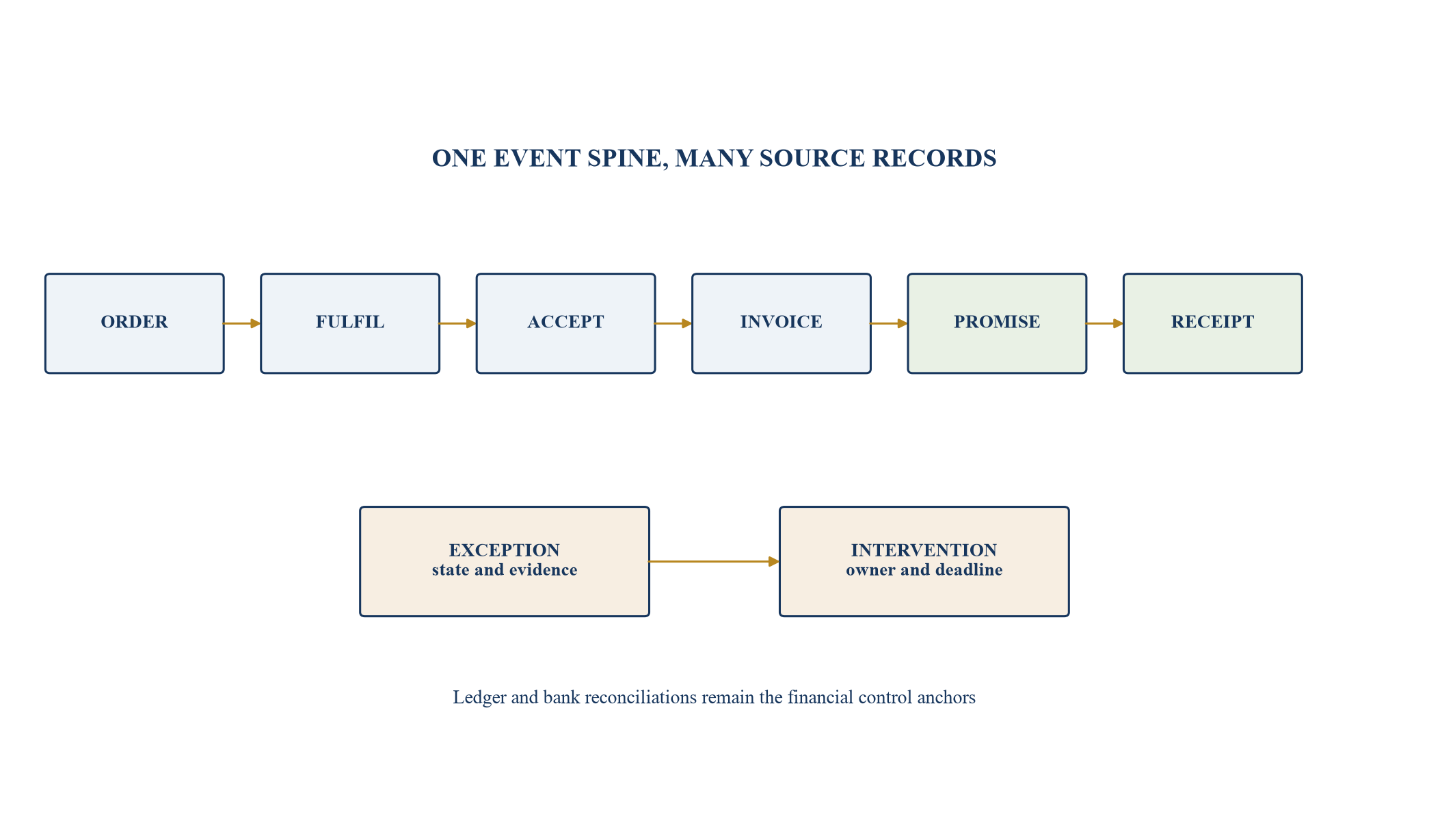
A controlled event spine links operational evidence to expected cash, exceptions and authorised intervention.
Table 1. Minimum cash-event record
| Field | Required evidence | Control question | Cash use |
|---|---|---|---|
| identity | transaction, document and counterparty identifiers | can records across systems be linked without ambiguity? | population and reconciliation |
| timestamp and status | source-system event time and version history | when did the state become observable? | expected cash date |
| value and currency | contract, invoice, ledger and tax attributes | is the amount complete and valid? | cash amount and exposure |
| dependency | preceding event, approval and contractual condition | what must occur before cash can move? | delay pathway |
| exception | reason, evidence, materiality and owner | what blocks the expected sequence? | intervention priority |
| action | authorised response, deadline and acceptance evidence | can management change the outcome in time? | realised cash |
Events should be reproducible, decision-relevant and connected to accountable operating evidence.
4. Reconcile events to accounting and cash
The twin should reconcile to authoritative financial records. Opening receivables, inventory and payables need to agree to controlled ledgers at the defined cut-off, subject to documented reconciling items. Bank receipts and payments should connect to cash events through references, amounts, dates and approved matching logic. Differences require ownership rather than silent model adjustment.
IAS 7 separates operating, investing and financing cash flows and supports analysis of the amount, timing and certainty of cash generation. The digital twin operates at a finer management frequency while preserving the company’s accounting policies and reporting classifications. Forecast events should not be presented as recognised revenue, inventory, liability or cash before the applicable evidence and accounting treatment exist.
Reconciliation has two directions. The ledger tests completeness and valuation of the modelled population. The event chain explains timing and operational cause behind the balance. A recurring gap between these views can reveal missing sources, cut-off errors, unallocated cash, manual journals, duplicate events or an inadequate model boundary. Finance should report these as controlled exceptions.
5. Use electronic invoicing as structured evidence
Electronic invoicing can create structured records of invoice issue, exchange, validation and reporting. The UAE Ministry of Finance distinguishes structured eInvoices from PDFs, word-processing files, images, scans and emails. This distinction matters because machine-readable fields and network status messages can provide earlier, more consistent evidence of invoice progression.
The company still needs commercial evidence beyond transmission. A technically valid invoice may depend on delivery, customer acceptance, purchase-order compliance, supporting documents, tax treatment or contractual approval. The twin should connect eInvoice status to these dependencies rather than treat successful transmission as a collection guarantee.
Implementation timelines, scope and technical specifications can change. Management should use the current official Ministry of Finance portal, obtain qualified advice and maintain a controlled regulatory interpretation. The twin can use structured invoice data to improve timeliness while retaining the customer, contract, accounting and cash controls needed for each transaction.
6. Model receivables as cohorts and pathways
Receivables should be grouped by economically meaningful characteristics: customer, contract, product, geography, currency, payment route, invoice type, dispute state, terms and evidence quality. Cohorts can reveal that two invoices with the same ageing have different collection pathways. A recurring customer on automated settlement differs from a milestone claim awaiting technical acceptance.
The expected cash date can combine contractual due date, observed customer behaviour, current event state, open exceptions, promise evidence and calendar effects. The model should preserve a baseline method and compare more complex methods against it. A predicted date needs an interval or scenario when uncertainty is material. One precise day can mislead treasury when the underlying state is unstable.
Cohort stability should be tested over time. Changes in customer ownership, systems, contracts, economic conditions or collection teams can break historical patterns. A model should identify the training or calibration period, recent performance and reasons for management overlays. High-value exposures may require named review even when the cohort model performs well on average.
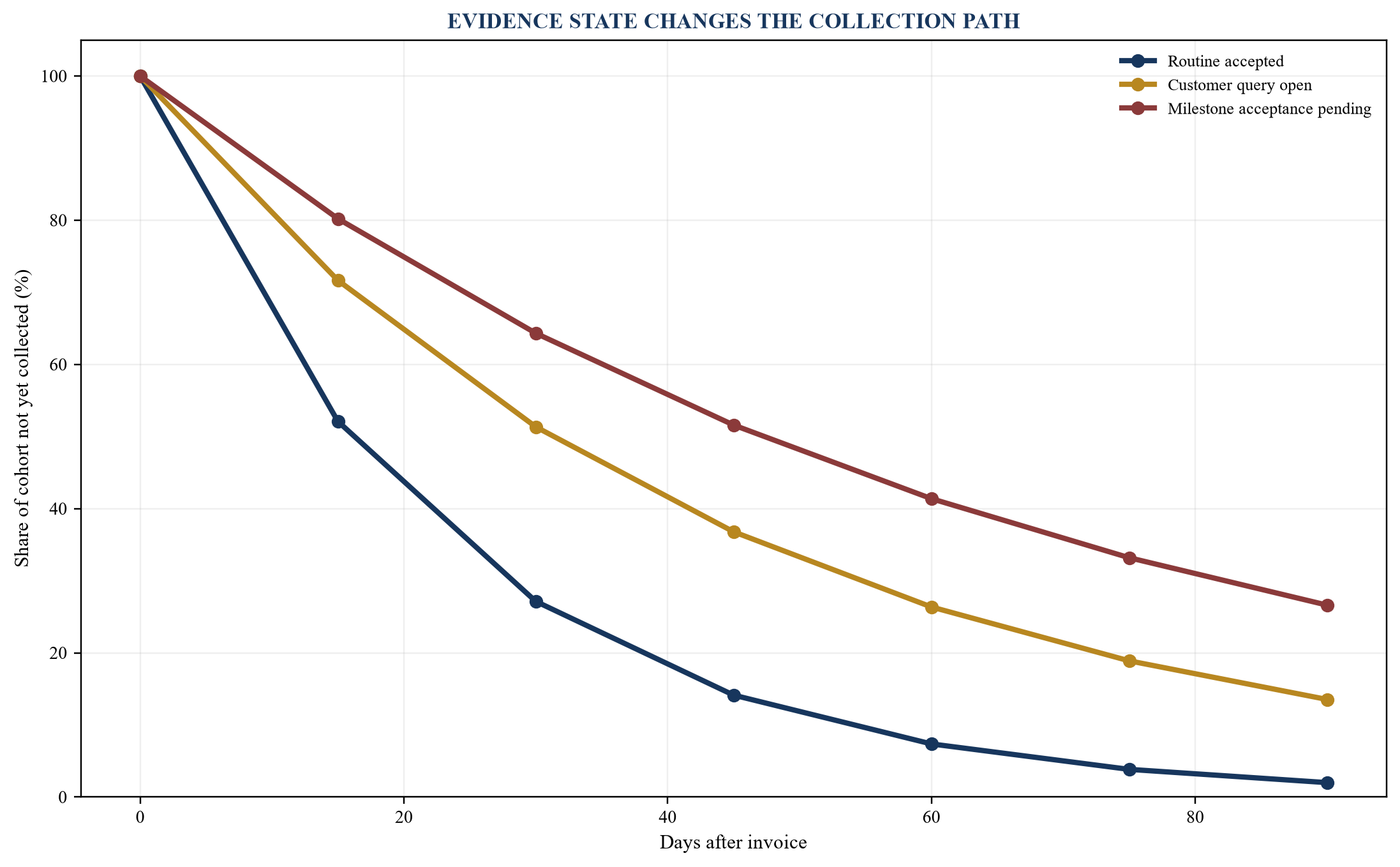
Ageing becomes more useful when combined with evidence state, customer behaviour and cash timing.
7. Separate probability from operational cause
A collection probability is a summary of evidence, not an explanation. Management needs to know whether delay arises from a missing purchase order, delivery evidence, price variance, customer liquidity, disputed scope, incorrect tax field, approval queue or internal follow-up failure. The twin should retain cause categories that support action and allow new categories when the evidence does not fit.
Classification models can assist by reading remittance text, dispute notes, workflow states and communication metadata within approved data and privacy controls. Suggested classifications should display confidence and source. Material or novel cases need review. Feedback from resolution can improve the model, provided the company avoids training on labels created by inconsistent historic practices.
Cause quality should be measured through resolution outcomes. A category that appears frequently but does not change the selected action has limited operational value. A rare cause that exposes a major contract, customer or legal issue may deserve priority. The taxonomy should therefore reflect cash materiality, actionability and consequence in addition to statistical frequency.
8. Create an invoice-quality gate before collection
Collection begins before an invoice is issued. The quality gate should verify customer identity, contract and purchase-order references, fulfilment and acceptance evidence, pricing, tax fields, currency, payment terms, bank details and required attachments. Exceptions should be corrected before transmission when possible. Rework after customer receipt consumes time and can reset approval.
The gate needs customer-specific rules where these are supported by contract and current operating evidence. A universal checklist can miss portal fields, document sequences or acceptance routes that determine payment. Rules should have owners, effective dates and version control. Commercial and finance leaders should approve material changes so that customer requests do not silently alter economics or risk.
Machine assistance can identify missing fields, inconsistent amounts, duplicate documents and unusual terms. It should not approve material contractual interpretation or tax treatment without accountable review. Performance should include first-pass acceptance, time to correction, rejection recurrence and cash-date improvement. A high technical pass rate has limited value if customer approval remains delayed.
Table 2. Invoice-quality gate and intervention route
| Exception | Evidence to inspect | Primary owner | Controlled response |
|---|---|---|---|
| missing order reference | contract, purchase order and customer portal rules | commercial operations | obtain or correct approved reference |
| incomplete delivery evidence | logistics record, certificate and acceptance terms | delivery owner | complete evidence or escalate acceptance |
| price or quantity variance | order, amendment, measurement and invoice calculation | commercial finance | reconcile and issue controlled correction |
| tax or entity mismatch | registration, supply facts and approved tax treatment | finance and tax specialist | correct after qualified review |
| duplicate risk | document history, credit notes and customer records | billing control | stop, investigate and preserve audit trail |
| bank-detail exception | approved master data and independent verification | treasury control | verify through authorised anti-fraud procedure |
Prevention and rapid correction should be measured through customer acceptance and cash outcomes.
9. Treat disputes as economic pathways
A dispute can affect the amount, timing, customer relationship, delivery plan and legal position. The twin should record the claimed amount, undisputed amount, cause, contractual notices, evidence, decision rights, proposed resolution and expected cash pathways. It should avoid assuming that the full invoice is either collected on time or lost.
Scenario pathways can include payment of the undisputed portion, negotiated adjustment, completion of evidence, credit note, offset, escalation or formal process. Each pathway needs a timing range and authorised owner. Qualified legal, tax or technical advice may be required. The model should represent those dependencies explicitly rather than hide them inside a probability.
Dispute learning should feed upstream controls. Repeated scope ambiguity may require contracting changes. Repeated measurement differences may require earlier joint validation. Recurring invoice-field rejection may require master-data repair. The value of the twin includes preventing the next exception, alongside accelerating the current receipt.
10. Build the promise-to-pay control
A promise to pay should record who made it, through which channel, for which invoices and amounts, on what date and subject to which condition. Unsupported free text creates false confidence. The twin should distinguish a customer statement, approved payment run, remittance advice, bank instruction and cleared receipt because each provides a different level of evidence.
Promise reliability can be measured by customer, channel, collector and condition. A broken promise should change the forecast and the next action. Repeated optimistic promises can create systematic cash bias. Review should focus on both the model and the operating behaviour that supplies its labels.
The collection team needs a clear sequence for confirmation, reminder, escalation, dispute routing and relationship management. Actions should comply with law, contract, policy and customer strategy. The twin prioritises evidence and timing; it does not automate coercive or inappropriate communication.
11. Map inventory to cash commitments
Inventory consumes cash before it becomes a sale and can also protect revenue, service and supplier continuity. The twin should link demand, order commitments, available stock, work in progress, replenishment, lead time, allocation, quality, expiry and payment obligations. A single days-in-inventory measure cannot represent these competing pathways.
The inventory record should distinguish physical quantity, system quantity, reserved quantity, usable quantity and financially recognised balance. Cycle counts, quality holds and goods in transit can create differences. Reconciliation rules and confidence should be visible. A forecast based on stock that cannot be shipped will overstate future receipts.
Cash decisions include changing order quantities, reallocating stock, expediting supply, slowing purchases, negotiating terms, disposing of obsolete items or funding a temporary build. Each action has cost, service, contractual and resilience consequences. The twin should show the net cash pathway rather than label every inventory reduction as value.
12. Construct an inventory risk map
The risk map can combine cash tied up, demand uncertainty, lead time, margin, criticality, ageing, shelf life, supplier concentration and customer commitment. High-value slow-moving stock may require commercial action. Low-value critical stock may need protection. Scarce components can create more cash risk through lost sales than through their carrying amount.
Machine-learning methods can support demand signals, anomaly detection and allocation scenarios where data are representative. Structural changes, promotions, customer concentration, project timing and supply disruption require explicit judgment. Forecast ranges should widen when the conditions differ from the history used by the model.
Management should preserve a counterfactual for interventions. If stock is transferred, discounted or cancelled, the company should compare realised cash and service outcomes with the approved baseline. This avoids claiming the full balance movement as a benefit when demand, currency or normal seasonality explains part of the result.
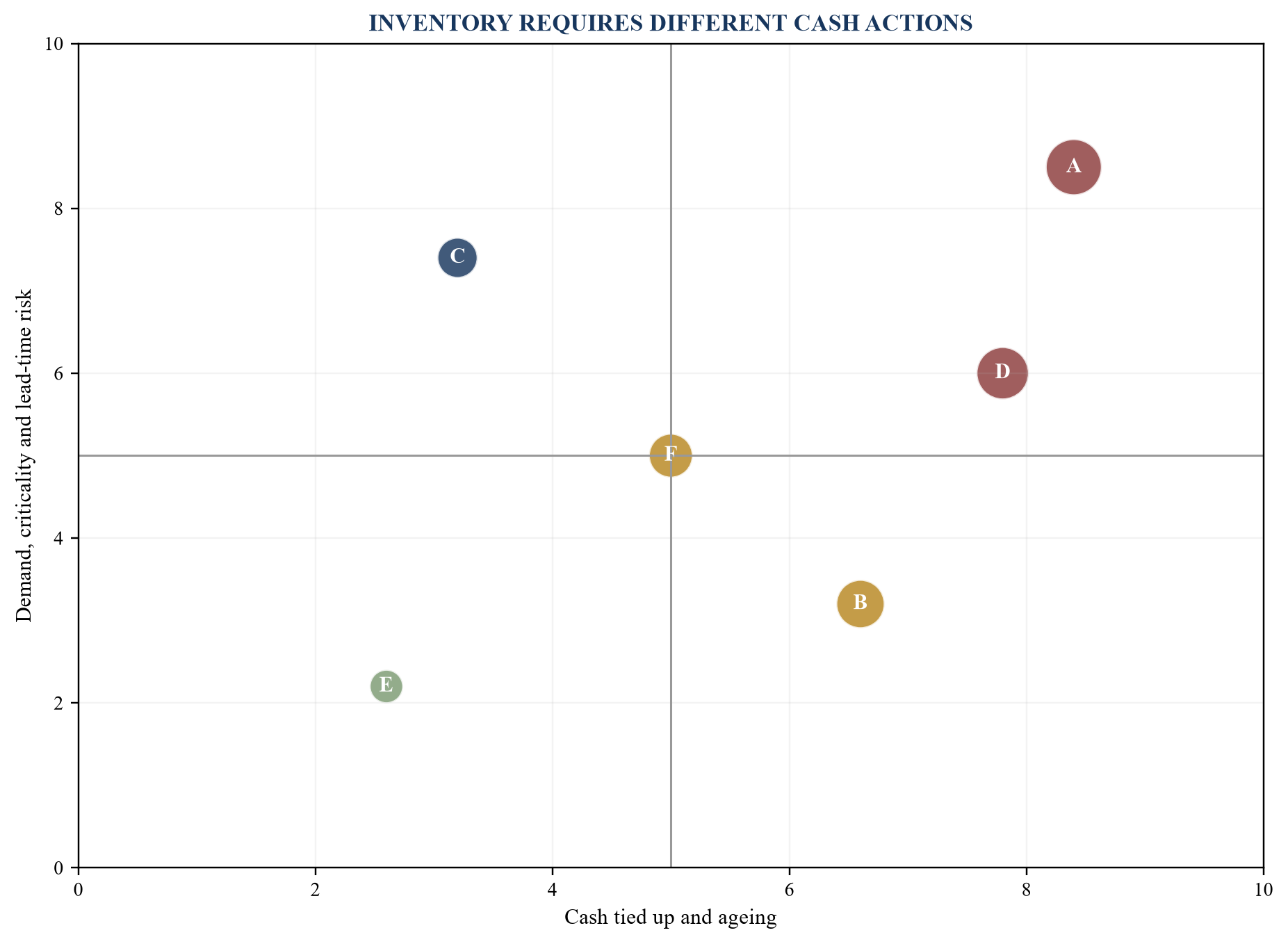
Inventory decisions should combine cash exposure, demand evidence, criticality and lead time.
13. Connect supplier events to liquidity and continuity
Payables optimisation should begin with the supplier event chain: approved purchase, receipt, invoice, match, exception, approval, payment proposal and settlement. Delays can preserve cash temporarily while damaging supply, pricing, credit support or legal compliance. The twin should represent both liquidity and continuity consequences.
Supplier segmentation can reflect criticality, substitutability, contractual terms, concentration, financial vulnerability and operational dependency. A payment action suitable for a low-risk indirect supplier may be unacceptable for a sole-source component or essential service. Accounts payable, procurement, operations and treasury need one controlled view of these differences.
The expected payment date should respect approved obligations, dispute states, discounts, financing arrangements and payment controls. Changes need authority and evidence. The twin should not convert an unapproved payment delay into forecast headroom. It should show proposed actions separately from committed or executed cash.
14. Identify supplier-finance arrangements
Supplier-finance arrangements can affect reported liabilities, cash-flow presentation, liquidity risk and supplier behaviour. IFRS issued amendments to IAS 7 and IFRS 7 requiring additional disclosures about these arrangements. Management should identify the relevant contracts, payment mechanics, balances and risks with qualified accounting advice.
The twin should distinguish ordinary trade payables, financed obligations, extended terms, early-payment programmes and other structures according to the applicable facts and accounting treatment. It should avoid treating all delayed cash outflow as operating improvement. A financing pathway can change liquidity timing while creating different funding, concentration or covenant exposure.
Treasury should connect programme availability, provider limits, supplier participation, maturities and termination rights to cash scenarios. A sudden reduction in programme capacity can bring payments forward or affect suppliers. The model should expose this dependency and its lead time.
15. Forecast the direct cash calendar
The direct cash calendar lists dated expected receipts and payments by bank account, currency and legal entity. It should reconcile opening cash, restricted balances, committed facilities, minimum operating cash and known transfers. Working-capital events feed the operating layer while payroll, tax, debt, leases and investment complete the liquidity view.
Forecast granularity should match the decision. Near-term treasury can require daily cash. A thirteen-week view can support facility, covenant and stakeholder decisions. Longer horizons can use cohorts and scenarios. Aggregation should not hide a legal-entity or currency deficit behind surplus cash that cannot be transferred.
Every expected item should state its evidence class: observed, contractually scheduled, model-estimated, management judgment or proposed action. This prevents a tentative collection promise or unapproved supplier delay from being reported as available liquidity. The board can then understand both the amount and the quality of forecast headroom.
16. Convert signals into an intervention queue
The intervention queue should rank exceptions by cash at risk, time to impact, actionability, confidence, relationship consequence and required authority. A large likely delay with no available remedy needs a financing response. A smaller invoice with a correctable field and imminent payment run can deserve immediate operational attention. Priority should reflect decision value rather than amount alone.
Each queue item needs one owner, due date, approved action and closure evidence. Duplicated tasks across finance, sales and operations create customer noise and unclear accountability. The twin should link related invoices and underlying causes so that management addresses one root problem rather than sending several disconnected reminders.
Queue status should distinguish identified, accepted, in progress, blocked, implemented and verified. An implemented action is not realised cash until the bank and ledger evidence support the outcome. Closure reasons should improve future prioritisation and reveal interventions that consume effort without changing cash.
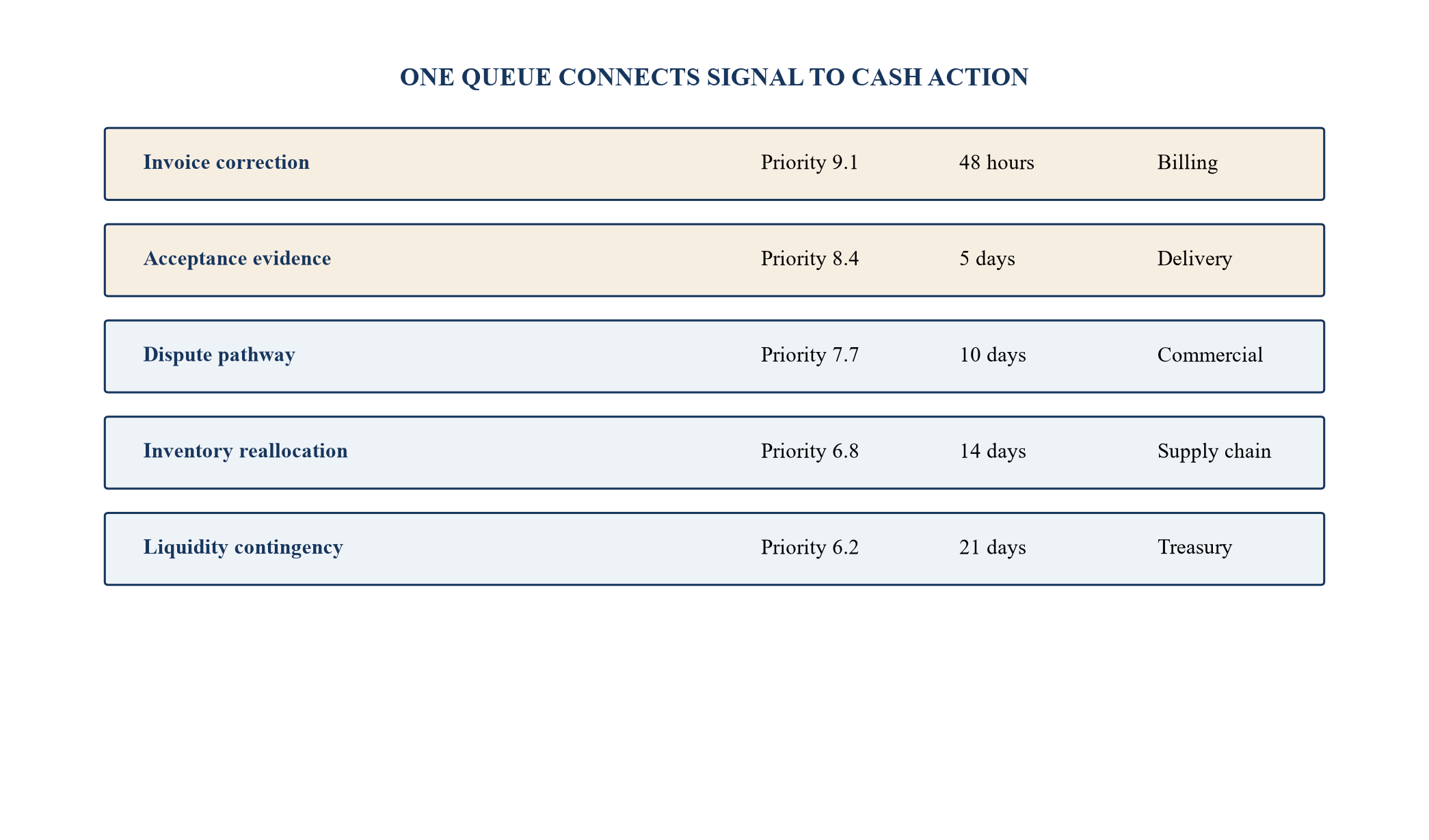
Priority combines materiality, time, confidence, actionability and relationship consequence.
Table 3. Intervention decision record
| Field | Decision requirement | Evidence at approval | Closure evidence |
|---|---|---|---|
| cash exposure | amount, currency, timing range and entity | event chain and forecast | bank and ledger reconciliation |
| root cause | controlled category and supporting record | source documents and accountable review | accepted resolution reason |
| action | lawful and commercially authorised response | decision authority and dependencies | implementation record |
| timing | latest responsible date and expected effect | customer, supplier or operating calendar | observed milestone and receipt |
| consequence | customer, supply, legal and control effects | cross-functional review | realised outcome and residual issue |
| learning | expected model or process change | baseline and success measure | approved rule, model or process update |
Proposed, executed and verified actions remain separate evidence states.
17. Connect the queue to management authority
The twin should operate within delegated authority. Correcting a clerical invoice can follow an approved workflow. Changing price, granting a credit, altering supplier payment, drawing debt or making a customer settlement can require different executives and specialist review. The system should route decisions without allowing analytical urgency to bypass governance.
Materiality thresholds should combine value and consequence. A low-value data change can be high risk when it affects bank details or access. A large routine receipt may be handled through standard control. Exceptions to authority need named approval, duration and compensating control. System permissions should align with the documented decision matrix.
Meeting design matters. A short daily control room can close operational exceptions. A weekly treasury forum can decide liquidity and financing actions. Executive and board forums can address concentration, covenant and structural working-capital choices. The same evidence chain should support every level without creating competing figures.
18. Validate forecast dates and ranges
Validation should compare predicted and observed receipt or payment dates using stable cohorts and repeated vintages. Useful measures include absolute day error, signed bias, interval coverage, error by horizon, concentration and performance around material exceptions. Amount-weighted measures should be accompanied by count-based views so that a few large items do not hide broad process weakness.
A benchmark can use contractual due dates, recent customer medians or a controlled rules model. More complex methods should demonstrate decision-relevant improvement against that benchmark. An average reduction in error is insufficient when the model remains poor on the high-value, disputed or near-liquidity-threshold items that matter most.
Validation also tests calibration and stability. If an eighty-per-cent prediction interval contains only half the observed outcomes, uncertainty is understated. Drift monitoring should detect changes in invoice mix, customer behaviour, payment infrastructure, policy and source quality. Material deterioration requires investigation, temporary controls and possible model withdrawal.
19. Measure forecast error by cause
The forecast-error waterfall should separate timing, amount, missing event, classification, model, management overlay, action and execution effects. This structure prevents the team from attributing every miss to the algorithm. A customer paid later than predicted for a newly opened dispute; the primary issue may be missing event capture rather than the collection model.
Errors should be measured from preserved forecast vintages. Rewriting history after the result is known destroys the evidence needed to learn. The system can retain the approved forecast, subsequent signals, interventions and final cash, with a documented reason for every material movement.
Management should connect error to decisions. A five-day error may be immaterial when liquidity is ample and serious when a facility maturity occurs first. The review should ask whether the system gave the correct action sufficient time, whether the action was executed and whether the forecast range communicated the risk.
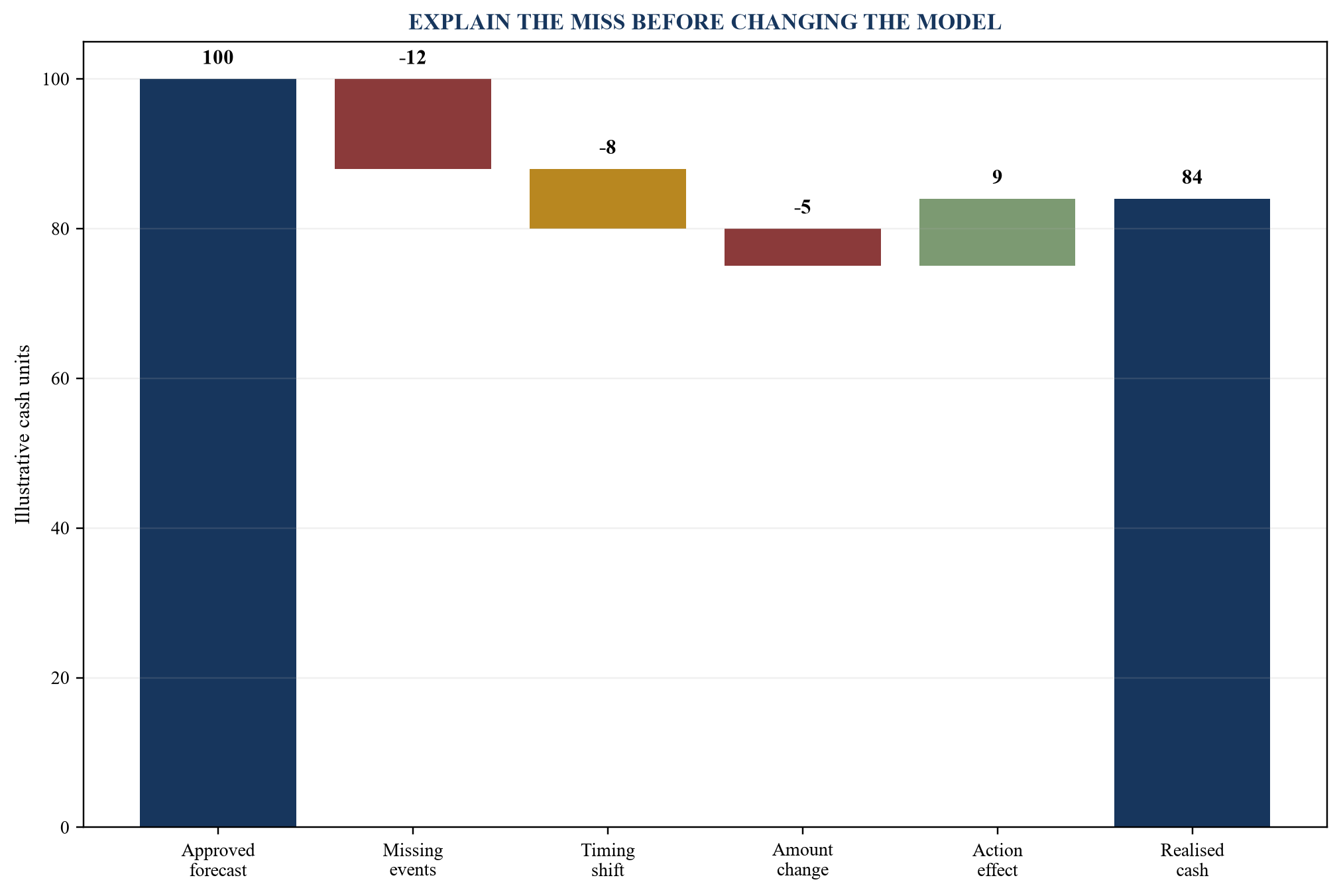
Variance analysis separates model, event, action and execution causes.
20. Measure intervention yield and realised cash
Intervention yield compares actions with outcomes against a preserved counterfactual. Measures can include invoices corrected before rejection, acceptance time reduced, disputes resolved, inventory released, supplier continuity protected and net cash realised. Costs, concessions, financing charges, lost margin and customer effects should be included.
Attribution should remain conservative. A receipt after a reminder is not automatically caused by the reminder. Cohort comparison, event evidence and repeated outcomes can improve confidence. Finance should distinguish identified opportunity, approved action, forecast effect, verified operational result and bank-realised cash.
The system should also measure harm and burden. Excessive customer contact, inappropriate supplier pressure, false alerts and manual review can destroy value. A successful programme improves cash visibility and decision quality while preserving commercial relationships, control and staff capacity.
21. Govern data quality as a cash control
Data quality should be assessed against the decision it supports. A missing invoice identifier can prevent matching. An inaccurate expected delivery date can distort both inventory and collections. A stale supplier status can create an inappropriate payment action. The twin should define completeness, validity, timeliness, uniqueness and reconciliation tolerances for every material field.
Exceptions need owners and expiry dates. Temporary mapping or estimated values should be labelled and removed when authoritative data arrive. Persistent defects should enter the transformation backlog with quantified cash and control consequences. A model cannot repair an operating process that repeatedly produces ambiguous events.
Quality metrics should distinguish source defects, integration defects and user behaviour. This directs investment to the cause. Management can then compare the cost of repair with the cash exposure, review burden and decision delay created by poor data.
22. Control identity and entity resolution
Customer and supplier records often contain duplicate names, changed legal entities, multiple accounts and inconsistent tax or bank identifiers. Entity-resolution methods can suggest links across systems, while material merges require controlled approval. A false merge can combine unrelated credit, dispute or payment behaviour and produce an unsafe action.
The golden record should retain source identifiers and effective dates. Corporate groups need explicit relationships so that management can analyse concentration without assuming that balances can be offset or collected together. Legal rights, contracts, currencies and payment routes remain transaction-specific.
Changes to bank details, tax identifiers and authorised contacts require enhanced verification. The twin may flag inconsistency, while the approved anti-fraud and master-data process determines whether a change is accepted.
23. Protect confidential commercial and personal data
The twin can contain customer contracts, prices, disputes, bank accounts, employee actions and supplier vulnerabilities. Access should follow purpose, role, legal basis, contractual obligation and data classification. Sensitive text should not be sent to an analytical service without approved security, retention and processing arrangements.
Data minimisation can reduce exposure. A forecasting component may need event state and timing rather than complete correspondence. Tokenisation or controlled identifiers can support analysis when names are unnecessary. Logs should record data access, model use, overrides and exports.
Cross-border processing, retention, legal hold and data-subject requirements depend on the applicable facts and jurisdictions. Qualified privacy, legal and security specialists should determine the design. The cash objective does not override those obligations.
24. Apply model-risk governance
The organisation should maintain an inventory of rules, statistical models, machine-learning components and language-model functions used by the twin. Each record should state purpose, owner, inputs, output, materiality, validation, limitations, dependencies, approval and fallback. Materiality can reflect cash, customer, supplier, reporting and financing consequence.
Independent challenge should test conceptual logic, data, implementation, performance and use. A model that predicts collection timing accurately may still be unsuitable if users treat a probability as permission to delay financing action. Validation therefore includes the surrounding decision process.
Change control should cover code, parameters, prompts, rules, data sources and interfaces. Emergency changes need temporary approval and retrospective review. The company should be able to reproduce the output used for a material decision.
25. Preserve human authority and effective challenge
Human review should have defined purpose. Asking a collector to approve thousands of automatically prioritised items creates ceremonial oversight. Review should concentrate on material, uncertain, novel or consequential cases and provide the evidence needed to challenge the recommendation.
The interface should show source events, missing data, confidence, alternative pathways, proposed action and authority. Reviewers need the ability to reject, modify and escalate. Overrides should record reason and outcome so that management can distinguish valuable judgment from recurring bias.
Accountability remains with the authorised decision maker. A vendor, model or automated agent cannot hold the commercial relationship, interpret every contractual fact or accept financing consequences on behalf of the company.
Table 4. Control framework for the working-capital twin
| Control domain | Minimum design | Evidence | Escalation trigger |
|---|---|---|---|
| data | lineage, reconciliation, quality rules and access | source logs and exception register | material missing or inconsistent population |
| model | inventory, benchmark, validation, version and fallback | approval and performance record | drift, bias or decision failure |
| action | authority, customer and supplier safeguards | decision and communication log | action outside delegation or policy |
| cash | bank, ledger and legal-entity reconciliation | daily and period-end control | unexplained cash or transfer restriction |
| security | identity, least privilege, monitoring and response | access and incident evidence | unauthorised access or data exposure |
| change | tested release, approval and rollback | version and deployment history | material untested or emergency change |
Control depth should reflect the cash, reporting, customer, supplier and financing consequence.
26. Build coherent cash scenarios
Scenarios should combine correlated events. Customer delays can reduce cash while inventory accumulates and supplier pressure rises. A supply interruption can postpone sales, increase expedited purchases and alter payment terms. Treating each variable as independent can understate the liquidity tail.
The twin should support a base pathway, downside states and event-specific stresses. Assumptions need owners, evidence and review dates. Probability can be used where defensible, while severe but plausible scenarios remain important even when a precise probability is unavailable.
Management actions belong inside scenarios only when authorised, feasible and timed. The model should show the period before an action becomes effective, any implementation cash cost and the risk that customers, suppliers or lenders respond differently than expected.
27. Connect working capital to facilities and covenants
Forecast cash should bridge to committed and uncommitted facilities, drawing conditions, interest, fees, maturities, security and covenant calculations. Availability can differ from the headline limit because of borrowing bases, reserves, eligibility, documentation or lender discretion.
A working-capital miss can affect leverage, fixed-charge cover, minimum liquidity or other covenants depending on the transaction. The twin should use the approved definitions and reconcile to finance and legal records. Qualified advisers should review material interpretations.
Escalation dates should precede the cash shortfall. A waiver, amendment, refinancing or equity process can require weeks or months. The decision system should identify the latest responsible date and preserve enough downside headroom for execution risk.
28. Manage customer and supplier concentration
Concentration should be measured across receivables, revenue, disputes, inventory allocation, purchases and critical dependencies. Several legal entities can share one economic parent or payment centre. Several suppliers can depend on one upstream source. The twin should represent known relationships without assuming unsupported control or correlation.
Stress tests can delay a major customer, remove a supplier-finance provider or interrupt a critical source. The cash result should include operational responses, replacement cost, inventory and financing effects. Concentration becomes decision-useful when it connects exposure to time, alternatives and authority.
Commercial strategy matters. Aggressive collection or payment action can have greater consequence for a strategic counterparty. The queue should display relationship tier and accountable sponsor while maintaining consistent controls and avoiding informal exceptions.
29. Address currency and cross-border cash
The event spine should retain transaction currency, functional currency, bank account and legal entity. Expected cash can change through timing and exchange rates. Hedging, settlement restrictions, taxes, documentation and intercompany arrangements may affect whether cash is available where it is needed.
The twin should separate local receipt from transferable liquidity. It should not offset a deficit with cash that is restricted, pledged or operationally unavailable. Intercompany transfers require approved legal, tax, treasury and accounting treatment.
Scenario analysis can combine collection delay with currency movement and funding cost. The company should avoid double counting the same risk in cash, hedge and financing assumptions. Treasury retains authority over execution.
30. Establish the operating cadence
A daily process should reconcile bank movements, refresh material events, route exceptions and confirm urgent actions. The purpose is disciplined closure rather than a large meeting. Automation can prepare the evidence pack, while owners resolve or escalate each item.
A weekly forum should review liquidity, concentration, forecast error, intervention yield, unresolved disputes, inventory and supplier risks. It should make decisions, assign owners and record deadlines. Monthly governance can approve model changes, benefits, controls and structural process improvements.
The period-end close remains essential. It provides authoritative accounting balances, cut-off review and evidence that recalibrates the twin. Continuous prediction and formal reporting should reinforce each other through reconciliation.
The cadence should include explicit stop decisions. A queue may be paused when source evidence is unreliable, customer communication is already coordinated elsewhere, a legal issue requires specialist control or the expected cash benefit no longer justifies the action. Recording why an item was stopped protects the relationship and improves future prioritisation.
Capacity should be monitored alongside opportunity. A queue that assigns more cases than teams can resolve encourages superficial closure and repeated escalation. Management can use expected cash, time requirement and specialist dependency to set a controlled work-in-progress limit. Unselected cases remain visible in the forecast and liquidity scenario rather than disappearing from risk reporting.
31. Design a modular technical architecture
The architecture can separate source connectors, event store, identity layer, rules, models, scenario engine, workflow, evidence store and reporting. Modular boundaries allow the organisation to replace a component without rebuilding the entire system. Interfaces should define fields, timing, validation and failure behaviour.
The event store should preserve effective time and system time so that users can reproduce what was known when a decision was made. Streaming can support high-frequency events, while controlled batch processes may be sufficient for other sources. The design should match business latency rather than adopt complexity for its own sake.
Fallback is part of architecture. If a model, connector or vendor fails, treasury needs a controlled cash view and material exception process. Recovery objectives should reflect liquidity consequence. Reconciled extracts, rules and manual approvals can provide temporary continuity.
Observability should cover source arrival, transformation, record matching, model execution, workflow delivery and user action. A technically available platform can still fail the cash decision when one source becomes stale or an exception is never routed. Monitoring should therefore connect technology health to the affected population, expected cash and latest responsible decision date.
The architecture should keep calculation and communication separate. A language model may help draft an explanation from approved fields, while the reconciled event store and forecast engine remain the source of amounts and dates. Generated narrative should cite the controlled evidence and should not create a new cash fact, customer commitment or accounting conclusion.
32. Evaluate vendors and internal build choices
Vendor assessment should begin with the event and decision requirements. Demonstrations should use representative anonymised or controlled data and test reconciliation, exception handling, model transparency, workflow, security, export and failure. A polished dashboard does not establish that the system can reproduce a material cash recommendation.
Contracts should address data rights, use restrictions, service levels, subcontractors, security, retention, model changes, audit evidence, portability and termination. Concentration and change-of-control exposure may be relevant. Specialist procurement, legal, technology and security review is required.
Internal build can improve fit and control while creating maintenance and key-person dependencies. The decision should compare lifecycle economics, skills, integration, assurance and exit. A hybrid architecture may retain the controlled event model internally and use replaceable analytical services.
33. Run a staged 100-day implementation
The first thirty days should define decisions, boundaries, event taxonomy, authoritative sources, reconciliations, baseline forecast and current operating performance. The team should select a material, manageable population rather than attempt enterprise coverage immediately.
Days thirty-one to sixty should build the event spine, invoice-quality rules, cohort forecasts and intervention queue. Outputs should run alongside existing treasury and collection processes. Every difference needs investigation, and users should record whether the proposed action would have been accepted.
Days sixty-one to one hundred should execute controlled interventions, validate outcomes, test fallback and approve production use. Expansion depends on reconciliation, forecast performance, operating capacity and realised decision value. Calendar completion alone is insufficient.
34. Use a controlled worked example
Consider a hypothetical company with opening available cash of 22 illustrative units and a thirteen-week working-capital forecast. The approved baseline expects 104 of customer receipts, 76 of supplier payments and 18 of payroll, tax and other operating payments. It therefore expects closing cash of 32 before financing and investment.
The event twin identifies 14 of receipts exposed to acceptance and dispute delay, 6 of inventory purchases that can be resequenced without breaching service assumptions, and 5 of supplier payments dependent on unresolved receipt evidence. These observations are analytical assumptions rather than claims about an actual company.
Management approves three actions: complete acceptance evidence for 8 of invoices, resolve the undisputed portion of a 4 dispute, and resequence 3 of inventory purchases. It rejects a broad supplier delay because continuity and contractual consequences exceed the cash benefit. The model retains both approved and rejected decisions.
35. Stress the example before relying on actions
In the illustrative downside, only half of the acceptance action succeeds within the horizon, the dispute payment arrives two weeks later and an additional customer delays 5. The inventory action delivers 2 after implementation cost. Closing cash falls below the baseline even though several interventions work.
The treasury response depends on minimum cash, facility availability, covenant definitions and decision lead time. The example assumes a committed facility is available, while an actual company would need to verify conditions, documentation, borrowing-base treatment and approvals. Forecast headroom should not include unverified funding.
The exercise demonstrates why the twin needs ranges and financing links. Operational actions can improve cash while remaining insufficient for a severe scenario. The board should see the residual gap early enough to decide on facilities, capital expenditure, equity, asset action or stakeholder engagement.
A second test should remove the assumed facility and delay the inventory response. This reveals whether the operating plan can survive without external liquidity and how early the board must open another route. The company may decide to preserve more minimum cash, reduce a discretionary commitment or begin lender engagement sooner. Those are management decisions supported by the scenario, not automatic model outputs.
The worked case should be repeated with actual approved company data before operational use. The population, legal entities, contracts, accounting, facilities and decision rights can materially change the result. The illustrative bridge demonstrates method and control structure only.
Table 5. Illustrative cash bridge and management decisions
| Item | Approved baseline | Downside before action | Approved action effect | Downside after action |
|---|---|---|---|---|
| opening available cash | 22 | 22 | 0 | 22 |
| customer receipts | 104 | 85 | 7 | 92 |
| supplier payments | -76 | -76 | 0 | -76 |
| inventory resequencing | 0 | 0 | 2 | 2 |
| other operating payments | -18 | -18 | 0 | -18 |
| closing cash before financing | 32 | 13 | 9 | 22 |
| verified facility draw | 0 | 0 | decision required | decision required |
All values are hypothetical analytical assumptions and do not describe Matchpoint Partners or a client.
36. Build the management dashboard
The dashboard should begin with available cash, forecast range, minimum liquidity, facility headroom and decision deadlines. Working-capital metrics then explain the pathway: expected receipts, evidence quality, disputes, promises, invoice rejection, inventory risk, supplier criticality and payment exceptions.
The intervention panel should show cash at risk, proposed effect, owner, status, deadline and verified outcome. Forecast metrics should show bias, interval coverage, cohort performance and recent drift. Control metrics should show unreconciled balances, missing events, access exceptions and model changes.
Every number should link to definition, cut-off and source. Visual simplicity should come from controlled hierarchy rather than removal of material uncertainty. The board needs enough evidence to decide and enough detail to challenge.
37. Prepare lender and investor evidence
Capital providers may request working-capital history, ageing, concentration, inventory, supplier terms, forecasts, facilities and management actions. The twin can produce a reconciled evidence pack when definitions, vintages and source links are preserved. External disclosure requires authorised review.
Management should distinguish actual balances, observed events, model estimates and proposed actions. Forecast improvement should be supported by repeated outcomes rather than one selected period. Limitations and material exceptions should remain visible.
The evidence pack can improve dialogue about liquidity and financing structure. It does not determine credit approval, accounting treatment, covenant interpretation or valuation. Those decisions remain transaction-specific.
38. Recognise limitations and failure modes
The twin can fail through incomplete populations, false record links, stale events, biased labels, unstable customer behaviour, inappropriate action rules, weak security or user overreliance. A high aggregate accuracy can coexist with dangerous errors in material cases. Reconciliation and segment validation remain essential.
Observed relationships may not be causal. A collection intervention can appear effective because teams select easier accounts. Inventory reduction can precede lost service or revenue. Supplier delay can create a future cash and continuity problem. Counterfactuals and longer outcome windows help expose these effects.
The system cannot resolve missing legal rights, inadequate contracts, insolvent counterparties or unavailable funding. It can surface evidence and decision deadlines. Management still needs commercial execution, specialist advice and capital.
Novel events create another limitation. A new market, product, customer process, payment rail or regulatory requirement may have little relevant history. The model should widen uncertainty, rely on explicit rules and route cases to experienced reviewers. It should avoid borrowing confidence from unrelated populations simply to produce a complete forecast.
Benefits can also decay. Teams may change behaviour after seeing queue rules, counterparties may alter payment processes and users may find ways around controls. Periodic outcome review, access monitoring and independent challenge are needed after initial validation. A system that passed at launch can become unsuitable later.
39. Define the value case conservatively
The business case should separate one-off recovery, sustained process improvement, financing cost, margin, service and control. Gross balance movement is not equivalent to value. Benefits should deduct concessions, implementation, operating cost, financing, tax and adverse commercial effects where applicable.
Recurring value may arise from fewer invoice failures, faster acceptance, lower forecast bias, reduced emergency borrowing, better inventory allocation and more reliable supplier decisions. Each claim needs a preserved baseline, approved calculation and bank or ledger evidence.
The programme should be stopped or redesigned when the decision benefit does not justify cost, risk and operating burden. Technology scale should follow verified value and control readiness.
40. Conclude with event-led cash control
A working-capital digital twin creates value by connecting commercial and operational events to cash decisions before the month-end close. Its foundation is a controlled event spine reconciled to the ledger and bank. Models, workflows and dashboards build on that evidence.
The operating sequence is disciplined: define decisions, bound the twin, connect events, reconcile, forecast pathways, prioritise exceptions, authorise action, verify cash and learn. Receivables, inventory, payables and financing remain linked because a decision in one area can transfer risk to another.
Boards should demand timely foresight with traceability, uncertainty and human authority. The twin should show which cash outcome is changing, why, which action remains available, when it must begin and how success will be verified.
References
- IFRS Foundation, IAS 7 Statement of Cash Flows. https://www.ifrs.org/issued-standards/list-of-standards/ias-7-statement-of-cash-flows/
- IFRS Foundation, IFRS 7 Financial Instruments: Disclosures. https://www.ifrs.org/issued-standards/list-of-standards/ifrs-7-financial-instruments-disclosures/
- IFRS Foundation, Supplier Finance Arrangements: Amendments to IAS 7 and IFRS 7, 2023. https://www.ifrs.org/projects/completed-projects/2023/supplier-finance-arrangements/
- IFRS Foundation, IFRS 15 Revenue from Contracts with Customers. https://www.ifrs.org/issued-standards/list-of-standards/ifrs-15-revenue-from-contracts-with-customers/
- IFRS Foundation, IAS 2 Inventories. https://www.ifrs.org/issued-standards/list-of-standards/ias-2-inventories/
- UAE Ministry of Finance, eInvoicing programme portal. https://mof.gov.ae/en/about-us/initiatives/einvoicing/
- UAE Ministry of Finance, decisions on the scope and timelines for implementing the Electronic Invoicing System, 2025. https://mof.gov.ae/en/news/ministry-of-finance-announces-the-issuance-of-two-ministerial-decisions-on-the-scope-of-obligations-and-the-timelines-for-implementing-the-electronic-invoicing-system-2/
- Central Bank of the UAE, Guidance Note on Consumer Protection and Responsible Adoption and Use of Artificial Intelligence and Machine Learning, 2026. https://rulebook.centralbank.ae/en/rulebook/guidance-note-consumer-protection-and-responsible-adoption-and-use-artificial-intelligence
- Dubai Financial Services Authority, AI Survey 2025: Generative AI Adoption and Governance in the DIFC, 2025. https://www.dfsa.ae/news/new-dfsa-ai-survey-generative-ai-adoption-has-nearly-tripled-within-difc-last-12-months-governance-continues-develop
- National Institute of Standards and Technology, Framework for a Digital Twin in Manufacturing, 2020. https://www.nist.gov/publications/framework-digital-twin-manufacturing
- National Institute of Standards and Technology, Digital Twins for Advanced Manufacturing. https://www.nist.gov/programs-projects/digital-twins-advanced-manufacturing
- National Institute of Standards and Technology, Use Case Scenarios for Digital Twin Implementation Based on ISO 23247, 2021. https://doi.org/10.6028/NIST.AMS.400-2
- International Organization for Standardization, ISO 23247-1:2021 Digital Twin Framework for Manufacturing, Part 1. https://www.iso.org/standard/75066.html
- National Institute of Standards and Technology, Artificial Intelligence Risk Management Framework 1.0, 2023. https://nvlpubs.nist.gov/nistpubs/ai/NIST.AI.100-1.pdf
- National Institute of Standards and Technology, AI RMF Core. https://airc.nist.gov/airmf-resources/airmf/5-sec-core/
- Financial Stability Board, The Financial Stability Implications of Artificial Intelligence, 2024. https://www.fsb.org/2024/11/the-financial-stability-implications-of-artificial-intelligence/
- Bank for International Settlements, Elasticity of Money in Production Networks, Working Capital, Credit Lines and Financial Conditions, 2026. https://www.bis.org/publications/working-paper-1350-elasticity-money-production-networks-working-capital-credit-lines-and-financial-conditions
- Bank for International Settlements, Theory of Supply Chains: A Working Capital Approach, 2023. https://www.bis.org/publications/working-paper-1070-theory-supply-chains-working-capital-approach
- European Central Bank, Instant Payments Regulation. https://www.ecb.europa.eu/paym/retail/instant_payments/html/instant_payments_regulation.en.html
- UK Financial Reporting Council, Guidance on the Going Concern Basis of Accounting and Related Reporting. https://www.frc.org.uk/library/standards-codes-policy/accounting-and-reporting/guidance-on-the-going-concern-basis-of-accounting-and-related-reporting/
- Committee of Sponsoring Organizations of the Treadway Commission, Enterprise Risk Management Framework. https://www.coso.org/enterprise-risk-management
- International Organization for Standardization, ISO 31000 Risk Management. https://www.iso.org/iso-31000-risk-management.html
- International Organization for Standardization, ISO/IEC 42001 Artificial Intelligence Management System. https://www.iso.org/standard/81230.html
- UK National Cyber Security Centre, Guidelines for Secure AI System Development, 2023. https://www.ncsc.gov.uk/collection/guidelines-secure-ai-system-development
- US Federal Reserve and Office of the Comptroller of the Currency, Supervisory Guidance on Model Risk Management SR 11-7 and OCC 2011-12. https://www.federalreserve.gov/supervisionreg/srletters/sr1107.htm
