

1. Define the board decision in cash and transaction terms
The board's immediate decision is whether the company can preserve a viable business long enough to execute a sale or another restructuring route. That question cannot be answered by a headline cash balance, a monthly forecast or a list of interested buyers. It requires a dated chain from opening liquidity through each material payment and receipt to a legally and operationally achievable closing.
The proposed thirteen-week clock begins with unrestricted cash that can actually be used. It separates restricted accounts, customer monies, trapped cash, undrawn facilities with unmet conditions, disputed receivables and proceeds that depend on future events. The model then identifies the minimum operating cash needed to keep the business safe and capable of transfer. A company may remain technically cash-positive while lacking the funds required for payroll, insurance, licences, essential maintenance or a critical supplier delivery.
The transaction plan should answer five linked questions. Which business and assets can be sold? Which buyers can fund and close within the runway? Which diligence evidence is essential to establish value and reduce conditionality? Which approvals, consents and stakeholder actions lie on the critical path? Which alternative becomes preferable if the sale misses a defined gate? The board should approve the questions, assumptions and decision dates before buyer discussions create momentum around a single route.
The board should also record the legal perimeter of its duties. Insolvency and near-insolvency rules differ by jurisdiction, entity and procedure. The United Kingdom guidance for directors upon insolvency emphasises creditor interests, asset protection, avoidance of further deterioration and the need for professional insolvency advice. [1] The UAE Financial Restructuring and Bankruptcy Law establishes its own procedures, authorities and effects. [2] Cross-border groups require entity-level analysis because cash, security, liabilities and authority may not sit in the same company.
The output is a decision system: a cash model, transaction timetable, evidence room, authority map, bid scorecard, contingency tree and daily or weekly governance rhythm. Each item should use the same perimeter and version date. A conflict between the finance model and the transaction plan is itself a warning that the proposed closing date may not be financeable.
2. Establish the liquidity perimeter
The cash model should begin with bank-by-bank balances reconciled to the ledger and adjusted for availability. Restricted cash, blocked accounts, minimum compensating balances, customer trust funds and cash pledged to lenders should be shown separately. Undrawn facilities should be included only when the conditions to draw, borrowing-base capacity, representations and lender discretion have been tested. A facility described as available in a board pack may be unavailable when a covenant, material-adverse-change clause or borrowing-base exclusion is triggered.
Receipts should be forecast from named invoices and collection actions. Historical days sales outstanding can provide context; it should not replace invoice-level evidence during distress. The forecast should state the customer, invoice, amount, due date, dispute status, collection owner and expected bank date. Large receipts should carry a confidence classification and a downside date. The company should also identify whether a buyer, lender or factor has rights over the receivable.
Payments should be organised by operational and legal consequence. Payroll, health and safety, utilities, insurance, data hosting, critical raw material, key subcontractors, taxes, debt service and professional costs may have different timing and consequences. Management should distinguish obligations it intends to pay, obligations it is legally required to pay, and obligations that may be renegotiated. The model should never assume a supplier extension before that supplier has agreed the terms.
The minimum operating cash floor should be evidence based. It can include the largest payroll run, immediate safety expenditure, cash needed to complete work that releases customer receipts, protected customer commitments and a contingency for forecast error. The floor should be reviewed as the operating perimeter changes. A sale of a division, customer termination or supplier standstill can reduce or increase the amount needed to operate safely.
The Financial Reporting Council's going-concern guidance calls for a company-specific assessment of solvency and liquidity risks. [3] That principle is directly relevant to a distressed sale. The board should understand the assumptions that support continued operation, the sensitivity to adverse events and the actions available if assumptions fail. The cash model provides the near-term operating evidence for that judgement; it does not replace the broader legal or accounting assessment.
3. Build a direct thirteen-week cash model
A direct model records cash receipts and payments in the weeks when money is expected to enter or leave the bank. It should avoid relying solely on EBITDA, accounting profit or a working-capital percentage. Those measures can be useful for valuation and longer-term planning, while a distressed process requires invoice, payroll and payment-run detail. The model should reconcile opening and closing cash to bank evidence and explain every material variance to the previous version.
The model should use a stable taxonomy. Customer receipts should separate contracted collections, deposits, milestone payments, retentions and asset-sale proceeds. Operating payments should distinguish payroll, critical suppliers, ordinary suppliers, rent, utilities, insurance and statutory obligations. Financing lines should identify interest, principal, fees, drawdowns and cash-collateral effects. Transaction lines should identify advisers, retention arrangements, cure costs, consent fees and closing expenses.
Each line needs an owner and evidence. Finance may own the bank reconciliation; sales may own customer collection dates; operations may own the supplier payment consequences; legal may own consent and claim assumptions. The weekly forecast meeting should challenge both timing and amount. A receipt moved from week four to week five is a decision event when the minimum cash floor is close.
The model should preserve versions and forecast accuracy. Management should compare forecast and actual cash each week, classify variances and revise the remaining horizon. Repeated optimism in collections or underestimation of supplier payments should lead to a formal bias adjustment. A transaction timetable based on an inaccurate cash model creates false comfort and can erode the board's ability to choose among alternatives.
The horizon should roll forward. Thirteen weeks is a useful operating window because it combines short-term visibility with enough time to coordinate a transaction. The final week is not a cliff after which cash ceases to matter. A buyer may delay, a court or regulator may require more time, and closing may trigger additional payments. The model should therefore include a post-closing bridge and a longer-range view of liabilities that become relevant to proceeds and solvency.
| Cash line | Minimum evidence | Timing owner | Downside test | Decision use |
|---|---|---|---|---|
| Opening unrestricted cash | Bank statement and reconciliation | Treasury | Exclude blocked or pledged balances | Defines usable starting liquidity |
| Customer receipts | Invoice, acceptance and collection record | Commercial and finance | Delay or dispute named receipts | Tests runway and collection actions |
| Payroll and people costs | Payroll file and payment calendar | People and finance | Include retention and termination effects | Protects continuity and legal compliance |
| Critical suppliers | Purchase order, delivery dependency and terms | Operations | Test cessation or cash-on-delivery | Identifies continuity floor |
| Statutory and financing payments | Filing, facility and security records | Tax, legal and treasury | Test default, penalty and enforcement effects | Sets escalation dates |
| Transaction and restructuring costs | Engagement, estimate and payment schedule | Transaction office | Include consent, cure and contingency costs | Funds the route to closing |
Original framework. Categories and priorities require company-specific legal, operational and financing review.
4. Convert the model into decision dates
The forecast should produce more than an ending cash number. It should identify the date on which unrestricted cash approaches the operating floor, the date on which committed payments cannot be met, and the date on which a transaction no longer has enough time to close. These dates may differ. The last credible launch date for a sale can arise weeks before the first missed payment.
Management should calculate backwards from closing. If funds need two business days to clear, documents require several days for execution, a lender release requires credit approval, a regulator has a minimum review period and the buyer needs an investment-committee meeting, those durations should be placed on the same calendar. The buyer's timetable should be supported by names, scheduled meetings and evidence of funds.
The process should contain hard gates. By the end of an early week, management may require a complete buyer list and approved teaser. A later gate may require non-disclosure agreements and access to an initial evidence room. Another may require funded indicative bids. A final gate may require executable documents, approvals and closing funds. Missing a gate should trigger an action, such as broadening the buyer universe, accelerating contingency financing or preparing a formal procedure.
Decision dates should also account for stakeholder behaviour. Suppliers may shorten terms, employees may leave, customers may withhold new orders and insurers may change coverage as distress becomes visible. The forecast should include leading indicators such as overdue supplier balances, order cancellations, employee attrition and customer escalation. These indicators can reduce the effective runway before the bank balance reaches the stated floor.
The resulting sale clock is a controlled dependency map. Each workstream has a latest safe start, required evidence, decision owner and fallback. The board can then see whether the sale remains feasible, which delay consumes the most optionality and when a different route should be activated.
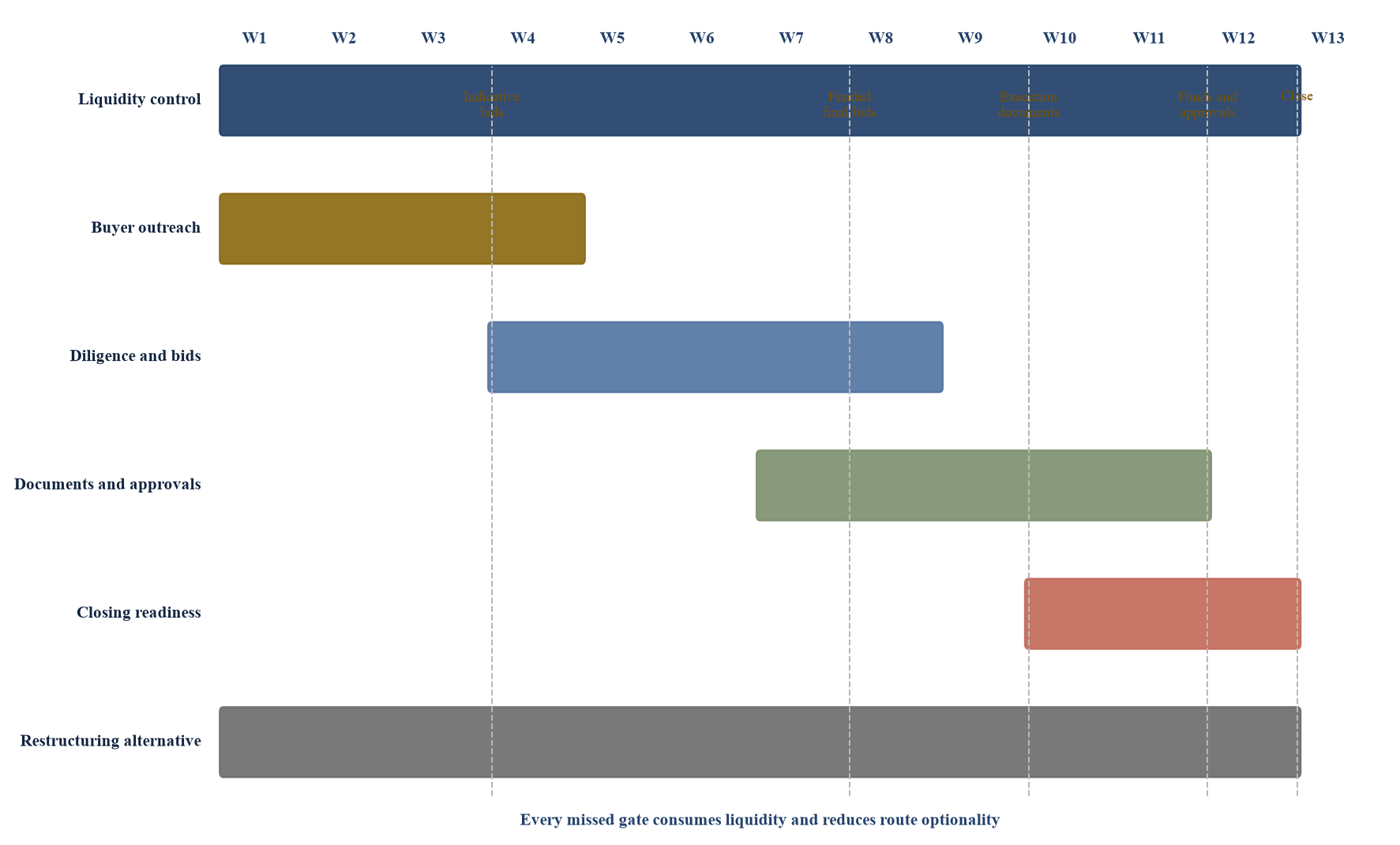
Original framework. Durations are illustrative; legal procedures, approvals and company conditions determine the live timetable.
5. Establish governance for a compressed process
The board should approve a governance charter for the transaction and liquidity response. It should identify which matters remain with the full board, which can be delegated to a transaction committee, and which decisions management can take within agreed thresholds. Reserved matters may include route selection, exclusivity, material funding, connected-party participation, entry into a formal insolvency procedure and acceptance of a binding bid.
Conflicts should be mapped at the outset. Directors may represent lenders, shareholders or prospective buyers; executives may have retention arrangements or future employment discussions; advisers may have existing relationships. The company should document disclosures, recusals, independent advice and information barriers. A process that is fast but poorly governed can create later challenges to value, fairness and authority.
The transaction office should maintain one integrated plan. Finance, legal, operations, human resources, tax, technology, communications and advisers should use the same milestone dates. A daily liquidity call may be appropriate when headroom is narrow; the board or transaction committee may meet weekly or when triggers occur. Minutes should record the evidence considered, alternatives available and reasons for decisions.
The company should appoint a forecast owner and a process owner. The chief financial officer may own cash integrity; a transaction leader may own buyer execution. Neither should be able to change core assumptions without a logged approval. The board should receive a short dashboard showing cash headroom, forecast accuracy, critical receipts, supplier status, buyer progression, diligence exceptions, approvals and alternative-route readiness.
Governance should remain proportionate. Excessive reporting can consume the same people needed to stabilise the business and answer diligence. The charter should define the minimum evidence required for each decision and establish a secure record. Clear authority and disciplined information flow allow speed without abandoning accountability.
6. Define the sale perimeter and value proposition
A distressed seller should define precisely what the buyer can acquire. The perimeter may comprise shares in one or more entities, selected assets, customer contracts, intellectual property, employees, inventory, permits or a combination. The choice affects liabilities, consents, tax, financing releases and operating continuity. It also determines which buyers can act and what evidence they require.
The perimeter should be tested against customer delivery. A carve-out that excludes a shared system, licence, property interest or specialist employee may be legally describable and operationally incomplete. The seller should map each revenue stream to the assets, people, contracts and approvals needed to deliver it. Missing dependencies should be addressed through transfer, replacement, transition services or a different perimeter.
The value proposition should explain the sustainable earnings and cash generation of the business after transfer. Management should reconcile historical accounts to the sale perimeter, identify abnormal distress effects and distinguish recurring costs from temporary measures. Buyers will apply their own assumptions; a controlled seller case can reduce avoidable uncertainty and focus negotiation on genuine differences.
The seller should prepare more than one route where feasible. A whole-company share sale may preserve licences and contracts. A business or asset sale may isolate value from legacy liabilities. A divisional sale may fund a wider restructuring. The alternatives should be compared for timing, proceeds, liabilities retained, execution risk and stakeholder outcome.
The perimeter decision should be revisited when facts change. A lost customer, licence issue, security claim or employee departure can alter transferability and value. The board should require a current perimeter schedule at each bid stage so that bidders price the same package and the proceeds model remains meaningful.
7. Build and qualify the buyer universe
The buyer universe should include strategic acquirers, private equity, special-situations investors, industry consolidators, management-backed buyers and, where appropriate, customers or suppliers. The company should screen competition, sanctions, foreign-investment, regulatory, funding and conflict issues before sharing sensitive information. A long list has little value when most parties cannot obtain approval or finance within the runway.
Buyer qualification should begin before detailed diligence. The seller should ask who controls the bidder, what approvals it needs, how it will fund the acquisition, which advisers are appointed, whether it has completed similar transactions and what conditions it expects. Evidence may include cash statements, committed facilities, equity commitment letters, investment-committee dates and named decision makers.
Strategic buyers may offer operating synergies and higher value; they may also face competition review, information sensitivities and slower internal approvals. Financial buyers may move rapidly when funding and management are in place; they may require financing, restructuring protections or a narrower liability perimeter. The scorecard should make these trade-offs explicit.
The company should control outreach. Each contact should have an owner, date, response, next action and confidentiality status. Buyer claims of speed should be converted into deliverables. A bidder that cannot provide a diligence team, funds evidence or a draft mark-up by the stated gate should not receive the same process status as a prepared party.
Maintaining competition matters because distress can encourage delay and retrading. The seller should avoid granting exclusivity before a bidder has demonstrated funding, diligence progress and a credible document path. If exclusivity becomes necessary, it should be short, milestone based and capable of termination when the bidder misses agreed actions.
8. Prepare a minimum viable evidence room
The evidence room should focus first on information that changes price, liability or closing certainty. This typically includes ownership and authority, recent financial performance, thirteen-week cash, debt and security, key customers, critical suppliers, employees, pensions, tax, litigation, licences, property, intellectual property, technology, data protection and environmental or safety matters. A comprehensive archive can follow if time and capacity permit.
Each document should have a source, owner, date, confidentiality classification and relevance to the sale perimeter. The seller should reconcile key schedules to one another. Customer revenue should agree to the financial model; employee schedules should agree to payroll; debt balances should agree to lender statements; asset lists should agree to ownership and security records. Inconsistency invites buyer caution and can delay documents.
The room should contain clear issue summaries where the source documents are complex. A summary should identify the fact, financial or operational consequence, remediation, decision owner and supporting evidence. It should not conceal adverse matters. Early, controlled disclosure can allow the parties to structure a solution; late discovery can lead to retrading, broad warranties or withdrawal.
Access should be staged. Initial bidders may receive sufficient information to assess perimeter, economics and major risks. Qualified bidders can receive detailed customer, employee or technical material under enhanced controls. Highly sensitive information may be provided through clean teams, anonymised schedules or expert reports. The release plan should reflect competition law, confidentiality, privacy and operational sensitivity.
The seller should run a readiness review before opening the room. Missing documents, expired licences, unsigned contracts and unreconciled balances should enter an exception log. Some items can be cured; others require pricing, indemnity, consent or a change in perimeter. The log becomes a transaction management tool rather than a hidden deficiency list.
9. Control communications
Distress creates a high risk of inconsistent messages. Employees may hear about a sale from suppliers; customers may interpret payment pressure as delivery risk; bidders may receive different financial versions; lenders may learn of material developments late. The company should establish a communications protocol covering authority, audience, timing, content and escalation.
The protocol should protect confidentiality while recognising that key stakeholders may need information to preserve value. A critical customer may require assurance about delivery and ownership continuity. A supplier may require a payment arrangement. Employees may need lawful consultation, retention terms or clarity on payroll. The company should coordinate these conversations with legal and transaction advice.
Management should avoid making promises that depend on an unapproved buyer, financing or court outcome. Communications should distinguish current operating arrangements from intended transaction steps. The same principle applies to bidders: management presentations should use the controlled forecast and sale perimeter, with assumptions and dates clearly identified.
A rumour or leak plan should be prepared before outreach expands. It should identify who monitors media and stakeholder questions, who approves a response and how operational teams are briefed. The plan should consider securities, employment and insolvency obligations in relevant jurisdictions. Silence, confirmation or corrective disclosure can each have consequences.
The communications record should feed the cash and risk models. A customer seeking additional security, an employee resignation or a supplier moving to cash in advance changes liquidity and execution. The transaction office should capture these events promptly and update the board dashboard.
10. Compare bids through distributable value and certainty
Headline enterprise value is an incomplete measure. A bid can include assumed debt, deferred consideration, working-capital adjustments, escrow, earn-outs, cure costs, excluded liabilities and conditions that reduce the amount or timing of cash available to creditors and stakeholders. The seller should build a proceeds bridge for every serious bid.
The bridge should begin with consideration and deduct debt-like items, leakage, transaction costs, taxes, consent or cure payments, employee amounts, working-capital adjustments and liabilities retained. It should identify cash received at closing, contingent amounts and security for deferred payments. Where a formal procedure applies, distributions and priorities require specialist advice.
Certainty should be scored separately. The score can cover funds evidence, internal approvals, financing conditionality, regulatory risk, diligence completion, document exceptions, perimeter acceptance and closing timetable. A lower nominal price with committed funding and limited conditions may produce a better expected outcome than a higher conditional bid that requires more cash to reach closing.
The comparison should also consider continuity. A buyer that preserves customer contracts, licences, employees and critical suppliers may protect value beyond the purchase price. A structure that leaves the seller with stranded liabilities or an unviable residual business may impose costs that the headline bid excludes.
The board paper should show assumptions, sensitivities and the reason for weighting. An expected-value calculation can inform the decision; it should not disguise uncertainty behind a single number. The board should understand which conditions drive the difference and whether management can improve them before selection.
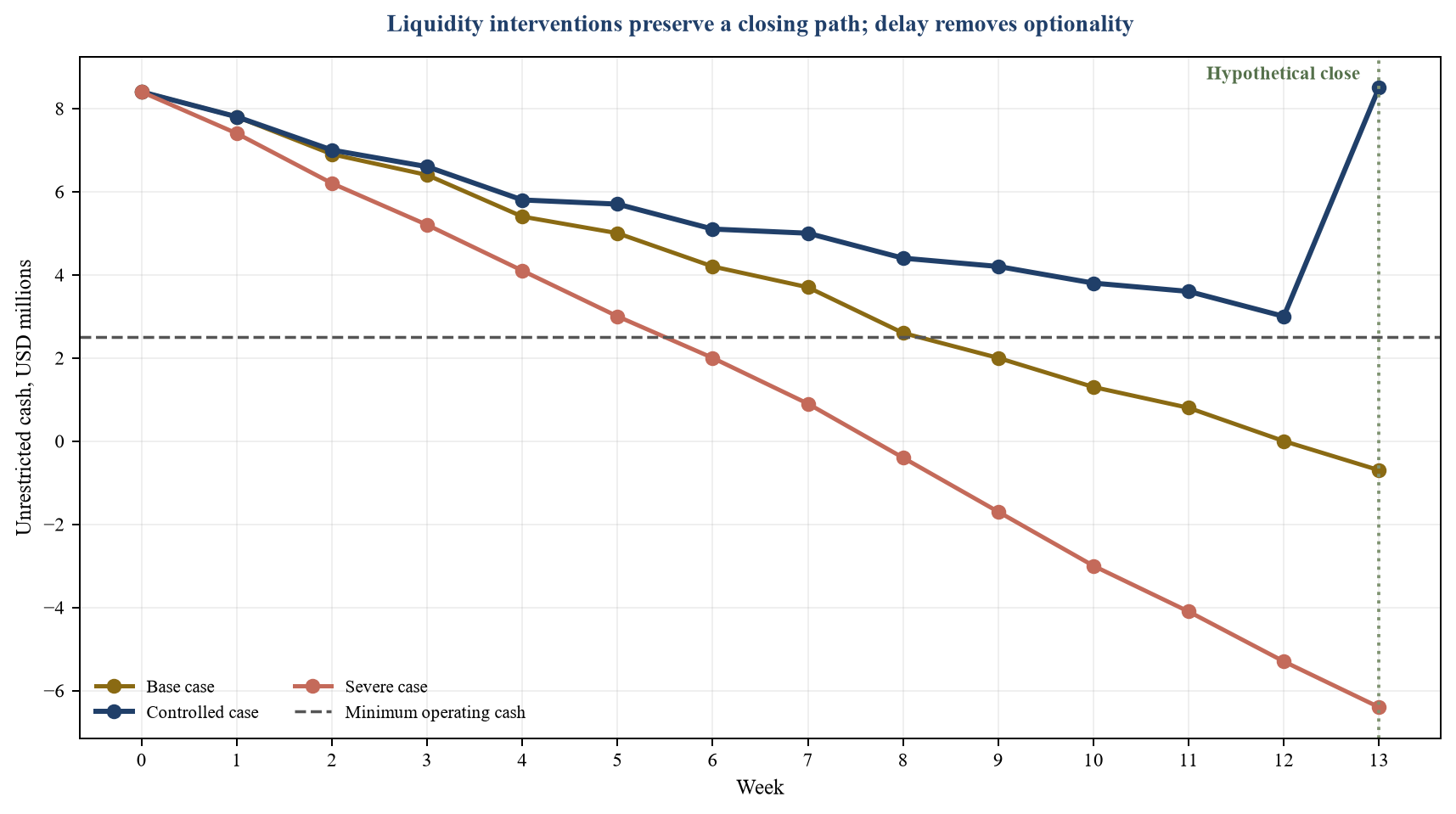
Original analysis. All amounts and interventions are hypothetical; the chart is not a forecast for any company.
| Measure | Bidder Alpha | Bidder Beta | Bidder Gamma |
|---|---|---|---|
| Headline consideration | USD 72.0m | USD 68.0m | USD 63.0m |
| Estimated cash at closing after stated deductions | USD 58.0m | USD 61.0m | USD 59.0m |
| Funding evidence | Conditional acquisition facility | Cash and signed equity commitment | Cash statement; approval pending |
| Material conditions | Financing, customer consent, no deterioration | Regulatory approval and confirmatory diligence | Investment committee and lender release |
| Earliest credible close | Week 15 | Week 13 | Week 12 |
| Closing-certainty score | 52 / 100 | 82 / 100 | 67 / 100 |
| Continuity assessment | Strong operating fit | Funded standalone plan | Narrow asset perimeter |
| Board issue | Runway does not reach stated close | Lower headline value; highest funded certainty | Residual liabilities and approval risk |
All amounts, scores and closing assessments are hypothetical. Expected values are analytical aids, not probability forecasts or fairness opinions.
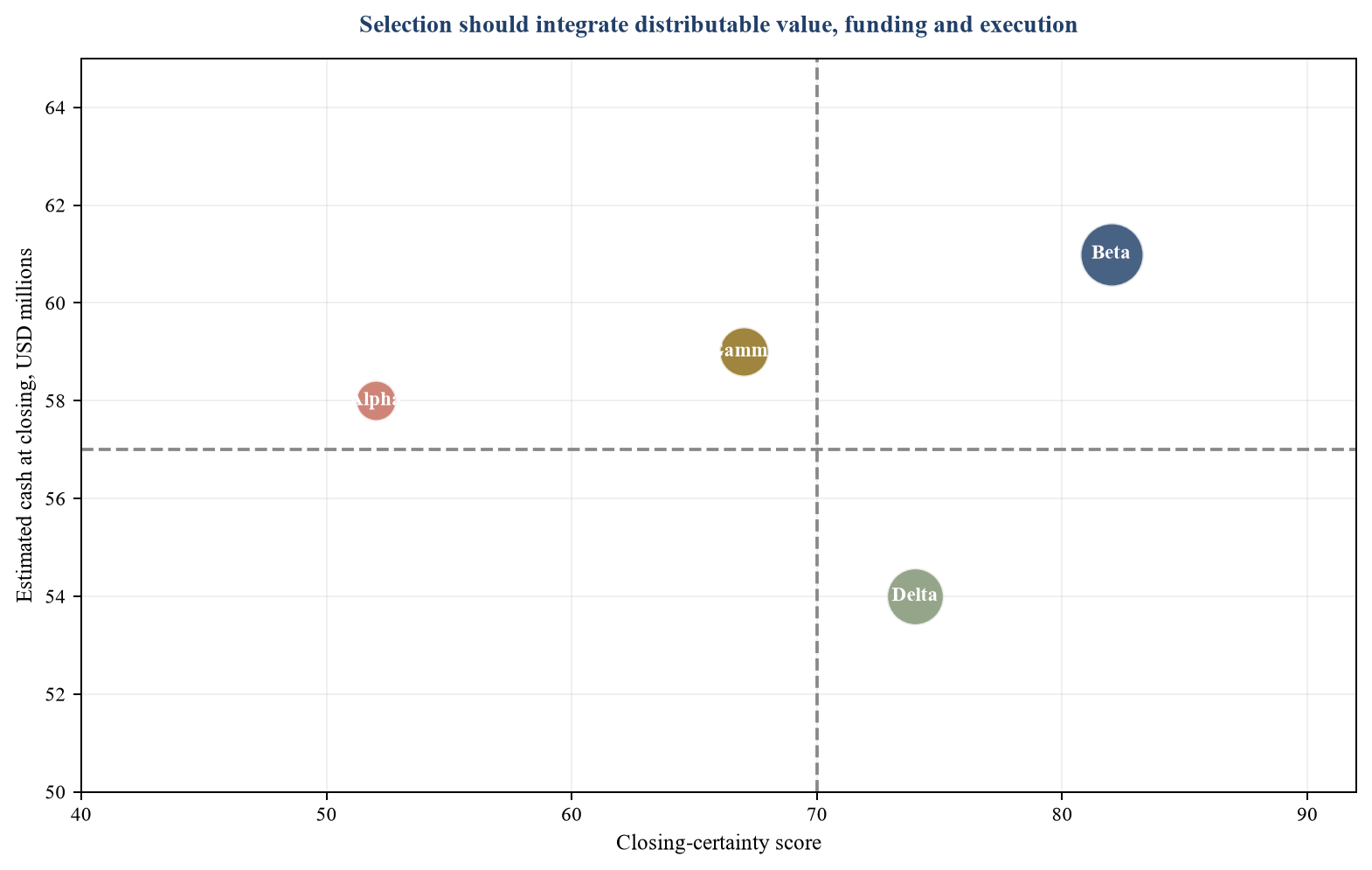
Original framework using hypothetical bidder positions. Bubble size represents funding-evidence strength, not transaction probability.
11. Integrate restructuring alternatives
A sale should be run alongside credible alternatives. These may include new-money financing, a consensual standstill, amendment and extension, asset-based funding, shareholder support, a formal restructuring plan, administration, bankruptcy protection or an orderly wind-down. The relevant options depend on jurisdiction, entity, security and business viability.
The alternative plan should not be treated as a document prepared only after the sale fails. It needs facts, advisers, authorities, creditor analysis and operational planning while time remains. Preparing it can also improve the sale because bidders recognise that the seller has another route and understands the consequences of delay.
UNCITRAL's Legislative Guide describes objectives that include timely resolution, maximising asset value, balancing affected interests and facilitating the rescue of viable businesses. [4] The World Bank Principles similarly emphasise transparency, predictability, viable rescue and efficient liquidation. [5] These objectives support a decision framework that compares stakeholder outcomes and value preservation rather than assuming that a private sale is always superior.
The company should map triggers for each route. A missed payroll, lender enforcement, withdrawal of insurance, loss of a critical licence, failed final bid or inability to fund the next stage may require immediate action. The trigger should identify who decides, what evidence is required and which communications follow.
Parallel preparation should remain controlled. The company should avoid creating contradictory commitments to buyers, lenders and stakeholders. One transaction office and a clear privilege protocol can coordinate the routes. The board should receive a comparative outcome analysis that is updated as bids, cash and legal options change.
12. Manage lenders, security and cash collateral
Lenders can influence both liquidity and transferability. The company should produce a facility and security map showing borrowers, guarantors, commitments, utilisation, maturity, covenants, events of default, cash controls, collateral and release mechanics. It should identify cross-default and change-of-control provisions and any lender consent needed for information sharing or sale.
The cash model should incorporate lender rights. A lender may block an account, cease funding, apply receipts, require a borrowing-base reserve or charge a consent fee. The company should not assume that ordinary cash management continues after a default or reservation of rights. Treasury, legal and restructuring advisers should reconcile the contractual position with actual bank operations.
Lender engagement should use a controlled information package. It can include the cash forecast, sale timetable, buyer evidence, restructuring alternatives and requested accommodation. The request should state what the lender is being asked to do, for how long, on what information and with which protections. A vague request for time can produce delay without an executable agreement.
Security releases and debt repayment belong on the closing critical path. The seller should identify the payoff calculation, release documents, filing actions, authorised signatories and funds flow. A bid that assumes clean title but does not address secured debt is not closing ready.
United States Chapter 11 guidance illustrates the importance of authority over cash collateral and outside-ordinary-course asset sales. Cash collateral generally requires creditor consent or court authority, and major asset sales require court approval. [6] A live cross-border process must apply the relevant law and procedure to each entity rather than importing one jurisdiction's mechanics.
13. Preserve customer revenue and contract transfer
Customers determine whether the business remains a going concern. The seller should rank customers by revenue, cash collection, margin, contract transferability, service dependency and risk of departure. A large contracted backlog can have limited value when consent is required, milestones are unaccepted or termination rights arise from insolvency or change of control.
The company should establish a customer action plan. It may include resolving disputed invoices, documenting acceptance, confirming delivery capacity, obtaining consent, protecting data and agreeing communications. The plan should distinguish steps that can occur before bidder selection from those that require a named buyer.
Buyer diligence should receive consistent customer evidence. Revenue schedules should reconcile to contracts, invoices and collections. Management should explain concentration, renewal, pricing, service credits and pipeline conversion. Unsupported optimism can damage credibility across the whole data room.
The cash forecast and customer plan should be linked. A delayed receipt may shorten the transaction runway; a premature sale announcement may create the delay. Customer conversations should therefore be approved through governance and reflected in liquidity scenarios.
Closing conditions involving customer consent should be limited and prioritised where possible. The seller and bidder can define a threshold by value or operational importance, with specific treatment for missing consents. The board should understand the revenue and liability consequences of each threshold before accepting it.
14. Stabilise suppliers and the operating platform
The supplier plan should identify which vendors can stop production, revoke access, terminate licences, withhold title or demand cash in advance. It should map outstanding balances, contractual rights, operational dependency, substitute availability and required cash. The purpose is to allocate scarce liquidity to value preservation under legal advice, not to classify vendors through habit or influence.
Critical suppliers may support a short standstill when they understand the transaction timetable and payment proposal. Any arrangement should be documented and included in the forecast. Promises made by operations, procurement and finance should be centralised so that the company does not commit the same cash more than once.
Inventory and work in progress require close control. The seller should know who owns materials, whether retention-of-title rights apply, what work releases customer cash and which inputs have long lead times. A payment to complete a high-value milestone may be value preserving; a payment for surplus stock may not be.
The buyer should receive an operating continuity pack showing critical suppliers, arrangements, open risks and Day One requirements. This can reduce a broad material-adverse-change condition and allow the buyer to plan funding. It also identifies costs that should appear in the bid comparison.
Operations should report incidents and performance changes promptly. Quality failure, downtime, safety events and delivery slippage can affect value and disclosure. The sale process should never suppress operational escalation. Preserving a safe and honest operating system is central to both stakeholder protection and transaction credibility.
15. Protect employees and critical capability
Employees may hold customer relationships, technical authority, licences, security clearances or knowledge needed to complete the sale and operate after closing. The seller should identify critical roles, concentration risks, notice periods, unpaid obligations, transfer rules and retention needs. The assessment should avoid treating every senior employee as critical merely because of title.
Retention arrangements should be targeted, affordable and governed. They can combine continued service, transaction milestones and handover obligations. The company should model payroll, bonuses, accrued leave, pension and termination effects in cash and proceeds. A retention award that cannot be funded or lawfully approved can reduce trust.
Employment transfer, information and consultation requirements depend on jurisdiction and structure. The legal workstream should identify minimum periods and documents early enough to fit the transaction clock. A share sale, business transfer and formal insolvency sale can produce different consequences.
Communications should acknowledge uncertainty and provide reliable operational information. Management should avoid promising continued employment by an unselected buyer. Employees need clear routes for questions, payroll confirmation and reporting of customer or supplier concerns.
The buyer should present a credible Day One organisation and leadership plan before closing. Gaps in authority, payroll access, health and safety or customer coverage can impair continuity. The seller's comparison of bids should therefore consider people readiness alongside price and legal conditionality.
16. Resolve tax, pensions, licences and regulatory approvals
Distressed timetables can obscure items that have fixed procedural duration. Tax clearances, pension arrangements, sector licences, foreign-investment review, competition approval, environmental transfer and data-protection requirements may determine the earliest possible closing. The company should identify them during route design rather than after selecting a bidder.
The tax analysis should cover transaction structure, losses, withholding, transfer taxes, debt releases, asset values and liabilities retained. It should also show cash timing. A structure with a higher headline price can yield lower distributable proceeds after tax or require funds the seller does not possess before closing.
Pension and employee-benefit obligations may affect security, creditor outcomes and buyer appetite. Trustees, regulators or counterparties may require information, consultation or mitigation. The company should obtain specialist advice and ensure that bid comparisons use consistent assumptions.
Licences and permits should be mapped to legal entities, sites, activities and transfer rules. A buyer may acquire equipment and contracts without the authority to operate them. The evidence room should include current permits, compliance status, renewal dates and identified transfer actions.
Regulatory submissions need accurate ownership, funding and business information. The seller should prepare a reusable fact base and allocate drafting responsibility. Where approval periods exceed the private-sale runway, the board should consider a structure or procedure that preserves the business during review.
17. Design bid procedures and document strategy
Bid procedures should state the sale perimeter, required form of offer, funding evidence, assumptions, conditions, timetable and contact protocol. They should reserve the seller's ability to change or terminate the process subject to applicable duties and law. The procedures should create comparable bids without implying an obligation to accept the highest price.
The seller should issue a draft transaction document early enough to expose material differences. Bidders should provide a complete mark-up and disclosure requests with final offers. Key issues may include consideration mechanics, assumed liabilities, warranties, indemnities, employee treatment, conditions, termination rights and reverse-break protections.
The document strategy should reflect the seller's capacity and procedure. A solvent share sale may support negotiated warranties and escrow. A sale through an insolvency officeholder may offer limited recourse and require different protections. The seller should avoid offering obligations that the residual entity cannot perform.
Bidder deviations should be captured in a comparison matrix. A bid described as unconditional may contain broad diligence completion, financing discretion or customer conditions. Legal terms should be translated into timing, cash and failure consequences so that the board can compare them with headline value.
The seller should prepare disclosure, funds flow and completion deliverables in parallel with negotiation. Waiting for agreement on every commercial point before assembling signatures, releases and filings can waste the final weeks. Parallel work should use controlled versions and clear assumptions.
18. Address connected-party and insider bids
A connected-party or management-backed bid may offer speed and knowledge of the business. It can also create conflicts, information advantages and questions about value testing. The board should identify connections broadly and obtain jurisdiction-specific advice on approvals, disclosure, independent evaluation and process safeguards.
The United Kingdom rules on substantial disposals in administration to connected persons restrict certain disposals within the first eight weeks unless creditors approve or an evaluator's report has been obtained. [7] The Insolvency Service guidance explains the relevant scrutiny and reporting framework. [8] These rules illustrate the need to build connected-party analysis into timing and documentation before a preferred bidder emerges.
Independent directors or a committee may need to supervise the process. The company should document equal information access, marketing efforts, valuation evidence, conflicts and reasons for selection. Management participants should be excluded from decisions that affect their bid or future employment where appropriate.
An independent valuation or fairness analysis can inform the board; it cannot cure a flawed process by itself. The analysis should use the same perimeter, liabilities and cash assumptions as the bid comparison. It should also recognise the distressed timetable and available alternatives.
The board record should explain why the selected route best serves the relevant interests under the applicable duties. A concise, evidence-based record is more valuable than a lengthy document produced after the decision.
19. Use triggers to pivot before optionality disappears
The process should define triggers that change action. Liquidity triggers may include cash falling within a stated buffer of the operating floor, a major receipt moving, a lender blocking funds or a supplier requiring prepayment. Transaction triggers may include insufficient qualified bidders, missed funding evidence, unresolved regulatory barriers or failure to produce executable documents.
Operational triggers may include loss of a licence, customer termination, key employee departure or a safety event. Legal triggers may include an insolvency test, enforcement notice, winding-up action or board advice that duties require a different route. Each trigger should identify the decision body, immediate protections and communications.
Triggers should be calibrated to lead time. A restructuring filing cannot be prepared after the last payroll date if documents, evidence and funding require several weeks. The sale clock should show the latest date for initiating each alternative while it remains capable of preserving value.
The board should resist extending a failed process through unsupported optimism. A bidder's request for more time should be assessed against available cash, probability-free evidence of progress and the cost of delay. Additional time may be rational when funding and documents are nearly complete; it may be destructive when the bidder continues to reopen settled issues.
Pivot decisions should be recorded against the agreed framework. The board can then show what changed, which alternatives remained available and why the selected action was proportionate. This discipline also helps management communicate consistently with lenders, employees and counterparties.
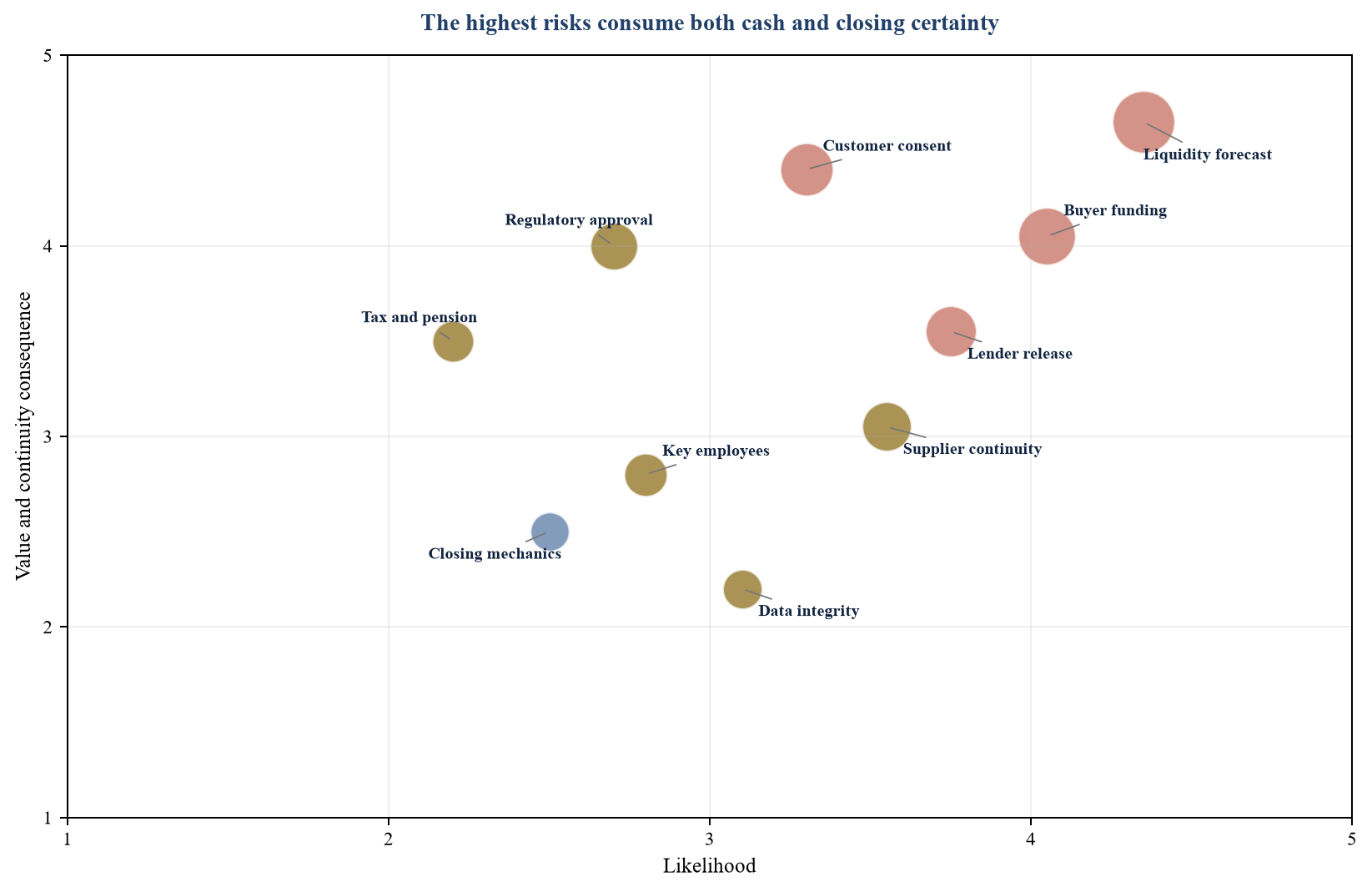
Original framework using hypothetical exposures. Position and bubble size require company-specific evidence and board review.
20. Apply the hypothetical thirteen-week case
The hypothetical company is a cross-border engineering-services group with active customer projects, leased facilities, specialist employees and secured debt. It begins week one with USD 8.4 million of unrestricted cash. Management establishes a USD 2.5 million operating floor based on payroll, safety, essential technology, insurance and completion of customer milestones that release receipts.
The base case assumes ordinary collections, existing supplier terms and transaction spending without additional controls. Cash falls to USD 2.6 million in week eight, breaches the operating floor in week nine and turns negative in week twelve. A sale that closes in week fifteen cannot be funded under this case, even if the price is acceptable.
The controlled case uses invoice-level collections, documented supplier arrangements, expenditure gates and a tightly qualified buyer process. These actions are hypothetical; they are assumed to preserve cash rather than promised as achievable. Cash remains above the floor through week twelve. A funded buyer closes in week thirteen and contributes USD 5.5 million of net cash to the residual entity after the simplified assumed closing deductions.
The severe case assumes two delayed receipts, cash-in-advance supplier requirements and a customer cure cost. Cash breaches the floor in week six and becomes negative in week eight. The private sale cannot continue on the same timetable without new liquidity or a procedure that changes the cash and transaction mechanics.
The case demonstrates the value of early gates. By week four, the controlled process requires qualified bidders and initial funds evidence. By week eight, it requires funded final bids. By week ten, the preferred bidder should have near-final documents. By week twelve, approvals, releases and funds flow should be ready. Missing any gate prompts a board review of financing and restructuring alternatives.
| Week | Controlled closing cash | Critical transaction gate | Required evidence | Pivot if missed |
|---|---|---|---|---|
| 1 | USD 7.8m | Approve perimeter, governance and buyer list | Reconciled cash, authority and sale perimeter | Activate adviser and lender contingency work |
| 3 | USD 6.6m | Open initial evidence room | Controlled financial, customer, debt and legal schedules | Narrow perimeter or expand specialist support |
| 4 | USD 5.8m | Receive qualified indications | Price range, conditions, funds evidence and timetable | Expand outreach and accelerate alternative funding |
| 8 | USD 4.4m | Receive funded final bids | Full mark-up, approvals, funds and closing plan | Prepare formal route and revised liquidity action |
| 10 | USD 3.8m | Select executable preferred bid | Proceeds bridge, certainty score and board record | Maintain competition; avoid unsupported extension |
| 12 | USD 3.0m | Complete approvals and funds flow | Releases, consents, signatures and bank instructions | Execute pre-approved restructuring alternative |
| 13 | USD 8.5m | Close and transfer operations | Cleared funds, title, Day One controls and notices | Apply emergency continuity and legal plan |
All values and actions are hypothetical. Closing proceeds are simplified and do not represent a creditor distribution analysis.
21. Prepare closing and Day One as one workstream
Closing readiness should begin when final bids are requested. The seller should maintain a checklist of approvals, signatures, releases, consents, filings, funds-flow instructions, employee actions, customer notices, systems access and physical handover. Each item needs an owner, dependency, due date and evidence of completion.
The funds flow should reconcile purchase consideration, debt repayment, fees, taxes, employee amounts, working-capital payments, escrow and residual cash. Bank details should be independently verified through a fraud-resistant protocol. Last-minute changes should require enhanced confirmation and approval.
Day One should preserve authority and controls. The buyer needs authorised signatories, payroll capability, bank access, insurance, licences, health and safety leadership, cyber controls, customer coverage and supplier arrangements. Transition services should identify scope, service level, price, duration, data access and exit.
The seller may retain entities, liabilities or operations after the transfer. The residual plan should identify governance, funding, records, claims, employee obligations and wind-down or restructuring actions. A transaction that transfers the attractive assets and leaves an unfunded residual problem can reduce the true outcome materially.
Closing evidence should be archived promptly. The record should include executed documents, approvals, funds confirmation, releases, disclosures and handover acceptance. This supports accounting, tax, regulatory reporting, creditor communications and later review.
22. Validate outcomes after closing
The board should compare actual closing cash and distributions with the bid model. Variances may arise from working capital, debt payoff, fees, tax, consent payments, leakage or delayed consideration. The comparison should identify whether the selection analysis used accurate assumptions and whether any post-closing claim or recovery action is required.
Operational validation should examine customer continuity, employee retention, supplier stability, licence status and Day One incidents. The buyer and seller may have different responsibilities; the transaction record should make them clear. Transition services should have measurable exit dates and governance.
The company should retain a decision and evidence archive. It should contain cash forecasts, variance analysis, board materials, buyer communications, bids, approvals, documents and closing evidence. Records should comply with legal privilege, confidentiality, data protection and retention requirements.
A lessons review can improve future crisis readiness. It should assess when distress indicators emerged, why liquidity action began, which data delayed the process, how buyers were qualified and whether governance enabled timely decisions. Findings should lead to improvements in cash forecasting, covenant monitoring, contract records and contingency planning.
The review should not convert a hypothetical or actual outcome into a universal rule. Distressed transactions depend on facts, law, stakeholder rights and market conditions. The reusable element is the decision architecture: reconcile cash, define the perimeter, qualify buyers, control evidence, preserve alternatives and act before the latest safe decision date.
23. Implement the framework through five controlled phases
Phase one is stabilisation. The company reconciles cash, sets the operating floor, protects critical operations, obtains legal and restructuring advice and establishes governance. It also freezes discretionary expenditure subject to controlled exceptions. The output is a trusted opening position and an agreed set of triggers.
Phase two is sale preparation. Management defines the perimeter, builds the buyer universe, prepares the minimum viable evidence room and maps consents and approvals. It creates a controlled financial and operating narrative and launches outreach under an information protocol.
Phase three is competition and diligence. The company qualifies buyers, manages access, resolves priority exceptions and receives comparable bids. Finance updates liquidity weekly and the transaction office translates diligence issues into price, liability, timing and continuity consequences.
Phase four is selection and execution. The board compares distributable value and closing certainty, confirms funding, negotiates documents and completes stakeholder and regulatory actions. The restructuring alternative remains ready until funds clear and title transfers.
Phase five is closing and validation. The company executes funds flow, releases security, implements Day One, funds the residual perimeter and archives evidence. It then reconciles outcomes and closes transition actions. Each phase should have an entry gate, exit evidence and a pivot rule.
| Phase | Principal weeks | Core outputs | Board gate | Failure response |
|---|---|---|---|---|
| Stabilise | 1 to 2 | Reconciled cash, operating floor, duties advice, governance and triggers | Is continued operation funded and controlled? | Emergency liquidity or formal procedure preparation |
| Prepare | 1 to 3 | Sale perimeter, buyer list, evidence room, consent and risk maps | Is there a transferable business and credible market? | Revise perimeter or prioritise another route |
| Compete | 3 to 8 | Qualified buyers, controlled diligence and funded final bids | Are bids executable within the runway? | Expand competition or activate contingency |
| Execute | 8 to 13 | Selection record, signed documents, approvals, releases and funds flow | Does the chosen bid maximise the relevant outcome under duties? | Execute pre-approved alternative before cash floor breach |
| Validate | 13 onward | Day One control, proceeds reconciliation, residual funding and evidence archive | Did value, continuity and compliance outcomes match the decision case? | Remediate, pursue claims and close control gaps |
Original framework. Timing should be compressed or extended according to verified liquidity, legal procedure and transaction complexity.
24. Conclusion
A thirteen-week cash forecast becomes strategically useful when it controls transaction decisions. It should identify usable liquidity, the minimum operating cash floor, the last safe dates for buyer and restructuring actions, and the evidence needed to choose among routes. The sale plan should use the same assumptions and dates.
The board should compare bids through cash at closing, conditionality, funding, timing, continuity and residual liabilities. A higher headline price can produce a weaker outcome when it cannot close within the runway or leaves material costs behind. Competition remains valuable; it must be balanced with the time and cash required to sustain it.
The hypothetical case shows how disciplined collections, supplier arrangements, spending gates and buyer qualification can preserve a closing path. It also shows that a severe case can remove that path several weeks earlier. These results are scenario mechanics, not forecasts or promises.
Effective execution depends on governance and alternatives. Directors need timely legal advice, entity-level cash evidence, controlled information, a credible restructuring route and trigger-based decisions. Preparing the alternative before the sale fails preserves optionality and can strengthen negotiation.
The central principle is simple: every transaction promise must fit inside the verified liquidity runway, and every week of runway should buy a measurable increase in closing certainty or stakeholder value. That discipline gives boards a defensible basis for acting under pressure.
Sources
- UK Insolvency Service, Director information hub: director duties upon insolvency, Read the primary source
- United Arab Emirates, Federal Decree-Law No. 51 of 2023 Promulgating the Financial Restructuring and Bankruptcy Law, Read the primary source
- Financial Reporting Council, Guidance on the Going Concern Basis of Accounting and Related Reporting, 2025, Read the primary source
- UNCITRAL, Legislative Guide on Insolvency Law, Read the primary source
- World Bank, Principles for Effective Insolvency and Creditor/Debtor Regimes, revised 2021, Read the primary source
- United States Courts, Chapter 11 Bankruptcy Basics, Read the primary source
- The Administration (Restrictions on Disposal etc. to Connected Persons) Regulations 2021, Read the primary source
- UK Insolvency Service, Requirements for independent scrutiny of disposals in administration, Read the primary source
- UK Insolvency Service, Pre-pack sales in administration report, 2020, Read the primary source
- UK Government, Corporate Financial Distress Guidance Note, Read the primary source
- IFRS Foundation, Going concern: a focus on disclosure, 2021, Read the primary source
- United States Bankruptcy Court, Northern District of California, Guidelines for early disposition of assets in Chapter 11 cases, Read the primary source
- United States Bankruptcy Court, Southern District of New York, Guidelines for asset sales, Read the primary source
- R3, SIP 16 Pre-packaged sales in administrations, Read the primary source
