

1. Define the integrated product before changing it
An AI product is more than a model. It can include proprietary and third-party models, prompts, retrieval corpora, feature pipelines, orchestration, tools, evaluation suites, deployment code, user interfaces, human review, security controls, infrastructure, customer configurations and operating knowledge. The integration perimeter should identify the complete system that produces the customer outcome and the cash flow underwritten in the acquisition case.
The buyer should preserve the signed-state architecture and operating baseline. It should identify which components transfer, which remain under licence, which require consent, which depend on named people and which are expected to change. A simplified architecture diagram prepared for diligence is insufficient unless it reconciles to production repositories, cloud accounts, data stores, credentials, contracts and support processes.
Integration objectives should be explicit. The buyer may seek continuity, cross-selling, lower inference cost, common identity, shared data, stronger security, faster releases or retirement of duplicated platforms. Each objective should connect to evidence, investment, dependencies, customer impact and accountable ownership. Changes without a defined value or control purpose should wait.
2. Establish five non-negotiable Day-One controls
Day One needs authority, access, cash, customer continuity and incident response. The buyer should know who can approve releases, change production models, access sensitive data, incur cloud spend, communicate with customers and declare an incident. Named deputies and escalation routes are required because key individuals may be unavailable.
Technical access should include source repositories, model registries, cloud consoles, monitoring, security tooling, data platforms, support systems and third-party portals. Credentials should be transferred through approved controls rather than shared informally. Break-glass access, key rotation and privileged logging should be tested before the buyer changes ownership or identity systems.
Customer continuity requires validated service contacts, support coverage, status communications, service-level monitoring and a change freeze appropriate to risk. Incident response should bridge buyer and target teams, define notification authority and preserve evidence. These controls create a stable starting point for the 100-day plan.
3. Run the integration through evidence-based gates
The plan can use five gates: close readiness, controlled ownership, operational stabilisation, value validation and scaled integration. Each gate has acceptance evidence and a decision authority. Calendar dates organise work; they do not replace readiness. A migration should proceed when prerequisites are satisfied and rollback is viable.
Close readiness confirms access, authority, continuity, critical people, cash and legal conditions. Controlled ownership inventories assets, rights, dependencies and responsibilities. Stabilisation tests production, monitoring, security and incident processes. Value validation measures customer, performance and economic effects. Scaled integration changes platforms, organisations and commercial ownership after the evidence supports it.
Exceptions should record the unresolved condition, temporary control, owner, deadline and residual exposure accepted by an accountable executive. A dashboard that shows green status without acceptance evidence can hide risk. Gate decisions should preserve the reasons and the baseline against which value will later be measured.
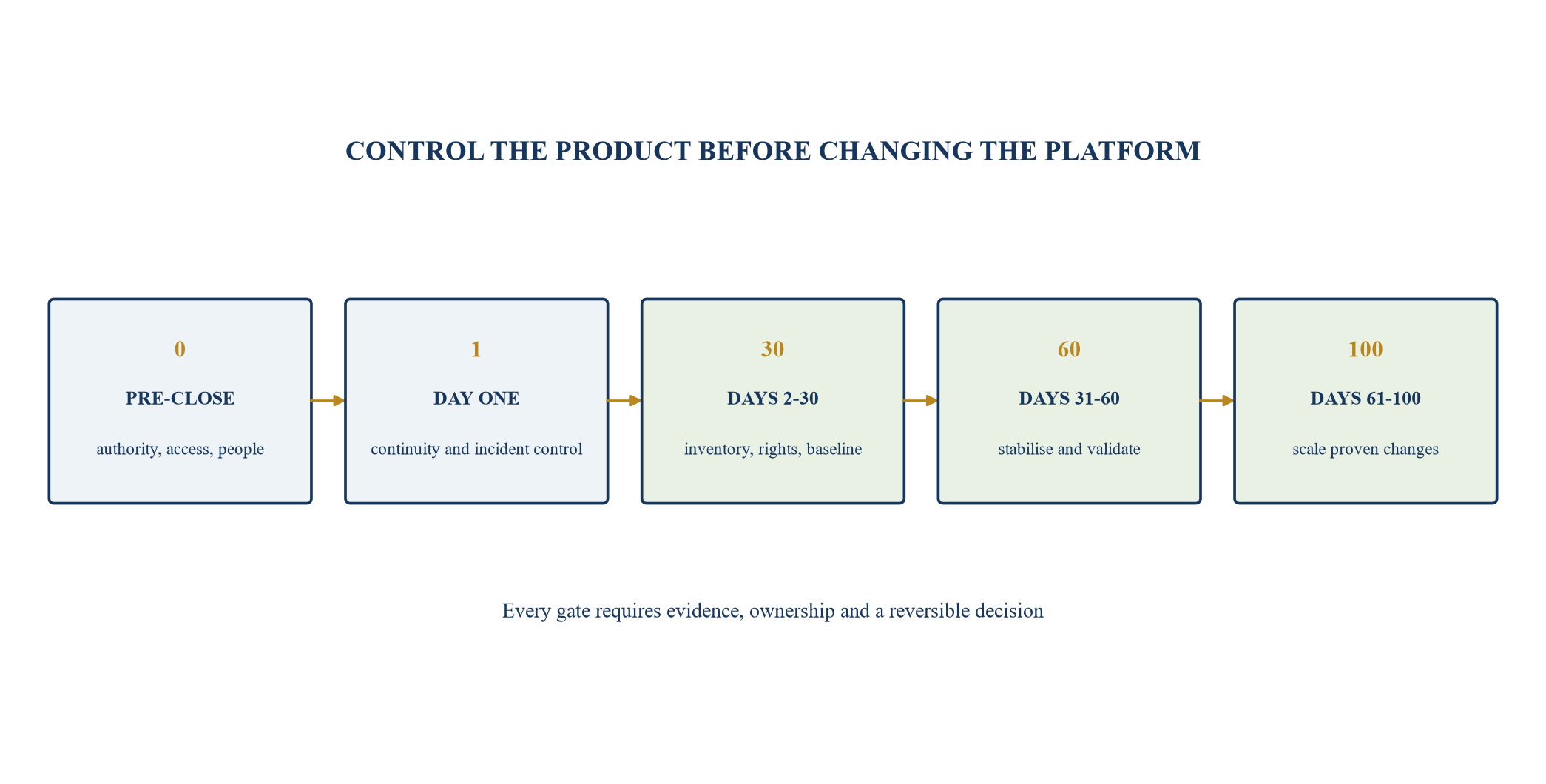
Continuity and control precede platform change and scaled value delivery.
Table 1. Integration gates and acceptance evidence
| Gate | Required evidence | Stop condition | Authority |
|---|---|---|---|
| close readiness | access, authority, continuity and critical-person coverage | missing production or incident control | transaction executive |
| controlled ownership | asset, rights, contract and dependency registers | material ownership or consent gap | integration chair |
| stabilisation | monitoring, security, rollback and service evidence | uncontrolled production change | product executive |
| value validation | customer, performance, cost and cash bridge | benefit unsupported by observed data | finance and business owner |
| scaled integration | tested target state, funded plan and accountable team | unacceptable resilience or customer risk | steering committee |
The accountable executive accepts the residual exposure at each gate.
4. Build a production-grade model inventory
The model inventory should identify every production, candidate, fallback and retired model. It records owner, purpose, provider, checkpoint or API identifier, deployment, data lineage, evaluation status, licence, cost, security classification, customer use and change history. Base models, fine-tunes, embeddings, classifiers, rerankers, safety models and rules should remain distinguishable.
The inventory needs to reflect the live call graph. A product can route cases across models based on language, customer, risk, cost or availability. Hidden fallbacks may be essential to resilience. Shadow models may consume material spend. The team should compare repository declarations, runtime telemetry, invoices and customer configurations to locate undocumented assets.
Each item needs an integration decision: retain, validate, migrate, replace, isolate or retire. The decision should state prerequisites, customer effect, data requirements, cost, owner and rollback. A model should not be replaced solely because the buyer has a preferred standard; replacement must improve an agreed outcome and preserve contractual and regulatory obligations.
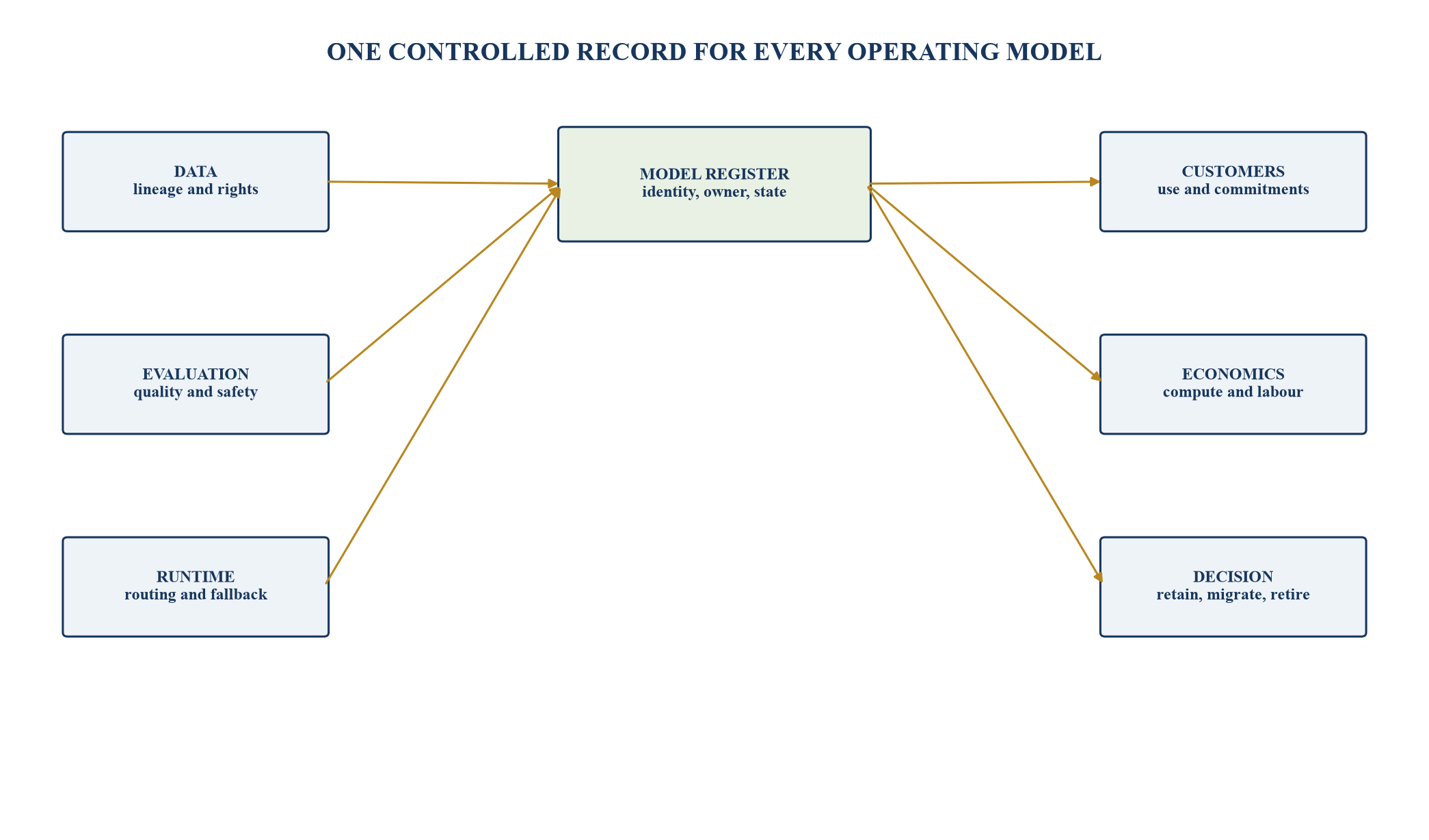
The inventory connects each model to its data, runtime, customers, rights and decision.
Table 2. Minimum model-inventory fields
| Field | Evidence | Integration question | Owner |
|---|---|---|---|
| identity | checkpoint, API, hash, version and environment | which exact system is operating? | model owner |
| purpose | task, users, risk and fallback role | what customer outcome depends on it? | product owner |
| data | training, tuning, retrieval and evaluation lineage | are rights and fitness supported? | data owner |
| assurance | quality, safety, security and monitoring | is operation within approved limits? | risk owner |
| economics | volume, latency, compute, tools and review | what is cost per successful outcome? | finance owner |
| decision | retain, validate, migrate, isolate or retire | what evidence allows the change? | integration owner |
Runtime evidence should reconcile to declared assets and invoices.
5. Reconcile legal ownership with operational control
The transaction documents may transfer shares or assets while operational control remains fragmented across founders, employees and suppliers. The integration team should map legal title, licence, account ownership, administrator rights, physical custody and practical ability to operate. These are separate states.
Source code may sit in a company repository while deployment keys belong to an individual. Model weights may be owned by the target while the training data licence restricts transfer or use after a change of control. A customer-specific fine-tune may be operationally important and contractually controlled by the customer. Each gap needs specialist review and an action.
The rights register should link evidence to the product dependency and transaction value. Missing evidence can affect closing conditions, holdbacks, remediation, replacement cost and integration sequencing. Qualified counsel should interpret ownership, licensing, privacy, employment and change-of-control provisions.
6. Map data rights before combining datasets
Data integration can create value through broader training, improved retrieval, cross-customer learning and common analytics. It can also breach purpose limits, confidentiality, localisation, retention, intellectual-property rights or customer commitments. The team should not combine datasets until the right to access, process, transfer and reuse is evidenced for the intended purpose.
The data-rights map links dataset, source, subject, controller or owner, purpose, jurisdiction, contract, consent, retention, security, model use and proposed integration action. It should distinguish training, fine-tuning, retrieval, evaluation, monitoring and support. Permission for service delivery may not include training a common buyer model.
Technical controls should enforce the decision. Separate storage, access policies, purpose tags, deletion workflows and lineage can prevent an approved restriction from becoming a spreadsheet note. Data stewards should test actual pipelines and logs. Counsel and privacy specialists should approve relevant transfers and changes.
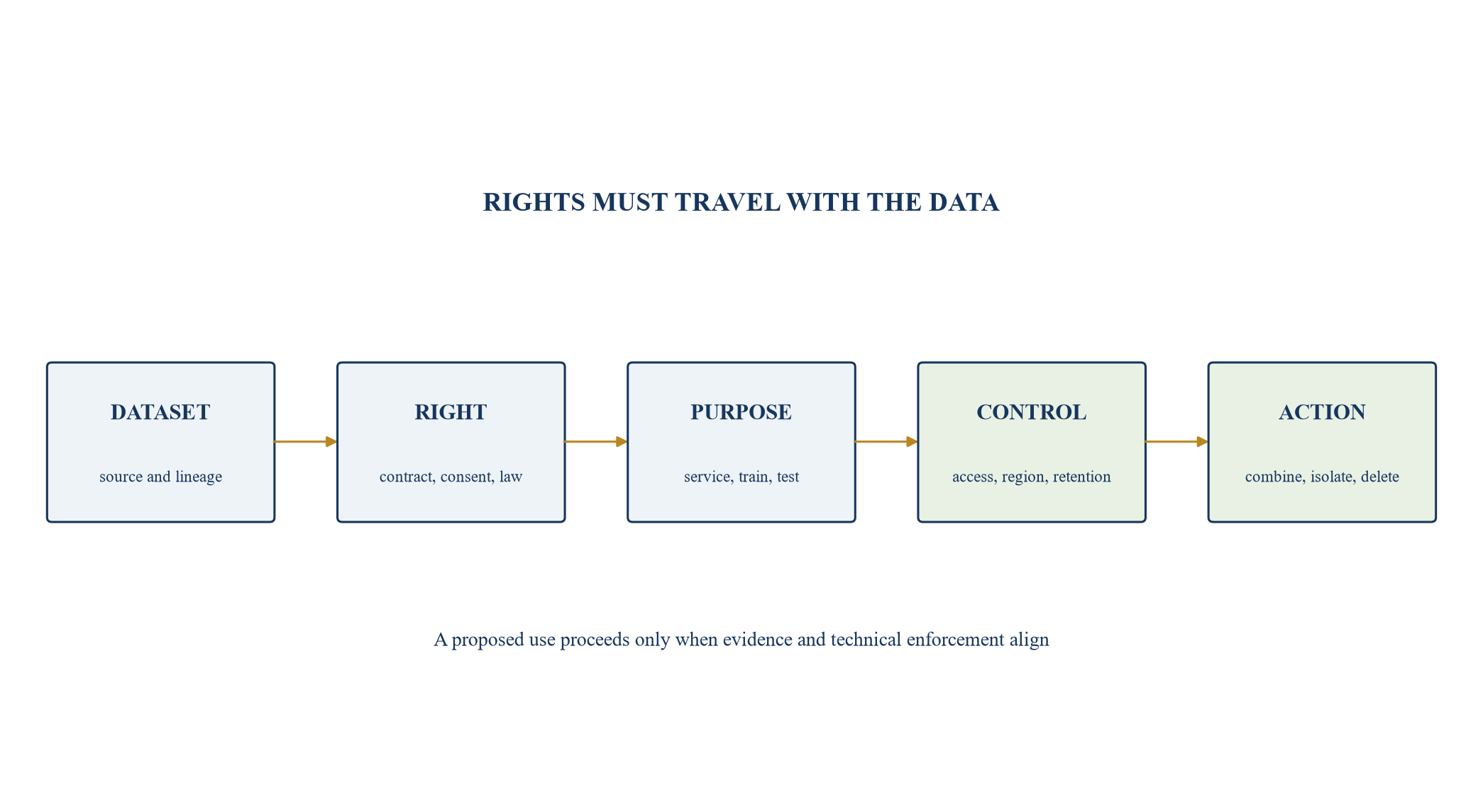
Every integration action links a dataset, permitted purpose and enforceable technical control.
Table 3. Data-integration decision record
| Question | Evidence | Control | Escalation trigger |
|---|---|---|---|
| who supplied or controls the data? | contract, notice, source and lineage | owner and source tag | disputed or missing provenance |
| which purpose is permitted? | contract, consent and applicable obligation | purpose-based access | proposed use exceeds evidence |
| where may data move? | localisation and transfer assessment | regional storage and routing | cross-border change |
| how long may it remain? | retention term and deletion duty | automated retention workflow | legal hold or conflicting term |
| may it train or evaluate models? | explicit right and documented basis | separate training and test stores | ambiguous secondary use |
| what happens at customer exit? | return, deletion and portability clause | verified deletion and export | shared-model dependency |
Legal interpretation and technical enforcement should remain linked.
7. Freeze high-risk change during the continuity window
The first integration period should define a risk-based change freeze. Production model swaps, data migrations, identity changes, network moves and observability replacements can create correlated failure. Critical security patches and customer commitments may still require change, so the freeze needs an exception route rather than a blanket prohibition.
The change record should identify the purpose, affected customers, dependencies, test evidence, rollback, monitoring, authority and communication. Buyer and target release processes may use different standards. The temporary process should choose the stronger applicable control and remain simple enough to operate under pressure.
The freeze ends by component when ownership, tests, monitoring and rollback are proven. A calendar-based release can expose the product to unresolved risks. Integration leaders should report the volume and reason for exceptions because repeated emergency changes may reveal operational weakness.
8. Reconstruct the model release and rollback process
The team should trace a model change from development through evaluation, approval, deployment, monitoring and rollback. It should identify who can promote versions, alter prompts, update retrieval, change routing and override safety controls. The release artefacts should include test results, risk acceptance, customer impact, version identity and rollback evidence.
Rollback can be complicated by data-schema changes, irreversible migrations, customer-specific state and third-party APIs. A nominal previous version may no longer be available. The team should rehearse rollback or an appropriate safe fallback in a controlled environment. Time to restore, data consistency and customer communication matter alongside technical success.
The target-state process should integrate with the buyer's governance while preserving AI-specific evidence. Generic software approval may not cover model drift, evaluation population, prompt changes and data rights. NIST AI RMF and the NCSC secure AI lifecycle guidance provide useful anchors for design, development, deployment, operation and monitoring.
9. Baseline product quality before integration changes
The buyer should preserve the pre-change evaluation suite and production measures. Quality may include task success, error by cohort, safety, latency, uptime, human review, support incidents and customer outcomes. The baseline should state population, period, metric, uncertainty and known gaps.
The evaluation suite should include public comparability, customer-like tests, regression tests, adversarial tests and service economics where material. Exposed public benchmarks cannot substitute for representative production evidence. The team should retain raw outputs and the exact system configuration.
Every material integration change should run against the baseline and any new target-state tests. Improvement in one metric should not hide deterioration in another. A cheaper model that increases escalations may reduce value. A stricter safety control can lower raw completion while improving customer trust and contractual compliance.
10. Stabilise observability and incident response
Observability should cover model identity, input and output controls, latency, errors, refusals, tool calls, retrieval, cost, drift, safety signals and customer impact subject to privacy and security. The team should identify blind spots before consolidating tools. Duplicate monitoring is preferable to a gap during transition.
Incident taxonomy should distinguish security, privacy, safety, availability, quality, data, cost and contractual events. Severity, authority, notification and evidence preservation should be agreed across buyer and target. Third-party model or cloud incidents need vendor escalation and fallback routes.
The first 30 days should include a tabletop exercise using a realistic scenario. Participants should locate the model version, affected customers, data path, owner, contractual duty and communication authority. Findings become funded actions. A successful tabletop indicates process readiness for that scenario; it does not prove all incidents are controlled.
11. Protect customer-specific configurations
AI products often contain customer prompts, fine-tunes, retrieval stores, policies, thresholds, tools and workflows. A common-platform migration can overwrite differences that carry contractual or operating value. The inventory should record configuration ownership, rights, performance, support and planned treatment.
Customer communication should follow the agreement and change significance. Some changes require consent, notice, validation or a new security review. The commercial owner and product owner should share accountability. Sales teams should not promise integration benefits before the operating team can deliver them.
The buyer should prioritise configurations supporting concentrated revenue, regulated use or high switching risk. A canary migration with reversible scope can create evidence before broader rollout. Customer retention and outcome measures belong in the integration value case.
12. Separate model migration from product migration
Replacing a base model can be less complex than moving the surrounding product, or more complex when behaviour changes. Model migration tests prompts, tools, retrieval, safety, latency, cost and customer outcomes. Product migration also changes identity, billing, support, data, workflow, interfaces and contracts.
The plan should decompose these moves and avoid simultaneous changes without need. A target product can continue on its current model while the buyer integrates commercial and support ownership. A model can move while the customer interface remains stable. Decomposition improves attribution and rollback.
The target architecture should state which capabilities become shared services and which remain product-specific. Centralisation can improve control and scale, while a shared dependency can create correlated failure. Resilience, latency, data location and team capacity should inform the design.
13. Inventory third-party model, cloud and tool dependencies
The acquired product may rely on external model APIs, cloud credits, data providers, labelling firms, vector databases, observability platforms, security services and open-source components. The dependency register should capture contract entity, consent, term, pricing, volume commitment, service level, data handling, change control, exit right and substitute.
Promotional credits or favourable founder relationships can distort the cost baseline. Change of control may reset pricing or require consent. A provider can deprecate a model or alter behaviour. The integration plan should test substitution, transition time, data portability and customer effect.
Open-source dependencies require version, licence, security and maintenance review. A permissive licence does not create operational support. Critical projects may depend on a small maintainer community. The buyer should decide where to accept, contribute, fork, replace or isolate.
14. Rebuild unit economics under buyer ownership
The acquisition case should be recalculated using observed production volume, model calls, tokens or compute, storage, tools, networking, monitoring, human review, support, customer success and allocated platform cost. Cost per successful customer outcome is more informative than cost per model call.
Integration can produce savings through routing, shared infrastructure, negotiated pricing and reduced duplication. It can also add enterprise security, compliance, support and transition cost. Both directions should be visible. The finance owner should reconcile run-rate, implementation cost, capital, working capital, tax and cash timing.
Benefits should enter value only when the operating mechanism, owner, investment and evidence are established. A vendor discount may depend on volume concentration and increase lock-in. A headcount saving may remove scarce model or customer knowledge. The unit-economics bridge should connect each action to service quality and resilience.
15. Identify critical people and tacit knowledge
The acquired capability can depend on a small group who understand model behaviour, data lineage, infrastructure, customer configurations and incident history. Organisation charts do not reveal this dependency. The team should map critical decisions, systems and customers to named roles, deputies, documentation and retention risk.
Interviews, access logs, code history, incident records and customer escalations can support the map. The purpose is continuity and capability planning, subject to employment law and appropriate governance. Personal data should be handled carefully, and the framework should avoid unsupported judgements about individuals.
Knowledge transfer needs acceptance evidence. A document repository is insufficient if no one can operate the system. Paired releases, incident simulations, architecture walkthroughs and customer handovers can test capability. Retention, succession, hiring and service support should be funded where gaps remain.
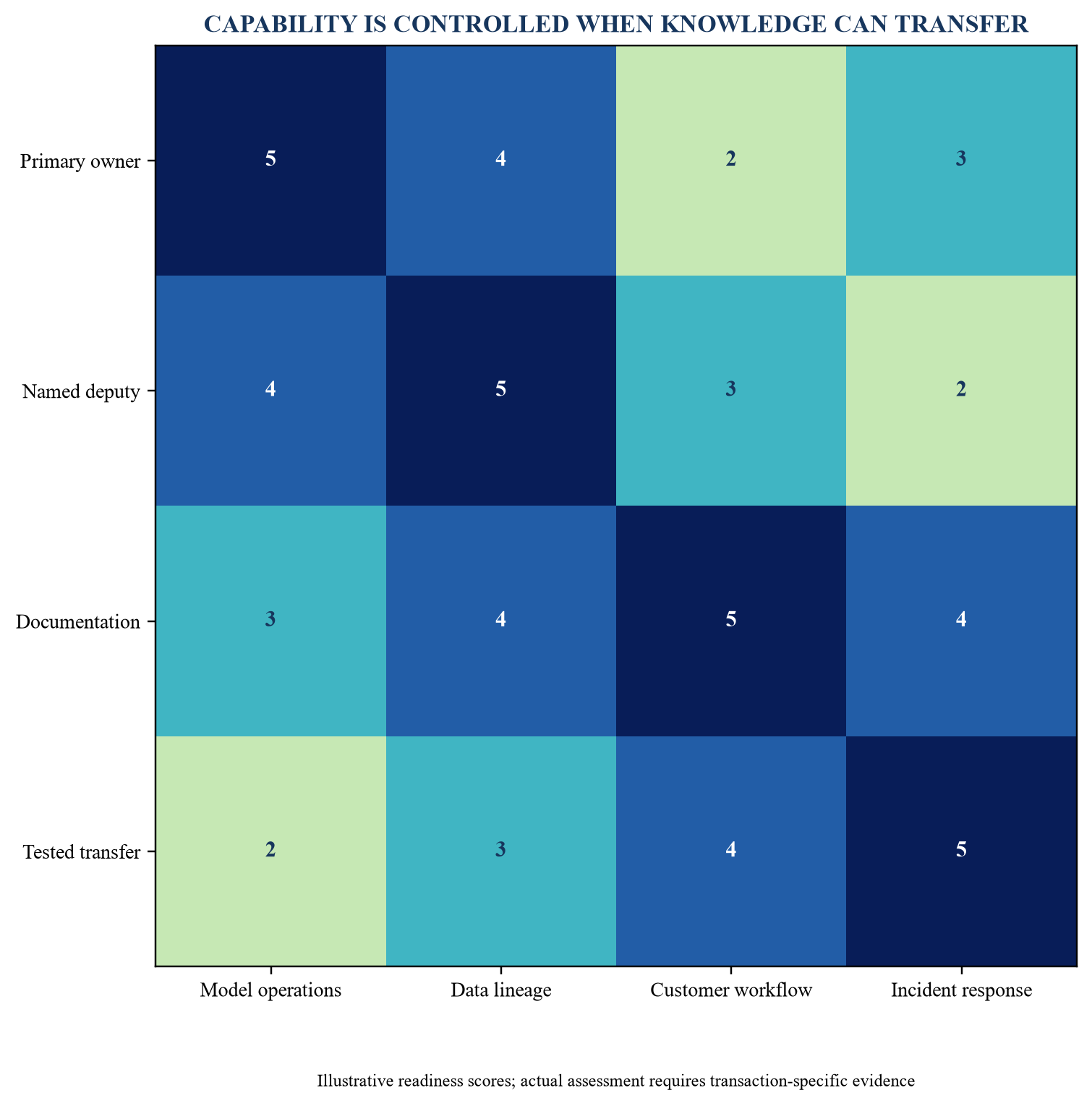
Critical capability combines ownership, backup, documentation and tested transfer.
Table 4. Critical-capability transfer record
| Capability | Primary evidence | Transfer test | Response to gap |
|---|---|---|---|
| model release | pipeline, approvals and run history | deputy executes controlled release | pair, document and rehearse |
| data lineage | catalogue, contracts and pipeline maps | trace sample from source to use | appoint steward and remediate |
| customer configuration | contract, settings and support record | hand over representative account | joint customer and product ownership |
| incident response | playbook, logs and contacts | tabletop material scenario | temporary dual command |
| cost control | telemetry, invoices and routing | reconcile outcome-level cost | finance and engineering workstream |
| regulatory evidence | documentation, owner and submissions | reproduce required record | specialist review and action plan |
Readiness depends on tested operation, not document volume.
16. Design retention around roles and outcomes
Retention should focus on capabilities required to operate, transfer and improve the product. Cash awards may help, while role clarity, authority, technical ambition, culture, location and career path can be equally important. The buyer should avoid commitments that conflict with target organisation design or unfairly exclude broader contributors.
The plan should identify the required role, period, deliverable, deputy and succession path. A founder may be essential for customer confidence during handover but not for long-term model operations. A senior engineer may hold tacit infrastructure knowledge that requires intensive transfer. Retention and transfer should be linked.
Employment, consultation and incentive design require qualified advice. Communications should be timely and accurate. Uncertainty about authority or future structure can accelerate departures and reduce service quality. Managers should track vacancies, regretted attrition, workload, engagement and transfer readiness without presenting unverified sentiment as fact.
17. Establish the target operating model for AI decisions
The target operating model assigns product, model, data, security, risk, commercial, finance and customer decisions. It should distinguish recommendation, approval, execution, monitoring and escalation. Shared committees without single-point accountability can slow releases and obscure responsibility.
Model changes may require several authorities depending on materiality. A low-risk prompt correction can follow delegated approval. A new model for a regulated use may require product, risk, security, legal and customer review. The policy should define thresholds and evidence rather than route every decision through the same forum.
The operating model also sets funding and prioritisation. Integration work competes with customer delivery and product development. The steering committee should protect essential remediation and continuity while preventing an expanding wish list from consuming the acquisition thesis.
18. Align product roadmaps without destroying the acquired advantage
The buyer and target may have overlapping features, platforms or customer segments. Roadmap integration should begin with customer outcomes, differentiation, technical dependencies and economics. A politically convenient platform winner can destroy product-market fit or delay committed delivery.
The team should preserve the target's release cadence during the continuity window and create a joint roadmap after evidence review. Each initiative should be classified as protect, complete, combine, defer or stop. Committed customer work, security remediation and regulatory deadlines require explicit treatment.
Architecture and commercial decisions should remain connected. A shared model service may lower cost but weaken a customer-specific advantage. A unified interface may simplify sales while increasing migration burden. The roadmap should show the value, affected customers, cost, risk and decision owner.
19. Govern security integration as a separate critical path
Security integration should assess identities, secrets, repositories, supply chain, cloud posture, model assets, data stores, agents, tools, logging and incident response. The NCSC secure AI guidance organises relevant practices across design, development, deployment and operation. The buyer should adapt controls to the product and threat model.
Rapid identity consolidation can break service accounts and deployment pipelines. Delayed integration can leave privileged access and weak controls. The plan should prioritise visibility, key rotation, administrator ownership, high-risk remediation and tested recovery before broad platform migration.
Material findings should link to customer obligations, insurance, disclosure, closing actions and investment. Detailed vulnerability information should remain restricted. Security status should use evidence and residual-risk acceptance rather than a simple colour label.
20. Map regulatory roles and documentation
The acquisition can change who is a provider, deployer, importer, distributor, controller, processor or sector-regulated operator. The team should map roles by product, use and jurisdiction. European Commission guidance describes documentation and information expectations across the general-purpose AI value chain, and downstream providers retain obligations for their systems.
The regulatory register should link role, system, intended use, documentation, evaluation, monitoring, incident, transparency, human-oversight and recordkeeping requirements. Enforcement dates and guidance can change. Qualified counsel should confirm applicability and transition actions.
Documentation transfer is operational. Model cards, technical files, training summaries, risk assessments and incident records need owners, versions and production links. A static diligence folder can become outdated quickly. The target operating model should maintain evidence through change.
21. Protect customer trust during ownership change
Customers may worry about data use, model changes, pricing, support, roadmap and the continued independence of the product. Communications should state verified changes, continuity controls and contact routes. Claims about improved capability should wait for evidence.
The team should segment customers by revenue, risk, configuration, renewal, contractual rights and strategic importance. Executive outreach can focus on material relationships while support and success teams receive consistent answers. Feedback and concerns should enter the issue register with owners and deadlines.
Retention should be measured against the standalone baseline and market conditions. A renewal achieved through a large concession differs from retained value at expected economics. The integration dashboard should connect customer outcome, price, support cost and cash.
22. Create a 100-day customer and contract workstream
The workstream inventories assignment and change-of-control terms, service levels, audit rights, security commitments, data restrictions, model-change provisions, pricing, renewal and termination. It identifies consents, notices and bespoke operating duties. Legal interpretation should link to technical implementation.
High-risk obligations should be tested. A contract may require regional processing while a proposed buyer model runs elsewhere. A service level may depend on target infrastructure scheduled for retirement. An audit right may require records the product does not currently preserve. Each gap needs a control and budget.
Commercial owners should know which integration actions can be offered as value and which create a negotiation. The team should avoid trading rights or price before understanding the operating and financial consequence.
23. Validate cross-sell before counting revenue synergy
Cross-sell depends on customer need, access, product fit, sales capability, proof, pricing, implementation and retention. The buyer should identify eligible cohorts and run controlled commercial tests. A shared logo list is not evidence of demand.
The integration plan should assign product readiness, sales enablement, solution engineering, security review, contracting, implementation and support. Capacity constraints can make early revenue expensive or destabilise current customers. Contribution margin and working capital belong in the case.
Revenue value should enter the dashboard through qualified pipeline, conversion, deployment, billed revenue, collection and retention. Management scenarios should remain labelled as assumptions until observed. Incentives should discourage premature selling of unready capabilities.
24. Validate cost synergies without removing critical capability
Duplicated model, cloud, tooling, support and corporate costs can create opportunity. The team should distinguish avoidable cost, stranded cost, implementation spend and capacity needed for growth. Removing a platform can require migration work and temporary dual running.
Headcount analysis should start with work and capability. A role can look duplicated while serving a different model, customer or regulatory duty. Critical people may support several systems. The capability map and service evidence should inform decisions.
Savings should be reconciled to contracts, payroll, invoices, telemetry and cash. A lower run-rate without stable service or retained revenue is not value creation. The steering committee should approve actions that change resilience, customer support or regulatory capacity.
25. Connect integration investment to the acquisition thesis
The buyer should maintain an integration investment register covering remediation, retention, data, infrastructure, migration, security, customer support, advisers and temporary dual running. Each item links to a value claim, control requirement or risk response. Unallocated contingency should have governance.
Timing matters. Cash may be required before synergy and while acquisition financing is most constrained. The model should test delay, vendor price changes, customer attrition and extended dual running. Capex, operating expense, tax and working capital require appropriate treatment.
The board should see gross opportunity, required investment, execution risk, realised cash and return. This prevents a technical milestone from being reported as value before its costs and customer effects are known.
26. Build an integration value dashboard
The dashboard should connect continuity, control, customer, product, people, economics and cash. Metrics need baselines, definitions, sources, owners, frequency and thresholds. A small set of decision-useful measures is preferable to an activity count.
Continuity can include availability, incidents and support backlog. Product can include quality, safety, latency and release health. People can include critical-role coverage and tested transfer. Customer can include retention, deployment and outcome. Economics can include cost per successful task, gross margin, integration spend and realised cash.
The dashboard should preserve leading and lagging indicators. Training completed is an activity; a deputy executing a controlled release is evidence. A vendor contract signed is an action; outcome-level cost reduction with stable quality is value evidence. Exceptions and residual risks should remain visible.
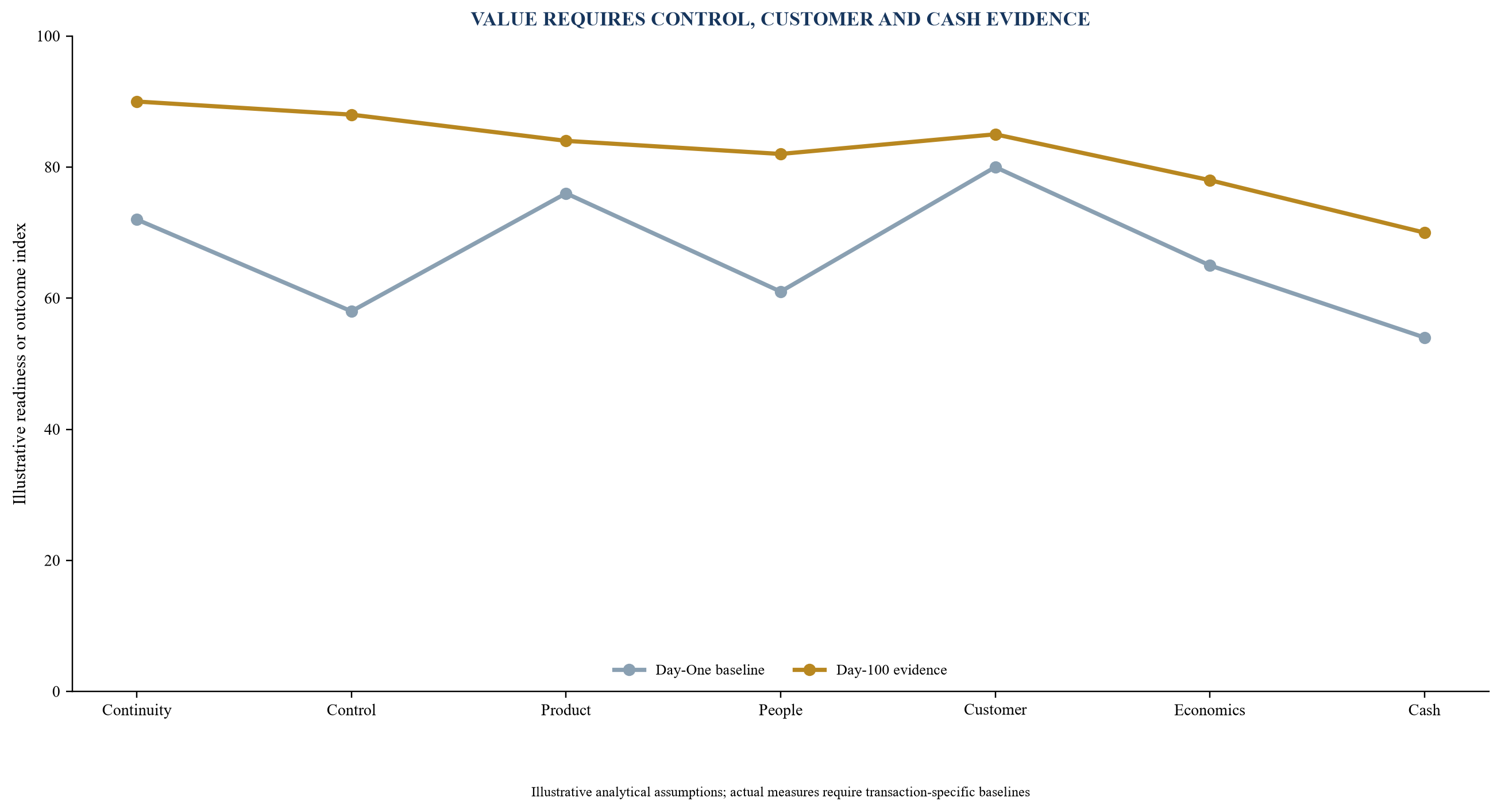
Technical and operating evidence flows into customer, margin and cash outcomes.
Table 5. Board-level integration value measures
| Dimension | Measure | Evidence source | Decision use |
|---|---|---|---|
| continuity | availability, incidents and support backlog | telemetry and service system | protect customer service |
| control | inventoried assets, rights and accepted exceptions | controlled registers | release or defer change |
| product | quality, safety, latency and release health | locked tests and production data | validate target state |
| people | critical-role coverage and tested transfer | capability records and simulations | retain, hire or support |
| customer | retention, deployment and paid outcome | contracts, usage, invoices and collection | validate revenue value |
| economics | successful-task cost, margin and integration spend | telemetry and finance records | fund and prioritise |
| cash | realised benefit net of investment | ledger and cash-flow bridge | assess acquisition return |
Each measure links to a source, owner and decision threshold.
27. Worked example: a hypothetical AI service acquisition
Assume a hypothetical buyer acquires an AI workflow company with illustrative annual revenue of USD 40 million and reported gross margin of 74 per cent. The product uses two external models, proprietary retrieval, customer-specific prompts and expert review. These figures are analytical assumptions and do not describe a company or transaction.
The Day-One inventory identifies one critical deployment account controlled by an individual, several customer datasets without clearly recorded secondary-use rights, and a fallback model absent from the diligence architecture. The buyer stabilises access, isolates restricted data, preserves dual monitoring and funds retention and transfer. It defers a common-model migration until customer-like tests and rollback pass.
By an illustrative Day 100, observed routing and contract renegotiation reduce cost per successful task by 9 per cent while quality remains within the approved range. A proposed additional saving is deferred because it would remove expert review for a high-risk cohort. Cross-sell remains optional until paid pilots provide evidence. The value case therefore recognises verified cost and retention effects, preserves integration investment and excludes unsupported revenue.
28. Preserve financing and liquidity through integration
Acquisition financing should reflect the cash needed for retention, remediation, migration, dual running and customer support. Savings may arrive later than the transaction model assumed. The finance case should test incidents, customer churn, vendor repricing, delayed consents and extended integration.
Lenders may receive reporting on material customers, performance, security events and integration spend. Definitions should reconcile to the controlled dashboard. Technical progress should not be presented as earnings or cash before accounting and facility treatment is established.
Minimum liquidity and operating resilience should guide sequencing. A platform migration that promises long-term savings can create near-term cash and service risk. The steering committee should see the funding envelope and downside before approving it.
29. Plan Day 101 before the 100-day window closes
The 100-day horizon establishes control and validates the target state. It rarely completes every data, platform, contract, organisation and regulatory change. Work should transfer to permanent owners with accepted scope, budget, milestones, risks and decision rights.
The integration office should distinguish completed outcomes, temporary controls, ongoing programmes and benefits awaiting evidence. It should retire temporary forums when the operating model can manage the work. Unresolved high-risk issues should remain visible to the board.
A post-integration review can compare the signed thesis, Day-One baseline, actions, investment, customer outcomes and realised cash. The purpose is accountability and learning. It should preserve original measures while allowing management to update forecasts.
30. Operate a repeatable AI acquisition-integration protocol
The protocol begins in diligence with a product-system map, critical-asset register, rights assessment, people dependency map and value baseline. Pre-close planning converts those records into Day-One controls. The first 30 days establish ownership and truth. Days 31 to 60 stabilise and test. Days 61 to 100 scale only the changes supported by evidence.
The process should measure missing artefacts, access exceptions, rights gaps, release failures, incident readiness, critical-role coverage, customer retention, cost per successful task, integration spend and realised cash. These measures indicate control and outcome. They do not prove causation without further analysis.
Adoption can start with the product capabilities that drive most value and risk. The buyer does not need to redesign the whole enterprise before improving control. It needs clear authority, traceable assets, enforceable data decisions, safe releases, capable people and a cash bridge. This sequence protects the acquired product while creating an evidence-based route to integration value.
31. Govern model and product branding during integration
The acquired product may carry a trusted name, published model claims and customer expectations that differ from the buyer's brand. A rapid rename can create confusion across documentation, interfaces, contracts, support, model registries and regulatory records. Continued standalone branding can preserve equity while leaving accountability unclear. The integration plan should assign an owner and evidence-led decision.
Brand treatment should connect to product strategy, customer research, legal rights, market position and operating architecture. Co-branding, endorsement, migration or retention each creates work. Model names and versions used in customer documentation should remain traceable even when marketing changes. A new label should not imply a new capability or broader validation than the evidence supports.
Communications should state what changes in ownership, service, data use, support and roadmap. Customer-facing claims need approval and alignment with tested performance. The team should inventory websites, contracts, portals, status pages, model cards, developer documentation and sales materials so that inconsistent representations can be corrected.
The value case should recognise transition cost and customer response. Brand consolidation can reduce marketing duplication, while a poorly sequenced change can weaken trust and renewal. Evidence from customers and paid adoption should guide the permanent decision.
32. Integrate sales incentives with delivery readiness
The buyer's sales force may gain access to a new AI product before implementation, security, contracting and support capacity are ready. Incentives can accelerate bookings and create delivery failures, concessions or churn. The 100-day plan should align commercial authority with product readiness gates and available operating capacity.
Sales enablement should cover the validated use cases, evidence, limitations, pricing, data requirements, security position, implementation path and support model. Teams should know which claims require specialist approval and which customer requests fall outside the tested product. A controlled opportunity review can protect material deals without creating a permanent bottleneck.
Compensation design should distinguish signed value from deployable, retained and collected value where appropriate. Commercial leaders should avoid incentives that reward unsupported custom commitments. Finance and product teams should provide capacity and margin thresholds for offers that change inference, human review or implementation work.
The dashboard can follow qualified pipeline, security review, contract, deployment, paid use, support burden, renewal and collection. This funnel makes commercial progress visible and prevents early bookings from being treated as realised integration value. Management estimates remain assumptions until supported by observed customer and cash evidence.
33. Manage technical debt and undocumented exceptions
The acquired product may contain temporary fixes, customer-specific branches, manual scripts, legacy models and infrastructure nearing end of support. Technical debt becomes transaction risk when it affects continuity, security, cost, release speed or the ability to transfer knowledge. The integration team should create a debt register linked to operating consequence.
Entries should identify the component, cause, affected customers, failure mode, security or regulatory relevance, owner, remediation, cost and dependency. Code-quality scores alone provide limited decision value. An old component can remain stable and well controlled, while a recent workaround can create severe exposure. Runtime evidence and incident history should inform priority.
The buyer should distinguish debt that must be remediated before platform change, debt that can be retired through migration and debt deliberately accepted. Remediation should not compete invisibly with customer features. The steering committee should fund material control work and record residual-risk acceptance.
Undocumented exceptions deserve attention because they often contain the practical knowledge that keeps a system operating. Inventorying and testing them can prevent a standardisation programme from removing an essential customer or resilience control. The target architecture should absorb, replace or explicitly retain each material exception.
34. Reconcile software, model and data-development lifecycles
Software, model and data changes can follow different cadences and evidence. A code release may preserve model identity while altering prompts, retrieval or preprocessing enough to change behaviour. A data refresh can change outputs without a model deployment. The target lifecycle should connect these changes through a single customer-impact and approval view.
The change record should identify affected components, evaluation populations, rights, security, cost and rollback. Model evaluation alone may miss a faulty interface or tool. Software tests may pass while data drift reduces performance. Data-quality checks may not detect a new model's unexpected behaviour. Integrated acceptance should cover the end-to-end system.
Versioning should allow the team to reconstruct which code, model, data, prompt and configuration served a customer at a given time. This supports incident analysis, contractual evidence and regulatory records. Where complete determinism is unavailable, the organisation should preserve the best available configuration and runtime evidence.
The buyer can consolidate tooling after requirements are understood. Forcing every team into one pipeline during the continuity window can remove mature controls. A staged convergence plan should define equivalent evidence and a migration test before retiring the target process.
35. Test operational resilience across shared dependencies
Integration can convert separate systems into shared model, data, identity, network or cloud dependencies. Shared services can reduce cost and improve control; they can also create correlated failure. The target architecture should map failure domains, capacity, fallback, recovery and customer concentration before consolidation.
Resilience tests can include provider outage, credential compromise, model withdrawal, region loss, retrieval failure, data corruption, traffic surge and loss of a critical operator. The scenario should reflect the architecture and customer commitments. The team should capture detection, decision, fallback, recovery time, data integrity and communication.
Fallback quality matters. A backup model can be available and produce outcomes outside the approved range. Manual operation may be safe but lack capacity. Multi-provider routing can improve resilience and create data, security and consistency challenges. The business owner should accept the service level and customer consequence of each fallback.
The investment case should price resilience explicitly. Duplicate capacity and testing cost can protect retained revenue and contractual performance. Removing redundancy should require evidence that the remaining system meets the approved risk and recovery objective.
36. Control international data and model operations
The acquired product may serve customers across jurisdictions with different data, sector, content, consumer and AI requirements. Integration can change where data is stored, which model provider processes it, who accesses it and which entity contracts with the customer. The geographic operating map should link these facts.
Regional configurations can include data stores, keys, model endpoints, moderation policies, support teams and incident routes. A global platform change may create an unapproved transfer or remove a local control. The team should identify geographic restrictions before consolidating infrastructure or support.
Model performance can also vary by language, culture and use. The evaluation suite should include material regional cohorts and customer workflows. A model selected on an English benchmark may not support the acquired product's wider customer base. Translation layers and local human review should enter quality and cost.
Qualified advisers should assess applicable obligations and transaction structure. Technical teams should enforce approved decisions through routing, access, storage, logging and retention. The dashboard should report unresolved geographic gaps, affected revenue and remediation rather than imply uniform readiness.
37. Set the integration office's exit criteria
An integration office should close when permanent governance can operate the acquired product and remaining programmes have accepted owners. Calendar completion or a presentation of completed activities is insufficient. Exit criteria should cover authority, assets, rights, releases, incidents, customers, people, economics and reporting.
Temporary controls should be retired or transferred. Dual monitoring, special access, manual reconciliations and joint approvals can protect transition while creating cost and ambiguity if retained indefinitely. Each temporary control needs a target state, owner and closure evidence. Exceptions accepted beyond Day 100 should enter the permanent risk and investment process.
The handover pack should include controlled registers, architecture, contracts, customer obligations, evaluation baselines, operating procedures, incident records, value measures, budgets and decision history. Permanent leaders should sign acceptance and identify any resources still required.
The board should receive a final bridge from acquisition thesis through investment and observed outcomes. Unsupported benefits remain forecasts. Realised value should reconcile to customer, finance and cash evidence. A later review can test sustainability without keeping the integration office open as a substitute for operating ownership.
38. Build institutional learning across AI transactions
A buyer completing several AI acquisitions can improve future diligence, integration sequencing, cost estimates and retention decisions. It should retain appropriately governed and anonymised information on missing artefacts, rights gaps, model migrations, incidents, critical dependencies, customer response, integration spend and realised value.
Cross-transaction analysis can identify recurring failure points and evidence standards. It may show that data-consent remediation delays particular use cases, that common-platform migrations require longer dual running or that certain capability-transfer tests predict continuity. These patterns support challenge and planning. They do not replace current transaction evidence.
The organisation should maintain reusable registers, gate definitions, test protocols, scenario libraries and board templates. Tools can automate inventories and comparisons once taxonomies and ownership are stable. Machine-generated conclusions should retain sources and review.
Learning should include decisions to preserve an acquired system rather than integrate it. Successful integration is the controlled realisation of the acquisition thesis, which may involve selective independence. The institutional advantage comes from connecting technical change, customer outcome, capital and accountability through evidence across the full transaction lifecycle.
39. Decide what should remain independent
Integration does not require every product, model, team and process to converge. The acquired business may derive value from a distinct brand, release cadence, data boundary, customer community or specialist culture. The buyer should identify where independence protects differentiation and where shared controls create measurable advantage.
The decision can compare customer impact, security, resilience, cost, talent, regulation, speed and strategic option value. Shared identity, finance and incident governance may be appropriate while model development and product roadmap remain separate. A common model platform may suit general workflows while specialist or regulated uses retain dedicated systems. The architecture and operating model should express these boundaries clearly.
Independence still requires accountability. The buyer needs visibility of material assets, risks, spend, customer obligations and results. Delegated authority should define which decisions remain with the acquired team and which require group approval. Separate operation should not become an excuse for missing evidence or unmanaged exposure.
The steering committee should review the boundary after observing customer, product and economic outcomes. Convergence can proceed where evidence supports it. Continued independence can be an intentional target state when it creates greater risk-adjusted value. The decision record should connect the chosen boundary to the acquisition thesis and the measures that could trigger reassessment.
This review should also test whether governance overhead, duplicated investment or fragmented customer ownership has changed enough to justify a different operating boundary and a new funded transition plan.
Conclusion
Acquiring an AI product creates an integration challenge across models, data, software, infrastructure, people, customers, contracts and obligations. The first objective is controlled continuity. Technical and organisational change should proceed through evidence-based gates with accountable authority and rollback.
A production-grade model inventory, data-rights map, capability matrix and value dashboard allow the buyer to see what it owns, what it may use, who can operate it and how change affects customers and cash. They also expose gaps hidden by a simplified architecture or organisation chart.
The 100-day plan should validate model operations, monitoring, security, customer commitments, unit economics, critical people and the target operating model. Benefits enter the acquisition case when their mechanisms, investment and evidence are established. Unresolved upside remains visible without being treated as realised value.
This controlled path protects service, preserves the acquired advantage and gives the board a reconstructable bridge from transaction thesis to operating ownership and cash.
References
- National Institute of Standards and Technology. AI Risk Management Framework. https://www.nist.gov/itl/ai-risk-management-framework
- National Institute of Standards and Technology. Artificial Intelligence Risk Management Framework 1.0, NIST AI 100-1. https://nvlpubs.nist.gov/nistpubs/ai/nist.ai.100-1.pdf
- National Institute of Standards and Technology. Generative Artificial Intelligence Profile, NIST AI 600-1. https://nvlpubs.nist.gov/nistpubs/ai/NIST.AI.600-1.pdf
- National Institute of Standards and Technology. AI RMF Playbook. https://www.nist.gov/itl/ai-risk-management-framework/nist-ai-rmf-playbook
- National Institute of Standards and Technology. Secure Software Development Framework. https://csrc.nist.gov/Projects/ssdf
- UK National Cyber Security Centre. Guidelines for secure AI system development. https://www.ncsc.gov.uk/collection/guidelines-secure-ai-system-development/guidelines
- UK National Cyber Security Centre. Secure development and deployment guidance. https://www.ncsc.gov.uk/collection/developers-collection
- UK Government. Introduction to AI assurance. https://www.gov.uk/government/publications/introduction-to-ai-assurance/introduction-to-ai-assurance
- UK Government. Portfolio of AI assurance techniques. https://www.gov.uk/guidance/portfolio-of-ai-assurance-techniques
- European Commission. General-purpose AI obligations under the AI Act. https://digital-strategy.ec.europa.eu/en/factpages/general-purpose-ai-obligations-under-ai-act
- European Commission. Guidelines on obligations for General-Purpose AI providers. https://digital-strategy.ec.europa.eu/en/faqs/guidelines-obligations-general-purpose-ai-providers
- European Commission. Guidelines for providers of general-purpose AI models. https://digital-strategy.ec.europa.eu/en/policies/guidelines-gpai-providers
- European Commission. The enforcement framework of the AI Act. https://digital-strategy.ec.europa.eu/en/policies/enforcement-ai-act
- European Commission. General-Purpose AI Code of Practice. https://digital-strategy.ec.europa.eu/en/policies/contents-code-gpai
- European Union. Regulation (EU) 2024/1689 laying down harmonised rules on artificial intelligence. https://eur-lex.europa.eu/eli/reg/2024/1689/oj
- Central Bank of the UAE. Guidance Note on Consumer Protection and Responsible Adoption and Use of Artificial Intelligence. https://rulebook.centralbank.ae/en/rulebook/guidance-note-consumer-protection-and-responsible-adoption-and-use-artificial-intelligence
- Organisation for Economic Co-operation and Development. OECD AI Principles. https://oecd.ai/en/ai-principles
- International Organization for Standardization. ISO/IEC 42001 Artificial intelligence management system. https://www.iso.org/standard/81230.html
- International Organization for Standardization. ISO/IEC 23894 Guidance on risk management for artificial intelligence. https://www.iso.org/standard/77304.html
- International Organization for Standardization. ISO/IEC 27001 Information security management systems. https://www.iso.org/standard/27001
- Competition and Markets Authority. Merger assessment guidelines. https://www.gov.uk/government/publications/merger-assessment-guidelines
- US Department of Justice and Federal Trade Commission. 2023 Merger Guidelines. https://www.justice.gov/atr/2023-merger-guidelines
- IFRS Foundation. IFRS 3 Business Combinations. https://www.ifrs.org/issued-standards/list-of-standards/ifrs-3-business-combinations/
- IFRS Foundation. IAS 36 Impairment of Assets. https://www.ifrs.org/issued-standards/list-of-standards/ias-36-impairment-of-assets/
- UK Information Commissioner's Office. AI and data protection guidance. https://ico.org.uk/for-organisations/uk-gdpr-guidance-and-resources/artificial-intelligence/
