

1. Begin with sustainable cash flow rather than the debt headline
The financing decision begins when the acquisition thesis becomes credible. Waiting until the purchase price is largely settled allows a lender quotation to become the de facto debt-capacity analysis. That reverses the proper sequence. The board should first determine which cash flows are sustainable, which obligations are unavoidable, which risks intensify after completion and which sources of liquidity remain available if the integration plan slips.
Acquisition debt is repaid by future cash, not by entry EBITDA. Reported EBITDA can include revenue that converts slowly, costs that recur outside the income statement, leases, capital expenditure, tax, minority leakage and working-capital demands. It can exclude the cost of separating a carve-out, integrating systems, retaining management or restoring underinvestment. A debt-capacity model should therefore bridge audited earnings to cash available for debt service and show each adjustment with an owner, source and review date.
The board needs three independent views. The operating view asks whether the combined business can deliver the cash plan. The financing view asks whether debt service, maturity and covenants remain workable across scenarios. The legal and tax view asks whether guarantees, security, upstream cash and interest deductions operate as assumed. One integrated memorandum should reconcile the views before a binding financing commitment or acquisition agreement is approved.
A prudent model protects optionality. Headroom is needed for forecast error, seasonal cash, integration, maintenance, growth and unexpected events. A structure that uses every available unit of debt on day one may force a waiver, equity injection or distressed refinance when a manageable operating variance occurs. The target is a resilient capital structure that supports the acquisition thesis and preserves credible action under downside.
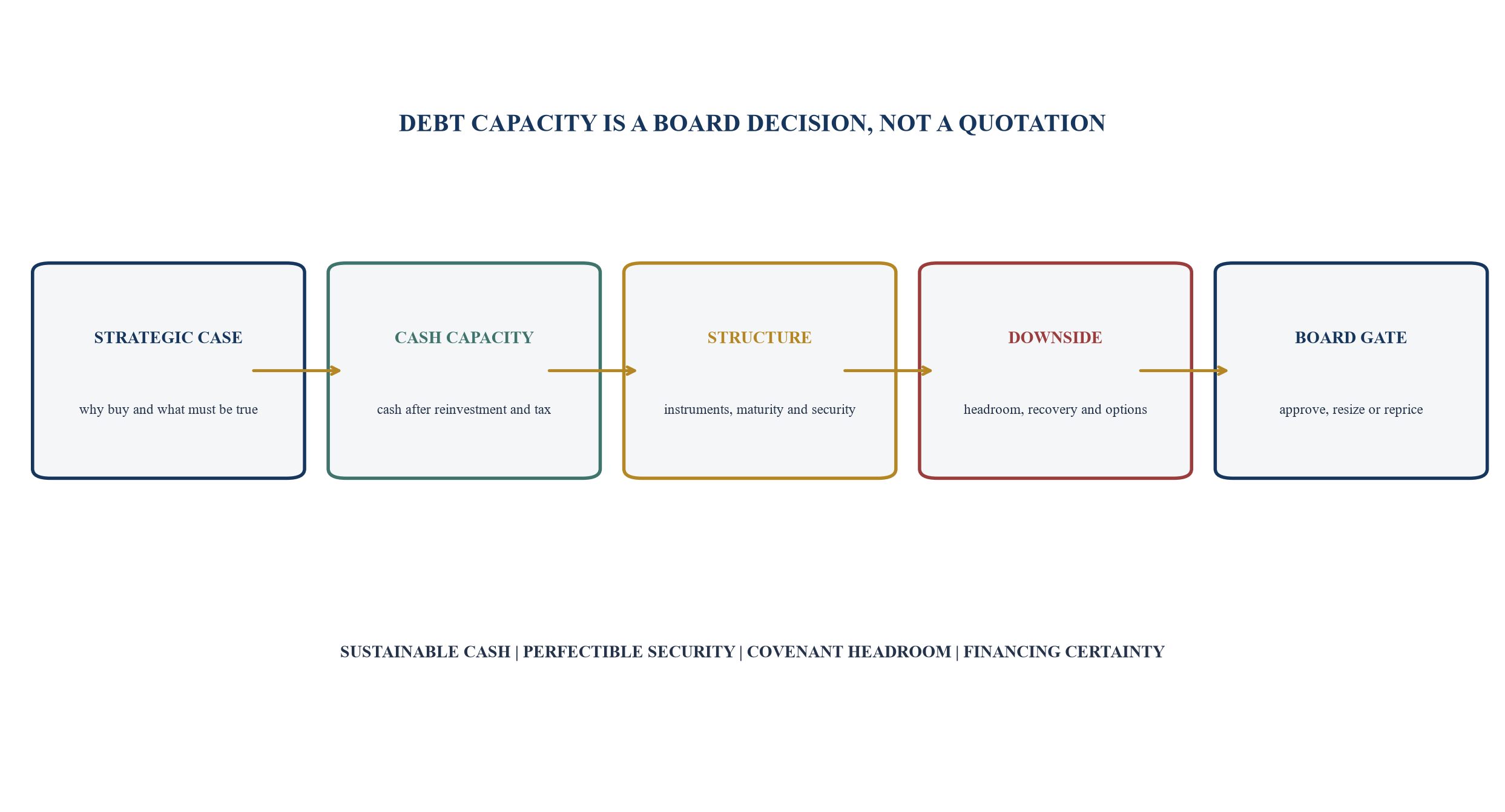
The sequence is a management framework. Transaction counsel, tax advisers, lenders and boards determine the final requirements and approvals.
2. Define the transaction and obligor perimeter
The structure chart should show the buyer, acquisition vehicle, target, operating subsidiaries, material asset owners, holding companies, minority interests and regulated entities. It should also show where cash is generated, where debt is booked, which entities can guarantee, which assets can be secured and which distributions or transfers require consent. A legal group chart without the cash paths is incomplete for financing purposes.
The acquisition vehicle may initially borrow the purchase price while the operating group generates repayment capacity. Moving cash from operations to debt service can depend on distributions, intercompany loans, management fees, tax, corporate-benefit analysis, minority rights, financial-assistance restrictions, lender consents and regulatory capital. Each step should be verified in the relevant jurisdiction. A consolidated leverage ratio does not prove that cash can reach the borrower when required.
The perimeter should include existing debt. Change-of-control clauses, negative pledges, permitted-security baskets, debt-incurrence tests, restricted-payment covenants and mandatory prepayment provisions can constrain the new structure. The team should collect executed facilities, guarantees, security, hedges, intercreditor arrangements, leases and material supplier finance. The sources-and-uses model should include repayment, breakage, consent fees, release costs and trapped cash.
Authority should be explicit. Management owns the operating forecast. The chief financial officer owns sources, uses, liquidity and covenant calculations. Transaction counsel owns legal structure and document conclusions. Tax advisers test deductions and cash movement. Lenders make independent credit decisions. The board approves risk appetite, financing limits and exceptions. The decision record should preserve those roles.
Table 1. Acquisition-finance decision rights and minimum evidence
| Decision | Management and adviser work | Board or committee decision | Minimum evidence |
|---|---|---|---|
| purchase-price and funding envelope | operating case, valuation, sources and uses | approve maximum consideration and equity commitment | reconciled price bridge, fees, refinancing, taxes and liquidity reserve |
| debt capacity | sustainable cash, stress cases and debt service | approve leverage and minimum headroom | audited baseline, quality of earnings, cash bridge and downside model |
| instrument mix | lender soundings and term comparison | approve structure, maturity and pricing range | senior, revolving, bridge, mezzanine, seller and equity comparison |
| security and guarantees | legal diligence, benefit and perfection map | approve permitted group support | entity, asset, ranking, consent, perfection and enforcement analysis |
| covenants | definitions, forecast and cure analysis | approve minimum operating flexibility | covenant model, baskets, cure rights, reporting and stress headroom |
| signing and funding | conditions, commitments and funds flow | authorise documents and draw | commitment status, CP register, funds-flow memorandum and closing certificate |
Actual authority follows constitutional documents, delegations, financing terms and applicable law.
3. Build a controlled sources-and-uses statement
Sources and uses should be the single numerical spine of the transaction. Uses include equity purchase price, debt refinancing, shareholder loans, transaction fees, financing fees, hedging, taxes, retention or incentive payments, separation and integration funding, minimum cash and contingency. Sources include buyer cash, sponsor equity, acquisition debt, revolving availability, vendor financing, rollover equity and permitted target cash. Every item should connect to a document, model or stated management assumption.
The statement should distinguish funding at signing, completion and after completion. A committed term facility may fund the price, while a revolving line protects seasonal working capital. A bridge may cover a divestment, bond issue or equity raise whose timing remains uncertain. Seller notes and earnouts can defer consideration, yet they add claims, subordination questions and future liquidity requirements. Rollover equity reduces day-one cash but can affect governance and exit economics.
Minimum cash belongs in uses. An acquisition should not consume cash required for payroll, suppliers, taxes, regulatory capital, customer performance or immediate integration. The appropriate reserve depends on volatility, seasonality, access to undrawn facilities and the reliability of the short-term forecast. The board should view unrestricted cash, trapped cash and available committed liquidity separately.
Sources and uses should balance under each material scenario. Purchase-price adjustment, leakage, debt payoff variance, fee changes and foreign-exchange movement can create last-minute funding gaps. The funds-flow memorandum should trace each payment, account, currency, authority and evidence. A small unexplained gap at completion can delay a transaction whose strategic and financing work is otherwise complete.
4. Normalise earnings before sizing debt
Quality of earnings establishes the operating base from which debt capacity is measured. The analysis should reconcile audited accounts, management reporting, tax filings, bank statements and the transaction model. It should test revenue recognition, customer concentration, gross margin, recurring costs, owner-related items, related-party transactions, provisions, capitalised expenditure, leases and one-off events. Adjustments require evidence and a clear reason.
Pro forma adjustments deserve particular control. Contracted revenue may support the forward case when delivery capacity, margin and customer obligations are understood. Pipeline without commitment should remain outside the base. Cost savings should enter debt capacity only when the action, timing, implementation cost and operational consequence are credible. Revenue synergies are usually more uncertain and should be treated cautiously in the financing case.
The board should see reported EBITDA, diligence adjustments, lender-accepted EBITDA and cash EBITDA as separate lines. A lender may exclude adjustments that management considers probable. The company may also need to operate under a covenant definition that differs from both accounting and valuation measures. The model should store each definition once and reconcile every output to that controlled dictionary.
Earnings resilience matters as much as the base. The analysis should decompose price, volume, customer, supplier, labour, energy, foreign exchange and regulatory exposures. It should identify which costs are fixed, semi-variable or discretionary and how quickly management can respond. Debt capacity should be anchored to the cash profile that survives a plausible downside, not the most persuasive transaction narrative.
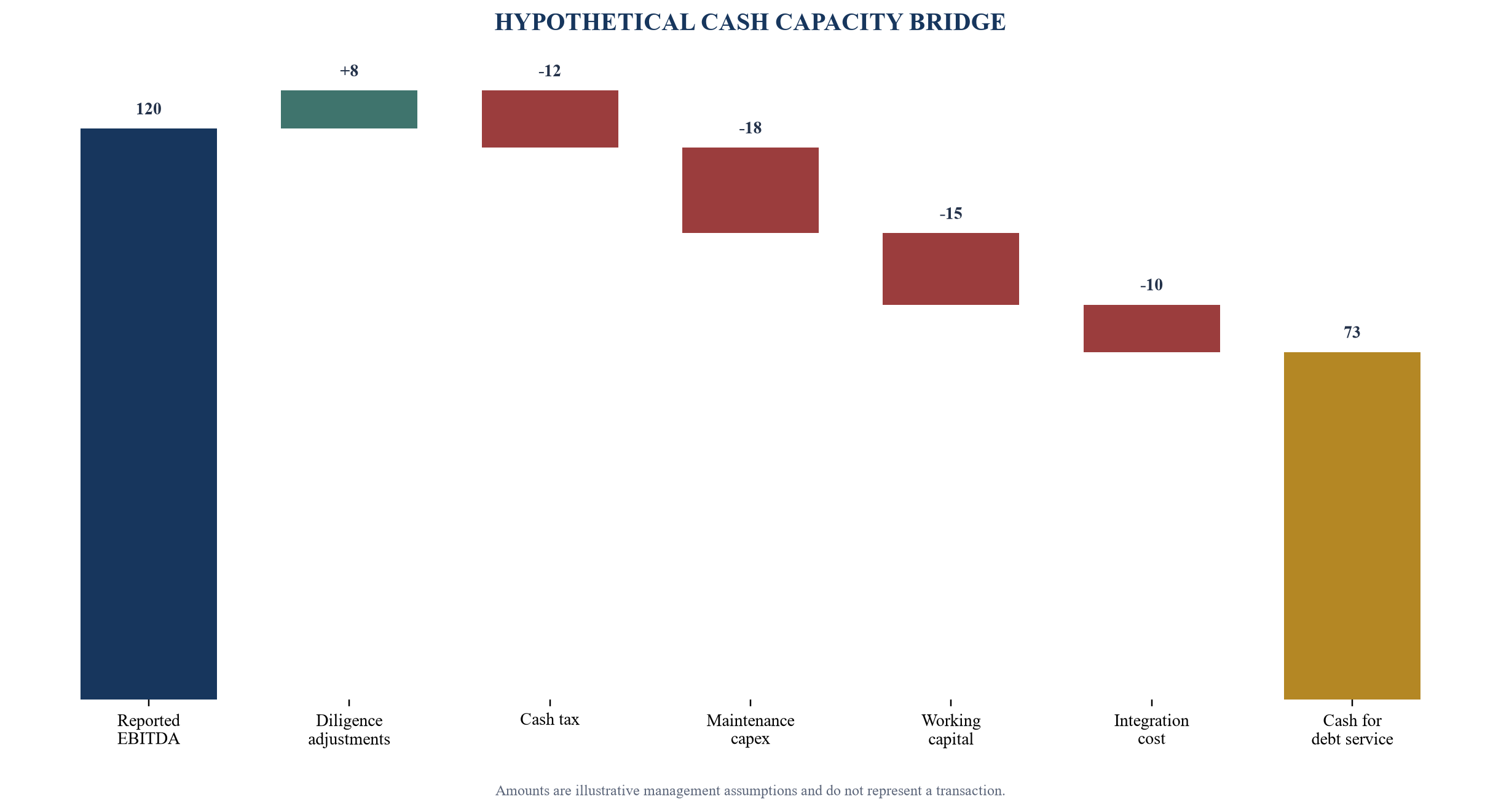
Values are hypothetical and shown only to demonstrate the method.
5. Convert earnings into sustainable free cash flow
Cash available for debt service should begin with the controlled operating forecast and deduct cash tax, maintenance capital expenditure, lease payments where relevant, working-capital investment, restructuring, integration and other unavoidable cash uses. Growth expenditure can be shown separately, but the board should understand which growth is required to protect the base. Deferred maintenance cannot be treated as optional indefinitely.
Working capital is often the largest difference between earnings and debt service. The model should examine receivable days, inventory, payables, customer advances, retentions, claims, seasonality and supplier terms by business line. Acquisition itself can change behaviour: suppliers may tighten terms, customers may delay decisions, or management may build inventory to protect integration. A monthly or thirteen-week cash view is needed around completion even when the long-term model is annual.
Cash tax must reflect the acquisition structure and current law. Interest deductions, losses, tax groups, transfer pricing, withholding, value-added tax and transaction taxes require qualified advice. In the UAE, the Federal Tax Authority's interest-deduction guidance explains the general limitation based on 30 percent of adjusted EBITDA above the applicable de minimis threshold, together with exclusions and a carry-forward mechanism [5][6]. The model should calculate cash tax independently of covenant EBITDA.
The debt-capacity output should include fixed-charge coverage, debt-service coverage, cash interest cover, minimum liquidity and annual debt paydown under base and downside cases. Ratios should be accompanied by absolute cash because a covenant can remain compliant while liquidity becomes inadequate. Headroom should be measured against the point where management loses useful options, not only the legal default point.
Table 2. Debt-capacity inputs, evidence and downside treatment
| Capacity input | Base evidence | Downside treatment | Board question |
|---|---|---|---|
| earnings | audited accounts and quality-of-earnings bridge | remove weak adjustments; stress price, volume and concentration | which earnings remain dependable through integration? |
| working capital | monthly historical balances and operating drivers | extend collections, rebuild inventory and tighten supplier terms | how much liquidity is required at the seasonal low point? |
| capital expenditure | asset register, maintenance plan and approved projects | preserve safety and maintenance; defer only executable growth | which spend protects the cash-generating asset base? |
| tax | current-law model and adviser memorandum | cap deductions and test structure-specific cash tax | does tax cash follow the financing case? |
| integration | detailed workplan, contracts and retention plan | delay synergies and increase separation or retention cost | what must be funded before benefits arrive? |
| debt service | lender terms, benchmark assumptions and amortisation | raise rate, reduce cash sweep and test maturity | when does headroom become operationally restrictive? |
The table is illustrative. Lenders, advisers and boards determine the applicable measures and definitions.
6. Stress the acquisition thesis before selecting instruments
The financing case should challenge the same assumptions that drive valuation. If the purchase price depends on synergy, the debt case should show the result when synergy is delayed, partially delivered or offset by implementation cost. If the acquisition depends on customer retention, the model should test concentration and renewal. If the target is cyclical, the downside should reflect a cycle rather than a uniform percentage reduction.
Stress design should be causal. A revenue decline can reduce gross profit, release or consume working capital, alter capital expenditure and change tax. A supply interruption can raise cost, delay delivery and create customer penalties. Interest-rate movement affects debt service and may interact with currency exposure. Integration delay can extend duplicate costs while postponing savings. Connected scenarios provide more decision value than independent sensitivities.
The board should define survival, control and recovery thresholds. Survival means payroll, critical suppliers, debt service and legal obligations can be met. Control means covenants, liquidity and reporting remain within the range where management can act without emergency consent. Recovery means the group can refinance or amortise on a credible path. The acquisition should be resized, repriced or restructured when the proposed funding fails those thresholds.
Reverse stress testing is useful. Instead of asking whether an arbitrary downside passes, the model asks which combination of trading, cash conversion, rate and integration outcomes causes minimum liquidity or covenant failure. The distance to that point becomes a transparent measure of resilience. Management can then identify the earliest observable signals and the actions available before the limit is reached.
7. Choose instruments by purpose, maturity and control
Senior term debt can fund the durable portion of the purchase price when cash flow supports amortisation or a credible bullet repayment. A revolving facility protects seasonal and integration liquidity and should not be permanently consumed by the acquisition unless that use is deliberate. Bridge facilities can provide speed or certainty while a bond, asset sale, equity issue or long-term facility is prepared. Their maturity and extension risk require a funded takeout plan.
Mezzanine, subordinated debt and preferred instruments can close the gap between senior capacity and equity. They usually carry higher return requirements, additional covenants, payment restrictions, warrants or conversion features. Seller notes, deferred consideration and earnouts can align value with future performance, yet they create competing claims and negotiation around subordination, set-off, information and acceleration. Rollover equity changes ownership rather than cash debt capacity.
Islamic financing may be appropriate for borrowers and providers seeking Sharia-compliant structures. Murabaha, ijara, wakala and sukuk arrangements require instrument-specific asset, profit, documentation and Sharia analysis. Their economic comparison should include all cash flows, fees, reserves, purchase undertakings, tax and operational obligations. The label alone does not determine risk or accounting.
Instrument selection should minimise refinancing and control risk across the acquisition horizon. Maturity should exceed the time needed to integrate, stabilise and establish a credible repayment or refinance path. Amortisation should match cash generation. Currency should follow the underlying cash flow or be hedged. Optional prepayment, portability, accordion capacity and permitted acquisitions can preserve strategic flexibility when appropriately priced.
Table 3. Acquisition-finance instrument comparison
| Instrument | Primary purpose | Main benefit | Main risk to test | Control point |
|---|---|---|---|---|
| senior term facility | fund durable purchase-price capacity | lower ranking risk and clearer amortisation | leverage, security, covenants and refinance | size to sustainable downside cash |
| revolving facility | working capital and integration liquidity | flexible drawings and repayment | availability conditions and permanent use | preserve an undrawn operating reserve |
| bridge facility | close before long-term takeout | speed and funding certainty | maturity, step-up, flex and failed takeout | board-approved takeout with trigger dates |
| mezzanine or subordinated debt | close leverage gap | reduces immediate common equity | high cash or accrued return and control rights | model full return and intercreditor limits |
| seller financing or earnout | defer or condition consideration | aligns part of price with future outcomes | disputes, subordination and future liquidity | define metric, evidence, set-off and ranking |
| Islamic financing | Sharia-compliant acquisition or asset funding | provider and structure fit | asset mechanics, documentation and profit obligations | obtain transaction-specific Sharia and legal approval |
Terms are transaction-specific and require lender, legal, tax, accounting and, where relevant, Sharia review.
8. Design the capital stack around downside cash
The capital stack should allocate loss and control consciously. Equity absorbs first loss and supports lender confidence. Senior debt has priority and usually the strongest security and covenants. Junior capital bears more risk in exchange for return and contractual protections. Seller claims can sit within or outside the financing stack depending on subordination and documentation. Every layer should be represented in one proceeds and cash waterfall.
Debt capacity should not be filled automatically with the cheapest instrument. A larger senior tranche can reduce weighted cost while tightening covenants, amortisation and security. A smaller senior tranche with additional equity may preserve operating flexibility and improve refinancing options. Junior capital can improve day-one certainty but create a high future claim. The comparison should include expected return, downside control, dilution, execution certainty and strategic flexibility.
The board should model value at completion, through the hold period and at refinance or exit. Entry equity can be lower under a levered structure, while future equity value becomes more sensitive to performance and multiple. Cash sweeps accelerate deleveraging but can starve growth. Payment-in-kind interest preserves near-term cash but compounds the claim. The preferred structure is the one whose control and cash profile support the acquisition plan through realistic scenarios.
Intercreditor terms determine how the stack behaves under stress. Payment blockage, turnover, enforcement standstill, voting, release, cure, purchase options and permitted junior payments can materially affect outcome. The borrower should understand the combined effect before agreeing separate term sheets. A headline margin comparison without intercreditor and covenant analysis is incomplete.
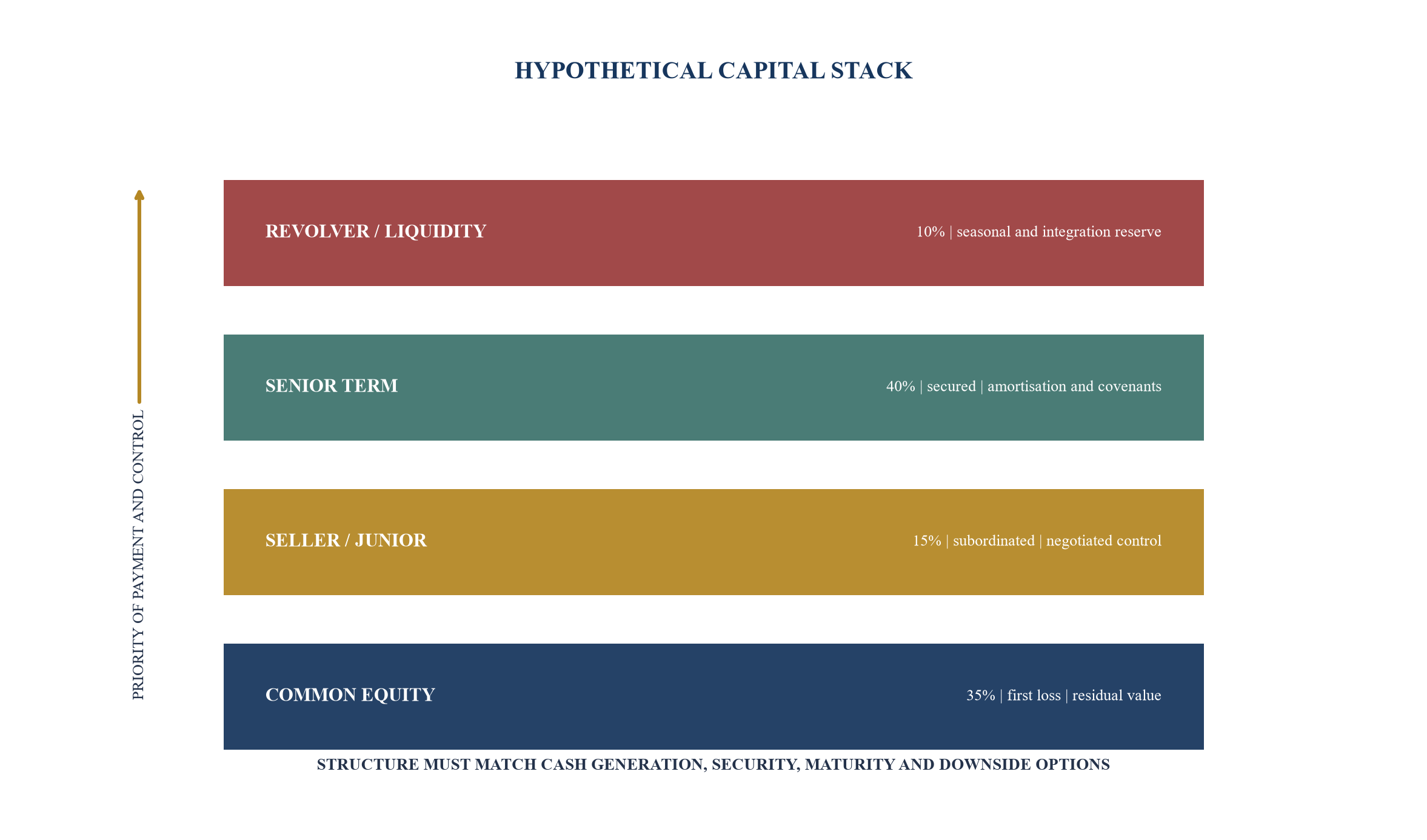
Percentages are hypothetical and do not indicate market terms or a recommended structure.
9. Map security by entity, asset and perfection step
A security package should be designed from the actual obligor and asset perimeter. It may include shares in the acquisition vehicle or target, bank accounts, receivables, inventory, equipment, intellectual property, insurance proceeds, real estate, contractual rights and assignments. Guarantees can add recourse to operating entities. Each item requires a legal owner, value rationale, consent check, perfection action, ranking analysis and enforcement view.
UAE Federal Law No. 4 of 2020 provides a framework for security rights over movable property, including receivables, bank accounts, equipment, business assets, inventory and certain future assets [7]. Its executive regulations address registration and related procedures [8]. The CBUAE Credit Risk Management Standards state that collateral should be legally enforceable and, where appropriate, registered with the relevant official body, including the land department for real estate and the designated registry for other collateral [2]. Counsel should confirm current registry, form and priority requirements.
Security value is not the gross asset balance. Receivables may be disputed, concentrated, already assigned or subject to set-off. Inventory may be specialised or perishable. Equipment may be leased, located elsewhere or expensive to remove. Intellectual property may sit outside the borrower. Real estate may carry prior mortgages or use restrictions. The lender's recovery analysis should apply eligibility, haircut, cost, time and enforceability.
Cross-border groups require a jurisdiction-by-jurisdiction map. Security documents, corporate benefit, guarantee limitations, registration, notarisation, translation, stamp or filing costs, foreign ownership, financial assistance and enforcement differ across GCC states and financial free zones. A single English-law facility agreement does not create the local security package. Local counsel should provide the legal steps and opinions required for each material jurisdiction.
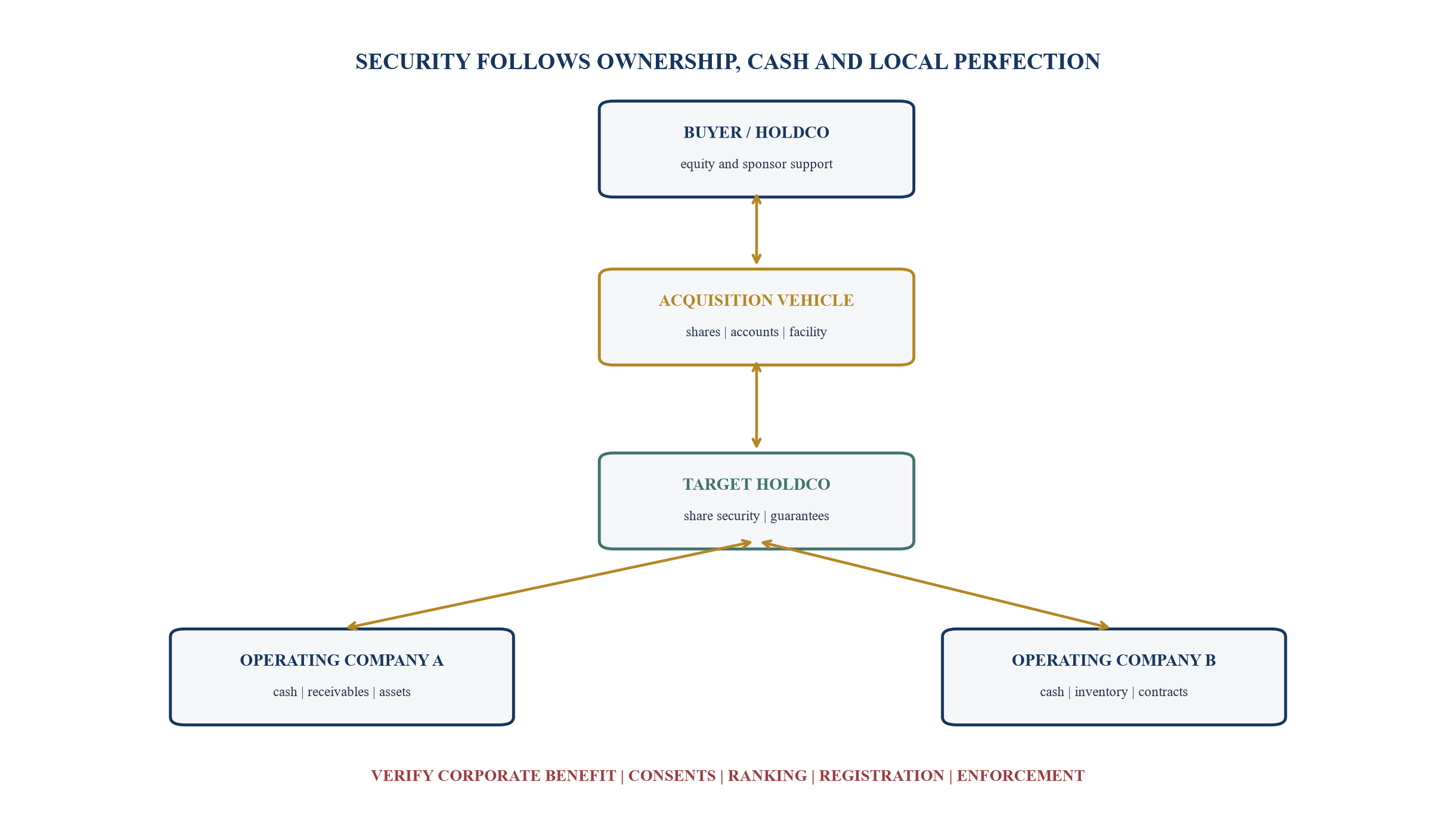
The map is illustrative. Actual security, guarantees and cash movement require transaction-specific legal and tax advice.
10. Test financial assistance, corporate benefit and upstream support
Acquisition structures often assume that the target will guarantee or secure debt used to purchase its shares. That assumption requires specific legal analysis. Article 224 of the UAE Commercial Companies Law restricts a company or its subsidiaries from providing financial aid that enables a person to hold securities issued by the company, including loans, assets as security and guarantees for third-party obligations, subject to the law's scope and exceptions [10]. The application to the entity type, transaction sequence and proposed support should be confirmed by counsel.
Corporate benefit should be documented for every guarantor and security provider. The board of an operating company should understand the obligations it assumes, the benefit it receives, its solvency and the interests it must consider. Upstream and cross-stream support can be limited by law, constitutional documents, minority rights, existing financing and directors' duties. A group-level acquisition rationale does not automatically establish entity-level authority.
The structure may need to separate acquisition debt from permitted post-completion refinancing. A target may be able to refinance its own existing debt or fund genuine corporate purposes after completion, while support for the original share purchase remains constrained. The steps, timing, funds flow and documentation should reflect substance and advice. Circular cash movements or unsupported board minutes create legal and credit risk.
The board gate should contain a support matrix. For each entity, it should show proposed guarantee, security, cash movement, corporate benefit, financial-assistance analysis, existing restrictions, approvals, solvency evidence and legal opinion. Any support excluded from the final package should be removed from debt capacity and recovery assumptions before signing.
Table 4. Security and guarantee verification matrix
| Support item | Evidence required | Constraint to test | Completion control |
|---|---|---|---|
| shares | ownership register, constitutional documents and existing pledge search | transfer restrictions, prior pledge and regulatory consent | executed pledge, notation or registration and legal opinion |
| bank accounts | account ownership, balances and bank terms | set-off, control, blocked-account operation and competing claims | account control or acknowledgement where applicable |
| receivables | contracts, ageing, assignment terms and debtor concentration | anti-assignment, set-off, eligibility and notification | registered security or assignment and operating collection control |
| movable assets | asset register, title, location and valuation | lease, prior security, identification and realisation cost | registry filing and evidence of priority where applicable |
| guarantee | entity accounts, benefit memorandum and authority | financial assistance, solvency, minority and existing covenants | board approval, execution and counsel confirmation |
| real estate | title, valuation, use and encumbrance search | mortgage consent, jurisdiction and registration | land-department registration and original-document control |
This is a management checklist. Qualified local counsel determines validity, perfection, priority and enforcement.
11. Measure covenant headroom as an operating resource
Covenants convert the financing model into contractual control. The borrower should build every ratio from the draft definitions rather than from internal shorthand. EBITDA add-backs, net debt, cash netting, leases, acquisitions, disposals, exceptional items, permitted adjustments and testing dates can alter the result materially. A controlled covenant dictionary should identify the clause, formula, source systems, judgement, owner and evidence for each component.
Headroom should be expressed in ratio points, currency and operating movement. A leverage covenant may show comfortable ratio headroom while a small EBITDA decline consumes it quickly. An interest-cover covenant can become sensitive to rate resets. A minimum-liquidity covenant can bind before leverage. The model should calculate the change in revenue, margin, working capital or interest that reaches each threshold.
The board needs early-warning levels above contractual default. An amber level can trigger forecast refresh, cash controls, lender engagement or restricted distributions. A red level can trigger board oversight, contingency funding and transaction restrictions. The trigger should respond to forecast headroom and evidence quality as well as reported compliance. Late accounts and repeated adjustments can be credit signals even when the ratio still passes.
Cure rights, equity cures, permitted prepayments, waiver mechanics and amendment thresholds should be understood before signing. A cure can restore compliance without resolving the operating cause. Repeated relief can increase cost and reduce lender confidence. The acquisition case should show how management returns to a stable range after any temporary action.
Table 5. Covenant architecture and management headroom
| Covenant or control | Contractual purpose | Management early warning | Evidence and action |
|---|---|---|---|
| net leverage | limits debt relative to defined earnings | forecast enters agreed buffer above covenant | refresh earnings, debt and add-backs; restrict discretionary cash |
| interest cover | protects capacity to service cash interest | rate or earnings stress consumes buffer | update benchmark and hedge; test repricing and prepayment |
| debt-service cover | tests total scheduled debt service | free cash flow approaches required coverage | protect collections, capex and working capital; reassess amortisation |
| minimum liquidity | preserves immediate payment capacity | thirteen-week low point enters warning band | activate cash controls and committed liquidity plan |
| capital expenditure | limits cash leakage outside approved plan | maintenance and growth compete for capacity | separate essential, committed and deferrable spend |
| information undertakings | gives lenders timely evidence | reporting delay or unresolved reconciliation | escalate ownership, close data gaps and document exceptions |
Measures and trigger levels are hypothetical. Executed documents and lender-confirmed calculations govern compliance.
12. Design covenants around the business and integration plan
A covenant package should control the risks that matter without preventing the operating plan the lenders underwrite. Financial covenants, debt and security restrictions, acquisitions, disposals, distributions, capital expenditure, related-party transactions, guarantees, business changes, information and events of default form one system. Baskets and permissions should be tied to expected activity, not copied from an unrelated transaction.
The integration plan belongs in covenant negotiation. The group may need restructuring, intercompany transfers, system contracts, employee retention, closure costs, capital expenditure and permitted acquisitions. If those actions are absent from the document model, routine execution can require consent. The borrower should prepare a covenant requirements map beside the one-hundred-day plan and confirm that every material step is permitted or subject to a known approval path.
Definitions should limit double counting. The same synergy should not increase EBITDA, reduce integration cost and support an acquisition basket without clear rules. Pro forma calculations should use consistent periods and evidence. Add-backs should have caps, time limits and delivery tracking. Currency translation and acquired debt should be treated consistently. The covenant model should be independently reviewed before the documents are signed.
Operating flexibility has value, but excessive baskets can weaken lender protection and raise price. The negotiation should focus on realistic capacity and governance. A basket that is unusable because a ratio test binds provides little value. A broad basket that permits cash leakage during downside can undermine resilience. The board should approve the combined package, including which strategic actions remain possible under base and stress cases.
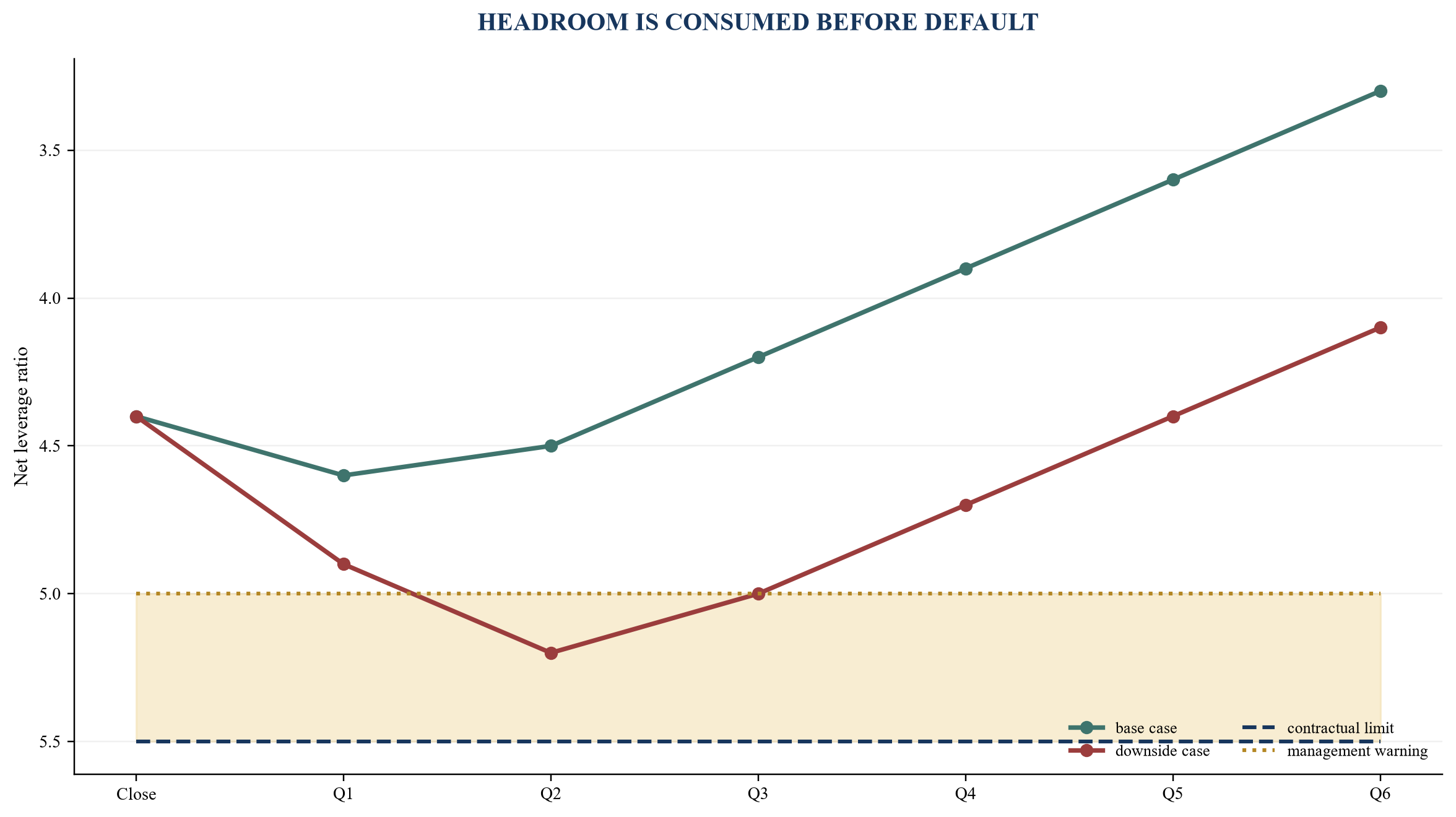
Ratios and scenarios are hypothetical management assumptions and do not represent a credit offer or forecast.
13. Control interest-rate, currency and refinancing risk
Debt service should be modelled from the contractual benchmark, margin, floor, payment dates, day-count and fees. Floating-rate debt can change cash interest without any change in operating performance. The model should use a current reference point, a forward or scenario curve and explicit stress. It should also show commitment fees, original-issue discount, agency cost, guarantee fees and hedging cash flows.
Currency should follow the cash that repays the debt. A GCC group can earn dirham, riyal, dollar-linked and non-pegged currencies while costs and debt sit elsewhere. Pegs can reduce some volatility without eliminating basis, convertibility, transfer or non-dollar exposure. Natural hedges, swaps, caps and forwards have different cost, collateral, accounting and counterparty implications. Treasury and advisers should approve a documented policy.
Hedging should protect the decision threshold rather than create a speculative position. The board should know the portion, duration, strike, premium, counterparty exposure, break cost and treatment under covenants. A hedge that expires before the facility or acquisition integration period can leave a refinancing cliff. A hedge whose notional does not follow amortisation can become over-sized.
Refinancing is a distinct risk for bullets and bridges. The model should identify the earliest takeout date, final maturity, extension conditions, rating or market dependency, required deleveraging and fallback. The CBUAE standards require lenders to assess refinancing risk for facilities that are not fully amortising [2]. The borrower should apply the same discipline and preserve a route that remains credible under a weaker market.
14. Integrate tax deductibility and legal-entity cash movement
The tax model should be built at entity level before it is consolidated. Debt may sit in an acquisition vehicle while taxable earnings arise in operating companies. Interest deductibility, tax grouping, losses, transfer pricing and distributions determine whether the assumed tax shield and cash movement are available. Qualified advisers should validate the structure and keep the model current as documents change.
The UAE Corporate Tax Law includes general and specific interest-deduction limitations [4]. FTA guidance explains adjusted EBITDA, the applicable de minimis threshold, carry-forward and exclusions [5]. Related-party debt used for certain transactions can require a valid commercial reason under the specific limitation. The acquisition memorandum should state which interest is expected to be deductible, when, at which entity and under which assumptions.
Tax capacity and covenant capacity should remain separate. A tax add-back may not be permitted under financing definitions. A tax group may not align with the guarantee group. A carried-forward interest amount can have future value while creating current cash tax. The model should show cash tax under base, delay and downside cases and reconcile it to the legal structure.
Other GCC jurisdictions have their own corporate tax, withholding, thin-capitalisation, zakat, transfer-pricing and deductibility rules. The group should maintain a jurisdiction matrix with source date and adviser owner. Cross-border interest, guarantees and cash pooling can create consequences in more than one state. No group-level assumption should enter debt capacity without entity-level support.
15. Align financing commitments with transaction certainty
The acquisition agreement and financing documents should share a critical path. Conditions precedent to funding, acquisition conditions, regulatory approvals, third-party consents, financial information, security, equity funding and funds flow should be reconciled. A transaction can be legally ready to complete and still lack a funding condition, or have committed debt whose availability expires before the acquisition long-stop date.
Commitment papers should be tested for conditionality, market flex, syndication, material adverse change, representations, equity funding, fees, expense reimbursement, confidentiality, assignments and termination. Counsel determines the legal effect. The board should understand which risks remain between signing and funding and which party bears them. A highly geared acquisition with conditional financing can transfer execution risk back to the buyer.
The conditions-precedent register should distinguish documentary completion from substantive uncertainty. Constitutional documents, resolutions, know-your-customer material, legal opinions, insurance, security and funds flow require owners and lead time. Regulatory or third-party conditions may depend on external decisions. The programme should state the evidence, responsible party, due date, waiver authority and impact on both acquisition and financing.
Funds certainty should include the equity leg. The source, approval, currency, account, call mechanics and timing of buyer or sponsor equity should be documented. Rollover and seller financing require executed instruments. The closing certificate should state that each committed source is available, each use is final, minimum liquidity remains and authorised signatories have approved the draw and payments.
16. Compare debt with equity, seller and contingent consideration
Debt can reduce immediate equity funding and increase equity sensitivity to performance. Additional equity can reduce default and refinancing risk while changing return and ownership. Seller financing and contingent consideration can bridge valuation gaps. The board should compare these instruments on cash, control, downside and execution rather than on headline cost alone.
The model should show the equity value distribution across cases. Higher leverage can improve returns in a strong case and accelerate loss in a weak one. A seller note can preserve cash at completion while creating a maturity that competes with bank debt. An earnout can align consideration with delivery, yet disputes over definitions, integration decisions and access to information can damage execution. Rollover equity can support continuity and create governance complexity.
Contingent claims should be incorporated into leverage, liquidity and exit analysis even when accounting presentation differs. Payment caps, floors, acceleration, security, subordination, set-off and change-of-control treatment affect risk. The financing agreement may restrict or permit these payments only within defined conditions. The acquisition agreement should use consistent definitions and information rights.
The preferred funding mix should pass the same resilience gate. It should fund all uses, preserve operating liquidity, remain compliant under the downside, allow the integration plan and retain a credible refinance or exit. The decision record should show why the selected mix creates more risk-adjusted value than the alternatives under stated management assumptions.
17. Build the lender evidence room and credit narrative
The lender evidence room should allow an independent credit decision. It should contain ownership and structure, audited financials, monthly management accounts, quality of earnings, customer and supplier concentration, contracts, working capital, tax, capex, litigation, regulation, insurance, management, forecasts, acquisition documents, integration plan, security evidence and sources and uses. Every model input should link to a source or identified assumption.
The credit narrative should explain purpose, repayment, downside and recovery. Purpose connects the acquisition to strategy and the financing to specific uses. Repayment identifies sustainable cash and maturity. Downside shows the earliest pressure and management action. Recovery identifies security, ranking, value and enforcement considerations. The CBUAE standards require lenders to understand purpose, ownership, risk drivers, leverage, debt-service coverage, liquidity, net worth and operating cash flows [1][2][3].
Information quality can affect price and certainty. Late, unreconciled or selectively adjusted data forces lenders to add caution, conditions or reserves. A controlled request list, version index and Q&A log improve confidence. Management presentations should distinguish facts, assumptions and planned actions. Legal privilege and confidentiality should be managed by counsel.
The borrower should prepare for lender challenge rather than optimise a single credit ratio. Customer durability, integration governance, key-person risk, cyber, sanctions, environmental obligations, related parties and contingent liabilities can alter risk. A complete answer can improve structure even when it does not increase leverage. The objective is a financeable transaction with transparent decision evidence.
18. Coordinate acquisition, financing and integration documents
The acquisition agreement should reflect financing reality without allowing the financing workstream to control the commercial bargain inadvertently. Purchase-price adjustment, locked-box leakage, completion accounts, earnout, warranties, indemnities, regulatory conditions, termination and long-stop dates can affect sources, uses and cash. The financing model should update whenever those terms change.
Interim operating covenants can protect the target between signing and completion. They should allow ordinary business while controlling actions that damage value or financing assumptions. Buyer consent rights require competition and transaction-law review. The target's existing lenders may require notices, consents, payoff letters and security releases. The closing sequence should prevent any gap between old releases and new perfection.
Integration commitments should be budgeted and permitted. Retention, restructuring, technology, branding, procurement, property and systems changes can require cash or covenant capacity. The financing case should state which synergies depend on these actions and which costs occur before benefits. The one-hundred-day plan should use the same assumptions as the lender case and board approval.
One change-control process should govern the transaction model. A revised purchase price, forecast, debt term, security exclusion, tax conclusion or integration cost should identify every affected output and approval. Parallel spreadsheets create hidden inconsistency. The programme lead should maintain a single decisions register linking commercial, legal, financing and operational workstreams.
19. Apply the framework to a hypothetical acquisition
Consider a hypothetical GCC corporate acquiring a regional services target. The transaction uses 120 units of reported target EBITDA and 8 units of supported adjustments. The cash bridge deducts tax, maintenance capex, working capital and integration, leaving 73 units available before debt service. The board evaluates senior term debt, a revolving reserve, seller financing and new equity. Every amount is an illustrative management assumption.
The base case assumes integration savings arrive over six quarters. The downside delays savings, reduces margin, extends collections and raises floating interest. The covenant model shows downside leverage approaching the management warning level in the second quarter while remaining below the contractual limit. That result supports a larger minimum cash reserve, lower day-one term debt and committed revolving capacity.
The security review identifies share security at the acquisition vehicle, account and receivables security at eligible operating companies and specific local perfection steps. One regulated subsidiary and one minority-owned entity remain outside the guarantee group. Their cash is excluded from debt service until distributions and consents are verified. The model also reduces the recovery value for assets whose enforcement or transfer is uncertain.
The board chooses a structure that funds all uses, preserves liquidity and retains a viable downside action plan. The decision does not establish a market term or recommended leverage level. It demonstrates the method: begin with cash, remove unavailable support, calculate covenant headroom, align maturity with integration and approve the financing alongside the acquisition rather than after it.
Table 6. Hypothetical acquisition-finance board case
| Measure | Initial proposal | Board-tested structure | Downside observation |
|---|---|---|---|
| reported EBITDA | 120 | 120 | revenue and margin stressed by business driver |
| supported adjustments | 8 | 8 with evidence and delivery tracking | weak or delayed items removed from covenant view |
| cash available before debt service | 73 | 73 with minimum-cash reserve protected | collection delay and higher integration cost reduce cash |
| senior term debt | maximum indicated amount | resized to preserve warning-level headroom | lower debt reduces waiver and refinance sensitivity |
| revolving facility | partly used for purchase price | preserved primarily for working capital and integration | committed availability protects seasonal low point |
| guarantee group | consolidated operating group | only entities with verified authority and support | excluded cash and assets removed from capacity and recovery |
| board outcome | proceed on headline terms | proceed subject to revised stack and verified conditions | stop or reprice if evidence or funding conditions deteriorate |
All values and conclusions are illustrative management assumptions. They do not describe a client, offer or forecast.
20. Operate a signing-to-one-hundred-day control plan
From signing to completion, the team should maintain the conditions register, financing availability, forecast, minimum cash, target performance, regulatory approvals, lender requests, security preparation and funds flow. Any material deviation should update debt capacity and covenant headroom. The board or delegated committee should receive decision-focused reporting rather than a list of completed tasks.
At completion, the company should confirm facility draw, equity funding, repayment of existing debt, releases, security perfection, hedges, fees, minimum liquidity, signatories and post-completion filings. Counsel and advisers provide the required opinions and confirmations. The borrower should retain the executed document set, source calculations and closing evidence in a controlled archive.
During the first hundred days, the finance function should run a thirteen-week cash forecast, monthly covenant forecast, synergy and integration cost ledger, capex control, lender reporting and early-warning dashboard. The opening balance sheet should reconcile acquisition accounting, debt, cash, fees and working capital. Forecast changes should identify cause, cash effect, covenant effect and action owner.
Lender communication should be planned. Timely evidence supports credibility when results vary from the case. Management should avoid premature claims of synergy and report realised benefits against an agreed baseline. An emerging issue should be analysed before a waiver request becomes urgent. The operating model should preserve management accountability and board oversight throughout integration.
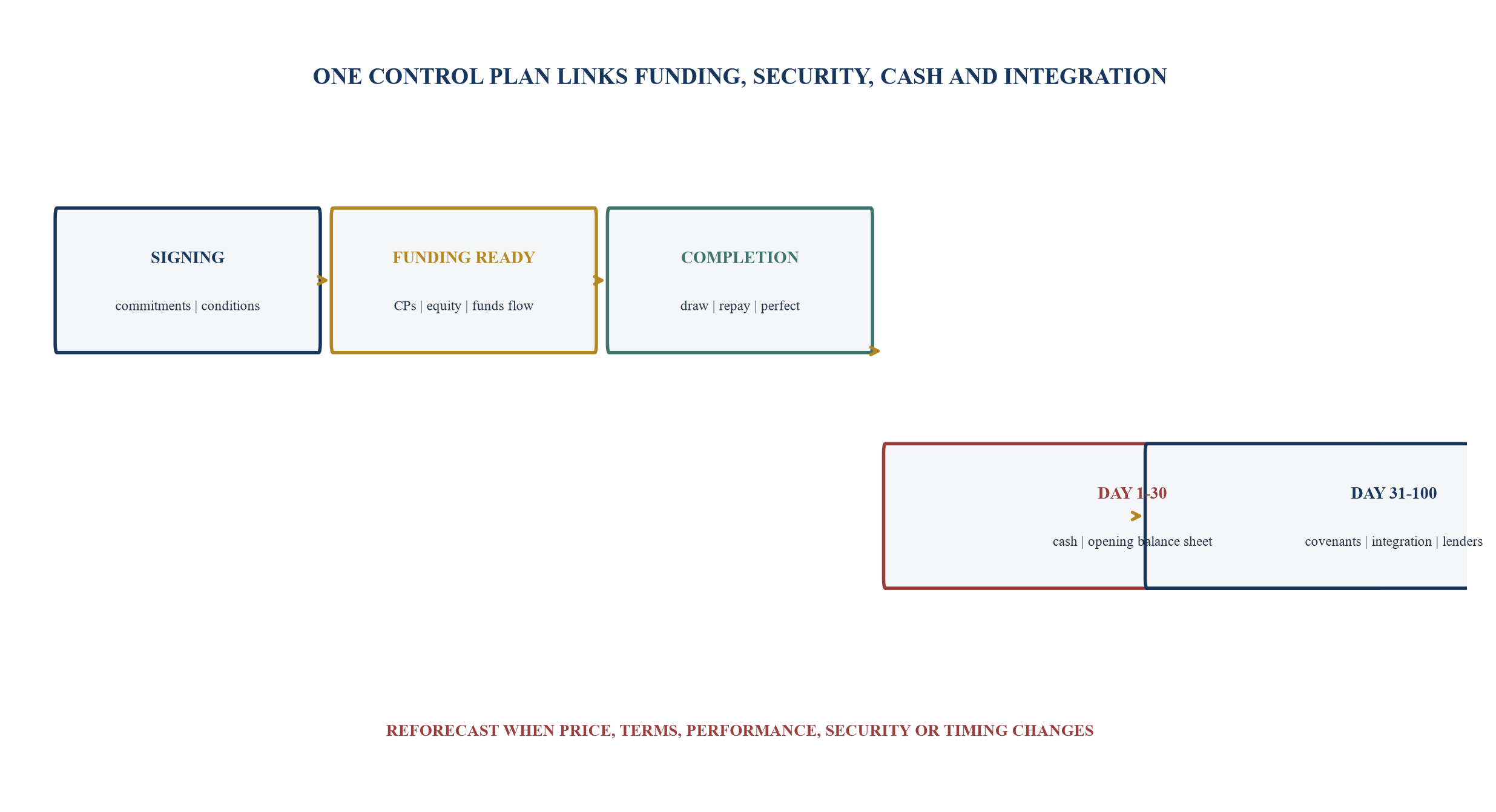
Timing is illustrative and should be adapted to the transaction documents, approvals and operating requirements.
21. Use a board gate and permanent acquisition-finance capability
The final board gate should bring the acquisition and financing decisions together. It should state the strategic rationale, purchase price, full sources and uses, debt-capacity bridge, downside cases, selected instruments, security and guarantees, legal and tax conclusions, covenant headroom, financing conditionality, minimum liquidity, integration funding and decision limits. Any unresolved item should have an owner, deadline and consequence.
The board can approve, resize, reprice, restructure or stop. Approval should be conditional where evidence remains outstanding. Resizing can change consideration, debt or equity. Repricing can reflect financing and execution risk. Restructuring can change perimeter, deferred consideration, security or timing. A stop decision protects capital when sustainable funding and transaction value cannot be reconciled.
Repeat acquirers should maintain a permanent toolkit: controlled sources-and-uses model, quality-of-earnings bridge, cash-capacity model, covenant dictionary, security matrix, tax and jurisdiction register, lender data-room index, conditions register, funds-flow template and one-hundred-day dashboard. The toolkit reduces repeated work while preserving transaction-specific judgement and advice.
Capability should be measured by decision quality. Useful indicators include forecast accuracy, cash conversion, headroom at completion, condition readiness, security perfection, lender-information timeliness, integration funding, exception frequency and refinancing progress. The objective is a transaction that closes with sufficient control to execute its strategic thesis and enough resilience to absorb uncertainty.
Sources and further reading
- Central Bank of the UAE, Credit Risk Management Regulation Official source
- Central Bank of the UAE, Credit Risk Management Standards Official source
- Central Bank of the UAE, Article 5 Credit Underwriting Official source
- UAE Federal Tax Authority, Corporate Tax Legislation Official source
- UAE Federal Tax Authority, Interest Deduction Limitation Rules Guide Official source
- UAE Federal Tax Authority, Interest Deduction Limitation Rules Official source
- UAE Legislation, Federal Law No. 4 of 2020 Regarding Securing the Rights in Movables Official source
- UAE Legislation, Cabinet Resolution No. 29 of 2021 Executive Regulations for Movable Security Official source
- UAE Legislation, Federal Decree-Law No. 16 of 2021 on Factoring and Transfer of Receivables Official source
- UAE Legislation, Federal Decree-Law No. 32 of 2021 on Commercial Companies Official source
- UAE Legislation, Federal Decree-Law No. 51 of 2023 Promulgating the Financial Reorganisation and Bankruptcy Law Official source
- Central Bank of the UAE, Financial Stability Report 2024 Official source
- Central Bank of the UAE, Standards for Capital Adequacy of Banks Official source
- Saudi Central Bank, Rules and Regulations for Banks Official source
- Basel Committee on Banking Supervision, Supervisory Framework for Measuring and Controlling Large Exposures Official source
- Basel Committee on Banking Supervision, Interest Rate Risk in the Banking Book Official source
- Basel Committee on Banking Supervision, Principles for Sound Liquidity Risk Management and Supervision Official source
- Basel Committee on Banking Supervision, Stress Testing Principles Official source
- Basel Committee on Banking Supervision, Corporate Governance Principles for Banks Official source
- Basel Committee on Banking Supervision, Principles for the Management of Credit Risk Official source
- Basel Committee on Banking Supervision, Guidelines on Credit Risk and Accounting for Expected Credit Losses Official source
- European Central Bank, Guidance on Leveraged Transactions Official source
- European Banking Authority, Guidelines on Loan Origination and Monitoring Official source
- United States Federal Reserve, Interagency Guidance on Leveraged Lending Official source
- Office of the Comptroller of the Currency, Comptroller's Handbook Leveraged Lending Official source
- IFRS Foundation, IFRS 9 Financial Instruments Official source
- IFRS Foundation, IAS 36 Impairment of Assets Official source
- Islamic Financial Services Board, Guiding Principles of Risk Management for Institutions Offering Islamic Financial Services Official source
- Loan Market Association, Sustainability-Linked Loan Principles Official source
- OECD, G20/OECD Principles of Corporate Governance 2023 Official source
