

1. Define the corporate venture decision as a staged acquisition system
A strategic minority investment should be approved for the value it can create during the minority period. Future acquisition potential can increase that value, but it should not rescue a weak investment or an unproved commercial relationship. The board should be able to explain why the company wants access now, why ownership is useful now, what evidence will be produced, and what future choices remain open if an acquisition never occurs.
The acquirer-side question is whether staged exposure improves the quality of a later buy decision. A minority position can provide learning about the product, customers, economics, founders and technical road map. It can also create sunk-cost bias, organisational advocacy and privileged access that makes the corporate overconfident. The investee-side question is whether the relationship accelerates enterprise value without making the company dependent on one strategic buyer. A venture may gain revenue and credibility while losing neutrality with other customers, partners and acquirers.
The board should therefore treat the pathway as a system of separate gates. The first gate tests strategic relevance. The second tests whether a commercial experiment is capable of producing decision-grade evidence. The third tests whether ownership improves the relationship. The fourth tests whether acquisition rights are proportionate to delivered value. The final gate tests whether full acquisition is superior to continued partnership, independent financing or a wider sale process.
Every gate needs an owner, evidence standard, expiry date and fallback. A pathway without expiry can become a permanent strategic shadow over the venture. A pathway without a fallback can leave both parties commercially entangled after the original sponsor, budget or strategy has changed.
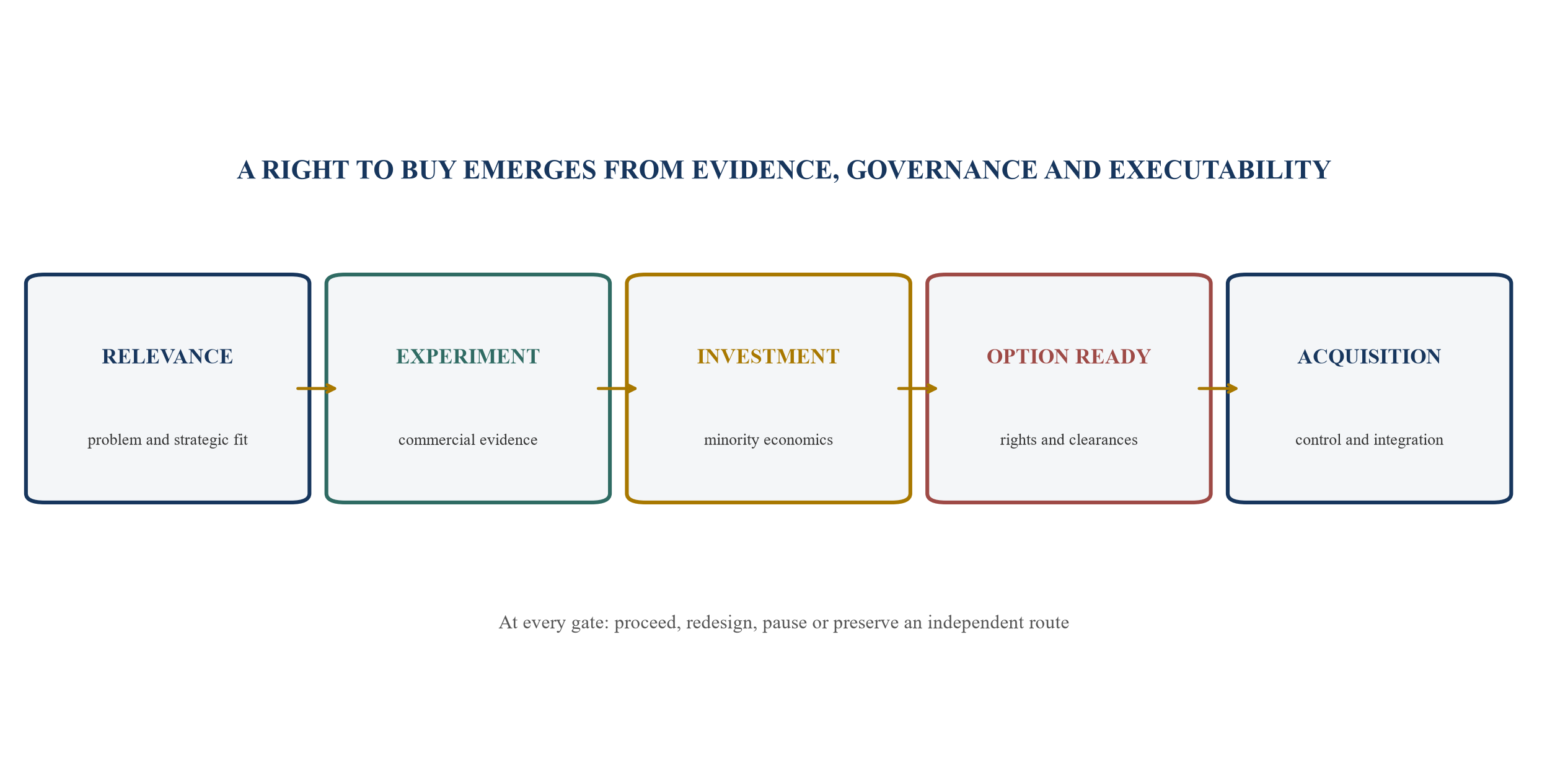
Each stage has a separate approval standard; later stages do not validate an uneconomic earlier stage.
2. Start with the acquisition thesis rather than the legal instrument
The proposed buyer should state the future value mechanism before negotiating an option. The acquisition thesis may depend on distribution, product integration, scarce technology, data, manufacturing capacity, talent, regulated access, supply security or entry into a new customer segment. Each mechanism requires different evidence. A distribution thesis needs verified pipeline conversion, delivery capacity and customer economics. A technology thesis needs performance, ownership, architecture and road-map evidence. A talent thesis needs retention, leadership and work-authorisation analysis.
The thesis should identify which activities must remain independent during the test period. Independence may be commercially valuable because the venture learns across several customers, proves that its product is portable and preserves a financing market. Excessive integration before acquisition can contaminate the evidence. Revenue generated only through preferential internal buying may not prove external product-market fit. A technical road map shaped entirely around one corporate stack can reduce value to other buyers.
The board should also identify why acquisition may be superior to continued partnership. The corporate may already receive most commercial benefits through a contract or licence. Full ownership may add control over investment, exclusivity, talent or economics, while also absorbing capital, integration risk and liabilities. The case for control should explain the incremental value that cannot be obtained through a less irreversible structure.
The thesis should include a disconfirming case. A corporate may believe that owning a scarce technology will create differentiation, while customer interviews show that implementation and service matter more than the underlying component. A venture may believe that the corporate's distribution will create rapid scale, while sales data show that the channel serves a different buyer or price point. Explicit disconfirmation tests make the later acquisition decision more reliable and reduce the influence of internal sponsorship.
The board should map the strategic asset to the entity and contracts that actually control it. Technology can sit across patents, software, licences, data rights, employment agreements, cloud accounts and customer permissions. Revenue can depend on a regulated subsidiary or a founder relationship. The future acquisition perimeter should follow the value mechanism rather than assume that buying the parent automatically delivers every required asset and right.
An acquisition thesis register should connect each claimed source of value to an evidence owner, observation period, minimum threshold and disconfirming signal. This keeps the pathway testable. It also prevents transaction momentum from replacing the original strategic reason.
Table 1. Structure choices and the evidence each can produce
| structure | principal purpose | evidence produced | principal constraint | suitable transition |
|---|---|---|---|---|
| commercial pilot | test use case and delivery | adoption, performance, cost and sponsor behaviour | limited ownership learning | expand, stop or renegotiate |
| distribution or supply agreement | test channel economics | pipeline, conversion, service and margin | dependency and exclusivity risk | scale contract or add capital |
| minority investment | align economics and fund growth | governance, reporting and strategic continuity | influence, information and exit friction | follow-on, sale or continued minority |
| joint venture | build a bounded shared business | operating compatibility and shared economics | deadlock and asset-boundary risk | acquire, separate or continue JV |
| acquisition process right | preserve access to a future sale | process discipline and timing visibility | bidder deterrence and price tension | negotiated purchase or open process |
| full acquisition | obtain control | integration and controlled capital allocation | irreversibility and liability absorption | ownership and integration |
The least restrictive structure that can generate the required evidence should be evaluated first.
3. Use the commercial experiment to generate falsifiable evidence
The commercial agreement should be designed as an experiment whose outputs can inform an investment and an acquisition. It should specify the customer problem, named operating sponsors, use cases, deployment scope, technical interfaces, resources, success measures and evidence dates. General commitments to introductions, co-selling or strategic collaboration are too weak for a conversion decision.
The parties should distinguish access from demand. A corporate sponsor can arrange meetings, place the venture on an approved vendor list and authorise a pilot. Those actions do not establish budget, buying authority, implementation capacity or repeatable gross profit. The evidence chain should move from access to qualified opportunity, contracted revenue, deployed product, accepted performance, collectible cash and repeatable unit economics.
The experiment should also capture negative evidence. Slow security review, weak business-unit ownership, low user adoption, custom integration, pricing resistance or disproportionate support demand may disprove the acquisition thesis even when a pilot technically succeeds. A well-designed pathway rewards learning rather than only positive results.
Data produced during the experiment needs a controlled provenance. Usage logs, customer feedback, performance results, incident records, cost data and implementation hours should be reconciled between the parties. The acquisition case should not rely on a presentation assembled after the fact from inconsistent systems.
4. Decide whether ownership adds value during the test period
Minority ownership can strengthen commitment, finance product development and create governance access. It can also add complexity without improving the experiment. The corporate should ask whether board or observer rights materially improve its ability to understand the investment, whether capital is required to reach the next evidence point, and whether the expected financial return compensates for risk if an acquisition does not occur.
The venture should compare the corporate capital with independent alternatives. The analysis should include price, dilution, liquidation preference, follow-on support, information rights, commercial value, conflicts, future fundraising and exit effect. A strategic investor should receive credit for resources that are named, authorised and measurable. Brand recognition and informal enthusiasm should not be capitalised as consideration.
Ownership percentage alone does not describe influence. Board appointment, observer rights, vetoes, budget consent, hiring rights, information access, funding dependencies and commercial exclusivity can matter individually and together. The rights package should be analysed across corporate law, competition, accounting and foreign-investment regimes before signing.
The investment should retain an independent return case. If the only credible return is a sale to the investor, the board is effectively negotiating a deferred acquisition under financing documents. That may be a valid choice, but it requires acquisition-level analysis of price, certainty, conflicts and alternatives.
5. Design a rights ladder instead of granting a permanent shortcut
Acquisition rights have different economic effects. A right of first negotiation creates a period for bilateral discussions. A right of first offer can require the investor to make an initial proposal before a wider process. A right of first refusal can allow the investor to match third-party terms. A call option can create a purchase right at a defined price or formula. A process notice can provide information about a sale without priority. These labels are only summaries; operative drafting determines their effect.
The board should use a rights ladder. Early in the relationship, a short notice or discussion right may be proportionate. Stronger rights should arise only after the investor delivers defined capital, commercial milestones or strategic resources. Rights should narrow, expire or fall away when milestones are missed, sponsorship changes, the investor competes with the venture, information controls fail or regulatory approval appears unlikely.
A right can distort value even if it is never exercised. Other bidders may avoid diligence if they expect their offer to become free price discovery for a matching holder. The venture may lose auction tension, timing certainty or confidentiality. The investor may also be harmed if a loosely drafted right forces a rapid decision without diligence, financing or internal approval.
The design should therefore state the trigger, notice content, response period, price mechanics, permitted conditions, proof of financing, treatment of non-cash consideration, regulatory allocation, confidentiality, outside date, waiver, assignment, change of control and expiry. The right should fit the likely acquisition process rather than an abstract desire for priority.
Consideration for the right should be visible. It may consist of price paid for shares, a separate option payment, committed commercial expenditure, technical resources or a measurable distribution obligation. Treating an acquisition right as free can conceal a transfer of value from existing shareholders and future bidders. The board should record what the company receives, how delivery is verified and what happens when the consideration is not delivered.
The right should also address corporate change. The holder may sell the relevant business, reorganise the venture unit, acquire a competitor or experience a change of control. Automatic assignment to an unknown successor can alter the original bargain. The documents can limit assignment, require continuing strategic fit or permit termination when the holder's identity, competitive position or capability changes materially.
Table 2. Acquisition-right design matrix
| mechanism | value to investor | risk to venture | design control | board evidence |
|---|---|---|---|---|
| discussion notice | early awareness | limited process delay | short notice and no exclusivity | responsible sponsor and clear scope |
| right of first negotiation | bilateral opportunity | lost momentum during negotiation | brief period, objective end and no automatic extension | acquisition thesis and approval path |
| right of first offer | investor frames initial value | anchoring and signalling | independent valuation and freedom after rejection | credible price process |
| right of first refusal | ability to match a third-party deal | bidder deterrence and disclosure | narrow matching terms, rapid election and expiry | measurable consideration for the right |
| call option | contractual purchase route | valuation, control and lock-in risk | objective trigger, complete formula and regulatory conditions | acquisition-level diligence and fairness process |
| ordinary sale participation | access without priority | less certainty for investor | clean process rules and equal information | competitive tension and governance independence |
Transaction-specific drafting and local advice determine legal effect.
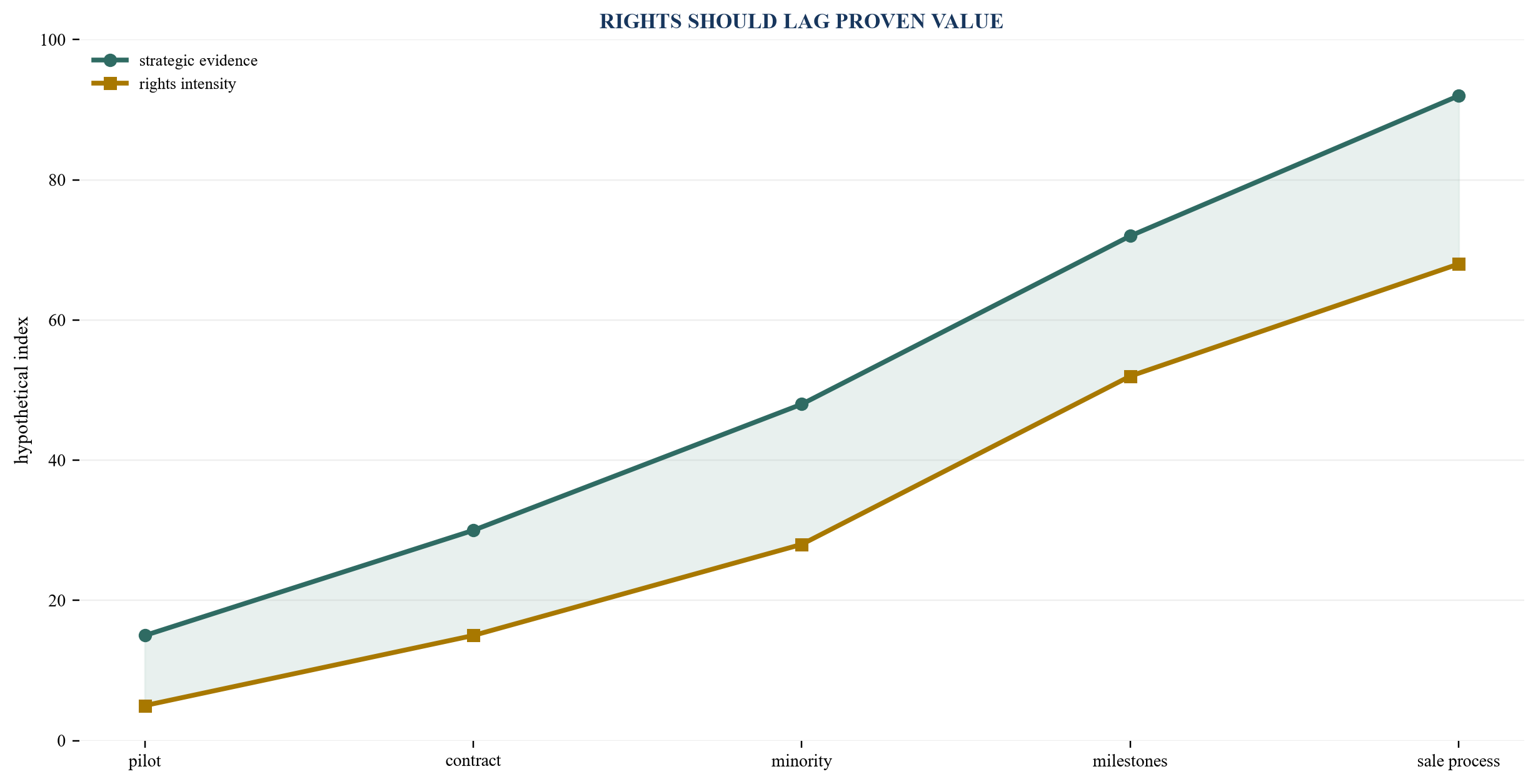
Hypothetical scores illustrate sequencing and do not prescribe a transaction structure.
6. Preserve a credible market for the venture
The venture should remain financeable and saleable throughout the pathway. This requires more than a clause allowing third-party transactions. Competing investors and buyers must believe that they can obtain information, negotiate and close without an embedded strategic investor appropriating their work or delaying the process.
Information rights should exclude bidder identities, proposed terms, customer-specific pricing and competitively sensitive material unless disclosure is legally required or governed through an approved clean team. Board observers with employment responsibilities in an adjacent corporate business may need recusal or restricted materials. The company should maintain a conflict register that identifies when ordinary investor access becomes transaction-sensitive.
The rights package should also preserve future financing. Pro rata rights, vetoes over new securities, most-favoured terms, strategic consent and commercial exclusivity can combine to make a new round difficult. The board should model a realistic financing before granting the rights, including a down round, new lead investor, extension round and strategic competitor.
Exit optionality should be reviewed from the perspective of an independent bidder. The test asks what documents the bidder receives, what the strategic investor sees, which waiting periods apply, whether customer or technology restrictions survive, and how regulatory approvals affect certainty. If a reasonable bidder would require a discount or refuse to engage, that effect belongs in the investment economics.
The company should maintain an alternative-capital file throughout the relationship. It can include current operating forecasts, a financing data room, investor feedback, debt capacity and a list of potential partners. This is operational resilience rather than a commitment to transact. It prevents the board from comparing the corporate proposal with an artificial alternative in which the venture has no funding or commercial route because independent readiness was allowed to lapse.
7. Separate protective rights from operating control
Protective rights can safeguard a minority investor against changes that fundamentally alter its investment. Operating rights can direct activities that affect returns. The distinction matters for corporate law, governance, accounting and competition analysis. A veto over issuing a senior security can look protective. Consent over budget, product road map, senior hiring, pricing or major customers can approach operational influence depending on facts and applicable rules.
IFRS 10 defines control through power over relevant activities, exposure or rights to variable returns, and the ability to use power to affect returns. It also distinguishes substantive rights from protective rights. IAS 28 addresses significant influence and includes a rebuttable presumption associated with twenty per cent or more of voting power. Percentage thresholds do not replace analysis of contractual arrangements and actual rights.
The parties should create a rights-purpose register. Each governance right should state the risk it protects, the decision it covers, the materiality threshold, duration, escalation route and accounting or regulatory analysis. Rights whose purpose cannot be explained should be removed or narrowed.
The register should be reviewed when commercial arrangements expand, follow-on capital is invested, a board role changes or acquisition discussions begin. The combined position can change even when no single document changes materially.
Table 3. Governance and information boundary
| item | legitimate minority purpose | control or conflict signal | practical safeguard |
|---|---|---|---|
| board observer | understand strategy and risk | participation in competing operating decisions | agenda screening, recusal and restricted pack |
| budget consent | protect against fundamental value shift | influence over ordinary allocation | high materiality and limited reserved matters |
| product information | monitor investment and collaboration | access to competitive road map | purpose-limited data room and clean team |
| hiring consent | protect key-person thesis | influence over management | limited named roles and expiry |
| financing veto | protect class economics | ability to block ordinary funding | objective seniority or dilution threshold |
| acquisition right | preserve strategic opportunity | deterrence, lock-in or early control | earned, bounded, time-limited process right |
Local legal, accounting and competition analysis remains necessary.
8. Build a clean information architecture before sharing begins
The corporate investor may be a customer, supplier, partner, potential buyer and competitor at the same time. Information cannot be governed by one broad investor-rights clause. The parties should classify information by purpose: ordinary financial reporting, commercial delivery, technical integration, board oversight, acquisition diligence and regulated or customer-restricted material.
Access should follow role and need. The venture team delivering a pilot may need product telemetry and incident data. The corporate venture unit may need financial and governance reporting. The business unit may need deployment data. The corporate development team may need acquisition diligence later. Competitively sensitive customer, pricing, road-map and strategy information can require a clean team, aggregation, delay or exclusion.
The architecture should identify systems, users, approval authority, permitted use, retention, onward disclosure and deletion. It should also address machine-readable exports and model training. Data that entered a shared environment for a pilot should not silently become corporate training data or acquisition diligence material.
Evidence of compliance belongs in the conversion gate. If the parties cannot prove who accessed restricted information and for what purpose, the acquisition process may face competition, confidentiality and trust problems precisely when speed matters most.
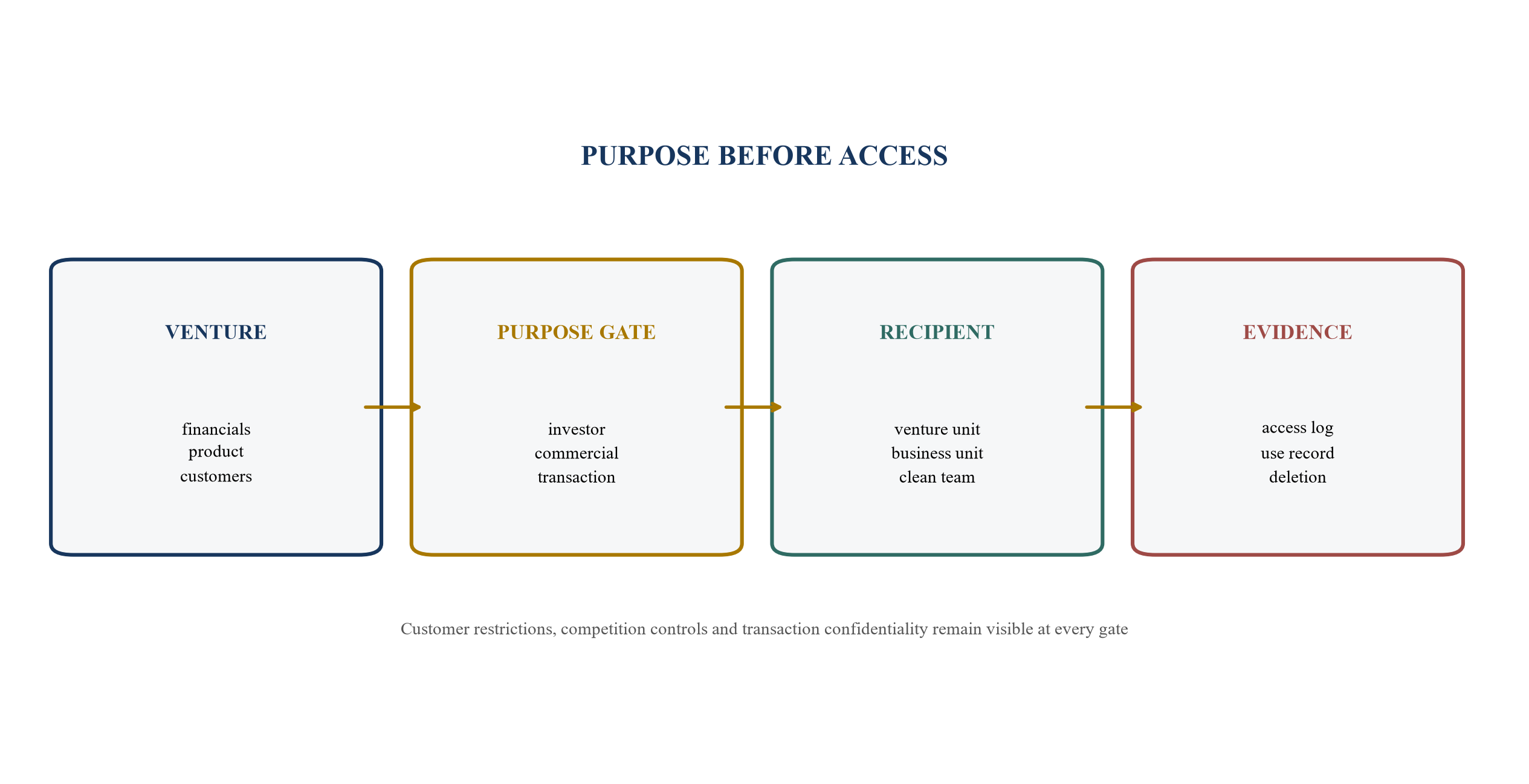
Restricted data remains segregated until an authorised purpose and recipient are documented.
9. Protect intellectual property and technical independence
The corporate relationship can create new intellectual property through integration, testing, feedback, configuration, data preparation, model tuning, joint development and product extensions. The documents should distinguish background intellectual property, independently developed improvements, jointly developed assets, feedback, data-derived outputs, interfaces and deployment-specific materials.
The venture should maintain evidence of ownership and transferability. WIPO guidance highlights the importance of an inventory covering patents, trademarks, trade secrets, copyrights, proprietary source code, third-party libraries, open-source components, acquired licences and technical documentation. Employment, contractor, university, founder and collaboration agreements should support the chain of title.
Acquisition readiness also depends on licences and customer contracts. Change-of-control restrictions, non-assignment clauses, source-code escrow, open-source obligations, territorial limits, field-of-use restrictions and data localisation can prevent the buyer from using the assets as modelled. The pathway should surface these issues during the minority period rather than leave them for confirmatory diligence.
Technical independence deserves an explicit score. Architecture built entirely around the strategic investor's infrastructure may reduce portability. Custom features may look like product traction while behaving as non-recurring engineering. The acquisition thesis should separate reusable product capability from buyer-specific adaptation and price each accordingly.
10. Measure strategic value through evidence, not access claims
Strategic value should be recognised when the relationship changes a measurable outcome. Examples include faster qualified pipeline, higher conversion, lower implementation cost, improved gross margin, reduced churn, stronger product performance, shorter regulatory approval, secured supply or accelerated entry into a geography. Each benefit needs a baseline, counterfactual, owner, measurement source, cost and confidence level.
The board should distinguish value created for the venture from value transferred to the corporate. Preferential pricing, exclusivity or custom development can make the corporate relationship appear successful while reducing venture economics. A transfer price that benefits the corporate buyer is not automatically enterprise value for the investee.
The measurement period should reflect the mechanism. A technical pilot may produce performance data in weeks. Enterprise revenue can require a procurement cycle, implementation and collection period. Talent retention and product-road-map evidence may require longer observation. Acquisition rights should not mature before the evidence they are meant to justify can exist.
The dashboard should retain failed experiments and missed commitments. Selective reporting creates acquisition bias. A buyer that sees only successful workstreams may overpay; a venture that ignores corporate delivery failures may grant rights without receiving the promised value.
11. Model the acquisition price before the relationship changes the evidence
Price design is difficult because the strategic investor can influence the venture's performance during the observation period. The investor may generate revenue, provide resources, delay contracts, change transfer pricing or shape investment priorities. A future price formula should not reward or penalise either party for outcomes it can manipulate without transparent adjustment.
The board can model several routes: a fixed price, a valuation corridor, a formula based on audited metrics, an independent valuation, a negotiated price subject to fairness procedures, or a wider sale process. Each route allocates market, performance and strategic-synergy risk differently. A fixed price gives certainty and can become stale. A multiple formula appears objective and can create disputes over definitions. An independent valuation needs a clear standard of value and information set. A market process tests third-party demand and can conflict with priority rights.
The model should separate stand-alone value, relationship-created value and buyer-specific synergy. Stand-alone value reflects the venture as an independent business. Relationship-created value reflects durable improvements generated during the partnership. Buyer-specific synergy reflects value available because this buyer owns the business. The allocation between shareholders and buyer is a negotiation; the bridge makes the negotiation visible.
Dilution and preference economics also matter. The corporate's minority stake reduces the cash required at acquisition and can change voting or approval dynamics. Conversion, liquidation preference, anti-dilution, warrants, debt and employee equity should be modelled on a fully diluted, transaction-specific basis.
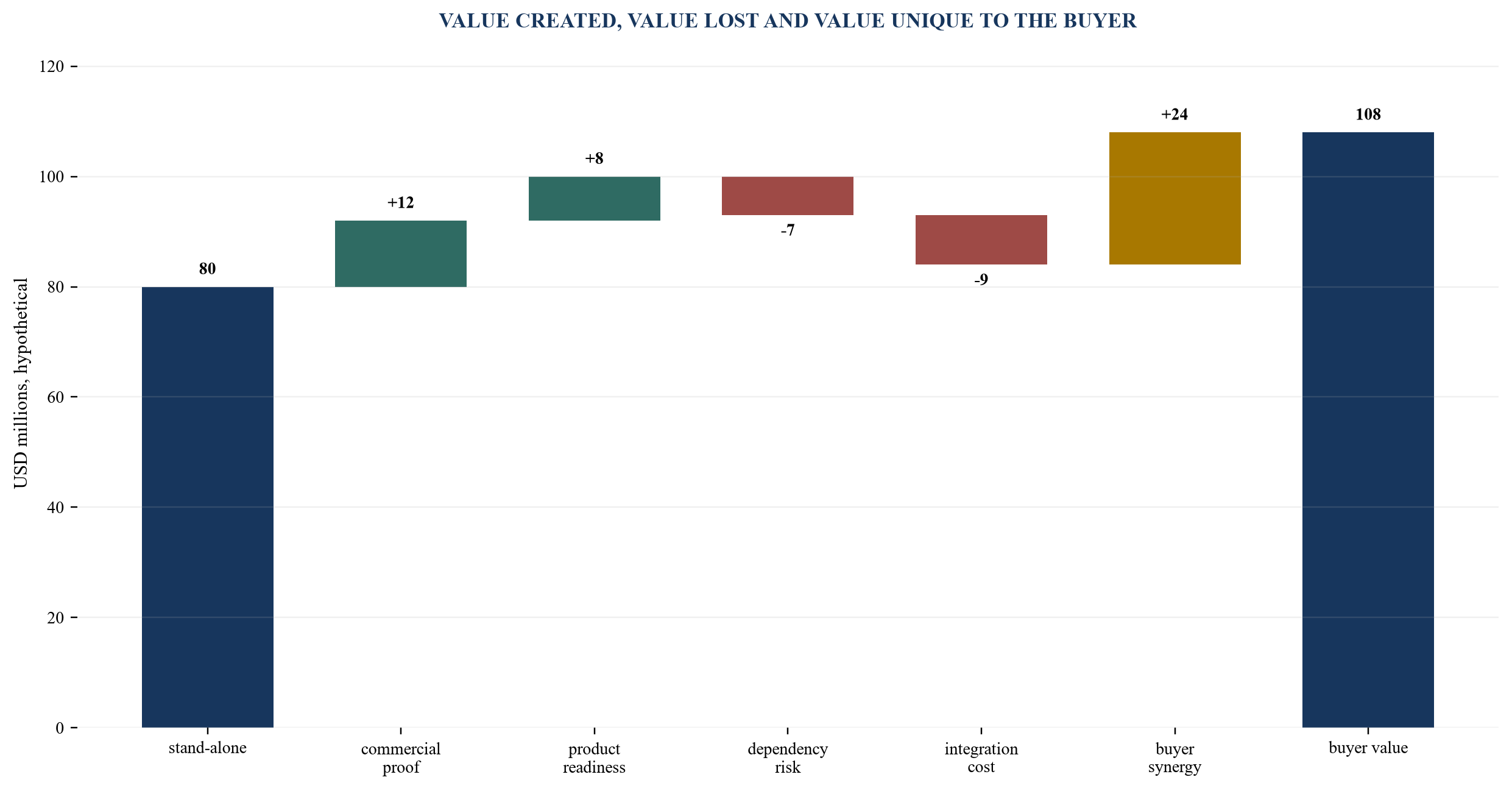
Values are hypothetical management assumptions in USD millions and are included only to demonstrate the bridge.
Table 4. Price architecture and dispute controls
| price route | strength | principal dispute | control | suitable evidence |
|---|---|---|---|---|
| fixed price | certainty | staleness and changed capital structure | short duration and adjustment schedule | near-term conversion |
| valuation corridor | bounded negotiation | metric and endpoint selection | independent process outside corridor | observable growth path |
| metric formula | transparency | definitions, manipulation and exceptional items | audited definitions and conduct covenants | stable recurring economics |
| independent valuation | third-party discipline | standard of value and assumptions | appointed expert, complete brief and finality rule | limited market evidence |
| negotiated price | flexibility | conflicts and bargaining imbalance | independent committee and fairness process | evolving thesis |
| market process | price discovery | bidder deterrence and confidentiality | bounded rights and equal process access | credible third-party demand |
Valuation methods require transaction-specific financial, tax, accounting and legal analysis.
12. Create two-speed diligence across the minority and control periods
Minority-investment diligence and acquisition diligence answer different questions. The investment review asks whether the security, governance, commercial proposition and downside are acceptable. Acquisition diligence asks whether the buyer can own, consolidate, finance, operate and integrate the whole business. The pathway should avoid repeating work while preserving the higher control standard.
A diligence ledger should record each topic, evidence date, source system, reviewer, conclusion, limitation and refresh trigger. Corporate records, capitalisation, financial statements, tax, customers, people, technology, cybersecurity, intellectual property, data, compliance, litigation and licences should each have a clear status. Evidence that remains current can be carried forward. Evidence affected by growth, incidents, new contracts or regulation should be refreshed.
Reliance matters. Informal learning by product or commercial teams may be useful but may not be suitable for an acquisition decision. The conversion process should identify what was observed, what was contractually represented, what was independently verified and what remains a management assumption.
The venture also needs diligence on the buyer. It should understand approval authority, acquisition budget, financing, antitrust strategy, integration model, employee treatment, data use and reputation for completing strategic transactions. A right to buy is valuable only when the holder can make a credible decision and close.
The ledger should include evidence freshness. Monthly recurring revenue, customer concentration, security incidents, key-person status and regulatory permissions can change rapidly. Corporate records, historic title and issued patents may move more slowly. A refresh policy should define the maximum age of evidence by risk and should escalate contradictory data. This converts continuous access into a controlled diligence advantage rather than an accumulation of unverified files.
Representations and warranties remain a separate workstream. The corporate's prior knowledge can affect negotiation and remedies under applicable documents and law. The pathway should record who knew what, when it was learned, the purpose for which it was shared and whether the issue was resolved. Informal operational familiarity should not create ambiguity about disclosure, reliance or risk allocation in the acquisition agreement.
13. Map competition risk from the first information request
Partial ownership can raise competition issues before acquisition. The United States merger guidelines state that minority interests may provide influence through voting, governance, capital decisions or access to competitively sensitive information. They also identify concerns where cross-ownership changes incentives to compete. Similar concerns can arise under other regimes through their own legal tests.
The parties should define product, customer and geographic overlaps at the start. They should identify whether the investor competes directly, supplies inputs, buys from the venture, controls a route to market or holds interests in other participants. Information flows and governance rights should be designed around that map.
Full acquisition changes the analysis. Notification thresholds, substantive tests, transaction value, local revenue, control and sequencing vary by jurisdiction. Australia's mandatory merger regime applies from 1 January 2026 for acquisitions meeting applicable requirements. UAE economic-concentration analysis, UK merger jurisdiction, EU merger control, India combination rules and Singapore assessment each require current transaction-specific review.
The pathway should maintain a living regulatory file rather than a one-time checklist. Follow-on investments, additional rights, commercial integration or a call-option exercise can create a new event. A filing or approval condition should be integrated into the right's timetable and outside date.
Table 5. Jurisdictional questions for a staged acquisition path
| geography | minority-stage question | control-stage question | evidence owner |
|---|---|---|---|
| United Arab Emirates | do rights or concentration facts require analysis? | are economic-concentration thresholds and approvals engaged? | UAE counsel and finance |
| United States | do influence, information or competitive overlaps create concern? | do merger and national-security rules apply? | antitrust, CFIUS and deal teams |
| United Kingdom | is material influence or an NSI trigger event relevant? | are merger and mandatory NSI requirements engaged? | competition and NSI counsel |
| European Union | do rights confer control or create investment-screening exposure? | do merger, foreign-subsidy and national screening regimes apply? | EU and member-state counsel |
| Australia | does the investment require foreign-investment or merger analysis? | is mandatory notification or approval required? | FIRB and competition counsel |
| India | does the investment meet combination or sectoral review conditions? | do additional shares or control change the analysis? | Indian counsel and company secretary |
| Singapore | can minority rights affect competitive assessment? | should the parties seek merger guidance or notification? | Singapore competition counsel |
This is a governance checklist rather than a statement of filing obligations.
14. Screen national-security and foreign-investment issues early
Technology, data, critical infrastructure, defence, semiconductors, communications, energy, advanced materials and sensitive supply chains can attract foreign-investment review. The relevant trigger can involve shares, voting rights, material influence, board access, assets, technology or sensitive data. A minority stage can therefore be reviewable even when the commercial objective is learning rather than control.
The United Kingdom's National Security and Investment guidance explains that qualifying acquisitions depend on the acquired right or interest and the degree of control, and that material influence can be relevant outside mandatory notification. CFIUS in the United States can review covered transactions and certain non-controlling investments involving critical technology, critical infrastructure or sensitive personal data. EU and national screening, Australian foreign-investment rules and sector-specific regimes add further layers.
The parties should create a national-security fact pack before granting rights. It should identify investors and ultimate ownership, target activities, locations, government customers, licences, export-controlled items, sensitive data, facilities, supply-chain roles and governance access. The analysis should include the future acquisition route so the right is not economically valuable but practically unexercisable.
Mitigation can affect economics. Information restrictions, governance limits, local operations, security protocols, supply commitments or exclusion of assets can reduce anticipated synergy. The acquisition model should incorporate these effects before price and rights are agreed.
Timing risk also needs ownership. The option or process right may expire while a review continues, or the commercial agreement may renew before approval. The documents should coordinate exercise, notification, long-stop dates, extensions, interim operating covenants and termination. A regulatory extension should be available only under defined conditions so that one party cannot hold the other in indefinite uncertainty.
The screening map should distinguish legal filing analysis from government-relations planning. Accurate ownership, technology, customer and supply-chain evidence supports both. Transaction messaging should remain consistent with the documents and operating facts. Assertions about economic benefit, local capability or security should be supported by commitments that the business can implement and monitor.
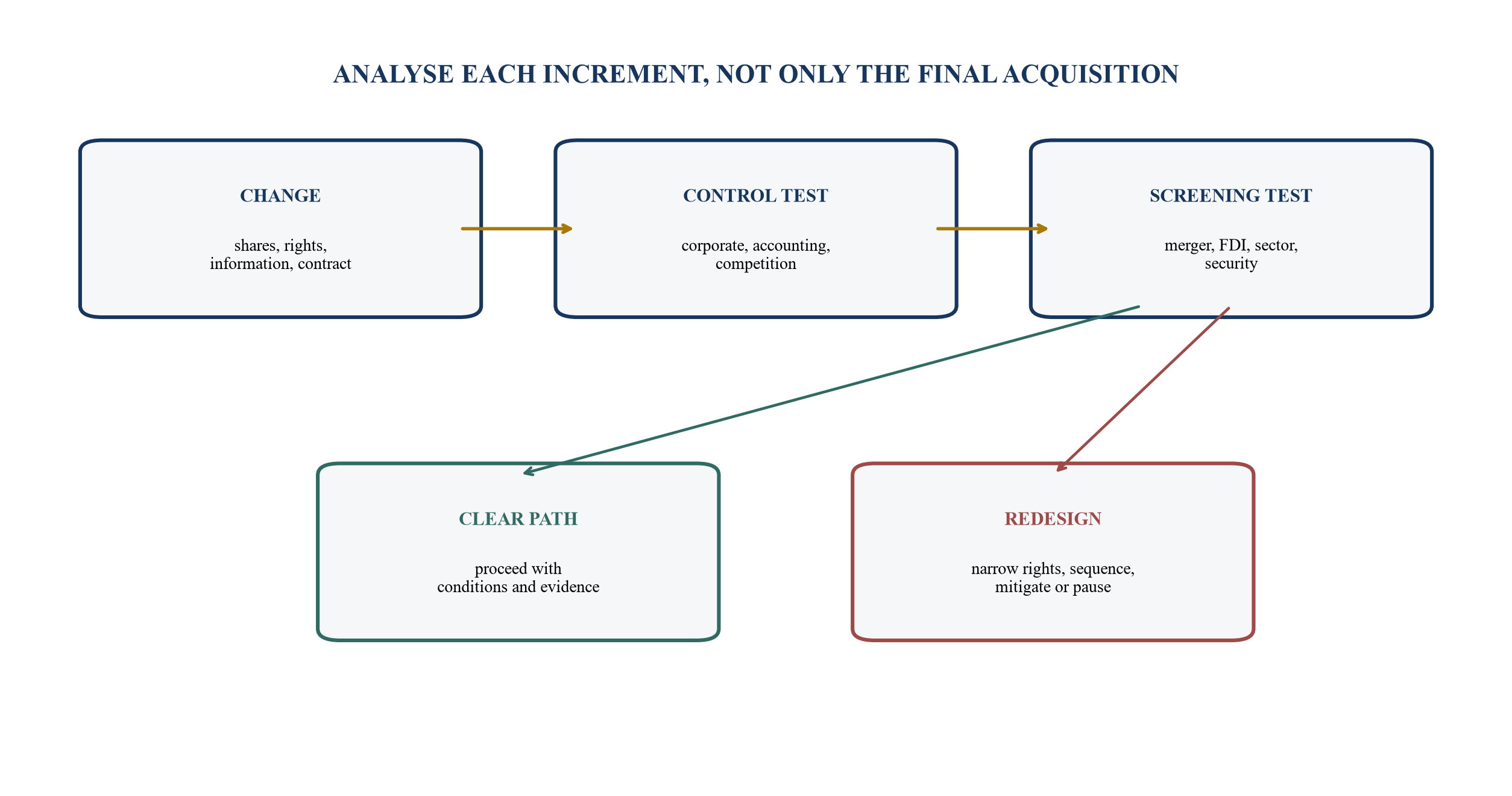
Qualified local advisers should determine whether a notification, approval or mitigation process applies.
15. Connect accounting, tax and financing to the rights design
The accounting analysis should begin when rights are drafted. IFRS 10 control, IAS 28 significant influence and IFRS 3 business-combination requirements can affect consolidation, equity accounting, purchase accounting and disclosures. Potential voting rights, substantive rights and contractual arrangements require fact-specific assessment. The board should not assume that a minority label determines the accounting outcome.
Tax analysis should cover the investment, commercial relationship, option or process right, cross-border payments, transfer pricing, withholding, employee equity and acquisition. A nominal option price, related commercial pricing or transfer of intellectual property can have consequences beyond the share purchase. The future acquisition structure may also affect deductibility, basis, losses, grouping and repatriation.
Financing needs to be credible at the point when a right can be exercised. The corporate should identify whether the acquisition is funded from cash, debt, equity, internal approval or a combination. A formula or option that produces a binding purchase obligation without committed capacity can create liquidity and governance risk.
The venture should also model the financing consequence if the acquisition does not occur. It may need a new round immediately after exclusivity expires or after commercial dependency becomes visible. Runway, investor signalling and bridge capacity belong in the pathway design.
16. Build integration readiness without integrating prematurely
The minority period can generate valuable integration knowledge. Teams can test interfaces, security, procurement, customer support and decision speed. The parties should use that learning to design a target operating model, while preserving legal, operational and competitive separation until closing.
Integration readiness should cover customer continuity, product architecture, data migration, cybersecurity, people, finance, tax, legal entities, controls, vendors and communications. Each domain should identify what can be prepared, what requires clean-team handling and what cannot occur before approval and closing.
The corporate should test its own capacity. Strategic fit can be high while the receiving business lacks leadership, product ownership, engineering resources or change capacity. The conversion gate should identify an integration leader, executive sponsor, budget, workstream owners and a first hundred-day sequence.
The venture should protect value during preparation. Key employees need appropriate retention and communication. Customers should not be exposed to premature messaging. Product investment should follow an approved stand-alone plan until the transaction has sufficient certainty.
Integration planning should preserve a clean baseline. The parties should record current service levels, product performance, headcount, costs, working capital, incidents and customer commitments before ownership changes. Without a baseline, the buyer cannot distinguish transaction disruption from underlying performance and the seller cannot demonstrate whether promised synergies or protections were delivered.
The target operating model should define decisions rather than only organisation boxes. It should state who owns product, pricing, customer commitments, technology architecture, data, capital expenditure, hiring and risk acceptance after close. Ambiguous decision rights are especially costly when the venture's speed and specialist talent are central to value.
17. Govern conflicts when the investor becomes a bidder
The strategic investor's role changes when acquisition discussions begin. Investor representatives may hold board information while their employer negotiates against the company. Commercial teams may depend on the relationship. Founders and employees may have different liquidity preferences. Existing financial investors may seek a wider process.
The board should activate a transaction protocol. It can establish an independent committee, define recusals, appoint advisers, separate buyer and investor communications, restrict board materials, create a clean team and document decisions. The protocol should identify who may waive or enforce acquisition rights and how fairness is assessed.
The company should maintain ordinary commercial performance during negotiations. Contract renewals, pricing, support and procurement should not become implicit deal leverage. Disputes over the commercial agreement need a route separate from the transaction process.
The corporate also needs internal separation. The venture team may advocate for the target, while corporate development, finance, legal, compliance and the receiving business test the acquisition independently. A staged pathway creates information advantages; it should not remove challenge.
18. Stress the failure modes before granting the right
A founder can treat the corporate investor as the inevitable buyer and underinvest in other channels. A business unit can sponsor an investment without authority to acquire. A venture unit can lose budget after a strategic reset. A right of first refusal can discourage bidders without creating a funded bid. Commercial exclusivity can increase dependency and weaken stand-alone value.
Other failure modes arise from incomplete design: the price formula lacks definitions; non-cash consideration cannot be matched; the option conflicts with shareholder rights; regulatory approval takes longer than the exercise period; the corporate lacks access to the required financing; intellectual property cannot transfer; data rights do not support the intended product; integration capacity is absent; or key employees leave during uncertainty.
The board should run a pre-mortem across both parties. For each failure, it should identify the earliest signal, prevention, owner, response and fallback. A fallback can include expiry, conversion to an ordinary investor relationship, termination of exclusivity, a structured sale process, independent financing or a separation plan.
The strongest evidence that a pathway is governed is the ability to stop it. The documents and operating plan should preserve a workable future for the venture if acquisition is no longer desirable or executable.
Table 6. Board conversion gate
| domain | minimum evidence | challenge question | pause signal |
|---|---|---|---|
| strategic fit | current acquisition thesis and alternatives | what value requires ownership? | partnership captures most value |
| commercial | reconciled revenue, adoption and unit economics | is demand independent and repeatable? | buyer-created dependency dominates |
| rights | complete process map and expiry | can a credible alternative bidder engage? | right destroys process tension |
| value | stand-alone, relationship and synergy bridge | who created each increment of value? | formula is manipulable or stale |
| diligence | current ledger with unresolved items | what remains assumed? | material ownership, data or liability gap |
| regulation | jurisdiction and approval map | can the deal close on the required timetable? | prohibition, mitigation or uncertainty breaks economics |
| integration | leader, capacity, budget and sequence | can the receiving organisation absorb the target? | no accountable owner or available capacity |
| financing | approved sources, uses and liquidity | is funding credible through downside? | approval or funding depends on unproved assumptions |
The board should require evidence across every domain before authorising a control transaction.
19. Apply the framework to a hypothetical conversion sequence
Consider a hypothetical technology venture whose product can improve asset monitoring for an international industrial group. The group begins with a twelve-month commercial pilot across two sites and invests USD 8 million for a 15 per cent fully diluted interest. These figures are management assumptions for illustration and do not describe an actual company or market term.
The documents separate the investment from a commercial schedule. The schedule names deployments, service levels, integration resources, data boundaries and evidence dates. The investor receives financial reporting and one observer, subject to agenda screening and recusal. Product road maps, customer-specific pricing and competitor information remain outside ordinary access. A limited right of first negotiation becomes available only after deployment, renewal and performance milestones are met. It lasts twenty business days and expires eighteen months after investment.
The parties model a future acquisition through an independent board process. Stand-alone value is tested using financing and third-party transaction evidence. Relationship-created value is supported by durable revenue, product reuse and customer proof. Buyer-specific integration and procurement synergies remain a separate bridge. The corporate has no automatic right to match a third-party offer and receives no bidder identity or detailed terms before the board determines the permitted process under the documents.
At month twelve, the pilot meets technical performance while expansion is slower than assumed. Support hours are higher, one important licence requires change-of-control consent and the receiving business lacks an integration product owner. The board does not treat technical success as a conversion decision. It extends the commercial evidence period, funds product standardisation, resolves the licence, appoints the integration owner and retains independent financing options.
At month sixteen, the evidence set is stronger. The corporate can now decide whether control adds value after integration cost and regulatory conditions. The venture board can compare the proposal with continued independence and any permitted market evidence. The right has organised a decision without predetermining it.
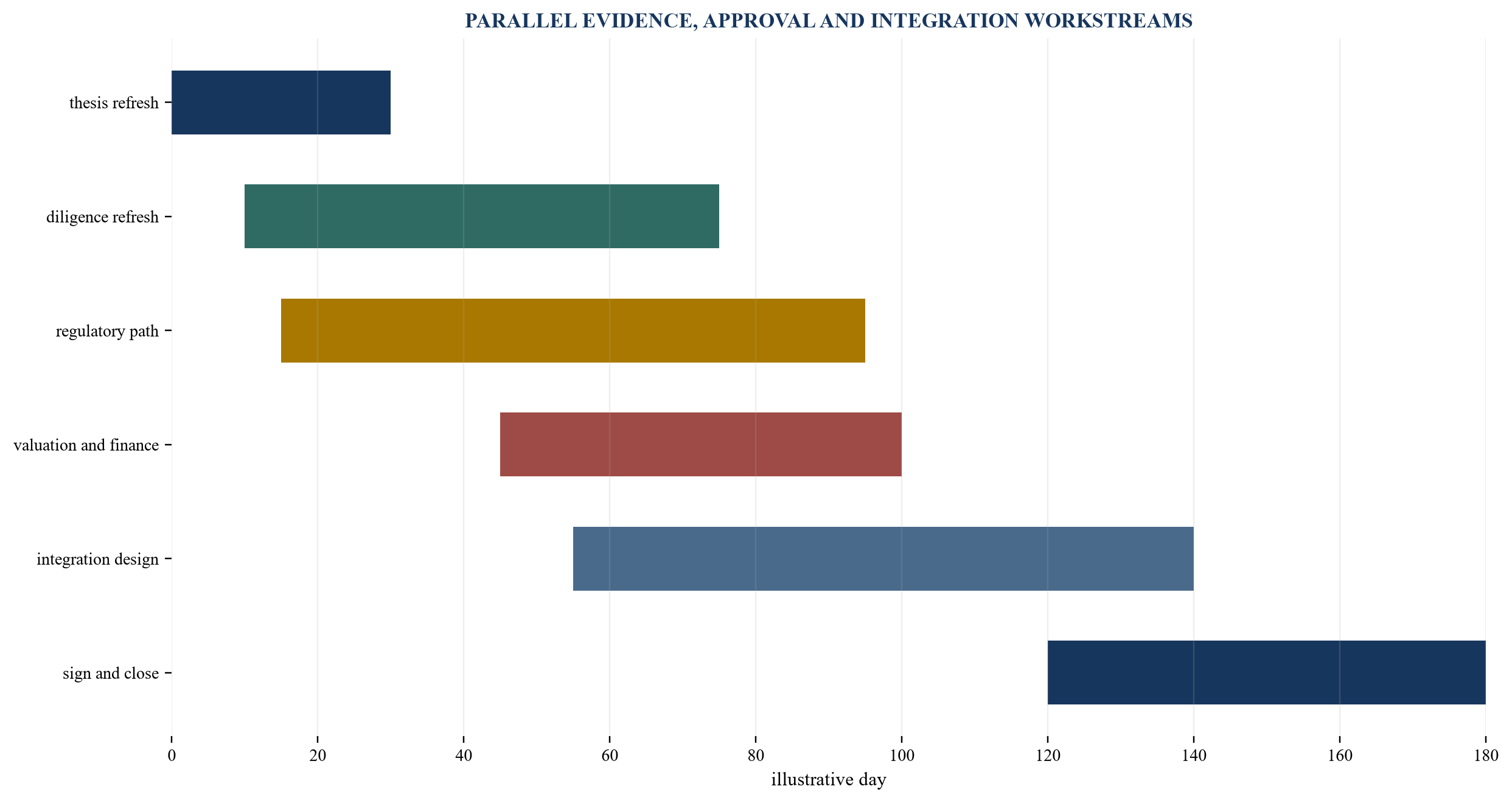
Timing is a hypothetical management assumption; regulatory and transaction facts determine the actual sequence.
20. Use a board decision that records alternatives and conditions
The board paper should state the strategic objective, evidence from the minority period, acquisition alternatives, valuation bridge, rights position, diligence exceptions, regulatory path, financing, integration plan and stakeholder consequences. It should distinguish verified evidence, management assumptions and advice still required.
The decision should specify conditions rather than provide a broad mandate. Conditions can cover price boundaries, minimum financing certainty, required consents, regulatory outcomes, retention, material contracts, intellectual-property ownership, data remediation, integration leadership and minimum liquidity. Authority should expire when material facts change.
The minutes should record conflicts, recusals, advisers, materials and alternatives considered. Where the strategic investor has board access, the information process should show which materials were withheld or provided through an appropriate protocol. This protects decision integrity and improves later execution.
A refusal to exercise a right should also be documented. The board should understand whether the right expires, whether commercial terms continue, what information is returned or deleted, and how future fundraising or a sale can proceed. Non-acquisition is an expected pathway outcome, not an administrative failure.
21. Build a repeatable corporate venture-to-acquisition capability
Corporations that invest strategically need a portfolio-level operating model. The model should define investment theses, business-unit sponsorship, commercial evidence, governance rights, information controls, follow-on funding, acquisition triggers, regulatory screening and exit routes. Each investment should fit that architecture while preserving transaction-specific judgement.
The venture portfolio should be reviewed for strategic continuity. Changes in corporate strategy, leadership, budget, technology or regulation can invalidate the original path. Rights should not remain on autopilot after the economic purpose has disappeared.
The capability should also learn from decisions that did not convert. A declined acquisition can reveal weak sponsorship, insufficient commercial proof, valuation gaps, regulatory barriers or integration limits. Those findings should improve future investment design rather than disappear when the transaction closes or stops.
The central principle is disciplined optionality. A corporate venture investment can create a superior acquisition decision when it generates verified commercial and operating evidence, preserves independent value, allocates information carefully, prices the future transparently and keeps control subject to a fresh board and regulatory gate. The right to buy should be earned, bounded and executable. It should organise a future decision while leaving both parties capable of choosing another path.
Sources and further reading
- Organisation for Economic Co-operation and Development, Corporate venture capital and start-up innovation in the digital age, 3 April 2026 Official source
- Organisation for Economic Co-operation and Development, Does corporate venture capital make start-ups more innovative?, 26 May 2026 Official source
- National Venture Capital Association, Model Legal Documents Official source
- National Venture Capital Association, 2025 Updates to Model Legal Documents Official source
- United States Department of Justice and Federal Trade Commission, 2023 Merger Guidelines Official source
- United States Department of Justice, Guideline 11 on Partial Ownership or Minority Interests Official source
- United States Department of the Treasury, Committee on Foreign Investment in the United States Official source
- United States Department of the Treasury, CFIUS Frequently Asked Questions Official source
- United States Department of the Treasury, CFIUS Mitigation Official source
- UK Competition and Markets Authority, Mergers: Guidance on the CMA's jurisdiction and procedure Official source
- UK Government, National Security and Investment Act guidance on acquisitions Official source
- UK Government, National Security and Investment Act collection Official source
- European Commission, Consolidated Jurisdictional Notice under the EU Merger Regulation Official source
- European Commission, Investment Screening Official source
- European Union, Regulation (EU) 2026/1386 on screening foreign investments Official source
- European Commission, Foreign Subsidies Regulation legislation Official source
- UAE Ministry of Economy and Tourism, Regulation of Competition Official source
- UAE Ministry of Economy and Tourism, Federal Decree-Law No. 36 of 2023 Regulating Competition Official source
- Competition and Consumer Commission of Singapore, Competition Act and Guidelines Official source
- Competition and Consumer Commission of Singapore, Merger Assessment Process Official source
- Competition Commission of India, Regulation of Combination Official source
- Competition Commission of India, Criteria of Combination Rules 2024 Official source
- Australian Government, Foreign investment: Business investments Official source
- Australian Government, Foreign investment: Key concepts Official source
- Australian Competition and Consumer Commission, Mergers and acquisitions Official source
- IFRS Foundation, IFRS 10 Consolidated Financial Statements Official source
- IFRS Foundation, IAS 28 Investments in Associates and Joint Ventures Official source
- IFRS Foundation, IFRS 3 Business Combinations Official source
- World Intellectual Property Organization, How to Prepare for IP Due Diligence, 14 July 2026 Official source
- World Intellectual Property Organization, Uncovering IP Risks and Potential: IP Audit Official source
