

1. Decide the integration thesis before the price becomes irreversible
An acquisition thesis explains why ownership should change. An integration thesis explains how the combined owner will organise the assets, capabilities and decisions required to realise that logic. The two theses should be connected before the board authorises signing. A deal can have a credible market rationale and still destroy value if the required operating model is infeasible, delayed or incompatible with customer, technology, regulatory or organisational constraints.
The board does not need a completed integration plan before the share purchase agreement. It needs a decision-grade view of the intended end state, the domains that must change, the domains that should remain distinct, the principal dependencies, the first irreversible decisions and the protections required in the contract. Detail should deepen as evidence improves. The early thesis sets direction without pretending that every implementation fact is known.
Integration choices influence price, working capital, financing, warranties, covenants, conditions, transitional services, retention, data access, consent requirements and the definition of closing readiness. When those choices appear after signing, the parties may discover that the valuation assumed synergies the operating model cannot deliver within the expected time or risk envelope.
The thesis should therefore become a formal investment-committee exhibit. It states the deal logic, target operating model, integration mode by domain, value bridge, cost and dis-synergy allowances, customer safeguards, regulatory boundaries, Day One requirements, leadership accountabilities and evidence gaps. Every material assertion remains linked to a source, assumption, owner and next test.
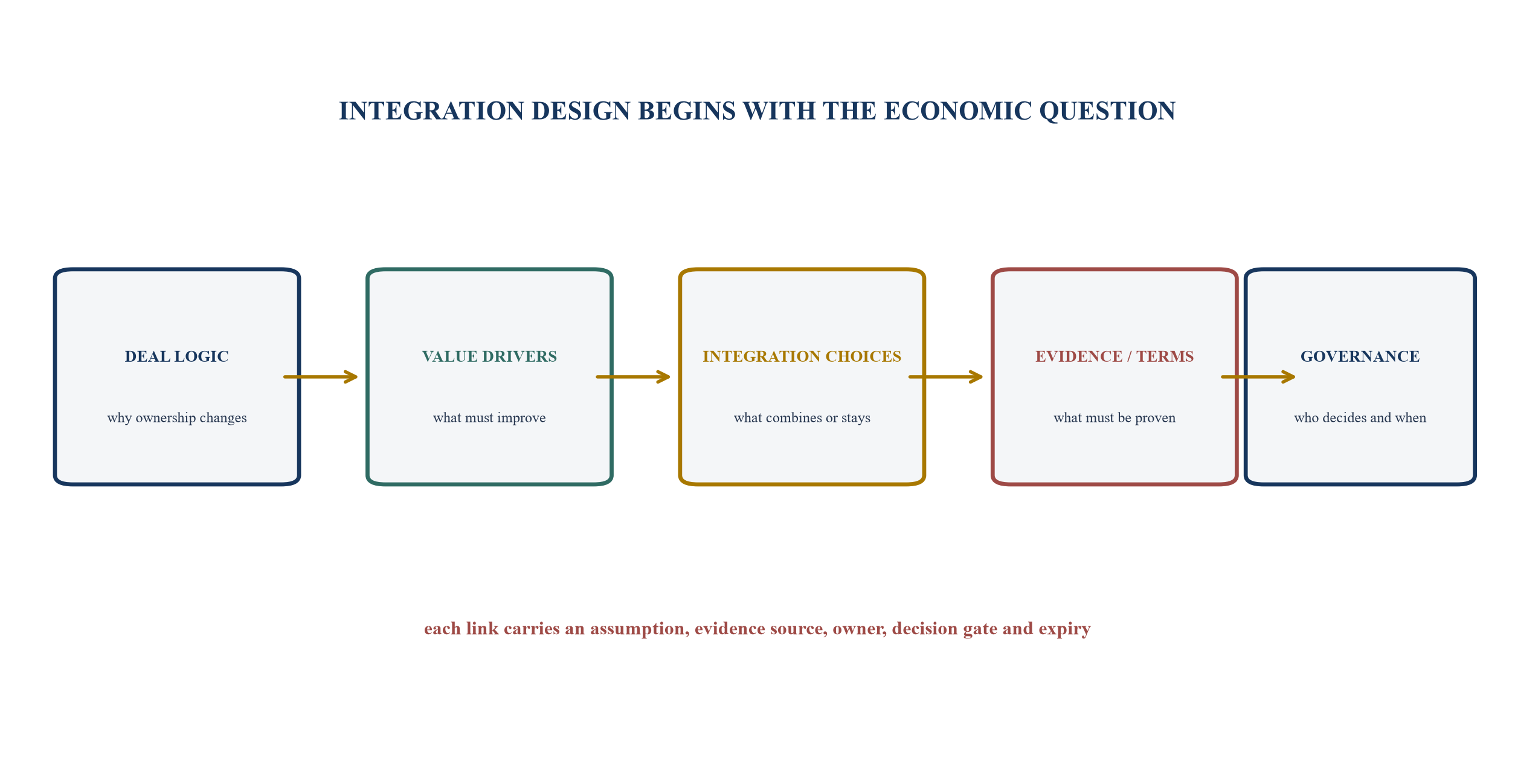
The board approves a connected chain of economic logic, operating choices, evidence and governance.
2. Define the acquisition thesis in measurable operating terms
Generic rationales such as growth, diversification, scale or capability are insufficient. The deal team should express the thesis as a limited set of measurable changes in customer economics, market access, product capability, cost structure, capital intensity, risk or strategic option value. Each value driver should identify the affected population, baseline, intervention, timing, investment, dependency and accountable executive.
A revenue thesis might depend on distributing the target's product through the buyer's channels. The integration implication is not simply to combine sales teams. Management must decide which customer segments, product bundles, territories, contracts, incentives, data and account ownership rules support the revenue hypothesis. It must also protect customer continuity while the evidence is tested.
A cost thesis might depend on procurement leverage and shared platforms. The implication is not to centralise everything. Management should identify categories where volume or standards create value, categories where local responsiveness matters, supplier termination costs, technical qualification, service-level risk and the systems required to measure actual savings.
A capability thesis may require preservation rather than absorption. A specialist engineering, research, advisory or software business can lose value when its decision speed, talent system, brand or product architecture is forced into a large-company model. The thesis should name the capability to preserve and define interfaces that allow the owner to govern capital, risk and outcomes without dismantling the source of value.
The board should ask whether each driver can be traced into an integration choice. A driver without an operating intervention is an aspiration. An intervention without a driver creates integration activity without a value rationale. The bridge between them becomes the organising logic for diligence, contract terms, sequencing and performance measurement.
3. Choose an integration mode for every material domain
Integration is not a binary choice between full combination and independence. A useful domain-level vocabulary includes combine, connect, coordinate, preserve, separate and exit. Combine creates one process or platform. Connect establishes controlled interfaces while retaining distinct operations. Coordinate aligns decisions or standards. Preserve protects a capability or identity. Separate creates a standalone perimeter. Exit removes an asset, product, contract or activity.
The mode can differ across domains. A buyer may combine treasury and financial control, connect customer data through governed interfaces, coordinate product roadmaps, preserve a regulated brand, separate an overlapping business required by a remedy and exit a legacy system. The end state should explain these combinations as one operating model.
Each choice requires an economic rationale and evidence. Full combination may produce scale while increasing migration, customer or regulatory risk. Preservation may protect revenue while retaining duplicate cost and control complexity. Connection may accelerate access while creating long-term interface and data-governance obligations. Separation may enable clearance or strategic focus while creating stranded costs and transition dependencies.
The integration thesis should state the default mode and the conditions that would change it. For example, a product platform may remain preserved until security testing, data migration and customer consent reach defined gates. This conditional design prevents the team from treating an early assumption as an irreversible programme commitment.
Table 1. Integration-mode decision matrix
| mode | operating meaning | value rationale | principal exposure | board evidence |
|---|---|---|---|---|
| combine | create one process, team, platform or policy | scale, control or customer simplicity | disruption, loss of local capability, migration failure | quantified value, dependency map, cutover test |
| connect | retain distinct operations with controlled interfaces | speed, flexibility or staged learning | interface cost, data lineage, split accountability | architecture, service levels, ownership and exit route |
| coordinate | align standards or decisions without full combination | consistency and leverage | slow decisions, ambiguous authority | decision-right map and escalation timetable |
| preserve | protect a capability, brand, culture or regulated perimeter | retain differentiated value | duplicate cost and weak group control | preservation rationale, control minimum and review date |
| separate | establish an independent or divestible perimeter | remedy, focus or optionality | stranded cost, transitional dependence | perimeter, separation cost, TSA and buyer readiness |
| exit | discontinue or dispose of an activity | remove drag, overlap or risk | revenue loss, obligations and execution cost | closure economics, stakeholder plan and approvals |
The modes are management choices that require transaction-specific evidence and authorised approval.
4. Put the thesis through a pre-signing deal funnel
The integration thesis should mature through the transaction stages. At initial screening, the team identifies the likely integration archetype, largest value drivers and possible disqualifying dependencies. Before indicative offer, it creates a domain-level mode map and a preliminary value bridge. During diligence, it tests the assumptions and converts gaps into requests, conditions or price protection. Before signing, it presents the board with a controlled thesis, open issues and contractual implications.
Each gate should require a minimum evidence standard. A strategic fit statement may be sufficient for early screening. A signing recommendation should show source-backed baselines, defined owners, implementation dependencies, cost ranges, customer and regulatory risks, and the decisions that cannot be reversed cheaply after closing.
The funnel should also expose contradictions. A model may assume rapid cross-selling while the integration plan preserves separate brands, sales incentives and customer data. A cost model may assume facility consolidation while the separation plan requires a remedy perimeter. A technology plan may assume immediate migration while contracts or data rules limit transfer. These conflicts should be resolved or quantified before the board relies on the value bridge.
A deal should pause when the integration thesis cannot explain how the economic logic becomes an operating result. The pause is a governance decision, not an assertion that the transaction is unattractive. Management may need more evidence, revised price, additional protections, a different integration mode or a clearer risk appetite.
5. Translate value drivers into a testable end state
The end state should be described through outcomes and interfaces rather than organisation charts alone. Customer outcomes include who owns the relationship, which proposition is offered, how service continuity is protected and how complaints or churn are measured. Product outcomes include roadmap authority, architecture, brand, pricing and support. Control outcomes include policy, data, finance, risk and regulatory accountability.
For every domain, management should answer five questions. What must be true for the value driver to work? What changes at closing, during the first 100 days and later? Which capability should remain intact? What evidence determines the next decision? Which failure mode would require a different route?
The answers form an integration decision record. The record links the end state to current-state evidence, dependencies, contract provisions, programme milestones and benefit measures. It also records dissent and rejected alternatives so later teams understand why a choice was made.
The board should see the end state as a portfolio of choices with different confidence levels. Customer coverage may be supported by contract and channel evidence. Technology consolidation may remain conditional on architecture discovery. Legal-entity simplification may depend on regulatory, tax and employee analysis. Confidence should reflect the evidence for each claim rather than a general red, amber or green label.
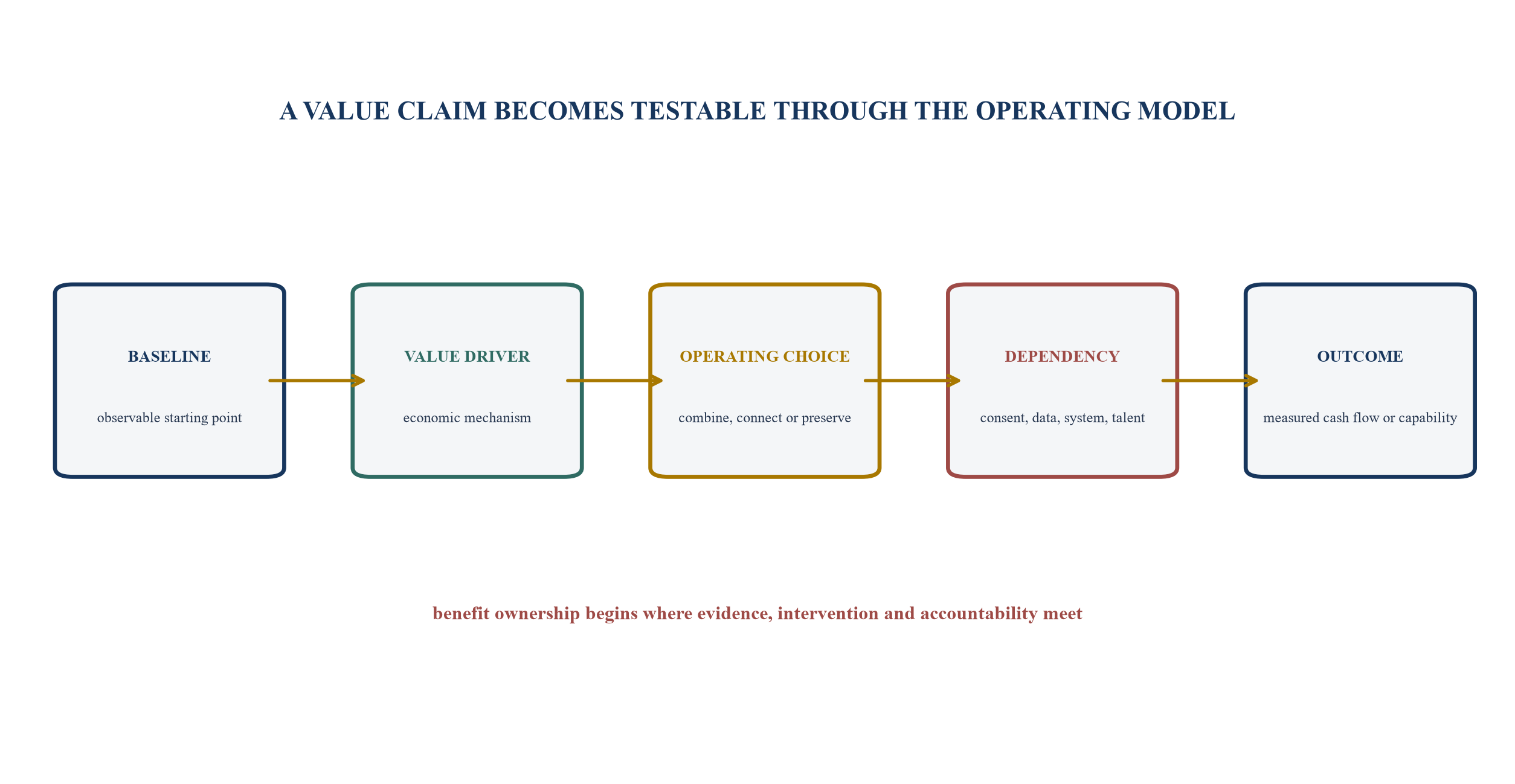
A measurable value driver needs a specific intervention, dependency and observed result.
6. Protect customer and revenue continuity
Revenue assumptions require customer-level design. The thesis should identify customer segments, contracts, renewal dates, concentration, service obligations, relationship owners, channel conflicts, pricing rules, consent requirements and data constraints. It should distinguish value from retaining current revenue, preventing disruption, improving conversion, expanding share of wallet and entering new markets.
The safest early decision is often to preserve the customer experience while testing the combined proposition. Branding, account ownership, invoicing, support and service levels can change at different speeds. A single announcement or legal close does not create a unified customer journey.
Cross-selling should be modelled as a funnel. The addressable installed base is narrowed by product fit, jurisdiction, contract, channel conflict, customer consent, sales capacity and conversion evidence. Gross pipeline should remain separate from contracted revenue, recognised revenue, margin and cash. The integration thesis assigns the work required at each stage.
Customer risk should enter the purchase agreement and close plan where relevant. Key contract consents, change-of-control clauses, service credits, data-transfer rules and concentrated renewals can alter value and sequencing. Management may require a closing condition, specific indemnity, purchase-price adjustment, retention plan, communication protocol or protected transition.
The customer dashboard should track continuity and value together. Measures can include retention, service incidents, renewal timing, complaint volume, order backlog, conversion, average selling price, contribution margin and cash collection. Hypothetical targets should be labelled as management assumptions and reconciled to the valuation model.
Table 2. Customer and revenue integration choices
| decision | evidence before signing | early operating choice | warning signal | accountable owner |
|---|---|---|---|---|
| account ownership | customer map, contracts, relationship history | preserve named owners through priority renewals | conflicting contact or lost escalation | commercial leader |
| proposition | product fit, use case and willingness evidence | pilot selected bundles by segment | pipeline without conversion or margin | product and sales leaders |
| pricing | price architecture, discount authority, channel terms | maintain controls and test harmonisation | unmanaged discounting or channel conflict | commercial finance |
| service | SLA, incidents, capacity and support model | protect continuity before consolidation | response-time deterioration or churn | operations leader |
| customer data | lawful basis, consent, security and access | use governed minimum-access design | uncontrolled transfer or identity mismatch | data owner and privacy lead |
| revenue reporting | contract, billing, recognition and cohort logic | reconcile commercial and statutory views | unexplained movement between entities or products | finance leader |
Measures and responses are illustrative management assumptions.
7. Decide how product, brand and innovation should interact
Product integration should begin with the customer problem and architecture, not a preference for one portfolio. The thesis should identify overlap, complementarity, dependencies, roadmap commitments, technical debt, intellectual property, regulatory status, support obligations and the product decisions that affect revenue or retention.
A brand may be a demand asset, a trust mechanism, a licence requirement or an employment proposition. Rebranding can simplify the portfolio while destroying recognition or channel access. The board should understand what the brand does economically before approving consolidation.
Roadmap authority needs an explicit owner. Separate product teams can preserve speed while creating duplicated engineering and incompatible architecture. Central control can improve standards while delaying customer commitments. A federated model can set group guardrails for security, data and capital while leaving domain product choices with accountable teams.
Innovation synergies should be stated as controlled options. Access to data, engineering, distribution or capital can expand the target's opportunity set, but each option requires resources, permissions and customer evidence. Management should avoid capitalising every possible combination into the acquisition price.
The product thesis should include stopping rules. A combined offering that misses adoption, margin, security or support thresholds should return to review. Preserved products should have a funding and architecture path. Legacy products scheduled for exit need customer migration, contractual and revenue-loss plans.
8. Design organisation and decision rights around value
Organisation design should follow the integration thesis. The board first identifies capabilities, decisions and interfaces; it then assigns leaders and reporting lines. Starting with names can bias the structure toward incumbency or political compromise.
Critical roles include leaders who own value drivers, customer continuity, product decisions, functional controls, integration workstreams and the acquired business. The thesis should distinguish permanent operating authority from temporary programme authority. An integration leader coordinates delivery but should not become an unbounded substitute for line management or the buyer's formal governance.
Retention decisions should focus on roles, knowledge and relationships. A list of senior employees may miss engineers, operators, account managers or control owners whose departure would interrupt the thesis. The team should map critical-role dependency, succession, authorisation, work eligibility, incentives, notice periods and knowledge transfer.
Decision rights should state who proposes, tests, approves, executes and reviews each material choice. High-risk decisions include customer migration, product retirement, platform cutover, workforce restructuring, supplier termination, legal-entity change, policy harmonisation and benefit recognition. Authority should align with the acting entity and applicable law.
Culture should be treated as observed operating behaviour. The team can compare decision speed, escalation, customer ownership, risk appetite, performance management, information flow and accountability. The integration design then protects behaviours that create value and changes behaviours that obstruct the intended operating model.
9. Make technology, data and cybersecurity part of the deal thesis
Technology integration is often the critical path for customer, finance and operating synergies. The thesis should identify the systems of record, architecture, interfaces, licences, cloud and supplier dependencies, identity model, data classification, cyber posture, technical debt, resilience requirements and cutover constraints.
The board should distinguish platform strategy from migration schedule. Selecting a strategic platform does not prove that data, process and controls can move safely within the valuation timetable. A conditional migration plan can preserve critical systems until the combined organisation has tested data quality, access, performance, security, rollback and continuity.
NIST Cybersecurity Framework 2.0 places governance alongside identify, protect, detect, respond and recover. Its supply-chain guidance is relevant when an acquisition introduces technology suppliers, products, services or dependencies into the buyer's risk perimeter. The integration thesis should assign governance for inherited vulnerabilities, third-party access, identity, logging, incident response, backups and recovery.
Data combination requires legal, semantic and technical evidence. The United Kingdom Information Commissioner's Office states that data sharing following a merger or acquisition should be considered during due diligence when information moves to a different or additional controller. The thesis should identify lawful basis, transparency, purpose limitation, security, retention, data-subject rights and cross-border transfer requirements with qualified advice.
The cyber and data plan should enter closing readiness. Minimum gates can include privileged-access control, high-risk vulnerability treatment, incident escalation, backup validation, identity separation or federation, supplier review, data-transfer protocol and a tested response route. These controls protect continuity while the long-term architecture remains under review.
Table 3. Technology, data and cybersecurity decision gates
| gate | evidence | decision | failure response | owner |
|---|---|---|---|---|
| architecture | system map, interfaces, capacity and lifecycle | strategic platform and interim connection | preserve system and fund remediation | technology leader |
| identity | directories, privileged users, joiner and leaver controls | separate, federate or migrate access | isolate high-risk access and review manually | security leader |
| data | inventory, ownership, quality, lawful basis and retention | transfer, map, restrict or delete | quarantine dataset and obtain advice | data and privacy owners |
| cyber | vulnerabilities, incidents, monitoring and response | Day One minimum and remediation sequence | isolate exposure and activate response governance | security leader |
| resilience | critical services, backup, recovery and supplier dependency | cutover threshold and rollback | defer cutover and maintain parallel operation | operations leader |
| licences | contracts, assignment, usage and termination rights | consolidate, novate or retain | negotiate transition or alternative | procurement and legal |
The gate owner should retain evidence and approve only within delegated authority.
10. Establish the finance, reporting and control model
The finance thesis connects acquisition accounting, statutory reporting, management reporting, treasury, tax, internal control and benefit measurement. IFRS 3 establishes recognition and measurement requirements for identifiable assets, liabilities, goodwill and disclosures. The integration programme should preserve the evidence and operating information required for those judgements.
The board should separate purchase-price allocation, management value bridge and integration benefit ledger. They answer different questions. Acquisition accounting measures the transaction under applicable standards. The value bridge explains the investment case. The benefit ledger records approved interventions, baselines, costs and observed outcomes. Reconciliation makes the differences visible.
Closing readiness requires authority over cash, banking, payment, accounting, credit, procurement and reporting. The buyer may retain target processes temporarily while establishing group oversight. The thesis should state which controls apply on Day One, which processes remain under transition and which exceptions require approval.
Management reporting should preserve continuity during chart-of-accounts, entity and system changes. A controlled crosswalk connects target history, contract metrics, group reporting and the benefit ledger. Manual adjustments receive source evidence, approval and expiry. The board should know when a reported improvement reflects performance, classification, perimeter or policy change.
Treasury should model purchase price, fees, integration cost, working capital, tax, financing, one-time separation cost, delayed benefit and downside liquidity. Synergy timing should not be used as a substitute for committed funding. The integration thesis connects programme gates to the sources and uses of cash.
11. Convert procurement and supply-chain scale into resilient value
Procurement value depends on category economics, technical requirements, supplier power, contract rights, transition cost and service risk. The thesis should distinguish price leverage, specification standardisation, demand reduction, supplier consolidation, payment terms and process efficiency.
Supplier consolidation should follow a criticality assessment. A lower unit price can increase concentration, switching or resilience risk. NIST supply-chain guidance supports governance of supplier requirements and risk. Operational categories may require qualification, inventory buffers, dual sourcing, regulatory approval or customer notification before change.
The contract review should identify assignment, change of control, minimum volume, exclusivity, termination, rebate, data, security, audit, service-level and liability provisions. A synergy estimate that ignores these obligations is incomplete. The SPA or transition plan may need consents, access, cooperation or protection for identified dependencies.
The procurement workstream should maintain a gross-to-net benefit bridge. Gross price or volume opportunity is reduced by termination cost, implementation expense, lost rebates, duplicate inventory, qualification cost, dis-synergy, service risk and the time required to reach steady state. Finance approves the baseline and observed outcome.
Supplier communication should be sequenced with legal and operational control. Before closing, each party remains responsible for its business and information protocols. After closing, category owners should protect supply while executing approved sourcing waves. Material change enters governance before commitments are made.
12. Map legal entities, licences, contracts and regulatory perimeters
Legal-entity simplification can reduce cost and complexity, but the operating model may depend on licences, tax attributes, contracts, employment, financing, customer requirements or local ownership. The thesis should identify the purpose of each entity and the approvals, obligations and timing associated with change.
Contract migration is a programme, not a clerical exercise. The team should map counterparties, assignment and novation requirements, change-of-control rights, guarantees, security, licences, data provisions, service obligations, termination and governing law. Priority follows value, criticality, consent lead time and downside exposure.
Regulated businesses may require preserved governance, capital, systems, people or reporting. The board should distinguish group oversight from local legal responsibility. Integration committees should not direct a regulated entity outside authorised channels or override responsibilities assigned by law or licence.
Merger remedies can reshape the integration thesis. A divestiture, access obligation, firewall, non-discrimination commitment or other condition may require a separate perimeter and continuing controls. The United Kingdom Competition and Markets Authority's December 2025 remedies guidance addresses the selection, design and implementation of remedies. The thesis should model the operational consequence of plausible conditions before signing.
The legal and regulatory map should connect each requirement to the transaction timetable. Filing, clearance, consent, consultation, employee process, financing condition and long-stop date influence what can be promised and when. Qualified advisers determine the applicable requirements.
13. Separate Day One, the first 100 days and the long-term end state
Day One should establish lawful control, continuity, authority, communication, cash protection, critical access, incident response and governance. It should avoid unnecessary change. The first 100 days should test and execute the highest-value reversible decisions while stabilising risk. The long-term plan completes structural and platform choices after evidence and capability are sufficient.
This horizon design prevents two common errors. The first is forcing end-state migration into Day One and increasing disruption. The second is treating transition arrangements as indefinite. Every temporary process, access route, duplicate control or transitional service should have an owner, cost, service level, exit criterion and review date.
Dependencies should determine sequence. Customer communication may depend on regulatory clearance and operating readiness. Product bundling may depend on pricing, contract, billing and support. Finance migration may depend on data mapping and control testing. Legal-entity change may depend on tax, employee, licence and contract steps.
The critical path should be explicit. It identifies the small number of dependencies that determine value timing or continuity. Programme reporting should show the decision or evidence required to move each critical item, rather than presenting hundreds of activities with equal importance.
The board approves the horizon logic and the stop conditions. A failed cutover rehearsal, unresolved security issue, missing consent, unacceptable customer risk or unproven benefit can delay a step without invalidating the entire acquisition thesis. The decision record preserves the rationale.
14. Plan integration without taking pre-closing control
Signing does not necessarily transfer operational control. The integration team should distinguish planning, permitted information exchange, consent rights and coordination from direction of the target's ordinary-course decisions. Applicable competition rules and transaction terms require qualified legal assessment.
The United States Federal Trade Commission has described gun jumping as unlawful pre-merger coordination and, in a January 2025 enforcement announcement, identified alleged pre-closing operational and decision-making control over significant business activities. The FTC also advises parties to establish a process that monitors and controls competitively sensitive information during diligence and negotiations.
The Competition Commission of India states that parties undertaking due diligence and post-signing integration planning should be cautious that their conduct does not violate standstill obligations. Canada imposes waiting periods for notifiable transactions. The European Union, United Kingdom, UAE, Saudi Arabia, Singapore and Australia apply their own review, standstill or process requirements.
A clean-team protocol should define the permitted purpose, people, information, aggregation, storage, use and destruction. It should identify decisions that remain with each party, restricted subjects, legal review and escalation. Information provided for valuation or planning should not become a mechanism for coordinating prices, customers, output, strategy or other competitive behaviour.
Pre-close planning can still be specific. Teams can define hypotheses, interfaces, workstreams, decision gates, Day One controls, communication drafts, data fields and post-close test plans. Execution begins only when the relevant authority and conditions permit it.
Table 4. Pre-closing integration-control protocol
| activity | planning purpose | control | retained authority | escalation trigger |
|---|---|---|---|---|
| customer analysis | test value thesis and continuity | clean team, aggregation and limited output | each party manages its customers | identifiable sensitive data or proposed coordination |
| pricing review | understand economics and architecture | restricted historical analysis | each party sets its prices | future pricing instruction or exchange |
| supplier analysis | identify dependencies and opportunity | limited contract review and clean team | each party manages suppliers | joint negotiation or operational direction |
| technology planning | map interfaces and Day One risks | controlled technical access and logging | each party operates its systems | production change or unrestricted access |
| organisation design | identify roles and decision structure | role-based planning with employment advice | seller retains workforce authority | instruction, selection or communication outside protocol |
| integration governance | prepare post-close workstreams | shadow plan with no operating mandate | boards and management retain current authority | action that could transfer beneficial control |
Qualified competition counsel should determine the permitted route for the transaction and jurisdictions involved.
15. Turn diligence findings into integration decisions
Diligence should produce an evidence-to-action register. Each material finding states the fact, source, date, perimeter, confidence, value or risk consequence, integration choice, contract implication, owner and next test. This prevents important findings from disappearing into separate reports after signing.
Commercial diligence informs customer, product, market and channel choices. Financial diligence establishes earnings, cash, working capital and cost baselines. Operational diligence identifies capacity, resilience, process and supplier dependencies. Technology and cyber diligence inform architecture, security and migration. Legal, tax, regulatory, people and environmental workstreams establish boundaries and obligations.
The integration thesis should reconcile cross-workstream conclusions. Revenue growth may require sales capacity that is absent from the operating plan. Procurement savings may conflict with technical qualification. Entity simplification may conflict with licensing. Data combination may conflict with purpose or consent. A single register makes these dependencies visible.
Evidence quality should shape commitment. Verified contract or system data can support a different confidence level from management representation, sample, estimate or external market assumption. The board should see the source class and sensitivity for every material value claim.
Open questions should become controlled conditions. Management can request further diligence, adjust price, change structure, add a contractual protection, create a closing condition, budget remediation, defer an integration decision or accept the risk explicitly. Silence should not turn an unresolved assumption into an approved fact.
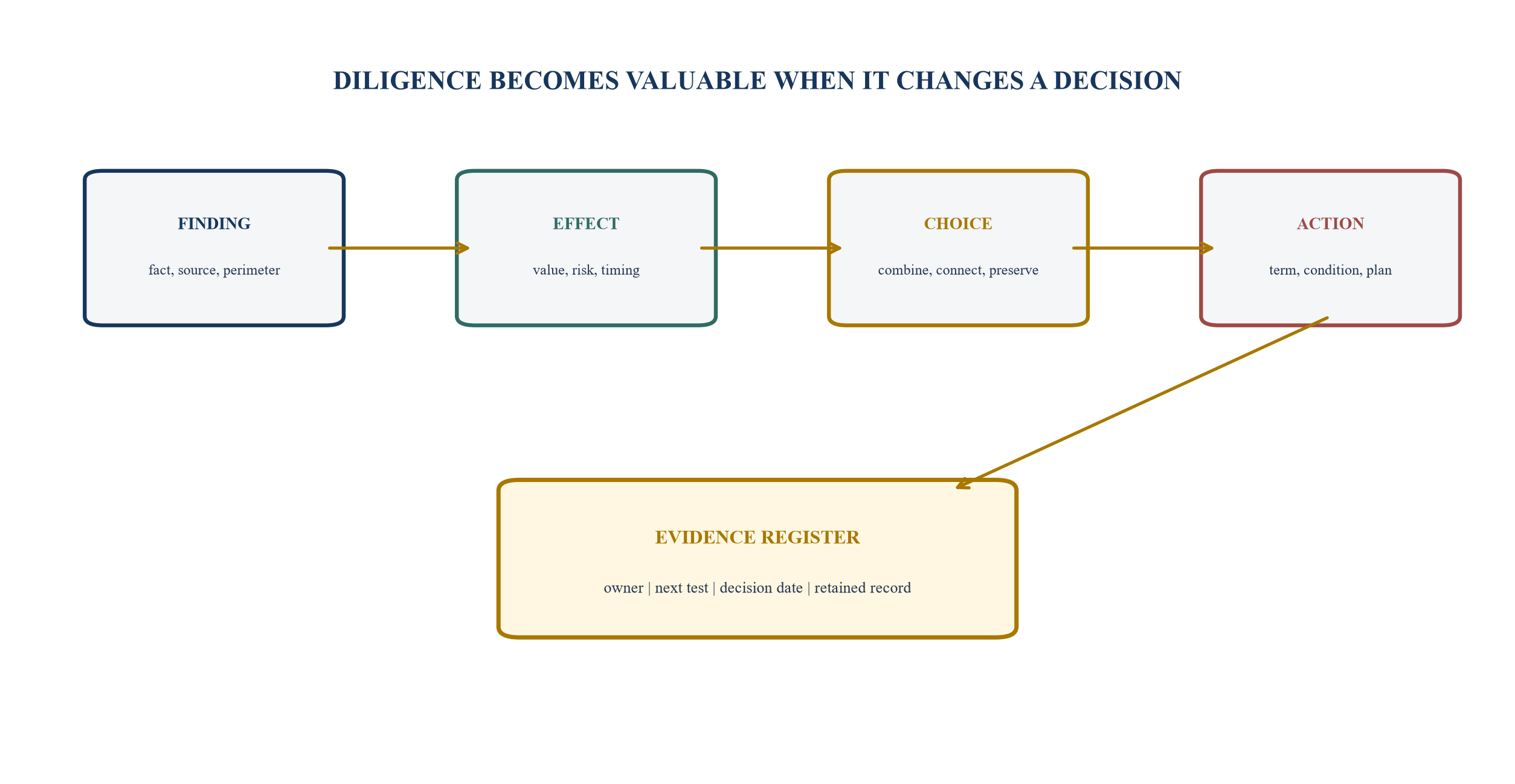
Findings become actionable when their economic effect and operating response are assigned.
16. Build a gross-to-net synergy and value bridge
The value bridge should begin with operating baselines and specific interventions. It separates revenue, gross margin, operating cost, working capital, capital expenditure, tax, integration cost, dis-synergy, stranded cost and timing. Each line identifies the source system, formula, owner, dependency and approval status.
Revenue opportunity is reduced by conversion, churn, cannibalisation, discount, implementation capacity, margin and timing. Cost opportunity is reduced by termination, redundancy, migration, remediation, dual running and service risk. Working-capital improvement is separated from earnings. Avoided cost is separated from realised reduction.
The bridge should show one-time and recurring effects. A three-year cash view can reveal that an apparently attractive annual synergy requires significant early funding or produces a delayed payback. Financing covenants, distributions, earnouts and management incentives may use different definitions and require reconciliations.
Benefit recognition needs a controlled baseline. Finance validates the starting point, approved intervention and observed result. Changes in volume, price, mix, exchange rate, policy, perimeter and external conditions are bridged. The operating owner explains the mechanism; finance controls the financial classification.
The board should review confidence-weighted scenarios while preserving the underlying gross and net lines. A probability or scenario adjustment does not replace evidence. It shows how uncertainty affects price, funding and risk appetite.
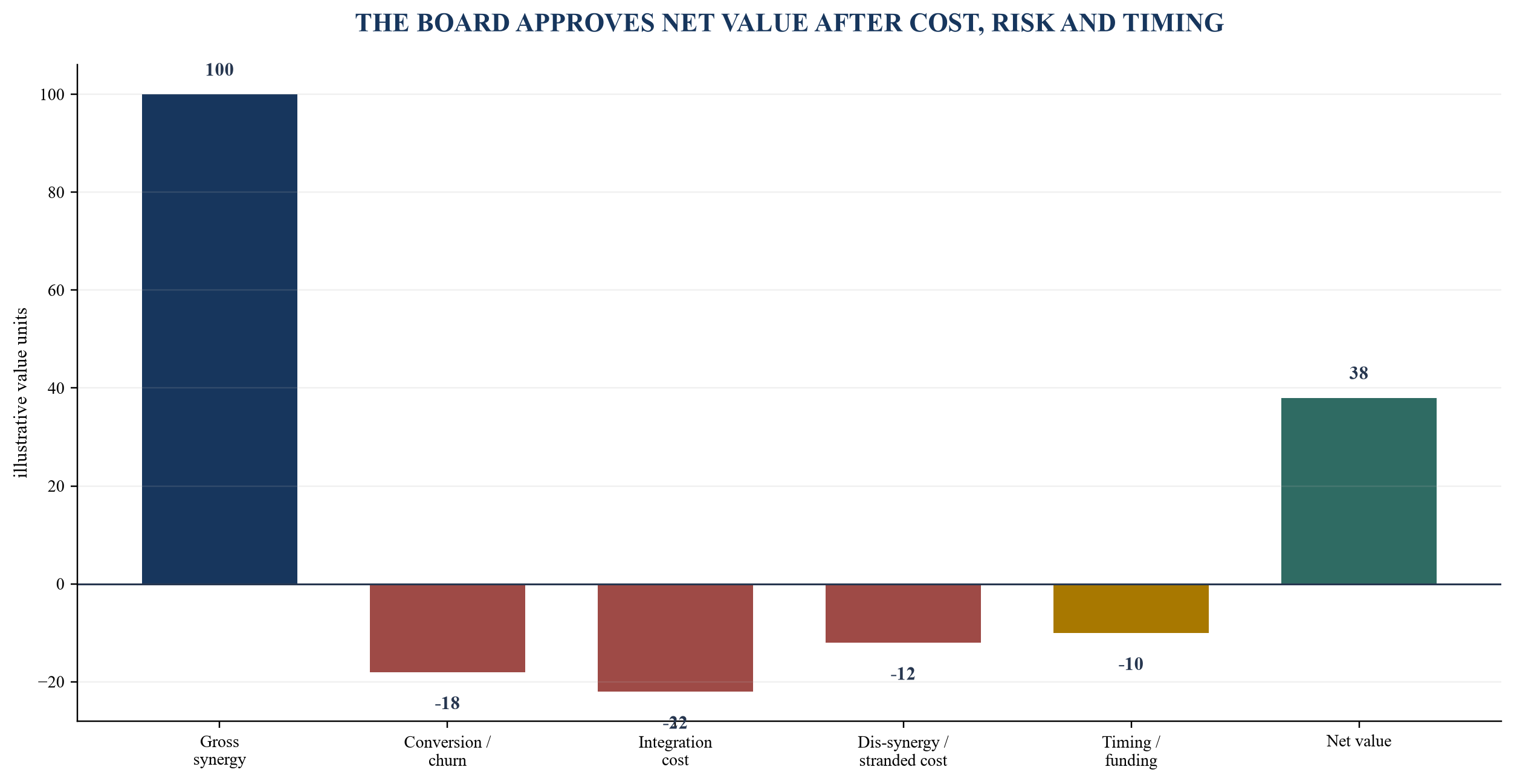
Values are hypothetical management assumptions shown only to demonstrate the bridge.
Table 5. Synergy and value register
| field | purpose | evidence | control owner | board use |
|---|---|---|---|---|
| baseline | establish the starting economic state | diligence data reconciled to reporting | finance | test valuation consistency |
| intervention | describe the operating action | approved workstream decision | operating executive | confirm causal mechanism |
| gross opportunity | show the undiluted value pool | customer, spend, capacity or process data | strategy and finance | compare opportunity across domains |
| costs and dis-synergies | identify price of change and value leakage | contracts, implementation plan and risk analysis | programme finance | fund execution and protect liquidity |
| dependency | state what must occur first | consent, system, talent, supplier or regulatory evidence | workstream owner | evaluate confidence and critical path |
| observed outcome | record realised financial and operating effect | controlled ledger and source reconciliation | finance and benefit owner | approve reported value and next gate |
The register keeps gross opportunity, required investment and observed outcome separate.
17. Design transitional services, separation and stranded-cost exits
An acquisition can depend on services supplied by the seller, a parent, a shared platform or a divested business. The thesis should identify every transitional dependency before signing and connect it to a service description, owner, volume, standard, security requirement, price, duration, exit plan and remedy for failure.
A transitional services agreement should support a defined migration or separation. It should not conceal an unknown operating model. The buyer should understand which people, systems, licences, data, facilities, suppliers and controls are required to replace the service.
Exit readiness requires milestones and evidence. A technology service may need environment build, data migration, identity setup, interface test, control approval, cutover rehearsal and rollback. A finance service may require bank authority, ledger, tax, reporting, payment and close capability. Each service has a latest safe decision date.
Stranded costs should enter the value bridge. Shared costs may remain after an asset or business is removed. The seller or buyer needs an accountable plan to terminate, repurpose, resize or absorb the cost. Allocated cost is not automatically avoidable cash.
Separation also protects optionality. A target capability that may be divested or subject to remedy can be managed through a clear perimeter and interfaces. The board weighs optionality against duplicate cost and operating complexity.
18. Create integration governance with decision velocity
Governance should move material decisions quickly while preserving entity authority, evidence and escalation. The structure normally includes the buyer board or investment committee, an executive steering group, an integration leader, workstream owners, finance control and specialist legal, regulatory, data, cyber, tax and people functions.
The integration leader maintains the integrated plan, dependencies, decision log, risk, benefit register and escalation. Workstream leaders own operating results. Finance controls baselines and benefit recognition. The board approves material changes to the investment case, risk appetite, funding, structure and reserved matters.
Every decision paper should state the question, alternatives, recommendation, evidence, financial effect, customer and control impact, dependencies, authority, implementation owner and expiry. A decision that remains pending past its latest safe date should escalate automatically.
Governance should include preserved-business representation where the thesis depends on target capability. The acquired team can identify customer, product and operating consequences that group functions may miss. Participation does not remove formal authority or conflict controls.
Meeting volume is not governance quality. The board should measure decision time, ageing, reopenings, condition closure, evidence quality, critical-path movement, benefits, cost and control exceptions. A programme with many green activities can still be late on the few decisions that determine value.
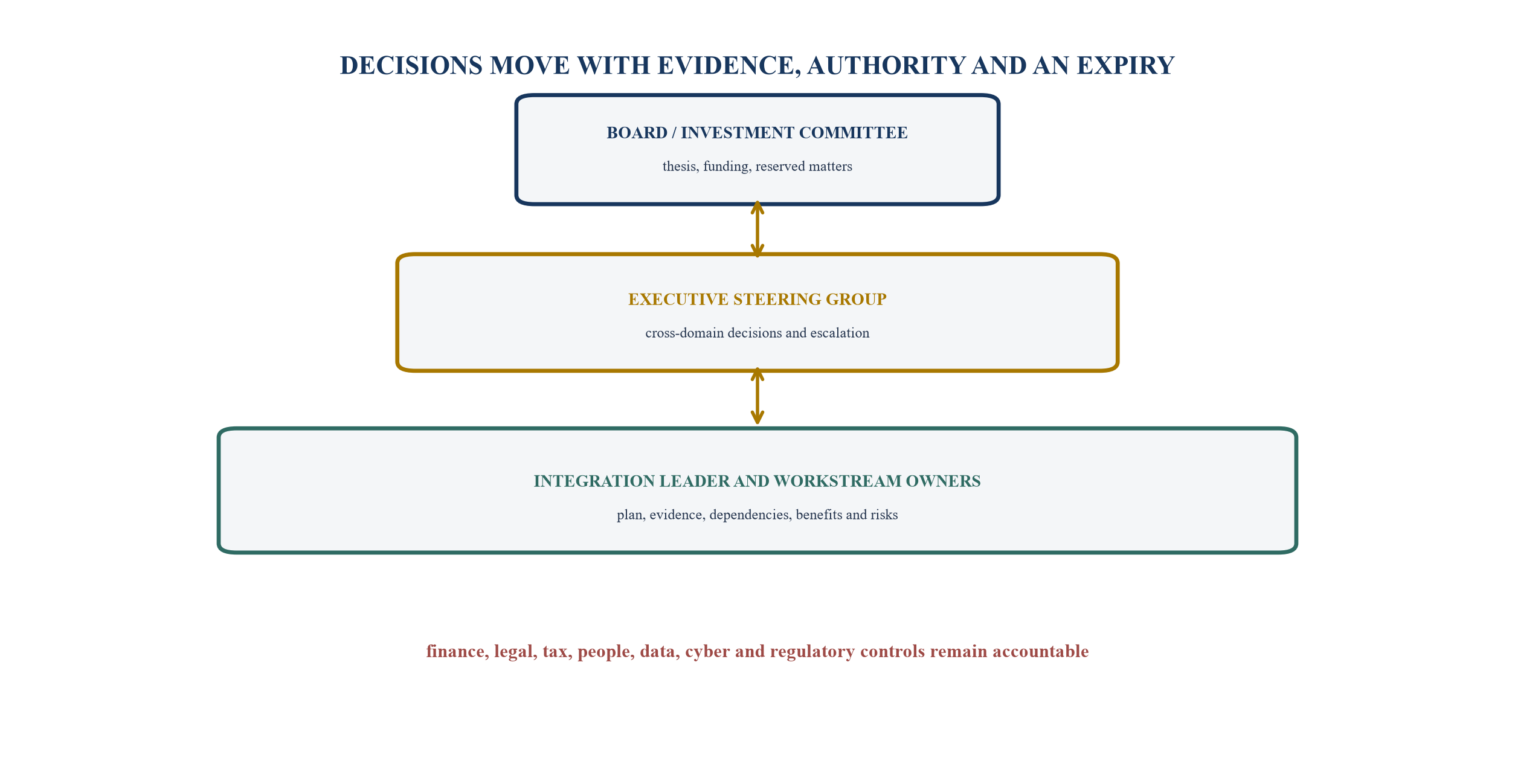
Authority remains with the relevant governing body and delegated executive.
19. Measure value, continuity and integration quality together
The scorecard should combine economic outcomes, customer continuity, operating performance, critical dependencies, control and programme health. A single synergy total cannot show whether the operating model is becoming more resilient or whether short-term value has been purchased through hidden risk.
Economic measures can include revenue retention, conversion, gross margin, controllable cost, working capital, capital expenditure, integration spend and net cash benefit. Operational measures can include service, quality, backlog, capacity, incident, supplier and cutover performance. Control measures include access, reconciliation, policy exceptions, regulatory commitments, data quality and evidence completeness.
Measures should connect to the thesis. If value depends on preserving specialist capability, the scorecard can track critical-role retention, delivery quality, decision speed and product milestones. If value depends on cross-selling, it can track qualified addressable accounts, offers, wins, margin and retention rather than gross pipeline alone.
The scorecard should bridge change. Perimeter, policy, system, price, volume, mix and timing effects are separated where material. Finance controls the calculation while operating owners explain the intervention and result. Hypothetical targets remain clearly identified as management assumptions.
The board should review leading and lagging evidence. Milestone completion, data readiness, customer consent and cutover tests indicate whether value is becoming possible. Revenue, cash and realised cost show the observed result. Both views matter.
Table 6. Board integration scorecard
| dimension | leading evidence | observed result | escalation question | owner |
|---|---|---|---|---|
| customer | consent, communication and service readiness | retention, incidents, revenue and margin | is change protecting the customer thesis? | commercial leader |
| product | roadmap decisions, architecture and support readiness | adoption, delivery, quality and contribution | is the portfolio choice creating measurable value? | product leader |
| people | critical-role coverage, retention action and authority | attrition, productivity and decision time | are capability and accountability intact? | business and people leaders |
| technology and data | access, mapping, security and cutover tests | availability, incidents, data quality and cost | can the next migration gate be approved? | technology and data leaders |
| finance and value | baseline, intervention, cost and reconciliation | net cash benefit, working capital and spend | is reported value controlled and funded? | finance leader |
| governance | decision age, condition closure and evidence quality | critical-path movement and control exceptions | does authority match the risk and timetable? | integration leader and board |
Thresholds and outcomes are illustrative management assumptions.
20. Apply the framework to a hypothetical acquisition
Consider a hypothetical industrial technology group acquiring a regional maintenance-software and field-services company for USD 180 million. Management expects value from customer retention, software cross-selling, procurement, working capital and shared infrastructure. All amounts, time periods and outcomes are hypothetical management assumptions.
The initial deal thesis assumes USD 14 million of annual gross opportunity by the end of year three. The first integration draft proposes combining sales, finance, procurement, cloud infrastructure and legal entities. Diligence shows that the target's revenue depends on long-term service contracts, local licences, specialist engineers, customer-specific data and a software platform linked to field operations.
The team restates the thesis. It will preserve the operating brand and engineering capability, coordinate product roadmap and pricing, connect customer and financial data through controlled interfaces, combine treasury and selected group controls, stage procurement waves, and defer legal-entity and platform consolidation until licence, contract, data and resilience gates are met.
The customer workstream maps 220 accounts and identifies 18 priority contracts representing a hypothetical 48 per cent of revenue. Six contain consent or notification provisions. The integration thesis protects existing account owners through the next renewal cycle and pilots cross-selling with a limited cohort after service and data readiness.
The product workstream finds that immediate bundling would require changes to billing, support and data. It creates a six-month pilot with an agreed standalone-price method, customer eligibility, support ownership and margin threshold. Product architecture remains connected rather than combined during the test.
Technology diligence identifies two high-risk vulnerabilities, an unsupported database and incomplete asset inventory. Day One gates require privileged-access review, incident escalation, backup validation and isolation of the vulnerable service. The long-term platform choice remains conditional on a parallel performance and data-migration test.
Procurement analysis estimates a hypothetical USD 4 million gross opportunity. Contract termination, qualification, inventory and service risk reduce the management case to USD 2.1 million. The first wave covers non-critical categories; engineered components remain with existing suppliers until qualification and resilience evidence is complete.
Finance establishes separate acquisition-accounting, management-value and benefit records. The board funds USD 11 million of integration and remediation rather than assuming the annual gross opportunity will fund early cash needs. Working-capital improvement is tracked separately from earnings.
The regulatory map shows review requirements in two jurisdictions. Clean-team protocols restrict customer, price and supplier data. Each party continues to operate independently before lawful closing. The teams prepare decisions and Day One controls without directing the target's business.
Before signing, the board receives the end-state mode map, gross-to-net bridge, critical path, Day One gate, customer continuity plan, cyber remediation, transitional dependencies, open evidence register and proposed contract protections. It approves the transaction subject to defined diligence closure and funding conditions.
At the end of the first 100 days, the hypothetical company has retained priority customers, completed the product pilot, executed the first procurement wave, remediated critical vulnerabilities and maintained service performance. These outcomes do not establish that the framework assures value. They illustrate how pre-signing integration choices can be tested through accountable post-closing execution.
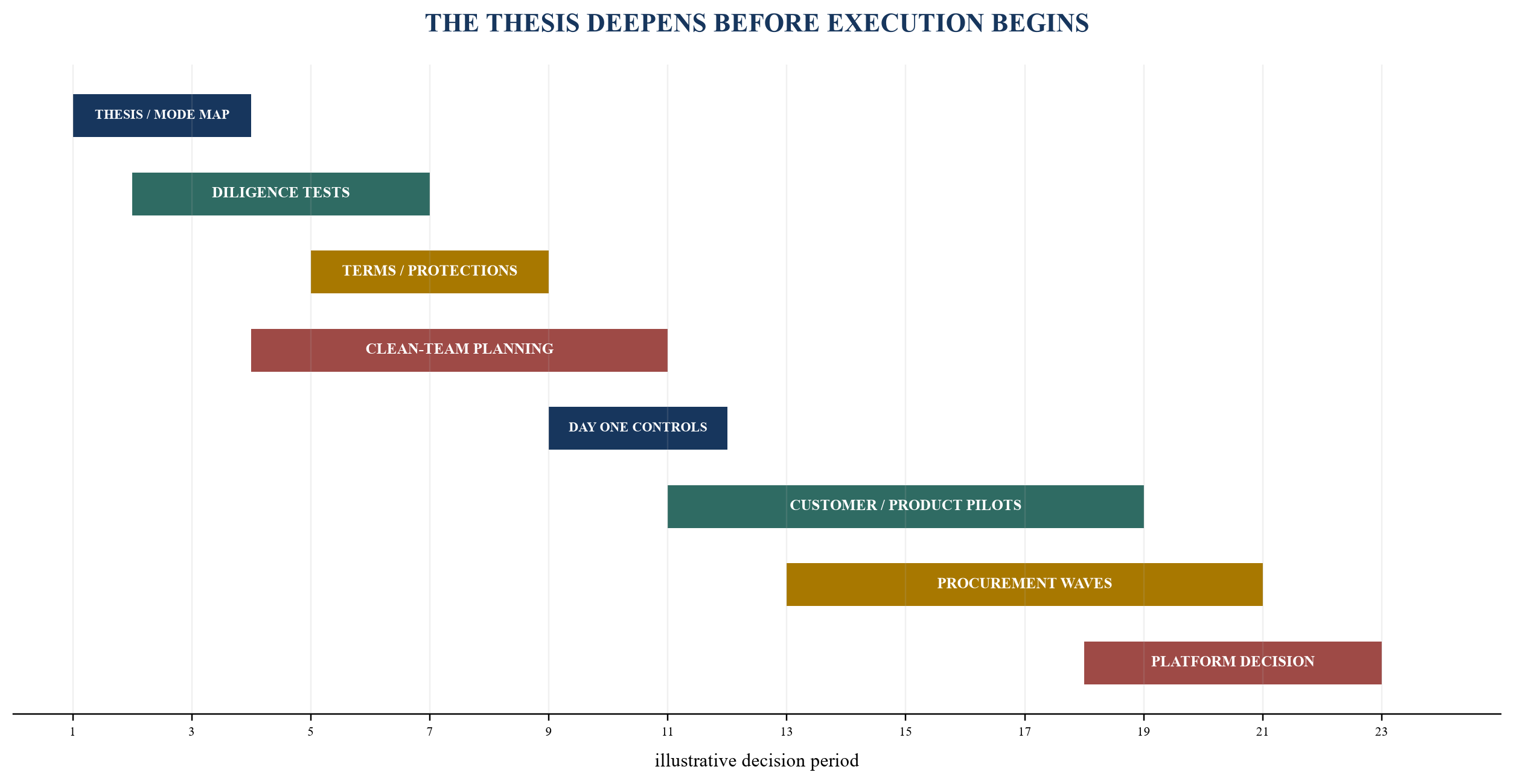
Timing and outcomes are hypothetical management assumptions.
21. Complete a 90-day pre-signing readiness programme
The first 30 days should establish the economic and operating hypotheses. The deal team defines value drivers, integration archetype, domain modes, principal customer and capability dependencies, preliminary value bridge, regulatory perimeter and evidence requests. The investment committee confirms the questions that must be answered before price or structure advances.
Days 31 to 60 should test the thesis through diligence. Workstreams populate the evidence-to-action register, reconcile cross-domain dependencies, identify Day One controls, quantify cost and dis-synergy, map transitional services, design the clean-team protocol and determine which assumptions require a contract term, condition, consent or further test.
Days 61 to 90 should prepare the signing decision. Management completes the end-state mode map, customer continuity plan, product and technology gates, organisation and critical-role design, finance and benefit model, legal-entity and regulatory path, integration governance, critical path, downside scenarios and funded 100-day plan.
The board gate should require nine conclusions. The acquisition thesis is measurable. Each value driver has an operating intervention. Each material domain has a stated integration mode. Customer and critical-capability continuity are protected. Technology, data and cyber dependencies are visible. Regulatory and pre-close boundaries are mapped. Costs, dis-synergies and funding are included. Open evidence has an owner and consequence. The post-close governance can make decisions at the required speed.
The readiness review should include a reverse stress test. Management asks which combination of delayed consent, customer loss, migration failure, supplier disruption, talent departure, remedy or cost overrun would remove the investment case. The answer informs price, conditions, financing, sequencing and risk appetite.
The integration thesis remains a controlled management document after signing. New evidence can change a domain mode, sequence or value estimate through authorised governance. The board retains the connection between the original deal logic, approved operating choices and observed results.
An acquisition should enter signing with a credible route from ownership change to operating value. The thesis does not predict the outcome. It creates a disciplined basis for choosing what to combine, what to connect, what to preserve, what to separate and what evidence must arrive before the next irreversible decision.
Sources and further reading
- IFRS Foundation, IFRS 3 Business Combinations Official source
- IFRS Foundation, IFRS 3 Business Combinations Standard PDF Official source
- IFRS Foundation, Business Combinations Disclosures, Goodwill and Impairment Discussion Paper Official source
- Financial Accounting Standards Board, Accounting Standards Update 2025-03 Business Combinations and Consolidation Official source
- Public Company Accounting Oversight Board, AS 2501 Auditing Accounting Estimates Official source
- United States Securities and Exchange Commission, Cybersecurity Risk Management Strategy Governance and Incident Disclosure Official source
- National Institute of Standards and Technology, Cybersecurity Framework 2.0 Official source
- National Institute of Standards and Technology, CSF 2.0 Quick-Start Guide for Cybersecurity Supply Chain Risk Management Official source
- United Kingdom Information Commissioner's Office, Due Diligence When Sharing Data Following Mergers and Acquisitions Official source
- United States Federal Trade Commission, Oil Companies to Pay Record Gun-Jumping Fine Official source
- United States Federal Trade Commission, Avoiding Antitrust Pitfalls during Pre-Merger Negotiations and Due Diligence Official source
- United States Department of Justice, 2023 Merger Guidelines Overview Official source
- United States Department of Justice, Merger Guideline on Products or Services Rivals Use to Compete Official source
- European Commission, EU Merger Control Legislation Official source
- European Commission, Review of the Merger Guidelines Official source
- United Kingdom Competition and Markets Authority, Merger Assessment Guidelines 2026 Official source
- United Kingdom Competition and Markets Authority, Merger Remedies Guidance 2025 Official source
- United Kingdom Competition and Markets Authority, Mergers Charter Official source
- United Arab Emirates Ministry of Economy and Tourism, Economic Concentration Official source
- United Arab Emirates Ministry of Economy and Tourism, Regulation of Competition Official source
- United Arab Emirates Ministry of Economy and Tourism, Cabinet Decision No. 3 of 2025 on Economic Concentration Thresholds Official source
- Saudi Arabia General Authority for Competition, Economic Concentration Review Guidelines Official source
- Competition Bureau Canada, Overview of the Merger Review Process Official source
- Competition and Consumer Commission of Singapore, Merger Assessment Process Official source
- Competition Commission of India, Combination Frequently Asked Questions Official source
- Competition Commission of India, Regulation of Combinations Official source
- Australian Competition and Consumer Commission, Merger Reform Frequently Asked Questions 5 August 2026 Official source
- Australian Competition and Consumer Commission, Merger Reform Official source
- Organisation for Economic Co-operation and Development, Merger Control Official source
- United States Cybersecurity and Infrastructure Security Agency, Cross-Sector Cybersecurity Performance Goals Official source
