

1. Treat activism around M&A as a decision problem
An activist challenge can arise before signing, between signing and closing, after a failed vote, during a regulatory delay or after completion. It can oppose an acquisition, demand a sale, challenge a disposal, seek a break-up, criticise a retained business or propose an alternative transaction. The board's task is to determine which course creates the best risk-adjusted outcome for the company and its shareholders within the applicable duties, transaction documents and market rules.
The first discipline is to convert rhetoric into decision propositions. A campaign may assert that the price is inadequate, the premium is illusory, the process was constrained, management is conflicted, synergies are overstated, separation costs are understated, regulation will prevent closing or the company has a superior standalone route. Each proposition needs a defined test, evidence owner and decision consequence.
The board should preserve four options from the outset: defend the signed thesis, seek improved terms, reconstruct the transaction, or pursue a different strategy. Reconstruction can include changing consideration, perimeter, financing, remedies, governance, transition support, stakeholder commitments or sequencing. An alternative can include remaining standalone, separating a division, undertaking a recapitalisation, selling another asset, inviting competing proposals or terminating the process where permitted.
The board's record should show that it considered material facts, conflicts, alternatives, advice and changed conditions. The G20/OECD Principles state that boards should act on a fully informed basis and oversee major acquisitions and divestitures. They also call for transparent and fair rules governing corporate control and substantial asset sales. [1] That standard supports a structured, contemporaneous decision process.
2. Define the exact contested decision
Transaction disputes often contain several decisions that become blurred. A shareholder may object to the acquisition price while also questioning financing. A campaign demanding a break-up may depend on a sale of one business and a leveraged recapitalisation of another. The board should decompose the contest into separate authorities and deadlines.
The decision statement should identify the transaction, parties, perimeter, consideration, timing, conditions, termination rights, fiduciary provisions, financing, approvals and required shareholder action. It should specify what the board can still change. A signed agreement may limit solicitation, but it may permit responses to unsolicited proposals or changes in recommendation subject to defined conditions. A public takeover may have a different regulatory architecture from a negotiated US merger or an asset sale.
The board should also distinguish corporate recommendation from shareholder choice. Under Rule 25.2 of the UK Takeover Code, an offeree board circular must explain the board's opinion, include the substance of independent financial advice and recommend shareholder action. Divergent views and relevant conflicts require explanation. The rule expressly allows factors beyond price. [2] The framework is therefore broader than a premium comparison.
The transaction clock matters. The evidence required before signing differs from the evidence required near a vote or long-stop date. Regulatory remedies, financing markets, business performance and competing proposals may change. Every board paper should state the effective date of the evidence and the next irreversible step.
| Decision | Board question | Minimum controlled evidence | Possible action |
|---|---|---|---|
| Defend | Does the signed transaction remain superior on value, certainty and stakeholder consequences? | Current valuation, process record, conditions, financing, regulation, operating update and alternatives | Reaffirm recommendation and evidence |
| Reprice | Has new evidence changed the value transfer or risk allocation? | Updated forecasts, market movements, buyer capacity, competing interest and closing risk | Seek price, structure or protection changes |
| Reconstruct | Can a changed perimeter or structure improve executability and value? | Asset map, tax, financing, remedies, separation, governance and consent analysis | Amend perimeter, sequence, consideration or commitments |
| Reject | Is the proposal inferior, conflicted or insufficiently executable? | Standalone case, risk-adjusted comparison, process evidence and downside plan | Reject and explain controlled alternative |
| Terminate | Has the thesis failed or has a superior permitted alternative emerged? | Rights, fees, financing, regulatory outcome, fiduciary analysis and transition plan | Terminate under applicable terms |
| Relaunch | Would a new process create more value than the current path? | Buyer universe, timing, market capacity, operating readiness and leakage estimate | Conduct controlled strategic-alternatives process |
Legal rights and duties depend on jurisdiction and transaction documents. Current advice is required for each live transaction.
3. Reconstruct the original deal thesis
The board cannot assess a challenge if the original thesis has been rewritten after signing. It should preserve the approval materials, forecasts, valuation ranges, diligence findings, synergy cases, financing assumptions, regulatory analysis, stakeholder commitments and reasons for selecting the counterparty and structure.
The thesis should be expressed as a chain. The company has a defined strategic problem or opportunity. Control of specified assets creates capabilities, market position or cash flows that cannot be obtained as effectively through another route. The proposed price and terms allocate expected value and risk in a way that exceeds the available alternatives. The company can finance, approve, integrate or separate the transaction. The result remains resilient under a defined downside.
Each link should have an invalidation condition. A revenue synergy can fail if customer overlap is lower than assumed. A disposal can destroy value if stranded cost cannot be removed. A break-up can fail if separation takes longer, tax leakage rises or debt cannot be allocated. A signed cash sale can become less attractive if standalone performance improves materially or a credible superior proposal emerges.
Preserving the original thesis also protects the integrity of review. A transaction should not be defended merely because management invested time and reputation. Equally, adverse market movements after signing do not prove that the original decision was weak. The board should compare what was reasonably knowable at approval with what is known now.
4. Translate the activist thesis into testable claims
Campaign materials are advocacy documents. They may still identify real omissions, weak assumptions or governance concerns. The board should create a claim register that records each material proposition, source, evidential status, management response, independent test and decision effect.
Claims generally fall into six classes. Value claims concern standalone value, premium, synergies, tax, separation and alternative transactions. Process claims concern outreach, timing, information access, go-shop design, conflicts and board independence. Execution claims concern financing, approvals, remedies, integration or separation. Strategy claims concern ownership, portfolio coherence and capital allocation. Governance claims concern incentives, disclosure and accountability. Stakeholder claims concern employees, customers, suppliers, national security or communities.
The register should avoid binary labels where evidence is incomplete. A claim can be supported, partly supported, contradicted, dependent on an assumption, or not currently testable. The board needs to know which claims could change the decision and which concern presentation rather than economics.
Public filings offer useful examples of contested narratives. In the 2023 Illumina contest, company and activist materials advanced sharply different interpretations of the GRAIL acquisition, leadership and board oversight. [3] [4] In later US Steel filings, the company, buyer, union, political actors and an activist presented conflicting positions on value, national security, labour, capital investment and the standalone alternative. [5] [6] These materials demonstrate the need to identify each statement as a party's position and test it independently.
5. Build a common value bridge
Headline values are rarely comparable. The board should reconcile every proposal to one valuation date, perimeter, share count, debt definition, pension treatment, tax position and cash-flow horizon. It should show gross value, deductions, timing and probability.
For a cash acquisition, the bridge begins with consideration and adjusts for expected completion, time value, dividends, transaction leakage and the downside if the deal fails. For an acquisition paid with shares, it includes exchange-ratio risk, ownership, synergies, integration costs, financing and the value of the combined company. For a break-up, it includes segment values, central-cost removal, separation cost, tax, debt allocation, stranded liabilities and execution time.
The bridge must distinguish enterprise value from equity value. Activist presentations often use segment enterprise values while public shareholders ultimately receive equity value after debt, pensions, leases, tax and other claims. Company analyses can also obscure value by embedding conservative assumptions inconsistently. A controlled bridge makes those choices visible.
The same discounting convention should apply across alternatives. A value delivered in three years cannot be compared directly with cash at closing. Probability should reflect specific dependencies rather than a single judgemental haircut. Where scenarios are correlated, the board should avoid multiplying independent probabilities mechanically.
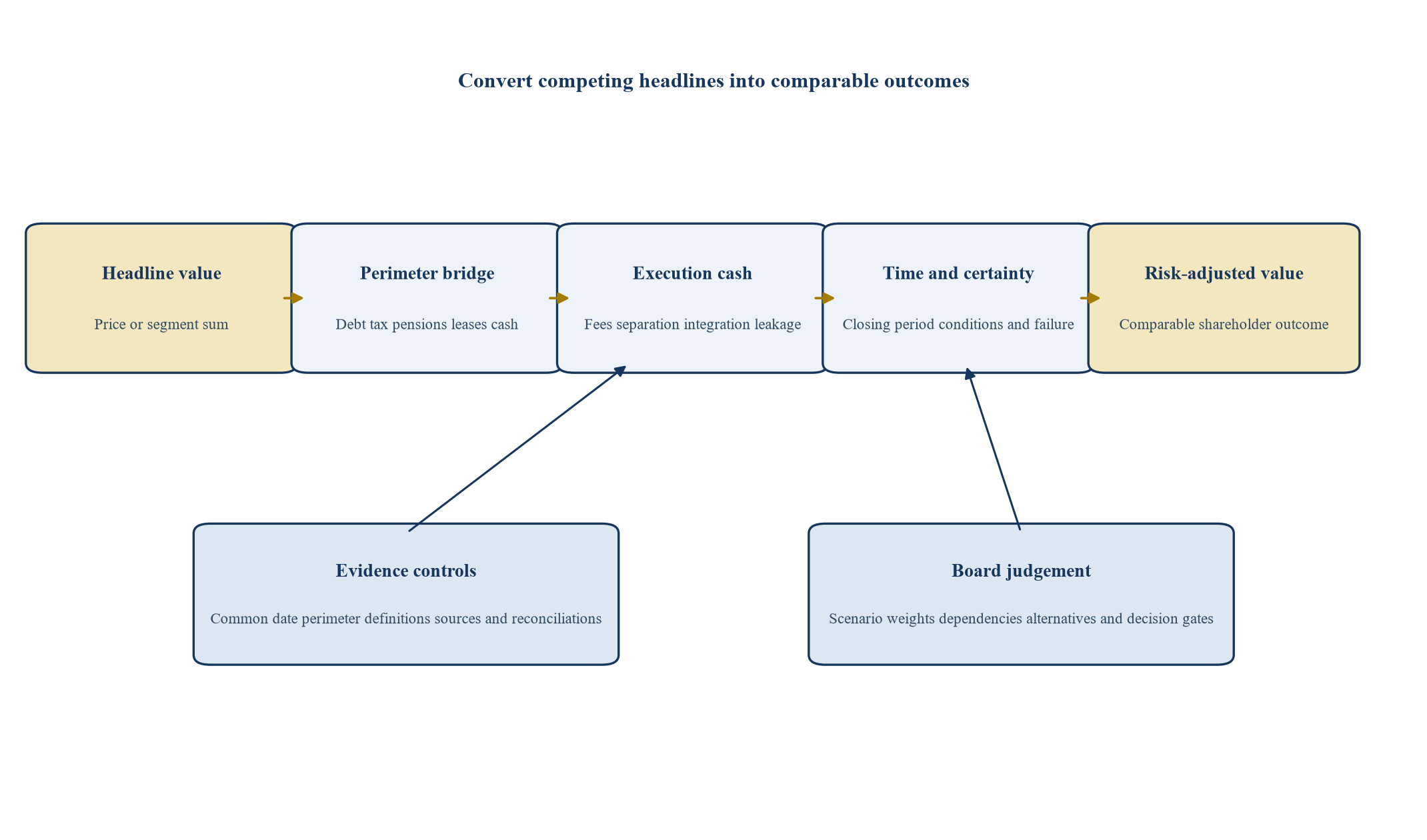
The diagram shows a controlled route from headline value to risk-adjusted value available to shareholders.
6. Test standalone value as an executable plan
Standalone value is the most common alternative to a sale or acquisition. It should be treated as a funded operating plan rather than a multiple applied to optimistic earnings. The board should establish the current baseline, initiative-level cash, management capacity, timing, downside and financing resilience.
The plan needs a bridge from current performance to the forecast. Revenue should separate volume, price, mix, retention and market growth. Margin should separate gross-margin change, productivity, fixed-cost absorption and temporary benefits. Cash should include working capital, capital expenditure, restructuring, tax and financing. Each improvement initiative needs an owner, milestone and evidence of controllability.
The valuation should use several methods where appropriate and state the limitations of each. Trading multiples may reflect businesses with different growth, margins or capital intensity. Discounted cash flow is sensitive to terminal assumptions. Precedent transactions may include control premiums and synergies unavailable to the standalone company. The board should show the sensitivity of equity value to operating and market variables.
The standalone case must also reflect the consequences of a failed transaction. Customers may delay commitments, employees may leave, advisers may be owed fees and the share price may reset. A company may retain valuable optionality, yet it may also face the problem that caused the process. The board should have a credible day-one plan if shareholders reject the deal or regulation prevents closing.
7. Test acquisition value beyond announced synergies
An acquisition defence often rests on strategic fit and synergies. The board should disaggregate value into the target's standalone value, control premium, cost synergies, revenue synergies, tax effects, financing, integration cost and risk. It should identify how much of the combined value is transferred to the seller through price.
Cost synergies require baselines, owners, timing, one-time costs and operating consequences. Revenue synergies require customer evidence, capacity, pricing, product readiness and probability. Financing benefits should reflect the actual structure and downside. Tax benefits need jurisdiction-specific advice and should not be treated as certain where legislation, elections or integration choices can change them.
The board should assess whether the same strategic objective could be achieved through a partnership, licence, minority investment, organic build or narrower asset purchase. A full acquisition can provide control and speed, while also importing liabilities and integration risk. The alternative analysis clarifies the price of control.
Regulatory remedies can change the acquired perimeter and synergy case. A divestiture, access commitment or operating restriction may reduce the value of the combination. The board should maintain a remedy-adjusted model rather than treating approval as a yes-or-no event.
8. Test disposal and break-up economics
A disposal can unlock value where another owner can invest, combine or operate the asset more effectively. It can also transfer future upside, create stranded cost and weaken the remaining group. The board should model proceeds and the post-transaction company as one decision.
The disposal model should include buyer value, debt-like items, tax, fees, separation, transition services, dis-synergies and retained liabilities. It should identify which central costs disappear, which remain and how quickly they can be removed. Shared systems, intellectual property, contracts, licences, pensions, people and procurement may constrain separation.
A break-up thesis requires a sequence. Several divisions may have plausible standalone values, yet simultaneous separation can overwhelm management and markets. Debt and ratings constraints can determine which asset must move first. Tax attributes and legal entities can change net proceeds. The board should show a realistic transaction map with dependencies and decision gates.
The remaining company requires its own investment case. A high-quality asset sale can make the residual business smaller, more leveraged or less diversified. Proceeds may support debt reduction, reinvestment, acquisitions or distributions. Each use should be tested against value, resilience and execution capacity.
| Value component | Evidence required | Frequent weakness | Board test |
|---|---|---|---|
| Gross asset value | Buyer indications, comparable assets, cash flow and strategic fit | Optimistic multiple without control or market evidence | Range by buyer class and market state |
| Separation cost | Systems, contracts, people, facilities and transition services | Incomplete scope and compressed timing | Bottom-up plan with contingency |
| Stranded cost | Function, owner, removal action and timing | Assumed immediate elimination | Monthly removal bridge and accountability |
| Tax and leakage | Structure, basis, jurisdiction and elections | Gross proceeds presented as net value | After-tax proceeds under alternatives |
| Retained liabilities | Guarantees, pensions, claims and environmental obligations | Liability left outside headline valuation | Probability and cash schedule |
| Residual company | Strategy, financing, governance and cost base | Residual treated as an unchanged multiple | Standalone plan and downside liquidity |
| Use of proceeds | Debt, reinvestment, distribution and transaction pipeline | Distribution assumed before closing certainty | Ranked uses with decision gates |
The schedule prevents a sum-of-the-parts headline from being mistaken for distributable equity value.
9. Audit process integrity
Process quality affects value, certainty and board credibility. The board should reconstruct the process chronology from the first strategic discussion through adviser engagement, outreach, indications, diligence, negotiation, approval and signing. The record should identify who participated, what information they received, what alternatives were considered and why the selected route prevailed.
The audit should test market coverage. A broad auction is not always superior to targeted bilateral negotiation. Confidentiality, business disruption, antitrust sensitivity or buyer scarcity may support a narrower process. The board should record that rationale and the protections used to test value, such as valuation work, independent advice, a market check or permitted response to unsolicited interest.
The process audit should examine information parity and time. Favoured parties should not receive advantages that cannot be justified. Deadlines should support competition without creating avoidable execution risk. Forecast changes during the process should be logged and provided consistently where required.
The board should also test deal protections. Break fees, matching rights, non-solicitation provisions, voting agreements and information rights can improve certainty while constraining alternatives. Their combined effect matters. An activist assertion that one term is coercive should be assessed within the full package and current law.
10. Establish a conflicts protocol
M&A decisions can create divergent interests. Executives may receive change-of-control payments, retain positions, roll equity or negotiate future employment. Directors may be connected to a buyer, seller, significant shareholder or competing bidder. Advisers may have financing, trading or prior-client relationships.
The company should identify actual and potential conflicts early, obtain required disclosures and determine who can participate in deliberation and recommendation. A special committee may be appropriate where conflicts are material, though its effectiveness depends on authority, independence, information and advisers. The UK Takeover Code notes that a conflicted director should normally be excluded from the offeree board's opinion and recommendation. [2]
Economic incentives should be quantified and disclosed where required. The board should not assume that disclosure cures a process weakness. It should show how conflicts were managed, whether negotiations were separated and whether independent directors had real authority.
Adviser conflicts require practical controls. The board should understand contingent fees, financing roles, prior relationships and information barriers. Fairness opinions address defined financial questions at a point in time. They do not replace commercial judgement, process governance, legal advice or execution analysis.
11. Map regulatory and political execution risk
Regulatory execution can determine whether headline value is delivered. The map should cover competition, foreign investment, national security, sector approvals, securities rules, tax, data, labour and other jurisdiction-specific requirements. It should record jurisdiction, authority, legal test, filing route, expected timing, remedies, appeal rights and contractual risk allocation.
Current merger guidance emphasises case-specific analysis. The September 2026 CMA guidelines examine unilateral effects, coordination, foreclosure, innovation and merger efficiencies, including ability, incentive, timeliness and verifiability. [7] US merger guidelines describe agency frameworks for assessing whether a transaction may substantially lessen competition. [8] The board should model the transaction against the relevant current regime and facts.
Political statements can affect timing and stakeholder behaviour, yet they are not a substitute for formal legal analysis. National-security review may consider supply chains, technology, capacity and commitments. The board should separate published authority requirements, party submissions, political positions and management judgement.
The transaction agreement's efforts standard, remedy obligations, reverse termination fee, long-stop date and interim covenants allocate execution risk. The economic model should reflect that allocation. A higher offer with weak regulatory protection may be worth less than a lower, more certain proposal.
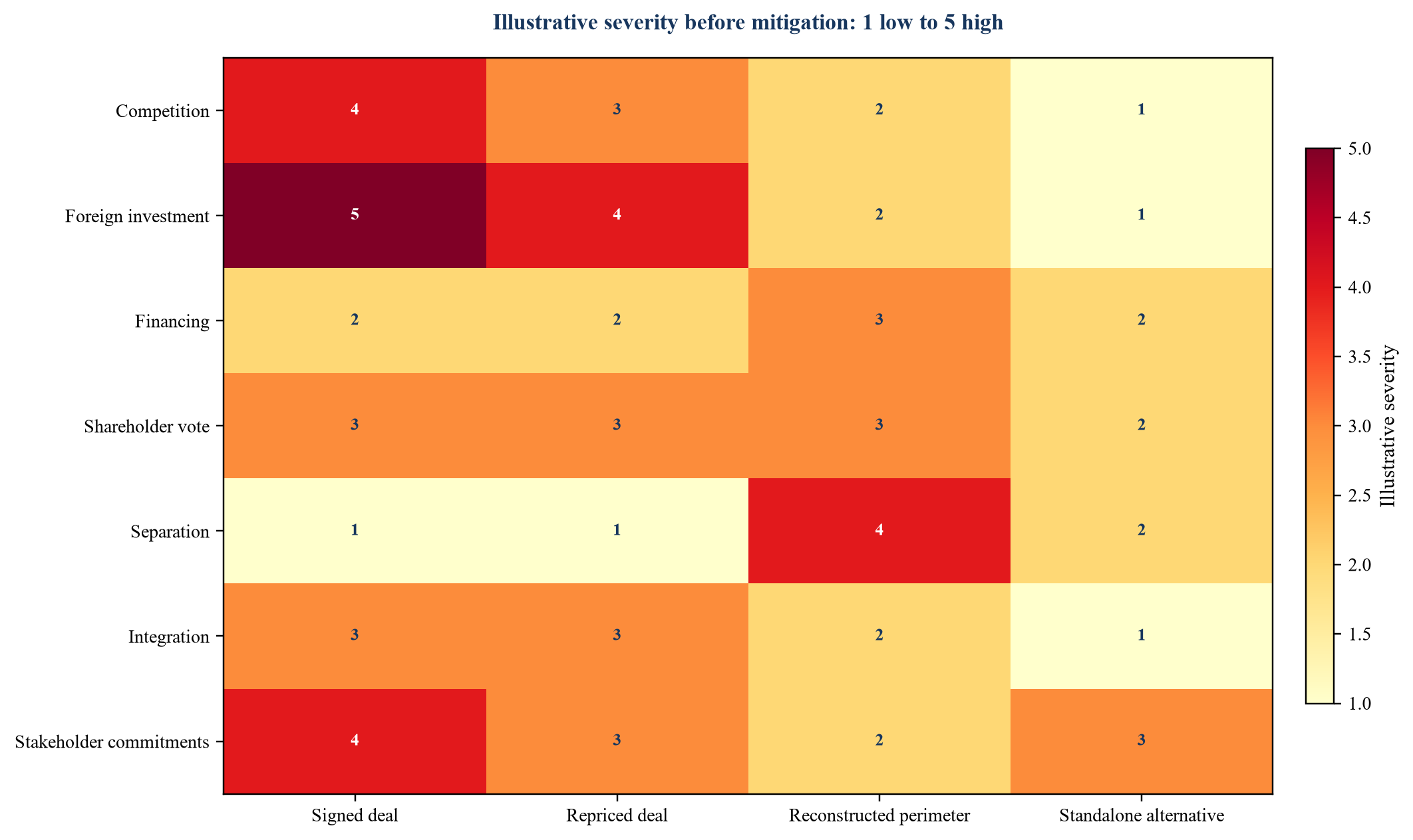
Scores are illustrative. Each live matter requires current jurisdiction-specific legal and regulatory advice.
12. Model financing and balance-sheet resilience
Financing affects both transaction certainty and post-close value. The board should analyse committed funding, conditions, maturities, hedging, currency, ratings, covenants and liquidity under central and adverse cases. It should test whether the company can operate through regulatory delay and integration or separation disruption.
For an acquisition, the model should show purchase funding, refinancing, fees, integration, working capital and debt reduction. It should state the leverage path and the operating performance required to reach it. Asset-sale proceeds or synergies should not fund near-term obligations before they are reasonably available.
For a sale, buyer financing and conditionality matter. A fully financed cash offer may have greater certainty than a nominally higher proposal dependent on syndication or asset sales. The board should understand enforcement rights and the buyer's capacity under stress.
For a recapitalisation or break-up alternative, debt capacity should be based on the post-separation businesses. Lenders and rating agencies may treat cash flows, assets and cyclicality differently after the perimeter changes. The board should model covenant and liquidity headroom through the implementation period.
13. Value stakeholder and operating commitments
Employees, customers, suppliers, communities and governments can influence execution and long-term value. The board should identify which commitments are contractual, regulatory, publicly stated or aspirational. It should quantify their cash, operating and governance consequences.
A buyer may commit to capital investment, employment, headquarters, research, supply security or facility continuity. These commitments can reduce execution risk or create cost. Their enforceability, duration, monitoring and remedies matter. A standalone plan may also require investment or restructuring that should be compared on the same basis.
Customer and employee evidence requires care during a live transaction. Surveys or interviews can be affected by uncertainty and selective participation. The board should combine contractual data, retention indicators, critical-role analysis and direct controlled engagement. It should protect confidentiality and comply with legal restrictions.
Stakeholder evidence should influence value where there is a credible cash, licence, delivery or strategic consequence. The analysis should avoid assigning arbitrary monetary values merely to create numerical precision.
14. Compare transaction certainty explicitly
Expected value combines outcome and probability, while the board also needs to understand distribution and timing. Two alternatives can have the same expected value and very different downside, liquidity and governance consequences.
The certainty model should decompose major conditions: financing, shareholder approval, competition, foreign investment, sector consent, third-party consent and material business performance. It should identify dependency among conditions. Regulatory clearance may affect financing duration; operating deterioration may affect the shareholder vote; remedies may change the valuation.
Probability estimates should be expressed as ranges with reasons and ownership. Legal advisers can assess process and precedent, financial advisers can assess market and financing, and management can assess operations. The board remains responsible for the decision. Historic averages may inform but cannot determine a case-specific probability.
Time should be modelled monthly where delay is material. Carry cost, lost initiatives, management distraction, retention, interim covenants and market exposure can change value. A long-stop extension should trigger a fresh comparison rather than an automatic continuation.
15. Build credible alternative transactions
An activist alternative deserves the same execution discipline as the signed transaction. A proposal to sell a division, separate a company or replace a buyer should identify counterparties, financing, consents, tax, timing, leadership, separation and downside.
The board can improve the debate by reconstructing the strongest feasible version of the alternative. This avoids dismissing a useful idea because the campaign presentation is incomplete. It also prevents the board from comparing a fully diligenced signed deal with an uncosted headline.
Alternative designs may combine actions. A company can retain a core business, sell a non-core asset, reduce debt and establish a joint venture. A buyer can acquire a narrower perimeter and enter a commercial agreement for the excluded assets. Consideration can include cash, shares, contingent value rights or retained stakes. Each structure changes risk, tax and governance.
The alternative should have failure gates. If buyer evidence, financing or regulatory feasibility does not reach a stated threshold by a date, the board should move to the next option. Optionality has value only when it is preserved through disciplined milestones.
| Route | Value source | Principal dependency | Evidence gate | Failure response |
|---|---|---|---|---|
| Signed sale | Premium and buyer ownership advantage | Approvals and buyer performance | Clearance path and committed funding | Reprice, extend or terminate under rights |
| Repriced sale | Additional consideration or protection | Buyer willingness and amendment | Executable revised terms | Retain signed terms or reassess recommendation |
| Narrower perimeter | Lower regulatory risk and retained upside | Separation and residual strategy | Carve-out plan, tax and buyer consent | Return to full perimeter or standalone route |
| Division disposal | Specialist-buyer value and debt reduction | Buyer universe and stranded-cost removal | Qualified indications and separation plan | Retain and improve business |
| Break-up | Different owners and capital structures | Sequencing, debt, tax and management capacity | Funded roadmap and board-ready residual plans | Stage actions or stop |
| Standalone reset | Operating improvement and retained optionality | Delivery, leadership and financing resilience | Ninety-day actions and twelve-month cash plan | Relaunch strategic review |
Every route should be compared on a common valuation date and after-tax, after-cost basis.
16. Use a decision scorecard without surrendering judgement
A scorecard can discipline comparison if it exposes rather than hides assumptions. The board should select criteria before final negotiation where practicable. Typical criteria are risk-adjusted shareholder value, certainty, time, downside, strategic control, stakeholder consequences, balance-sheet resilience and governance complexity.
Weights should reflect the company's situation and applicable duties. A company with limited liquidity may give more weight to certainty and time. A regulated infrastructure company may place greater weight on approvals and commitments. The score should not replace the underlying valuation and risk analysis.
The board should examine sensitivity to weights and scores. If a small change reverses the ranking, the decision is finely balanced and should be described that way. If one alternative dominates across reasonable assumptions, the recommendation is more robust.
Evidence confidence should be reported separately. A high-value alternative supported by weak evidence may warrant diligence rather than immediate adoption. A lower-value but executable option may serve as the downside floor.
| Criterion | Board question | Controlled measure | Escalation condition |
|---|---|---|---|
| Risk-adjusted value | Which route offers the strongest after-tax value after cost, time and probability? | Equity-value range and sensitivity | Ranking changes under a reasonable assumption |
| Closing certainty | Can the parties satisfy conditions within the available period? | Condition-level range and dependency map | Critical approval or funding path deteriorates |
| Downside protection | What happens if the route fails or is delayed? | Failure value, liquidity trough and contractual recovery | Minimum cash or strategic resilience is breached |
| Process integrity | Did the board have sufficient information, independence and market evidence? | Chronology, outreach, advice and conflict record | Material omission or unmanaged conflict emerges |
| Strategic control | Which capabilities, assets and options remain after the action? | Perimeter and ownership map | Critical capability or licence becomes dependent |
| Stakeholder execution | Can commitments be delivered without impairing value? | Funded commitments and operating milestones | Commitment is unfunded or unenforceable |
| Reversibility | Can the board change course if evidence deteriorates? | Decision gates, termination rights and alternative readiness | Next step creates disproportionate lock-in |
Scores should be supported by the underlying models and evidence. They are prompts for judgement, not a mechanical decision rule.
17. Work through a hypothetical contested sale
Assume a listed industrial-technology company signs an all-cash sale at an equity value of USD 6.0 billion. The unaffected equity value is USD 4.8 billion. The company has USD 900 million of net debt, USD 3.2 billion of revenue and USD 410 million of EBITDA. The buyer expects operational and commercial benefits that are not available to the company standalone.
An activist proposes a separation of the digital division, a sale of two non-core assets and a recapitalisation. Its headline sum of equity values is USD 7.1 billion. The board reconstructs the proposal and identifies USD 310 million of tax and transaction cost, USD 220 million of separation and stranded-cost exposure, a two-year implementation period and financing dependency.
The signed sale has an assumed 82 per cent probability of closing in twelve months. Failure produces an assumed USD 4.45 billion equity value after fees, disruption and market reset. Discounting and probability produce a scenario expected value of USD 5.72 billion. The activist route produces central equity value of USD 6.35 billion after cost, with a 58 per cent probability of full execution; partial execution and downside cases reduce expected value to USD 5.35 billion. The refreshed standalone plan produces USD 4.65 billion.
Negotiation produces a revised package: USD 6.2 billion cash consideration, stronger regulatory obligations, a USD 250 million reverse termination fee and a USD 180 million funded transition commitment. Its probability-adjusted value is USD 6.08 billion. These figures are assumptions, not market evidence or recommended benchmarks.
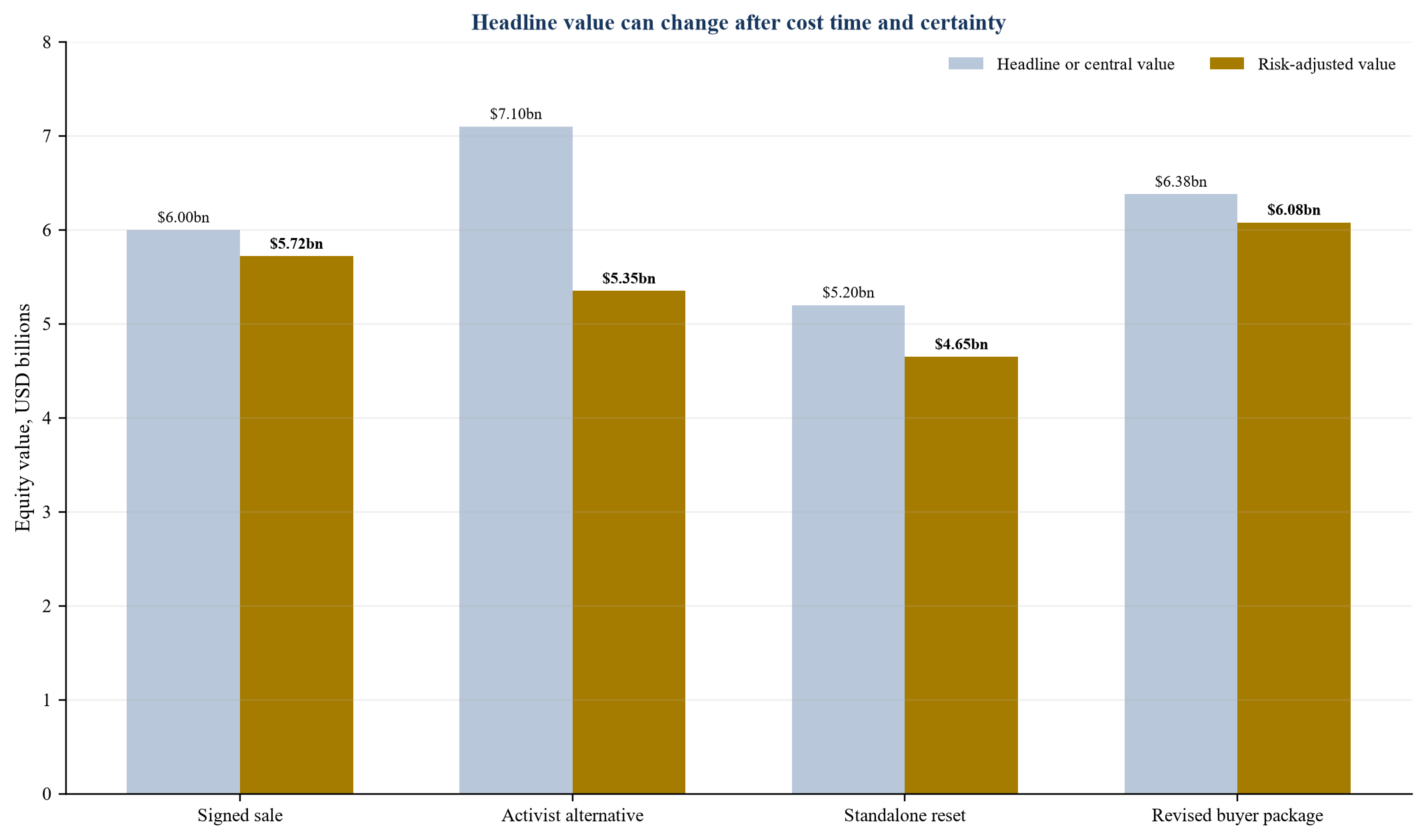
All values are scenario assumptions in USD billions and demonstrate the method only.
18. Decide whether to defend, reprice or reconstruct
The board should defend when the signed thesis remains superior across reasonable scenarios, process integrity is sound, conflicts are controlled and execution risk is acceptable. Defence should present the evidence and acknowledge the material downside. Repetition of the announcement rationale is insufficient after facts change.
Repricing is appropriate where value transfer or risk allocation has changed and the counterparty has capacity to improve terms. The negotiation can concern price, mix of consideration, contingent value, financing, remedies, fees, covenants or stakeholder commitments. The board should define its minimum acceptable package and the consequences of failure.
Reconstruction is appropriate where the strategic logic remains valid but the original perimeter, sequence or structure creates avoidable risk. A carve-out, retained stake, phased acquisition, joint venture, asset swap or different financing structure may preserve value. Reconstruction requires fresh tax, accounting, regulatory and operational analysis.
The board should change course where evidence supports a superior executable alternative or the signed thesis is invalidated. A disciplined reversal can protect value. The decision record should explain the changed fact, the alternative and the consequences.
The negotiation mandate should separate information, recommendation and authority. Management and advisers can update the evidence and negotiate within defined parameters. Independent directors should retain authority over material changes to value, protections, conflicts and recommendation. The board paper should show the current package, minimum acceptable outcome, remaining leverage, likely counterparty responses and the consequences of allowing the next deadline to pass.
The board should also test mixed outcomes. Regulation may approve the transaction with a remedy that reduces value. A competing proposal may offer higher consideration with weaker certainty. A buyer may improve price while requesting greater interim control or a lower remedy commitment. These packages should be decomposed and compared rather than described as globally better or worse.
Decision gates should be dated and linked to evidence. Examples include receipt of committed financing, acceptance of a remedy perimeter, delivery of a separation plan, confirmation of shareholder support or completion of tax diligence. A gate that fails should trigger a defined response. This preserves optionality and limits the tendency to continue because time and fees have already been spent.
19. Communicate with shareholders through controlled evidence
Engagement should begin before the vote crisis. The board and management need a clear account of strategy, process, valuation, execution and alternatives. The company should know which information is public, which is confidential and which may become material.
The communication should answer the strongest opposing case. It should show how values reconcile, why the process was appropriate, how conflicts were managed, what conditions remain and what happens if the transaction fails. It should avoid unsupported certainty and personalised attacks.
US universal-proxy rules require a common proxy card in non-exempt contested director elections and specify notice, solicitation and presentation requirements. [9] A transaction dispute can therefore become a board contest with a direct choice among nominees. Governance and transaction evidence should remain aligned.
The company should maintain one controlled fact base across board materials, regulatory submissions, investor presentations, employee communications and media statements. Differences caused by legal format should be explainable. Disclosure controls should review measures, forecasts and material changes.
20. Prepare for the vote and the day after
The board should prepare for approval, rejection, delay and litigation. Each route needs a decision calendar, authority, communication, liquidity plan and operating actions. The transaction team should not consume the organisation's entire capacity.
If shareholders approve, the company still needs regulatory, financing and closing discipline. If they reject, management should activate the standalone or alternative plan immediately. If the vote is delayed, the board should assess whether additional evidence, negotiation or engagement can change the outcome.
The day-after plan should identify leadership, critical employees, customers, suppliers, lenders and regulators. It should specify the first thirty days of capital and operating decisions. A failed deal can expose the company to market pressure and strategic drift; a prepared response preserves agency.
The board should schedule a post-decision review. The review should compare the original thesis, contested claims, actual execution and value outcome. Lessons should inform future M&A governance without judging prior decisions solely through hindsight.
The operating plan should remain live throughout the contest. Customer service, safety, compliance, cyber resilience, cash collection and critical investment cannot wait for the transaction result. Interim covenants may restrict actions, but they do not remove the board's responsibility for the business. Management should identify decisions requiring buyer consent, regulator contact or board escalation and maintain an auditable response log.
Retention should focus on roles required to preserve value and complete either route. Blanket awards can be costly and poorly targeted. The board should understand critical positions, departure risk, replacement time, transaction responsibilities and the duration of need. Arrangements should comply with the transaction documents, disclosure requirements and remuneration governance.
21. Implement the framework in thirty days
Days one to five establish control. The board appoints an accountable committee or lead director, confirms legal advice, maps conflicts and freezes the original deal record. Management creates the claim register, transaction chronology and decision calendar.
Days six to twelve build comparable economics. Finance and advisers reconcile valuation, cash, tax, financing and certainty across the signed deal, activist proposal, standalone case and credible alternatives. Operating leaders validate implementation assumptions. Risk maps conditions and dependencies.
Days thirteen to twenty test process and structure. Independent directors review market coverage, information, negotiations, protections and conflicts. The team develops repricing and reconstruction options, including buyer capacity and consent requirements. The board defines negotiation authority and walk-away conditions.
Days twenty-one to thirty decide and communicate. The board receives a controlled decision paper, sensitivity analysis and stakeholder plan. It records its reasons, approves engagement materials and activates the appropriate execution route. Unresolved evidence gaps carry owners and deadlines.
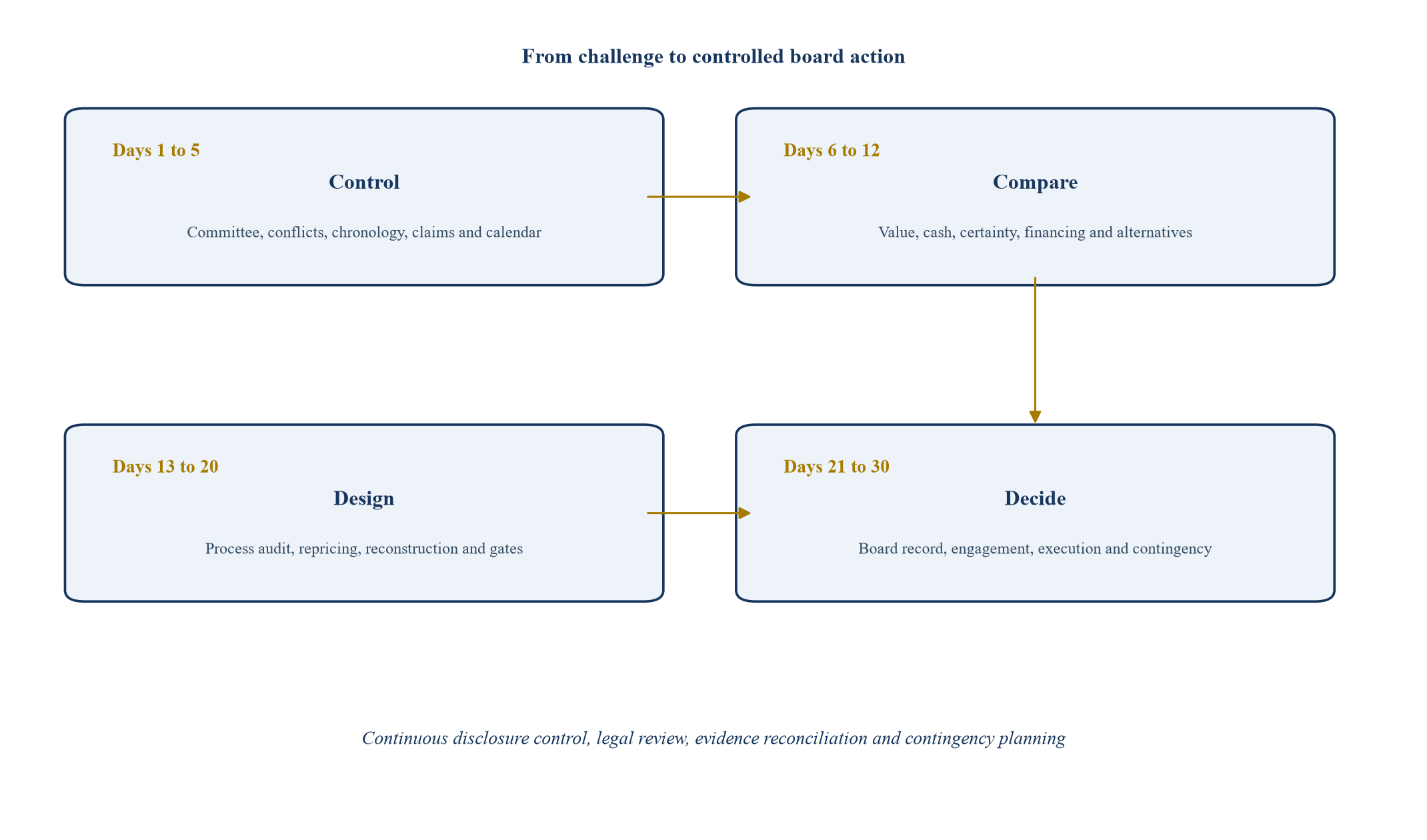
Timing is illustrative and must be adapted to live transaction deadlines and legal requirements.
22. Recognise limitations
The framework cannot determine the correct outcome without company-specific evidence and current professional advice. Valuation depends on forecasts, market conditions, discount rates and transaction structure. Probability estimates are board judgements informed by evidence; they are not statistical certainty.
Legal duties, shareholder rights, disclosure requirements, takeover rules and regulatory processes vary by jurisdiction. A live board must obtain current legal, tax, accounting, regulatory, valuation and financing advice. Transaction documents can materially constrain available actions.
Public campaign materials and company responses are advocacy. They may contain accurate data while presenting contested interpretations. This paper cites them as examples of positions in live or historical disputes and does not adopt the parties' claims as fact.
The hypothetical case demonstrates mechanics. Its amounts, probabilities, fees, values and timing are not benchmarks. Real transactions require bottom-up evidence, independent challenge and controlled sensitivities.
23. Conclusion
Activism around M&A tests the quality of the transaction decision and the evidence supporting it. A strong board response reconstructs the original thesis, translates campaign claims into tests, compares risk-adjusted value on common definitions, audits process and conflicts, and maps financing, regulatory and operating execution.
The board retains four practical routes: defend, reprice, reconstruct or change course. The right route depends on current evidence and executable alternatives. Headline premium and sum-of-the-parts values are starting points. After-tax cash, time, certainty, stakeholder consequences and downside determine what shareholders may receive.
The framework improves the decision before a contest and provides a controlled response during one. It enables the board to explain what changed, what was tested, which alternative prevails and how value will be delivered after the vote.
Sources
- OECD, G20/OECD Principles of Corporate Governance 2023, including markets for corporate control and responsibilities of the board, Read the primary source
- UK Takeover Panel, Takeover Code Rule 25.2, Opinion of the offeree board on the offer, current code accessed 17 September 2026, Read the primary source
- Illumina, Inc., Preliminary Proxy Statement, 30 March 2023, Read the primary source
- Icahn Group, Definitive Proxy Statement concerning Illumina, 2023, Read the primary source
- United States Steel Corporation, Definitive Merger Proxy Statement concerning Nippon Steel, 12 March 2024, Read the primary source
- Ancora Alternatives, Preliminary Proxy Statement concerning United States Steel, 14 March 2025, Read the primary source
- UK Competition and Markets Authority, Merger Assessment Guidelines, updated 3 September 2026, Read the primary source
- US Department of Justice and Federal Trade Commission, 2023 Merger Guidelines, 18 December 2023, Read the primary source
- U.S. Securities and Exchange Commission, Universal Proxy, Release No. 34-93596, Read the primary source
- OECD, The responsibilities of the board, G20/OECD Principles of Corporate Governance 2023, Read the primary source
- OECD, Disclosure and transparency, G20/OECD Principles of Corporate Governance 2023, Read the primary source
- OECD, The rights of shareholders and key ownership functions, Corporate Governance Factbook 2023, Read the primary source
- UK Competition and Markets Authority, Mergers: guidance on jurisdiction and procedure, updated 19 December 2025, Read the primary source
- UK Competition and Markets Authority, Mergers: how they are investigated, updated 23 June 2025, Read the primary source
- Federal Trade Commission, Guide to Antitrust Laws: Mergers, Read the primary source
- Broadwood Partners, Schedule 14A materials concerning the proposed STAAR Surgical and Alcon transaction, 2025, Read the primary source
- Ancora Alternatives, Schedule 14A materials concerning United States Steel, 7 April 2025, Read the primary source
- U.S. Securities and Exchange Commission, Commission Guidance on Management's Discussion and Analysis of Financial Condition and Results of Operations, 30 January 2020, Read the primary source
