

1. Audit the argument before the campaign
An activist campaign is an alternative strategic plan presented with an ownership position, a governance route and a communications strategy. Its power depends on whether other shareholders find the diagnosis credible. The board therefore needs to understand the strongest value-gap argument available from public information before a campaign appears.
The audit should not be a defensive exercise built around rebuttal. It should test the company as an informed long-term owner would test it. The relevant questions concern portfolio logic, operating competitiveness, capital allocation, balance-sheet resilience, governance, management incentives, investor communication and execution credibility. A weakness in one area can amplify weaknesses elsewhere. Poor segment disclosure can make a sound portfolio look incoherent. A weak capital-allocation record can reduce confidence in an otherwise attractive investment plan.
The board should commission the audit through a small team with access to strategy, finance, operations, legal, investor relations, tax, remuneration and transaction expertise. Independence of challenge matters. Management should provide evidence, while the board retains the judgement about whether the current plan closes the gap at an acceptable level of risk.
The output is a decision record. It identifies credible campaign theses, supporting and contradictory evidence, value ranges, execution requirements, legal and governance constraints, actions already justified by strategy, options that need further work and a response plan. It should be refreshed when performance, ownership, regulation or market conditions change.
2. Start with shareholder rights and current market rules
The legal route available to an activist varies by jurisdiction, listing venue, ownership structure and company constitution. The G20/OECD Principles of Corporate Governance state that shareholders should have secure ownership registration, timely information, participation and voting rights, and a voice in fundamental changes, board elections and remuneration. They also address institutional-investor engagement, conflicts, related-party transactions and equitable treatment. [1]
In the United States, the SEC universal-proxy rules require parties in a contested director election to use proxy cards listing all duly nominated candidates, subject to the rule's conditions. [2] The SEC also modernised beneficial-ownership reporting, including filing deadlines and structured data requirements, and maintains current staff interpretations for Sections 13(d) and 13(g). [3] [4] These rules affect the timing and visibility of an accumulation and the mechanics of a board contest.
The UK Corporate Governance Code 2024 applies to financial years beginning on or after 1 January 2025, with Provision 29 applying from 1 January 2026. [5] UK company law provides a route through which qualifying members may require directors to call a general meeting. [6] The Takeover Panel has published guidance relevant to shareholder activism and the circumstances in which coordinated conduct can engage acting-in-concert analysis. [7] [8]
The audit needs a jurisdiction sheet for every material listing and shareholder base. It should record disclosure thresholds, meeting rights, nomination procedures, solicitation rules, insider and market-abuse controls, takeover-code considerations, derivative disclosure, securities-lending effects and settlement timing. Current counsel should verify the applicable position before any action.
3. Build the outside-in campaign thesis
An activist begins with the information available to investors. The audit should therefore reproduce the external analytical view before adding management information. The outside-in file should include annual and interim reports, results presentations, regulatory announcements, earnings-call transcripts, investor-day materials, remuneration disclosures, ownership filings, voting results, peer filings, credit information and material press statements.
The team should write the shortest credible campaign letter it can. A useful version contains five elements: the value gap; the cause; the evidence; the proposed actions; and the governance route. A thesis becomes stronger when these elements reinforce one another. A conglomerate discount claim gains force if segment returns are weak, capital repeatedly moves to low-return units and disclosure prevents investors from testing the board's explanation.
Each proposition should receive an evidence grade. Grade A is directly supported by audited or regulatory information. Grade B is supported by reconciled company data that could be disclosed. Grade C is an analytical estimate with transparent assumptions. Grade D is a hypothesis requiring diligence. This discipline prevents confident language from substituting for proof.
The outside-in team should also identify what an activist cannot know. Contractual constraints, tax leakage, stranded costs, regulatory approvals, pension obligations, customer dependencies and technology separation can change the economics of a proposed disposal. These facts should inform the board's decision. They should not become a blanket reason to avoid explaining the strategy.
| Potential thesis | Public signal | Internal test | Evidence needed | Board decision |
|---|---|---|---|---|
| Portfolio lacks owner advantage | Persistent valuation discount and unrelated segments | Parenting advantage by business and alternative-owner value | Segment returns, synergies, stranded cost, tax and separation analysis | Retain, improve, partner, separate or sell |
| Margins are structurally weak | Peer or historical margin gap | Price, mix, productivity and overhead bridge | Reconciled operating drivers and cost actions | Set target and funded delivery plan |
| Capital is misallocated | Low returns, repeated impairments or weak cash conversion | Project and acquisition returns against hurdle rates | Decision records, post-investment reviews and cash bridge | Reallocate capital and change gates |
| Balance sheet is inefficient | Excess cash or leverage without a clear purpose | Liquidity, ratings, covenants and strategic capacity | Downside cases and financing options | Debt reduction, distribution or investment |
| Governance lacks accountability | Long tenure, weak succession or misaligned incentives | Skills, independence, evaluation and pay outcomes | Board matrix, evaluation, succession and remuneration tests | Refresh roles, skills or incentives |
| Disclosure obscures value | Unclear segments, changing metrics or weak targets | Investor decision-usefulness and consistency | KPI definitions, reconciliations and disclosure controls | Improve reporting and engagement |
The register is a proposed management control. Evidence grades should reflect the quality and reproducibility of the underlying information.
4. Define the value gap without pretending to know one number
A market-price gap is not automatically a strategic value gap. Price can reflect macroeconomic conditions, liquidity, risk aversion, ownership concentration, governance concerns, execution history or uncertainty about future cash flows. The audit should develop a range of values and explain the assumptions that move the range.
At least four lenses are useful. A trading lens tests current and normalised earnings against relevant market references. A sum-of-the-parts lens values businesses separately and deducts central costs, debt, pensions, tax and separation effects. A cash-flow lens tests the present value of the board's operating plan under alternative risk and terminal assumptions. A transaction lens examines what a strategic or financial buyer might pay after synergies, financing and execution risk.
The team should reconcile enterprise value to equity value and headline value to distributable value. Asset sales can generate tax, fees, debt repayment, pension funding, stranded costs and reinvestment needs. A campaign that adds gross disposal proceeds to current market capitalisation can materially overstate the result.
The board should focus on the conditions under which value can be realised. A division may have a higher theoretical value under another owner but require a two-year separation, customer consents and substantial stranded-cost removal. The audit should model timing, probability, funding and governance rather than treating each initiative as immediately additive.
5. Test portfolio logic business by business
Every business should have a reason to be owned by the group. The reason may be shared customers, technology, assets, capabilities, funding, risk management, brand, procurement, data or management systems. The audit should measure the benefit and the cost. Statements about strategic fit need evidence in revenue, cash flow, risk reduction or option value.
The test has four parts. First, does the group improve the business relative to a credible alternative owner? Second, does the business improve the group after the capital and management attention it consumes? Third, can the claimed benefits survive scrutiny and be reproduced? Fourth, could the same benefit be obtained through a commercial agreement, minority investment, joint venture or partnership?
Each business should be placed in an action category: compound, improve, reposition, partner, separate or exit. The category needs a value thesis, milestones and review date. A business in the improve category should not remain there indefinitely. Failure to meet operational and return gates should trigger a new ownership review.
Portfolio analysis should include central functions and shared assets. An exit can remove revenue while leaving overhead, systems, property or guarantees behind. The proposed transaction perimeter, stranded-cost plan and buyer universe should therefore be considered during the strategic audit rather than after a public commitment.
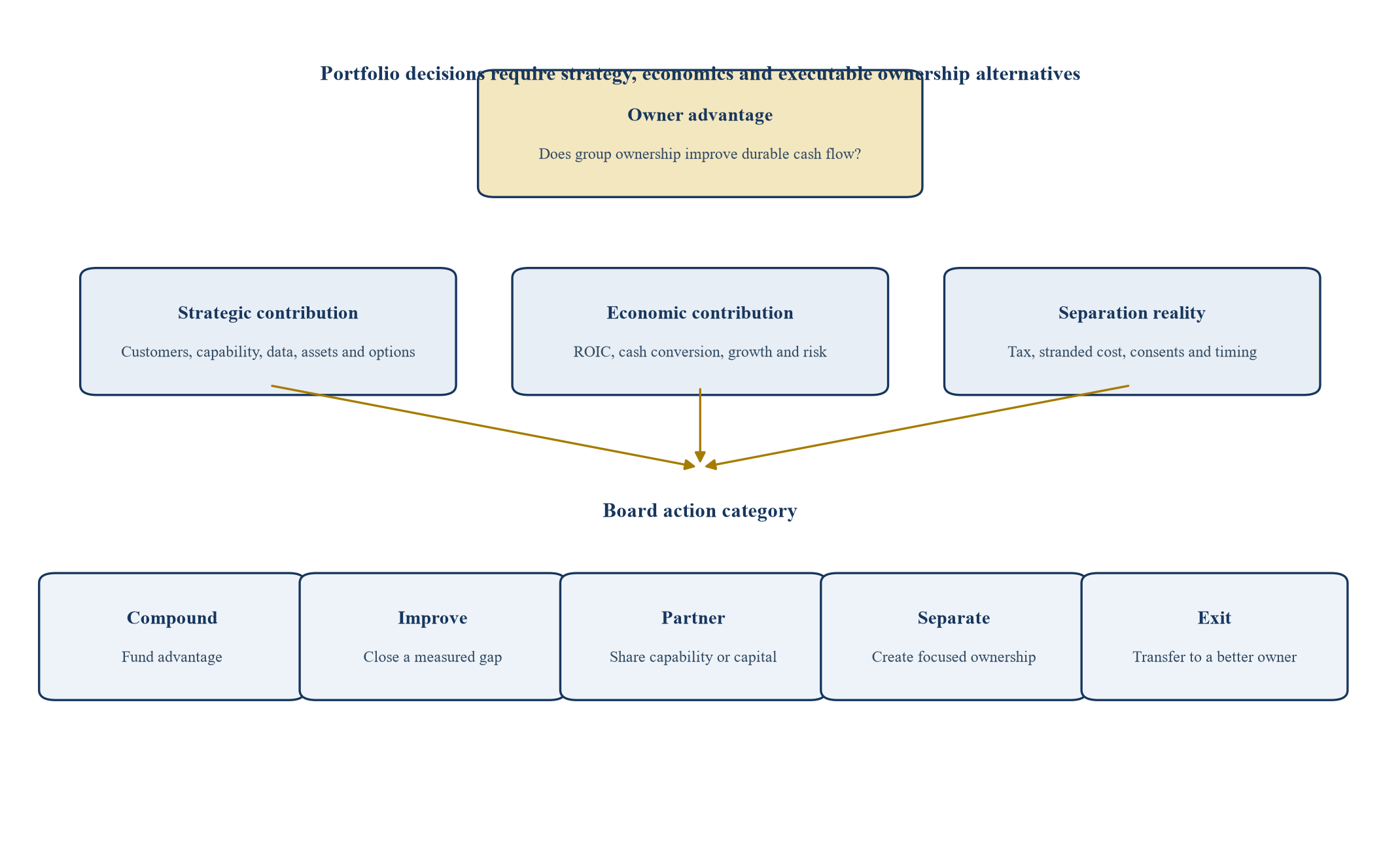
The framework is a decision aid. Positioning should reflect evidence, execution constraints and the board's approved strategy.
6. Decompose the operating-performance gap
An activist can convert a broad underperformance claim into an apparently simple margin target. The board needs a more rigorous bridge. Revenue should be decomposed into volume, price, mix, customer retention and currency. Gross margin should be decomposed into input cost, yield, capacity, logistics, service and product mix. Operating cost should be separated into scalable capability, necessary control, duplication, inefficiency and investment for future growth.
Peer comparisons require care. Accounting policies, business mix, geography, capital intensity, outsourcing, leases and acquisition history can make reported margins incomparable. The audit should show the adjustments and range rather than choosing the most favourable peer. Historical self-comparison can be equally useful when it connects performance to operational causes.
The improvement plan should specify actions, investment, responsible leaders, run-rate timing, cash conversion and risks to revenue or capability. Gross savings and net benefits should be shown separately. Restructuring charges, working-capital effects and implementation capacity belong in the value model.
The board should distinguish a temporary performance gap from a structural one. A temporary gap needs milestones and leading indicators. A structural gap may require changes in operating model, portfolio or leadership. Repeatedly describing a structural problem as temporary damages credibility.
7. Reconstruct the capital allocation record
Capital allocation is observable through acquisitions, disposals, capital expenditure, research and development, working capital, debt, dividends and repurchases. The audit should reconstruct at least five years of decisions and compare the original case with actual outcomes.
Each material investment should have an approved strategic rationale, cash-flow case, risk-adjusted hurdle rate, downside case and accountable sponsor. The post-investment review should measure actual revenue, margin, cash, synergies and strategic milestones. Changes in assumptions should be explained. An impairment is an accounting event, while the underlying lessons often concern price, diligence, integration, market change or governance.
The audit should examine whether capital gates differ across divisions for sound reasons. A mature unit may generate cash and require maintenance investment. A growth unit may consume capital but create valuable options. The comparison should reflect risk, duration and strategic interdependence, while preserving a clear route to value.
Share repurchases should be evaluated against intrinsic-value ranges, leverage, liquidity, investment opportunities and distribution policy. A buyback can create value when shares are materially undervalued and capacity is genuine. It can destroy flexibility if it is funded near a cyclical peak or used to offset dilution without addressing its cause.
8. Test balance sheet resilience and optionality
The balance sheet supports strategy through liquidity, credit quality, covenant capacity and access to markets. The audit should examine base, downside and transaction cases. It should include working-capital volatility, pension or lease obligations, guarantees, committed capex, litigation, tax and refinancing maturities.
Excess cash should be defined after operational liquidity, regulatory needs, seasonal requirements and credible investment options. Debt capacity should reflect business volatility, asset coverage, ratings objectives, covenant headroom and refinancing risk. A simple leverage comparison can miss these differences.
The audit should model the sequencing of portfolio actions. Disposal proceeds may arrive after restructuring costs or debt maturities. A separation can require temporary duplication and working capital. A distribution announced before closing may narrow the board's alternatives. Liquidity gates should therefore precede commitments.
Capital structure also affects the credibility of the strategic plan. A company that claims to pursue acquisitions while carrying limited capacity should explain the funding route and return discipline. A company retaining substantial cash should explain the options it is preserving and the date on which those options will be reviewed.
9. Examine governance as an operating system
Governance is more than compliance. It determines who decides, what evidence is required, how performance is challenged and how accountability follows outcomes. The audit should test board composition, committee mandates, succession, evaluation, information flow, director capacity and the relationship between strategy, risk and remuneration.
The skills matrix should connect directors to the company's actual strategic risks and opportunities. Generic labels such as finance, technology or international experience can obscure depth and recency. The matrix should identify the experience required for portfolio decisions, capital allocation, transformation, cyber risk, regulation, people and transactions.
Tenure and independence need a factual assessment under the applicable code and circumstances. Refreshment should be planned against succession and strategic milestones. Sudden changes made under public pressure can remove institutional knowledge or signal that the board lacked a prior plan.
Board information should permit challenge. Papers should disclose alternatives, sensitivities, prior commitments and execution capacity. Minutes should record the substance of decisions. A board that has already tested the credible activist thesis can respond with evidence rather than reconstructing its reasoning after the event.
10. Align incentives with the value thesis
Remuneration should reward the outcomes that underpin long-term value and discourage actions that create a temporary metric improvement at the expense of durability. The audit should map each incentive measure to the strategy, controllability, disclosure and possible unintended behaviour.
Relative total shareholder return can align outcomes with investors but may reward market movements outside management control. Earnings measures can encourage investment discipline but may penalise value-creating expenditure or encourage timing choices. Return measures can improve capital discipline but require consistent definitions. Strategic milestones can support transformation when they are specific and independently assessed.
The audit should test the relationship among targets, budgets, external guidance and incentive ranges. Persistent payouts despite missed strategic outcomes can weaken trust. Equally, a plan that pays nothing after strong controllable execution during an external shock can harm retention and decision quality.
Equity ownership, holding periods, malus, clawback and post-employment provisions should be reviewed against the applicable governance code and shareholder expectations. Any change should follow an articulated remuneration philosophy rather than a reaction to one campaign.
11. Make disclosure decision useful
Investors value information that lets them understand how the company makes money, how capital is deployed and how the plan is progressing. The audit should examine segment reporting, alternative performance measures, targets, reconciliations, capital allocation, portfolio logic and risk.
Disclosure should be consistent across reports, presentations and calls. Metric definitions should be stable or changes clearly reconciled. Targets should include a baseline, period and scope. Operational milestones should connect to financial outcomes. Narrative claims should be supported by data that the disclosure controls can reproduce.
More disclosure can create competitive, legal or execution risk. The board should identify information that is genuinely sensitive, explain the category where useful and determine whether aggregation or delayed disclosure can meet investor needs. A broad claim of commercial sensitivity can appear evasive.
The investor-relations team should maintain a question log that distinguishes requests for clarification, strategic disagreement and governance concern. Recurring questions often reveal where the market cannot connect the strategy to value. The response may require better evidence, a clearer plan or a change in strategy.
| Decision question | Weak signal | Strong evidence | Audit action |
|---|---|---|---|
| Why does the group own each business? | Generic synergy language | Quantified owner advantage and review gates | Publish portfolio logic and milestones |
| What drives the margin path? | One aggregate target | Price, mix, productivity and investment bridge | Reconcile operational drivers to guidance |
| How is capital prioritised? | Broad hierarchy without outcomes | Hurdle rates, post-investment reviews and allocation history | Explain decisions and realised returns |
| What can change the plan? | Static forecast | Sensitivities, liquidity gates and strategic alternatives | Disclose key dependencies and review dates |
| How is the board accountable? | Skills labels and boilerplate evaluation | Strategy-linked skills, succession and actions | Connect governance disclosure to decisions |
| How will investors measure progress? | Changing measures | Stable definitions, baselines, dates and reconciliations | Publish a compact value-creation scorecard |
The diagnostic should be applied within the company's disclosure controls and applicable securities law.
12. Read the shareholder base as a set of mandates
The register contains different mandates, horizons, concentration limits, voting policies and engagement styles. The audit should identify beneficial owners where legally and practically possible, while respecting privacy, market-conduct and solicitation rules. It should distinguish index, quantitative, active long-only, hedge, event-driven, income, stewardship and retail holdings.
The team should examine changes in ownership, securities lending, voting history, public stewardship policies and participation at prior meetings. This analysis does not predict votes. It helps the board understand which evidence matters to different shareholders and where the company has weak relationships.
Engagement should be continuous and substantive. Directors should participate in accordance with the governance model and applicable rules. Management should listen, answer consistently and record commitments. Selective disclosure and market-abuse controls need clear protocols.
The board should test whether its investor programme reaches decision makers or only intermediaries. During a contested situation, established relationships and a record of responsive engagement can matter. A sudden outreach campaign cannot recreate years of credibility.
13. Scan for campaign catalysts
Campaign risk can rise when performance misses guidance, a major acquisition underdelivers, a chief executive transition is mishandled, a disposal stalls, leverage increases, a governance controversy emerges or a strategic review appears inconclusive. The audit should maintain a catalyst calendar.
The calendar should include results, investor days, annual meetings, nomination windows, major maturities, regulatory decisions, lock-up expiries, strategic milestones and board succession. Ownership filings and public commentary should be monitored through lawful market-intelligence processes.
A catalyst does not establish that a campaign exists. It changes the consequence of being unprepared. The board can use the calendar to complete analysis, improve disclosure and settle decision rights before a compressed period.
The audit should identify messages that could be misunderstood. A change in segment reporting, cancellation of an investor day or unexplained director departure can create a narrative vacuum. Timely, accurate disclosure within legal constraints reduces avoidable ambiguity.
14. Compare strategic alternatives on one basis
The board should compare the current plan, accelerated operational improvement, portfolio transactions, partnerships, capital returns and leadership or governance changes through a common framework. Each alternative needs strategic logic, value range, funding, timetable, dependencies, risks and reversibility.
Alternatives should be evaluated after tax, fees, stranded costs, separation, financing and implementation. Execution capacity is finite. A plan combining a disposal, major cost programme, systems transformation and large acquisition may exceed management capacity even if each project is attractive in isolation.
The board should also consider combinations and sequencing. A cost programme can improve a business before sale. A minority partnership can validate value while retaining option exposure. A debt reduction can create future acquisition capacity. The model should make dependencies explicit.
Decision criteria should be approved before outcomes are known. This limits hindsight bias and enables a clear explanation of why the selected plan creates superior risk-adjusted value.
15. Define the hypothetical company and baseline
The worked case concerns a listed diversified industrial and services group with four divisions. The scenario assumes USD 2.40 billion of revenue, USD 270 million of EBITDA, USD 1.15 billion of net debt and an enterprise value of USD 3.60 billion. The implied enterprise-value-to-EBITDA multiple is approximately 13.3 times.
The reported EBITDA margin is 11.25 per cent. Management uses a 14.0 per cent reference case for the combined portfolio. The 2.75 percentage-point difference corresponds to USD 66 million of potential gross EBITDA on the current revenue base before implementation cost, dis-synergies, timing and risk. The reference is an audit assumption, not an observed peer benchmark.
Division Delta has USD 420 million of revenue and USD 18 million of EBITDA, a 4.3 per cent margin. The group also owns non-core property with an assumed realisable value of USD 140 million after execution adjustments. Three-year capital expenditure totals USD 510 million. The scenario assumes group return on invested capital of 7.8 per cent and a 10.2 per cent weighted average cost of capital.
The outside-in campaign argues for the sale of Division Delta, a USD 70 million gross cost programme, release of the property, debt reduction, a conditional repurchase and board refreshment. Management's internal analysis supports some of these actions but identifies different sequencing and lower net benefits.
16. Build a board led value creation plan
The board-led plan begins with actions supported by the audit. It prepares Division Delta for a potential sale while testing operational improvement and purchaser interest. For modelling, a disposal at eight times EBITDA implies USD 144 million of enterprise value before debt-like items, tax, fees and separation. The plan assumes USD 120 million of net proceeds available after those adjustments.
The cost programme identifies USD 70 million of gross run-rate actions. It also identifies reinvestment, capability replacement and revenue-protection costs, leaving an assumed USD 38 million net annualised EBITDA benefit. Implementation expenditure is assumed at USD 52 million over eighteen months. Benefits are phased rather than credited immediately.
The property programme assumes USD 140 million of net proceeds. The board allocates USD 120 million to debt reduction and retains capacity for an USD 80 million high-return investment programme. A repurchase of up to USD 70 million is considered only after the disposal, leverage and liquidity gates are met.
Governance actions include adding a director with current industrial-transformation experience, formalising post-investment reviews and publishing a value-creation scorecard. These actions are justified by the strategy and evidence. They are not presented as concessions to a hypothetical campaign.
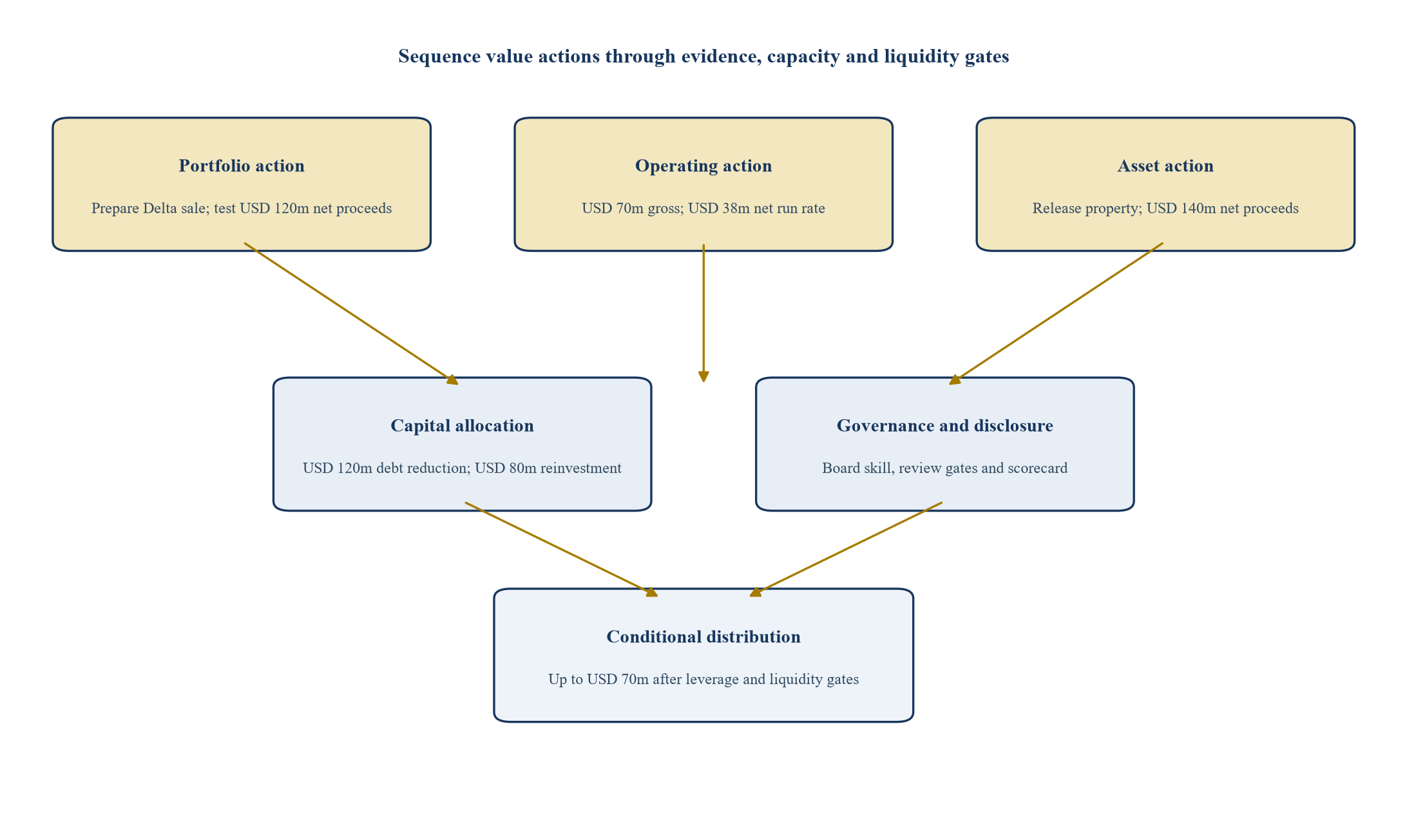
All amounts and actions are scenario assumptions. Arrows show proposed sequencing rather than a forecast.
17. Model three scenarios without double counting
The base case assumes the current portfolio and approved operating plan. The board-led case includes the phased net cost benefit, Delta disposal, property release, debt reduction and reinvestment. The campaign case assumes faster execution, a higher cost benefit and a larger repurchase, with higher implementation and business-disruption risk.
The valuation model should separate operating value, transaction proceeds, debt and distributions. Disposal proceeds should not be added to enterprise value if the disposed earnings remain in the capitalised EBITDA. Cost savings should be included only once and after the period in which they are expected to become sustainable. Repurchases change share count and cash; they do not create enterprise value by themselves.
The scenario ranges should reflect execution probability. A faster plan can have a higher headline value but a wider downside if revenue, people or systems are disrupted. The board should examine expected value, downside liquidity and strategic option value alongside the central estimate.
All outputs in the worked model are management illustrations. They are designed to show decision mechanics rather than predict a security price or recommend a transaction.
| Measure | Base case | Board led plan | Campaign case |
|---|---|---|---|
| Revenue after portfolio action | USD 2,400m | USD 1,980m | USD 1,980m |
| EBITDA after portfolio action and benefits | USD 270m | USD 290m | USD 306m |
| Net annualised cost benefit included | USD 0m | USD 38m | USD 54m |
| One-time implementation expenditure | USD 0m | USD 52m | USD 78m |
| Assumed Delta net proceeds | USD 0m | USD 120m | USD 130m |
| Assumed property net proceeds | USD 0m | USD 140m | USD 145m |
| Planned debt reduction | USD 0m | USD 120m | USD 80m |
| Conditional share repurchase | USD 0m | Up to USD 70m | USD 150m |
| Principal execution risk | Persistent value gap | Sequencing and delivery | Revenue disruption and reduced flexibility |
All figures are scenario assumptions. Values are illustrative, rounded and exclude several company-specific tax, pension, financing and accounting effects that would require diligence.
18. Stress test the campaign case
The audit should red-team both management and activist proposals. A campaign thesis can be directionally right but operationally incomplete. A management plan can be detailed but too slow. The red team should change key assumptions, identify hidden dependencies and examine who bears the downside.
For the Delta disposal, the team should test lower bids, delayed separation, stranded cost, tax leakage, customer loss and a limited buyer universe. For the cost programme, it should test revenue at risk, implementation capacity, inflation, labour constraints and technology spend. For the repurchase, it should test refinancing conditions, covenant headroom and a cyclical downturn.
The audit should calculate break-even conditions. At what disposal price does continued ownership create more value? How much revenue attrition absorbs the net savings? What minimum liquidity is needed before a distribution? These questions convert debate into decisions.
The red team should also examine strategic opportunity cost. A company engaged in a contested campaign can lose management attention, transaction opportunities and employees. The cost is difficult to value precisely, yet it should be represented in capacity and timing decisions.
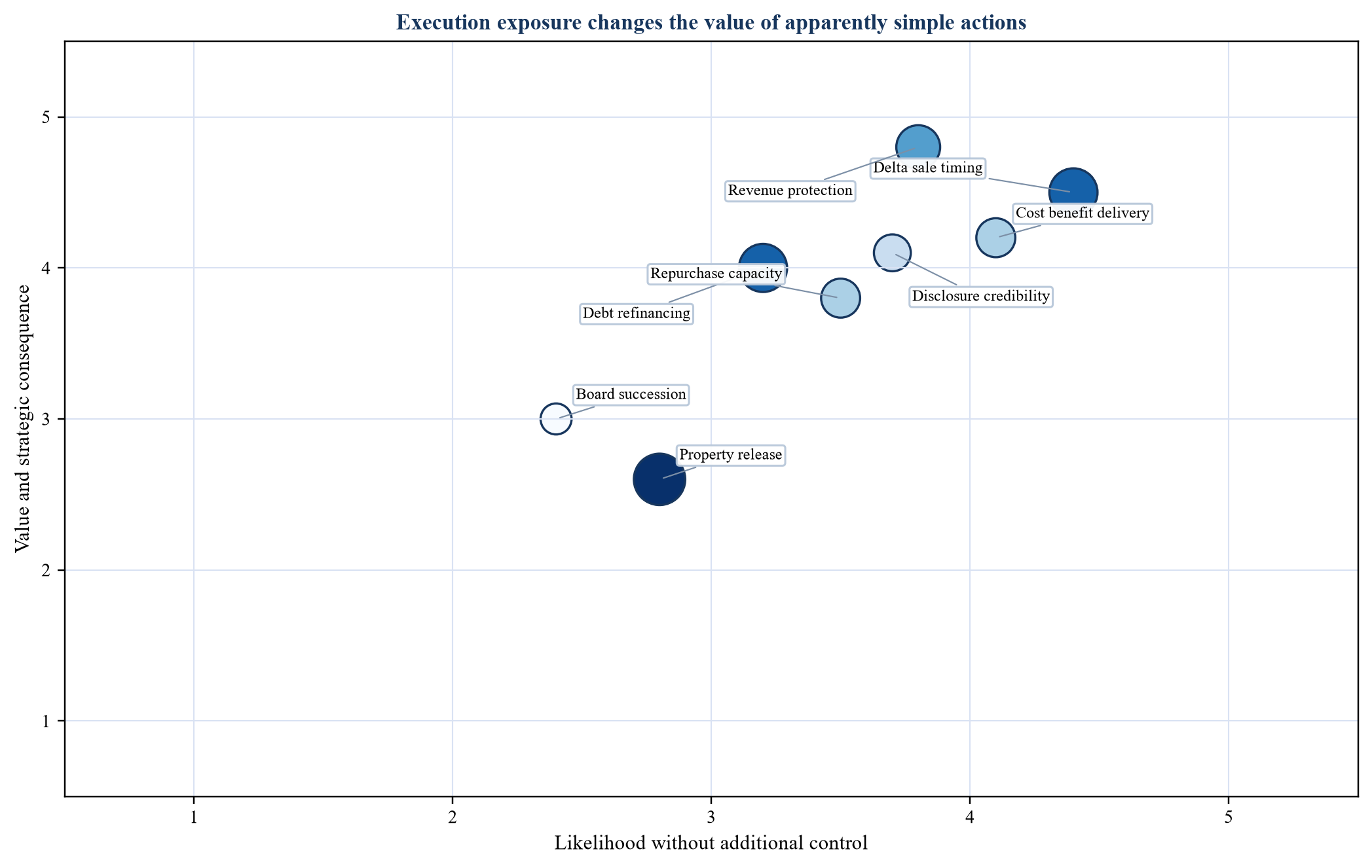
Scores are scenario assumptions. Bubble size indicates the illustrative gross value exposed, not a forecast of loss.
19. Establish board decisions and response governance
The board should approve a standing activism-response protocol before it is needed. The protocol should identify the chair, lead independent director, chief executive, general counsel, chief financial officer, investor-relations lead and external advisers. It should define escalation, confidentiality, privilege, disclosure, insider-list and recordkeeping procedures.
The core team should be small enough to decide quickly. Workstreams can cover strategy and value, legal and governance, shareholder analysis, communications, operations and transactions. Each workstream needs a fact base and one version of the numbers.
The board should define which decisions management can take under the approved plan and which require board or committee approval. It should also determine how interested directors, conflicts and adviser roles will be handled. The process should comply with fiduciary duties and the applicable legal framework.
The first response to a private approach should preserve options. The company should acknowledge appropriately, verify the facts, assess disclosure obligations and establish a disciplined engagement route. Public communication should follow evidence and legal review. The protocol should avoid commitments that outrun board analysis.
20. Engage with substance and maintain control of facts
Engagement can reveal whether the parties disagree about facts, time horizon, risk or strategic judgement. The company should ask the activist to explain assumptions, ownership, proposed actions, financing, dependencies and governance requests. Management should answer accurately within legal and disclosure constraints.
The board should consider useful ideas on their merits. Adoption of an action should follow the board's own analysis and duties. The record should show the evidence and rationale. This protects decision quality and helps explain the plan to all shareholders.
Communications should use one reconciled fact book. Financial measures, segment data, capital allocation history and milestones should agree across board papers, regulatory filings, investor materials and media statements. Forecasts and targets need appropriate controls.
Personalised attacks and speculative claims can damage credibility. The strongest response is a coherent strategy, measurable progress and clear accountability. Where the board disagrees, it should explain the evidence, execution constraints and superior alternative.
21. Run a 90 day audit and implementation cycle
The audit can be completed in ninety days when data and leadership are available. The first fifteen days establish scope, governance, the outside-in thesis and the evidence register. Days sixteen to thirty-five complete the portfolio, operating and capital-allocation diagnostics. Days thirty-six to fifty-five build alternatives and valuation cases.
Days fifty-six to seventy test execution, governance, remuneration and disclosure. Days seventy-one to eighty complete red-team review and investor-message testing. Days eighty-one to ninety produce the board decision, action plan, disclosure roadmap and response protocol.
Actions should then enter normal strategy execution. Each action needs an owner, investment, milestones, leading indicators, value bridge and board review date. The company should disclose what is material and appropriate under applicable law.
The audit should be refreshed at least annually and after major acquisitions, disposals, performance resets, leadership changes or material ownership developments. It should remain connected to the strategy process rather than becoming a file used only during a campaign.
| Period | Required output | Accountable owner | Board gate |
|---|---|---|---|
| Days 1 to 15 | Mandate, outside-in thesis, rule map and evidence register | Chair, general counsel and strategy lead | Approve scope, team and escalation protocol |
| Days 16 to 35 | Portfolio, operations, capital allocation and balance-sheet diagnostics | CFO and business leaders | Confirm credible points of attack |
| Days 36 to 55 | Valuation ranges and strategic alternatives | Strategy, finance and transaction leads | Select alternatives for execution diligence |
| Days 56 to 70 | Governance, remuneration, disclosure and shareholder-base review | Nomination, remuneration and IR leads | Agree required governance and communication changes |
| Days 71 to 80 | Red-team challenge, sensitivities and execution-capacity test | Independent challenge team | Approve preferred plan and downside controls |
| Days 81 to 90 | Board decision, scorecard, disclosure roadmap and response protocol | Chair and chief executive | Authorise implementation and monitoring |
| Quarterly | Progress, ownership, catalyst and value-gap refresh | CFO, strategy and IR | Reallocate resources or reopen alternatives |
Timing should be adapted to the company's reporting calendar, governance process and applicable law.
22. Use a board dashboard that exposes trade offs
The dashboard should separate value, execution and resilience. Value measures can include segment growth, margin, cash conversion, return on invested capital and progress against transaction gates. Execution measures can include milestones, investment, people, customer indicators and benefits realised. Resilience measures can include liquidity, leverage, covenant headroom and downside capacity.
Portfolio reporting should show the action category for each business, owner advantage, return profile and next review date. Capital allocation reporting should show approved amounts, original cases, actual outcomes and lessons. Governance reporting should show succession, board skills and evaluation actions. Disclosure reporting should show unresolved investor questions and the evidence required to answer them.
The dashboard should reconcile to public measures where possible. Internal detail can explain the drivers, while the definitions remain stable. Red status should trigger a decision, funded remedy or revised plan.
The board should retain the source model, evidence register, alternatives, minutes and action tracking. The record demonstrates that decisions were based on current evidence and considered alternatives. It also enables faster response when a shareholder raises a similar thesis.
The dashboard should include a benefits-reconciliation schedule. Each initiative should start with the approved gross benefit and show implementation cost, reinvestment, revenue effects, timing, cash conversion and the amount reflected in guidance. Finance should reconcile realised benefits to the ledger and operating measures. Business leaders should attest to the operational causes. This limits double counting across cost, procurement, property and portfolio programmes.
An evidence-confidence indicator should sit beside the value estimate. High confidence may require a signed contract, completed diligence or a repeated operating result. Medium confidence may reflect a funded plan with early milestones. Low confidence may reflect an untested assumption or external dependency. A large theoretical value with weak evidence should receive different governance from a smaller action already within management control.
Capacity should be reported explicitly. The company should identify the executives, specialists, systems and advisers required by each initiative and show competing demands. If the same finance, technology or legal team supports multiple critical programmes, the board should sequence work or fund additional capacity. Delivery risk can arise from resource concentration even when the strategic logic is sound.
The dashboard should record option-expiry dates. Nomination windows, financing commitments, consent periods, reporting dates and market windows can change the available choices. A decision that remains economically attractive can become unavailable because evidence or approval was not completed in time. Recording the date, dependency and accountable owner makes this risk governable.
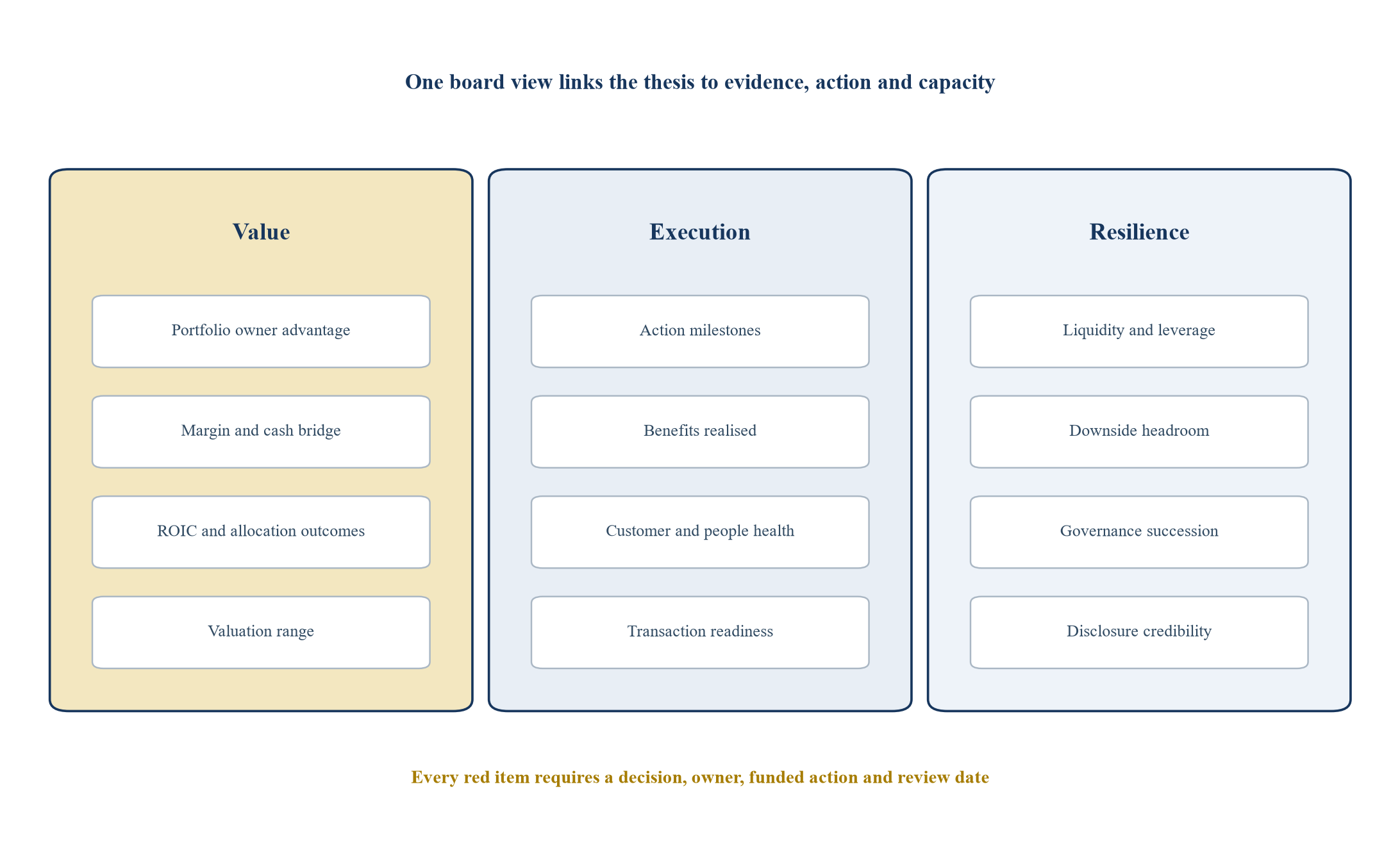
Measures and thresholds are illustrative and should be approved for the company's strategy and risk appetite.
23. Convert vulnerability into strategic preparedness
An Activist Value Gap Audit gives the board a structured way to test whether the company's strategy, performance, capital allocation, governance and disclosure withstand an informed external challenge. It identifies credible campaign theses before compressed timelines and public positions limit the available choices.
The audit begins with current shareholder rights and an outside-in fact base. It grades evidence, defines valuation ranges and tests owner advantage business by business. It decomposes operating gaps, reconstructs capital allocation and evaluates balance-sheet capacity. Governance, incentives, disclosure, ownership and campaign catalysts are treated as connected parts of the value system.
The hypothetical case shows why headline proposals need integrated modelling. A sale, property release, cost programme, debt reduction, reinvestment and repurchase interact through earnings, cash, risk and execution capacity. The board-led plan uses gates so that distribution follows evidence and liquidity rather than preceding them.
Preparedness rests on decisions and delivery. The board should act on findings that improve durable value, establish measurable milestones, communicate material information accurately and maintain a response protocol. The framework does not predict a campaign, a vote, a security price or the outcome of any transaction. Companies should obtain current legal, tax, accounting, regulatory and financial advice for their circumstances and jurisdictions.
Sources
- OECD, G20/OECD Principles of Corporate Governance 2023, shareholder rights, institutional investors and boards. Read the primary source
- United States Securities and Exchange Commission, Universal Proxy, final rule, 17 November 2021. Read the primary source
- United States Securities and Exchange Commission, Modernization of Beneficial Ownership Reporting, 10 October 2023. Read the primary source
- United States Securities and Exchange Commission, Compliance and Disclosure Interpretations, Exchange Act Sections 13(d) and 13(g), updated 11 July 2025. Read the primary source
- Financial Reporting Council, UK Corporate Governance Code 2024 and application dates. Read the primary source
- UK Parliament, Companies Act 2006 explanatory notes, section 303 and related member meeting rights. Read the primary source
- UK Takeover Panel, Practice Statement 26, Shareholder Activism. Read the primary source
- UK Takeover Panel, definition of acting in concert. Read the primary source
- OECD, Shareholder Meetings and Corporate Governance, key findings and outstanding policy issues, 2025. Read the primary source
- Financial Reporting Council, Corporate Governance Code Guidance, 2024. Read the primary source
- European Union, Directive EU 2017/828 amending the Shareholder Rights Directive. Read the primary source
- Japan Exchange Group, Tokyo Stock Exchange, Action to Implement Management that is Conscious of Cost of Capital and Stock Price, updated 28 April 2026. Read the primary source
- Singapore Exchange, Code of Corporate Governance 2018. Read the primary source
- Hong Kong Securities and Futures Commission, Securities and Futures Ordinance Part XV, Disclosure of Interests, current forms and guidance. Read the primary source
- Australian Securities and Investments Commission, Shareholder rights and responsibilities. Read the primary source
- Australian Securities and Investments Commission, Regulatory Guide 128 and guidance on collective action by investors, 23 June 2015. Read the primary source
- Alberta Securities Commission, National Instrument 62-103, The Early Warning System and Related Take-Over Bid and Insider Reporting Issues. Read the primary source
- United States Securities and Exchange Commission, How to file Schedules 13D and 13G and amendments. Read the primary source
