

1. Define the add-on integration factory
An add-on integration factory is a repeatable operating system for absorbing acquisitions without treating every transaction as a first attempt. It combines a stable governance architecture, reusable evidence standards, modular workstreams and company-owned implementation. Its purpose is to convert the buy-and-build thesis into customer continuity, operating improvement, verified value and a business that remains governable as the acquisition count rises.
The factory has four layers. The first is the investment thesis: why this target improves the platform and which value mechanisms depend on integration. The second is the repeatable core: governance, data standards, risk controls, value definitions, Day One checks and reporting. The third is the modular layer: choices that vary by geography, sector, system, regulatory regime and target maturity. The fourth is the learning loop: evidence from each completed integration is used to refine the next diligence request, sequencing decision and resource plan.
The factory should not become a central team that absorbs accountability from the business. The portfolio-company chief executive remains accountable for the operating result. Workstream leaders own decisions within approved authority. Finance validates value. Legal and regulatory specialists define restrictions. Technology and cybersecurity leaders control access and migration. The sponsor establishes the thesis, challenge and governance while company management delivers the combination.
Repeatability comes from decision architecture rather than identical outcomes. A small local distributor may require rapid commercial and financial integration. A regulated technology target may require legal separation, restricted data access and a longer migration. The same factory can support both when it defines mandatory controls and permits evidence-led exceptions.
The board should approve a factory charter before the next add-on enters exclusivity. The charter should state scope, decision rights, value definitions, information boundaries, approval gates, escalation routes, reporting cadence and closure criteria. It should also specify which capabilities remain permanent after the temporary integration office closes.
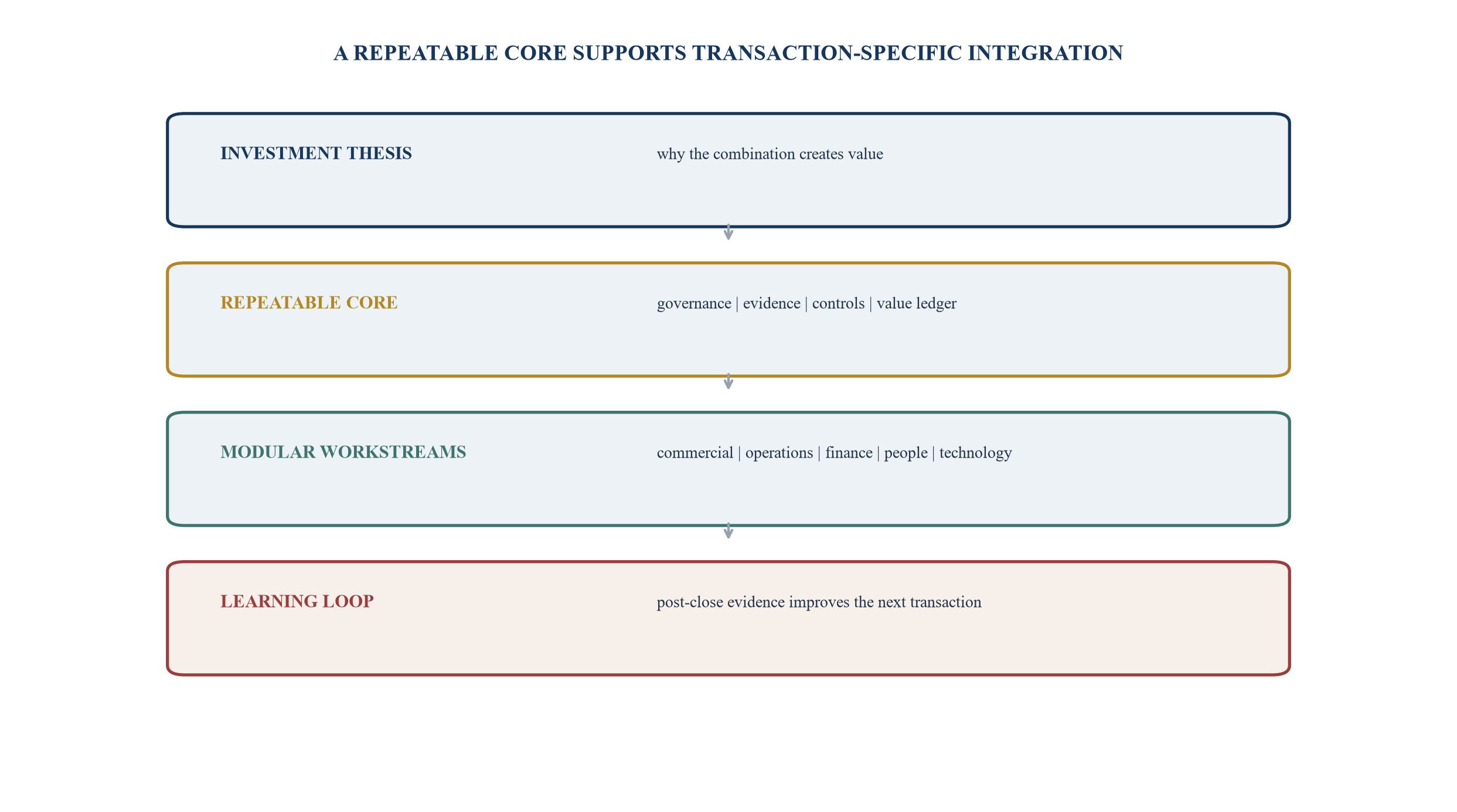
The architecture is illustrative. Governance and decision rights require company-specific approval.
2. Build the buy-and-build thesis before the next deal
Integration design begins with the reason for acquiring. A target may add geography, customer access, product capability, recurring revenue, licences, capacity, talent, technology or procurement scale. Each route creates a different dependency. A roll-up that relies on cross-selling needs customer and sales evidence. A capacity strategy needs asset utilisation, qualification and production evidence. A technology strategy needs product architecture, intellectual-property rights, cybersecurity and development-roadmap evidence.
The thesis should identify what must remain local, what should become common and what may be shared through a service model. It should explain how the target contributes to revenue, margin, cash, risk and strategic option value. It should also state dis-synergies, transition cost, resource constraints and the time required for the combined operating model to stabilise.
Competition analysis belongs inside the thesis. The United States Merger Guidelines state the agencies' analytical approach to mergers, including serial acquisitions and patterns that may reduce competition [5]. Canada's Competition Bureau also states that serial acquisitions can raise concerns when their collective effect changes competitive conditions [25]. A sponsor should therefore maintain a portfolio view of market overlap, prior acquisitions, pipeline targets and the cumulative effect of control.
The thesis should use testable statements. A claim that a target will expand distribution should identify products, territories, channel access, customer consent, sales capacity and the route to revenue. A claim that overhead will be reduced should identify duplicated roles, required control capacity, employment constraints, transition cost and the accounting line. A claim that technology will be standardised should identify data, interfaces, licences, resilience and migration risk.
Investment-committee approval should include a value map and a dependency map. The value map traces each benefit to evidence, action, owner and financial outcome. The dependency map records regulatory clearance, customer approval, lender consent, system readiness, workforce consultation, key-person retention and supplier continuity. These maps become the initial integration backlog and provide a disciplined basis for deciding whether the acquisition fits the platform's actual capacity.
3. Establish the repeatable core and modular perimeter
The repeatable core should contain only elements that improve control across nearly every transaction. It commonly includes governance, restricted-information protocols, Day One readiness, a common issue taxonomy, finance validation, cybersecurity triage, value tracking, decision logs, risk escalation and closure evidence. These components benefit from stable templates, trained owners and consistent definitions.
The modular perimeter holds choices that should respond to the transaction. Commercial integration varies with channel conflict, customer concentration and brand strategy. Technology varies with architecture, regulatory data requirements and technical debt. Workforce integration varies with law, collective arrangements, role duplication and talent dependency. Operational integration varies with product qualification, assets, safety and location. A factory that forces one path across these dimensions can accelerate the wrong work.
The platform should maintain a module library. Each module should define trigger conditions, minimum evidence, decision owner, standard deliverables, common risks and known variants. For example, a legal-entity consolidation module may be triggered by tax, licence, contract or treasury analysis. A sales-force integration module may be triggered by overlapping accounts and compatible customer propositions. A regulated-data module may require ring-fenced access, approved transfer and audit evidence.
Exceptions require formal treatment. An exception should state which standard is being varied, why the variation protects or creates value, who approved it, how long it applies and what control replaces the standard. The aim is to make local differentiation visible. Hidden exceptions create inconsistent processes, and uncontrolled standardisation can damage customer or regulatory outcomes.
The factory should measure reuse. Useful measures include the share of evidence requests drawn from the library, the number of decisions supported by standard tests, time from close to controlled reporting, exception volume, reopened issues and lessons incorporated into the next deal. These measures assess process maturity. They do not demonstrate investment value until operating and financial outcomes are verified.
Table 1. Integration factory module library
| Module | Trigger | Minimum evidence | Repeatable output | Primary owner | Typical exception |
|---|---|---|---|---|---|
| governance | signed or probable transaction | thesis, perimeter, authority and restrictions | charter, RACI and decision log | chief integration officer | regulated local board authority |
| Day One | closing readiness | critical processes, people, access and payments | continuity checklist and command centre | chief operating officer | legal separation after close |
| commercial | customer or channel interaction | contracts, pipeline, pricing and account overlap | account rules and revenue plan | commercial lead | protected local brand |
| finance and controls | control or consolidation | chart of accounts, close, tax and controls | opening balance and close plan | chief financial officer | delayed system migration |
| technology and cyber | network, data or application change | architecture, assets, identity and incidents | containment and migration plan | chief information officer | ring-fenced regulated data |
| people | organisation or terms change | roles, costs, obligations and retention | authority map and workforce plan | chief people officer | consultation or works-council sequence |
| value ledger | any synergy or cost claim | baseline, action, cost, timing and owner | finance-approved value bridge | finance transformation lead | risk value kept outside earnings |
The modules and ownership roles are illustrative. Transaction facts and qualified advice determine the required design.
4. Connect diligence evidence to integration decisions
Diligence should produce decisions that survive closing. A report can identify issues while leaving the integration team without the data, owner or authority to act. The factory should therefore convert each material diligence finding into one of five destinations: a valuation adjustment, transaction protection, closing condition, Day One control or post-close initiative.
The evidence chain begins with a question tied to the thesis. The team records the source, date, completeness, limitation and owner. It then states the decision affected, the consequence of an adverse answer and the point at which uncertainty must be resolved. Where evidence cannot be obtained before signing, the transaction team should decide whether protection, access rights, escrow, insurance, pricing or a post-close control is required. Qualified advisers should assess the legal and accounting implications.
The United States Department of Justice asks prosecutors to consider whether companies subject merger and acquisition targets to timely risk review and integrate acquired entities into compliance programmes [7]. The OECD due-diligence framework similarly describes risk-based diligence across operations, supply chains and business relationships [14]. These sources support a continuous evidence process that extends beyond the transaction data room.
The factory should maintain an evidence register with stable identifiers. Each item should show the original request, response, underlying document, open question, decision, owner and closure proof. The register should also distinguish management representation from independently supported evidence. Oral explanations can guide inquiry; they should not become a durable control record without appropriate support.
Diligence-to-integration handover should occur before close. Workstream leaders need access to permitted evidence, open items, management assumptions and contractual obligations. The handover should identify what remains restricted until clearance or close. It should also record which findings require confirmation during the first reporting cycle. This approach reduces the loss of deal knowledge when advisers and transaction teams disengage.
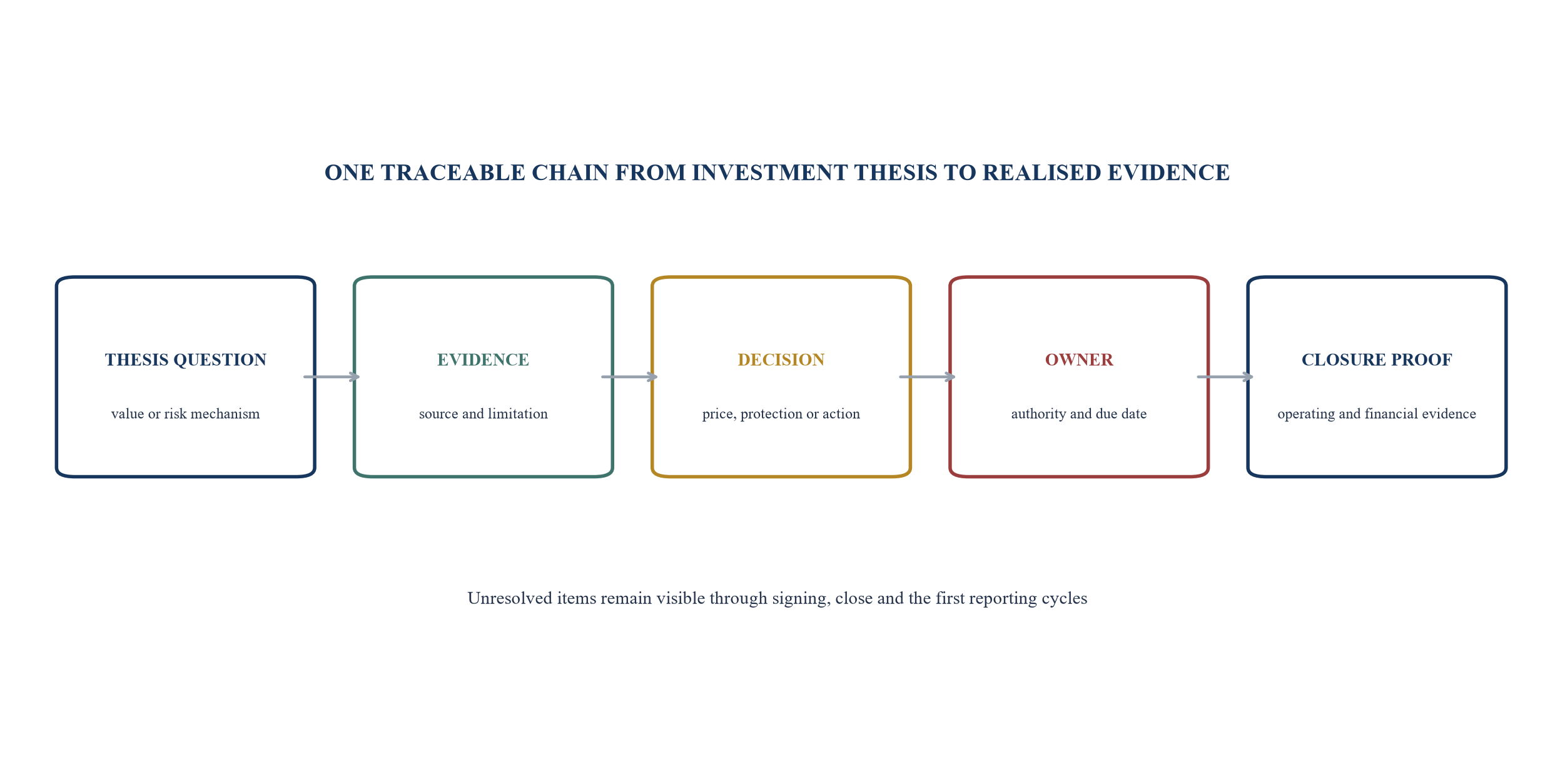
The chain is a governance model. Access, privilege and use of information require transaction-specific legal controls.
5. Map merger-control, standstill and information restrictions
Integration planning must operate inside the legal perimeter. The perimeter can include merger control, foreign-investment screening, sector approvals, contractual consent, confidentiality, data protection and securities-law restrictions. The integration factory should maintain a jurisdictional map that links each requirement to transaction steps, prohibited conduct, permitted planning, owners and evidence.
The European Commission states that concentrations with an EU dimension must be notified and cannot be implemented before notification and clearance [3]. The United States Hart-Scott-Rodino programme requires parties to certain transactions to file and wait before closing [6]. India's combination regime is mandatory and suspensory for applicable transactions [21]. Australia's mandatory regime took effect on 1 January 2026 and requires notification for transactions meeting the applicable thresholds [19]. These regimes differ, so the factory needs transaction-specific legal direction.
The United Kingdom can impose interim measures in completed mergers. CMA guidance describes restrictions that can include pausing integration, maintaining separate sales and brands, retaining key staff, continuing supply and limiting access to commercially sensitive information [2]. This has direct implications for management appointments, pricing, customer allocation, supplier negotiations, system access and communications.
Clean-team design should identify permitted members, permitted data, purpose, storage, reporting and destruction. Outputs should be aggregated to the degree needed for legitimate planning. Access logs and approval records should be retained. Business leaders who compete in pricing, customers, suppliers or labour markets should receive only information approved for their role.
The jurisdictional map should be refreshed when deal structure, ownership, scope, timing or target activity changes. The UAE competition framework includes economic-concentration notification thresholds under Cabinet Resolution No. 3 of 2025 [23]. Saudi Arabia's economic-concentration guidelines address changes of control and reportable structures [24]. The UK National Security and Investment regime covers qualifying acquisitions and sensitive activities [16]. The transaction cannot rely on a prior deal's map without a fresh legal assessment.
Table 2. Merger-control and standstill decision map
| Jurisdictional question | Evidence required | Integration consequence | Control owner | Closure evidence |
|---|---|---|---|---|
| is notification or approval required? | parties, control, turnover, transaction value, activities and geography | closing and implementation sequence | competition counsel | written assessment and decision |
| does a standstill obligation apply? | filing status, waiting period and authority direction | no implementation before permitted point | general counsel | dated clearance or expiry record |
| are interim measures possible? | completion status, overlap and authority engagement | separation, hold-separate and monitoring design | legal and integration leads | compliance statements and derogations |
| is foreign-investment review relevant? | ownership, investor rights, target sector, assets and data | access, governance, remedies and closing condition | investment-screening counsel | clearance and remedy tracker |
| can sensitive information be shared? | data category, purpose, recipients and competition relationship | clean team, aggregation and access logs | legal and information-security leads | approved protocol and audit trail |
| do remedies change the perimeter? | divestiture, access, licensing or behavioural commitment | carve-out, TSA and operating restrictions | remedy manager | authority-approved implementation proof |
This table is an illustrative control aid. Applicable law, thresholds and permissions require current jurisdiction-specific legal advice.
6. Design Day One around continuity and control
Day One is the first day the acquirer has the legal authority and responsibility contemplated by the transaction. It is a control event, not a ceremonial launch. The factory should identify the minimum conditions for customers, employees, suppliers, payments, safety, data, licences, insurance, banking, tax, reporting and decision authority to function without avoidable disruption.
Critical-process mapping should begin with outcomes. The team identifies what must happen during the first day, week and reporting cycle, who performs it, which system or third party supports it and what failure would mean. It then confirms access, approvals, credentials, instructions, contingencies and escalation. The highest-priority items usually involve cash, customer delivery, workforce pay, safety, regulated activity and incident response.
ISO 22301 provides a framework for business continuity management and recovery from disruptive incidents [15]. Its principles support scenario-based readiness. The integration team should run tabletop tests for plausible failures such as unavailable banking access, incorrect payroll, blocked customer orders, missing system credentials, supplier stop notices, licence uncertainty or a cyber event during migration.
The command centre should operate for a defined period. It should include decision owners, incident severity, communication routes, issue logging and shift coverage where required. It should not bypass established safety, regulatory or cybersecurity procedures. Issues should be triaged into immediate containment, business restoration, root-cause work and permanent control design.
Day One readiness should use evidence. A task marked complete needs an artefact such as approved authority, tested access, a reconciled employee file, confirmed banking instruction, customer communication approval or a successful continuity exercise. The steering committee should review exceptions and decide whether to close, defer, mitigate or escalate. A transaction can close with open tasks when the risk is understood and controlled; the open items should remain visible after celebration activity ends.
7. Set the integration perimeter and sequencing
The integration perimeter describes which entities, processes, products, customers, systems, data and people will move toward a common model. The perimeter should reflect the thesis, regulatory position and operating constraints. It should not be defined solely by legal ownership or an organisational chart.
Sequencing decisions should balance value, dependency, reversibility and capacity. Early moves are appropriate when they protect continuity, establish control or unlock evidence. Later moves are appropriate when customer consent, regulatory approval, data cleansing, technical testing or workforce process is required. Some capabilities may remain permanently local because they create differentiation, satisfy regulation or support accountability close to the customer.
The factory can use four integration patterns. Full integration moves the capability into the platform model. Federated integration establishes common standards and reporting while retaining local execution. Shared services centralise selected activities under service levels and charge logic. Ring-fenced operation keeps defined separation with controlled interfaces. The chosen pattern should be explicit for each capability.
Dependencies should be mapped as a network. Finance-system migration may depend on the chart of accounts, opening balances, tax mapping, customer masters and bank approvals. Commercial integration may depend on customer segmentation, pricing authority, data rights and sales incentives. Workforce changes may depend on consultation, role design, retention and system access. A date-only plan can conceal these relationships.
The factory should maintain a sequencing register with decision, prerequisite, earliest safe point, latest useful point, owner, contingency and evidence. The board should see whether value delay arises from an external restriction, incomplete evidence, insufficient resources or a deliberate protection of customer and operating outcomes. This distinction improves capital allocation and accountability.
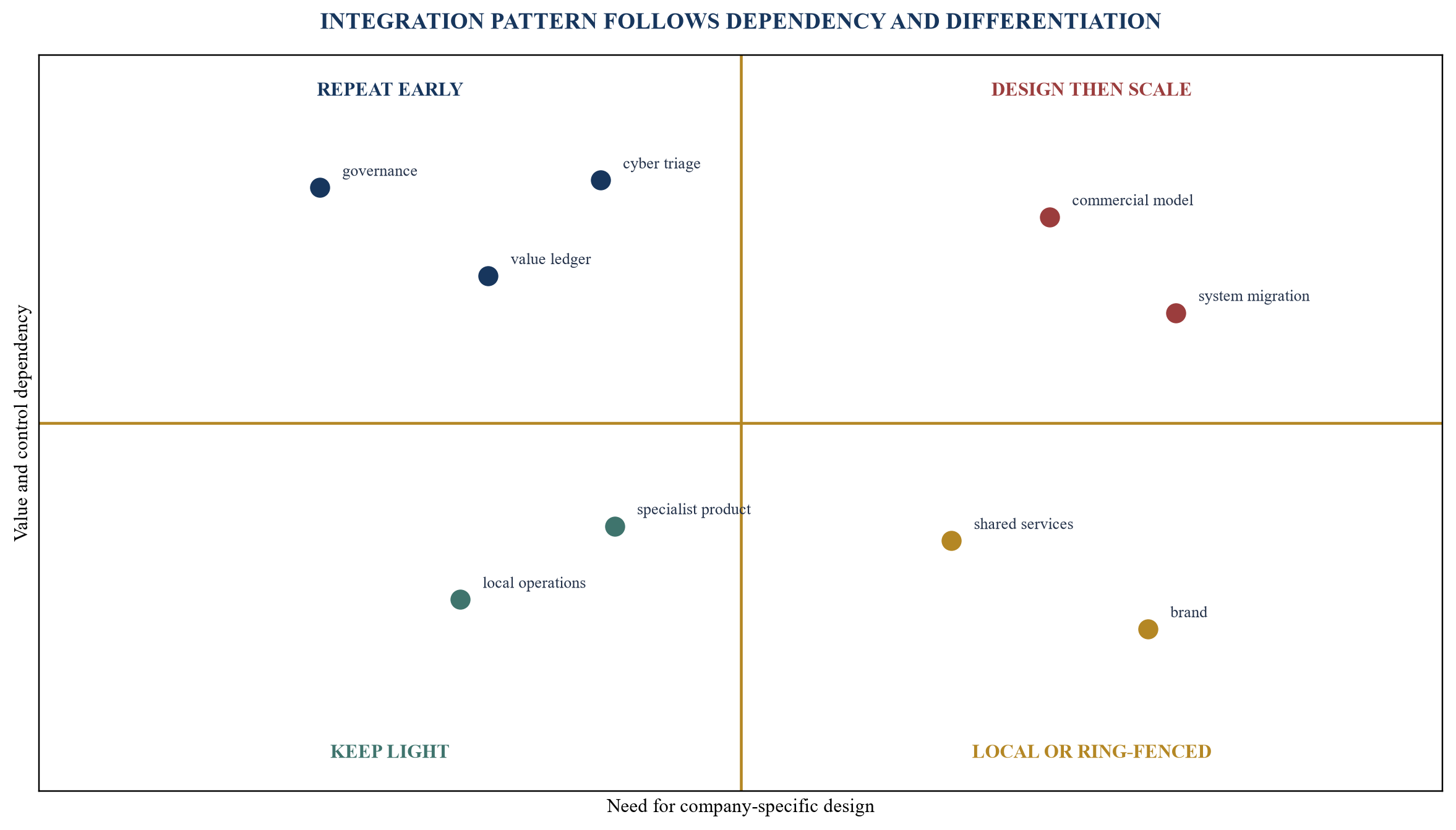
The placements are illustrative. Actual integration pattern and timing require transaction-specific evidence.
8. Govern customers, revenue and commercial continuity
Commercial integration starts with customer protection. The team should identify contracted obligations, pricing, service levels, renewal dates, change-of-control rights, exclusivity, consent, rebates, credit, data permissions, complaints and active bids. It should also identify account ownership, relationship depth and the operational capabilities required to fulfil each promise.
Revenue synergy requires an executable route. Cross-selling depends on product fit, customer need, sales capacity, incentives, regulatory permission, delivery capability and a measurable conversion path. Price harmonisation depends on contracts, customer value, competitive position and service. Channel consolidation depends on conflict, economics and coverage. The value ledger should keep these mechanisms separate.
The team should create customer rules before sales teams receive overlapping account information. Rules should address named-account ownership, lead referral, product specialist access, pricing authority, credit decisions, pipeline attribution and dispute resolution. Clean-team and standstill restrictions should shape access before clearance and close. Customer data should be handled under applicable privacy and contractual obligations.
The UK Information Commissioner's Office states that mergers and acquisitions involving a transfer to a different or additional controller require data-sharing diligence, including purpose, lawful basis, transparency, security and documentation [28]. The integration factory should therefore include customer-data mapping, retention, access, consent and communication in the commercial workstream.
Commercial continuity should be monitored through revenue, renewal, pipeline, service, complaints, churn, credit and customer-concentration indicators. These measures need baseline and ownership. A temporary rise in reported pipeline can result from duplicate opportunities. A higher order book can conceal delivery strain. The steering committee should review revenue evidence alongside capacity and customer experience.
9. Integrate finance, accounting and internal controls
Finance integration creates the opening control environment for the combined group. The workstream should address legal entities, consolidation, purchase accounting, opening balances, chart of accounts, close calendar, revenue recognition, tax, treasury, banking, intercompany activity, working capital, management reporting and internal controls.
IFRS 3 requires the acquisition method, including identification of the acquirer and acquisition date, recognition and measurement of identifiable assets and liabilities, and recognition of goodwill or a bargain purchase [8]. IFRS 10 establishes control as the basis for consolidation [9]. These requirements shape data, valuation, governance and reporting from the point control is obtained. Qualified accounting advisers should determine the transaction-specific treatment.
The finance team should create an opening-balance plan and a first-close plan. The plans should identify data sources, valuation work, cut-off, intercompany positions, debt, tax, systems, reconciliations, approvals and review. Estimates and provisional amounts should have owners, basis and update dates.
Control integration should be risk-based. PCAOB AS 2201 describes a top-down approach to internal control over financial reporting for applicable audits [11]. The factory can use a similar principle by identifying significant accounts, disclosures, risks, process owners, controls and evidence. It should retain local controls where immediate replacement would weaken reliability.
The SEC's acquisition-disclosure rules can require financial statements and pro forma information for significant acquired businesses in applicable circumstances [10]. Public-company and financing plans may therefore change the timetable. Private groups also benefit from an audit trail that explains the acquisition perimeter and performance.
Table 3. Finance and control integration evidence
| Finance domain | First decision | Evidence | Day One or first-close control | Board indicator |
|---|---|---|---|---|
| control and consolidation | acquisition date and reporting perimeter | transaction documents, rights and legal structure | approved consolidation map | entities included and exceptions |
| opening balance | valuation and cut-off responsibilities | trial balance, contracts, debt, tax and valuation files | reconciled opening-balance register | unresolved provisional items |
| revenue and customer balances | policy and data compatibility | contracts, billing, deferred revenue and receivables | policy assessment and subledger reconciliation | revenue, churn and ageing variance |
| cash and debt | authority, liquidity and covenant reporting | bank mandates, facilities, security and forecasts | controlled signatories and daily liquidity view | liquidity headroom and covenant status |
| internal control | significant risks and evidence | process maps, access, journals and reconciliations | interim control matrix and deficiency log | open high-risk deficiencies |
| management reporting | common metrics and data source | chart of accounts, KPI definitions and systems | signed first reporting package | close duration and adjustment volume |
The evidence set is illustrative. Applicable accounting standards, tax rules, financing documents and auditor requirements govern the final plan.
10. Integrate data, technology and cybersecurity
Technology integration should begin with containment and visibility. The team needs an inventory of identities, privileged access, devices, applications, infrastructure, cloud services, data stores, interfaces, licences, third parties, incidents, vulnerabilities, backups and recovery arrangements. Unknown assets and unmanaged access should remain visible as risks rather than being assumed into the migration plan.
NIST's Cybersecurity Framework 2.0 organises cybersecurity outcomes across Govern, Identify, Protect, Detect, Respond and Recover [12]. NIST SP 800-161 addresses cybersecurity supply-chain risk across products and services [13]. The factory can use these sources to structure a current-state profile, target profile, supplier review and prioritised action plan.
Connection decisions require evidence. Linking networks or identity systems can transfer risk. Migrating data can introduce loss, corruption, excessive access or regulatory breach. Consolidating suppliers can create concentration and dependency. The technology workstream should define entry criteria for connectivity, identity federation, data transfer, application retirement and infrastructure migration.
The target architecture should reflect the integration pattern. Full integration may move to common platforms. Federated operation may retain local systems with controlled interfaces and common reporting. Ring-fenced operation may require separate identity, data and monitoring. The decision should consider business value, resilience, technical debt, licence cost, data rights, security, regulatory obligations and implementation capacity.
Cybersecurity evidence should enter the value and risk conversation. Remediation cost, downtime, contract exposure and migration resources can affect the transaction economics. A security improvement can create resilience and customer trust; it should not be booked as certain earnings without an approved financial mechanism. The board should receive a clear view of residual risk, temporary controls and the path to the target profile.
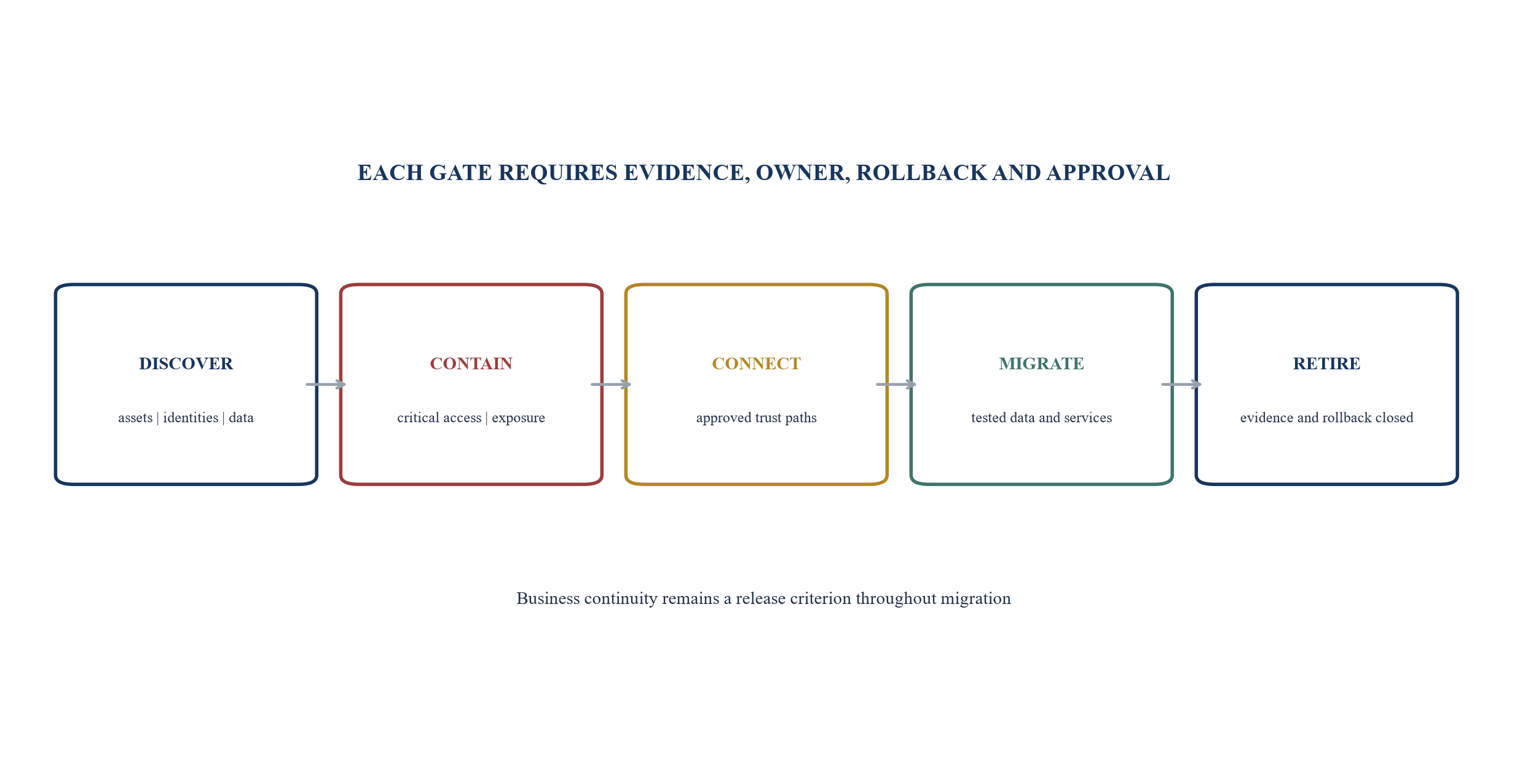
The gates are illustrative. Cybersecurity and data decisions require current technical evidence and qualified approval.
11. Integrate people, authority and incentives
People integration should establish who decides, who performs and what behaviour the combined model rewards. The workstream should map critical roles, legal employers, reporting lines, delegations, compensation, benefits, retention, workforce obligations, vacancies, contractors, succession and key-person dependency.
Role decisions should begin with the operating model. Selecting leaders before defining accountabilities can preserve duplication or remove essential capacity. The team should describe each role's purpose, decisions, outputs, interfaces and required capability. It should then assess incumbents using relevant evidence and a documented process. Employment law, consultation, discrimination, collective arrangements and privacy require qualified local advice.
Retention should focus on dependency and replacement risk rather than hierarchy alone. A product architect, licence holder, plant supervisor, account leader or finance-system administrator may be more critical to continuity than a senior title suggests. The retention plan should state the dependency, required period, knowledge-transfer plan, incentive, behavioural expectation and alternative.
Incentives should align with combined outcomes. Sales compensation should address account sharing, product referral and margin. Operational incentives should protect service, quality and safety during change. Integration-team incentives should reward verified milestones and sustainable value rather than activity volume. Management equity and earn-outs should be assessed alongside the authority and behaviours they may encourage.
The United States WARN Act provides notice requirements for qualifying plant closings and mass layoffs in applicable circumstances [27]. Other jurisdictions can impose consultation, transfer, works-council or collective requirements. The factory's jurisdictional map should therefore link organisation decisions to legal sequence and communication. Workforce communication should state what is decided, what remains under review, when updates will occur and where employees can raise questions.
12. Protect culture while standardising management behaviour
Culture becomes operational when it affects decisions, escalation, customer treatment, risk, pace, accountability and information flow. A broad claim that cultures fit is insufficient. The factory should identify behaviours required by the combined strategy and evidence whether existing norms support or obstruct them.
The assessment can examine how each company approves spending, handles bad news, manages customers, resolves quality issues, rewards collaboration, treats controls and allocates authority. Interviews, observed routines, employee data, customer feedback and decision records can provide evidence. The team should distinguish local style from behaviours that create financial, safety, conduct or execution risk.
Standardisation should target management essentials. These can include accurate reporting, customer commitments, safety, compliance, cybersecurity, capital approval, performance review and issue escalation. Other practices can remain local when they support customer proximity, innovation or talent. The factory should explain this boundary so employees understand which changes are mandatory and which choices remain with the business.
Leaders shape integration culture through the first decisions. How they handle a missed target, customer failure, data incident, role conflict or disputed synergy communicates more than launch messages. Decision logs and operating reviews should show whether leaders use evidence, respect authority and close actions. Inconsistent exceptions should be addressed openly.
Culture indicators should be linked to outcomes. Examples include regretted attrition in critical roles, overdue decisions, issue escalation time, control exceptions, customer complaints, safety events, cross-selling collaboration and employee questions. The steering committee should avoid a single composite culture score that conceals the underlying behaviours and populations.
13. Capture procurement and supplier value safely
Add-on acquisitions can create purchasing leverage, specification opportunity, supplier consolidation and working-capital improvement. These levers require a combined view of spend, contracts, demand, service, capacity, concentration and supplier financial health. A lower price is not value when the supplier cannot perform or the transition damages operations.
The procurement workstream should reconcile suppliers and parent groups across entities. It should identify overlapping categories, contract terms, rebates, minimums, change rights, termination, data access, cybersecurity, continuity and local-content obligations. Category strategies should distinguish global scale from local service and regulation.
Supplier engagement needs a clear purpose and permitted information. Before clearance, exchange may require clean-team controls. After close, the team should respect contract rights and avoid unsupported commitments. Strategic suppliers should receive a credible view of demand, specifications, transition and governance. Fragile critical suppliers may need payment discipline, capacity support or diversification rather than aggressive term extension.
The OECD due-diligence framework supports risk-based attention to operations, supply chains and business relationships [14]. NIST's supply-chain cybersecurity guidance supports supplier assessment across the technology lifecycle [13]. The factory should combine commercial, continuity, conduct and cyber evidence so supplier decisions do not move risk between disconnected functions.
Procurement value should enter the same finance-led ledger as other synergies. The baseline must separate price, volume, mix, foreign exchange, inflation, acquisitions and implementation cost. Contracted value should remain separate from realised value. Working-capital effects should remain separate from recurring earnings. This discipline allows the board to assess net value and supplier-system health together.
14. Standardise operating processes and performance measures
Operating integration should focus on processes that deliver customer outcomes and control economic performance. The team should map order-to-cash, procure-to-pay, plan-to-produce, service delivery, quality, maintenance, product development, incident management and financial close to the level needed for decisions.
Process maps should include inputs, activities, systems, roles, controls, outputs, measures and failure points. They should show where the target's method is stronger. The platform should adopt the best supported process rather than assume the larger company is superior. A target may have better customer response, automation, yield, product knowledge or local compliance.
The factory should define a common metric dictionary. Each measure needs purpose, formula, unit, source, frequency, owner, scope and reconciliation. Revenue, gross margin, backlog, utilisation, service level, quality, working capital and headcount can differ materially across businesses. Reporting a combined figure before definitions are aligned can create false confidence.
Standardisation should pass an outcome test. The proposed process should improve control, customer experience, cost, speed, resilience or decision quality. It should also have an implementation owner and transition plan. Where local variation remains, the team should document the reason and interface. This avoids a hidden patchwork inside nominally common policy.
Process performance should be reviewed alongside integration milestones. A completed system migration can coincide with slower invoicing or lower service. A new organisation chart can coexist with unclear decisions. The board should see whether the operating outcome stabilises after the change and whether temporary controls are being closed.
Table 4. Operating process integration test
| Process | Customer or control outcome | Baseline evidence | Target-state decision | Release criterion | Post-change measure |
|---|---|---|---|---|---|
| order-to-cash | accurate promise, delivery, billing and collection | orders, backlog, service, invoice and ageing | common stages and authority | tested order, invoice and exception path | service, billing accuracy and cash conversion |
| procure-to-pay | controlled demand, supply and payment | contracts, orders, receipts, invoices and terms | supplier master and approval model | reconciled supplier and payment data | leakage, exceptions and on-time payment |
| plan-to-produce | capacity aligned to customer demand | forecast, schedule, yield, downtime and inventory | planning horizon and constraint logic | tested plan and escalation | attainment, yield and inventory |
| service delivery | safe and consistent customer outcome | response, completion, quality and complaints | service standard and local variation | trained roles and contingency | response, first-time resolution and complaints |
| financial close | complete and reliable reporting | calendar, reconciliations, journals and adjustments | common package and control ownership | signed first-close rehearsal | close duration and post-close adjustments |
| incident management | rapid containment, decision and recovery | incidents, severity, response and lessons | common taxonomy and escalation | tabletop test and contact readiness | response time, recurrence and closure quality |
The tests are illustrative. Company-specific operating, safety, regulatory and customer requirements govern acceptance.
15. Build a synergy and dis-synergy value ledger
The value ledger should connect the investment thesis to realised earnings, cash and risk. It should record each initiative's baseline, mechanism, owner, action, timing, implementation cost, probability, financial line, dependency, dis-synergy and evidence. Finance should control definitions and approve movement between stages.
Revenue value can arise from cross-selling, channel access, price, product expansion or retention. Cost value can arise from procurement, workforce, facilities, systems, insurance, professional services and process improvement. Cash value can arise from working capital, capex, deposits and tax timing. Risk and capability value should be stated separately unless an approved financial mechanism supports recognition.
Dis-synergies belong inside the ledger. They can include customer churn, retention awards, duplicate systems, transitional services, inventory builds, contract termination, separation controls, integration staff, advisory cost, tax, remediation and productivity loss. Excluding these items can produce a gross synergy claim that does not explain net cash or earnings.
The ledger should use stages such as identified, evidenced, approved, implemented and realised. Identified value is a hypothesis. Evidenced value has a supported baseline and action. Approved value has accountable ownership and required authority. Implemented value has completed operational change. Realised value reconciles to actual financial or operating evidence. Forecast and realised amounts should remain distinct.
Double counting requires explicit tests. A procurement reduction may overlap with a budget cut. A sales initiative may overlap with market growth. A role removal may overlap with a vacant position. A technology saving may be offset by migration cost or new licences. Each initiative should map to one value line and name interactions with other initiatives.
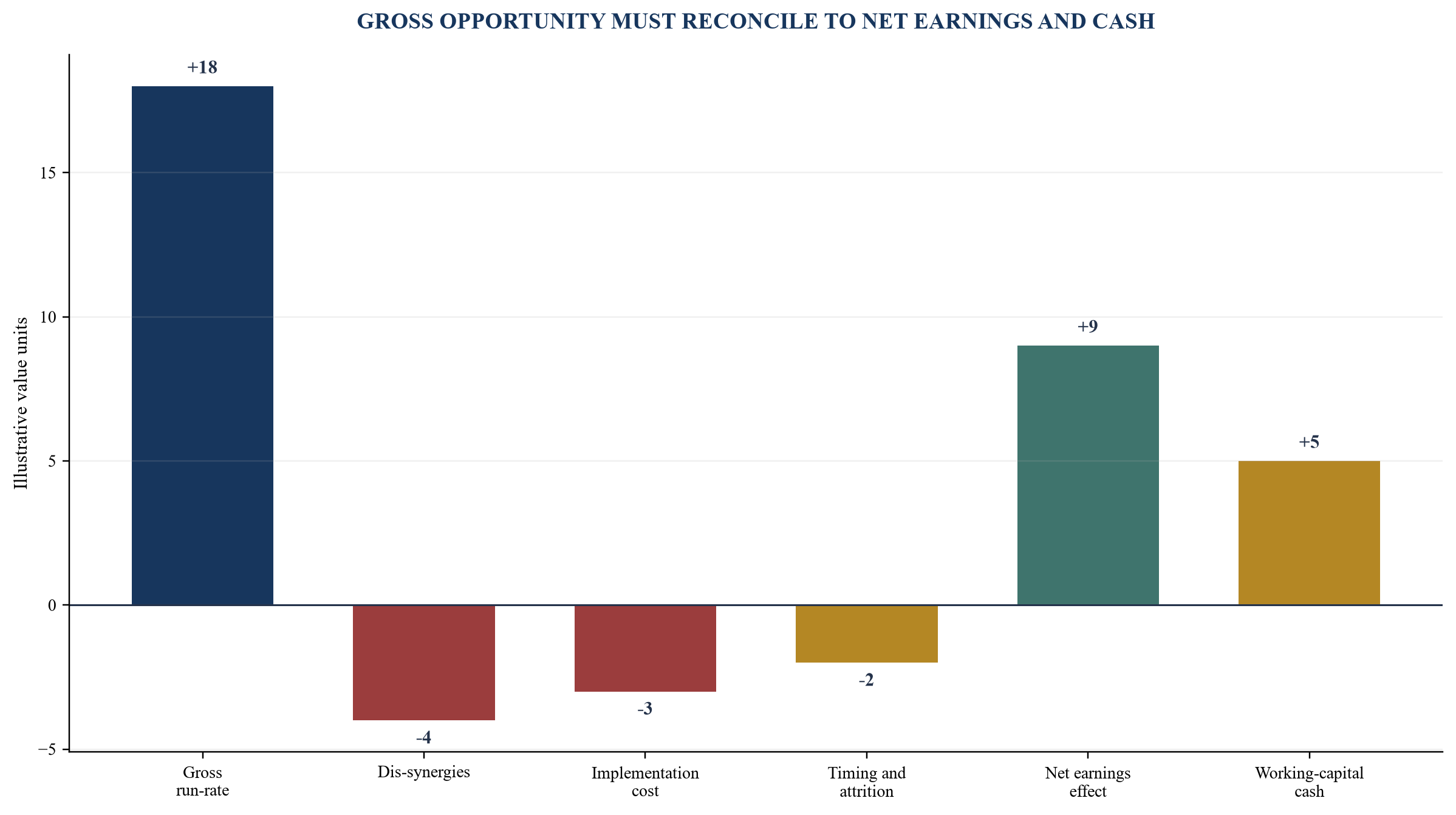
Values are hypothetical management assumptions used only to illustrate reconciliation. They do not represent a forecast or client outcome.
16. Create company accountability inside a portfolio factory
A sponsor can centralise methods, expertise and challenge while preserving company accountability. The factory should distinguish portfolio standards from company decisions. Standards can cover value definitions, risk escalation, evidence, reporting and lessons. Company decisions cover customer commitments, operating processes, people, contracts, spending and implementation within delegated authority.
The sponsor should maintain a small permanent capability: a playbook owner, data and value standards, specialist access, a lessons library and portfolio reporting. Each active integration should have a company-based leader with authority, time and access to the chief executive. Temporary workstreams should draw on operating leaders who will own the resulting process.
Resource capacity should be planned before signing. A platform with several simultaneous add-ons can face competition for finance, technology, legal, people and operational leaders. The factory should show committed capacity, critical-path workload, external support, decision bottlenecks and business-as-usual requirements. Deal pace should be matched to absorption capacity.
Portfolio reporting should support comparison without forcing false uniformity. It can show stage-gate status, value stage, critical risks, customer outcomes, control readiness, resource gaps and closure evidence. Raw values should be accompanied by scope and baseline. A larger acquisition should not appear worse solely because it has more issues; severity, consequence and closure quality matter.
The sponsor should challenge the platform's repeat-acquisition capability during each investment decision. Questions include whether prior integrations reached closure, whether temporary controls remain open, whether leaders are available, whether systems can scale and whether claimed synergies from earlier deals are realised. This connects the next acquisition to the existing operating reality.
17. Use stage gates from diligence through the first hundred days
Stage gates convert the integration plan into explicit decisions. A gate should state the decision, evidence, owner, approvers, exceptions and consequence of failure. It should reduce ambiguous progress reporting and support escalation before an irreversible change.
The pre-sign gate confirms thesis, perimeter, material risks, valuation consequences and contractual protection. The pre-close gate confirms regulatory restrictions, Day One readiness, authority, critical retention, cash, communications and incident response. The first-close gate confirms consolidation, opening balances, controls, reporting and liquidity. Subsequent gates can cover customer integration, system connection, organisation, supplier awards and value realisation.
The first-hundred-day plan should be driven by dependencies rather than a fixed list of activities. The first phase establishes authority, containment and continuity. The second stabilises reporting, customers, people and critical operations. The third executes approved value initiatives and target-state changes. The fourth confirms evidence, closes temporary controls and transfers ownership.
Gate failure should produce a clear response. The team can defer the change, add a control, narrow the scope, fund remediation, obtain approval or stop the initiative. A red status without a decision creates reporting noise. A green status without evidence creates false assurance. The integration leader should keep the standard demanding and proportionate.
The gate library should improve after each transaction. The post-integration review should identify which evidence predicted issues, which tests failed, which decisions were late and which controls created little value. Updates should be approved and versioned. This creates institutional learning that can be inspected rather than relying on individual memory.
Table 5. Integration stage-gate control
| Gate | Decision | Minimum evidence | Approvers | Failure response | Closure proof |
|---|---|---|---|---|---|
| pre-sign | does the target fit the platform and absorption capacity? | thesis, diligence, value map, risk and resource plan | investment committee | reprice, protect, narrow or withdraw | signed decision and conditions |
| pre-close | can ownership begin with continuity and control? | clearance, Day One tests, authority, cash and communications | board and executive team | defer permitted change or add contingency | readiness certificate and exceptions |
| first close | can the group report reliably? | opening balances, consolidation, reconciliations and controls | chief financial officer and audit governance | extend local control and remediate | signed reporting package |
| customer release | can accounts, products or pricing be combined? | contracts, permissions, capacity, data and account rules | commercial, legal and operations leaders | phase by segment or retain separation | customer and revenue evidence |
| technology release | can systems or data connect safely? | asset inventory, security tests, migration and rollback | technology, security and business owners | contain, remediate or resequence | tested service and control evidence |
| value realisation | has the initiative reached earnings or cash? | baseline, implementation, ledger and operational outcome | finance and initiative owner | retain as forecast or reopen action | finance-approved bridge |
Timings are illustrative. Transaction documents, law, operating conditions and board authority determine the actual gates.
18. Run an operating cadence that makes decisions
The integration cadence should match the decisions and risk. Daily coordination may be needed around close and critical migrations. Weekly workstream reviews can manage actions and dependencies. A fortnightly or monthly steering committee can approve resources, exceptions, scope and value changes. Board review should focus on thesis, customer outcomes, controls, material risk and net value.
Each forum should have a defined purpose, decision rights and standard evidence. Workstream meetings should resolve execution issues. The steering committee should address cross-functional conflicts and changes to the approved plan. Finance review should validate baselines, stages and double-counting. Risk and legal review should address restrictions and residual exposure. The board should decide matters reserved to its authority.
Reporting should be exception-led and evidence-backed. The dashboard can show stage gates, critical path, value bridge, customer indicators, people, controls, technology, cash and top risks. Every item should have a current owner and next decision. Long activity lists can sit beneath the dashboard for delivery management.
Decision latency is an integration risk. The factory should record the date an issue was raised, information required, decision owner, due date and outcome. Repeated delay can signal unclear authority, unavailable leaders or insufficient evidence. The steering committee should address the underlying cause rather than repeatedly moving dates.
The cadence should also protect management capacity. Business leaders need time to operate the company. The factory should combine forums where the decision set overlaps, remove reports that do not drive action and close workstreams when ownership transfers. A mature integration becomes part of the operating system rather than a permanent parallel bureaucracy.
19. Measure portfolio integration health and learning
The portfolio dashboard should show whether integrations create value without weakening customers, controls or operating capacity. It should combine financial, operational, people, technology and risk measures. It should also show confidence in the underlying evidence.
Financial measures can include realised earnings, cash, implementation cost, dis-synergies and forecast variance. Commercial measures can include revenue retention, renewal, pipeline conversion, complaints and customer concentration. Operating measures can include service, quality, backlog, utilisation and working capital. People measures can include critical-role coverage, regretted attrition and decision clarity. Technology measures can include high-risk exposure, access closure, migration performance and recovery tests.
The heat map should distinguish severity from volume. One unresolved customer, safety, control or cybersecurity issue can matter more than dozens of routine tasks. Each status should show consequence, trend, owner, decision date and mitigation. Evidence confidence should show whether the status is based on reconciled data, management representation or incomplete information.
Learning measures assess factory maturity. Examples include repeated issues, reuse of tested modules, time to first controlled close, time to close temporary access, percentage of value with finance-approved baselines and lessons incorporated into the next deal. These measures support improvement and should not be presented as a substitute for value.
Portfolio review should identify systemic risks. Several targets may depend on the same software, supplier, customer, data centre, financing line or executive. Individual integration reports can miss this concentration. The sponsor should maintain a cross-company dependency view and decide whether to diversify, invest in capacity, adjust insurance or change acquisition pace.
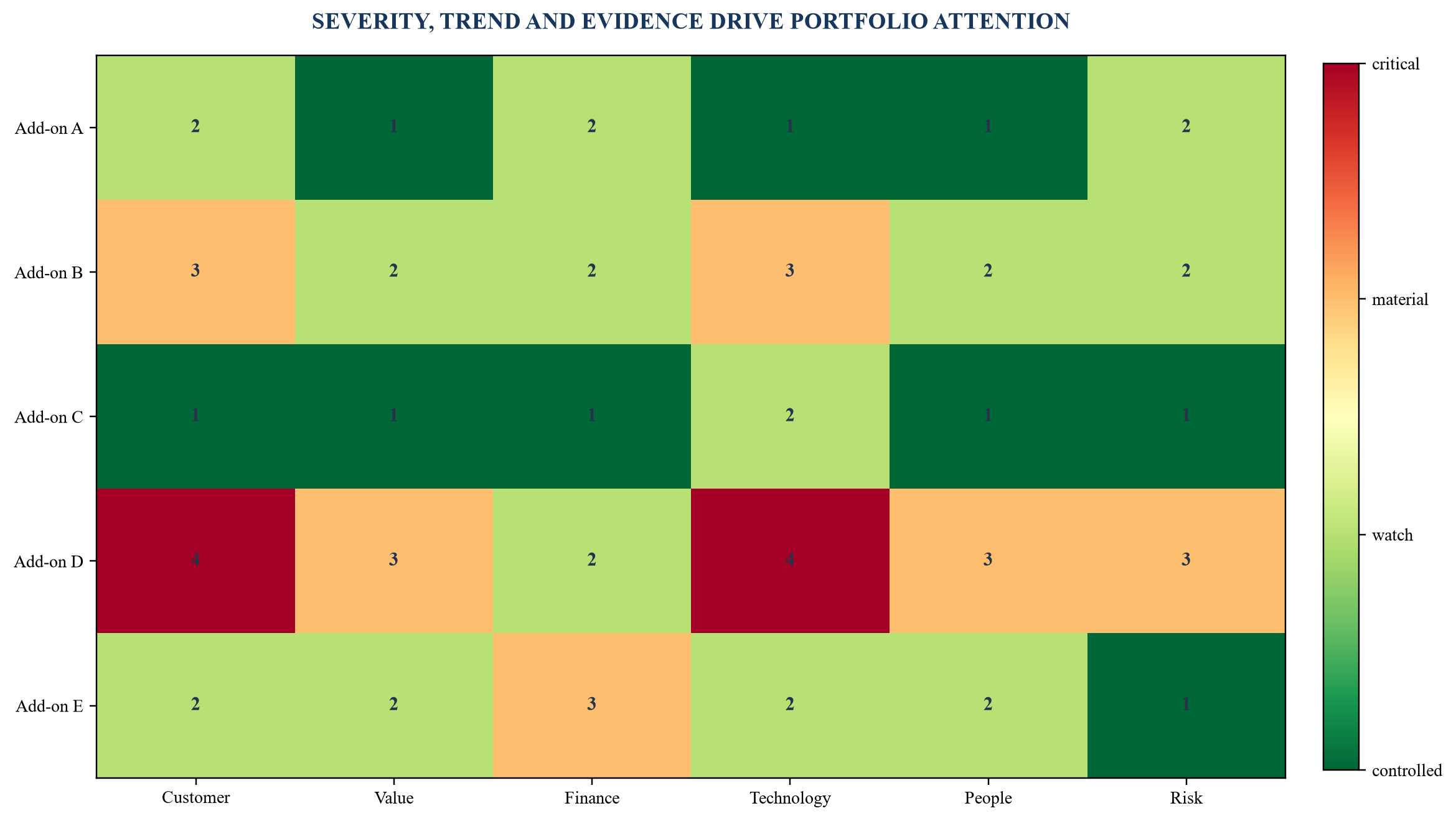
Scores are hypothetical management assumptions used to demonstrate the dashboard. They do not represent actual companies or outcomes.
20. Build exit-ready evidence and recognise failure modes
Integration creates exit value when a future buyer can understand the operating model, recurring economics, controls, customer position and remaining risks. A list of completed tasks is weak evidence. The exit file should reproduce why changes were made, how value reached the accounts and whether the combined capability can operate under new ownership.
The factory should retain the thesis, diligence evidence, decision logs, stage gates, customer and supplier decisions, organisation, architecture, controls, value ledger, implementation cost and operating outcomes. It should identify benefits that depend on sponsor-wide arrangements, related parties, temporary rebates, individual relationships or transitional services. A future buyer may adjust value where benefits are not durable or transferable.
Common failure modes can be detected early. The platform may acquire faster than it can integrate. It may select leaders before designing roles. It may connect technology without containment. It may combine customers before defining account authority. It may count signed initiatives as realised value. It may standardise weak platform processes. It may retain temporary controls indefinitely. It may lose critical people before knowledge transfers.
Regulatory failure can also change value. The EU merger process includes mandatory notification and standstill for concentrations with an EU dimension [3]. The UK NSI regime can require approval for qualifying acquisitions in sensitive areas [16]. CFIUS reviews certain foreign-investment and real-estate transactions for national-security effects [17]. The EU FDI framework supports cooperation on security and public-order screening [18]. The exit file should record applicable clearances, remedies and continuing obligations.
The factory should conduct evidence drills. A reviewer selects a synergy, control, customer change or system migration and traces the baseline, decision, approval, implementation, current owner and outcome. Gaps should be corrected while knowledge remains available. This process supports financing, audit, warranty, diligence and board oversight.
21. Use a board decision checklist
The board should govern each add-on as both a transaction and an operating transformation. First, does the acquisition fit the platform's strategy, market position and absorption capacity? The decision should include the cumulative effect of prior acquisitions and the resources still committed to open integrations.
Second, is the value thesis testable? Each material benefit should have evidence, mechanism, owner, timing, cost and financial route. Dis-synergies and transition cash should be visible. Third, are regulatory, standstill, foreign-investment, data and contractual restrictions mapped to the plan? Qualified advisers should own the relevant assessments.
Fourth, is Day One ready for customers, cash, employees, suppliers, safety, systems and incident response? Exceptions should have mitigations and authority. Fifth, is the target operating model explicit by capability? The board should know what will be fully integrated, federated, shared or ring-fenced and why.
Sixth, can finance produce a controlled first close and opening balance? Seventh, are technology connectivity and data migration governed by evidence and rollback? Eighth, are critical people, authority and incentives aligned with the combined model? Ninth, can the company demonstrate net value without double counting?
Tenth, does the factory improve after the transaction? Lessons should update the evidence request, module library, stage gates and resource assumptions. The board can approve, approve with conditions, phase, redesign, defer for evidence or reject a major integration decision. Conditions should have owners and dates.
The durable outcome is a platform that can acquire while preserving governance, customer trust and operating performance. Repetition creates value when the factory makes evidence, decisions and accountability stronger with every deal. The board should require proof that the integration system is learning at least as fast as the acquisition programme is expanding.
Table 6. Board-ready add-on integration scorecard
| Decision dimension | Board question | Evidence standard | Escalation condition | Available decision |
|---|---|---|---|---|
| strategic fit | does the add-on strengthen the platform within absorption capacity? | thesis, market view, portfolio dependencies and resource plan | earlier integrations or critical resources remain materially open | phase, defer or reject |
| regulatory perimeter | are clearance, standstill and screening obligations controlled? | written qualified assessments, protocols and timetable | unresolved filing, access or implementation restriction | condition, ring-fence or stop |
| continuity | can ownership begin without avoidable customer or control failure? | tested Day One plan and exception register | critical payment, safety, service or incident gap | mitigate or defer change |
| operating model | is each capability's integration pattern explicit? | target-state map, dependencies and authority | standardisation weakens differentiation or control | redesign or retain local model |
| value | does finance reconcile net earnings and cash? | signed baseline, dis-synergies, cost and realised evidence | overlap, unsupported assumptions or unclear accounting | defer value recognition |
| exit evidence | is the combined business governable and transferable? | control file, operating outcomes and dependency analysis | temporary, sponsor-dependent or unreproducible benefit | adjust valuation and remediation plan |
The scorecard is an illustrative governance aid. Scores, thresholds and decisions require company-specific approval.
Sources and further reading
- United Kingdom Competition and Markets Authority, Merger Assessment Guidelines 2026 Official source
- United Kingdom Competition and Markets Authority, Interim Measures in Merger Investigations: Summary for Businesses Official source
- European Commission, Mergers Procedures Official source
- European Commission, Mergers Overview Official source
- United States Federal Trade Commission and Department of Justice, Merger Guidelines 2023 Official source
- United States Federal Trade Commission, Premerger Notification Program Official source
- United States Department of Justice, Evaluation of Corporate Compliance Programs Official source
- IFRS Foundation, IFRS 3 Business Combinations Official source
- IFRS Foundation, IFRS 10 Consolidated Financial Statements Official source
- United States Securities and Exchange Commission, Amendments to Financial Disclosures about Acquired and Disposed Businesses Official source
- Public Company Accounting Oversight Board, AS 2201: An Audit of Internal Control Over Financial Reporting Official source
- National Institute of Standards and Technology, Cybersecurity Framework 2.0 Official source
- National Institute of Standards and Technology, SP 800-161 Revision 1, Cybersecurity Supply Chain Risk Management Practices Official source
- OECD, Due Diligence Guidance for Responsible Business Conduct Official source
- International Organization for Standardization, ISO 22301:2019 Business Continuity Management Systems Official source
- United Kingdom Government, National Security and Investment Act Guidance Official source
- United States Department of the Treasury, CFIUS Overview Official source
- EUR-Lex, Regulation EU 2019/452 Establishing a Framework for Screening Foreign Direct Investments Official source
- Australian Competition and Consumer Commission, Mergers and Acquisitions Official source
- Competition Commission of India, Competition Commission of India Combinations Regulations 2024 Official source
- Competition Commission of India, Regulation of Combination Official source
- United Arab Emirates Legislation, Federal Decree-Law No. 36 of 2023 Regarding Regulating Competition Official source
- United Arab Emirates Legislation, Cabinet Resolution No. 3 of 2025 Regarding Economic Concentration Thresholds Official source
- Saudi General Authority for Competition, Economic Concentration Review Guidelines Official source
- Competition Bureau Canada, Specific Areas of Enforcement: Mergers Official source
- Competition and Consumer Commission of Singapore, Merger Assessment Process Official source
- United States Department of Labor, WARN Act Compliance Assistance Official source
- United Kingdom Information Commissioner's Office, Due Diligence when Sharing Data following Mergers and Acquisitions Official source
- European Commission, Foreign Subsidies Regulation Questions and Answers Official source
- European Commission, DG Competition Manual of Procedures for the Application of the EU Merger Regulation Official source
