

1. Define the procurement value-creation office
A procurement value-creation office is a time-bound operating system that converts purchasing opportunities into verified enterprise value. It combines commercial sourcing with finance, operations, legal, technology, sustainability and business-unit ownership. Its output is not a list of negotiated discounts. Its output is a set of implemented initiatives that preserve supply, meet operating requirements and reconcile to the financial statements.
The office should be established around four outcomes: recurring earnings, cash release, risk reduction and capability. Earnings can improve through price, specifications, demand, yield, freight, maintenance, energy, inventory loss and process cost. Cash can improve through inventory, payment architecture, rebates, deposits and reduced leakage. Risk can improve through dual sourcing, contractual clarity, cyber controls, supplier monitoring and business continuity. Capability can improve through clean data, category ownership, repeatable governance and stronger supplier collaboration.
The sponsor or board should define the office's authority before mobilisation. Procurement may lead sourcing, yet operations must approve specifications and service levels. Finance must validate the baseline and realised value. Legal must approve competition, contract and due-diligence positions. Treasury must approve payment and supplier-finance structures. Business leaders must own operational adoption. A central office without these rights becomes a reporting layer; a sourcing team operating without these controls can create savings that the business cannot use.
ISO 20400 provides guidance for integrating sustainability into procurement and was confirmed as current in 2023 [3]. The OECD due-diligence framework places risk-based responsibility across operations, supply chains and business relationships [1]. These sources support an integrated office because procurement choices affect cost, continuity, conduct and external obligations together.
The office charter should state scope, exclusions, value definitions, approval thresholds, information rights, escalation routes, meeting cadence and closure criteria. It should identify how merger-related initiatives interact with the integration management office and how portfolio initiatives interact with company boards. Each initiative remains owned by the operating company whose customers, suppliers, employees and accounts are affected.
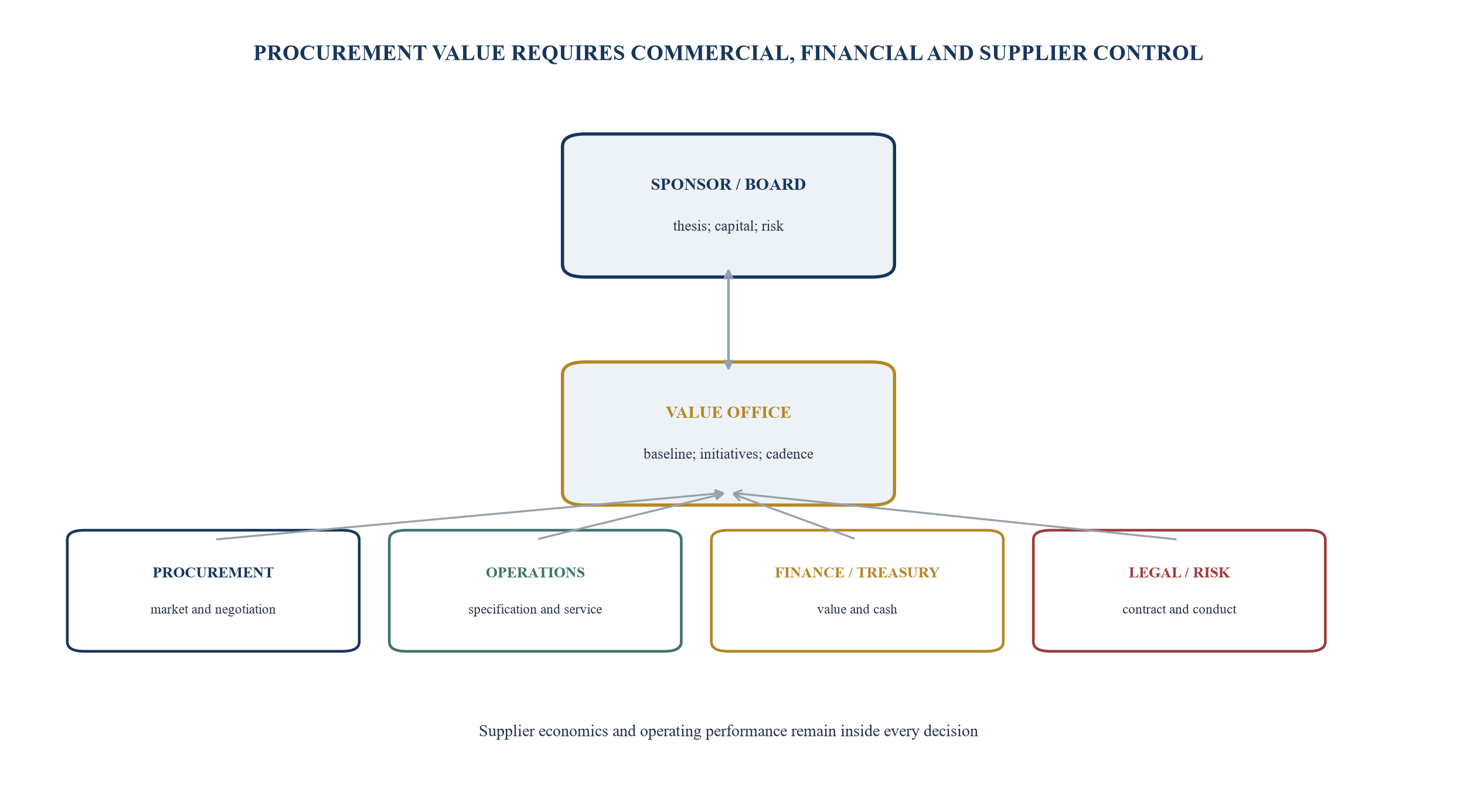
The architecture is illustrative. Governance and decision rights require company-specific approval.
2. Start with the value thesis and operating constraints
The value office should begin with the investment thesis, not the procurement ledger. A business acquired for service quality, regulated performance, product reliability or proprietary know-how may lose value if sourcing standardises the very capability that customers pay for. The team should identify which costs are strategic inputs, which are commodities, which support differentiation and which represent avoidable complexity.
The initial thesis should state how procurement can affect revenue, margin, cash conversion, capital expenditure, resilience and exit. It should also state the constraints. These may include customer specifications, approved-vendor lists, regulated inputs, safety certifications, local-content commitments, intellectual-property controls, union arrangements, long qualification cycles, lender covenants or contractual change restrictions. The office should treat these constraints as design parameters rather than obstacles discovered after a sourcing event.
Value should be separated into five classes. Price value changes the paid unit price for an unchanged requirement. Demand value changes quantity or consumption. Specification value changes the requirement while preserving the required outcome. Process value reduces transaction, quality or operating cost. Capital value changes inventory, deposits, payment design or asset use. Resilience value reduces expected disruption or protects strategic capacity. The first four can sometimes be measured in earnings or cash. Resilience usually requires a risk-based decision and should not be presented as certain EBITDA.
The World Bank Procurement Framework emphasises value for money, economy, integrity, fit for purpose, efficiency, transparency and fairness [4]. Its public-procurement setting differs from a portfolio company, although its balance of price, quality and delivery is instructive. The value office should define acceptable service, quality and risk before it asks the market for a lower price.
The investment committee should approve a short value hypothesis for each major category. The hypothesis should name the commercial lever, evidence, operating dependency, implementation owner and financial route. For example, consolidating fragmented maintenance providers can reduce rates and improve standards when sites share requirements; it can also create concentration when response capability is local. The hypothesis must capture both effects.
3. Establish a reconciled spend, contract and demand baseline
Procurement value cannot be measured reliably from accounts-payable spend alone. The baseline should reconcile general-ledger expense, purchase orders, invoices, contracts, inventory movements, production volumes, headcount, asset use, capital expenditure, rebates, credits, freight, quality loss and intercompany allocations. It should distinguish price from volume, mix, foreign exchange, inflation, acquisitions and accounting reclassification.
The office should create one controlled data dictionary. Suppliers need a stable identifier across entities and systems. Parent-child relationships should be separated from legal contracting entities. Categories should describe economic demand rather than inconsistent local labels. Units of measure, currencies, tax treatment and fiscal periods should be normalised. Contract records should capture scope, term, renewal, indexation, minimum purchase, volume bands, rebates, termination, change control, liability, data rights and governing law.
Baseline selection changes the claimed opportunity. A trailing period can reflect unusual demand, temporary shortages or acquisition effects. Budget may contain unsupported savings. Run-rate extrapolation may conceal seasonality. The office should choose a baseline for each initiative and document why it is decision-useful. Finance should retain the original and adjusted baseline, then approve a locked version before negotiation results are reported.
Demand evidence matters because a lower rate on units that will not be purchased creates no value. The team should link category spend to production, sites, employees, customers or assets. It should identify committed, forecast and discretionary demand. It should map off-contract buying, duplicate specifications, emergency orders, maverick spend and unused subscriptions.
Data quality should be scored separately from opportunity. A category can be attractive and poorly evidenced. The office may begin market engagement while the baseline is completed, yet it should not include a value claim until quantities, terms and implementation are sufficiently controlled. A monthly data-quality dashboard should show unidentified suppliers, uncategorised spend, missing contracts, unreconciled rebates and invoice exceptions.
Table 1. Minimum procurement value evidence request
| Evidence layer | Minimum fields | Reconciliation test | Typical owner | Decision supported |
|---|---|---|---|---|
| spend and ledger | supplier, entity, category, period, currency, quantity, unit and account | invoices to ledger and payment | finance controller | addressable baseline |
| contract | legal entity, scope, term, price, indexation, rebate, change and termination | contract to purchase order and invoice | legal and procurement | rights and negotiation route |
| demand | production, site, user, asset, forecast and committed quantity | consumption to operating driver | operations | demand and specification lever |
| performance | delivery, quality, service, claims, downtime and response | supplier score to operating record | quality and operations | service floor and supplier choice |
| cash | terms, actual payment date, discounts, deposits and finance programme | invoice date to cash movement | treasury | working-capital value and supplier effect |
| risk | criticality, alternatives, location, financial health, cyber and continuity | supplier record to risk register | risk and procurement | resilience and escalation |
The request is an illustrative starting point. Category, system and jurisdiction determine the required evidence.
4. Segment categories by economics and operating consequence
Category segmentation determines the sourcing method. A portfolio should not run the same process for electricity, cloud services, specialised ingredients, temporary labour, insurance, professional services and office supplies. Each category has a different cost structure, switching friction, information asymmetry, concentration and consequence of failure.
The value office should score categories on addressable spend, margin sensitivity, demand volatility, supplier concentration, substitution, qualification time, specification complexity, internal fragmentation, contract coverage and operational criticality. It should also identify whether the sponsor's portfolio creates genuine common demand. Similar ledger labels can hide different service levels, geographies, regulations and technical requirements.
A useful segmentation has four broad routes. Leverage categories have material spend, standard requirements and competitive supply. Strategic categories have high operational consequence and benefit from collaboration, capacity planning or joint innovation. Bottleneck categories have lower spend but few alternatives or long qualification. Routine categories benefit from process automation, catalogues and demand control. The labels support judgment; they do not replace category-specific evidence.
The portfolio lens should distinguish aggregation from coordination. Aggregation combines volume under common commercial terms. Coordination shares market intelligence, specifications, supplier performance and contract standards while companies retain separate awards. Some categories should remain local because freight, service coverage, local content or regulation dominates scale. Others can use regional or global frameworks with local call-offs.
The office should maintain a category strategy sheet that states demand, market structure, incumbent position, target outcome, sourcing route, dependencies, timetable and risks. It should identify which suppliers can be invited without disclosing competitively sensitive company information. Legal counsel should review exchanges among portfolio companies, particularly when they compete in product or labour markets.
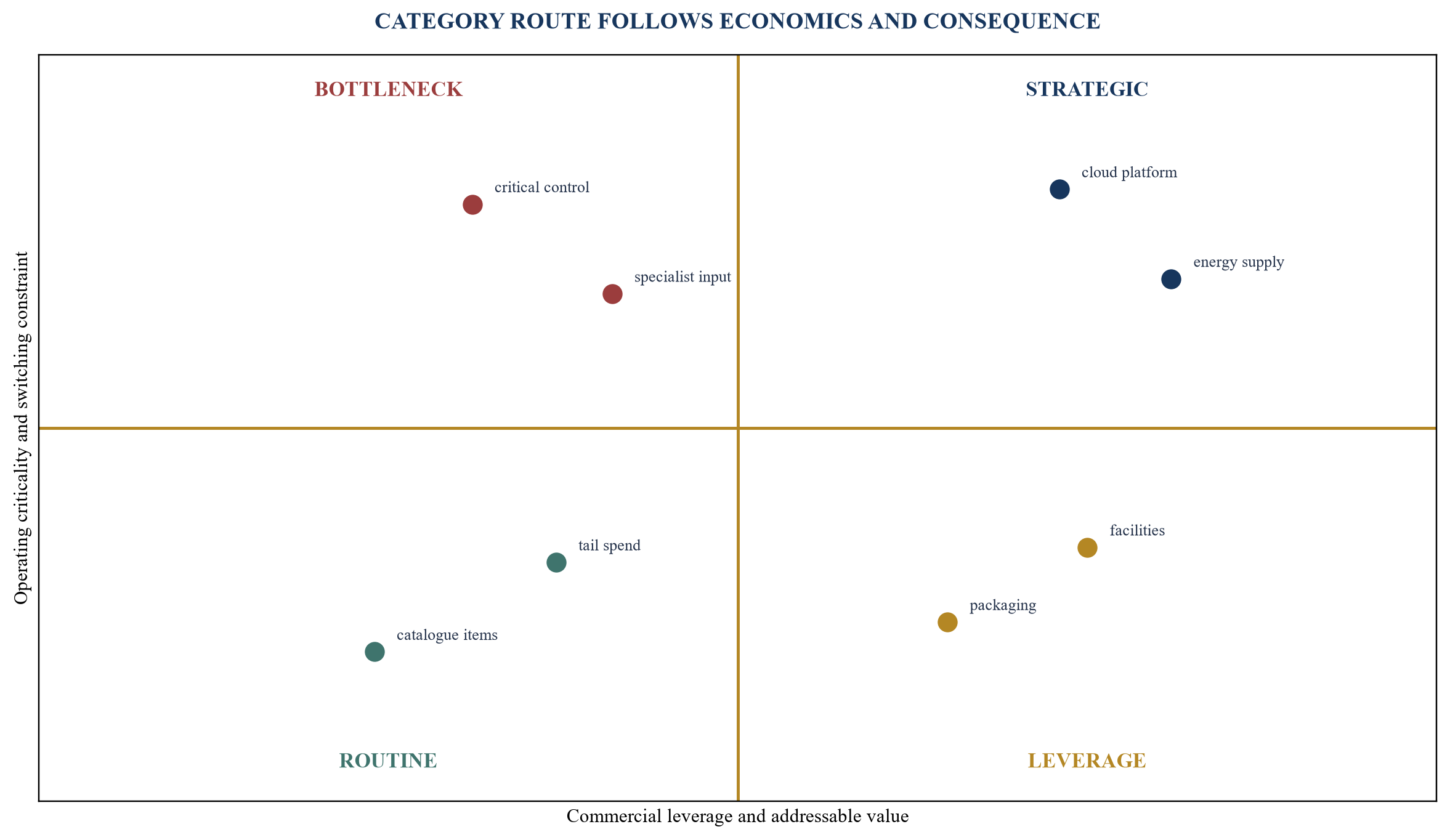
Positions are hypothetical examples. Actual category placement requires spend, market and operating evidence.
5. Segment suppliers by criticality, health and strategic contribution
Supplier segmentation should combine spend with business consequence. A low-spend provider can control a licence, component, algorithm, test method or maintenance response that is essential to revenue. A high-spend supplier can remain readily substitutable. The office should therefore map criticality, concentration, financial health, capacity, performance, innovation, data access, geopolitical exposure and switching time.
Criticality should be defined through failure scenarios. The team should ask what stops, how quickly, which customers are affected, what inventory or redundancy exists, how long an alternative takes and which approvals are required. The response should be supported by operating evidence and continuity testing. A declared second source is not resilience when it shares the same factory, port, cloud region, raw material or subcontractor.
Financial-health assessment should use available statements, payment behaviour, credit information, order dependence, working-capital profile, refinancing needs and management dialogue. The purpose is to understand performance capacity and transmission risk. The office should handle confidential supplier information under appropriate controls and avoid unsupported conclusions from a single score.
Strategic contribution includes technical expertise, product innovation, capacity investment, regulatory knowledge, sustainability performance and access to scarce talent or assets. Negotiation should distinguish transferable economic rent from capability that must be preserved. A supplier investing in dedicated capacity may require volume, term, forecast quality or capital support in exchange for price and service commitments.
The OECD framework supports risk-based prioritisation based on severity and likelihood rather than a simple spend ranking [1]. NIST's cybersecurity supply-chain guidance similarly emphasises identifying, assessing and managing supplier-related risk across the lifecycle [6]. The value office should integrate these perspectives into one supplier record so that cost, continuity, conduct and cyber issues are not managed in disconnected lists.
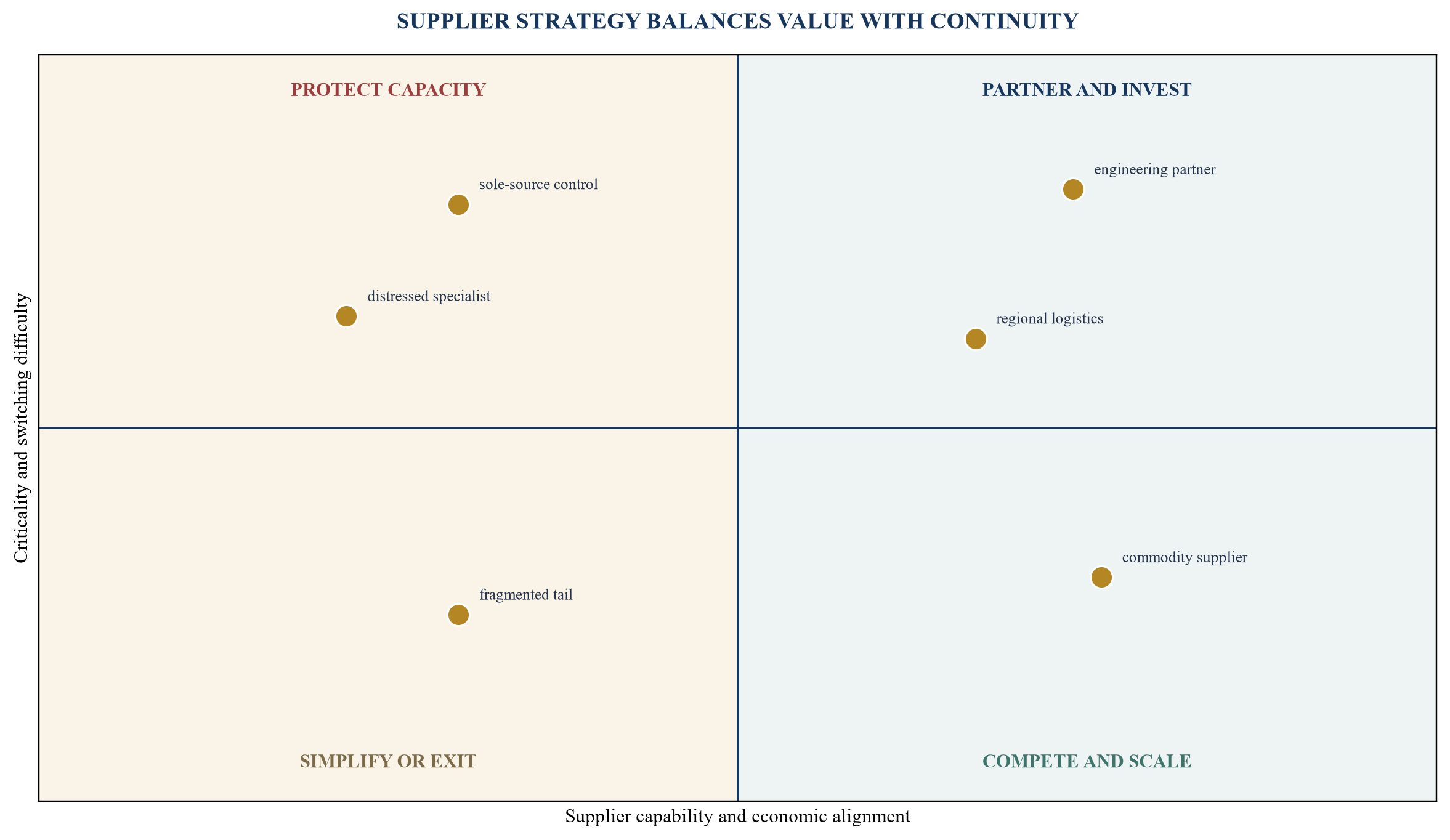
The matrix is illustrative. Supplier assessment requires current evidence, engagement and qualified review.
6. Build a lever portfolio beyond unit-price negotiation
Negotiation is one lever in a broader value portfolio. The office should test demand, specification, make-or-buy, process, quality, yield, logistics, inventory, energy, maintenance, payment design, contract leakage, rebates, tax and asset utilisation. Each lever should have an economic mechanism and an operating owner.
Demand management can remove unused licences, excessive service frequency, over-ordering, nonstandard variants and emergency purchases. Specification redesign can simplify materials, packaging, tolerances, service levels or reporting requirements. Competitive sourcing can test price and capacity. Should-cost work can analyse input, conversion, overhead, logistics and supplier return. Supplier collaboration can improve yield, lead time, design and total cost. Process automation can reduce purchase-order, invoice and exception effort.
Levers interact. A lower specification may reduce price and quality cost; it can also increase consumption or customer complaints. Longer contract duration may secure capacity and reduce rate; it can also limit future competition. Volume concentration may improve economics while increasing interruption exposure. The initiative case should show the entire system effect, not a single negotiated line.
The office should use a lever register with clear value classes. Hard earnings value changes the income statement under approved accounting treatment. Cash value changes timing or balance-sheet use. Cost avoidance prevents a supported increase but may not improve reported profit against the prior period. Risk value protects a downside and should be described through scenarios. Capability value supports future execution. Finance should prevent these classes from being added together without a bridge.
Implementation cost belongs in every case. It can include termination, qualification, tooling, systems, inventory, transition, travel, advisers, supplier support and internal time. The initiative should identify recurring and one-off effects, tax, foreign exchange, timing, probability, dependencies and dis-synergies. The board can then compare initiatives on net value and execution risk.
Table 2. Procurement value-lever register
| Lever | Economic mechanism | Required evidence | Supplier effect | Value classification | Implementation gate |
|---|---|---|---|---|---|
| demand control | reduce avoidable quantity or frequency | consumption driver and service need | lower volume and better forecast | earnings and cash | business-owner adoption |
| specification | preserve outcome with simpler requirement | technical test and customer acceptance | redesign and qualification effort | earnings, capex or risk | engineering approval |
| competitive sourcing | test price, service and capacity | comparable bid and market structure | award gain or loss | earnings | executable alternative |
| should-cost | align price to efficient input and conversion | cost drivers, indices and productivity | margin transparency | earnings or avoidance | evidence and negotiation plan |
| supplier collaboration | improve yield, lead time or innovation | joint business case and governance | shared investment and benefit | earnings, cash and capability | signed ownership plan |
| working capital | redesign inventory, deposits and payment | cash cycle and supplier economics | financing and liquidity effect | cash and risk | treasury approval |
Value classifications and examples are illustrative. Finance and operating owners should approve the company-specific treatment.
7. Build a value bridge that finance can verify
Procurement should report value through a bridge from the approved baseline to realised earnings and cash. The bridge should separate price, volume, mix, inflation, foreign exchange, specification, implementation cost, rebates, accounting period and acquisition perimeter. It should show where savings appear in cost of sales, operating expenses, capital expenditure or working capital.
A signed contract is a commercial milestone. Realised value usually requires demand to move, orders to follow the new terms, goods or services to perform and invoices to reconcile. The office should use stages such as identified, validated, contracted, implemented and realised. Only finance-validated effects should enter reported realised value. Forecast value should remain clearly separate.
The office must prevent double counting. A category negotiation can overlap with a budget reduction, headcount initiative, site closure, engineering redesign or integration synergy. A rebate may already be accrued. A lower rate can be offset by higher demand. A payment-term change can create cash timing without earnings. The initiative record should name the value owner and the line of the financial model to which it reconciles.
The following worked bridge uses hypothetical management assumptions. Assume an addressable baseline of 100 units. Negotiated price and demand actions produce gross improvements of 7 and 3 units. Mix and service changes reduce the benefit by 2 units. Implementation costs consume 2 units in the first period. The net recurring run-rate is 8 units, while first-period income-statement value is 6 units. A separate 4-unit working-capital release is cash timing and is not added to recurring EBITDA.
The bridge should include a confidence view. Contracted value can remain exposed to adoption, volume or supplier performance. A practical dashboard shows gross opportunity, net run-rate, period benefit, cash release, implementation cost, stage and evidence quality. The board should see both value and the supplier or operating risks created by each initiative.
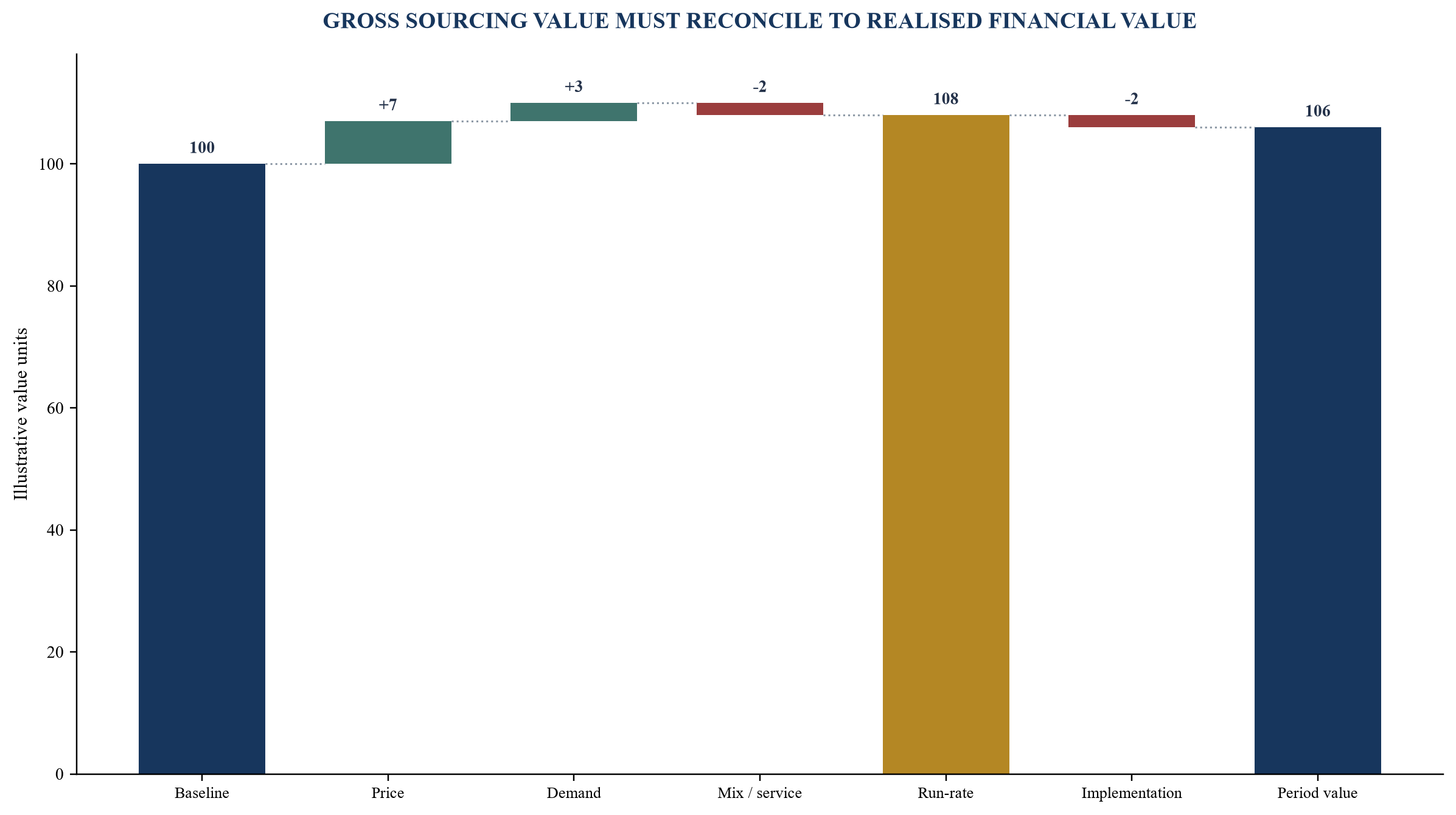
All values are hypothetical management assumptions used to demonstrate reconciliation. They are not a forecast or promised result.
8. Test supplier economics before applying scale
Scale can improve a supplier's economics through fuller capacity, fewer selling costs, stable scheduling, standard specifications and lower demand volatility. Scale can also increase tooling, inventory, labour, working capital, logistics, quality controls and customer concentration. The office should test both sides before it assumes that a larger award supports a lower price.
The supplier economics review should estimate material inputs, labour, conversion, energy, freight, overhead, capital, financing and required return. It should identify which costs are fixed, variable or step-fixed and how utilisation changes. It should test order pattern, forecast accuracy, minimum batch, changeovers, lead time, payment, warranty and returns. The objective is a commercially credible range rather than an asserted entitlement to confidential cost data.
Capacity deserves specific attention. A consolidated award can exceed equipment, labour, quality or logistics capacity. Incremental capital may require a multi-year commitment or explicit cost recovery. A supplier can quote an attractive rate and later fail through overtime, expediting, subcontracting or quality loss. Site visits, production records, independent technical review and phased ramp-up can provide stronger evidence than a spreadsheet capacity statement.
The office should test concentration from both directions. Buyer dependence can make the supplier vulnerable to volume changes and create conduct or continuity risk. Supplier dependence can make the portfolio vulnerable to disruption or opportunistic repricing. A balanced contract may include forecast bands, minimum commitments, open-book triggers, capacity reservations, productivity sharing, indexation, exit assistance and continuity rights.
The 2023 US Merger Guidelines include guidance on mergers that can harm competition among buyers, including effects on suppliers from suppressed purchase prices or reduced purchase volume [13]. This does not determine a specific portfolio strategy. It reinforces the need for competition counsel to assess market definition, buyer power, information exchange and the effect of aggregation before portfolio-wide action.
Table 3. Supplier economics and capacity tests
| Test | Core question | Evidence | Value risk if ignored | Possible design response |
|---|---|---|---|---|
| unit economics | which cost drivers change with the proposed award? | indices, process map, quotes and operational dialogue | false should-cost and unstable price | indexed bands or productivity sharing |
| capacity | can the supplier perform at peak and during ramp-up? | equipment, labour, yield, shifts and subcontractors | delay, quality loss and expediting | phased award and capacity milestones |
| working capital | what cash is required before buyer payment? | inventory, production cycle, terms and finance cost | liquidity stress and interruption | deposit, milestone billing or finance programme |
| concentration | how dependent is each party? | buyer share, supplier share and alternatives | bargaining imbalance and continuity exposure | volume bands, diversification and exit support |
| investment | who funds tooling, certification and dedicated assets? | capital plan, ownership and residual value | stranded capital and dispute | amortisation and termination formula |
| service | which service and quality outcomes protect revenue? | service levels, defects, claims and customer requirements | savings offset by operating loss | measurable service floor and remedies |
The tests are illustrative. Suppliers, buyers and advisers should determine the evidence appropriate to the relationship.
9. Govern payment terms as a cash and continuity decision
Payment terms can release buyer cash and increase supplier financing needs at the same time. The value office should treat term changes as a treasury, procurement, legal and continuity decision. A policy that extends every supplier by the same number of days ignores bargaining position, production cycle, financing access, contract terms and criticality.
The baseline should measure stated terms and actual payment behaviour. Late approval, invoice disputes, missing purchase orders and system errors can make actual payment materially worse than the contract. Extending stated terms while leaving process defects unresolved increases uncertainty and supplier cost. The first improvement may be accurate, predictable payment under the existing contract.
The office should segment term strategy. Large, well-financed suppliers may accept standard terms. Small or critical suppliers may need prompt payment, milestone billing or deposits. Capital-intensive suppliers may require progress payments. Distressed or capacity-constrained suppliers may require an agreed recovery plan. The decision should consider total economics, including any price response and continuity risk.
Regulation varies. The EU Late Payment Directive establishes rights and remedies for late payment in commercial transactions [14]. UK large businesses have reporting obligations concerning payment practices [18], and the government publishes performance statistics [17]. The UK Commercial Payments Bill was introduced in 2026 and should be treated as a legislative proposal until its status changes [19]. India's framework for micro and small enterprises includes statutory payment periods and remedies [22]. Applicable counsel should determine entity, contract and jurisdiction coverage.
The office should report payment outcomes by supplier segment: agreed days, actual days, dispute rate, overdue value, critical-supplier exceptions and price consequences. A working-capital gain should be shown separately from recurring earnings. Any supplier distress created or worsened by the change should be reflected in the risk register and board decision.
10. Use supplier finance with transparent economics
Supplier-finance programmes can allow a supplier to receive approved invoices early while the buyer pays later. The economics depend on approval timing, financing rate, buyer credit, programme structure, fees, optionality and operational process. A programme can improve liquidity when participation is voluntary, pricing is transparent and invoices are approved promptly. It can become a hidden transfer of risk when suppliers are pressured to join, terms are extended without dialogue or financing disappears during stress.
Treasury should own programme design with procurement, finance, legal and accounting input. The team should identify funding providers, committed capacity, eligible suppliers, currency, rate-setting, onboarding, data flow, sanctions controls, fraud controls, dispute treatment, termination and contingency. It should test how the programme performs when the buyer's credit weakens, the funder changes appetite or invoices are rejected.
Accounting and disclosure require specific review. The IASB amended IAS 7 and IFRS 7 to improve transparency about supplier-finance arrangements [8]. The amendments call for information about terms, carrying amounts, payment due-date ranges and liquidity-risk exposure. FASB ASU 2022-04 introduced disclosures for supplier-finance programme obligations under US GAAP [10]. The applicable accounting framework and facts determine classification and disclosure.
India's TReDS framework facilitates financing of micro, small and medium enterprise trade receivables through multiple financiers [23]. It demonstrates a regulated multi-financier mechanism, although company eligibility and transaction rules require current review. Other markets use bank-led reverse factoring, platform structures or bilateral receivables finance. The office should avoid assuming that one structure transfers across jurisdictions unchanged.
Programme value should be measured for both parties. Buyer cash timing, supplier financing cost, price response, operational effort and resilience should be presented together. Participation rate alone is not success. A board-ready measure is the proportion of eligible supplier invoices funded at a transparent cost without worsening disputes, concentration or financial-reporting risk.
11. Protect competition and confidential information
Portfolio procurement can create competition risk when companies share current or future price, output, cost, supplier or strategic information. Risk can arise even when the stated purpose is efficiency. The office should obtain competition advice on company relationships, market structure, information flows, joint negotiation, buyer power, supplier access and contractual restrictions before it establishes portfolio-wide category forums.
The operating model should use information controls. Aggregated and historic data may support opportunity sizing. Clean teams or an independent adviser can handle competitively sensitive information. Portfolio companies should retain decisions where required. Meeting agendas, access permissions, data-room logs and legal guidance should be documented. A supplier negotiation should not become a channel for exchanging downstream competitive strategy.
Buyer power should be assessed as well as seller concentration. The FTC and US Department of Justice's 2023 Merger Guidelines discuss harm to suppliers and workers where a transaction strengthens competition among buyers [13]. The UAE's Federal Decree-Law No. 36 of 2023 addresses competition, including restrictive agreements, abuse of dominant position and economic dependence [24]. Current thresholds and implementing decisions should be reviewed for the relevant transaction and conduct.
The value office should test exclusivity, most-favoured-customer clauses, bundling, tying, rebates, information rights, capacity reservations and termination provisions with counsel. A clause that protects volume in one context can foreclose competition in another. The assessment depends on market definition, share, alternatives, duration and effect.
Competition review should be embedded in the initiative gate. The record should state whether the proposal involves joint purchasing, aggregated volume, shared supplier data, exclusivity, market-sensitive information or a concentrated upstream market. Legal approval should be a prerequisite to external engagement where those factors arise. The objective is a procurement design that captures lawful efficiency and remains defensible to suppliers, boards and regulators.
12. Design contracts that preserve executable value
A negotiated headline rate creates value only when the contract defines the requirement, commercial mechanism and operating obligations clearly. The value office should use a clause library while preserving transaction-specific judgment. Core areas include scope, specifications, forecasting, ordering, price, indexation, rebates, taxes, service levels, quality, audit, data, intellectual property, cybersecurity, subcontracting, continuity, change, liability, insurance, termination and exit assistance.
Indexation should match the cost drivers that remain with the supplier. A broad inflation index can overcompensate or undercompensate when materials, labour, energy and freight move differently. The contract should define source, base period, frequency, caps, floors, lags, exceptional review and downward adjustment. Open-book provisions may help with exceptional change, but they require defined data, confidentiality and dispute processes.
Volume commitments should reflect forecast confidence. Minimums can support supplier investment and lower unit cost. They can also create take-or-pay exposure and reduce flexibility. The office should model downside demand, product change, site closure and merger separation. Capacity reservation should specify what is reserved, when, at what performance level and how it is verified.
Contract remedies should support performance rather than create illusory protection. Service credits can be too small to compensate for lost production or customer harm. Unlimited liability can be commercially unavailable. The agreement should align prevention, monitoring, cure, step-in, alternative supply, insurance, indemnity, cap and termination with the actual consequence of failure. Counsel should determine enforceability.
The office should maintain a contract value sheet. It should record the baseline, new economics, conditions, implementation tasks, obligations, renewal dates and value risks. Procurement, finance and the business owner should sign it before award. This record connects negotiation to ordering, invoice control and realised-value tracking.
Table 4. Contract design decision table
| Clause area | Value objective | Supplier protection | Buyer protection | Evidence before signature |
|---|---|---|---|---|
| forecast and volume | support efficient capacity | bands, notice and minimum logic | flexibility and no unsupported commitment | demand scenarios and capacity plan |
| price and indexation | preserve competitive economics | objective cost-driver adjustment | downward movement and audit route | index history and cost model |
| service and quality | protect operating outcome | clear measures and cure | remedies, alternatives and escalation | operating baseline and test method |
| change control | avoid scope and price leakage | priced, documented requests | approval authority and value test | responsibility map and workflow |
| continuity | maintain supply under stress | realistic obligations and support | information, recovery and exit rights | continuity test and dependency map |
| termination | preserve commercial flexibility | notice and stranded-cost treatment | cause, convenience and transition | investment ownership and alternative route |
The table is illustrative and does not provide legal advice. Applicable law and transaction facts govern contract design.
13. Integrate responsible-business due diligence
Procurement savings can be offset by legal, operational and reputational exposure in the supply chain. The value office should integrate risk-based due diligence into category and supplier decisions. The OECD framework describes a process of embedding responsible conduct, identifying and assessing adverse impacts, ceasing, preventing or mitigating them, tracking implementation, communicating and enabling remediation where appropriate [1].
The UN Guiding Principles on Business and Human Rights distinguish state duties from corporate responsibility and provide a due-diligence framework [12]. The ILO's supply-chain strategy focuses on decent work across supply chains [11]. These frameworks are broad. Applicable legal obligations and company responsibilities vary by jurisdiction, entity, activity and relationship.
The office should identify salient risks by geography, sector, product and workforce. These can include forced labour, child labour, unsafe work, excessive hours, recruitment fees, discrimination, wage issues, land impacts, pollution and ineffective grievance mechanisms. Supplier questionnaires alone are limited. Evidence can include worker voice, site assessment, certification controls, purchasing practices, corrective-action records and engagement with affected stakeholders.
Purchasing practice belongs inside the assessment. Unrealistic lead times, late changes, unstable forecasts, below-cost pricing and delayed payment can undermine a supplier's ability to meet labour and environmental requirements. The buyer should examine whether its own commercial conduct contributes to the risk. Corrective action may require forecast, price, capacity or timetable changes alongside supplier remediation.
The EU Corporate Sustainability Due Diligence Directive establishes a legal framework whose application has been subject to legislative amendments and timing changes [15]. Canada's Supply Chains Act creates reporting obligations for covered entities concerning forced labour and child labour [29]. Germany's Supply Chain Act establishes due-diligence duties for covered enterprises [30]. Counsel should confirm current scope, timing and national implementation before the office relies on any requirement.
14. Build cybersecurity and data controls into supplier value
Digital suppliers can create operational concentration, privileged access, data-processing and software-supply-chain exposure. A procurement value programme that consolidates technology vendors can reduce licence cost and simplify architecture. It can also concentrate outages, cyber compromise, switching cost and data dependence. The category case should include security, resilience and exit economics.
NIST SP 800-161 Revision 1 provides guidance for cybersecurity supply-chain risk management across acquisition and the system lifecycle [6]. NIST SP 1326 offers a supplier due-diligence quick-start guide and was published as final in July 2026 [7]. The office can use these sources to structure minimum supplier information, risk assessment, contractual controls and continuous monitoring.
Technology diligence should cover ownership, hosting, subcontractors, development practices, vulnerabilities, incident history, access, encryption, logging, data location, business continuity, recovery, support, intellectual property, model or algorithm dependency and portability. The review should be proportional to business consequence. A catering supplier and a core payments platform require different controls.
Contract value should include transition cost. A low initial subscription price can be offset by implementation, integration, data migration, customisation, minimum commits, usage growth and exit. The office should model total cost over the expected period and under a stressed migration scenario. It should retain data-export rights, documentation, assistance, deletion confirmation and continuity provisions appropriate to the service.
Supplier monitoring should focus on decision-useful indicators: critical vulnerabilities, unresolved audit matters, material incidents, service availability, recovery tests, subcontractor changes and financial health. A long questionnaire repeated annually may provide less protection than targeted evidence and rehearsed response. Cyber and procurement leaders should jointly approve exceptions and remediation plans.
15. Localise supply without creating brittle economics
Local-content programmes can support capability, industrial development, employment, resilience and public-policy objectives. Procurement value therefore includes eligibility, localisation pathways and supplier development. A sponsor operating across jurisdictions should distinguish statutory requirements, tender preferences, incentive programmes, customer expectations and voluntary commitments.
The UAE National In-Country Value programme uses an ICV certificate and approved-certification process to support local value in procurement [26]. The UAE federal procurement framework sets procedures and policy for federal entities and includes local-content considerations [25]. Saudi Arabia applies regulations that give preference to local content, local small and medium enterprises and listed companies in government procurement [27]. The Saudi Industrial Development Fund's Tawteen programme supports localisation opportunities and supplier development [28]. Company and transaction eligibility require current official review.
The value office should map which spend, inputs, employment, assets and supplier investments contribute to each relevant mechanism. It should avoid treating a certificate as a complete category strategy. Local capacity may require qualification, tooling, technical assistance, forecast commitment, finance or phased volume. The business case should compare total landed cost, reliability, lead time, working capital, quality, policy value and future scale.
Localisation risk includes overconcentration in a single geography, dependence on imported upstream inputs, immature capacity and policy change. The office should map tier-two dependencies and identify where nominally local supply shares the same foreign source. It should design dual or regional supply when customer, continuity and policy requirements allow.
Supplier development should have measurable milestones. These can include certification, yield, delivery, safety, cybersecurity, local employment, engineering capability and capacity. Commercial support should be conditional and time-bound. The office should show the board what value is created through eligibility, resilience or growth and what incremental cost or capital is required.
16. Build a portfolio model with company-level accountability
A sponsor can create value by sharing market intelligence, category expertise, contract standards, analytics and supplier-development capability across portfolio companies. The model should preserve company accountability because each board owns its contracts, operations and financial statements. Centralisation should be applied where it improves evidence, speed or economics.
The office can use three delivery modes. An insight network shares benchmarks, supplier performance and methods. A centre of excellence provides tools, experts and clean-team analysis. A coordinated-buying model combines specified demand under a lead company, agent or framework. The legal, tax, data, competition and operational consequences become more significant as coordination increases.
Portfolio comparability requires a common taxonomy and value method. It does not require identical systems. Companies can submit controlled extracts that map supplier, category, period, quantity and terms. The sponsor can identify fragmentation, outliers and common markets while limiting sensitive access. Each company should approve the use of its data and the initiatives it joins.
Allocation of benefit and cost should be explicit. A lead company may perform sourcing work for others. A portfolio agreement may create volume commitments or fees. Supplier rebates may depend on aggregated thresholds. The office should define how benefits, implementation costs, liabilities and shortfalls are attributed. Tax and transfer-pricing advice may be required for intercompany services and cross-border arrangements.
The governance forum should review opportunity, execution, supplier health and conflicts. It should not direct operating decisions outside approved authority. Portfolio executives should escalate capacity, customer, labour, legal and continuity issues before an aggregated award. The sponsor should record which value arises from common ownership, which from company improvement and which from market movement so that exit claims remain credible.
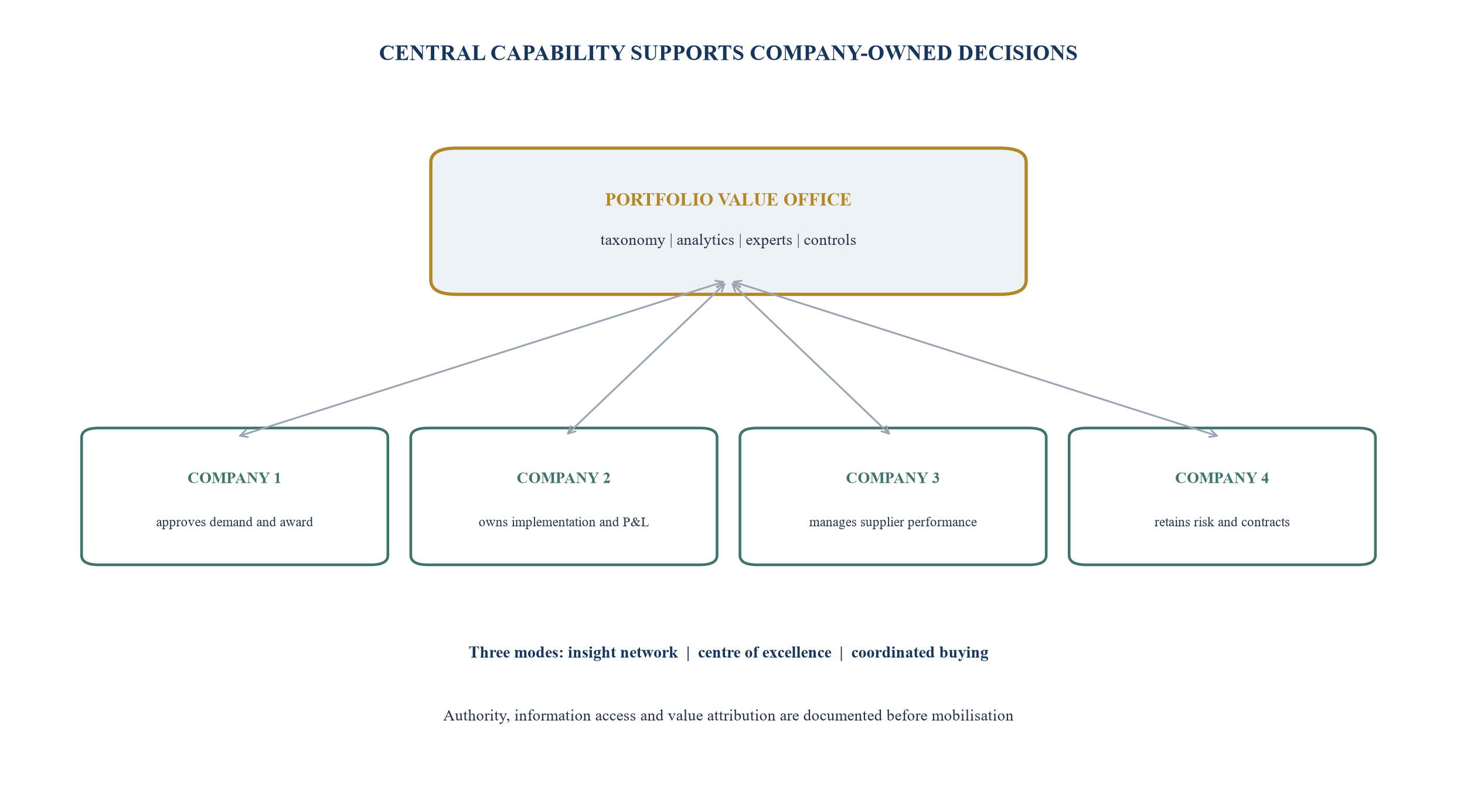
The model is illustrative. Legal entities, competition rules and governance determine the permissible structure.
17. Run the diligence-to-first-hundred-day sequence
Procurement value should enter the transaction before signing. Early diligence can identify spend concentration, contract constraints, supplier dependence, payment behaviour, change-of-control provisions, integration overlap and value hypotheses. The team should avoid publishing a precise synergy number when access, data and supplier engagement remain limited.
During initial diligence, the office should request spend, top suppliers, contracts, payment terms, procurement organisation, major disputes, continuity plans and known obligations. It should identify categories requiring clean-team treatment and suppliers whose contact could signal the transaction. It should prepare low, base and high cases with evidence and implementation costs.
Between signing and closing, the team can complete taxonomy, cleanse supplier data, confirm contracts, design decision rights and prepare engagement plans within legal constraints. It should define Day One continuity, especially where duplicate systems, shared services, carve-out arrangements or supplier consents exist. The separation or integration agreement should allocate purchasing data, transitional supply and vendor management where relevant.
After closing, the first thirty days should stabilise supply, validate baselines and launch no-regret controls. The next phase can execute selected sourcing, demand and contract initiatives. Larger specification, capacity and supplier-development changes should proceed through technical and operational gates. By the end of the first hundred days, the board should have a validated pipeline, realised-value evidence, supplier-risk view and twelve-month programme.
The timetable in this paper is a hypothetical management framework. Transaction size, access, regulation, supplier markets and operational risk determine the actual pace. The office should sequence initiatives by value, evidence, dependency and reversibility. A quick negotiation with a critical supplier may destroy more value than a slower redesign supported by reliable data and capacity planning.
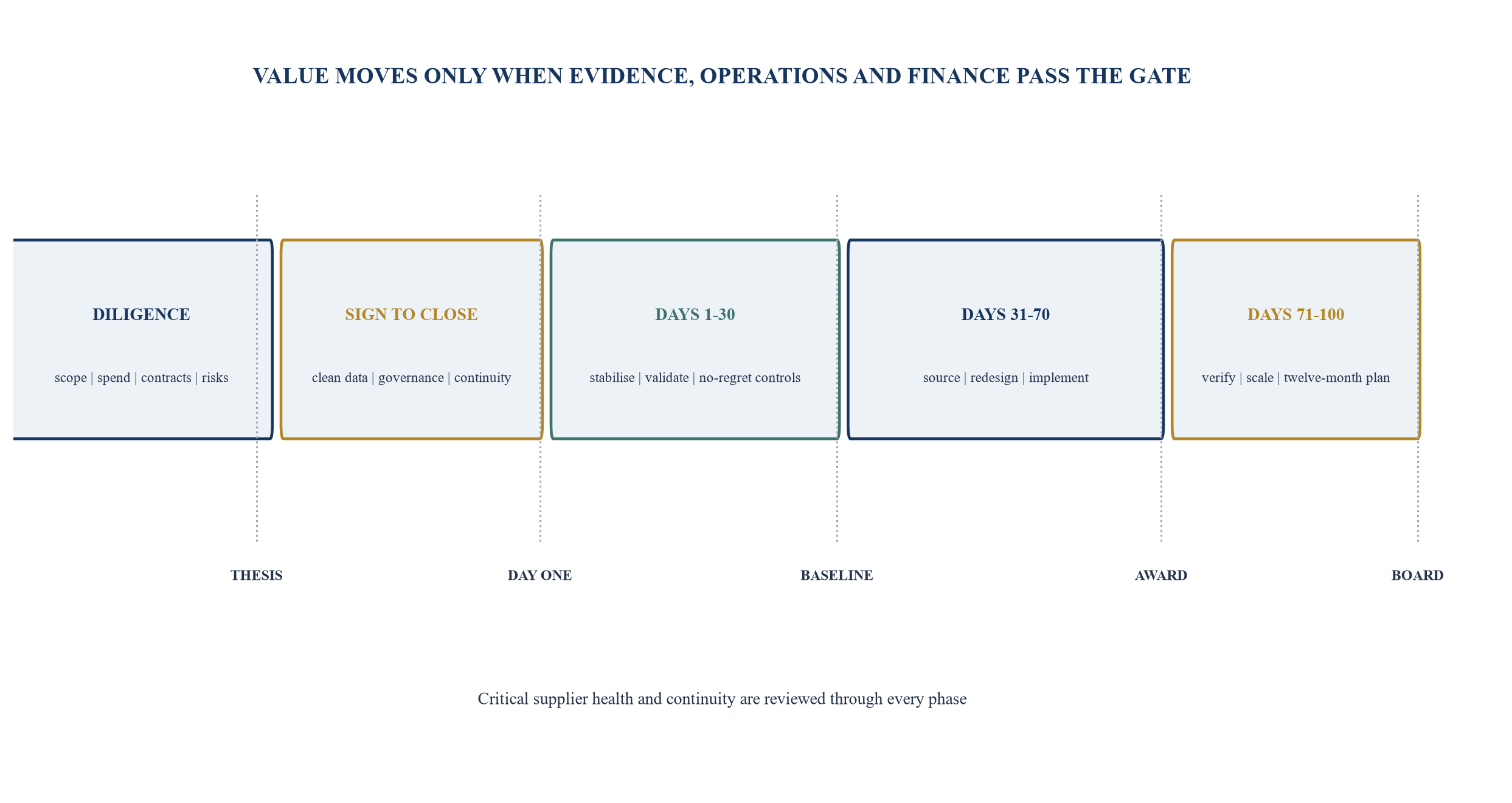
Durations and gates are hypothetical management assumptions. Transaction-specific facts determine sequencing.
18. Install an operating cadence with decision rights
The value office needs a cadence that moves decisions rather than producing status reports. A weekly initiative review should resolve evidence, scope, negotiation, contract and implementation issues. A monthly steering committee should approve baselines, awards, exceptions, supplier interventions and value. A quarterly board review should assess realised economics, cash, concentration, responsible-business risks and capability.
Every initiative should have one accountable business owner, one procurement lead and one finance validator. Legal, treasury, technology, engineering or sustainability leaders should join when their decisions are required. The initiative record should show decision needed, evidence, alternatives, recommendation, owner and deadline. Meetings should close with recorded actions and approvals.
Stage gates reduce false precision. Identification requires a stated lever and addressable baseline. Validation requires finance and operating agreement. Sourcing requires an approved market and legal route. Contracted status requires executed terms and an implementation plan. Implemented status requires changed demand, orders or process. Realised status requires financial evidence. A risk reduction should use a separate acceptance and monitoring test.
The office should maintain an exception register. Examples include single-source awards, extended payment to a vulnerable supplier, untested capacity, missing cyber evidence, off-contract spend, delayed qualification and legal constraints. Each exception should have an owner, expiry and mitigation. Repeated exceptions can reveal a flawed category strategy or insufficient capability.
Closure should be planned. The office should transfer category strategies, dashboards, contract obligations, supplier plans and open risks into the permanent organisation. It should identify which central capabilities continue and how they are funded. A temporary office that leaves no operating owner creates a value cliff after the sponsor's initial programme ends.
Table 5. Procurement value office decision cadence
| Forum | Frequency | Core decisions | Required evidence | Accountable chair |
|---|---|---|---|---|
| initiative review | weekly | scope, data, supplier route and implementation unblock | initiative record, baseline and action log | value-office lead |
| category gate | fortnightly or as needed | market engagement, shortlist, award and contract position | category strategy, bids, capacity and risk | procurement executive |
| finance validation | monthly close cycle | forecast, realised earnings, cash and double-counting | ledger bridge, volume, price and implementation cost | CFO delegate |
| supplier-risk forum | monthly | intervention, diversification, payment and continuity | health, service, concentration and incident evidence | operations or risk executive |
| steering committee | monthly | priorities, resources, exceptions and escalations | portfolio dashboard and decision papers | CEO or sponsor operating partner |
| board review | quarterly | value thesis, residual risk, capital and capability | signed value bridge, risk heat map and exit evidence | board chair |
Cadence and authority are illustrative. The board and management should approve company-specific governance.
19. Measure value without hiding supplier damage
The dashboard should put financial value and supplier-system health on the same page. Earnings and cash measures alone can reward behaviour that increases concentration, overdue invoices, service failures or remediation risk. Supplier scores alone can obscure whether the programme contributes to the investment thesis. The office should show both.
Financial measures can include validated run-rate, period income-statement effect, cash release, implementation cost, rebate recovery, price variance and value at risk. Operating measures can include service level, quality, lead time, downtime, inventory, forecast accuracy and change requests. Supplier measures can include concentration, capacity, payment predictability, financial health, cyber status, corrective actions and continuity tests.
Metrics should have definitions, owners and source systems. A savings figure without baseline version, period, accounting line and approval is not board evidence. A supplier-health colour without rationale, date and action can mislead. The office should retain supporting files and a change log so that internal audit, lenders, buyers or regulators can reproduce the result where appropriate.
The dashboard should separate leading and lagging indicators. Contract coverage, qualified alternatives, implementation tasks and invoice accuracy can signal future performance. Realised margin, service failure, disruption and overdue payment show outcomes. The steering committee should define thresholds that trigger action. Thresholds should be company-specific and approved rather than copied from a generic template.
The Australian Payment Times Reporting Scheme publishes payment-practice information for large businesses operating in Australia [20]. The ACCC's unfair-contract-term regime applies to relevant standard-form contracts, with coverage and penalties determined under Australian law [21]. These examples show that supplier-facing commercial practices can create public and legal consequences in addition to internal economics. The value office should maintain an accurate jurisdictional map.
20. Build exit-ready evidence and recognise failure modes
Procurement value supports exit when a buyer can see the baseline, recurring economics, contracts, supplier capacity, implementation cost and operating ownership. A spreadsheet of annualised negotiated savings is weak evidence. The exit file should reconcile actual price and demand to financial statements, identify remaining contractual term, show service performance and explain which benefits persist under a new owner.
The office should retain category strategies, signed baselines, bid records, approvals, contracts, supplier plans, value bridges, accounting treatment and dashboards. It should record whether a saving depends on sponsor-wide volume, a related-party arrangement, a temporary rebate or a personal relationship. A buyer may adjust value when the benefit is not transferable.
Common failure modes are predictable. The programme may count purchase-price variance as profit while volume changes. It may claim cost avoidance as recurring earnings. It may aggregate suppliers before specifications are aligned. It may extend terms to a fragile critical supplier. It may sign a low rate without capacity. It may launch too many initiatives for the operating team. It may ignore local content, cybersecurity, human rights or competition. It may treat a contract as implementation.
Early warning requires independent challenge. Finance should challenge value. Operations should challenge service and feasibility. Legal should challenge conduct and obligations. Treasury should challenge cash structures. Supplier dialogue should test capacity and economics. The board should challenge whether the programme creates durable enterprise value or a short-lived variance.
Exit readiness should begin at mobilisation. The short title, initiative IDs and data structure can remain stable through ownership. The office should conduct periodic evidence drills: select a claimed benefit, reproduce the baseline, contract, order, invoice, accounting effect and operating outcome. Gaps should be corrected while people and records remain available.
21. Use a board decision checklist
The board should approve the procurement value-creation office as an investment programme with operating and supplier consequences. The decision record should address thesis, scope, governance, data, initiatives, supplier economics, contracts, cash, risk, localisation, implementation and exit evidence.
First, is the value thesis connected to the company's customer proposition and operating model? The board should see which costs can be changed and which capabilities must be protected. Second, is the baseline reconciled and controlled? Opportunity should be traceable to spend, demand, contract and finance records. Third, are initiative values separated into recurring earnings, period impact, cash, avoidance, risk and capability? The bridge should deduct implementation cost and prevent overlap.
Fourth, has supplier consequence been tested? The decision should show capacity, financial health, concentration, working capital, performance and alternatives. Fifth, are competition, contract, responsible-business, cybersecurity and jurisdictional issues owned by qualified functions? Sixth, do localisation and public-policy commitments have evidence, funding and measurable milestones? Seventh, can the operating organisation implement the award without service loss?
Eighth, are payment and supplier-finance decisions transparent to treasury, accounting and the supplier? Ninth, does each initiative have an accountable owner, approval path and realised-value test? Tenth, can the company reproduce the value claim for lenders and future buyers?
The board can approve, approve with conditions, phase, redesign, defer for evidence or reject an initiative. Conditions should have owners and dates. Residual risk should be explicit after mitigation and contract protection. The office should update the decision when demand, supplier health, regulation, market structure or implementation changes materially.
The durable objective is a procurement system that earns trust from operators, suppliers, finance and future owners. Scale is valuable when it produces better total economics, reliable capacity, clearer contracts, disciplined cash and stronger capability. The board should require evidence that all five are moving together.
Table 6. Board-ready procurement value scorecard
| Decision dimension | Board question | Evidence standard | Escalation condition | Required decision |
|---|---|---|---|---|
| thesis | does the initiative protect the customer and operating proposition? | approved category hypothesis and service floor | value depends on weakening strategic capability | redesign or reject |
| value | does finance reconcile net earnings and cash? | signed baseline, bridge and implementation cost | overlap, unsupported volume or unclear accounting | defer for evidence |
| supplier | can the supplier perform and remain economically viable? | capacity, health, working capital and concentration review | critical capacity or liquidity concern | phase, support or diversify |
| conduct | are competition, contract and due-diligence duties addressed? | written functional approvals and risk record | unresolved legal or responsible-business issue | condition or stop |
| execution | can operations implement on time without service loss? | owner, plan, qualification and contingency | missing resource or dependency | resequence or fund |
| exit | will the benefit persist and remain reproducible? | realised-value file, contract term and transfer analysis | temporary, non-transferable or sponsor-dependent value | adjust valuation claim |
The scorecard is an illustrative governance aid. Scores, thresholds and decisions require company-specific approval.
Sources and further reading
- OECD, Due Diligence Guidance for Responsible Business Conduct Official source
- OECD, Recommendation of the Council on Public Procurement Official source
- International Organization for Standardization, ISO 20400:2017 Sustainable procurement guidance Official source
- World Bank, Procurement Framework Official source
- World Bank, Procurement Regulations for IPF Borrowers, Seventh Edition, September 2025 Official source
- National Institute of Standards and Technology, SP 800-161 Revision 1, Cybersecurity Supply Chain Risk Management Practices Official source
- National Institute of Standards and Technology, SP 1326, Cybersecurity Supply Chain Risk Management Due Diligence Assessment Quick-Start Guide Official source
- IFRS Foundation, IASB increases transparency of companies' supplier finance Official source
- IFRS Foundation, IAS 7 Statement of Cash Flows Official source
- Financial Accounting Standards Board, Accounting Standards Update 2022-04, Supplier Finance Program Obligations Official source
- International Labour Organization, ILO strategy on decent work in supply chains Official source
- Office of the United Nations High Commissioner for Human Rights, Guiding Principles on Business and Human Rights Official source
- Federal Trade Commission and United States Department of Justice, Merger Guidelines 2023 Official source
- EUR-Lex, Directive 2011/7/EU on combating late payment in commercial transactions Official source
- EUR-Lex, Directive EU 2024/1760 on corporate sustainability due diligence Official source
- EUR-Lex, Directive EU 2019/633 on unfair trading practices in the agricultural and food supply chain Official source
- United Kingdom Government, Large businesses payment practices and performance statistics Official source
- United Kingdom Government, Business payment practices and performance reporting requirements Official source
- United Kingdom Government, Commercial Payments Bill overview Official source
- Australian Government, Payment Times Reporting Scheme Official source
- Australian Competition and Consumer Commission, Contracts and unfair contract terms Official source
- Government of India Ministry of Micro, Small and Medium Enterprises, Delayed Payments to Micro and Small Enterprises Official source
- Reserve Bank of India, Trade Receivables Discounting System FAQs Official source
- United Arab Emirates Legislation, Federal Decree-Law No. 36 of 2023 on the Regulation of Competition Official source
- United Arab Emirates Legislation, Cabinet Resolution No. 122 of 2024 concerning the Executive Regulation of Federal Decree-Law No. 11 of 2023 on Procurements in the Federal Government Official source
- United Arab Emirates Ministry of Industry and Advanced Technology, Issuing an In-Country Value certification Official source
- Saudi Arabia Ministry of Finance, Regulations on Preference for Local Content and Local SMEs in Government Procurement Official source
- Saudi Industrial Development Fund, Tawteen program Official source
- Government of Canada, Fighting Against Forced Labour and Child Labour in Supply Chains Act reporting Official source
- Germany Federal Ministry of Labour and Social Affairs, Supply Chain Act Official source
