

1. Convert climate exposure into a transaction question
Climate risk becomes commercially relevant when it changes a target's ability to sell, produce, source, employ, insure, finance, invest or comply. A sponsor should therefore begin with the value thesis and transaction perimeter. The diligence question is whether climate-related drivers can alter the forecast cash flows, assets, liabilities, capital requirements, financing terms or exit options that support the proposed price.
Physical risks include acute events such as flood, cyclone, wildfire and extreme precipitation, together with chronic changes such as heat, water stress, sea-level rise and changing precipitation. Transition risks can arise from policy, law, technology, energy systems, market demand, customer requirements, financing and reputation. The categories interact. A site may require adaptation capital while its products face changing customer specifications and its lender requests additional data or covenants.
The IPCC's Sixth Assessment synthesis integrates evidence on physical climate change, impacts, adaptation and mitigation [1]. The European Environment Agency's first European Climate Risk Assessment identifies risks across energy, food, infrastructure, water, health and financial stability [2]. These assessments are broad evidence bases. They do not determine the financial result for a specific target. Commercial diligence must connect global and regional evidence to the target's locations, assets, dependencies, contracts, operating model and forecast.
The investment committee should receive a climate issue only after five links are stated: the climate driver, the exposed business element, the vulnerability or resilience, the financial transmission channel and the proposed deal response. A high hazard score with low exposure may be immaterial. A moderate hazard can be material when a single site, supplier or utility is critical and difficult to replace.
Climate diligence should remain integrated with commercial, operational, financial, legal, tax, insurance, technical and environmental workstreams. Separate reports can create duplication and gaps. One issue register should identify the evidence, owner, financial effect, contractual response and post-close action for every material finding.
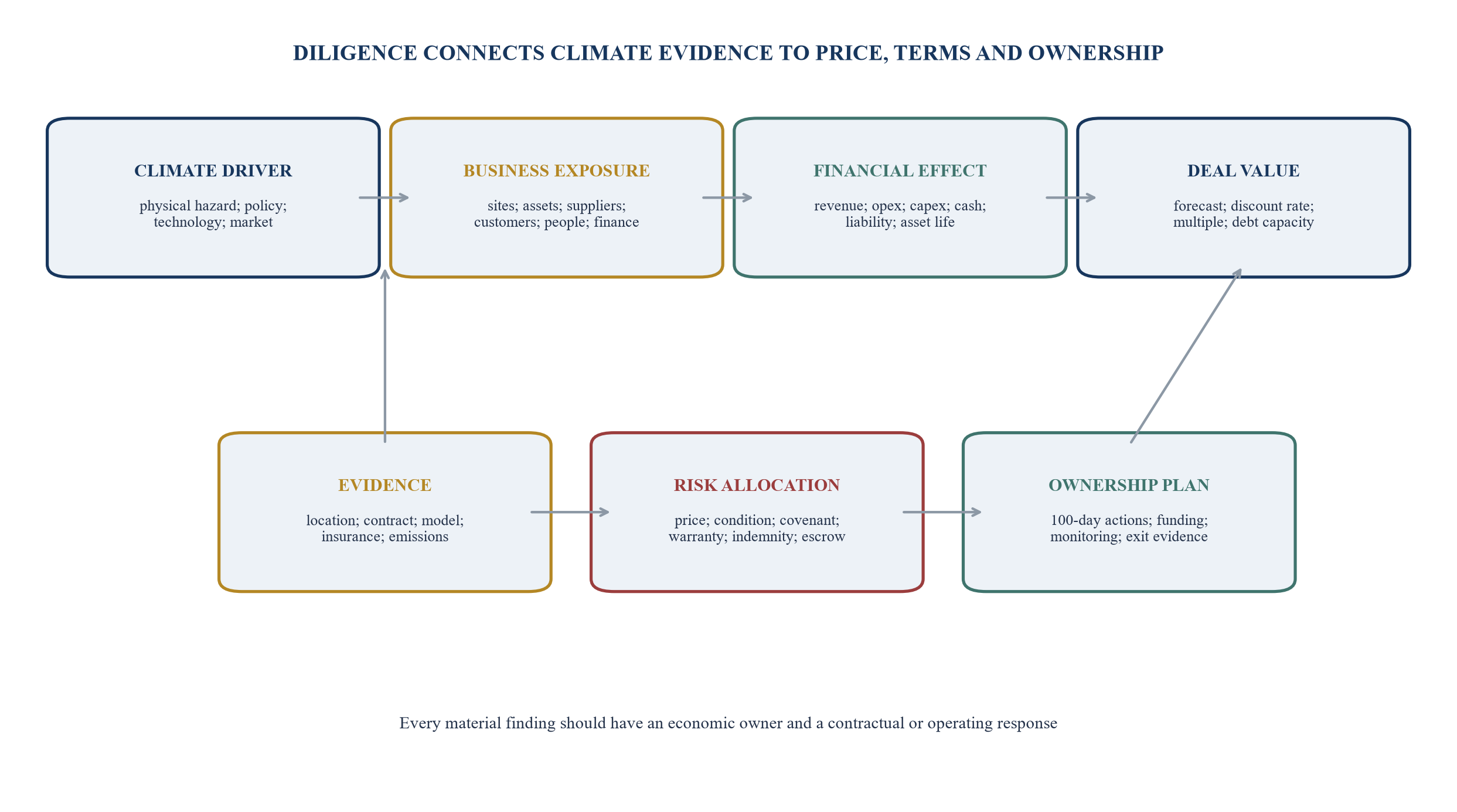
The architecture is illustrative. Transaction-specific facts and qualified advice determine the analysis and contractual response.
2. Define the transaction perimeter before screening risk
The perimeter should identify the legal entities, assets, sites, joint ventures, leases, concessions, products, suppliers, logistics routes, customers, utilities, licences, permits, employees and financing arrangements included in the transaction. It should also identify excluded assets, transitional services, shared facilities, seller dependencies and planned separations.
Transaction structure affects exposure. A share acquisition may transfer historic liabilities, contractual commitments and reporting obligations within the acquired entities. An asset acquisition may allow a different allocation while leaving permits, site conditions, employees and counterparty consents to be addressed. A carve-out can create new energy, data, insurance and supply-chain dependencies. A minority investment may limit information and control rights. Applicable law and documents determine the actual result.
The team should map the target's value chain from critical inputs to end customers. Scope should extend beyond owned sites where a supplier, port, data centre, energy source, transport corridor or customer segment is material to cash flow. OECD due-diligence guidance emphasises that significant impacts can occur in operations, supply chains and business relationships [10]. The GHG Protocol Scope 3 Standard also structures value-chain emissions across fifteen categories [15]. Emissions accounting and commercial dependency analysis have different purposes, although the same supplier and customer records can support both.
The perimeter should be frozen in a written scope memo, then updated through a controlled change log. New diligence may identify a critical dependency or regulatory threshold that changes materiality. The investment committee should see what was included, what was excluded and why.
The scope memo should assign specialists. Physical risk may require engineering, hydrology, catastrophe modelling or site inspection. Transition analysis may require sector, policy, technology and customer expertise. Legal counsel should determine applicable obligations and transaction allocation. Finance and valuation teams should control the model bridge. Insurance specialists should review availability, limits, exclusions, deductibles and pricing.
Table 1. Climate-commercial diligence issue register
| Issue | Evidence required | Financial channel | Diligence owner | Deal response | Post-close owner |
|---|---|---|---|---|---|
| site flood and drainage | geocoded assets, elevation, flood maps, history and engineering controls | interruption, repair, inventory loss, insurance and adaptation capex | technical and insurance leads | price, condition, capex covenant or specific indemnity | chief operating officer |
| heat and water stress | site climate data, water rights, cooling load, workforce exposure and contingency | energy, productivity, downtime, capacity and capex | operations and engineering | forecast adjustment, resilience plan and funding covenant | operations director |
| product transition | regulation, customer specifications, technology curve and substitution economics | volume, price, margin, R&D and asset life | commercial and strategy leads | scenario value, earn-out or investment covenant | commercial executive |
| emissions and reporting | organisational boundary, scopes, method, source data and assurance | compliance cost, customer eligibility, financing and claims risk | finance, legal and sustainability | warranty, remediation covenant and data-room completion | CFO |
| supplier concentration | critical supplier sites, routes, alternatives, contracts and inventories | lost sales, working capital, expedited freight and redesign | procurement and operations | closing condition, inventory bridge or diversification plan | procurement lead |
| environmental obligation | permits, site studies, notices, remediation, provisions and insurance | cash outflow, capex, delay and liability | legal and environmental advisers | indemnity, escrow, price adjustment or exclusion | general counsel |
The register is an illustrative management template. The transaction team should adapt it to the target and applicable requirements.
3. Build a hazard, exposure and vulnerability model
Physical risk is a combination of hazard, exposure and vulnerability. Hazard describes the potential event or chronic condition. Exposure describes the assets, people, operations and dependencies in its path. Vulnerability describes susceptibility and the effectiveness of resilience measures. Diligence should analyse all three.
The data room should include accurate coordinates, site function, replacement value, revenue contribution, critical equipment, floor elevation, construction characteristics, drainage, cooling, fire protection, water source, grid dependency, backup systems, inventory, workforce, access routes, suppliers, customers and business-continuity plans. Geocoding errors can materially change a screen. A headquarters address may not represent factories, warehouses or supplier sites.
Historical loss records provide evidence of actual disruption, repair, insurance recoveries and management response. An absence of reported loss may reflect short history, incomplete records or favourable past conditions. Forward-looking analysis should use several sources and time horizons. The World Bank Climate Change Knowledge Portal provides country and spatial climate information [3]. IPCC regional material and national sources can support context. Engineering evidence is needed to translate hazard into asset performance.
The PRI's 2025 technical guide for private markets separates information gathering into hazard, exposure, vulnerability and impact, then connects assessment to valuation and action [11]. This sequence fits transaction diligence. A high-level screen can prioritise deeper work. It should not be used as the final financial estimate when a material exposure is identified.
Vulnerability analysis should test existing controls. Sea walls, drainage, elevation, cooling, redundant utilities, supplier alternatives, insurance and emergency procedures can reduce risk. Their condition, capacity, legal control and maintenance matter. A resilience plan without approved capital, permits or ownership may be an aspiration.
Table 2. Physical-risk diligence questions by operating layer
| Operating layer | Core question | Evidence | Financial test | Escalation trigger |
|---|---|---|---|---|
| owned sites | can each critical site operate through relevant acute and chronic hazards? | coordinates, design, loss history, protection and maintenance | downtime, repair, adaptation capex and residual value | single-site concentration or inadequate protection |
| utilities | how do power, water, cooling, telecom and waste dependencies fail? | contracts, capacity, backup, outages and regional plans | lost production, backup cost and capacity constraint | no viable redundancy within required recovery time |
| suppliers | which inputs or routes share correlated exposure? | supplier sites, tier mapping, routes, inventory and alternatives | lost margin, substitution cost and working capital | critical single source or long qualification cycle |
| workforce | can people work safely and reach the site? | heat protocols, transport, health and absence records | productivity, staffing, compliance and insurance | repeated threshold breach or weak response capacity |
| customers | can climate events change demand, access or service delivery? | customer concentration, locations, channels and contracts | volume, churn, service credits and credit loss | concentrated customers in a common hazard zone |
| insurance | what losses remain after policy terms and market capacity? | schedules, exclusions, deductibles, limits, claims and renewal quotes | retained loss, premium, covenant and liquidity | shrinking cover, material exclusions or unaffordable renewal |
The questions are illustrative. Hazard and engineering specialists should define the appropriate analysis.
4. Use scenarios as conditional tests
Scenario analysis asks how the target performs under different combinations of physical conditions, policy, technology, demand and energy systems. It is a structured sensitivity exercise. It is not a prediction and should not be presented as a probability unless the methodology supports that claim.
The Network for Greening the Financial System provides long-term climate scenarios for financial-risk analysis [4]. In February 2026, NGFS published an official notice stating that the academic paper underlying specified Phase V physical-loss variables had been retracted. NGFS identified the affected outputs, stated that short-term scenarios and previous long-term phases were not affected, and said an updated methodology was planned for the next release [4]. A diligence team using Phase V should record this limitation and triangulate physical-risk estimates.
The Basel Committee's current consolidated guidance states that climate risk drivers can translate into traditional financial risk categories and supports proportionate scenario analysis [5]. The guidance is directed to banks and supervisors. A sponsor can use the same discipline when assessing debt capacity: define the purpose, select scenarios and horizons, challenge assumptions and show transmission into credit metrics.
Commercial scenarios should be specific enough to affect the model. A physical-risk scenario may alter downtime, maintenance, insurance, inventory, supplier cost and adaptation capex. A transition scenario may alter energy cost, product mix, customer eligibility, carbon price, technology spend and asset life. A combined scenario should consider interactions and management response.
Management actions should be tested for feasibility. A forecast may assume relocation, product redesign, renewable procurement or supplier replacement. The model should include timing, capital, approvals, capacity, execution risk and stranded cost. Actions that require future investment should not be treated as costless mitigants.
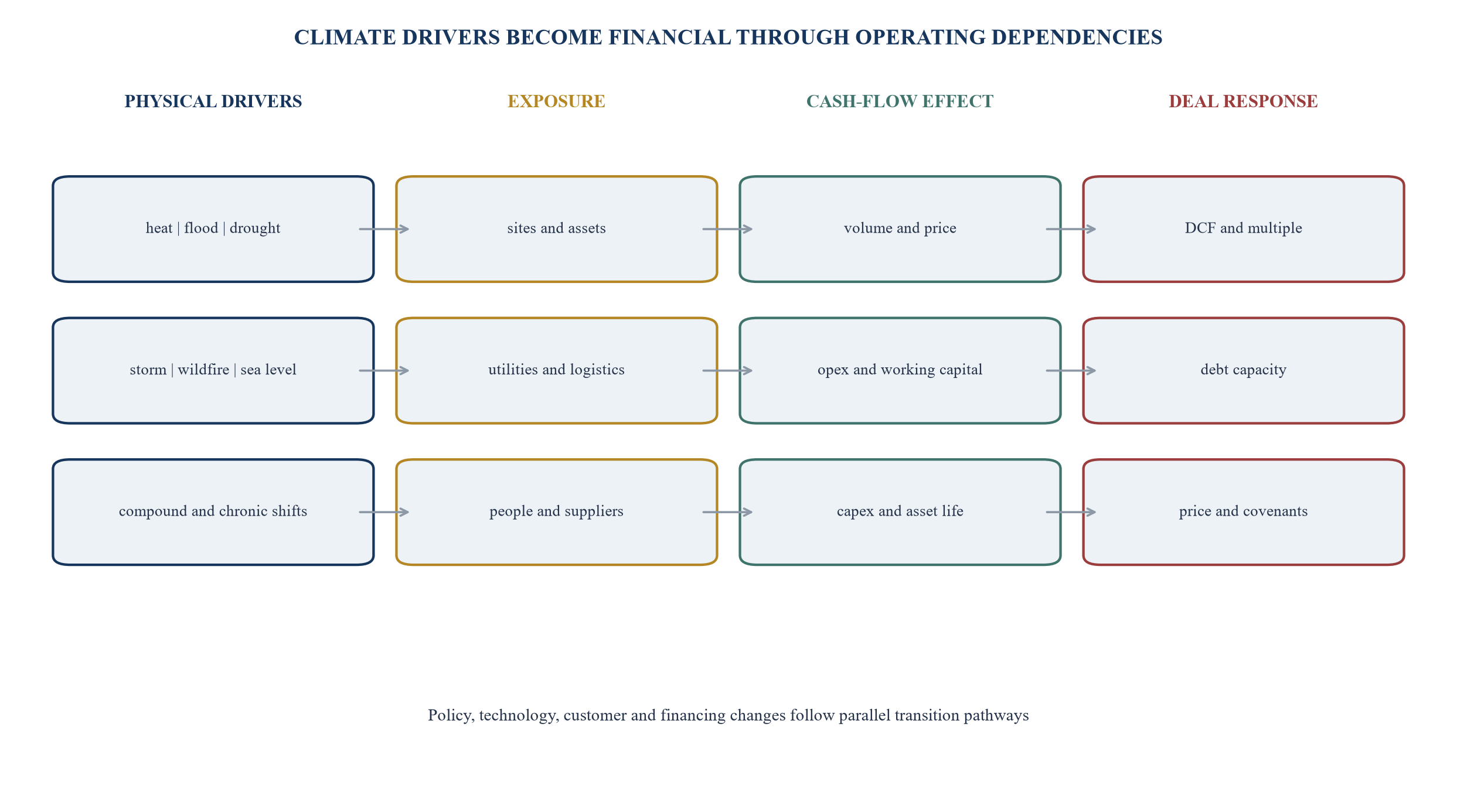
The pathways are illustrative. Sector, geography and company facts determine actual transmission.
5. Test transition risk through the target's market
Transition analysis should begin with the target's products, customers, assets and technology. A broad sector label can conceal different pathways. Two manufacturers in the same industry may have different energy intensity, customer requirements, product specifications, asset ages and access to substitutes.
The commercial team should interview customers and test procurement requirements, product standards, tender criteria, willingness to pay, substitution risk and expected timing. It should distinguish formal contractual requirements from stated preferences. Historical revenue should be segmented by customer type, geography, product and emissions or energy characteristics where relevant.
Policy analysis should identify enacted obligations, implementation dates, proposals and voluntary standards separately. The EU sustainability framework changed materially through the Omnibus process. In July 2026, the European Commission announced revised European Sustainability Reporting Standards and a reduced CSRD scope [16]. The EBA's final ESG-risk guidelines apply from 11 January 2026 for most covered institutions and later for small and non-complex institutions [17]. Target-specific counsel should determine which entities and value-chain requests are relevant.
Technology analysis should compare cost, performance, replacement cycles, infrastructure and adoption barriers. A target may benefit from a lower-carbon product, face substitution, or require investment to maintain customer eligibility. The forecast should identify which path management has funded and what evidence supports customer adoption.
Transition risk can also create opportunity. Energy efficiency can reduce cost. Resilient products can gain demand. Verified data can improve tender access and financing dialogue. Diligence should measure opportunity with the same discipline used for downside: addressable demand, contribution margin, capital, timing, competition and evidence.
Table 3. Transition-scenario commercial matrix
| Driver | Current-policy case | Accelerated-transition case | Fragmented-market case | Diligence evidence |
|---|---|---|---|---|
| customer demand | gradual preference shift | rapid specification and procurement change | divergent requirements by customer and geography | interviews, tender rules, churn, win rate and pipeline |
| energy and inputs | current tariffs and contracted path | faster price and technology change | volatile regional supply and policy | contracts, consumption, hedges, technology alternatives |
| product standards | enacted rules and known dates | wider or earlier performance thresholds | overlapping standards and border frictions | legal map, certification, product-level compliance |
| capital expenditure | approved maintenance and compliance | accelerated retrofit or replacement | duplicated systems and local adaptation | asset register, engineering plan, permits and funding |
| finance and insurance | current renewal assumptions | stronger lender and insurer conditions | uneven capacity and covenant treatment | lender feedback, policy quotes and covenant drafts |
| terminal value | current asset-life assumptions | shorter life for exposed assets; value for resilient assets | geography-specific obsolescence | scenario DCF, comparable evidence and exit-buyer interviews |
The matrix is illustrative. Scenario design and financial values require target-specific research and approval.
6. Verify emissions evidence and claims
Emissions data can affect reporting, customer contracts, financing and external claims. Diligence should establish the organisational and operational boundary, scopes, methodology, base year, calculation factors, estimates, exclusions, controls and assurance. The target should be able to reconcile source data to reported totals.
IFRS S2 requires climate-related disclosures for entities applying the standard and includes greenhouse-gas information [6]. The ISSB issued targeted amendments in December 2025, effective for reporting periods beginning on or after 1 January 2027 with early application permitted [7]. The amendments provide specified reliefs and clarifications. A transaction team should record the standard and version applied by the target and any jurisdictional modification.
Scope 1 and 2 data often rely on fuel and electricity records. Scope 3 can rely on supplier data, spend models, activity estimates and product assumptions. The GHG Protocol describes fifteen Scope 3 categories and cautions that company inventories are designed primarily for tracking an entity over time rather than direct comparison without additional consistency [15]. Diligence should examine method stability before comparing targets or basing price on an intensity ratio.
External targets and labels should be placed in a claims register. The team should identify the target boundary, baseline, time horizon, offsets, removals, governance, capital plan, dependencies and progress. A credible plan should connect operational actions and investment to the forecast. The IFRS Foundation published transition-plan disclosure guidance in June 2025 [9]. The guidance supports disclosure under IFRS S2 and does not itself create a transaction warranty.
Misstatements can create customer, financing, litigation and reputation risk. The deal response may include a disclosure correction, data-room completion, seller warranty, remediation covenant or price adjustment. Counsel should determine materiality and liability.
7. Reconcile climate matters to financial statements
Climate matters may already affect accounting estimates, asset lives, impairment, provisions, onerous contracts, inventory, expected credit losses and going concern. The diligence team should reconcile sustainability information, board materials, budgets and financial statements.
The IFRS Foundation's educational material on climate-related matters identifies potential effects across several accounting standards, including impairment assumptions, provisions and contingent liabilities [8]. The material does not add new accounting requirements. It demonstrates that climate matters can be relevant when applying existing standards.
The team should compare stated transition plans with the forecast and asset register. If management plans to replace equipment, exit a product or retrofit sites, depreciation, impairment, capex and provisions may require consideration. If the forecast assumes continued use of exposed assets, the resilience and maintenance case should be documented.
Environmental permits, remediation notices, restoration duties, carbon obligations and contractual commitments should be mapped to provisions and contingencies. Legal and technical advisers should assess obligation, timing and range. Insurance recoveries should not be netted without evidence that coverage responds and collection is supportable.
The quality-of-earnings bridge should identify climate-related one-offs and recurring items. Temporary energy support, unusually favourable weather, deferred maintenance, insurance recovery or compliance expenditure can distort the run rate. The bridge should distinguish historical normalisation from forward-looking scenario adjustment.
Finance should also review consistency across lender reports, customer tenders, tax submissions, emissions disclosures and transaction materials. Conflicting boundaries or numbers create diligence questions and can affect warranties.
8. Analyse insurance as capital, not a complete transfer
Insurance can transfer defined losses subject to policy terms, limits, deductibles, exclusions, sublimits, waiting periods and insurer credit. It does not remove operational dependency, customer loss, reputational harm or all adaptation cost. Diligence should therefore treat insurance as one component of resilience and liquidity.
The team should obtain policies, schedules, claims, broker reports, engineering surveys, renewal terms and coverage recommendations. It should identify named insureds, covered locations, values, business-interruption periods, contingent business interruption, flood and storm treatment, heat or drought exclusions, parametric coverage and lender requirements.
Historical claims should be reconciled to losses and recoveries. A low claim record can coexist with high exposure when events have not occurred during the ownership period. A high claim record may reveal weak controls or effective recovery. Both require interpretation.
Forward cost should use current market evidence. The model should include premium, deductible, retained loss, uninsured exposure and adaptation. Where coverage availability is uncertain, management should obtain indicative terms before signing or include a closing condition. A representation that insurance is adequate may be too general to resolve a material known exposure.
The acquisition financing should test insurance covenants and collateral requirements. Lenders may require specific cover, loss-payee status, reporting and remediation. A climate finding that affects collateral value or business interruption can change debt capacity even when the sponsor accepts the equity risk.
9. Quantify the value bridge
The value bridge should translate diligence findings into the same financial model used for the investment decision. Every adjustment should identify the base forecast line, scenario, timing, tax treatment, probability or conditional logic, mitigation and owner.
Revenue effects can arise from interruption, lost customers, product eligibility, price, capacity and new demand. Operating costs can include energy, water, maintenance, labour, logistics, insurance, reporting, compliance and supplier substitution. Working-capital effects can include buffer inventory, slower collections and supplier terms. Capital expenditure can include adaptation, replacement, monitoring, new technology and decommissioning. Liabilities can include remediation, contractual claims, levies and litigation.
The model should distinguish one-off remediation from recurring economics. A purchase-price reduction for known capex does not automatically compensate for implementation risk or lost cash flow. A risk with a range should be shown through sensitivities or scenarios rather than hidden in a single blended number.
Discount rates and valuation multiples require care. Climate risk may affect cash-flow volatility, financing, asset life and buyer demand. The analyst should avoid deducting the same risk from cash flow and again through a blanket discount-rate premium. Comparable-company differences in geography, product and disclosure should be considered before applying a multiple adjustment.
Terminal value deserves specific challenge. A forecast period may end before material asset replacement or policy change. The terminal case should reflect sustainable margins, maintenance and adaptation capital, asset life, customer demand and exit-buyer requirements.
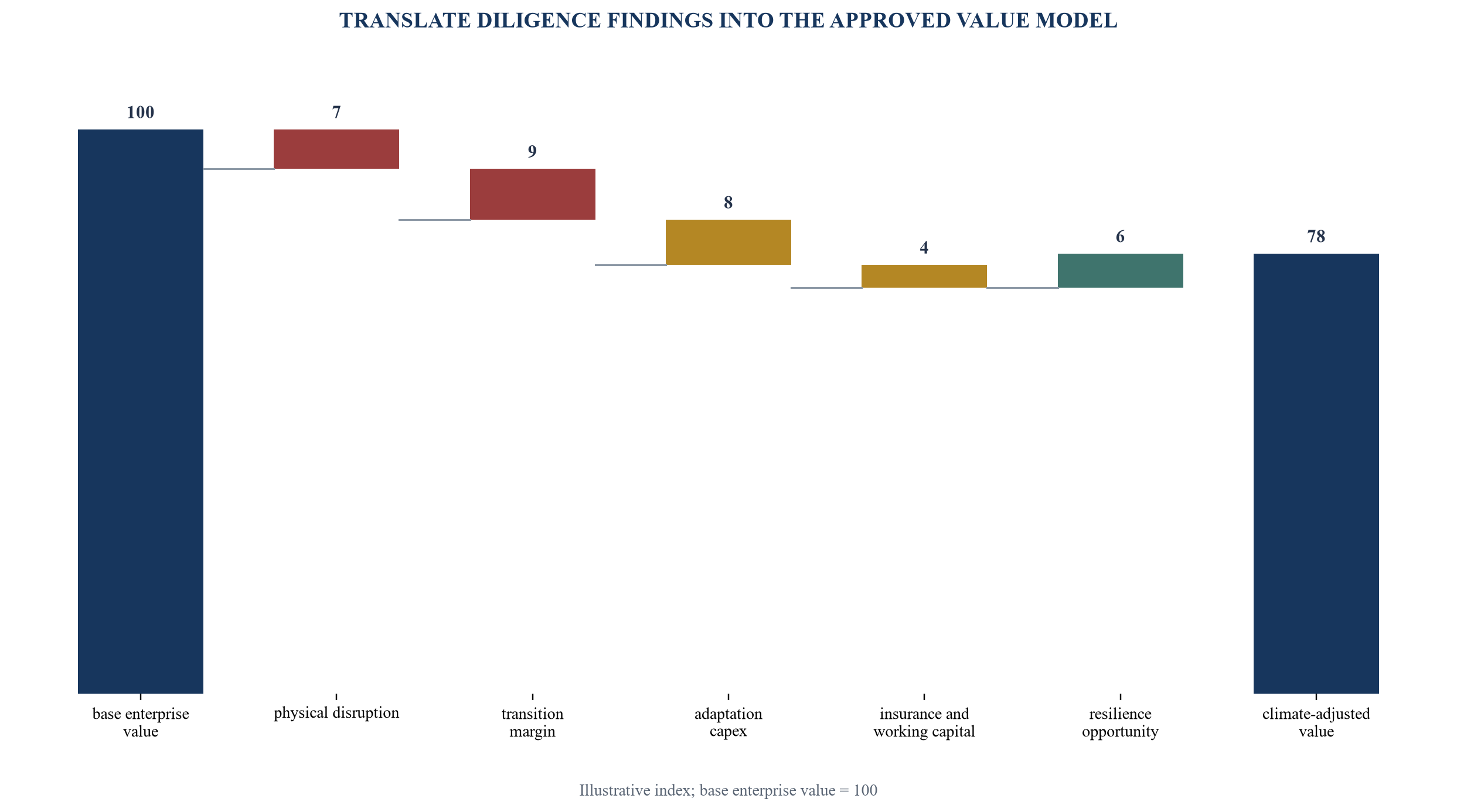
Values are hypothetical management assumptions used to demonstrate the method. They are not a forecast or transaction recommendation.
10. Separate price from risk allocation
Price and contractual protection answer different questions. Price reflects expected economics and risk. Warranties allocate loss from inaccurate statements subject to negotiated limits. Indemnities can allocate identified risks. Covenants require actions or restraint. Conditions precedent determine whether closing can occur. Escrow or holdback can support recovery. Earn-outs or contingent value rights can bridge uncertainty in future performance.
The deal team should choose the response based on measurability, control, timing, recurrence, seller knowledge, buyer tolerance and enforceability. A known adaptation project with a scoped budget may support a price adjustment or seller completion covenant. An unresolved historic environmental liability may require a specific indemnity and security. A customer transition risk may be better addressed in valuation or contingent consideration because a warranty cannot make future demand certain.
The purchase agreement should define relevant terms precisely. Climate, sustainability, environmental law, emissions, permits and claims can have different scopes. A broad compliance warranty may not identify the known issue, data weakness or future investment. Disclosure schedules should connect the statement to evidence.
The buyer should assess warranty-and-indemnity insurance treatment. Known issues, forward-looking performance and certain environmental exposures may be excluded or require specific underwriting. Policy terms control coverage. An insurance policy should not be assumed to replace seller recourse without confirmation.
The allocation should also fit acquisition financing. Lender consent, mandatory prepayment, information undertakings and financial covenants can interact with the purchase agreement. The sponsor should avoid promising a seller action that the financed group cannot implement under the debt documents.
Table 4. Climate finding-to-deal-term toolbox
| Finding type | Economic treatment | Contractual tool | Security or evidence | Residual ownership risk |
|---|---|---|---|---|
| quantified adaptation capex | deduct or fund separately; reflect downtime | pre-close completion or post-close capex covenant | engineering scope, budget, permit and holdback | cost overrun and execution |
| historic non-compliance or remediation | provision, price deduction or excluded liability | specific indemnity and remediation covenant | escrow, guarantee, authority correspondence | collection, scope and timing |
| unreliable emissions or reporting data | include remediation cost and customer risk | data warranty, completion condition and correction covenant | agreed methodology, assurance and data-room index | future measurement uncertainty |
| customer transition exposure | scenario-adjust revenue and margin | earn-out, contingent price or customer condition | contract renewal, tender eligibility and customer evidence | market demand and buyer execution |
| physical interruption exposure | downtime, retained loss, adaptation and insurance | resilience covenant, insurance condition and disclosure | renewal quote, business-continuity test and capex plan | tail event and coverage limits |
| uncertain future regulation | scenario and sensitivity; avoid false precision | change-in-law allocation and information covenant | legal update protocol and compliance budget | policy timing and interpretation |
The responses are illustrative. Counsel, advisers and the parties should determine enforceability and transaction suitability.
11. Design the purchase-price mechanics
Climate findings can enter locked-box, completion-accounts and enterprise-to-equity bridges. The team should identify whether a cost is reflected in historical net debt, working capital, provisions, capex or forecast cash flow. Double counting can arise when the same issue reduces enterprise value and is also treated as debt-like.
Outstanding environmental fines, remediation obligations, unpaid carbon liabilities or committed adaptation spend may be proposed as debt-like items depending on the transaction definition and facts. Normal recurring compliance cost may belong in EBITDA and valuation. Abnormal buffer inventory may affect the working-capital peg. Deferred maintenance can affect capex or price.
Locked-box protections should consider leakage related to environmental settlements, unusual capex, asset transfers, insurance proceeds and new commitments. Permitted leakage should be explicit. Completion accounts should use consistent policies for provisions, inventory and liabilities.
The quality-of-earnings analysis should avoid unsupported EBITDA add-backs for climate or sustainability spend. A cost required to operate, comply or retain customers may be recurring. A one-time implementation cost may be non-recurring, although the replacement and monitoring run rate remains.
The buyer should maintain one reconciliation that shows every climate item across EBITDA, capex, debt-like treatment, working capital, provisions and valuation scenarios. Finance, legal, commercial and technical teams should sign off the classification.
12. Use covenants that can be measured and enforced
A covenant should identify the action, owner, standard, evidence, timing, review and consequence. General commitments to improve sustainability provide limited control when the transaction depends on a specific outcome.
Pre-closing covenants can preserve insurance, permits, data, assets and ordinary-course spending. Conditions precedent can require a permit, remediation plan, customer approval, insurance renewal, engineering sign-off or agreed disclosure correction. Post-closing seller covenants may support transitional access, records or remediation. Portfolio-company covenants in financing can require reporting, capex, insurance, compliance or performance targets.
Sustainability-linked loan terms should follow the applicable market framework. The 2025 Sustainability-Linked Loan Principles describe material, ambitious and quantifiable performance objectives, reporting and verification [29]. They address a voluntary product label. A conventional acquisition facility can contain climate-related information or risk covenants without being labelled sustainability-linked.
Metrics should have a defined boundary, baseline, formula, data source, target, testing date, adjustment mechanism and verification standard. Acquisitions and disposals can alter boundaries. The covenant should say how recalculation occurs. A target that management cannot control or measure creates dispute risk.
The consequence should match the purpose. A margin ratchet creates an incentive. A drawstop or event of default protects against credit deterioration or breach. A remediation covenant creates an action. Mixing these without clarity can create unintended outcomes.
13. Test debt capacity and lender expectations
Climate diligence should be incorporated into financing from the start. The lender may assess the target's creditworthiness, collateral, insurance, business model, capital needs and information quality. Findings can affect leverage, margin, amortisation, reserves, conditions, covenants and syndication.
The Basel Committee's climate-risk chapter states that banks should consider transmission into traditional risk categories and incorporate material risk into credit processes [5]. In the UAE, the CBUAE's climate-related financial-risk regulation requires covered financial institutions to identify customer-level effects on creditworthiness and underwriting, including asset and liability value, profitability, cash flow, collateral and business-model risk [23]. These are lender obligations within their stated scope. They help explain why acquisition lenders may ask for target-level evidence.
The financing model should test base, physical, transition and combined cases against leverage, interest cover, fixed-charge cover, liquidity and covenant headroom. Adaptation capex should be funded. Insurance deductibles and working-capital shocks should enter liquidity analysis.
Lender due diligence should receive the same reconciled facts as the investment committee. Inconsistent emissions, capex or risk descriptions can delay underwriting. The sponsor should identify which findings are confidential and establish controlled disclosure.
Where a sustainable-finance label is proposed, eligibility, KPIs, targets, reporting and external review should be assessed independently. The transaction should remain economically sound without relying on a small pricing incentive.
14. Map current jurisdictional obligations accurately
The target's obligations depend on entity, location, listing, size, sector, activity, customer and value chain. The diligence team should maintain a jurisdictional register with legal status, effective date, applicability, required evidence and owner. Enacted requirements, regulator guidance, consultations and voluntary standards should have separate labels.
The European Commission adopted revised sustainability reporting standards in July 2026 as part of the Omnibus simplification process [16]. EU banking institutions are also subject to the EBA ESG-risk guidelines according to their scope and implementation dates [17]. Counsel should confirm the target's CSRD, ESRS, taxonomy and due-diligence perimeter under current EU law.
The United Kingdom consulted in 2025 on transition-plan requirements and related sustainability reporting standards [20]. The consultation material describes potential routes and should not be presented as enacted rules. Existing company, listing and FCA obligations should be mapped separately.
The UAE Federal Decree-Law No. 11 of 2024 addresses reduction of climate-change effects and entered into force nine months after publication [22]. The CBUAE maintains climate-risk principles and an in-force regulation for institutions within its scope [23, 24]. The transaction should assess both target obligations and lender expectations.
Australia's mandatory climate reporting is phased. ASIC Regulatory Guide 280 describes Chapter 2M sustainability reporting and AASB S2 for covered entities [25]. Singapore's roadmap, updated in July 2026, begins climate-first reporting from FY2025 for listed companies according to tier and sets a later path for large non-listed companies [26]. India uses BRSR Core and value-chain disclosure arrangements for covered listed entities [27].
In the United States, the SEC proposed in May 2026 to rescind its 2024 climate-disclosure rules; those rules had been stayed during litigation [28]. State, sector, financial-statement and general materiality requirements can still be relevant. Counsel should verify current federal and state status at signing.
Table 5. Jurisdictional diligence register
| Jurisdiction or framework | Current anchor at August 2026 | Diligence question | Evidence |
|---|---|---|---|
| global reporting | IFRS S2 and December 2025 targeted amendments | what standard and version does the target apply; are boundaries and assumptions consistent? | disclosures, methodology, controls and assurance |
| European Union | revised ESRS announced July 2026; EBA ESG-risk guidelines effective by scope | which entities, reports, lender requests and transition plans apply? | legal perimeter, reports, data and implementation plan |
| United Kingdom | existing company and FCA rules; 2025 transition-plan consultation | which requirements are current and which remain proposed? | counsel memo, listing analysis and disclosure controls |
| United Arab Emirates | Federal Decree-Law No. 11 of 2024; CBUAE regulation and principles | what operating, reporting and lender expectations affect the target? | emissions, plans, governance and credit evidence |
| Australia | Corporations Act Chapter 2M, AASB S2 and ASIC RG 280 | which reporting cohort and assurance path applies? | threshold analysis, sustainability report and controls |
| Singapore | ACRA and SGX climate-first roadmap updated July 2026 | what tier, year, emissions and ISSB-based disclosures apply? | market-cap, entity thresholds, report and assurance plan |
| India | SEBI BRSR Core and value-chain framework | does the target or its major customer require BRSR Core data? | listed status, customer requests, data and assurance |
| United States | SEC 2024 rules stayed; May 2026 rescission proposed | which federal, state and sector requirements remain relevant? | counsel status note, filings, controls and state map |
This is a research map and not legal advice. Applicability and status require transaction-specific confirmation.
15. Link the finding to the investment committee
The investment committee should receive a concise decision record backed by the full diligence file. The record should state the material findings, evidence quality, scenario effects, valuation bridge, deal allocation, financing impact, residual risk and ownership plan.
Findings should be classified by evidence strength. Verified facts come from contracts, permits, invoices, geocoded assets, loss records and controlled data. Modelled estimates depend on assumptions and scenarios. Management plans depend on future funding and execution. The committee should see these classes separately.
Materiality should be linked to the transaction thesis. A risk may be small relative to current earnings and material to a growth plan, critical site, customer contract, lender covenant or exit route. The record should show time horizon and reversibility.
The committee should approve specific actions: proceed at the proposed price and terms, adjust price, change financing, require a condition, seek an indemnity, fund a resilience plan, narrow the perimeter, defer for evidence or stop. Open items should have owners and deadlines.
The residual risk statement should identify what remains with the buyer after price and protection. Contractual recovery can be limited by caps, time, exclusions, credit and proof. An adaptation plan can fail. Insurance can change. The underwriting case should remain acceptable under the residual exposure.
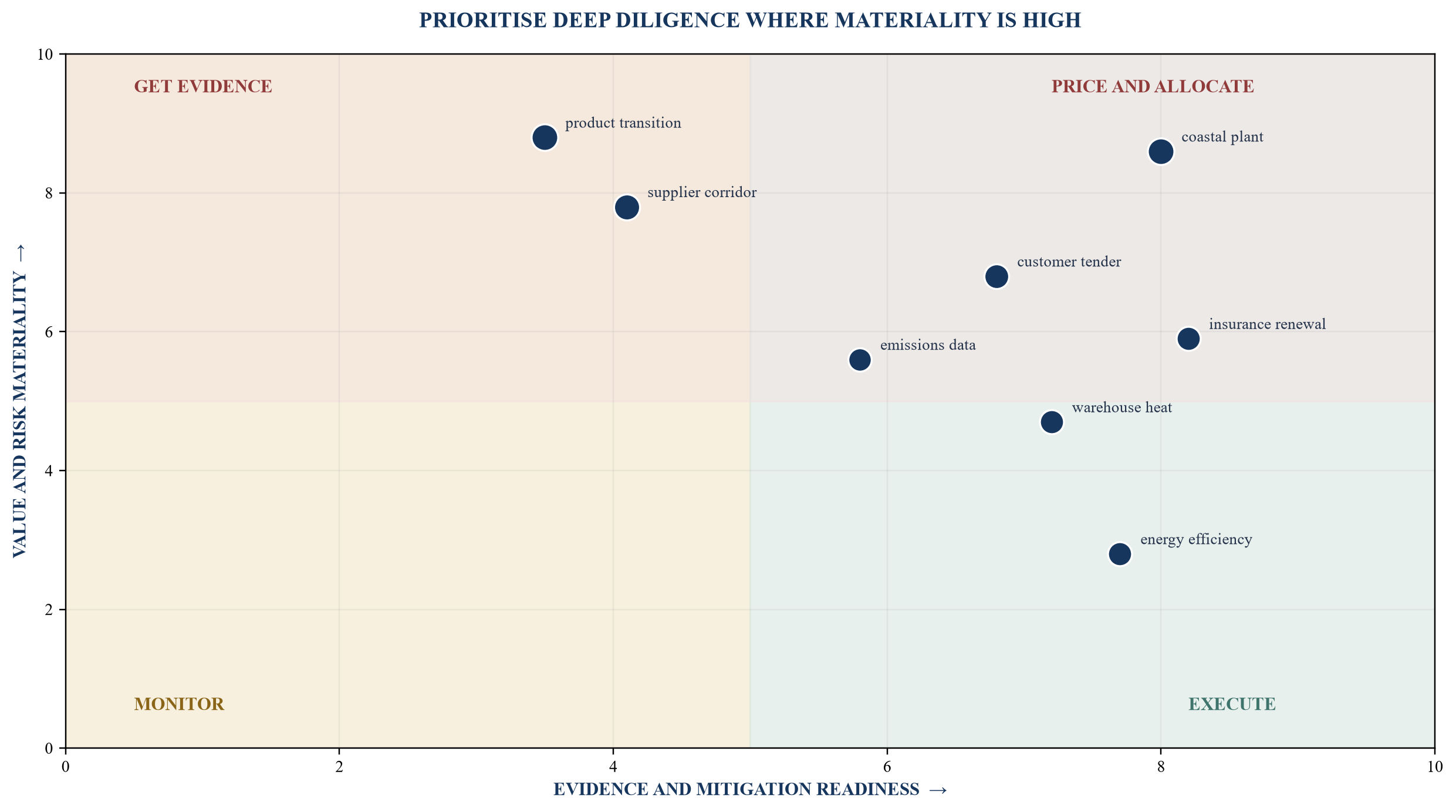
Positions are hypothetical examples. Actual scoring requires company and asset evidence.
16. Run a gated diligence timetable
Climate work should begin at initial screening and deepen as access improves. A rapid screen can identify sector, geography, sites, product and regulation. The team should not wait for confirmatory diligence to request coordinates, utility data, insurance and emissions evidence.
During indicative bidding, the team should identify red flags, valuation sensitivities, specialist scope and information requests. The bid letter can reserve identified matters. Exclusivity should trigger site-level analysis, customer and supplier work, legal mapping, insurance review and model integration.
Before signing, every material finding should have a defined treatment. Open evidence should be reflected in conditions, price, protection or a documented risk acceptance. The acquisition financing should use the reconciled case. Disclosure schedules and the data room should be indexed.
Between signing and closing, the parties should complete conditions, maintain insurance, preserve assets and update material events. Climate events can occur during this period. The agreement should allocate notification and ordinary-course response.
The first hundred days should execute funded resilience, data and commercial actions. The deal team should hand the issue register to management rather than archive it. Benefits and costs should enter the operating plan.
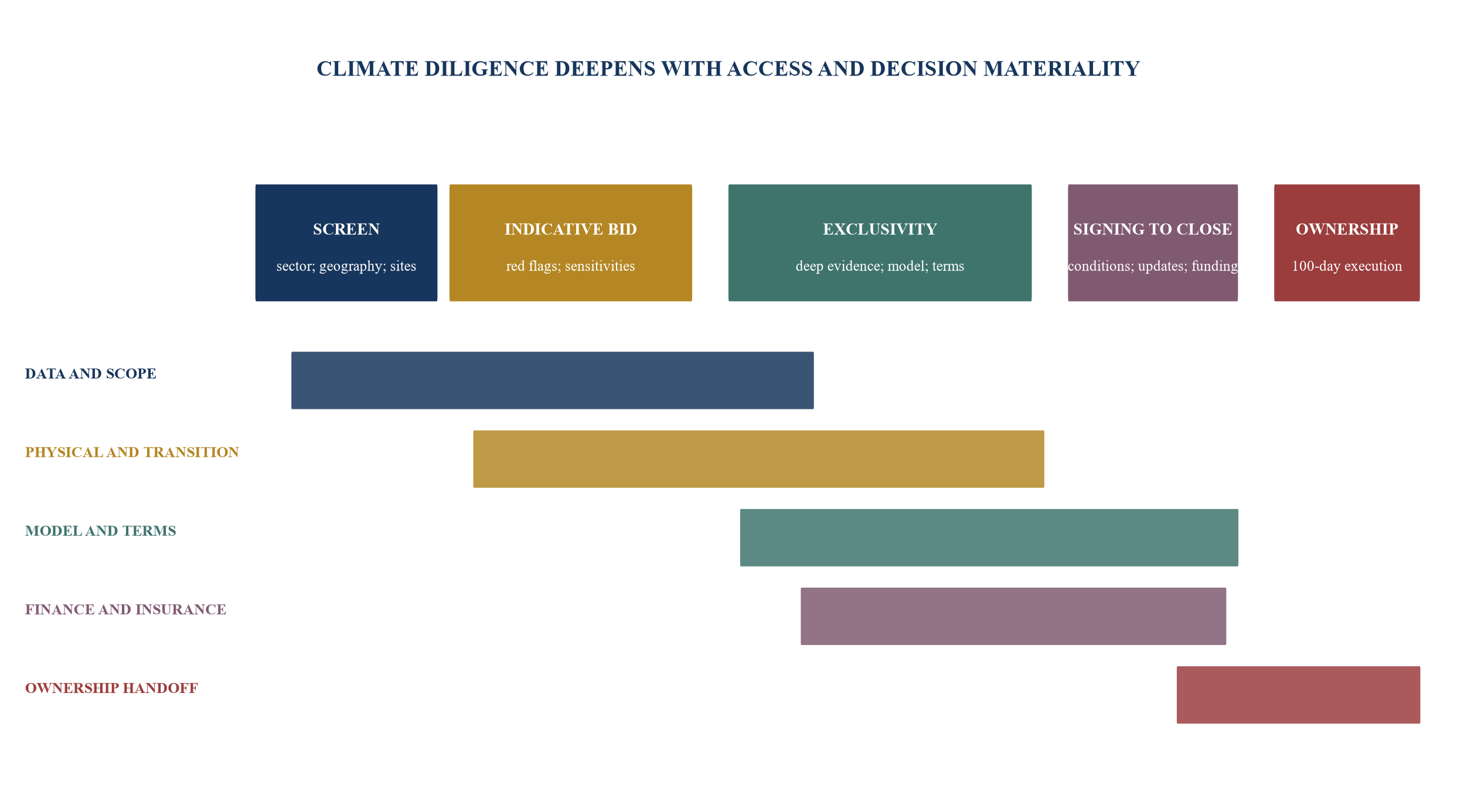
Timing is illustrative. Transaction structure, access, regulation and risk determine the actual timetable.
17. Build the first hundred-day ownership plan
The ownership plan should be approved with the investment. It should convert diligence findings into funded workstreams, operating measures and board reporting. Deferred decisions should not disappear after closing.
The plan should prioritise immediate safety, compliance, insurance and liquidity issues. It should then address measurement, adaptation, commercial transition, supply-chain resilience, data and governance. Each action needs an owner, budget, milestone, dependency and evidence of completion.
Physical actions may include engineering studies, drainage, cooling, fire protection, utility redundancy, inventory policy, supplier alternatives and continuity testing. Transition actions may include product redesign, customer engagement, energy procurement, equipment replacement and workforce capability. Reporting actions may include boundaries, data controls, methods, assurance and disclosure.
The value-creation plan should reconcile to the underwriting model. If the investment case includes adaptation capex or energy savings, finance should track actual spend and outcomes. Delays should update the forecast and risk register.
The board should receive early-warning indicators. These can include insurance renewal, hazard alerts, site downtime, energy and water intensity, customer tender eligibility, supplier exposure, capex completion and regulatory milestones. Indicators should support decisions rather than become a reporting burden.
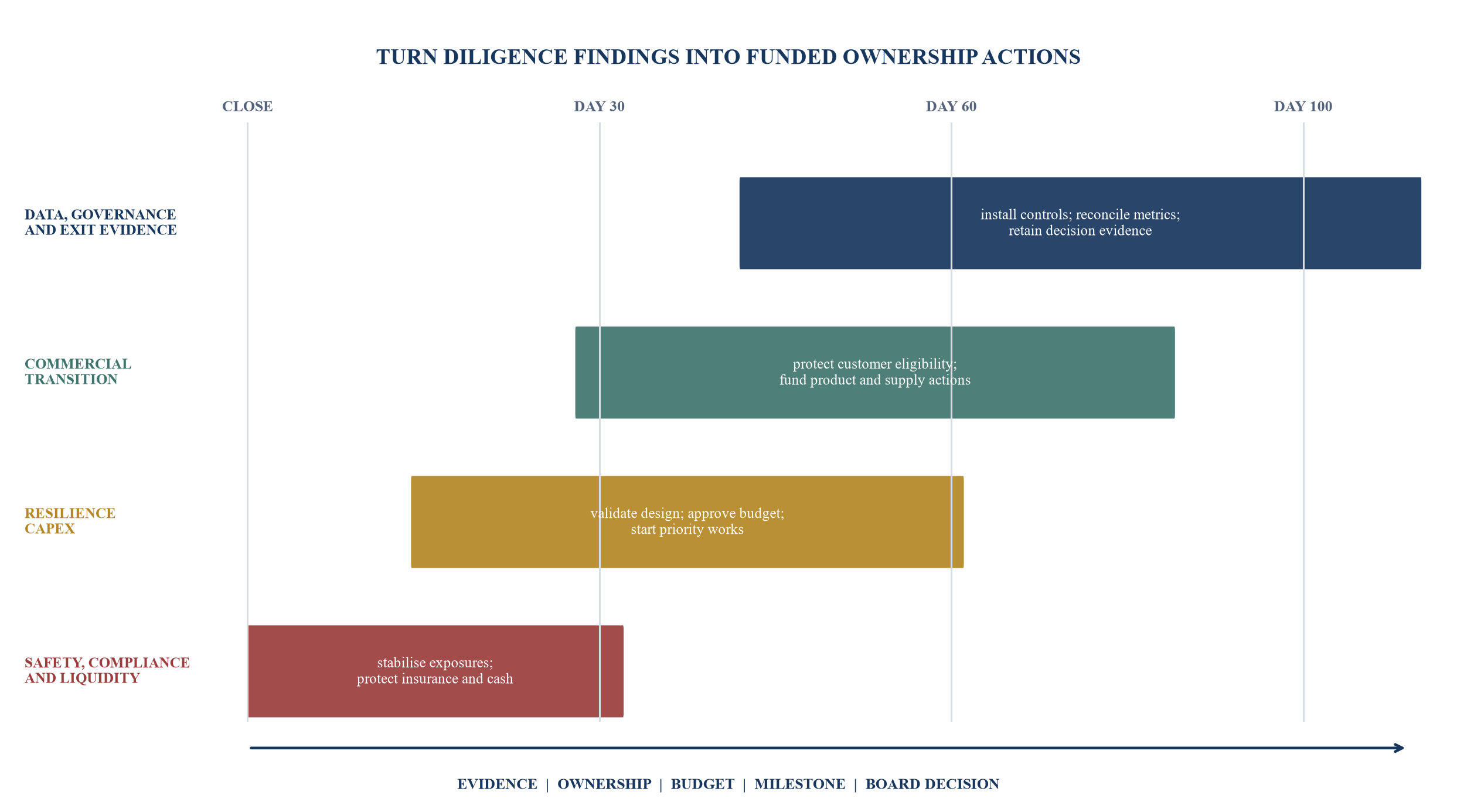
The sequence is an illustrative management framework. Priorities, timing and ownership require transaction-specific evidence.
18. Prepare the exit evidence from day one
An exit buyer may repeat climate diligence with updated standards, data and market expectations. The portfolio company should therefore maintain an evidence room throughout ownership.
The evidence room should include the site and value-chain map, hazard assessments, engineering reports, resilience capex, permits, emissions boundaries and source data, targets, customer requirements, supplier plans, insurance, incidents, board decisions, financial reconciliation and external claims. Version history should explain changes.
Exit evidence should connect investment to performance. A resilience project may reduce downtime or retained loss. An efficiency project may reduce energy cost. A product transition may protect customer eligibility or create revenue. Benefits should use credible baselines and avoid unsupported attribution.
The company should maintain consistency between sustainability reports, lender data, customer tenders, financial statements and the information memorandum. Differences may be legitimate because boundaries and purposes vary. They should be reconcilable.
A seller should assess whether vendor due diligence is useful. Independent review can identify gaps before the buyer process. Assurance under a recognised framework may strengthen data credibility. ISSA 5000 provides a global standard for sustainability assurance engagements and can be applied across topics and frameworks by eligible practitioners [30]. The appropriate assurance scope depends on the transaction and reporting obligations.
Table 6. Investment-committee and board dashboard
| Dashboard item | Decision | Evidence class | Owner | Illustrative cadence |
|---|---|---|---|---|
| top physical exposures | engineering, insurance, capex and continuity | verified site data plus modelled hazard | operations and risk | monthly for material sites |
| transition revenue at risk | product, customer and pricing response | contracts, interviews and scenarios | commercial executive | quarterly |
| climate-adjusted value bridge | price, capital and return | approved model and sensitivity | CFO and investment team | each investment gate |
| open contractual protection | signing, closing and recovery | executed documents and disclosure | legal counsel | weekly through closing |
| lender and insurance conditions | funding, liquidity and compliance | term sheets, policies and covenant tests | treasury and insurance | each financing milestone |
| 100-day resilience actions | budget, ownership and escalation | approved plan and completion evidence | portfolio-company CEO | monthly after closing |
| reporting and claims consistency | disclosure and exit readiness | reconciled data and control sign-off | CFO and general counsel | quarterly or before publication |
| residual risk and incidents | accept, mitigate or revisit thesis | event, control and financial evidence | board risk owner | immediate plus board cycle |
Frequencies and thresholds are illustrative management assumptions.
19. Recognise common failure modes
The first failure mode is stopping at a heat map. A score identifies where to investigate and does not quantify target cash flow. The remedy is an evidence-to-model bridge.
The second is using headquarters instead of operating locations. The remedy is a geocoded asset, supplier and logistics perimeter.
The third is treating scenarios as forecasts. The remedy is a conditional analysis with purpose, assumptions, limitations and sensitivity.
The fourth is counting gross exposure without resilience. The remedy is engineering evidence on vulnerability, controls and residual risk.
The fifth is treating insurance as complete transfer. The remedy is policy-level review of limits, exclusions, deductibles, business interruption and renewal.
The sixth is mixing enacted law with proposals and voluntary frameworks. The remedy is a jurisdictional register with status and effective date.
The seventh is double counting value. The remedy is one reconciliation across EBITDA, capex, working capital, debt-like items, discount rate and multiple.
The eighth is using broad warranties for known risks. The remedy is a specific allocation with evidence, security and post-close responsibility.
The ninth is deferring capex without funding. The remedy is an approved ownership plan reflected in sources and uses, financing and the forecast.
The tenth is publishing claims that exceed the evidence. The remedy is a controlled claims register and cross-document reconciliation.
20. Establish a sponsor climate-diligence capability
A reusable sponsor capability combines a common taxonomy, data request, screening method, specialist panel, financial bridge, deal-term library and ownership handoff. The purpose is consistent decision quality across sectors and geographies.
The sponsor should maintain minimum fields for sites, hazards, value-chain dependencies, emissions, customer transition, regulation, insurance, finance and claims. Sector modules can add water, agriculture, power, shipping, real estate, data centres, manufacturing or healthcare questions.
Specialist engagement should be risk-based. A screen can identify where engineering, legal, insurance or scenario expertise is needed. The sponsor should document provider methods, data vintages, limitations and conflicts. Outputs should be comparable enough for portfolio oversight without forcing false precision.
The issue register and value bridge should be standard. Deal teams can then focus on judgement. Lessons from ownership and exits should improve future diligence. Failed assumptions should be recorded.
Capability metrics can include time to material finding, share of critical sites geocoded, issues with quantified financial channels, closing conditions completed, insurance gaps resolved, ownership actions funded and exit evidence readiness. The number of climate reports produced is an activity metric.
21. Approve the transaction through six climate-value gates
The final decision should answer six questions. First, is the transaction perimeter complete across entities, sites, assets, suppliers, logistics, customers and financing? Second, are material physical and transition risks supported by credible evidence and appropriate scenarios? Third, are the effects translated into revenue, cost, working capital, capex, liabilities, asset life and financing? Fourth, does valuation avoid double counting and show sensitivity? Fifth, do price, conditions, warranties, indemnities, covenants, escrow and insurance allocate the identified risks coherently? Sixth, is the residual exposure acceptable under a funded ownership plan?
The committee should see limitations. Location data may be incomplete. Models may disagree. Regulation may change. Customer behaviour may remain uncertain. The response is proportionate evidence, sensitivity, protection and ownership, with a record of what the decision assumes.
Climate diligence can improve the transaction beyond downside protection. It can identify resilience investment, energy savings, product opportunities, stronger customer eligibility, better insurance data and more credible lender dialogue. Opportunity should be evidenced with the same standard as risk.
A defensible decision connects climate science and policy to the target's operating reality. It then connects operating reality to cash flow, value, financing, contract and execution. This creates a single board record from exposure to ownership.
Sources and further reading
- Intergovernmental Panel on Climate Change, AR6 Synthesis Report: Climate Change 2023 Official source
- European Environment Agency, European Climate Risk Assessment Official source
- World Bank, Climate Change Knowledge Portal User Manual Official source
- Network for Greening the Financial System, NGFS Climate Scenarios for central banks and supervisors Phase V Official source
- Basel Committee on Banking Supervision, RMA60 Climate-related financial risks Official source
- IFRS Foundation, IFRS S2 Climate-related Disclosures supporting materials Official source
- IFRS Foundation, ISSB issues targeted amendments to IFRS S2 Official source
- IFRS Foundation, Effects of climate-related matters on financial statements Official source
- IFRS Foundation, Guidance on disclosures about transition plans Official source
- OECD, Due diligence guidance for responsible business conduct Official source
- Principles for Responsible Investment, Assessing physical climate risk in private markets Official source
- Principles for Responsible Investment, Guide for limited partners: responsible investment in private equity Official source
- International Finance Corporation, Performance Standards on Environmental and Social Sustainability Official source
- Equator Principles Association, Equator Principles EP4 and resources Official source
- GHG Protocol, Corporate Value Chain Scope 3 Standard Official source
- European Commission, revised European Sustainability Reporting Standards announced 3 July 2026 Official source
- European Banking Authority, Final Guidelines on the management of ESG risks Official source
- EUR-Lex, Directive (EU) 2022/2464 on corporate sustainability reporting Official source
- EUR-Lex, Directive (EU) 2024/1760 on corporate sustainability due diligence Official source
- UK Government, Climate-related transition plan requirements consultation Official source
- Financial Conduct Authority, Sustainability reporting requirements Official source
- UAE Legislation, Federal Decree-Law No. 11 of 2024 on the Reduction of Climate Change Effects Official source
- Central Bank of the UAE, Climate-related Financial Risk Management Regulation Official source
- Central Bank of the UAE, Principles for the effective management of climate-related financial risks Official source
- Australian Securities and Investments Commission, Regulatory Guide 280 Sustainability reporting Official source
- Accounting and Corporate Regulatory Authority Singapore, Sustainability reporting and assurance requirements Official source
- Securities and Exchange Board of India, BRSR Core framework for assurance and ESG disclosures for value chain Official source
- U.S. Securities and Exchange Commission, SEC proposes rescission of climate-related disclosure rules Official source
- Loan Market Association, Sustainability-Linked Loan Principles and sustainable lending resources Official source
- International Auditing and Assurance Standards Board, Understanding International Standard on Sustainability Assurance 5000 Official source
