

1 Define the adviser effect before measuring it
The relevant decision for a business owner is whether a particular adviser mandate produces a better sale decision than a feasible alternative. The alternative may be an owner-led approach, a different adviser, a limited valuation engagement or a staged preparation mandate. These alternatives are not interchangeable. A business with an identified strategic buyer, complete audited accounts and a short timetable has different needs from a founder-owned company that must create a buyer universe, normalize earnings and disentangle related-party assets. Any claim that advisers raise sale prices must say which service, which owners and which deals it compares.
The word outcome needs equal precision. A signed letter of intent is not a closing. A high enterprise value can be diluted by debt, working-capital adjustments, seller financing, contingent consideration, tax and fees. A transaction may close at a lower nominal price while providing more cash at completion and fewer continuing obligations. Owners can also rationally choose to remain independent. An adviser effect therefore has at least four dimensions: access to credible bidders, quality of executable offers, time and certainty of closing, and net value actually received by the selling shareholders. These outcomes may move in different directions.
Published research provides useful hypotheses, not a transferable UAE coefficient. Povel and Singh model takeover contests in which bidders have unequal information [1]. Kim and Zheng estimate auction costs using US public-company deals [2]. Research on advisers and valuation peers examines disclosed public-company transactions [3]. Those settings help identify mechanisms; they do not reveal what a UAE private owner would have achieved without an adviser. This paper does not claim to observe that counterfactual. Its practical contribution is an appointment and measurement framework that a seller can use now and that a future study can test.
The analysis is scoped to a privately held, non-listed UAE operating business considering a sale of all or a controlling stake. Free-zone, regulated, listed and cross-border cases may need additional approvals and different disclosure. The term mid-market is used descriptively; no numerical UAE market boundary is asserted. Owners should set a transaction-specific range and identify the legal entities, assets and shareholders in scope before soliciting adviser proposals.
2 Distinguish published evidence from the missing cohort
Research on M&A advisers is heterogeneous. A study of US banking acquisitions reports that adviser involvement has different associations for private and public targets in its sample [4]. A REIT study models selection into adviser use before estimating valuation effects [5]. Research on valuation peers shows how adviser choices can affect negotiation narratives in disclosed transactions [3]. None of those studies can be read as an estimate of the causal return from appointing an adviser to sell a privately held UAE company. Deal size, target quality, buyer universe, governance and data disclosure differ. Study results can even point in different directions because the adviser and the outcome are defined differently.
The selection problem is fundamental. Owners may hire an adviser because a sale is difficult, because an unsolicited bid has already arrived, or because the company is unusually attractive. An observed difference between advised and unadvised transactions can reflect those prior conditions. Published work on US takeover provisions shows the value of reconstructing process details from source documents; biased data on bidder competition had supported misleading conclusions [6]. A future UAE study needs the same discipline. It cannot start with a list of completed deals and infer what happened to mandates that failed, were withdrawn or never reached a bid.
No consented UAE sell-side cohort, complete engagement-letter set or bid-and-close panel was supplied for this paper. We therefore do not report a regression, average premium, completion probability or adviser return on fees. The design in later sections is a proposed research protocol. A measured result would require a documented sample frame, permissions to use confidential deal records, a data dictionary, methods for missing observations and independent review. Aggregate publication would also need a disclosure threshold that avoids re-identifying companies.
For an owner choosing an adviser today, the absence of a cohort does not mean that diligence is impossible. Proposal documents, team biographies, comparable work, buyer-access evidence, work plans, conflict declarations, fee models and references can be checked. The questions are narrower than a causal effect: what exactly is the adviser offering to do, who will do it, when can the owner evaluate progress and which decision rights remain with the owner? An appointment based on those questions is auditable even if the eventual incremental sale value cannot be known in advance.
3 Begin with a seller decision, not a sales pitch
The owner should define the decision before commissioning the process. Is the objective a full exit, partial liquidity, succession, a strategic partner or a financing alternative? How much time can management devote to diligence? Is there a minimum cash amount, a preferred buyer profile, a required role for the founder or a concern about staff and customer continuity? These preferences can change the ranking of offers. A seller that wants immediate clean cash may reject a higher contingent headline. A family that wants stewardship of a brand may attach value to buyer conduct that is absent from enterprise value.
The scope document should identify the company perimeter. It should reconcile subsidiaries, licences, intellectual property, real estate, shareholder loans, related-party contracts and personal guarantees. A buyer may price the group differently from the business described in a teaser. The adviser can help form a sale perimeter, but legal and accounting specialists should validate the rights and financial statements. An ambiguous perimeter creates avoidable retrading and gives bidders reason to make conditional offers.
The board or owners should also state a credible alternative to sale. That may be continued ownership, refinancing, a management buy-out, a minority capital raise or a staged partnership. A walk-away position helps the adviser avoid turning every indication of interest into a perceived mandate success. It also makes fee terms more intelligible: the owner can see whether a success fee becomes payable on a transaction that differs materially from the intended sale. The alternatives should be reviewed with current cash needs and debt obligations, not an abstract valuation target.
An appointment brief should fit on a few pages. It should set the decision, perimeter, approval body, confidentiality constraints, desired timetable, initial buyer universe, conflicts to check and information available. The brief should ask every prospective adviser to respond against the same questions. Without a common brief, one proposal may promise extensive preparation while another prices only introductions. Comparing headline percentages between these proposals would conceal the difference in deliverables.
4 Make the mandate a control document
The engagement letter should connect each workstream to a deliverable, an owner and a decision point. A typical proposed scope can include readiness assessment, valuation range and assumptions, information memorandum, buyer longlist, agreed short list, staged outreach, NDA administration, indicative-offer instructions, bid comparison, management meetings, diligence log, negotiation support and closing coordination. Whether every item is needed depends on the seller and the transaction. A mandate that merely says “advise on a sale” leaves the parties to argue later over what was purchased.
The document should specify who approves contacts and external materials. An adviser may prepare a buyer map, while the owner retains the right to approve names before approach. Outreach evidence can be recorded without revealing buyer identity to staff or competitors. The parties should decide how unsolicited bids, existing relationships and buyers already in discussion affect exclusivity and fees. A workstream can be valuable even if the owner ultimately declines a sale; the payment structure should reflect the agreed scope rather than silently converting every preparation task into a closing-only promise.
Fee analysis needs the same detail. Retainers, milestone payments, success fees, minimum fees, expense caps, tax treatment, credit for earlier payments, tail periods and fees on non-cash consideration should be modelled. A percentage applied to enterprise value can yield a different bill from one applied to equity proceeds. The letter should say whether assumed debt, rollover equity, earn-out, deferred consideration or shareholder-loan repayment enters the fee base, and when the fee is due. The seller should run at least three example transactions through the formula before signing.
Conflicts require a written process. The adviser may have a relationship with a bidder, lender, investor or another sell-side client. The DFSA's 2026 thematic review emphasizes documented and proportionate conflict controls for firms it regulates in the DIFC [7]. That review does not establish the licence position or duties of every UAE M&A adviser. The engagement should identify the actual entity, permissions and governing rules. It should require timely disclosure of relevant relationships and a decision procedure if one emerges mid-process.
Table 1. Adviser comparison matrix for a private-company sell-side appointment
| Workstream | Evidence to request | Owner decision | Failure signal |
|---|---|---|---|
| Sale perimeter and readiness | Defined entities, financial bridge and diligence gaps | Approve scope and remediation budget | Key assets or liabilities remain undefined |
| Valuation and alternatives | Assumptions, scenarios and hold alternative | Set reservation conditions | Single unsupported headline multiple |
| Buyer mapping | Named rationale, conflicts and contact route | Approve each outreach wave | Recycled list without credible access |
| Process design | Timetable, disclosure gates and bid instructions | Select controlled or bilateral route | No reason for process choice |
| Bid and diligence control | Bid-comparison and issue-log templates | Authorise exclusivity and concessions | Price compared without terms |
| Closing and economics | Fee model, conditions map and closing ledger | Approve final net-proceeds case | Fee base or deferred value ambiguous |
Author-developed selection tool. A seller should populate evidence from each proposal and check legal and regulatory status for the actual entity.
5 Price team capacity and accountability
The seller is buying people and available hours as well as a firm name. A proposal should identify the senior lead, day-to-day execution team, functional specialists, expected allocation and escalation route. The owner can ask which named professionals will attend management meetings, lead buyer calls, build the valuation, review data-room requests and negotiate economic terms. A senior partner's presence at the pitch does not specify who will undertake these tasks. A staffing schedule can show when capacity is committed and what happens if a team member leaves.
The team should be tested against the transaction's actual complexity. A family-owned industrial company may need working-capital, property, employment, tax and succession coordination. A software company may need cohort metrics, intellectual-property provenance and customer concentration analysis. A regulated business may need change-of-control permissions. Sector experience is useful when it produces better buyer targeting, more realistic diligence preparation and an informed response to sector-specific valuation objections. It is not a substitute for current evidence that a team can execute the agreed process.
References should be specific and consented. Ask a former client what the adviser did, what changed during the mandate, whether the senior lead remained involved, how confidentiality was managed, which issues delayed closing and whether fees followed the agreed formula. One glowing reference cannot establish average performance. It can nevertheless test whether an advertised capability was delivered. Confidential references may be limited; the adviser can still explain the work completed without naming another client or disclosing restricted deal terms.
The owner should retain a single accountable internal sponsor, normally a shareholder representative or board-authorised executive. The adviser cannot resolve conflicting owner objectives that have not been surfaced. A decision-rights schedule should say who approves materials, contacts, price concessions, exclusivity, diligence disclosures and the final sale. This schedule protects the adviser too: it identifies the person who can make a decision when a bidder's offer expires or a diligence issue arises.
6 Choose process design to fit information risk
An auction can create competitive pressure, but more bidder invitations also create cost, confidentiality exposure and management distraction. Kim and Zheng's structural analysis of US public-company auctions considers information leakage to industry rivals as a cost of wider entry [2]. Povel and Singh show, in a theoretical model, that bidder information asymmetry changes the optimal sequence of approaches [1]. These papers do not prescribe an auction for every private UAE sale. They support a process question: which bidders are credible, what information do they need, and what does revealing it cost the seller?
A narrow bilateral route can be appropriate when a buyer has a distinctive strategic rationale, when a sale perimeter is sensitive or when regulatory and customer risks make broad outreach expensive. A staged competitive route can be appropriate when several capable bidders can value the business and the seller can maintain comparable information access. A dual-track may compare a sale with financing or continued ownership, provided the two tracks have realistic resources and decision dates. The adviser should explain the proposed route in a short process memorandum with a stop point.
Competition should be measured by actionable offers, not the count of teasers sent. A long list can be inflated with names that cannot finance or approve an acquisition. A serious bidder has an articulated rationale, access to decision makers, a plausible funding path, an NDA, an agreed information stage and a willingness to submit terms. The adviser can report the conversion of approved names to qualified contacts, NDAs, indications and final bids. A narrowing funnel can be healthy if it removes unserious buyers while preserving options.
The process memorandum should set information gates. A teaser can omit names and sensitive customer data. A confidential information memorandum can follow an NDA and buyer qualification. Detailed contracts, employee information, pricing files and source code may wait until later, with access restrictions and clean-team protocols where needed. Applicable data-protection law and sector rules require specialist review. The UAE federal personal-data law is a relevant starting point for mainland handling, with jurisdiction and exemptions to be checked for the actual entities [8].
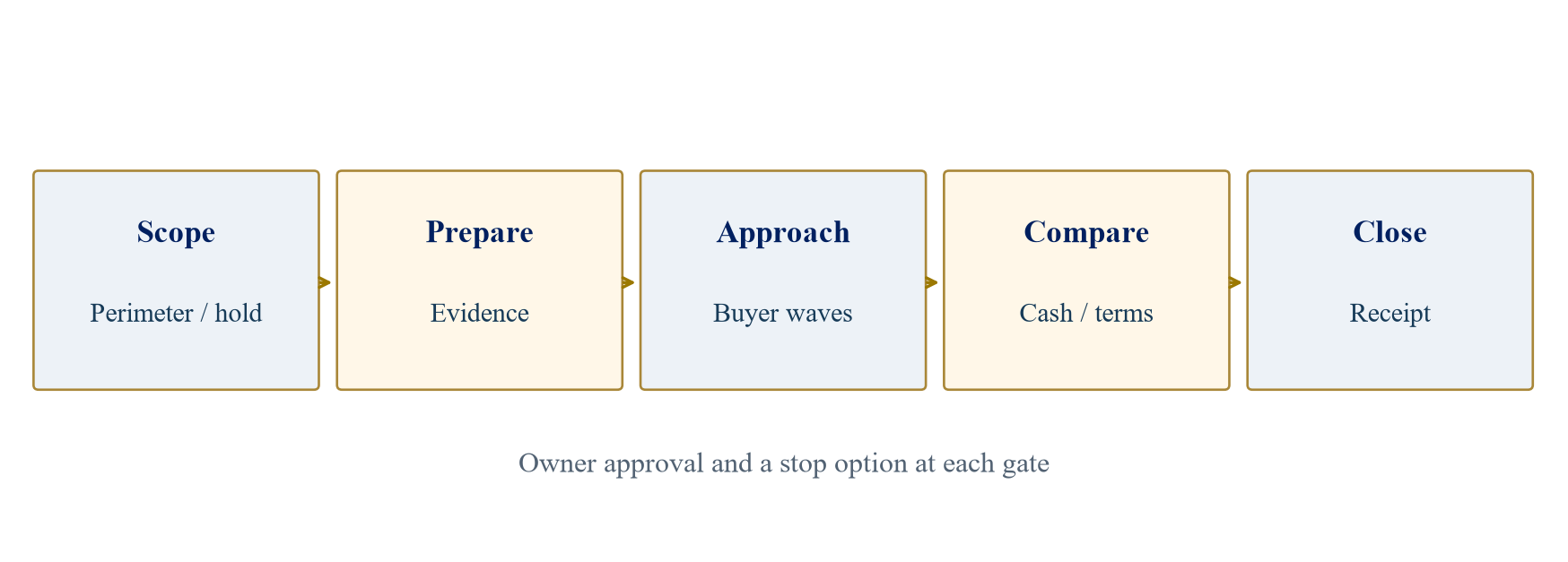
Author-developed process map. Stage timing and information access require transaction-specific approval.
7 Turn preparation into buyer-ready evidence
A sale memorandum is persuasive only when its claims can be reconciled. The adviser should first map the historical accounts, management reporting and forecast to a common business perimeter. One-off adjustments need evidence, dates and a treatment that a buyer can challenge. Customer concentration should use actual contracts and revenue records. Backlog should distinguish signed work from pipeline. Property titles, licences, intellectual property and material contracts should be linked to the legal entities that own or benefit from them. This work may reveal a choice to defer outreach until a material gap is closed.
Preparation has a commercial dimension. A buyer will ask why revenue is durable, who can run the company after the founder leaves, which assets require additional investment and where growth capital is needed. A sell-side adviser can organize the answer across finance, operations and strategy. A specialist lawyer, accountant, technical adviser or vendor-diligence team may own parts of the evidence. The engagement should state who appoints those specialists and who integrates their findings. If the same firm supplies several services, the owner should understand the total cost and any independence issue.
The data room should have a disclosure policy, not merely folders. Documents can be released in layers as bidder seriousness increases. Sensitive customer prices or employee records may need aggregation or redaction before a buyer gains access. An issue log should track each request, document owner, response status, version and unresolved exception. The seller should maintain an accurate record of what each bidder received, so a later difference in bid terms can be understood. Equal access is not always possible, but unexplained asymmetry can undermine comparability.
An adviser can be evaluated on readiness deliverables even before a bid exists. Were the financial bridge and perimeter approved? Were unresolved issues ranked by likely deal impact? Did management sign off the buyer-facing claim register? Did the data room reduce repeated questions? These are process indicators, not evidence of incremental sale proceeds. They are valuable because they can be inspected while the owner still has the option to improve the mandate or stop the sale.
8 Build a buyer universe with an evidence trail
Buyer mapping should start with strategic logic. A buyer might value market access, technology, capacity, contracts, licences or synergies. A financial sponsor might value recurring cash generation and an executable management plan. The adviser should record why each buyer belongs on the list, who has decision authority, what acquisition history or mandate supports capacity, what conflict or competitive risk exists and how contact will be made. A spreadsheet of corporate names alone is insufficient evidence of an accessible buyer market.
The seller should approve exclusions as carefully as inclusions. Direct competitors may be able to pay more yet pose greater information risk. Existing customers or suppliers may have leverage over the business during an attempted sale. Buyers with financing contingencies may consume scarce management time. An apparently attractive overseas bidder may face approvals, foreign-exchange, sanctions or integration constraints. The adviser can propose a tiered outreach sequence and document why each tier is worth the exposure. Legal specialists should assess competition and regulatory questions for named bidders.
The UAE competition framework is relevant where transaction thresholds and market definitions are engaged. Federal Decree-Law No. 36 of 2023 and Cabinet Resolution No. 3 of 2025 set a notification framework and thresholds, including AED 300 million of relevant-market annual sales or more than 40% of relevant-market transactions under the stated tests [9,10]. Cabinet Resolution No. 59 of 2026 provides executive regulations [11]. These sources do not mean every private-company sale requires notification; the actual transaction, entities, market and current law must be assessed. The adviser should identify a possible filing question early enough to affect the buyer timetable.
Buyer feedback has research value when it is coded honestly. The adviser can distinguish “declined after teaser,” “declined after NDA,” “indicative value below seller conditions,” “funding unverified” and “withdrew after diligence.” Such categories explain funnel attrition. A vague count of parties “engaged” can blur actual interest. A clean activity record also allows the owner to test whether the adviser changed the scope of outreach without approval or repeatedly contacted unlikely buyers to create an appearance of momentum.
9 Compare offers as contracts
An indication of interest should be normalized before it enters a ranking. Each offer should state the transaction perimeter, enterprise and equity valuation, form of consideration, debt and cash assumptions, working-capital target, earn-out formula, escrow, rollover, management retention, financing condition, due-diligence scope, exclusivity request, approvals and expected closing date. A missing term should remain visibly missing. Where bidders use different definitions of EBITDA or net debt, the adviser should translate them to a common basis and preserve the original wording.
Headline price can obscure a risk transfer. One buyer may offer a large earn-out tied to future revenue that the seller cannot control after closing. Another may pay a lower cash price without an earn-out. A third may require the owner to roll equity in a vehicle whose rights and exit are uncertain. Comparing only a stated enterprise value makes these offers look commensurate when they are not. The adviser can show conditional and unconditional amounts separately and ask legal counsel to explain enforceability and tax consequences.
For a wholly hypothetical illustration, suppose Offer A states an enterprise value of AED 100 million, assumes AED 20 million net debt, retains AED 10 million in escrow and includes AED 10 million of contingent earn-out within the stated equity value. If the earn-out is not achieved and the escrow is fully released, gross cash to shareholders over time is AED 70 million before fees and taxes; AED 60 million is due at completion under the simplified assumptions. Offer B states AED 92 million enterprise value, the same AED 20 million net debt, no earn-out and AED 2 million escrow. It yields AED 72 million gross over time and AED 70 million at completion under those assumptions. These are arithmetic examples, not observed offers or estimates of recovery.
The example does not assign a probability to either earn-out or closing, since doing so without bidder-specific evidence would create false precision. The owner can instead ask what must happen for each amount to be received, who controls that event and what security exists. The comparison should identify fees, taxes, loan repayment and retained liabilities separately. A bid committee can then choose based on a visible set of trade-offs, including strategic fit and continuity, rather than on the largest number at the top of a letter.
Table 2. Hypothetical comparison of two indicative offers, AED millions
| Item | Offer A | Offer B |
|---|---|---|
| Stated enterprise value | 100 | 92 |
| Assumed net debt | 20 | 20 |
| Stated equity value | 80 | 72 |
| Contingent earn-out included above | 10 | 0 |
| Escrow within non-contingent consideration | 10 | 2 |
| Cash at completion | 60 | 70 |
| Gross equity cash if all conditions met | 80 | 72 |
| Gross equity cash if earn-out fails and escrow releases | 70 | 72 |
Every amount is an author assumption. Enterprise value, net debt and timing are simplified; taxes, adviser fees and other adjustments are excluded.
10 Treat financing and approvals as part of price
A bid is executable only if the buyer can fund and approve it. A seller may ask for evidence of available equity, lender support, investment-committee authority, board approval path and any regulatory condition. The quality of evidence varies: an indicative financing discussion is weaker than an approved commitment, and a sponsor's stated intention to raise equity is weaker than available committed capital. The adviser can report the evidence class without claiming a financing guarantee. A bidder can change its financing between indication and signing; the issue log should record the change.
Closing conditions determine the time value and risk of a bid. Conditions can include antitrust approval, sector consent, shareholder approval, lender consent, property transfer, key-customer assignment or a clean diligence outcome. Counsel should review their wording. The adviser can help put the conditions on a timeline, identify the party responsible for each item and record whether it is within the buyer's or seller's control. A seemingly minor third-party consent can be the longest path to completion.
If exclusivity is requested, the owner should compare its cost with the increased probability of a signed transaction under the actual bid. Exclusivity can stop competitive tension, while giving a serious bidder room to incur diligence cost. The duration, milestones, information requests, financing evidence and right to terminate should be negotiated. A rolling exclusivity arrangement without measurable progress can transfer optionality to the bidder for little consideration. A seller can insist on a timetable and a clear decision when a gate is missed.
Published research on takeover provisions cautions against simple causal readings of deal protection and competition [6]. The evidence concerns disclosed public transactions, yet the methodological lesson is relevant: terms should be assessed in the full process and with source documents. In a private UAE sale, the adviser should record the actual documents, approvals and deadlines rather than infer closing certainty from the buyer's reputation. The owner should see both an economics ledger and a conditions ledger before authorising a binding agreement.
11 Reconcile enterprise value to seller cash
The seller's proceeds ledger should begin with the consideration defined in the executed agreement, not the enterprise value quoted in a teaser. It should then bridge to equity value through cash, debt and debt-like items, working capital and any agreed adjustments. From equity value it should distinguish cash received at completion, escrow, holdback, earn-out, rollover and deferred payments. Finally it should deduct seller-borne transaction expenses, repayment of shareholder instruments, applicable taxes and any personal obligations. Several of these items may be uncertain until completion; the ledger should show a range and the evidence supporting each input.
An adviser success fee can produce a counterintuitive result when its base differs from cash to shareholders. Consider the hypothetical Offer A from Table 2. A fee on AED 100 million enterprise value is calculated even though AED 60 million is due to shareholders at completion under the simplified case. A fee on equity value produces another amount. A fee payable on deferred consideration at signing creates a cash burden before the seller receives that consideration. The letter must settle these points before a buyer appears. The paper does not propose a market fee percentage; fee terms are negotiated and depend on scope and jurisdiction.
The bridge should be version-controlled through the process. An early valuation may assume normalized working capital; diligence may reveal customer deposits, overdue payables or capital expenditure that changes debt-like adjustments. The financial adviser can maintain the commercial bridge, while accounting and legal advisers validate the definitions. The owner should receive a reconciliation at each decision gate, including indicative bids, final bids, signing and completion. This makes retrading visible. A reduction in cash caused by a newly identified liability has a different explanation from a unilateral buyer price cut.
Net proceeds also require timing. Deferred cash received in a year is not economically identical to cash received at closing, and its credit risk may be material. An earn-out payable only after complex accounting tests should be shown as conditional, without assigning a fabricated likelihood. Rollover equity is an investment in the buyer or combined business, with its own rights and liquidity risk. A clean bid comparison separates realised cash, legally enforceable deferred claims, contingent amounts and non-cash exposure. The owner can then make a decision according to stated preferences rather than an invented single “risk-adjusted” number.
12 Preserve negotiation options without misrepresenting bids
Negotiation is a sequence of decisions under incomplete information. The adviser should maintain a live issues list covering value, structure, warranties, indemnities, completion accounts, management arrangements, financing, exclusivity and approvals. Every proposed concession should have an owner-approved rationale and a record of what the seller receives in exchange. A bidder's higher price may accompany a broader indemnity or more uncertain payment. The adviser can coordinate the economic trade while counsel drafts legal terms. Neither should imply that the other has approved an unresolved issue.
The bid process must avoid manufacturing competition. A seller may have two indications but only one financeable buyer. Telling a bidder that another offer is executable when it is not could undermine trust and may create legal risk. The adviser can accurately describe a competitive process without disclosing confidential terms. The owner should receive an internal bid status with evidence: verbal interest, written indication, funds evidence, diligence completion, investment approval and signed financing. This internal truth set supports honest external communication.
The owner can ask for a negotiation memo before entering exclusivity. It should identify the preferred bidder, why alternative bidders remain or fall away, the minimum acceptable economics, the concessions likely to be requested and the stop conditions. If no buyer meets the minimum, the memo should say so. This is where the adviser demonstrates judgement; its value is not the number of calls made, but the quality of the decision under real constraints. The seller should be free to reject a weak process result without being told that a transaction must close to validate the mandate.
The memo should distinguish an offer improvement from market movement or a changed business forecast. A higher second-round bid after new audited earnings is not wholly attributable to the adviser's negotiation. Likewise, an adviser may have preserved value by preventing a deeper reduction, but that counterfactual is difficult to prove. Claims of uplift need a reference point, matched terms and a documented chronology. For research purposes, the same discipline applies to every deal in a future sample, including those that fail.
13 Make closing certainty observable
“Closing certainty” should be decomposed into evidence. Has the buyer obtained internal approval? Is financing committed, subject to conditions or merely discussed? Is the sale agreement substantially negotiated? Are key consents mapped? Is the target's information consistent with the warranties? Can the parties meet completion mechanics? A single subjective score can hide a weak link. A conditions register can instead show each approval, responsible party, documentary proof, due date and consequence of failure.
The process should record timing from mandate to first approach, bid, exclusivity, signing and completion. Delay can arise from a seller's incomplete records, a buyer's financing, a regulatory review, a customer consent or a negotiated extension. Attribution matters. An adviser should not be credited or blamed for every elapsed day. The owner can evaluate whether the team identified a critical-path issue early, assigned it to an accountable party and escalated it before it threatened the deadline.
The UAE competition filing question is an example. The federal law, thresholds and executive regulations require an assessment of the actual transaction [9-11]. A buyer may also need sector-specific or foreign-jurisdiction approvals. The adviser can coordinate the timetable but cannot replace qualified legal advice. Where a regulated financial business is involved, the applicable authority's change-of-control rules may add a separate path. The conditions register should show these dependencies alongside commercial ones, so the seller does not assume signing equals imminent cash.
The final measure of certainty is a closing or a transparent reason for non-closing. A signed transaction that later terminates belongs in a future research cohort, as does a mandate stopped before a bid. Excluding failures would systematically flatter results. For live seller governance, a failed process can still produce useful information about buyer appetite or readiness, but the owner should not call it a closed sale. A post-mortem should record the point of failure, avoid speculative blame and define whether another process is justified.
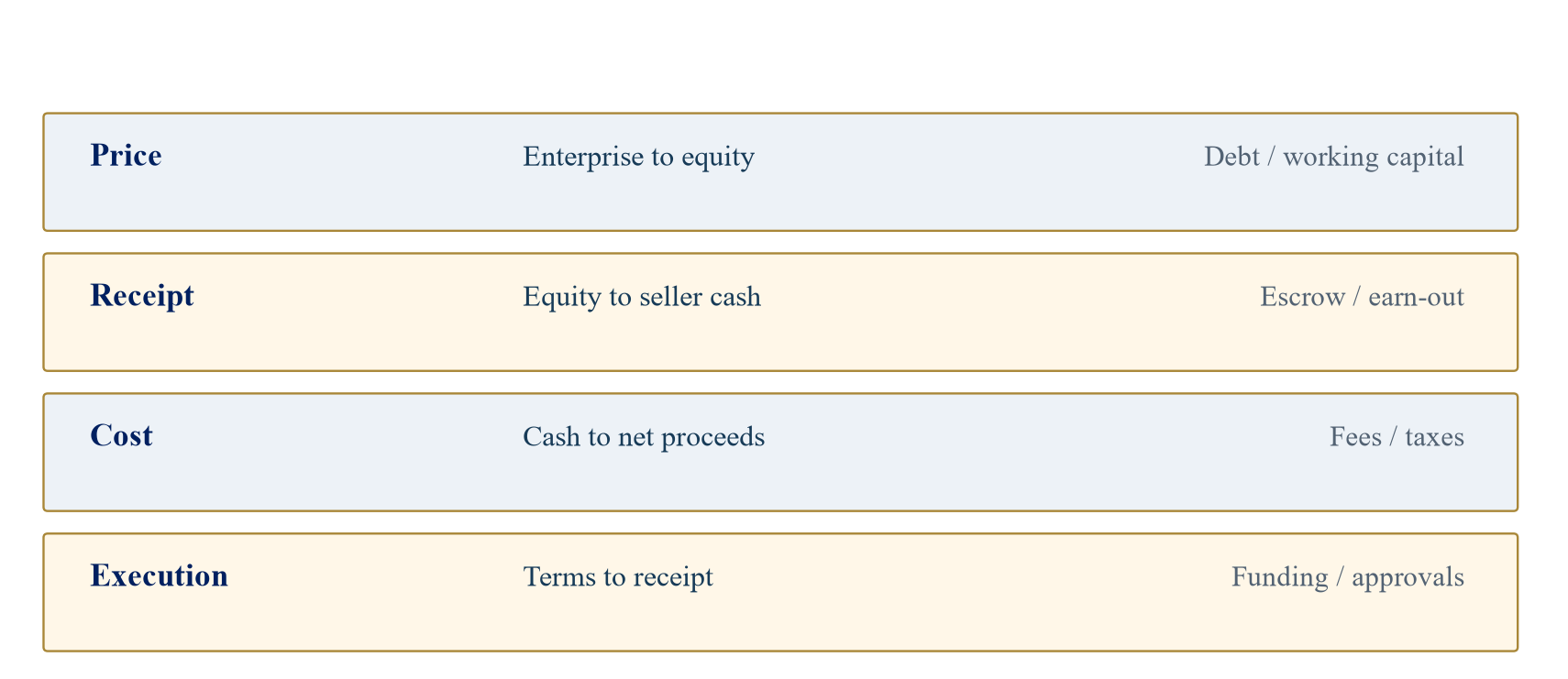
Author-developed decision framework. No empirical conversion rate or offer probability is implied.
14 Align fee incentives with the chosen outcome
An adviser that is paid only on closing may have a strong reason to complete a transaction, while a seller may prefer to stop if terms deteriorate. A retainer may finance necessary preparation but can also reduce the adviser's dependence on a closing. No simple fee structure removes every tension. The owner should ask what behaviour each component rewards, what work it pays for, and how both parties can end the relationship if the strategy changes. The fee model should be judged alongside governance and reputation, not in isolation.
A success fee may increase with sale value, which appears to align price incentives. Its marginal effect depends on the fee slope and the adviser's cost of additional work. The owner should not assume that a percentage fee guarantees effort or a higher price. The engagement can instead make deliverables and approval gates explicit. A fee based on final seller proceeds could align more closely with cash received, though its calculation, taxes and deferred consideration would need careful drafting. The analysis is contractual, not a statement that any particular arrangement is customary or legally preferable.
Tail clauses and exclusions merit close attention. A tail may protect an adviser if the owner sells shortly after termination to a buyer the adviser introduced. A broad tail covering every party in a loosely defined universe can burden a later independent sale. The letter can list introduced parties, require evidence of substantive contact and set a proportionate duration. It can also clarify treatment of pre-existing relationships and an owner-sourced buyer. These are negotiation issues; the applicable legal advice belongs with the parties' counsel.
Conflicts can arise beyond compensation. A firm may provide financing to a bidder, seek a future buy-side role, hold an investment or advise another potential buyer. Public-company cases and legal analysis have examined how such relationships can affect sale processes [12]. A UAE private mandate should require actual disclosures and a management decision at the time a conflict is identified. The DFSA's 2026 thematic review is relevant to authorised DIFC firms [7]; the engagement must identify which regulator and rulebook, if any, apply to the actual adviser entity. A generic statement that conflicts are “managed” supplies little comfort without a named control.
15 Test scope against a realistic mandate timetable
The sale plan should specify what is possible within the owner's resources. A team that promises valuation, vendor diligence, a complete buyer map and a full auction within an implausibly short period may be signalling that parts of the work will be superficial. The adviser and owner can build a critical path from readiness to materials, buyer contact, bids, diligence, signing and closing. Each gate has an evidence condition. The timeline should reserve room for financial clean-up, customer consents and management availability, even when the owner's preferred sale date is earlier.
A staged appointment can reduce commitment risk. The first stage might deliver a readiness assessment, valuation range and buyer feasibility note. The owner can then authorise outreach, retain the same adviser with revised terms or pause. This structure is particularly useful when accounts, ownership or regulatory perimeter are uncertain. It should be documented clearly so the adviser knows whether early-stage work creates any tail or exclusivity. A pilot that carries all the obligations of a full sale mandate without its deliverables defeats the purpose of staging.
The timeline should show how advisers coordinate rather than overlap. A corporate-finance lead may manage buyer process; counsel drafts agreements; accountants test earnings and working capital; tax advisers assess structure; sector specialists assess technology, property or licences. Deliverable ownership and review paths prevent two teams from producing inconsistent numbers. The financial model should use the same sale perimeter as the information memorandum and legal document. A weekly issue log can identify a single source of truth for each item.
At each milestone, the owner should receive a decision pack, not a long activity report. It should state what was learned, which evidence changed, what decision is due, the alternatives and consequences. If the outreach phase has produced no qualified buyer, the pack should recommend whether to expand the universe, change the sale perimeter, improve readiness, seek capital instead or stop. The adviser may recommend a course, while the owner retains authority. A documented stop can preserve value by avoiding a distressed or ill-timed transaction; its value cannot be translated into a realised uplift without a valid counterfactual.
16 Specify a future consented cohort study
The proposed empirical question is whether defined adviser workstreams are associated with bid competition, closing and net seller proceeds in UAE private mid-market sales, after accounting for observable deal characteristics. This is a protocol, not a result. The study population would need to include eligible mandates that closed, failed, were withdrawn and remained open over a predeclared period. The unit of observation should be the sale process, with separate bidder and offer records. Repeated mandates for one company should be linked. A signed consent framework must govern access to engagement letters, confidential bids and shareholder receipts.
Before data collection, the research team should define eligibility. It would specify UAE nexus, legal entity type, sale of control or significant stake, transaction size range, start and end dates, and whether distressed transactions, related-party sales or management buy-outs are included. These choices matter. Including only announced deals misses private failures; including every capital raise as a sale creates incomparable outcomes. A public protocol should explain how mandates are sampled from participating advisers and sellers and how nonparticipating firms may differ.
The data dictionary should separate treatment, process and outcome. Treatment could record adviser appointment, hours, fee structure and verifiable workstreams. Process variables could record approved buyer contacts, qualified bidders, written bids, exclusivity and diligence milestones. Outcomes could include completion, time to completion, final cash at closing and net proceeds over an observation window. The sample would also need sector, deal size, profitability, concentration, ownership, debt, distress, unsolicited approach, sale perimeter and market period. A source and assurance grade should accompany each variable.
Publication should use aggregated, disclosure-safe results only. Individual buyer names, fees, offers and sellers' private financials may be highly identifying even after names are removed. The UAE personal-data law and contractual confidentiality deserve a legal review before collection [8]. Data security, retention, withdrawal rights and access logs should be specified. A researcher should not infer permission to publish because one party shared a document during a transaction. Independent governance should resolve conflicts between commercial advisory work and claims made from the resulting data.
17 Address selection and causal limits before estimation
The comparison of advised and unadvised sales faces selection on both observed and hidden characteristics. A well-run company may attract an adviser and buyers; a difficult sale may hire an adviser because it is already at risk. Matching on size, sector and profitability cannot remove unmeasured owner urgency, quality of management, buyer knowledge or prior unsolicited interest. A study should pre-register hypotheses and show descriptive statistics before estimating associations. It should avoid presenting a regression coefficient as the value created by the adviser unless the identification strategy is credible.
Several designs could improve credibility if the data permit. A within-adviser comparison of mandates with different verified workstreams may reduce some firm-level differences, though scope selection remains. A before-and-after change in an adviser's staffing or process could provide variation, but only if the change is unrelated to deal quality. A policy or contract change might create a natural experiment; the researcher would need to test its timing and effect on selection. Instrumental-variable or difference-in-differences labels alone do not validate an estimate. The assumptions must be defendable from source evidence.
There is also outcome censoring. An open mandate has not yet failed, and a recently closed deal may have unreleased escrow or earn-out. A fixed observation window and survival treatment are needed. Net proceeds should distinguish contracted from actually received amounts. A failed sale may later be followed by a successful one, possibly with a different adviser. The protocol should decide whether that later outcome belongs to the original process, a new process or both, and disclose sensitivity to the choice. Missing fee information and privately negotiated adjustments cannot be silently set to zero.
For a first publication, a descriptive cohort may be more honest than a causal claim. It could show the distribution of scope, buyer conversion, closing times and net-proceeds adjustments in consented cases, with clear sample limitations. A later paper could test effects after sample breadth and identification are adequate. Public-company studies illustrate methodological possibilities and limitations [2-6]; their reported coefficients should not be transplanted to a private UAE owner. The discipline of admitting the missing counterfactual is part of making the research citable.
Table 3. Proposed cohort data and publication controls
| Field | Source document | Proposed quality control | Publication form |
|---|---|---|---|
| Adviser scope and fee | Signed engagement and amendments | Dual coding of deliverables and fee base | Aggregate categories |
| Buyer contacts and bids | Approved outreach and bid log | Distinguish qualified bid from expression of interest | Counts and conversion bands |
| Closing and timing | Signed agreements and completion proof | Record withdrawals and censored open cases | Rates with sample definition |
| Seller proceeds | Completion statement and later receipts | Reconcile cash, debt, fees, escrow and earn-out | Aggregated ranges |
| Deal characteristics | Accounts, cap table and sector record | Consistent perimeter and dates | Controlled summary statistics |
| Consent and privacy | Owner, adviser and data-use agreements | Access logs, retention and disclosure review | No identifiable deal details |
Research protocol only. No cohort has been assembled or analysed for this paper.
18 Use the framework for a live seller decision
An owner considering advisers can run a short selection exercise without waiting for a research programme. First, issue the same appointment brief to a small set of plausible firms. Second, request a workstream-by-workstream response, named team, references, conflicts, process route, preliminary buyer rationale and fee model. Third, score the evidence against the business's actual gaps. A score can organize discussion, but the owner should not disguise subjective judgement as a precise prediction of sale price. The final decision note should explain why the chosen adviser is suited to the transaction and where the seller must add external expertise.
Before signing, the owner should model three fee and transaction cases. One can assume an early stop after preparation, one a completed cash sale and one a sale with deferred or contingent proceeds. Every number should be identified as an assumption until tied to a real offer. The model should show who pays specialist costs, what happens on termination, whether a tail applies and when fees are earned. The engagement letter and spreadsheet should produce the same answer. If they do not, the ambiguity should be resolved before the adviser contacts buyers.
During the mandate, the owner can review evidence at gates: approved materials, qualified buyer map, outreach record, comparable bids, financing evidence, issue log and closing conditions. An adviser may recommend changing route when evidence changes. The owner should assess that recommendation against the hold alternative and the cash-proceeds ledger. A process with many contacts and no financeable bid is a different result from a process with one carefully qualified buyer and executable terms. Neither is proof of an incremental adviser effect, but each is a basis for a current decision.
At completion or termination, the parties should reconcile actual receipts and costs against the last approved case and record deviations. The post-mortem can identify which workstreams were useful, which preparation gaps remained and which closing conditions drove delay. If the owner later consents to research use, this record can support a cohort study. If no consent exists, the information remains confidential mandate evidence. The practical standard is a decision trace that the owner can defend without claiming that a future sale would have produced the same outcome.
19 Build an executable advisory workplan
The first deliverable is a two-week diagnostic whose duration is illustrative and subject to the company's size and records. It should produce an entity and shareholder map, historical financial bridge, value drivers, key diligence gaps, buyer-access thesis and a draft proceeds model. The adviser should show the evidence behind each assertion. A diagnostic that simply repeats management's target valuation adds little decision value. Where a material issue is outside the adviser's competence, the workplan should name the specialist and specify the decision it must support.
The second deliverable is a sale-process charter. It records approved buyer tiers, confidentiality protocol, material-release gates, bidder instructions, timetable, decision rights, weekly reporting, conflict procedure and the criteria for entering exclusivity. It should include a controlled path for unsolicited approaches and a stop option. The charter can be amended with owner approval when market feedback changes. A change log matters; it distinguishes an adaptive process from a silent shift toward whichever buyer is easiest to close.
The third deliverable is a bid and closing pack. It contains source bids, normalized comparison, proceeds and conditions ledgers, financing evidence, legal and tax open items, negotiation recommendation and a completion timetable. The adviser should state the limits of its verification and obtain specialist sign-off where appropriate. If management forecasts change, the pack should show the date and reason. The board should receive the same version used by the transaction team. A verbal summary of “best price” cannot replace the underlying cash and condition analysis.
The final deliverable is a reconciliation. It records gross and net consideration, cash received, deferred claims, unresolved obligations, professional fees, timeline and reasons for variances against signing. The owner should retain all operative documents and data-room logs under its own document policy. The adviser can help prepare a lessons-learned memorandum. A future study can only use such records with proper consent and safeguards. This workplan turns the question “What did the adviser do?” into observable tasks and a documented owner decision.
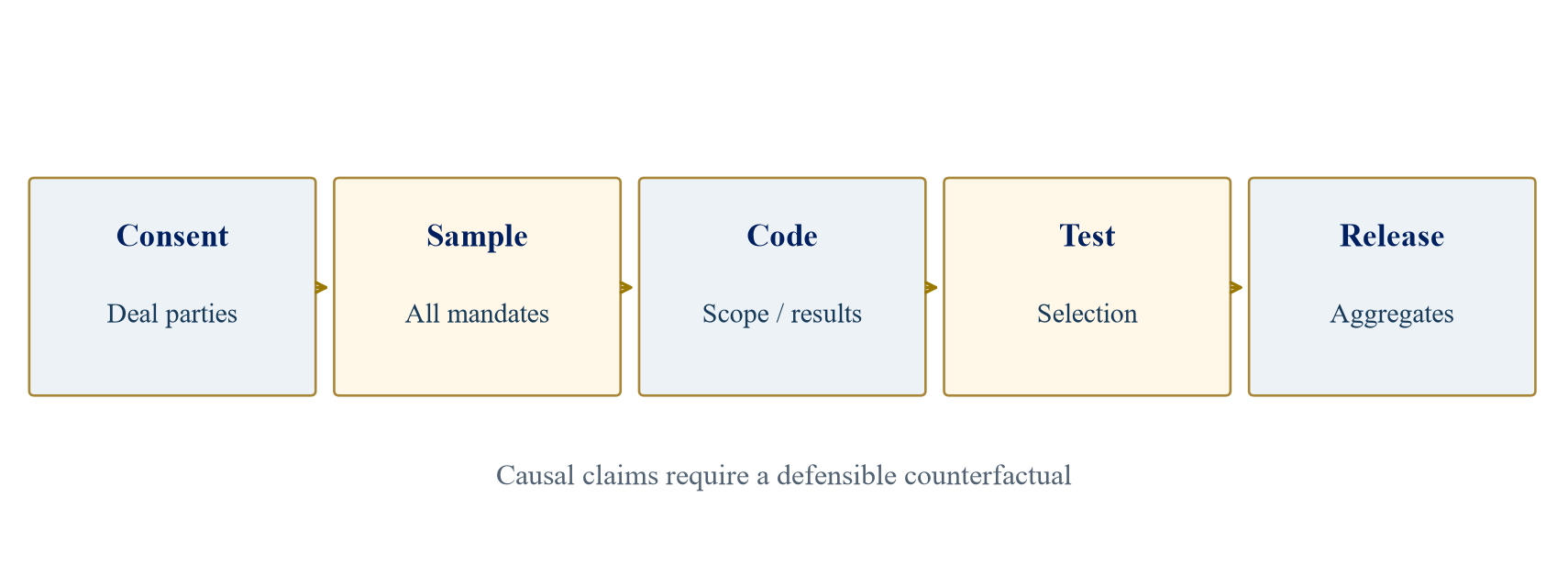
Author-developed protocol. The research has not collected transaction records or estimated adviser effects.
20 State what the paper can and cannot establish
This paper develops a decision and research framework from selected published studies and UAE legal and regulatory sources. It does not estimate the financial effect of appointing a sell-side adviser in the UAE. No confidential transaction cohort was available. The hypothetical offers, numbers, fee cases and timetable are author assumptions used to explain calculations and decisions; they are not market data, observed transactions, forecasts or recommendations of a particular fee or price. Published empirical findings cited here concern other transaction populations and should not be extrapolated as UAE mid-market results.
The legal references have limited scopes. The DFSA's conflict review concerns firms it regulates in the DIFC [7]. The UAE federal personal-data and competition materials need analysis for the actual entities, market and transaction [8-11]. Other transactions can invoke additional requirements. Counsel and authorised specialists should assess the specific deal. This paper is not legal, tax, accounting, regulatory or investment advice.
The core seller decision is to purchase a defined process capability at a known price, with visible governance. A carefully scoped adviser can bring preparation, access, bid discipline, negotiation and closing coordination. Whether that work increases realised seller proceeds in a particular transaction remains an empirical question. The owner can still evaluate the scope, team, evidence, fee terms and current progress. It can compare offers using cash, conditions and retained risk rather than headline enterprise value alone.
The next research step is a consented cohort with failed and completed mandates. For a live mandate, issue a consistent brief, verify team and conflicts, model fees and proceeds, and approve a process charter. Both steps should distinguish observable evidence from an unknown counterfactual.
References
- Povel, P. and Singh, R. “Takeover Contests with Asymmetric Bidders.” Review of Financial Studies 19(4), 2006, 1399-1431. Accessed 6 October 2026. https://academic.oup.com/rfs/article-abstract/19/4/1399/1580527
- Kim, D.-H. and Zheng, Y. “How Costly to Sell a Company? A Structural Analysis of Takeover Auctions.” Working paper revised 2025. Accessed 6 October 2026. https://papers.ssrn.com/sol3/papers.cfm?abstract_id=3505106
- “Neglected Peers in Merger Valuations.” Review of Financial Studies 36(8), 2023, 3257 onward. Accessed 6 October 2026. https://academic.oup.com/rfs/article/36/8/3257/6984732
- Leledakis, G. N. et al. “Does It Pay to Acquire Private Firms? Evidence From the U.S. Banking Industry.” European Journal of Finance 27(10), 2021. Accessed 6 October 2026. https://papers.ssrn.com/sol3/papers.cfm?abstract_id=3078497
- Daniels, K. and Phillips, R. “The Valuation Impact of Financial Advisors: An Empirical Analysis of REIT Merger and Acquisitions.” Journal of Real Estate Research 29(1), 2007. Accessed 6 October 2026. https://papers.ssrn.com/sol3/papers.cfm?abstract_id=887407
- Boone, A. L. and Mulherin, J. H. “Do Termination Provisions Truncate the Takeover Bidding Process?” Review of Financial Studies 20(2), 2007, 461-489. Accessed 6 October 2026. https://academic.oup.com/rfs/article-abstract/20/2/461/1573538
- Dubai Financial Services Authority. “New DFSA Thematic Review: Conflicts of Interest across DIFC Firms.” 9 January 2026. Accessed 6 October 2026. https://www.dfsa.ae/news/new-dfsa-thematic-review-conflict-interest-across-difc-firms
- United Arab Emirates. Federal Decree-Law No. 45 of 2021 Concerning the Protection of Personal Data. Accessed 6 October 2026. https://www.uaelegislation.gov.ae/en/legislations/1972/download
- United Arab Emirates. Federal Decree-Law No. 36 of 2023 Regarding Regulating Competition. Accessed 6 October 2026. https://uaelegislation.gov.ae/en/legislations/2117/download
- United Arab Emirates. Cabinet Resolution No. 3 of 2025 Regarding Ratios Related to Competition. Accessed 6 October 2026. https://www.uaelegislation.gov.ae/en/legislations/2788/download
- United Arab Emirates. Cabinet Resolution No. 59 of 2026 Regarding Executive Regulations of the Competition Decree-Law. Accessed 6 October 2026. https://uaelegislation.gov.ae/en/legislations/4451/download
- “Trust, Reputation, and Law: The Evolution of Commitment in Investment Banking.” Journal of Legal Analysis 7(2), 2015. Accessed 6 October 2026. https://academic.oup.com/jla/article/7/2/363/1752751
- Bowers, H. M., Latham, W. R. and Nedanov, B. “Does Legally Mandated Independence of Advisers Improve Merger Outcomes for Shareholders?” Working paper, 2008. Accessed 6 October 2026. https://papers.ssrn.com/sol3/papers.cfm?abstract_id=1121169
- Galpin, T. “Consummate to Reach Transaction Close.” In Winning at the Acquisition Game, Oxford University Press, 2020. Accessed 6 October 2026. https://academic.oup.com/book/31964/chapter/267697961
About the Author
Chennakeshav (CK) is a corporate finance and investment banking executive with 25+ years of global experience in deal origination, structuring and execution across M&A, growth capital and corporate strategy. He has led value-creation mandates for founders, corporates and funds — bridging the boardroom view to hands-on execution and close.
His career spans Morgan Stanley, HSBC, Lloyds Banking Group, EWEC, ADQ portfolio companies and Emirates Growth Fund, across TMT, real estate, fintech, deeptech, cleantech, infrastructure and energy. He has partnered with C-suite leaders, private equity and venture funds, sovereign wealth funds and family offices to finance complex fund raises and scale-up ventures, and has led M&A due diligence, post-merger integration and business-transformation initiatives to create value.
At Matchpoint Partners he is Managing Partner, leading the firm's corporate finance, M&A and capital-raising practice. He holds an MBA from London Business School, an engineering degree from VTU and a Master of Laws (LLM, in progress) from UCL London.
An active start-up mentor, CK mentors at Techstars, DIFC FinTech Hive, Startup Grind, Founder Institute and IN5, serves as Entrepreneur Mentor in Residence (EMiR) at London Business School, and judges the Entrepreneurship World Cup.
