

1. Define the acquisition decision
The investment committee must decide what it is buying. An AI-governance platform may be a content product, a workflow application, a technical assurance layer, a data and model inventory, an integration hub or a managed compliance service. Each form carries different margins, switching costs, liabilities and integration requirements. A broad category label cannot support a valuation.
The acquisition thesis should state the customer problem, the product boundary, the evidence of adoption and the value-creation route. A strategic buyer may seek distribution, workflow adjacency, regulatory capability or access to a specialised team. A financial sponsor may seek durable recurring revenue, operating leverage and add-on potential. The evidence required for each thesis should be explicit before confirmatory diligence begins.
The board should approve a bounded decision. It should identify the maximum price, the assumptions supporting that price, the evidence still required, the conditions for closing and the plan for the first hundred days. This converts enthusiasm about AI regulation into an accountable capital-allocation process.
Table 1. Control-record maturity and its valuation consequence
| Maturity level | Product reality | Required evidence | Valuation interpretation |
|---|---|---|---|
| Control catalogue | Policies and control statements are stored and searchable | Version history, authorship, mapping method and customer usage | Content value with limited switching-cost evidence |
| Managed workflow | Owners, tasks, approvals and exceptions move through the platform | Role records, workflow logs, completion data and escalation history | Workflow value subject to adoption and configuration burden |
| Evidence system | Tests and artefacts are linked to controls and decisions | Immutable or protected records, timestamps, source lineage and export quality | Auditability premium where evidence is reliable and portable |
| Integrated operating layer | Product exchanges data with model, cloud, security and business systems | Connector inventory, data contracts, failure monitoring and customer dependence | Higher retention potential offset by integration and support cost |
| Enterprise control record | Governance decisions are reproducible across systems, entities and regulations | Stable taxonomy, complete history, governed changes, renewal and contribution margin | Durable platform value supported by embedded use and verified economics |
The buyer should credit only evidence that can be traced to current product behaviour and customer use.
2. Establish the regulatory baseline
The regulatory baseline is a map of obligations, effective dates, affected roles, jurisdictions and evidence expectations. The European Union AI Act entered into force in 2024 and applies progressively. Governance rules and obligations for general-purpose AI became applicable in August 2025. The European Commission states that enforcement powers for certain provisions apply from August 2026, while high-risk-system timelines extend into 2027 and 2028 under the current implementation framework.
The OECD AI Principles, updated in 2024, organise trustworthy AI around inclusive benefit, human rights, transparency, robustness and accountability. The accountability principle calls for traceability across datasets, processes and decisions throughout the AI lifecycle. NIST AI RMF 1.0 structures activity around Govern, Map, Measure and Manage; NIST's Generative AI Profile adds actions for risks specific to generative systems. ISO/IEC 42001 specifies an organisational AI management system.
These instruments overlap without being identical. A platform that labels one generic control as satisfying several instruments may simplify presentation while obscuring distinct obligations. Diligence should test the legal basis, control objective, responsible role, evidence type, review frequency and applicability logic behind every claimed mapping.
3. Separate regulatory demand from product demand
Regulatory change can enlarge the addressable problem. It does not establish willingness to pay for a particular platform. Customers may use internal tools, general governance suites, consulting support or manual processes. They may delay procurement, narrow scope or bundle AI governance into cybersecurity, privacy, model-risk or enterprise-risk budgets.
The buyer should reconstruct demand from purchase evidence. Relevant records include budget ownership, procurement cycle, paid pilot conversion, contract term, expansion, renewal, active users, governed systems, completed reviews and accepted outputs. Pipeline descriptions should remain separate from contracts. Regulatory deadlines should not be treated as revenue commitments.
The strongest product-demand evidence connects a recurring customer decision to a recurring workflow. Examples include approving a model for production, recording a risk acceptance, monitoring a deployed system, documenting an incident or preparing an assurance package. Durable demand is more likely when the platform shortens that decision, improves evidence quality and reduces coordination cost.
4. Define the control record
A control record is the reproducible history of why a governance decision was taken, which requirement applied, who was accountable, what evidence was examined, which exception was accepted and what monitoring followed. It should survive staff turnover, model change, regulatory revision and system integration.
The record should link six objects: the governed AI system; applicable obligations; control objectives; evidence and tests; approvals and exceptions; and subsequent monitoring or incidents. Each object needs an identifier, owner, version and effective date. Relationships should be queryable without relying on free-text interpretation.
This definition creates a practical valuation boundary. Attractive interfaces and control counts matter only when they contribute to a reliable record. The buyer should test whether the target preserves historical states, prevents silent overwriting, distinguishes source evidence from management assertion and exports a coherent package for internal audit, regulators or customers.
5. Map the product architecture
The architecture normally contains an inventory, regulatory knowledge layer, control library, workflow engine, evidence repository, integration layer, analytics and reporting. Some platforms add model testing, red teaming, policy generation or automated monitoring. Diligence should identify which capabilities are native, licensed, partner-delivered or manually operated.
The inventory should define the governed object. It may record a model, a composite application, a business process or a third-party service. The knowledge layer should map changing obligations to that object. The workflow engine should assign accountable decisions. The evidence layer should preserve results and provenance. Reporting should present current status without erasing history.
Architectural diagrams should reconcile with deployed code and customer configuration. A product may claim broad functionality while relying on professional services, spreadsheets or bespoke scripts. The valuation model should assign software economics only to repeatable product capability.
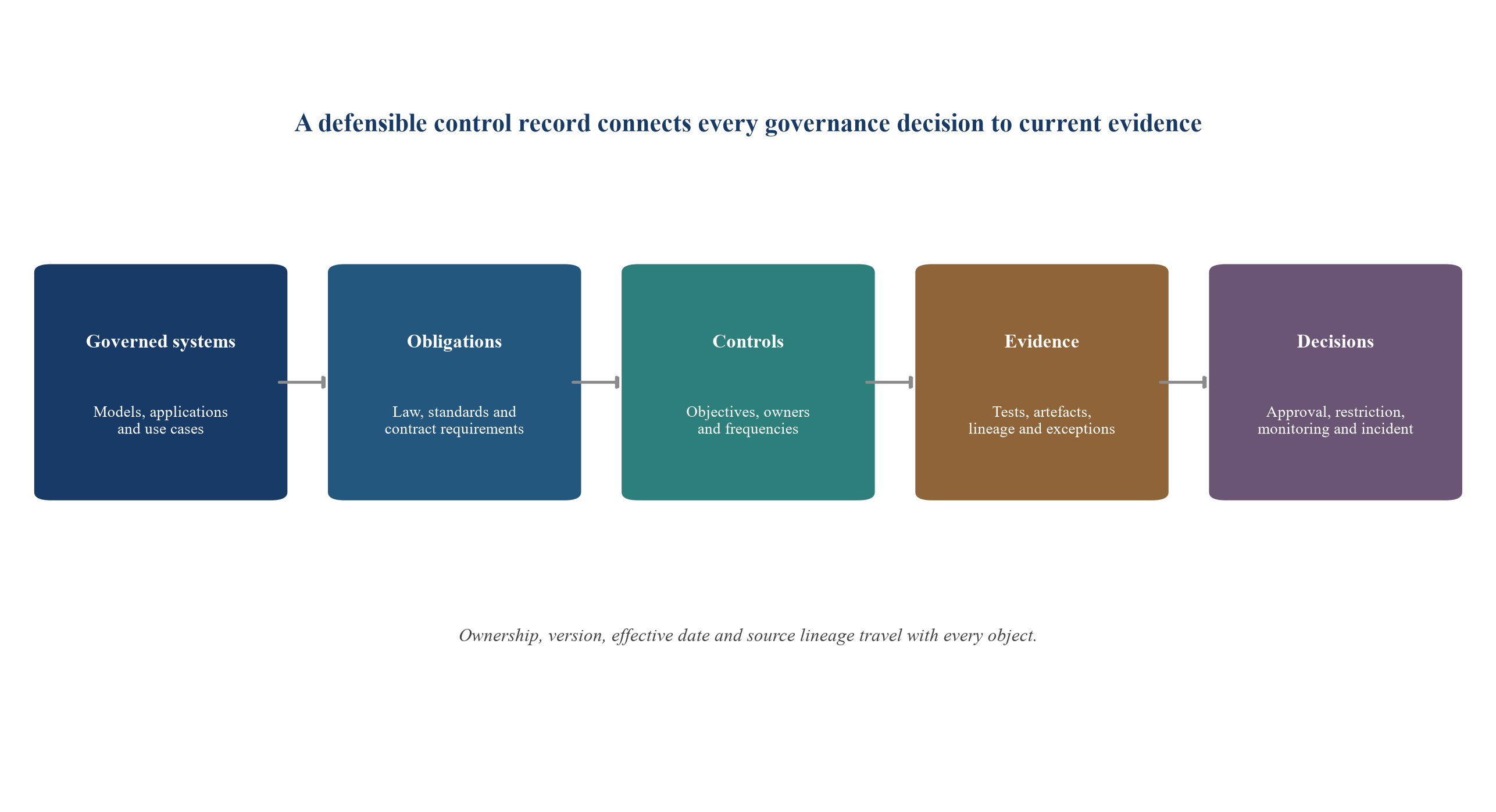
Value depends on traceable relationships across governed systems, obligations, controls, evidence and decisions.
6. Test the control library
Control count is a weak measure. A library can grow through duplication, broad wording and speculative mappings. The buyer should sample controls across privacy, security, fairness, transparency, human oversight, model performance and incident response. Each control should state an objective, scope, owner, evidence, frequency and response to failure.
The sample should include controls used by paying customers. Diligence should compare the standard template with the configured control and the evidence actually collected. A control described as automated may still depend on a manual upload or consultant review. A control mapped to several regulations may address only part of each obligation.
Library quality also depends on change governance. The target should document sources, reviewers, effective dates, superseded versions and customer notifications. The cost of maintaining legal mappings should appear in the operating model. Unfunded content obligations can consume the apparent gross margin.
7. Examine regulatory mapping
Regulatory mapping is a knowledge-production process. It requires qualified interpretation, jurisdictional context, defined assumptions and review. A software vendor should explain whether mappings are legal analysis, management guidance or workflow suggestions. Customer contracts should use the same description.
The buyer should test bidirectional traceability. Starting from a legal requirement, the platform should identify relevant control objectives and evidence. Starting from a control, it should identify the source obligations, applicable products and affected entities. Ambiguous many-to-many links should have documented rationale.
Change impact is equally important. When a rule changes, the system should identify affected mappings, customers, controls and open assessments. A static spreadsheet imported into an attractive interface offers limited protection. A governed update workflow with review, effective dating and customer action creates stronger product value.
8. Measure workflow integration
Workflow integration determines whether the platform is a peripheral reporting tool or part of an operating process. The buyer should trace representative journeys: registering a use case, classifying risk, assigning controls, collecting evidence, approving deployment, recording an exception and responding to an incident.
For each journey, diligence should measure completion time, hand-offs, manual work, rework, failure points and use of external tools. User counts should be separated into active decision-makers, evidence contributors, reviewers and passive viewers. Logins alone do not establish embedded use.
Integration depth should also be assessed at renewal. Customers may tolerate heavy implementation in year one while questioning ongoing value later. Cohorts with stable workflow volume, broader system coverage and multi-function participation provide stronger evidence of durable adoption.
9. Assess inventory integrity
Every control conclusion depends on the inventory. The platform should identify the systems, models, vendors, datasets, business owners, locations, purposes, users and deployment status within scope. Duplicate records, stale owners and unclear system boundaries weaken every downstream report.
Diligence should reconcile the platform inventory to source systems such as model registries, cloud accounts, procurement records and application portfolios. The buyer should sample additions, retirements and material changes. It should test whether unapproved or shadow systems can be discovered and how exceptions are escalated.
Inventory completeness should be presented as a measured coverage statement. Management estimates should remain labelled. A customer with one hundred registered systems may govern only a subset of its deployed use cases. Pricing and renewal analysis should distinguish records created from systems actively governed.
10. Test evidence provenance
Evidence provenance records where an artefact came from, when it was created, which system version it describes, who approved it and whether it changed. Uploaded files without lineage can support a checklist while failing an audit.
The buyer should inspect evidence ingestion from APIs, automated tests, ticketing systems and manual submissions. It should test timestamps, access controls, checksum or version protection, retention, deletion and export. Evidence generated by the platform's own AI features should be identified as generated content and subjected to human review.
Sampling should include an adverse case. Diligence should find a failed test, overdue control, rejected approval or policy exception and reconstruct the response. Systems designed mainly to display green status may hide the information that matters most to an acquirer.
11. Evaluate auditability
Auditability is the ability to reproduce a conclusion from preserved records. A reviewer should be able to determine the applicable requirement, control design, test performed, evidence examined, result, exception, approver and later change. The process should work without relying on the memory of the implementation team.
Audit logs should capture material actions and protect them from unauthorised alteration. Privileged administration, bulk edits, integration failures and data exports deserve particular scrutiny. Retention should align with customer contracts and applicable obligations. The product should support legal hold and defensible deletion where required.
Export quality affects strategic value. Customers and regulators may require portable evidence. Proprietary lock-in can support retention but may weaken trust and increase exit friction. A platform that exports complete, intelligible records can earn confidence while retaining customers through workflow value.
12. Review access and segregation
AI governance brings together sensitive model details, security findings, personal data, legal analysis and executive decisions. Role-based access should follow organisational and jurisdictional boundaries. The system should distinguish contributors, reviewers, approvers, administrators and auditors.
Diligence should test tenant isolation, encryption, key management, authentication, privileged access, break-glass procedures and administrative logging. Customer-hosted and software-as-a-service deployments may have different control boundaries. Subprocessors and hosting locations should reconcile with contracts.
Segregation of duties is a product feature and a governance requirement. The person submitting evidence should not silently approve the same control where independent review is required. Configurable workflows need safe defaults and warnings when a customer weakens the control design.
13. Analyse model and data dependencies
The target may use third-party foundation models, classifiers, regulatory data, testing libraries or monitoring services. Each dependency can affect cost, product continuity, security, intellectual property and regulatory responsibility. The buyer should maintain a current bill of materials for software, data and AI services.
Contracts should permit intended use, commercial distribution and transaction-related transfer. Open-source obligations should be reviewed against deployment. Training and evaluation datasets should have documented rights and provenance. Customer data used for product improvement should follow explicit terms.
Dependency concentration should enter valuation. A low-cost service can become expensive, unavailable or strategically conflicted after closing. The integration plan should identify replacement options, migration cost and customer-consent requirements before the buyer assumes synergy.
14. Diligence automated assessments
Automated classification, policy drafting and evidence review can improve productivity. They can also create false confidence. The buyer should define each automated function, its intended use, performance measure, human review and failure response.
Testing should reflect the target population and material use cases. A demo based on selected examples does not establish production reliability. The buyer should examine false positives, false negatives, drift, prompt or configuration changes, adversarial inputs and language coverage. Material outputs should preserve the underlying evidence and reviewer decision.
Automation economics should include inference cost, evaluation, monitoring and human oversight. A feature that reduces analyst time may still raise cloud cost and liability. Value should follow verified net contribution and customer acceptance.
15. Map customer responsibilities
Governance platforms operate within shared responsibility. The vendor provides software and perhaps content or managed services. The customer defines context, supplies data, appoints owners and makes consequential decisions. Consultants and technology suppliers may perform additional roles.
Contracts, product design and marketing should describe these boundaries consistently. The platform should not imply that using a checklist establishes legal compliance. Customer configuration can weaken outcomes; the product should surface critical omissions and preserve responsibility.
The buyer should sample customer success records to see how responsibilities are implemented. Heavy reliance on named individuals can create concentration and integration risk. Repeatable onboarding materials, role definitions and acceptance criteria support scale.
16. Reconstruct the revenue base
Revenue should be rebuilt from contracts, invoices, credits, collections and customer-level general-ledger records. Subscription, usage, implementation, content, managed service and partner revenue should be separated. Annual recurring revenue should exclude non-recurring work and unsupported run-rate assumptions.
The buyer should identify termination rights, renewal mechanics, price protection, service credits, acceptance clauses and customer dependencies. Multi-year contract value is not equivalent to collected recurring revenue. Backlog should be adjusted for delivery obligations and cancellation.
Currency, reseller arrangements and gross-to-net presentation can distort reported growth. A clean quality-of-revenue analysis ties each cohort to contracted scope, deployed product, invoice and cash. This record becomes the foundation for valuation.
17. Build revenue cohorts
Cohorts should be organised by first production date, product module, customer segment, deployment type and geography. Measures should include gross retention, net retention, expansion, contraction, churn, collection and contribution margin. Paid pilots should remain separate until production conversion.
The buyer should link revenue behaviour to product use. Renewal associated with growing governed-system coverage, recurring approvals and integrated evidence is more persuasive than renewal driven by a broader vendor bundle or relationship concession.
Cohort analysis should identify concentration. A small number of regulated customers may provide strong reference value and material revenue risk. Valuation should recognise both customer quality and dependency.
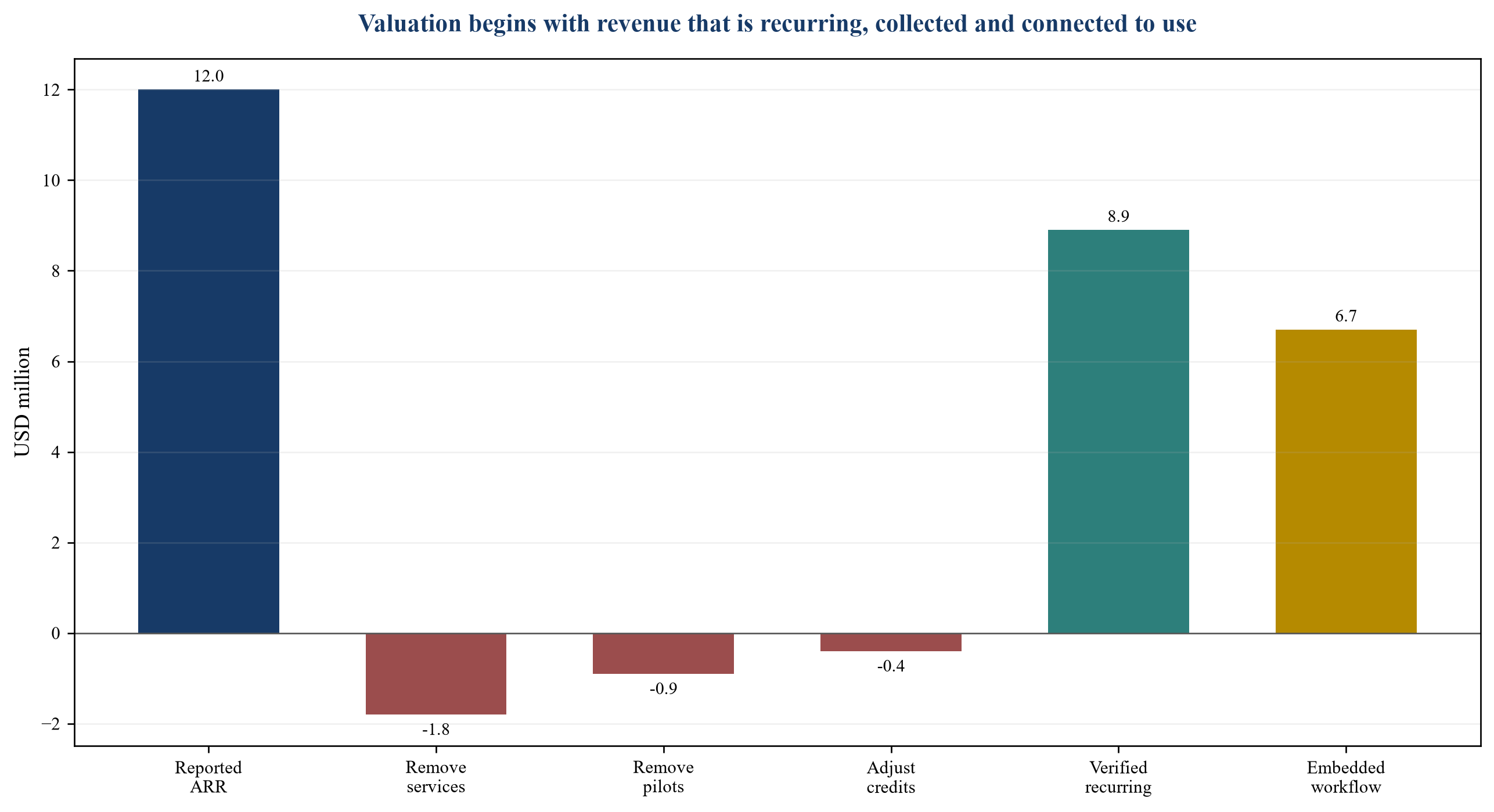
Values are hypothetical management assumptions and do not represent observed company information.
18. Measure implementation burden
Implementation can create adoption and hide weak software economics. The buyer should measure hours, skills, duration, travel, third-party cost and customer effort required to reach production. Work should be classified as repeatable configuration, integration, data remediation, content interpretation or bespoke development.
Gross margin should reflect all delivery labour required by the contract, including customer success, regulatory-content maintenance and recurring evidence support. Capitalised development and contractor costs should be reviewed for consistency.
A platform may merit strategic value even with significant services when those services unlock durable software use. The valuation should treat the services honestly and model the path to standardisation. Assumed margin expansion needs an operational plan.
19. Review product telemetry
Telemetry should answer whether the product performs the work described in the acquisition thesis. Relevant measures include governed systems, active workflows, controls completed, evidence ingested, decisions approved, exceptions managed, connectors operating and reports exported.
Definitions should be stable and reconcilable. An active user may mean a login, an edit or an approval. A completed control may mean a tick box or verified evidence. Diligence should inspect source events, transformation logic and dashboard calculations.
Telemetry coverage should also be measured. Privacy commitments, customer-hosted deployments and legacy versions may limit data. Missing telemetry should remain an open evidence item rather than being filled with assumptions.
20. Assess integration defensibility
Connectors to model registries, cloud platforms, security tools, ticketing systems, document repositories and development pipelines can create workflow depth. They also generate maintenance obligations. The buyer should list every connector, customer using it, authentication method, data contract, failure rate and support owner.
Defensibility comes from reliable orchestration and accumulated governance context, not connector count alone. Public APIs and partner ecosystems can reduce barriers. Bespoke connectors can increase switching cost while weakening margins.
The integration plan should identify overlap with the buyer's estate. Retaining customer value may require continued support for competing platforms. Premature consolidation can trigger churn and undermine the acquisition thesis.
21. Examine security and resilience
The target is likely to hold sensitive assurance material and may influence high-stakes approvals. The buyer should review secure development, vulnerability management, penetration testing, incident response, backup, recovery, availability and supplier risk. Certifications should be verified for scope and current status.
Security incidents, customer notifications, regulatory inquiries and contractual claims should be reconciled. A clean management representation is insufficient without supporting records. Product logs and ticket histories can identify unresolved weaknesses.
Resilience should be tested through operating evidence. Recovery objectives, backup restoration and failover should have dated results. The cost of remediation should enter the purchase-price and integration model.
22. Inspect privacy and data governance
The platform may process personal data about employees, customers, affected individuals and reviewers. Diligence should map data categories, purposes, lawful basis, retention, transfers, subprocessors and individual-rights procedures. Customer configuration does not remove the vendor's own responsibilities.
Training or improving AI features with customer content requires particular attention. Product terms, privacy notices and technical behaviour should agree. De-identification claims should be supported by method and testing.
Data portability and deletion affect deal execution. The buyer should know which data can move at closing, which consents or notices are required and how customer-hosted instances will be handled. The integration plan needs a lawful and technically feasible data path.
23. Diligence intellectual property
The buyer should establish ownership of source code, control content, mappings, taxonomies, datasets, documentation and brands. Employee and contractor assignments should cover relevant jurisdictions and periods. Contributions from founders, universities and partners require separate review.
Third-party content may carry redistribution limits. Regulatory text can be public while commentary, translations and mappings are protected. The target should distinguish owned intellectual property from licensed materials and customer-specific configuration.
The analysis should identify what creates differentiation. A control library that can be recreated from public sources may have limited standalone value. Proprietary workflow data, tested mappings, reliable integration patterns and accumulated outcome evidence can be more defensible.
24. Evaluate people dependency
Regulatory knowledge, architecture and customer trust may be concentrated in a small team. The buyer should map critical roles, decision rights, customer relationships, compensation, notice periods and retention risk. Job titles should be reconciled to actual responsibility.
Key-person risk is highest when product configuration and regulatory interpretation are undocumented. The control record should apply to the target's own operations: content changes, releases, incidents and customer commitments should be reproducible from records.
Retention packages should align with integration milestones and durable value. Paying solely for presence can preserve cost without transferring knowledge. The plan should include documentation, succession and accountable ownership.
25. Analyse sales evidence
Pipeline should be reconstructed from source opportunity records, proposals, security reviews, procurement stages and customer correspondence. Probability should reflect observed conversion by stage and segment. Regulatory interest should not substitute for buyer commitment.
The sales cycle may include legal, security, risk, technology and procurement approvals. The platform's own governance claims can increase customer scrutiny. Diligence should measure cycle length, proof-of-concept conversion, discounting and implementation capacity.
Channel relationships should be tested for enforceability and economics. A global consulting or cloud partnership may create credibility without guaranteed revenue. Forecast value should follow specific opportunities and verified historical conversion.
26. Assess pricing architecture
Pricing may use employees, AI systems, use cases, modules, workflows, evidence volume or enterprise tiers. The metric should scale with customer value and remain auditable. Complex combinations can create leakage and sales friction.
The buyer should compare contracted entitlement, actual use, invoice and renewal outcome. Free modules and broad enterprise rights can conceal low willingness to pay. Usage-based pricing may align value while increasing revenue volatility.
Price increases should be analysed by cohort. A regulatory deadline can support urgency, yet durable pricing depends on embedded value. The integration model should preserve commercial terms until customer evidence supports change.
27. Reconcile gross margin
Reported software gross margin should include hosting, third-party models, regulatory data, customer support, implementation obligations and production reliability. Functions labelled research or customer success may perform direct delivery work. Their cost should follow activity.
The buyer should calculate contribution by customer and module. High-revenue customers can be low-value when they require bespoke content, data residency or senior support. Cloud and model costs should be tied to usage.
Synergy should be modelled separately from current economics. Removing duplicated functions may reduce cost and weaken product knowledge. A credible plan identifies timing, owner, implementation cost and customer impact.
28. Build the integration thesis
Integration should begin with the customer promise. The buyer should decide which workflows, records, contracts and support relationships must remain stable. Product consolidation, brand change and cross-selling can follow evidence.
The first hundred days should protect service continuity, privileged access, regulatory-content governance, incident response and customer communication. Decisions about hosting, identity, data architecture and model providers should be sequenced around risk.
An integration backlog should record dependency, decision, owner, acceptance test and timing. The purchase price should include the cost of preserving the control record during transition.
29. Protect the control record at closing
Ownership changes can break evidence continuity. User identities may move, domains may change, systems may be consolidated and administrators may gain access. The closing plan should preserve timestamps, approvals, logs, retention rules and customer-specific boundaries.
The buyer should take immutable or independently protected backups of critical records where lawful and contractually permitted. Administrative access changes should be logged. Data transfers should follow approved procedures.
Customer notifications should explain continuity and responsibility. Overstating immediate integration can create assurance risk. The platform should maintain a clear version and operating boundary throughout the transition.
30. Assess competition and platform risk
An AI-governance platform may connect multiple technology providers, advisers and customers. A strategic acquisition can change incentives regarding interoperability, access and treatment of competing products. The United States 2023 Merger Guidelines identify platform competition, access to competitively significant inputs and conflicts of interest as relevant areas of analysis.
Diligence should identify whether the target holds competitively sensitive customer or supplier information, controls a route to market or certifies products that compete with the buyer. Governance and information barriers may be needed.
Competition analysis should be jurisdiction-specific and led by qualified counsel. The commercial model should include remedy, delay and integration constraints where relevant. Transaction value depends on rights the buyer can lawfully exercise.
31. Create the diligence evidence matrix
Every valuation assumption should map to an evidence owner and source. The matrix should cover product, controls, regulatory mapping, security, privacy, intellectual property, customers, revenue, cost and integration. Open items should remain visible.
Evidence quality can be graded. Primary system records and executed contracts generally carry more weight than presentations. Independent tests can strengthen technical claims. Management estimates remain useful when labelled and reconciled as evidence arrives.
The matrix should feed the valuation model. A finding that changes renewal, gross margin, remediation cost or integration timing should flow directly into price and terms.
Table 2. AI-governance platform diligence matrix
| Diligence area | Core question | Preferred evidence | Financial consequence |
|---|---|---|---|
| Product | Does the platform produce a reproducible control record? | Live workflow sample, version history, audit export and adverse case | Product premium or capability discount |
| Regulation | Are mappings current, scoped and governed? | Source register, review log, applicability rules and change impact | Content maintenance cost and liability reserve |
| Customers | Is the product embedded in recurring decisions? | Cohort use, renewal, expansion, workflow volume and references | Retention and revenue multiple |
| Technology | Are integrations reliable and transferable? | Connector telemetry, architecture, support history and rights | Integration cost and switching risk |
| Economics | Is recurring revenue collected and contribution-positive? | Contracts, invoices, cash, credits and customer cost allocation | Enterprise value and debt capacity |
| Integration | Can records and accountability survive closing? | Day-one plan, data map, access plan and acceptance tests | Purchase-price adjustment and holdback |
The matrix links transaction questions to evidence and financial consequences.
32. Construct the valuation bridge
Valuation should start with verified recurring revenue and normalised contribution. It should adjust for retention, concentration, implementation burden, hosting, content maintenance, security remediation and integration. Strategic value should be supported by specific cash flows or avoided cost.
A control-record premium may be justified when customers rely on the platform for recurring decisions, evidence is auditable, integrations are durable and renewal economics are strong. The premium should decline when use is superficial, records are incomplete or value depends on regulatory speculation.
The bridge should remain reversible. Each adjustment needs a source and a response if evidence changes. This discipline helps the board distinguish price from aspiration.
33. Apply scenario valuation
A scenario model should separate current operation, remediation and integration outcomes. The downside may assume weaker retention, extended regulatory-content work and delayed cross-sell. The base case should use observed cohort and cost evidence. The upside should require specific integration and commercial milestones.
Probability weights are management estimates. They should not hide asymmetric loss. Data migration failure, a security incident or loss of a critical customer can reduce value sharply. Representations, escrow, holdback and earn-out can allocate selected risks.
The buyer should test reverse scenarios. It should identify the renewal, gross-margin or remediation threshold at which the deal no longer meets the required return. This creates clear pre-close and post-close decision points.
Table 3. Hypothetical transaction valuation bridge
| Item | Downside | Base | Upside | Evidence required |
|---|---|---|---|---|
| Verified recurring revenue | USD 6.1m | USD 8.9m | USD 9.6m | Contract, invoice, collection and cohort reconciliation |
| Retained recurring revenue after two years | USD 4.5m | USD 8.3m | USD 10.4m | Renewal, expansion, product-use and concentration evidence |
| Normalised contribution margin | 24% | 41% | 52% | Customer-level hosting, delivery and support cost |
| Remediation and integration cost | USD 5.8m | USD 3.4m | USD 2.5m | Security, product, content and migration workplan |
| Indicative enterprise value | USD 22m | USD 51m | USD 78m | Discounted cash flow and milestone evidence |
Every value is an illustrative management assumption and should not be treated as observed transaction or market data.
34. Price uncertainty through terms
Price and terms should address different risks. A lower headline price addresses general uncertainty. Holdback can support identified remediation. Earn-out can link payment to renewal, integration or contribution milestones. Escrow and indemnity can address specified historical exposure.
Metrics must be objectively defined and within the responsible party's influence. Revenue earn-outs can encourage discounting or low-margin services. A control-record milestone may be more useful when value depends on product evidence, such as successful migration of historical records and customer acceptance.
The agreement should preserve access to evidence. Post-close disputes become harder when source systems or definitions change. Calculation procedures, audit rights and dispute mechanisms should be designed before signing.
35. Build the first-hundred-day scorecard
The scorecard should cover customer continuity, control-record integrity, people, security, product, revenue and integration. Each measure needs a baseline, owner, target and source. Early indicators include critical staff retention, connector health, open incidents, customer objections and record-migration exceptions.
Financial measures should include collected revenue, churn, expansion, contribution and integration spend. Product measures should include active governed systems, workflow completion, evidence quality and exceptions. Regulatory content should have a release and review measure.
The scorecard should preserve the distinction between activity and value. Completing a migration task is useful; retaining an accepted and auditable customer workflow establishes value.
Table 4. First-hundred-day control-record acceptance plan
| Workstream | Day-one requirement | Hundred-day acceptance | Value protected |
|---|---|---|---|
| Customer continuity | Support, escalation and contractual responsibility remain clear | Priority customers accept the operating model and service measures remain stable | Retention and reference value |
| Record integrity | Historical evidence, approvals and logs remain protected | Sample records reproduce pre-close conclusions after migration | Auditability and regulatory trust |
| Product and integration | Critical connectors and production configurations remain supported | Integration backlog is governed and priority interfaces meet agreed reliability | Workflow depth and switching cost |
| Security and privacy | Access, incident response, tenant boundaries and data terms remain effective | Remediation is verified and transfer obligations are closed | Liability protection and enterprise adoption |
| Revenue and cost | Billing, collection and delivery continue without interruption | Cohort retention, contribution and integration spend reconcile to the deal model | Supported enterprise value |
Each workstream requires a source record and a named executive owner.
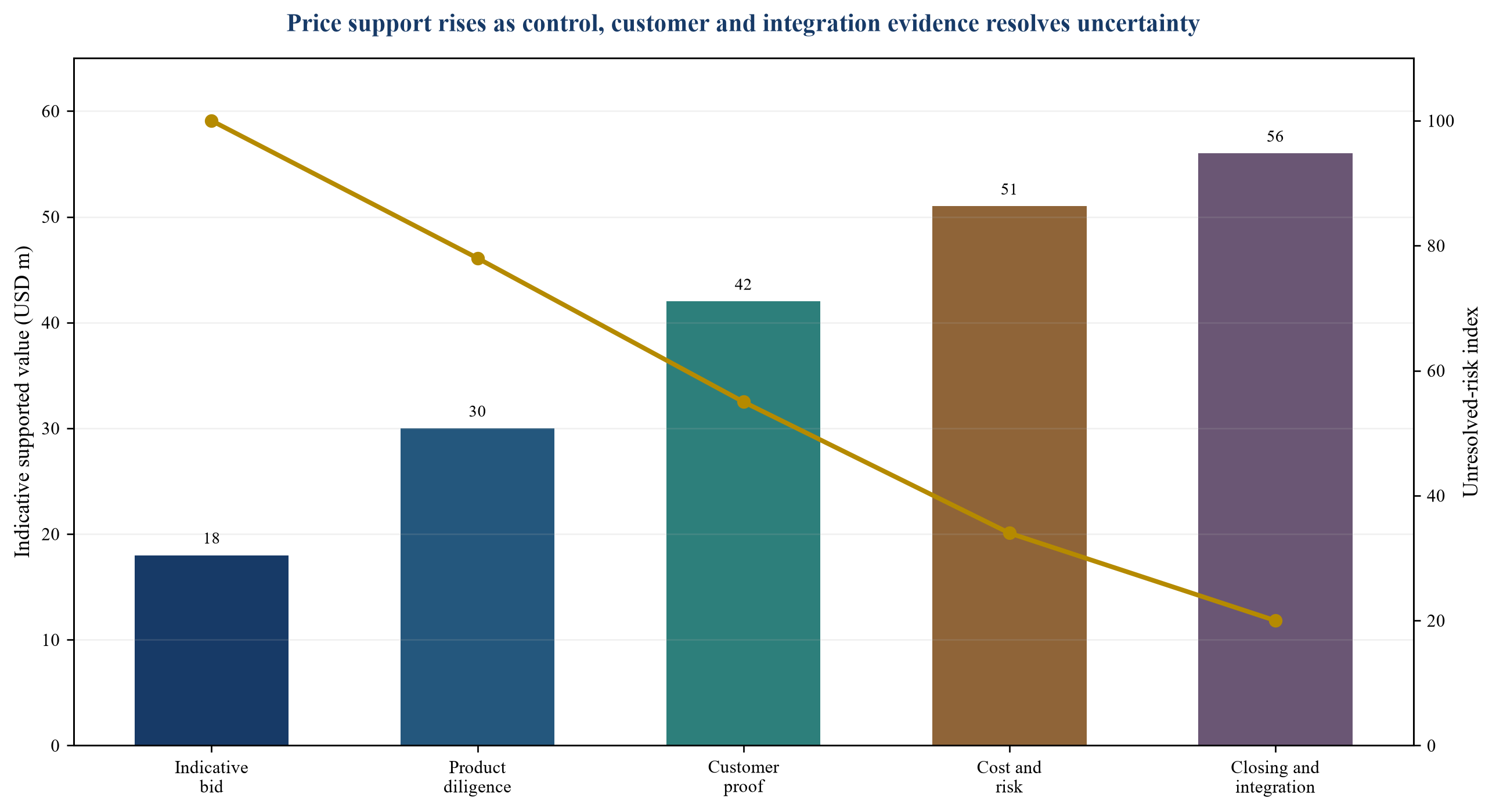
Values are illustrative management assumptions and do not represent an observed transaction.
36. Define red flags
Critical red flags include overwritten audit history, incomplete tenant isolation, undisclosed data use, unsupported compliance claims, unowned intellectual property, revenue reconstructed from pipeline, and material customer dependence hidden by aggregate metrics. Any one can change price or transaction structure.
Operational red flags include extensive bespoke code, manual evidence work described as automation, connectors without monitoring, control mappings without source governance and key-person dependence. Their financial impact should be quantified.
The response depends on severity and remediability. The buyer may seek evidence, remediation, contractual protection, a revised price or withdrawal. A red-flag register should state owner, evidence, impact, decision and closure condition.
37. Establish an investment-committee decision record
The final paper should not be a collection of diligence reports. It should present the acquisition thesis, verified evidence, open risks, valuation bridge, terms and integration plan in a form the board can revisit.
Each material claim should link to the evidence matrix. Management assumptions should be labelled. Legal conclusions should come from qualified advisers. Customer and employee information should follow access restrictions.
The decision record becomes part of post-close governance. The integration team can test whether the promised value is appearing and whether conditions have changed. This accountability improves future capital allocation.
38. Build the transaction data room
The data room should contain product architecture, control taxonomy, regulatory sources, mapping history, audit logs, security evidence, privacy records, intellectual-property documents, customer contracts, invoices, collections, telemetry, cost allocation and integration plans.
Documents should be current, versioned and reconciled. Samples should include successful and adverse cases. Customer information should be minimised and access-controlled.
A buyer should be able to trace a valuation assumption to a contract, record, test or labelled estimate. A data room organised around that traceability shortens diligence and exposes unsupported claims early.
39. Test third-party assurance revenue
Some targets earn revenue from readiness reviews, control assessments, certification support or partner-led assurance. These services can deepen product adoption and provide valuable implementation evidence. They can also create independence questions when the same party designs controls, operates the workflow and judges whether the customer has satisfied them.
The buyer should distinguish software output, management assessment, internal-audit support and independent assurance. Engagement terms, practitioner qualifications and report language should align with the actual service. A badge or score should not imply regulatory approval. Where external auditors or certification bodies rely on platform records, the scope and responsibility should be documented.
Assurance-related revenue should be analysed separately. Repeatable assessment modules may support attractive economics. Labour-intensive reviews depend on utilisation and specialist retention. Liability, insurance and quality-review cost should be included. The acquisition thesis should explain whether assurance remains a service line, becomes a partner channel or is separated to protect independence.
40. Validate vendor and supply-chain governance
AI governance increasingly depends on third-party models, data, infrastructure and applications. The target may sell vendor-risk workflows as part of its platform. Diligence should test whether those workflows capture contracts, intended use, data access, model changes, security obligations, incident notification, evaluation rights and exit provisions.
The target's own supplier governance is an equally important test. Critical cloud, model, data and content providers should have named owners, current contracts, concentration analysis and continuity plans. Product claims should remain achievable if a supplier changes terms or withdraws a feature. Customer commitments should not exceed upstream rights.
Transaction integration can change the supply chain. The buyer may introduce preferred vendors, consolidate hosting or gain access to customer data. Each change should be assessed for consent, performance, security and regulatory consequences. Expected procurement savings should be reduced by migration cost and loss of product flexibility. A reliable vendor record supports both current assurance and post-close execution.
41. Prove transferability of the operating model
Enterprise value depends on whether the product, contracts, people and evidence can transfer to the buyer. Diligence should test change-of-control clauses, assignment rights, data-processing terms, licences, certifications and customer-hosted components. Required consents should be identified before the closing schedule is fixed.
Operational transferability requires more than legal assignment. Support procedures, deployment scripts, content-review calendars, customer configurations and escalation paths should be documented. The buyer should rehearse one representative customer transition and one incident escalation. Findings should update the integration budget and customer-communication plan.
The operating model should also withstand separation from founders and shared services. The target may depend on a parent company's security team, finance systems, legal content or cloud contract. Transitional service agreements can provide time, yet they create cost and execution dependency. Standalone cost should be reflected in normalised contribution. Transferability is established when the buyer can identify the rights, resources, systems and accountable people required to deliver the contracted service after closing.
42. Conclude with a controlled price
AI-governance platforms address a significant and evolving operating problem. Their transaction value depends on execution: a reliable inventory, governed controls, traceable evidence, accountable decisions, durable customer workflows and credible economics.
The recommended approach begins with the control record. The buyer should trace real customer decisions from obligation through control, evidence, approval and monitoring. It should connect that product proof to contract, cash, renewal and contribution. Integration should preserve the record before pursuing consolidation.
This method produces a controlled price. Regulatory change defines context. Product and customer evidence define adoption. Cohort economics and integration cost define value. A transaction that keeps those distinctions visible can fund strategic growth while protecting the buyer from paying for unsupported compliance narrative.
References
- National Institute of Standards and Technology, Artificial Intelligence Risk Management Framework 1.0, NIST AI 100-1, January 2023.
- National Institute of Standards and Technology, Artificial Intelligence Risk Management Framework: Generative Artificial Intelligence Profile, NIST AI 600-1, July 2024.
- National Institute of Standards and Technology, AI Risk Management Framework Playbook, current public edition.
- National Institute of Standards and Technology, Trustworthy and Responsible AI Resource Center, accessed September 2026.
- Organisation for Economic Co-operation and Development, Recommendation of the Council on Artificial Intelligence, updated May 2024.
- Organisation for Economic Co-operation and Development, OECD AI Principles overview, accessed September 2026.
- Organisation for Economic Co-operation and Development, Accountability principle, accessed September 2026.
- Organisation for Economic Co-operation and Development, Transparency and explainability principle, accessed September 2026.
- Organisation for Economic Co-operation and Development, Robustness, security and safety principle, accessed September 2026.
- Organisation for Economic Co-operation and Development, Advancing accountability in AI, February 2023.
- ISO, ISO/IEC 42001:2023, Information technology, artificial intelligence, management system.
- ISO and IEC, ISO/IEC 23894:2023, Information technology, artificial intelligence, guidance on risk management.
- European Parliament and Council, Regulation (EU) 2024/1689 laying down harmonised rules on artificial intelligence.
- European Commission, AI Act regulatory framework and application timeline, accessed September 2026.
- European Commission, Enforcement framework of the AI Act, accessed September 2026.
- European Commission, Navigating the AI Act, frequently asked questions, accessed September 2026.
- European Commission, General-Purpose AI Code of Practice, current public edition.
- European Commission, Guidelines on prohibited artificial-intelligence practices, current public edition.
- United States Department of Justice and Federal Trade Commission, 2023 Merger Guidelines, December 2023.
- United States Department of Justice, Merger Guidelines Guideline 5 on access to products and services used by rivals.
- United States Department of Justice, Merger Guidelines Guideline 9 on multi-sided platforms.
- Federal Trade Commission, Premerger Notification and the Merger Review Process, current public guidance.
- UK Competition and Markets Authority, AI Foundation Models update report, April 2024.
- UK Competition and Markets Authority, AI strategic update, current public edition.
- UK Government, A pro-innovation approach to AI regulation, white paper and subsequent response.
- Information Commissioner's Office, AI and data protection guidance, current public edition.
- European Data Protection Board, Opinion 28/2024 on certain data-protection aspects related to the processing of personal data in the context of AI models.
- European Union Agency for Cybersecurity, Multilayer Framework for Good Cybersecurity Practices for AI, June 2023.
- Cloud Security Alliance, AI Controls Matrix, current public edition.
- MITRE, ATLAS Adversarial Threat Landscape for Artificial-Intelligence Systems, current public knowledge base.
- OWASP Foundation, Top 10 for Large Language Model Applications, current public edition.
- Institute of Internal Auditors, Global Internal Audit Standards, 2024.
- COSO, Enterprise Risk Management, Integrating with Strategy and Performance, 2017.
- Financial Accounting Standards Board, Accounting Standards Codification Topic 606, Revenue from Contracts with Customers.
- International Auditing and Assurance Standards Board, International Standard on Assurance Engagements 3000, revised.
- International Organization of Securities Commissions, The Use of Artificial Intelligence and Machine Learning by Market Intermediaries and Asset Managers, September 2021.
About the Author
Chennakeshav (CK) is a corporate finance and investment banking executive with 25+ years of global experience in deal origination, structuring and execution across M&A, growth capital and corporate strategy. He has led value-creation mandates for founders, corporates and funds — bridging the boardroom view to hands-on execution and close.
His career spans Morgan Stanley, HSBC, Lloyds Banking Group, EWEC, ADQ portfolio companies and Emirates Growth Fund, across TMT, real estate, fintech, deeptech, cleantech, infrastructure and energy. He has partnered with C-suite leaders, private equity and venture funds, sovereign wealth funds and family offices to finance complex fund raises and scale-up ventures, and has led M&A due diligence, post-merger integration and business-transformation initiatives to create value.
At Matchpoint Partners he is Managing Partner, leading the firm's corporate finance, M&A and capital-raising practice. He holds an MBA from London Business School, an engineering degree from VTU and a Master of Laws (LLM, in progress) from UCL London.
An active start-up mentor, CK mentors at Techstars, DIFC FinTech Hive, Startup Grind, Founder Institute and IN5, serves as Entrepreneur Mentor in Residence (EMiR) at London Business School, and judges the Entrepreneurship World Cup.
