

1. Define the valuation decision
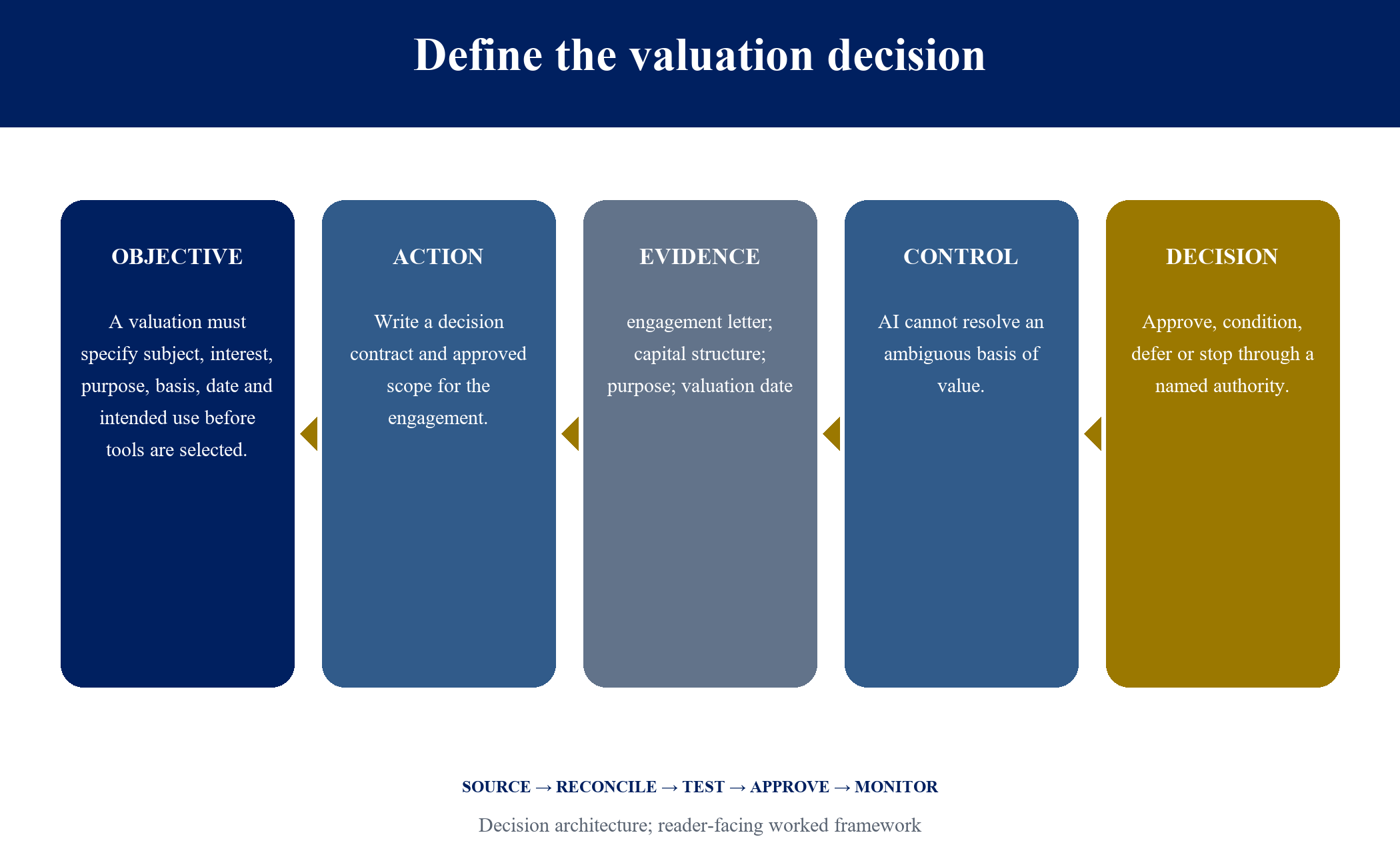
A valuation must specify subject, interest, purpose, basis, date and intended use before tools are selected. This matters in ai-augmented valuation for the gulf mid-market because the economics, legal rights, operating evidence and timing can move on different clocks. A useful analysis therefore begins with the decision being made, the party authorised to make it and the date on which the evidence is expected to be current. The work should distinguish source facts, management representations, analytical assumptions and professional judgement so that a reviewer can see where each conclusion originates.
The recommended workstream is to write a decision contract and approved scope for the engagement. The team should translate that instruction into named owners, dated gates and a common set of definitions. A base case should describe the expected path; a downside case should test weaker operating performance or slower execution; and a delay case should test what happens when a required approval, document, counterparty or financing event arrives later than planned. Any decision threshold used in the model should be recorded as a management choice unless it comes directly from a cited rule or contract.
The decision framework has four layers. First, define the commercial objective and non-negotiable constraints. Second, assemble the minimum source record and reconcile it to the numbers used in the analysis. Third, compare executable alternatives under consistent assumptions, including cost, control, liquidity, timing and downside. Fourth, approve the route, its conditions and the fallback. This sequence keeps a transaction from moving ahead on an attractive headline while unresolved implementation questions remain outside the decision paper.
1.2 Evidence and controls
The minimum evidence for this module is engagement letter; capital structure; purpose; valuation date Each item should have an owner, effective date, source location and review status. Where information is produced through a model or transformation, the file should preserve the original input, calculation logic and output version. The reviewer should be able to reproduce the material conclusion without relying on a presentation slide, an uncited summary or the memory of the person who prepared it.
Control quality can be tested through three questions. Does the source support the stated fact? Does the calculation use the approved definition? Does the proposed action remain within the authority and risk limits already granted? An exception to any of these tests should enter a dated register with a named resolver and a stop, proceed or conditional-proceed decision. Completion means that the evidence and decision have been accepted by the accountable owner; document production alone is an intermediate output.
The principal failure mode is that aI cannot resolve an ambiguous basis of value. The response is to make the vulnerable assumption visible, test a plausible adverse state and identify the earliest observable warning indicator. The analysis should also state what remains outside its scope and which legal, tax, regulatory, accounting, valuation, technical or investment conclusions require qualified advice. This creates a practical boundary between a research framework and a conclusion for a particular company, investor, lender, family or transaction.
| Control question | Required record | Decision response |
|---|---|---|
| What is being decided? | Write a decision contract and approved scope for the engagement. | Approve objective and authority. |
| What proves the case? | engagement letter; capital structure; purpose; valuation date | Reconcile and sign off. |
| What can fail? | AI cannot resolve an ambiguous basis of value. | Test downside and escalation. |
2. Build the evidence layer
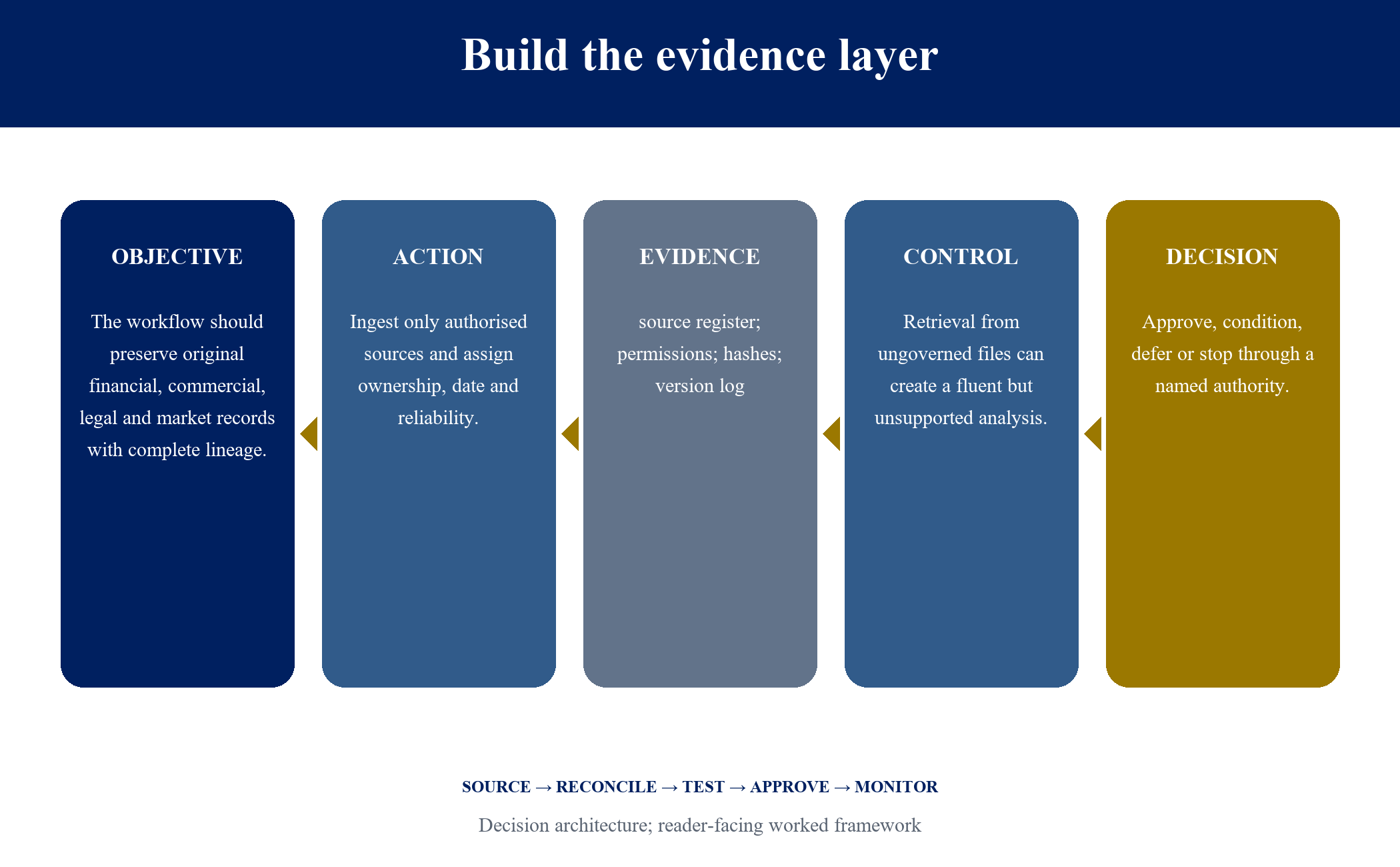
The workflow should preserve original financial, commercial, legal and market records with complete lineage. This matters in ai-augmented valuation for the gulf mid-market because the economics, legal rights, operating evidence and timing can move on different clocks. A useful analysis therefore begins with the decision being made, the party authorised to make it and the date on which the evidence is expected to be current. The work should distinguish source facts, management representations, analytical assumptions and professional judgement so that a reviewer can see where each conclusion originates.
The recommended workstream is to ingest only authorised sources and assign ownership, date and reliability. The team should translate that instruction into named owners, dated gates and a common set of definitions. A base case should describe the expected path; a downside case should test weaker operating performance or slower execution; and a delay case should test what happens when a required approval, document, counterparty or financing event arrives later than planned. Any decision threshold used in the model should be recorded as a management choice unless it comes directly from a cited rule or contract.
The decision framework has four layers. First, define the commercial objective and non-negotiable constraints. Second, assemble the minimum source record and reconcile it to the numbers used in the analysis. Third, compare executable alternatives under consistent assumptions, including cost, control, liquidity, timing and downside. Fourth, approve the route, its conditions and the fallback. This sequence keeps a transaction from moving ahead on an attractive headline while unresolved implementation questions remain outside the decision paper.
2.2 Evidence and controls
The minimum evidence for this module is source register; permissions; hashes; version log Each item should have an owner, effective date, source location and review status. Where information is produced through a model or transformation, the file should preserve the original input, calculation logic and output version. The reviewer should be able to reproduce the material conclusion without relying on a presentation slide, an uncited summary or the memory of the person who prepared it.
Control quality can be tested through three questions. Does the source support the stated fact? Does the calculation use the approved definition? Does the proposed action remain within the authority and risk limits already granted? An exception to any of these tests should enter a dated register with a named resolver and a stop, proceed or conditional-proceed decision. Completion means that the evidence and decision have been accepted by the accountable owner; document production alone is an intermediate output.
The principal failure mode is that retrieval from ungoverned files can create a fluent but unsupported analysis. The response is to make the vulnerable assumption visible, test a plausible adverse state and identify the earliest observable warning indicator. The analysis should also state what remains outside its scope and which legal, tax, regulatory, accounting, valuation, technical or investment conclusions require qualified advice. This creates a practical boundary between a research framework and a conclusion for a particular company, investor, lender, family or transaction.
| Control question | Required record | Decision response |
|---|---|---|
| What is being decided? | Ingest only authorised sources and assign ownership, date and reliability. | Approve objective and authority. |
| What proves the case? | source register; permissions; hashes; version log | Reconcile and sign off. |
| What can fail? | Retrieval from ungoverned files can create a fluent but unsupported analysis. | Test downside and escalation. |
3. Normalise company financials
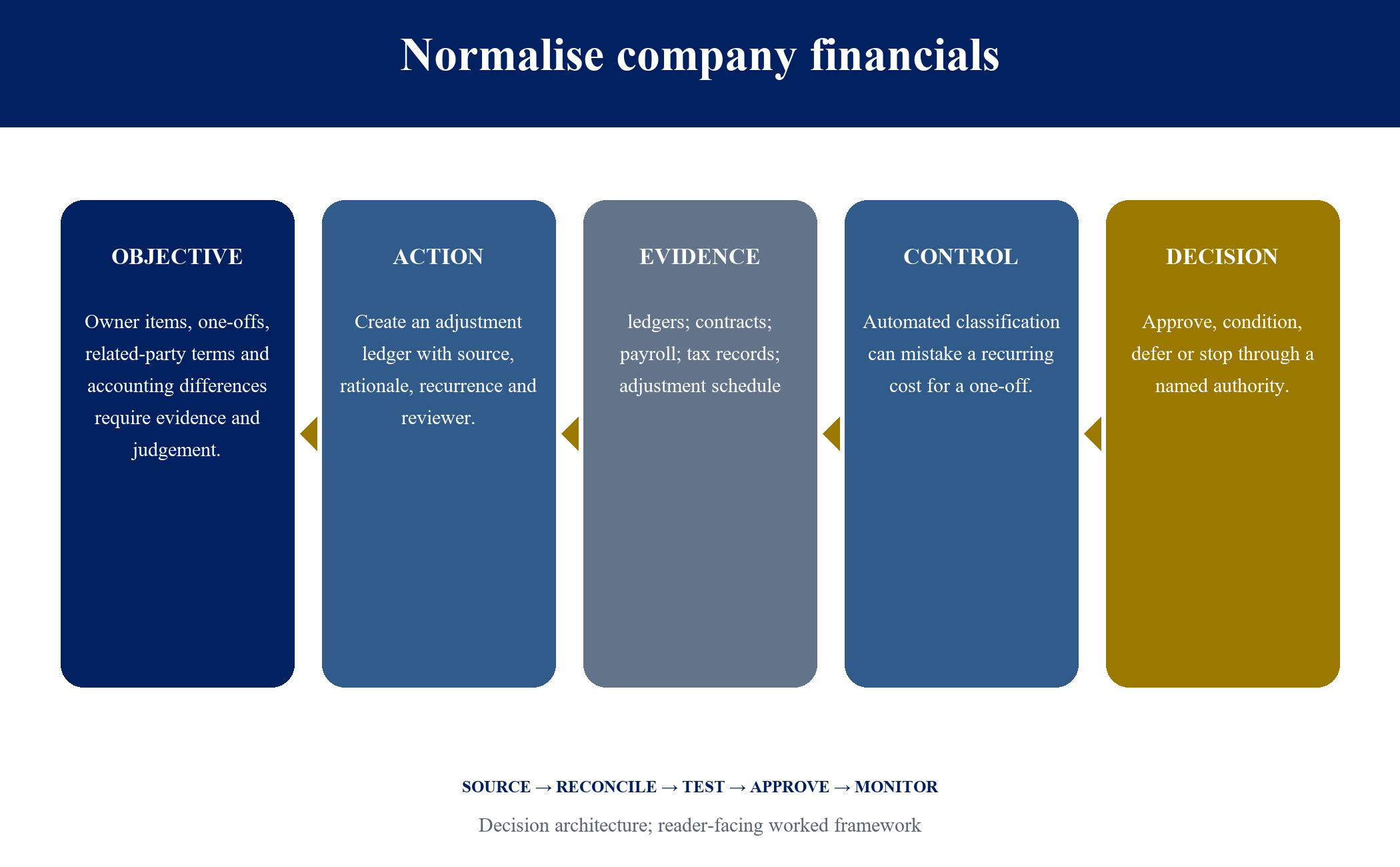
Owner items, one-offs, related-party terms and accounting differences require evidence and judgement. This matters in ai-augmented valuation for the gulf mid-market because the economics, legal rights, operating evidence and timing can move on different clocks. A useful analysis therefore begins with the decision being made, the party authorised to make it and the date on which the evidence is expected to be current. The work should distinguish source facts, management representations, analytical assumptions and professional judgement so that a reviewer can see where each conclusion originates.
The recommended workstream is to create an adjustment ledger with source, rationale, recurrence and reviewer. The team should translate that instruction into named owners, dated gates and a common set of definitions. A base case should describe the expected path; a downside case should test weaker operating performance or slower execution; and a delay case should test what happens when a required approval, document, counterparty or financing event arrives later than planned. Any decision threshold used in the model should be recorded as a management choice unless it comes directly from a cited rule or contract.
The decision framework has four layers. First, define the commercial objective and non-negotiable constraints. Second, assemble the minimum source record and reconcile it to the numbers used in the analysis. Third, compare executable alternatives under consistent assumptions, including cost, control, liquidity, timing and downside. Fourth, approve the route, its conditions and the fallback. This sequence keeps a transaction from moving ahead on an attractive headline while unresolved implementation questions remain outside the decision paper.
3.2 Evidence and controls
The minimum evidence for this module is ledgers; contracts; payroll; tax records; adjustment schedule Each item should have an owner, effective date, source location and review status. Where information is produced through a model or transformation, the file should preserve the original input, calculation logic and output version. The reviewer should be able to reproduce the material conclusion without relying on a presentation slide, an uncited summary or the memory of the person who prepared it.
Control quality can be tested through three questions. Does the source support the stated fact? Does the calculation use the approved definition? Does the proposed action remain within the authority and risk limits already granted? An exception to any of these tests should enter a dated register with a named resolver and a stop, proceed or conditional-proceed decision. Completion means that the evidence and decision have been accepted by the accountable owner; document production alone is an intermediate output.
The principal failure mode is that automated classification can mistake a recurring cost for a one-off. The response is to make the vulnerable assumption visible, test a plausible adverse state and identify the earliest observable warning indicator. The analysis should also state what remains outside its scope and which legal, tax, regulatory, accounting, valuation, technical or investment conclusions require qualified advice. This creates a practical boundary between a research framework and a conclusion for a particular company, investor, lender, family or transaction.
| Control question | Required record | Decision response |
|---|---|---|
| What is being decided? | Create an adjustment ledger with source, rationale, recurrence and reviewer. | Approve objective and authority. |
| What proves the case? | ledgers; contracts; payroll; tax records; adjustment schedule | Reconcile and sign off. |
| What can fail? | Automated classification can mistake a recurring cost for a one-off. | Test downside and escalation. |
4. Segment earnings and cash
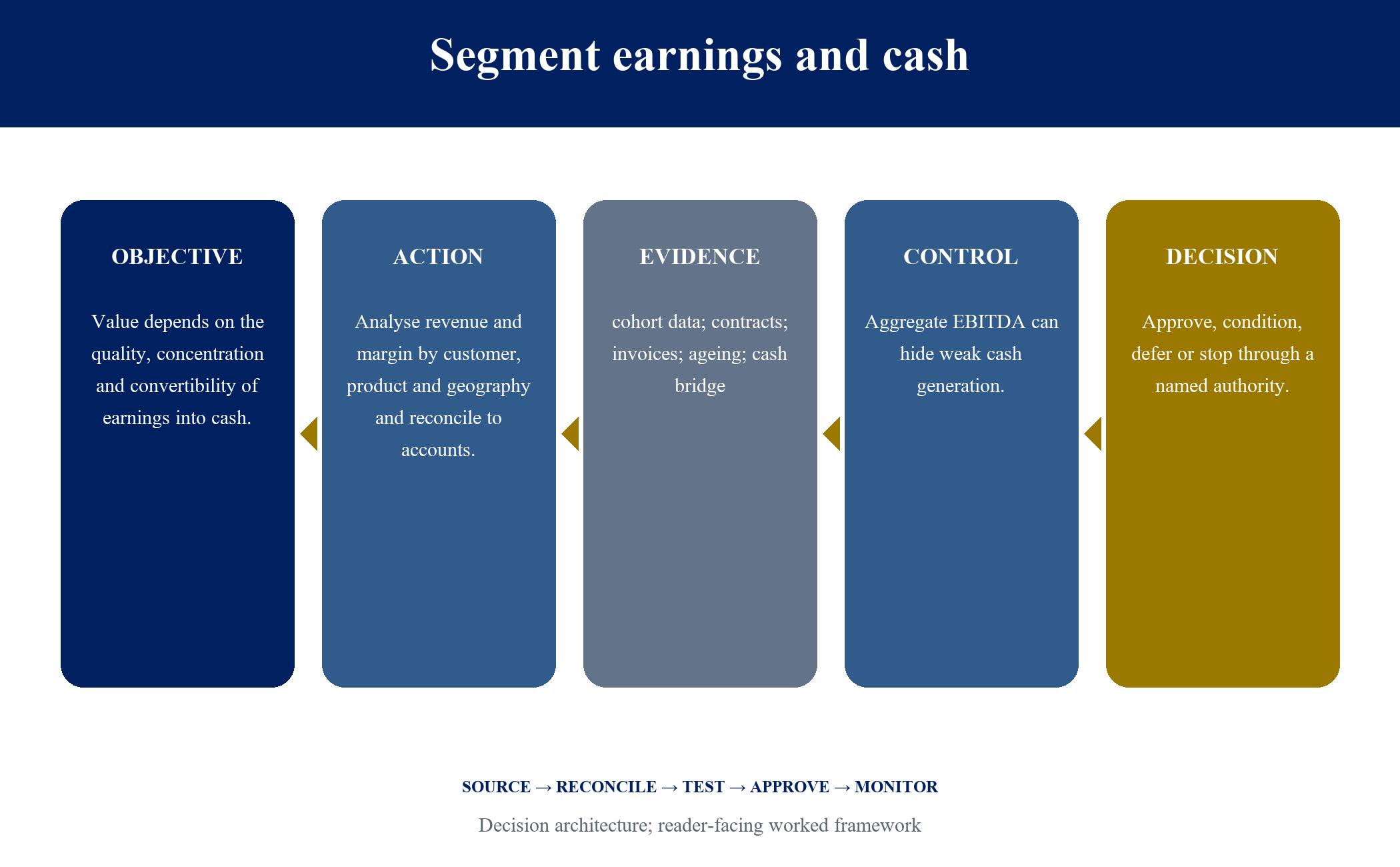
Value depends on the quality, concentration and convertibility of earnings into cash. This matters in ai-augmented valuation for the gulf mid-market because the economics, legal rights, operating evidence and timing can move on different clocks. A useful analysis therefore begins with the decision being made, the party authorised to make it and the date on which the evidence is expected to be current. The work should distinguish source facts, management representations, analytical assumptions and professional judgement so that a reviewer can see where each conclusion originates.
The recommended workstream is to analyse revenue and margin by customer, product and geography and reconcile to accounts. The team should translate that instruction into named owners, dated gates and a common set of definitions. A base case should describe the expected path; a downside case should test weaker operating performance or slower execution; and a delay case should test what happens when a required approval, document, counterparty or financing event arrives later than planned. Any decision threshold used in the model should be recorded as a management choice unless it comes directly from a cited rule or contract.
The decision framework has four layers. First, define the commercial objective and non-negotiable constraints. Second, assemble the minimum source record and reconcile it to the numbers used in the analysis. Third, compare executable alternatives under consistent assumptions, including cost, control, liquidity, timing and downside. Fourth, approve the route, its conditions and the fallback. This sequence keeps a transaction from moving ahead on an attractive headline while unresolved implementation questions remain outside the decision paper.
4.2 Evidence and controls
The minimum evidence for this module is cohort data; contracts; invoices; ageing; cash bridge Each item should have an owner, effective date, source location and review status. Where information is produced through a model or transformation, the file should preserve the original input, calculation logic and output version. The reviewer should be able to reproduce the material conclusion without relying on a presentation slide, an uncited summary or the memory of the person who prepared it.
Control quality can be tested through three questions. Does the source support the stated fact? Does the calculation use the approved definition? Does the proposed action remain within the authority and risk limits already granted? An exception to any of these tests should enter a dated register with a named resolver and a stop, proceed or conditional-proceed decision. Completion means that the evidence and decision have been accepted by the accountable owner; document production alone is an intermediate output.
The principal failure mode is that aggregate EBITDA can hide weak cash generation. The response is to make the vulnerable assumption visible, test a plausible adverse state and identify the earliest observable warning indicator. The analysis should also state what remains outside its scope and which legal, tax, regulatory, accounting, valuation, technical or investment conclusions require qualified advice. This creates a practical boundary between a research framework and a conclusion for a particular company, investor, lender, family or transaction.
| Control question | Required record | Decision response |
|---|---|---|
| What is being decided? | Analyse revenue and margin by customer, product and geography and reconcile to accounts. | Approve objective and authority. |
| What proves the case? | cohort data; contracts; invoices; ageing; cash bridge | Reconcile and sign off. |
| What can fail? | Aggregate EBITDA can hide weak cash generation. | Test downside and escalation. |
5. Select comparable companies
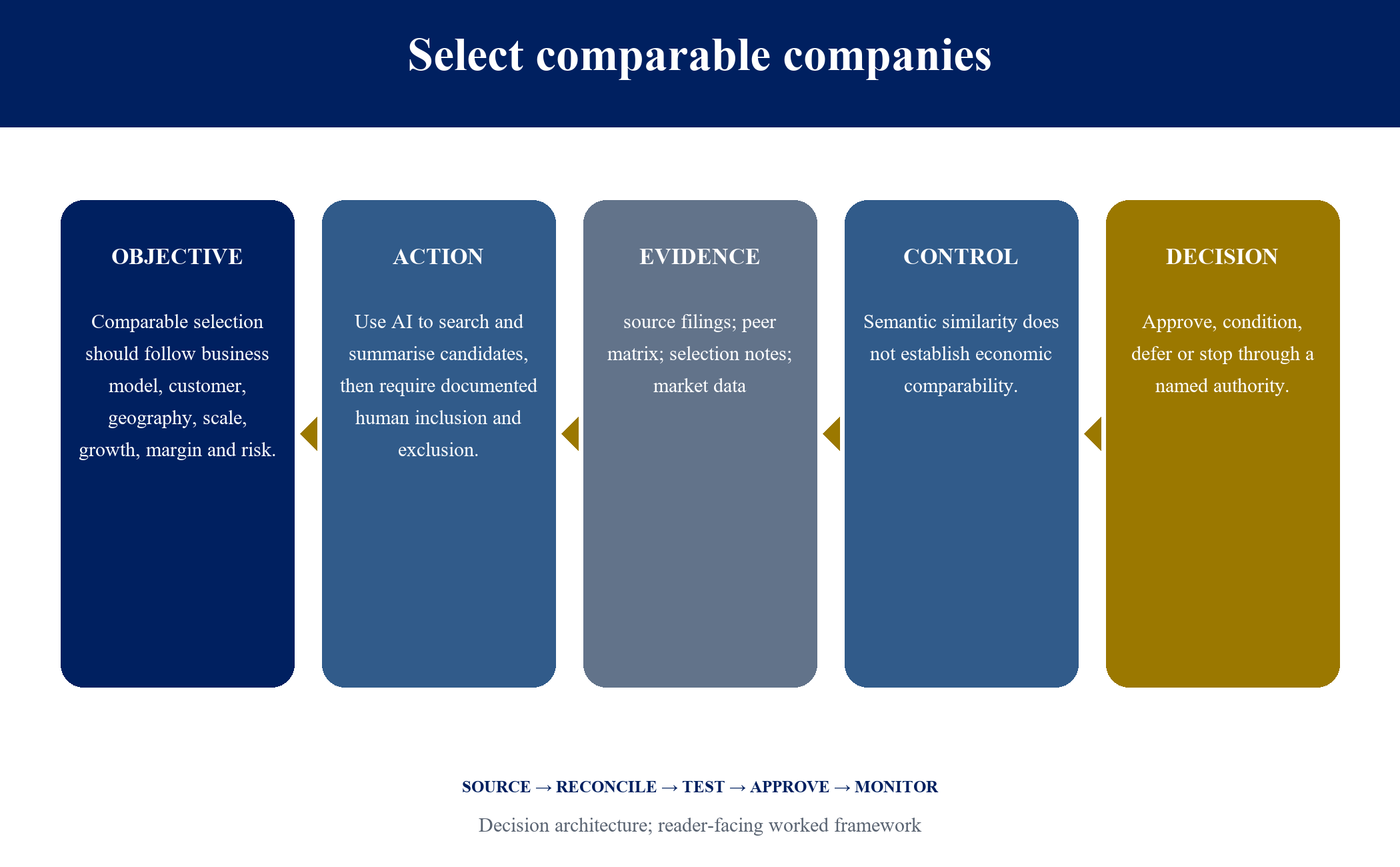
Comparable selection should follow business model, customer, geography, scale, growth, margin and risk. This matters in ai-augmented valuation for the gulf mid-market because the economics, legal rights, operating evidence and timing can move on different clocks. A useful analysis therefore begins with the decision being made, the party authorised to make it and the date on which the evidence is expected to be current. The work should distinguish source facts, management representations, analytical assumptions and professional judgement so that a reviewer can see where each conclusion originates.
The recommended workstream is to use AI to search and summarise candidates, then require documented human inclusion and exclusion. The team should translate that instruction into named owners, dated gates and a common set of definitions. A base case should describe the expected path; a downside case should test weaker operating performance or slower execution; and a delay case should test what happens when a required approval, document, counterparty or financing event arrives later than planned. Any decision threshold used in the model should be recorded as a management choice unless it comes directly from a cited rule or contract.
The decision framework has four layers. First, define the commercial objective and non-negotiable constraints. Second, assemble the minimum source record and reconcile it to the numbers used in the analysis. Third, compare executable alternatives under consistent assumptions, including cost, control, liquidity, timing and downside. Fourth, approve the route, its conditions and the fallback. This sequence keeps a transaction from moving ahead on an attractive headline while unresolved implementation questions remain outside the decision paper.
5.2 Evidence and controls
The minimum evidence for this module is source filings; peer matrix; selection notes; market data Each item should have an owner, effective date, source location and review status. Where information is produced through a model or transformation, the file should preserve the original input, calculation logic and output version. The reviewer should be able to reproduce the material conclusion without relying on a presentation slide, an uncited summary or the memory of the person who prepared it.
Control quality can be tested through three questions. Does the source support the stated fact? Does the calculation use the approved definition? Does the proposed action remain within the authority and risk limits already granted? An exception to any of these tests should enter a dated register with a named resolver and a stop, proceed or conditional-proceed decision. Completion means that the evidence and decision have been accepted by the accountable owner; document production alone is an intermediate output.
The principal failure mode is that semantic similarity does not establish economic comparability. The response is to make the vulnerable assumption visible, test a plausible adverse state and identify the earliest observable warning indicator. The analysis should also state what remains outside its scope and which legal, tax, regulatory, accounting, valuation, technical or investment conclusions require qualified advice. This creates a practical boundary between a research framework and a conclusion for a particular company, investor, lender, family or transaction.
| Control question | Required record | Decision response |
|---|---|---|
| What is being decided? | Use AI to search and summarise candidates, then require documented human inclusion and exclusion. | Approve objective and authority. |
| What proves the case? | source filings; peer matrix; selection notes; market data | Reconcile and sign off. |
| What can fail? | Semantic similarity does not establish economic comparability. | Test downside and escalation. |
6. Normalise market multiples
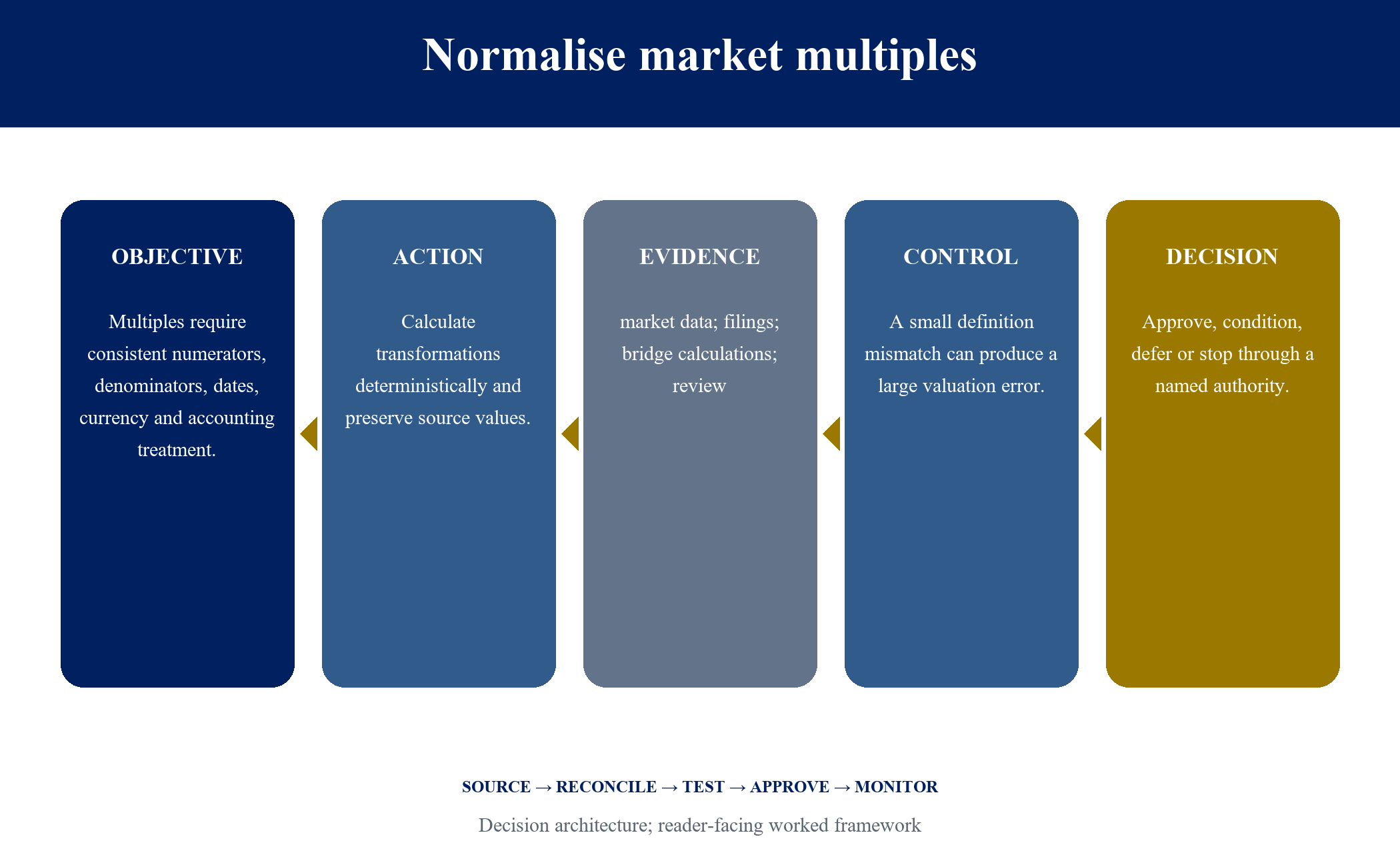
Multiples require consistent numerators, denominators, dates, currency and accounting treatment. This matters in ai-augmented valuation for the gulf mid-market because the economics, legal rights, operating evidence and timing can move on different clocks. A useful analysis therefore begins with the decision being made, the party authorised to make it and the date on which the evidence is expected to be current. The work should distinguish source facts, management representations, analytical assumptions and professional judgement so that a reviewer can see where each conclusion originates.
The recommended workstream is to calculate transformations deterministically and preserve source values. The team should translate that instruction into named owners, dated gates and a common set of definitions. A base case should describe the expected path; a downside case should test weaker operating performance or slower execution; and a delay case should test what happens when a required approval, document, counterparty or financing event arrives later than planned. Any decision threshold used in the model should be recorded as a management choice unless it comes directly from a cited rule or contract.
The decision framework has four layers. First, define the commercial objective and non-negotiable constraints. Second, assemble the minimum source record and reconcile it to the numbers used in the analysis. Third, compare executable alternatives under consistent assumptions, including cost, control, liquidity, timing and downside. Fourth, approve the route, its conditions and the fallback. This sequence keeps a transaction from moving ahead on an attractive headline while unresolved implementation questions remain outside the decision paper.
6.2 Evidence and controls
The minimum evidence for this module is market data; filings; bridge calculations; review Each item should have an owner, effective date, source location and review status. Where information is produced through a model or transformation, the file should preserve the original input, calculation logic and output version. The reviewer should be able to reproduce the material conclusion without relying on a presentation slide, an uncited summary or the memory of the person who prepared it.
Control quality can be tested through three questions. Does the source support the stated fact? Does the calculation use the approved definition? Does the proposed action remain within the authority and risk limits already granted? An exception to any of these tests should enter a dated register with a named resolver and a stop, proceed or conditional-proceed decision. Completion means that the evidence and decision have been accepted by the accountable owner; document production alone is an intermediate output.
The principal failure mode is that a small definition mismatch can produce a large valuation error. The response is to make the vulnerable assumption visible, test a plausible adverse state and identify the earliest observable warning indicator. The analysis should also state what remains outside its scope and which legal, tax, regulatory, accounting, valuation, technical or investment conclusions require qualified advice. This creates a practical boundary between a research framework and a conclusion for a particular company, investor, lender, family or transaction.
| Control question | Required record | Decision response |
|---|---|---|
| What is being decided? | Calculate transformations deterministically and preserve source values. | Approve objective and authority. |
| What proves the case? | market data; filings; bridge calculations; review | Reconcile and sign off. |
| What can fail? | A small definition mismatch can produce a large valuation error. | Test downside and escalation. |
7. Analyse precedent transactions
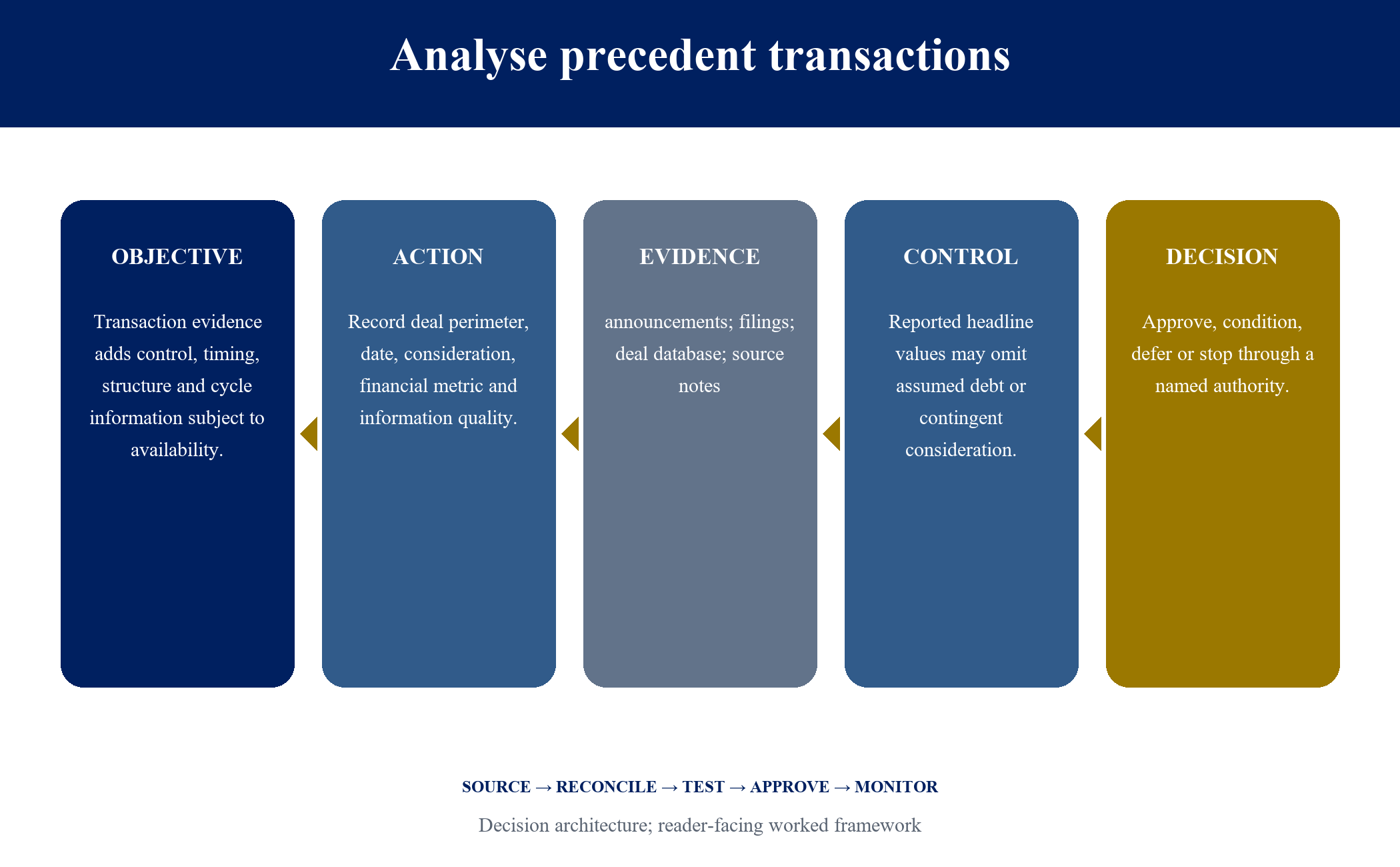
Transaction evidence adds control, timing, structure and cycle information subject to availability. This matters in ai-augmented valuation for the gulf mid-market because the economics, legal rights, operating evidence and timing can move on different clocks. A useful analysis therefore begins with the decision being made, the party authorised to make it and the date on which the evidence is expected to be current. The work should distinguish source facts, management representations, analytical assumptions and professional judgement so that a reviewer can see where each conclusion originates.
The recommended workstream is to record deal perimeter, date, consideration, financial metric and information quality. The team should translate that instruction into named owners, dated gates and a common set of definitions. A base case should describe the expected path; a downside case should test weaker operating performance or slower execution; and a delay case should test what happens when a required approval, document, counterparty or financing event arrives later than planned. Any decision threshold used in the model should be recorded as a management choice unless it comes directly from a cited rule or contract.
The decision framework has four layers. First, define the commercial objective and non-negotiable constraints. Second, assemble the minimum source record and reconcile it to the numbers used in the analysis. Third, compare executable alternatives under consistent assumptions, including cost, control, liquidity, timing and downside. Fourth, approve the route, its conditions and the fallback. This sequence keeps a transaction from moving ahead on an attractive headline while unresolved implementation questions remain outside the decision paper.
7.2 Evidence and controls
The minimum evidence for this module is announcements; filings; deal database; source notes Each item should have an owner, effective date, source location and review status. Where information is produced through a model or transformation, the file should preserve the original input, calculation logic and output version. The reviewer should be able to reproduce the material conclusion without relying on a presentation slide, an uncited summary or the memory of the person who prepared it.
Control quality can be tested through three questions. Does the source support the stated fact? Does the calculation use the approved definition? Does the proposed action remain within the authority and risk limits already granted? An exception to any of these tests should enter a dated register with a named resolver and a stop, proceed or conditional-proceed decision. Completion means that the evidence and decision have been accepted by the accountable owner; document production alone is an intermediate output.
The principal failure mode is that reported headline values may omit assumed debt or contingent consideration. The response is to make the vulnerable assumption visible, test a plausible adverse state and identify the earliest observable warning indicator. The analysis should also state what remains outside its scope and which legal, tax, regulatory, accounting, valuation, technical or investment conclusions require qualified advice. This creates a practical boundary between a research framework and a conclusion for a particular company, investor, lender, family or transaction.
| Control question | Required record | Decision response |
|---|---|---|
| What is being decided? | Record deal perimeter, date, consideration, financial metric and information quality. | Approve objective and authority. |
| What proves the case? | announcements; filings; deal database; source notes | Reconcile and sign off. |
| What can fail? | Reported headline values may omit assumed debt or contingent consideration. | Test downside and escalation. |
8. Build the income approach
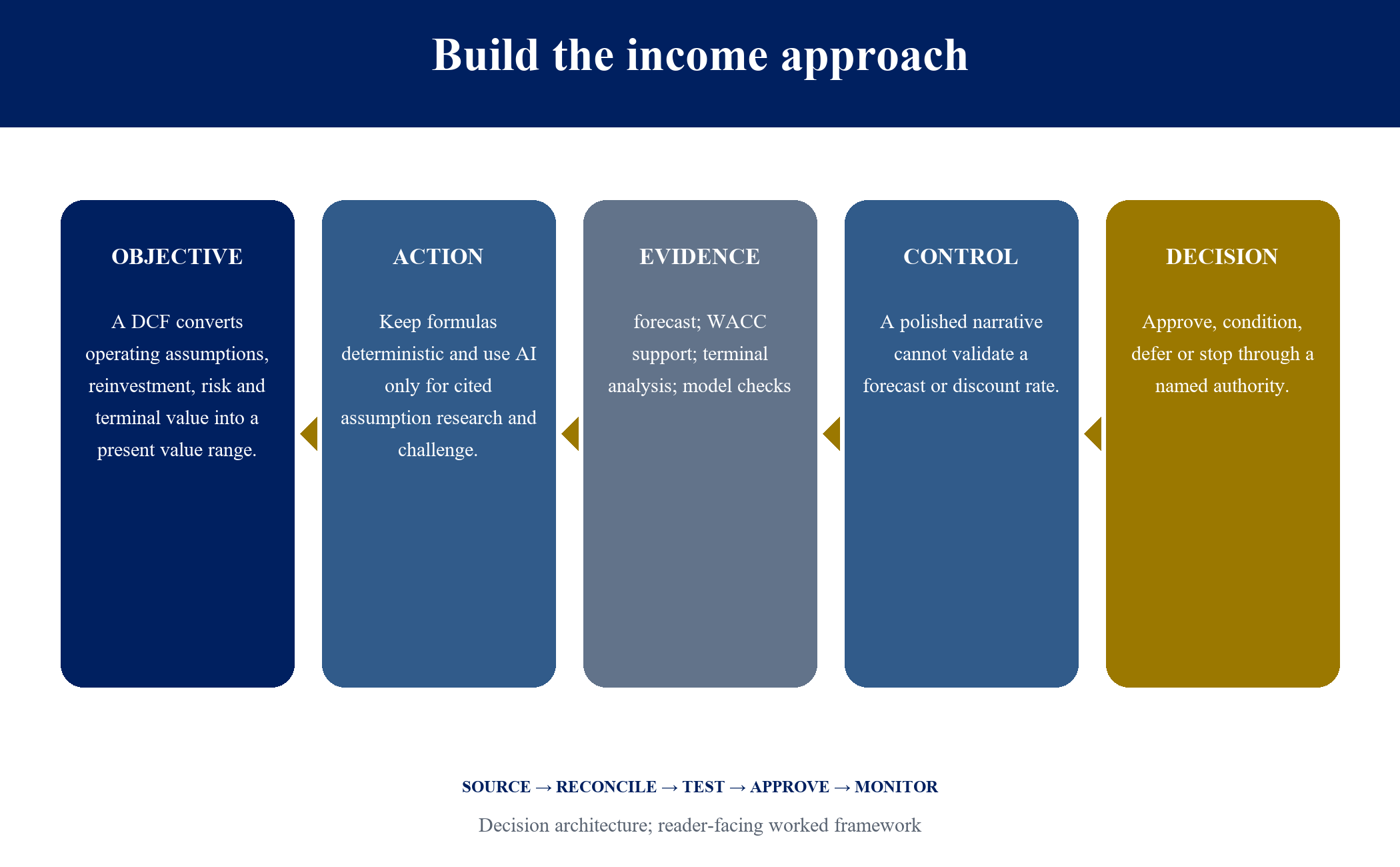
A DCF converts operating assumptions, reinvestment, risk and terminal value into a present value range. This matters in ai-augmented valuation for the gulf mid-market because the economics, legal rights, operating evidence and timing can move on different clocks. A useful analysis therefore begins with the decision being made, the party authorised to make it and the date on which the evidence is expected to be current. The work should distinguish source facts, management representations, analytical assumptions and professional judgement so that a reviewer can see where each conclusion originates.
The recommended workstream is to keep formulas deterministic and use AI only for cited assumption research and challenge. The team should translate that instruction into named owners, dated gates and a common set of definitions. A base case should describe the expected path; a downside case should test weaker operating performance or slower execution; and a delay case should test what happens when a required approval, document, counterparty or financing event arrives later than planned. Any decision threshold used in the model should be recorded as a management choice unless it comes directly from a cited rule or contract.
The decision framework has four layers. First, define the commercial objective and non-negotiable constraints. Second, assemble the minimum source record and reconcile it to the numbers used in the analysis. Third, compare executable alternatives under consistent assumptions, including cost, control, liquidity, timing and downside. Fourth, approve the route, its conditions and the fallback. This sequence keeps a transaction from moving ahead on an attractive headline while unresolved implementation questions remain outside the decision paper.
8.2 Evidence and controls
The minimum evidence for this module is forecast; WACC support; terminal analysis; model checks Each item should have an owner, effective date, source location and review status. Where information is produced through a model or transformation, the file should preserve the original input, calculation logic and output version. The reviewer should be able to reproduce the material conclusion without relying on a presentation slide, an uncited summary or the memory of the person who prepared it.
Control quality can be tested through three questions. Does the source support the stated fact? Does the calculation use the approved definition? Does the proposed action remain within the authority and risk limits already granted? An exception to any of these tests should enter a dated register with a named resolver and a stop, proceed or conditional-proceed decision. Completion means that the evidence and decision have been accepted by the accountable owner; document production alone is an intermediate output.
The principal failure mode is that a polished narrative cannot validate a forecast or discount rate. The response is to make the vulnerable assumption visible, test a plausible adverse state and identify the earliest observable warning indicator. The analysis should also state what remains outside its scope and which legal, tax, regulatory, accounting, valuation, technical or investment conclusions require qualified advice. This creates a practical boundary between a research framework and a conclusion for a particular company, investor, lender, family or transaction.
| Control question | Required record | Decision response |
|---|---|---|
| What is being decided? | Keep formulas deterministic and use AI only for cited assumption research and challenge. | Approve objective and authority. |
| What proves the case? | forecast; WACC support; terminal analysis; model checks | Reconcile and sign off. |
| What can fail? | A polished narrative cannot validate a forecast or discount rate. | Test downside and escalation. |
9. Create scenario architecture
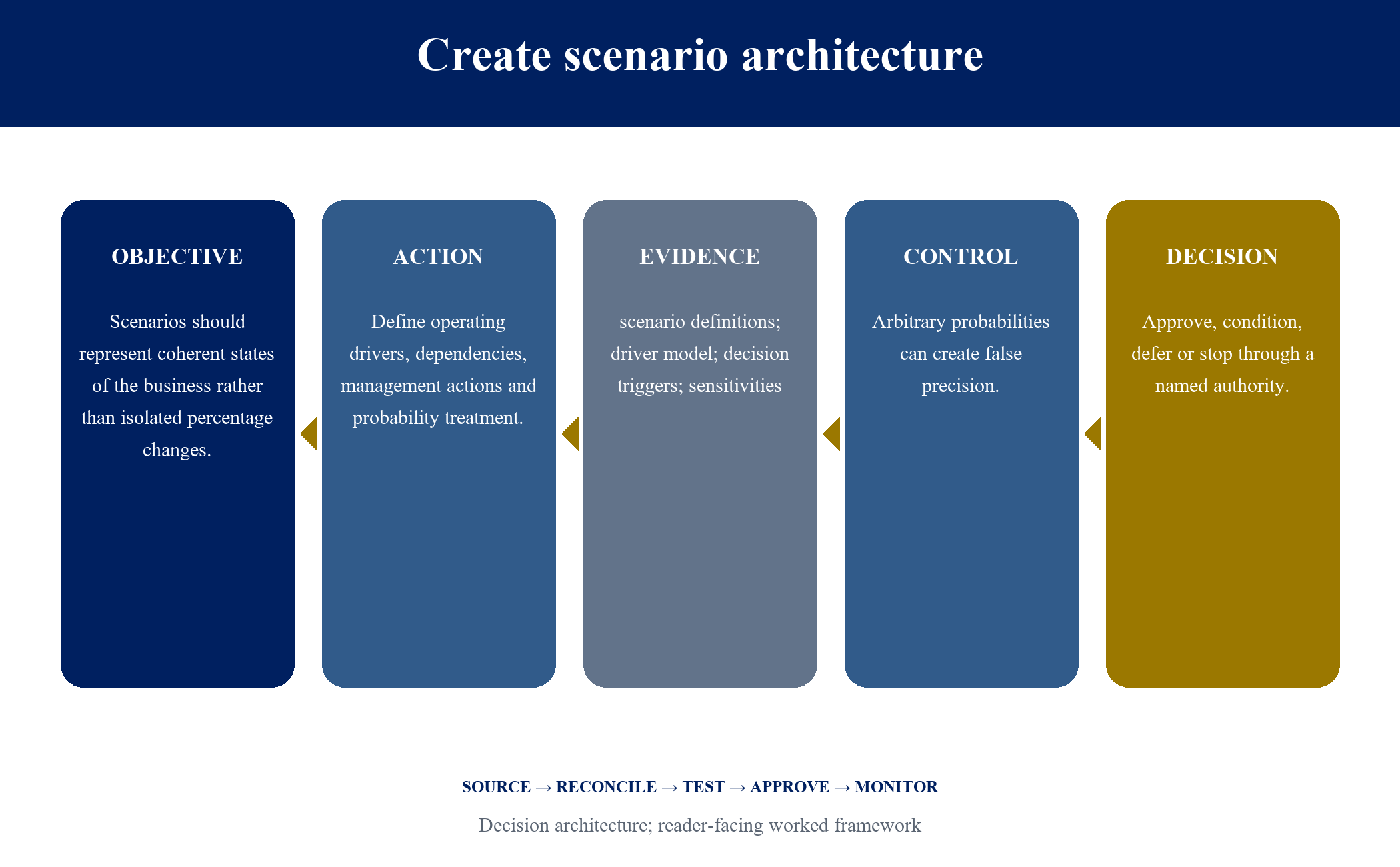
Scenarios should represent coherent states of the business rather than isolated percentage changes. This matters in ai-augmented valuation for the gulf mid-market because the economics, legal rights, operating evidence and timing can move on different clocks. A useful analysis therefore begins with the decision being made, the party authorised to make it and the date on which the evidence is expected to be current. The work should distinguish source facts, management representations, analytical assumptions and professional judgement so that a reviewer can see where each conclusion originates.
The recommended workstream is to define operating drivers, dependencies, management actions and probability treatment. The team should translate that instruction into named owners, dated gates and a common set of definitions. A base case should describe the expected path; a downside case should test weaker operating performance or slower execution; and a delay case should test what happens when a required approval, document, counterparty or financing event arrives later than planned. Any decision threshold used in the model should be recorded as a management choice unless it comes directly from a cited rule or contract.
The decision framework has four layers. First, define the commercial objective and non-negotiable constraints. Second, assemble the minimum source record and reconcile it to the numbers used in the analysis. Third, compare executable alternatives under consistent assumptions, including cost, control, liquidity, timing and downside. Fourth, approve the route, its conditions and the fallback. This sequence keeps a transaction from moving ahead on an attractive headline while unresolved implementation questions remain outside the decision paper.
9.2 Evidence and controls
The minimum evidence for this module is scenario definitions; driver model; decision triggers; sensitivities Each item should have an owner, effective date, source location and review status. Where information is produced through a model or transformation, the file should preserve the original input, calculation logic and output version. The reviewer should be able to reproduce the material conclusion without relying on a presentation slide, an uncited summary or the memory of the person who prepared it.
Control quality can be tested through three questions. Does the source support the stated fact? Does the calculation use the approved definition? Does the proposed action remain within the authority and risk limits already granted? An exception to any of these tests should enter a dated register with a named resolver and a stop, proceed or conditional-proceed decision. Completion means that the evidence and decision have been accepted by the accountable owner; document production alone is an intermediate output.
The principal failure mode is that arbitrary probabilities can create false precision. The response is to make the vulnerable assumption visible, test a plausible adverse state and identify the earliest observable warning indicator. The analysis should also state what remains outside its scope and which legal, tax, regulatory, accounting, valuation, technical or investment conclusions require qualified advice. This creates a practical boundary between a research framework and a conclusion for a particular company, investor, lender, family or transaction.
| Control question | Required record | Decision response |
|---|---|---|
| What is being decided? | Define operating drivers, dependencies, management actions and probability treatment. | Approve objective and authority. |
| What proves the case? | scenario definitions; driver model; decision triggers; sensitivities | Reconcile and sign off. |
| What can fail? | Arbitrary probabilities can create false precision. | Test downside and escalation. |
10. Adjust for capital structure
Enterprise value must be reconciled to equity value through debt, cash, leases, claims and non-operating assets. This matters in ai-augmented valuation for the gulf mid-market because the economics, legal rights, operating evidence and timing can move on different clocks. A useful analysis therefore begins with the decision being made, the party authorised to make it and the date on which the evidence is expected to be current. The work should distinguish source facts, management representations, analytical assumptions and professional judgement so that a reviewer can see where each conclusion originates.
The recommended workstream is to build an item-by-item bridge with ownership and settlement evidence. The team should translate that instruction into named owners, dated gates and a common set of definitions. A base case should describe the expected path; a downside case should test weaker operating performance or slower execution; and a delay case should test what happens when a required approval, document, counterparty or financing event arrives later than planned. Any decision threshold used in the model should be recorded as a management choice unless it comes directly from a cited rule or contract.
The decision framework has four layers. First, define the commercial objective and non-negotiable constraints. Second, assemble the minimum source record and reconcile it to the numbers used in the analysis. Third, compare executable alternatives under consistent assumptions, including cost, control, liquidity, timing and downside. Fourth, approve the route, its conditions and the fallback. This sequence keeps a transaction from moving ahead on an attractive headline while unresolved implementation questions remain outside the decision paper.
10.2 Evidence and controls
The minimum evidence for this module is debt schedule; bank confirmations; leases; claims register Each item should have an owner, effective date, source location and review status. Where information is produced through a model or transformation, the file should preserve the original input, calculation logic and output version. The reviewer should be able to reproduce the material conclusion without relying on a presentation slide, an uncited summary or the memory of the person who prepared it.
Control quality can be tested through three questions. Does the source support the stated fact? Does the calculation use the approved definition? Does the proposed action remain within the authority and risk limits already granted? An exception to any of these tests should enter a dated register with a named resolver and a stop, proceed or conditional-proceed decision. Completion means that the evidence and decision have been accepted by the accountable owner; document production alone is an intermediate output.
The principal failure mode is that net-debt definitions often become a transaction dispute. The response is to make the vulnerable assumption visible, test a plausible adverse state and identify the earliest observable warning indicator. The analysis should also state what remains outside its scope and which legal, tax, regulatory, accounting, valuation, technical or investment conclusions require qualified advice. This creates a practical boundary between a research framework and a conclusion for a particular company, investor, lender, family or transaction.
| Control question | Required record | Decision response |
|---|---|---|
| What is being decided? | Build an item-by-item bridge with ownership and settlement evidence. | Approve objective and authority. |
| What proves the case? | debt schedule; bank confirmations; leases; claims register | Reconcile and sign off. |
| What can fail? | Net-debt definitions often become a transaction dispute. | Test downside and escalation. |
11. Analyse rights and liquidity
Control, minority rights, transfer restrictions and liquidity can affect the valued interest. This matters in ai-augmented valuation for the gulf mid-market because the economics, legal rights, operating evidence and timing can move on different clocks. A useful analysis therefore begins with the decision being made, the party authorised to make it and the date on which the evidence is expected to be current. The work should distinguish source facts, management representations, analytical assumptions and professional judgement so that a reviewer can see where each conclusion originates.
The recommended workstream is to obtain legal and market evidence before applying any premium or discount. The team should translate that instruction into named owners, dated gates and a common set of definitions. A base case should describe the expected path; a downside case should test weaker operating performance or slower execution; and a delay case should test what happens when a required approval, document, counterparty or financing event arrives later than planned. Any decision threshold used in the model should be recorded as a management choice unless it comes directly from a cited rule or contract.
The decision framework has four layers. First, define the commercial objective and non-negotiable constraints. Second, assemble the minimum source record and reconcile it to the numbers used in the analysis. Third, compare executable alternatives under consistent assumptions, including cost, control, liquidity, timing and downside. Fourth, approve the route, its conditions and the fallback. This sequence keeps a transaction from moving ahead on an attractive headline while unresolved implementation questions remain outside the decision paper.
11.2 Evidence and controls
The minimum evidence for this module is shareholder agreements; market studies; legal advice; rationale Each item should have an owner, effective date, source location and review status. Where information is produced through a model or transformation, the file should preserve the original input, calculation logic and output version. The reviewer should be able to reproduce the material conclusion without relying on a presentation slide, an uncited summary or the memory of the person who prepared it.
Control quality can be tested through three questions. Does the source support the stated fact? Does the calculation use the approved definition? Does the proposed action remain within the authority and risk limits already granted? An exception to any of these tests should enter a dated register with a named resolver and a stop, proceed or conditional-proceed decision. Completion means that the evidence and decision have been accepted by the accountable owner; document production alone is an intermediate output.
The principal failure mode is that generic discount ranges are not a substitute for interest-specific analysis. The response is to make the vulnerable assumption visible, test a plausible adverse state and identify the earliest observable warning indicator. The analysis should also state what remains outside its scope and which legal, tax, regulatory, accounting, valuation, technical or investment conclusions require qualified advice. This creates a practical boundary between a research framework and a conclusion for a particular company, investor, lender, family or transaction.
| Control question | Required record | Decision response |
|---|---|---|
| What is being decided? | Obtain legal and market evidence before applying any premium or discount. | Approve objective and authority. |
| What proves the case? | shareholder agreements; market studies; legal advice; rationale | Reconcile and sign off. |
| What can fail? | Generic discount ranges are not a substitute for interest-specific analysis. | Test downside and escalation. |
12. Use AI for research and challenge
Model-assisted work can identify sources, compare disclosures, draft questions and test narrative consistency. This matters in ai-augmented valuation for the gulf mid-market because the economics, legal rights, operating evidence and timing can move on different clocks. A useful analysis therefore begins with the decision being made, the party authorised to make it and the date on which the evidence is expected to be current. The work should distinguish source facts, management representations, analytical assumptions and professional judgement so that a reviewer can see where each conclusion originates.
The recommended workstream is to bound tools to approved repositories and require citations for factual outputs. The team should translate that instruction into named owners, dated gates and a common set of definitions. A base case should describe the expected path; a downside case should test weaker operating performance or slower execution; and a delay case should test what happens when a required approval, document, counterparty or financing event arrives later than planned. Any decision threshold used in the model should be recorded as a management choice unless it comes directly from a cited rule or contract.
The decision framework has four layers. First, define the commercial objective and non-negotiable constraints. Second, assemble the minimum source record and reconcile it to the numbers used in the analysis. Third, compare executable alternatives under consistent assumptions, including cost, control, liquidity, timing and downside. Fourth, approve the route, its conditions and the fallback. This sequence keeps a transaction from moving ahead on an attractive headline while unresolved implementation questions remain outside the decision paper.
12.2 Evidence and controls
The minimum evidence for this module is prompts; retrieved passages; citations; reviewer actions Each item should have an owner, effective date, source location and review status. Where information is produced through a model or transformation, the file should preserve the original input, calculation logic and output version. The reviewer should be able to reproduce the material conclusion without relying on a presentation slide, an uncited summary or the memory of the person who prepared it.
Control quality can be tested through three questions. Does the source support the stated fact? Does the calculation use the approved definition? Does the proposed action remain within the authority and risk limits already granted? An exception to any of these tests should enter a dated register with a named resolver and a stop, proceed or conditional-proceed decision. Completion means that the evidence and decision have been accepted by the accountable owner; document production alone is an intermediate output.
The principal failure mode is that external search can introduce stale or unrelated data. The response is to make the vulnerable assumption visible, test a plausible adverse state and identify the earliest observable warning indicator. The analysis should also state what remains outside its scope and which legal, tax, regulatory, accounting, valuation, technical or investment conclusions require qualified advice. This creates a practical boundary between a research framework and a conclusion for a particular company, investor, lender, family or transaction.
| Control question | Required record | Decision response |
|---|---|---|
| What is being decided? | Bound tools to approved repositories and require citations for factual outputs. | Approve objective and authority. |
| What proves the case? | prompts; retrieved passages; citations; reviewer actions | Reconcile and sign off. |
| What can fail? | External search can introduce stale or unrelated data. | Test downside and escalation. |
13. Evaluate the workflow
Quality gates should test extraction, citation, calculation handoff, consistency and material-error detection. This matters in ai-augmented valuation for the gulf mid-market because the economics, legal rights, operating evidence and timing can move on different clocks. A useful analysis therefore begins with the decision being made, the party authorised to make it and the date on which the evidence is expected to be current. The work should distinguish source facts, management representations, analytical assumptions and professional judgement so that a reviewer can see where each conclusion originates.
The recommended workstream is to build a representative test set and consequence-weighted thresholds. The team should translate that instruction into named owners, dated gates and a common set of definitions. A base case should describe the expected path; a downside case should test weaker operating performance or slower execution; and a delay case should test what happens when a required approval, document, counterparty or financing event arrives later than planned. Any decision threshold used in the model should be recorded as a management choice unless it comes directly from a cited rule or contract.
The decision framework has four layers. First, define the commercial objective and non-negotiable constraints. Second, assemble the minimum source record and reconcile it to the numbers used in the analysis. Third, compare executable alternatives under consistent assumptions, including cost, control, liquidity, timing and downside. Fourth, approve the route, its conditions and the fallback. This sequence keeps a transaction from moving ahead on an attractive headline while unresolved implementation questions remain outside the decision paper.
13.2 Evidence and controls
The minimum evidence for this module is evaluation cases; expected outputs; error log; approval Each item should have an owner, effective date, source location and review status. Where information is produced through a model or transformation, the file should preserve the original input, calculation logic and output version. The reviewer should be able to reproduce the material conclusion without relying on a presentation slide, an uncited summary or the memory of the person who prepared it.
Control quality can be tested through three questions. Does the source support the stated fact? Does the calculation use the approved definition? Does the proposed action remain within the authority and risk limits already granted? An exception to any of these tests should enter a dated register with a named resolver and a stop, proceed or conditional-proceed decision. Completion means that the evidence and decision have been accepted by the accountable owner; document production alone is an intermediate output.
The principal failure mode is that average accuracy can conceal a severe valuation error. The response is to make the vulnerable assumption visible, test a plausible adverse state and identify the earliest observable warning indicator. The analysis should also state what remains outside its scope and which legal, tax, regulatory, accounting, valuation, technical or investment conclusions require qualified advice. This creates a practical boundary between a research framework and a conclusion for a particular company, investor, lender, family or transaction.
| Control question | Required record | Decision response |
|---|---|---|
| What is being decided? | Build a representative test set and consequence-weighted thresholds. | Approve objective and authority. |
| What proves the case? | evaluation cases; expected outputs; error log; approval | Reconcile and sign off. |
| What can fail? | Average accuracy can conceal a severe valuation error. | Test downside and escalation. |
14. Govern human approval
Qualified valuers and transaction professionals retain assumptions, adjustments and conclusions. This matters in ai-augmented valuation for the gulf mid-market because the economics, legal rights, operating evidence and timing can move on different clocks. A useful analysis therefore begins with the decision being made, the party authorised to make it and the date on which the evidence is expected to be current. The work should distinguish source facts, management representations, analytical assumptions and professional judgement so that a reviewer can see where each conclusion originates.
The recommended workstream is to use preparer, reviewer and approver roles with recorded changes. The team should translate that instruction into named owners, dated gates and a common set of definitions. A base case should describe the expected path; a downside case should test weaker operating performance or slower execution; and a delay case should test what happens when a required approval, document, counterparty or financing event arrives later than planned. Any decision threshold used in the model should be recorded as a management choice unless it comes directly from a cited rule or contract.
The decision framework has four layers. First, define the commercial objective and non-negotiable constraints. Second, assemble the minimum source record and reconcile it to the numbers used in the analysis. Third, compare executable alternatives under consistent assumptions, including cost, control, liquidity, timing and downside. Fourth, approve the route, its conditions and the fallback. This sequence keeps a transaction from moving ahead on an attractive headline while unresolved implementation questions remain outside the decision paper.
14.2 Evidence and controls
The minimum evidence for this module is sign-offs; change log; independence record; final report Each item should have an owner, effective date, source location and review status. Where information is produced through a model or transformation, the file should preserve the original input, calculation logic and output version. The reviewer should be able to reproduce the material conclusion without relying on a presentation slide, an uncited summary or the memory of the person who prepared it.
Control quality can be tested through three questions. Does the source support the stated fact? Does the calculation use the approved definition? Does the proposed action remain within the authority and risk limits already granted? An exception to any of these tests should enter a dated register with a named resolver and a stop, proceed or conditional-proceed decision. Completion means that the evidence and decision have been accepted by the accountable owner; document production alone is an intermediate output.
The principal failure mode is that human review can become ceremonial when evidence is not presented clearly. The response is to make the vulnerable assumption visible, test a plausible adverse state and identify the earliest observable warning indicator. The analysis should also state what remains outside its scope and which legal, tax, regulatory, accounting, valuation, technical or investment conclusions require qualified advice. This creates a practical boundary between a research framework and a conclusion for a particular company, investor, lender, family or transaction.
| Control question | Required record | Decision response |
|---|---|---|
| What is being decided? | Use preparer, reviewer and approver roles with recorded changes. | Approve objective and authority. |
| What proves the case? | sign-offs; change log; independence record; final report | Reconcile and sign off. |
| What can fail? | Human review can become ceremonial when evidence is not presented clearly. | Test downside and escalation. |
15. Deploy through a controlled pilot
Production use should begin with low-authority tasks and expand only on observed quality and economics. This matters in ai-augmented valuation for the gulf mid-market because the economics, legal rights, operating evidence and timing can move on different clocks. A useful analysis therefore begins with the decision being made, the party authorised to make it and the date on which the evidence is expected to be current. The work should distinguish source facts, management representations, analytical assumptions and professional judgement so that a reviewer can see where each conclusion originates.
The recommended workstream is to pilot source retrieval, comparable packs and scenario documentation before decision automation. The team should translate that instruction into named owners, dated gates and a common set of definitions. A base case should describe the expected path; a downside case should test weaker operating performance or slower execution; and a delay case should test what happens when a required approval, document, counterparty or financing event arrives later than planned. Any decision threshold used in the model should be recorded as a management choice unless it comes directly from a cited rule or contract.
The decision framework has four layers. First, define the commercial objective and non-negotiable constraints. Second, assemble the minimum source record and reconcile it to the numbers used in the analysis. Third, compare executable alternatives under consistent assumptions, including cost, control, liquidity, timing and downside. Fourth, approve the route, its conditions and the fallback. This sequence keeps a transaction from moving ahead on an attractive headline while unresolved implementation questions remain outside the decision paper.
15.2 Evidence and controls
The minimum evidence for this module is pilot scorecard; time ledger; correction rate; go-live approval Each item should have an owner, effective date, source location and review status. Where information is produced through a model or transformation, the file should preserve the original input, calculation logic and output version. The reviewer should be able to reproduce the material conclusion without relying on a presentation slide, an uncited summary or the memory of the person who prepared it.
Control quality can be tested through three questions. Does the source support the stated fact? Does the calculation use the approved definition? Does the proposed action remain within the authority and risk limits already granted? An exception to any of these tests should enter a dated register with a named resolver and a stop, proceed or conditional-proceed decision. Completion means that the evidence and decision have been accepted by the accountable owner; document production alone is an intermediate output.
The principal failure mode is that fast drafting alone does not establish a reliable valuation process. The response is to make the vulnerable assumption visible, test a plausible adverse state and identify the earliest observable warning indicator. The analysis should also state what remains outside its scope and which legal, tax, regulatory, accounting, valuation, technical or investment conclusions require qualified advice. This creates a practical boundary between a research framework and a conclusion for a particular company, investor, lender, family or transaction.
| Control question | Required record | Decision response |
|---|---|---|
| What is being decided? | Pilot source retrieval, comparable packs and scenario documentation before decision automation. | Approve objective and authority. |
| What proves the case? | pilot scorecard; time ledger; correction rate; go-live approval | Reconcile and sign off. |
| What can fail? | Fast drafting alone does not establish a reliable valuation process. | Test downside and escalation. |
Primary and authoritative sources
- International Valuation Standards Council, IVS effective 31 January 2025. https://ivsc.org/new-edition-of-the-international-valuation-standards-ivs-published/
- IFRS Foundation, IFRS 13 Fair Value Measurement. https://www.ifrs.org/issued-standards/list-of-standards/ifrs-13-fair-value-measurement/
- IFRS Foundation, IFRS 13 Supporting Material. https://www.ifrs.org/supporting-implementation/supporting-materials-by-ifrs-standards/ifrs-13/
- Anthropic, Building Effective Agents. https://www.anthropic.com/engineering/building-effective-agents
- Anthropic, Citations. https://docs.anthropic.com/en/docs/build-with-claude/citations
- Anthropic, Define Success Criteria and Build Evaluations. https://docs.anthropic.com/en/docs/test-and-evaluate/define-success
- Anthropic, Advanced Tool Use. https://www.anthropic.com/engineering/advanced-tool-use
- NIST, Artificial Intelligence Risk Management Framework. https://www.nist.gov/itl/ai-risk-management-framework
