

1. Define the succession decision
The programme should begin with the decision being prepared. An internal family succession, management buyout, third-party sale, financing, emergency-continuity plan and phased founder withdrawal require different evidence, authority and timing. The legal perimeter, ownership path, management roles, transition date, retained family involvement and expected buyer integration should be explicit.
The central question is which valuable outcomes depend on knowledge that another authorised person or system cannot yet reproduce. Document volume is a weak proxy. A business can own thousands of files while the founder still decides which customer receives scarce stock, which supplier will extend terms, how a difficult specification is interpreted and when an exception protects a relationship.
Observed capability, planned capture, successor learning and strategic optionality should remain separate. The decision record should identify evidence, owner, deadline, residual dependency and consequence for continuity, value, financing or transaction protection.
Success criteria should be agreed before capture begins. They can include continuity during planned founder absence, independent handling of a named customer class, successor approval of defined capital items, stable supplier terms and closure of high-risk incidents within approved limits. The programme should also define failure: delayed decisions, concealed intervention, customer escalation, control breach or results outside tolerance. A clear decision frame prevents an attractive technology deployment from being mistaken for succession readiness.
2. Map the family-business operating system
The operating system includes ownership, governance, customer relationships, supplier access, pricing, credit, quality, production, service, people, capital allocation and family protocols. Formal organisation charts frequently omit who is consulted, who can unblock a decision and whose personal credibility secures cooperation.
Mapping should follow work and cash. A relationship is economically important when its interruption changes revenue, contribution, service, working capital, compliance or investment. The analysis should identify ordinary routines and rare events, because a founder may add most value during a product failure, delayed permit, customer dispute or liquidity squeeze.
Family roles require care. Ownership influence, employment, board authority and informal status are distinct. The programme should document decision rights without rewriting family arrangements or exposing personal matters beyond the authorised purpose.
The map should include the information cycle that supports each forum. A board may formally approve investment while the founder privately shapes assumptions before papers are circulated. A purchasing committee may appear collective while one individual supplies the supplier intelligence. Recording who creates, challenges, approves and monitors information reveals whether governance can operate independently. It also identifies where the transition requires better reporting, revised delegations or a new capability rather than additional documentation.
3. Distinguish knowledge forms
Codified knowledge sits in contracts, specifications, procedures, systems and records. Tacit knowledge includes pattern recognition, judgement, timing and interpretation developed through experience. Embedded knowledge lives in routines, teams, equipment settings, relationships and organisational norms. Each form requires a different capture and transfer method.
Transcription can preserve a founder's explanation; it does not prove the explanation is complete or current. Observation can reveal workarounds and cues that an interview misses. System histories can show what happened, while customer and employee evidence can test why it happened and whether the outcome was reliable.
The target state is usable organisational capability. That requires an authorised person to find relevant evidence, understand limits, make or escalate the decision, record the outcome and improve the system.
Different knowledge forms should be valued by their contribution to an outcome, not by ease of capture. A detailed video may preserve technique while leaving the physical skill untested. A relationship note may explain history while giving the successor no credibility. A model may retrieve prior decisions while missing a new market condition. The transfer method should therefore combine source preservation, explanation, supervised practice and operating feedback in proportions suited to the decision.
4. Build the knowledge-dependency ledger
Table 1. Family-business knowledge-dependency ledger
| Layer | Controlled evidence | Transition test |
|---|---|---|
| role | authority, backup and availability | who may decide? |
| decision | trigger, inputs, rule and judgement | what must be reproduced? |
| relationship | customer, supplier, adviser or regulator | whose cooperation matters? |
| exception | deviation, reason, approval and expiry | where does routine fail? |
| outcome | quality, service, cash and risk | what changed? |
| continuity | successor, rehearsal and monitoring | can the result survive absence? |
Each dependency should connect a person, decision and source to a measurable operating or cash consequence.
The ledger should retain source, date, owner, confidentiality, jurisdiction, version and review cycle. Management recollection should remain distinguishable from contract, system, customer or financial evidence. Conflicting accounts should be preserved and resolved through controlled review.
A buyer or board should be able to select a key-person adjustment and trace it to decisions, relationships, incidents, economic consequences and transfer tests. Unsupported confidence belongs in the downside case.
The ledger should record dependencies that are intentionally retained. A family may decide that the founder continues to chair a customer council or approve acquisitions for a defined period. That arrangement can be viable when authority, availability, remuneration, conflicts, incapacity and exit are addressed. It should not be presented as completed transfer. The residual reliance belongs in business continuity, governance, valuation and transaction documents with a named mitigation route.
5. Construct the dependency map
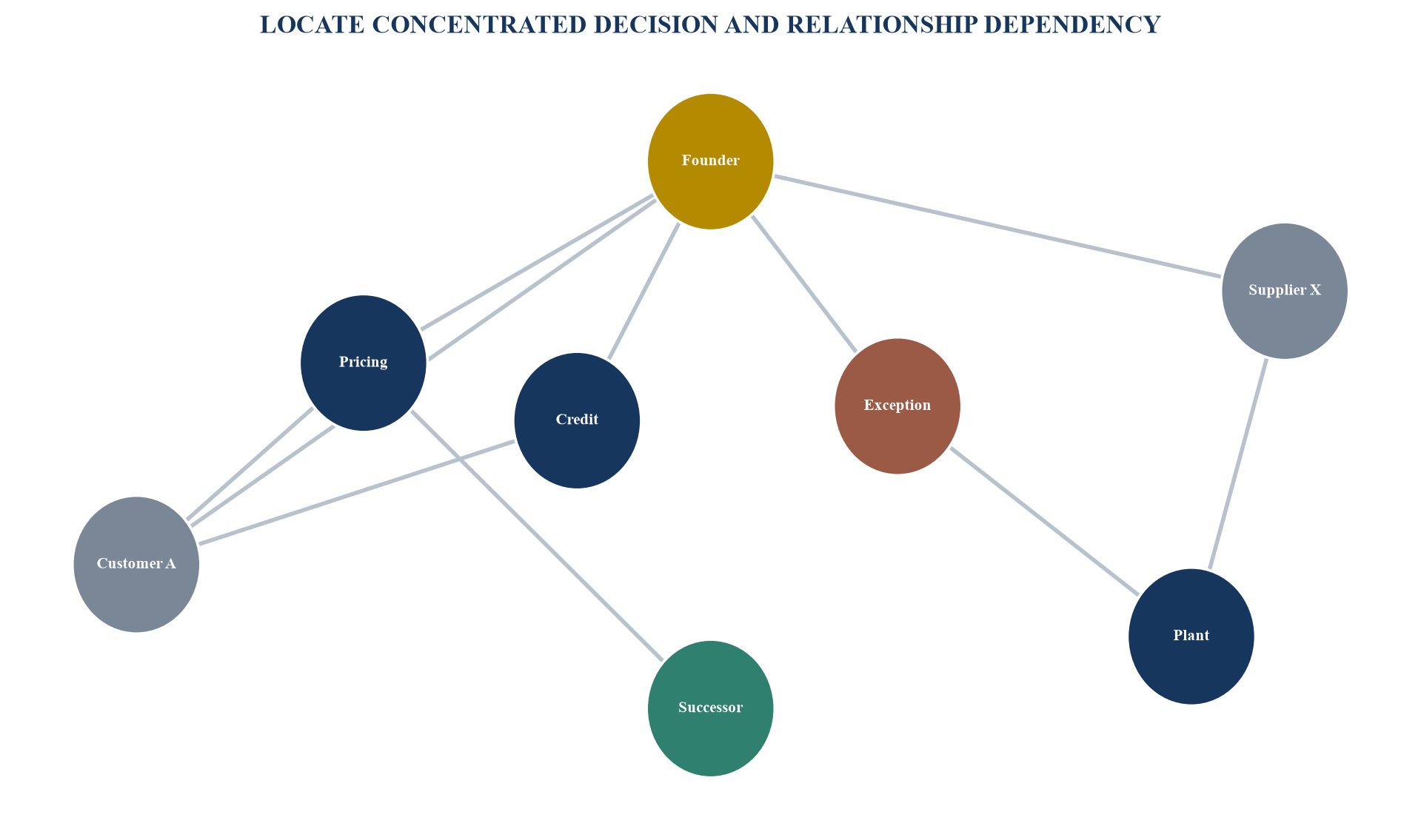
Nodes and links should be generated from authorised evidence and validated by accountable process owners.
The map should join people, roles, decisions, processes, customers, suppliers, assets, systems, documents, incidents and controls. Direction and time matter. A founder may initiate a relationship while a commercial team now maintains it; a process may look distributed until a rare exception returns to one person.
Centrality can help prioritise interviews and controls, but it does not establish economic materiality. The programme should overlay revenue, contribution, working capital, service, compliance, safety and replacement time. Sensitive personal and family links should be restricted to authorised users.
Map quality should be tested against recent work. Select material decisions and incidents, reconstruct the actual participants and compare them with the formal design. Missing nodes, late consultations and repeated founder escalation indicate that the map is incomplete. A temporal view can show whether concentration is improving or whether new dependency is forming around a successor, chief operating officer, customer director or system administrator.
6. Prioritise economically material knowledge
Priority should reflect consequence, frequency, uniqueness, volatility, replacement time and transfer difficulty. A daily low-value approval can be delegated quickly; an infrequent regulatory judgement can threaten the licence to operate. Revenue alone can understate supplier, quality, cash or safety dependency.
Each item should receive a reasoned score supported by incidents, decisions and owner review. Scoring is a triage mechanism rather than a valuation conclusion. The team should test concentration by individual, relationship, site, product and event type.
Early effort should target high-consequence knowledge with a credible capture route. Some dependencies require a second person, contractual change, system integration or external adviser rather than an AI tool.
Prioritisation should recognise portfolio effects. Ten individually modest decisions can create material exposure when they all depend on one person or occur during the same seasonal window. Dependencies can also amplify one another: supplier allocation knowledge, customer promises and working-capital authority may converge during a shortage. Scenario-based prioritisation can reveal these compound events and prevent the programme from treating each knowledge item as independent.
7. Design the process ontology
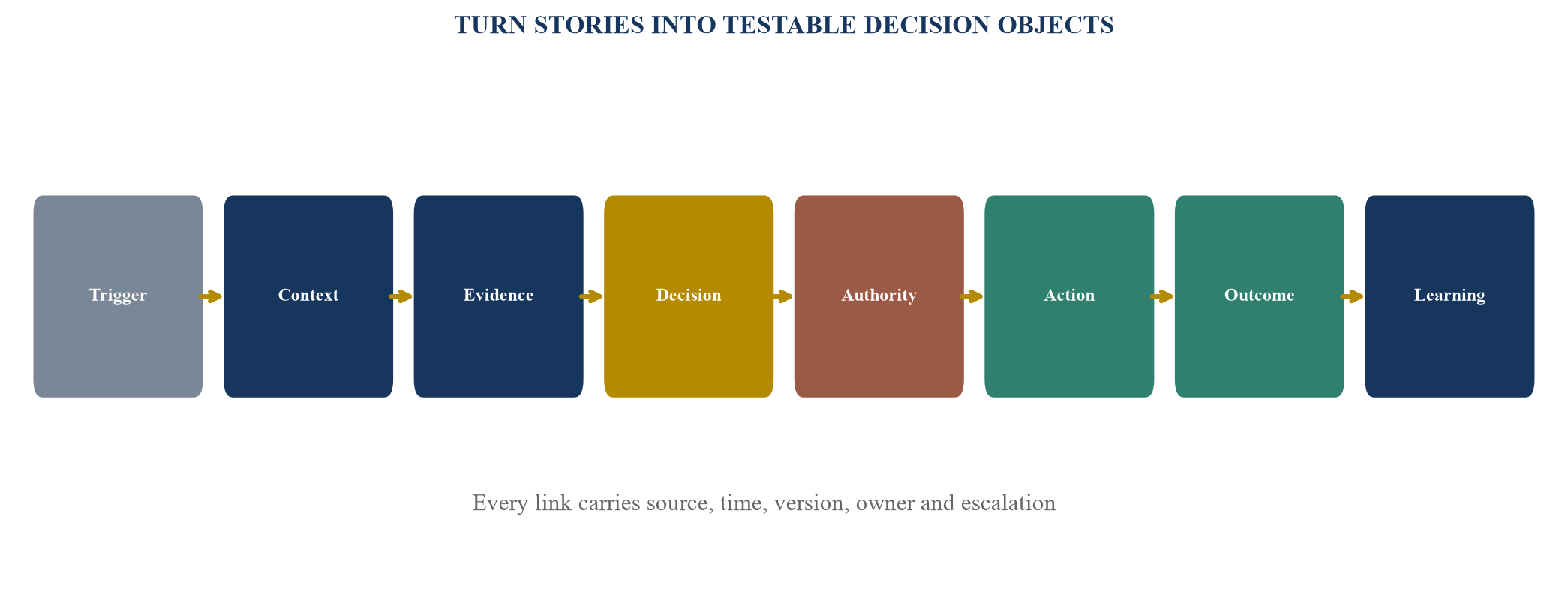
The ontology should preserve evidence, authority, exceptions and cash consequences.
The ontology should describe triggers, context, evidence, decision, authority, action, outcome, exception and learning. It should link commercial and operating language to systems and financial measures. Definitions need owners and examples so that successor, employee and model interpret terms consistently.
The structure should preserve uncertainty and escalation. A procedure that forces every case into a rule can erase the judgement being transferred. Decision objects should state what is known, what remains uncertain, which constraint dominates and when a higher authority is required.
Ontology governance should include a steward, definition approval, versioning and deprecation. Business terms such as strategic customer, acceptable credit, urgent order and critical supplier can carry different meanings across functions and generations. Example cases, counterexamples and measurable thresholds can reduce ambiguity. Mapping terms to accounting, customer, product and workflow identifiers allows decisions to reconcile to operating and financial evidence rather than remain a separate knowledge exercise.
8. Freeze the evidence perimeter
The perimeter should identify legal entities, businesses, sites, periods, systems, communication channels, customer and supplier records, family documents and employee data included. Access should follow purpose, authority, confidentiality and jurisdiction.
Acquisitions, system migrations and informal channels can fragment evidence. The team should reconcile identities, dates, versions and ownership before training or retrieval. Private messages and personal devices should not be collected merely because they may contain useful history; lawful basis, consent, employment rules and proportionality require review.
The evidence pack should include explicit exclusions and known gaps. Missing history can be addressed through interviews, external corroboration, successor testing and conservative treatment rather than silent completion by a model.
Evidence preservation should follow a defensible cut-off. Messages and documents can change during transition, and a buyer may need to distinguish what existed at signing from what was prepared later. Hashes, export logs, custodians, collection dates and legal review can support integrity where material. The programme should avoid broad collection without purpose; a narrower, well-governed record is more useful than an uncontrolled archive containing personal, privileged or irrelevant material.
9. Interview for decisions rather than biography
Interviews should centre on recent decisions, difficult exceptions, failed attempts, signals, alternatives and outcomes. Questions such as “walk through the last time” produce more testable material than broad requests for lessons. Source records should be available during follow-up.
The interviewer should separate fact, recollection, opinion, preference and hypothesis. Leading questions can manufacture consistency. Important claims should be corroborated with contracts, system events, customers, suppliers, employees or financial outcomes where authorised.
Transcripts require review by the speaker and process owner. Corrections should preserve versions. The aim is a usable decision record, not a polished founder narrative.
Interview sampling should extend beyond senior family members. Customers, suppliers, supervisors, frontline employees and advisers may observe different parts of the decision system. Their evidence can confirm, qualify or contradict the founder account. Participation should be authorised and proportionate. The programme should identify where deference, loyalty, conflict or fear may shape responses and should use concrete events, source records and separate interviews to improve reliability.
10. Observe work in context
Shadowing can reveal information cues, sequence, interruptions, tool use and informal consultation absent from interviews. Observation should cover routine activity and selected exceptions without disrupting service or collecting unnecessary personal data.
The observer should record trigger, evidence inspected, alternatives, communications, approvals, action and outcome. Screen, call or meeting capture requires appropriate notice and authority. Sensitive customer, employee and family information should be minimised or redacted.
Comparison across operators can distinguish personal habit from necessary process. Differences should be tested against quality, service, cost and risk before standardisation.
Observation plans should include sampling across location, shift, product, customer and demand condition where those dimensions matter. A process that works while the founder is present may behave differently during absence, peak load or disruption. The observer should distinguish action from explanation and record waiting, rework and informal coordination. These details can identify which knowledge needs training, which process needs redesign and which system lacks the information required for independent execution.
11. Capture critical incidents
Critical incidents include customer loss, supplier failure, quality escape, covenant pressure, cyber event, regulatory inquiry, safety issue, product launch and liquidity shock. They reveal decision logic that normal procedures may never invoke.
The record should reconstruct chronology, information available at each point, alternatives, authority, actions, consequences and subsequent learning. Hindsight should be controlled; the decision should be judged against information then available.
Incident patterns can inform simulations and escalation rules. Confidentiality, privilege and regulatory obligations require legal review before material enters a knowledge system or transaction data room.
The analysis should compare intended and actual governance. If an incident was resolved by bypassing approval, the programme should determine whether the rule was impractical, the authority unavailable or the action improper. Converting every successful workaround into precedent can institutionalise control weakness. A validated lesson should state the condition, risk, authorised response and evidence required, together with changes to policy, system or capability.
12. Map customer relationship knowledge
Customer knowledge may include operating context, specifications, decision makers, service expectations, pricing terms, complaint history, credit behaviour and relationship boundaries. The programme should distinguish contractual rights, permitted business records and personal familiarity.
Transfer should occur through account plans, shared meetings, documented commitments, system ownership and measured customer continuity. Introducing a successor without operational credibility can increase risk. Milestones should include independent handling of routine and difficult interactions.
Valuation should follow retained contribution and relationship transfer, subject to accounting and legal treatment. A contact list alone does not prove control or future economic benefit.
Customer transition can be segmented by economic and behavioural risk. Some accounts depend on technical knowledge, others on personal trust, contractual performance, credit flexibility or emergency availability. The successor plan should address the actual dependency. Tracking meetings alone can overstate progress; evidence should include decisions made, commitments met, complaints resolved and commercial outcomes. Customer consent and confidentiality should govern what history is shared with successors and systems.
13. Map supplier and ecosystem knowledge
Supplier value can depend on allocation priority, technical support, credit, exclusivity, certification, quality response and personal trust. The business should identify which benefits are contractual, customary, performance-based or individual.
The transfer plan should include consent, joint operating reviews, alternative sources, specification records, order history and escalation contacts. A founder introduction should be followed by successor-led execution and evidence that terms and service persist.
Buyer diligence should test change-of-control, concentration, substitution, working-capital effects and the cost of formalising informal arrangements.
Supplier knowledge should include the negative history that explains current terms: prior shortages, quality disputes, delayed payments, certification failures and commitments made personally. That context can prevent a successor from reopening settled issues or assuming a benefit is permanent. It should be corroborated and access-controlled. The transition should also identify whether supplier power could increase when the founder departs and whether alternatives are technically approved, economically viable and available within the required time.
14. Capture commercial exception logic
Exceptions in price, credit, warranty, delivery, returns and exclusivity often contain the founder's most valuable judgement. Each exception should record trigger, baseline rule, evidence, authority, reason, duration, customer consequence and outcome.
Recurring exceptions may indicate an outdated policy or hidden customer segment. One-off exceptions can remain non-repeatable. The system should distinguish precedent from circumstance and expire approvals where conditions change.
AI can retrieve analogous cases, but human authority should remain explicit for material credit, legal, safety or relationship decisions.
Exception analysis should identify patterns by account, decision maker, product, reason, value and outcome. Frequent founder overrides may reflect superior judgement, outdated policy, weak data or an organisational habit of escalating responsibility. Each explanation has a different response. Controlled delegation requires limits and feedback, while policy redesign requires broader evidence. The programme should avoid using historical exceptions as training labels until their quality and legitimacy are reviewed.
15. Capture operating exception logic
Operating exceptions can involve machine settings, substitute materials, quality concessions, maintenance sequencing, scheduling, logistics and emergency sourcing. Some practices may be unsafe, non-compliant or obsolete even when they appear effective.
Capture should include technical evidence, constraints, approvals, inspection, outcome and lessons. Engineering, quality, safety and regulatory owners should validate material instructions. Unapproved workarounds should enter remediation rather than a reusable playbook.
The successor should demonstrate correct use under representative conditions and know when the case exceeds authorised limits.
Operating knowledge often includes sensory and spatial cues that text captures poorly: sound, vibration, appearance, sequence, access constraint and environmental condition. Approved photographs, video, sensor traces, drawings and supervised practice can complement procedures. The record should avoid implying that an image or model diagnosis replaces qualified technical judgement. Testing should confirm that the successor can recognise abnormal conditions, stop work and obtain the correct authority.
16. Build a governed knowledge repository
The repository should preserve native sources, metadata, ownership, access, retention, confidentiality, version and approval. Search convenience should not replace records management. Derived summaries must link to evidence and state limitations.
Content should be organised around decisions and processes as well as folders. A user should be able to retrieve the current approved procedure, relevant exceptions, underlying evidence and accountable owner. Archived versions remain necessary for audit and learning.
Role-based access, encryption, logging, backup, recovery and deletion should follow the information risk. Customer, employee, family and transaction materials may require separate domains.
Repository ownership must survive the transition. Named content owners should review decisions and sources at a frequency linked to change and consequence. Departing employees should transfer control, while revoked accounts and preserved audit histories protect integrity. Search analytics can reveal unanswered questions and stale material, subject to privacy controls. The board should fund maintenance, because an unmanaged repository can become less reliable as the business evolves.
17. Use AI for discovery and classification
AI can identify related documents, entities, topics, duplicates, missing fields and potential dependencies across authorised corpora. Discovery outputs are candidates for review. Confidence, source and model version should remain visible.
Classification should use a controlled taxonomy with human review for material content. Models can misread context, privilege, ownership and currency. Sensitive-class detection should be tested on representative languages, formats and legacy records.
The economic case should include ingestion, cleaning, review, security, licences, compute and ongoing maintenance. A one-time document exercise does not establish a living capability.
Discovery should be benchmarked against a known sample before scale. Measures can include recall of material records, false inclusion, entity resolution, confidentiality classification and reviewer effort. Performance may differ by language, scan quality, handwriting, legacy format and technical vocabulary. The deployment plan should preserve a manual route for content the system cannot interpret and should record which sources remain outside the searchable corpus.
18. Use AI for retrieval with citations
Retrieval should return the relevant approved source, passage, date, owner and confidence. Generated summaries should cite evidence and distinguish current policy from historical example. The interface should show when no supported answer exists.
Access controls must be enforced before retrieval so that a model cannot disclose content the user may not see. Prompt injection, poisoned documents and embedded instructions require filtering, testing and monitoring. Logs should support investigation without retaining unnecessary personal data.
High-consequence decisions need source review and accountable approval. Retrieval accelerates preparation; authority remains with the designated role.
Retrieval evaluation should use questions drawn from real workflows and include adversarial cases, superseded documents, conflicting sources and missing answers. Citation presence does not prove support; reviewers should examine whether the cited passage entails the answer and whether the document is current and authorised. Metrics should be reported by decision class and consequence. Critical failure rates can matter more than an average score across routine questions.
19. Control generated procedures
AI can draft procedures from interviews, observations and source records. The draft should be reviewed by process, legal, quality, safety, finance and information owners as relevant. Approval should identify scope, prerequisites, exceptions and escalation.
Fluent synthesis can conceal contradictions. The review should trace each material instruction to evidence, test it in practice and record unresolved gaps. The generated draft should never overwrite the source history.
Procedures need change control and scheduled review. A succession repository that freezes founder practice can block necessary innovation.
The approved procedure should identify what remains judgemental. Examples can show why different responses were appropriate under different conditions, while preserving customer and employee confidentiality. Users should be encouraged to report mismatch between procedure and reality. A controlled feedback route can convert experience into updated organisational knowledge without allowing informal edits to alter critical instructions.
20. Build decision simulations
Simulations can present representative customer, supplier, operating and cash scenarios to a successor. The system should vary information quality, time pressure and competing objectives. Outcomes should test reasoning, evidence use, escalation and communication rather than agreement with one historical answer.
Scenario authors should identify source, assumptions, correct constraints and acceptable decision range. Synthetic scenarios should be labelled inside internal workpapers and should not be confused with actual incidents or financial results.
Performance should improve through feedback and repeated practice. Results can inform training and delegation, while employment and family consequences require fair governance.
Simulation design should avoid teaching users to imitate the founder mechanically. Scoring should reward evidence gathering, option generation, risk recognition, communication and appropriate escalation. Multiple acceptable outcomes may exist. A facilitator can examine whether the successor understands why an action worked and how the decision changes under different cash, customer or regulatory constraints. Results should support development and governance rather than become an opaque employment decision.
21. Create the successor practice loop
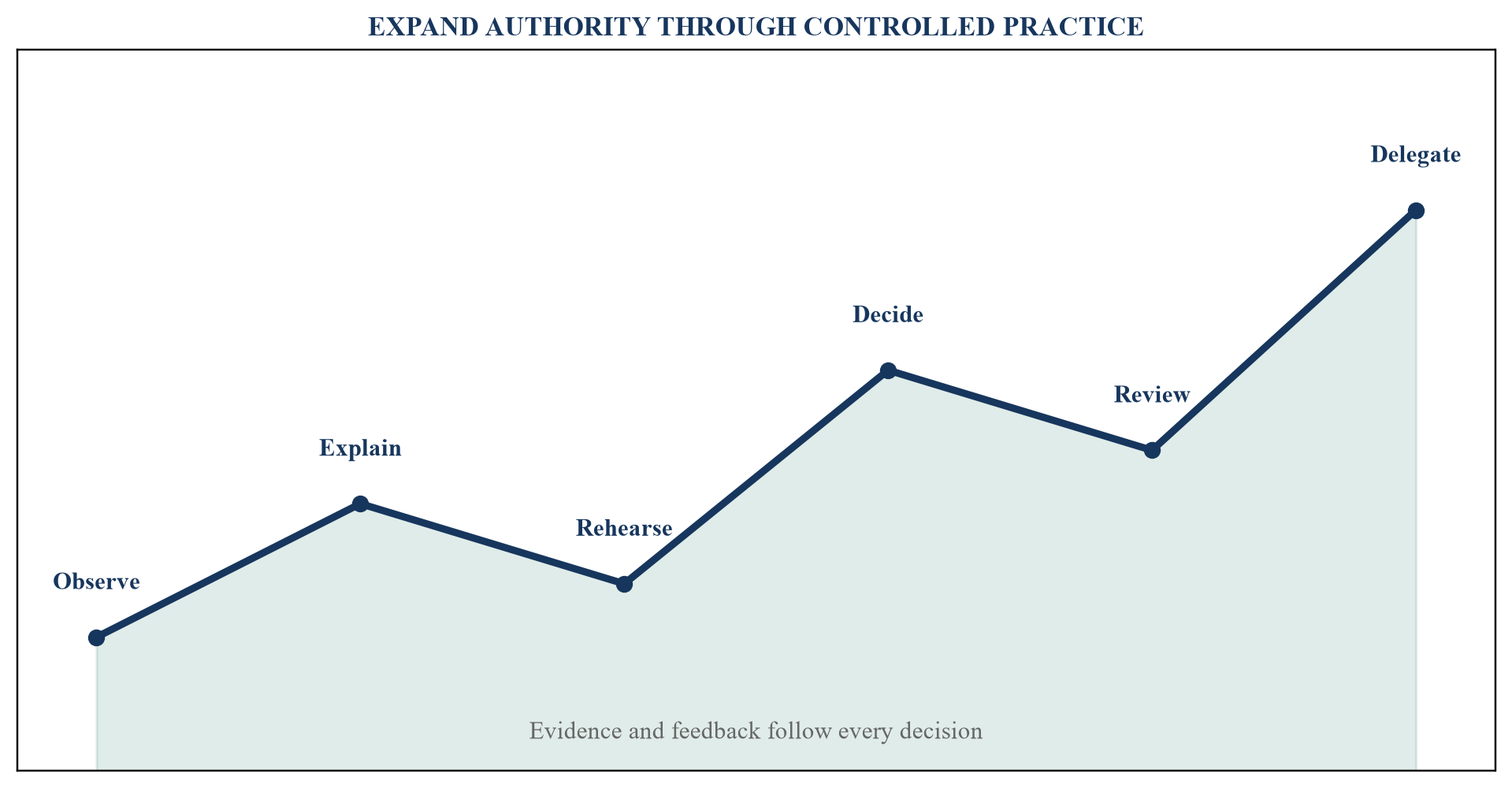
Authority expands after observed competence, controlled rehearsal and outcome review.
The loop begins with observation and explanation, then moves through rehearsal, supervised decision, outcome review and bounded delegation. The founder should explain cues and trade-offs; the successor should articulate an independent rationale. Disagreement can reveal hidden assumptions.
Authority should expand by decision class and consequence. Routine decisions may transfer before strategic customer, capital or crisis authority. Delegation should be recorded in governance and systems, not merely understood informally.
The test is sustained outcome quality during reduced founder involvement. A successful meeting attended by the founder is weak evidence of independence.
Practice should be scheduled around the operating calendar so the successor encounters renewals, budgeting, peak demand, supplier negotiation and selected crisis exercises. Where a rare event cannot be observed, simulation and external expert review can provide partial evidence. The programme should document which capabilities have been demonstrated, rehearsed, explained or remain untested. These categories should not be collapsed into one completion percentage.
22. Measure knowledge-transfer quality
Measures should include coverage of material decisions, source traceability, retrieval precision, procedure currency, successor performance, escalation quality, customer and supplier continuity, incidents, time to decision and founder interventions.
Activity measures such as interviews completed or documents uploaded can support programme management. They should not be treated as economic outcomes. Quality should be tested on representative cases and difficult exceptions.
The board should see gaps, overdue reviews, concentrations and adverse outcomes. Measures must avoid incentivising unnecessary documentation or premature delegation.
Measurement should preserve the denominator. A high success rate can result from testing only easy decisions, and a falling founder-intervention count can reflect reduced activity rather than transfer. Reports should show the eligible decision population, exposure, complexity and exceptions. Where evidence is qualitative, the report should identify the reviewer, observation and basis for judgement. Trend interpretation should reflect business volume and transition milestones.
23. Quantify key-person risk
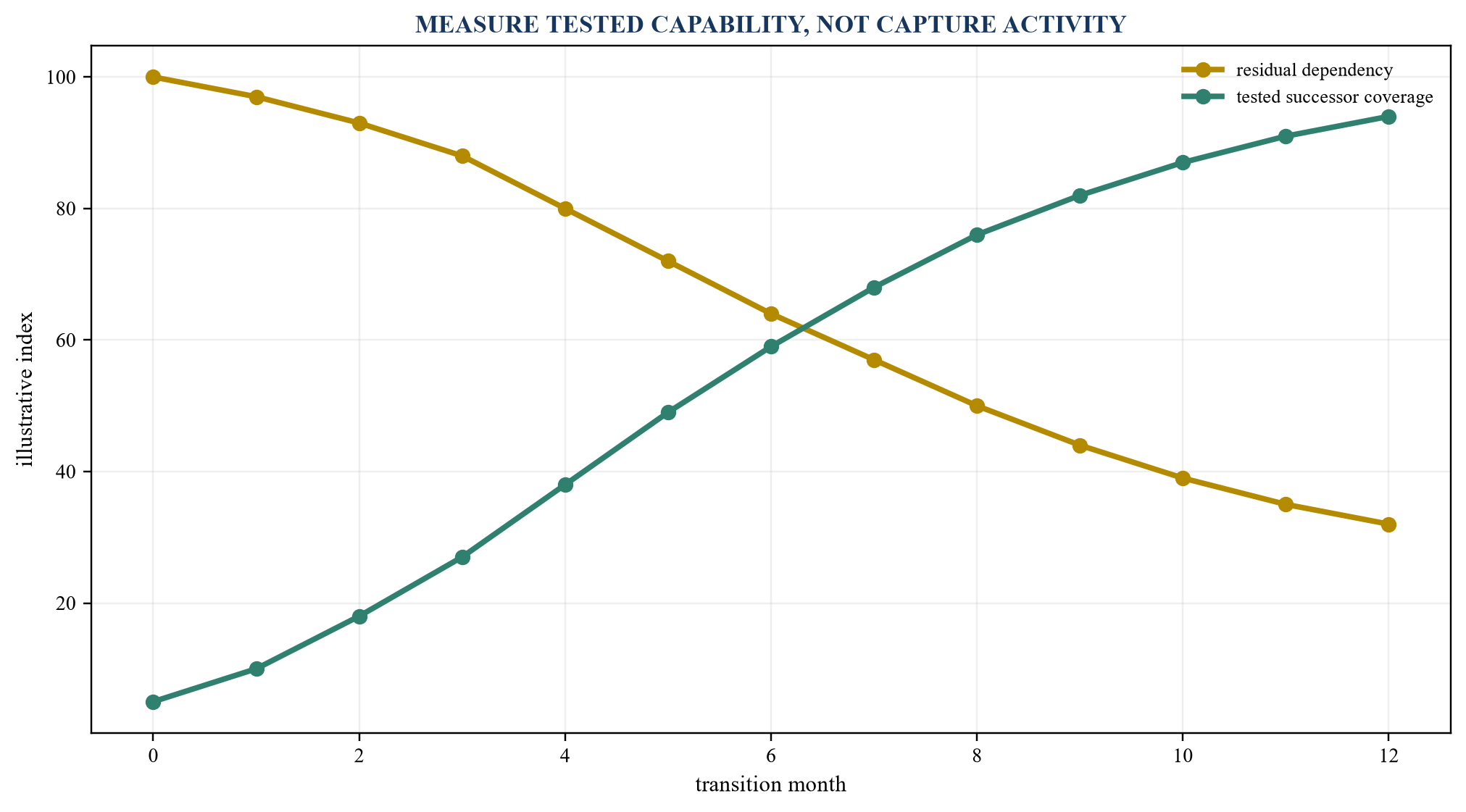
Replace the curve with evidence from defined decision classes, rehearsals and operating outcomes.
Risk should be assessed by decision class, consequence, backup, transfer evidence and time to recover. Probability and impact can be informed by absence tests, intervention logs, incident history, customer concentration and successor performance. Estimates require documented assumptions and sensitivity.
The curve should decline only when a dependency is tested under representative conditions. Capturing an interview can reduce information loss while leaving authority, relationship and execution exposure unchanged.
Insurance, retention, delegated authority, contractual formalisation and external support can mitigate different elements. Residual risk should remain visible in valuation and transaction structure.
Risk aggregation should recognise timing and correlation. Founder absence during a refinancing, major renewal or plant disruption can create a different loss distribution from an ordinary month. The model should examine planned and unplanned absence, partial availability and permanent departure. Recovery time, liquidity headroom and customer or supplier response can be as important as the probability assigned to the event.
24. Link transfer to customer continuity
Customer continuity should be measured through contact coverage, successor engagement, service, complaints, retention, contribution and cash collection. Important customers may need tailored transition plans consistent with contract and confidentiality.
Founder withdrawal should be staged where evidence supports it. The successor should lead relevant interactions while the founder observes or remains available within defined bounds. Hidden founder intervention should be logged because it can overstate readiness.
Customer feedback can validate relationship transfer, yet statements of support are not binding cash flow. Valuation should use observed behaviour and downside scenarios.
Continuity testing should preserve normal commercial accountability. Discounting price or extending credit to secure apparent retention can shift value rather than prove transfer. The bridge should reconcile customer-level revenue, pocket contribution, service cost, receivables and concessions. Lost opportunities and reduced pipeline quality should also be considered where evidence exists, because a customer may remain while future share weakens.
25. Link transfer to supplier continuity
Supplier tests should cover terms, allocation, technical support, quality response, credit, rebates and change-of-control. Successor-led negotiations and problem resolution provide stronger evidence than introductions alone.
The business should reduce dependence through contracts, performance data, multiple relationships and alternatives where economical. Formalisation may change terms, so the value bridge should include cost and working-capital effects.
Material supplier uncertainty may affect purchase price, debt capacity, conditions or transitional support.
Supplier outcomes should be compared with the contractual and economic baseline. A successor may retain nominal credit days while losing allocation priority, engineering support or rebate eligibility. These changes can surface later in inventory, service and margin. The programme should track the full supplier proposition and should distinguish market-wide changes from transition-specific effects through comparable vendors, documented negotiations and operating evidence.
26. Link transfer to management depth
Succession should create a management system rather than replace one central person with another. Decision rights, forums, information, incentives and escalation should distribute authority to capable roles while preserving accountability.
The programme should identify where key managers lack information, authority or development. Retention plans should connect to genuine role criticality and knowledge transfer. Unfunded promises or indiscriminate bonuses can weaken value.
Board and management minutes should evidence independent challenge, decisions and follow-through. A successor who receives every answer from the founder remains dependent.
Management depth should be tested across interfaces. Commercial, operations, finance and technology leaders may each perform well within function while relying on the founder to resolve cross-functional trade-offs. Exercises and live decisions should test who frames the enterprise problem, integrates evidence and makes the final allocation. The transition design can then strengthen forums, information and authority where integration capability is thin.
27. Protect privacy and employment rights
Interviews, messages, recordings and performance analysis can contain personal data. The programme should define lawful basis, purpose, minimisation, access, retention, notice, rights and cross-border transfer with qualified advice. Employee monitoring should be proportionate and transparent.
AI tools should not ingest personal or confidential material outside approved environments. Vendors, subprocessors, locations, training use, deletion and incident responsibilities require review. Sensitive family information should be excluded unless necessary and authorised.
Privacy controls can improve transfer quality by clarifying which knowledge belongs to the business and which remains personal.
A data-protection impact assessment may be appropriate where systematic monitoring, sensitive data, large-scale profiling or innovative technology creates high risk under applicable rules. The assessment should follow the actual system and use. It should identify affected people, necessity, proportionality, access, retention, vendor flows, rights and residual risk. Conclusions require qualified review in the relevant jurisdictions.
28. Protect trade secrets and intellectual property
Valuable know-how may qualify for legal protection only when secrecy and reasonable controls are maintained under applicable law. Access, confidentiality, ownership, contractor terms, labelling and exit processes should be reviewed.
AI services can create disclosure, licence and provenance risk. The business should understand whether prompts, uploads, outputs or feedback are retained or used for training. Generated material should be checked for third-party rights and source attribution.
Transaction disclosures should follow the data-room protocol and clean-team arrangements where required. More capture can increase exposure if controls are weak.
Ownership should be resolved for employee-created materials, consultant deliverables, family archives, software configurations and customer-supplied content. The organisation may possess a copy without owning the right to reuse it for training, transfer or sale. Rights gaps should be recorded with remediation, operating constraint and transaction consequence. Preservation of provenance supports both protection and defensible exclusion.
29. Secure the knowledge system
The system should follow risk-based identity, least privilege, encryption, logging, backup, recovery, vulnerability, supplier and incident controls. Succession can attract fraud because counterparties expect changes in authority and communication.
Critical instructions should require integrity checks and approved versions. Retrieval from compromised content can produce unsafe or fraudulent guidance. Testing should include prompt injection, malicious documents, account takeover and unauthorised export.
Continuity should include offline or alternative access for essential procedures. The knowledge platform must not become a new single point of failure.
Security testing should reflect the transition threat model. Attackers may impersonate the founder, alter bank instructions, exploit delegated authority or target the concentrated repository. Payment, customer-master, supplier-master and access changes should retain independent verification. Incident exercises should include the successor and demonstrate that communication, containment and recovery operate when the founder is unavailable.
30. Govern model and vendor risk
Table 2. AI knowledge-system control matrix
| Risk | Evidence | Control response |
|---|---|---|
| unsupported answer | source and retrieval test | citation, abstention and review |
| obsolete practice | owner and review date | expiry and change control |
| data leakage | access and vendor terms | isolation, minimisation and logging |
| biased capture | coverage and contradiction | diverse interviews and challenge |
| malicious content | provenance and test | filtering, sandbox and monitoring |
| vendor exit | export, formats and rights | portability and replacement plan |
Control depth should reflect information sensitivity and decision consequence.
The inventory should record models, providers, versions, data, purpose, owners, testing, incidents, limitations, dependencies and exit. Vendor claims require verification against contracts and observed performance.
Monitoring should follow answer quality, retrieval, access, latency, cost, incidents and user behaviour. Material changes require revalidation. Contractual protection cannot replace operational controls.
Vendor diligence should cover financial resilience, service locations, support, subcontractors, security certifications, incident history, model changes, data use, intellectual-property allocation, audit, insurance, liability and termination. Exit testing should demonstrate that content, metadata and logs can be exported in usable formats and deleted where required. Replacement time and operating disruption belong in the continuity and valuation analysis.
31. Establish human authority and escalation
Every decision class should have an accountable role, permitted support, approval threshold, escalation and record. The interface should distinguish information retrieval, recommendation, draft and execution. Users should understand when AI is involved.
High-consequence commercial, employment, legal, safety, regulatory and capital decisions require appropriate human review. Escalation should be practical under time pressure and should preserve context rather than restart the case.
Repeated escalation can reveal a missing rule, weak training or poor system boundary. Governance should learn from the pattern.
Authority should be reflected consistently in board delegations, bank mandates, contracts, enterprise systems, workflow limits and external communications. A successor who is nominally empowered but cannot approve payment, access records or bind the company cannot reproduce the role. The transition checklist should confirm effective dates, dual control, revocation of obsolete authority and contingency for incapacity or disagreement.
32. Validate the system independently
Validation should test completeness, accuracy, source traceability, access, abstention, adversarial content, currency and usefulness. Test sets should include routine questions, rare exceptions, contradictory evidence and cases where no answer exists.
Reviewers should include process owners, successor users, information security, privacy and independent challenge. Results should be retained by version and population. Passing an average threshold should not conceal failure on critical cases.
Deployment approval should state limitations, permitted uses and monitoring. Material findings enter the transition plan and valuation risk.
Independent validation should be organisationally able to challenge the programme sponsor and technology provider. Review scope, evidence and findings should be available to the board or transaction committee. Remediation closure should be retested rather than accepted by statement. Where a limitation cannot be resolved before the decision date, the system boundary and valuation treatment should reflect it explicitly.
33. Build the buyer evidence room
Table 3. Buyer evidence room for succession transferability
| Module | Core evidence | Buyer question |
|---|---|---|
| governance | roles, authority, board and family protocols | who controls decisions? |
| dependency | maps, interventions and absence tests | where is concentration? |
| relationships | contracts, plans and transition outcomes | what transfers? |
| operations | procedures, exceptions and incidents | can work be reproduced? |
| technology | architecture, rights, controls and tests | is the system reliable? |
| value | continuity, cost, cash and downside | what is capitalisable? |
Summaries should link to native evidence, owners, dates and open issues.
The room should preserve native files, source lineage, dates, ownership, confidentiality and version. Management presentations should reconcile to evidence. Open gaps require owners and transaction treatment.
Personal family information should remain outside buyer access unless necessary, lawful and appropriately controlled. Redaction and staged disclosure can protect legitimate interests.
Buyer access should be sequenced by diligence need and competitive sensitivity. Customer names, supplier terms, employee records and family protocols may require anonymisation, aggregation, clean teams or late-stage disclosure. The seller should maintain a disclosure log and ensure that summaries remain accurate after redaction. Access restriction should not be used to conceal a material dependency; the issue can be described and tested through controlled procedures.
34. Translate evidence into valuation
Valuation should begin with operating cash under the expected ownership and management structure. Key-person exposure can affect revenue retention, margin, working capital, investment, cost, growth, discount rate, probability, terminal assumptions and transaction structure. Adjustments should avoid double counting.
Demonstrated successor capability, formalised relationships, management depth and controlled knowledge systems can narrow uncertainty. Programme spending is not automatically an asset or value increase. Accounting recognition and transaction economics are distinct and require appropriate standards.
The buyer should separate target improvements, buyer synergies and remaining execution. Sensitivities should show customer loss, supplier term change, delayed delegation, management departure, system failure and remediation.
Table 5. Buyer treatment of succession-transfer claims
| Claim class | Required evidence | Illustrative treatment |
|---|---|---|
| demonstrated continuity | controlled absence and stable outcomes | base cash flow support |
| tested successor capability | representative decisions and authority | risk-range improvement |
| captured but untested knowledge | sources and approved process | execution plan with probability |
| buyer-specific management depth | buyer resources and integration | separate synergy case |
| retained founder dependency | contract, availability and limits | cost, downside and structure |
| unresolved relationship risk | customer or supplier evidence gap | sensitivity, reserve or condition |
Treatment should follow operating evidence, transferability, timing and residual dependence.
Adjustment classification should remain consistent across commercial diligence, quality of earnings, valuation, financing and transaction documents. Moving a benefit from the forecast into a run-rate label does not improve its evidence. The committee should record amount, source, decision owner, confidence range, expected validation date and protection for every material adjustment.
35. Construct the value bridge
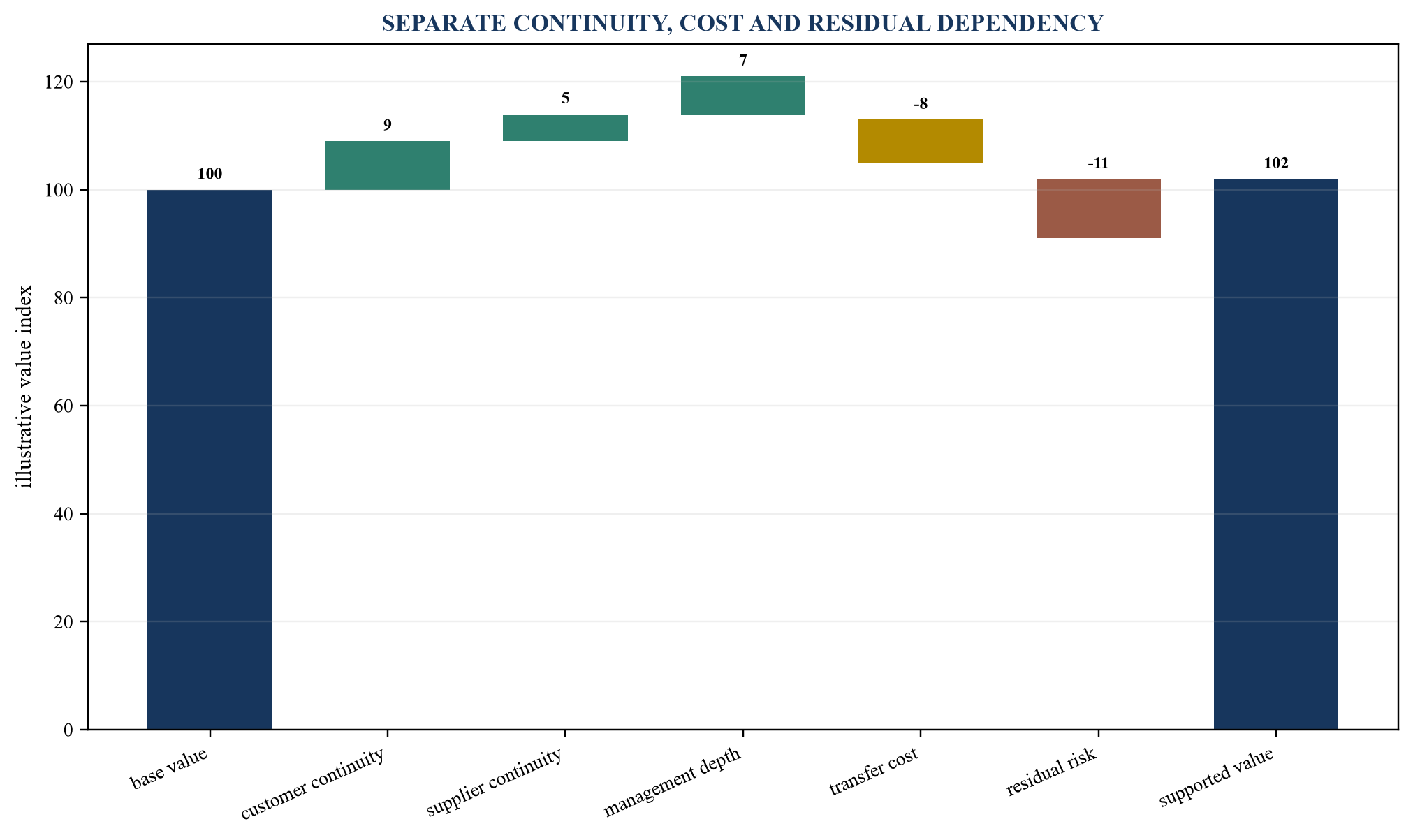
Values are conceptual; replace them with reconciled transaction cash flows and supported buyer assumptions.
The bridge should reconcile the base case to supported continuity effects, implementation and retention cost, timing, tax, investment and residual downside. Each element needs source, owner, probability and sensitivity. One benefit should not appear in both cash flow and discount rate without clear rationale.
Strategic optionality can be described separately until evidence supports cash. The final range should remain consistent with commercial diligence, quality of earnings, financing and transaction documents.
36. Use transaction structure for residual risk
Earn-outs, holdbacks, escrow, warranties, covenants, transitional services, founder consultancy, retention and staged authority can allocate specific risk. Structure should match measurable uncertainty and avoid keeping the successor permanently subordinate.
Metrics require precise definitions, systems, access, accounting policy, control over decisions and dispute mechanisms. Founder support should have scope, availability, authority, confidentiality, conflicts, liability and termination. Relationship introductions without deliverables are difficult to value.
Structure cannot cure an untransferable business model. Material unresolved dependency may justify lower value, delayed closing or a different transaction perimeter.
37. Design the transition governance
Governance should include sponsor, programme lead, family and board interface, process owners, successor, technology, information, legal and independent challenge. Decisions and conflicts should follow agreed authority.
The dashboard should show material dependencies, capture, validation, successor testing, founder interventions, customer and supplier outcomes, incidents, cost and residual risk. Personal performance data requires controlled access.
The programme should stop or redesign activities that create privacy, security, service or family-governance harm. Pace should follow evidence and organisational capacity.
38. Execute a one-hundred-day plan
Table 4. One-hundred-day knowledge-transfer plan
| Period | Primary work | Decision gate |
|---|---|---|
| days 1–30 | freeze perimeter, map dependencies and secure evidence | approve priorities and access |
| days 31–60 | capture decisions, build ontology and test retrieval | approve controlled pilot |
| days 61–100 | rehearse successors, validate outcomes and quantify risk | approve delegated authority |
Timing should reflect transaction stage, family governance and operating risk.
The first month should identify high-consequence decisions, preserve evidence, establish lawful access and address urgent continuity gaps. The second should combine interviews, observation, incident reconstruction, controlled repository and source-grounded retrieval.
The final phase should test successors on representative decisions, measure customer and supplier continuity, validate controls and update valuation treatment. Unresolved dependencies should have mitigation, owner and transaction consequence.
39. Identify red flags
Red flags include a document count presented as readiness, generated procedures without sources, a successor who lacks authority, customer introductions without independent outcomes, private messages ingested without governance, obsolete founder practice, hidden interventions and a valuation uplift based on programme spend.
Other signals include one administrator with unrestricted access, vendor training on confidential data, missing export rights, no abstention, untested rare events, relationship benefits without contracts or evidence, management retention without role analysis and a terminal assumption that founder dependency disappears automatically.
A red flag is a diligence prompt. Its effect depends on evidence, materiality, remediation and protection. Related clusters can indicate that transferability has not been demonstrated.
40. Conclusion
Family-business succession becomes investable when critical decisions and relationships can be reproduced through authorised people, governed evidence, tested workflows and accountable escalation. AI can accelerate discovery, organisation, retrieval and practice; value arises from continuity and cash that survive reduced founder dependence.
The practical standard is reproducibility. An independent reviewer should be able to trace a material decision from trigger and context through evidence, authority, action, outcome and learning. The successor should demonstrate capability under representative conditions, and the board should see residual dependency without cosmetic scoring.
Strong evidence can support continuity, financing, transaction confidence and focused investment. Weak evidence should lower value, increase protection or delay delegation. The resulting system gives families, boards, lenders and buyers one language for knowledge, succession risk and transferable value.
For a transaction committee, the final output should be a concise bridge from person-dependent claim to tested organisational capability. It should state what is controlled, what remains reliant on individuals, which relationships have transferred, what the system costs, how authority works and how downside is protected.
References
- Organisation for Economic Co-operation and Development, Business transfer as an engine for SME growth, https://www.oecd.org/en/publications/strengthening-smes-and-entrepreneurship-for-productivity-and-inclusive-growth_c19b6f97-en/full-report/component-9.html
- European Commission, Business transfers, https://single-market-economy.ec.europa.eu/smes/continuity-and-exit/business-transfers_en
- European Commission, Recommendation on the transfer of small and medium-sized enterprises, https://single-market-economy.ec.europa.eu/document/download/0eaf3116-9bd8-4c6f-91e2-9805c5367b86_en
- International Organization for Standardization, ISO 30401 Knowledge management systems, https://www.iso.org/standard/68683.html
- International Organization for Standardization, Draft revision of ISO 30401, https://www.iso.org/obp/ui#iso:std:iso:30401:dis:ed-2:v1:en
- National Institute of Standards and Technology, Artificial Intelligence Risk Management Framework 1.0, https://www.nist.gov/publications/artificial-intelligence-risk-management-framework-ai-rmf-10
- National Institute of Standards and Technology, Generative Artificial Intelligence Profile, https://nvlpubs.nist.gov/nistpubs/ai/NIST.AI.600-1.pdf
- National Institute of Standards and Technology, AI RMF Playbook, https://airc.nist.gov/docs/AI_RMF_Playbook.pdf
- National Institute of Standards and Technology, Cybersecurity Framework 2.0, https://www.nist.gov/cyberframework
- IFRS Foundation, IAS 38 Intangible Assets, https://www.ifrs.org/issued-standards/list-of-standards/ias-38-intangible-assets/
- IFRS Foundation, IFRS 3 Business Combinations, https://www.ifrs.org/issued-standards/list-of-standards/ifrs-3-business-combinations/
- International Valuation Standards Council, International Valuation Standards, https://ivsc.org/standards/
- International Valuation Standards Council, Making Intangibles More Tangible, https://ivsc.org/ivsc-perspectives-paper-making-intangibles-more-tangible-series-lessons/
- European Union, Regulation (EU) 2024/1689 laying down harmonised rules on artificial intelligence, https://eur-lex.europa.eu/eli/reg/2024/1689/oj
- United Kingdom Information Commissioner's Office, Guidance on AI and data protection, https://ico.org.uk/for-organisations/uk-gdpr-guidance-and-resources/artificial-intelligence/guidance-on-ai-and-data-protection/
- United Kingdom Information Commissioner's Office, Employment practices and data protection, https://ico.org.uk/for-organisations/uk-gdpr-guidance-and-resources/employment/
- World Intellectual Property Organization, Trade secrets, https://www.wipo.int/tradesecrets/en/
- International Organization for Standardization, ISO/IEC 42001 Artificial intelligence management systems, https://www.iso.org/standard/81230.html
- International Organization for Standardization, ISO/IEC 27001 Information security management systems, https://www.iso.org/standard/27001
- National Institute of Standards and Technology, Privacy Framework, https://www.nist.gov/privacy-framework
- United Kingdom Competition and Markets Authority, AI Foundation Models technical update report, https://www.gov.uk/government/publications/ai-foundation-models-technical-update-report
- United States Federal Trade Commission, Keep Your AI Claims in Check, https://www.ftc.gov/business-guidance/blog/2023/02/keep-your-ai-claims-check
- United States Securities and Exchange Commission, Remarks at the Roundtable on Artificial Intelligence in the Financial Industry, https://www.sec.gov/newsroom/speeches-statements/uyeda-ai-roundtable-032725
- Bank for International Settlements, Artificial intelligence and the economy, https://www.bis.org/publ/bisbull128.htm
- Organisation for Economic Co-operation and Development, OECD AI Principles, https://oecd.ai/en/ai-principles
- International Labour Organization, Protection of workers' personal data, https://www.ilo.org/publications/protection-workers-personal-data
