

1. Define the value-creation decision
The work should begin with the decision being prepared. A board operating plan, pricing redesign, acquisition, sell-side process, financing or post-close integration requires different evidence, horizon and authority. The legal perimeter, service lines, client groups, delivery locations, workforce, contractors, intellectual property and expected buyer contribution should be explicit.
The central question is how a defined AI-enabled workflow change affects quality, throughput, effort, price, demand, cost, working capital and recurring cash. Time saved is an operating observation. Enterprise value arises when the business converts that capacity through additional demand, improved service, higher price, reduced external spend, avoided hiring or a deliberate cost action.
Observed outcomes, funded actions, forecasts and strategic options should remain separate. Each adjustment needs an owner, source, period, transferability test and decision consequence.
Success criteria should be agreed before implementation. They can include accepted output per professional, contribution per engagement, renewal, cash conversion, defect tolerance and capacity converted within a named period. Failure should also be defined: lost revenue, delayed delivery, client escalation, uncontrolled tool use, cost overrun or capability erosion. This decision frame allows the board to compare the initiative with hiring, pricing, acquisition, outsourcing and ordinary process redesign.
2. Map the services economic system
Services economics begin with demand, available skilled capacity, productive utilisation, realised rate, delivery cost, quality and cash collection. Project duration, fixed-price exposure, subcontractors, sales effort, bench, leave, attrition, rework and geographic mix can change contribution materially.
The model should reconcile sold work to scheduled capacity, recorded effort, accepted deliverables, invoice, contract asset, receivable and cash. A practice can report high utilisation while losing value through discounted rates, overruns, partner intervention or delayed collections. It can report improving margin while underinvesting in knowledge, controls or capability.
AI value should follow the limiting constraint. Automation creates little cash when demand is weak and no cost action follows. When talent is scarce, capacity release can support growth without equivalent hiring if quality and customer acceptance persist.
The system should capture how sales, staffing and delivery interact. A practice may win work it cannot staff, hold specialists on bench while the pipeline slips or use senior staff to repair low-quality output. Capacity is not interchangeable across skills, jurisdictions, clearances and client relationships. The model should therefore show where released capacity can actually be deployed and which bottleneck remains after automation.
3. Establish the controlled perimeter
The perimeter should identify service, client, contract, engagement, workflow, deliverable, team, location, grade, system, model and period. Acquired practices often use different time, billing, revenue and cost definitions. A consolidated dashboard can conceal inconsistent populations.
Control rights matter. The company may rely on client data, third-party models, vendor platforms, contractor knowledge or licences that restrict reuse. Data rights, intellectual property, change of control, model access, export, confidentiality and transition support should be mapped before value is attributed.
The cash perimeter should include delivery labour, bench, sales, subcontractors, technology, compute, data, review, security, insurance, remediation, working capital and implementation. Buyer capabilities belong in a separate synergy case.
Perimeter integrity should be tested through sample engagements. Select transactions from proposal to cash and confirm that client identity, scope, team, effort, deliverables, credits, invoice and collection remain linked. Missing identifiers or inconsistent engagement codes can create false productivity and recurrence. The reconciliation should also identify work delivered under framework agreements, statements of work, purchase orders and informal extensions.
4. Build the service evidence ledger
Table 1. AI-enabled services evidence ledger
| Layer | Controlled evidence | Buyer test |
|---|---|---|
| commercial unit | client, contract, engagement and service | what was sold? |
| workflow | task, model, user, time and review | what changed? |
| outcome | deliverable, quality, cycle time and acceptance | what improved? |
| capacity | hours, skill, redeployment and utilisation | what was released? |
| economics | price, labour, technology, rework and cash | what reached contribution? |
| durability | demand, rights, people, controls and competition | what persists? |
Each claim should connect a controlled workflow change to client outcome and cash.
The ledger should retain definition, source, population, version, owner and approval. Estimates and illustrative scenarios should remain distinguishable from observed operating results inside transaction workpapers.
A buyer should be able to select a recurring-value claim and trace it through cash, invoice, accepted service, team, workflow, intervention and baseline. Broken links and unresolved reconciliations enter downside treatment.
The ledger should preserve negative and null outcomes. Failed pilots, rejected outputs, client concessions, waived fees and abandoned reuse are important evidence about scalability. Excluding them can make the model appear more effective and the opportunity larger than it is. Reviewers should see the eligible population, exclusions and reason, together with any changes made after results were observed.
5. Construct the service-capacity model
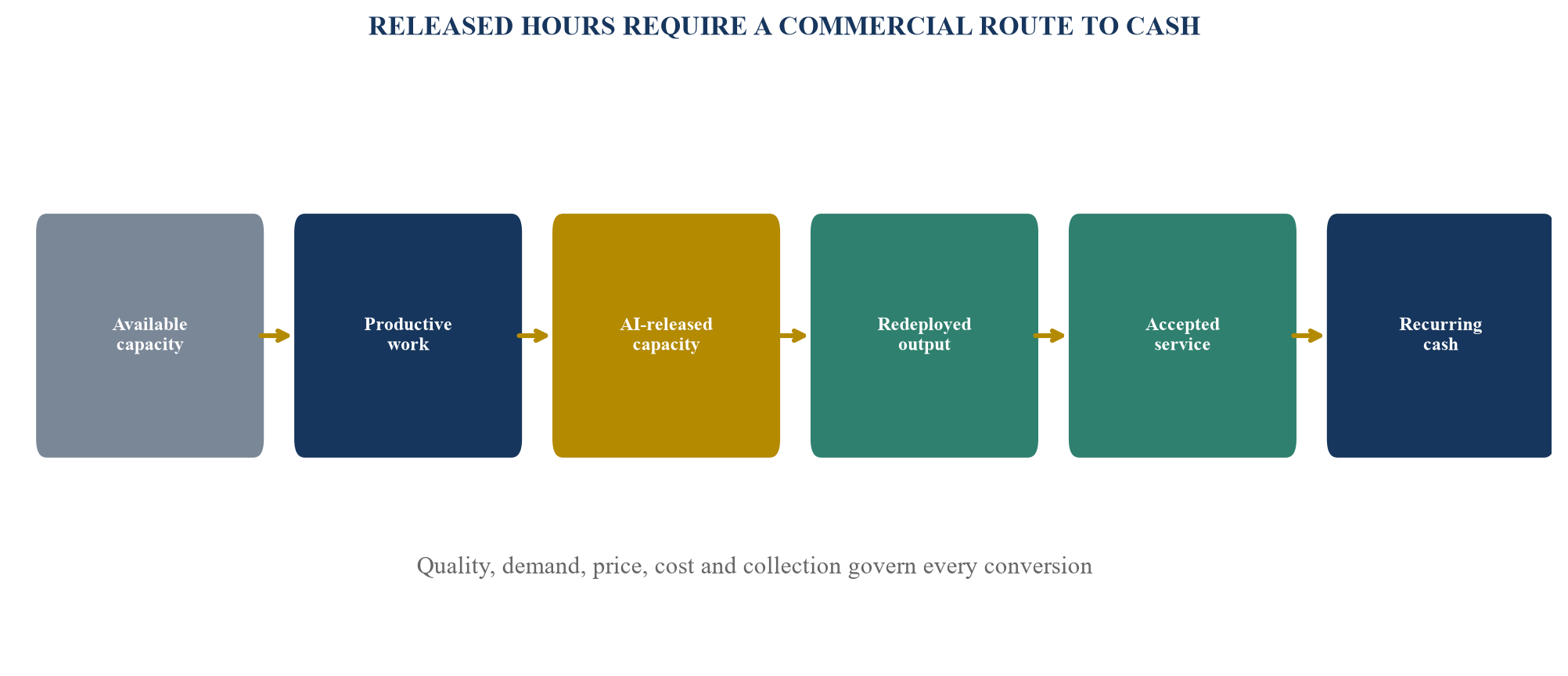
The model should reconcile people, workflow, quality, commercial conversion and cash.
Available capacity should reflect employees and approved contractors by skill, grade, location and calendar. Productive work should distinguish client delivery, internal development, sales support, training, leave, bench and rework. Timesheets require reconciliation and behavioural review.
AI-released capacity should be measured against a controlled baseline at equal or better quality. The conversion path then identifies redeployment, additional output, avoided hiring, external-spend reduction or cost action. Without that path, capacity release remains an opportunity.
Capacity conversion requires timing alignment. Hours released in one role or month may not match demand in another role or quarter. The model should preserve skill, seniority, location, client restriction and calendar. It should include the time needed for training, sales, contracting and assignment. A gross annualised number can overstate value when capacity is fragmented or becomes available after the demand window.
6. Freeze the baseline protocol
The baseline should state workflow, population, period, skill, volume, complexity, input quality, output definition, review, error, cycle time, effort and client acceptance. It should reconcile to delivery and financial systems. Self-reported time estimates should be supported where material.
Demand shifts, staff mix, acquisitions, new tools, contract changes and seasonality can change outcomes during rollout. Adjustments should be defined before results are inspected. Reported and normalised views should remain linked.
Comparable cases matter. A pilot using experienced staff on well-structured work should not be extrapolated to new joiners, difficult clients or exception-heavy engagements without evidence. The baseline should include rework and downstream consequence.
The baseline should also preserve commercial behaviour. Teams may reduce recorded hours because they expect automation targets, move effort into internal codes or perform work outside approved systems. Independent sampling, system events, deliverable timestamps and reviewer effort can complement time records. Changes to scope, acceptance and client involvement should be captured so the evaluation does not attribute a simpler engagement to the tool.
7. Reconstruct the utilisation bridge
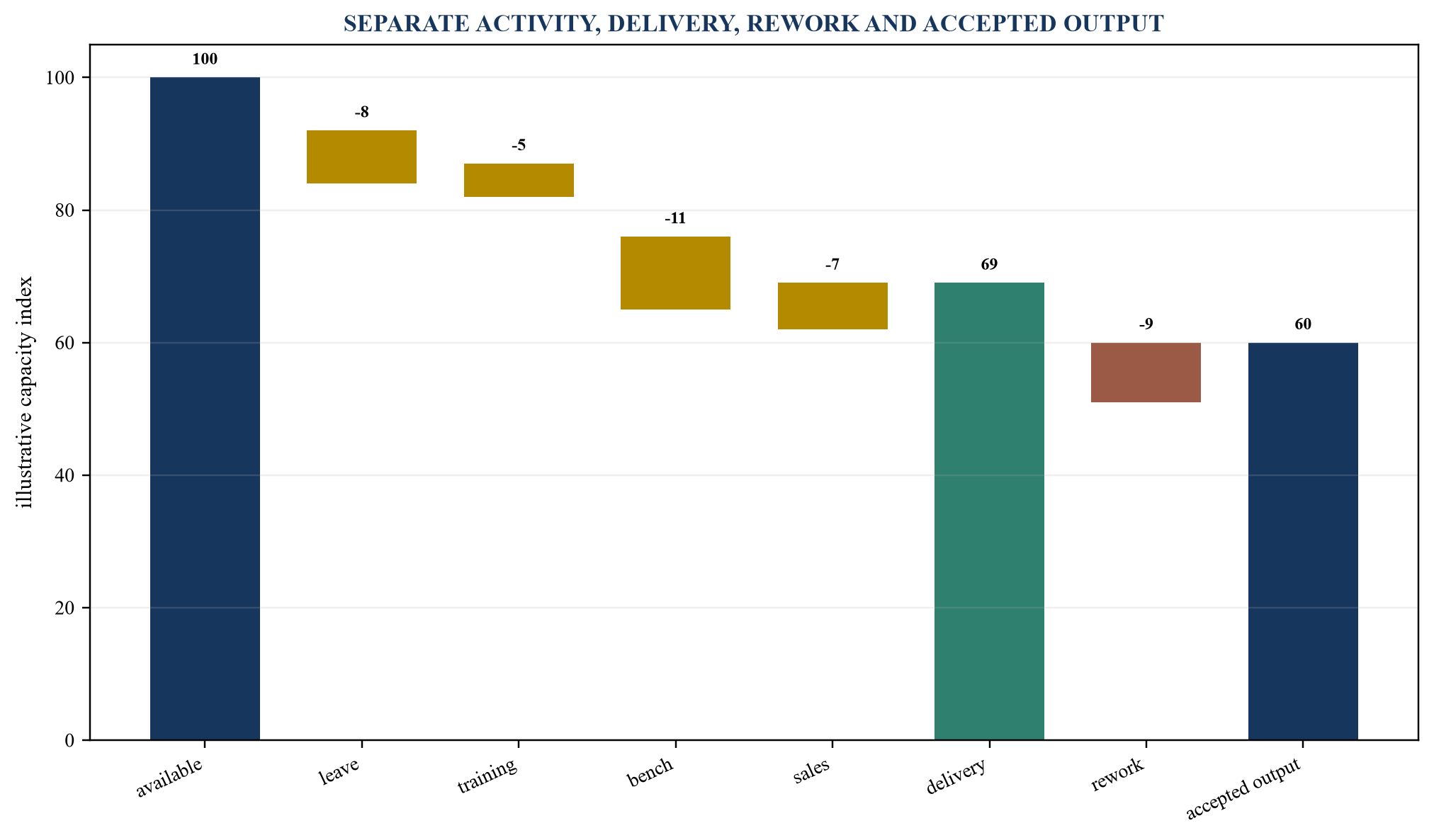
Replace values with reconciled workforce, time, delivery and cash evidence.
Utilisation should be defined consistently. Billable, chargeable, productive and deployed measures can differ. The bridge should show denominator, exclusions, contractors, overtime, partner time and work recorded outside the time system.
AI can reduce delivery hours and therefore reported utilisation before revenue changes. Management should distinguish beneficial efficiency from demand weakness, write-off, staffing imbalance and premature effort reduction. The economic outcome depends on contract type and capacity conversion.
Utilisation should be interpreted with price and contribution. A lower-utilisation subscription service can create attractive cash when delivery is highly standardised, while a fully utilised fixed-price team can destroy margin through overruns. Partner and specialist interventions should be visible even when not charged. The bridge should show planned, recorded, productive and accepted effort, together with the route from released time to an economic result.
8. Decompose engagement economics
Every material engagement should reconcile contracted revenue, variable consideration, delivery effort, labour cost, subcontractors, technology, travel, rework, credit, billing and collection. Shared platforms and senior oversight require a consistent allocation view alongside direct contribution.
Fixed-price work can benefit from lower controlled effort, while time-and-materials revenue may fall unless scope, volume or pricing changes. Managed services can create recurring revenue but require transition cost, service-level capacity and continuous improvement.
Portfolio averages can hide loss-making clients, profitable exceptions and cross-subsidy. Value analysis should examine engagement and client cohorts through their lifecycle.
Engagement economics should distinguish implementation from steady state. Transition, data preparation and workflow integration may be loss-making by design and recovered through future recurring contribution. The contract and cohort model should show whether recovery is protected by term, minimum commitment, termination charge or evidence of renewal. If the client can terminate before payback, the downside belongs in pricing and valuation.
9. Define the automation ladder
The ladder can move from search and drafting to supervised task execution, orchestrated workflow, managed capacity and outcome responsibility. Each step changes evidence, control, skill, contract and pricing requirements. A use case should not advance because the model is fluent.
Assistive tools may improve individual productivity while leaving the operating model unchanged. Workflow automation requires integration, roles, exceptions and monitoring. Outcome models require control over enough of the process to accept delivery and commercial risk.
The business should document intended use, autonomy, review, stop rules and residual manual capacity. Expansion should follow quality and economics.
Movement up the ladder should be governed by evidence gates. Assistive drafting may require source review; supervised execution may require exception sampling; workflow orchestration may require system reconciliation and rollback; managed capacity may require service-level reserves; outcome responsibility may require causal measurement and risk capital. A use case can remain at a lower level when that design produces better economics and control.
10. Measure workflow productivity causally
Randomised rollout, phased adoption, matched teams or credible pre-post designs can estimate effect depending on operational constraints. The unit may be task, deliverable, engagement or team, provided selection and spillovers are addressed.
Measures should include effort, elapsed time, throughput, defects, rework, escalation, client acceptance and downstream outcome. Users who adopt early may differ from controls. A tool can make a draft faster while increasing senior review.
Report effect size, uncertainty, population and duration. Material extrapolation should reflect workflow mix, adoption, implementation capacity and learning.
Evaluation should retain intention-to-treat and actual-use views where possible. High adopters may be more capable or may choose easier tasks. A measured benefit among users does not establish the effect of deployment across the eligible population. The review should examine spillovers, learning, novelty and whether control teams access similar tools. Pre-specified measures reduce selective reporting.
11. Control quality and rework
Quality should be defined by the service: accuracy, completeness, compliance, usability, reliability, timeliness and client acceptance. Internal model scores do not replace outcome evidence. Sampling should target material and difficult cases.
Rework includes correction, senior review, client clarification, rollback and downstream remediation. It can appear in another team or period. The evidence should trace first output to accepted completion.
Automation should have source, review, escalation, incident and version controls. A lower initial effort with higher hidden rework can destroy both margin and trust.
Quality cost should be translated into economics. Review hours, client credits, professional liability, remediation, repeated meetings and delayed billing can offset productivity. Rare material errors may dominate average outcomes. The test set should therefore include high-consequence cases and should track severity as well as count. Control cost should be included in the steady-state service model.
12. Measure client outcome and acceptance
The client may value speed, quality, continuity, insight, compliance, cost or operational performance. The engagement should define which outcome the provider controls and how acceptance is evidenced. Satisfaction alone does not prove economic impact.
Client acceptance can include approved deliverable, service-level performance, reduced exceptions, realised operational result or renewal. Baseline, dependencies and client responsibilities should be explicit.
Claims should avoid attributing the client's entire business improvement to one service intervention. Valuation follows the provider's contracted and repeatable cash.
Acceptance evidence should be linked to contractual rights and behaviour. A signed deliverable can coexist with poor renewal prospects; a high satisfaction score can coexist with disputed scope. The cohort should follow service use, requests, expansion, credits, complaints, renewal and cash. Where client outcome depends on implementation by others, the provider should state its controlled contribution and the assumptions required for impact.
13. Build the demand conversion path
Released capacity becomes growth only when qualified demand, sales coverage, contracting, staffing and delivery acceptance are available. The plan should link capacity by skill and location to pipeline by service, probability and start date.
Bookings and backlog require careful interpretation. Definitions can be management measures, include estimates and convert over different periods. Cancellation, scope reduction and delivery constraints should enter the bridge.
Where demand is uncertain, cost avoidance or margin protection may be the more defensible route. The operating plan should avoid hiring while capacity remains unconverted.
Pipeline should be segmented by service readiness and capacity fit. Opportunity value, probability and expected close do not prove a start date or usable demand. The plan should incorporate procurement, security review, data access, contracting and mobilisation. It should also show the sales capacity required to convert newly productised services. A backlog that cannot be staffed or accepted within client timing does not support capacity value.
14. Redesign sales propositions
The proposition should state the client problem, controlled outcome, evidence, scope, dependencies, service level and commercial model. Adding AI language to an existing proposal does not create differentiated value.
Reusable assets can shorten sales and delivery when they are governed, configurable and supported. The company should distinguish proprietary method, licensed component, client-specific work and generally available model capability.
Sales incentives should align with deliverable economics, renewal and cash. Volume sold without delivery capacity or acceptable risk can reduce value.
Proposition evidence should include referenceable outcomes, implementation requirements and limitations. Clients may use AI internally, compare providers more easily or expect efficiency sharing. The service company should explain why its domain knowledge, workflow integration, assurance, data rights or operating accountability remains differentiated. Marketing claims should be reviewed against controlled evidence and applicable regulation.
15. Select the pricing architecture
Table 2. Pricing architecture for AI-enabled services
| Model | Evidence requirement | Primary risk |
|---|---|---|
| time and materials | effort, role and approved time | efficiency reduces billable volume |
| fixed deliverable | scope, acceptance and cost | overrun and change control |
| managed capacity | availability, skills and service levels | idle or surge capacity |
| subscription | recurring service and entitlement | adoption and renewal |
| usage | metered unit and quality | volatility and unit economics |
| outcome-based | baseline, causality and control | attribution and variable consideration |
Commercial form should match control, evidence, variability and risk capacity.
Pricing should reflect value, evidence and risk. A provider should not accept outcome exposure it cannot control or measure. Floors, bands, shared savings, service credits and change mechanisms can allocate uncertainty.
The transition can use hybrid models while data and trust mature. Commercial experiments should preserve comparable cohorts and client transparency.
Price architecture should consider risk capacity. Fixed and outcome models can raise margin when scope and variation are controlled, while a small number of adverse engagements can consume the benefit. The company should model distribution rather than one average case. Change control, dependency, client delay, volume bands, minimum fees, service credits and liability should align with the operating evidence.
16. Align contracting and revenue recognition
Contracts should define promises, performance obligations, acceptance, service levels, data, intellectual property, model use, responsibility, audit, liability, termination and transition. The accounting analysis should follow applicable standards and facts.
Variable consideration, principal-agent treatment, contract modifications and over-time recognition can affect revenue timing and presentation. Management should not label a contract recurring without examining cancellation, minimum commitment, renewal, concentration and delivery obligation.
The valuation bridge should reconcile contracted economics to reported revenue, contract assets, receivables and cash.
Commercial and accounting definitions should remain separate. Annual contract value, bookings, remaining performance obligations and recurring revenue can answer different questions. The paper should state inclusion, cancellation, foreign exchange, implementation, usage and update policy for each management measure. Buyers should reconcile those measures to native contracts and financial statements rather than rely on labels.
17. Build recurring-revenue cohorts
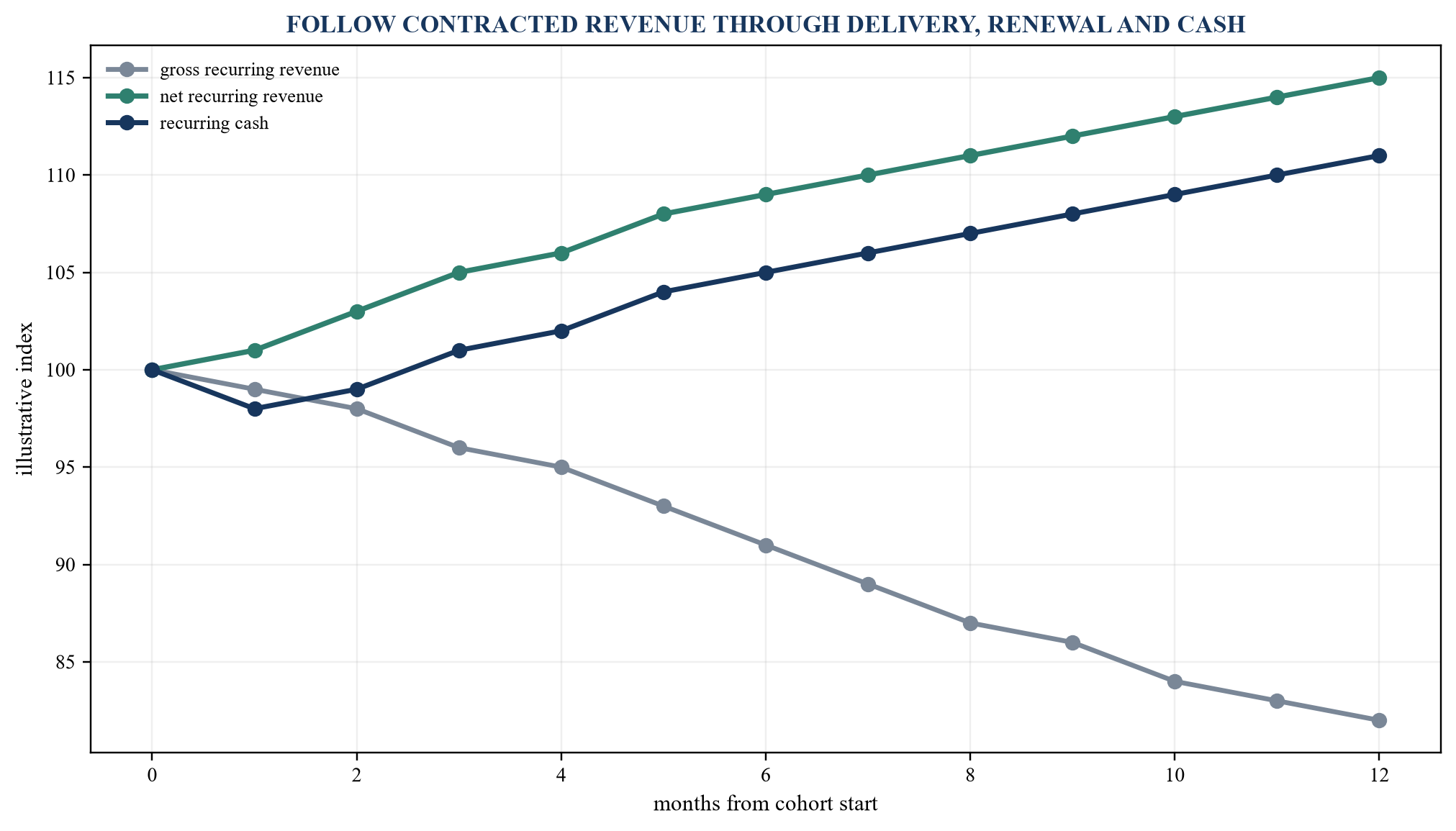
Replace curves with contracted, delivered, renewed and collected cohort evidence.
Cohorts should begin at contract or service commencement and track opening recurring value, churn, contraction, expansion, price, usage, credits and collection. Definitions must remain stable. Project extensions should not be reclassified as recurring without evidence.
Gross retention shows preserved base; net retention includes expansion. Both require service delivery and client economics. Cash cohorts can reveal billing and collection weakness hidden by revenue.
Cohorts should also show contribution and resource intensity. Net revenue retention above one hundred percent can coincide with declining economics if expansion requires bespoke delivery or senior intervention. Implementation credits, service penalties and discounts should follow the cohort. The company should explain how mergers, currency, reseller activity and client transfers affect the calculation.
18. Test recurrence and durability
Recurrence depends on continuing client need, service integration, switching cost, quality, contract, relationship and competitive position. A multi-year contract can still carry termination, rebid or concentration risk.
Renewal should be analysed by client, service, tenure, cohort and contribution. Expansion can mask churn. Contracted minimums, actual usage and discounts require reconciliation.
Durability also depends on the provider maintaining models, data, people, security and service. Underinvestment can temporarily lift margin while weakening renewal.
Competitive response should enter persistence. Clients and rivals can adopt similar foundation models, reducing willingness to pay for generic output. Durable value is more likely to arise from embedded workflow, trusted delivery, domain evidence, integration, proprietary rights and accountability. The buyer should test how much of the result survives model price declines, client insourcing and the departure of key professionals.
19. Create the knowledge-reuse system
Reusable knowledge can include methods, templates, code, prompts, process models, benchmarks, taxonomies and delivery evidence. It should have owner, source, rights, version, quality and approved use.
Retrieval should cite current sources and respect client separation. Reuse must not disclose confidential client work or third-party material. Generic lessons should be abstracted and reviewed.
The economic measure is reduced controlled effort, improved quality or faster time to value across repeat cases. Repository size and search activity are supporting measures.
Reuse should be measured by lineage and outcome. The company should know which approved asset entered an engagement, what configuration was required and how quality and effort compared with a credible baseline. Repeated manual customisation can indicate that an asset is a reference rather than a scalable product. Maintenance ownership and deprecation are required so obsolete advice does not propagate.
20. Protect data, confidentiality and intellectual property
Client data, deliverables, employee work and model outputs can have different ownership and use rights. Contracts and system controls should govern ingestion, training, retention, location, subprocessors, deletion and audit.
The company should identify which capability transfers in a sale. Staff know-how, licensed tools and client-restricted assets may not be separable. Generated outputs require provenance and rights review where material.
Privacy, trade secret, professional and sector obligations should follow the actual service and jurisdiction.
Client separation should be tested technically and operationally. Permission inherited from a broad file store can expose one client's material to another team or model. Retrieval, logging, export and support access require the same control. The company should understand whether prompts and outputs are retained by providers, whether content contributes to training and how deletion is verified after engagement or vendor exit.
21. Govern AI models and vendors
The inventory should record model, provider, purpose, data, users, version, evaluation, limitations, incidents, cost and exit. Vendor claims should be tested against contracts and observed performance.
Governance should map, measure and manage risk through the lifecycle. High-consequence services require stronger evaluation, human authority and contingency. Model changes can alter output without commercial terms changing.
Portability and replacement should be tested. A critical service should not depend on a provider the company cannot monitor or exit within client obligations.
Model and vendor risk should be reported by service consequence. A failure in internal research differs from a failure in regulated advice, production software or client operations. The company should maintain fallback processes, approved model changes and incident communication. Contractual rights to audit, export and terminate are useful when the organisation also has the people and procedures to exercise them.
22. Redesign roles and career architecture
Automation changes task mix, supervision, apprenticeship and expertise formation. Entry-level work can provide context needed for later judgement. Removing it without a new learning path can weaken future delivery capacity.
Roles should be redesigned around client problem framing, evidence, domain judgement, workflow control, exception handling and relationship. Training should be tested through work outcomes.
Employment decisions require lawful, fair and transparent governance. Productivity claims should not become opaque individual performance scores.
Career architecture should preserve the route from novice to accountable expert. Training can combine supervised client work, simulations, source review, exception handling and model evaluation. The company should test whether professionals understand the output rather than merely edit it. Promotion and workload should reflect new responsibilities for quality, data, client communication and workflow ownership.
23. Plan workforce capacity
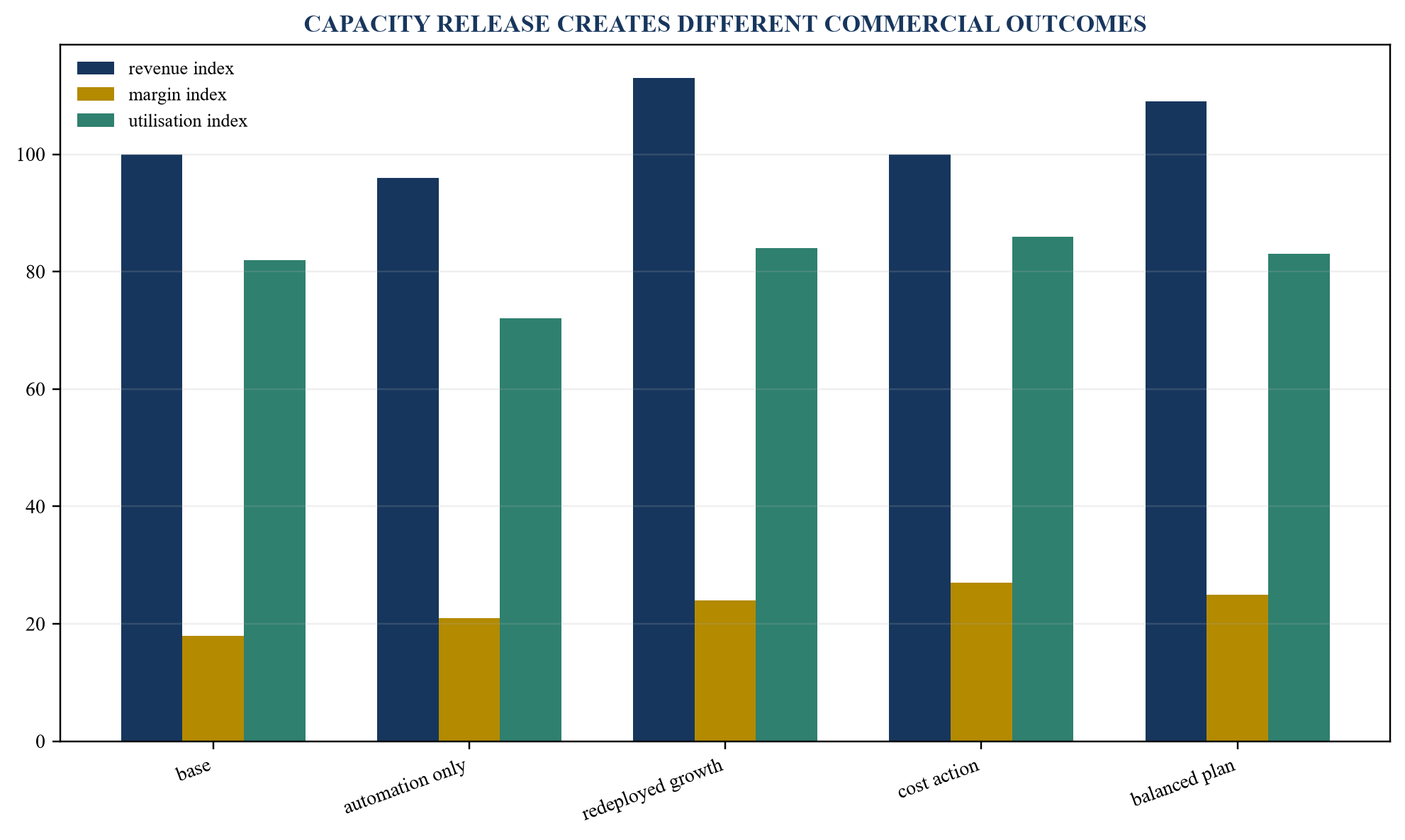
Replace scenarios with demand, skill, adoption, quality and employment evidence.
Capacity planning should combine demand by service and timing with skills, location, productivity, attrition, hiring, contractors and learning. A uniform automation percentage is unlikely to fit different workflows.
Scenarios should show revenue, utilisation, margin, cash, quality and capability. The business should identify decisions and lead times for hiring, redeployment, training and cost action.
Capacity scenarios should include demand shortfall, rapid growth, model failure, client restrictions and slower adoption. A balanced case may preserve reserve capacity for quality and surge rather than maximise utilisation. Decision thresholds should identify when to pause hiring, release contractors, accelerate sales, reduce fixed cost or invest in a bottleneck. Workforce actions require appropriate consultation and legal review.
24. Align incentives and performance management
Incentives should reward client outcome, contribution, quality, reuse, renewal, collection and capability building. Billable hours alone can discourage automation; automation volume alone can encourage unsafe deployment.
Team measures can reflect shared delivery while preserving individual accountability. Overrides and escalations should be interpreted in context. A reviewer who prevents a material error creates value even if throughput falls.
Commercial leaders should not be paid for unprofitable recurring revenue or contracts that cannot be delivered within approved risk.
Performance design should account for transition behaviour. A team that honestly records review effort can appear less productive than one that hides it, and a practice that rejects unsuitable automation can appear less innovative. Independent controls, outcome measures and audit trails reduce these distortions. Incentives should not encourage staff to use unapproved tools or avoid escalation when client information or professional judgement is at risk.
25. Manage client concentration
Services companies can depend on a small number of clients, partners or sectors. Concentration should be measured by revenue, contribution, backlog, receivables, skill and platform dependency.
AI transition can increase concentration when only large clients fund new models or when reusable assets encode one client's requirements. The business should test portability and address client-specific constraints.
Downside should include loss, scope reduction, insourcing, rebid, price pressure and delayed payment. Relationship strength should be evidenced through contract and behaviour.
Concentration analysis should include correlated exposure. Several legal entities may belong to one group, and multiple clients may depend on the same sector, partner platform or procurement cycle. A recurring book can therefore behave less diversified than the account count suggests. The buyer should examine renewal dates, termination, decision makers, service criticality and switching path alongside historical retention.
26. Control subcontractors and delivery partners
Subcontractors can provide flexibility and scarce skills while creating margin, quality, confidentiality and continuity risk. The company should know which party performs each obligation and whether it controls the service.
AI tools used by subcontractors require approved environments, data terms, output controls and audit. Informal tool use can expose client information or rights.
The economic bridge should include markup, idle risk, rework and replacement. Critical knowledge should not leave with one contractor.
Partner governance should identify where the company is principal or agent for the specified service, who owns delivery and which party bears failure. Subcontractor use can affect revenue presentation, client consent and liability. Capacity value should include the terms on which external talent can be retained, scaled or replaced. A margin based on temporarily favourable rates may not persist.
27. Reconcile full technology cost
Full cost includes licences, compute, data, integration, workflow redesign, security, privacy, evaluation, monitoring, support, training, change, remediation and vendor exit. Cost should follow usage and service where feasible.
Per-user licence cost can understate model calls, storage, review and platform teams. Early pilots can benefit from subsidised pricing or unusual support. Scale assumptions should use contractual and operational evidence.
The valuation should include reinvestment needed to sustain performance and meet client commitments.
Cost behaviour should be modelled by volume and service level. Compute, review, data and support may rise non-linearly when complexity or latency requirements increase. Vendor discounts can expire. Reserved capacity may be required even when usage is low. The company should preserve gross and fully loaded views and should avoid allocating enterprise costs so heavily that a scalable service appears uneconomic or so lightly that contribution is overstated.
28. Link operations to working capital
Faster delivery creates cash only when acceptance, billing and collection follow. Contract assets, milestones, disputes, credits and client procurement can delay conversion. The workflow should connect completion evidence to invoicing.
AI can improve time capture, acceptance packs, invoice quality and collection prioritisation. It can also produce deliverables that clients dispute or require additional assurance.
Days sales outstanding should be decomposed by client, contract, stage and cause. One-off collections should not be treated as recurring operating improvement.
Working-capital analysis should include unbilled effort and contract assets, not only receivables. Fixed-price and outcome contracts can accumulate delivery before a milestone or acceptance. Faster production without faster acceptance can increase exposure. The operating design should connect evidence of completion, client sign-off, change requests, invoice accuracy, dispute resolution and collection ownership.
29. Build the recurring-unit economics
Unit economics should be calculated by service, client and cohort. Measures include recurring revenue, gross and contribution margin, implementation cost, support, renewal, expansion, acquisition cost, working capital and cash payback.
Implementation revenue and cost should remain separate from steady-state service where useful. A profitable contract can require material upfront capacity and cash. Expansion can be uneconomic when bespoke complexity rises.
The model should reconcile to financial statements and preserve allocated and direct views.
Unit economics should be tested across vintages. Early clients may receive discounts and intensive support; later clients may benefit from mature assets. A combined average can conceal whether the model improves with scale. Cohort comparison should control for service, complexity and client size. Payback should use collected contribution and should include sales, implementation and expansion effort.
30. Establish board reporting
The board should see demand, capacity, utilisation, accepted output, quality, rework, pricing, recurring cohorts, client concentration, full technology cost, working capital, incidents and cash. Definitions should remain stable.
Leading indicators include adoption, workflow coverage, model quality, sales conversion and implementation capacity. Lagging indicators include contribution, renewal, cash and customer outcomes.
Reporting should separate observed results from plans and identify where founder, partner or buyer support remains essential.
Board reporting should expose trade-offs. Revenue growth driven by low-margin implementations, margin growth driven by reduced investment and retention supported by concessions require different responses. The board should see definitions, source quality and changes. Material incidents and client losses should connect back to the workflow and commercial model rather than sit in a separate technology report.
31. Build the buyer evidence room
Table 3. Buyer evidence room for AI-enabled services
| Module | Core evidence | Buyer question |
|---|---|---|
| commercial | contracts, pricing, backlog and cohorts | what revenue recurs? |
| delivery | workflows, capacity, quality and acceptance | can outcomes scale? |
| technology | architecture, rights, tests and incidents | is capability transferable? |
| people | skills, roles, attrition and incentives | who sustains delivery? |
| economics | contribution, full cost and working capital | what reaches cash? |
| control | privacy, security, model and vendor governance | what downside remains? |
Summaries should link to native evidence, owners, dates and open issues.
The room should preserve native files, source lineage, dates, definitions and version. Management claims should reconcile to evidence. Open gaps require owner and transaction treatment.
Client-confidential material may require redaction, aggregation, clean teams or staged access. Restriction should not conceal material dependency.
The room should include a reproducible sample from proposal through renewal and cash. Buyers can then test whether recurring labels, capacity, workflow and economics describe the same population. The seller should preserve a disclosure log and resolve differences between CRM, resource, time, delivery, billing and finance systems. Known gaps should have a quantified exposure where evidence permits.
32. Classify buyer adjustments
Observed recurring contribution, funded conversion actions, buyer synergies and unresolved risks should remain distinct. Re-labelling forecast efficiency as run rate does not improve evidence.
Each adjustment should identify amount, source, cohort, owner, probability, timing, transferability and sensitivity. Treatment should remain consistent across diligence, quality of earnings, valuation and financing.
One benefit should not appear in both cash flow and multiple without clear rationale.
Table 5. Buyer treatment of AI-enabled services claims
| Claim class | Required evidence | Illustrative treatment |
|---|---|---|
| observed recurring cash | cohorts, contribution and collection | base earnings or cash flow |
| converted capacity | accepted output and demand route | evidenced run-rate range |
| funded recurring plan | contracts, owners, cost and milestones | probability and timing |
| buyer delivery leverage | buyer-specific capability | separate synergy case |
| unconverted hours | productivity without demand or action | operating opportunity |
| unresolved client or model risk | concentration, rights or control gap | downside, reserve or structure |
Treatment follows operating evidence, commercial conversion, transferability and persistence.
Classification should remain consistent across management reporting, commercial diligence, quality of earnings, valuation and financing. A recurring label should not move a forecast into base cash. The committee should record amount, source, period, population, owner, confidence, validation date and protection for every material adjustment.
33. Translate evidence into valuation
Valuation should begin with sustainable cash under the expected delivery and commercial model. AI-enabled change can affect revenue growth, gross margin, operating cost, working capital, reinvestment, risk and terminal assumptions.
Recurring revenue may support lower uncertainty when contracts, retention, contribution, delivery and rights persist. Concentration, cancellation, price pressure, vendor dependency, weak controls or missing talent can offset that benefit.
Accounting recognition and transaction economics are distinct. Adjustments should follow appropriate standards and avoid double counting.
The valuation should reflect transition timing. Revenue may fall before new pricing and demand convert released capacity; cost may rise during dual running; recurring cohorts may require implementation investment. A single steady-state margin can obscure this path. Scenario analysis should connect operating milestones to cash and should show the consequence of slower sales, weaker renewal, higher review cost and client restrictions on AI use.
34. Construct the enterprise-value bridge
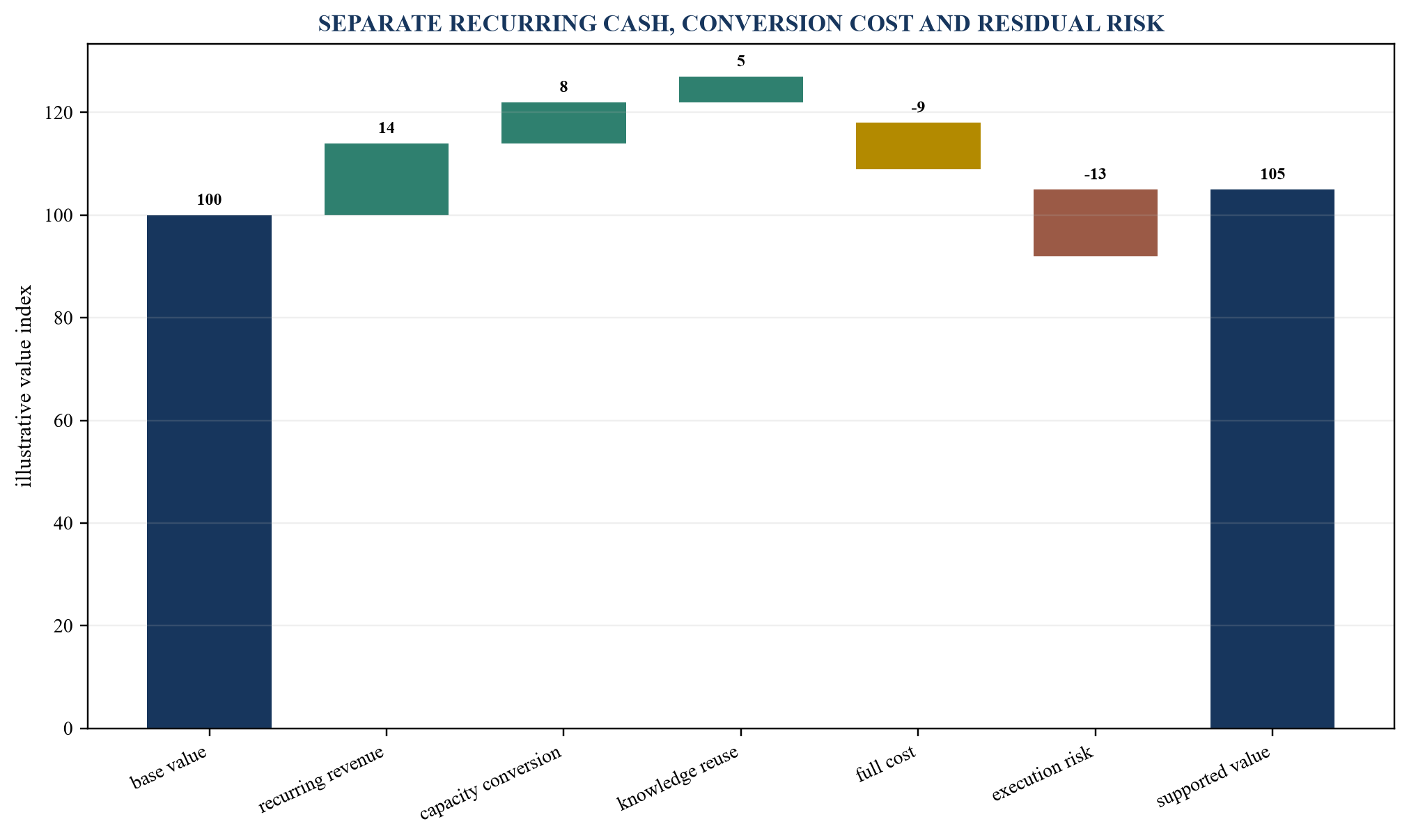
Values are conceptual; replace them with reconciled transaction cash flows and supported buyer assumptions.
The bridge should reconcile base value to recurring contribution, capacity conversion, reuse, full cost, tax, investment and residual risk. Each element needs evidence, owner and sensitivity.
Strategic options should remain separate until a credible commercial and operating path supports cash. The final range should align with transaction documents.
The bridge should be tested against market and transaction evidence without forcing comparability. Services companies can differ materially in contract mix, client concentration, growth, geography, labour model, intellectual property, recurrence and working capital. Multiples can provide a reasonableness range when the underlying economics are understood. The primary bridge should remain linked to the target's supported cash and risk.
35. Design transaction structure
Earn-outs, holdbacks, escrow, warranties, covenants, retention, staged consideration and transition services can allocate specific uncertainty. Metrics require precise definitions, systems, access and control.
Structure can address renewal, margin, cash, client retention, model rights or delivery milestones when parties can measure them fairly. Buyer actions and accounting policy should not distort outcomes.
Structure cannot transform unproven automation into recurring value. Material gaps may justify lower value or delayed recognition.
Earn-out design should consider who controls sales, staffing, pricing, technology and client decisions after closing. Measures should be resistant to changes in allocation and accounting. Dispute mechanisms, access, audit and treatment of acquisitions or lost clients require precision. Retention arrangements should reflect genuinely critical capability and should include knowledge transfer rather than simple tenure.
36. Execute the operating-model transition
The transition should sequence workflow redesign, commercial change, contract, technology, people, controls and client communication. Automation should not outrun demand, quality or governance capacity.
Existing engagements may require consent or revised terms. New offerings can be piloted with defined clients and cohorts. Sales and delivery should share one economic model.
The operating cadence should review evidence, incidents, capacity conversion and client outcome before expansion.
Transition governance should include commercial, delivery, finance, people, technology, privacy, security and independent challenge. Owners should resolve conflicts between utilisation, quality, revenue and long-term capability. Existing client obligations remain the operating boundary. A steering committee should be able to pause a workflow, change commercial terms or fund additional controls when evidence changes.
37. Design the one-hundred-day plan
Table 4. One-hundred-day AI-enabled services plan
| Period | Primary work | Decision gate |
|---|---|---|
| days 1–30 | freeze perimeter, baseline capacity and contract economics | approve priority workflows |
| days 31–60 | reproduce productivity, quality and commercial conversion | approve controlled offers |
| days 61–100 | scale cohorts, controls, roles and board reporting | approve recurring-value plan |
Sequence should reflect client commitments, evidence maturity and workforce capacity.
The first month should reconcile demand, capacity, engagement economics, rights and risk. The second should test representative workflows and pricing paths. The final phase should launch controlled recurring cohorts and funded actions.
Unresolved dependencies should have owner, mitigation, cost, timing and transaction consequence.
The one-hundred-day plan should preserve the original baseline and identify buyer actions separately. This supports fair measurement, earn-out administration and organisational learning. Material assumptions should have validation dates. Workstreams that depend on client consent, data access or contract renewal should not be reported as complete before those conditions are satisfied.
38. Identify red flags
Red flags include time saved presented as cash, utilisation improvement without denominator, recurring labels without contracts or cohorts, gross revenue without contribution, project extensions treated as renewal, quality measured only by model score and technology cost excluding review.
Other signals include client data used without rights, unmanaged shadow AI, one critical vendor, reusable assets that cannot transfer, automation without demand, hidden partner rework, optimistic backlog conversion and valuation uplift based on plan spend.
A red flag is a diligence prompt. Its effect depends on evidence, materiality, remediation and protection.
Clusters of related red flags can indicate that the operating model is not yet transferable. For example, unconverted capacity, optimistic backlog, weak cohort definitions and one critical vendor may reflect one underlying dependency. The committee should trace causes before applying separate adjustments, because double counting can overstate downside just as easily as an unsupported plan can overstate value.
39. Establish the decision standard
An AI-enabled services claim is decision-ready when an independent reviewer can reproduce the workflow baseline, intervention, effort, quality, accepted outcome, commercial route, full cost and cash consequence. Transferability and persistence should be tested.
The committee should understand which results are observed, which depend on funded action, which are buyer-specific and which remain uncertain. Ranges should reflect evidence quality and downside.
The same standard should govern board investment, sell-side preparation, buyer diligence and post-close accountability.
40. Conclusion
AI can change the relationship between effort and output in services businesses. Enterprise value increases when the company converts controlled capacity release into accepted client outcomes, recurring commercial models and durable cash while maintaining quality, rights, people and governance.
The practical standard is end-to-end reproducibility. Hours, workflow, deliverable, contract, contribution and collection should connect. Recurring value should be visible in cohorts and should survive client choice, competition, model change and ownership transfer.
Strong evidence can support pricing change, investment, transaction confidence and focused integration. Weak evidence should lower value, increase protection or delay recognition. The resulting system gives boards, managers, lenders and buyers one language for capacity, recurrence and transferable value.
For a transaction committee, the final output should be a concise bridge from automation claim to recurring cash. It should state what was released, how it converted, what the service costs, why clients renew, which assets transfer and how downside is protected.
References
- United States Securities and Exchange Commission, Accenture plc Annual Report on Form 10-K for 2025, https://www.sec.gov/Archives/edgar/data/1467373/000146737325000217/acn-20250831.htm
- United States Securities and Exchange Commission, Cognizant Technology Solutions Annual Report on Form 10-K for 2025, https://www.sec.gov/Archives/edgar/data/1058290/000105829026000008/ctsh-20251231.htm
- United States Securities and Exchange Commission, Genpact Limited Annual Report on Form 10-K for 2025, https://www.sec.gov/Archives/edgar/data/1398659/000139865926000004/g-20251231.htm
- United States Securities and Exchange Commission, ServiceNow Annual Report on Form 10-K for 2025, https://www.sec.gov/Archives/edgar/data/1373715/000137371526000007/now-20251231.htm
- IFRS Foundation, IFRS 15 Revenue from Contracts with Customers, https://www.ifrs.org/issued-standards/list-of-standards/ifrs-15-revenue-from-contracts-with-customers/
- IFRS Foundation, IFRS 3 Business Combinations, https://www.ifrs.org/issued-standards/list-of-standards/ifrs-3-business-combinations/
- IFRS Foundation, IAS 38 Intangible Assets, https://www.ifrs.org/issued-standards/list-of-standards/ias-38-intangible-assets/
- Bank for International Settlements, AI adoption, productivity and employment: evidence from European firms, https://www.bis.org/publications/working-paper-1325-ai-adoption-productivity-and-employment-evidence-european-firms
- Brynjolfsson, Li and Raymond, Generative AI at Work, National Bureau of Economic Research Working Paper 31161, https://www.nber.org/papers/w31161
- National Institute of Standards and Technology, Artificial Intelligence Risk Management Framework 1.0, https://www.nist.gov/publications/artificial-intelligence-risk-management-framework-ai-rmf-10
- National Institute of Standards and Technology, Generative Artificial Intelligence Profile, https://nvlpubs.nist.gov/nistpubs/ai/NIST.AI.600-1.pdf
- National Institute of Standards and Technology, Cybersecurity Framework 2.0, https://www.nist.gov/cyberframework
- International Organization for Standardization, ISO/IEC 42001 Artificial intelligence management systems, https://www.iso.org/standard/81230.html
- International Organization for Standardization, ISO 30401 Knowledge management systems, https://www.iso.org/standard/68683.html
- International Valuation Standards Council, International Valuation Standards, https://ivsc.org/standards/
- International Valuation Standards Council, Making Intangibles More Tangible, https://ivsc.org/ivsc-perspectives-paper-making-intangibles-more-tangible-series-lessons/
- European Union, Regulation (EU) 2024/1689 laying down harmonised rules on artificial intelligence, https://eur-lex.europa.eu/eli/reg/2024/1689/oj
- United Kingdom Information Commissioner's Office, Guidance on AI and data protection, https://ico.org.uk/for-organisations/uk-gdpr-guidance-and-resources/artificial-intelligence/guidance-on-ai-and-data-protection/
- United Kingdom Competition and Markets Authority, AI Foundation Models technical update report, https://www.gov.uk/government/publications/ai-foundation-models-technical-update-report
- United States Federal Trade Commission, Keep Your AI Claims in Check, https://www.ftc.gov/business-guidance/blog/2023/02/keep-your-ai-claims-check
- United States Securities and Exchange Commission, Remarks at the Roundtable on Artificial Intelligence in the Financial Industry, https://www.sec.gov/newsroom/speeches-statements/uyeda-ai-roundtable-032725
- Organisation for Economic Co-operation and Development, OECD AI Principles, https://oecd.ai/en/ai-principles
- Organisation for Economic Co-operation and Development, The impact of artificial intelligence on productivity, distribution and growth, https://www.oecd.org/en/publications/the-impact-of-artificial-intelligence-on-productivity-distribution-and-growth_8d900037-en.html
- United States Bureau of Labor Statistics, Productivity and Costs, https://www.bls.gov/productivity/
- International Labour Organization, Generative AI and jobs, https://www.ilo.org/publications/generative-ai-and-jobs-refined-global-index-occupational-exposure
- World Intellectual Property Organization, Trade secrets, https://www.wipo.int/tradesecrets/en/
