

1. Replace the single forecast with a decision system
Traditional grid plans often begin with a central demand forecast and add a reserve margin, then identify reinforcement needed to serve the resulting peak. That method remains useful where growth is gradual and diversified. It becomes fragile when a small number of large projects can change local demand by hundreds of megawatts, connection dates move, project phases change, and customer technology alters load shape after approval.
The planning question is wider than how much load will appear. The decision maker needs to know where load may connect, when it may ramp, how persistent it may be, which network elements constrain service, how long each remedy takes and what happens if the forecast is wrong. The investment plan should therefore connect uncertainty to decisions rather than conceal uncertainty inside one number.
The International Energy Agency describes growing electricity demand from data centres and AI alongside opportunities for AI to improve energy operations.[1] Its transmission analysis highlights accelerating demand, long grid project lead times and the large volume of generation awaiting connection.[2] These conditions create an economic timing problem. An asset commissioned too late can delay customers and increase reliability risk. An asset commissioned too early can remain underused while customers fund its cost.
The first record should be a decision perimeter. It identifies the planning authority, network boundary, reliability duty, forecast horizon, customer classes, connection process, tariff treatment, capital approval, land, permits, supply chain and operating alternatives. It also states which decisions are reversible and which create long-lived commitments.
The investment thesis should be causal. A reinforcement is required when credible load, constrained transfer capability, reliability criteria, flexibility availability, asset condition and delivery lead time cross a defined threshold. Every element should have evidence, uncertainty and an owner. AI can improve evidence processing and scenario estimation. The accountable authority retains the capital decision.
The plan should also identify the cost of each error direction. Underbuilding can produce delayed connections, emergency procurement, curtailment, losses and service risk. Overbuilding can increase financing cost, depreciation and customer charges while capacity remains unused. The two costs are rarely symmetrical. A critical zone with a long equipment lead time can justify earlier enabling work than an unconstrained zone with modular alternatives. This asymmetry should influence the probability threshold used at each gate.
2. Define load in operational terms
Connected capacity, contracted capacity, requested capacity, annual energy and coincident peak load are different measures. A data centre can request a large connection, build in phases, operate below nameplate and ramp computing load over time. An industrial plant can have high maximum demand but flexible production. Distributed solar can reduce midday net load while increasing evening ramps.
The forecast should define gross demand, embedded generation, storage charging, demand response, losses and net system load. It should distinguish annual energy, seasonal peak, minimum load, ramp, reactive power, power quality and fault contribution. The relevant measure depends on the network constraint.
Granularity matters. A national forecast may be accurate while a specific substation is overloaded. The planning model should retain geography, voltage level, customer type, connection point and time resolution needed for the decision. Aggregation should preserve coincident behaviour rather than sum non-coincident peaks.
Weather normalisation should capture temperature, humidity and extreme events. In Gulf systems, cooling demand can dominate summer peaks. Demand can also change through efficiency standards, building growth, desalination, industrial policy and electrification. The model should preserve causal variables that planners can explain and update.
Data quality begins with meter coverage, timestamps, missing intervals, estimated values, clock changes, curtailment and topology. A measured reduction can reflect an outage or customer disconnection rather than efficiency. The forecast data set should record each adjustment and keep raw evidence available for review.
Load decomposition improves both forecast and response. Base demand, temperature-sensitive demand, industrial schedules, pumping, charging, storage and exceptional events should be separated where evidence permits. The planner can then test which component creates the constraint and whether it can be shifted or controlled. A decomposition that cannot reconcile to the governing meter should remain diagnostic rather than become the investment baseline.
3. Build a probabilistic load fan rather than a point estimate
A probabilistic forecast expresses a range of outcomes and their conditional likelihood under stated assumptions. It can combine time-series models, weather relationships, customer-level project models, economic scenarios and engineering judgement. The objective is calibrated uncertainty rather than a narrow interval that looks precise.
The model should produce distributions for peak, energy, ramp and local network loading over relevant horizons. Near-term forecasts can use high-frequency operational data. Long-term forecasts should include structural scenarios for large loads, policy, technology, price and supply. The distribution should widen where evidence weakens.
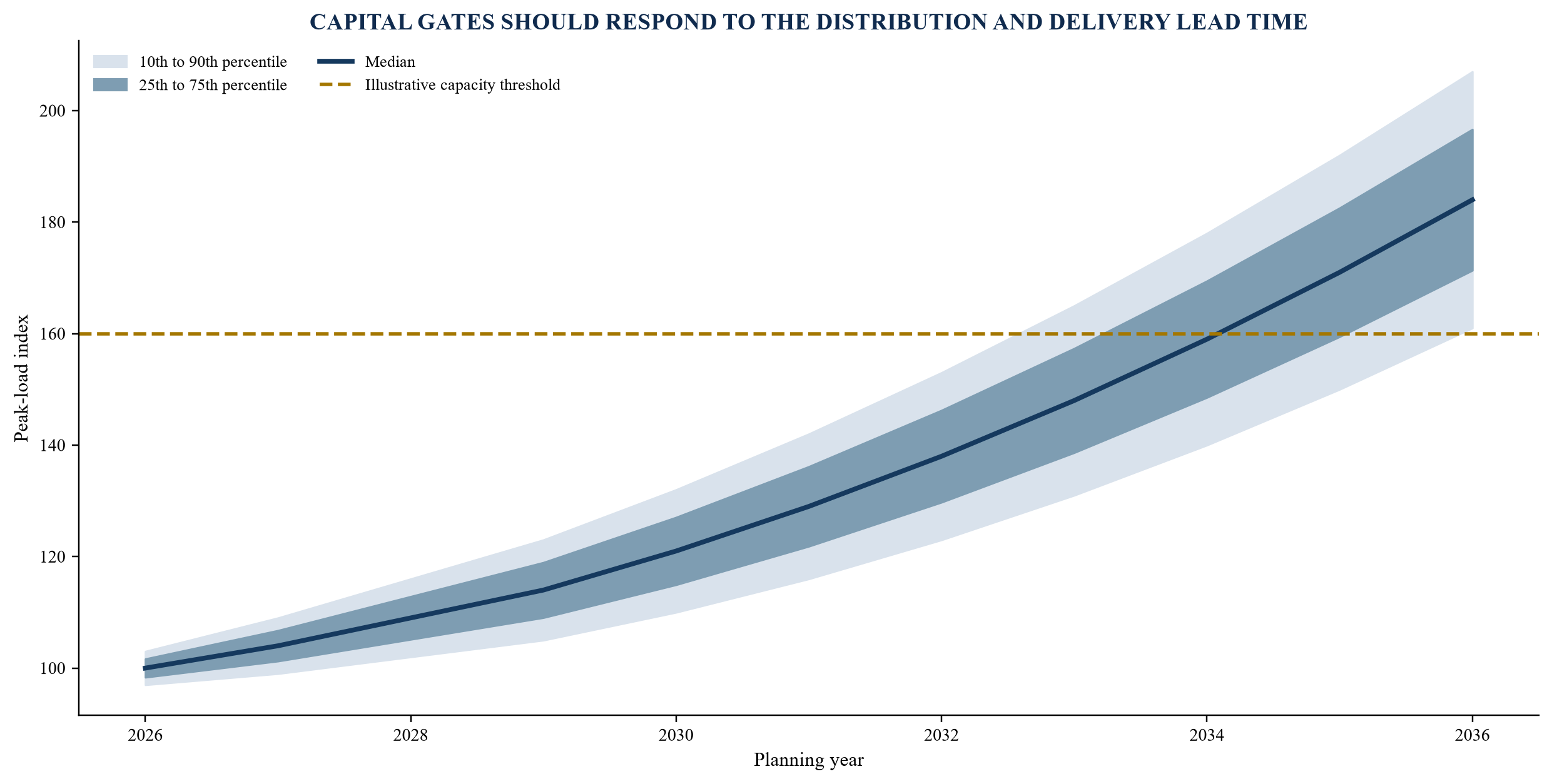
Values are illustrative; bands should be calibrated and back-tested for the relevant system.
Table 1. Probabilistic forecast control register
| Forecast element | Evidence | Test | Decision use |
|---|---|---|---|
| Base load | historical meters and weather | rolling back-test and residual review | operating and near-term capacity |
| Large loads | contracts, permits, funding and construction | milestone-conditioned conversion | local reinforcement timing |
| Distributed resources | registrations, telemetry and adoption | cohort and saturation sensitivity | net-load and reverse-flow planning |
| Extreme demand | weather and outage scenarios | tail calibration and stress testing | reliability and reserve design |
| Structural change | policy, price and technology cases | scenario comparison | corridor and long-life assets |
Each model output should retain version, training period, scenario and approval.
Calibration should be measured. If an 80 percent interval contains actual outcomes far less frequently, it is overconfident. Coverage, sharpness, bias and performance by season and location should be reported. A more complex model earns use through out-of-sample performance and decision value, not fit to historical data alone.
Scenario probabilities should be conditional and dated. A probability assigned before land, financing or an environmental approval should change when that evidence arrives. The model should retain the previous probability, the new evidence and the approved update. This creates a decision audit trail and prevents an analyst from changing historical assumptions merely to make the model appear accurate after the event.
4. Convert connection queues into probability-weighted demand
Connection queues contain information and noise. Projects may submit early to secure capacity, apply at multiple locations, change ownership, reduce scope or fail to reach financing. A queue total should not be treated as committed load. It should not be ignored merely because conversion has been low historically.
Each application should be represented as a project record. Useful fields include identity, requested capacity, location, technology, phase, land, permits, funding, customer contract, equipment orders, construction, security deposit, study status, target energisation and operating profile. Evidence quality should be scored separately from commercial importance.
FERC Order No. 2023 introduced reforms for generator interconnection, including first-ready, first-served cluster studies, processing speed and technological requirements.[3] The specific framework applies to covered US transmission providers, yet the underlying control lesson travels: queue governance improves when readiness, study discipline and milestone evidence influence processing.
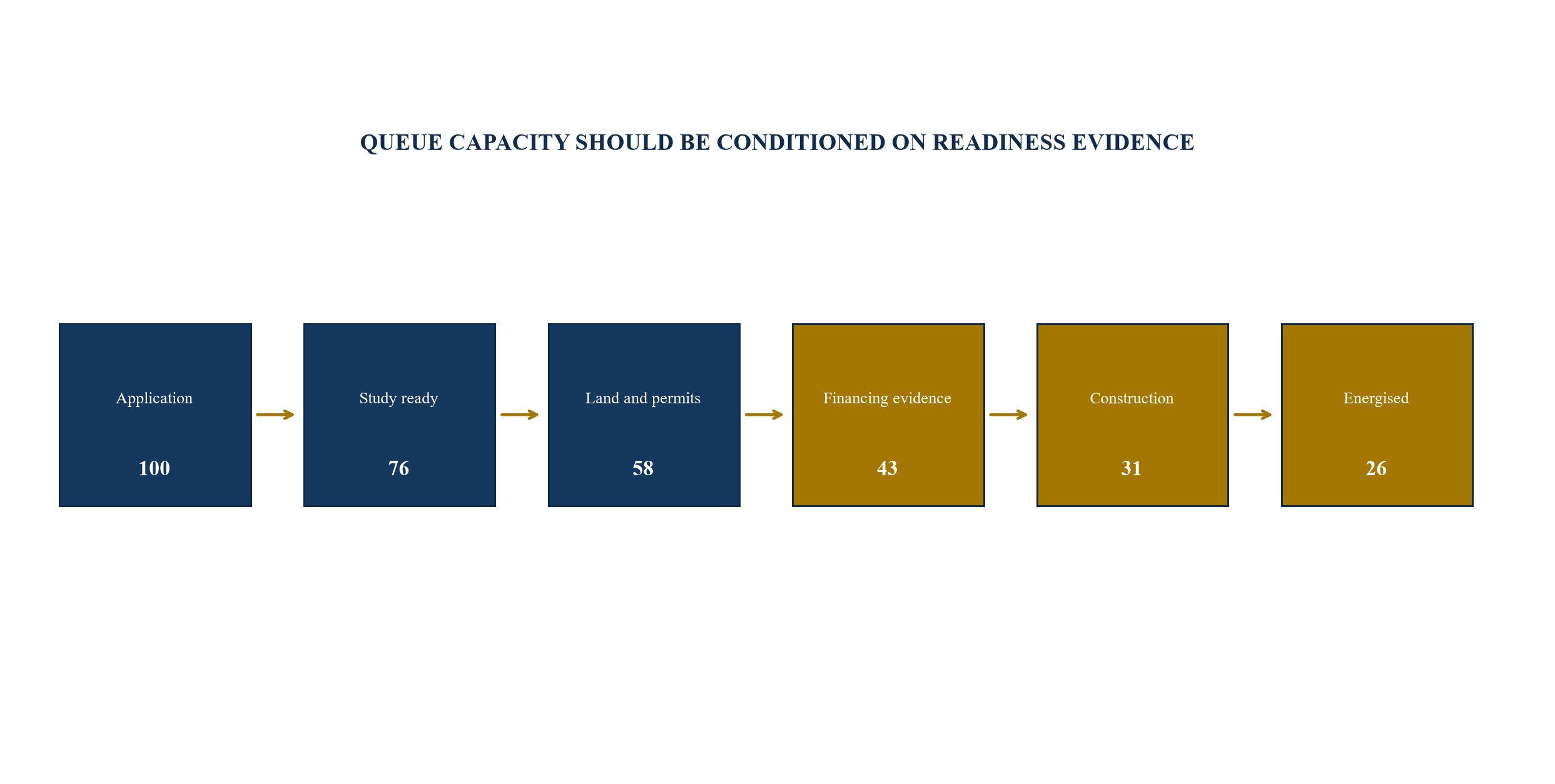
Requested capacity becomes planning demand through verified milestones and conditional probabilities.
Conversion probability should be estimated by cohort and stage. The model can use historical outcomes where enough comparable projects exist, then update the prior with current evidence. A signed customer contract or commenced construction can increase confidence. Duplicated sites, missing land or repeated delay can reduce it. Expert judgement should remain explicit and reviewable.
Queue withdrawal and modification are as important as new applications. The register should capture reductions, relocations, ownership changes, energisation delays and partial capacity release. A customer that has reached one milestone can still change its operating profile. Connection governance should therefore continue until measured ramp and contractual capacity align, with transparent treatment of unused reserved capacity.
5. Model location, timing and coincidence
Grid need depends on where and when demand appears. Two equal loads can have different investment consequences if one uses spare capacity and another sits behind a constrained transformer. A project that ramps over five years can permit staged reinforcement; a project that requires full load on energisation can compress the schedule.
The model should connect each load scenario to the current and planned network topology. Power-flow, short-circuit, voltage, stability and contingency analysis remain engineering functions. AI can help screen scenarios, approximate repeated calculations and identify influential inputs, subject to validation against approved tools.
Timing should include customer decision, permitting, procurement, construction, testing and ramp. The grid asset has its own lead time. A threshold may need to trigger before demand becomes probable enough for a conventional forecast because late action has a large service consequence.
Coincidence should be estimated from operating profile. Data centres may have high load factors. Cooling creates temperature correlation. Electric vehicle charging and industrial processes can respond to price or control. The planner should test simultaneous peak, diversified peak, maintenance and extreme-weather states.
Spatial correlation matters when several projects rely on the same economic cluster, fuel source, fibre route, water availability or policy incentive. Their probabilities are not independent. A regional downturn can delay several loads together; a strategic infrastructure opening can accelerate several. The portfolio model should retain common drivers.
Network topology changes during the forecast horizon. Planned substations, generation, interconnectors, retirements and customer assets can create or remove constraints. The scenario set should use dated topology snapshots and identify projects on which the preferred reinforcement depends. A load forecast should not be assessed against a future network whose enabling projects lack funding, permits or delivery evidence.
6. Separate forecast uncertainty from model risk
Forecast uncertainty describes the range of future load given the available information. Model risk describes the possibility that the method, data or implementation is wrong or unsuitable. The two need different controls.
Data error can arise from missing meters, incorrect topology, customer duplication, estimated intervals and inconsistent units. Method error can arise from leakage between training and test data, unstable relationships, unrecognised regime change or inappropriate probability assumptions. Implementation error can arise from code, configuration, version or interface defects.
The NIST AI Risk Management Framework organises risk work through govern, map, measure and manage functions and emphasises validity, reliability, safety, security, resilience, transparency and accountability.[4] A grid-planning model should translate those principles into specific evidence and decision rights.
Model inventory should state purpose, owner, developer, version, data, constraints, validation, approved use and retirement. Forecast models should not silently replace approved reliability or power-system tools. Interfaces and manual overrides should be logged.
Independent validation should review conceptual soundness, data, implementation, back-testing, sensitivity, stability, interpretability and limitations. Validation intensity should reflect the capital and reliability consequence. A model can remain useful with known limitations when the decision process preserves conservative thresholds, human review and fallback.
Benchmarking should compare the AI model with simple alternatives. Seasonal persistence, linear regression and planner-adjusted forecasts can provide strong controls. If the advanced model offers only a small error improvement, its operational complexity, explainability and maintenance cost may outweigh the benefit. The comparison should include the resulting capital decision, because a statistically better model can still produce no material improvement at the relevant threshold.
7. Connect the forecast distribution to reliability criteria
Investment decisions should respond to service and reliability duties. The planner needs to translate load scenarios into thermal loading, voltage, stability, fault level, loss, resilience and expected unserved energy. A threshold should state the consequence it protects.
The IEA recommends regular adequacy assessments that capture variability and uncertainty, consider all flexibility sources and guide investment frameworks consistently with policy uncertainty.[5] NERC's 2025 assessment highlights uncertainty in large loads and the use of probabilistic adequacy measures including unserved energy and load-loss metrics.[6] Applicable standards differ by jurisdiction, but the planning principle is consistent.
Deterministic criteria such as N-1 remain important. Probabilistic analysis complements them by showing event frequency, consequence and joint uncertainty. A low-probability, high-impact state may justify resilience measures even when expected value alone appears modest.
The reliability model should retain planned outages, forced outages, weather, fuel, interconnection, protection and restoration. Network reinforcement should not be justified by load alone when an operating change or protection solution addresses the actual constraint.
The decision record should distinguish compliance, economic and resilience drivers. A mandatory standard has a different approval route from an investment that reduces losses or creates headroom. Bundling benefits is valid when each is measured and double counting is controlled.
Reliability consequence should be segmented by customer and service. Hospitals, water systems, transport, communications and critical industrial processes can have restoration or resilience needs beyond average energy not served. Applicable rules determine priority and obligations. The planning case should state the consequence categories without using unsupported economic values or treating all interrupted load as equivalent.
8. Build a flexibility stack before fixing the asset solution
Flexibility can delay, resize or complement conventional reinforcement. Options include demand response, interruptible connection, storage, dynamic line rating, topology control, reactive support, distributed generation, efficiency and temporary generation. Each option has duration, response, availability, control, customer and regulatory limits.
The planner should define the service required: megawatts, megavars, location, start time, duration, frequency, season, notification and reliability. A generic flexibility volume is insufficient. The contract and control system should demonstrate delivery during the constrained state.
Table 2. Flexibility option assessment
| Option | Evidence | Limitation | Capital decision role |
|---|---|---|---|
| Demand response | metered baseline and dispatch test | fatigue, rebound and customer exit | bridge or recurring peak support |
| Storage | location, duration and state-of-charge control | energy limit and degradation | contingency and congestion support |
| Dynamic rating | weather, sensors and validated algorithm | correlated hot or still conditions | release latent capacity |
| Interruptible connection | enforceable curtailment and controls | customer economics and priority | earlier conditional connection |
| Efficiency | verified load reduction | persistence and measurement | reduce or delay growth capex |
| Topology or reactive support | power-system studies and procedures | operational complexity | targeted reinforcement alternative |
Availability and value should be tested for the exact network need.
Flexibility should be compared on risk-adjusted lifecycle cost. The model should include procurement, control, availability payments, energy, testing, telemetry, cybersecurity, degradation, penalties and replacement. Avoid assuming the lowest bid provides firm capacity.
The network asset may still be required later. Flexibility can create value by buying time until demand evidence improves, permits complete or supply constraints ease. That time value should be explicit.
Availability should be demonstrated through testing. A demand-response contract should show baseline, dispatch, telemetry, response and rebound. Storage should show state-of-charge management across consecutive events. Dynamic ratings should be tested under the weather that creates the system peak. Contracted flexibility that fails under the critical condition should not be credited at its nameplate amount in the reliability case.
9. Use real options to value staged commitment
Grid investments contain options to wait, stage, expand, relocate, contract flexibility or abandon a preparatory path. Conventional net-present-value analysis can undervalue these choices when uncertainty and irreversibility are material.
The option-value tree begins with decisions that preserve future routes at limited cost. These can include land, route protection, design, permits, modular substations, spare bays, conditional equipment reservations and digital monitoring. Later gates release larger capital when load and system evidence cross thresholds.
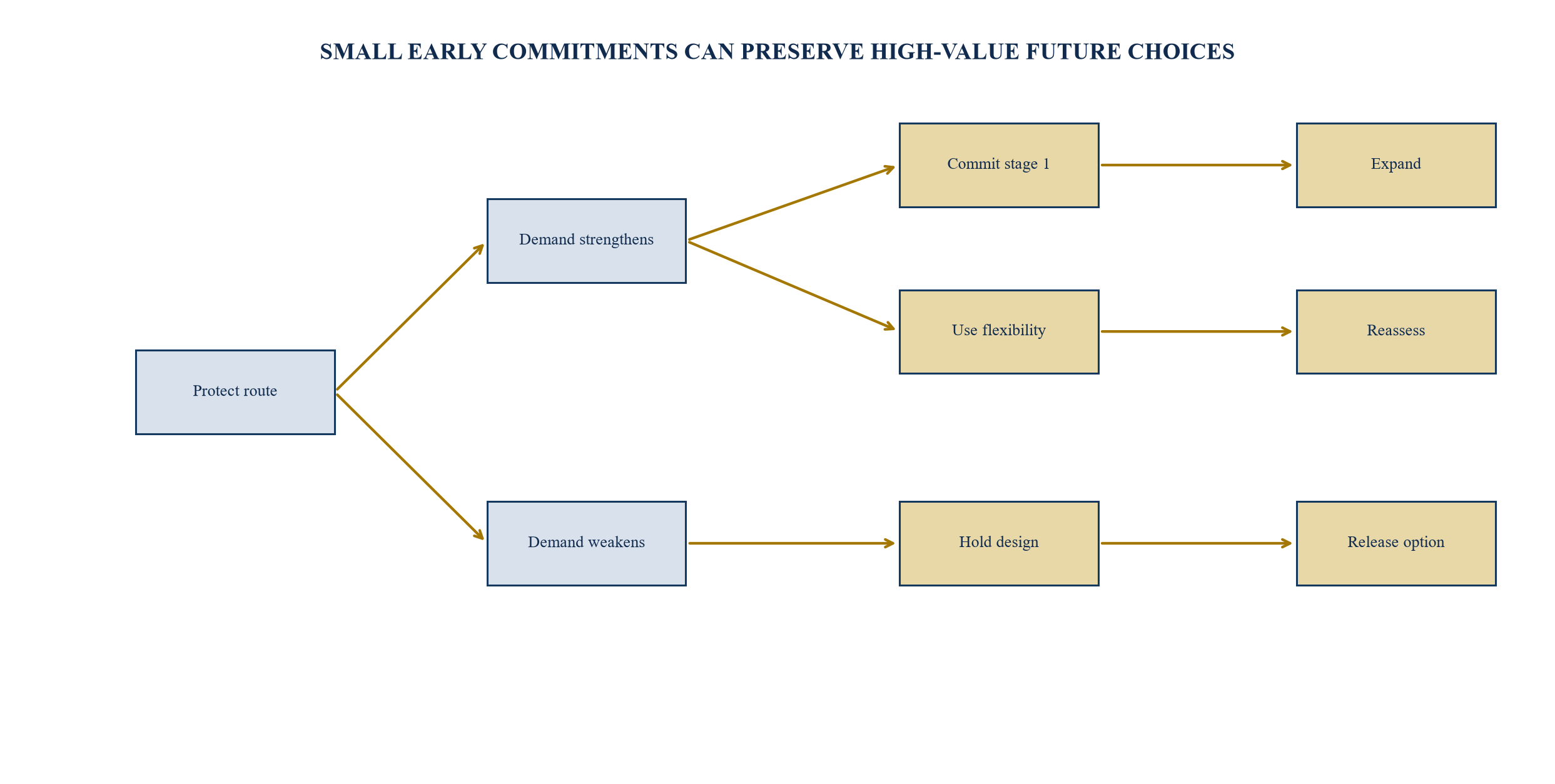
Gate probabilities and costs are hypothetical and require project-specific analysis.
The analysis should compare the cost of waiting with the value of information and flexibility. Delay can create outage, congestion, customer and inflation cost. Early commitment can create stranding. The preferred route changes with lead time, probability, consequence and reversibility.
Option value should not become an excuse for indefinite delay. Each gate needs a date, evidence threshold and authority. Expiring land, permits or equipment offers should be visible.
Real-option analysis should remain transparent. The committee should be able to see the immediate commitment, future choices, exercise triggers, expiry and downside. A complex option-pricing formula is unnecessary when a scenario tree and discounted cash flows show the decision clearly. The purpose is to preserve useful choices and price irreversible commitment, rather than assign false precision to uncertain long-term states.
10. Design staged capex gates
A staged plan separates no-regret work, enabling work, conditional commitment and final construction. No-regret work can address existing reliability, asset condition or data gaps. Enabling work can protect land, design and permitting. Conditional commitment can reserve long-lead equipment. Final construction follows the defined demand and reliability gate.
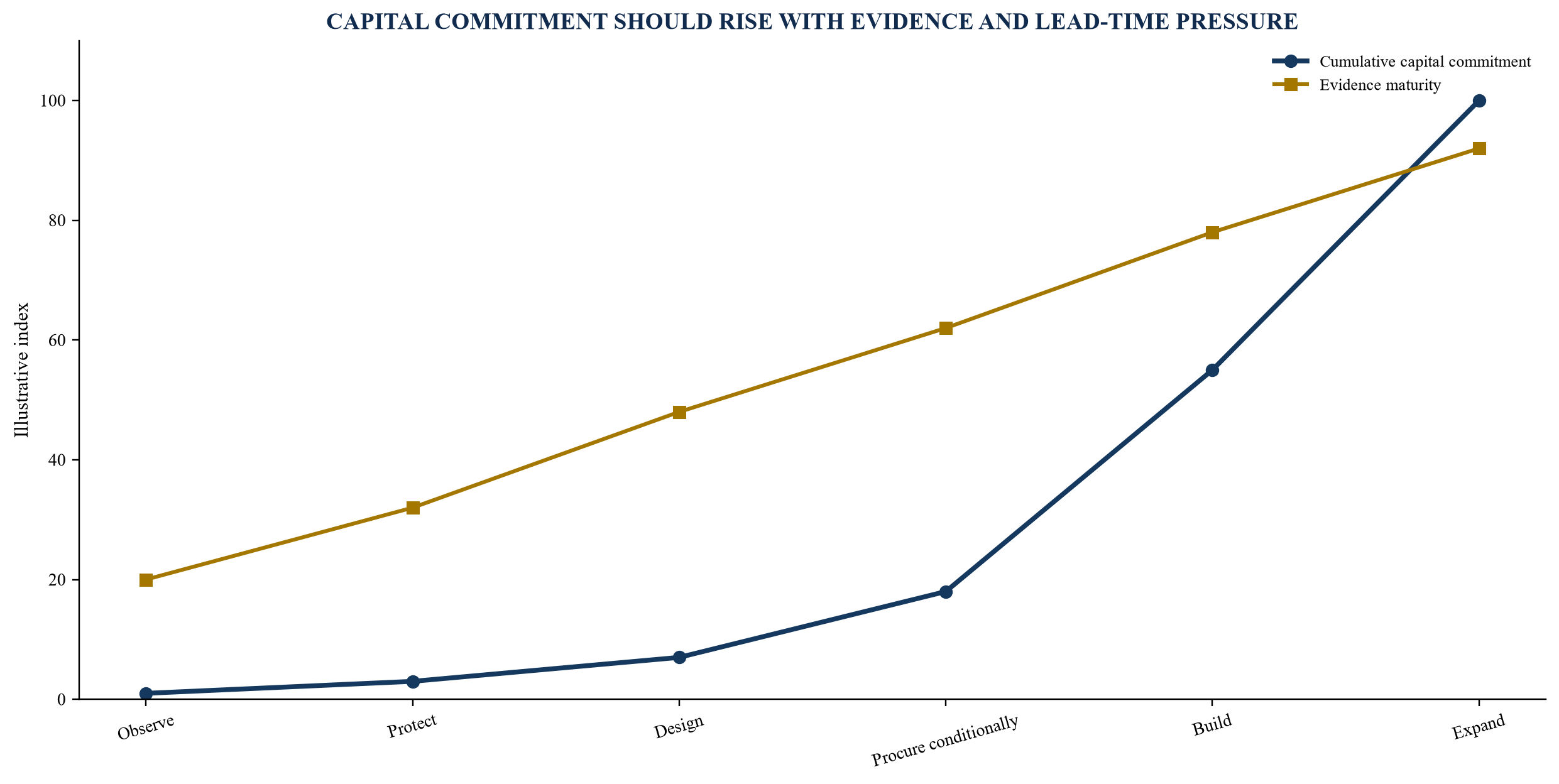
The proportion of capital at each stage is illustrative.
Table 3. Staged-capex decision schedule
| Stage | Minimum evidence | Commitment | Stop or redesign trigger |
|---|---|---|---|
| Observe | controlled load, queue and topology data | monitoring and studies | data remains unreliable |
| Protect | credible corridor or site need | land, easement and permit work | alternative location dominates |
| Design | probabilistic need and engineering options | reference design and procurement plan | flexibility changes preferred solution |
| Conditional procurement | lead time threatens service date | cancellable or transferable reservation | demand milestone fails |
| Build | reliability threshold and credible demand | construction and commissioning | scope or phasing revised |
| Expand | realised ramp and next threshold | modular addition | forecast recalibrated downward |
Each stage should state sunk cost, option preserved and consequence of delay.
Stage economics should include cancellation, storage, redesign and inflation. A refundable reservation can be more valuable than a cheaper fixed order when uncertainty is high. Procurement and accounting treatment require specialist advice.
Each gate should carry a readiness checklist across engineering, commercial, regulatory, land, environment, procurement, cybersecurity, funding and operations. A load threshold alone does not make a project executable. Conversely, a fully permitted and designed project can remain on hold when demand evidence weakens, provided land, design validity and supplier assumptions are monitored.
11. Integrate asset condition and replacement
Growth planning should not sit apart from asset renewal. An overloaded old transformer may need replacement regardless of new demand. A healthy asset can sometimes be uprated, reconfigured or monitored. The integrated plan should combine condition, criticality, capacity and customer growth.
Asset-health indices should retain inspection, testing, failure, maintenance, loading, environment and manufacturer evidence. AI can classify images, detect anomalies and predict failure patterns, but rare catastrophic events and changing operating regimes can limit statistical learning.
The planner should identify common-cause exposure. Multiple assets of similar age or design can fail under the same heat, contamination or control defect. A portfolio model that treats failures as independent can understate risk.
Replacement timing should reflect outage windows and temporary supply. A new customer can reduce maintenance flexibility by using previously spare capacity. The staged plan should preserve outage access and contingency during construction.
Combining growth and replacement can produce economies in land, civil work, protection and outage. It can also create an oversized project if benefits are bundled without discipline. Each scope item should retain its driver and counterfactual.
12. Translate uncertainty into regulatory evidence
Anticipatory investment can be difficult to approve because the asset precedes realised demand. The regulatory case should state probability, reliability consequence, lead time, alternatives, staging, customer commitments, utilisation path and safeguards against stranding.
The IEA notes that anticipatory investment and improved planning can help avoid grid bottlenecks.[7] The decision should remain accountable to the applicable tariff and approval framework. AI output alone is not evidence of prudence.
The business case should separate mandated reliability, customer connection, loss reduction, resilience, policy and economic development benefits. Costs and beneficiaries should be identified. Large-load connection charges, capacity reservation, guarantees or milestones can align incentives where the legal framework permits.
Affordability analysis should show how timing and utilisation affect customer charges. A large anticipatory asset can create near-term pressure when the allowed cost enters tariffs before demand arrives. Staging, customer contribution, grants or a delayed recovery profile may change that effect where permitted. The submission should present these mechanisms and their legal basis, rather than assume a regulatory solution.
The approval record should show which assumptions are observed, contractual, modelled or management-estimated. It should include downside utilisation and tariff effects. A post-investment review should compare actual load and cost with the decision case.
Regulatory reporting should preserve model versions and overrides. A forecast updated after approval should not rewrite the historical basis. Transparent learning supports future approvals even when uncertainty resolves differently from the central case.
13. Govern large-load connection commitments
Large customers can materially influence grid timing and cost. The connection process should align customer milestones with network commitment. Possible controls include application fees, study deposits, financial security, land and permit evidence, staged capacity rights, construction milestones and release of unused capacity.
The customer should provide an operating profile, ramp, redundancy, power quality, backup generation, storage, demand response and outage tolerance. Data-centre loads may include phased buildings, different utilisation, cooling and onsite generation. The grid model should avoid treating nameplate equipment as immediate coincident demand.
Connection agreements should define energisation, capacity reservation, delay, curtailment, reinforcement, cost allocation, testing, telemetry and change control. Legal and regulatory rules determine available terms. Commercial desire to secure a customer should not bypass reliability and fairness.
Portfolio governance should identify duplicate sponsors, related sites and common dependencies. Queue position should be updated when evidence changes. Released capacity should return through a transparent process.
The planner should also consider customer cancellation after network commitment. Security can reduce cost transfer but may not cover full stranded value. Modular design and alternative users can preserve recovery.
14. Use AI where it improves the decision chain
AI can assist short-term load forecasting, long-term scenario classification, queue conversion, anomaly detection, asset condition, scenario screening, document extraction and optimisation. Each use case should have a defined user, decision, baseline and performance measure.
Short-term models can use weather, calendar and meter history. Long-term models need causal project and policy variables. A model that extrapolates historical load may miss a new industrial cluster. A customer-level model can miss system coincidence. An ensemble can combine strengths when governance remains clear.
Queue models can rank readiness from documented milestones. They should avoid using opaque proxies that disadvantage applicants or confuse correlation with commitment. Decisions affecting access or cost require transparent criteria and review.
Optimisation models can compare capital, loss, reliability and flexibility across scenarios. Constraints should reflect approved engineering limits. A mathematically optimal solution can be operationally infeasible if it ignores outage, land, protection, workforce or procurement.
AI should support traceability. Extracted contract or permit facts should link to source pages. Forecast explanations should identify influential variables. Uncertain or out-of-domain cases should be escalated.
15. Establish human authority and safe fallback
Critical-infrastructure decisions require accountable human authority. The planning committee should approve model purpose, thresholds, overrides and capital gates. Engineers, operators, commercial teams, cybersecurity, finance and regulation should own their respective evidence.
The model should produce a recommendation and uncertainty record rather than an unreviewable command. A reviewer should be able to reproduce the input version, model version, scenario and output. Material overrides should state rationale and approver.
Fallback should be designed before deployment. If data fail, the model drifts or the service is unavailable, the organisation needs a conservative forecast and approved manual procedure. Graceful degradation is especially important when AI supports operationally adjacent planning.
Change control should cover data, code, parameters, dependencies, interfaces and environment. A model that performed well before a tariff reform, new customer class or system reconfiguration may need revalidation.
Training should help users understand scope, uncertainty and prohibited uses. Expertise cannot be replaced by a dashboard. The model's value depends on disciplined interpretation.
16. Secure the planning data and model supply chain
Grid planning data can reveal critical assets, constraints and customer projects. Access should follow role, need, confidentiality and applicable law. Data exchange with customers, consultants and vendors needs purpose, retention and security controls.
Model supply chain includes libraries, cloud services, vendor models, data feeds and hardware. Inventory, version, vulnerability, licence and support should be controlled. External services should not receive sensitive network data without authorised architecture and contract.
Business continuity should include loss of vendor support and inability to reproduce an output. Source code or model artefacts, configuration, documentation and data lineage should be retained according to the delivery model and contract. Procurement should define audit, incident notification, vulnerability response, subcontracting, intellectual property, exit assistance and secure deletion.
Adversarial or corrupted inputs can distort forecasts. Plausibility checks, source authentication, anomaly detection and segregation can help. High-impact changes should require review.
Operational technology should remain separated according to approved cybersecurity architecture. A planning model does not need uncontrolled write access to control systems. Integration should use governed interfaces and logs.
Incident response should cover model compromise, data leakage, erroneous recommendation and service outage. The team should preserve evidence, contain the issue, assess decisions influenced and communicate through established authority.
17. Finance and procure staged grid programmes
Staging changes funding and procurement. Early work may include land, studies and design, followed by conditional equipment and construction. The financial model should show cash, cancellation, escalation, storage, warranty, commissioning and financing cost by gate.
Long-lead transformers, switchgear, cables and protection systems can require commitment before final demand certainty. Framework agreements, options, standard designs and transferable orders can preserve flexibility. Their value depends on supplier capacity, specifications and commercial terms.
The utility should avoid splitting packages in a way that creates interface risk or weak accountability. Systems engineering should maintain configuration and acceptance across stages. Performance security and warranties should survive revised timing.
Financing can be corporate, regulated, project-linked or supported by public funding. The repayment source and tariff treatment should match the approved asset. A customer contribution can reduce socialised cost while creating refund, service or ownership obligations.
Portfolio procurement can reduce unit cost and delay, yet concentration can create supplier risk. The plan should preserve alternative sources, spares and technical interoperability where practical.
Commercial evaluation should compare total delivered capability. Equipment price, transport, civil interface, testing, losses, spares, training, warranty, cyber support and outage requirements can outweigh the headline bid. Conditional orders should specify how design changes, cancellation and delivery movement affect price and warranty. The project team should maintain one configuration baseline across utility, consultant, contractor and supplier.
18. Monitor thresholds through a reliability dashboard
The dashboard should connect forecast, queue, network, delivery and reliability evidence. It should show distributions and thresholds rather than a traffic light without context. Each exception should have an owner and decision date.
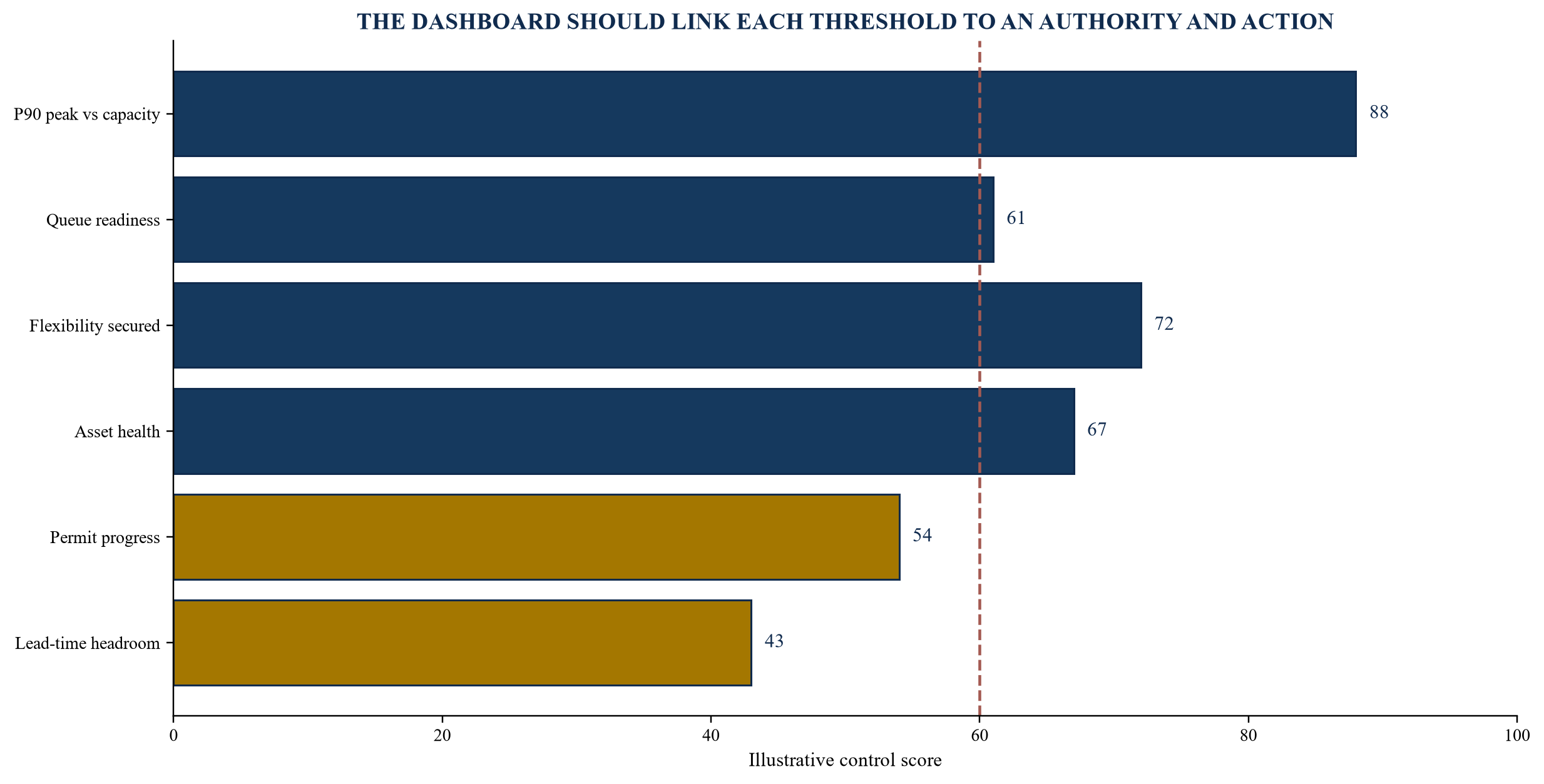
Thresholds are illustrative and should be approved for the relevant network.
Table 4. Reliability dashboard and escalation
| Indicator | Evidence | Trigger | Action |
|---|---|---|---|
| Load distribution | calibrated forecast | tail crosses capacity before delivery | release next design or procurement gate |
| Queue readiness | project milestones | credible capacity rises materially | refresh location and coincidence studies |
| Network margin | approved studies and telemetry | contingency margin falls | deploy flexibility or accelerate build |
| Asset condition | inspections and failures | critical health deteriorates | combine renewal with reinforcement |
| Delivery | permits, supplier and construction | float falls below threshold | escalate scope, contract or sequence |
| Model performance | back-test and drift | coverage or bias fails limit | restrict use, recalibrate or revert |
Frequency should reflect decision lead time and volatility.
The dashboard should preserve history. A current green status can follow a severe earlier breach. Trend, cause and action matter. Board reporting should show capital at risk, service exposure and choices requiring authority.
19. Run post-investment learning and model recalibration
After each gate and commissioning, the organisation should compare forecast, queue conversion, cost, delivery, utilisation and reliability with the decision case. Variance should be attributed to data, model, scenario, customer, network, procurement and execution causes.
Learning should update probability and lead-time assumptions. A project that withdraws after a specific milestone changes the evidence for comparable queues. A customer that ramps faster changes phase assumptions. The historical decision should remain preserved.
The learning review should identify whether a variance was foreseeable. A customer delay that was already visible in missing permits indicates weak evidence discipline. A sudden external event may validate the width of the scenario distribution even when the median was wrong. This distinction supports better governance and avoids penalising teams merely because an uncertain future resolved in a different state.
Benefits should be measured against a counterfactual. A reinforcement may avoid connection delay, unserved energy, losses or emergency work. Avoid adding benefits that overlap. Flexibility value should include avoided or deferred capital and actual service delivery.
Model recalibration should not chase noise. Change requires evidence, validation and governance. Performance should be assessed across seasons, locations and customer classes.
The review should also ask whether the staged process preserved useful options. An unused permit can still have created value if it prevented an irreversible early build while maintaining readiness. That value should be documented with the avoided commitment and decision timeline.
20. Create a repeatable grid-investment control system
The framework becomes repeatable through controlled templates, definitions and evidence. Core records are the decision perimeter, probabilistic load model, queue register, network scenario set, flexibility stack, option tree, staged-capex schedule, model-risk file, reliability dashboard and decision log.
Table 5. Governance gates for AI-assisted grid investment
| Gate | Required evidence | Decision owner | Failure response |
|---|---|---|---|
| Forecast | calibrated distribution and scenario rationale | planning authority | revise data or widen uncertainty |
| Queue | verified milestones and duplication control | connection authority | reduce probability or release capacity |
| Engineering | approved studies and alternatives | accountable engineer | redesign or gather evidence |
| Model risk | validation, limitations and fallback | model-risk authority | restrict or withdraw model use |
| Capital | cost, lead time, reliability and regulatory case | investment committee | stage, defer or stop |
| Delivery | permit, procurement and construction readiness | programme sponsor | hold gate or resequence |
Authorities should align to law, licence, delegation and technical standards.
Implementation can begin with one constrained zone. The team reconciles two years of load and weather, the complete connection queue, network headroom, asset condition and planned outages. It produces a calibrated load distribution and tests conventional reinforcement, flexibility and staged routes. Decision makers approve thresholds and a limited monitoring period.
The approach can then scale across the portfolio with common controls and local engineering detail. AI provides value when it improves forecast calibration, evidence processing, scenario coverage and decision timing. The final capital authority remains responsible for reliability, affordability and prudent investment.
A portfolio implementation should use a common economic language. Each constrained zone can report expected present cost, capital at risk, delivery exposure, reliability consequence and the value of waiting for further evidence. These measures allow the investment committee to compare unlike projects without removing their engineering differences. The comparison should retain the full distribution of outcomes, because two projects with the same expected cost can have very different tail risks and reversibility.
The programme office should maintain an assumption ledger that links every consequential input to its source, owner, effective date and next review. Changes in customer milestones, equipment lead times, interest rates, tariffs, land access or reliability rules can then be propagated through the decision cases. Material changes should create an exception for review rather than silently alter a dashboard. This control supports auditability and prevents teams from operating with different versions of the same planning assumption.
Procurement strategy should also follow the stage design. Framework agreements, design reservations, option clauses, conditional notices to proceed and modular equipment can preserve delivery capacity while avoiding premature full commitment. Their value depends on enforceable terms, supplier capacity and cancellation economics. The capital case should compare those costs with the cost of delay and the probability that the asset is needed. Commercial flexibility should never be recorded as technical capacity until the equipment, contract and operating arrangements can deliver the required service.
Regulatory engagement benefits from the same evidence structure. A filing can show the forecast distribution, queue-readiness tests, reliability thresholds, alternatives considered, staged commitments and protections against overinvestment. It can explain which costs respond to legal service duties and which depend on uncertain customers. Where incentives or tariff treatment differ between capital and operating solutions, the authority should make that asymmetry visible. Transparent treatment supports a decision that can be revisited as evidence develops.
The operating cadence can be monthly for queue and construction evidence, seasonal for forecast calibration and annual for the portfolio plan. High-consequence exceptions should be reviewed when triggered. The cadence should match data latency and decision lead time. Faster reporting does not improve a decision when the underlying evidence changes slowly or cannot be validated.
Success should be defined before deployment. Measures can include forecast calibration, reduction in queue-study cycle time, avoided emergency work, utilisation of commissioned assets, delivery against need date, reliability performance, flexibility availability and the share of decisions supported by complete evidence. Financial measures should distinguish cash deferred from cost avoided. The control system should record adverse outcomes as carefully as favourable ones, creating a durable basis for better future thresholds.
Capability development should cover planners, engineers, connection teams, operators, finance, procurement, regulators, cybersecurity and model-risk specialists. Each role needs enough understanding to challenge the evidence used at its gate. Training should use historical cases and simulated shocks, including a large customer delay, an equipment failure, a forecast miss and unavailable flexibility. The exercise should test whether decision rights, data access, fallbacks and escalation work under time pressure.
Data architecture should support controlled reuse without creating a single fragile platform. Meter, weather, asset, topology, queue, contractual and project-delivery data can remain in governed systems of record while a decision layer records approved features, versions and outputs. Access should follow role and purpose. Sensitive customer information should be minimised, protected and retained under applicable requirements. A model result should remain reproducible after source systems change.
Independent challenge should concentrate on the assumptions that can change the capital decision. Reviewers can test alternative queue-conversion rates, correlated customer delays, severe weather, common equipment constraints, higher financing costs, demand response failure and slower permitting. They should also test whether the chosen stage remains preferable when several adverse conditions occur together. A challenge that only reruns the central case provides limited assurance.
The mature system becomes a capital-allocation memory for the network. It preserves what decision makers knew, the uncertainty they accepted, the options they retained and the outcomes that followed. That record improves future planning, supports regulatory evidence and helps management direct scarce engineering and financing capacity toward projects whose timing and consequence are most compelling.
References
- International Energy Agency, Energy and AI, 2025, https://www.iea.org/reports/energy-and-ai
- International Energy Agency, Building the Future Transmission Grid, 2025, https://www.iea.org/reports/building-the-future-transmission-grid
- Federal Energy Regulatory Commission, Order No. 2023: Improvements to Generator Interconnection Procedures and Agreements, https://www.ferc.gov/major-orders-regulations
- National Institute of Standards and Technology, Artificial Intelligence Risk Management Framework 1.0, 2023, https://doi.org/10.6028/NIST.AI.100-1
- International Energy Agency, Secure Energy Transitions in the Power Sector, 2021, https://www.iea.org/reports/secure-energy-transitions-in-the-power-sector
- North American Electric Reliability Corporation, 2025 Long-Term Reliability Assessment, https://www.nerc.com/globalassets/our-work/assessments/nerc_ltra_2025.pdf
- International Energy Agency, Electricity Grids and Secure Energy Transitions, 2023, https://www.iea.org/reports/electricity-grids-and-secure-energy-transitions
- Abu Dhabi Department of Energy, Abu Dhabi Integrated Energy Model, https://doe.gov.ae/Abu-Dhabi-Integrated-Energy-Model
- International Energy Agency, Electricity 2026, https://www.iea.org/reports/electricity-2026
- International Energy Agency, Energy Supply for AI, 2025, https://www.iea.org/reports/energy-and-ai/energy-supply-for-ai
- National Institute of Standards and Technology, AI RMF Critical Infrastructure Profile Concept Note, 2026, https://www.nist.gov/system/files/documents/2026/04/08/Concept%20Note_%20Development%20of%20the%20NIST%20AI%20RMF%20Trustworthy%20Use%20of%20AI%20in%20Critical%20Infrastructure%20Profile.pdf
- National Institute of Standards and Technology, AI Risk Management Framework Resource Center, https://airc.nist.gov/
- Federal Energy Regulatory Commission, Order No. 1920: Electric Regional Transmission Planning and Cost Allocation, https://www.ferc.gov/major-orders-regulations
- International Energy Agency, Grid Investments, https://www.iea.org/reports/grid-investments
- International Renewable Energy Agency, Innovation Landscape for a Renewable-Powered Future, https://www.irena.org/publications/2019/Feb/Innovation-landscape-for-a-renewable-powered-future
- World Bank Group, Utility Performance and Behavior in Africa Today, https://openknowledge.worldbank.org/entities/publication/564eb21f-e70e-5e3f-af9e-0b8555ab156d
- International Electrotechnical Commission, Artificial Intelligence in the Energy Sector, https://www.iec.ch/artificial-intelligence
- GCC Interconnection Authority, Electricity Market and Interconnection, https://gccia.com.sa/gcc-power-trade-market/
- International Energy Agency, Digitalisation and Energy, https://www.iea.org/reports/digitalisation-and-energy
- World Bank Group, Private Participation in Infrastructure Database, https://ppi.worldbank.org/en/ppi
