

1. Build the control room around commitment authority
The bid control room is the operating system through which a buyer converts changing evidence into an authorised transaction position. It should show what the bidder knows, what remains assumed, how the economics respond, which protections are available and who can approve a change. Its purpose is decision integrity under time pressure.
Commitment authority should be explicit. A deal team can investigate, model and negotiate within a mandate. A board or investment committee may approve price, leverage, equity cheque, conditionality and risk limits. Lenders approve facilities and conditions. Legal advisers document the agreed structure. An AI service can prepare analysis, while it cannot expand any party's authority.
The operating system should distinguish a proposal from a commitment. Drafting a price bridge, term sheet or markup is reversible. Communicating a final bid, signing an agreement or delivering a funding confirmation can create legal and commercial consequences. The workflow should require the relevant approval and an evidence snapshot before each commitment event.
Decision rights should follow both amount and type of change. A small price movement may sit within delegated authority, while a new regulatory remedy, uncapped indemnity, financing gap or fundamental diligence exception may require escalation regardless of value. The mandate should define these hard triggers before the auction compresses time.
2. Create one versioned deal fact base
The fact base should link source documents, management responses, adviser findings, market information, model assumptions and buyer decisions. Each item needs an owner, date, source, status, confidentiality classification and affected model cells or contractual positions. A finding without lineage should not silently become a verified fact.
Information states should be simple and visible: verified evidence, seller representation, bidder assumption, third-party evidence, unresolved question and superseded item. These states prevent a management assertion from carrying the same weight as an audited record or executed contract. They also show which valuation outputs depend on unresolved material.
Versioning matters because auction information changes. A new customer file can alter revenue concentration; a revised debt schedule can change net debt; a lender term sheet can change cash interest and covenant headroom. The control room should preserve the prior view, identify the change and show every downstream effect.
Data access should follow need, privilege and clean-team restrictions. Commercially sensitive material, personal data, financing information and legal advice may have different access groups. An AI system should inherit these boundaries and should not combine restricted sources into an output for an unauthorised user.
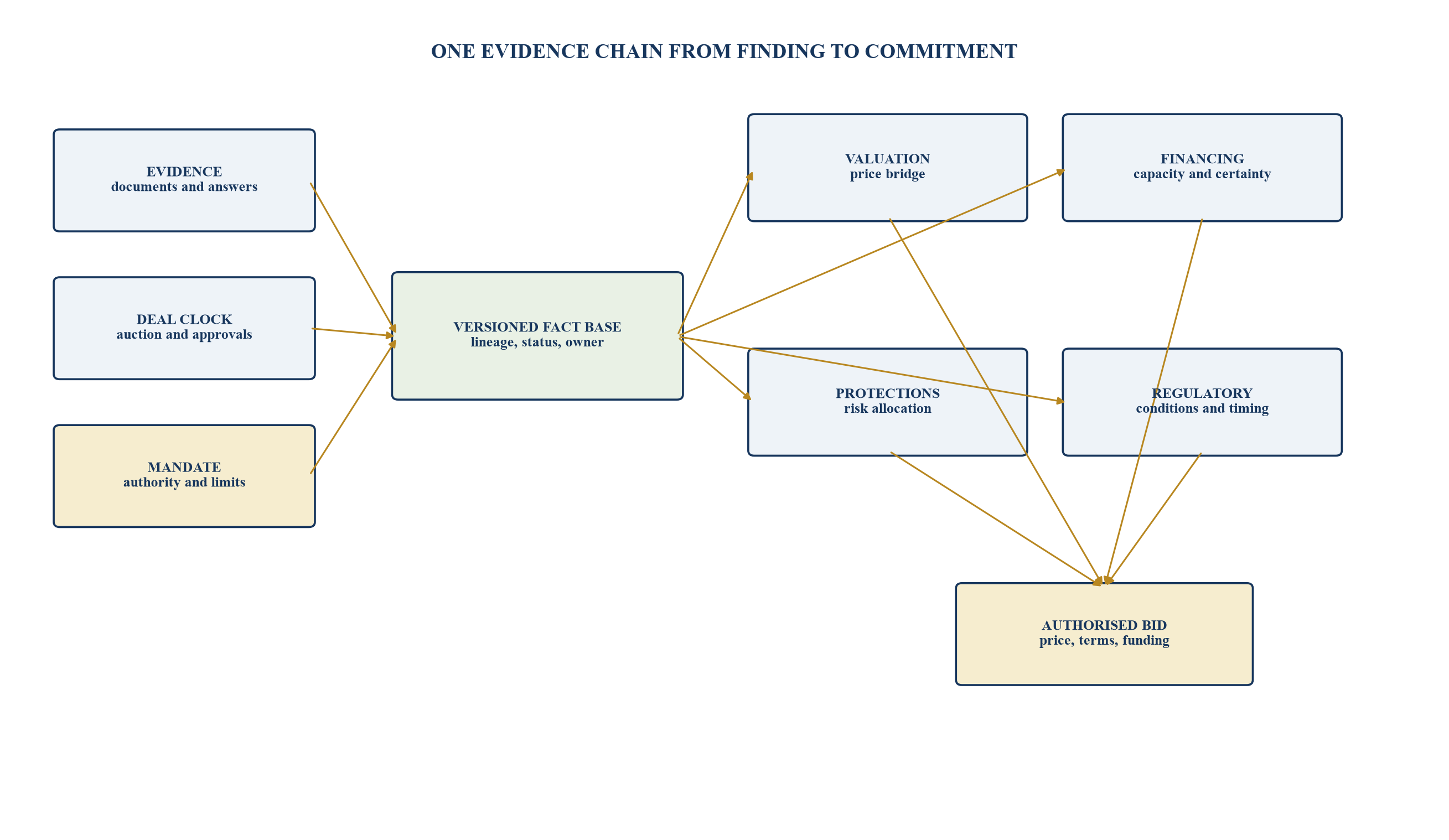
Evidence moves through bounded analytical modules before an authorised commitment.
Table 1. Deal fact and decision register
| Register field | Required content | Control question | Owner |
|---|---|---|---|
| evidence | source, date, location and access | can the item be reconstructed? | workstream lead |
| status | verified, represented, assumed or unresolved | what weight may the item carry? | diligence lead |
| economic effect | revenue, cost, cash, debt or timing | where does the model change? | finance lead |
| protection | covenant, condition, indemnity or price term | can risk be allocated or contained? | legal lead |
| financing effect | leverage, interest, liquidity or condition | does funding remain available? | financing lead |
| approval | mandate, escalation and decision | who may accept the revised position? | transaction chair |
| audit trail | prior version, change and rationale | what changed before commitment? | control-room manager |
Every material item is connected to a source, status and decision effect.
3. Convert the auction timetable into a decision clock
An auction calendar lists data-room releases, management meetings, bid dates, financing milestones, regulatory work and signing. The decision clock adds the time required to review evidence, update models, negotiate protections and obtain approvals. A deadline is manageable only when the critical decision path is visible.
The control room should work backwards from commitment events. Before a final bid, the buyer needs an approved valuation, funding view, mark-up, regulatory position, conditions and unresolved-risk register. Each deliverable needs a cut-off, owner and escalation route. Late evidence should trigger a defined response rather than an improvised extension of authority.
Decision latency should be measured. A material finding that takes two days to reach the financing model can leave the bid inconsistent. The system should record time from discovery to classification, quantified effect, proposed response and approval. Bottlenecks can then be addressed before the final round.
The seller's timetable may create strategic pressure, while the buyer should preserve its hard conditions. Walk-away thresholds, evidence requirements and funding conditions should not disappear because another bidder is faster. The control room should identify which items can be accepted as residual risk and which prevent commitment.
4. Translate diligence findings into economic variables
A finding creates decision value when it changes an economic variable, a protection, a condition, an integration action or the decision to proceed. Narrative severity labels are insufficient. The team should identify the affected cash flow, balance-sheet item, probability, timing or capital requirement and show the source of the estimate.
Revenue findings can affect volume, price, retention, concentration, pipeline conversion and deferred revenue. Cost findings can affect gross margin, people, suppliers, technology and standalone requirements. Cash findings can affect working capital, capital expenditure, tax, provisions and leakage. Balance-sheet findings can affect debt-like items, pensions, leases and contingent liabilities.
Not every risk should be priced through a probability-weighted deduction. Some risks are better addressed through a condition, specific indemnity, escrow, covenant, insurance, structure or refusal to proceed. The model should show both the unprotected exposure and the value and limitations of the proposed response.
Estimates should preserve range and evidence quality. A workstream may know the direction but lack a reliable amount. The decision pack can show a sensitivity and require a protection rather than create a false point estimate. Assumptions should remain labelled and owned.
5. Maintain a live valuation bridge
The live bridge should reconcile the last approved value to the current bid view. It can show base-plan changes, quality-of-earnings adjustments, commercial findings, synergy revisions, tax and capital items, financing effects, execution risk and the value of protections. Each line should link to the fact register.
Enterprise value, equity value and total cash required should remain distinct. Net debt, debt-like items, working-capital mechanisms, transaction expenses, refinancing and leakage can change the equity cheque without changing the headline multiple. The control room should show each bridge clearly.
The buyer should separate standalone value, buyer-specific synergies and strategic option value. A competitive process can tempt the bidder to use all expected synergy to support price. The model should show realisation cost, timing, tax, probability, dis-synergy and the share retained by the buyer.
Valuation methods should remain plural where appropriate. Discounted cash flow, trading comparables, precedent transactions, LBO returns and strategic value illuminate different assumptions. The purpose of AI support is faster reconciliation and scenario preparation, not the production of an authoritative number without judgement.
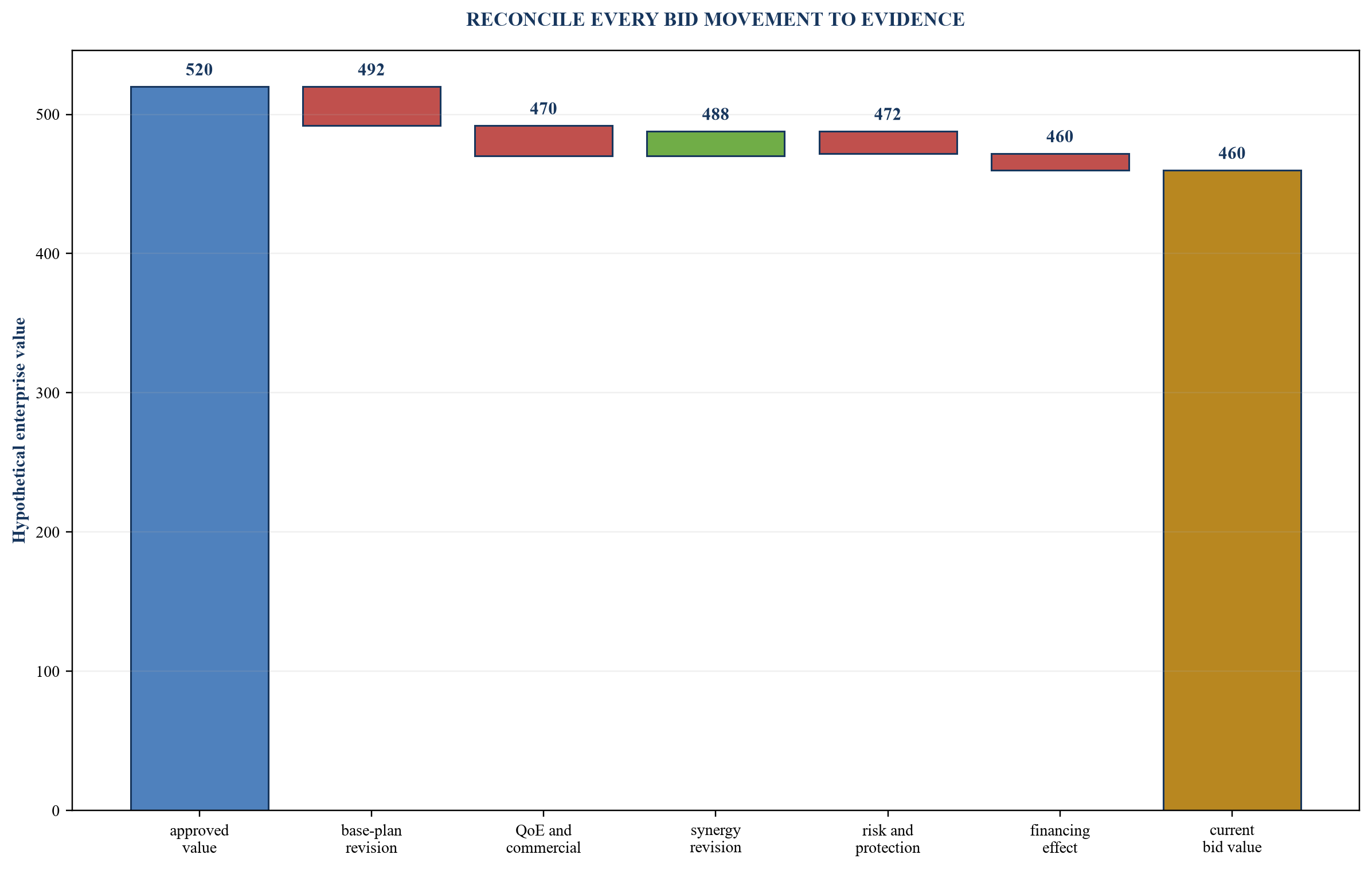
Hypothetical values show how evidence, protections and financing move the bidder's position.
6. Re-underwrite AI-exposed revenue and credit
An acquisition target can be affected by artificial intelligence as a product opportunity, operating tool or competitive threat. Software revenue may face pricing, replacement or concentration risk as customers adopt new tools. An AI-enabled target may depend on model providers, compute, data rights and human review that are absent from reported unit economics.
The buyer should map revenue by product, customer cohort, contract, use case and substitutability. Renewal, seat count, usage, discounting, implementation and support should be examined. Management claims about AI defensibility should be tested against customer evidence, product telemetry, data rights and the cost of delivering accepted outcomes.
Credit exposure matters because acquisition financing depends on cash-flow durability. The BIS reported in July 2026 that business development companies had substantial lending exposure to software firms and observed that generative-AI revenue uncertainty had not yet changed loan pricing in the sample it examined. A buyer should perform its own target-specific analysis rather than assume public credit pricing captures the risk.
The control room should connect AI scenarios to revenue, margin, capital expenditure, debt capacity and covenant headroom. A lower-cost product opportunity may require migration investment and could cannibalise existing revenue. The scenario should show both the transition and steady state.
7. Test quality of earnings against the bid thesis
Quality of earnings should reconcile reported performance to sustainable cash generation. Revenue recognition, one-time items, capitalised costs, customer concentration, working capital, related parties and run-rate adjustments can change both valuation and financing. The bid model should show which adjustments are accepted, challenged or unresolved.
AI and technology costs require particular care. Model consumption, cloud commitments, data acquisition, evaluation, human review and support may sit across cost lines or be capitalised. A product margin that excludes these items can overstate scalability. The buyer should rebuild contribution margin by customer or workload where material.
Normalisation should avoid double counting. A cost added back as exceptional cannot also be included as a synergy. A revenue uplift should not appear in both the base plan and the synergy case. The control room should use identifiers that allow every adjustment to flow once through valuation, leverage and returns.
Cash conversion should be tested under downside cases. A target can show EBITDA growth while consuming cash through receivables, implementation, deferred commissions, capex or committed infrastructure. Acquisition debt and integration funding depend on the cash profile, not the presentation metric alone.
8. Convert regulatory analysis into timing and value
Merger-control analysis should inform timetable, conditions, remedies and long-stop risk. The relevant authorities and tests depend on the parties, markets and jurisdictions. The UK CMA's current guidance, the US merger guidelines, EU merger-control rules and other regimes provide frameworks; transaction-specific legal analysis remains necessary.
The bid model should identify filing thresholds, substantive theories, information requirements, expected phases, remedy scenarios and required cooperation. A longer review can increase financing carry, integration delay, employee attrition and customer uncertainty. A remedy can reduce revenue, synergy or strategic control.
Regulatory evidence should remain separate from probability theatre. A legal team may describe plausible paths and key uncertainties. Management can use scenarios for economic planning, while the score should not be presented as a regulator's predicted decision. Hard conditions and unacceptable remedies should be defined explicitly.
Changes in filing requirements can affect the workplan. The FTC's March 2026 guidance records the then-current HSR filing position following litigation affecting the 2025 form. The control room should use current official instructions at the time of filing and should not rely on a static template from an earlier deal.
9. Map each risk to a protection or decision
The protection matrix connects a risk to the proposed contractual, structural, financing or operating response. It should state the exposure, evidence, responsible party, survival, cap, deductible, security, enforceability assumptions and residual risk. A generic “covered in the SPA” status does not establish economic protection.
Price adjustments address items that can be quantified at closing. Warranties and indemnities allocate specified risks subject to negotiated limits and collectability. Covenants govern conduct before completion. Conditions can prevent completion when defined events occur. Escrow, retention, guarantees and insurance can support recovery. Structure can ring-fence or defer value.
The matrix should show interaction. A lower price may coexist with an indemnity; a condition may protect against a regulatory outcome; a lender may require the same issue to be resolved before funding. The buyer should avoid paying twice for a mitigation or assuming that one protection solves a different risk.
Residual exposure should return to the approval body. Legal drafting can narrow a risk without eliminating it. Enforcement takes time and may depend on the seller's resources. The decision record should show what remains after the proposed terms and whether it fits the mandate.
Table 2. Risk-to-protection matrix
| Risk | Economic effect | Candidate response | Control-room test |
|---|---|---|---|
| overstated recurring revenue | lower cash flow and value | price, warranty, earn-out | evidence and collection match thesis |
| tax exposure | cash outflow and delay | specific indemnity and escrow | cap, survival and security sufficient |
| regulatory remedy | lost revenue or control | condition, covenant, termination right | remedy boundary fits mandate |
| leakage | reduced equity value | locked-box covenant or completion accounts | definition and recovery are workable |
| customer consent | delayed or lost revenue | condition, covenant or price holdback | named consents and timing tracked |
| financing shortfall | inability to complete | committed facility, equity backstop | conditions and funds flow reconcile |
| integration dependence | delayed synergy and extra cost | price, TSA, covenant and plan | owner, budget and deliverability tested |
Protection value depends on drafting, enforceability, security, timing and residual exposure.
10. Reconcile price with acquisition financing
Financing is part of the bid, not a parallel workstream. The control room should connect purchase price, refinancing, fees, minimum cash, integration funding and contingencies to the sources and uses. Each change should flow to leverage, interest, liquidity, covenants and equity returns.
Debt capacity should be based on lender-defined earnings, cash flow and security rather than the buyer's headline EBITDA. Adjustments accepted in the valuation case may be excluded or capped by lenders. Synergy credit can differ by facility and documentation. The model should preserve these definitions separately.
Funding certainty includes commitments, conditions precedent, market flex, documentation, security, intercreditor arrangements and the ability to satisfy the funds flow. A nominal facility amount is insufficient when draw conditions or timing are unresolved. The financing checklist should connect every condition to an owner and evidence date.
Interest and fees should be tested under base rate, margin, currency and timing scenarios. Regulatory delay can extend ticking fees or bridge exposure. A lower bid price may still require more equity if debt capacity falls after diligence. The decision dashboard should show this interaction in real time.
11. Build financing sensitivities around cash, not presentation metrics
The financing model should begin with cash available for debt service after tax, working capital, maintenance investment, restructuring and unavoidable integration cost. Adjusted EBITDA can support comparison, while the debt case needs a cash bridge that reflects lender definitions and actual payment timing.
Sensitivity should combine drivers that can move together. A revenue shortfall may reduce margin, increase working-capital consumption and delay synergy. A regulatory delay can add financing cost while postponing integration. Independent one-variable sensitivities can understate the equity and liquidity requirement.
The buyer should model covenant headroom through the period in which integration risk is highest. Interest cover, leverage, minimum liquidity and borrowing-base tests may use different definitions and dates. The control room should identify the first binding constraint and the action available before breach.
Refinancing risk should be visible. A bridge or short-dated acquisition facility can create a dependency on capital markets after signing. The model should show maturity, expected takeout, market flex, fees and the consequences of delay. The approval body should understand which funding outcome remains outside the buyer's control.
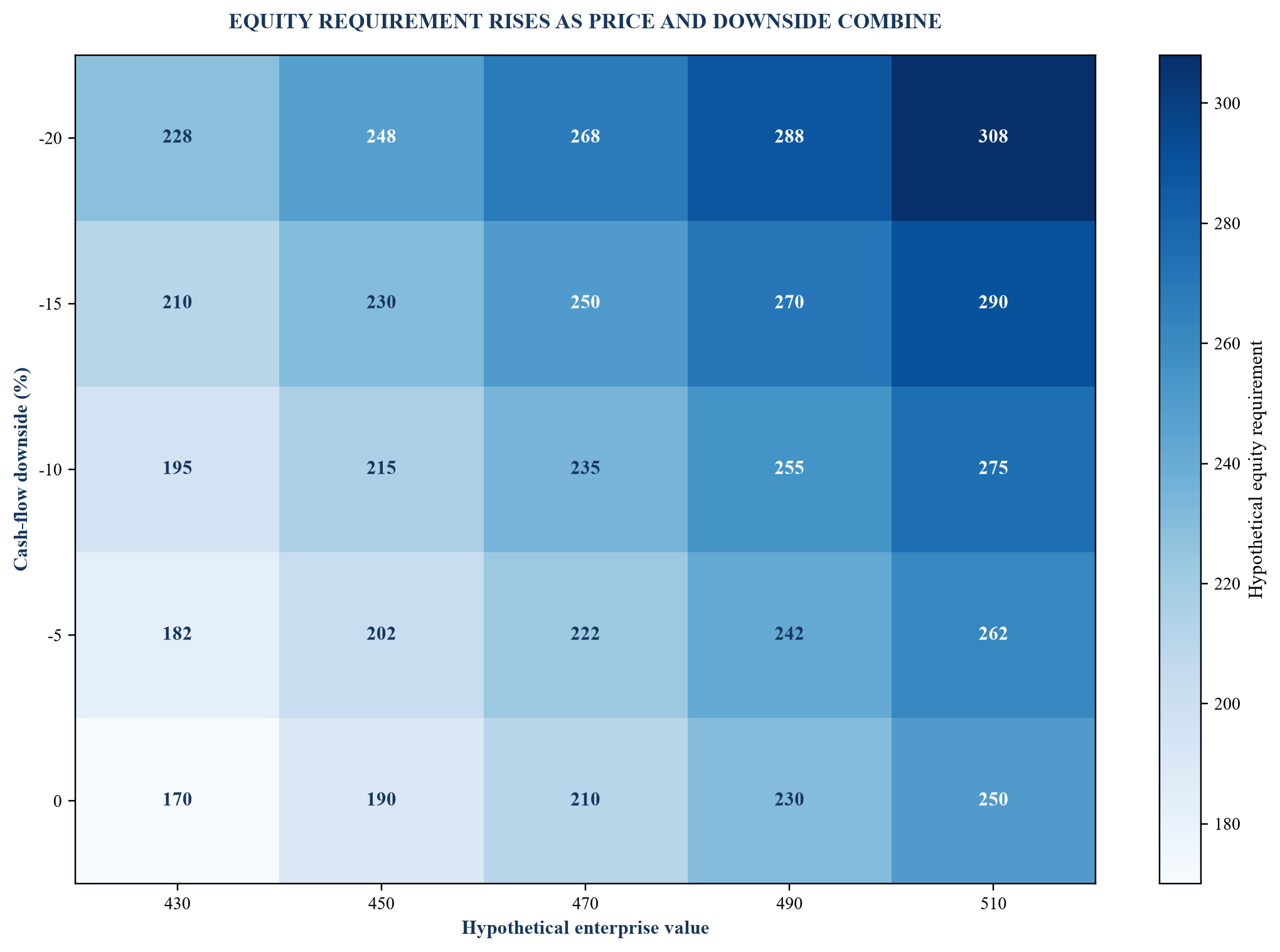
Hypothetical equity requirements demonstrate the interaction between bid price and debt capacity.
Table 3. Acquisition-financing control sheet
| Financing item | Required evidence | Bid effect | Escalation trigger |
|---|---|---|---|
| sources and uses | price, fees, refinancing and cash | equity cheque and funding need | uncovered use or stale amount |
| lender earnings | documented definitions and adjustments | debt capacity | material lender rejection |
| cash flow | downside cash and investment bridge | service capacity | minimum liquidity shortfall |
| conditions | commitment and draw requirements | completion certainty | unmet or discretionary condition |
| market flex | margin, fee and structural flex | returns and liquidity | mandate threshold exceeded |
| covenants | headroom by test date | operating flexibility | downside breach or thin headroom |
| maturity | bridge, takeout and refinancing plan | exit and market exposure | delayed or unavailable takeout |
Definitions and evidence are reconciled before the bidder relies on facility availability.
12. Set walk-away conditions before competitive pressure peaks
A walk-away framework should state the maximum price and the conditions under which the buyer will not proceed. It should cover value, equity cheque, leverage, return, liquidity, regulatory remedy, customer loss, evidence gaps, contractual protection and financing certainty. Several conditions should operate as hard limits rather than weighted scores.
The framework should distinguish a valuation ceiling from a bid recommendation. The maximum price may assume full diligence, acceptable protections and committed financing. If those conditions deteriorate, the allowable price can fall. A single number without conditions creates false authority.
Walk-away rules should also protect strategic logic. A target may no longer deliver the capability, geography, customer access or synergy that supported the original thesis. A revised price cannot always restore strategic fit. The control room should show when the transaction has become a different investment.
Exceptions to the mandate require the designated approval body and a documented rationale. The system should prevent an analyst from changing a threshold to make the current bid pass. Approval should record the new evidence, alternatives and residual exposure.
13. Use scenario engines without creating false precision
Scenario analysis should test coherent transaction states rather than thousands of arbitrary combinations. A base case, operational downside, regulatory delay, financing stress and severe-but-plausible case can connect revenue, margin, cash, leverage, terms and timing. Each scenario should state its evidence and management assumptions.
AI can help classify new information and prepare the affected scenarios. It can identify where a customer loss touches revenue, synergy and covenant headroom. The calculation engine should remain deterministic, versioned and reviewable. The model should not silently invent probabilities or change approved formulas.
Probability-weighted values can support comparison when their assumptions are transparent. They should not conceal a hard risk, such as unavailable financing or an unacceptable remedy. The control room should show scenario outputs and the conditions that make each scenario relevant.
Decision-makers should also see sensitivity to the uncertain inputs that drive the result. If value is dominated by one retention rate or exit multiple, additional analysis of minor costs creates little decision value. The evidence plan should focus on the variables that can change the bid.
14. Control artificial intelligence as a bounded deal-room service
AI tools can extract terms, compare document versions, classify diligence findings, trace source citations, detect model inconsistencies and prepare meeting packs. These uses can reduce coordination latency. The output remains subject to source verification, professional review and the bidder's decision rights.
The service should use approved data, models, tools and access groups. Confidential information should not enter a public or unapproved model. Privileged material, clean-team data and financing information may require separate environments. Prompts and outputs should follow retention and disclosure policy.
Every AI-produced fact should carry a source. A summary without a document location cannot support a material price or legal decision. Numerical extraction should be reconciled to totals and periods. Contract analysis should preserve the exact clause and version for adviser review.
The workflow should include abstention. Missing, inconsistent or poor-quality evidence should generate a question or exception rather than a completed answer. The service should be monitored for citation errors, omitted qualifications, access anomalies and drift after model or prompt changes.
15. Protect privilege, confidentiality and information barriers
Deal information can include personal data, competitively sensitive material, inside information, legal advice and lender terms. The control room should classify sources and outputs, restrict access and record sharing. A broad searchable repository can weaken an information barrier even when every user belongs to the buyer.
Clean teams may analyse restricted commercial information under agreed protocols. Their outputs to the wider team should follow approved aggregation and disclosure rules. An AI service used by the clean team should not expose underlying data, embeddings or logs to unauthorised environments or users.
Legal privilege depends on jurisdiction and circumstances. The technology design should support counsel's protocol rather than assume that a label creates privilege. Prompts, drafts and collaboration logs can become records. The team should agree purpose, access, retention and export before using AI for legal work.
Security monitoring should detect unusual retrieval, bulk export, changed permissions and attempts to combine restricted sources. Incident response should identify affected information, users, counterparties and required notifications. The bid timetable should include time for containment without forcing an uninformed commitment.
16. Create an approval pack that changes with the facts
The live approval pack should show the transaction thesis, evidence quality, valuation, sources and uses, financing, protections, regulatory path, integration requirements and unresolved matters. It should identify changes since the last approval and the decisions required now. A static presentation can be obsolete before the meeting begins.
Each output should link to the fact register and model version. Decision-makers should be able to inspect a material bridge line or risk without navigating several workstream files. The pack should remain concise at the top level and provide controlled drill-down.
Assumptions should be labelled by owner and date. Management estimates, adviser judgements and third-party data can all be useful, while they carry different evidence weight. The pack should show when a conclusion depends on a seller assertion or unresolved item.
The approval record should capture attendees, conflicts, materials, questions, conditions, dissent and delegated authority. If the bid changes after approval, the control room should determine whether the change fits the mandate or requires a new decision.
17. Design the bidder's communication protocol
Seller communications should remain consistent with the buyer's authorised position. Price, conditionality, financing and diligence messages can affect negotiating leverage and legal exposure. The protocol should identify who can communicate each item and which statements require prior approval.
AI can prepare drafts and compare the proposed message with the mandate, while an authorised person should release material communications. The system can flag a price, date or condition that differs from the approved record. It should preserve the final transmitted version and recipient.
Internal communication should use the same fact base. Workstreams should not circulate competing versions of net debt, earnings or bid value. Urgent messaging needs a clear channel and escalation so that a late material finding reaches the transaction chair before commitment.
The protocol should address leaks and rumours. Listed-company and takeover situations can have specific announcement and market-conduct requirements. Counsel and financial advisers should lead the applicable response. The control room should preserve time-stamped evidence and restrict speculative commentary.
18. Link contractual protections to financing conditions
Lenders may require representations, diligence, security, equity funding, regulatory approvals and other conditions that overlap with the acquisition agreement. The control room should map these dependencies. A buyer should avoid accepting a purchase obligation that it cannot fund under the facility conditions.
Certain-funds and cash-confirmation regimes can impose specific requirements in public takeovers. The current Takeover Code should be applied by qualified advisers to the actual offer. The control room can support consistency among the announcement, financing documents, sources and uses, conditions and funds flow.
The financing workstream should review every change in purchase terms. An earn-out, escrow, deferred consideration, leakage mechanism or remedy can affect facility eligibility and required equity. The legal workstream should understand lender controls that may constrain negotiation.
At signing readiness, the buyer should be able to trace each acquisition condition to the corresponding financing treatment. Any gap should be escalated. Reliance on a general statement that financing is “in place” does not establish draw certainty.
19. Treat integration cost and dis-synergy as bid variables
Integration planning should begin during diligence because separation, migration, retention, regulatory remedies and operating-model choices affect value. The bid model should include one-time cost, stranded cost, required capex, service agreements and the period before synergy is realised.
Dis-synergies can include customer loss, supplier repricing, employee attrition, duplicated systems, lost tax attributes and management distraction. They should be identified by workstream and linked to cash timing. A gross synergy presentation without these effects can overstate debt capacity and buyer returns.
The plan should distinguish actions controlled by the buyer from outcomes dependent on customers, regulators or counterparties. Accountability improves when each synergy has an owner, baseline, delivery action, cost, time and evidence. The control room should reduce or defer value when dependencies remain unresolved.
Integration complexity can also affect contractual protection. A transition service, pre-close covenant, information right or employee arrangement may preserve value. The economic and legal workstreams should evaluate these terms together.
20. Apply the framework to public and private transactions
Private transactions often allow negotiated warranties, indemnities, escrows and completion mechanisms. Public takeovers operate under market rules, timetable, disclosure and financing requirements that can limit conditionality. The control-room architecture remains useful, while the permitted decisions and communications differ.
The applicable rules should be encoded as a transaction-specific checklist maintained by counsel and advisers. The AI service can help reconcile drafts and deadlines but should not interpret the rules autonomously for commitment. Changes in the current code, regulation or authority guidance should be checked at the decision date.
The bidder should also distinguish friendly, competitive and hostile contexts. Access to information, timetable and communication can change. The fact base should show which conclusions rely on confirmatory diligence and which derive from public information or assumptions.
Cross-border transactions can face several merger-control, foreign-investment, securities and sector regimes. The control room should integrate their conditions and timing without reducing them to one probability. A delay or remedy in one jurisdiction can affect the entire financing and long-stop structure.
21. Worked example: a hypothetical competitive acquisition
Assume a buyer is considering a target with reported revenue of 180 and adjusted EBITDA of 36 in hypothetical currency units. The seller seeks an enterprise value of 500. The buyer's initial case assumes sustainable EBITDA of 34, net debt of 40, gross synergies of 14 and integration cost of 20. These figures are analytical assumptions, not observed company data.
Diligence identifies customer concentration, capitalised product-development cost, an uncommitted cloud obligation and a required regulatory remedy scenario. Lenders accept only 31 of EBITDA for debt sizing and offer 240 of committed capacity subject to defined conditions. The buyer revises the standalone case, synergy timing and equity requirement.
The protection matrix proposes a completion-account adjustment for debt-like items, a specific indemnity for an identified tax matter, customer-consent covenants and a regulatory remedy boundary. The control room shows that a bid above 460 would breach the approved equity return under the downside case even if the base case remains acceptable.
The committee authorises a final bid of 455 subject to the specified protections, financing documents and no material deterioration in the top-customer cohort. A later seller request to remove the regulatory condition automatically triggers reapproval rather than remaining within the team's price discretion.
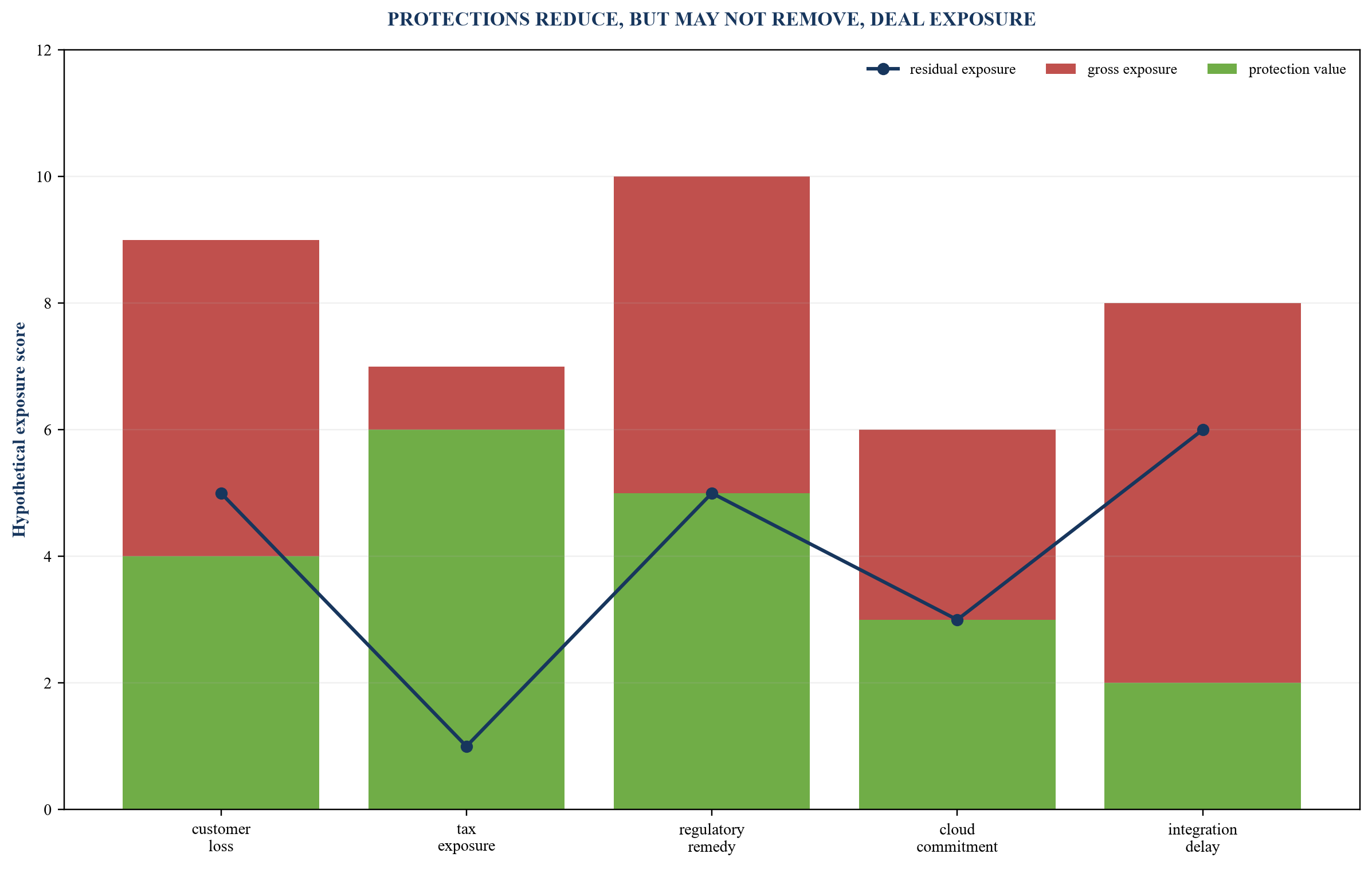
Hypothetical scores show why contractual language and economic exposure must be reviewed together.
Table 4. Hypothetical bid-control decision bridge
| Decision item | Initial view | Revised view | Control-room response |
|---|---|---|---|
| sustainable EBITDA | 34 | 31 | reduce debt and standalone value |
| gross synergy | 14 | 11 | revise timing, cost and buyer share |
| integration cost | 20 | 28 | increase equity and cash requirement |
| committed debt | under review | 240 | reconcile conditions and funds flow |
| regulatory remedy | broad assumption | defined downside | set remedy boundary and condition |
| maximum bid | 485 | 460 | enforce walk-away dashboard |
| authorised final bid | none | 455 | condition on protections and funding |
Values are illustrative assumptions used to demonstrate the framework.
22. Build the walk-away dashboard
The dashboard should display current bid value, equity cheque, leverage, return, liquidity, unresolved evidence, protection status, regulatory conditions and financing certainty against approved thresholds. It should show both base and downside cases and identify the condition that is closest to breach.
Colour alone is insufficient. Each warning should state the threshold, current value, source and required decision. A model refresh should not clear a warning without evidence or authorised assumption change. Hard stops should remain visible even when aggregate economics appear attractive.
The dashboard should also show staleness. A return calculated with yesterday's debt terms or an earlier net-debt schedule can mislead. Material inputs should carry timestamps, owners and the next expected update. The final bid snapshot should freeze the exact data and model version approved.
Users need controlled drill-down. An investment committee may see the top conditions; workstream leads can inspect sources and calculations. Access to clean-team or privileged material remains restricted while the decision effect is communicated in an approved form.
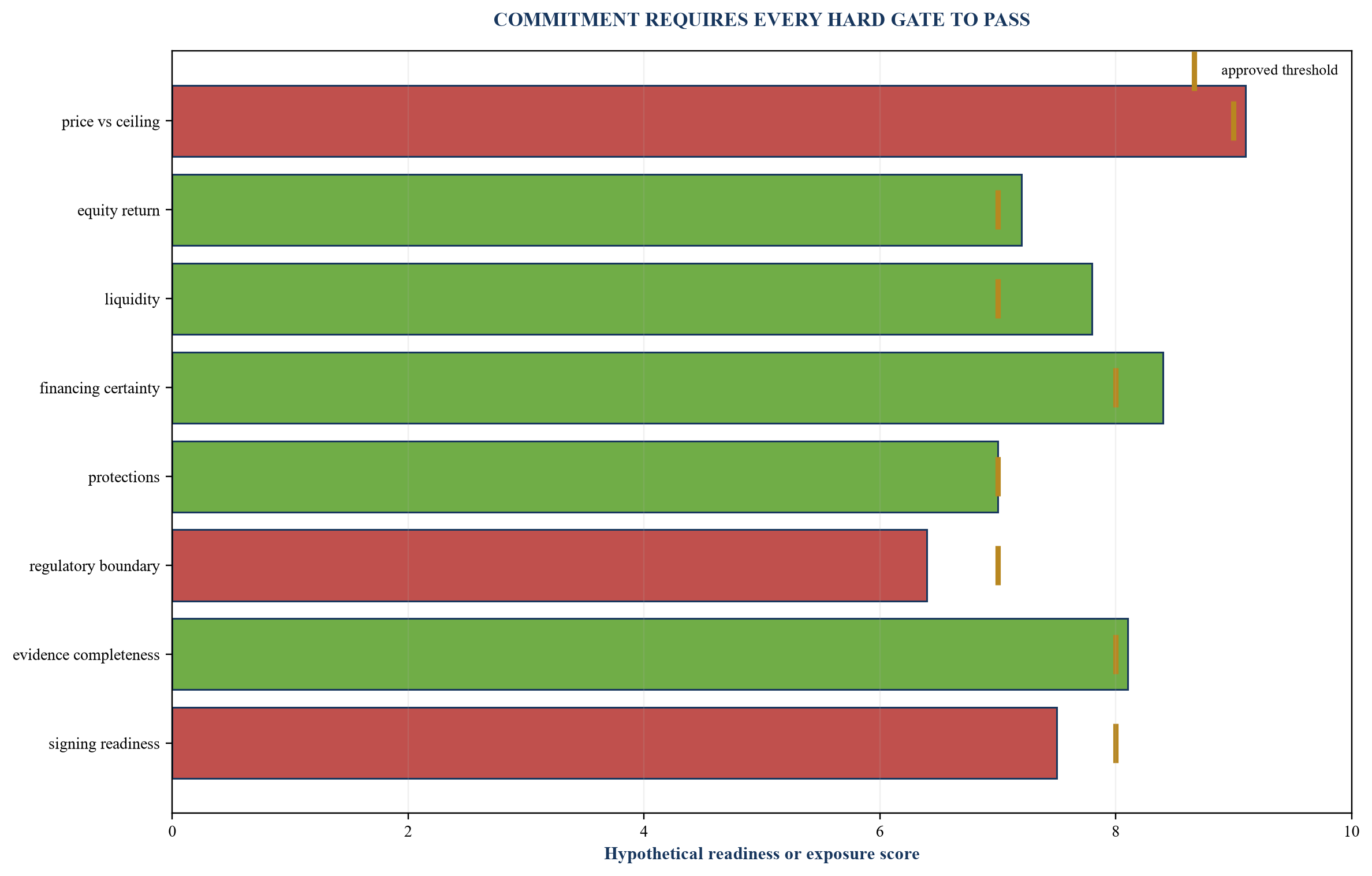
Hypothetical indicators combine economics, protection, funding and evidence gates.
Table 5. Final-bid readiness gates
| Gate | Evidence | Pass condition | Failure response |
|---|---|---|---|
| price | current valuation and bridge | within approved conditional ceiling | reduce, reapprove or withdraw |
| returns | base and downside equity case | approved threshold met | change price, structure or decision |
| financing | commitments, documents and funds flow | available on acquisition terms | close gap before commitment |
| protections | agreed mark-up and residual register | within risk mandate | negotiate, price or escalate |
| regulatory | counsel analysis and remedy boundary | acceptable path and conditions | restructure, condition or stop |
| evidence | material diligence register | no prohibited unresolved item | obtain evidence or abstain |
| authority | committee mandate and conditions | bid fits delegated authority | obtain new approval |
| execution | timetable, signatures and communications | controlled commitment path ready | pause release |
The actual approval body determines which gates are mandatory for the transaction.
23. Run a 72-hour final-bid protocol
During the first 24 hours, the control room should freeze the data-room index, reconcile open questions, refresh valuation and financing, and identify every item capable of changing the mandate. Workstream leads confirm source status and material changes since the prior bid.
During hours 25 to 48, legal, regulatory, financing and integration positions are reconciled. The team resolves internal model differences, confirms protections, tests downside funding and prepares the approval pack. Unresolved hard items receive a decision owner and deadline.
During hours 49 to 72, the approval body reviews the current evidence and conditions. The final bid, mark-up, financing, communications and funds flow are checked against the approved snapshot. Any late change is classified before transmission and either fits authority or triggers reapproval.
The protocol should preserve time for a controlled decision. An auction deadline does not justify skipping the evidence and authority needed to commit. A decision to abstain or submit a lower bid is a valid output of the control room.
24. Verify signing and completion as separate states
Signing establishes contractual obligations; completion transfers the business after specified conditions. The control room should maintain separate checklists, authority and evidence for each state. A signed transaction can still face regulatory, financing, consent, conduct and deterioration risks before completion.
The buyer should track conditions, covenants, long-stop dates, financing availability and required certificates. Each item needs an owner, source and escalation trigger. Changes to the target's performance should flow to liquidity, integration and any relevant contractual analysis.
Financing conditions should remain aligned with acquisition conditions through completion. Waivers, amendments or remedy commitments can affect funds availability and returns. The approval body should receive material changes and their quantified effects.
Completion readiness should include funds flow, security, corporate approvals, closing accounts or locked-box controls, communications and day-one operations. AI can reconcile documents and tasks, while authorised advisers and executives confirm the legal and financial state.
25. Monitor post-signing value leakage
The period between signing and completion can create leakage through trading, capex, people, customers, suppliers and management decisions. Pre-completion covenants and information rights can help, subject to legal limits on control before closing. The buyer should track agreed indicators without directing the target unlawfully.
The value model should update for material changes and distinguish contractual remedies from operating consequences. A breach may create a claim but still leave the buyer with integration or liquidity pressure. The control room should show both.
Retention, customer consent, data separation, financing and regulatory remedies may require action before completion. The integration office should connect each dependency to value and day-one readiness. Costs and delays should be updated in the approved case.
After completion, the bid-control fact base should transfer into purchase-price adjustment, integration, synergy and claims work. This preserves evidence and prevents the deal team from disappearing with the assumptions that supported the price.
26. Board and investment-committee questions
The board should ask what changed since the last approval, which sources support the change and how price, financing, protections and timing respond. It should identify the largest unresolved item and the maximum exposure before detection or recovery.
The committee should examine the downside equity cheque, liquidity and covenant headroom alongside the base return. It should understand which synergies are required to justify price, who controls delivery and what happens if integration is delayed.
The board should ask whether the proposed protections are collectible and whether financing is available on the acquisition terms. It should see every hard condition and any request to depart from the mandate. AI-generated material should be identifiable and source-linked.
The final record should state the authorised bid, terms, funding, conditions, residual risks, delegated authority and triggers for reapproval. This creates accountability after the competitive moment passes.
27. Limitations and research agenda
The framework cannot replace transaction-specific legal, tax, accounting, regulatory, financing or valuation advice. Auction processes, jurisdictions and transaction forms vary materially. A control room improves reconciliation and decision evidence; it cannot remove uncertainty or make a bid successful.
The worked example and dashboard values are hypothetical. They are not market observations, forecasts or recommended thresholds. Real decisions require target records, independent diligence, current financing terms and authorised professional judgement.
Artificial intelligence can create its own errors through omitted context, incorrect extraction, weak citations, access failures and model change. Its use should be bounded, evaluated and monitored. Deterministic calculations also fail when formulas, inputs or definitions are wrong.
Further research should compare decision latency, error correction, bid discipline and post-close value across controlled deal processes. Evidence on AI-assisted diligence should separate faster document handling from improved transaction outcomes and collected cash value.
28. Preserve bid discipline in a competitive auction
Auction dynamics can influence judgement through time pressure, sunk cost, rivalry and fear of losing a scarce asset. The control room should make these pressures visible without pretending that competitive behaviour can be reduced to a formula. The buyer needs a clear view of strategic alternatives and the cost of winning on unacceptable terms.
The bid history should show each price and term movement, the evidence that supported it and the value retained by the buyer. A movement attributed only to “competition” provides little basis for governance. Management should explain whether new information, greater certainty, changed financing or a deliberate transfer of synergy justifies the position.
The team should maintain an outside option. Organic investment, partnership, minority ownership, a different target or no transaction can compete for the same capital. These alternatives may have different timing and risk, but they help the board evaluate the premium being paid for speed, control or scarcity.
Adviser incentives should be understood. Fees, relationships and mandate objectives can affect behaviour even when advice is professional. The approval body should receive the analysis needed to exercise its own judgement. Conflicts and contingent compensation should be disclosed under the buyer's governance.
A lost auction should produce evidence, not an automatic conclusion that the ceiling was too low. The post-process review can compare the winner's terms, later performance and the buyer's alternative use of capital where information becomes available. Discipline is demonstrated by the quality of the decision at the time, using evidence then available.
29. Diligence the target's own AI operating system
When the target uses AI in products or operations, the buyer should map models, data, prompts, retrieval, tools, human review and state-changing actions. The diligence scope should identify which capabilities are proprietary, licensed, open source or dependent on a founder, employee or external provider.
Data rights require source-level analysis. A target may possess data without having the contractual, privacy or intellectual-property rights required for training, retrieval or product use. Customer agreements, consent, licences, retention and cross-border processing can affect continued operation after change of control.
Model performance should be tested in the actual workflow. Benchmark claims, demonstrations and aggregate accuracy can conceal customer cohorts, languages, rare failures and expensive review. The buyer should inspect evaluation sets, incident records, overrides, complaints, release controls and the cost per accepted business outcome.
Technology and commercial diligence should connect. A fragile model dependency can affect renewal, gross margin, support, security and roadmap. A credible deterministic control plane, evidence lineage and portability can support scalability and reduce integration risk. The findings should enter both valuation and the hundred-day plan.
Change-of-control provisions matter. Providers, data licensors, customers and employees may have consent, termination or pricing rights. The control room should link each dependency to closing conditions, protections, financing and integration. A technical asset that cannot legally or operationally transfer should not remain in the bid thesis at full value.
30. Integrate foreign-investment and national-security review
Foreign-investment regimes can apply independently from merger control and can focus on ownership, technology, data, infrastructure, supply chains and government relationships. The buyer should identify potentially relevant jurisdictions and mandatory or voluntary filings early, using current official guidance and transaction-specific legal advice.
The economic model should include timing, interim obligations, potential mitigation and the effect of a prohibition or divestment. A condition that protects the buyer can make the bid less attractive to the seller. A commitment to accept remedies can preserve deal certainty while transferring economic risk to the buyer. The mandate should define acceptable boundaries.
Sensitive data and technology may require clean teams, access restrictions or ring-fencing during diligence. The AI environment should enforce these controls. Combining restricted technical material with commercial strategy in a broad model context can create an avoidable security and legal exposure.
Financing should reflect the review path. A longer period can affect availability, interest, bridge maturities and equity funding. Lenders may require specified approvals or mitigation limits. The acquisition agreement and facility documents should be reconciled for each relevant condition.
The control room should avoid presenting a jurisdictional score as a legal conclusion. It can track counsel's analysis, evidence, milestones, scenarios and economic effects. The accountable decision remains with the bidder and its advisers under the applicable law.
31. Measure decision quality after the transaction
Post-deal review should compare the approved case with observed performance, while recognising that later outcomes do not alone prove whether the original decision was reasonable. The review should reconstruct the evidence, assumptions, alternatives and conditions available at the time of approval.
The buyer can track revenue, margin, cash conversion, customer retention, integration cost, synergy, financing, regulatory outcomes and claims. Variances should distinguish diligence miss, assumption error, execution failure, external change and deliberate strategic choice. This classification supports learning across deals.
Control-room performance should also be measured. Useful indicators include time from finding to model update, late changes, unresolved material at commitment, version errors, duplicated adjustments, approval exceptions and the use of protections. Faster processing has value only when decision evidence and control remain strong.
AI-assisted work should receive separate evaluation. The review can identify extraction errors, missed qualifications, poor citations, access incidents and cases where the tool reduced latency or found an inconsistency. Production evidence should guide later authority and investment rather than relying on user enthusiasm.
The findings should update templates, evaluation sets, mandate language and training. Sensitive transaction evidence needs appropriate protection, while anonymised patterns can improve future diligence and bid discipline. Learning should be governed so that one unusual deal does not become an automatic rule for every transaction.
32. Transfer the bid case into the first 100 days
At completion, the control room should hand over the value thesis, assumptions, protections, commitments and unresolved risks to accountable operating owners. The transaction team should not leave the integration office with a static synergy number and several disconnected diligence reports.
Each value driver needs a baseline, owner, milestone, cash timing and evidence source. Integration cost, retention, customer consent, technology migration, regulatory remedy and financing covenant should remain linked to the approved model. The reporting cadence should show both operating progress and value effects.
Contractual rights also need ownership. Completion accounts, earn-outs, indemnities, escrows, warranties and transition services can require notices, evidence and action within defined periods. The handover should identify responsibility and preserve the source record.
Financing and liquidity should be monitored against the actual close balance sheet and operating plan. Purchase-price adjustments, fees or delayed synergies can change covenant headroom. Management should reconcile the final funds flow and update the board's approved case promptly.
The hundred-day review should state which transaction assumptions have been confirmed, revised or retired. This closes the loop between bid discipline and value creation. It also gives future approval bodies evidence on which diligence questions, protections and integration actions created measurable value.
Conclusion
An effective M&A bid control room creates one evidence chain from diligence finding to authorised commitment. It makes price, protections, financing, regulation and integration respond to the same versioned facts and approved assumptions.
Artificial intelligence can reduce coordination latency through extraction, comparison, classification and scenario preparation. Deterministic models, access controls and approval gates preserve repeatability and authority. Executives and advisers remain accountable for the bid and its consequences.
The decision system should make walking away as operationally credible as bidding. When every material change is traced to value, funding and terms, the buyer can move quickly while preserving the discipline required to sign, finance, complete and create value.
References
- Bank for International Settlements. AI disruption in private credit: exposure to software firms in BDCs, BIS Bulletin 128. https://www.bis.org/publications/bulletin-128-ai-disruption-private-credit-exposure-software-firms-bdcs
- US Securities and Exchange Commission. Remarks at the SEC Roundtable on Artificial Intelligence in the Financial Industry. https://www.sec.gov/newsroom/speeches-statements/uyeda-ai-roundtable-032725
- US Department of Justice and Federal Trade Commission. 2023 Merger Guidelines. https://www.justice.gov/atr/merger-guidelines
- Federal Trade Commission. HSR Notification Forms, Instructions and Guidance. https://www.ftc.gov/enforcement/premerger-notification-program/hsr-notification-forms-instructions-guidance
- Competition and Markets Authority. Merger assessment guidelines. https://www.gov.uk/government/publications/merger-assessment-guidelines
- Competition and Markets Authority. Mergers: guidance on jurisdiction and procedure. https://www.gov.uk/government/publications/mergers-guidance-on-the-cmas-jurisdiction-and-procedure
- Competition and Markets Authority. Quick guide to UK merger assessment. https://www.gov.uk/government/publications/quick-guide-to-uk-merger-assessment
- European Commission. Merger control procedures. https://competition-policy.ec.europa.eu/mergers/procedures_en
- European Union. Council Regulation (EC) No 139/2004 on the control of concentrations between undertakings. https://eur-lex.europa.eu/legal-content/EN/TXT/?uri=CELEX:32004R0139
- UK Takeover Panel. The Takeover Code. https://www.thetakeoverpanel.org.uk/the-code/download-code
- UK Takeover Panel. Rule 24.3, financial and other information on the offer and financing. https://code.thetakeoverpanel.org.uk/tp/rules/rule-24/rule-24-3.html
- UK Takeover Panel. Practice Statement 10, cash offers financed by offeror securities. https://code.thetakeoverpanel.org.uk/tp/ps/ps-10.html
- Financial Conduct Authority. UK Market Abuse Regulation. https://www.fca.org.uk/markets/market-abuse
- US Securities and Exchange Commission. EDGAR company filings. https://www.sec.gov/search-filings
- International Organization of Securities Commissions. Artificial intelligence in capital markets: use cases, risks and challenges. https://www.iosco.org/library/pubdocs/pdf/IOSCOPD684.pdf
- National Institute of Standards and Technology. AI Risk Management Framework. https://www.nist.gov/itl/ai-risk-management-framework
- National Institute of Standards and Technology. Generative AI Profile, NIST AI 600-1. https://nvlpubs.nist.gov/nistpubs/ai/NIST.AI.600-1.pdf
- UK National Cyber Security Centre. Guidelines for secure AI system development. https://www.ncsc.gov.uk/collection/guidelines-secure-ai-system-development
- Central Bank of the UAE. Guidance Note on responsible AI and machine learning. https://rulebook.centralbank.ae/en/rulebook/guidance-note-consumer-protection-and-responsible-adoption-and-use-artificial-intelligence
- Dubai Financial Services Authority. AI Survey 2025. https://www.dfsa.ae/news/new-dfsa-ai-survey-generative-ai-adoption-has-nearly-tripled-within-difc-last-12-months-governance-continues-develop
- IFRS Foundation. IFRS 3 Business Combinations. https://www.ifrs.org/issued-standards/list-of-standards/ifrs-3-business-combinations/
- IFRS Foundation. IAS 36 Impairment of Assets. https://www.ifrs.org/issued-standards/list-of-standards/ias-36-impairment-of-assets/
- US Department of the Treasury. Committee on Foreign Investment in the United States. https://home.treasury.gov/policy-issues/international/the-committee-on-foreign-investment-in-the-united-states-cfius
- UK Government. National Security and Investment Act guidance. https://www.gov.uk/government/collections/national-security-and-investment-act
- OECD. Competition and artificial intelligence. https://www.oecd.org/competition/artificial-intelligence-and-competition.htm
